Making a habit of it

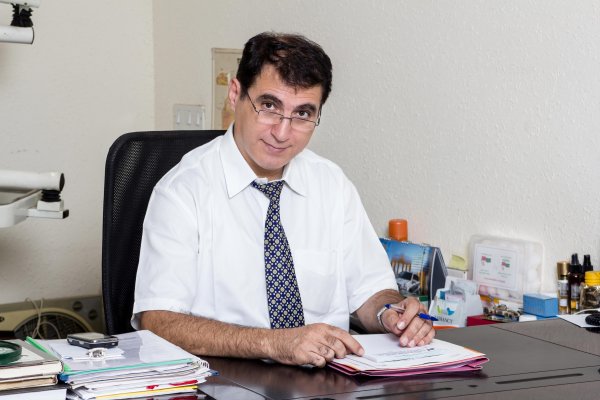
Dr AJ Ansari (52) Director, Pristine Medical Services

His commitment to running and reading helps this doctor juggle multiple activities.

A man with his finger in many pies, Dr AJ Ansari is also the President of the Classic Road Runner’s Athletic Club and MD-Chairman of Community House and Development (CHAD), an NGO. He even holds membership in various medical associations, and juggles a busy work day with multiple emails and responsibilities at the clinic. It is his exercise routine and spiritual quest that keeps him centred enough to power through his busy days.

“My day starts by 7.30 am and ends late — sometimes by midnight,” he says. But he doesn’t allow that to affect his essential rituals. As a child he would play football and basketball in Dubai, where he grew up. Later when he came to India for studies, he couldn’t join a sports club, but ensured that he was involved in some kind of sporting activity.

His running journey began a few years ago, when he participated in the Human Rights Day run organised by the Classic Road Runner’s Club. “I decided to become part of the club. We promote health through sports by conducting aerobics classes for people and continue to organise the Human Rights Day run.”

While he advocates sports to beat the stress of life, Dr Ansari is also a spiritual man. The divine texts of different religions are an important part of his morning. “I am a strong believer in God. Every morning I look for quotations from the holy writings. I have all of them. Each one has a kind of light which can guide you,” he believes. Late in the evening too, he finds solace in books, which help him “sleep better”.

It is these routines, that Dr Ansari follows without compromise, that streamline his life.

source: http://www.bangaloremirror.com / Bangalore Mirror / Home> Columns> Work / by Ayesha Tabassum, Bangalore Mirror Bureau / February 24th, 2014

Hamid Ansari calls for water conservation

New Delhi :

Vice President Hamid Ansari  on Monday said water scarcity was a developing crisis which needed to be addressed urgently. Ansari said desalination would become a major exercise in the not too distant future.

“We are facing a crisis situation. Why should we not look at desalinating water,” said the vice president, while releasing a book – Water, Peace, and War – by geostrategist Brahma Chellaney.

“A message needs to go to every family, every child that water is a scarce commodity which should not be wasted,” said Ansari.

source: http://www.timesofindia.indiatimes.com / The Times of India / Home> India / TNN / February 25th, 2014

Heritage marks this mosque

It reminds one of the oldest mosque in Kerala in Calicut, maybe even in India – a quiet nondescript house sitting serenely in one of the most crowded areas in Mangalore called Bunder. We had been searching for it and so understated was it that we were directed to two other mosques before we actually found it.

The Zeenath Baksh Mosque is thousand years old

Maybe we should have asked for Jumma Masjid for that is its other name. We went through bustling alleys and streets, most of whom had their own mosques, new ones with domes of different shades of glistening green domes and minarets.

Finally we reached Bunder. The street was lined with shops selling a plethora of goods ranging from groceries to bicycle parts. By sheer happenstance we asked a particular shop owner where this mosque was and he pointed next door to say” It’s here only”. Here? We were surprised as it seemed like just another house.

It is housed a little inside from the road. We were conspicuous by our presence, my friend and I, for there were hardly any women going in or out. A young man in a kurta pajama and white cap came forward and my friend asked if we could take a picture. He agreed instantly and asked if we would like to come inside. But he said, you will have to cover your heads. We agreed and he took us around , very patiently explaining to us its history.

He said that it was a thousand years old; Islam in Kanara dates back to the twelfth century, as it had become the regional center for thriving international trade with Africa and Arabia. There are purportedly letters from Cairo assumed to be from an Abraham Ben Yiju, a North African Jew who settled here for twenty years.

This was unlike the other fellow traders who came and went intermittently, but ultimately went back to their land of origin. These missives are part of the Genizah documents (so called because they were found in the Genizah which is the back room of a synagogue) prove the existence of trade between Africa and Arabia and India. Author Amitav Ghosh researched these scholarly documents for his story in his brilliant novel “In an Antique Land”.

In a similar fashion, Muslim Arab traders had a cordial relationship with the rulers of the western coastal belt of India. This is attested to also by the writing of Ibn Batuta, the intrepid North African traveller who passed through India in 1342 who estimates that the Muslims in this region amounted to 4000.

The Masjid Zaynath Baksh in Bunder is said to have been established in Mangalore in 644 A.D and was inaugurated in February 644 A.D.

In the seventeenth century, Tipu Sultan renovated the mosque adding beautifully carved rosewood pillars and also a carved ceiling. The mosque was renamed after his daughter Zeenat Baksh. The prayer hall is on a plinth with an open colonnade running around the building under heavy overhanging eaves. The renovation coexists in harmony with the older, more ancient structure.

Men were praying with quiet intensity, some standing with stretched hands and some were sitting and praying. I traced the curlicues  in the carved ornamentation of the pillars, standing solid and reassuring.

There is a pellucid ablution pool at the back and around the building is a cemetery.The façade of the mosque has green pillars supporting it.

Overall it gives the appearance of a dignified house of worship, providing a sacred sanctuary for both the dead and the living.

Maya Jayapal

source: http://www.deccanherald.com / Deccan Herald / Home> Supplements> Spectrum / by Maya Jayapal / February 25th, 2014

Muslim Co-op. Bank Polls : Mir Humayan team retains all 11 seats

 (sitting from left) Fiaz Pasha, Nisar Ahmed Khan, Team leader Mir Humayun, Dr. Abdul Ravoof, Dr. Muneer Ahmed; (standing) Meher Banu, Iftekahr Ahmed Khan, Rahmath Ulla Shariff, Abdul Rahman Shariff, Ahmed Saleem Ahmed and Nasreen Begum
(sitting from left) Fiaz Pasha, Nisar Ahmed Khan, Team leader Mir Humayun, Dr. Abdul Ravoof, Dr. Muneer Ahmed; (standing) Meher Banu, Iftekahr Ahmed Khan, Rahmath Ulla Shariff, Abdul Rahman Shariff, Ahmed Saleem Ahmed and Nasreen Begum

Mysore :

In the elections to the new Managing Committee of Muslim Co-operative Bank held on Sunday at Vidyavardhaka Law College on Sheshadri Iyer road here, the ruling group led by Mir Humayun, President, retained all the 11 seats.

The following were elected to the new Managing Committee of the Bank for a term of 5 years:

Dr. Abdul Ravoof (1,650 votes), Mir Humayun (1,517), Abdul Rahman Shariff (1,495), Fayaz Pasha (1,363), Dr. Muneer Ahmed (1,349), A. Saleem Ahmed (1,278), Nisar Ahmed Khan (1,179), Rahmathulla Shariff (1,122), Iftekhar Ahmed Khan (Backward Reserved-1,179), Nasreen Begum (Women Reserved-1,187) and Meher Banu (Women – 1143).

Out of 5,357 eligible voters, 2,340 members cast their votes at the polling held up to 4pm. The counting was taken up at 4.30 pm in the auditorium of Vidyavardhaka Law Collegeunder the supervision of Returning Officer V. Srinivas Murthy.

The newly-elected Directors of the bank were greeted by Incharge General Manager Md. Khaleelulla Shariff.

On the occasion, Mir Huma-yun garlanded Srinivas Murthy and Sub-Inspector of Police Shabbir Hussain, who supervised the bandobast at election venue along with Inspector Rajanna.

Roshan Baig, Minister for Information, Infrastructure and Haj, congratulated Humayun and his group over phone on their victory.

source: http://www.starofmysore.com / Star of Mysore / Home> General News / February 18th, 2014

The lone Indian doctor in Kandahar

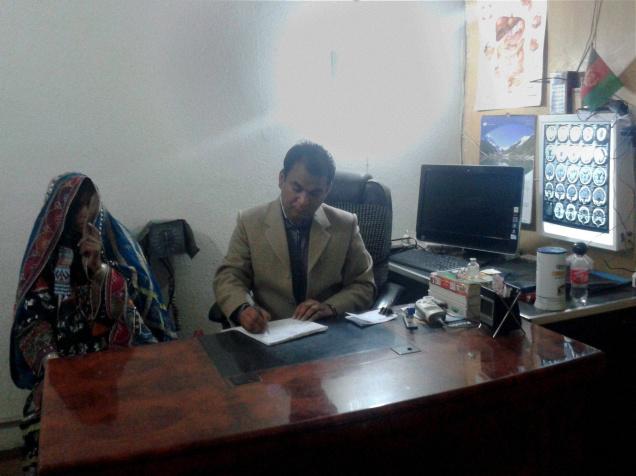
Doctor Shah Nawaz with a patient at a private hospital in Kandahar in Afghanistan.

Shah Nawaz says he is happy to serve the Afghan people

Set to complete a decade in the former power hub of the Taliban, Dr Shah Nawaz, the ‘lone Indian’ here, is happy to help the war-weary Afghan people with their medical needs.

Nawaz, 45, is a doctor working at a private hospital. Officials said Dr. Nawaz is the only Indian working in the city apart from a handful of staff at the Indian Consulate in Kandahar city.

Recalling his journey to Afghanistan, Dr. Nawaz said an Afghan businessman in the dry fruits trade had contacts with his family in India. The businessman often spoke to Dr. Nawaz of the plight of people in Kandahar and their health requirements.

“I then gave him a proposal to build a hospital. He (the businessman) was ready to invest and I expressed readiness to come to Afghanistan and serve the people,” Dr. Nawaz said.

“People here are very simple, their needs are very limited. Actually even basic treatment is not available,” said Nawaz, who hails from Maharashtra.

“I am here since August 2005. My family is not here. They are in Malaysia. I visit them twice or thrice a year and they come once a year to India,” he said. Dr. Nawaz said he was the only Indian working in the city but a number of his compatriots were employed in a huge U.S. military base in Kandahar. According to sources, Indians working at the U.S. base come through Dubai and are not registered with the Consulate.

India last week helped Afghanistan establish its first agriculture university here as part of a major capacity-building project to help the war-torn country increase farm output and attain economic independence.

The Afghan National Agricultural Sciences and Technology University (ANASTU) is coming up in the sprawling Tarnak farm in the former Taliban stronghold of Kandahar.

source: http://www.thehindu.com / The Hindu / Home> News /by PTI / Kandahar, February 24th, 2014

Short cut to a story

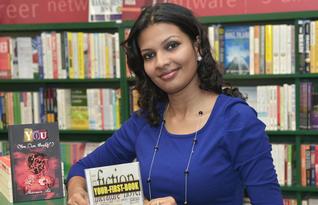
Seven principles of brain scienceSharmin used them / Photo: BHagya Prakash k. / The Hindu

Chat Sharmin Ali believes that 90 days is all it takes to write a book

She wrote her first book in less than a week and now wants to help other budding novelists do the same. Meet debut novelist, entrepreneur, public speaker, blogger, theatre artist and motivational speaker, Sharmin Ali whose debut novel Y.O.U(You Own Yourself), reflects the author’s determination to bring about a positive change in the lives her readers.

Yet this has not come easily to this multi-faceted, self-possessed young woman who believes in doing things differently, “I had a stammering problem as a child,” she admits adding that the first person whose life she transformed was herself.

An engineer by profession, Sharmin worked in the corporate field for several years before quitting to do theatre.

She went on to co-found a production house, Plain Ice Productions and then decided to write, “I’ve always wanted to write but didn’t know how to put my ideas across. So I started reading a lot of best-sellers and understanding why they worked. After reading 10 of them, I realized I could predict how the eleventh would work. That made it easier for me to write my own and I went ahead and wrote my first non-fiction book is less than a week,” she says.

Her experience with writing her own book made her realize that there was a need to share it with other budding writers, “There are so many out there and I wanted to create something that would make it easier for them,” she says.

This has lead to the creation of her latest product Your-First-Book.com, a formula on how to become a published author in less than 90 days. The CD of the program was launched at the Oxford Bookstore earlier this month.

The product hand holds a budding writer through the journey of writing and includes tips on how to start, how to position yourself, what to write about and how to get published,

“I’ve used the seven principles of Brain Science while creating this product. This will help you create your Magnum opus,” she says adding, “At the end of the day it is attitude not aptitude that matters. You need to just get up and start doing things.”

PREETI ZACHARIAH

source: http://www.thehindu.com / The Hindu / Home> Features> Metro Plus / by Preeti Zachariah / February 21st, 2014

Snapshots from the past

Mohammed Aquil (left) with his father Mohammed Abdul Latheef at Camera Crafts./ Photos: K.V. Srinivasan / The Hindu

Spanning nine decades, Camera Crafts in the city has been a witness to the evolution of the photo industry

An auto screeches to a halt. A man gets down and walks in carrying a camera. Many customers have already settled into the backless seats at the store, and more filter in with cameras. Mohammed Aquil is busy shuffling in and out of his workshop at the back. Such scenes have remained unchanged at Camera Crafts in Triplicane for many years now. But what hasn’t changed is how the store has continuously adapted itself to the evolution of the photo industry.

Mohammed Abdul Sattar set up a camera repair shop in Triplicane in 1925 since there was nothing of that sort anywhere in the vicinity. “We were among the first in the Presidency,” says Aquil, as he wipes lenses carefully and places them aside. “My grandfather was good with carpentry and so, we started manufacturing wooden field cameras soon,” says Aquil, beside whom is a model of an old wooden camera with adaptable zoom lens.

For studios

Aquil says that his grandfather had told him how most of Camera Crafts’ customers back then were studios or wealthy locals who wanted their cameras repaired. Another aspect that Aquil remembers is Sattar narrating how military personnel visited the store during World War II. “Apparently, we were the only shop here then, so my grandfather would tend to all their cameras as well.”

When Sattar passed away in 1969, Aquil’s father Mohammed Abdul Latheef took over the business — just after the era of wooden cameras and at the beginning of the mechanical era. In keeping with the store’s tradition, he manufactured enlargers, studio lights and single-bulb flashes.

“Before the era of digital prints, one would need an enlarger to zoom images, and so my dad was making those. At one point, my father manufactured about 40,000 single-bulb flashes for studios such as Choksi Brothers spread across the country,” he says. And when electrical flashes became the norm, Aquil’s father decided to create sockets in older cameras to fit flashes. “He made those pre-War cameras compatible with flash,” he says.

In 1988, Aquil himself joined the shop, after completing a degree in electrical engineering. “We had a factory right here, which we demolished in the late 1980s. We moved the shop to a small one-room setup in the street opposite and functioned out of there for some time. Now, we have stopped manufacturing machines or cameras, and stick to just servicing. A lot of studios, professional and wildlife photographers continue to come here since we have been around for long.” He does sell cameras but not too many. “I mostly sell professional models.”

Cameras of yore: At Camera Crafts / The Hindu

However, he does have a large collection of cameras. “So many cupboardfuls,” he laughs. “Maybe 500 or even more.” Among the old cameras in his collection are the wooden field cameras his grandfather made — Leica and Rolleiflex. “A lot of them are pre-War cameras. I’m trying to restore as many as possible,” he adds. “Recently, I sold six cameras to a tourist who was looking for antiques. I just opened the cupboard and asked her to pick whatever she wanted.”

Camera Crafts has no visiting card. “Whatever customer base I have built is purely through word-of-mouth,” he smiles. “You can see for yourself.” Sure enough, more customers walk up to the counter with cameras.

source: http://www.thehindu.com / The Hindu / Home> Features> MetroPlus / by Anusha Parthasarathy / Chennai – February 06th, 2014

Shah Rukh Khan meets former Mexican President

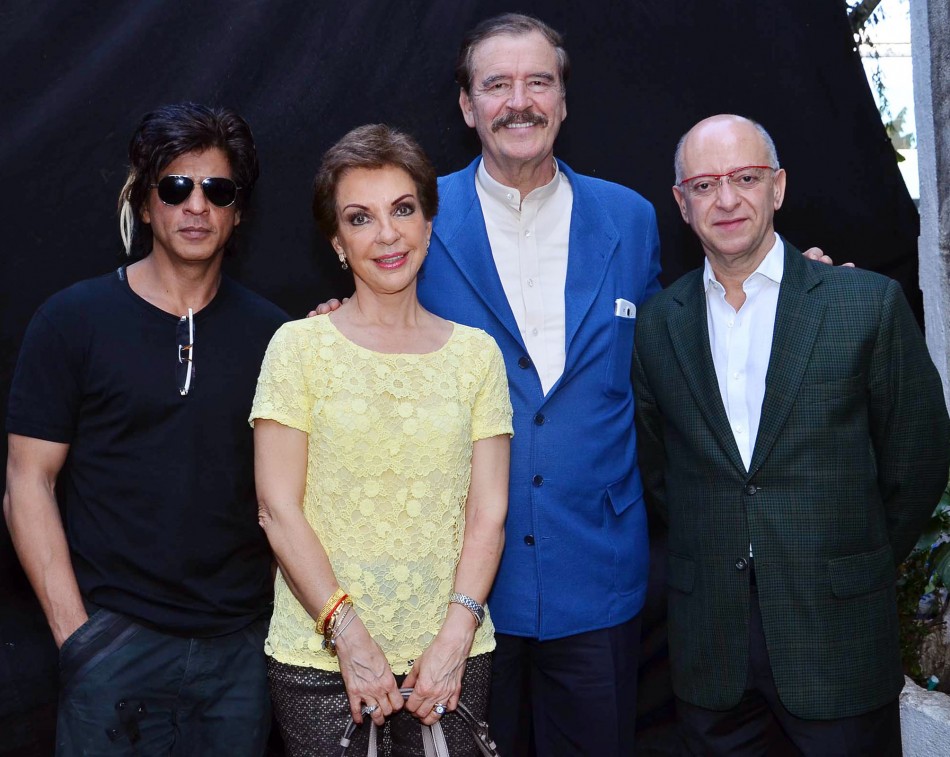
Shah Rukh Khan with Vicente Fox and Martha Fox.

Shah Rukh Khan and former Mexican President Vicente Fox met on the sets of Red Chillies Entertainment Pvt Ltd’s film ‘Happy New Year’ on Feb 11, which is currently being shot in RK Studios in Mumbai. Fox was accompanied by his wife, Martha Fox, and the current Mexican ambassador to India Jamie Nualart. They discussed everything from Bollywood films, to things about Mexico and the importance of education. 

About the meeting, Fox said, “We have been visiting many places, but meeting SRK and talking to him we feel he is a great person. The set is fabulous and the activity is just amazing. We hope that Mr Shah Rukh Khan would visit us at Mexico some day.” Well, no-one ever doubted SRK’s diplomatic skills!

source: http://www.timesofindia.indiatimes.com / The Times of India / Home> Entertainment> Hindi> Bollywood / by Reza Noorani, TNN / February 13th, 2014

In the rhythm of the beats

Nineteen-year old Hilal Aal, a second-year BBM student, started beat-boxing three years ago. It all happened when he came across a beat-boxing video on a social networking site that left him amazed. “I went ‘wow’ when I saw the performance and wanted to try my hand at it. I kept practising to improve myself. And now, I simply love beat-boxing,” says Hilal, adding, “I’ve learnt by trial and error.” Within three months, Hilal found himself battling it out at competitions. Recalling the first competition that he took part in at RV College of Engineering, Hilal says, “I came second and it was a confidence booster.” Hilal, who has no stage fear, goes on to add, “I’ve always been a social person and was a speaker and debator in school. So I’m at ease on stage.” 

HilalMPos20feb2014

Pointing out that beat-boxing was relatively new a couple of years ago, Hilal says that the performing art is picking up quickly. Explaining how he comes up with new beats each time, the artiste says, “I listen to a couple of songs and then merge them together. And what comes out is something totally new.” Hilal, who beat boxes at any time of the day or night, says, “I beat-box when I’m happy, sad or angry. Sometimes, I even beat-box in my sleep.”

Hilal, who started with dubstep beat-boxing and moved on to techno, house, progressive house and then hip-hop, says, “Music is my life. And I beat-box just for myself.” So who are his inspirations? “The art itself inspires me. But when I look at those proficient in the field, I get inspired all the more.”   Hilal has entered several competitions including the latest season of ‘India’s Got Talent’. “The best complement I received was from Malaika Arora Khan, who said that she hadn’t seen anyone as talented,” he says, adding, “I enter every competition for the experience. Many times I win and sometimes, I don’t. But it’s a great platform to learn.” He adds, “If I find someone better than me, I learn from him or her and if I find someone who I think can do better, I give them suggestions to improve.”

Explaining the challenges of beat-boxing, the youngster says, “Coming up with something new every time to keep the audience engaged is the biggest challenge. It’s always good to keep the audience guessing as to what the next beats will be.” He adds, “I have goofed up on stage sometimes but I’ve learnt to rectify them in time.” Hilal says that performing at events keeps him busy and at the same time allows him to be independent. “From the money I make, I’m able to pay my bills and buy what I want,” he informs. Although his parents were slightly apprehensive when he took to beat-boxing, he says that now, they are encouraging. “Even then, I haven’t made up my mind whether I want to take it up full-time,” he signs off.

source: http://www.deccanherald.com / Deccan Herald / Home> Supplements> MetroLife / by Vidya Iyengar / DHNS – February 20th, 2014

Rahul Dravid, Qamarul to receive honorary doctorate

Gulbarga University’s 32nd convocation will be held today

The former Indian cricket captain Rahul Dravid is among the 12 personalities who will receive honorary doctorate from Gulbarga University during the 32nd annual convocation to be held on the university campus here on Thursday.

Vice-Chancellor E.T. Puttaiah told presspersons here on Wednesday that the list included people ranging from educationists and politicians to social activists. They would be conferred Doctor of Laws and Doctor of Sciences.

The other persons who will receive the honorary doctorate are Union Minister of State for Micro, Small and Medium Enterprises K.H. Muniyappa; Municipal Administration and Waqf Minister Qamarul Islam; Rajyogini Brahmakumari Dadi Ratan Mohini; Sri Chennaveera Shivacharyaru of Samsthan Hiremath; Sri Shivanand Swamigalu of Siddalingeshwar Viraktamath; Dalit leader Shivaram Mogha; Editor of Agni Rajasekhar Hatagundi; secretary of the Hyderabad Karnataka Education Society Sharad Rampure, chairman of the New Horizon Educational Institution Mohan S. Manghnani; entrepreneur Krishnaji Kulkarni and contractor Dhareppa Uppar.

Defending the decision to confer the doctorate on so many people, Prof. Puttaiah said the university had received a total of 46 applications. The final list was selected by Governor H.R. Bhardwaj, who is also Chancellor of the university.

Prof. Puttaiah said that Ph.D and M. Phil would be awarded to 115 and 90 scholars respectively.

A total of 157 meritorious students who stood first in their respective courses would receive gold medals and cash prizes.

Sumita Pujari, a student of Doddappa Appa MBA Institute, topped the university by bagging eight gold medals and securing the first rank in MBA.

Hussain Basha came second by winning seven gold medals and securing the first rank in M.Sc. Mathematics.

Eminent scientist and Principal Scientific Advisor to the Union government R. Chidambaram will deliver the convocation address.

source: http://www. thehindu.com / The Hindu / Home> News> National> Karnataka / by  Special Correspondent / Gulbarga – February 20th, 2014