Makkal auto or people’s auto was launched in Chennai by social entrepreneur Manzoor Ali Khan. yesterday. The unique auto, meant for women only, includes an Android tablet enclosed in a steel casing which is water, tamper, and theft resistant.
The device acts as a fare calculator and is also equipped with GPS tracking, 3G data communication with a centralised call centre and a panic button in case of emergency. In addition, passengers can pay with their credit and debit cards.
source: http://www.punemirror.in / Pune Mirror / Home> News> Pune> Nation> Story / Thursday – February 13th, 2014
Fahadh & Nazriya say they are not sure if they will be seen together in a flick
Family is most important for Malayalam actor Fahadh Fazil, who got engaged to teenage sensation Nazriya Nazim recently. To a question if Nazriya will continue to act after marriage, Fahadh said, “My priority is family, but I have no issues if she acts.”
“She understands what I meant. I am not sure if we will act again together,” he added.
On their relationship, he pointed out that it was their families which took the inititaive which eventually led to their marriage. Nazriya also seems confident of her new life after marriage.
“I need no preparation for a new life as his family is similar to mine,” said Nazriya, who added that Fahadh is one of her favourite actors. Nazriya also denied media reports that she was a minor. “No, no, I am 19,” said the actress who began her career as a child artiste. And when asked if the age difference is going to be a problem, Fahadh said: “My parents too have a similar age difference and they are happily married for many years.” Fahadh is the son of legendary Malayalam film-maker Fazil, who launched many stars, including Mohanlal.
But strangely when the master director launched his son in 2001 in the film Kaiyethum Doorath, it miserably failed and many thought that the career of Fahadh in his debut film itself had reached a dead end. Fahadh, however, returned in 2009 to act in Kerala Cafe.
Then came an offbeat film Chappa Kurishu which clicked and since then he has had no reason to look back. Now, the actor is one of the most busiest actors in Malayalam.
source: http://www.bangaloremirror.com / Bangalore Mirror / Home> Entertainment> South Masala / by Agenices / February 11th, 2014
Meet architects Farah Ahmed and Dhaval Shellugar, who love to come up with out-of-the-box ideas
Farah Ahmed and Dhaval Shellugar are the people behind the Farah And Dhaval Design (FADD) Studio on St. Mark’s Road, which started in 2012. So, what’s new about them?
For starters, they like working with offbeat and natural material such as burnt rust cement or bricks. “Cement, when it is waxed, looks so gorgeous that you will be surprised that it is cement,” explains Dhaval.
He adds that he always had a passion for architecture. “My father was into automobile accessories. The products at his store always intrigued me and I would find myself creating something new with the material he had. Then, I decided that I had to study architecture at Rachana Sasand’s Academy of Architecture in Bombay, after which I worked with Sandeep Khosla.”
Farah, on the other hand, was an artist. She says she always had leanings towards design. She studied in the U.S. and the turning point came when “I was gifted a camera which drove me into photography. Strangely it was never about people, but more about landscape and forms and textures. I was so inspired by nature that I found myself always creating an abstract composition.”
The young architect started exhibiting her works and lived as an artist before she interned with Sandeep Khosla, where she met Dhaval and the duo decided to start FADD.
She went on to study at Istitutio Marangoni in Milan. “I feel interior designing is a different manifestation of the same kind of creativity that I used in my art work. The only difference is in architecture, the physical space becomes my canvas,” explains Farah.
Coming to their work they say that Indians are fascinated with new designs. And with the world becoming smaller, resources are always “at our disposal”.
Dhaval says one should also always keep a tab on global trends. “That way you will be in sync with the latest in the market. No, we do not have a signature style for that will just put us and our thinking in a box. It is more like playing with form and function and yet keeping it minimal.”
They talk about the challenges they face in their profession. According to Farah it is “changing people’s set notions about designs. They think if something is expensive then it is classy. That is not always true.”
Dhaval says for him the challenge was designing the florist shop, Flower Box in Indiranagar. “We wanted to create a special look for the flowers, which are so colourful by nature. So we had to create an intensive design that would not kill the beauty of the flowers. We studied Zen and Ikebana and other flower arrangements to come up with something unique for this store.” The duo used shades of white and grey and found that the “flowers simply pop out from the shaded backgrounds”. A Kerala houseboat designed for a business man in Goa is also close to their heart.
For more on the architects, log on to www.faddstudio.com or call 22223661.
This column features those who choose to veer of the beaten track.
SHILPA SEBASTIAN R.
People think if something is expensive then it is classy. That is not always true
source: http://www.thehindu.com / The Hindu / Home> Features> Metro Plus / by Shilpa Sebastian R. / February 12th, 2014
Jung tries to find a solution to any situation that the state government faces
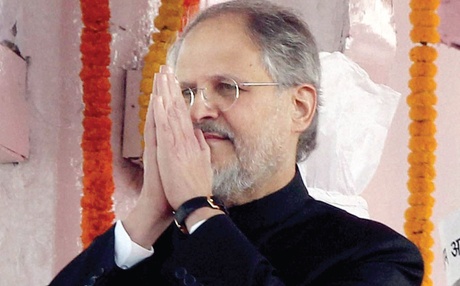
It is a battle of files between two former bureaucrats—one an ex-IAS officer and the other who quit the IRS. The former is the 19th Lieutenant Governor of Delhi, while the latter is its Chief Minister. The strategic warfare between the soft spoken, nattily dressed theatre loving Najib Jung and the hectoring, muffler sporting and drama obsessed Arvind Kejriwal has escalated to open warfare. Years after Jagmohan retired from in 1982 from the colonial era Raj Niwas in North Delhi’s leafy Civil Lines, no other occupant has become a major political player in Delhi like Jung.
The latest controversy is over the Lt Governor seeking Attorney General Mohan Parasharan’s opinion on the constitutionality of Kejriwal’s AAP government tabling the Jan Lok pal Bill, which the chief minister has promised to launch with much fanfare at Ramlila Maidan. AAP called Jung a “Congress agent.” Referring to the communication between Jung and Parasaran, AAP leader Ashutosh told media that when anything from AAP government goes to LG, parts of it become public via the media.
Because Delhi is a Union Territory, all bills tabled in Delhi assembly are by convention sent to the Home Ministry for approval before being tabled in the state assembly. The AAP led government doesn’t, however, agree. Media leaks exposed the opinion of the Solicitor General’s office that introducing a bill directly assembly would be ‘unconstitutional’. Ashutosh questions whether the “LG’s office is involved in the leak”.
“Just like you had sought the opinion of the Solicitor General, the Delhi government has also sought an opinion from three noted lawyers and a former chief justice. All these four experts are of the opinion that the union home ministry order is unconstitutional. Their names are: Justice Mukul Mudgal, Mr PV Kapoor, Mr KN Bhat and Mr Pinaki Mishra. After getting their opinion, the Delhi cabinet in its meeting on February 3, 2014, passed a resolution recommending that the home ministry should withdraw its order and till such time decided not to accept it,” said Kejriwal in a letter written to Jung.
However, Mishra and Mudgal denied being consulted.
AAP’s main worry is that clearance of the bill from the central government could take a long time, which the AAP can ill afford since it has promised to get the Janlokpal bill passed within fifteen days of coming to power; that deadline is already over.
Though Delhi’s Lieutenant Governor is appointed by the Centre, Jung’s background as an eminent academician and a prominent member of Delhi’s Muslim community is seen as a Congress attempt to woo both the minorities and its urban base.
In the ongoing saga between AAP and the UPA government, this is not the first time Jung is playing a key role in a political situation. Two weeks ago, he resorted to parantha diplomacy to dissuade a perennially coughing Arvind Kejriwal to end his wintry dharna outside Rail Bhawan demanding suspension of two policemen. Jung sent hot “parathas” to the chief minister through AAP leader Yogendra Yadav with the conciliatory offer that the cops would be sent on leave if the CM ended his protest. Kejriwal, aware that the Republic Day parade was approaching and in all likelihood would be evicted by the Indian Army, hastily accepted the offer as a face saving device. That round went to Jung.
The Delhi LG, not the person to be sitting behind the high aloof walls of LG’s office is known for his eye for detail. His nature of being particular and reading files comes from being a career bureaucrat. He is known to be approachable and actively engages in solving any impasse and ever ready to give a patient ear, to various delegations including those of Congress, BJP which visit him. Delhi CM Kejriwal too has had fairly long discussions on the Janlokpal bill with him.
When Delhi CM Kejriwal recently said that licenses of private power distribution companies would be cancelled if they resort to power cuts, Jung called Delhi Electricity Regulatory Commission (DERC) chief PD Sudhakar for a meeting. This shows his quality of not being a governor who is aloof, but a governor who actively engages and tries to find a solution to any situation or eventuality that the state government faces.
Seen as an official who goes by the rulebook, Jung had recommended President’s rule in Delhi with the assembly being kept in suspended animation after the assembly elections gave a hung verdict. The 62 year old Jung’s academic record shows that he is nobody’s unthinking lackey; the masters in history from Delhi University, and the MA from the London School of Economics in social policy and planning in developing countries earned by the Lieutenant Governor would give him the necessary perspective to handle tricky political situat ions with significant social overtones as in AAP’s case. The Bill controversy is just the beginning.
source: http://www.newindianexpress.com / The Sunday Standard / by Tarun Nangia – New Delhi / February 09th, 2014
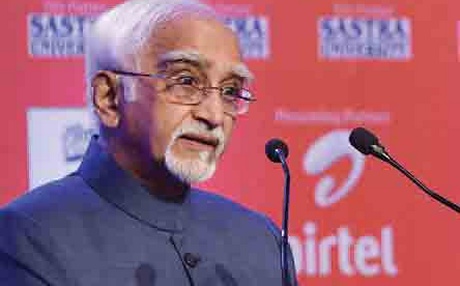
Echoing the concerns of various stakeholders at the valedictory function was Vice-President Mohd. Hamid Ansari. He pointed to the fact that India would have one of the youngest populations in the world in six years. “It is estimated that by 2020, the average Indian will be only 29 years of age, compared with 37 in China and US, 45 in Western Europe and 48,” he said at the concluding session of the ThinkEdu Conclave.
Hence, at the centre of all efforts to create a knowledge-based society should be provision of high quality relevant education for all at the primary, secondary and higher levels, including professional, technical and vocational education. Any shortcomings or failure in the effort could transform the potential ‘demographic dividend’ into a possible nightmare, of a ticking demographic time-bomb, with all its economic, social and economic consequences, he warned.
Posing three queries on the status of education in India, the vice-president quoted official reports highlighting the declining quality at all levels due to poor infrastructure, poor curricula and poor teacher and teaching quality. He saw far-reaching correctives in the sector, including introduction of holistic education, carried out in a time-bound manner as the only solution to the malady.
In the Vice-President’s view, holistic education drew its relevance from the need to address to challenges such globalisation, materialism, consumerism, commercialisation of education and other threats due to climate change, environmental degradation and terrorism. “It is essentially an education concerned with both individual freedom and social responsibility,” he said.
Ansari called for the cooperation and support of parents, guardians and community members to make the endeavour a success.
source: http://www.newindianexpress.com / The Sunday Standard / Home / by The Express News Service / February 02nd, 2014
Photo – Extreme Left -1) Sameena Jabeen Corporator . Photo -2) The dried branches of trees near Buddha Stupa which need to be pruned.
North: From Mahatma Gandhi Circle (front of Court) to Madhavarao Circle (Agrahara Circle) through M.G. Road (Vani Vilas Road).
East: From Madhavrao Circle to Basaweshwara road 11th cross through 101 Ganapathi Temple.
South: From Basaweshwara road 11th cross to Nanjumalige Circle through Hosabandikeri 1st cross. From Nanjumalige Circle to N.S. Road and Kantharaj Urs road junction and Jayanagar Under-bridge through Kantharaj Urs road.
West: From Jayanagar Under-bridge and Kantharaj Urs road junction to Mahatma Gandhi Circle (In front of Court) through K.R. Boulevard road.
by S. Kenneth Shishir
Ward 3 comprises areas — Lakshmipuram, Hosabandikeri, Nanjumalige and areas in front of city Court Complex — which consists of many apartments and commercial establishments.
Excluding Lakshmipuram, most of the roads in the Ward are congested, resulting in traffic jams and many of the roads also need to be asphalted.
Nanjumalige is mainly a market street. The street vendors should be provided space to carry out their business as they have encroached the footpaths and roads.
Most of the roads in the Ward need to be asphalted, storm water drains need to be cleared from blockages and trees need to be pruned.
Vani Vilas Market
Situated in Agrahara, the market that came up during the Maharaja’s reign, owing to exposure of the European ways of life, has outlived its utility and is not fit for occupation. The MCC has planned to demolish this market and construct a new building in its place with a parking lot to ease traffic congestion on the road.
Former Mayor Sandesh Swamy who had inspected the market had said that new facilities would be added including a parking lot and the new structure would retain the vintage look.
The main roads in the Ward are neat with footpaths laid using inter-locking tiles.
Some of the residents, speaking to SOM, said that, as such, they are not experiencing serious problems, but added that irregular supply of electricity and low pressure of drinking water supply were the main issues.
Storm water drain on Vani Vilas Road needs to be cleared as the drain is completely blocked near Siddappa Square.
Santosh Kumar Paul, a social worker told SOM that the “Ward cannot hope for any development as the Corporator is from BSR Congress party and getting funds were difficult. If only she was from Congress, funds would have been released for developmental works,” he added. He further said that many developmental works like widening of roads, installation of new street lights, renovation of Vani Vilas Market, asphalting of roads etc. should be taken up.
Lakshminarayan, a two-wheeler mechanic said that the authorities, after providing good roads, should also maintain it properly. He said that dried branches of trees should be removed, trees should be pruned and debris on road sides be cleared.
Many residents of the Ward, especially in Hosabandikeri, said that garbage is not cleared regularly, there is no pressure in water being supplied and there are cases of frequent blockages of drainages. Also the parks need maintenance with installation of slide, swings, see-saw, etc.
When these issues were brought to the notice of Corporator Sameena Jabeen, she said that JUSCO had laid pipelines to supply 24×7 water supply to the residences of the Ward about five months back and had installed water meters to the houses.
She said that water is being supplied to major portion of the Ward through this pipeline where the pressure is good and the same will be completed in other parts of the Ward soon. Regarding irregular garbage clearance, Sameena said that the public has been provided with phone numbers so to complain such irregularities and only then can action be taken against erring officials.
She further said that grants are awaited for taking up road and drainage repair works and added that a proposal had been given to install a statue of late Srikanta Datta Wadiyar in Manuvana Park during the last Council meeting which is awaiting approval.
Corporator Sameena Jabeen can be contacted on Mob: 93421-25591.
source: http://www.starofmysore.com / Star of Mysore / Home> Feature Articles / February 05th, 2014
Young pacer Javed Khan has been included in the Delhi squad for their final Ranji Trophy group league encounter against Karnataka at the Feroze Shah Kotla ground from Monday.
Javed, who was a part of the U-25 squad has replaced an injured Parvinder Awana, who sustained a back injury during the last match against Punjab. Left-arm seamer Pawan Suyal has been dropped as burly left-arm spinner Manan Sharma comes into the side.
Manan and Varoon Sood will be the two spinning options apart from Virender Sehwag and Mithun Manhas who can bowl off-breaks. Meanwhile, the anti faction of the DDCA led by Bishan Singh Bedi, Madan Lal, Kirti Azad and Surinder Khanna will be sitting on a dharna infront of the Kotla on Monday, to protest against the proxy system run by the DDCA.
Shami was the star of the Indian bowling in the second innings of the recently-concluded first Test against New Zealand here, which ended in a 40-run defeat for the visitors | PTI
In five Tests since his debut against the West Indies in November 2013, Mohammad Shami has shown complete control of line and length and while the rest of the Indian bowlers have been faltering in the ongoing tour of New Zealand, he is fast emerging as the bowling spearhead.
Shami was the star of the Indian bowling in the second innings of the recently-concluded first Test against New Zealand here, which ended in a 40-run defeat for the visitors.
But Shami made an impression taking three for 37, rattling the top-order of the Black Caps in the second innings, and set his team on a comeback path in the match after their first-innings performance had more or less closed that door.
At the start of play on day one, he bowled with fire, using the bounce in the Eden Park pitch to good effect. During the ODI series, skipper Mahendra Singh Dhoni had impressed upon the ‘need to aim the bouncers well’. And Shami did so, making both Peter Fulton and Hamish Rutherford jump around.
He should have picked up more wickets than the one he did in the first innings. But throughout that innings, he beat the bat regularly and was the toughest Indian bowler on display in best batting conditions.
Even as Brendon McCullum hit a double hundred and the Kiwis crossed the 500-run mark, it goes to show that among the four frontline bowlers deployed by Dhoni, Shami was the only one not to concede 100 runs.
More so, considering that he gave runs at only 3.39 per over, in his complete spell of 1-95 in 28 overs. In comparison, Zaheer Khan (2-132 in 30 overs) gave away runs at 4.40 per over, Ravindra Jadeja (1-120 in 26 overs) at 4.61 per over and despite his six-wicket haul, Ishant Sharma (6-134 in 33.4 overs) went at 3.98 per over.
At the end of the first innings, McCullum pointed out that “some days you just cannot get wickets. Shami bowled very well and didn’t get the rewards”.
The New Zealand skipper had talked about Ishant as well, given his superior wicket-tally. But it was obvious that the seamer had bowled shorter lengths throughout.
Dhoni stressed that the Indian bowling in the first innings had been very poor.
“We gave away too many deliveries to score off (as a bowling unit),” he had said.
But the captain was all praise for Shami, saying, “In the first innings, he was very consistent and did not give too many runs, (even when he wasn’t getting any wickets). He will have to make sure that it becomes part of his bowling and he does not try too many things when he is not getting wickets.
“Cricket seems easy when you are getting runs and wickets but those tough periods are the ones where you have to put in all your learning, whatever you have learned so far.”
Shami was handed the new ball first, rather than Zaheer at the start of the Test and then again in the second innings.
It could have been coincidence, since the Indian captain likes to play around with bowlers from different ends. But then, there was this moment on day one, 10 minutes before lunch,when New Zealand were reeling at three wickets down for less than 50 runs on board.
India were looking to press on their advantage and Dhoni made a bowling change. Zaheer came in from his fielding position, looking for the ball, but was sent back. And Shami was the captain’s choice.
In five Tests since his debut, Shami has taken 21 wickets. Out of these, he has bowled batsmen 13 times and has another three successful LBW appeals. It hints at a control of line and length that is sometimes found lacking in other bowlers like Ishant, who despite his nine-wicket haul in this first Test is yet to achieve the consistency of a bowler who has played 54 Tests for India.
“In the sub-continent, if you can bowl quick, you know two bouncers and an over-pitched delivery can get you a wicket. At some international venues, this won’t really work. Shami is someone who keeps his line and length really close to the batsmen. His seam positioning is really good and he can bowl quick as well. Now, as he plays more matches, he is learning other ways to get batsmen out,” said Dhoni of his new pace spearhead.
source: http://www.newindianexpress.com / The New Indian Express / Home> Cricket> News / by Chetan Narula / PTI – Auckland / February 10th, 2014
Indian business leader, scientist and philanthropist Dr Yusuf Hamied on Monday announced a major financial donation to the Royal Society of Chemistry, the world’s leading chemistry community, to support an innovative chemistry education programme for school students in India.
Dr Hamied, who is the chairperson of the generic pharmaceuticals company Cipla and has pioneered the model of producing affordable medicines for patients in developing countries, is donating Rs eight crore to the Royal Society of Chemistry’s Hamied Inspirational Chemistry Programme.
The programme will be managed by the Royal Society of Chemistry in partnership with the UK’s Salters Institute and leading Indian academic institutes to enhance the skills and knowledge of Indian chemistry teachers and inspire students to study chemistry at university.
Over the next five years, the programme aims to equip 8,000 teachers across India with the specialist knowledge and skills to deliver exciting and engaging chemistry lessons, and to pass this knowledge on to their colleagues. It will also provide 1,600 of the brightest chemistry students from all backgrounds with places at chemistry camps to motivate them to reach the necessary standards to study chemistry at university.
Dr Hamied said: “I am very pleased to be working in partnership with the Royal Society of Chemistry to support the Hamied Inspirational Chemistry Programme. I believe the programme will make a real difference to the education and experience of students studying chemistry in schools across India.”
Chief Executive of the Royal Society of Chemistry, Dr Robert Parker, said: “We are delighted to be working with Dr Hamied and grateful for his generous donation to enable us bring together leading organisations from the UK and India to deliver this education programme and make a real impact.” Dr Hamied added: “To inspire the next generation of great Indian scientists we must equip our teachers with the specialist knowledge and practical skills they need to show their students that chemistry is a fascinating.”
Just as teachers pass on their knowledge to their pupils, the programme will support the most talented chemistry teachers in India to train their colleagues to deliver informative and exciting chemistry lessons – a “train the trainer” approach. I am very pleased to support this sustainable model for teacher training which will allow the programme to reach thousands of teachers across the country.” Dr Hamied said: “An inspiring chemistry education isn’t just about excellent teachers.
We need to encourage and motivate the best students to achieve the knowledge and skills they need to go on to study chemistry at university and eventually, to make a strong contribution to India’s success. This isn’t just about getting the best grades – we also need students to develop problem-solving and interdisciplinary skills. That is why I am also very pleased that this joint initiative will support the best students – particularly those from disadvantaged backgrounds – to take part in chemistry camps at leading academic institutions and experience a true taste of chemistry at university.”
Dr Simon Campbell, former president of the Royal Society of Chemistry and personal friend of Dr Hamied, said: “This unique programme is a significant educational investment with great potential to train the skilled chemists that will be vital for India’s growth and social wellbeing.”
source: http://www.deccanherald.com / Deccan Herald / Home> State / Bangalore – DHNS / February 10th, 2014