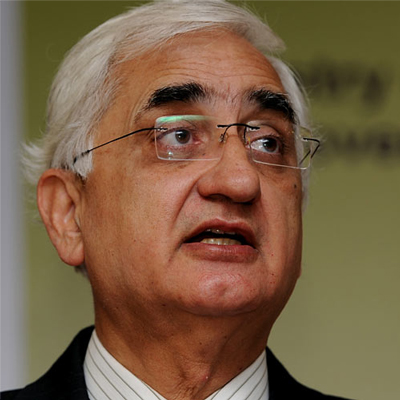
Observing that disparities between the rich and the poor are growing, External Affairs Minister Salman Khurshid today pitched for a new global awakening and a means to meet the needs of the poorest “effectively and adequately”.
“We are living in a complex world where disparities between the rich and the poor, as just being told, are wide and continue to grow. The world population continues to grow and increase globally,” he said during the inaugaral address of the Delhi Sustainable Development Summit.
“Consequently, the needs also grow exponentially. We, therefore, need a new global awakening to be able to deal with disparities and means by which the needs of the poorest can be met effectively and adequately,” Khurshid said.
He said this was not just a political imperative, as has been reminded due to important and dramatic changes taking place in several countries of the world, but also a moral obligation. He asked the global community to take urgent steps to anticipate future challenges and start dealing with them right away in the wake of growing problems of energy, water and food.
“Problems of energy, water and food are likely to become more acute over time unless we take urgent steps globally to anticipate future challenges in this regard and start dealing with them right away,” Khurshid said. He said while large number of people in this world do not have access to electricity, there are others who are living under the shadow of water shortages, hunger and malnutrition.
“Continuation of these conditions will lead to global tensions and threats to lasting peace. The global community and international organisations in particular have to be at the forefront of efforts — to change directions if need be — and take such initiatives as are required to solve these problems,” Khurshid said. He said India has placed great emphasis on food, water and energy and no global efforts to live in peace together will be possible unless we ensure sustainable development.
source: http://www.dnaindia.com / DNA / Home> India / Thursday – February 06th, 2014
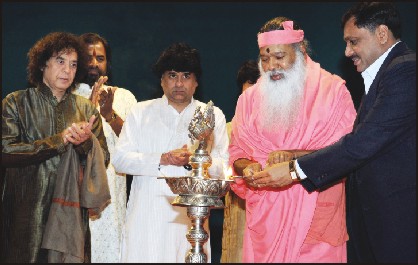
City Police Commissioner Dr. M.A. Saleem and Sri Ganapathy Sachchidananda Swamiji are seen lighting the lamp to inaugurate the music concert as Tabla Maestro Zakir Hussain and other artistes look on.
Mysore :
The audience at Nada Mantapa at the premises of Ganapathi Sachchidananda Ashram on Ooty Road here were mesmerised by the Tabla recital of Ustad Zakir Hussain last evening.
The Tabla maestro was accompanied by Ganesh and Kumaresh on Violin and Trichty Harikumar on Mridanga. The synchronisation of the awesome quartet was so perfect and rhythmic, the music lovers remained spellbound throughout the programme which featured both Hindustani and Karnatak classical music.
Sri Ganapathy Sachchidananda Swamiji graced the occasion. City Police Commissioner Dr. M.A. Saleem and others were present on the occasion.
source: http://www.starofmysore.com / Star of Mysore / Home> General News /January 31st, 2014
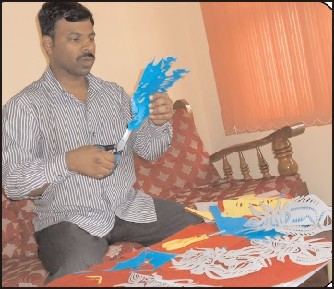
Mysore Art Gallery and Saanjhi Kala Loka have jointly organised a three-day workshop and exhibition on ‘Sanjhi Mask Art’ by artist S.F. Huseni (Mysore Huseini) at Mysore Art Gallery premises on Ramanuja road in city from tomorrow.
The programme will be inaugurated tomorrow by D. Mahadevappa, Chief Editor of ‘Prajanudi’ at 11 am.
Nirmala Matapati, Assistant Director, Dept. of Kannada and Culture and Littereteur P.M. Subramanya will be the chief guests.
A workshop and training programme on Sanjhi art will be held on Feb. 2 and those interested may register their names through Mob: 98451-53277.
The exhibition and the workshop will conclude on Feb. 3.
Artist’s Profile
S.F. Huseni (Syed Fakruddin Huseni), was born on April 15, 1976 to Syed Peer and Zeenatunnisa Bi at Shivana Samudram (Bluff) in Mandya district.
He completed his Diploma in Fine Arts, Art Master (A.M) and BFA in painting at K.P.J. Prabhu Artisan’s Training Centre (Canara Bank PRJD Trust).
Huseni, who is gifted with this art, received encouragement from his parents right from his study time. The present theme of paintings created by the artist mainly depict the theme “Home in every Heart.”
Huseni has participated in many solo exhibitions and group exhibitions besides conducting camps and is a recipient of various State Awards and scholarships. For details, log on to mysorehuseini.blogspot.com or call Mob: 98451-53277.
source: http://www.starofmysore.com / Star of Mysore / Home> General News / January 31st, 2014
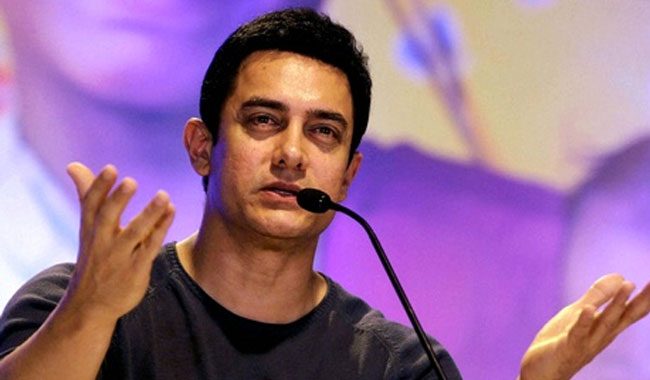
Superstar Aamir Khan has lent his support to end the violence against women in the global `One Billion Rising` campaign.
In the global campaign, supporters join together to show collective strength to support gender equality and end violence against women. India too has joined in as the instances of rape and brutality in the society today are increasing every year.
Aamir Khan, who has been an active crusader for social causes, has urged people to join hands in support for the campaign. The first episode of the popular television show `Satyameva Jayate` was focussed on female infanticide.
For `One Billion Rising`, the Padma Bhushan Awardee has made a video message to urge his fans to come and join the global movement.
In the video Aamir says, “I believe that to combat violence against women, we men, will first have to change. Raising our hand to strike a woman does not increase our masculinity. Instead, it shows cowardice. If we truly want to be real men, I feel, we will have to first learn to be sensitive. This year, in February, a billion voices will rise again to end violence against women across the world. I would like if you join in and become a part of this movement.”
Last year several celebrities came up to lend a hand to the cause such as Shubha Mudgal, Farhan Akhtar, Anushka Shankar, Shabana Azmi. The ghastly act of the gang rape of Jyoti Singh on 16th December 2012, in Delhi brought forward many supporters for the dance demonstration at Parliament Street in the national capital, New Delhi.
In 2014, Actress Gul Panag has also joined in for the cause along with several NGOs from across the country.
source: http://www.zeenews.india.com / Z News / Home> Entertainment> Society / by Aparna Mudi / Thursday – February 06th, 2014
To assuage the sentiments of Muslims in the wake of Muzaffarnagar riots, the Uttar Pradesh government on Friday elevated three ministers of state from the community to the Cabinet rank and also inducted a new Muslim face in the ministry.
Those elevated to the Cabinet rank today are Mehboob Ali, Iqbal Mehmood and Shahid Manzoor. Yasir Ali was sworn in as a minister of state by Governor BL Joshi. Ali is the son of Waqar Ahmed Shah, who was ailing for the past several months and was relieved of his labour portfolio.
The expansion of the 21-month-old Akhilesh Yadav ministry came ahead of the upcoming Lok Sabha elections.
Shivakant Ojha, who could not be present during the last reshuffle on January 18 as he was abroad, was today elevated as a cabinet minister.
The swearing in function was held in Raj Bhawan here.
With this, the strength of the ministry has risen to 60 — 27 cabinet, including the chief minister, and 33 ministers of state.
This is the sixth Cabinet expansion since Samajwadi Party came to power in March 2012.
The exercises is understood to have been taken in the wake of ruling SP facing flak in the aftermath of riots in Muzaffarnagar and Shamli districts last year, in which over 60 persons were killed. Many victims, who had fled their homes are still languishing in relief camps.
PTI
source: http://www.zeenews.india.com / Z News / Home> State News> Uttar Pradesh / by PTI / Friday – January 24th, 2014
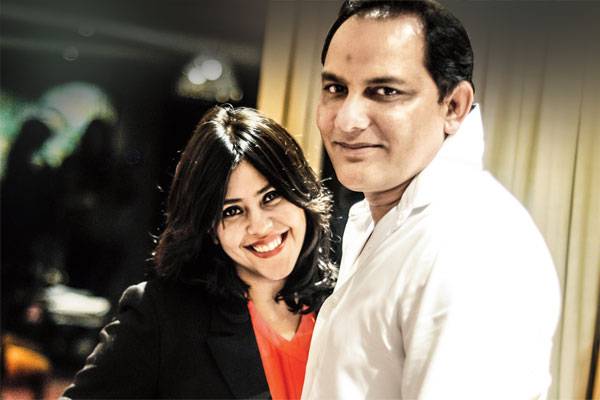
Mohammed Azharuddin has turned 50. He lost his grandfather, the man he loved the most on November 17, 1984. Azhar debuted on December 31, 1984, scoring three centuries. In his 17- year cricketing career, he was captain for nine years. A life ban on playing cricket, divorce with his wife Naureen , second marriage and separation from Sangeeta Bijlani, losing a 19-year-old son to a road accident — he has seen it all.
(Ekta Kapoor and Mohammed…)
In the words of Ekta Kapoor , who has now bought the rights of making a film on his life, he is a Victim and a Victor who has emerged victorious. He had led a glorious life, but one that was never picture- perfect. He is humble, emotionally strong and very stylish. Bombay Times spoke exclusively to both about their reasons for making and agreeing to this film on one of India’s greatest cricketing icons. Excerpts:
In conversation with Ekta Kapoor:There are several cricketing legends. Why a film based on Azharuddin?
My dad is an obsessive cricketing fan and for him, Azhar sir is a cricketing god. My dad has shifted his interest in the construction business and is usually not interested in any of the movies I have made. But, he is jumping for this movie. Like my mother, Azhar sir, too, is an Aquarian and number 8. She too likes him, does not cry and is strong for everybody around her. He has been the captain all his life, be it on the field or off it. Some people are victims and some are victors, but those who are victorious have their collar up like he always does.
You can make a documentary on 100 cricketers. But that is only one level of the film. I remember I was 26 when I was awarded the Ernst & Young award for being the youngest and the first woman to be given the award. But four days after, I was told that the award could not be given to me as my TRPs were fake. No one really takes you to a courtroom as in the minds of people, they want to believe that you are wrong. Eventually, it got proved that I was right when Rahul Bajaj called me and gave me the award. I have never enjoyed picking up an award more than that, sitting amongst such old men. At the same time, on the day I was being given the award, due to a personal issue that morning, my happiness was diluted. And that’s what happens in life too, where life is not picture perfect. And I am here to tell his story.
Here is a man who has been condemned but has stood up. Some people wear age on their face, some wear experience. He wears his experience. I had decided that I will just pick up the phone and tell him that we want to present your life. It’s a life with a lot of blemishes, a lot of colour. The best thing about his life is that it is not picture-perfect as one thing was always missing. For instance, he played only 99 matches, not 100. I am not a cricket fan. I am a fan of the man. People have pushed him down, but he stood up and walked and at 50, stands tall. He is an icon whose story needs to be told.
In conversation with Mohammed Azharuddin:You are 50. Are you excited about a film being made on your life?
I am happy. I was very reluctant and took one year to agree. I realised that people want to know my story. I have gone through a lot of ups and downs and a lot of hardwork. The biggest thing I possess is infinite patience. Once you are patient, things fall in place. During that period of time, I could have said so many things that would have backfired on me. But I didn’t, only due to my patience. At the end of the day, it took a long time but you can’t fight destiny. Whatever is destined to happen will happen. I am excited to see how the film will be made. There are many struggles that I have forgotten, but the film will probably remind me of those. I am a positive person and the story is finally a positive one.
Where do you get your patience from?
My religion. Allah is with people who show patience. If you are down in the dumps, Allah will help you if you have belief. But this is a personal thing between you and him. You can’t fool Allah. I remember after I scored my three 100s in my first match, this photographer saw me praying and wanted to take pictures. I was reluctant, but allowed him to. He came the next day and wanted to take them again as he said that despite him taking so many pictures, his reel was blank.
Why do you always have your collar standing?
I used to always field at silly point or point, where the rays of the sun were always very strong and my neck would burn. So, I started wearing a handkerchief, but it was uncomfortable. I later moved to collar that has now become my style. People like me this way.
What do you consider your strengths?
My strength is my humility. When you are humble, people like you. I feel happy when people tell me, ‘Sir, you should play now also.’ I know I can’t physically. I keep myself fit. Somebody today tells me, ‘Why don’t you go and play in New Zealand?’ They know I can’t play, but it’s their feeling that makes them say that. I have always been strong and never show my emotions. I will be the last person to come and say, ‘Well done.’ Number 8 is an up-and-down number, When you are up, nobody can touch you, but when you are down, everybody pulls you down. Emotionally, I depend only on myself. My strong belief in the Almighty carries me.
What do you think are the qualities the actor who will play you should possess?
He needs to be stylish. People tell me that my game was very stylish. I learnt to be stylish over time. Allah gave me the talent. I showed it on the field. Saif Ali Khan, due to his cricketing background and style, would be my first choice, but Ekta is the boss and will decide.
Do you watch Hindi movies?
My favourite movie is Abhimaan as my favourite actor Mr Amitabh Bachchan was in it. The only time my mum lifted her hand at me was when she caught me listening to Sholay dialogues by the roadside. That is the only time she beat me. Long back, I told Mr Bachchan that, ‘Sir, because of you I got beaten.’ Nobody can touch Mr Bachchan in style.
You never showed your emotion on the field. Have you ever broken down in life?
I broke down only when I lost my grandfather Mir Vajehuddin (nana). I was 21 then and it was November 17, 1984. I debuted a month later on December 31 and made three 100s. Till his last day when he died of a heart attack, I would sleep in between my nana and nani. He was a very pious man, who was a descendent of Prophet Mohammed’s family, so he belonged to his lineage. I can always feel him next to me. At times, I was not even allowed to watch films when I was growing up as he would say, ‘No, this is not your line.’ I would get frustrated. I would tell him, ‘You let everybody go, but don’t let me go.’ And he would say, ‘You will remember me one day.’ Can you imagine that the autograph I sign was taught to me by him. He signed for me and would make me practise it 50-60 times a day. He was a brilliant mathematician, who could count in Arabic and Persian and give the answer in English. He taught me a lot of things. He said, ‘Stay humble as that is the best thing you can possess in life. The day you think you are somebody, you will come down.’ You couldn’t talk to him looking into his eyes, as he had very powerful eyes. He would never look into a camera as he would say that the camera would break if he did so.
He never told me but he told my mother, ‘Don’t tell him but he will become a big cricketer’ My parents too were very supportive of me playing. My father had only one wish that I should score a 100 at the Lords cricket ground, which made him very happy when I did. I would get up at 4.30 in the morning and before going to practice, I would give my grandmother tea. At that time, she would give me her blessings, which were very powerful. I am the eldest son (five younger siblings) and it is my job to play captain even at home. I never show my emotions. When my son passed away, so many times I felt like crying, but then there are so many people behind me, like my parents. If I break down. they will break down and I need to carry them with me. My mother even today keeps telling me, ‘Allah should have taken me.’ It was very tough for them as within a week, they had lost two grandchildren.
Talk about your relationship with Kapil Dev?
Kapil paji is a very nice man. He understands people. He could take anything from my kit bag and so could I. We did not need to ask each other. Usually people don’t give even their broken bats to you. You have to a have a big heart to give. If you give, you get. If you don’t give, you don’t get. I had that rapport with him. I played under him and he played under me. As a captain, I didn’t need to tell him anything as he knew everything exactly what he had to do. I would just give him the ball. I knew he knew his job and if he goes on to the field, he will do his job. I learnt from him. If he is convinced, he will support you. Mr Kamal Morarka and Mr Raj Singh Dungarpur also helped me. I didn’t meet Mr Morarka many times, but at that time he really supported me. He is a nice person who is not scared of anybody. That’s what is most important. He will express what he feels. I never forget people who help me.
source: http://www.timesofindia.indiatimes.com / The Times of India / Home> Entertainment> Hindi> Bollywood / by Priya Gupta, TNN / January 31st, 2014
Most of the world’s disabled live in the global south. This is why India and other Brics nations must ensure their policies are both inclusive and accessible
Abidi says companies should not equate disability with corporate social responsibility.
Born with congenital spina bifida, a developmental disorder, Javed Abidi has traversed the world on a wheelchair, advocating the rights of the disabled.
Considered a pioneer of the cross-disability movement in India, he was instrumental in the drafting and passage of The Persons with Disabilities (Equal Opportunities, Protection of Rights and Full Participation) Act, 1995, and in the setting up of the National Centre for Promotion of Employment for Disabled People in 1996. He has been its director since 1997. In October 2011, he was appointed world chair of Disabled People’s International (DPI), a global organization working for the rights of people living with disabilities.
In July, Abidi also took over as the vice-chair of the International Disability Alliance, a global alliance working for disability causes. In his new role, he stresses that disability movements must focus on the global south (which includes India), for this is where nearly 800 million of the world’s one billion people with disabilities live. Edited excerpts from an email interview:
As the world chair of Disabled People’s International, what are your priorities?
The dynamics of the disability rights movement are going through tremendous churning at this point. In 2011, the World Health Organization (WHO) said one billion, or 15% of the world’s population, live with a disability. Of this, as many as 80%, or 800 million, live in countries of the global south. People with disabilities also comprise 20% of the world’s poorest. Yet the leadership and the mechanisms that shape policies that affect the lives of this 80% are controlled by people from the developed world, who have absolutely no idea what it means to be a person with disability—to not even have a wheelchair, to not even have a hearing aid, to live in abject poverty, etc. My biggest priority as of now is to remind the world, again and again, of this fact.
What is the DPI’s agenda for the UN general assembly’s high-level meeting on disability and development in September in New York?
In the past decade or so, it has by and large been established that disability is a cross-cutting human rights issue. But what the DPI and other global bodies are now trying to underline is that disability is also a developmental issue. Our first endeavour is to ensure that the respective governments send the highest level of delegations to this meeting. The DPI has also raised the demand for a global forum on disability and development—a platform for all stakeholders on the sidelines of the high-level meeting, along with a strong outcome document.
Most importantly, the DPI will try for a sizeable representation from the global south—from Asia, Africa, Latin America, Caribbean—to ensure that their disability and development agenda is not hijacked by people who have very different realities from ours.
How can workplaces in India be made disabled-friendly? What are the challenges, and how can they be met?
Companies that are serious and committed to being disabled-friendly will have to look at it as a policy issue at the highest level. Inclusivity is not just employing people with disabilities. It encompasses making all your facilities and systems accessible. Most companies approach this wrong and equate disability with corporate social responsibility. They first employ people with disabilities and then make their workplaces disabled-friendly. Very soon, India will have a strong anti-discrimination law on disability. Everyone will have no choice but to fall in line. It is up to the employers to decide if they want to be a role model or be forced to comply.
Post-2015, when the world prepares for a new development framework after the UN’s Millennium Development Goals (MDGs), where do you see the disability movement going?
I think that in the past couple of years, development practitioners have become more aware of disability. The challenge is to translate this awareness into action and tangibles. Apprehensions are that disability will again be overlooked. Policymakers and decision makers do not seem to grasp the obvious connection between disability and human rights and development issues. For instance, if you talk about conflict and wars, disability has a direct and significant correlation to it. The same holds true for disability and natural disasters; disability and situations of humanitarian risks; disability and the effects of climate change, and so on.
The task at hand, especially for grass-roots organizations such as the DPI, is to ensure that we keep reminding the people who matter about us.
In what ways can India shape the global disability agenda?
If we go by the 15% theory of WHO, India would be home to more than 150 million people with disabilities, and some of these are the poorest and most vulnerable people on this planet. India’s policy on disability, hence, will have a significant impact on not only the region but also the world. With the new economic dynamics and the power balance shifting towards developing economies such as India and the other Brics nations—Brazil, Russia, China and South Africa, it is imperative that their development policies are inclusive and accessible to disabled people. India should lead here by looking at reforms to advance disability rights, raising the issue at the UN and other bilateral and multilateral platforms. The nations of the global south, especially the Brics countries, are somewhat disillusioned by the MDGs and will therefore be critical to the post-2015 process.
What are the key hurdles in India’s disability movement and how can they be met?
The biggest challenge is to get the attention of policymakers and decision makers to put disability on the agenda and to convert the attention into political will. India made a grave mistake during the formative years, because of which our schools, colleges, universities and public infrastructure continue to be inaccessible to people with disabilities. Rather than rectifying those errors, we are continuing to build more barriers. In a budget analysis done by us, we found that in the Union budgets since 2008, India spends only 0.009% of its GDP on disability! A strong anti-discrimination law with punitive measures is also needed to ensure equal participation of people with disabilities.
What difference are you going to make for the movement in South Asia, especially since you are an Indian?
The MDG Report of 2012 says that by 2015, four out every five people living on less than $1.25 (aroundRs.70) a day will be in South Asia. It is anybody’s guess as to how many of them will be people with disabilities, given the vicious cycle of poverty and disability. My immediate aim is to build a strong cross-disability network in South Asia to highlight these issues. We have already started this process and some progress has been made.
As a major development aid donor, India also needs to rethink its “no-strings attached” south-south cooperation policy. A democracy cannot possibly fund projects that violate the human rights of people with disabilities by creating barriers for them.
source: http://www.livemint.com / Live Mint & The Wall Street Journal / Home> Lounge> Business of Life> Indulge / by Pallavi Singh / Sunday – April 28th, 2013
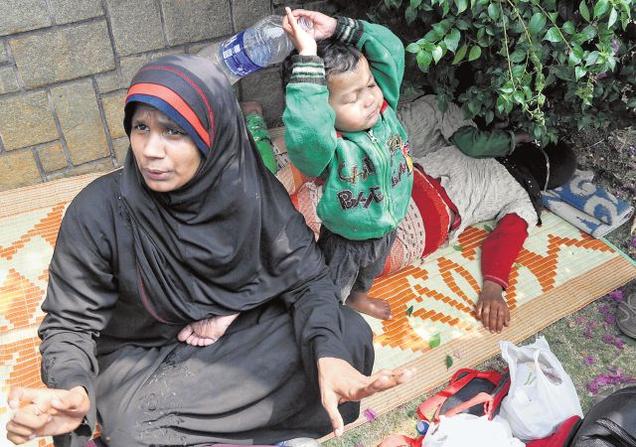
Jazeera in front of the house of businessman Kochouseph Chittilappilly in the city on Tuesday. / Photo: K.K. Mustafah / The Hindu
The stress of sleeping on the pavement in the heat and cold of the day is writ large on the face of Mohammed, who is hardly one and a half years old. His sisters, 12-year-old Rizwana and 10-year-old Shifana, recalled their experience the previous night when mosquitoes and insects disrupted their sleep and forced them to remain awake till the morning to keep their little brother out of harm’s way.
“Kochi is horrible compared with Delhi despite the freezing cold in the capital because of the attack by mosquitoes here. Even during the day time, insects and mosquitoes cause extreme discomfort to us. We are concerned about Mohammed, who is too young to withstand such a situation,” said Rizwana, daughter of 31-year-old V. Jazeera of Kannur, who began a sit-in protest in front of the house of industrialist Kochouseph Chittilappilly on Monday afternoon, seeking clarity on a cash award promised to her.
Ms. Jazeera, who drew world-wide attention through her four-month sit-in at Jantar Mantar in New Delhi against illegal sand mining in her native village in Kannur, is on a protest against Mr. Chittilappilly, who promised a cash award of Rs 5 lakh in recognition of her boldness in starting the struggle against quarrying.
Ms Jazeera, wearing soiled clothes and sitting under a tree in front of Mr Chittilappilly’s bungalow, said she had forgotten to bring along even the minimum change of dress for her children as she was not prepared for a long round of agitation. “I came here to seek clarity from Mr Chittilapilly on the promised cash award. My earlier plan was to leave by 11 am on Tuesday after getting an explanation from him. But he has now forced me to go on an indefinite strike,” she said.
A few autorickshaw drivers and local residents offered to provide fresh clothing to the mother and her three children. The locals also offered food and bathing facilities for the family.
Asked why she was putting her children to such suffering on the pavement, Ms Jazeera said she had told her two daughters go back to the native village and live with relatives. “As I am breast-feeding Mohammed, he alone can stay with me. But my daughters are fully convinced of my agitation and they stick with me during these crucial days,” she said. The two girls said they would not abandon their mother on the pavement to go back to their village.
When pointed out that the popular perception was that she was begging in front of the house of a generous man for a cash award he had announced voluntarily, Ms Jazeera said her demand was just clarity, not money. “If Mr Chittilappilly says that he will not give the promised amount, I will soon stop the agitation and return home. In fact, he and his business ventures gained undue publicity by announcing the award. It was not his commitment to my cause but the severe public criticism against giving cash award to a woman who voiced her personal concerns against a popular struggle in the State capital that prompted him to announce it,” she said.
“Sandhya, the housewife in Thiruvananthapuram, voiced her concern against all agitations. I was not ready to receive the cash award by sharing a platform with Sandhya as demanded by Mr. Chittilappilly. If I was crazy about money, I could have taken a flight from Delhi as suggested by Mr. Chittilappilly and stayed at a posh hotel to receive the amount. Mr Chittilappilly used me as a tool to gain publicity,” she said.
She had no answer to a question on the nature of assurance she received from Chief Minister Oommen Chandy on illegal sand mining. “How I can continue the strike indefinitely in New Delhi?,” she asked.
On Tuesday, the premises of Mr. Chittilappilly’s bungalow saw a number of hoardings extending solidarity to Ms. Jazeera. They included one jointly put up by the CPI(M)’s trade union wing CITU and Congress’ INTUC.
Meanwhile, Mr. Chittilappilly convened a press meet where he said the protest staged by Ms Jazeera was politically motivated. “Everybody knows who have organised the protest,” he said in an apparent reference to the CPI(M), which turned against him after he announced a cash prize of Rs 5 lakh to Sandhya. “I stand by my earlier promise. I am ready to deposit the amount in a bank account of her children,” he said.
“Why is Mr Chittilappilly overly worried about my children? I am capable of looking after them. If he is ready to give the amount, it must be directly handed over to me. I am yet to decide how the money will be utilised,” Ms Jazeera said.
source: http://www.thehindu.com / The Hindu / Home> News> Cities> Kochi / by K. A. Shaji / Kochi – February 05th, 2014
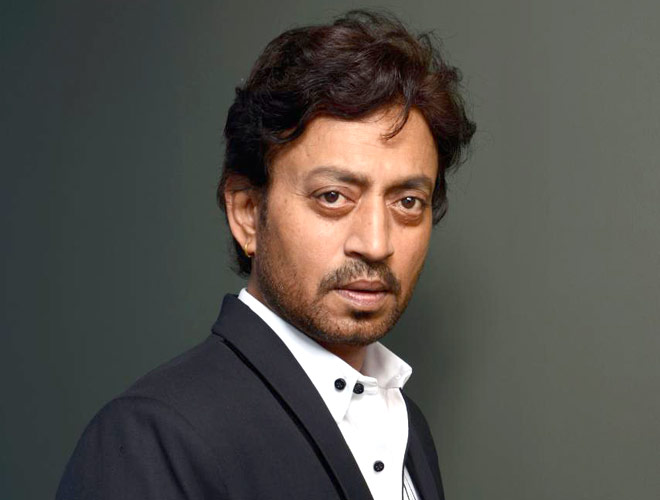
Acclaimed Indian actor Irrfan Khan won the best actor award for his brilliant performance in ‘The Lunchbox’ at the 10th edition of Dubai International Film Festival (DIFF).
Irrfan won the award Friday in the Muhr AsiaAfrica Feature category, while films writer-director Ritesh Batra got a special mention for screenplay for the film about a lunch box, which becomes a symbol of hope, in the same category. World renowned Indian filmmaker Shekhar Kapur headed the jury.
Sandeep Ray won the best director award for his Bengali language film ‘Shirno Bahu’ (Thin Arms), which revolves around an octogenarian woman who undergoes treatment for a debilitating medical condition, in the Muhr Asia Africa shorts category.
DIFF chairman Abdulhamid Juma said that the sense of community this year was palpable.
“After 10 years, we are seeing recurrent visitors, both film professionals and cinema lovers, from the region and beyond. This year we celebrated the gains that have been made in Arab cinema in the past decade, the result of years of work from our team to discover, nurture and promote talent from the Arab world,” he added.
“There is a feeling that Arab cinema has ‘arrived,’ with increasing numbers of Arab films on the world stage, winning awards at the most prestigious festivals, and gaining currency even with audiences who have never visited the region.”
source: http://www.indiatoday.intoday.in / indiatoday.in / Home> Movies> Bollywood / by IANS / December 16th, 2013
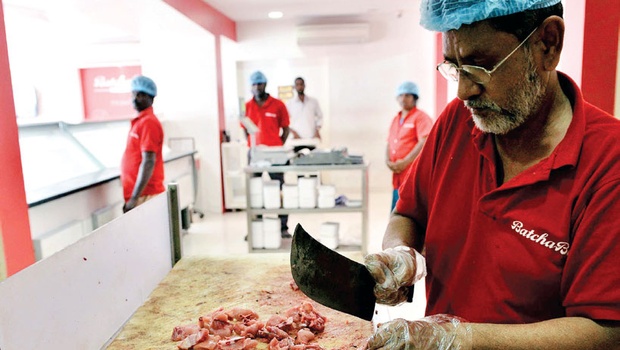
Sparkling white tiles, gleaming metal counters, spotlessly clean knives and the soft humming of refrigerators… This could be the sight that greets you when you walk into a run-of-the-mill meat shop on the streets of Chennai. Not in a few years or even a few months, but right now.
The Meat Sciences Department of the Tamil Nadu Veterinary and Animal Sciences University (TANUVAS), has been providing meat retailers free designs and consulting services to convert their shops into places where hygiene is the priority – and they have been doing it for the past five years.
“We have been giving out designs and consultation to any entrepreneur who wishes to start up or modernise his business,” says Robinson Abraham, Head of theMeat Services Department. “All they have to do is approach us.” Consulting at a private firm would be prohibitively expensive to the small businesses that most meat shops were, he pointed out.
But when asked about what these five years of free consulting has engendered, he points to just one operating shop in Chennai. The BatchaBai meat shop in Kilpauk stands as a silent testimony to what a few well-thought out improvements in slaughter house design can do.
There are counters made of stainless steel, teflon cutting boards, rounded edges to prevent wiping hands on tables and white tiles to make any spattered blood visible. Compared to the ill-lit, ill-washed rooms that most meat shops offer, the sight is almost unreal in its cleanliness. “These are very small but necessary design elements,” points out R Narendrababu, one of the three professors in the department. “They improve the hygiene of the shop tremendously.”
The reason why hygiene comes in a sad second in the owners’ list of priorities, he adds, is because consumers themselves have been desensitised to the dangers of bad hygiene. “Unless people refuse to buy meat from shops that don’t adhere to basic hygiene norms, retailers will never feel the need to implement these practices,” he says.
source: http://www.newindianexpress.com / The New Indian Express / Home> Cities> Chennai / by Jonahan Ananda – Chennai / January 29th, 2014