Tag Archives: Indian Muslim Padma Bhushan

Gujjar leader, Padma Bhushan awardee Mian Bashir Ahmed dies at age 98

Wangat Village (Ganderbal District), JAMMU & KASHMIR :
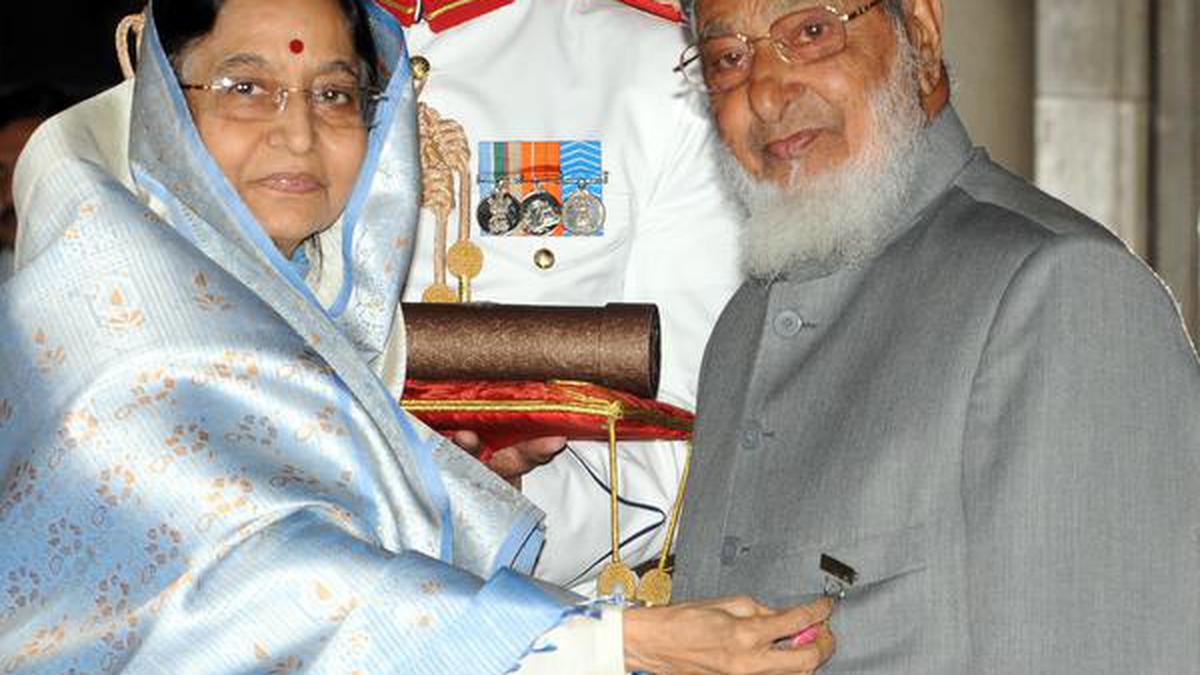
Former President Pratibha Patil presenting the Padma Bhushan Award to gujjar leader Mian Bashir Ahmed, during the presentation of Padma Awards at Rashtrapati Bhavan in New Delhi on May 10, 2008

A former minister in Sheikh Mohammad Abdullah’s cabinet, he was honoured with the Padma Bhushan for his extraordinary service for the Gujjar-Bakarwal community and other downtrodden groups.

Veteran Gujjar leader and Padma Bhushan awardee Mian Bashir Ahmed, a resident of Ganderbal district of Jammu and Kashmir, passed away on Saturday night after a prolonged illness. He was 98.

Ahmed, a resident of village Wangat in Kangan area of the central Kashmir district, breathed his last at about 10 pm, family sources said.

His Nimaz-e-Jinazah (funeral prayers) will be performed on Sunday at Mizar Shrief Baba ji Sahib Larvi located at Baba Nagari Wangat, they said.

Ahmed was the son of top Gujjar leader and saint Mian Nizam Din Larvi and father of former Minister and National Conference (NC) leader Mian Altaf Ahmad.

Born in November 1923, Mian Bashir Ahmed was a minister in Sheikh Mohammad Abdullah’s cabinet. Later, he left politics and started working for Islamic Sufi tradition and to help downtrodden people.

In 2008, he was honoured with the Padma Bhushan award for his extraordinary service for the Gujjar-Bakarwal community and other downtrodden groups.

Condolences to his family poured in from various quarters.

“Just heard about the sad demise of Mian Bashir Sahib, a spiritual leader & a mass leader revered by many especially in the Gujjar community. His demise will be deeply felt by many of us. My condolences to my colleague Mian Altaf Sb & his family,” NC vice president Omar Abdullah said in a tweet.

His party said Ahmed’s death has felt a void that cannot be filled.

“Grieved over the passing of Mian Bashir Ahmad Laaravi, a renowned spiritual leader & political figure. His death has felt a void that can’t be filled. Our condolences go out to Mian Altaf Laaravi, the entire family & Bashir Sb’s admirers. May Allah grant him a place in Jannat,” the NC wrote on Twitter.

Jammu and Kashmir Pradesh Congress committee (JKPCC) expressed profound grief over his passing, describing it as a great loss to the UT.

In his condolence message, JKPCC president Ghulam Ahmad Mir expressed deep sorrow over the passing of the eminent religious scholar, socio-political figure, saying Ahmed was known for his spirituality and social work he rendered to the people of Jammu and Kashmir.

“Saddened to learn about the passing away of Mian Bashir Saheb. I have no words to express my grief,” Mir said.

He expressed deepest condolences to Mian Altaf and other members of the bereaved family and Ahmed’s followers.

Praying for the eternal peace to the departed soul, the JKPCC president said, adding that Ahmed’s guidance and teachings shall continue to inspire generations.

Jammu and Kashmir Peoples Conference chairman Sajad Lone described Ahmed as an inspirational leader.

“Deepest and heartfelt condolences to the family of Mian Bashir Sahab. An inspirational leader, defined by simplicity who had a humbling effect on people he interacted with. May his soul rest in peace,” Lone said.

source: http://www.thehindu.com / The Hindu / Home> News> India> Other States / by PTI / August 15th, 2021
Late Supreme Court judge Justice Fathima M Beevi awarded Padma Bhushan

KERALA:

Justice Beevi was the first Muslim woman to be appointed to the higher judiciary in the country and the first woman to be elevated to the Supreme Court of an Asian country.

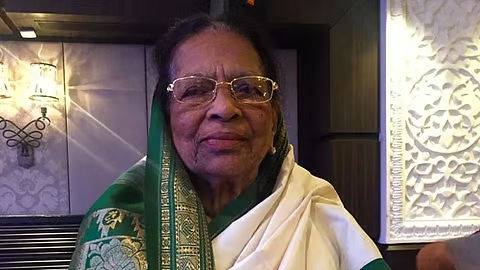
Late Supreme Court judge Justice Fathima M Beevi awarded Padma Bhushan

The first woman to be a judge of the Supreme Court of India, Justice M Fathima Beevi, was on Thursday posthumously awarded the Padma Bhushan.

Justice Beevi received India’s third-highest civilian award in the field of Public Affairs.

The former Supreme Court judge passed away aged 96 in November last year. Justice Beevi was the first Muslim woman to be appointed to the higher judiciary in the country.

She was born in Kerala in 1927 and her father encouraged her to study law. In 1950, she topped the Bar Council exam becoming the first woman to receive a Bar Council gold medal.

She started her career as an advocate in Kerala and worked her way up to become a district and sessions judge in 1974. In 1980, she joined the Income Tax Appellate Tribunal and was appointed as a High Court judge in 1983.

She made history in 1989 by becoming the first woman appointed to the Supreme Court.

As a Supreme Court judge, she became the first Muslim woman in the higher judiciary and the first woman to become a Supreme Court judge in Asia.

After retiring in 1993, she had served as a member of the National Human Rights Commission and then as Governor of Tamil Nadu.

She had resigned from the post of Governor of Tamil Nadu after rejecting the mercy petitions filed by four condemned prisoners in the Rajiv Gandhi assassination case.

Read more about the former judge here.

source: http://www.barandbench.com / Bar and Bench / Home> News / by Bar and Bench / January 27th, 2024

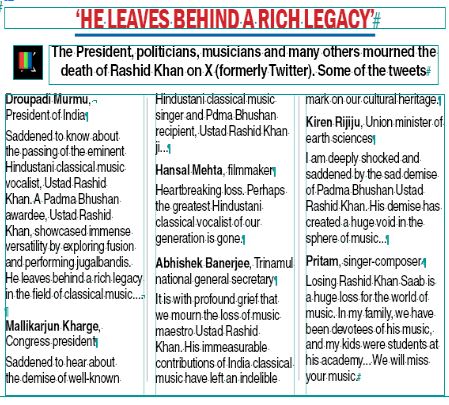
The stirring raga rages on: Adjectives are too limited to describe the golden voice of Rashid Khan

Sahaswan (Budaun) , UTTAR PRADESH / Kolkata, WEST BENGAL :

He could captivate the audience and eradicate the thin line between a structured format and the playfulness of a classical composition while his voice moved through the shades of ragas.

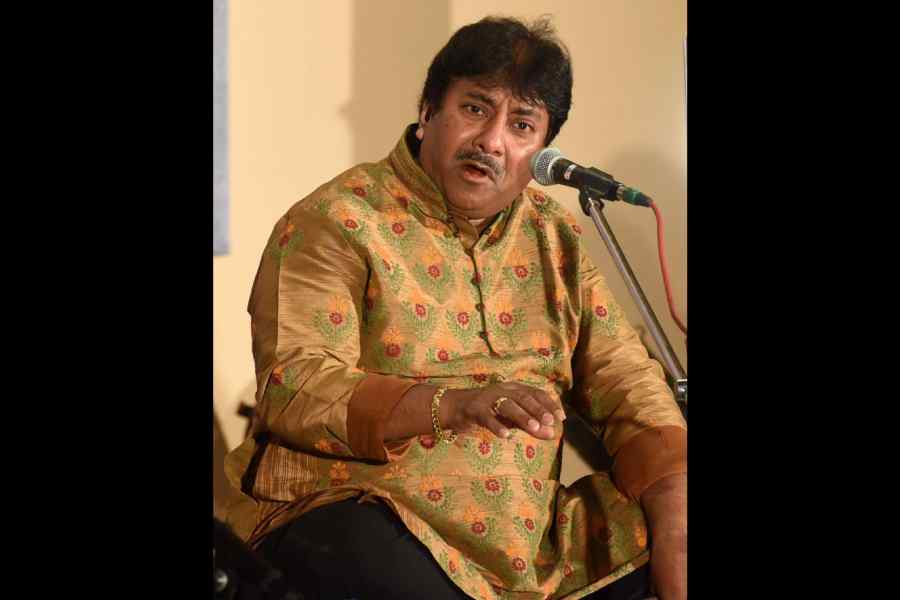
Rashid Khan./ Sourced by The Telegraph

The name of Ustad Rashid Khan reminds one of the words of T.S. Eliot: “Music heard so deeply/that is not heard at all, but/you are the music/while the music lasts.’’

A born genius, talented and extraordinary musician… adjectives are too limited to describe the golden voice of Rashid Khan.

The fulfilment of an art form touches immortality when the artist becomes the art, as the poet said. Diehard listeners of Rashid Khan and ardent music lovers know the truth because they have discovered the artiste’s voice in different genres of music and steeped integrated melodies.

The great-grandson of the legendary Ustad Inayat Hussain Khan, the founder of the Rampur Sahaswan Gharana, Rashid was born on July 1, 1968, at Badaun in Uttar Pradesh.

Memory and melancholy created the soul of the artiste, although he was completely unaware he would one day become one of the greats of Indian classical music. He lost his mother and younger brother at a very early age; he found solace in kabaddi and cricket.

Rashid studied in Mumbai for about a year and after coming back to his hometown, his tutelage was started under his illustrious granduncle and guru, Ustad Nissar Hussain Khan. He also carried the lineage of renowned vocalists like Mushtaq Hussain Khan and Ghulam Mustafa Khan. But the rather authoritarian Ustad Nissar Hussain Khan changed the course of his life and made him what he became over the years. He nurtured the latent potential of Rashid through his training, first at his own residence at Badaun and subsequently at the Sangeet Research Academy in Calcutta.

Young Rashid Khan, an assured voice of the future of Indian classical vocal music, certified by none other than Pandit Bhimsen Joshi, was to evolve into a formidable talent, especially with his prowess in taankari and gamak.

His full-throated voice was an exceptional amalgamation of depth and rhythmic generosity. He could captivate the audience and eradicate the thin line between a structured format and the playfulness of a classical composition while his voice moved through the shades of ragas. He was adept at the instrumental stroke-based style which he inherited from his gharana, as well as an expert at infusing emotion into an elaborate musical verse.

Probably this is the reason he was successful in different styles of singing and innovation despite being a rooted classical musician.

For example, when he sang Tagore songs based on various ragas, he focused on the rendition of the quintessential flavour; his command over the notes and tunes brought out the charm of the song with skilful originality.

Rashid had fond memories of the town of Badaun and its surroundings where he spent his early days. The river which flows by the town was a witness to the number of hours Rashid spent by its side singing.

He paid his respects on his visits to his hometown at the cemetery where his parents and young brother were laid to rest.

It may well be the inexplicable pain and loneliness of childhood filtered through his every rendition of ‘Yaad Piya ki Aye’ (composed originally by Ustad Bade Ghulam Ali Khan) — a Rashid reinvention that became very popular. As with the Bollywood hit ‘Aoge Jab tum o saajna’ from Jab We Met.

He skilfully obliterated differences between musical genres and was able to recreate a unique combination of love and exuberance with the full boom of his voice in three octaves, as manifested in each and every song. In numerous playback essays, he successfully broke traditional boundaries with his scintillating voice and evoked sensibilities even when he was out of his core expertise.

In the words of senior organiser of the Dover Lane Music Conference, Bappa Sen: “Rashid contributed an unparallel range to the music fraternity. We have seen him grow as a man as well as an artiste and witnessed his excellence in all spheres of music. He was an integral part of this music festival from a very young age and even performed in the periodicals. Along with his talent, he excelled himself to heights that required enormous hard work and open-mindedness. As a person he was as humble and respectful to all of us as he was from the very first day.”

Sarodiya Amaan Ali Khan thinks: “Unki voice mein to Ishwar hain.” He had countless memories with this senior artiste, fellow musician and co-performer who, Amaan says, was always an inspiration to him. “He was a person as clear as water,” said Amaan.

To his close friends and contemporary musicians, Rashid Khan was an irreplaceable voice and human being in every sense. The absence of Rashid’s mortal existence has now created a vacuum in the world of Indian classical music which is now devoid of his rich depth of voice.

Rashid’s son Armaan is carrying the torch of the legacy, his daughters Suha and Shaona are into Sufi music.

Rashid flourished as the breaking dawn with Lalit, Ahir Bhairon, Miyan ki Todi, returned to the root with Puriya Kalyan, Puriya Dhaneshree, Shree, sparkled with Sohini.

He has left behind an unforgettable repertoire of renditions and the gift of his unbridled imagination to lovers of his singular work.

source: http://www.telegraphindia.com / The Telegraph Online / Home> Culture> Music / by The Telegraph / January 10th, 2024