Tag Archives: Nahla Nainar

The minstrel from Nagore

Nagore, TAMIL NADU :

On his birth centenary, Nagore Hanifa continues to be celebrated and his timeless devotional and political numbers continue to draw in listeners.

The Hanifa fan base continues to grow, as seen by the number of cover versions of his ‘Iraivanidam Kaiyenthungal’ | Photo Credit: Special Arrangement

Of the many singers in South India with a universal appeal, ‘Isai Murasu’ Esmail Mohamed Hanifa stands tall on the pantheon of greats with origins in Tamil Nadu’s Cauvery delta region.

Hanifa, an iconic minstrel of Islamic devotional songs in Tamil had strong links with Nagore, the town in Nagapattinam that hosts the 16th century shrine to Sufi saint Syed Abdul Qadir. It eventually became the prefix to his name too.

Recently, the Tamil Nadu government kickstarted the celebration of Hanifa’s centenary year by naming a street and public children’s park in Nagore after him. 

It is a fitting tribute to a man who captured the hearts of fans with his distinctive baritone from the early 1930s. 

Even posthumously, the Hanifa fan base continues to grow, as seen by the number of cover versions of his ‘Iraivanidam Kaiyenthungal’ and his other songs that are available online. 
Hanifa’s devotional and wedding songs continue to hold sway in Tamil Muslim social functions | Photo Credit: Special Arrangement

The youngest of three children of Mohamed Ismail, a railway worker in Malaysia, and Mariam Biwi of Ramanathapuram, Hanifa began singing mainly to support his family. 

The singer spent his early childhood in  Ramanathapuram, and later went to work for his paternal uncle Abu Bakr Rowther in Tiruvarur. It was here that Hanifa’s musical talent was noticed. His first professional concert at the age of 13 set him off on a trajectory no one imagined.

“My father’s rousing voice owes much to the Ghousia Bait-us-Sabha at Nagore, for whom he used to sing,” says his son Naushad Ali, based out of Chennai. 

“At the time, there was a practice of taking out a pre-wedding procession to introduce the bridegroom to the families in the neighbourhood. A team of young drummers beating ‘thabs’ would head the procession, followed by the groom in a car or on horseback.

My father and his accompanists would be in the middle, with the hosts and guests making up the back of the crowd. He learned early on to beat the competition from the ‘thabs’ boys by singing loudly and in tune, without the help of a microphone. It was a skill that he developed out of necessity,” he adds. 

Hanifa was a mainstay at most of the ‘Urs’ festivals held by the Sufi dargahs in the State | Photo Credit: Special Arrangement

Naushad, now in his sixties, was his father’s caregiver in his later years, and also renders vocal concerts in the Nagore Hanifa style.  

Hanifa’s devotional and wedding songs continue to hold sway in Tamil Muslim social functions. His devotional songs were often based on ‘nasheed’ (Islamic chants sung a cappella or with instruments) and ‘naat’ (poetry in praise of Prophet Muhammad), referencing the Muslim faith, history, and current events. Quite a few of them were modified to suit Tamil listeners. 

‘Hasbi rabbi jallalah’, for instance, has just the first stanza in Arabic; the rest of the song in Tamil adds elements from Ramanathapuram’s history. “It was first recorded in the 1970s for a school function, and I was among the children who sang the chorus,” recalls Naushad.  

‘Maalai soodum manamakkale’, ‘Vazhga, vazhga, vaazhgave’ and ‘Deen kula kanne’, were among the songs that he presented at marriage concerts, usually held a day before the nuptials or after the wedding reception.

He was a mainstay at most of the ‘Urs’ festivals held by the Sufi dargahs in the State.

Nagore Hanifa married past the age of 30, and his  wife A.R. Roshan Begum looked after the couple’s six children in Nagore while Hanifa built his career. 

“We did not get to see our father much while growing up, because he would always be on tour. At the peak of his career, he would have at least 45 engagements in a month. He rarely declined any offer. Those were different times, with no marketing, public relations or copyright. Many songs were set to popular film tunes re-arranged by his small orchestra. I wonder how he managed his career all alone,” wonders Naushad.

Hanifa’s songs were known for their profound lyrics. He was helped in this by poets Abidin and Nagore Saleem, among others. 

The self-taught maestro picked up tips on Carnatic music from S.M.A. Qadir at the Nagore dargah.

Naushad was tasked with the job of copying out the lyrics and taking care of his father’s correspondence. “Much of what I know about Tamil literary expression and pronunciation is due to my father. He would rap me on my head if I got the spelling or grammar wrong,” he laughs.

Though he had a prodigious memory for lyrics, Hanifa would always take his notebooks with him on stage. “If he noticed mistakes in the rendition, he would skillfully re-sing the portion in a way that the audience would not notice,” shares Naushad. 

Nagore Hanifa performed in all kinds of venues — from five star hotels and modest homes — with the same flair, and never let his celebrity status get in the way. He would also do any number of encores — he had no ego, says his son.

Hanifa occasionally lent his voice to Tamil films — in movies such as Gulebakavali (1955), Paava mannippu (1965) and Chembaruthi (1992) —  but consciously kept away from cinema because he was not open to adopting a ubiquitous name such as ‘Kumar’, which was what some composers demanded.  

“My father used to say that it is more satisfying to sing four songs as Hanifa than a crore songs as Kumar. Having held the stage in live concerts that ran into hours, he did not appreciate his craft being adapted for light music,” says Naushad.

When Hanifa passed away on April 8, 2015, at the age of 96, a veil fell forever on an era of homespun superstars produced in Tamil Nadu.

Political anthem

In his heyday, Hanifa used to be known as the ‘voice’ of the Dravida Munnetra Kazhagam (DMK), because of his political anthems for the party. His warm friendship with DMK leader and former Chief Minister M. Karunanidhi began in their adolescence and stayed strong through their lifetime. Some of the songs he sang for the party are still used by the DMK to raise the morale of party cadres.

source: http://www.thehindu.com / The Hindu / Home> Entertainment> Music / by Nahla Nainar / February 06th, 2025
Faith burns bright at this ancient mosque near Tiruchi’s Fort Station

Tiruchi, TAMIL NADU :

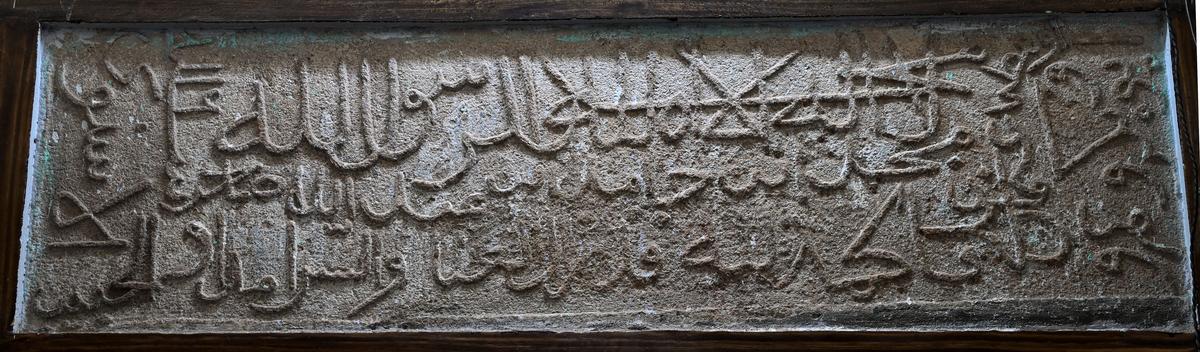
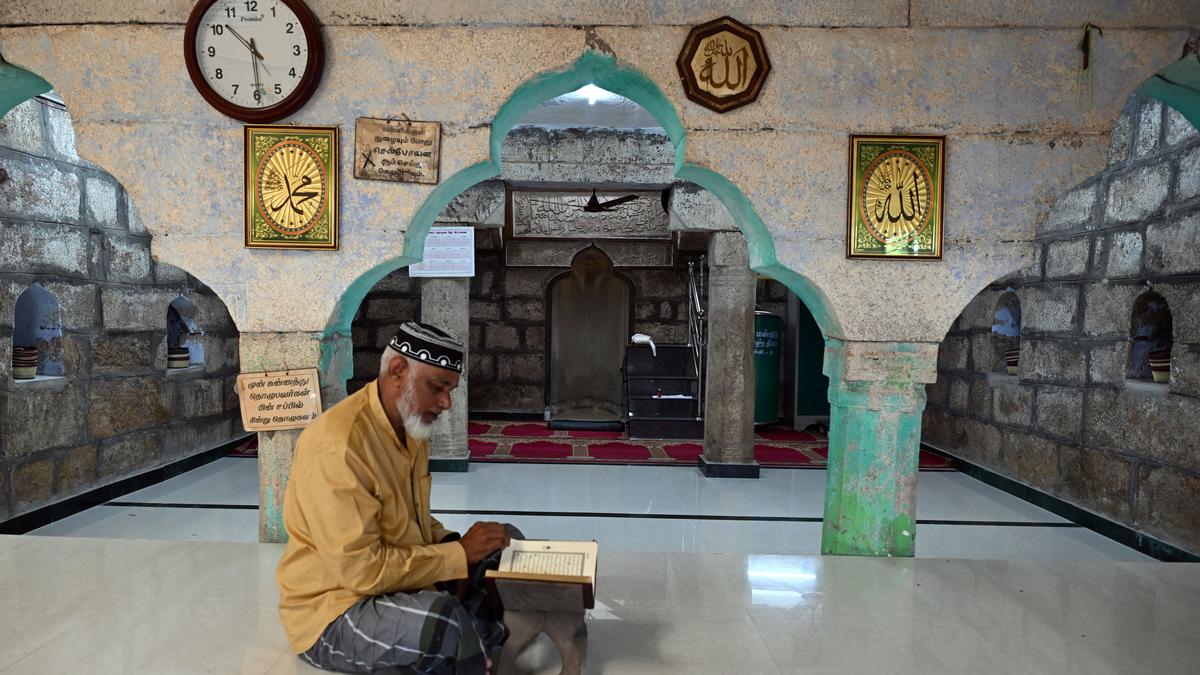
Makkah Masjid is among the oldest Islamic shrines in Tamil Nadu. An inscribed tablet dates the mosque back to the year 116 of the Al-Hijri calendar, corresponding to 734 A.D.

An inscription on the stone structure’s wall (background), dates the building to the Islamic (Hijri) year of 116, corresponding to 734 A.D. | Photo Credit: M. MOORTHY

The family of a cloth merchant has been taking care of the mosque for generations.

Tucked away next to a carpentry workshop on Tiruchi’s Fort Station Road is what is considered to be one of the oldest Islamic places of worship in Tamil Nadu: the Makkah Masjid that dates back to the year 116 of the Al-Hijri calendar, corresponding to 734 A.D.

A view of the prayer hall of Makkah Masjid in Fort Station Road, Tiruchi. It is considered to be among the oldest Islamic shrines in the country. | Photo Credit: M. MOORTHY

The family of M.G.A.R. Abdul Rahman, a cloth merchant in Tiruchi, has been taking care of the property for several generations.

The mosque’s age is validated by an inscribed stone tablet in Arabic above the ‘mihrab’ (the niche that indicates the ‘qibla’ or direction of prayer). The graves of Mohamed Ibrahim, Hazrat Haji Abdullah, Hazrat Haji Mohamed Anwar, Ahmed Kabir, and Tahira Biwi, thought to be pious Muslims of yore, are also to be found here. Two recently added minarets indicate the mosque’s presence in this quiet part of town.

Surrounded by thorny bushes

“Until the 1980s, the mosque was very different from what you see today,” A.R. Mohamed Ghouse, hereditary trustee, and one of Mr. Rahman’s 12 children, told The Hindu. “When my father was bequeathed this shrine, it was surrounded by thorny bushes and palm trees. There was no road access; people would walk single-file on a narrow pathway to reach the premises. Since this is a low-lying area, the building would be flooded during the rainy season. Before we got electricity connection in the 1980s, the place used to be lit up with oil lamps and hurricane lanterns. We have been maintaining the buildings with the help of generous donors from all faiths,” he said.

The Muslim community has had a long and harmonious presence in Tiruchi since ancient times. The Makkah Masjid is a stone’s throw away from Hazrat Thable Alam Badhusa Nathervali Dargah, the mausoleum dedicated to a nobleman of Turkish-Syrian lineage born as Sultan Mutahirruddin in 927 A.D., in Suharwardy, near Samarkand, who gave up his privileged life to spread the message of Islam in southern Asia. It is said the saint stayed on the Makkah Masjid premises before he settled in the present site.

Mosques endowed by the erstwhile Nawabs of Arcot are also an indelible part of Tiruchi’s landscape. Woraiyur, the capital of the Chola dynasty from the 2nd Century (now a suburb of Tiruchi), was already known to Arab traders. After the birth of Islam, Arab-Muslim missionaries began travelling to the region. Biographies of Muslim saints and the local traditions of the period reveal that Islam spread in the southern part of India in a largely peaceful and voluntary manner.

According to J. Raja Mohamad, historian and former curator of Pudukottai Government Museum, the Makkah Masjid could have been built for the Muslim settlement that emerged in the Tamil hinterland during the Pallava rule. “When I visited the mosque in the 1970s, it was hard to spot because of the overgrown bushes. It resembled a small ‘mandapam’ (hall), built in granite, with six Dravidian style pillars that are square at the base, octagonal in the middle, and square again. The ceiling was also made of granite slabs. Though it has become more modernised now, the trustees have retained most of the old building,” he said.

While Dravidian-style granite mosques are present elsewhere in Tamil Nadu, the Makkah Masjid may be the only shrine with a contemporary dated inscription in the State as well as in southern peninsular India, he added.

Caliphs named in inscription

In his 2004 book, Islamic Architecture in Tamil Nadu, supported by the Nehru Trust for Indian Collections at Victoria and Albert Museum, London, Mr. Mohamad writes, “According to the Arabic inscription in the rectangular granite slab above the ‘mihrab’, this mosque was built by one Mohamed Ibn Hameed Ibn Abdullah in Hijri 116 corresponding to 734 AD. The names of the four Caliphs (successors to Prophet Muhammad) — Abu Bakr, Umar, Uthman, and Ali — are also mentioned in the inscription, which has been accepted by scholars as belonging to the 8th Century AD.”

Maintaining the mosque has been a labour of love for the family trustees. “The prayers have never stopped in the Makkah Masjid even though we do not have a ‘mohalla’ (a neighbourhood congregation).

Approximately, 200 people attend the Friday prayers,” said A.R. Abdul Razak, 74, the eldest son of Rahman and the imam (who leads prayers) for the past 39 years.

The annual ‘Urs’ (festival) commemorating Mohamed Ibrahim and Tahira Bibi on the 28th day of the Islamic month of Rajab (now in its 1,329th year) at the dargah on the mosque’s campus is supported by people of many faiths, who donate generously towards the public feast.

Mr. Razak gave up his job as a ship cook in Switzerland in deference to his ailing father’s wish to officiate as the chief cleric of the mosque. “I underwent training in Quranic recitation and Islamic theology from scholars in Tiruchi before taking up this position,” he said.

An antique copy of The Holy Quran is among the oldest artefacts in the mosque.

To prevent flooding, the ground level was raised with truckloads of mud after road access was granted by Southern Railway in the 1980s. As a result, five of the eight steps of the prayer hall are now permanently below the ground. Several coats of whitewash were scrubbed away to reveal the original granite walls and inscriptions. Some of the stonework also contains fragments of Tamil writing from the 10th Century. “We have tried to maintain the premises to the best of our ability. We hope succeeding generations of our family will continue to take care of the Makkah Masjid,” said Mr. Ghouse.

source: http://www.thehindu.com / The Hindu / Home> News> India> Tamil Nadu / by Nahla Nainar / June 28th, 2024

Syed Mohamed Husain Nainar: Scholar, polyglot, and my grandfather

Palani , TAMIL NADU :

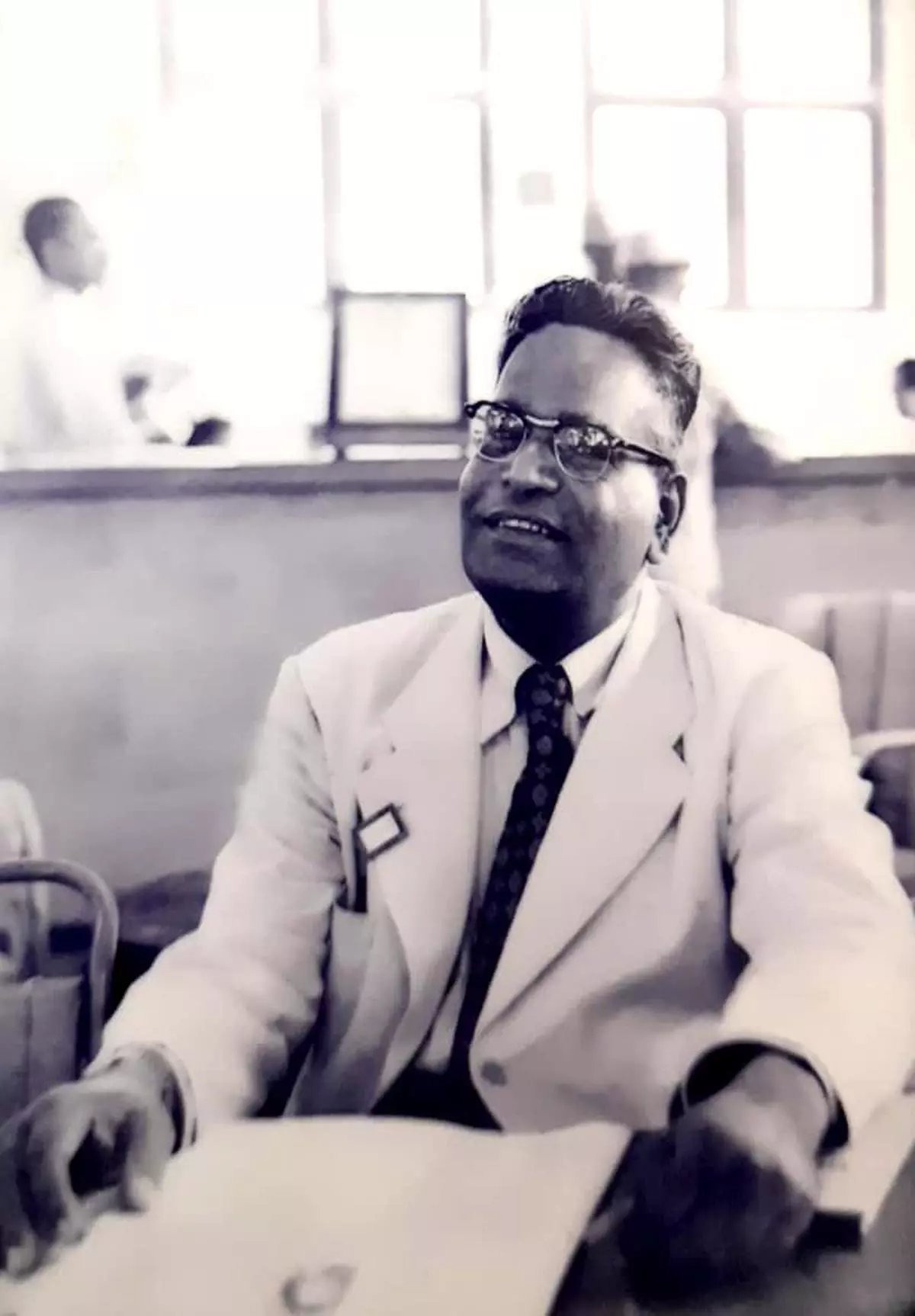
S.M. Husain Nainar in his later years | Photo Credit: Special Arrangement

A termite-infested trove of papers unveils the extraordinary life and scholarly legacy of a Tamil Muslim academic who bridged civilisations.

This would perhaps be a good time to thank the termites: for their help in reconstructing the jigsaw puzzle that is my paternal grandfather Syed Mohamed Husain Nainar’s legacy. If they had not been so keen on chewing through the wooden cabinets of our house in Salem, Tamil Nadu, we may have never found it necessary to finally dig into the mountain of paper that had built up from the 1800s till date, hoarded for the rainy day that never came. As Nainar’s 125th birth anniversary approaches (May 25, 2024), this account of a search for a patriarch’s profile(s) would resonate with those trying to figure out how their ancestors lived.

Contemporary fact-seekers may often come across the name of S.M. Husain (also sometimes spelt Husayn) Nainar, (1899-1963), when they study Tamil country’s history before the British Raj, or look into the influence of Islam and Arab travellers in this region from the 7th to 13th centuries. As a senior reader and later head, of the Department of Arabic, Persian and Urdu at Madras University, from 1927-1954, Nainar wrote, edited and translated over 20 works about South Indian antiquity that are considered an important repository of knowledge gleaned from rare, archival documents in multiple languages.

He wrote in English and Tamil; he was proficient in Arabic, Urdu, Persian, and Malayalam; could read and understand Dutch and French, and also learned Malayan and Bahasa Indonesia in the later part of his career. Among Nainar’s publications are Arab Geographers’ Knowledge of South India, originally written as his PhD thesis for the School of Oriental Studies (now known as the School of Oriental and African Studies or SOAS), University of London, in the 1930s; the English translation of ‘Tuhfat-al-Mujahidin (A Gift to the Holy Fighters), a historical work in Arabic by Zainuddin Makhdoom II, about Portuguese colonialism in 16th century Kerala (1942), and five volumes of Sources of the History of the Nawabs of the Carnatic edited based on Persian manuscripts Tuzak-i-Walajahi by Burhan Ibn Hasan; Sawanihat-i-Mumtaz by Muhammad Karim Zamin; and Bahar-i-Azamjahi by Ghulam Abdul Qadir Nazir, about the princely state in the erstwhile Madras Presidency.

In 1948 he mobilised public support and published a daily newspaper in Tamil called Swatandira Nadu. It was printed and published by Nuri Press, established by my grandfather and his elder brother with funds raised by well-wishers in Malaysia, Singapore and Burma. However, the daily could not survive beyond two years.

Shortly before his retirement, he was deputed as a research scholar to Indonesia by the Indian Council for Cultural Relations (ICCR), Ministry of Education in 1952, to study relations between India and Indonesia. After the ICCR’s contract ended, he stayed on to complete the research at his own expense, and worked as a professor at the Government Institute of Islamic Studies in Yogyakarta from 1957 to 1960.

When he returned to India, after a short stint at the Indonesian section of All India Radio’s External Services Division, he joined the Department of Arabic, Persian and Urdu at Sri Venkateswara University, Tirupati in 1961. Nainar passed away due to liver failure in 1963, while still in service.

This is my grandfather’s story in a very crowded nutshell, gleaned from the papers and documentation that survived the termite infestation. A more detailed version can be found at www.smhnainar.com, a website I compiled with the help of some patient family members and web developers in Salem and Tiruchi.

An educational pioneer

Arabic, Persian and Urdu were, at different times, widely used in India, in the courts of kingdoms and revenue offices before the British Raj brought English into vogue. Tamil was influenced by Arabic from the 7th century, even before the birth of Islam in Arabia, and as Nainar’s research indicates, contains a significant number of loan words which are still in use. How did a boy from the temple town of Palni, Tamil Nadu, born into a family of ‘olai’ (palm fronds processed into writing material) merchants, farmers and ‘munsiffs’ (local magistrates), choose to study Arabic, and its sister languages of the South and West Asia, and then use his learning to decipher the history of South India?

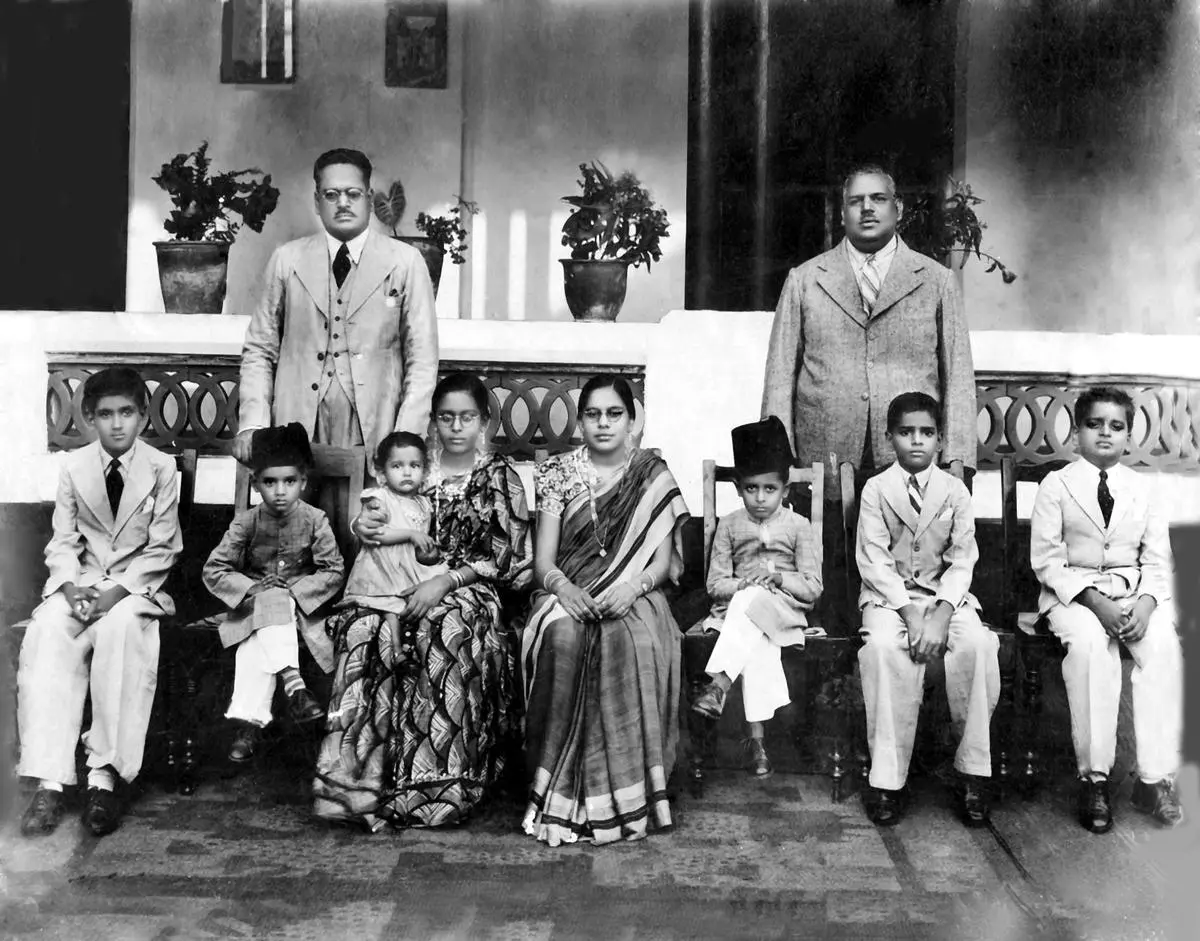
S.M. Husain Nainar and his brother S. Kadir Mohamed Nainar with their children, circa 1940s.  | Photo Credit: Special Arrangement

Nainar grew up at a time when Tamil Muslims were resistant to the idea of any kind of non-religious education. His father, N. Syed Bawa Rowther, was convinced that Western education would reduce his sons’ marriage ‘market value’. His three daughters possibly never attended school.

But the winds of change had begun to blow in Nainar’s part of the world. Like his elder brother Syed Kadir Mohamed Nainar, former district judge and public prosecutor, Nainar excelled in his studies. He studied Arabic at the madrasa (Islamic school) in Podakkudi, Thiruvarur district, and later at the Madrasa Jamaliya in Perambur, Madras, according to family sources.

A detailed eight-page résumé prepared by him, possibly while he was in between jobs in the 1960s, traces his progress from senior school in Victoria Memorial High School, Bodinayakanur (1918-1921), and Intermediate at American Mission College, Madurai (1921-1923), to BA in Arabic at Government Mohammedan College, Madras (1923-1925) that would eventually lead him to Aligarh Muslim University (AMU).

Here too, he was a bit of an over-achiever, as he simultaneously pursued Bachelor of Laws (LLB) and a Masters in arts in Arabic, from 1925 to 1927. Our discovery of his exam hall tickets confirms that.

At AMU, Nainar was a student of renowned scholar Abdul Aziz Maimani, who was known for his mastery over Arabic. Nainar also studied Arabic, Hebrew and Aramaic under the tutelage of British Arabist A.S. Tritton, who served at the AMU from 1921 to 1931.

Linguistic bridges

In 1927, Nainar was appointed as senior lecturer of the Islamic section of the Institute of Oriental Studies and Research at the University of Madras, which was later re-constituted as the Department of Arabic, Persian and Urdu in 1930. Much of his work began with authorising ‘true copies’ to be made by professional scribes that did not deviate in any way from the original, down to the number of lines on a page. Among such true copies that have survived in his collection, is a version of Kerala Pazhama, in Malayalam, meant to be a companion volume to Tuhfat-ul-Mujahidin, for which Nainar collaborated with his colleague C. Achutha Menon.

Despite studying Arabic under notable tutors in India, and his fluency in it, Nainar still felt that his expertise was limited, and his sons could perhaps fill this lacuna by studying the language in an Arab country. When his elder son Anwar chose to study Economics, he sent my father, Munawwar, to pursue his BA in Arabic at Cairo University in Egypt. Rescued from a loft full of paper bundles, we found all the correspondence from this period.

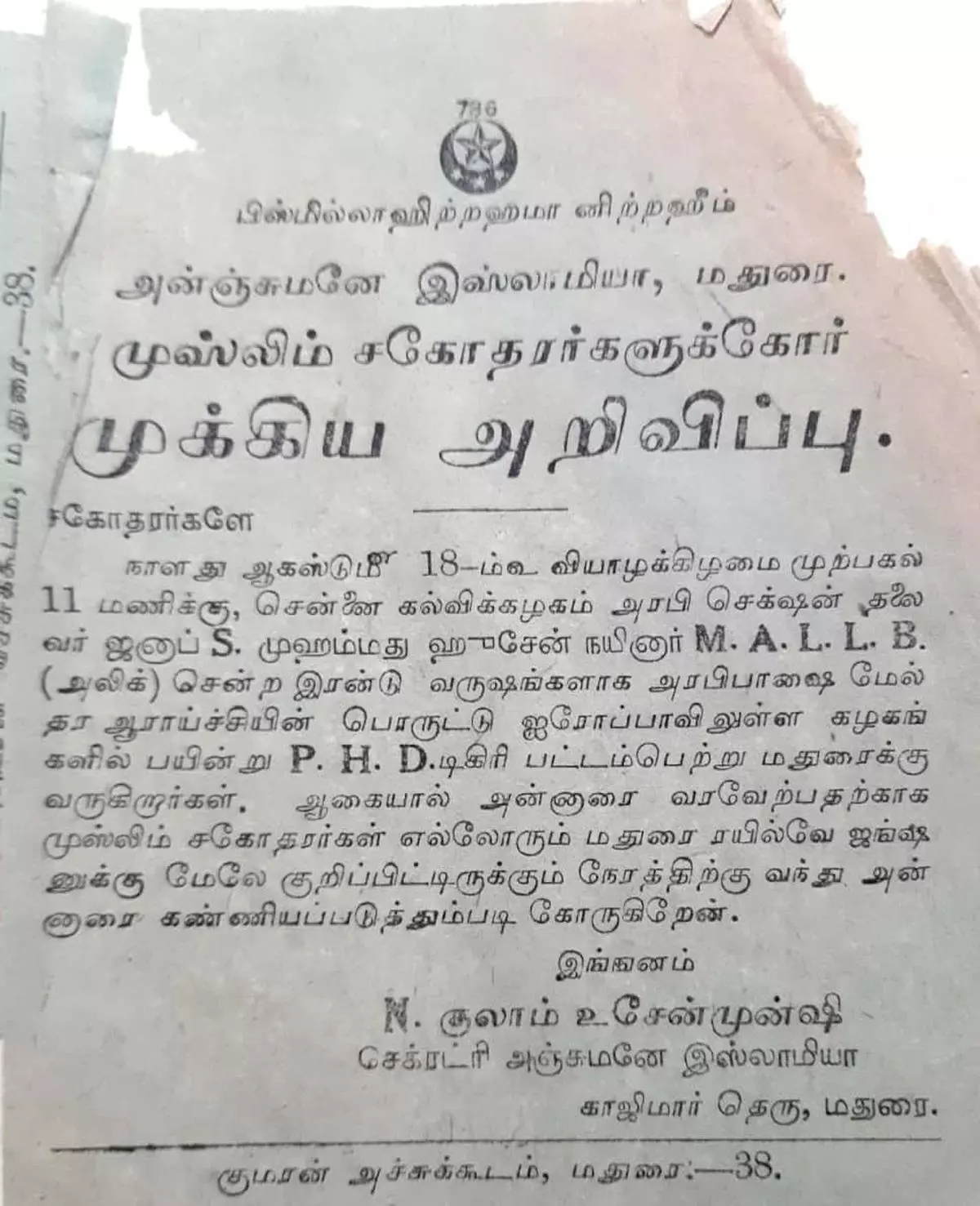
A flyer issued in 1938 by N. Ghulam Hussain Munshi, secretary, Anjuman-e-Islamiya in Madurai, asking Muslims in the city to gather at the railway station to welcome Nainar after he completed his doctoral studies at SOAS, London. | Photo Credit: Special Arrangement

My father’s time in Cairo University was completely overseen through letters from 1955-1960, because Nainar was on deputation in Indonesia when he was sent off to Egypt at the age of 19. One personal favourite is a trilingual true copy made by Nainar, of three letters written by my father in Arabic, Tamil and English, informing him that he had passed his first year BA exams.

A man of letters

Family history can be a touchy subject, with each person having their own spin on events. In my case, having a stockpile of at least 10,000 documents from the 1800s kept me going, and helped to dispel the myths that had built up around my grandfather. There are flashes of humanity amid the academic studies: letters from his children (he had three daughters and two sons) written from India, when he was in the UK, reporting faithfully, the antics of my father, then just a three-month-old infant, and the periodic health checks by the doctor, besides requests for books, umbrellas and toys.

The letters grow more serious as the children walk into adulthood, and the subject of marriage proposals gets a few wires crossed between the senior Nainar brothers. One wonders how he navigated life as a student, scholar and family man across two World Wars and later, a complete change of government. At work, he seemed to be always in demand, seguing from professor to orator and in Indonesia, a representative of the Indian government, with ease.

In 1952, Dr. Nainar was chosen to head the Indian History Association’s 15th session in Gwalior, a rare honour for a language professor. In his presidential address, he spoke on early medieval Indian history, suggesting that the study of the Muslim period in India needed to be re-assessed, and indexed especially in the Deccan and the south with the help of inscriptions and letters in local languages.

It is sobering to know that my grandfather has no claim on public memory today; of the institutions he studied in only the SOAS archivist was able to provide a copy of his admission form and course details, within a day. Like many scholars, his work is valuable, but not, apparently, glamorous enough in a country where history is easily rewritten. Had he stayed with us longer, he may perhaps have written his autobiography, and guided his family through yet another idea of India.

source: http://www.frontline.thehindu.com / Frontline / Home> Society> Profile / by Nahla Nainar / May 24th, 2025