DELHI :
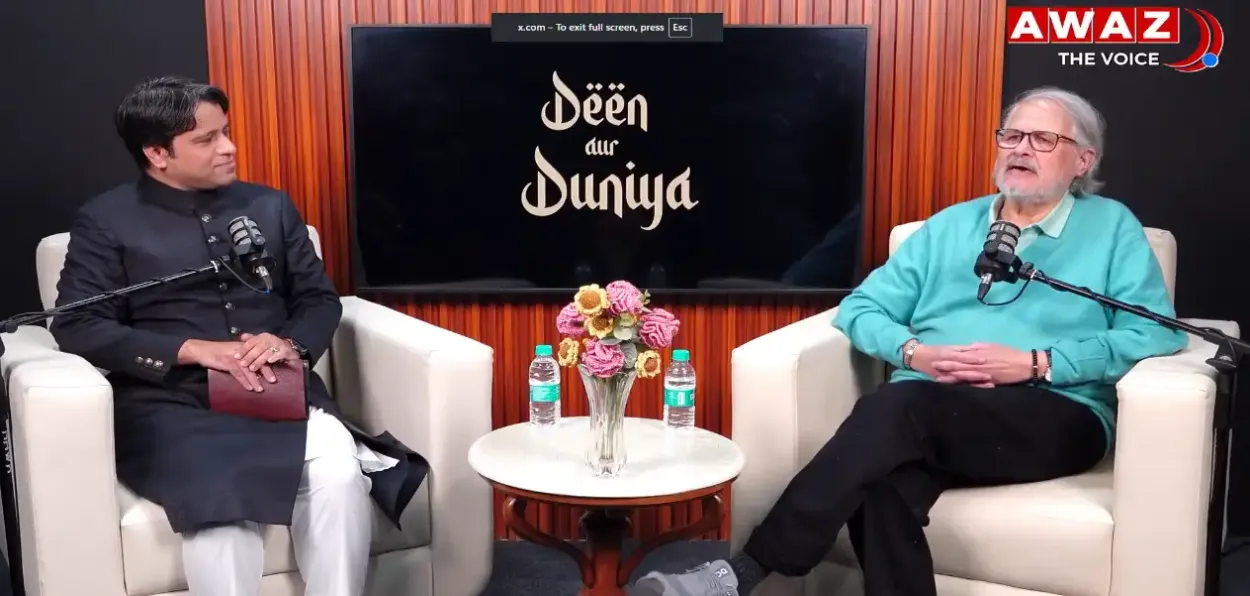
Saquib Salim and Najeeb Jung in Deen aur Duniya podcast
New Delhi :
The first episode of Awaz-The Voice’s new podcast series “Deen aur Duniya” was launched on Saturday evening. The programme has emerged as a serious attempt to understand and bridge the perceived divide between deen (faith) and duniya (society and civic life) within the Indian Muslim community.
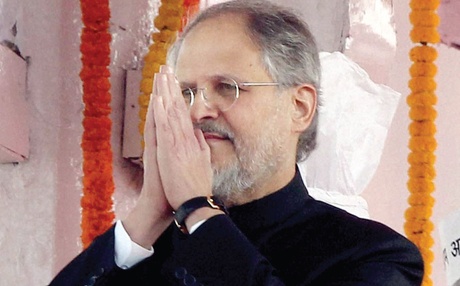
The clarity, balance, and intellectual depth of the very first episode firmly established the podcast as a meaningful platform for thoughtful dialogue. The inaugural guest has Najib Jung, former Lieutenant Governor of Delhi, former IAS officer, and former Vice Chancellor of Jamia Millia Islamia, speaking candidly on crucial issues concerning Indian Muslims, democracy, education, and the Constitution to Saquib Salim.
At the heart of the discussion was the question of the Indian Muslim community and the idea of the “mainstream.” Najib Jung challenged the very premise of this debate, asserting that Indian Muslims have never been outside the mainstream. In his words, “First, it is important to understand what this ‘mainstream’ actually means.
“When were we ever outside it? I am a resident of India, and I have always been part of the mainstream.” He said that in an ancient and pluralistic civilisation like India, considering any community as an outsider is itself a flawed notion.”
He described it as a major irony and tragedy that in the Indian Subcontinent, the minorities are not given their due and they face dicrimination.
Najib Jung believes that the Indian Muslim community needs to move beyond the misconceptions surrounding its own identity. He emphasised that Muslims must understand that their identity is not separate from the identity of the nation. Self-acceptance and self-respect, he said, are what give any community the strength to move forward.
Speaking about young Muslims with clarity andf firmly, he said today’s Muslim youth should not live with any complex. “If a Muslim youth today considers himself inferior, that is his own shortcoming, not someone else’s,” he said. According to him, if one’s patriotism is questioned or one is viewed with suspicion, the response should come through confidence, hard work, and conduct, not through complaints or a sense of inferiority.”
The discussion also touched upon the issue of atrocities against minorities in Pakistan and Bangladesh. On this, Najib Jung offered a measured response, saying it is completely illogical to expect Indian Muslims to answer for what happens in neighbouring countries. “No mature and sensible society makes such demands,” he said. He made it clear that if injustice or oppression occurs anywhere in India, raising a voice against it is the responsibility of the entire society, not of any single community.
While speaking on Indian democracy and its secular character, Najib Jung highlighted the concept of fraternity enshrined in the Preamble of the Constitution as the most crucial element.
He said fraternity is even more important than secularism because it is what binds society together. “Fraternity means moving forward together, and that is the soul of our Constitution,” he noted. According to him, India’s freedom struggle was the result of a collective effort, and the rights enshrined in the Constitution are equal for all citizens, irrespective of religion, caste, or social background.
On the issue of education, Najib Jung’s concern and vision appeared both broad and thoughtful. He said education should not be limited to degrees or technical skills alone. Expressing concern over changes in history textbooks, he warned that incorrect history can mislead children’s thinking and shape their personalities in the wrong direction. Education, he stressed, should aim to develop the ability to think and reason, with subjects like history, philosophy, and sociology playing a vital role.
Referring specifically to the Muslim community, he described the growing awareness around education as a positive sign. He said that today the community is far more conscious about the education of its children than before, whether in government schools, private institutions, or madrasas. The changes taking place even in rural areas, he added, offer hope for the future.
Discussing the economic and social situation, Najib Jung observed that slow but visible change is taking place within the Muslim community. He noted that a large number of Muslim youth are now moving into medicine, engineering, and other professional fields. While acknowledging that economic hardship remains a major obstacle, he said the desire to progress is clearly evident within the community.
On the role of the government, he said that serious and concrete affirmative action is required to address the social backwardness of the Muslim community. He expressed regret that the necessary seriousness has not been shown in this direction so far. Just as special policies were formulated for Dalits and other marginalised sections, he said, there should be well-planned efforts for the Muslim community as well.
See the Full Podcast here:
Towards the end of the programme, Najib Jung delivered a positive and inspiring message. He said Muslims must learn to stand on their own feet, a process that has already begun over the past one-and-a-half to two decades. From small businesses to higher education, the community is striving to carve out its space.
He emphasised that unless a community becomes economically and socially empowered, it cannot assert its demand for equal rights with strength.
source: http://www.awazthevoice.in / Awaz, The Voice / Home / by Saqib Salim / January 18th, 2026