Tag Archives: Professor Farhat Basir Khan

Media innovator Farhat Khan joins global film powerhouse IIFSA as fellow and Astar award council member

Gorakhpur, UTTAR PRADESH / NEW DELHI :

Prof. Farhat Basir Khan (image outsourced)

India’s media innovator Farhat Khan joins global film powerhouse IIFSA as fellow and Astar award council member. Here is the report:

As the global film industry increasingly embraces innovation at the intersection of art, science, and education, an Indian academic has been named to one of its most distinguished international institutions.  Prof. Farhat Basir Khan has been elected a Fellow of the International Institute of Film Science and Art (IIFSA) and appointed to its Astar Award Council, becoming the first Indian to hold both positions.

The dual appointment represents a significant moment for India’s academic and cinematic communities. It signals the growing international recognition of India’s contributions to the evolving landscape of film theory, media education, and technological storytelling. As IIFSA prepares to host its inaugural Astar Awards in Bangkok on August 27, and expands its global academic alliances across Europe, North America, and Asia, Khan’s appointment places an Indian voice at the core of international decision-making on the future of screen culture.

The role is more than symbolic. The Astar Council will shape the vision and execution of one of the most anticipated new global awards in film and media innovation. The ceremony will convene leaders from across creative, academic, and technological fields, recognising those redefining what it means to tell stories in the digital age.

Based in New York City, IIFSA is a globally respected think tank advancing the integration of cinematic art with scientific and technological exploration. Its current roster of Fellows includes some of the most influential figures in the field: Demetri Terzopoulos, Oscar Technical Award winner and a pioneer in visual computing; Prof. Patricia Pisters, a leading theorist on neuro-cinema; and George Huang, the UCLA professor whose screenwriting work has shaped Hollywood’s narrative landscape. IIFSA’s initiatives range from academic research and policy reports to cross-continental educational reforms and interdisciplinary artistic collaborations.

Prof Farhat Khan’s journey to this global stage is built on decades of educational innovation. He was instrumental in developing the academic and technical foundation of the AJK Mass Communication Research Centre at Jamia Millia Islamia, now considered among the premier media schools in Asia. Farhat Khan portfolio includes the creation or restructuring of over 24 academic programmes, the establishment of 12 media production labs across Indian institutions, and the launch of the Department of Design and Innovation in 2021 , an interdisciplinary space focused on storytelling, technology, and civic engagement.

Currently heading the Centre for Media and Mass Communication Studies at Jamia Hamdard, Farhat Khan continues to influence media education with an emphasis on accessibility, innovation, and purpose-driven communication. His work extends far beyond the classroom: initiatives like Photos4Peace, ChitthiAayi Hai, and Votography have used visual storytelling as tools for public awareness, democratic participation, and social change.

Farhat Khan also led the Indian student team that won the country’s first Sony World Photography Award (Student Focus category) at Cannes in 2009, competing against teams from around the globe, a milestone still regarded as a turning point in India’s international visual arts recognition.

Farhat Khan election to IIFSA’s Fellowship and Council reflects the organisation’s emphasis on inclusive, global, and interdisciplinary leadership. As IIFSA seeks to shape the next era of cinematic practice and education, perspectives from emerging and underrepresented regions are being brought to the centre of the conversation ,and Khan’s presence plays a key role in that realignment.

Far from being a personal accolade alone, this appointment points to a broader shift: the recognition of India not only as a consumer or producer of cinema, but as a thought leader in how visual narratives will be conceived, taught, and experienced in the years to come.

source: http://www.theokhlatimes.com / The Okhla Times / Home> JMI-Edu / by The Okhla Times / August 08th, 2025
Adv. Raees Ahmed, Others Honoured with Watan Ke Ratan Award 2024

NEW DELHI:

Ashfaq, Bismil wanted discrimination-free democratic country: Qamar Agha

New Delhi :

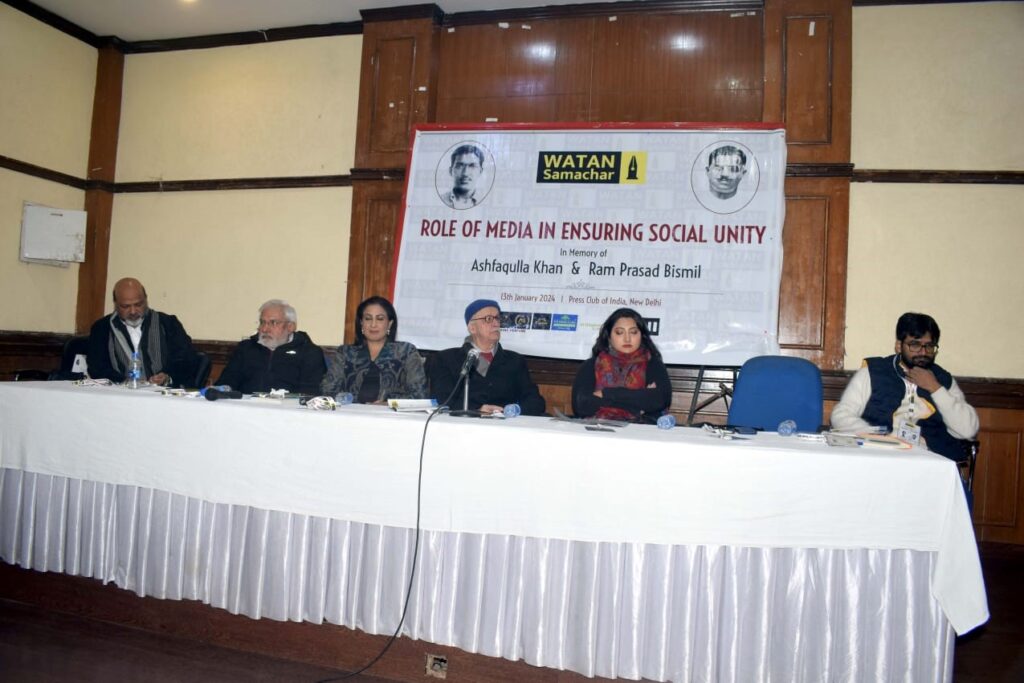
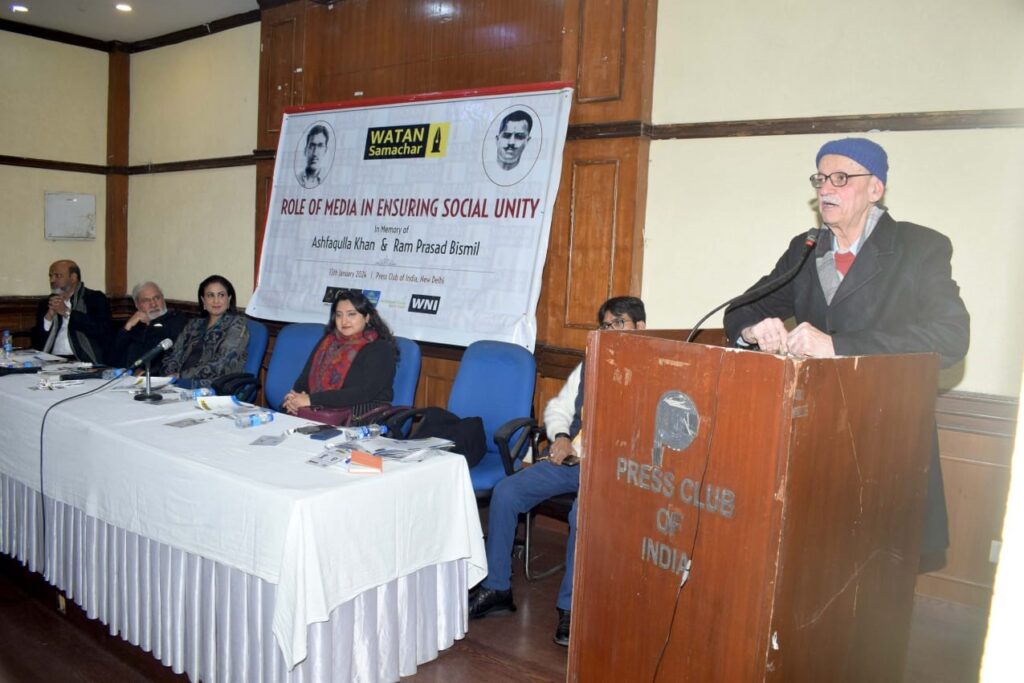
WNI Media Group organized a conference on Role of Media in Ensuring Social Unity in the memory of great freedom fighters Shaheed Ashfaqullah Khan and Ram Prasad Bismil at the Press Club of India here. A large number of dignitaries as well as renowned journalists, social workers and lawyers participated in the conference.

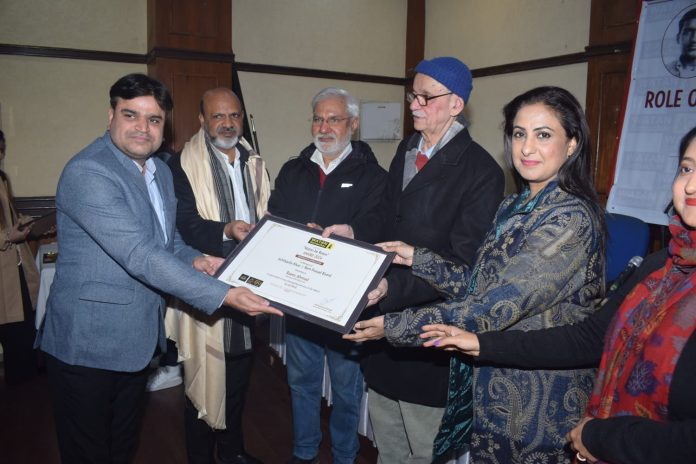
Senior journalists Rahul Dev, Qamar Agha, TV9 Bharatvarsh anchor Sumera Khan, India Today journalist Milan Sharma jointly honored Delhi Minority Commission Advisory Committee former member and Advocate Raees Ahmed with the ‘Watan Ke Ratan’ Award for 2024 for his social and legal services.

Qamar Agha said Ashfaq and Bismil wanted a non-partisan and democratic country. Journalist Rahul Dev said given the current situation that the disease will have to be talked about only then treatment will be possible.

Milan Sharma said hatred spread in the society will be cured through joint efforts. While, Sumera Khan termed the efforts of the Forum as a commendable step.

Advocate Raees Ahmed said that it is important to maintain our mutual brotherhood and unity strongly. We should try to remove misunderstandings and dispute, for which we need to take the help of mutual dialogue, only then society will be free from hatred.

Senior journalist Mohammad Ahmed convened the program.

Professor Farhat Basir, Dr. Zubaidur Rahman alias Babban Mian, Jamal Ahmed Alig, Firoz Ghazi, Neha Garg, Muhammad Akbar, Syed Muhammad Mujahid Hussain, Muhammad Ramish, Asad Sabri, Advocate Anwar Hussain Saifi, Mirza Anwarulhaq Baig, Hunaiza Khan, Jyoti Yadav, Dr. Syed Muhammad Asdar Ali, Shahid Ansari, Vipul, Muhammad Ali, Arshita, Asrar Ahmed, Iqrar Ahmed, Bhavana Yadav, Vakil Aslam (Supreme Court), Haji Zahoor Ataichi Wale, Nisar Ahmed, Nawab Akhtar, Shahnawaz Badar Qasmi, Dawood Bhai Shaikh, Shadab Ahmed Patrika, Aqeel Salmani, Archana Gaod and others were also honored with the Watan Ke Ratna Award- 2024.

Aslam Ahmed Advocate of Supreme Court on record extended vote of thanks.

source: http://www.radiancenews.com / Radiance News / Home> Pride of the Nation> Awards / by Radiance News Bureau / by Shakilur Rahman / January 15th, 2024

From her perspective

Gorakhpur, UTTAR PRADESH  / NEW DELHI :

Celebrating works of female photographers, an exhibition was mounted in New Delhi’s Indira Gandhi National Centre for the Arts

You would be familiar with the ‘male gaze’, a term coined by feminist critic Laura Mulvey, which states that the point of view of almost all cinema or photograph is masculine. But if one pays attention to the recent trend in photography, women are actually taking back the gaze. Female gaze can be ascribed to anything photographed by a woman and in that process frees females from the “male-constructed” photographs that have developed an image of femininity in our minds throughout the history of image making.

Similar themes were central to Prof. Farhat Basir Khan’s recently concluded exhibition Feminography at the Indira Gandhi National Centre for the Arts, which was the result of his observations and curated work of female photographers which includes media practitioners, teachers, scholars, writers, mothers and daughters.

On the rationale of holding an exhibition based on women’s perspective of the world, Prof. Khan, who also teaches photography at MCRC, Jamia Millia Islamia, said: “Feminography celebrates the work of women in India and their journey of both being and becoming a woman. It is a narrative of the people, places and spaces, and the relation women shares within it, which is shot through the lens.”

Prof. Khan is happy that more and more women are now asserting their position through social media platforms like Instagram and the broader perspective on the way we look at the woman is changing through it. It is also reflected in the shifting of many institutional magazine’s portrayals of women, which are now showing them as a character in a visual narrative, not as an object of desire.

Transcending barriers

Nitisha Malick takes inspiration from urban eccentricities and captures the connection with the wilderness in her picture Maids Of Gurgaon. “I wanted to show the emotions of those women who live in the shadows of modern cities but their life is still very far from development,” said Mallick, while explaining her work. In an another picture, she explored the contentment of a girl despite all hardships and challenges in her life. All images shown were powerful stories of cities andspaces that women photographers inhabit and the barriers that they transcend.

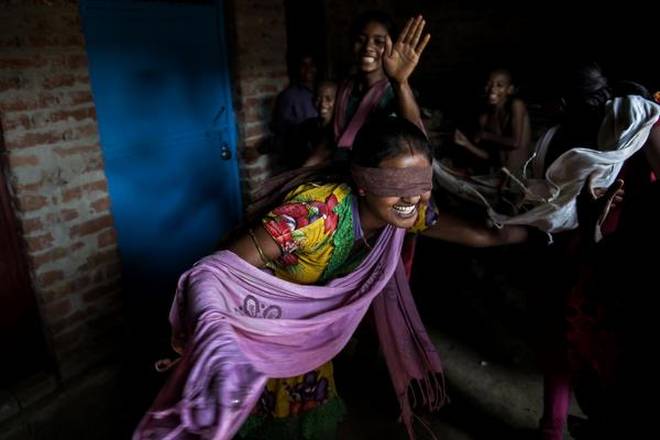
FROM HER PRISM Saumya Khandelwal’s “Child Bride in Shravasti”

Some were independent memories shot with a half smile; others with grit and determination, still others with a gentle non-abrasive press of a shutter. Saumya Khandelwal’s “Child Bride in Shravasti”, questions the life of young married girls yet reflects the happiness that they have built for themselves. “The subjects in the works includes forms and textures – the mundane and the ordinary which is transcending them into works of art to frame, admire and cherish,” concluded Prof. Khan.

source: http://www.thehindu.com / The Hindu / Home> Entertainment> Art / by Atif Khan / January 04th, 2017