It was a cold day in February 2016. A woman from a small town of Uttar Pradesh received her Ph.D. at the 63rd Annual Convocation of Aligarh Muslim University (AMU), Aligarh. She was the first from her clan to have taken admission to AMU in 2003. Her parents never attended college; her four brothers took up family businesses at a younger age. The woman in the discussion is me. I am Mahino Fatima, a Muslim girl from a backward caste who became a scientist against all odds.
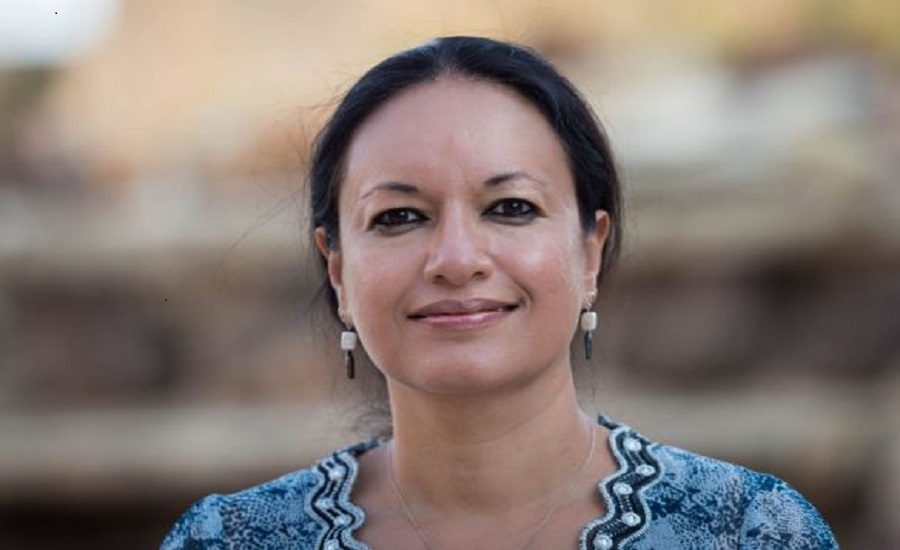
pix: heritagetimes.in / Dr. Mahino Fatima
Friends, relatives, and peers celebrated my becoming a scientist as a consequence of my hard work and perseverance. In my heart of hearts, I knew this day has not come only because of me; I was grateful for the privilege of education that I was born with.
Most importantly, I should not forget Fatima Sheikh. If not for her, I would never have become a scientist. Lakhs of women who are successful because of education would have remained illiterate but for Fatima Sheikh’s pioneering work.
How can I, a woman, forget that my foremothers were not allowed to learn how to write? How can I, a backward caste woman, forget that my forefathers were not allowed to receive an education? Today, when we look at our curriculum, we find that women scientists, economists, philosophers, and intellectuals are negligible in comparison to men. Famous philosopher, Jaques Derrida, once remarked that no woman was a philosopher. His observation was true, but he did not delve into the reason. How can a woman become a philosopher when men for centuries controlled the development of her intellectual capacities in the name of culture?
In our society, men would not let women learn the art of writing for the fear that if literate these women would communicate to ‘lovers’ through letters. Bibi Ashraf, a late 19th-century educationist, recalled how she was not allowed to learn reading and writing like male members of her family. She secretly learned to write. The secret came out when during the revolt of 1857; she had to write a letter to her father and uncle. Instead of receiving accolades, she was abhorred by men in her family. Her uncle was furious and made her take an oath that she would never write a letter to a man. Similar was the story of Rassundari Devi, who secretly learned writing by stealing books from her son. How do we expect women scientists in such a society? Still, a large section of our society would not let women study more than what is needed in the ‘marriage market’.
In this society, Fatima Sheikh, along with Savitribai Phule, started a school for girls in 1848. Yes, 1848. 26 years before Sheikh Abdullah, who later founded a women’s college at Aligarh, and 32 years before Begum Rukaiya Sakhawat, doyen of women education, were born, Fatima had started a girls’ school and taught herself. Today, that small classroom of 9 girls has prepared lakhs of educated women.
Today women are asking for gender parity in opportunities and pay scales. Thanks to Fatima, women today are educated to understand their worth and assert their rights.
Fatima was a pioneer; she was followed by Begum Rukaiya, Begum Wahid, Muhammadi Begum. A revolution starts with an idea. Fatima’s was the idea that put women of India in general and Muslim women in particular, on the march to empowerment through education.
Today, I thank Fatima for making me a scientist. Nobody knows how many bright women before 1848 had been deprived of education and were not allowed to dream of becoming a scientist. But, we surely know that after 1848, women have slowly entered different fields through education and are today competing with men to have their rightful place in the books, laboratories, and society.
(Author is a neurobiologist with her major research on depression and Alzheimer’s)
source: http://www.awazthevoice.in / Awaz, The Voice / Home> Stories / by Mahino Fatima / Saquib Salim / January 09th, 2022
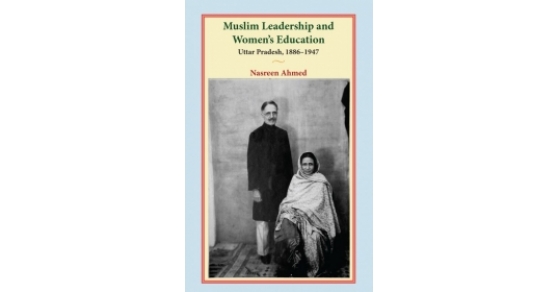
By Nasreen Ahmed / First Edition Pub. October 2012, x+190 pages, 8.5 x 5.5 in. / ISBNs: 978-81-88789-82-5
This is a broad study of the efforts at modern education for Muslim women, especially with reference to the Aligarh Movement and the initiatives inspired by it in other parts of UP, namely Lucknow, Allahabad, Rampur and Agra. The role of Muslim leaders, both male and female, the nature of the problems they encountered and the manner in which they countered them is the major thrust of this study. In the process we are introduced to the major debates on women and education during the course of late nineteenth and the first half of the twentieth century.
The author breaks many stereotypes as we learn that it was the more traditional among the Muslim leadership, rather than the ‘modernisers’, who pioneered women’s education and that Muslim women themselves played a major role in nurturing the first institutions under their personal care.
Based on an extensive range of primary sources and contemporary writings in English, Urdu, Hindi and Persian, this is a definitive work in many ways, gives food for thought on developments other than its main theme and will be useful to those concerned with women’s studies, social reform, education and modernity in colonial India, particularly with reference to Muslims.
CONTENTS
Muslim Women’s Education in the Nineteenth Century: A Study of the Traditionalist Attitudes
Efforts for the Education of Muslim Women, 1857-1885
Aligarh Movement and Muslim Women’s Education, 1875-1902
Female Education Section: Early Discussions, 1896-1904
A School for Muslim Girls at Aligarh
From Female Normal School to Muhammadan Girls’ School, 1906-1910
A Degree College Managed by the University
Establishment of Schools by Other Indigenous Efforts: Lucknow, Allahabad, Rampur and Agra.
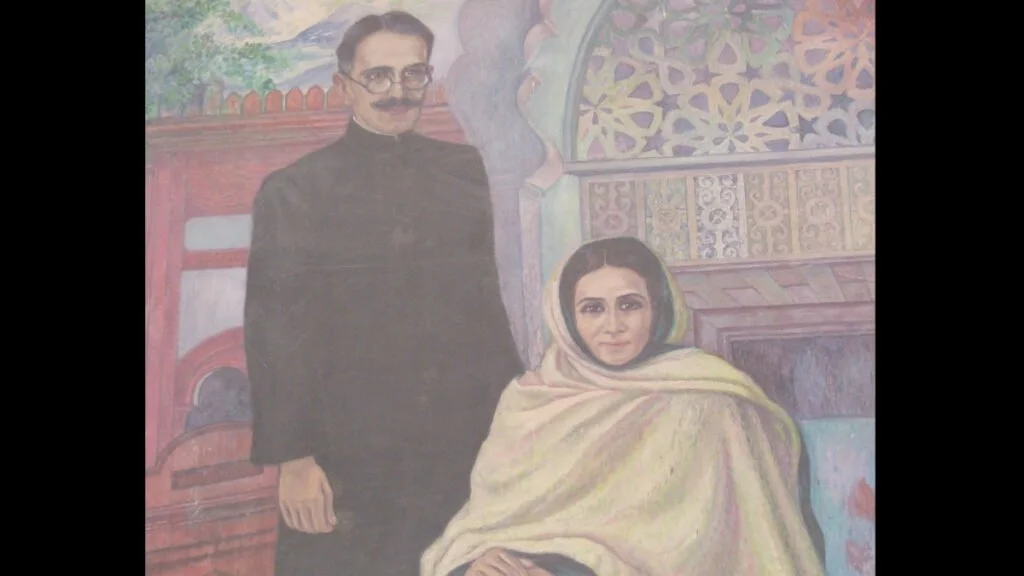
Cover photo: Papa Mian (Sheikh Abdullah, 1864-1965) and Waheed Jahan Begum (1884-1939), founders of the first school for Muslim girls in Aligarh. Back cover: Carriage used to bring girls to school, accompanied by a female escort. (1923)
Nasreen Ahmed
Nasreen Ahmed (1954-2009) studied at the Aligarh Muslim University and later taught at the Karamat Husain College, Lucknow.
She is a pioneer among historians on concerns of Muslim women’s education, as her early essays on the theme published in the late 1970s show. Thereafter she presented her work at various national conferences and seminars. Her studies are rich in sociological data: she records a great deal that feminist scholars writing on Muslim women today have missed. She is author of many research articles published in the Proceedings of the Indian History Congress, a journal of frontier scholarship in history.
source: http://www.threeessays.com / Three Essays Collective
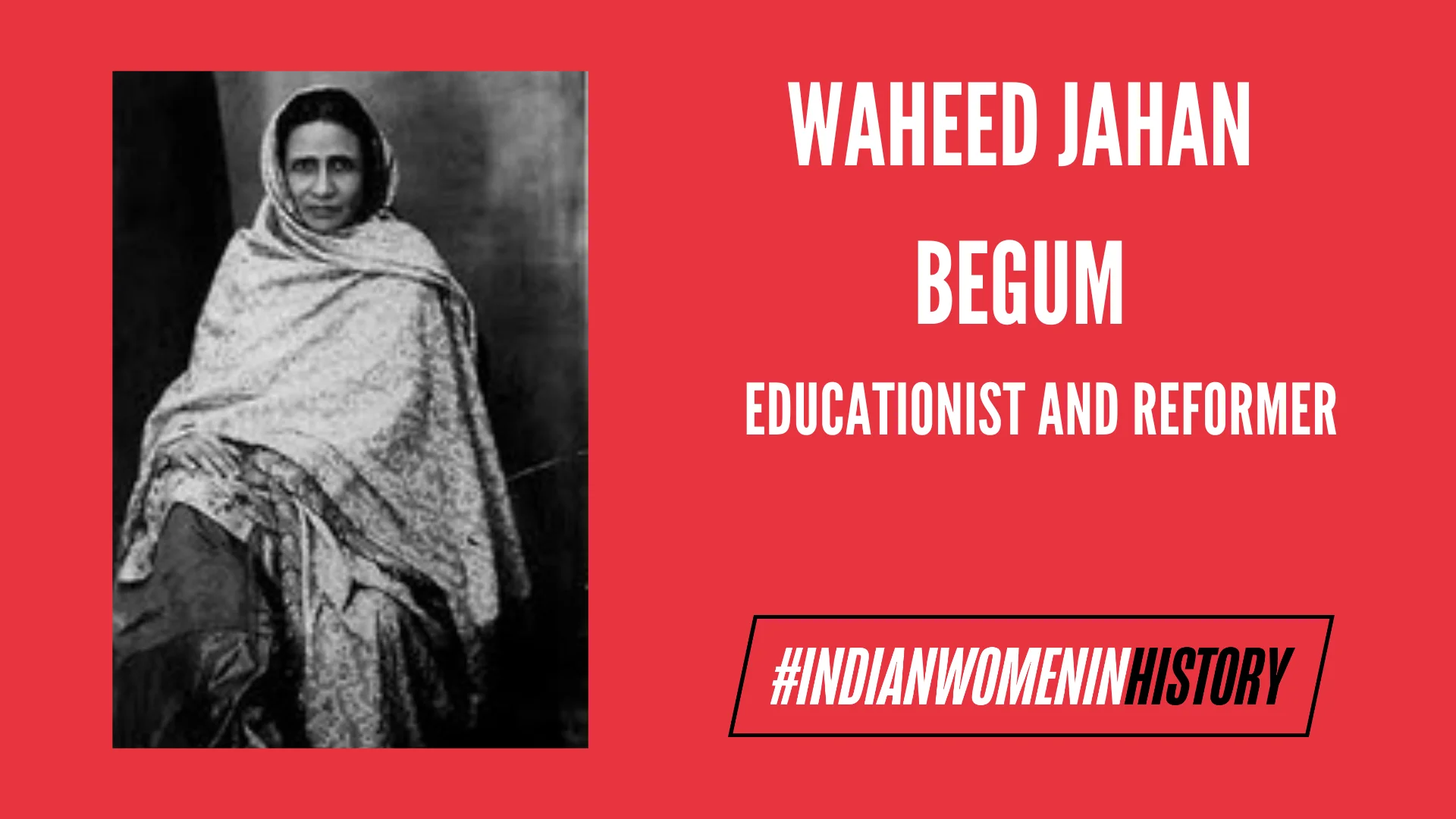
In a time when women were relegated to the home and the hearth, and their dreams resigned to those of little other than a committed marriage and devout motherhood, Waheed Jahan Begum proved that women could want more for themselves.
Throughout India’s modern history in the struggle for women’s rights, many Indian reformers have gravitated towards upholding the crusade for women’s education as their foremost priority. For the everyday individual, the topic of women’s education tends to bring to mind a few notable Indian reformers who fought for women’s rights to pursue an education, albeit the large majority of these names are of men.
Throughout India’s modern history in the struggle for women’s rights, many Indian reformers have gravitated towards upholding the crusade for women’s education as their foremost priority. For the everyday individual, the topic of women’s education tends to bring to mind a few notable Indian reformers who fought for women’s rights to pursue an education, albeit the large majority of these names are of men.
Jyotirao Phule’s wife, Savitribai, was responsible for opening the first school for girls in the Indian subcontinent, yet her contributions and accomplishments are often accredited to their union than to her alone, and she is often overlooked for her importance to the movement while her husband is remembered by history as one of the leading reformers for it.
Similarly, in the union between Sheikh Abdullah and Waheed Jahan Begum, we see an identical dichotomy emerge as the husband rises to prominence for his contributions to women’s rights movements, while the wife is remembered only as his counterpart, or inspiration.
Source: Book Women Education by Dr Nasreen Ahmad
Today we understand the importance of education in the lives of modern women, as a means to achieve financial independence in a patriarchal set-up that favours women as being financially dependent on their fathers, and later, their husbands. But despite the well-established variety of schools and colleges for women we have in India today, it was not always as such and the story of the path to women’s education would be incomplete without the role played by Waheed Jahan Begum.
An early educator
Waheed Jahan Begum was the youngest daughter born to Mirza Mohammad Ibrahim Beg, a minor municipal official, in a landholding family from Delhi in 1874. Though she did not have the means to pursue formal schooling, her father personally ensured she would be fluent in Urdu and Persian, while also hiring English tutors to provide her with an understanding of arithmetic and elementary English.
She subtly began to implement her lifelong dream to start a school for girls in her surroundings growing up, by gathering up the houseworkers’ children and teaching them. Through this method, she succeeded at establishing one of the first concerted efforts at providing girls with an education in a group setting, akin to a school. She attempted to make education accessible to girls within her locality, regardless of their background, at a time when few others were able to say the same.
In one simple gesture, she managed to lay down the foundations upon which she built her career from the ground up.
Source: Aligarh Muslim University
But as a single Muslim woman in the Indian subcontinent, it would have been nearly impossible to single-handedly bring about concrete change.
Sheikh Abdullah, however, was a Kashmiri lawyer who was a prominent leader in the Aligarh Movement, which encouraged the Muslim youth to pursue a modern English education. Though many in the movement rejected Muslim women’s right to an education as well, Sheikh Abdullah represented one of the few men in the movement who was outspoken regarding the need to educate girls and women. This made him a suitable candidate for Waheed Jahan Begum to partner with in her pursuit of fighting the cause for women’s education. They also later had five daughters and a son together.
Creating a class of well educated muslim women
On marrying Sheikh Abdullah, Waheed Jahan Begum encouraged him in his quest to appeal to the issue of women’s education to the masses. Together, the couple concluded that female teachers needed to be trained to impart education to young girls.
While Sheikh Abdullah took up the matter of women’s education in front of the Muslim Education Conference and was subsequently elected secretary of the Female Education Section, Waheed Jahan Begum became editor of an Urdu monthly, Khatoon, that the couple began publishing in 1904 to further the cause of women’s education. Additionally, they opened a primary school for the elite populace of Muslim girls.
Waheed Jahan Begum also hosted meetings among educated Muslim women from across the country to champion the advantages and benefits of women’s education in the country, consequently securing funding for establishing a girls’ school.
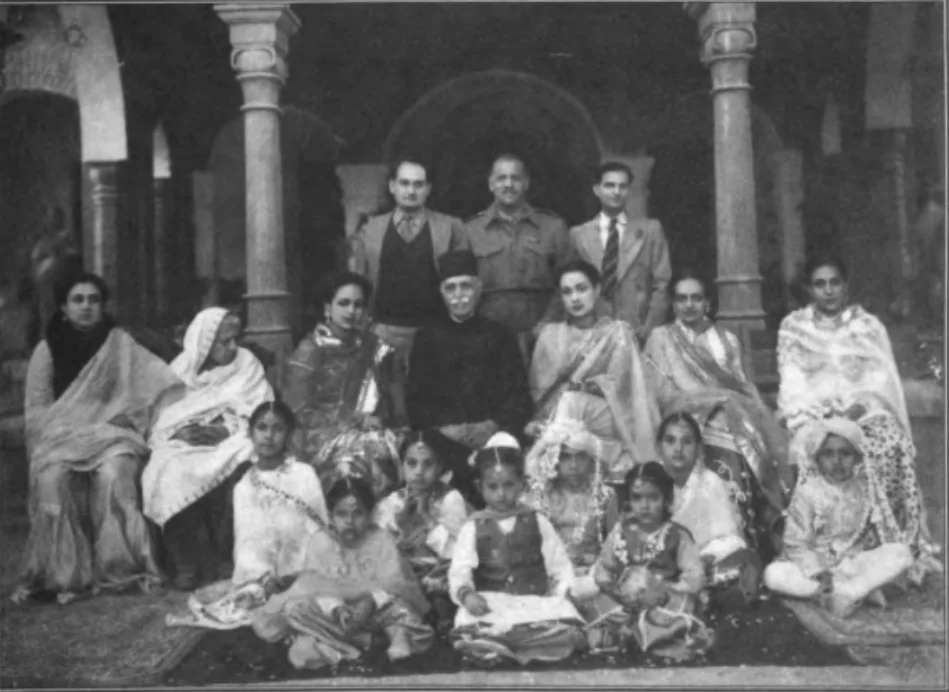
Sheikh Abdullah with his daughters, son-in-law and grandchildren
However, Waheed Jahan Begum’s secular approach to women’s education growing up proved to be difficult to maintain going forward into her professional life as her lifelong goal to establish a school for girls proved to be a challenge amongst those in charge.
As when the couple then moved on to start a primary school for girls on various disciplines relevant to the education of Muslim women, including Urdu, the Quran, arithmetic, and needlework, it was restricted to the daughters of elite families who could afford to educate their girls. Additionally, though the school opened with only seven students in 1906, it grew over the years to accommodate around a hundred students in 1909.
This, however, did not come without its societal dangers, as the girls enrolled in the school faced harassment from the local boys and men in the process of travelling from their homes to the school in curtained carriages. This led to their families pulling them out of school once they reached puberty.
To counteract the threats posed to the girls in their travels, the couple then proceeded with, and succeeded at, pushing for the opening of a boarding school for girls. Leaving her children to be overseen by houseworkers’, Waheed Jahan Begum committed herself to establish the boarding school within the paradigm of a family structure, taking care of each of the girls enrolled in the boarding school as though they were her daughter.
From personally overseeing each aspect of the daily lives of her pupils regarding housekeeping, laundry, and shopping, she would even go as far as inviting the families of the girls to stay in the hostels for a few days to assure them of the safety of the boarding school and to secure their trust.
In addition to such measures, strict purdah was enforced in the form of walls built around the facility to garner social acceptance from the Muslim elite, though both husband and wife agreed on the restrictive nature of purdah. Their battle for women’s education was riddled with compromises and concessions made which reveal the complexities of the arena of women’s education within the given historical context, as families would assign greater value to their daughters’ “honour” than their education as the former kept them marriageable. The latter held little weightage to their prospects in the market.
A legacy to look upto
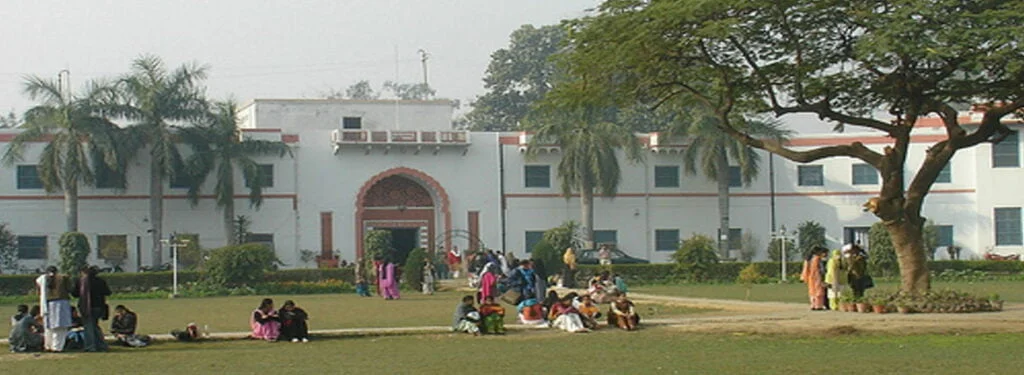
By the time Waheed Jahan Begum passed away in 1939, the boarding school had developed into a women’s college which offered several degree courses.
Waheed Jahan Begum turned her dreams into reality, by handing down the gift of education to a new generation of Muslim women, with the women’s college she opened with her husband now boasting a strength of around 40,000 students and counting. Students travel from across the world to study at the college she opened back in the days when even moderately educated women were few and far between.
Source: Aligarh Muslim University
To have achieved such a lasting change in the sphere of women’s education is no small feat, and while it is bleak to confront how little ability women have to bring forth a change within their material reality without the support of the progressive men in their lives, such as their husbands or fathers, it would altogether be impossible to bring to fruition without the hard work of inspiring women such as Waheed Jahan Begum.
She paved the way for the first steps to be taken in the emancipation of Muslim women in the Indian subcontinent, she believed in the power of education as a stepping stone to liberation from traditionalism which would have women confined to the knowledge of the four walls of their husband’s home and little of the vast world that lay beyond.
As a woman who sacrificed so much of her freedom to dedicate her life to striving for the progress of future generations of Muslim women, she is deserving of recognition beyond her role as a supportive and ingenious partner to Sheikh Abdullah as he set the wheels in motion for women’s education within Muslim society at large.
In a time when women were relegated to the home and the hearth, and their dreams resigned to those of little other than a committed marriage and devout motherhood, Waheed Jahan Begum proved that women could want more for themselves, and for women at large, by leaving their mark on history in their words and actions, to inspire and leave room for future generations of women to add on to their legacy and change the world we live in, bit by bit.
source: http://www.feminisminindia.com / Feminism in India – FII / Home / by Tanya Roy / January 13th, 2023
Amar Sohal’s ‘The Muslim Secular’ is a compelling exploration of ideas, identities, and legacies that takes you on a scholarly journey that traverses the intricate terrain of India’s struggle for Independence and its subsequent partition through the lens of three influential Muslim leaders: Maulana Abul Kalam Azad, Khan Abdul Ghaffar Khan, and Sheikh Abdullah.
Photo: Getty Images
Amidst the dynamic sociopolitical landscape of the subcontinent, the Muslim community grapples with multifaceted challenges, navigating issues of identity, representation and political agency. It is against this backdrop that Amar Sohal’s book ‘The Muslim Secular: The Parity and Politics of India’s Partition’ emerges as a pertinent exploration.
Sohal embarks on a scholarly journey that traverses the intricate terrain of India’s struggle for Independence and its subsequent partition through the lens of three influential Muslim leaders: Maulana Abul Kalam Azad, Khan Abdul Ghaffar Khan, and Sheikh Abdullah. This meticulously crafted work not only delves into the historical narratives surrounding these figures but also navigates the complex intersectionality of religion, politics, and regional identity, offering readers a profound and nuanced understanding of a pivotal period in South Asian history.
Sohal’s narrative unfolds with the exploration of Azad’s vision, which significantly departs from conventional perspectives. Azad, rather than emphasising a stark dichotomy between Hindus and Muslims, envisions a shared Indian nationality rooted in historical evolution. His integrationist stance grapples with the challenges of sectarian antagonism, weaving a narrative that transcends the simplistic notions of religious division. Sohal adeptly captures Azad’s dynamic response to historical exigencies, portraying him not merely as a religious leader, but as a visionary navigating the multifaceted socio-cultural landscape of India.
The focus then shifts to Ghaffar Khan, a transformative figure whose reinterpretation of the Muslim Pashtun warrior archetype challenges prevailing stereotypes. By divorcing bravery from violence, he introduced an ethical dimension to the pursuit of freedom. Sohal meticulously unravels the intricacies of Ghaffar Khan’s advocacy for a symbiotic relationship between Muslim Pashtuns and Hindu Hindustanis. The book doesn’t shy away from the complexities of Ghaffar Khan’s engagement with the post-Partition referendum in Kashmir, illuminating the enduring impact of his ideas on regional political dynamics.
Amar Sohal’s book ‘The Muslim Secular: Parity and the Politics of India’s Partition’
Abdullah emerges as another pivotal figure and Sohal meticulously traces the evolution of his perspectives on Kashmiri identity. Abdullah’s delicate balance between preserving the region’s distinctiveness and fostering unity with the broader Indian context adds layers of complexity to his political trajectory. Sohal deftly navigates Abdullah’s integrationist phase in later years, providing readers with a nuanced understanding of the man and his enduring influence on the Kashmiri political landscape.
What distinguishes ‘The Muslim Secular’ is its seamless transition between historical narratives and contemporary implications. Sohal draws intriguing parallels with the present, shedding light on how the legacies of Azad, Ghaffar Khan, and Abdullah continue to shape the political landscape. The comparison with the Pashtun Tahafuz Movement in Pakistan adds depth to the exploration of non-violence and symbiotic centre-region relationships, offering readers insights into the ongoing dynamics in the region.
Expanding the scope of the book, Sohal delves into the role of large Muslim-minority communities in Kerala, West Bengal, and Assam. These communities, constituting a significant portion of the population, actively resist the homogenising efforts of the Bharatiya Janata Party (BJP) through sub-national political formations. Inspired by the integrationist visions of Abdullah and Ghaffar Khan, they navigate the intricate socio-political terrain, contributing to the overarching theme of the book. This expansion not only enriches the narrative but also provides a holistic understanding of how these visions transcend regional boundaries.
‘The Muslim Secular’ stands out as a seminal work that transcends traditional historiography. Sohal’s narrative is not only informative but also reflective, inviting readers to engage deeply with the complexities of India’s political trajectory. The book encourages a nuanced understanding of the legacies of Azad, Ghaffar Khan, and Abdullah, urging readers to contemplate their enduring impact on the current socio-political milieu.
In conclusion, ‘The Muslim Secular’ is a compelling exploration of ideas, identities and legacies. Sohal’s nuanced and insightful approach ensures that readers not only gain a profound understanding of the historical context but also appreciate the lasting relevance of these visionary leaders in shaping India’s political landscape. The book serves as an indispensable resource for scholars, historians, and anyone seeking a comprehensive understanding of the intricate interplay between religion, politics, and regional identity during a pivotal period in South Asian history.
However, it is imperative to recognise that the book might present challenges for the general reader, particularly in the initial sections. The narrative, laden with academic jargon and intricate historical details, necessitates a certain familiarity with the subject matter. While this scholarly depth undoubtedly elevates the work, it could potentially form a barrier for readers less acquainted with the nuances of Indian history and politics. Yet, for those willing to navigate this initial complexity, the reward is a profound and enlightening exploration that unveils the complex tapestry of India’s political evolution, offering insights that extend far beyond the pages of this thought-provoking work.
Sohal’s ‘The Muslim Secular’ not only adds scholarly richness to the discourse but also invites readers to confront and engage with the multifaceted dimensions of a crucial period in South Asian history.
(Saleem Rashid Shah is a literary critic and an independent writer based in New Delhi. He tweets at @SaleemRashid176. Views expressed are personal.)
source: http://www.outlookindia.com / Outlook / Home> Weekend Reads / by Saleem Rashid Shah / October 28th, 2023
Dr. Nyla Ali Khan has been appointed as a Commissioner on the Oklahoma Commission on the Status of Women. She has been appointed for a five-year term by Senator Greg Treat, who is President Pro Tempora of the Oklahoma Senate.
“The Oklahoma Legislature created the Oklahoma Commission on the Status of Women in 1994 to act as an advisory entity on equity issues relating to gender bias; monitor legislation to determine whether it is discriminatory toward one gender or the other; act as a resource and a clearinghouse for research on issues related to women and gender bias; report annually to the governor, president pro tempore of the Senate, and speaker of the House of Representatives regarding its activities and make recommendations concerning needed legislation or regulatory changes relating to equity and gender bias.”
Dr. Nyla Ali Khan is the first South Asian Muslim member of the Oklahoma Commission on the Status of Women. She said that as a member of the Oklahoma Commission on the Status of Women, she acts as a resource and provides expertise to the Commission. She provides research and information on societal violence and structural inequities that result from deep-rooted prejudices against women. Dr. Nyla Khan said, “The questions to which I seek to provide well-substantiated answers are as follows: How can we, as women, develop the ability to organize and mobilize for social change, which requires the creation of awareness not just at the individual level but at the collective level as well? How can we develop self-esteem for which some form of financial autonomy is a basis? How can we make strategic life choices that are critical for people to lead the sort of lives they want to lead? We require a quality education for these mammoth tasks.”
c.reddirtreport.com
source: http://www.caravandaily.com / Caravan Daily / Home> Indian Muslim / March 12th, 2019