Tag Archives: Zubair Rizvi

Zubair Rizvi lived and died glorifying Urdu language

Amroha, UTTAR PRADESH :
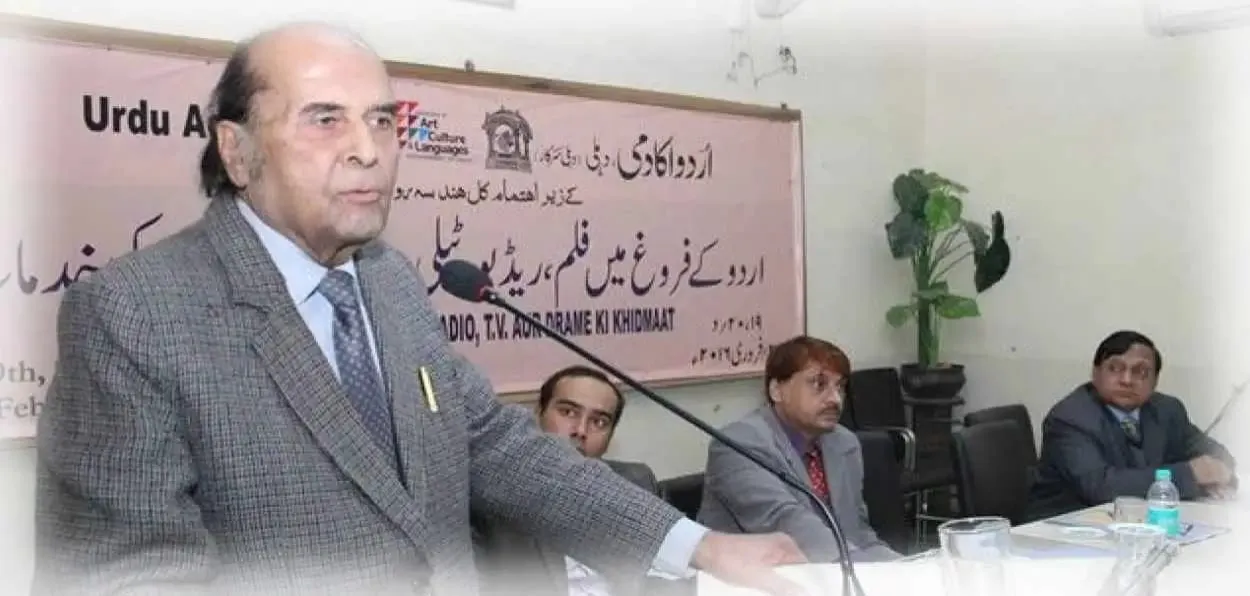
Zubair Rizvi speaking at a function of Urdu Academy

It was February 21, 2016. A seminar on Urdu was in progress in the Qamar Rais Hall of Delhi Urdu Academy of Delhi. The president of the Urdu Academy Zubair Rizvi rose to speak. He apologized for becoming emotional and said it was difficult for him to speak. Zubair Rizvi had been heading the Academy for 30 years and the audiences too it as the idiosyncrasy of a reputed poet. He left his speech midway and walked slowly to his chair and sat down in it. Rakim Numan, the chief guest, who was seated close to him found him feeling uneasy. He rose and rushed towards Zubair’s seat. Before he could pour water from his bottle to the doyen of Urdu litterateur, he had collapsed.

Majid Deobandi, vice chairman of the Academy immediately ran towards Zubair. People lifted him and rushed him to the hospital. A few minutes later Zubair Rizvi was declared dead.

The gem of a litterateur from Amroha, Uttar Pradesh, died working till his last breath and amidst fans and admirers. He was laid to rest the same day in his ancestral cemetery in Amroha.
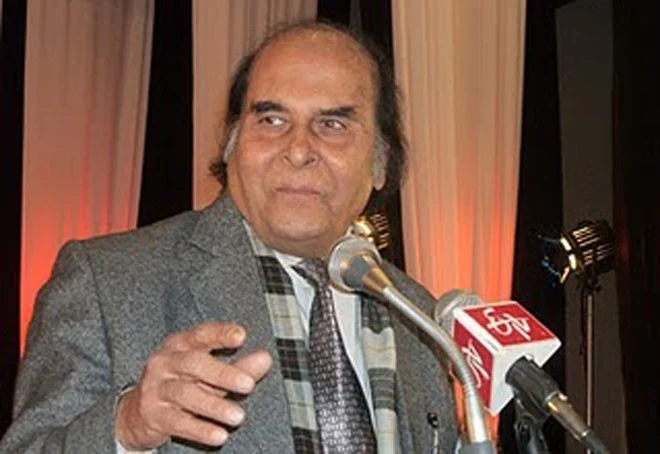
Zubair Rizvi

Zubair Rizvi was a writer par excellence. He was also the best scholar with an awakened consciousness about the literary heritage of Urdu. As a popular poet, he enjoyed adulation and cherished admirers. He made his mark as a successful poet in mushairas all over the world including India Pakistan, Canada, etc., and introduced a new tone to contemporary poetry. He was also a successful broadcaster and a staunch intellectual critic. During his days with the All India Radio, he was posted as Station Director of the Rampur station for some time.

One of his famous poems, Yeh Hai Mera Hindustan, which he read with gusto at many a Mushaira, not only gained great popularity among Urdu lovers but was also included in many textbooks.

Zubair Rizvi was born on April 15, 1935, in a scholarly family in Amroha, Uttar Pradesh; the atmosphere in his family was filled with religious and spiritual fragrances. His father Muhammad Rizvi and his mother Fahmida Rizvi were famous religious and scholarly figures.

A distinguished poet, Zubair donned many hats in his prismatic career: Broadcaster; Secretary, Urdu academy; Lecturer, Mass communication; Jury for AIR, Writer, and Magazine composer.

He began his career at the famed Hamdard Dawa-Khana, followed by a position as an interviewer, scriptwriter, and interviewer at AlR, Delhi where he interviewed celebrities such as Amitabh Bachchan, Dharmendra, Lata Mangeshkar, and Dilip Kumar.

He rose to the position of Director of Sports at AIR.
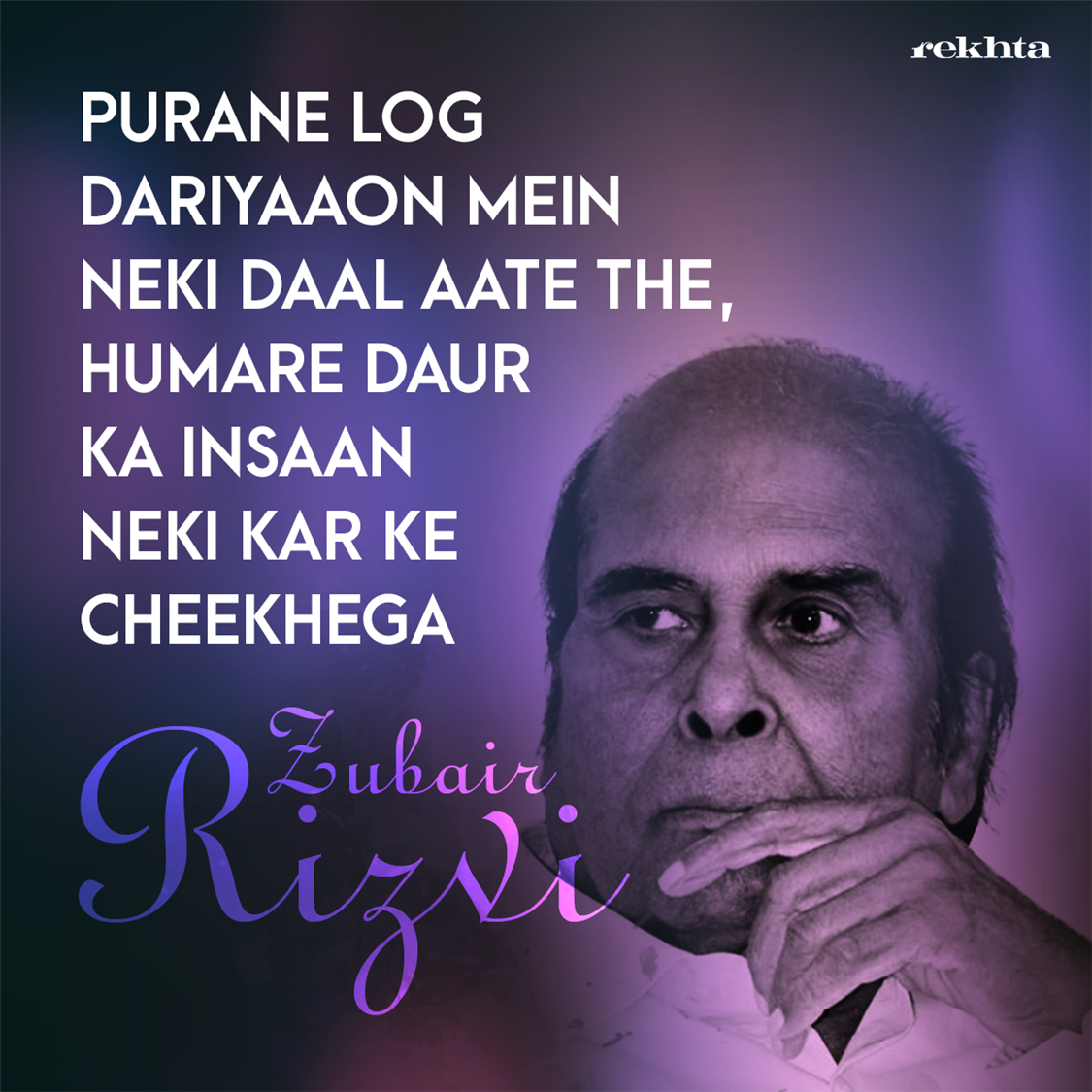
A sher of Zubair Rizvi 

A postgraduate of the Delhi University, Zubair Razvi, joined Urdu Academy, Delhi as Secretary after 30 years of service at All India Radio. He was the director of the Urdu Academy for two years, and during this time he did an incredible job of promoting and helping Urdu lovers learn the language. He held seminars on popular topics such as The Role of Urdu in Bollywood which was attended by Yash Chopra, Gulzar, and Farooq Shaikh to name a few.

He was appointed a member of many jury committees for script selection and also appointed as a guest lecturer in the Department of Mass Communication at Jamia Milia Islamia Delhi.

His journey as a poet started from Hyderabad at a very early stage; around the 1950s. He had the chance to share the stage with then-famed poets like Kaifi Azmi and Ali Sardar Jafri. Soon, he made a place for himself as an Urdu Poet. Be it critics or less-informed audiences, Zubair Rizvi is regarded very highly by both as an Urdu poet, writer, and a significant contributor to Urdu Literature.
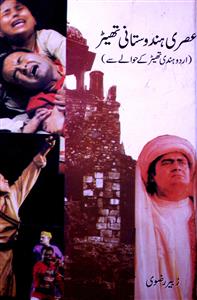
Cover of one of Zubair Rizvi’s books

In verse, he mainly tried his hand at Ghazal, Nazm, and Geet. He has over 17 books to his credit, some of the more important ones among these include, Lahar Lahar Nadiya Gahri (Collection of Poems), Khisht-e-Deewar, Musafat-e-Shab, Purani Baat Hai, Dhoop Ka Saibaan, Ungliyaan Figaar Apni, etc.

Two books have been written on his life and work and he has compiled and edited 24 books.

His remarkable contribution to the field of literature can be fathomed by the breadth of awards he amassed during his lifetime. These included: The All India Radio New Delhi- External Services Division Award; Sant Gyaneshwar National Award for the year 2009 by Maharashtra Urdu Sahitya Academy; All India Mushaira Award of Honor S.C.D. Govt College SAHIR Memorial Society Ludhiana (2002); Urdu Academy Delhi Award for Ghalib Aur Funoon-e-Lateefa; Consulate General Of India, Jeddah, Saudia Arabia- Certificate of Appreciation; Certificate for Sufi Studies-Maharaja Ranjit Singh Police Academy (2001); Karnataka Urdu Academy, Bangalore; Urdu Academy at Delhi Secretariat presented an award to his book Sang-E-Sada; Uttar Pradesh Urdu Academy, Lucknow Award for Sang-E-Sada (2014); National Council for Promotion of Urdu Language -World URDU Conference (2016).

As a poet, his beyond-the-borders following can be gauged by the different mix of mediums that his works have featured. A few of these special features include: Door Darshan Serial “Khali Haath”, written by Dr. Harikrishna Devsare, had Zubair Rizvi’s lyrics. In five Indian states, the NCERT Urdu curriculum has selected Zubair Razvi’s iconic patriotic song” Yeh hai Mera Hindustan, Mere Sapnon Ka Jahan Is Se Pyaar Mujhko” for school textbooks. He was also quite famous for his recitals and was invited to Mushairas in Asia, Canada, Europe, and especially America where he once performed in 15 different states in one tour.

Zubair Rizvi’s passion for Urdu was undying, and to spread this language of love to lands far and wide, he started the famous magazine Zehn-e-Jadid – Bari Zaban Ka Zinda Risala, which is now being published and edited by his wife Jamshed Jahan.

source: http://www.awazthevoice.in / Awaz, The Voice / Home> Stories / by Siraj Naqvi / December 12th, 2023
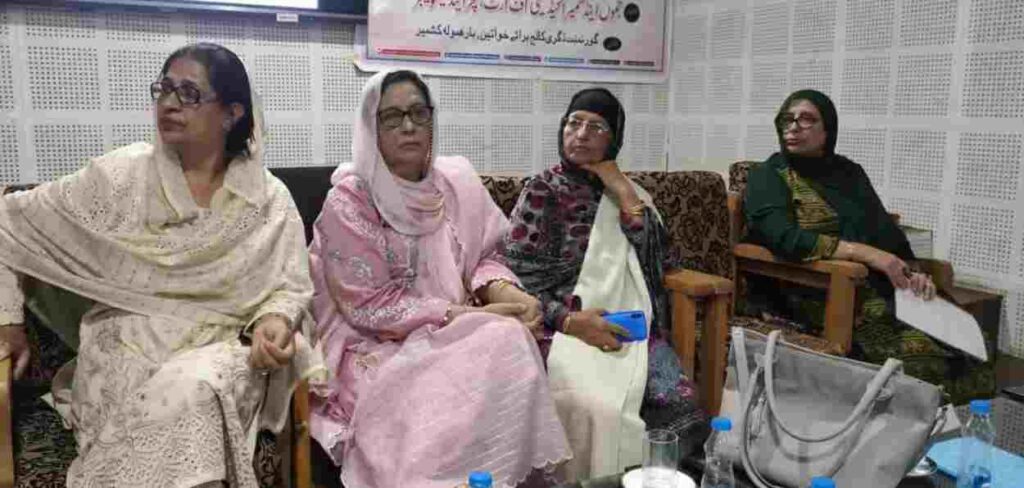
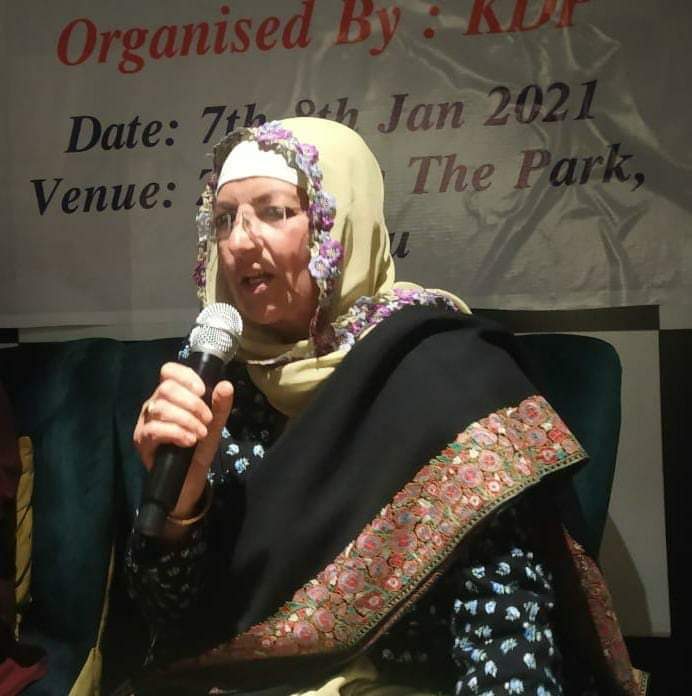
Rukhsana Jabeen: a doyen of Urdu poetry from Kashmir

JAMMU & KASHMIR:

Rukhsana Jabeen (Second from right) at a poetic symposium

Rukhsana Jabeen is one of the very few female litterateurs in Jammu and Kashmir who carved a niche in the Subcontinent’s vast domain of Urdu poetry at the intersection of the 20th and the 21st century. An overarching and unceasing armed insurgency, that muted all expressions in art and literature in the Valley failed to silence her for 33 years.

After serving All India Radio for over 30 years, Jabeen retired as a Director at Radio Kashmir Srinagar in 2015. The participation of a Kashmiri woman in the annual All India Mushaira on the eve of Republic Day or Independence Day was fatally proscribed by terrorists. Jabeen did so without break.

“Whatever came to my mind, I wrote and expressed without thinking a bit about its consequences”, Jabeen revealed to Awaz- the Voice at her winter residence in Jammu.

Born in a family of the decedents of the revered saint and Kashmiri-Persian poet Syed Meerak Shah Kashani in the Khwaja Bazar neighbourhood of downtown Srinagar in 1955, Jabeen did Master’s in Urdu followed by MA and M Phil in the Persian language and literature at the University of Kashmir. In 1983, she joined AIR Srinagar as a program executive.

Rukhsana Jabeen at a poetic symposium

“I was not the first woman to enter the station for an all-India job”, Jabeen said “but in our family setting it was like breaking the glass ceiling. Getting selected for the job in a tough patriarchal competition was like a big success for me. Knowing well that I wouldn’t be permitted to apply for it, I kept it all discreetly concealed from my family”.

“I was also selected as a teacher in the State Education Department. As my father learned about my getting a job at the AIR, he insisted I should join as a teacher. I agreed with him that the AIR officers could be transferred to any Indian State, but I lied that female officers were not posted outside their home States. Thereupon my family relented, and I joined as a program executive”, Jabeen said.

In 1994, Jabeen established AIR’s Poonch station close to the Line of Control in Jammu where she served for three years. In 1999, she was promoted to Assistant Station Director (ASD).

Unlike many of her tribe, Jabeen’s tryst with creative literature began late during her university days. A prominent Urdu poet and literary critic and the head of the Urdu Department, Prof. Hamidi Kashmiri, encouraged Jabeen to write prose and poetry in Urdu. “I was thrilled when Hamidi Sahab refined my first Ghazal and got it published in the annual edition of his department’s magazine ‘Baazyaft’. Under his tutelage, I learned about modern sensibility and the post-modernist literary trends”, Jabeen recalled.

Rukhsana Jabeen recording a radio programme

She narrated how affectionately some celebrated litterateurs like Hamidi at the University of Kashmir and Zubair Rizvi at Radio Kashmir Srinagar gave her select books and literary magazines to hone her talent and faculties as a creative writer.

“One day, incredulously I found five of my poems published together, alongside my profile, in Kumar Pashi’s journal ‘Satoor’. Later, Zubair Sahab disclosed that he had got the same published in the prestigious Urdu magazine. It was an incredible encouragement and my recognition as a poet. Thereafter, a number of my poems were published in the top representative journals like ‘Alfaaz’, ‘Shayir’, ‘Mafaheem’ and ‘Asri Agahi’. Hamidi Sahab and Zubair Sahab steered me to the extensive studies of Shaharyar, Rajinder Manchanda Bani, Nasir Kazmi, and Mohammad Alvi. I am still deeply under the influence of Mohammad Alvi and a few others”, Jabeen added.

Kishwar Naheed, Parveen Shakir, and Fahmida Riaz inspired Jabeen into some new experiments. She was initially also influenced by female Urdu litterateurs like Rafia Shabnam Abidi, Aziz Bano Darab Wafa, and Sajida Zaidi and later shared the stage with them at AIR and all-India poetry symposiums. For over three decades, Jabeen was a regular guest poet at Delhi’s Red Fort and other literary rendezvous, integrating a Sub-continental network of the intelligentsia and defying a hostile ambiance at home.

For several years, Jabeen translated poetry from 22 Indian languages into Kashmiri as a project of the Sahitya Akademi. She participated in many such all-India poetry symposiums at Varanasi and other Indian cities. She remained closely linked to top-notch Urdu poets like Shaharyar, Bashir Badr, Nida Fazli, Makhmoor Saeedi, Ali Sardar Jafri, Kaifi Azmi, Qateel Shifai, Ahmad Faraz besides literary critics like Shamsur Rahman Faruqi, Naiyer Masud and Malikzada Manzoor Ahmad.

“Many of them organized Mushairas in my honour at their homes. It was a unique recognition and hospitality as never before has anyone from Kashmir been entertained to such honours”, Jabeen said. “I invited many of these doyens of Urdu literature to our programmes at Radio Kashmir”.

Ghazal in Urdu and Kashmiri is Jabeen’s forte even as she also tried her pen at the popular genre of ‘Nazam’. “But I no love lost for blank verse and free verse. I believe those who can’t write in Urdu’s traditional meters have little right to write in free verse. Besides, I have seen how many of the aspirants, particularly females, get free verse written by others and read the same as their poetry. They perform such poor poetry at stage. Contrarily, nobody gives out a Ghazal. A Ghazal and Nazam writer is often an authentic poet”, Jabeen said.

In addition to volumes of the translation of short stories from different languages into Kashmiri and a translation of the collection of Hafiz Shirazi, which she accomplished with Dr. Syed Raza of Budgam, Jabeen has three of her collections—two in Urdu and one in Kashmiri—ready to publish.

“But I’m unbelievably indolent. I never get after awards and accolades. I can’t fulfill those formalities. Every year, I decided to publish these three volumes of my poetry but my laziness spoils my endeavour.”

source: http://www.awazthevoice.in / Awaz, The Voice / Home> Story / by Ahmed Ali Fayyaz, Jammu / January 14th, 2024