Monthly Archives: January 2023

DYWA, AFMI felicitate 84 meritorious school students from all over the country

USA / NEW DELHI:

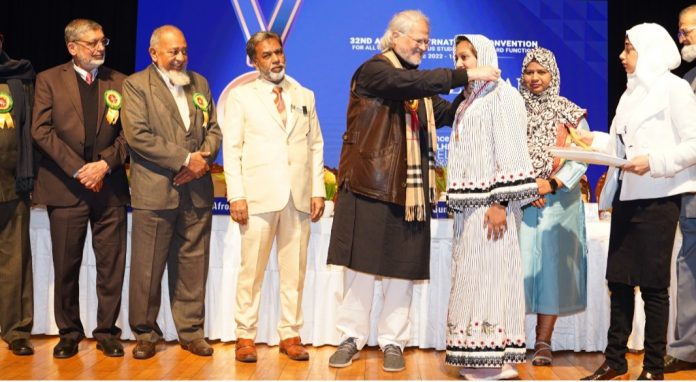
Najeeb Jung, former LG, Delhi, felicitating a meritorious student at the convention.

New Delhi:

Students along with their parents from 19 states convened in the national capital for the event. More than 80 students who passed class 10th and 12th in the year 2022 received medals, certificates and cash prizes.

“I was truly impressed when I got to know that people in America are so committed to contribute to the welfare of students here in India. This is very motivating,” said Ifrah Rauf, who received silver medal. Ifrah scored 95.6 per cent in class 12th and is now pursuing B.C.A from Indraprastha University. Ifrah’s mother is a teacher and father, a software professional. “This is encouraging for parents as well. This makes us believe that we took the right step by getting our daughter educated,” said Ifrah’s mother, Tayyaba Rehman who was present the convention.
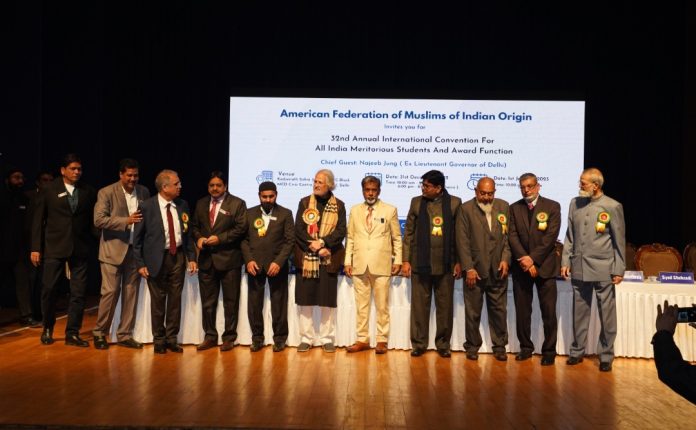
Dr Tabrez Taj, senior journalist, Afroz Alam, member, AFMI, Seraj Thakore, former president, AFMI. Mohammad Naeem, president, DYWA and Najeeb Jung, former L,G, Delhi, felicitating meritorous students during the convention.

Sixty one out of 84 awardees were girls. Gold, silver and bronze medallists received Rs 7,000, Rs 5,000 and Rs 3,000 respectively.

“It is fantastic to see so many students, especially girls, scoring so high in schools,” said Najeeb Jung, former LG, Delhi, who was the chief guest at the programme. “We should remember that knowledge is different from education. While you get educated through curriculum, it is also important to get knowledge because knowledge tells you how to be a better human being and how to treat people around you. Good scores will get you a job but knowledge will change your perspective,” said Jung.

He cautioned the audience against the dangers of technology. “It is good that we learn and use social media but we have to avoid addiction and ensure that the tech companies don’t manipulate us,” he said.

AFMI was formed in 1989 in Detroit (USA). AFMI has held conventions all over the country since its inception in 1989. It has honored more than 4,000 students from over 400 of India’s districts.

DYWA, formed in Delhi’s Walled City in 1990, works to promote education for under privileged children. It runs scholarship schemes, course distribution and a library housing more than 4000 books, among other initiatives.

Khalil Ahmed, patron, DYWA, said that in the present age and time, we should not always associate education with jobs and career. “Get educated to understand yourself, the world and the journey of life,” he said. “If you get a job, it is an added bonus. If you don’t get one, it is not the end of the world. If you have a family business, focus on expanding the same and take it to new heights. Don’t look down at it,” said Ahmed.

The awardees included two sisters from Telangana. Nargis Sultana (gold medal) and Nafees Sultana (silver medal) scored 95 per cent and 93 per cent in grade 12th. Nargis wants to be a doctor and is preparing for NEET. Nafees is pursuing Bachelors in pharmacy in Telangana. Their father, Mohammad Abdul Saleem accompanied them for the ceremony. “Both myself and my wife could not finish school education. We were clear that we would get out daughters educated and make them self- dependent,” said Saleem who works as a supervisor in a borewell. “Events like this one boosts our morale,” he added.

This was AFMI’s 32nd convention to honour student achievers in the country.
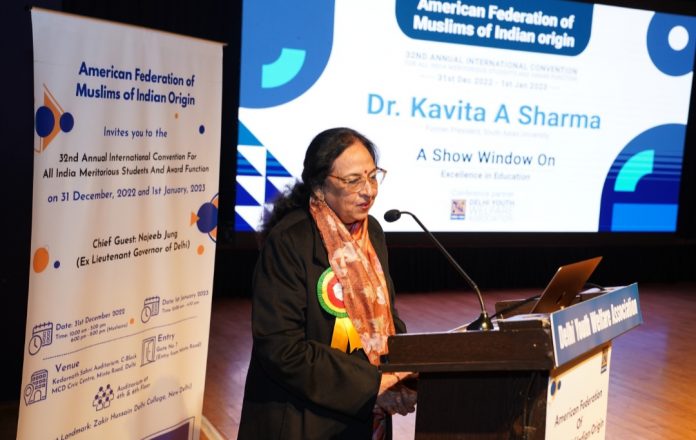
Dr Kavita Sharma, former president, South Asian University speaking at the convention.

Dr Kavita Sharma, former president, South Asian University, Dr Akhtarul Wasey, president, Maulana Azad University, Jodhpur, historians Swapna Liddle and Samina Mishra were also present at the event,

“In a jungle, trees compete to get sunlight. In the process, they outgrow each other. Similarly, we have tried to create a healthy competition among students. They get motivated and inspired when they see each other at such events,” said Shafi Lokhandwala, member, AFMI.

source: http://www.muslimmirror.com / Muslim Mirror / Home> Communal Harmony> Positive Story / by Muslim Mirror Network / January 01st, 2023

Hyderabad: This restaurant readies 15000 kgs of Biryani for new year’s eve

Hyderabad, TELANGANA:

According to food delivery platform Swiggy, last year, Bawarchi clocked a sale of 2 biryanis per minute on the same day. The restaurant is planning to break that record this time.

 Representational Image

Hyderabad: 

Bawarchi restaurant in Hyderabad, for new year’s eve, has readied 15000 kgs of Biryani to cater to thousands of food lovers who are celebrating the end of another year.

According to food delivery platform Swiggy, last year, Bawarchi clocked a sale of 2 biryanis per minute on the same day. The restaurant is planning to break that record this time.

Chicken Biryani continued to be the most ordered on the food delivery platform Swiggy for the third consecutive year, showing statistics from the company. This pretty much sums up the city’s food culture, which if it has to be summed up in one line is: Biryani is king.

Interestingly, the number one snack item ordered on Swiggy in Hyderabad was everyone’s favourite – Idly. Apart from the usual chicken wings, samosas and veg puff – which are regularly on the most ordered items on Swiggy – the traditional Bun Maska (usually sold in Irani cafes) also found its way up on the most ordered list for snacks.

Another traditional item, Khubani Ka Meetha or Apricot Delight, turned out to be the most favourite dessert for Hyderabadis, while Double Ka Meetha was the most ordered dessert in Telangana, showed stats from Swiggy.

What people of Hyderabad and Telangana love to Eat on Swiggy Food Marketplace

  • Top 3 most ordered dishes: Chicken Biryani, Apricot delight, Mutton Biryani
  • Top 3 most ordered non-dishes – Thums up (drink), Milk Products, Tomatoes 
  • Top 3 most ordered snacks: Idli, Maska Bun, Masala Dosa
  • Top 3 most ordered desserts on Swiggy: Apricot Delight, Double ka Meetha, Fruit Salad with Ice Cream

source: http://www.siasat.com / The Siasat Daily / Home> News> Hyderabad / by News Desk, posted by P N Sree Harsha / December 31st, 2022

Pincode 110001: Mughals, British and Unani – how a college in Delhi connects the dots

NEW DELHI:

During his tenure as Viceroy General of India, Charles Hardinge, the 1st Baron Hardinge of Penshurst, came in touch with many practising hakims and vaidyas while opening medical colleges in India.

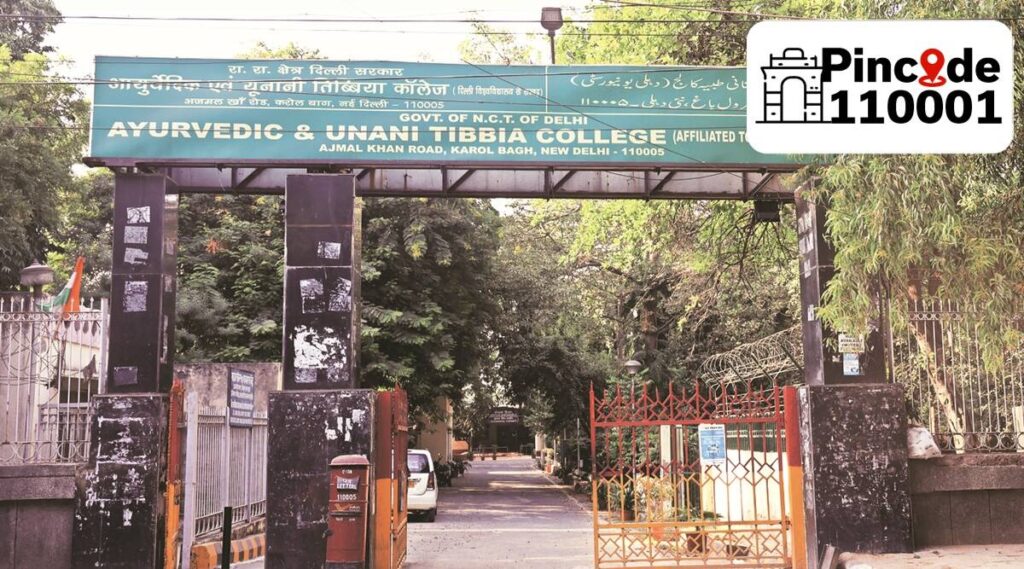
Ayurvedic and Unani Tibbia College in Karol Bagh. (Express Photo by Amit Mehra)

During the middle of the 18th Century, India had physicians from diverse backgrounds including vaidyas and hakims who practised Ayurveda and Unani respectively, and freely borrowed medicine recipes from each other. But, with the arrival of the British, both practices were sidelined.

During his tenure as Viceroy General of India, Charles Hardinge, the 1st Baron Hardinge of Penshurst, came in touch with many practising hakims and vaidyas while opening medical colleges in India. It was his friendship with Hakim Ajmal Khan, a practising Unani medical physician from the lineage of hakims of Mughal rulers, that made him lay the foundation stone of the Ayurvedic and Unani Tibbia College in 1916.

Prior to the college, currently situated in Karol Bagh, Hakim Ajmal Khan and his two elder brothers Hakim Abdul Majid Khan and Hakim Mohamed Wasal Khan worked under their father, Hakim Gulam Mehmood Khan, in their house, Sharif Manzil, in Chandni Chowk’s Ballimaran. Their father ran a small Unani school, named Unani Madrasa Tibbia, where they practised and taught Unani and Ayurvedic medicine to young scholars.

Hakim Ajmal Khan’s grandfather, Hakim Sharif Khan, was a physician to Mughal Emperor Shah Alam and had built Sharif Manzil, after which the family came to be known as “Sharifi”. Hakim Sharif Khan’s ancestors had come to India during the reign of Babar and were of imminent importance during Shah Jahan’s rule. They were then known as the aristocrats of Delhi and enjoyed a high social status.

Speaking with The Indian Express, the great grandson of Hakim Ajmal Khan, 80-year-old Masroor Ahmed Khan, said the Unani Madrasa Tibbia was opened in 1882. “We have 300 years of history and were known as royal hakims. When the Britishers came, they were bringing a new ordinance under which Allopathy medicine was going to be promoted more and Unani, Ayurveda were being sidelined. Until then, the education of Unani medicine was not institutionalised. Fearing that their practices will fade out, they started a college from Sharif Manzil,” he said.

Masroor added that he is the first in his family to not practise medicine.

He said the three brothers taught at Sharif Manzil and after the death of his two elder brothers, Hakim Ajmal Khan continued as the head of the college and raised the quality of the institution. “His popularity grew further, and he went on to become chief physician to the Nawab of Rampur. He was also a consultant for the royal families of Patiala, Jind, Gwalior, Gaikwad,” said Masroor.

The Unani Madrasa Tibbia was flourishing alongside Hakim Ajmal Khan’s popularity, and he then decided to buy land to build a new college for which a board of trustees was formed. With some influence and a promise that a wing of the hospital will be dedicated to Lady Hardinge, the trust received land from the British India government. The land in Karol Bagh was granted to the Anjuman-I-Tibbia on February 14, 1916, by the imperial Delhi Committee.

The foundation stone was laid on March 29, 1916, by Lord Hardinge after the board sent him a letter inviting him for the same.

Masroor said it was Hakim Ajmal Khan’s nationalistic approach because of which he named the college Ayurvedic and Unani Tibbia College, where 99% practitioners were of Unani medicine and only 2-3% of Ayurveda. “Hakim Ajmal Khan was also one of the founders of Jamia Millia Islamia and he was the only Muslim to chair a session of the Hindu Mahasabha. He was elected as president of the Indian National Congress from 1921-22 and also became president of the Muslim League and the All India Khilafat Committee,” said Masroor.

During his Khilafat movement days, Hakim Ajmal Khan had corresponded with Mahatma Gandhi to inaugurate the college, which the latter agreed to, and launched it on February 13, 1921.

Much before the Parliament, North and South avenues and India Gate, the college was an architectural marvel in the newly founded capital of India. The buildings represent a mix of Indian and Mughal architecture and house classrooms, laboratories, hospital pharmacies, hostels, office and staff quarters.

Hakim Ajmal Khan also helped in developing the college of more than 50 acres and also established a garden of herbs on the road across the college. The garden has now been named after him as ‘Ajmal Khan Park’ and is maintained by the MCD. The road has also been named after him – Ajmal Khan Road is now a popular shopping area of Delhi.

During the Partition, a majority of hakims of the family left for Pakistan and the college was taken over by Hakim Jamil Khan, son of Hakim Ajmal Khan, and while he was using the college as his own personal space, the then education minister Maulana Abul Kalam Azad decided to take over the college and run it as a government institution.

The matter reached the Supreme Court, which announced that the college will be a government run institution. The college is now being run by the Delhi government and admits students through the NEET exam.

According to college principal Mohammed Zubair, a total of 75 seats are through NEET. He said the college also provides courses in BUMS and BAMS and MD.

He added that post Covid, the perspective of students and patients in general has changed and a large number of students have opted for these courses. “We had students even before Covid but now a number of students who have done courses in physiotherapy and have done their BSc have come to study here.”

Not only this. Mohammed Zubair said a large number of patients too still believe in Unani and Ayurvedic medicine. “We have a footfall of 1,000 patients in our OPD. We also provide minor surgeries. The Delhi government had also established the Ayush Centre in our college where we admitted 989 Covid patients,” he said.

According to writer and historian Sohail Hashmi, there are a lot of people in smaller towns and remote places, where allopathy hasn’t reached or is not enough, who opt for traditional systems of medicines including Ayurveda, Unani and Siddha.

“Once we were colonised, it was then that our traditional systems were discarded. Colonisation colonised our minds. The Indian system of Ayurveda and Unani function on the basis of five groups of illnesses; so did Hippocrates’ four humors theory. There are a whole lot of commonalities in what Hippocrates discovered and it came to India from Greece via Iran and Arabia,” he said.

source: http://www.indianexpress.com / The Indian Express / Home> Cities> Delhi / by Ankita Upadhyay / New Delhi – November 13th, 2022

40th National Unani Medicine Conference: Maharashtra CM announces 10% reservation for Unani doctors

MAHARASHTRA :

40th National Unani Medicine Conference

Nagpur:

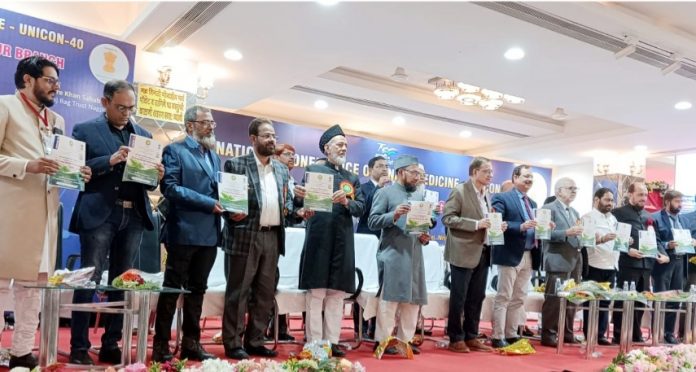
Maharashtra Chief Minister Eknath Shinde announced that Unani physicians will have a 10% reservation quota in the state’s public hospitals and primary healthcare facilities. He also said that the state needed a government-run Unani medical college. He made these commitments through a video message during the 40th National Unani Medicine Conference, which was hosted by the Nagpur branch of the All India Unani Tibbi Congress.

The Chief Minister thanked Unani physicians for their services during the deadly Covid epidemic in a brief speech. He assured the conference that every effort would be made to advance Unani medicine in the state.

 Dr Wajahat Mirza, a Congress MLC and the head of the Maharashtra State Waqf Board, welcomed the Chief Minister’s decision in his speech and assured the gathering that he would exert all of his political power to see that the proposed government Unani Tibbi College would be realised. He claimed that if there had been no conflict over the city, the college would have been founded much earlier.

Former  Congress minister and MLA Nitin Raut echoed his sentiments, saying that Unani medicine is a very efficient and cost-effective treatment and that it should be given every chance to flourish.

Dr Anis Ahmad, a former minister of Maharashtra, proposed building an Unani house with full facilities. He also offered to provide a plot of land to the intended centre.

AIUTC national president Professor Mushtaq Ahmad, who was presiding over the conference, praised the Maharashtra chief minister and noted that this was the first time the Maharashtra government has made a significant announcement about the development of Unani medicine. He also expressed his joy at the All India Unani Tibbi Congress Nagpur branch’s pompous arrangement of this magnificent conference, in which devoted Unani physicians from all across the country took part with great zeal.

In his keynote address Dr Syed Ahmed Khan, general secretary of AIUTC provided a snapshot of the organisation’s activities. He listed problems faced by the Unani fraternity at the national and state levels. He pointed out that Unani representation was overlooked in the new decision-making process as it was clubbed with a regional medicine of system. He called upon the Unani fraternity to make concentrated efforts for the advancement of Unani Tibb.

As far as Maharashtra is concerned, according to the conference’s organising chairman Dr Niyazuddin Siddiqui, it is a model state for Unani medicine because it enjoys the support of the state government. He claimed that there are 200 Unani doctors practising in and around Nagpur city and demanded the revival of the Unani Tibbi college, which was shut down in 20024. The college was started in 1991. He claimed Nagpur had become a hub for unani medicine.

In a similar vein, Special Guest Dr Vaidya Jayant Devpujari (Chairman, NCISM Government of India) stated in his speech that our primary goal is to standardise medical colleges. He said, “Such a conference is very important for the promotion of Unani medicine, and the role played by Unani medicine in Covid-19 is commendable. I also wish to congratulate the members of the All India Unani Tibbi Congress Nagpur for organising a very standard and grand programme which will send a strong message about Unani medicine throughout the country.

Dr Nadim Usmani, the advisor to AIUTC Maharasthra, also shed light on the activities of State Unani unit. He said Unani medicine is a bright future in the state.

 The 40th Conference titled   ‘Role of Unani Medicine In present Scenario’has sessions on specialised lectures on some major diseases. The experts and academics presented their papers through power-point. Professor Ahsan Farooqui presented his paper on Fasd(Venesection): Concept and Application with Demonstration. Dr Shabbir Raja’s topic was  Dialysis and RenalTransplant: Myths and Facts. Cancer Management with Unani Medicine by Dr Mastan Shaikh, Pain Management in Unani Medicine by  Prof Khan Mohammad Qiaser and Management of PCOS in Unani Medicine by Prof Nafees Bano.

 Prof. Arif Zaidi, Dean, Faculty of Unani Medicine, Jamia Hamdard also spoke on the occasion.

The conference held on December 25 also released a souvenir highlighting the achievements of Unani Tibb in Maharashtra.

In the end, the 40th conference also passed several resolutions including the Directorate of AYUSH, Government of Maharashtra must create a post, Deputy Director – Unani, Assistant Director – Unani in the Directorate to represent the Unani System of Medicine in the State of Maharashtra.

The other resolutions are as follows:

*-  Ministry of Food and Drugs Administration, Government of Maharashtra must create a post of Licensing Authority – Unani / Technical Officer- Unani  / Drug Inspector – Unani in FDA to serve as an expert of Unani under provisions given in  Drugs and Cosmetic Act 1940 and Rules 1945.

*  Follow up to complete implementation for the establishment of Government Unani Medical College in the State of Maharashtra  As per the declaration of Chief Minister of Maharashtra Shri Eknath Shinde Ji on 25th Dec 2022 at Nagpur to establish one Government Unani Medical College in the State of Maharashtra.

* Central Government and Delhi NCR must declare and approve Ayurvedic and Unani Tibbia College, karol baugh as Hakim Ajmal khan Ayurvedic and Unani Tibbia University.

* Ministry of AYUSH  and NCISM, New Delhi must proposed to amend the Act NCISM 2020 to felicitate separate Unani Board under NCISM

* There are No proper representation in NCISM and its constituted authority/committee, hence a sufficient number of Unani representatives must be there.

* Strong recommendation for Empanelment of Unani System of Medicine in the Ministry of Defence / Defence Department to serve healthcare services to Defence personnel as Ayurveda is already empanelled.

source: http://www.muslimmirror.com / Muslim Mirror / Home> Health> Indian Muslim / by Abdul Bari Masoud / December 30th, 2022

Bhabiji Ghar Par Hai’s Aasif Sheikh honoured by World Book Of Records for playing 300 characters

NEW DELHI :

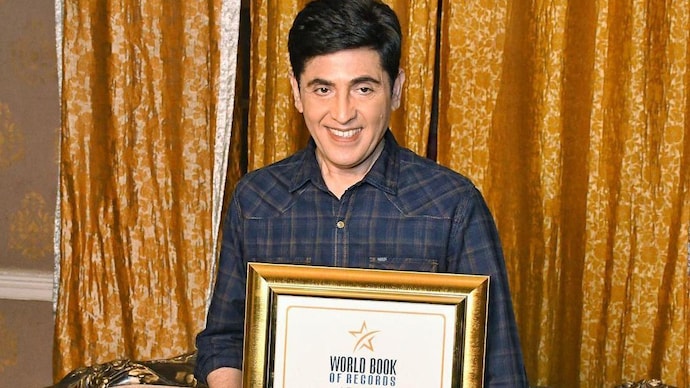
Aasif Sheikh has been honoured by the World Book Of Records for playing 300 different characters on Bhabiji Ghar Par Hai. The actor shared his picture with the certificate on social media.

Bhabiji Ghar Par Hai's Aasif Sheikh honoured by World Book Of Records for playing 300 characters
Aasif Sheikh holding his certificate from World Book of Records.

 Who doesn’t love Bhabhiji Ghar Par Hai’s Vibhuti Narayan Mishra? With his quirky ways of flirting with the neighbour’s wife to portraying different hilarious characters, Vibhuti is the show’s favourite. Did you know that Aasif Sheikh, who plays the role of Vibhuti, has also portrayed 300 different characters on the show? The actor has now been bestowed with a special certificate from the World Book of Records, London, for crossing 300 characters in Bhabiji Ghar Par Hain.

Aasif Sheikh Honoured by World Book of Records

Aasif Sheikh has won a million hearts with his constant hard work and amazing comic timing. He has now received a special award for portraying various characters on Bhabhiji Ghar Par Hai. Aasif posted his picture with the certificate on his Instagram account and wrote, “Thank you guys for making it happen. Crossed 300 different characters in bhabhiji ghar par hai (sic).” In the picture, the actor looks elated holding his certificate while wearing a blue check shirt.

Saumya Tandon is ‘Super, Super Proud’ of Aasif Sheikh

Saumya Tandon, who earlier played the role of Anita bhabi on the show congratulated Aasif Sheikh and commented, “Huge Congratulations, no one else deserves this more than you. It’s all the years of hard work , labour of love and passion for your craft. Super proud (sic).”

About Aasif Sheikh

Aasif started his journey in 1984 with India’s first TV serial Hum Log. He then appeared in a number of TV shows and Bollywood films. The actor featured in popular shows such as Yug, Champion, Tanha, Muskaan, Gul Sanobar, Chandrakanta, Yes Boss, Dill Mill Gayye, CID and Chidiya Ghar to name a few.

source: http://www.indiatoday.in / India Today / Home> News> Television> Celebrity / by Grace Cyril, Mumbai / October 21st, 2021