Monthly Archives: September 2025

Safia Akhtar: An Underrated Genius And Connoisseur Of Urdu Literature #IndianWomenInHistory

Rudali / Lucknow, UTTAR PRADESH :

Safia Akhtar was a brilliant writer, poet, author, teacher, critic, and connoisseur of Urdu literature, who remains underrated.
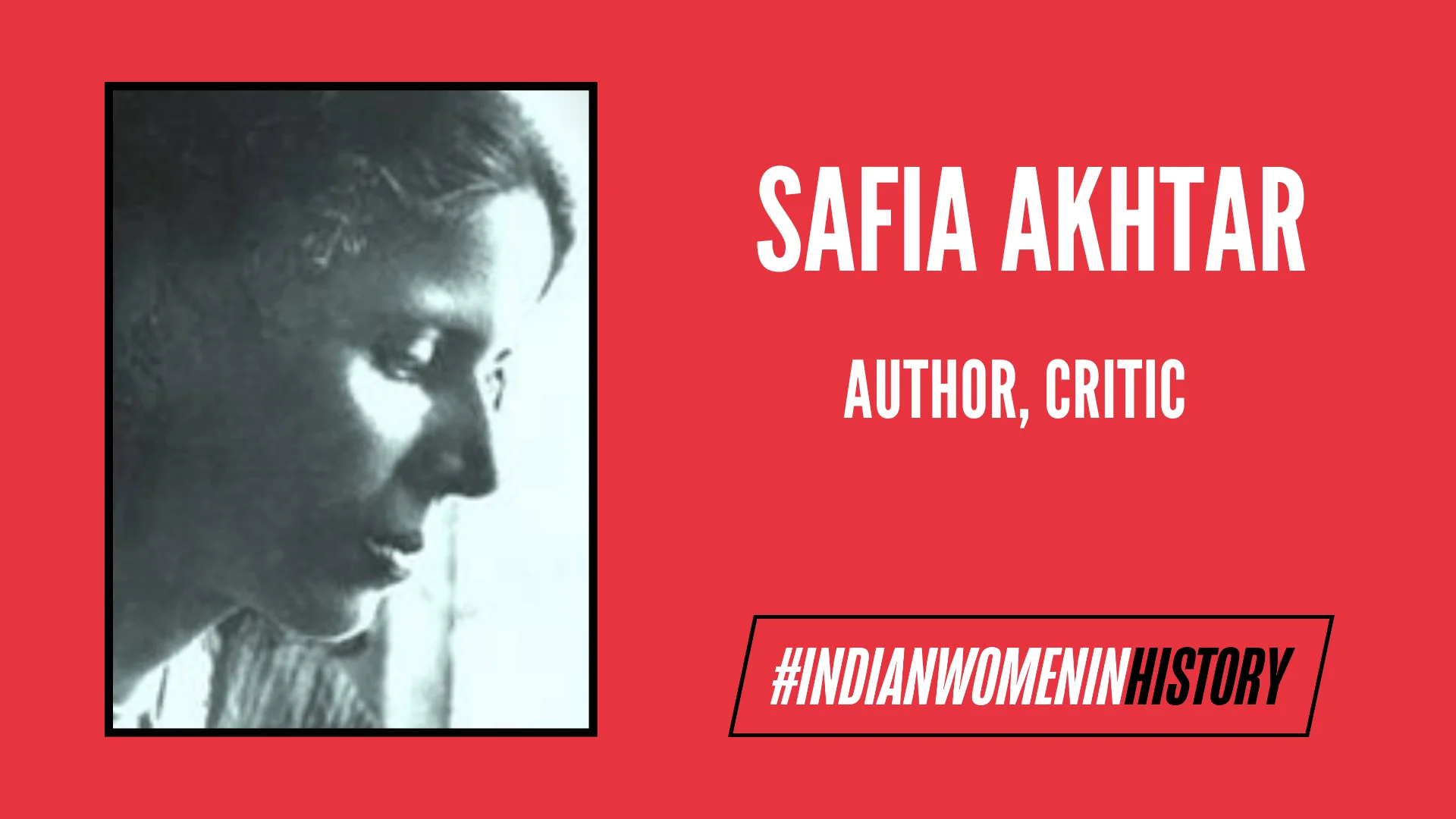
If you know who Safia Akhtar is you would probably know her as Javed and Salman Akhtar’s mother, Jan Nisar Akhtar’s wife, or Asrar-ul-Haq, better known as Majaz Lakhnawi’s sister but Safia was quite the personality herself. She was a brilliant writer, poet, author, teacher, critic, and connoisseur of Urdu literature.

The best of Safia Akhtar’s work includes the letters that she wrote to her husband while they were apart. Her letters which were written over a period of nine years were published after her death by her husband as “Hurf-e-Ashna” and “Zer-e-lab” translating to “familiar words” and “below the lips” respectively. Safia Akhtar also wrote, “Andaz-e-Nazar” (The way to look at it) which is a collection of short essays.

Safia’s sister Hamida Salim was also a talented writer having authored many books like “Hum Saath the”(We were together) which gives an account of the lives of the siblings. Javed Akhtar, her son who lost Safia only when he was eight years old calls his mother a “nayaab aurat” during her time.

She set foot into education and pursued it at a time when women were rarely given the choice or opportunity to do so. Safia Akhtar chose her life partner, she worked and financially supported her family as well as her husband who was in another state, looking for work. To top it all off, she also took care of her two sons.
Safia Akhtar Image: Rekhta

Childhood, education, and early life

Safia Siraj-ul-Haq was born in Rudauli, Uttar Pradesh. Safia was an educated Muslim woman, one of the first of her time, in the 1940s. As Javed Akhtar recalls, his Nana (maternal grandfather) mentioned to him that someone once visiting couldn’t locate their house and asked for directions to the house of the girl who graduated and was easily guided to Safia Akhtar’s place.

Safia’s primary education took place at home where her father, Chowdhary Seraj-ul-Haq, taught her English, Urdu, and Farsi. Her brother, Majaz, assisted her with mathematics and she was tutored in the Quran by a female teacher. Owing to her father’s transfer, who was a law graduate, a door opened for Safia Akhtar and her siblings for further education. She was admitted to Karamat Hussain Muslim Girls college in the fourth grade. However, soon after, her father was transferred again from Agra, where Safia was studying living at a hostel, to Aligarh.

Safia Akhtar then started studying at Abdullah College and excelled in her academics. After completing high school, she had to wait a year for the B.A. classes to start in the girls’ college. Safia stayed in a hostel during her B.A. and after completing it, worked as a supervisor of a training program with her teachers as they were amazed by Safia’s caliber. After completing her undergraduate course, she studied further and got a Master’s degree in education from Aligarh Muslim University.

Safia grew up imbibing a progressive ideology. She set foot into education and pursued it at a time when women were rarely given the choice or opportunity to do so. Safia Akhtar chose her life partner, she worked and financially supported her family as well as her husband who was in another state, looking for work. To top it all off, she also took care of her two sons. Safia’s brother and husband were also part of the progressive writers’ movement at the time.
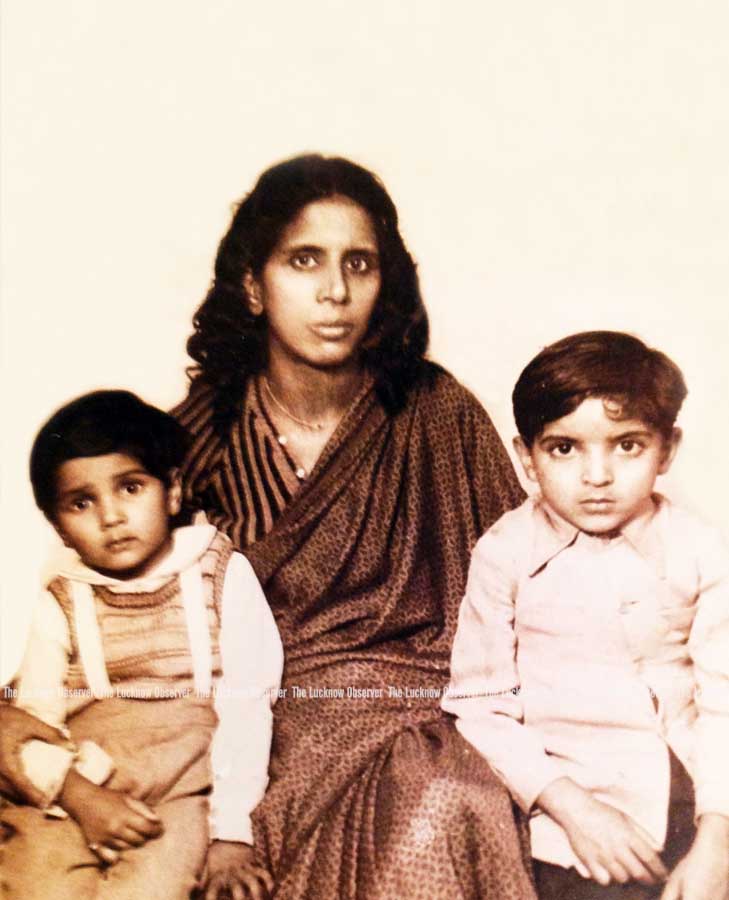
pix: lucknowobserver.com

Safia and Jan Nisar Akhtar

Jan Nisar Akhtar, the famous poet and Bollywood lyricist was a friend of Safia Akhtar’s brother Majaz and also the cousin of Salma, her roommate while she was staying in the hostel in Aligarh. Salma recounts Jan Nisar coming to the girls’ college randomly to meet Safia and introducing himself as a friend of her brother’s. Safia fell in love at first sight. However, the love seemed to be one-sided as Jan Nisar did not get in touch with her for quite a while and this disheartened Safia.

After some time passed, Jan Nisar wrote to Safia about his work, interests and disinterests, and himself. Soon after, Safia’s family received a marriage proposal from Jan Nisar’s side. As the culture still prevails, the girl’s family did a background check on Jan Nisar and his family. Salma, his cousin, testified for Jan Nisar’s family (even though she wasn’t too well informed about them) that they had a legacy of poets; his father Muztar Khairabadi was a well-known shayar of the time.

The letters give a glimpse of Safia’s immense love and optimism toward Jan Nisar. They also give an insight into episodes of her life events including her job, their two children Javed and Salman, her life at home, and towards the end, her suffering. These letters stand proof of what a literary genius Safia Akhtar was

Jan Nisar himself was well accomplished and was an Urdu literature lecturer in Gwalior. With no time wasted, Safia Akhtar’s parents sent their acceptance as they did not find any flaws as such in Jan Nisar. But to their disappointment, the Akhtars did not respond for a considerable amount of time.

This silence motivated Safia to take a rather valiant step. She poured her heart out to Jan Nisar in a letter and also enquired about the holdback from their side. Jan Nisar reverted with a confession about his feeling for another woman, his older, widowed relative who helped him during a rough patch after his first relationship came to an end. Safia appreciated Jan Nisar’s honesty. The proposal was re-established and the nikkah followed soon after, although there were some odd happenings during the time.

source: youtube.com / Letters Of Love & Loss | Jaan Nisar Akhtar Aur Safia Ke Khat | Rekhta Studio

In 1949, Jan Nisar switched cities from Bhopal to Bombay in the pursuit of becoming a lyricist in Bollywood. Safia Akhtar chose to stay back and continue with her teaching post at Hamidiya College, thus, supporting her husband money-wise and also rearing their two children. The distance between the two encouraged Safia to write letters to him.

She wrote to him consistently, multiple times a week in some instances. The letters give a glimpse of Safia’s immense love and optimism toward Jan Nisar. They also give an insight into episodes of her life events including her job, their two children Javed and Salman, her life at home, and towards the end, her suffering. These letters stand proof of what a literary genius Safia Akhtar was. Safiya suffered from an unconfirmed terminal illness (it was either blood cancer or skin cancer, not conclusive). Unfortunately, fate had other plans and Safia passed away prematurely in 1953 when she just was in her late 30s.

Without a doubt, Safia’s letters were and to this day are, a gem in Urdu literature. She expresses her feelings so very aesthetically and makes the most mundane of her daily tasks seem something literary and intriguing. About her letters being published, there seems to be a difference of opinion.

On one hand, there is the stance that the letters were something intimate, personal, and not meant to be out for the public. Salma, her roommate, calls it a “Dastan-e-Gham”, the saga of sorrows that she shared with her husband and would not want to be disclosed. While others appreciate the sheer brilliance of her words and feel lucky to have access to them. 

source: http://www.feminisminindia.com / Feminism In India (FII) / Home> Culture> Books / by Tuba Chauhan / August 04th, 2022
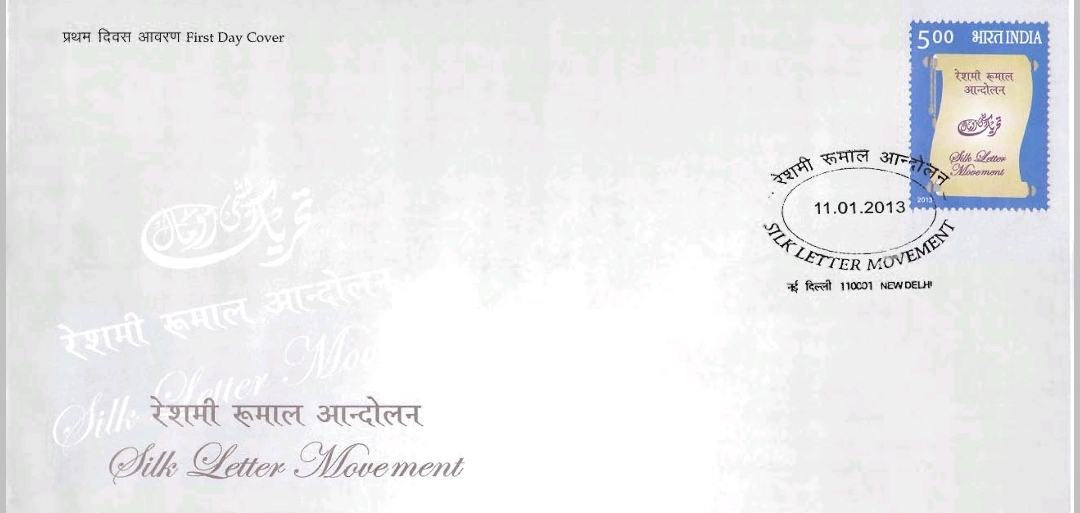
Silk Letter Movement: Name of all 59 charged by the British for waging war against the Crown

INDIA :

During the First World War, Maulana Mahmood Hasan, and other Islamic scholars planned an armed attack on British India from the Afghanistan frontier. The ambitious plan did not succeed because of the changed geo-political scenario (defeat of Turkey and Germany) and the British getting hold of three silk letters, which gave away the whole planning. After this, 59 people were charged for waging the war against the crown. I am sharing the names of these 59 forgotten heroes of the Indian freedom struggle.

During the First World War, Maulana Mahmood Hasan, and other Islamic scholars planned an armed attack on British India from the Afghanistan frontier.  The ambitious plan did not succeed because of the changed geo-political scenario (defeat of Turkey and Germany) and the British getting hold of three silk letters, which gave away the whole planning.

After this, 59 people were charged for waging the war against the crown. I am sharing the names of these 59 forgotten heroes of the Indian freedom struggle.

Silk Letter Movement : A freedom struggle woven in silk

  1. Abdul Aziz Molvi, son of Haya Gul from Itman Zai, Peshawar
  2.  Abdul Bari B.A., son of Ghulam Jilani from Lyallpur
  3. Abdul Hai Khwaja, son of Khwaja Abdur Rahman from Gurdaspur 
  4. Abdul Haq Shaikh alias Jeewan Das from Shahpur district. He was an official witness.
  5. Abdul Haq Molvi from Rifah-e-Aam Press Lahore. 
  6. Abdul Majeed Khan, son of a Risaldar Manager from the 15th Cavalry Battalion of the army.
  7.  Abdullah Molvi, son of Nihal Khan from Sukkur district. He was an official witness.
  8. Abdul Qadir B.A., son of Ahmad Deen from Lyallpur. 
  9. Abdur Rahim Sindhi Shaikh, son of Lala Bhagwan Das from Hyderabad, Sindh
  10. Abdur Rahim Molvi, son of Rahim Bakhsh, Masjid Cheenian Wali, Lahore.
  11. Abdur Rashid, a migrant student of Mardan and Lahore.
  12. Abdur Razzaq Ansari Hakim, son of Abdur Rahman of Delhi.
  13. Abdul Waahid, son of Siddiq Ahmad from Tanda, United Provinces.
  14. Abul Kalam Azad Molvi, nickname Mohiuddin, son of Maulana Khairuddin from Calcutta
  15. Abu Muhammad Ahmad Molvi alias Molvi Ahmad, son of Ghulam Hussain from Lahore and Chakwal
  16. Ahmad Ali Molvi, son of Habibullah, from Gujranwala district. He was an official witness.
  17. Ahmad Miyan Molvi, son of Abdullah Ansari from Ambetha, district Saharanpur (United Provinces). He was an official witness.
  18. Allah Nawaz Khan, son of Khan Bahadur Rab Nawaz Khan honorary magistrate of Multan, Punjab
  19. Anees Ahmad, B.A. Molvi, son of Idrees Ahmad, assistant secretary at Anglo-Oriental College Aligarh , United Provinces.
  20. Ozair Gul Molvi, son of Shaheed Gul of Durgayee, Northwest Frontier. 
  21. Barkatullah Molvi Muhammad of Bhopal and Japan
  22. Fatah Muhammad Sindhi from Rok, Sindh
  23. Fazlul Hasan Molvi alias Hasrat Mohani from Aligarh .
  24. Fazl Elahi Molvi, son of Meeran Bakhsh from Haripur, thana Wazirabad, district Gujranwala, Punjab.
  25. Fazl Mahmood Molvi, son of Molvi Noor Muhammad from Charsadda, Northwest Frontier.
  26. Fazl Rabbi Molvi from Peshawar.
  27. Fazl Wahid Molvi, son of Faiz Ahmad, alias Haji Turangzai, from Northwest Frontier.
  28. Habibullah Ghazi, the son of Ruhullah from Kakori, district Lucknow, United Province.
  29. Hadi Hasan Syed, from Khan Jahanpur, district Muzaffar Nagar, United Province.
  30. Hamdullah Molvi, son of Haji Sirajuddin from Panipat. 
  31. Hussain Ahmad Madani Molvi, son of Molvi Habibullah from Faizabad and Medina .
  32. Ibrahim Sindhi, M.A. Shaikh, son of Abdullah from Karachi.
  33. Kala Singh, a migrant from Ludhiana (Punjab) 
  34. Khan Muhammad Khan Haji from Peshawar. (died)
  35. Khushi Muhammad, son of Jan Muhammad from Talauli, district Jalandhar, Punjab.
  36. Mahendra Pratap Kunwar, son of late Raja Ghanshiam Singh from Mursan, United Province.
  37. Mahmood Hasan Maulana, former head-teacher at Deoband Madrasa, United Province.
  38. Matloobur Rahman Molvi of Deoband, an employee of the Agricultural Department, UP Govt.
  39. Mohiuddin alias Barkat Ali Molvi from Kasur. 
  40. Mohiuddin Khan Molvi from Moradabad. (Qazi of Bhopal)
  41. Muhammad Abdullah B.A., son of Shaikh Abdul Qadir, Secretary Mianwali District Board.
  42. Muhammad Ali B.A. son of Abdul Qadir from Kasur.
  43. Muhammad Ali Sindhi, the son of Habibullah from Gujranwala.
  44. Muhammad Aslam Attar from Peshawar.
  45. Muhammad Hasan B.A. from Lahore whose father was an employee in the Paisa newspaper.
  46. Muhammad Hashim Molvi Syed from Kora, Jahanabad, Fatahpur. 
  47. Muhammad Masood Molvi, son of Mazhar Hussain from Deoband, United Province. (Official witness)
  48. Muhammad Miyan Molvi, son of Molvi Abdullah Ansari from Ambetha, district Saharanpur, United Province.
  49. Muhammad Mubeen Molvi, son of Muhammad Momin from Deoband. (Official witness)
  50. Muhammad Murtuza Molvi Syed, son of Bunyad Ali from Bijnor, United Province. (Official witness)
  51. Noorul Hasan Syed from Ratheri, district Muzaffar Nagar U.P.
  52. Obaidullah Molvi alias Buta Singh from Sialkot, Punjab.
  53. Sadruddin alias Dr. Abdul Karim Barlasi, son of Amir Ali of Banaras. 
  54. Saifur Rahman Molvi, son of Ghulam Khan from Peshawar district, Northwest Frontier.
  55. Shah Bakhsh Haji, son of Imam Bakhsh Ansari from Hyderabad, Sindh. 
  56. Shah Nawaz Khan, son of Khan Bahadur Rab Nawaz Khan, honorary magistrate, Multan, Punjab.
  57. Shujaullah, son of Habibullah from Lahore.
  58. Wali Muhammad Molvi from Futuheewala, district Lahore.
  59. Zahoor Muhammad Molvi from Roorkee, son of Inayatullah of Saharanpur.

source: http://www.heritagetimes.in / Heritage Times / Home / by Mahino Fatima / August 04th, 2024

Inaugural function held for the Social Work and Outreach Activities Club

Aligarh, UTTAR PRADESH :

Aligarh :

The Social Work and Outreach Activities Club of Women’s College, Aligarh Muslim University held an inaugural talk and launched its membership programme.

Highlighting the objectives of the club, Prof. Shadab Bano drew the critical distinction between charity and social work, and stressed that receiving an education gives us a responsibility to share its benefits with others. She urged the students to view social work as a civic duty.

Prof. Nazura Usmani emphasized the importance of the disability support committee and discussed strategies to foster inclusivity and increase the representation of differently-abled students on campus. She stressed the need for disability sensitization among the student body to build a more understanding and accessible environment for everyone.

Dr. Eisha Rahman announced the club’s committees and introduced the coordinators; Prof. Nazura Usmani and Prof. Shadab Bano as Main Coordinators; Dr. Arshi Shoaib and Dr. Shagufta Munir for Remedial Classes for Abdullah School students; Dr. Shagufta Niyaz and Dr. Mahjabeen for Disability Support; Dr. Arshia Shafqat, Dr. Fozia Waheed, and Dr. Eisha Rahman for Tuitions for Non-Teaching Staff’s children; Dr. Heena Parveen and Dr. Eisha Rahman for Adult Education for Fourth Grade Employees; and Dr. Fozia Waheed, Dr. Mohd. Firoz Ahamed, Dr. Mahjabeen and Dr. Masudullah Khan for the Locality Cleanliness Drive.

Prof. Shadab Bano and Dr. Eisha Rahman addressed the queries of the participants, providing clarity on the club’s goals and activities. About 65 students registered themselves as the members of the club.

Dr. Mohd Firoz Ahamed concluded the event, encouraging students to join the club for bringing meaningful changes and making a positive impact on their community.

source: http://www.indiaeducationdiary.in / India Education Diary / Home> National News / by India Education Diary / November 07th, 2024

PB Ahmed Mudassar Elected as New President of KCCI

Mangaluru, KARNATAKA :

PB Ahmed Mudassar

Mangaluru: 

PB Ahmed Mudassar has been elected as the new President of the Kanara Chamber of Commerce and Industry (KCCI).

The elections were held on Saturday, where businessman Ahmed Mudassar was chosen to lead the chamber. He had previously served as the Vice President during the last term.

source: http://www.english.varthabharati.in / Vartha Bharati / Home> Karavali / by Vartha Bharati / September 27th, 2025

Bomb Blast Acquit Turned Advocate Abdul Wahid Shaikh Awarded PhD at MGM University, Aurangabad

Mumbai, MAHARASHTRA :

Bomb Blast Acquit Turned Advocate Abdul Wahid Shaikh Awarded PhD at MGM University, Aurangabad

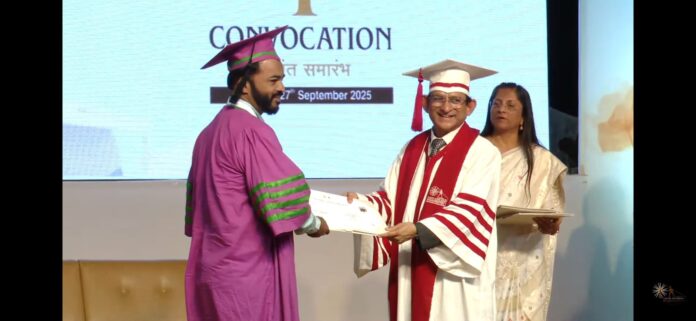
Advocate Abdul Wahid Shaikh, noted lawyer, prison rights activist, and the first person person acquitted in the 2006 Mumbai train blast case, was conferred with a Doctor of Philosophy (PhD) degree at MGM University, Aurangabad. The degree was presented by Vice Chancellor Prof. Dr. Vilas Sakpal during a formal convocation ceremony.

Dr. Shaikh’s doctoral research, titled “Prison Literature: Post-Independence”, brings focus to the writings emerging from Indian prisons, highlighting voices of resistance, resilience, and injustice. His work underscores how incarcerated individuals have shaped Urdu literature and contributed to broader narratives of social justice in post-independence India.

Speaking on the occasion, Dr. Shaikh said:“This PhD is not just an academic milestone, but a continuation of my struggle for prison justice. Prison literature is the voice of the silenced, the testimony of those behind bars, and a mirror to our society’s conscience.”

As General Secretary of the Innocence Network, Dr. Shaikh has long campaigned for the release of wrongfully imprisoned individuals and advocated for humane prison reforms. His latest academic achievement strengthens his commitment to legal activism and adds a scholarly dimension to his work.

Faculty members, scholars, students, and well-wishers attended the convocation, applauding Dr. Shaikh’s perseverance and his contribution at the crossroads of academia, activism, and law.

His achievement is a landmark—demonstrating how an exoneree can turn personal suffering into intellectual strength and contribute meaningfully to the pursuit of justice and the rights of the incarcerated.

source: http://www.muslimmirror.com / Muslim Mirror / Home> Positive Story / by Muslim Mirror Special Correspondent / September 29th, 2025

Businessman-philanthropist Haji Abdul Razzaq Kalsekar passes away

Dasur Village (Rajapur Tehsil, Ratnagiri) / Mumbai, MAHARASHTRA / Dubai, U.A.E. :

Late Abdur Razzak Kalsekar, Chairman, Rasasi Group

Dubai/Mumbai:

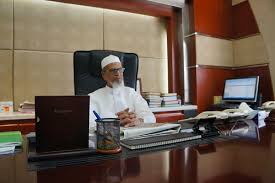
Distinguished citizen, pioneer businessman and philanthropist, Haji Abdul Razak
Kalsekar passed away on Monday at Dubai.

The well-known educationist and philanthropist who ran Kalsekar Trust, Kalsekar College and Kalsekar Hospital among many other charitable institutions. His special interest lay in the education sector and he had established many schools, colleges and orphanages.

“His philanthropy in India and West Asia will be remembered forever. He was very much concerned towards the upliftment of the downtrodden and empowerment of women.

Among his educational institutions, Kalsekar Girls Degree College for Women in Mumbra was established in order to provide quality education to girls. He was also very instrumental in setting up many hospitals, engineering, pharmacy and architecture colleges,” Aamir Edresy, president of the Association of Muslim Professionals, said.

Razzaq ran a perfume business in Dubai.

The AMP team offered deep condolences to his family and thousands of people, who considered him not just as an employer but also as a father and a guide.

source: http://www.twocircles.net / TwoCircles.net / Home> Indian Muslim / by TCN News / August 11th, 2015

In U.P more Muslims go to school, spend on girls’ education

UTTAR PRADESH :

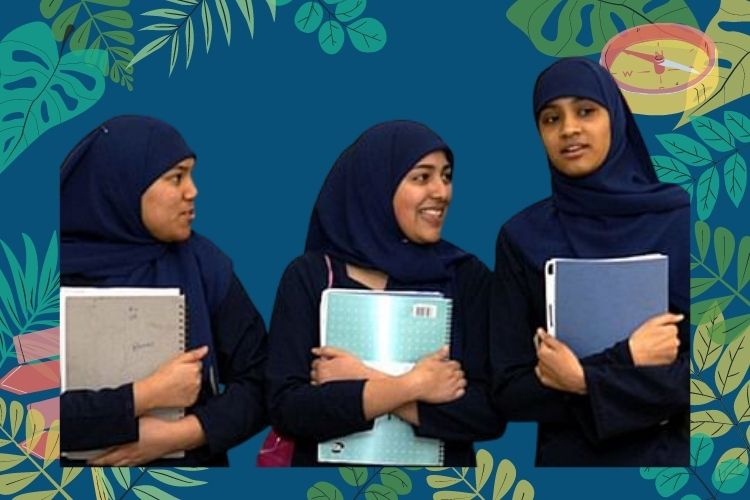
A representative image

Indian Muslims as a community, due to various social and political influences, have remained educationally backward. The Sachar Committee Report in 2006 revealed the dismal state of education among Muslims. The report was an eye-opener for the community and led to the efforts to spread education among Muslims. Muslims introspected and asked how come a community that believes in “Read with the name of your Lord who created (everything)”  – the first Quranic revelation – lagged in education. Not only did the community urge the country’s political leadership to address it but also made efforts to improve the state of affairs.

The efforts have not gone in vain. The data compiled in the Unified District Information System for Education (UDISE) by the Union Ministry of Education, points towards a remarkable increase in school-going Muslims in Uttar Pradesh, the most populous state in India.

Changing trends among Muslims

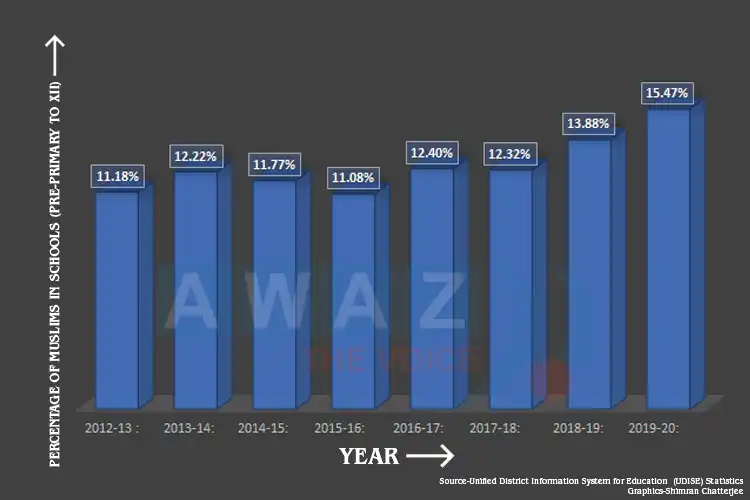
The UDISE survey reveals that in U.P, 4,53,62,059 students were studying in schools, from pre-nursery to class XII, during the 2019-20 session. Out of these, 70,18,201, or 15.47%, were Muslims. Because the Muslims are 19.26% of the population in the state, this number seems insufficient, which it is. But, if we consider the fact that seven years ago, in the 2012-13 session, out of 4,69,61,179 school-going children only 52,49,664, or 11.18%, were Muslims, the significance of the present numbers becomes evident.

The numbers show that the proportion of Muslims is steadily increasing and moving towards their proportion in the population, i.e. 19.26%. From the 2015-16 session till 2019-20, the percentage of Muslims among school-going children has been registered to be 11.08%, 12.40%, 12.32%, 13.88%, and 15.47% in successive years. If we talk in pure numbers, in 2015-16, there were 53,63,670 Muslim kids out of 4,84,06,853 students. In 2019-20, this figure has increased by more than 16 lakh to reach 70,18,201 as the total school enrolment in the state dropped by more than 30 lakhs. 

Graphic explanation of the changing trend in Muslim education-1

In order to understand the recent awakening in the community, one needs to look at the new enrollments. At the entry-level, Muslim students have reached very near to their proportion in the population. In the 2019-20 session, out of 51,48,352 students enrolled in class I, 9,71,229 were Muslims. This translates into 18.86% of the total class I students. It is a significant increase from 2018-19 when 16.92% of class I students were found to be Muslims, and in the year before the ratio was at 16.23%. 

The people working in the education sector among the Muslims of U.P often complain about the high dropout rates. As we go up the education levels, the proportion of Muslims tends to decrease. The apprehension is true, but the recent trends show an improvement in Muslim representation in higher classes. The survey found 3,73,304 Muslim students out of a total of 30,73,228 studying in class X, during the 2019-20 session. This makes 12.15% of the total class X students in the state, a significant rise from 2016-17 when only 7.65% of the total class X students were from the community. In the last four academic sessions, the proportion of Muslims in class X is, 7.65%, 8.38%, 10.90%, and 12.15%, successively. 

At Higher Secondary (+2), XI & XII, the proportion of Muslims enrolled has increased from 7.24% in the 2016-17 to 10.48% in the 2019-20 session. In successive sessions this proportion has been registered as 7.24% in 2016-17, 7.81% in 2017-18, 10.08% in 2018-19 and 10.48% in 2019-20. 

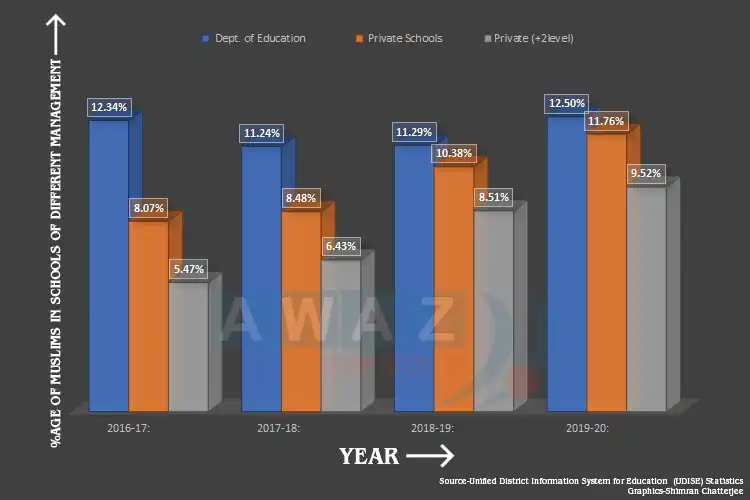
These numbers are no yardstick of the quality of education Muslims are availing. To get an idea we need to look at the type of schools at which these students are enrolled. As a matter of fact, in U.P, it is commonly believed that private schools are in a better condition than schools owned by the Department of Education. Out of the total 2,20,69,303 students enrolled in private schools, 25,95,073, or 11.76%, were found to be Muslims in 2019-20. This was a considerable increase from 2016-17 when 8.07% of the private school students were Muslims. In the last four academic sessions since 2016-17, the Muslim proportion in private schools was found to be 8.07%, 8.48%, 10.38%, and 11.76% respectively. 

Changing trends in Muslims’ education Graph-II

On the other hand, in the schools of the Department of Education, Muslim proportion remained more or less constant. In 2016-17, 12.34% of the students at the Department’s schools were Muslims which has shown a marginal increase at 12.50% in 2019-20. Another very important aspect of education among Muslims is that almost one out of every five school-going Muslims attends a Wakf/ Madrasa Board recognized Madrasa/ Maktab. In the 2019-20 session, 19.76% of the Muslim children were enrolled in these Madrasas. It is an increase from 2016-17 when 16.49% of Muslims were attending these institutions. But this shift can be attributed to a positive shift. In 2016-17, 5.31% of Muslim kids were attending unrecognized Madrasas which came down to 3.10% in 2019-20. It is a welcome change that Madrasa-going children are attending recognized Madrasa of Madrasa / Wakf Board instead of unrecognized Madrasas. 

Prof. Aquil Ahmed (Statistics & OR), AMU, believes that an increase in enrolments in private schools and status quo in Department of Education’s schools is a pointer that this increase in education among Muslims owes itself to the efforts from within. In recent years, he says that the community has started understanding the importance of education and hence without much help from the government people have started spending on education more and sending their children to schools.            

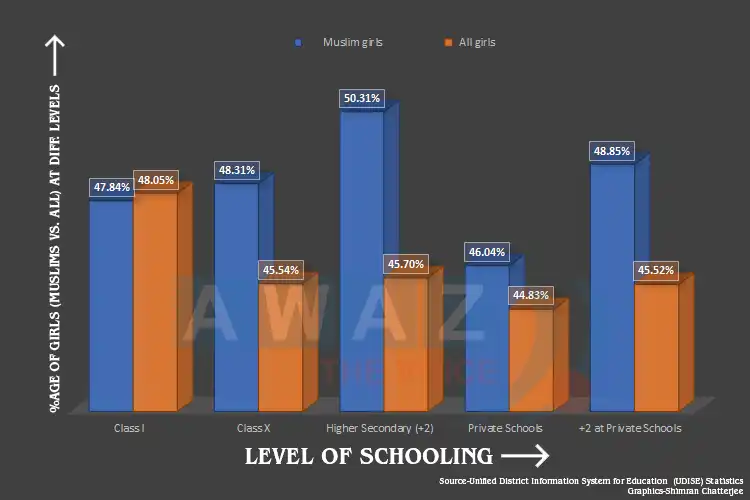
Bhim Rao Ambedkar said that women’s education and empowerment were the yardstick to measure the development of a society. The survey gives us immense hope as we analyze the data on girl students among Muslims. It is an open secret that ours is a patriarchal society. Irrespective of religion or caste, people discriminate against girls. It was not a surprise to see that, in 2019-20, out of 45,39,933 students enrolled in Higher Secondary (+2) in the state, 54.30% were boys and 45.70% were girls. Similarly, in class X, 54.46% of the total students were boys. On a similar pattern, for the same session, 55.17% of students enrolled in private schools were boys during the same session. But, the sweet surprise was the ratio of girls among Muslim students of U.P. In Higher Secondary,

Changing trends in Muslims’ education Graph-III

In 2019-20, 50.31% of the total Muslim students were girls while their proportion was 48.31% in class X. In private schools also enrolment of boys among Muslims was 53.96%. This means, among Muslims, proportionally more girls are being admitted in private schools than the average of the state. This positive approach towards women’s education is a welcome trend.       

The survey suggests that Muslims as a community are paying more attention to women’s education. As discussed above, in 2019-20, 10.48% of the total enrolments in Higher Secondary (+2) belonged to the Muslim community. If we look at gender then we find that, in 2019-20, of all the girls enrolled in +2, 12.06% were Muslims while 9.67% of the boys came from the community. This trend is a feature of all the preceding years as well. In 2019-20, in private schools out of all the girls enrolled 12.08% were Muslims while the proportion among boys was 11.50%. 

Interestingly, in higher secondary education in private schools, the proportion of Muslims among girls stands at 10.22% while among boys it is 8.94%.  In each session we find more Muslim girls taking admissions in higher secondary than Muslim boys. The proportion of Muslims among girls is much higher than their proportion among boys. For class X, in 2019-20, 12.88% of girls were Muslims while among boys they were 11.53%. The trend breaks the stereotype that Muslims do not send their girls to school. Moreover, it shows that Muslims are moving away from the orthodox traditions faster than the other communities.

Prof. Nazura Usmani (AMU), believes that access of younger generations to religious texts has made this women empowerment possible. Muslims, on understanding the true message of religion, are breaking the shackles of traditional orthodoxies, which kept women caged for centuries. Now, people are understanding that women’s education is part of religion and also there is growing acceptance in the community towards economically working women. She says that those people who do not identify themselves with revolutionary feminism are accepting that women should be educated and economically independent.  

The UDISE survey report brings out a positive trend of increasing education among Muslims. Though the community is still lagging the developments of recent years instills hope. Moreover, the survey brings out that Muslims are showing more gender parity when it comes to education than other communities.  

(Saquib Salim is a Historian and a Writer)

source: http: //www.awazthevoice.in / Awaz, The Voice / Home> Stories / by Saquib Salim / December 09th, 2021

I became a scientist because of Fatima Sheikh

UTTAR PRADESH :

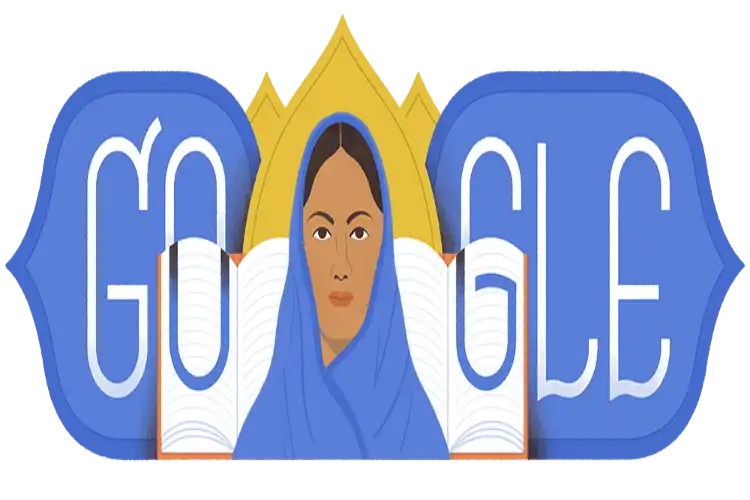
Doodle of Fatima Sheikh issued by Google

It was a cold day in February 2016. A woman from a small town of Uttar Pradesh received her Ph.D. at the 63rd Annual Convocation of Aligarh Muslim University (AMU), Aligarh. She was the first from her clan to have taken admission to AMU in 2003. Her parents never attended college; her four brothers took up family businesses at a younger age. The woman in the discussion is me. I am Mahino Fatima, a Muslim girl from a backward caste who became a scientist against all odds.

pix: heritagetimes.in / Dr. Mahino Fatima

Friends, relatives, and peers celebrated my becoming a scientist as a consequence of my hard work and perseverance. In my heart of hearts, I knew this day has not come only because of me; I was grateful for the privilege of education that I was born with.

Most importantly, I should not forget Fatima Sheikh. If not for her, I would never have become a scientist. Lakhs of women who are successful because of education would have remained illiterate but for Fatima Sheikh’s pioneering work.

How can I, a woman, forget that my foremothers were not allowed to learn how to write? How can I, a backward caste woman, forget that my forefathers were not allowed to receive an education? Today, when we look at our curriculum, we find that women scientists, economists, philosophers, and intellectuals are negligible in comparison to men. Famous philosopher, Jaques Derrida, once remarked that no woman was a philosopher. His observation was true, but he did not delve into the reason. How can a woman become a philosopher when men for centuries controlled the development of her intellectual capacities in the name of culture? 

In our society, men would not let women learn the art of writing for the fear that if literate these women would communicate to ‘lovers’ through letters. Bibi Ashraf, a late 19th-century educationist, recalled how she was not allowed to learn reading and writing like male members of her family. She secretly learned to write. The secret came out when during the revolt of 1857; she had to write a letter to her father and uncle. Instead of receiving accolades, she was abhorred by men in her family. Her uncle was furious and made her take an oath that she would never write a letter to a man. Similar was the story of Rassundari Devi, who secretly learned writing by stealing books from her son. How do we expect women scientists in such a society? Still, a large section of our society would not let women study more than what is needed in the ‘marriage market’.

In this society, Fatima Sheikh, along with Savitribai Phule, started a school for girls in 1848. Yes, 1848. 26 years before Sheikh Abdullah, who later founded a women’s college at Aligarh, and 32 years before Begum Rukaiya Sakhawat, doyen of women education, were born, Fatima had started a girls’ school and taught herself. Today, that small classroom of 9 girls has prepared lakhs of educated women. 

Today women are asking for gender parity in opportunities and pay scales. Thanks to Fatima, women today are educated to understand their worth and assert their rights. 

Fatima was a pioneer; she was followed by Begum Rukaiya, Begum Wahid, Muhammadi Begum. A revolution starts with an idea. Fatima’s was the idea that put women of India in general and Muslim women in particular, on the march to empowerment through education.

Today, I thank Fatima for making me a scientist. Nobody knows how many bright women before 1848 had been deprived of education and were not allowed to dream of becoming a scientist. But, we surely know that after 1848, women have slowly entered different fields through education and are today competing with men to have their rightful place in the books, laboratories, and society.  

(Author is a neurobiologist with her major research on depression and Alzheimer’s)

source: http://www.awazthevoice.in / Awaz, The Voice / Home> Stories / by Mahino Fatima / Saquib Salim / January 09th, 2022

Aligarh and Women’s Education: A Brief Overview

Aligarh, UTTAR PRADESH :

Women’s education in nineteenth-century India was no easy task. In the case of Muslim women, the task was even more difficult due to their triply marginal identity: as colonial subjects, as women, and as Muslims. Not only did the custom of purdah added to their seclusion from the social and cultural changes, their men hated everything about the western cultural influence (being displaced as rulers by the British). As a result, the middle class (the initiators of reform) was to develop late among the Indian Muslims than their Hindu counterparts. Nevertheless, by the late nineteenth century, a middle-class among the Indian Muslims was fledging. For this, no institution of the nineteenth-century can be given more commendation than Aligarh Muslim University.

Formed in 1920, the Aligarh Muslim University just completed its hundred years as a modern residential university. There has been a perception that the Aligarh Movement, for whatever reasons, neglected the issue of modern education to Muslim women. But there is more to this argument, some things to be explored, some to be re-interpreted.

This article, therefore, attempts to trace the genesis and trajectory of women’s educational reform in Aligarh through the profile of a woman reformer – Waheed Jahan (1886-1939), wife of Shaikh Abdullah (1874-1965), and the co-founder of Aligarh’s first girls’ school. Waheed Jahan was a pioneer of Muslim women’s education at Aligarh in the early twentieth century. Her role in ending the relative isolation of Indian Muslim women, while at the same time preserving the Muslim identity of the community, is worthwhile to recall. Her biography was published in Urdu by her husband in 1954. [1]

The educational reforms among Indian women were mostly started by men. Such men started with writings advocating women’s education. In this regard, among Muslims, Nazir Ahmad (1833-1912) published his novel, Mirat-ul-Arus, in 1869; Altaf Hussain Hali (1837-1914) published Majlis-un-Nissa, in 1874. Soon, magazines and journals followed, like the Tahzib un-Niswan by Sayyid Mumtaz Ali (1860-1935), the Khatoon by Shaikh Abdullah and Waheed Jahan, and the Ismat by Rashid-ul- Khairi (1868-1936). Gail Minault regards these as ’The Big Three.’ [2] Apart from literary activism, others tried more practical measures, like opening schools for Muslim girls.

As the movement intensified, so did the opposition against it. In such an atmosphere, even the talk of women’s education by a woman herself was quite a chivalry.

Yet, unexpectedly, there were women who defied the odds and broke the ground. Rashid-un-Nissa of Patna, became the first Muslim woman to write an Urdu novel, Islah-un-Nissa in 1881 (published in 1894), when writing was a distant dream for Muslim women. Rokeya Sakhawat Husain (1880-1932), a widow herself, pioneered Muslim women’s education in Bengal. Muhammadi Begam (1878-1908) edited one of the leading ladies’ home journals, Tahzib-un-Niswan. One such icon of women’s education at Aligarh was Waheed Jahan.

Waheed was born in 1874 in a landholding family in Delhi. Her father Mirza Ibrahim Beg was of Mughal ancestry, serving as a minor municipal official in Delhi. Her only brother, Bashir Mirza went to the Mohammadan Anglo-Oriental College (MAO Colege), Aligarh, where he befriended Shaikh Abdulla (a Kashmiri convert to Islam, named Thakur Das before conversion).

As was the custom, Waheed received no formal schooling. She learnt Urdu and Persian from her father and arithmetic and elementary English from a visiting English tutoress.

Ismat Chughtai, in her autobiography, Kagazi hai Pairahan, records, how Waheed Jahan, before her marriage, had dreamt of establishing a school for the girls. She would gather the servants’ children and teach them, and soon the rudimentary school became popular among her neighbours. It is noteworthy that, at a time when others (mostly men) were still imagining a school for girls (that too only in their writings), Waheed, in her own limited capacity, was practically making a difference.

In 1902, Waheed married Shaikh Abdullah – a lawyer at Aligarh, and an ardent supporter of women’s education since his school days. Following the marriage to a woman with some education, he began to consider concrete ways to promote Muslim women’s education. The Mohammadan Education Conference (MEC, founded at Aligarh by Sir Syed Ahmad in 1886) had established a Women’s Education Section (WES) in 1896 to start a Normal School for girls and to train female (zenana) teachers. In 1902, Shaikh became the secretary of WES, which by then had merely achieved anything beyond discussions and debates around women’s education.

Luckily, Waheed’s marriage to a reformist like Abdullah helped her materialize her dream. To champion women’s education, they started an Urdu monthly, the Khatoon, in 1904 with Waheed Jahan as editor. Begum Sultan Jahan (1858-1930) of Bhopal, Binnat Nazir-al-Baqir, Suharwardiya Begum, and Binnat Nasiruddin Haider were some important female contributors to the journal.

The paucity of funds made it impossible to start a Normal School. Waheed Jahan advised her husband to start a primary school for the elite (Sharif) girls. In 1904, the Mohammadan Educational Conference passed a resolution to start a girls’ school in Aligarh. Waheed proved to be an efficient manager and fund-raiser for the cause.

Her capacities as a fund-raiser and organizer were displayed in 1905, when she organized a meeting of Muslim women in Aligarh, with participants from far corners of Lahore and Bombay. Judging from the context of the time when purdah among Muslims was so harsh, even the idea of organizing such an event was quite revolutionary.

Aware of women education in Turkey and Egypt and its benefits to society, she tried to convince other women; she said:

When women meet among themselves, there will be more solidarity. . . Now there is a division between educated and uneducated women. Uneducated women, who do not go out, think that respectability is confined to the four walls of their houses. They think that people who live beyond those walls are not respectable and not worthy of meeting. But God has ordained education for both men and women, so that such useless ideas can be dispensed with. . . [3]

The meeting was a success, the exhibition of women’s craft secured good funds; finally, the women passed a resolution favouring a girls’ school in Aligarh. In October 1906, Aligarh Zenana Madrasa (girls’ school) opened its doors, and seventeen students were enrolled. Urdu, arithmetic, needlework, and the Quran formed the curriculum. Leaving her own children in servants’ care, Waheed took the responsibility of supervising the school. Within six months, the number of students increased to fifty-six. Waheed’s efforts secured the school a cumulative grant of Rs. 15,000 and a monthly grant of Rs. 250. By 1909, the school taught 100 students and shifted to a larger building.

The opposition to girls’ school took new forms. One amusing story is recorded in Shaikh Abdullah’s Urdu memoir (1969), Mushahedaat o Taaassuraat. [4] Maintaining purdah, the girls were carried in daulis (curtained carriages) to school, and some street urchins started harassing the school going girls by lifting the curtains of their daulis. The mischief only stopped when Shaikh gave one of the miscreants a good thrashing. In another incident, Shaikh confronted a tehsildar who had accused the school of making the girls insolent.

When the Abdullahs proposed a girls’ boarding school, it invited opposition from elite corners. The European principal of MAO College, W.A.J Archbold; Ziauddun Ahmad (1873-1947); and Viqar-ul-Mulk (1841-1917) opposed vehemently.

The couple, however, succeeded in 1914, witnessing the transformation of the school into a boarding school. The same year saw the culmination of Muslim women’s activism by the foundation of Anjuman-i-Khavatin-i-Islam (AKI) at the same venue. Begum Sultan Jahan (1858-1930) of Bhopal graced the foundational ceremony of the boarding school, felicitating Waheed; she urged other women to follow her example. Fyzee sisters, Abru Begum, Begum Shafi, and Begum Shah Nawaz were the other dignitaries.

The Begum was already active in various social and educational reform projects. She served as the first chancellor of AMU from 1920 until her death in 1930. Having a woman as the first chancellor was indeed a historic feat.

Only nine girls became the residents, most of them from Waheed’s own family. By the end of the year, the enrollment rose up to twenty-five. This was the result of what the historian Gail Minault calls as Abdullahs’ portrayal of girls’ school as an extension of girls’ families and also of their own. To make the school successful, Waheed used to invite the parents of girls to Aligarh, for a few days stay in the hostel, to convince them that the conditions there were safe enough to let their daughters stay, records Sheikh Abdullah, in his Mushahedaat o Taaassuraat. She supervised everything – housekeeping, laundry, shopping, and even tasted each dish cooked for the girls.

It could be said that Waheed Jahan acted as a foster mother to these girls, counselling, nursing, and treating them as a part of her own extended family. They called each other as Apa (sister), Shaikh Abdullah as Papa Mian, and Waheed Jahan as Ala Bi. This created a sense of sisterhood among the girls.

This familial system of ethos still remains unique to the Aligarh Women’s College.

The boarding school project contained other complex problems, such as maintaining proper purdah. Both Shaikh and Waheed agreed that the purdah practiced in the Sharif society was more restrictive than purdah sanctioned by the Shari’a (Islamic Law). But to secure social acceptance for their school, they chose to go with strict purdah, building fortress-like walls to fend off the male gaze, students’ mails were scrutinized, and only close relatives were allowed inside.

This accommodation of purdah within the gamut of their reformist agenda, to gain social acceptance, was indeed very astute of the Abdullahs. Thus, Waheed Jahan succeeded in preserving both the elite and the “Muslim” identity of herself and her community while simultaneously breaking the relative isolation of Indian Muslim women. The girls’ school became an intermediate college in 1925 and started degree classes in 1937 (with 250 students). Waheed passed away in 1939, only after seeing her school becoming a degree college.

The relation between education and social change is complex, varying from culture to culture and among different classes in the same culture.

True, that Aligarh movement was late to include women’s education in its fold. Even the school founded by the Abdullahs did not fulfil all its expectations – their choosing an exclusively elite (Sharif) clientele limited the impact of their reforms.

But their efforts indeed bore fruits; the educational reforms for Muslim women at Aligarh contributed to many social developments. After the formation of AKI in 1914, the number of meetings and associations (for women-only) increased rapidly in the 1930’s. The growth in the number of educated women created a market for new publications for and by women.

The Aligarh Women’s College produced many women of substance, who made sure to shine above and beyond purdah, some figuratively and others literally. These ladies excelled in various fields, from teaching to medicine to writing.

Rashid Jahan, Waheed Jahan’s daughter, became a successful physician, a radical writer, and a staunch communist. Her short stories in Angare (1932) became the opening salvo of the Urdu Progressive Writers Movement (1936). Rakhshanda Jalil, in her biographical work on Rashid, A Rebel and her Cause: The Life and Work of Rashid Jahan, writes that Angare was a “document of disquiet”; a self-conscious attempt “to shock people out of their inertia, to show how hypocrisy and sexual oppression had so crept in everyday life”. Rashid became an inspiration for a generation of women writers such as Ismat Chughtai, Attia Hosain, Sadia Begum Sohravi, and Razia Sajjad Zaheer, among others.

Like all other reform movements of that time period, the Aligarh movement had its limitations too. For a start, it did prioritize men’s education over women’s, for various reasons (a story that needs to be told elsewhere), but by the early twentieth century, things were changing. The Aligarh movement not only took up the cause of women’s education actively, but it also let women (Like Wahid Jahan) be a part of the process.

Notes

[1] Shaikh Abdullah, Savanih-i- Umri-i- Abdullah Begum, Aligarh, 1954

[2] Gail Minault, Gender, Language, and Learning: Essays in Indo-Muslim Cultural History, Permanent Black Publications, Ranikhet, 2009, p. 87

[3] Khatoon 3, 1 (Jan 1906) “Ladies Conference”, pp 7-8

[4] Shaikh Abdullah, Mushahidat-wa-Ta’asurat, Female Education Association, Aligarh, 1969, pp. 234-6

(Ishrat Mushtaq is PhD Candidate, Centre of Advanced Study in History, Aligarh Muslim University and Sajad Hassan Khan is PhD. Candidate, Centre of Advanced Study in History, Aligarh Muslim University. Article courtesy: Mainstream Weekly.)

Janata Weekly does not necessarily adhere to all of the views conveyed in articles republished by it. Our goal is to share a variety of democratic socialist perspectives that we think our readers will find interesting or useful. —Eds.

source: http://www.janataweekly.org / Janata Weekly / Home / by Ishrat Mushtaq and Saad Hassan Khan / January 24th, 2021