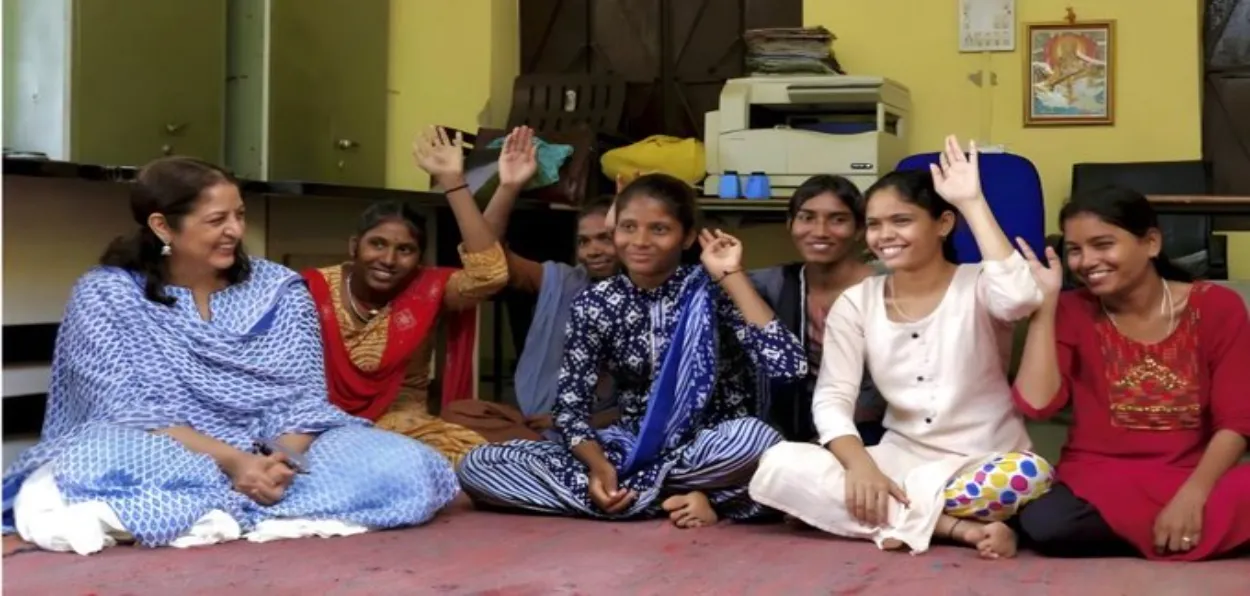
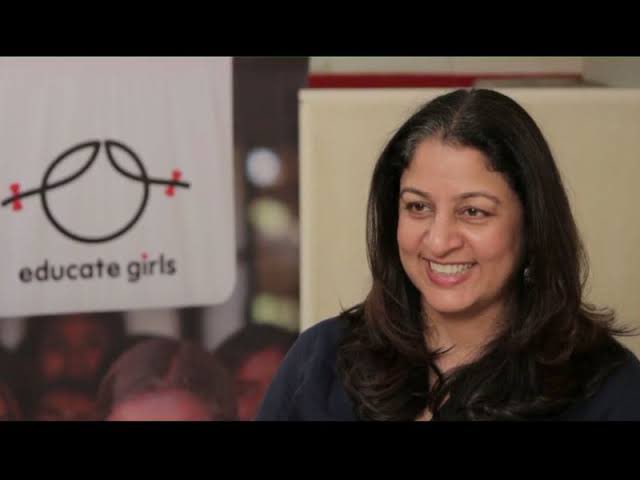
Safeena Husain (Extreme left) with some of the girls who whom her NGO helped
New Delhi
“The Ramon Magsaysay Award for ‘Educate Girls’ is a historic moment for India, and it places the global spotlight on a people-powered movement that began with a single girl in a remote village in the country,” said the non-profit’s founder, Safeena Husain, after the Manila based committee named her NGO for the coveted award for 2025, said.
Founded by Safeena Husain, The Foundation to Educate Girls Globally, widely known as ‘Educate Girls,’ has made history as the first Indian organisation to receive the Ramon Magsaysay Award, a statement from the Ramon Magsaysay Award Foundation (RMAF) said.
“Educate Girls” shares the 2025 Ramon Magsaysay Award with Shaahina Ali (Maldives), honoured for combating plastic pollution and protecting marine ecosystems, and Fr. Flaviano Antonio L. Villanueva (Philippines), recognized for restoring dignity to Manila’s poor and homeless.
‘Educate Girls’ has been named for Asia’s premier prize and highest honour for “its commitment to addressing cultural stereotyping through the education of girls and young women, liberating them from the bondage of illiteracy and infusing them with skills, courage, and agency to achieve their full human potential,” the RMAF statement said.
Reflecting on the milestone, Husain said, “Being the first Indian non-profit to receive the Ramon Magsaysay Award is a historic moment for Educate Girls and for the country. This recognition places a global spotlight on India’s people-powered movement for girls’ education, one that began with a single girl in the remotest village and grew to reshape entire communities, challenging traditions and shifting mindsets.”
The award honours dedicated Team Balika volunteers, valued partners, passionate gender champions, and supporters, and acknowledges the millions of girls who reclaimed their right to education, she said.
“As we work to reach 10 million learners in the next decade and share this blueprint beyond India, we carry forward a simple truth that when one girl is educated, she takes others with her, multiplying change across families, generations, and nations,” Husain said.
The organisation’s CEO, Gayatri Nair Lobo, said, “At Educate Girls, we believe that education is one of the greatest levers for development. But above all, education is every girl’s fundamental and inherent right. This prestigious award recognises the transformational change that is possible through partnerships with the government, philanthropic institutions, corporations, and grassroots communities, working together to tackle societal and systemic barriers and promote equitable and accessible education for girls everywhere.”
“We are deeply grateful to the Government of India for its phenomenal initiatives that have made this possible. Warm congratulations to our fellow awardees, Shaahina Ali and Fr. Flaviano Villanueva, whose work inspires us all,” she added.
Starting from Rajasthan, Educate Girls identified the neediest communities in terms of girls’ education, brought unschooled or out-of-school girls into the classroom, and worked to keep them there until they were able to acquire credentials for higher education and gainful employment, the statement said.
“It started with 50 pilot village schools reaching over 30,000 villages across India’s most under-served regions, involving over two million girls, with a retention rate of over 90 per cent,” the Foundation said.
The organisation is being recognised for its commitment to addressing cultural stereotyping through the education of girls and young women, liberating them from the bondage of illiteracy and infusing them with skills, courage, and agency to achieve their full human potential, a release said.
Safina Husain, founder The Foundation to Educate Girls Globally
It is the first Indian organisation ever to receive this award, in recognition of ‘its commitment to addressing cultural stereotyping through the education of girls and young women, liberating them from the bondage of illiteracy and infusing them with skills, courage, and agency to achieve their full human potential.’
The non-profit joins a lineage of distinguished laureates, including filmmaker Satyajit Ray, singer M.S. Subbulakshmi, social reformer Kiran Bedi, and Vinoba Bhave, alongside international icons such as Nobel Peace Prize laureates the Dalai Lama and Mother Teresa, as well as Oscar-winning storyteller Hayao Miyazaki.
Educate Girls, founded in 2007, empowers girls through education to break cycles of poverty and illiteracy. Since its inception, mobilising 55,000+ volunteers, it has brought back over 2 million girls to school and supported over 2.4 million children with remedial learning.
It operates in over 30,000 villages, aligning with the government’s priorities and initiatives. With a goal to reach 10 million learners in the next decade, the organization drives systemic change through government partnerships and ensures last-mile access for the most vulnerable. Its global recognition underscores the transformative power of investing in girls’ education.
The 2025 Ramon Magsaysay Awardees will formally receive their medallions and certificates during the 67th Ramon Magsaysay Awards Presentation Ceremonies on 7 November 2025 at the Metropolitan Theatre in Manila, Philippines.
source: http://www.awazthevoice.in / Awaz, The Voice / Home> Stories / posted by Aasha Khosa / September 02nd, 2025
Lakhimpur Kheri District / Aligarh, UTTAR PRADESH :
A leading scholar of Islamic studies with focus on Seerah literature and history, he unconventionally broke many stereotypes—both orthodox and modern and all his life epitomized the cause of Islam on the intellectual front.
With the death of Yaseen Mazhar Siddiqui, at the age of 76, Muslims in South Asia lost one of the most respected and leading scholars of Islam. A graduate of, and now professor at Aligarh University is less known in the West for his 29 books than for his Catalogue of Arabic Manuscripts at the Aligarh Muslim University, India, published in London in 2002 by the Furqan Heritage Foundation.
An eminent Muslim religious scholar, academic and historian who served as director of the Institute of Islamic Studies at Aligarh Muslim University. Siddiqui was a well-placed and reputed figure of great spiritual and intellectual insight recognized on national as well as international level.
Siddiqui was instrumental over the past 30 years in the framing, development and streamlining the influence of Islam in Aligarh Muslim University. To commemorate the outstanding services of Hazrat Shah Waliullah and to promote the Islamic values, the Institute of Objective Studies instituted an Award known as “Shah Waliullah Award” to honour eminent scholars who have done outstanding work in Social Sciences, Humanities, Law and Islamic Studies. The fifth Shah Waliullah Award was rightly conferred on Prof. Mohd Yasin Mazhar Siddiqi, as the renowned scholar for his contribution to Sirah and Historiography in Islamic Perspective in 2005.
Siddiqui was an exceptionally modest and humble man, with an intellectually engaging and honest commitment to Islam, away from self-eulogizing claims of pseudo-intellectualism. His commitment to Islam, which occupied him for his whole life, left an indelible mark in the hearts and minds of people across territorial boundaries.
One thing all this illustrates is Siddiqui’s intense sense of duty — a sense that he unthinkingly expected his colleagues to share. Siddiqui’s well-stocked mind, clarity and unflinching intellectual honesty devoted to respond the questions of Orientalist scholarship on Sirah literature and subsequent other corollaries. He had little time for Islam’s own accounts of its origins rather his interest revolved around “Qurʾān and Sirah” and its role in shaping the worldview of Muslims who are struggling to makes sense of their identity amid the challenges emerging from dominant discursive colonial Eurocentric episteme. Leaving the conventional hollow claims, without efforts to prove how and why so much sanctity is attached to Islam and its sources—Qurʾān and Sunnah/Sirah being the primary one, he reckoned, to fill the gap using contemporary sources and knowledge of Hadīth, from orientalist and now its pedigree of modernist claims. This task required both personal and intellectual bravery. As he knew the central beliefs of Islam, such as the way the Quran took shape, the place of Sirah, its underlying methodology, he was equally aware how outside scrutiny has tempered the flare, especially when the conclusions are expressed in a witty and sardonic style.
His soft way of speaking, affectionate manner and hospitable nature made him a much-loved figure. Because of his erudition most people who came in contact with him thought of him as a teacher; many saw him as a spiritual mentor. With his humble appearance, it was easy to mistake him for a country bumpkin.
Born in India in 1944 in the Lakhimpur Kheri district of United Provinces of British India. He graduated in the traditional Dars-e-Nizami (pure religious textual studies of Islamic texts) studies from Nadwatul Ulama in 1959, and Master’s in literature from the University of Lucknow in 1960. He passed the intermediate exams from the Jamia Milia Islamia in 1962 and then acquired a B.A. in 1965 and B.Ed. in 1966 from the same University. In 1968, Siddiqui recieved a M.A. degree in History, M.Phil. in 1969, and Ph.D. in 1975 from the Aligarh Muslim University. Yasin Mazhar Siddiqui benefited from great teachers like Maulana Rabi Hasni Nadvi, Maulana Syed Abul Hassan Ali Nadvi, Maulana Ishaq Sandelvi K. A. Nizami, Abd al-Hafīz Balyāwi and Rabey Hasani. Anwar was welcomed as an independent member of various advisory committees and expressed pride in the research done in the field of Sirah.
Professor Siddiqui wrote more than 40 books and 300 research articles in Urdu, Arabic and Persian.
His publications and presentations have reverberated throughout the discipline of Islamic studies and social sciences, profoundly shaping the scholarship of a new generation of scholars as they develop a thoughtful, knowledgeable, and critical approach to Seerah and history. He was well known for the great quality and high calibre of his originality of research in Islamic studies and all related subjects.
He was recognized as one of the compelling and intellectually grounded voice on Seerah studies. As a scholar and teacher, he embodied and followed strong moral and political principles, and formulated new ways of understanding the subject of Seerah, history, religious freedom, and the rights of religious minorities. His writings on the Prophet and his teachings garnered wide acclaim.
He wrote extensively in reputed literary journal, ‘Nuqoosh’ and got international ‘Nuqush Award’, ‘Seerat-e-Rasool Award’ and ‘Sirah Nigari Award’.
Two of his most popular works are Muslim Conduct of State and Introduction to Islam. The first book was Ehd-e-Nabwi mai Tanzīm-e-Riyāsat-o-Hukūmat and the second book The Prophet Muhammad: A Role Model for Muslim Minorities has gained such wide acclaim—mainly for the reason that its contents are divided into chapters (which stand on their own as a monograph) which deal with related specific subject matter. It is easy to understand how his style of presentation has endeared the book not only to common folk, but also to the people who would like to gain a reasonable insight into the true spirit of the teachings of Islam.
For such Muslim communities, the political perspectives reflected by the corpus of traditional fiqh are of little or no relevance, and can even be hugely problematic. Siddiqui therefore takes it upon himself to develop an understanding of Muslim jurisprudence that is particularly suited to their context, making a valuable contribution to the limited, but slowly expanding, corpus of writings on fiqh al-aqalliyat or fiqh for [Muslim] minorities. Siddiqui argues that the basis of fiqh for Muslim minorities must lie in the Makkan period of life of the Prophet Muhammad and his companions, a period of around thirteen years when the Muslims were a minority and did not enjoy political domination. In many senses, their position resembled that of Muslim minorities today. Muslim minorities need to see the role of the Prophet and the early Muslims in that period as a model for them to emulate, Siddiqui suggests:
The Prophet had close personal ties with several non-Muslims in Mecca, and Muslim minorities, Siddiqui advises, must emulate him in this regard and must have “excellent social relations with non-Muslims” (p. 194).
As Siddiqui succinctly puts it:
Muslims all over the world, especially Muslim minorities, have to prove that they are the best community, devoted to the cause of protecting mankind against suffering and blessing everyone with happiness, regardless of caste, colour or creed. Their position is of the best community and their duty is to serve mankind […] Their presence must guarantee help for everyone, especially of their non-Muslim country. However, this cannot be affirmed merely verbally or by recounting old stories. They have to prove it by their conduct. (p. 194)
This monograph and his other works are a brilliant contribution to the on-going debates about fiqh for Muslim minorities. It provides valuable insights for developing new and more relevant understandings of Islamic jurisprudence in Muslim minority contexts, envisaging the possibility of reconciling Islamic commitment with Muslim minority-ness, an issue that has largely escaped the attention of Islamic scholars but one that has sometimes been, and continues to be, a troubling one for many Muslims living as minorities.
Siddiqui’s diverse and intellectually engaging work that speaks eloquently to a wide spectrum of readers with different backgrounds and interests. To use terms such as “monumental”, “one-of-a-kind”, and “exceptional” to describe this work is not exaggeration.
A committed Muslim, throughout his career Siddiqui maintained the principle of genuinely evidence-based research. Dapper and courteous, he was a highly effective communicator, quoted widely in the local context as well as cited in academia.
A direct criticism to his work also emerges from scholars who assert that in his Introduction of The Prophet Muhammad—A Role Model for Muslim minorities’ Siddiqi (p. 62) formally describes himself as a humble and error-prone human being. However, he then proceeds to negate the worth of all previous biographies of the Prophet, claiming that these ‘conventional’ authors used ‘outdated methodology and lines of argument’. Consequently, according to him, all previous studies of the Makkan period were ‘markedly inadequate’ and ‘the entire life history of the Prophet remains to be analysed’ since ‘no biographer of his has ever given thought to this obvious fact that the Makkan period of his life represents the phase of subjugation’. Therefore, Siddiqi considers the conventional treatment of the Makkan and Madinan periods of Islamic history as ‘downright pernicious’ (p. ix). One wonders indeed whether the author is aware of some of the most popular biographies of the Prophet—beyond the classical ones: Ibn Ishaq, Ibn Hisham, and Ibn Kathir—including the works by Muhammad Hamidullah, Muhammad Haikal, Martin Lings, Karen Armstrong, and Tarik Jan, all contradicting his assertions.
With quite a serious criticism on his assertions about various aspects of mis-reading the Seerah of the Prophet there still remains a lot to be talked about his contribution to diverse areas of Islamic Studies. And though he is no longer here to share his thoughts, he has done enough to enable us to think with him. Certain towering intellectuals become integral to the very alphabet of our moral and religious imagination. They live in those who read and think them through-and thus they become indexical, proverbial, to our thinking.
Siddiqui lived so fully, so consciously, so critically through the thick and thin of our times that he is definitive to our critical thinking, just like Mustafa Azami, Abul Hasan Ali Nadvi, or other Muslim luminaries are. He was – and remains – a brilliant intellectual, whose legacy of rethinking certain conventional assertions around Islam and efforts still reverberate today and will continue to do so.
He cultivated with joyous attention her relationships with family and friends. He mentored, as one of his students mentioned once, with remarkable care and intensity, demanding their best work, listening, responding with a sharp generosity, coming alive in thought, and soliciting others to do the same. He immersed himself, in illness and heath, in reading the Quran post morning prayers and transformed himself and transmitted the values of thought and love, leaving now a vibrant legacy that will persist and flourish among all whose lives were touched by his life and work.
May Allah Almighty bless him with the loftiest of abodes in the Gardens of Firdaus in the company of Allah’s beloved Messenger and grant all those who cherished him patience.
source: http://www.muslimmatters.org / Muslim Matters / Home> Islam / by Dr Mehraj Din / September 22nd, 2020
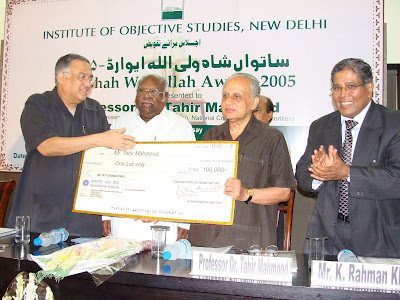
Vahanvati presenting the cheque to Tahir Mahmood with A R Laxamanan, and Rajya Sabha Deputy Chairman, K Rahman Khan
New Delhi:
The seventh Shah Waliullah Award was conferred on eminent legalist and an authority on Muslim Law Dr Tahir Mahmood today in New Delhi by Institute of Objective Studies (IOS).
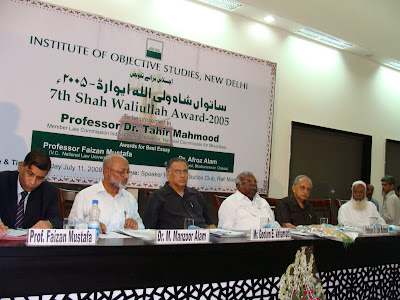
The award carrying a shawl and a check of Rs one lakh was presented to Dr Mahmood, who is currently Member, Law Commission of India and former Chairman of the National Commission for Minorities, by Attorney General of India Goolam E Vahanvati in the presence of Deputy Chairman, Rajya Sabha, K Rahman Khan, Law Commission of India Chairman, Justice A R Lakshmanan, IOS chairman Dr Manzoor Alam and Lok Sabha Member Maulana Asrarul Haque Qasmi.
In his award accepting speech Dr Tahir Mahmood, author of several books and Muslim and general law, offered his gratitude to the IOS for selecting him for the prestigious award as it is named after renowned Islamic scholar and reformer Shah Waliullah Muhaddis Dehlvi and deciding to present it to him by the eminent jurist and present Solicitor General Goolam E Vavanvati in the presence of K Rahman Khan and other dignitaries.
Islamic law was distorted by the British judiciary, and what is today found in text books in the name of Islamic law, is in fact far from the true Islamic law, said Dr Mahmood who has spent about 50 years on working on Muslim Law – first 20 years since 1959 on studying it through original sources and next 30 years teaching and writing on Muslim Law.
Prof Faizan Mustafa, V-C, National Law University, Bhubaneshwar, IOS chairman Dr Manzoor Alam, Attorney General of India Goolam E Vahanvati, Justice A R Laxamanan, chairman, Law Commission of India, Dr Tahir Mahmood, Maulana Asrarul Haque Qasmi, MP, Lok Sabha
He announced to donate the award money to the Indian Association of Scholars of Religion and Law (ASRAL-India), a group he set up to create a platform for engagement between religion and law.
IOS instituted the award in 1999 to commemorate the outstanding services of Shah Waliullah to promote the Islamic values and to honour eminent scholars who have done outstanding work in Social Sciences, Humanities, Law and Islamics.
This was the 7th award for the year 2005. The first award for the year 1999 was conferred posthumously on Maulana Syed Abul Hasan Ali Nadvi on November 3, 2000. The second award went to Qazi Mujahidul Islam Qasmi, the renowned Islamic scholar and an authority on Islamic fiqh and the third to Prof Nejatullah Siddiqui, eminent Islamic economist.
source: http://www.twocircles.net / TwoCircles.net / Home> Indian Muslim / by Mumtaz Alam Falahi, TwoCircles.net / July 11th, 2009
Apart from the need for education, it underlines the importance of representation in legislative bodies and jobs
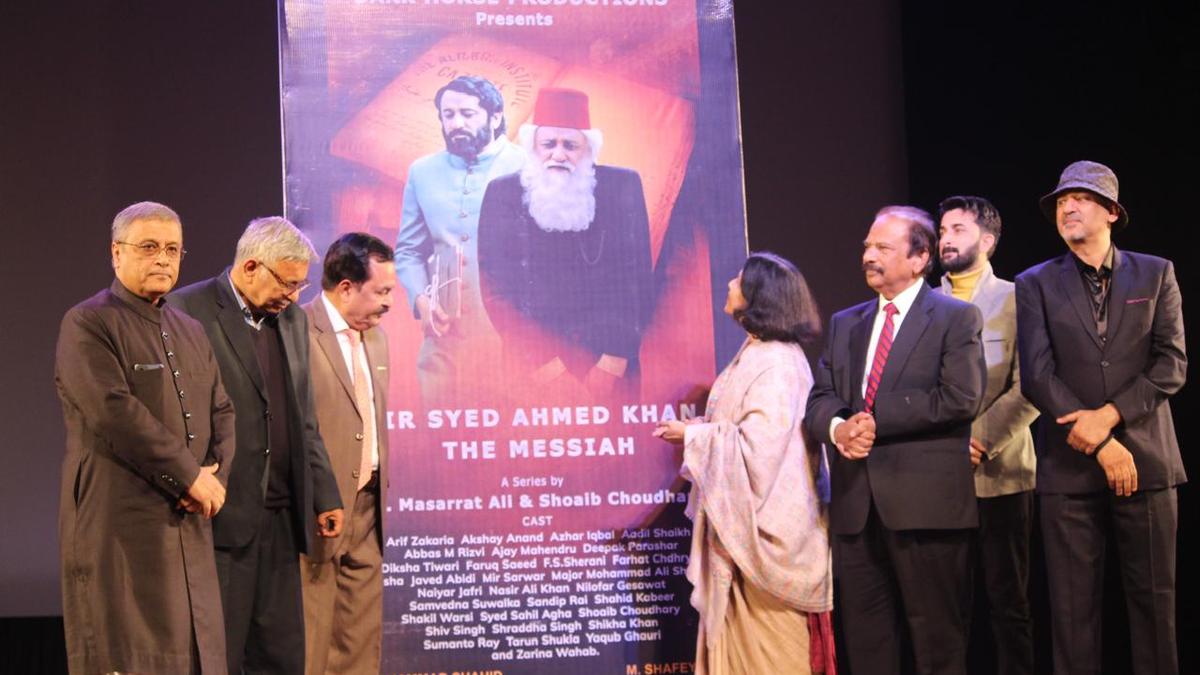
Syed Ahmed Khan biopic | Photo Credit: SPECIAL ARRANGEMENT
He is one of the architects of modern India or a proponent of the two-nation theory. However, moving away from easy binaries, the first biopic of Sir Syed Ahmed Khan attempts to find answers to the contested legacy of the founder of the Muhammedan Anglo-Oriental College that took the shape of Aligarh Muslim University (AMU). Long in the works, a two-hour cut of the OTT series, The Messiah premiered at the iconic Kennedy Auditorium in AMU on Monday, before the series streamed on Apple TV.
Coming at a time when the minority status of the Central University is being hotly debated in courts and society, the series details how Sir Syed confronted a section of the clergy and conservative elements within the Muslim community by creating a modern centre of learning to build bridges between the Muslims and the British government after the revolt of 1857, when the colonial power held the community largely responsible for the rebellion. “He held the ignorance as the primary reason behind the political decay of Muslims and thus pushed for modern education,” says Shoaib Hussain Chaudhary, who not only directed the series but also played the title role. “The role fell into my lap after big names declined to take up the challenge, perhaps because of the stigma attached to him.”
A known name in the television circuit, Chaudhary sees Sir Syed as an advocate of Hindu-Muslim unity, who was wrongly associated with the two-nation theory. “The theory came into being long after his demise in 1898. What he asked for was Muslim representation in legislative bodies and it remains relevant considering the political status of the community today.”
As someone who believed in answering a book with a book, Sir Syed responded to William Muir’s controversial commentary on Prophet Muhammad with a rational interpretation of Islamic tradition in Khutbat-e-Ahmadiya.
An adaptation of Hayat-e-Javed, Khwaja Altaf Hussain Hali’s biographical account of Sir Syed’s life, the series puts him in the league of reformists like Raja Ram Mohan Roy and Ishwar Chand Vidyasagar and argues that he was not a communal figure but a communitarian who was conscious of the fact that Hindus of Bengal were at least 50 years ahead of Muslims in taking up modern education.
Interestingly, the spark came from Mirza Ghalib. When Sir Syed approached the poet to write the preface of his translation of Ain-e-Akbari, he advised him to concentrate on the contemporary issues of the community and said there was no point in celebrating Akbar’s rule when the constitution of the world was being written in Calcutta.
‘Controversial ideas’
The series also critiques Sir Syed’s point of view on girls’ education and backward Muslims and debates whether he made a mistake by not joining hands with the Indian National Congress. It also explores his tumultuous relationship with his son Syed Mohammad, the first Muslim judge of a High Court during the British Raj, whose proclivity towards alcohol created problems in his personal and professional life. “Sir Syed’s character appears dichotomic but if you see him as a product of his times, things fall in place,” says screenwriter Mutyim Kamalee. “While Islam abhors slavery, he opted for pragmatism as after the revolt of 1857, the community was not in a position to take on the colonial power. Mahatma Gandhi also didn’t take the path of armed rebellion.” Kamalee says Sir Syed didn’t join the Congress but towards the end of his life he showed a change in his point of view and perhaps would have joined the Congress had he lived longer.”
Describing the series as an authentic portrayal of Sir Syed’s life and works, Prof. Shafey Kidwai, an authority on Sir Syed says, “Sir Syed views on women’s education and backward Muslims are widely misunderstood. The film tries to put the record straight in a convincing manner.”
Made on a tight budget, the series was shot on sets after AMU declined permission. “Filmmakers in the past didn’t live up to their promises, so the previous administration was circumspect about our intentions but I am glad now the university has embraced the film,” says Chaudhary.
Apart from Chaudhary, the series stars Akshay Anand, Zarina Wahab, Arif Zakaria, and Deepak Parashar in important roles.
source: http://www.thehindu.com / The Hindu / Home> News> India> Uttar Pradesh / by Anuj Kumar / December 20th, 2024
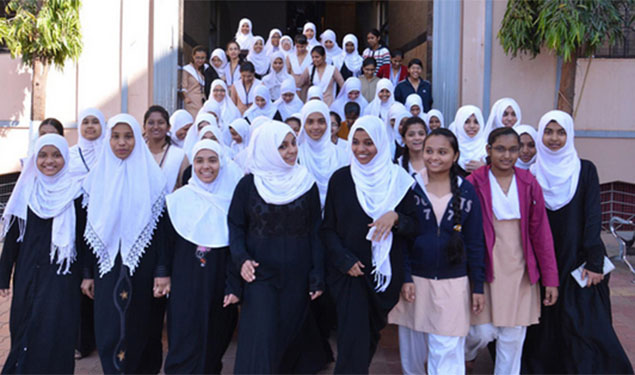
[Female students of Shaheen in a group photo. (File)]
Bidar (Karnataka):
Qurratul Aian, Shooa Fatima Khanam and Ammatulah Fatiha Nabisat, who passed the National Eligibility cum Entrance Test – UG (NEET 2018) and became eligible for admission to various medical courses, are Hafizah.
Hafizah is the Arabic term used to identify the females who memorise the entire Holy Quran comprising of 114 Suras or Chapters, and 6,236 Ayats or Verses.
While Hafiza Qurratul Aian scored 550 marks securing an All India Rank (AIR) of 7,446, Hafiza Shooa Fatima Khanam scored 483 marks with AIR 28,443 and Hafiza Ammatulah Fatiha Nabisat scored 462 marks and got 38,033th position in the NEET 2018 All India Rank (AIR).
The National Eligibility cum Entrance Test – UG (NEET 2018) result was declared on Monday June 04. A total 7,12, 635 candidates have qualified from India, 342 qualified students are from abroad, 1200 are Non Resident Indians (NRIs), 367 are OCI and 36 are PIO.
Qurratul Aian, Shooa Fatima Khanam and Ammatulah Fatiha Nabisat, the 03 female memorisers of the Holy Quran are the students of “Hafizul Quran Plus” program of Shaheen Group headquartered in Bidar, Karnataka.
The 04-year integrated course especially designed for Urdu speaking Huffaz and Aalims is divided into Foundation Course: (6 months), Bridge Course: (6 months), 10th class: (1 year) and Junior College: (2 years) preparation of 12th class along with NEET, JEE and other competitive examinations.
Besides the above three female memorisers of the Holy Quran, 10 other Huffaz of Shaheen Hafizul Quran Plus program have also passed the NEET 2018. A total of 1,600 Shaheen students had appeared for the National Eligibility cum Entrance Test – UG NEET in 2018. Of them, 1,363 students scored more than the minimum marks in NEET 2018.
“Out of the total 1,363 who qualified the medical entrance this year, 300 students have scored enough marks to get admission in different medical colleges”, Abdul Qadeer, Founder Chairman of Shaheen Group of Institutions, said while talking to ummid.com.
“Among them are 13 Huffaz including 03 Hafizah – female memoriser of the Holy Quran. One of the Huffaz who passed NEET 2018 is Waheed Abdullah of Gorakhpur, Uttar Pradesh. Like other students of Shaheen Hafizul Quran Plus, he never went to a school. He got free coaching at Shaheen’s Bidar center and scored 579 out of the total 720 marks to secure All India Rank (AIR) 3295”, he added.
Shaheen Group of Institutions was established in 1989 with Shaheen School to provide quality education to students from Urdu medium. Started with just 18 students, it now has more than 12,000 students and centers running in different cities of India including Bengaluru, Mysore, Belagavi, Shimoga, Kolar, Gulbarga, Raichur, Bidar, Basavakalyan, Humnabad, Aurad, Chitguppa, Aurangabad, Patna and Lucknow.
Besides special integrated course for Huffaz, the Shaheen Group also runs NEET coaching for regular students. It had sent more than 200 students to different medical colleges in 2017, 152 in 2016, 111 in 2015, 93 in 2014, 89 in 2013 and 71 in its first batch in 2012.
source: http://www.ummid.com / Ummid.com / Home> Education & Career / by ummid.com news network / June 11th, 2018
The Aligarh Muslim University community deeply mourned the sad demise of noted cardiothoracic, vascular surgeon and former Pro-Vice Chancellor of AMU, Prof Mohammad Hanif Beg, 69, who took his last breath early morning today in Moradabad.
Extending condolences to the bereaved family of Prof Beg and the AMU fraternity, the Vice Chancellor, Prof Mohammad Gulrez said, “I offer my deepest condolences to Prof Beg’s family and AMU community and pray for the comfort for his loved ones at this difficult time. He was a selfless soul who earned admiration, respect and esteem as a distinguished surgeon and seasoned academic who anchored a number of developmental works at the J N Medical College and the university.”
“At this moment of sorrow and grief, we share the pain of Prof Beg’s family and pray to the Almighty for giving them strength and courage to bear this loss,” he added.
Prof Azam Haseen (Chairman, Department of Cardiothoracic Surgery) expressed a deep sense of sorrow on his demise and prayed for solace to the bereaved family.
“Prof Beg mentored students with steadfast dedication, inspiring them to achieve their maximum potential. He also guided younger colleagues at key career moments for educational and professional strides,” he added.
Prof Beg served as the Dean, Faculty of Medicine and Chairperson, Department of Surgery, JNMC. He played a key role in the establishment and development of the Department of Cardiothoracic and Vascular Surgery and started the Open-Heart-Surgery procedure in 1988 at the JNMC.
Prof Beg completed his MBBS from K G Medical College, Lucknow in 1976 and attended PGIMER Chandigarh for his MS (Surgery) and M Ch (CVTS) from 1980 to 1982. He joined JNMC as a lecturer in 1983 and became Reader in 1988 and Professor in 1993.
Prof Beg is considered a pioneer in performing endoscopy and endoscopic removal of various foreign bodies from aero-digestive tracts since 1983. He has invented many new techniques such as designing of ‘Intercostal Tube drainage System’, which saves precious lives daily.
Prof Beg is survived by his wife, a daughter and two sons.
source: http://www.amiu.ac.in / Aligarh Muslim University (AMU) / Home / by Public Relations Office, AMU / April 06th, 2023
Asma Hussain, an iconic name in the Indian fashion industry, is renowned for her remarkable designs and her deep-rooted connection to the royal family of Awadh. As a descendant of Shuja-ud-Daula, a ruler from the 18th century, Asma carries with her a rich legacy that has greatly influenced her work in fashion. Born into a family that has always been associated with culture and heritage, Asma Hussain’s foray into the world of fashion was a natural extension of her upbringing.
Since unveiling her first collection in 1994, Asma Hussain has become a household name in India and across the world, known not only for her royal heritage but also for her impeccable craftsmanship.
She is the founder of the Asma Hussain Institute of Fashion Technology (AIFT), an institution dedicated to imparting high-quality fashion education to young aspiring designers….
Early Life and Inspirations: Shaping a Designer’s Vision
Asma Hussain’s lineage has greatly shaped her journey as a designer. The royal family of Awadh is known for its contributions to art, culture, and history, and Asma has absorbed these influences into her design philosophy. Raised in a family that placed immense value on tradition, culture, and the finer things in life, Asma’s designs reflect a deep understanding of Indian craftsmanship, royal grandeur, and modern aesthetics.
While Asma’s royal connection often takes center stage in media discussions, it is her extraordinary skill and passion for design that truly sets her apart. Asma’s collection is an intersection of history and modernity, reflecting both her ancestry and the needs of the contemporary fashion world. She drew upon royal Indian textiles, ornate embroideries, and rich fabrics such as silk, velvet, and brocade to create collections that exude royalty while maintaining a sense of modern sophistication.
Her collection’s distinctive blend of Eastern and Western elements has helped her carve a unique niche in the fashion industry. Over the years, she has showcased collections that feature traditional styles combined with avant-garde concepts, which have gained the attention of both Indian and international clientele.
From AIFT to Fashion House: A Pioneer in Fashion Education
In addition to her success as a designer, Asma Hussain has contributed to the fashion industry in another significant way. In 1999, she founded the Asma Hussain Institute of Fashion Technology (AIFT) in Uttar Pradesh. The institute is recognized as one of the top fashion design schools in the country, offering comprehensive courses in fashion design, fashion technology, and merchandising.
AIFT was born out of Asma’s vision to provide young, aspiring designers with the skills, tools, and guidance they need to succeed in the competitive fashion world. Asma’s institute is unique because it goes beyond just offering technical knowledge—it teaches creativity, innovation, and critical thinking. The curriculum integrates both traditional and modern techniques of fashion design, which allows students to learn everything from embroidery and fabric manipulation to fashion history and business strategies.
Since its inception, AIFT has produced several successful fashion designers, many of whom have gone on to work for major fashion houses or start their own design labels. Asma’s role as an educator and mentor has become a cornerstone of her legacy, further cementing her influence on the Indian fashion scene.
Asma Hussain’s clientele speaks volumes about her versatility and reach. Her designs have been worn by some of the most influential figures in India, including Bollywood legends, politicians, and celebrities. Asma’s ability to create outfits for a diverse group of people—from film stars to political leaders—demonstrates her exceptional skills and understanding of different tastes.
Some of Asma Hussain’s most notable clients include Bollywood actress Saira Banu, known for her timeless elegance, and Shabana Azmi, an award-winning actress and social activist. In addition to Bollywood icons, Asma’s fashion has also attracted attention from politicians, including the Prime Minister of India, Narendra Modi, and Uttar Pradesh Chief Minister, Yogi Adityanath. The fact that these high-profile figures have chosen Asma’s creations is a testament to her ability to craft outfits that blend traditional beauty with contemporary style.
In 1996, her fashion house was inaugurated by the legendary Bollywood actor Dev Anand, who was known for his style and charisma. Dev Anand’s association with Asma Hussain further solidified her reputation as a designer with a strong sense of elegance and sophistication. Since then, Asma’s creations have graced numerous high-profile events, cementing her position as one of India’s leading fashion designers.
Design Philosophy and Signature Style
Asma Hussain’s design philosophy is deeply rooted in the rich cultural traditions of India, especially those from her home state of Uttar Pradesh. Drawing from the royal aesthetics of Awadh, Asma’s clothing collections often feature ornate embroidery, luxurious fabrics, and rich color palettes. She is known for her use of traditional Indian textiles, such as Banarasi silks, georgette, and velvet, to create elegant yet modern garments.
One of the key elements of Asma’s designs is the intricate work on fabrics, especially hand-embroidered motifs that reflect the grandeur of royal craftsmanship. From sarees to lehengas, and even contemporary Western-style outfits, Asma’s attention to detail and craftsmanship is unparalleled. She is particularly known for her bridal collections, which are often a blend of traditional and contemporary styles, making them perfect for the modern bride who wants to feel regal on her special day.
Her designs are not limited to one particular category or occasion. Whether it is a wedding, a red-carpet event, or a festive occasion, Asma’s clothes can be seen on people from all walks of life. Her ability to create both traditional and contemporary looks has made her a favorite among clients looking for timeless elegance with a modern twist.
The Royal Influence: Awadh’s Rich Cultural Heritage in Every Stitch
The legacy of the royal family of Awadh plays a significant role in Asma Hussain’s designs. As a descendant of Shuja-ud-Daula, a ruler known for his opulence and patronage of arts and culture, Asma’s upbringing was steeped in the cultural richness of the region. The intricate embroidery and regal fabrics used in her creations are reminiscent of the royal courts of Awadh, where intricate craftsmanship was highly valued.
The use of zari work, brocade, and gold thread embroidery in her creations adds an aura of luxury and tradition. Each piece is meticulously crafted to ensure that it embodies the royal aesthetic, while also incorporating contemporary elements that make it relevant in today’s fashion landscape.
The Future of Asma Hussain in the Fashion Industry
Asma Hussain has not only succeeded in her career as a designer but has also played a pivotal role in shaping the future of fashion in India. Through her institute and her dedication to educating young talent, she is creating a legacy that will continue for generations. Asma’s vision for the future of fashion is one that embraces both tradition and innovation, ensuring that Indian fashion continues to evolve while staying grounded in its cultural heritage.
Her influence on the fashion industry is undeniable, and she continues to be a source of inspiration for aspiring designers. Asma Hussain is not just a fashion designer; she is a symbol of how tradition, culture, and modernity can come together to create something truly exceptional.
Asma Hussain’s Legacy in Indian Fashion
Asma Hussain is a name that has become synonymous with elegance, sophistication, and cultural heritage. With her roots deeply entrenched in the royal family of Awadh, Asma has successfully blended her ancestral legacy with her modern fashion sensibility. Her designs reflect the rich cultural heritage of India while catering to the modern woman’s needs, making her one of India’s most respected and successful designers.
Her legacy extends beyond her own creations to the many students who have passed through the Asma Hussain Institute of Fashion Technology, taking forward her vision and continuing to innovate in the world of fashion. Asma Hussain’s contribution to Indian fashion is undeniable, and her influence will be felt for years to come.
source: http://www.atlucknow.com / @Lucknow / Home> Lifestyle / by Mohd Badar / November 09th, 2024
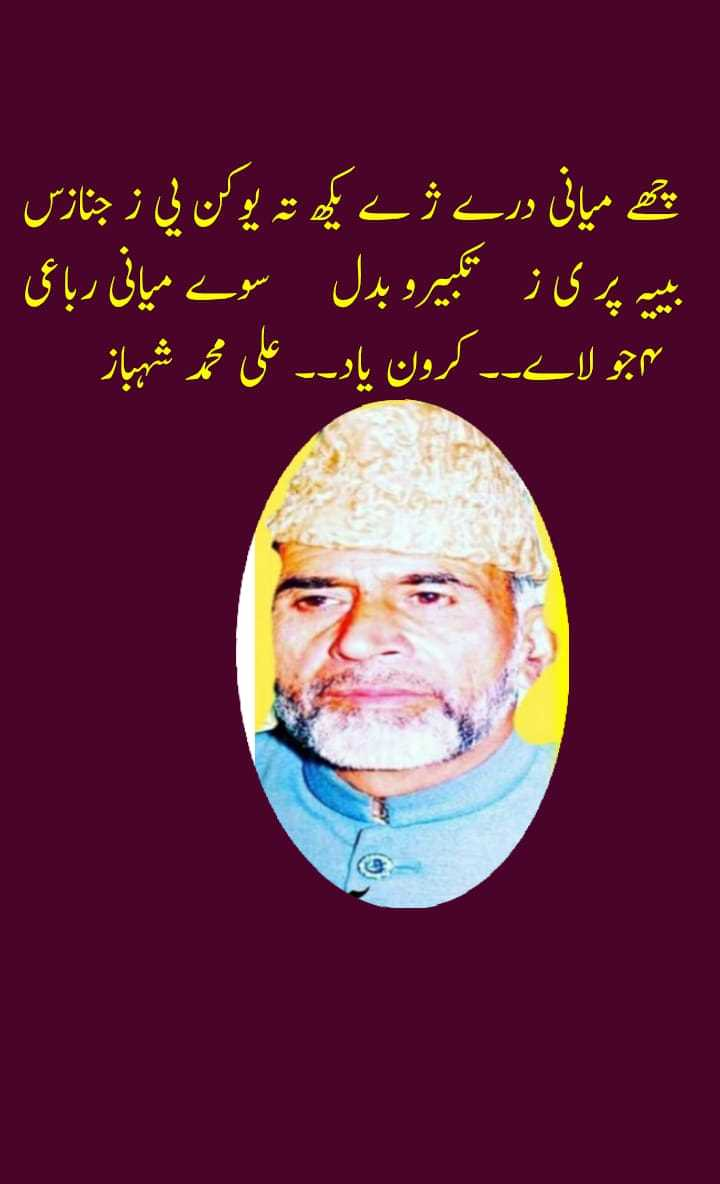
Popular Kashmiri poet and scholar Ali Mohammed Shahbaz was remembered across jammu and Kashmir on his 24th death anniversary. In this connection different functions and events were organized at various places and sites to pay glowing tributes to late literary luminary, who was Martyred by unidentified gunmen on July 4,1996 at his his native village Shathgund Handwara.
The major online event was organized by Kashmir Marksz- e -Adab -o -Saqafat chrar-i- Shareef.
The event was presided over by prof Mohd Zaman Azurdah. A large number of distinguished scholars, participated in the program and paid rich tributes to him. The speakers highlighted various dimensions of life and contribution of late poet.
The main attraction of the event was first ever Shahbaz memorial award. The award was presented to popular Kashmir folk singer, a house hold name of Kashmir folk singer Manzoor Ahmad Shah.
Dr Aziz Hajini, Convener Northern Regional Board Sahitya Akademi, New Delhi Presented the award to Manzoor Ahmad Shah. Dr Gazanfer Ali, president Kashmir Markaz e adab o Saqafat Chrari Shareef , Gen secretary Anayat Gul and son of late poet, Nazir Qureshi Ibn e Shahbaz were also present on the occasion.
The prominent poets and writers paid rich tribute to Late Ali Mohd Shahbaaz which include Gh Qadir Shaheen, Rahim Rehna, Gh Rasool Josh, Mushtaq Mehram, Producer Radio kashmir, Javed Sofi, Nazim Nazir, noted journalist and editor of Brighter Kashmir Farooq Wani.
Dr Sohan lal Koul, Bashir Bhadarwahi, Prem Nath Prem, Shown at Shafi Masoodi , Javed Rasool
source: http://www.brighterkashmir.com / Brighter Kashmir / Home / by BK News Service / July 05th, 2020
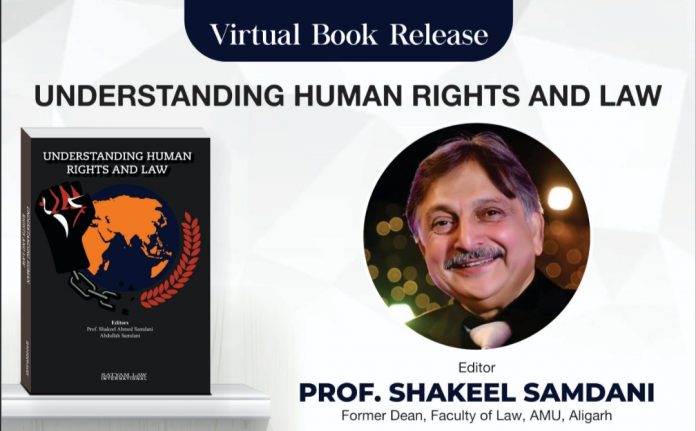
A virtual book release event was organized for the last book of Late Prof. Shakeel Samdani (Former Dean, Faculty of Law, Aligarh Muslim University, Aligarh) titled “Understanding Human Rights and Law” which has been published by Satyam Law International Publishers, New Delhi. This book has been jointly edited by Prof. Shakeel Samdani and Abdullah Samdani.
Presiding over this event, Prof. Tariq Mansoor, Vice Chancellor, AMU, Aligarh said that, Prof. Samdani was a good teacher, researcher and above all, a versatile and a very talented public speaker. He remembered his speech when he represented the AMU teachers at Sir Syed Day 2020 and said that he was the only person who gave an extempore speech. He further said that he was surprised to see Prof. Samdani’s popularity after he received so many tributes from people outside Aligarh.
Discussing about the human rights book, Prof. Mansoor said that he has written forward for this book along with Justice K G Balakrishnan, Former Chief Justice of India. He said that we cannot have a civilized society without an educational system and a sound legal system. He said that this book contains 20 well researched articles from academicians, judges, lawyers, researchers and students. He congratulated Late Prof. Samdani and Abdullah Samdani for bringing an edited book on a very important topic.
While delivering his key note speech, Prof. Faizan Mustafa, Vice Chancellor, NALSAR University of Law, Hyderabad, said that my relationship with Prof. Samdani very close. He shared many old incidents from Prof. Samdani’s life, including his popularity with the students of Aligarh Muslim University. He said that Prof. Samdani was very keen for human rights.
Prof. Mustafa explained in detail about his perception of human rights which has been influenced by the Western perspective. He also discussed in detail about the article on Marxism theory which has been written by Prof. Mohibul Haque in this book. He further stated that, this book can be very useful if we have our commitment towards human rights. At last, he said that he sees a young, talented scholar in Abdullah Samdani who can carry forward the legacy of his father, Prof. Shakeel Samdani.
Speaking in this event, Prof. Md. Zafar Mahfooz Nomani, Dept. of Law, AMU congratulated the family members of Prof. Shakeel Samdani for organizing this event. He said Law Faculty, AMU has lost a gem in the face of Prof. Samdani.
Prof. Nomani quoted from the introduction of this book which was written by Prof. Samdani that “as a teacher it is not only to understand human rights, but to spread awareness among other about human rights”. He said that Prof. Samdani tried his best in his lifetime to spread awareness about the educational mission of Sir Syed Ahmad Khan and with this book he wanted to spread the concept of human rights to others.
Speaking in this event, Dr. Dilshad Ahmad, President of Indian Forum for Education, Riyadh, Saudi Arabia said that Prof. Samdani was a very dynamic person. He always wanted the upliftment of Muslim community. He discussed in detail about how Prof. Samdani motivated the NRI students of Saudi Arabia to pursue legal field as their career in a webinar organized by his forum. He said that whatever Prof. Samdani advised he used to give examples from Quran and Sunnah to support it. Dr. Dilshad also discussed in detail about the important topics which the book Understanding Human Rights and Law have discussed.
Speaking in this event, Prof. Asim Siddiqui, Chairperson, Dept. of English, AMU said that this event was due in the lifetime of Prof. Samdani but due to his unfortunate death this event was delayed. He congratulated the family members of Prof. Samdani for organizing this event. He said that Prof. Samdani was a very cheerful person who was always ready to laugh and he has not seen a dull moment in Prof. Samdani’s lifetime.
Discussing about this book Prof. Siddiqui said that he became aware about various aspects of human rights due to this book. He said that he is a professor of literature, but this book has beautifully explained about human rights and anyone who reads this book can understand the concept of human rights from the legal angle. At last, he said that most of the arguments in quoted in this book have been supported by empirical data.
Speaking in this event, Dr. Aruj Qayum, Senior Paediatrician, Newham University Hospital, London said that COVID has taken one of our most accomplished persons in the form of Prof. Shakeel Samdani. He shared his experience with Prof. Samdani in London and said that, Prof. Samdani was a very big fan of Sir Syed Ahmad Khan and he showed me the place where Sir Syed lived during his visit in London. He further said that Prof. Samdani was an institution in itself. He said that Prof. Samdani has discussed in detail about human rights which are available in Islam.
Speaking in this event, Adv. Shariq Abbasi, Supreme Court of India, New Delhi said that Prof. Samdani was bestowed with the capacity to do big things in a short span of time. He gave the example of an event in which Former Chief Justice of India addressed the students of AMU, that Prof. Samdani successfully organized this event in a short period of only 12 hours. He said Prof. Samdani had deep and great concern about the human rights throughout the world and this book has reflected his concern. He said that seven important aspects of human rights have been wonderfully covered in this book.
Last speaker, Dr. Shad Ahmad Khan, University of Buraimi, Oman said that he is having very mixed feeling of joy and sadness whenever he looks at this book. He said that he had shared a very special bond with Prof. Samdani from his student life. He said that today’s event is more than a book release ceremony and we can celebrate it as a tribute to Prof. Samdani for his contributions throughout his life.
This event was hosted and moderated by Mr. Abdullah Samdani. Dr. Ayesha Samdani started this event by reciting verses from the Holy Quran and Sarah Samdani welcomed the guests in this book release event. Prof. Mohibul Haque, Dept. of Political Science, AMU, Mrs. Anjum Tasneem, Adv. Shoeb Ali, Mr. Salman, Mr. Hunain Khalid, Mr. Farhan Javed and Mr. Danish Iqbal played a very important role in making this event a great success.
source: http://www.muslimmirror.com / Muslim Mirror / Home / by Muslim Mirror Network / December 29th, 2021
Prof. A.M. Pathan, who headed two central varsities and introduced many new courses, to lay down office as CUK V-C on June 30
Prof A.M. Pathan
Abdul Jaleel Khan M. Pathan, popularly known in academic circles as Prof A.M. Pathan, would be laying down office as Vice-Chancellor of the Central University of Karnataka (CUK) on June 30 after completing his illustrious service in the field of higher education in different capacities, including the rare honour of being the Vice-Chancellor of two Central Universities and serving as Vice-Chancellor of Karnatak University, Dharwad, for two consecutive terms.
During his 14 years as the Vice-Chancellor of Karnatak University, Maulana Azad National Urdu University in Hyderabad, and Central University of Karnataka in Gulbarga, Prof. Pathan had set new standards to improve the quality of education and extend the reach of higher education to all sections of society.
A reputed geologist, who specialised in ore geology, he had completed his undergraduation and postgraduation in Karnatak University before doing his Ph.D. in Bangalore University. A bright student throughout his career, he was awarded the Wrangler Dr. D.C. Pavate Award for scoring the highest marks in B.Sc and won the same award in the M.Sc examinations of Karnatak University.
Prof. Pathan strengthened every institution that he led and was sensitive to the social engagement of the institution with its stakeholders. Life Fellow of the Mineralogical Society of India (MSI), he is presently its Vice-President. He had also held the post of President of the Association of Indian Universities by virtue of being the seniormost Vice-Chancellor.
Market-friendly courses
Dr. Pathan, who served as the Vice-Chancellor of Karnatak University for two terms from July 1996 to July 2002, was responsible for improving and strengthening the infrastructure of various departments and providing state-of-the-art laboratories and had introduced several vocational and market-friendly courses such as seed technology, tissue culture, food processing, corporate secretary, international economic and business, and biotechnology.
As the second Vice-Chancellor of the Maulana Azad National Urdu University, a Central University established by an Act of Parliament, he improved the reach and quality of the distance education offered by the University, benefitting more than 1.56 lakh learners in140 study centres in all the States and Union Territoriesof the country. A study centre was also established in Saudi Arabia for the benefit of the expatriate Urdu learners and he initiated steps to establish similar study centres in the U.K. and the U.S.
Prof. Pathan was responsible for introducing CBSE education in Urdu medium in the model schools established by the university in the educationally backward and Urdu-speaking majority areas such as Darbhanga.
He was a member of the site selection committee constituted by the Union Government and the UGC for establishing the Central University in the educationally backward Gulbarga district.
As the first Vice-Chancellor of the CUK, Prof. Pathan introduced many new courses at the undergraduate and postgraduate levels and was responsible for introducing a unique integrated course for the students coming out of PUC. The Central University of Karnataka also offered PG and Research programmes in English, Kannada, Hindi, Economics, Social Works, Commerce, Applied Geography and Geoinformatics, Psychology, Mathematics, Physics, and MCA, and a diploma in educational counselling.
Prof. Pathan opened the doors of the CUK for girl students hailing from the economically weaker sections by waiving the course fee and hostel fees.
The CUK also offered merit-cum-means scholarship to the extent of 20 per cent of the tuition fees collected in each course and a scholarship of Rs. 5,000 per month in addition to annual contingency of Rs. 12,000 to all the Ph.D. scholars in the University.
source: http://www.thehindu.com / The Hindu / Home> Features> Education Plus / by T V Sivanandan / June 25th, 2012

 and his companions, a period of around thirteen years when the Muslims were a minority and did not enjoy political domination. In many senses, their position resembled that of Muslim minorities today. Muslim minorities need to see the role of the Prophet and the early Muslims in that period as a model for them to emulate, Siddiqui suggests: