Monthly Archives: September 2025

Old stones, new tales: How inscriptions rewrite Kashmir’s religious history

JAMMU & KASHMIR :

A new study has revealed narratives of syncretism that counter the politically motivated and polarised versions of the Valley’s history.
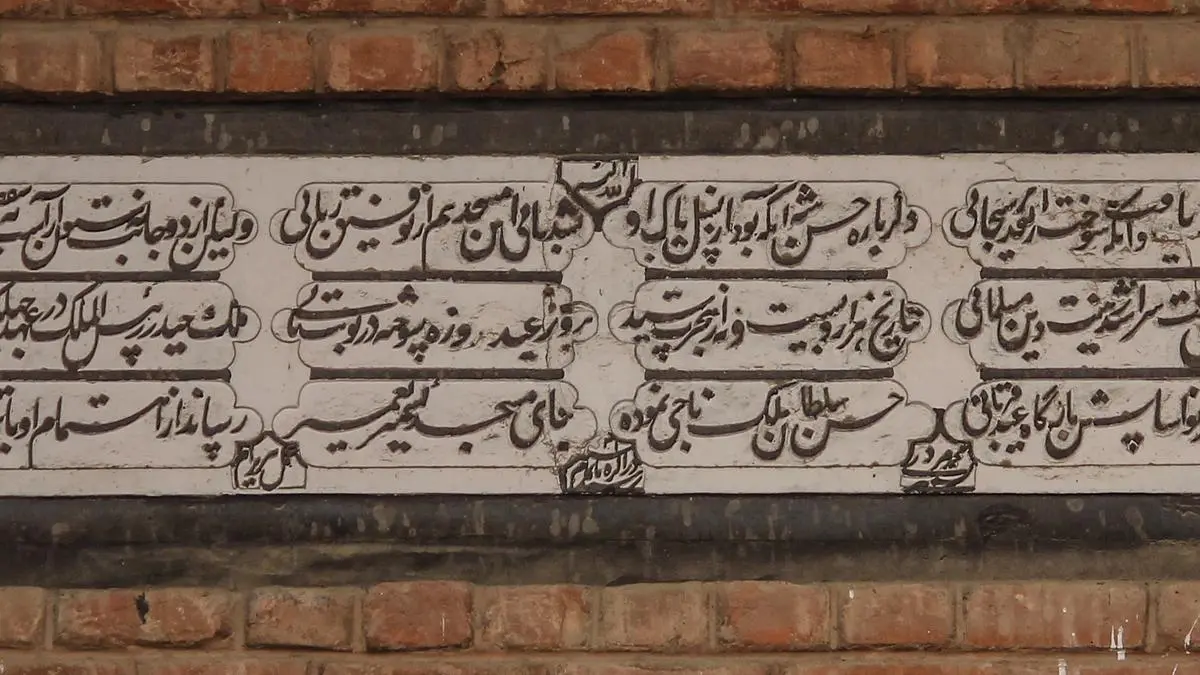
The 17th century limestone slab in the walls of Jamia Masjid in Srinagar. At the bottom, a small engraving reads, “the work of Hari Ram”. | Photo Credit: Tabish Haider, Barakat Trust 

Strolling inside the quadrangle of Kashmir’s 600-year-old Jamia Masjid, worshippers stop to take pictures of the mosque’s large steeple, its outlines sharpened against the backdrop of Hari Parbat, the famous fort-hill of Srinagar. What they usually overlook is a limestone plaque with Persian inscriptions embedded in the wall just above the mosque’s entrance.

In January 2024, when the Srinagar-based art historian Hakim Sameer Hamdani (he is currently the Design Director of the Jammu and Kashmir chapter of the Indian National Trust for Art and Cultural Heritage) examined the slab, he found that it mentioned names of medieval-era sultans and their governors involved in the repeated repair and rebuilding of the mosque since its original construction in 1402. At the bottom, he noticed the name of the engraver: Hari Ram. Hamdani told Frontline: “Based on our investigation, it appears that Hari Ram, who inscribed the text on the limestone plaque, was a master carver in the Mughal atelier. There is no information about Hari Ram in any Mughal source. But from this slab we know now that he was Hindu and part of the overall Mughal patronage system.”

The Jamia mosque was constructed during the reign of Sultan Sikandar Shah Miri in 1402, a few decades after the Turkic-origin Shahmirid dynasty took over the reins of the kingdom from the royal house of the Loharas, who were Hindus. In Kashmir’s narrative tradition, the mosque is invested with great symbolism: Jamia Masjid embodies not just the crowning of Islam as the State religion of Kashmir after eight centuries of Hindu rule, but also the start of the spread of a culture heavily influenced by Persia.
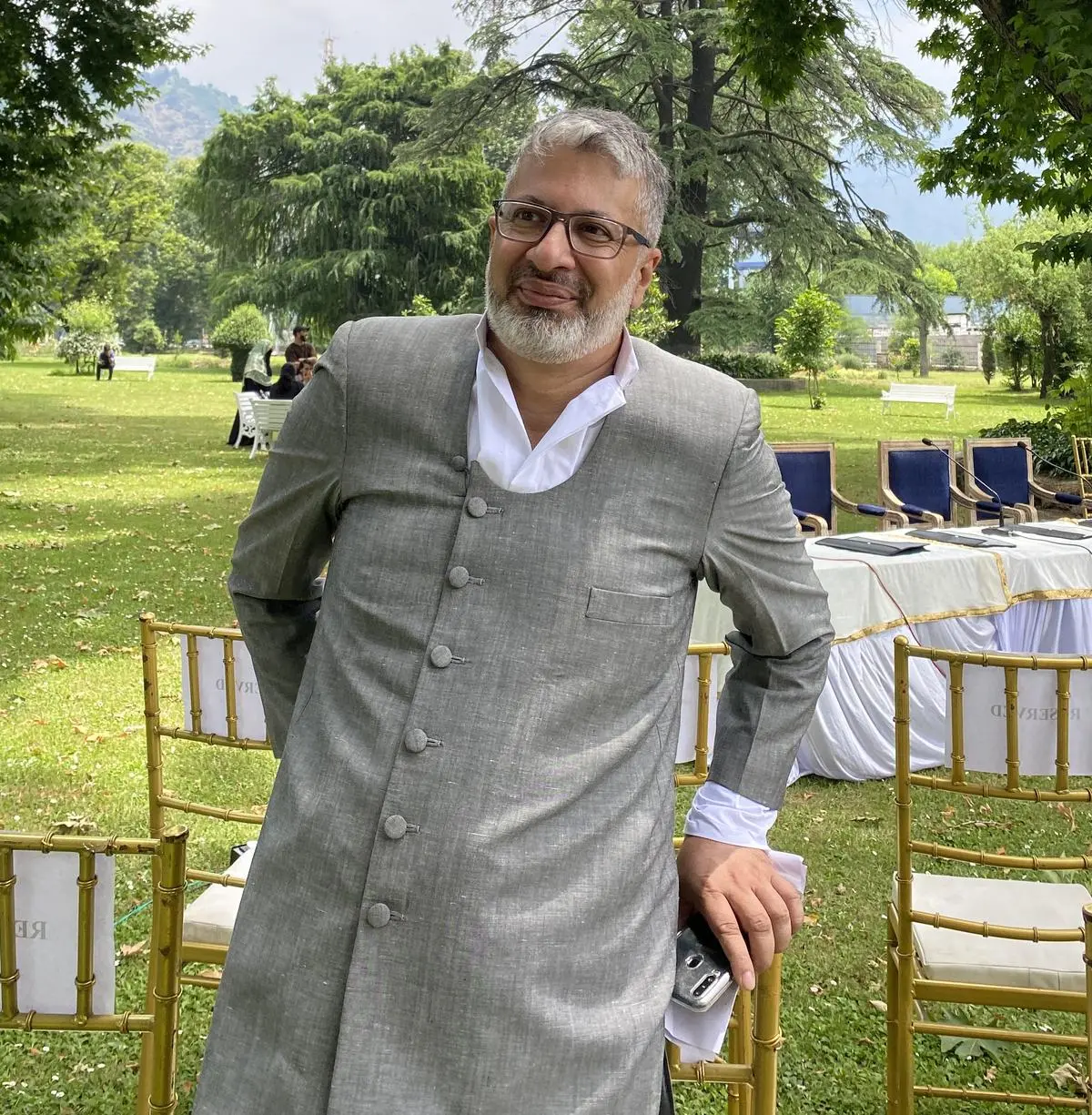
Hakim Sameer Hamdani, Srinagar-based architect and art historian who led the documentation project. Hamdani is Design Director with INTACH, Jammu & Kashmir. | Photo Credit: By Special Arrangement

The medieval era in Kashmir, particularly the 14th and 15th centuries, when it gradually transitioned to Islam, has been sought to be presented in contemporary political and cinematic discourse as a period of widespread persecution of Hindus. The movie The Kashmir Files (2022), for example, has a scene where the protagonist describes the Kashmir of yore as a thriving seat of Hindu learning until it was despoiled by Islamic rulers in the 14th century. However, historic epigraphs such as the one in Jamia Masjid and elsewhere in Srinagar point to a culture that was more syncretic than confrontational.

With such discoveries, Hamdani’s project intends to counter the politically motivated narratives around Kashmir’s history. He embarked on the project earlier in 2024, roping in a team of heritage architects and graphic designers from Srinagar. The team consisted of Umar Farooq (Assistant Professor, Department of Architecture, Islamic University of Science and Technology, or IUST, Jammu and Kashmir), who surveyed the inscriptions; Tabish Haider (cultural activist and Young India Fellow, 2022, at Ashoka University), who took life-size images of the plaques; Mehran Qureshi (Assistant Professor, Department of Architecture, IUST), who investigated the epigraphs and translated them into English; and Taha Mughal (a specialist in preservation), who rendered them into measured drawings. The team has examined several epigraphs, dating from the 15th to the 19th centuries, engraved in various heritage sites across the Valley. While the majority of them are in Persian, there are texts in Arabic and Sharda (an ancient script of Kashmir) as well.

Many of these inscriptions have been rendered almost undecipherable by the passage of time—the main reason why they had escaped the attention of historians so far. Hamdani and his team used technology and linguistic expertise to decipher their content and to bring the information to the public domain for the first time. Of the over 100 slabs that the team has investigated across Kashmir, the details of 40 were catalogued and put on display in an exhibition, “Naqsh-i-Dawaam”, held in Srinagar in June 2024. Hamdani is currently writing a coffee-table book that will make the findings accessible to readers across India and the world. Qureshi is further expanding the scope of the investigation by surveying similar inscriptions found in medieval-era tombstones in Kashmir. Qureshi’s work is sponsored by the Netherlands-based Prince Claus Fund while the grant for Hamdani’s project came from London’s Barakat Trust, which researches the art, architecture, and history of the Islamic world.

_______________

Highlights

A documentation project undertaken by Srinagar-based architect and art historian, Hakim Sameer Hamdani, has added layers to Kashmir’s history, challenging its unipolar representation in popular narratives.

————
Of the over 100 slabs that Hamdani’s team has investigated across Kashmir, the details of 40 were catalogued and put on display in an exhibition, “Naqsh-i-Dawaam”, held in Srinagar in June 2024.

————
Hamdani is currently writing a coffee-table book that will make the findings accessible to readers across India and the world.

________________________________

“The idea was to add a layer of nuance to Kashmir’s history,” Hamdani said while talking about his project. “We tried to flesh out what we already knew about the transmission of knowledge and culture from the Central Asian regions into Kashmir at the onset of the Sultanate period in the 14th century.”

Adding layers

The investigation has added layers to the understanding of Kashmir’s history. Take the Jamia Masjid slab, for instance. It dates back to 1622, when Jahangir was the emperor of Hindustan. In 1589, Jahangir’s father, Akbar, had forced Kashmir to surrender its sovereignty to the larger Mughal Empire. This created resentment, sparking off rebellion and political unrest that continued for years until a semblance of stability was achieved during Jahangir’s rule. To mark the end of hostilities, Jahangir commissioned a renovation of the mosque and installed the slab, which attempts to naturalise him as the legitimate ruler of Kashmir.
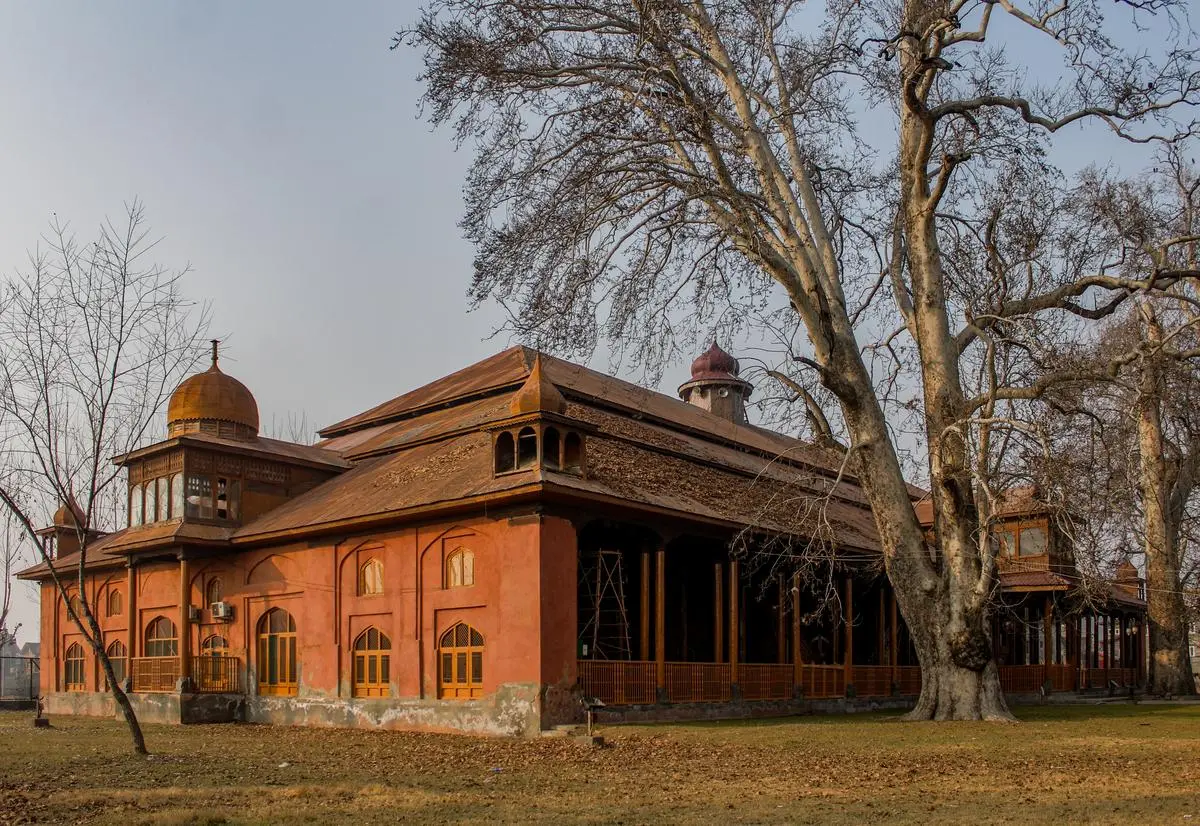
The 15th century Aali Masjid, Srinagar’s second largest mosque. It combines Mughal, Kashmiri and Safavid architectural styles. | Photo Credit: Tabish Haider, Barakat Trust 

Hamdani said: “The text seeks to connect Jahangir to a historical project, showing him as continuing the work of the sultans of Kashmir, who reigned before the Mughal annexation.” The association of a Hindu craftsman with a major imperial programme tells us something about the prevailing milieu, where royal patronage could be sought and obtained regardless of the craftperson’s religious affiliation.

The idea of exploring epigraphs to unravel history came to Hamdani when he was working on his thesis on Islamic architecture at the School of Planning and Architecture, New Delhi, six years ago. As part of his study, he examined extant Islamic epigraphs in the monuments and buildings of Kashmir. Among the ones he analysed was an Arabic hadith (essays on the words and actions of the Prophet Muhammad) etched on the 15th century hospice of a Sufi mystic, Malik Ahmad Itoo, located at Safa Kadal in Srinagar city. It is a small hermitage on the banks of the Jhelum river. The verses, engraved on the shrine’s tympanum, remind the faithful of the spiritual rewards that would accrue to the builder of a mosque.
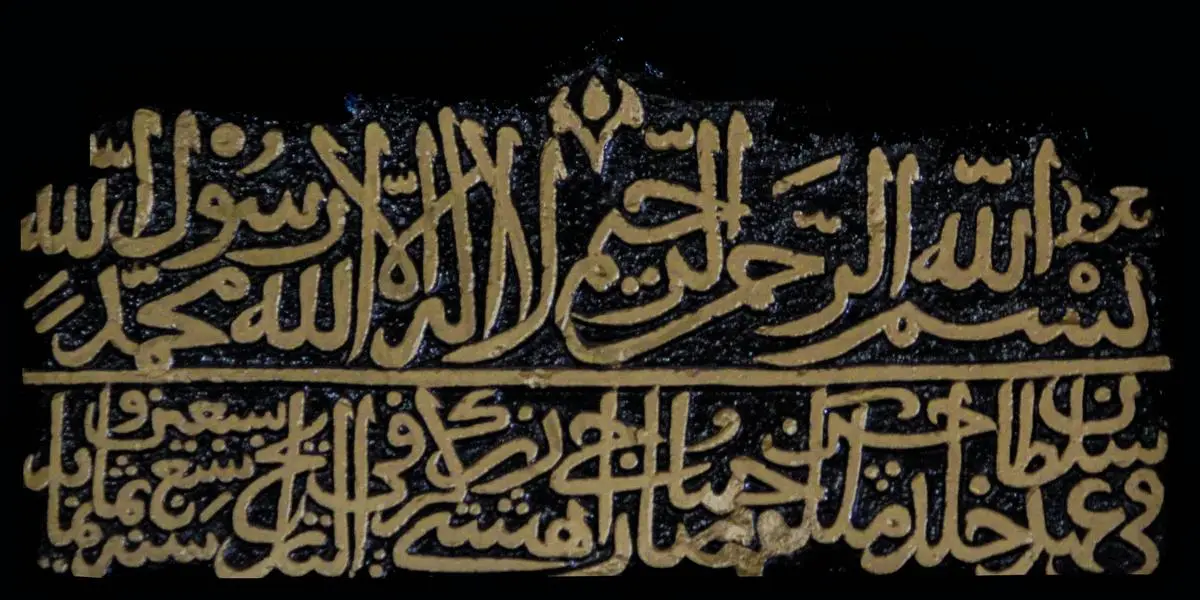
The Persian slab inside Aali Masjid which identifies the architect of the mosque as Raja Bihisti Zargar. | Photo Credit: Tabish Haider, Barakat Trust 

Hamdani said: “Such inscriptions, commonly seen in Kashmiri shrines, are different from medieval Islamic epigraphy found in Delhi.” Speaking of the latter, the scholar Anthony Welch said that their “principal function in late-twelfth-century India was to warn the non-Muslim majority to accept Islam” (in his 2008 essay, “The Emperor’s Grief: Two Mughal Tombs”). The epigraphs associated with early Islam in Kashmir, by comparison, are devoid of such hegemonic overtones. “Their stress is rather on cultivating personal piety,” Hamdani said.

His project has thrown up unexpected stories that often go against the recorded textual histories of Kashmir. Consider the case of Aali Masjid, Srinagar’s second largest mosque. The 15th century mosque embodies a fusion of Iranian, Mughal, and Kashmiri architectural styles. Added during a renovation in the 17th century, the balusters of its portico rest on distinct stone bases reminiscent of those of Safavid pavilions in Iran; the technique was brought to Kashmir by the Mughals. Although the 1887 Persian text Tarikh-e-Hasan—thought to be an authoritative commentary on Kashmir’s medieval historyattributes its construction to Ali Shah, the eighth sultan of the Shahmirid dynasty, the stone slab restored by Hamdani names a different patron: Sultan Hasan Shah, who reigned 50 years later. The epigraph identifies Raja Bihisti Zargar as the architect of the mosque.

Startlingly, the same name was once engraved on a stone pillar inside Srinagar’s Shankaracharya temple. Today, no trace of this inscription remains in the temple, but it is important to remember its existence in view of recent attempts to polarise sentiments by creating a controversy over the name of the Shankaracharya hill, also called Takht-e-Suleiman.

The Shankaracharya temple is one of the oldest temples in Kashmir, mentioned by Kalhana, author of the 12th century Sanskrit text Rajatarangini (River of Kings), which gives a history of Kashmir. The Rajatarangini remained a text in progress for a long time, with Brahmin court historians adding bits to it at different periods. After Kalhana, Jonaraja took it up in the 15th century, followed by Srivara and Shuka in the 16th century.
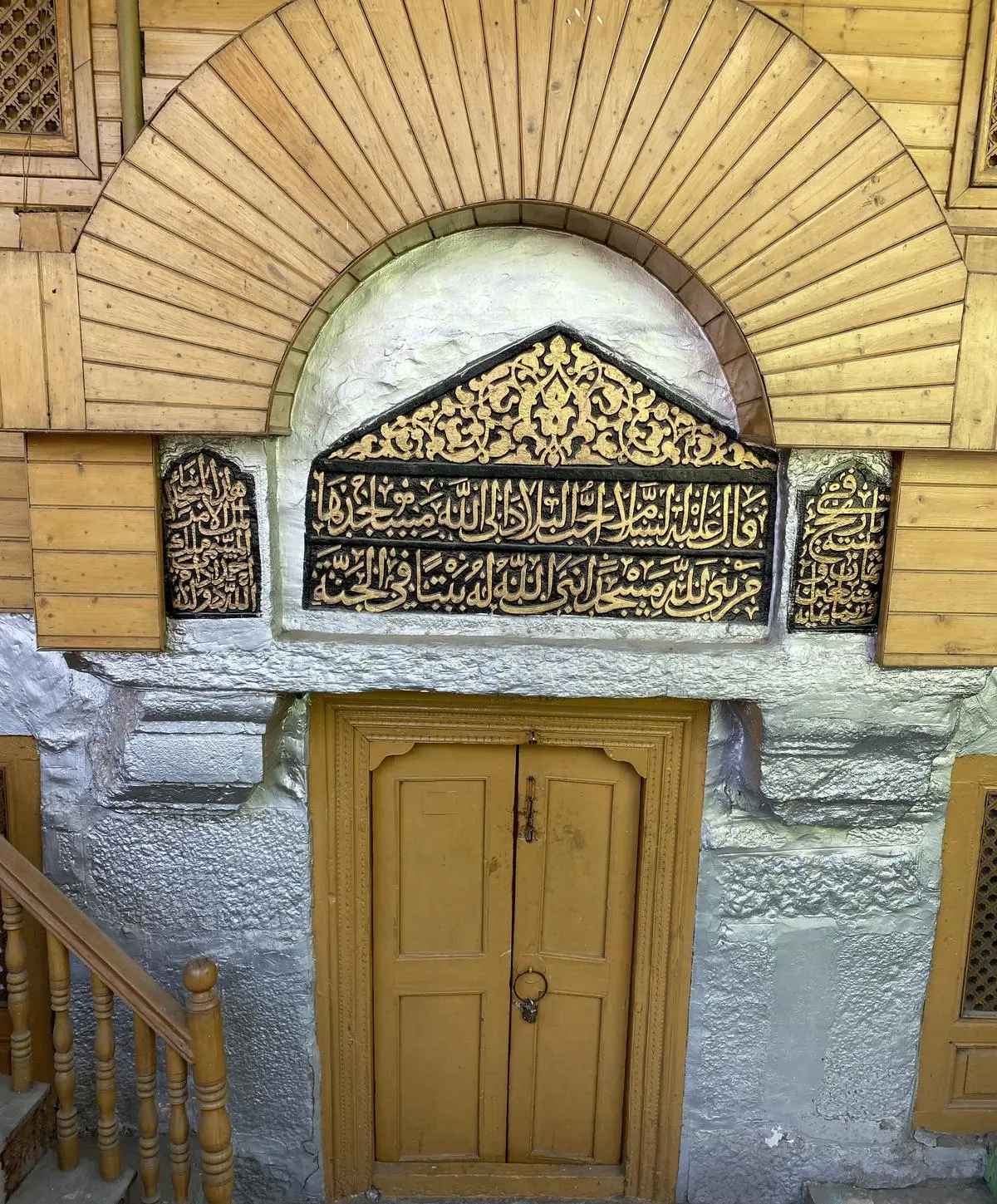
The hadith inscription on the shrine of Sufi mystic, Malik Ahmad Itoo, in Srinagar. It is one of the earliest surviving Islamic epigraphies in Kashmir. | Photo Credit: Shakir Mir

Hamdani’s team was able to access a preserved facsimile of the temple epigraph in a book titled Illustrations of Ancient Buildings in Kashmir (1869), based on a survey conducted under the Archaeological Survey of India by Henry Hardy Cole. In the survey, Cole suggested that the inscriptions (there were more than one) were linked to repair work done in the temple in the 16th century. But he could not identify the ruler under whose leadership the work was carried out.

Cole was not the only one whose interest was piqued by the presence of Persian inscriptions inside a Hindu temple. The British explorer Alexander Cunningham (1814-93) also mentioned them in his “Essay on the Arian Order of Architecture in Temples of Kashmir” (1848), which says that he had copied out an inscription (a different one at the same site): “but since then it has been so completely defaced by the Dogar [Dogra] soldiery that I could with difficulty trace the name of Takht-i-Suliman”.

Later, in 1875, a group of European travellers made another attempt to decode the writings, scrawling a rudimentary translation in their diary. “This idol… was made by Haji Hashti… in the year 54 of the Samut (Samvat) or Hindoo era,” they wrote, adding that “the foot of the back part of the pillar states that he who raised up this idol was Quajah Rukm, son of Mirjan.”

The case seems to be have been buried in 1935 after it received a clumsy dismissal from an antiquarian, Pandit Anand Koul, who concluded: “Islam was unknown in that remote period when this temple was built, so there could not have been a Khwaja or a Mir then…. Nor would a Muhammadan build a temple as his own” (Archaeological Remains in Kashmir, 1935).
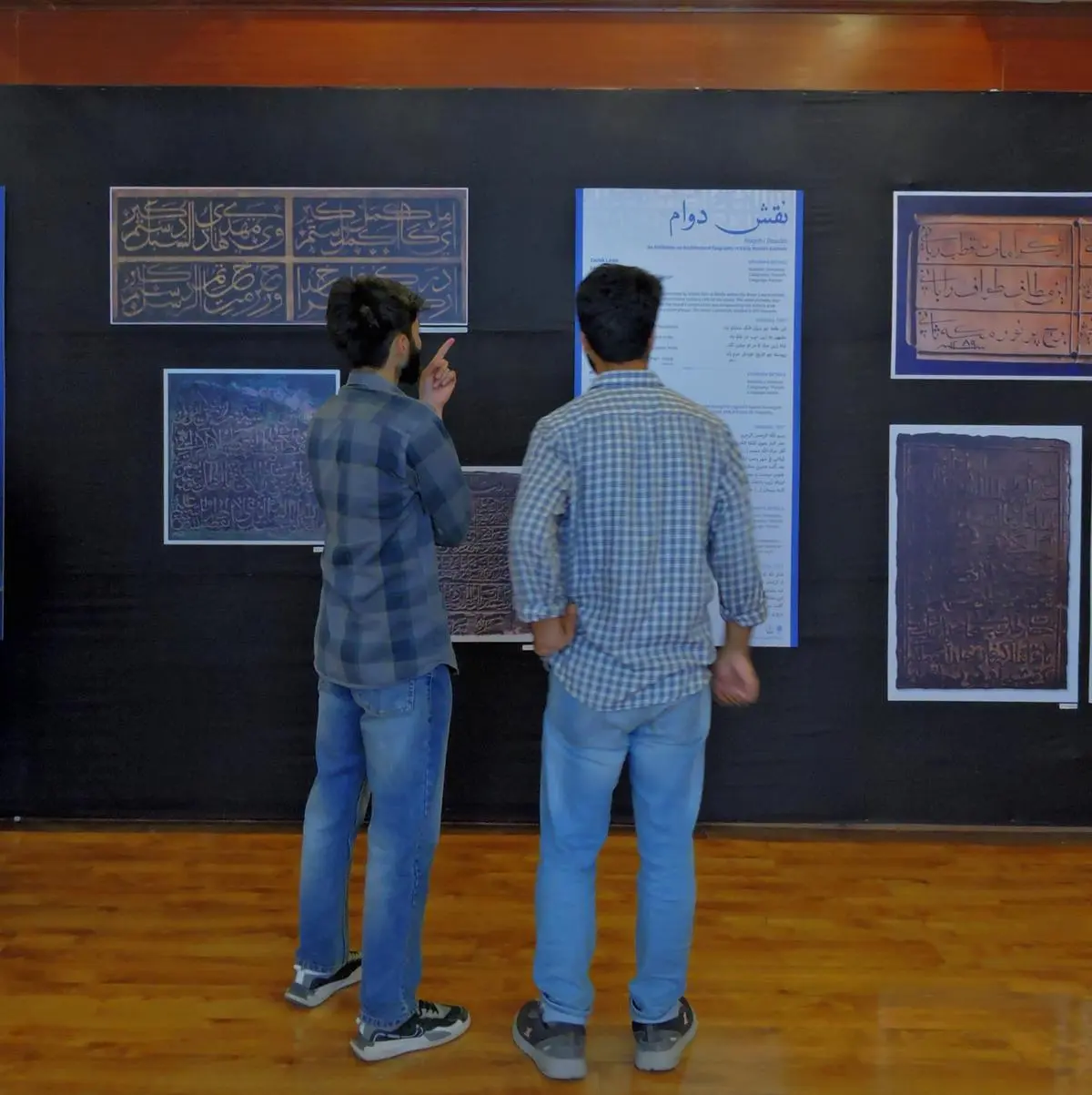
The restored epigraphs were put on display at an exhibition in Srinagar in June 2024. | Photo Credit: Tabish Haider, Barakat Trust 

But when Hamdani’s team examined the Aali Masjid slab, a different story emerged: the Muslim architect (Raja Bihisti Zargar) responsible for designing the mosque was the same one who oversaw the repair of the Shankaracharya temple in the 16th century. This suggests that even in the late Sultanate era, often depicted as a period of widespread destruction of Hindu places of worship, Muslim rulers continued to extend their patronage to Hindu cultural spaces. Understandably, the Dogra militia had tampered with this evidence in the 19th century.

Folds of history

Another epigraph documented by Hamdani was written in Sharada on the limestone wall of a 15th century almshouse at Khonmoh in Srinagar, built by a Hindu merchant, Purnaka. The text seems to heap praises on one of the Shahmirid kings by describing him as the son of the “illustrious Sakandra” (Sultan Sikandar). The effusive language used for Sikandar by a Hindu merchant is especially significant because the sultan was depicted as an iconoclast by the contemporary Brahmin chronicler Jonaraja in Rajatarangini. Jonaraja’s characterisation of Sikandar was perpetuated by colonial historiographers. In his 1848 booklet, Cunningham invoked the “destroying hand of Mahomedan [sic] bigotry” to explain the ruin into which Kashmir’s ancient temples had fallen.

But the Khonmoh inscription reveals that there existed a multiplicity of narratives around Sikandar in the 15th century and not all of them told the same story. “We are not denying that persecutions have happened in the past,” Hamdani said. “Our project drives home the point that history never uncoils in a linear way. History has many folds, each one with layers and textures of its own.”

Shakir Mir is a freelance journalist based in Srinagar. He was previously a correspondent with The Times of India.

source: http://www.frontline.thehindu.com / Frontline / Home> Arts & Culture> Heritage> History / by Shakir Mir ./ September 13th, 2024
The Bahmani remains

KARNATAKA :

A short excursion through the towns of Bijapur, Gulbarga, Bidar and Yadgir in north-eastern Karnataka can turn into a marathon heritage walk with serendipitous sightings of monuments from the medieval era.

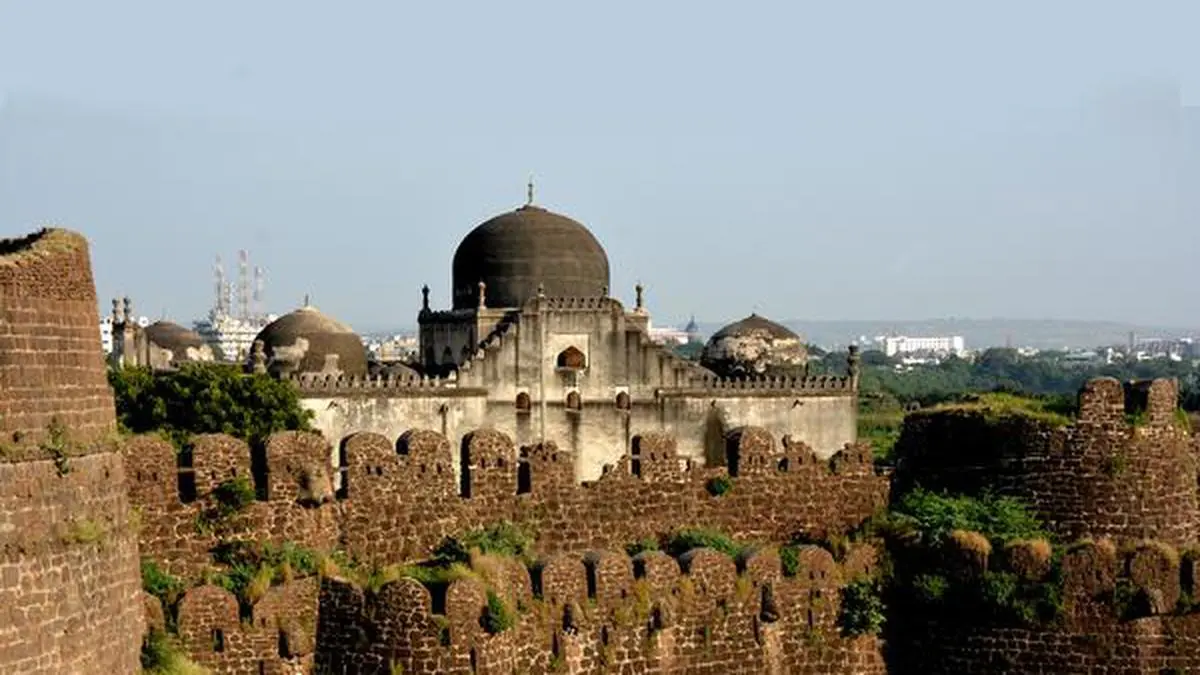
The Gulbarga fort and the Jama Masjid inside it.

SARMAST is said to have been the first Sufi to have come to the Deccan. He settled down in what is now the outskirts of Sagar village in Yadgir district of Karnataka. His grave is now venerated as a dargah. Rocky hillocks with generous splashes of greenery run along the road leading to Sagar from Gulbarga, a distance of 90 kilometres, belying the strong notion that all of the Hyderabad-Karnataka region is dry and dusty.

Tajuddin Dervish, the keeper of the holy grave, sat outside the arched entrance smoking a beedi. As we entered the dargah, we struck up a conversation with him about Sarmast. He recalled the legend, which must have got corroded by retellings over generation. In this tale, the necromancer Karmatgaar, who was up to mischief all the time, flew across the skies and disturbed the Sufi’s meditation. Enraged, Sarmast flung him across the Deccan plateau. In this fantastic tale, the goddess Yellamma (who is worshipped in the northern parts of Karnataka) also makes an appearance; her role is one of heroism. A temple supposedly dating back to the time of the incident is dedicated to her at Sagar.

If we link these hagiographical stories to actual events as the historian Richard M. Eaton has done in Sufis of Bijapur, 1300-1700: Social Roles of Sufis in Medieval India , it is certain that Sarmast was part of the raiding parties from the north sent by Alauddin Khalji (r. 1296-1316), who made forays into the Deccan and further south. The Deccan later became a part of the expanding Delhi Sultanate under the rule of the Tughlaqs. A bloody battle is supposed to have taken place at the site of Sarmast’s dargah, and many warriors were buried where they fell. The large circular area around the open grave of the saint is a medieval graveyard.

Unnamed tombs, locally called gumbad s, in various states of decrepitude and portions of walls with vestiges of fine carvings lie scattered around the area. Tomb raiders, probably lured by stories of treasures, have broken the graves inside these sepulchres. In the town of Sagar, there is a single-arched gateway so broad that an elephant can pass through it. A magnificent and well-maintained tomb on an imposing platform lies on the path a little ahead, next to a baoli (stepwell). None of these historical structures come under the purview of national or State-level archaeological conservation authorities.

The Bahmani sultanate

A few decades after the rulers from the north made forays into the Deccan, another Sufi saint, Sheikh Sirajuddin Junaydi (d. 1380), gained prominence. He blessed Alauddin Bahman Shah (r. 1347-1358), who broke away from the Tughlaq empire to establish the first independent Bahmani Sultanate in 1347, thereby inaugurating the rule of Muslim kings in the Deccan. While Junaydi’s tomb, marked by two imposing minarets, has flourished and is venerated to this day in Gulbarga, the tomb of Alauddin Bahman Shah is empty and the small compound in which it is situated is surrounded by illegal constructions.

Basavanappa, employed by the State Archaeological Department, guards the four Bahmani-era monuments. He said: “This is the man whose descendants built so many grand monuments. Guarding these gives us our daily bread and I have the responsibility of safeguarding his tomb.”

Alauddin Bahman Shah’s rule was brief. The moving of the capital from Daulatabad to Gulbarga, after severing links with the Delhi Sultanate, marked his reign. He also set up a dynasty that lasted two centuries (between 1347 and 1527) which, along with its legatee kingdoms, matched the Delhi Sultanate and later the Mughals in the splendour of their courts. At the centre of Gulbarga is the fort from where the Bahmanis ruled their vast empire which at its peak extended from Gujarat to Goa, all the way across modern-day Maharashtra, Karnataka, Telangana and Andhra Pradesh. While the Bahmanis constantly went to war with the Vijayanagara Empire, they also had deep cultural encounters with their neighbours.

The Bahmani kings ruled over a multi-ethnic and linguistically diverse empire whose citizens included indigenous residents, who spoke Marathi, Kannada and Telugu and other local languages, and migrants from north India. There was a regular stream of immigrants coming from Iran and Turkey to the royal cities via the sea route. African slaves, who rose up in the ranks, also played important roles in the matters of the Bahmani court.

The Bahmani Empire shifted its capital to Bidar in the 15th century, but an implosion was imminent because of differences between its ruling nobles. The waning empire gave birth to five independent sultanates that shone brilliantly in their maverick existences. They subsumed their differences and combined forces to defeat the Vijayanagara king at the Battle of Talikota (1565), but the sultanates were annexed by the Mughal Empire during the reign of Aurangzeb (r. 1658-1707), whose campaigns in the Deccan were to keep him occupied for half of his regnal period.

The Bahmani Sultanate and its splinter kingdoms have had a long impact on the culture and society of the Deccan. Magnificent architectural specimens of their reign can be seen in the entire region. Tombs, mosques, idgah s (prayer grounds), palaces and forts stud the entire area. These structures have a distinct style, which the architectural historian Helen Philon calls a “unique Deccan architectural vocabulary” in her book Gulbarga, Bidar, Bijapur . She says that this style is augmented by “building forms and decorative motifs introduced from Arabia and Persia, as well as from Turkey and Central Asia”.

A short excursion through Bijapur, Gulbarga and Bidar can turn into a heritage walk, marked by serendipitous sightings of monuments. While some of these edifices, such as the Gol Gumbaz, are fairly well known, there are others such as the royal necropolis of Ferozabad, around 30 kilometres from Gulbarga, which are known only to heritage enthusiasts.

One the most significant public works of the Bahmani kings was the karez system, in which water was supplied through tunnels from stepwells and other underground sources. Such tunnels supplied water to civilian settlements and the garrison inside the Bidar fort. The karez system is now being revived by Team Yuva, a Bidar-based non-governmental organisation led by Vinay Malge.

The Muslim kings also gave importance to landscape gardening and decorations. Local material such as basalt, granite and laterite have been used for buildings; lush gardens dominate the landscape around larger monuments. Vestiges of decorative motifs, murals and tile work can be seen in the monuments in Bidar.

A grand Jama Masjid is at the centre of the Gulbarga fort. It is a simple but imposing structure made even more stately because of the vacant space around it. There is a watchtower inside the fort on which a 29-foot cannon, said to be the longest in the world, is mounted.

Visitors are told that the Jama Masjid was the original congregational mosque of the Bahmani capital; actually, a large rectangular mosque in the crowded Shah Bazaar area of the city was the original Jama Masjid of Gulbarga. Prayers are held every Friday at this mosque, which is now known as the Shah Bazaar mosque. Visitors are allowed to go to the terrace, which is crowned with cupolas. This architectural style of domes on the terrace, mirroring the arches on the ceiling, can be found in prominent mosques from this era in the Deccan. Another historical site in Gulbarga that is worth seeing is the funerary complex, called the Haft Gumbad, of the Bahmani kings. Five rulers of the Bahmani dynasty until Feroz Shah Bahmani (r. 1397-1422) are buried at this site. The tombs, constructed over a period of a few decades, help one see the evolution of the architectural style. The early tombs have slightly sloping walls and are less distinguished, while the later tombs such as that of Feroz Shah, are larger, have a cleaner finish and are embellished with fine carvings.

Feroz Shah’s tomb reflects the king’s aesthetic sense as he was said to be a man of refined taste, was interested in local culture, and was also a polyglot who married the daughter of a Vijayanagara king. He built the city of Ferozabad. If one is visiting Ferozabad for the first time, one will get the feeling of discovering new things. The necropolis, which was inhabited briefly, can now be accessed only after passing through a village off the main road. The main entrance, which is through an arched gateway, is visible, although blocked. One must enter through an agricultural field. Ferozabad reveals itself little by little. It is a complete city with a fort, a palace, a mosque and royal residences, all of which are in ruins now. The apathy towards the upkeep of the architectural splendour of the region is evident from the poor maintenance of Ferozabad. Stone walls that formed part of the ramparts of the fort stand precariously on the ground. A tur dal field is being ploughed inside the premises of what was once the main mosque. The Bhima river glints some distance away. The city was abandoned towards the end of the 15th century after a deluge caused by the overflowing Bhima.

Shifting the capital to Bidar

A strange aspect of Feroz Shah’s tomb is that it has twin domes and separate chambers although only one of these was used for burial with the other lying vacant. Local legend has it that the second chamber was the designated burial space of Feroz Shah’s brother, Ahmed Shah (r. 1422-1436), who was not buried there. During the reign of Ahmed Shah, in 1432, the Bahmani capital shifted to Bidar, and Khwaja Hazrat Bandenawaz (d. 1422), the most well-known Sufi of the Deccan, is supposed to have been one of the causes for this. The Bahmani kings had close ties with Sufi saints, and Ahmed Shah continued the tradition but he was also considered a saint; the only king to be treated as such by his followers. His tomb in the funerary complex of Ashtur, just outside Bidar, is venerated by Muslims, who consider him to be a wali (friend of God), as well as by Hindus, who consider him to be an avatar of Allama Prabhu, a Vachana poet who lived before Basava. Ahmed Shah’s tomb has well-preserved murals and verses from the Quran. The resident caretaker at the tomb used a mirror to ingeniously cast splotches of reflected sunlight on the interior of the dome, which gave us an idea of the bright hues that are still intact.

The funerary complex of Ashtur is far more majestic than the Haft Gumbad. The tombs are bigger and more imposing and the well-maintained lawns add to the beauty of the location. Since the tombs must have been built at different times over a period spanning a century, each tomb has a different architectural style. One tomb that stands out is that of Humayun Shah (r. 1458-61). Lightning has damaged its dome, leaving only a portion of it intact. Visitors are told an apocryphal story of divine justice. Humayun Shah was such a cruel ruler that the word zaalim (tyrant) was affixed to his name. When this tyrant died, God in his infinite wisdom struck his tomb so that he would be exposed to sun and rain for eternity. As the influence of the dynasty waned and independent sultanates began to emerge, the tombs of its rulers also lost their magnificence. The tombs of the last two rulers remain poor cousins of the larger tombs at Ashtur, both in size and form.

From Ashtur, one can see the ramparts of the fort of Bidar, along the short drive to Bidar. This grand Bahmani era fort is surrounded by three moats and impressive bastions. The monuments of Bidar are in much better shape than those in Gulbarga. In the precincts of the fort, which has a massive gateway, are palaces and a mosque, an austere building with 16 arches crowned with a dome. Pathways run through gardens in the royal enclosure. Some of the best examples of exquisite woodwork (a hallmark of Hindu architecture) and mother-of-pearl inlays can be seen in Rangin Mahal, the palace inside the fort. Mahmud Gawan, a powerful prime minister in the Bahmani court, built a madrasa (theological school) bearing his name in 1472. The madrasa is located some distance away from the fort. There are remnants of turquoise tile work of Central Asian design on the tall minaret.

Adil Shahi dynasty

As the Bahmani Sultanate began to fall, it split into separate sultanates, the strongest of which was the Adil Shahi dynasty of Bijapur under Yusuf Adil Khan (r. 1490-1510).

“The period between accessions of Sultan Ali I (1558) to the death of Sultan Muhammad (1656) can be called the Golden Age of the Adil Shahis, as the kingdom flourished in all walks of life,” writes Abdul Gani Imaratwale, a historian based in Bijapur, in his book Studies in Medieval Bijapur . This is reflected by the grandeur of the monuments during this period.

Mohammed Adil Shah’s tomb, the Gol Gumbaz, is often featured on tourism brochures of the Karnataka Tourism Department. It would not be wrong to say that it is the grandest edifice in the modern State of Karnataka. The Gol Gumbaz is visible from many places in Bijapur and is overwhelming at close quarters because of its sheer size. Inside the large tomb, the cenotaph of Mohammed Adil Shah and his close family members can be seen, but these are replicas, with the original graves lying in an underground crypt. At the four corners of the room, steep and winding stairs that test the climber’s stamina lead up to the gallery. The vastness of this free-standing dome accentuates the acoustics within it. Schoolchildren can be seen clapping and yelling to hear the echo. Each burst of sound echoes several times making it difficult to stay there long enough to appreciate the engineering marvel.

The Ibrahim Rauza complex consisting of the tomb of Ibrahim II and a mosque is a delicately built structure and looks as if it has been laid out in front of visitors as they approach it from the garden. Bijapur has many other gems, such as the main congregational mosque, the Jama Masjid, which is an incomplete structure but is remarkable for its large and decorated mihrab (the prayer niche). The largest cannon in the world, the Malik-e-Maidan (lord of the field), which was truly a weapon of mass destruction in the medieval age, can also be found in Bijapur. A palace associated with the early Adil Shahis, the Chini Mahal, is now converted into a government office, and the throne room is now the treasury officer’s cabin.

The towns situated near Bijapur also have historical monuments. There is a 17th century mosque in Afzalpur built by Afzal Khan, a general who was killed by Chhatrapati Shivaji. This smart structure, ignored by archaeological authorities, is being maintained through the personal initiative of Maqsood Afzal, a descendant of the general.

This overview hardly does justice to the extensive architectural heritage in this part of Karnataka. These spectacular monuments do not figure in the itinerary of most tourists.

A wonderful monument like Ibrahim Rauza has only around 500 visitors in a day. In fact, some of the conservation authorities are not even aware of the necropolis of Ferozabad or the Afzal Khan mosque. Infrastructure essential for the growth of tourism is poor in the Hyderabad-Karnataka region. Information on the architectural sites in the region is limited. Efforts to get this heritage corridor recognised as a United Nations Educational, Scientific and Cultural Organisation (UNESCO) World Heritage Site have failed. Ayazuddin Patel, a Lalit Kala Akademi awardee based in Gulbarga, who has photographed the architecture of the region, laments: “We have been completely ignored and forgotten.” The Hyderabad-Karnataka region has been ignored by successive governments since Independence.

The Bahmani kingdom has receded into history although its rulers governed the Deccan for several centuries. This is partly due to the peripheral status of the Deccan and southern India in history writing in India. The long reign of the Bahmani Sultanate and its descendant sultanates has left behind another kind of legacy: a syncretic culture that is visible in harmonious communal relations, the participation of all communities at the shrines of various Sufi saints, and even during events that mark Muharram. The lingua franca of the region, Dakhni Urdu, is also a legacy of the Bahmanis. Many of these medieval rulers openly embraced non-Muslim practices and patronised local cultures, but a communal reading of history pits these kingdoms against the “Hindu” empire of Vijayanagara in a biased understanding of history.

Historians have often disproved this and have stressed aspects of mutual interpenetration and a fusion of cultures and practices (most recently in Power, Memory, Architecture: Contested Sites on India’s Deccan Plateau, 1300-1600 by Richard M. Eaton and Phillip B. Wagoner), but the religious reading of history continues in popular discourse. In February, a small attempt was made to celebrate the legacy of this regional history, with the district administration of Gulbarga deciding to hold a Bahmani and Rashtrakuta Utsav simultaneously. (The Rashtrakuta dynasty ruled this region between the eighth and 10th centuries.)

The Bharatiya Janata Party (BJP) instantly opposed this, with its Member of Parliament from Karnataka, Shobha Karandlaje, even tweeting: “Who is Bahamani Sulthans? Who killed lakhs of hindus, who burnt thousands of villages, who raped hindu women, who destroyed temples…. now congress celebrating thier festival… more dangerous” (sic). Considering that this was just a few months before elections to the Karnataka Assembly were to take place, the ruling Congress government quietly withdrew permission for the event. Needless to say, the inaugural edition of the Rashtrakuta Utsav was held in all its splendour. The BJP’s move of selectively opposing events on communal lines is part of its agenda. The partisan reading of history, where the history of Muslim rulers is ignored, will affect inter-religious relations.

Surreal experience

While Sarmast was the first Sufi of the Deccan, Bandenawaz, who was not averse to taking part occasionally in courtly intrigues, was the most well known. At his 15th century tomb in Gulbarga, the interiors of which have been garishly redecorated without any consideration to its architectural significance, Hindus and Muslims arrive in droves and bow in reverence before his grave.

Behind the tomb are a number of unmarked graves. A supplicant, his eyes closed, was ardently praying, with his head bent towards the direction of Bandenawaz’s tomb. Some things must not have changed at this place since the death of Bandenawaz in 1422. Walking through these lands where Sufis lived and kings ruled, where the detritus of empty tombs and unknown crypts can be found all over, one finds myth and fable combining with fact to create a surreal experience.

(In 2014, the names of Gulbarga and Bijapur were officially changed to Kalaburagi and Vijayapura respectively by the government of Karnataka. Yadgir, which was part of Gulbarga district, attained separate district status in 2009.)

source: http://www.frontline.thehindu.com / Frontline / Home> Arts & Culture> Heritage> Architecture / by Vikhar Ahmed Sayeed / Photographs Mohammed Ayazuddin Patel / October 20th, 2018

The artist and his muse

Thrissur, KERALA / Mumbai, MAHARASHTRA :

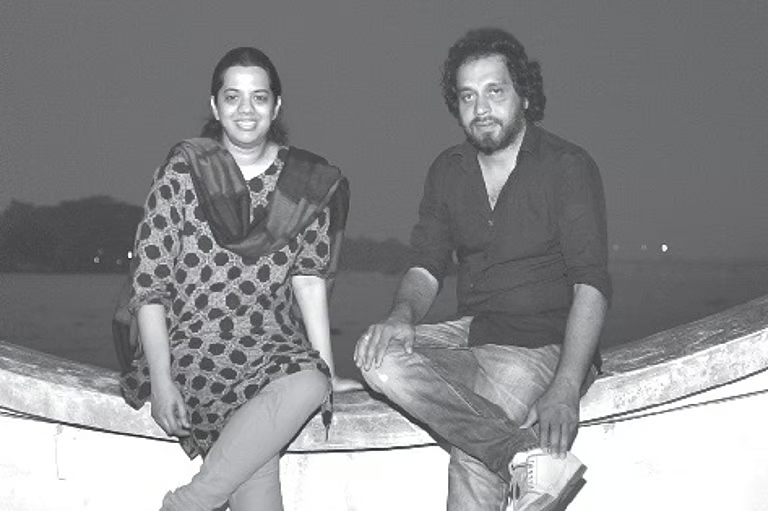
Zoya talks about life with artist Riyas Komu, secretary of the Kochi Biennale Foundation

Zoya met Riyas Komu when they were both in the same class at the Sir JJ School of Art in Mumbai in the 1990s. “What I noticed immediately was that he had a zest and an infectious energy,” says Zoya. “Since he was from Kerala, there was an element of rawness – a kind of innocence – about him, unlike most of my other classmates.”

They were drawn to each other, because of their mutual interest in world cinema. “We attended a lot of film festivals together, and admired the films of Mohsen Makhmalbaf and Andrei Tarkovsky,” she says.

And they gradually fell in love even though they belonged to different backgrounds. Zoya’s parents are from Uttar Pradesh, but they have been settled in Mumbai for a long time, while Riyas is the son of politician M M Komu in Thrissur.

The fact that Zoya did not know Malayalam was not a hindrance for Riyas. Whenever he would come across an interesting article in a Malayalam magazine, he would translate it so that Zoya could also enjoy it. “Thanks to Riyas, I have read [Vaikom Mohammed] Basheer in an English translation,” says Zoya. “He is one of my favourite authors. I loved ‘Poovan Banana (Poovanpazham)’.”

The couple got married on April 7, 2001. And for their honeymoon, they came to visit Riya’s large family, of seven brothers and two sisters. “I am an only child, so it was an interesting experience to become part of a large family,” she says. “The language and culture were so different. You are into and still not into the family. Sometimes, it was difficult to comprehend things, but at the same time, it was quite engaging.”

What ensured Zoya’s assimilation was because she loved Riyas intensely. “He is not obsessed about art only,” she says. “Riyas has an open mind and is interested in all subjects, be it football, theatre, films, literature, and about people and happenings in his village and the world.”

And unusually, for a Malayali, Riyas gives Zoya the mental and physical space to be herself. “Riyas wants me to have my own views and feel free,” she says. “That is the case with the people who work with him. As a result, everybody feels at ease with Riyas.”

In Mumbai, on an ordinary day, Riyas gets up at 8 a m. Following breakfast, he goes to his studio: it could be the one where his sculpting works are done, or his painting studio, both of which are in the suburb of Dahisar. “If he starts work on a painting, he will spend hours on it, and continues labouring on it through the night,” says Zoya. “That is how he likes to work.”

Of course, an artist leads a different life, as compared to a banker or a businessman. “Every day is fluid,” says Zoya. “You have discipline, but you don’t have rigidity. The advantage is that you can do whatever you like, but there are different responsibilities, as compared to a person working in an office. You have to manage your own life.”

In effect, Riyas is the star of his own show. “But the only time he feels pressure is when there is a show coming up, and the works are not ready,” says Zoya.

Not surprisingly, Zoya has a few favourites, among Riyas’ works. One of them, which was displayed at the 2007 Venice Biennale, is a set of paintings called, ‘Petro Angel’. This was inspired by the plight of Iranian women, as shown in the film, ‘The Circle’ (2000). “He has been able to portray the different emotions of women very well,” says Zoya.

Riyas, himself, has gone through an emotional roller-coaster because he, along with Bose Krishnamchari, struggled to set up the landmark art event, the Kochi-Muziris Biennale. “He was asked to take the responsibility, and did so,” says Zoya. “Riyas knew that it was important not only for him or Kerala, but for establishing an art culture in India.”

Incidentally, because of Riyas’s preoccupation with the Biennale, Zoya has moved to Kochi with their four-year-old daughter Mariyam. “I am happy to be here and am proud of what Riyas has achieved,” she says.

source: http://www.newindianexpress.com / The New Indian Express / Home> Kochi / by Shevlin Sebastian / December 24th, 2012

Sarangi maestro Ustaad Sultan Khan is no more

Jodhpur, RAJASTHAN :

The Padma Bhushan awardee, who hailed from Jodhpur, died of kidney failure in Mumbai.

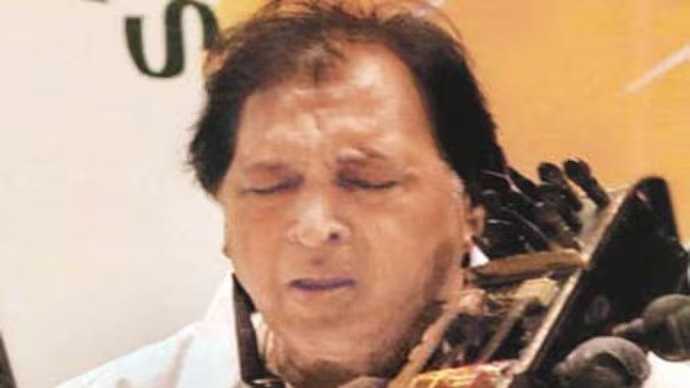
Sarangi maestro and classical singer Ustad Sultan Khan, the soulful voice behind hits such as Piya basanti re and Albela sajan, passed away in Mumbai on Sunday after kidney failure.

The Padma Bhushan awardee, 71, who hailed from a family of sarangi players in Jodhpur, was on dialysis for the past three months and died on his way to the hospital, family sources said.

Khan is survived by his second wife Bano, son Sabir – also a well-known sarangi player – and two daughters. His funeral will take place in Jodhpur on Monday.

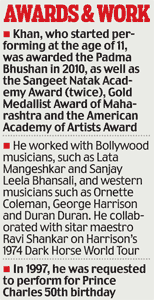
Credited for reviving the sarangi, Khan is famous for his extraordinary control over the instrument and his husky voice. He started performing at the age of 11, and later collaborated at the international level with sitar maestro Ravi Shankar, on George Harrison’s 1974 Dark Horse World Tour.

Khan’s was a family of sarangi masters from Rajasthan. He was initially tutored by his father, Ustad Gulab Khan. Later, he trained under Ustad Amir Khan, a classical vocalist of the Indore gharana. After establishing himself as a sarangi player, Khan worked with Bollywood musicians, such as Lata Mangeshkar and Sanjay Leela Bhansali, apart from collaborating with western musicians, such as Ornette Coleman, George Harrison and Duran Duran.

Apart from the Padma Bhushan, Khan won numerous musical awards, including the Sangeet Natak Academy Award (twice), the Gold Medallist Award of Maharashtra and the American Academy of Artists Award in 1998.

Khan was also a member of the Indian fusion group Tabla Beat Science with Zakir Hussain and American bassist Bill Laswell.

The news of Khan’s death came through a post by music composer Salim Merchant (of Salim-Sulaiman fame) on Twitter.

“I lost my ustad – Ustad Sultan Khan, my guru my friend my idol. He passed away this afternoon. We will never have a sarangi maestro like him,” he tweeted.

Eminent sarod player Amjad Ali Khan also condoled his death, saying it was a great loss to the music world. “I am deeply saddened at his demise. He gave a different meaning and dimension to the sarangi ,” he said.

Among the other musicians who expressed grief were music director Vishal Dadlani, and singers Shreya Ghoshal, Abhijeet Sawant and Shaan. “Just heard about the loss of our dear ustad sa’ab :(I had the gr8 fortune and honour of working with him. Too saddened,” Ghoshal tweeted.

Actors Akshay Kumar, Rahul Bose and Dia Mirza also wrote on Twitter. “This has not been a good year what with so many great personalities leaving us. My thoughts and prayers with his (Khan’s) family,” Akshay said.

“He played on the soundtrack of my directorial feature, Everybody Says I’m Fine! Ustad Sultan Khan saab had a huge heart and an impish sense of humour,” Bose recalled.

source: http://www.indiatoday.in / India Today / Home> News> West / by India Today Online, Mumbai / November 28th, 2011

Deccan architecture

KARNATAKA / MAHARASHTRA :

Architectural exploration in the sultanate of Ahmednagar can provide deep insights into the political history of the Deccan.

B Y the late 15th century, the Bahmani kingdom that had ruled much of the Deccan since its establishment in 1347 was imploding because of internecine differences among its nobility. Westerners, or the “Afaqis”—immigrants from Persia and Central Asia—had differences with the natives, or the “Deccanis”, an eclectic group of nobles that consisted of descendants of the early Delhi sultanate migrants, local converts to Islam, Habshis (Africans) and Marathas. The weakening of the kingdom was accompanied by ambitious provincial governors declaring independence one after the other, leading to the emergence of five separate principalities, or sultanates.

The earliest to break away and proclaim himself sultan was Ahmed Nizam Shah I, who was the governor of the north-west province of the Deccan, later to be known as Ahmednagar, after the name of the city he would build and designate as capital of the sultanate. Of the four other sultanates that would cleave away chunks of the Bahmani kingdom, Bijapur and Golconda were the large and important ones to emerge.

Ahmednagar survived as a robust Shiite polity for more than a century, until 1600, and then in a feebler form until 1636 before the Mughals, with their unceasing imperial ambitions, completely swamped the city. It took 50 more years for the Mughals to subjugate all the kingdoms of the Deccan when Aurangzeb finally defeated the sultanates of Bijapur and Golconda in 1686 and 1687 respectively. Even though it was the first sultanate to fall to the Mughals because of its location, Ahmednagar survived as an independent state for more than 100 years.

During this time, it carved out a distinct identity in statecraft apart from leaving behind a fairly rich architectural legacy, which is the subject of study of the book under review. With this clearly defined ambition, Pushkar Sohoni, who is an architectural historian, has turned the spotlight on the sultanate of Ahmednagar and presented a method by which architectural exploration can provide deep insights into the political history of a geographical region.

The art and architecture of the Deccan sultanates was the focus of many scholars in the past. In pre-independent India, the region’s architecture was studied as an addendum to the Islamic architecture of northern India (for example, the second volume of Percy Brown’s seminal work on Indian architecture, 1942). More recently, the study of the Deccan as an independent area has come into its own, with scholars such as George Michell and Mark Zebrowski ( Architecture and Art of the Deccan Sultanates , 1999) publishing detailed studies.

Among exhaustively edited volumes on the same theme, a few stand out in recent times, including Silent Splendour: Palaces of the Deccan, 14th19th Centuries edited by Helen Philon (2010) and Sultans of the South: Art of India’s Deccan Courts, 1323-1687 edited by Navina Najat Haidar and Marika Sardar (2011).

Richard Eaton and Phillip B. Wagoner have published a book titled Power, Memory, Architecture: Contested Sites on India’s Deccan Plateau, 1300-1600 (2014) that looks in detail at secondary urban centres of the Bahmani and Deccan Sultanate era such as Kalyana, Raichur and Warangal.

Coming to the scholarship on individual sultanates: Pramod B. Gadre has studied Ahmednagar in some detail ( The Cultural Archaeology of Ahmadnagar during Nizam Shahi Period, 1494-1632 , 1986); Deborah Hutton has looked carefully at the art of Bijapur ( Art at the Court of Bijapur , 2006); Marika Sardar has extensively studied the fortifications of Golconda (“Golconda Through Time: A Mirror of the Evolving Deccan”, unpublished PhD thesis, 2007). The book under review adds to this burgeoning bibliography on the art and architecture of the Deccan sultanates.

In his prefatory chapter, Sohoni makes a forceful case for the independent study of the Deccan, which had a distinct identity from “Hindustan”, or northern India, for most of the past. He writes: “The deep connections of the Deccan with West Asia, completely independent of Northern India, along with the autonomous cultural and historical developments in the south have shaped the Deccan very uniquely. Detailed studies of the polities of the Deccan, therefore, of architecture and statecraft, need to be undertaken in order to explain how, in moments of disengagement with the north, unique formations were created independent of developments in North India.”

This disconnectedness from north India led to the emergence of a distinctive architecture as the Nizam Shahis developed their own style. Sohoni’s argument is that the “…architecture of the Nizam Shahs does not follow a linear development from its Persian origins to the creation of a regional style. The buildings are variously of broadly Persianate and Indic characteristics, at times both, but to call them derivative is unfair, as the kingdom of the Nizam Shahs was trying to create a new architectural language as a regional claim.”

This study of architecture and the politics of Ahmednagar also leads Sohoni to argue ingeniously that the Deccani kingdoms saw themselves as “regionalists” who were resisting the “Hindustani” expansion led by the Mughals. This is an interesting perspective of medieval India.

Thus, the Deccan kingdoms were resisting the cultural expressions of the north by forging links with Persianate lands, which led to autonomous architectural representations. Chaul, Dabhol, Bhatkal and Goa were the principal ports through which connections with the wider Persianate world were forged independently, bypassing north India. In their architecture and in other aspects such as coinage, literature and painting, the Deccan sultans intended to bolster their independent claims as Deccan potentates. At the time, the Deccan was a multi-ethnic society with strong and independent connections to Persia.

There was also a great deal of cultural interaction and churning in the region involving ethnicities as diverse as African, Arab, Central Asian and South Asian. Thus, Sohoni provides ample evidence to back his argument that the Deccan has to be studied independently from “Hindustan”.

Sohoni’s intervention is valuable for the much-needed nuance it provides to the story of medieval India. In the reductive nationalist and colonialist versions of the time, Muslim rulers are seen as invaders “…upsetting indigenous practices until the ‘Hindu revival’ under the Marathas in the seventeenth century which is a simplistic and naive model of regional history”. Through Sohoni’s work, we see that the Nizam Shahi’s forbears were Brahmins who converted to Islam. Sohoni goes on to demonstrate, through his close reading of visual architecture, that the Nizam Shahi state “…formed the basis of the nascent Maratha state that emerged in the mid-seventeenth century under Shivaji Bhonsale”.

Sohoni delineates his method of studying architecture: “In this book, art-historical methods of visual inspection and formal analysis, along with documentation of architecture and construction, expand on earlier attempts to overcome the limited interpretations of previous text-based histories.” His book has a detailed historiographical note on the Nizam Shahis combined with the study of other aspects, such as the role of guilds and the material used in buildings of the time, providing a fulsome interpretation of architecture.

Sohoni also looks briefly at the literature, visual culture and coins of the Nizam Shahs. It is interesting to note that Ahmednagar started minting its own coins only in the second half of the 16th century, and this was done only when it realised the implications of Mughal expansion and had to symbolically demonstrate its independent status.

Commencing his detailed look at the architecture of Ahmednagar, Sohoni dedicates a chapter to urban patterns in six settlements of Ahmednagar: Junnar (the first capital of the Nizam Shahis), Daulatabad (the older capital of the northern Deccan), Ahmednagar (the capital built from scratch by the Nizam Shahis), Chaul (a major seaport), Parenda (a fortified military centre built by the Bahmanis) and Sindkhed Raja (the hereditary fief of the Jadhavs, Maratha nobles at the court of the Nizam Shahs). He also looks at the water technology and the fortifications in these settlements.

In the next chapter, Sohoni looks at the palaces and mansions of Ahmednagar such as Farah Baksh Bagh, a large building originally set on a raised platform in a pool of water. Sohoni spends some time on this monument before moving on to detailed discussions of other monuments such as the Hasht Bihisht Bagh, Manzarsumbah and Kalawantinicha Mahal.

In a subsequent chapter, Sohoni discusses the architecture of 12 mosques spread across various settlements in erstwhile Ahmednagar. Interestingly, Sohoni points out that there was no main congregational mosque in Ahmednagar where proclamations of sovereignty could be made on Friday, which is something unique and can be attributed to the Shiite orientation of its rulers. In the next chapter, Sohoni looks at tombs. One would imagine that like their royal forbears and peers among the Deccan sultanates the Nizam Shahis would also have grand tombs, but barring the first king of the dynasty, none of the other kings are buried here as their bodies were embalmed and sent off to Karbala (Iraq) in homage to their Shiite belief.

Thus, the 14 tombs that have been discussed are of the higher nobles who were buried in the region and memorials that are attributed to Maratha nobles, such as the ancestors of Shivaji in Verul and that of Lakhuji Jadhav in Sindkhed Raja. Another chapter is dedicated to the discussion of miscellaneous buildings, including royal hamam s.

Sohoni does not claim to have catalogued all the extant buildings from the Ahmednagar era, but his list is fairly thorough and includes all the prominent monuments in the region.

Through his work, the author sounds an urgent note of caution as many of these buildings are in a poor state of preservation with a few even slated for demolition. Several noteworthy monuments are not even protected by archaeological authorities. Sohoni has provided accompanying photographs and architectural plans for many of the monuments in his work. His detailed appendix is also useful as it provides an annotated listing of inscriptions on several monuments.

Sohoni concludes by providing an overview of what the Nizam Shahis represented. They were the last medieval state that the early modern Mughal state encountered as it swept across the Deccan.

He writes: “This study locates the Nizam Shahs as a critical component of the architectural and political history of the sixteenth-century Deccan, and hopefully can restore to them some of the status that they once commanded in their own time.” Drawing a direct link from the Nizam Shahis to the incipient Marathi state that emerged, Sohoni contradicts reductive scholarship that sees the Marathas as breaking from an Islamicate past. He writes that “…it is possible to conclude that there was no nationhood or polity based on an ethnic identity, and that their ethnic identity was a marker of social rise through military service. The cultural forms of the greater Islamicate world, as expressed in the Deccan by the Bahmanis, the Vijayanagar kings, and the later sultanates, were also adopted by the Maratha courts. In conception, execution, and ornament, the architecture of the early Marathas was exactly the same as that of their sultanate overlords and peers. The structural forms, decorative details, and planning logic conform to the Islamicate architecture of the Deccan sultanates.”

This book is valuable to architectural historians and historians of medieval India. A logical expectation would be for similar research to be done on the other Deccan sultanates, each of which represented robust regional resistance to the imperial policy of the Mughals.

source: http://www.frontline.thehindu.com / Frontline / Home>Books / by Vikhar Ahmed Sayeed / July 17th, 2019

The medieval Deccan

KARNATAKA :

A reading of three books throws light on the culture and politics of the Persianate world of the medieval Deccan.

Through fierce forays into southern India, rulers of the Delhi Sultanate like Alauddin Khilji (reign 1296-1316) extended the boundaries of their empire to its furthest extent at the end of the 13th and the beginning of the 14th centuries by dismantling the existing Yadava, Kakatiya, Hoysala and Pandya kingdoms. Khilji’s forces even reached Madurai in the deep south, where they established a base. Mohammed bin Tughlaq (reign 1325-1351), the eccentric genius of the Tughlaq dynasty that followed the Khiljis, moved the capital of his vast empire from Delhi to Devagiri or Daulatabad, located in what is now the central part of Maharashtra, in order to have his court more centrally located. The Delhi Sultans’ rule in these far-flung domains of their realm was always tenuous, and when Tughlaq’s rule, beset by internal crises and external challenges, withdrew to north India, many provincial governors rebelled, forming independent kingdoms or sultanates.

In the Deccan, an amorphous geographical region extending from the south of the Vindhya Range to the Krishna and Tungabhadra rivers, the Bahmani Sultanate was established by rebel Tughlaq nobles in 1347 with its initial base in Daulatabad. Across the Krishna, the vacuum that had set in after the Tughlaq withdrawal had led to the founding of the Vijayanagara kingdom sometime between 1336 and 1346.

The Bahmanis would shift their capital to Gulbarga (now Kalaburagi) in 1350 and in the early 15th century, to Bidar. At its height during the reign of Muhammad III (reign 1463 to 1482), when Mahmud Gavan was the prime minister, the Bahmani Empire extended from the Arabian Sea to the Bay of Bengal, helmed in by the Khandesh Sultanate in the north and the Vijayanagara empire in the south. While the Bahmani empire was a powerful state, ethnic affiliations overlaid with sectarian differences among the ruling nobility led to its implosion at the end of the 15th century. The provincial governors of Bijapur, Ahmednagar, Golconda, Bidar and Berar established their own Sultanates, snuffing out the Bahmani dynasty. Collectively referred to as the Deccan Sultanates, the 16th century would see these legatee states frequently fight with one another. The mighty Vijayanagara to their south usually sided with one or the other sultan in these conflicts.

Recognising the threat that the powerful Vijayanagarans perennially posed to them, the Deccan Sultanates came together in a temporary alliance in 1565 to defeat Vijayanagara, leaving it to totter to its eventual demise over the next century (See “Beyond the Hindu-Muslim Binary” in Frontline , January 18, 2019). This brief friendship was soon forgotten, and the Deccan Sultanates continued to fight with one another. Berar and Bidar were gobbled up by Ahmednagar and Bijapur respectively, leaving these two states, along with Golconda, as the unchallenged rulers of the Deccan for some time until their wealth attracted the attention of the Mughals. The expansionist policy of the Mughals led to the weakening and eventual subjugation of these regional powers as first Ahmednagar (1636) and then Bijapur (1686) and Golconda (1687) succumbed to Mughal might, ending the glorious epoch of the Deccan Sultans.

In popular understanding, medieval India is usually equated with the Mughal empire, but this is not to say that the Deccan was deprived of serious explorations of its medieval history. H.K. Sherwani and P.M. Joshi were early modern historians who looked at the Bahmanis and their descendants closely ( History of the Medieval Deccan: 1295-1724 , 1973). One of the books being reviewed in this essay, T.S. Devare’s A Short History of Persian Literature: At the Bahmani, the Adilshahi and the Qutbshahi Courts—Deccan (1961) is also from an earlier era. The work of these scholars has been followed by other prominent historians such as Richard Eaton and Phillip. B. Wagoner, who have closely looked at various facets of medieval Deccan. Manu Pillai ( Rebel Sultans , 2018) has attempted to tell the political history of the Deccan (for a review of this book, see “The Deccan Chronicles”, in Frontline , May 10, 2019). The architecture of the Deccan Sultanates has also been closely studied by architectural historians like George Michell and Helen Philon (the two scholars’ new book is being reviewed here). A new generation of scholars like Deborah Hutton, Marika Sardar, Pushkar Sohoni (for a review of Sohoni’s book, see “Deccan Architecture” in Frontline , August 2, 2019) and Emma J. Flatt (whose book is being reviewed in this essay) have begun to use innovative methods to explore other dimensions of the Deccan states, moving beyond political history.

Magnificent architecture

George Michell and Helen Philon are recognised scholars of the architecture of medieval Deccan. Early in his career, Michell co-founded the Vijayanagara Research Project, which continues to have a vast scope and consists of leading researchers on the history of this grand empire. Since the 1990s, Michell has moved on to study the architecture of Vijayanagara’s traditional rivals, the Bahmanis and their legatee sultanates. That makes him the only architectural historian whose expertise spans peninsular India. His many publications attest to his reputation as the foremost authority on medieval Indian architecture south of the Vindhyas. Helen Philon has published on Sultanate architecture in the past and her guidebook on Gulbarga, Bijapur and Bidar has become classic reference material for travellers to these Sultanate-era towns.

These two historical and architectural experts have combined forces with the photographer Antonio Martinelli, leading to the publication of the gorgeous coffee-table book under review. There are 290 photographs in the book capturing various monuments and their details in a fantastic display of exquisite photography. A significant number of architectural drawings adds to the value of this book.

While it excels as a coffee-table book, Islamic Architecture of Deccan India is also a handy academic work that collates existing literature on the theme in its introductory essay. This essay is a thorough summary of the medieval history of the Deccan, displays impressive historical and architectural awareness and serves as a perfect prologue to the book whose pages are otherwise filled with photographs of monuments. There are nine chapters that follow, each focussing on a Sultanate-era town. Towns gained prominence in a linear fashion in medieval Deccan and the chapters follow that development, with the photographs and captions highlighting the evolution of architecture.

Daulatabad and its neighbour, Khuldabad, attained early importance as the peninsular headquarters of the Delhi Sultanate and later as the first capital of the Bahmanis. After this, the capital of the Bahmanis was moved to Gulbarga and briefly Ferozabad (which is a necropolis now) before being shifted permanently to Bidar. The Bahmani empire eventually broke up into five separate sultanates. Ahmednagar, Bijapur and Golconda were the headquarters of these provincial kingdoms and boasted majestic architecture that saw a boost after the 1565 “Battle of Talikota” with Vijayanagara. These extensive chapter-long surveys end with Aurangabad, which was the Mughal bridgehead for conquering the Deccan. Interestingly, Michell and Helen Philon choose to include Burhanpur, the capital of the Khandesh Sultanate which separated the Deccan from “Hindustan”, in their examination of the Deccan. This is unusual, provoking the question as to what truly constitutes the Deccan.

Seeing the photographs in the book, each of which has immortalised a monument, one cannot help but recall Susan Sontag’s thoughts from her must-read book On Photography . She writes: “All photographs are memento mori. To take a photograph is to participate in another person’s (or thing’s) mortality, vulnerability, mutability. Precisely by slicing out this moment and freezing it, all photographs testify to time’s relentless melt.” Martinelli’s alluring and breathtaking photographs, accompanied by Michell’s and Helen Philon’s notes, not only make the reader aware of the magnificence of these monuments but also the relentless passage of time.

Persian in the Deccan

The second book under review is a reprint of a classic on Persian literature in medieval Deccan by T.N. Devare. A Short History of Persian Literature: At the Bahmani, the Adilshahi and the Qutbshahi Courts—Deccan was first published in 1961 and was the PhD thesis of the author, who died in 1957 when he was only 43 years old. It continues to remain relevant because it is the only book in English that exhaustively studies the vast corpus of Persian literature produced in the courts of the Bahmanis and the Deccan Sultanates. Devare’s contemporaries had made substantial progress in the study of medieval Indian Persian literature but their main focus was on the works produced under the Delhi Sultanate and the Mughals. Thus, Devare’s intention was to correct this academic anomaly and to show that great Persian literature was also produced in the Deccan.

Considering the demand in academic circles for a reprint, the author’s family took the initiative in reprinting this valuable book last year. Methods of historical and language research have changed substantially in the six decades since Devare did his research. Thus, the book’s conceptual approach and style may seem outdated if seen from the perspective of current scholarship, but its value lies in its wide scope and its ambitious attempt at collating texts and then critically discussing them. Merely locating all of these texts in the 1950s, when they were spread across several libraries and personal collections, must have been a tedious task.

By discussing the major works produced in the Deccan, Devare has also put together what could be read as an extended annotated bibliography of the literature produced at these courts, making the book both a useful primary and secondary source for historical research on Persian literature in India and the history of the Deccan Sultanates. Devare also reads all the Persian texts directly and interprets them for his readers. His work is foundational as he does not rely or build on the work of other scholars. It is rare, or almost impossible nowadays, to find a scholar with such advanced competence in medieval Persian. Devare also frequently translates passages of Persian poetry and prose, enriching the book.

Devare’s book is divided into seven chapters, not including an introductory chapter that looks at the historical connections between Persia (now Iran) and India. Reading these chapters, one becomes aware of the easy mobility of a vast number of Persian speakers who migrated to the Deccan. Five of the seven chapters have a clear focus on different kinds of personages and their contributions to Persian literature in the Deccan. In each chapter, Devare chronologically lists the writers, thematically linking them before discussing their work, devoting several pages to noteworthy contributors.

For example, in the chapter on saints of Islam and their contribution to the development of Persian literature, the longest discussion is on the literary contributions of Khwaja Bandenawaz, the Sufi saint buried in Kalaburagi, whose enduring spiritual legacy has established him as the most prominent Sufi of the Deccan. Bandenawaz wrote a number of treatises and pamphlets on religion and Sufism apart from the poetry that has been discussed by Devare.

Discussing the Persian literature produced by the rulers of the Deccan Sultanates, Devare devotes several pages to Ibrahim Adil Shah II (reign 1580-1627) of the Adil Shahi dynasty of Bijapur. Like the Mughal emperor Akbar (reign 1556-1605), his elder contemporary in northern India, Ibrahim Adil Shah II also had an eclectic spiritual curiosity that defined his world view. He was addressed as “jagat guru” because of his love for music and veneration of the goddess Saraswati. Devare’s exhaustive survey goes on to include discussions of the works of the prominent litterateurs, architects, calligraphists and other prominent nobles in the Bahmani, the Adilshahi and the Qutbshahi courts.

In the chapter on poets, the prominent poets discussed by Devare include Isami, the composer of the Futuh-us-Salatin , a masnawi (poem in rhyming couplets) on Muslim rule in India, who was at the Bahmani court, and Zuhuri, the master of ghazal writing who was employed by the Ahmednagar and Bijapur Sultanates.

In a chapter on historians, Devare discusses the craft of history writing as practised by Muslim historians before moving on to discuss the works of individual historians. He makes a rare accusation of plagiarism against Ferishta, the historian whose works provide the maximum primary material for writing the histories of those times. The last chapter of the book looks at the influence of Persian on Marathi and Dakhni languages.

A flaw, or rather, a handicap of the book is that most of the dates are mentioned in the Islamic or Hijri calendar, which makes it tedious for the reader to correlate them with the dates of the common Gregorian calendar.

Emma J. Flatt’s fabulous book adds tremendous new knowledge to the history of the medieval Deccan. Borrowing methodological tools from anthropology and seeped in a robust reading of original Persian texts, Emma Flatt’s book is a rigorously researched work that opens up the courts of the Deccan Sultanates in exquisite detail. Emma Flatt’s main intention is to investigate the “idea of courtliness in the political, social and cultural worlds of the late fifteenth- and sixteenth-century Deccan Sultanates”. The book studies a wide set of practices among the elite of the Deccan courts and will certainly become a landmark of historical research as Emma Flatt has demonstrated how a finite set of primary sources can be interrogated to wring out new kinds of knowledge and add to our understanding of a historical period. This work is also academically exciting as there are hardly any historical works that analyse South Asian “courts” as a category apart from Daud Ali’s pioneering work on courts in early medieval India ( Courtly Culture and Political Life in Early Medieval India , 2011).

Through the book, Emma Flatt reiterates the point made by the historians Richard Eaton and Phillip Wagoner in the past that it is erroneous to view the various Deccan Sultanates and the Vijayanagara Empire as having fixed geographical boundaries and that, as the movement of the courtiers showed, there was a fluidity in these boundaries. Emma Flatt writes: “During this period, individuals of different backgrounds and cultures moved from across the Persian-speaking world to take up service at the courts of the Deccan Sultanates, and between the Deccani courts with a felicity that belies modern assumptions about the fixity of political and geographical boundaries on the one hand, and the incompatibility of Indic and Islamicate religio-cultural systems on the other.”

Emma Flatt relies on three key theoretical terms—the court, ethics and the Persian Cosmopolis—to take her argument forward. By virtue of the easy movement between a variety of courts, the courtiers acquired a certain courtly disposition that was widely shared across the “Persian Cosmopolis”, a phrase that has recently acquired tremendous heft in its expression of the shared set of cosmopolitan training in Persian texts that informed the subsequent world view of the elite across a vast swathe of land from Persia to Bengal. Emma Flatt’s book looks at facets of these courtly societies and examines certain courtly skills that were necessary for courtiers in order to become part of this courtly culture.

The book is broadly divided into two parts containing three chapters each, “Courtly Society” and “Courtly Skills”. Emma Flatt argues that there was a shared cosmopolitanism that the courtiers acquired through a shared foundational education of key Persian texts whose aim was not merely the acquisition of knowledge but the development of a “specific type of disposition within each individual”. This helped them move easily across the Persianate Cosmopolis, allowing them to find employment in various Deccani courts, as evinced in the careers of two individuals discussed in the next chapter.

By examining the careers of two elite noblemen, Muhammad Nimdihi and Hajji Abarquhi, Emma Flatt demonstrates how individuals used familial, scholarly, mercantile, religious and friendly networks in order to move across the Persian Cosmopolis.

The court society of the Sultanates was heavily influenced by “…the practices, the commodities and the vocabulary of long-distance trade”. She looks at the biographies of three powerful individuals, Khalaf Hasan, Mahmud Gavan and Asad Khan Lahri, in some detail to argue this point.

In the second half of her book, Emma Flatt looks at the courtly skills that were required for “worldly success and ethical refinement”. She writes: “By disciplined repetitive practice, the participant honed his ability at a particular skill, and simultaneously refined his soul, rendering the pursuit of skills an ethical endeavour.” Emma Flatt looks at scribal, esoteric and martial skills as part of the training for worldly success and the development of a courtly disposition.

The importance of scribal skills in the development of a refined courtier is examined through the epistolatory skills of Mahmud Gavan (1411-1481), the dynamic merchant-scholar who rose to become a vizier of the Bahmani rulers.

In a fantastic chapter that looks at the esoteric skills that courtiers could acquire to rise in the eyes of the rulers, Emma Flatt does a meticulous reading of the “Nujum al-Ulum”, the esoteric text composed in the Bijapuri court of Ali Adil Shah I (reign 1558-1580). In its divergent sourcing from both Islamicate and Indic cosmologies, she sees “conceptual commensurabilities” for a courtly society made up of a people belonging to a plurality of religious and cultural beliefs.

In the last chapter, Emma Flatt looks at “…how the acquisition of martial skills was associated with an ethical ideal known as javanmardi or young-manliness, an ideal structuring the daily lives of courtly and urban men in the medieval Persianate world”.

This brief review hardly does justice to the wide scope of Emma Flatt’s work which will be valuable for anyone interested in the history of the medieval Deccan. As this review essay shows, there is a substantial amount of ongoing research in the history of the medieval Deccan, but compared with the large body of work on the Mughals, much remains to be done for historical research of the medieval Deccan.

source: http://www.frontline.thehindu.com / Frontline / Home>Books / by Vikhar Ahmed Sayeed / December 04th, 2019

Making history accessible

KARNATAKA :

A translation project, involving 21 volumes written in medieval Persian on the Adil Shahi dynasty of the Bijapur sultanate, which M.M. Kalburgi was heading before his murder, has been completed.

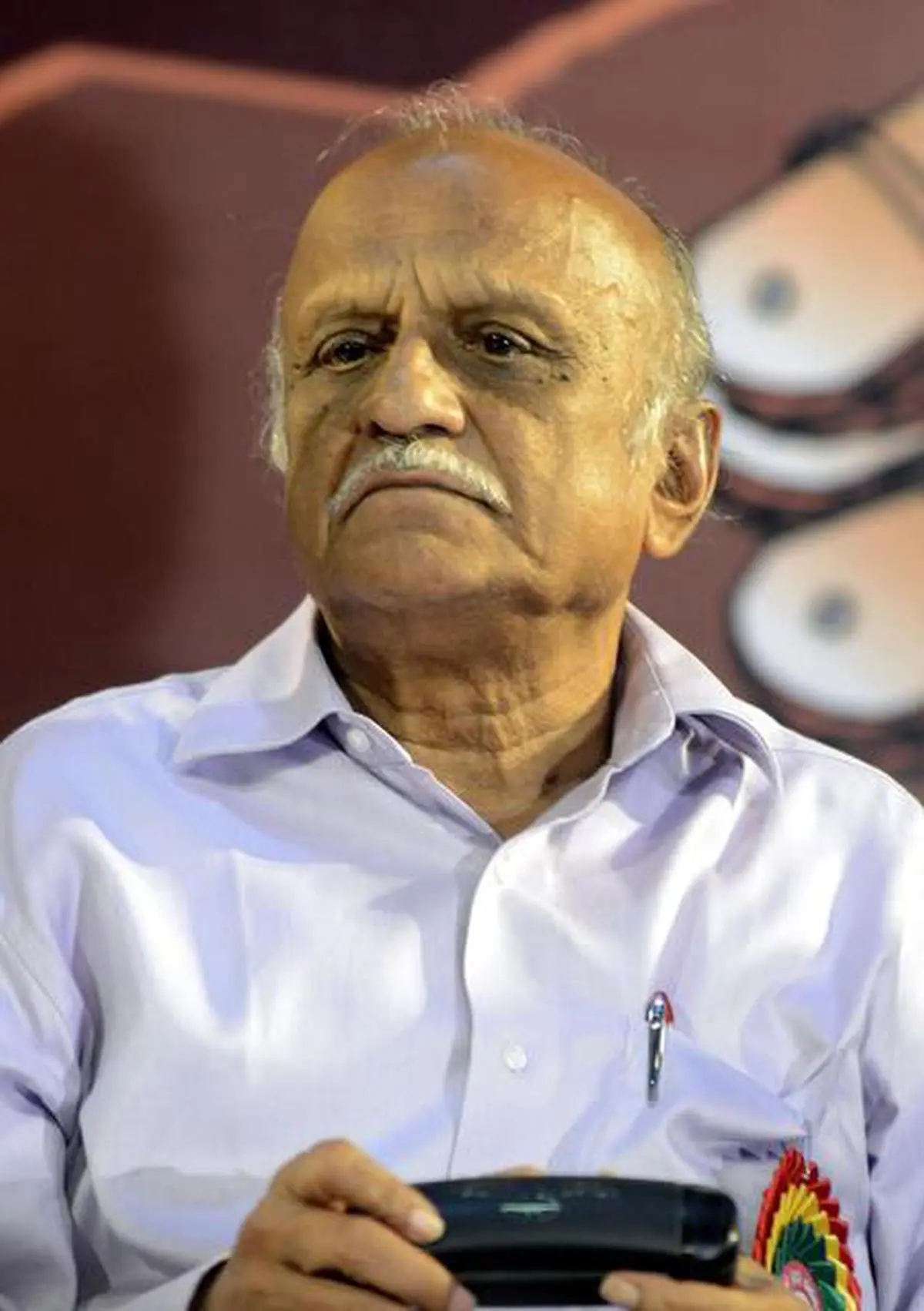
M.M. Kalburgi.

When the Kannada scholar M.M. Kalburgi’s life was suddenly and brutally ended by a gunman on August 30, 2015, he left many projects unfinished. The senior researcher was primarily known for his iconoclastic interpretation of the Lingayat credo, embittering conservative believers. But his work went beyond this, and he had versatile interests. As an epigraphist, he was keenly interested in the history of Karnataka. At the time of his death, he was supervising the translation of Persian manuscripts into Kannada from the time of the medieval sultanate of Bijapur, when the Adil Shahi dynasty (1489-1686) ruled the region.

The Adil Shahi Sultanate was one of the five kingdoms that emerged in the wake of the implosion of the Bahmani Empire. The Adil Shahis ruled a vast area from the city of Bijapur, and at its peak the boundaries of the Bijapur sultanate stretched from the Arabian Sea to the Bay of Bengal. It took the might of the Mughal Empire to finally defeat this kingdom in 1686. During the reign of Ibrahim Adil Shah II (r. 1580-1627), Bijapur was one of the leading urban centres of the Indian subcontinent, rivalling the majesty of Mughal administrative and cultural centres of northern India such as Delhi, Agra and Lahore. The population of Bijapur was around 10 lakhs at the time, and this exceeded the population of other royal Indian towns. The kings of the Adil Shahi dynasty left their mark on this town, which is littered with a variety of monuments, the most famous being the Gol Gumbaz, the mausoleum of Mohammed Adil Shah (r. 1627-1656).

The largest chunk of the Bijapur sultanate, including its capital Bijapur, lay in what is now modern Karnataka. Hence, an understanding of the sultanate’s history adds significantly to the understanding of the history of medieval Karnataka. Kalburgi’s translation project was staggering in its scale; it involved the translation of 21 volumes written in medieval Persian, forming most of the primary source material on the Adil Shahi dynasty. The material was a treasure trove for historians working on the region but had remained inaccessible because it was not available in Kannada.

A translation like this had never been done in Kannada and was only possible under the fervid leadership of Kalburgi. According to people close to Kalburgi, he was excited about this project as he felt that the history of Karnataka would have to be rewritten after the publication of these volumes. The first volume came out in 2014, the year before he was killed. He lived to see a few more volumes published, but the bulk of the project was finished after his death. The final volume was published only in 2018.

The provenance of the project can be traced to the early 2000s, when Kalburgi was the Vice Chancellor of the Kannada University at Hampi. He had reached out to Krishna Kolhar Kulkarni, a historian of Bijapur, to present a bibliographical essay on the Adil Shahi dynasty at the university. “Along with this, he encouraged me to translate at least one book from Persian to Kannada,” recalled Kulkarni, 79, in a chat with Frontline . Kulkarni, who is originally from the village of Kolhar near Bijapur (now Vijayapura), spent 11 years in Bombay (now Mumbai) as a telegraph employee. He became fluent in Marathi during those years. “The book that I chose to translate was the Basateen-e-Salateen , a nineteenth century account of the Adil Shahi dynasty by Ibrahim Zuberi. It had been translated into Marathi from Persian, and I relied on that translation to bring it out in Kannada,” explained Kulkarni.

Encouraged by the success and quality of this initial translation, a project proposal, “the Adil Shahi Literature Translation Project” was readied in 2011 under the aegis of the Dr. P.G. Halakatti Research Centre of the Bijapur Lingayat District Educational Association (BLDEA). The aim of the project was to translate the entire corpus of Adil Shahi literature into Kannada. The proposal received the support of M.B. Patil, a senior politician from Vijayapura who is known to take a keen interest in the heritage of his city. The Kannada and Culture Minister at the time, Govind M. Karjol, a native of a neighbouring district, approved the project, and Rs.75 lakh was sanctioned for this purpose in 2012-13. The translation was carried out by a committee under the chairmanship of Kalburgi and under the direction of Kulkarni.

“The first task that I did was to identify and acquire the primary Persian texts of the Adil Shahi era. This I did from several libraries all over the country as they were not located in one place. I got photocopies of original Persian texts from places like the Salar Jung Museum and the Andhra Pradesh Archives and Research Institute in Hyderabad. In Maharashtra, I visited the archives in Mumbai, Pune and Aurangabad, apart from using material available at the Bharat Itihas Sanshodak Mandal in Pune. Finally, I also had to visit the National Archives of India in Delhi for some rare material,” Kulkarni said.

After this, translators were identified and the work began in earnest. As the project had to be completed soon, several translators were identified for the purpose. Each translator was allocated a different text, and in some cases where the text was voluminous, different parts of the same text. Many translators worked in teams of two people, with one person more competent in Persian and the other in Kannada. Thus, a 2,626-page tome like the Tarikh-e-Farishta , which is a chronicle of Muslim history in the subcontinent written by Farishta, a courtier in Bijapur, was translated by eight translators.

As the director of the project, Kulkarni acknowledged that using multiple translators was not the most rigorous way to translate a text, but he explained how he made it work: “Once the translations came to me, I would work on them further to provide clarity and stylistic uniformity.” Kulkarni also acknowledged that while some texts were directly translated from Persian and old Deccani with the help of scholars like M. Rahman Madani of Vijayapura, many were translated from Urdu and English. So these were translations of translated texts. Some of the other texts that were translated were the poem Ibrahimnama of the Saraswati-venerating-monarch Ibrahim Adil Shah II, containing 712 stanzas, and his Kitab-e-Nauras , the Book of Nine Rasas. Chronicles of kings of the ruling dynasty like Mohammed Adil Shah and Ali Adil Shah II, Sufi texts from the era and compendiums of fatwas constitute the other volumes in the translated set.

It is evident that there is some arbitrariness in the way in which the translations have taken place, and a philologist may not approve of this. A historian specialising on the Adil Shahi dynasty who spoke to Frontline on the condition of anonymity said: “The quality of the translations is not up to the mark as they have not carried over the nuances of the Persian original.” While this may be true, the 21 volumes open up the world of medieval north Karnataka to modern researchers working in Kannada. Kalburgi’s dream of adding a great new source material to the understanding of the history of Karnataka has come true.

source: http://www.frontline.thehindu.com / Frontline / Home> India> History / by Vikhar Ahmed Sayeed / July 08th, 2019

Pages from Bahmani days

KARNATAKA :

Six more books from the period of Adil Shah have been released

A GLIMPSE OF… the books, manuscripts and maps

The ambitious work of translating Adil Shahi literature in Kannada, has now achieved another milestone. Six more rare books of that era written in Persian and Dakhani Urdu have been released and are available for the readers.

The Adil Shahi Literature Translation Committee which was earlier headed by the late M. M. Kalburgi, is rapidly doing its work to complete the entire project by the end of this year.

Writer Krishna Kolhar Kulkarni, director of the committee, who now heads the project after the demise of Prof. Kalburgi, said that last year the committee came up with six books, this year, as the second instalment, the committee has released six more rare books after translating them into Kannada.

It was a difficult task to collect these books, since they are rare and hard to find. Names of the books that will be released and their brief description:

Mohammad Naama: The book written by Zahoor Bin Zahoori in Persian is gives demographic details of Karnataka and the expansion of Adil Shahi dynasty into southern parts of the country. The writer offers critical information about the life of Mohammad Adil Shah (1636-1656) who got the historic Gol Gumbaz built. The book has been translated by Dr. Mehnoor Zamani Begum, Prof. A.H. Masapati, Fakir Mohammad Katpadi and Moulana Rashid Al Khashmi.

Ali Naama and Tarikh-e- Sikandari: The books written in Dakhani Urdu by Mulla Nusrati, are primarily poems in which writer gives illustrated description of Ali Adil Shah-II (1656-1672) and Sikandar Adil Shah (1672-1686). The book meticulously writes about the historic Umarani war between Maratha King, Shivaji and Ali Adil Shah-II in which Shah humiliatingly sends Shivaji back from the battle field.

The books are translated by the late, Dr. Mohammad Sibkhatullah and Dr. Vithalrao Gaikwad.

Urus-e-Irfan: The book written by Hazrat Kazi Mehmood Behri in Persian, is about contemporary details of religious and historical moments. The book is translated by Bode Riyaz Ahmed Timmapuri.

Tazkirat-ul-Mulk: The book written by Rafiuddin Ibrahim Shirazi in Persian, is one of the best books on ancient Bijapur history of the famous Rakkasaki-Tandagi war in 1565.

The writer gives an eye-witness account of the war and mentions the fall of Vijayanagar Empire. The book is translated by Fakir Mohammed Katpadi.

Kitab-e-Nouras: Written by Ibrahim Adil Shah-II in Dakhani Urdu, who adored art and music. In his books, the king introduced Indian music to Persian people. The book is translated by Dr. Krishna Kolhar Kulkarni.

Rouzat-ul-Auliya: The book written by Mohammed Ibrahim Zuberi in Persian is about some 105 men and eight women Muslim Saints who lived in Bijapur district.

The writer visits each tomb and collects details of all the saints before compiling a book on their lives. The book is translated by Dr. Amiruddin Kazi.

While six book are translated now, previously, another six books that were translated and released are: Tareekh-e-Farishta, Basateen-e-Salateen, Guldasta-e-Bijapur, Ibrahim Naama, Tareekh-e-Haftakursi and Futuhat-e-Alamgeer .

Meanwhile, Dr. Kulkarni said that the team of experts is busy working on the final volume of eight books to be released by the end of this year.

“It is surely a painstaking and labour-intensive job. It has to be translated without distorting the originality,” he said.

Maps and manuscripts

He said that during their search of books, the team laid hands on some of the rare maps of ancient Bijapur district prepared between 1763 and 1909.

“This is no less than a treasure for us . We also got hundreds of manuscripts and ‘Farmaans’ (official correspondents between Kings and landlords).

We have decided to display them in a museum to be established in future,” he said.

source: http://www.thehindu.com / The Hindu / Home> Features> Friday Review / by Firoz Rozindar / October 18th, 2016

The medieval splendour of Bijapur

Vijayapura (formerly) Bijapur, KARNATAKA :

The myriad monuments of Bijapur, such as the Gol Gumbaz, the Jami Masjid, the Malik-e-Maidan and the Ibrahim Rauza, continue to evoke the grandeur of its past as the capital city of a sultanate that held sway for two centuries.

The Ibrahim Rauza contains the tomb of Ibrahim Adil Shah II (r. 1580-1627). The tomb and the mosque in the complex were built by Malik Sandal, the celebrated Abyssinian architect in the Adil Shahi Sultanate of Bijapur.

DURING the reigns of Ibrahim Adil Shah II (r. 1580-1627) and Mohammed Adil Shah (r. 1627-1656) over the Deccan Sultanate of Bijapur, there lived an architect of Abyssinian origin called Malik Sandal who, some historians aver, learnt his trade in Turkey before being lured to the lands of the Deccan. Among the many splendorous monuments that this architect designed is the Ibrahim Rauza, the tomb of Ibrahim Adil Shah II, which the architectural historian Helen Philon describes “as the most beautiful and splendid of all Adil Shahi funerary monuments”. Malik Sandal used the services of a guild of builders whom he trained, called the imaratwale (builders).

Almost four centuries after Malik Sandal’s time, a descendant of this guild of builders continues to live in the city of Bijapur (now Vijayapura). While he has abandoned the profession of his ancestors, Abdul Gani Imaratwale often wanders into monuments that his forebears must have built, laying one basaltic block over another. His wanderings are not nostalgic strolls but serious forays of a historian of the medieval Sultanate of Bijapur who teaches at the Anjuman Degree College in Vijayapura. Seeking a deeper understanding of the history of Bijapur, Imaratwale often finds himself staring for hours at something as obscure as the fish motifs that adorn many of the monuments in this grand city. Bijapur in its heyday, rivalled and, at times, surpassed its Mughal contemporaries such as Delhi, Agra and Lahore in magnificence.

Imaratwale, who has published several books on various aspects of medieval Bijapur, has now brought out his latest edited volume, Studies in Bijapur Sultanate . His co-editor in this work is Maqsood Afzal Jagirdar, who is the direct descendant of Afzal Khan (d. 1659), a powerful generalissimo of the Adil Shahis. Thus, the two editors of the volume, apart from being scholars, have primordial familial links with the history of the Adil Shahi Sultanate of Bijapur.

Studies in Bijapur Sultanate consists of 43 academic papers, of which 17 are from an academic seminar that took place in 1983 in Bijapur when Imaratwale was a young historian, while the remainder are the outputs of modern research. In the latter section, the majority of the papers are authored by Imaratwale, followed by Jagirdar. The work of a few more scholars complete the volume.

The inclusion of unpublished papers from the seminar of 1983 is an academic scoop of sorts as they add tremendously to our understanding of the history of this epoch. Scholars from New Delhi, Hyderabad, Pune, Kolhapur, Bangalore (now Bengaluru) and Mysore (now Mysuru) had made the journey to Bijapur to participate in this pathbreaking seminar. On the second day of the seminar, they were taken around Bijapur in horse-drawn tongas to see the Gol Gumbaz, Jama Masjid, the massive cannon called the Malik-e-Maidan and the Ibrahim Rauza. Many of these historians, who had spent most of their academic lives researching the Deccan and south India, have since passed away, making this exercise of publishing their papers even more precious.

The Bijapur Sultanate was founded in 1489 by the Persian migrant Yusuf Adil Khan (known as Shah in later histories) (r. 1489-1510), who was a protege of the Bahmani Prime Minister Mahmud Gawan. At the time, the almost 150-year-old Bahmani Sultanate that stretched across the northern Deccan was in its death throes because of internecine differences among the native and foreign components in its nobility. The execution of Mahmud Gawan in 1481 at the behest of Mohammed Shah III (r. 1463-1482), the last notable king of the Bahmani throne who ruled from Bidar, catalysed the breakneck speed at which this empire unravelled as governors of different provinces gradually assumed independent power.

Over the next two decades, the boundaries of the northern Deccan would have to be redrawn to account for the birth of five new principalities, or Sultanates, of the Deccan that emerged from the implosion of the Bahmani Empire. The Deccan Sultanates that emerged were Bijapur (the Adil Shahi Sultanate), Golconda (the Qutb Shahi Sultanate), Ahmednagar (the Nizam Shahi Sultanate), Bidar (the Barid Shahi Sultanate) and Berar (the Imad Shahi Sultanate). Of these five, the three Sultanates of Bijapur, Golconda and Ahmednagar survived as robust and strong states into the 17th century when the imperial ambitions of the Mughals snuffed them out forever. The last great Mughal, Aurangzeb (r. 1658-1707), personally led campaigns to the Deccan, vanquishing Bijapur and Golconda in 1686 and 1687 respectively, ending the era of the Deccan Sultanates. Thus, historians like S.K. Aruni argue that the Deccan Sultanates formidably “resisted the north Indian imperialism” of the Mughals. Nine Sultans ruled the Adil Shahi Sultanate of Bijapur over the two centuries of its independent existence between 1489 and 1686. They ruled over a linguistically diverse land from their headquarters of Bijapur that lay at the nebulous meeting point of the Kannada- and Marathi-speaking lands. Their reign would later extend into the Tamil-speaking areas of the deep south as well. Like the other Deccan Sultanates of Ahmednagar and Golconda, which were ruled by ardent Shiites (as opposed to the Sunni Mughals), Bijapur, too, had a Shiite orientation that manifested in its close relationship with the Shiite Safavid dynasty of Persia.

Here, it is important to mention that even though Yusuf Adil Shah was the first Muslim king in India to declare himself as Shiite, his descendants often vacillated between Shiism and the Sunni creed. These rulers also never imposed their Shiite creed on their fellow Muslims, which is vindicated by the fact that Shiites continue to remain a negligible minority among modern Muslims even in the city of Vijayapura. Sufi saints such as Sayyed Hashim Husaini Alvi (the full name of Hazrat Hashimpeer) were also patronised by the ruling clique.

Like the Bahmanis before them, the Sultans of Bijapur ruled over a variety of people. Among the nobility itself, the factional schism between the Afaqis (or the foreign component which Imaratwale prefers to call Gharibuddiyar ) and the Dakhnis (or the native component) that had been the bane of the Bahmani court continued to fester in the Bijapur court as well. There were also Habshis or the Abyssinians who were an important faction in the court as well. Among its non-Muslim population, the Bijapur rulers formed a tight patron-client relationship with the Maratha nobility, with at least one prominent historian of the medieval Deccan, P.M. Joshi, comparing this relationship to the one that existed between the Mughals and the Rajputs in Hindustan or north India.

Imaratwale lists some of the prominent Maratha families that served the Adil Shahis militarily. These include the “Nimbalkars of Phaltan, Ghatges of Maun, Manes of Muswar, Ghorpades of Mudhol, Dafles of Jath, Sawants of Wari, etc.”. Marathi-speaking brahmins also served Bijapur in its civil administrative work. This relationship dates back to the founder of the dynasty, Yusuf Adil Shah, who married a Maratha noblewoman, and before him to the Bahmanis who had built a close relationship with the Marathas.

Bijapur was often involved in wars with the empire of Vijayanagara, its powerful neighbour in the south. In direct confrontations such as the battles that took place in 1510 and 1520, Vijayanagara (that was ruled by Krishnadevaraya [r. 1510-1529] at the time) was able to trump Bijapur. In the chequerboard of the medieval Deccan, victories or losses were never permanent, which meant that Bijapur would often ally with Vijayanagara over the next few decades in conflicts with its sibling Sultanates, until a final breach in this fluctuating relationship led to the Battle of Talikota in 1565. Four (of the five) Deccan Sultanates, including Bijapur, set aside their squabbles to briefly ally in this ultimate battle, which sounded the death knell for Vijayanagara. Historians have argued that the confederation of Sultanates, while having the smaller army, gained an immense advantage because of their advances in artillery pioneered by engineers such as Fatehullah Shirazi who lived in Bijapur during the reign of Ali Adil Shah I (r. 1558-1579). Bijapur benefited tremendously from this battle as it paved the path for the southern expansion of its territory across the Tungabhadra river as they were able to defeat a number of vassals of Vijayanagara over the next century.

Moment of glory

The victory at Talikota also led to the commencement of a golden period for Bijapur which saw a flurry of construction as Hindu artisans from the defeated capital of Vijayanagara sought new patrons. Bijapur entered its moment of glory with the ascension of Ibrahim Adil Shah II in 1580, who ruled for almost 50 years and is considered the greatest Adil Shahi Sultan. Part of his reign coincided with the reign of the greatest Mughal king, Akbar (r. 1556-1605), and aspects of Ibrahim Adil Shah II’s personality were similar to those of Akbar as the Bijapur ruler also had an eclectic outlook and, some argue, tried to establish a syncretic religious creed on the lines of Din-i-Ilahi .

In fact, Ibrahim Adil Shah II was addressed as “Jagat Guru”, for, as an aesthete steeped in musical and literary pursuits, he was a devotee of Goddess Saraswati. In some of the farmans (royal edicts) issued during his rule, he is referred to as Az Puja Shri Saraswati . Ibrahim Adil Shah II’s own composition, the Kitab-e-Nauras , contains lavish praise of Saraswati. Ibrahim Adil Shah II was also more comfortable in Marathi, a consequence of the ruling dynasty’s close links with Maratha nobility and the status that the language had as the lingua franca, than with Persian, which he spoke with some difficulty. He also patronised poets in his court, including Mulla Zuhuri, who wrote: “If they make the elixir of mirth and pleasure/They make it from the holy dust of Bijapur”.

A Mughal envoy, Asad Baig, who visited Bijapur during the reign of Ibrahim Adil Shah II, describes it thus: “In one street [of the bazaar in Bijapur] were thousands of people drinking; and dancers, lovers and pleasure seekers assembled. None quarrelled or disputed with one another and this state of things was perpetual. Perhaps no other place in the world could present a more wonderful spectacle to the eye of the traveller.” On his return to the court of Akbar, he took along with him fabulous gifts, including tobacco and Chanchal, the favourite elephant of the Sultan, who was “accustomed to drinking two mans [one man is equal to 37.324 kilograms] of wine daily”.

Mohammed Adil Shah (r. 1627-1656) also displayed some of his father’s penchant for art, music and literature, apart from being a wise ruler. It is his remains that are interred in the Gol Gumbaz, the awe-inspiring mausoleum that has one of the largest free-standing domes in the world.

At its peak in the first half of the 17th century, the boundaries of the Bijapur Sultanate touched both the Arabian Sea and the Bay of Bengal. In the West, Bijapur traded with Persia, Arabia, East Africa and Europe through its entrepots of Chaul, Dabhol, Bhatkal and Goa (which it lost to the Portuguese in 1510). Leaving the eastern Deccan in the hands of its neighbour, the Sultanate of Golconda, Bijapur’s tentacle of power extended south and south-east across Bangalore, Mysore, Tanjore and Madurai. This vast swathe meant that it was the second largest kingdom in India at the time after the Mughal Empire. The territory of the Sultanate encompassed regions in the modern Indian States of Karnataka, Maharashtra, Goa, Telangana, Andhra Pradesh and Tamil Nadu.

Evan as Bijapur reached the apogee of its power, its clashes with the Mughals who had become its northern neighbour after gobbling up the Sultanate of Ahmednagar, and increasingly fractious wrangling with the Marathas who had coalesced under Shivaji’s leadership, restricted its power. The early rise of Shivaji, who became the first Chhatrapati of the Maratha Empire reigning between 1674 and 1680, can be indirectly attributed to the Adil Shahis. His father Shahji was one of the chief generals of the Bijapur army during the reign of Mohammed Adil Shah and Ali Adil Shah II (r. 1656-1672) and was even granted a string of titles and the jagir (landholding) of Bangalore for his services.

The decline of the Bijapur Sultanate set in after the ascension of Ali Adil Shah II, who was unable to complete the building of his own tomb (the incomplete structure is erroneously called Barakaman and was possibly conceived to be larger than the Gol Gumbaz), and continued under Sikandar Adil Shah (r. 1672-1686) who, after a year-long siege of Bijapur, was captured by Mughal forces in 1686 ending the saga of the Adil Shahis.

The Adil Shahis’ liberal religious policies, their broad outlook towards their subjects of various ethnicities, their patronage of art and literature also ensured that their reign engendered a unique Deccani culture in their territories, vestiges of which continue to linger on in modern Karnataka and Maharashtra. Their legacy in language can be seen in Dakhni Urdu, which continues to be spoken by Deccani and south Indian Muslims even to this day. In the implementation of justice, the “Adil Shahi kings preferred Hindu law for Hindu subjects and the Muslims were governed by Shariah .” The farmans of the Adil Shahis were in Persian but often appended by a translation in Marathi or Kannada. The historian and archaeologist Dr A. Sundara has demonstrated that the Deccani architectural style of the Adil Shahis even had an impact on temple architecture.

Imaratwale makes the important point that “Hindus enjoyed socio-religious freedom” during the Adil Shahi period. Many of the Persian histories written during the Adil Shahi period mention how the Hindu population celebrated festivals such as Ugadi, Holi, Deepavali and Dasara, and the rulers financially supported “annual fairs and the maintenance of religious places such as temples and mathas ”. The contemporary Persian histories that Imaratwale relies upon are valuable sources of Bijapur history. Chief among these is Tarikh-e-Farishtah of Muhammad Qasim Hindu Shah Astrabadi, who wrote this history under the patronage of Ibrahim Adil Shah II.

While modern Vijayapura, also the district headquarters, is a nondescript city, its myriad monuments continue to evoke the grandeur of its past. Both religious structures, be they tombs or mosques, and secular structures, such as forts, tanks, palaces, markets and gardens, still vie for the attention of the modern-day tourist. The detritus of majestic structures that survives in its suburbs and neighbouring towns and villages such as Afzalpur, Tikota, Kumatagi, Ainapur, Aliabad and Nauraspur, also beckon discerning visitors.

Abdul Gani Imaratwale can be contacted at dr.imaratwale@gmail.com

source: http://www.frontline.thehindu.com / Frontline / Home> Arts & Culture> Heritage / by Vikhar Ahmed Sayeed / July 09th, 2021

Safe walls of Bijapur’s past

Vijayapura (formerly) Bijapur, KARNATAKA :

A secure inn for gem traders during the Adil Shahi era, Nawab Mustafa Khan Sarai houses prisoners today.

The interiors of the Nawab Mustafa Khan Sarai now known as Dargah Jail Photo | Express

Vijayapura :

Several historical remnants dot the landscape of Vijayapura, reflecting Bijapur’s glorious past. While Gol Gumbaz and Ibrahim Roza are some shining examples of Deccan Indo-Islamic architecture, there is another imposing structure of that bygone era, which is still alive and in use today.

With its formidable heightened walls built with large black stone over five acres of land; a narrow arched-entrance, flanked by small rooms for guards; and a grand courtyard, surrounded by rooms for accommodation, a large kitchen, and bathrooms, Nawab Mustafa Khan Sarai served as the most secure place of stay and rest for travellers and traders in precious gems for over four decades.

Nawab Mustafa Khan Sarai, translated as Nawab Mustafa Khan Inn, continues as a secure place of boarding even today, the only difference being that it’s no longer an inn. Located around 4 km from the central bus stand in Vijayapura city, this splendid monument houses hundreds of prisoners, since being converted into a jail during the British Raj.

Dargah Jail

Popularly known as Dargah Jail, owing to its proximity to the shrine (Dargah) of Sufi saint Hazrat Khwaja Ameen Chishti, the monument is a reminder of the architectural marvels sanctioned by the Adil Shahi dynasty that ruled the South-Western part of India during 1490-1686 CE. Specifically, the Bijapur Central Prison, which is historically Nawab Mustafa Khan Sarai, was built by Nawab Mustafa Khan in 1636 CE. Khan was appointed Commander-in-Chief during the reign of Sultan Mohammed Adil Shah, and proved himself to be an astute administrator.

Elucidating the need for such an inn or boarding house, historians cite the wealth and prestige of the Sultanate of Bijapur in the 17th century that called for such structures to be built.

“Since Bijapur had gained immense prosperity during the Adil Shahi period, hundreds of domestic and international travellers and traders started visiting it. At that time, a new suburb called Shahapur was commissioned, which had all modern facilities of the time. Since travellers traded in precious stones from across the globe, they needed a safe and secure place to stay in Bijapur. Considering the need, Mustafa Khan got the inn built in 1636 CE near Vijayapura city, which was located close to Shahapur then,” explains Dr Abdul Gani Imaratwale.

A painting Nawab Mustafa Khan

The veteran historian, who has written several books on Bijapur’s history, said the inn’s tall walls were designed to prevent intruders from entering the premises, protecting the resident traders and their priceless wares.

“To instil a sense of security among traders and travellers, Khan also got a verse of the Quran inscribed on a wall of the monument. The verse means – ‘Allah is assuring all those who have entered heaven they need not to be scared or carry any fear as they are now safe and secure because they are in the custody of Allah’. This verse is meant to reassure visitors that they are in a very safe and secure place,” Dr Imaratwale elaborates.

Further, he says the sultan had appointed guards, whose job was to keep the precious items of the traders in their custody and maintain a complete record. The visitors were charged some fee for the service.

Inn becomes prison

The inn continued to function for several years until the end of the Adil Shahi dynasty, and then it was captured by Mughal Emperor Aurangzeb in 1686 CE. Soon after, the traders stopped arriving, and the once bustling structure fell to ruin and disrepair, and remained deserted for another two centuries.

In 1885, the British, under whose control Bijapur was at that time as part of the Bombay Presidency, decided to convert the Sarai into a prison. Historical records suggest that the British wanted to build a prison, but first wished to explore the possibility of converting any monument into one, with some minor changes. The colonial authorities found the inn suitable, and decided to go ahead with turning it into a jail, allocating Rs 20,000. “The British found the monument best-suited for a prison, because of the high walls surrounding it. Also, it had rooms that could be converted into barracks for inmates,” Dr Imaratwale informs.

Today, the jail has 10 barracks, with each having a capacity to house around 40 inmates. There are around 500 prisoners (male and female, and convicts and undertrials) lodged here. In due course, more amenities have been added for the inmates. Security features such as CCTV cameras too have been installed.

In 1983, the jail was converted into a District Central Prison, where convicts began to be incarcerated. But over time, the authorities found the prison proving to be small to accommodate an increasing number of prisoners, prompting the government to construct a new high-tech jail on the city’s outskirts. Officials said that work on the new building is under way. Soon, the present jail will be shifted to a new facility. Till then, Dargah Jail will remain one of the oldest prisons in the country.

A symbol of piety

Besides constructing a ‘sarai’ or inn for travellers, Nawab Mustafa Khan also got a large mosque built in the central part of old Bijapur city. Located on Bari Kamaan (large arch) Road, the mosque is said to be built in 1639 CE, and later became popular as Nawab Masjid. It is still used regularly for prayers. Though a masjid committee is taking care of the Masjid, since it is listed as a ‘protected monument’ by the Archaeological Survey of India as it is an edifice of historical importance. Historians view the Masjid as a unique monument, constructed using only large stone slabs. Another striking feature is that it has no pillars, entirely standing on huge stone walls. The design of the inner arch, where the Imam leads the namaz, is said to have been derived from the historical Jama Masjid. The inner area can accommodate at least 200 worshippers, while an equal number of people can offer prayers in the outer area. The mosque also has a tank for ablution, which used to be full of water round the year in past, since it was connected via underground pipes to the Begum Talab, almost 3 km away.

source: http://www.newindianexpress.com / The New Indian Express / Home> Good News / by Firoz Rozindar / July 21st, 2024