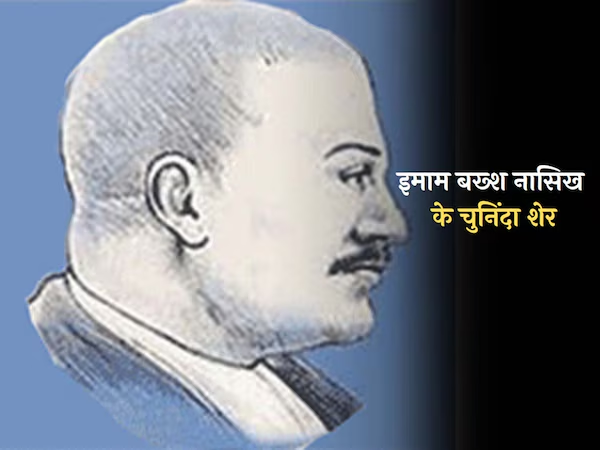
Imam Bakhsh Nasikh was a poet of the Mughal period. He played a significant role in the development of Urdu poetry and couplets.
Imam Bakhsh Nasikh Hindi Shayari:
Imam Bakhsh Nasikh was an Urdu poet of the Mughal Empire. He was born on April 10, 1772, in Faizabad, Uttar Pradesh.
He is considered the founder of the Lucknow school of poetry. Nasikh’s father died. He was adopted by Khudabakhsh, a wealthy merchant. He received a good education. Later, he also became the heir to Khudabakhsh’s estate. Nasikh rejected the offer of the Nawab of Awadh. After this, he was forced to leave Lucknow. After a few days, he returned to Lucknow. He died in Lucknow on August 16, 1839.
He never forgets me from his heart,
I have seen him forget in a hundred ways.
What can be achieved by any means, man is helpless due to fate
You always kept delaying your arrival,
I kept leaving and you kept coming with all your heart.
He never forgets me wherever I go,
oh what should I do, where should I go
I cannot show my face to you out of shame,
that is why my back is towards the sun.
Let others’ work continue and we fail,
what is our work in your government now?
My friend’s sword is killing me,
it is the sword of swords, the speed of speed.
It is foolish to search for anything,
whatever is written on the forehead will have to happen.
Life is the name of the lively,
the dead live on nothing.
I don’t take his name out of jealousy, lest someone hears it,
I remember him in my heart.
No one’s face matches yours,
I roam around the world with your picture.
You imprisoned me in your hair and killed me with your eyebrows,
you did not listen to anything my heart said.
He who says that fate is wrong is himself wrong,
sometimes even the writing of fate may be wrong.
How can I suddenly give up the thought of your hair,
these black snakes have been kept for a long time.
He is visible to me,
I am not visible to him in the dark at night.
Though I don’t meet you, but due to the demands of my heart,
I come to your street a hundred times every day.
Even after death I fear you so much
I have not even raised my eyes to see any houris in heaven.
source: http://www.zeenews.india.com / Zee News / Home> ZeeSalaam> ZeeSalaam News / by Siraj Mahi / July 17th, 2023
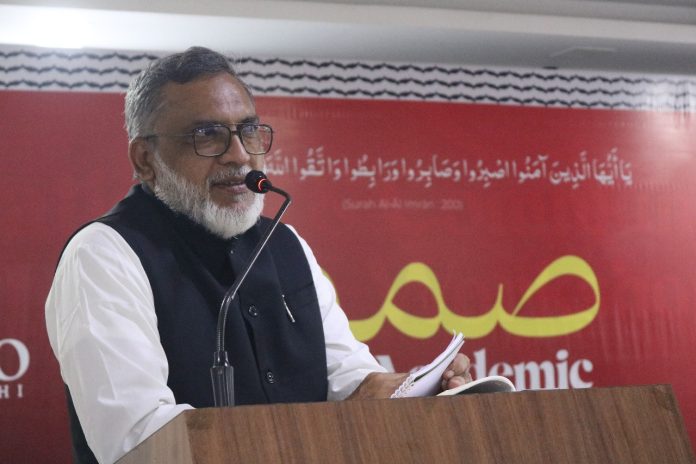
Malik Moatasim Khan, Vice President, JIH, addressing the Sumud Academic Conference organised by SIO Delhi Zone
New Delhi:
The Students Islamic Organisation of India (SIO), Delhi Zone, organised the Sumud Academic Conference at Jamaat-e-Islami Hind headquarters, bringing together over 100 students and scholars from Delhi University, Jamia Millia Islamia, Jamia Hamdard, and other institutions across the region.
The daylong event, themed “Reminding Muslim Students to Re-evaluate, Reimagine and Reconstruct Campuses,” featured paper presentations, panel discussions, and keynote addresses. Speakers focused on contemporary challenges faced by Muslim students, particularly issues of identity, saffronisation, and the growing privatisation of higher education.
Prominent speakers included Malik Moatasim Khan, Vice President, JIH; Dr. Roshan Mohiuddin, National Secretary, SIO India; Dr. Khan Yasir, Faculty, IISR; Hammad Yasir, independent researcher; Mohd. Alfauz, Doctoral Fellow, JMI; and Fawaz Shaheen, Lawyer & Researcher, among others.
In his address, Malik Moatasim Khan spoke on “The Idea of a University Under Siege: Privatisation and Saffronisation in Indian Education,” stressing that while privatisation has some positive aspects, its negative impacts are far more serious, whereas saffronisation poses an unmitigated threat to education.
Dr. Khan Yasir, Faculty, IISR (C) addressing the Sumud Academic Conference organised by SIO Delhi Zone
Dr. Khan Yasir, in his session “From Campus to Ummah,” argued that students should rethink education as more than a pursuit of employment, urging them to explore knowledge and alternative models of livelihood beyond the narrow frame of job-seeking.
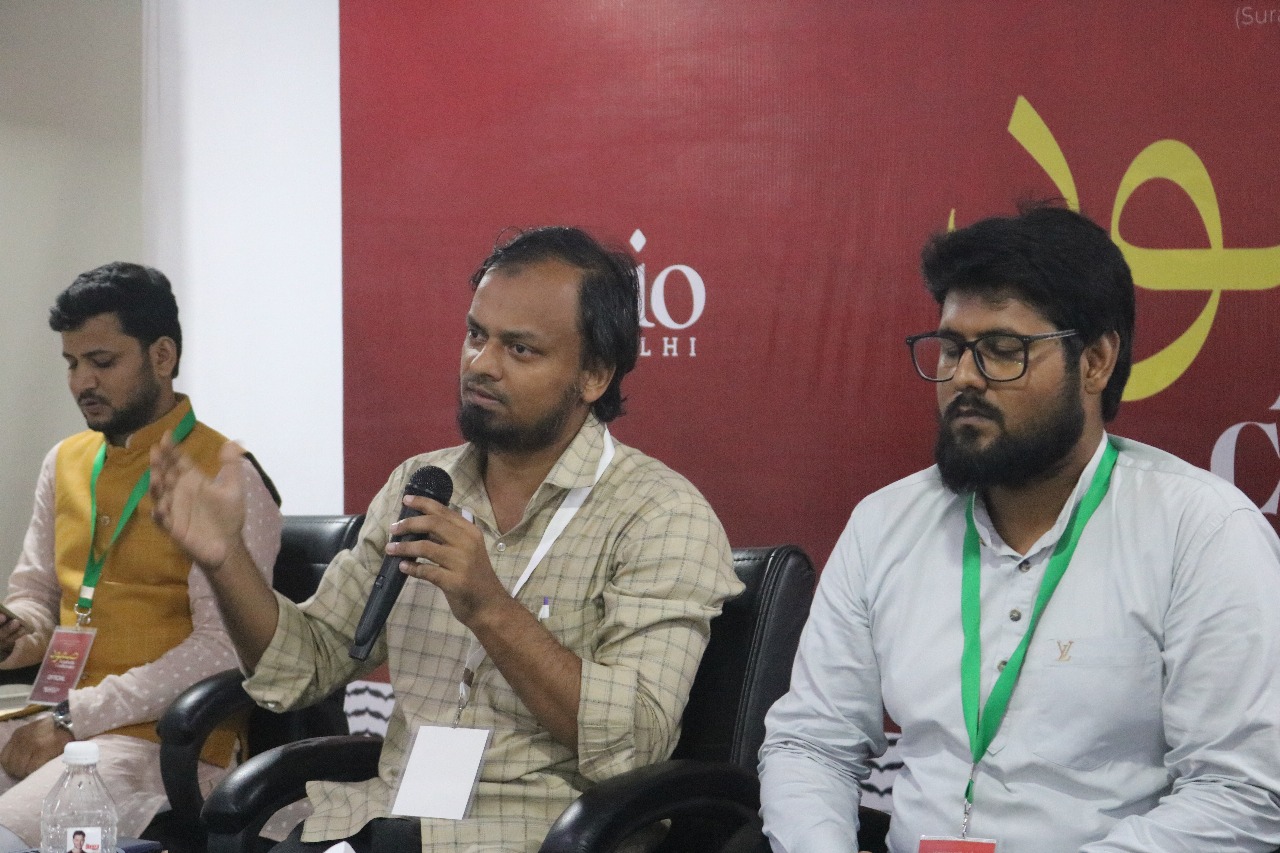
A panel discussion titled “Faith in Flux: Navigating Identity in the Modern Campus” featured Dr. Roshan Mohiuddin, Fawaz Shaheen, and Mohd. Alfauz, with an interactive Q&A and open-floor session encouraging student participation.
A view of the audience
Paper presentations formed another highlight, with young researchers presenting their work under the review of Hammad Yasir. Topics ranged from navigating identity and the role of students in shaping intellectual futures, to the broader challenges of “universities under siege.”
The conference underscored sumud – steadfastness and perseverance – as a guiding principle for Muslim students to confront academic and political pressures while upholding democratic and secular values. Organisers emphasised that the event was not only about imparting knowledge but also about integrating student perspectives into the broader discourse.
Concluding the event, SIO Delhi Zone described the conference as a vital platform to prepare students for the realities of campus life, urging them to remain resilient in the face of rising challenges.
source: http://www.radiancenews.com / Radiance News / Home> Education> Latest News> Report / by Radiance News Bureau / September 25th, 2025
Alam died after a cardiac arrest at a private hospital in Mohali; last rites at Sirhind on Wednesday.
Mohd Izhar Alam, a former DGP, prisons, of Punjab Police, was inducted into the Shiromani Akali Dal after his retirement. His wife, Farzana Nissara Khatoon, is a former SAD MLA from Malerkotla. (HT file photo)
Mohammad Izhar Alam, 73, a former director general of police, prisons, died after a cardiac arrest at a private hospital in Mohali on Tuesday.
He is survived by wife Farzana Nissara Khatoon, a former Shiromani Akali Dal MLA from Malerkotla, three sons and two daughters.
The 1972-batch Indian Police Service officer was a Padma Shri awardee.
He had a controversial stint during the decade of militancy in Punjab.
Despite opposition, former chief minister Parkash Singh Badal inducted Alam into the SAD on November 18, 2009, and appointed him chairman of the Punjab Wakf Board.
In the 2012 assembly elections, Farzana won the Malerkotla seat on the SAD ticket, defeating Razia Sultana of the Congress.
Chief minister Captain Amarinder Singh also mourned the former DGP’s death.
The last rites will be performed in Sirhind on Wednesday.
source: http://www.hindustantimes.com / Hindustan Times / Home / by HT Correspondent / July 06th, 2021
Muslim-majority Malerkotla has been declared as the 23rd district of the state, with the Punjab government fulfilling a decade-long demand of its residents.
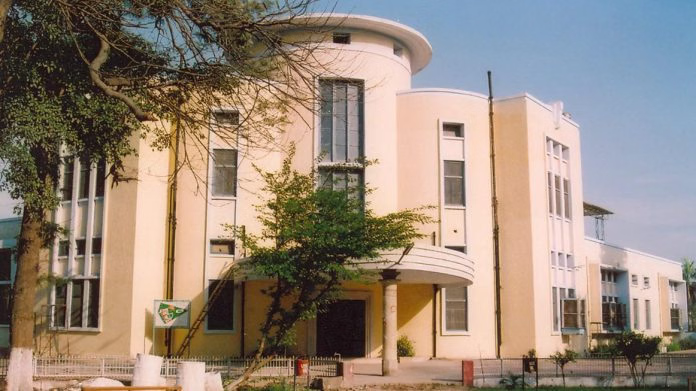
The government college in Malerkotla | Wikimedia commons
Chandigarh:
On the occasion of Eid-ul-Fitr Friday, Punjab Chief Minister Captain Amarinder Singh declared the Muslim-majority Malerkotla as the 23rd district of the state, while announcing a slew of projects for the development of the historic city.
The move fulfils an at least decade-old demand in Malerkotla and a promise that the ruling Congress had made in its manifesto ahead of the 2017 assembly elections.
Punjab’s decision, however, hasn’t gone down well with the BJP, particularly Uttar Pradesh Chief Minister Yogi Adityanath.
Adityanath tweeted Saturday that the move was “proof of the Congress’ divisive politics”.
“Any distinction on the basis of religion is contrary to the basic spirit of the Constitution of India,” the Uttar Pradesh CM said. “Presently, the formation of Malerkotla (Punjab) is a reflection of the divisive policy of the Congress.”
मत और मजहब के आधार पर किसी प्रकार का विभेद भारत के संविधान की मूल भावना के विपरीत है।
इस समय, मलेरकोटला (पंजाब) का गठन किया जाना कांग्रेस की विभाजनकारी नीति का परिचायक है।
Tarun Chugh, the BJP’s national secretary from Punjab, weighed in, saying the decision was clearly “communal” and that it was for the first time in the history of Punjab that an administrative decision was taken to further communal interests.
None of these charges, however, will find any resonance in Punjab, where Sikhs and Malerkotla’s Muslims share historically harmonious ties. So entrenched is this solidarity, that the Muslim-majority region saw no violence even as the rest of Punjab went up in flames during Partition in 1947.
The Punjab chief minister even alluded to this while responding to his UP counterpart.
“What does he (Yogi Adityanath) know of Punjab’s ethos or the history of Malerkotla, whose relationship with Sikhism and its Gurus is known to every Punjabi? And what does he understand of the Indian Constitution, which is being brazenly trampled every day by his own government in UP?” Amarinder asked in a statement issued Saturday evening.
A 300-year-old legacy
Punjab Sikhs’ reverence for the Muslims of Malerkotla dates back chiefly to one singular event in history.
According to Anna Bigelow, associate professor of Islamic Studies in the Department of Religious Studies at Stanford University, the Nawab of Malerkotla, Sher Muhammad Khan, had in 1705 opposed the death penalty handed out to nine-year-old Baba Zorawar Singh and seven-year-old Baba Fateh Singh — the sons of Guru Gobind Singh, the 10th Sikh Guru.
Bigelow, who has researched Malerkotla’s history, writes that despite Khan’s protests, the then Mughal governor of Sirhind, Wazir Khan, bricked alive the two children.
The Malerkotla nawab’s defiance, referred to as “ha da naara (cry for justice), however, earned him the respect and adoration of Sikhs.
“Guru Gobind Singhji blessed Sher Muhammad Khan and ever since Malerkotla has become an icon of Sikh-Muslim brotherhood,” said the Shiromani Akali Dal (SAD) general secretary Dr Daljeet Singh Cheema. “Even during Partition, this town remained completely peaceful.”
The new district will also have a government medical college in the name of Nawab Sher Muhammad Khan.
The Opposition SAD has backed Chief Minister Amarinder, with Cheema issuing a statement that Adityanath’s tweet was in bad taste and symbolic of his complete lack of historical knowledge about Malerkotla town and its significance for Sikhs.
“Malerkotla town is a unique example of Sikh-Muslim communal harmony that has lasted for over 300 years,” Cheema said.
A Muslim-majority region
Malerkotla was part of a jagir of several villages that the then Delhi Sultan Behlol Lodhi granted as dowry to the Afghani Sufi Saint Sheikh Sadruddin-i-Jahan (also called Haider Sheikh) in 1454.
According to Bigelow, the original settlement was called “Maler” and it remains the name of the neighbourhood surrounding the Sheikh’s tomb.
Following the advent of Mughal rule in India, the descendants of the Sheikh became the nawabs of Malerkotla.
Bigelow writes that Kotla came to be in 1657 when Mughal emperor Aurangzeb granted permission to Bayazid Khan, the first ruler of Malerkotla, to build a fortified city.
Bigelow also states that during British rule, Malerkotla was as turbulent as the other smaller principalities of the time, marked by infighting and ever-changing loyalties. The last ruler of Malerkotla was Nawab Iftikhar Ali Khan.
During Partition in 1947, Malerkotla remained absolutely peaceful and when the princely state merged with India, Iftikhar Ali Khan was its first chief minister.
Malerkotla was later merged with other princely states of the region to form the Patiala and East Punjab States Union (PEPSU). During the reorganisation of states in 1956, Malerkotla became a part of Punjab.
Modern-day Malerkotla
With almost 70 per cent of its population comprising Muslims, the Malerkotla assembly constituency has always been represented by a Muslim.
Nawab Iftikhar Ali Khan served as MLA twice while his second wife Begum Yusuf Zamani and fourth wife Begum Sajida were legislators as well. All of them were part of the Congress party.
The Malerkotla seat has, in the last few decades, been alternating between the Congress and the Akali Dal.
Razia Sultana, the current Congress MLA from Malerkotla, is representing the constituency for the third time (2002, 2007 and 2017). She is the wife of former Punjab DGP Mohammad Mustafa. In 2012, however, Farsana Alam, the wife of another IPS officer, Izhar Alam, was elected as the Akali MLA from here.
The constituency’s politics has not been without its intrigue. In 1981, the last nawab divorced Sajida Begum. She then went on to marry Anwar Ahmed Khan of the Shiromani Akali Dal, against whom she had fought multiple elections.
The nawab died in 1982 and Sajida Begum in 2006. The legacy of the last nawab continues as an ugly family litigation for property and palaces.
On Friday, Chief Minister Amarinder Singh, himself the scion of the Patiala royal family, recalled his ties to the last nawab of Malerkotla, whom he fondly called Chachaji (Uncle) and who he said lovingly addressed him Bhateej (nephew).
Amarinder also said he had written to the Aga Khan Foundation to undertake conservation and restoration of Mubarak Manzil Palace, occupied by Begum Sahiba Munawwar ul-Nisa, the wife of the last nawab.
The Punjab government, the chief minister said, has acquired the Mubarak Manzil Palace, adding that “its restoration and upkeep would be a fitting tribute to the nawabs of Malerkotla”.
A decade-long demand
The demand for district-hood is not new.
Malerkotla falls on the Ludhiana-Sangrur road and is part of Sangrur district. It’s almost equidistant from the district headquarters of Ludhiana and Sangrur and for every administrative work residents had to go to Sangrur, which is over 40 km away.
The town is full of small steel units and is specially known for manufacturing badges and uniforms.
The Congress’ manifesto had also promised district status for Malerkotla.
According to the government’s order Friday, the subdivisions of Malerkotla and Ahmedgarh, as well as the sub-tehsil of Amargarh, would be included in the newly-created district. The process of bringing villages under the jurisdiction of Malerkotla district would begin later, after the conclusion of the census operations, the order said.
The chief minister has also directed the Sangrur deputy commissioner to find a suitable building to immediately start the functioning of the district administration office. The deputy commissioner for the newly-carved district would be appointed soon.
(Edited by Arun Prashanth)
source: http://www.theprint.in / The Print / Home> India / by Chitleen K Sethi / May 16th, 2021
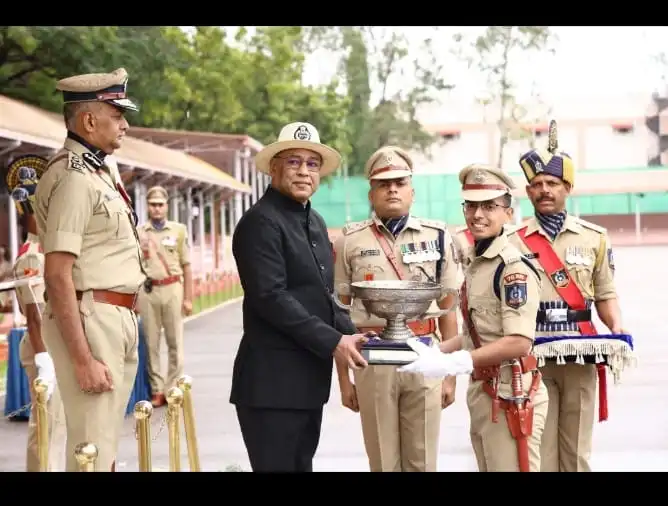
In a prestigious recognition of intellectual depth and commitment to the ideals of unity and peace, Dr. Syed Mustafa Hashmi, IPS (P), a probationer from the 76th Regular Recruit (RR) batch borne on the Jharkhand cadre, has been awarded the Ministry of Home Affairs Trophy for the Best Essay on the theme “Communal Harmony and National Integration”.
His essay stood out among numerous entries submitted by IPS probationers across the country for its clarity, depth of analysis, and strong articulation of inclusive governance.
Securing the second prize in the same category was Anna Sinha, IPS (P), also from the 76 RR batch, who is borne on the AGMUT cadre. Her essay was lauded for its innovative approach and empathetic insights into India’s diverse societal fabric.
The awards were presented during the Valedictory Parade of Phase II training of the 76 RR IPS Probationers at the Sardar Vallabhbhai Patel National Police Academy (SVPNPA) in Hyderabad.
The ceremony marks the culmination of their intensive training that spanned law enforcement tactics, ethical policing, public service delivery, and nation-building.
The Director of SVPNPA, senior IPS officers, and faculty members were present during the function, which also included a ceremonial parade by the probationers — a symbol of their readiness to join the ranks of the Indian Police Service and serve the nation with integrity and valor.
This year’s training cohort included a diverse group of young officers from across India, representing various states and social backgrounds.
Their training included exposure to modern policing challenges such as cybercrime, terrorism, social media monitoring, community policing, and strategies to foster communal harmony and inclusive development.
Home Ministry’s Essay Competition: A Platform for Thought Leadership
The Ministry of Home Affairs Essay Competition is an annual initiative that encourages future IPS officers to reflect on themes central to India’s national unity. By promoting intellectual discourse on critical social issues, it aims to create a cadre of officers who are not only efficient administrators but also thought leaders in promoting harmony, justice, and inclusive governance.
Dr. Hashmi, who has a background in medicine prior to joining the IPS, emphasized in his essay the role of empathetic policing, grassroots engagement, and inclusive policymaking as tools to bridge communal divides.
He has been praised for blending scholarly analysis with practical insights drawn from his field experiences during training.-
Anna Sinha, in her essay, highlighted the role of women in peace building and the need for greater representation and sensitivity in community policing. Her perspectives reflected a balanced understanding of law enforcement challenges and the human dimension of national integration.
A Pledge to Serve
The valedictory function ended with the probationers taking a solemn oath to uphold the Constitution, maintain law and order, and serve with dedication, impartiality, and compassion. The entire 76 RR batch is now set to report to their respective cadres and districts, where they will begin their real-world policing assignments as Assistant Superintendents of Police (ASPs).
As they embark on their careers, recognitions like the Home Ministry Essay Trophy serve as a reminder of the intellectual and moral leadership expected from the IPS — to not only enforce law, but also to be torchbearers of national unity and harmony.
source: http://www.uditvani.in / Udit Vani, English News / Home / July 25th, 2025
Raziya Sultana, wife of a top cop and third time MLA, is the only Muslim legislator in the 117-member Punjab Assembly]
Malerkotla (Punjab):
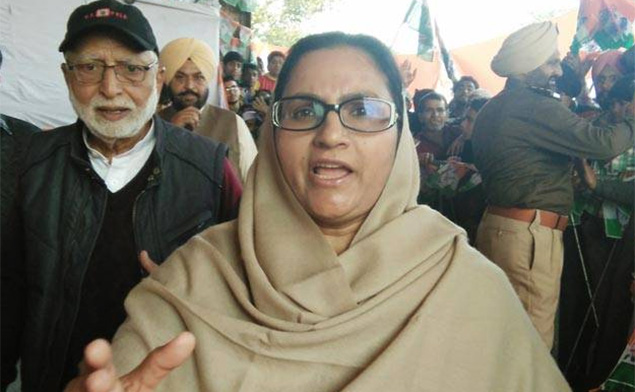
Raziya Sultana, wife of a top cop and third time MLA, is the only Muslim legislator in the 117-member Punjab Assembly. Congress is set to form its government in the state, and Raziya Sultana as one of the seniormost members in the party, eyes for a key post in the government.
Raziya Sultana, who contested the 2017 Punjab Assembly elections as Congress candidate, defeated her nearest rival Mohammad Owais of Akali Dal by over 12,000 votes. Raziya Sultana is wife of Mohammad Mustafa DGP Punjab who was bestowed with with five gallantry medals.
According to the final result of Punjab Assembly elections declared by the State Election Commission, Raziya Sultana polled a total of 58.982 votes whereas Mohammad Owais could bag just 46,280 votes.
Mohammad Arshad contesting from Malerkotla was the only Muslim candidate of the Aam Aadmi Party (AAP). Mohammad Arshad came a distant third bagging 17,635 votes.
Raziya Sultana was defeated by F. Nesara Khatoon (Farzana Alam) of Akali Dal in the 2012 elections in Malerkotla – the seat she won in 2002 and 2007.
Malerkotla has been represented by Muslims most of the time since 1957. Yusuf Zaman Begum was the first Muslim to win from Malerkotla in 1962. She was followed by H. H. N. I. A. Khan in 1967, Nawab Iftikhar Ali Khan in 1969, Sajida Begum in 1972 and 1980, Anwar Ahmad Khan in 1977, Nusrat Ali Khan in 1985 and 1997 and Abdul Ghaffar in 1992 state elections.
The Punjab Assembly had 02 Muslim MLAs in 2012. Besides, F. Nesara Khatoon (Farzana Alam) of Akali Dal who won from Malerkotla in 2012, Mohammad Sadique of the Congress won from Bhadaur Assembly seat in 2012.
Congress MLA Mohammad Sadique contested the 2017 elections from Jaito Assembly seat. But, he lost the elections to Baldev Singh of the Aam Aadmi Party (AAP) by some 10,000 votes. Baldev Singh polled 45,344 votes and Mohammad Sadique bagged 35,351 votes.
In Qadia, hub of Ahmadiyas, Fatehjang Singh Bajwa of Aam Aadmi Party (AAP) won the elections. No muslim candidate was in fray in this constituency.
Congress has fielded 02 Muslim candidates in 2017 Punjab Assembly elections, Aam Aadmi Party (AAP) and Akali Dali has given party ticket to 01 Muslim each. The BJP has not fielded any Muslim in the 2017 state elections
Overall, the Congress has won 77 of the total 117 seats of the Punjab Assembly. AAP is a distant second with 20 seats.
Akali Dal and BJP, ruling the state since last ten years, ended with 15 and 03 seats respectively. Lok Insaaf Party won 02 seats.
source: http://www.ummid.com / Ummid.com / Home> Politics / by ummid.com & Agencies / March 13th, 2017
This unusual sight is the heart of Slums to Oxford, a movement built on the belief that learning has no age or boundary.
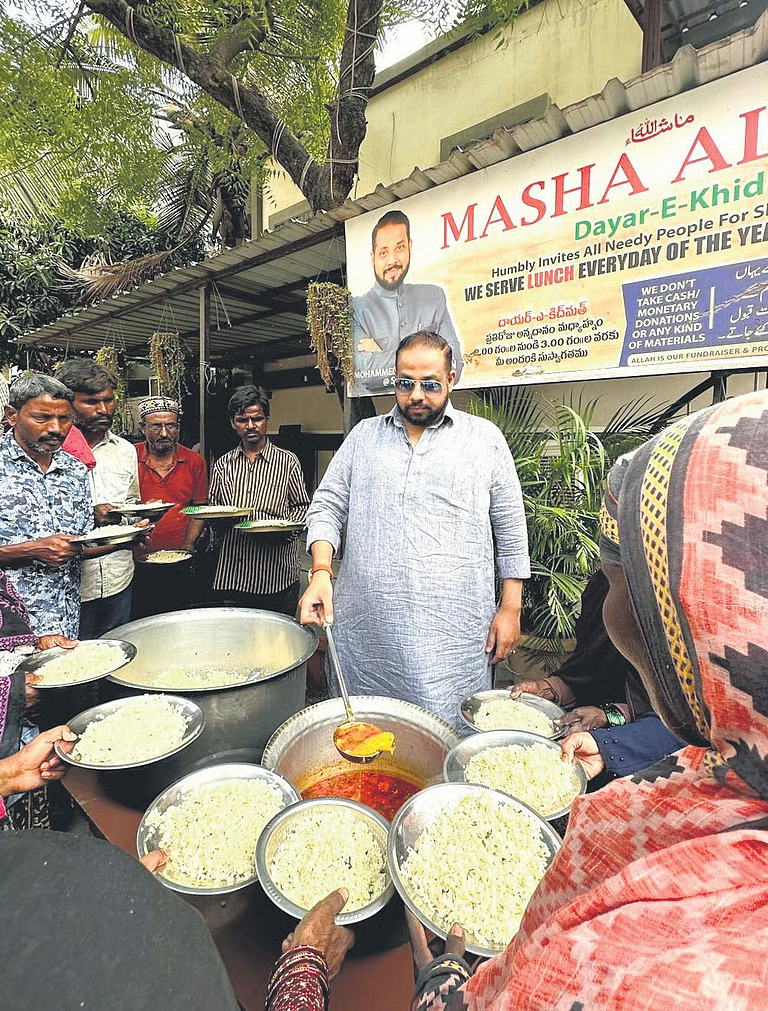
For 15 years — 5,748 days without a break — Mohammed Asif Hussain Sohail’s team has served free lunch in low-income neighbourhoods across Hyderabad.Photo | special arrangement
Hyderabad :
Every evening, in the narrow lanes of the city’s slums, classrooms stir to life. But these are not filled with children alone. A 78-year-old grandmother grips a pencil for the first time, vegetable vendors practise alphabets after long hours at the market and daily wage workers sit shoulder to shoulder, determined to read, write and count.
This unusual sight is the heart of Slums to Oxford, a movement built on the belief that learning has no age or boundary. Its founder, Mohammed Asif Hussain Sohail, tells TNIE that when elderly people take up education, they inspire children and grandchildren to follow.
Across three evening schools, more than 1,000 learners aged between eight and 80 are rewriting their destinies. Lessons go beyond alphabets and numbers to address social realities — domestic violence, human trafficking and drug abuse, among others — while also offering vocational training, particularly for women.
But education is only one part of Sohail’s mission. For 15 years — 5,748 days without a break — his team has served free lunch in low-income neighbourhoods across Hyderabad. What began with 50 plates has grown into thousands each day, cooked in community kitchens. For abandoned elders, the homeless or those battling addiction, these meals provide not just sustenance but also a path into rehabilitation and work opportunities. “Food is beyond caste or religion,” Sohail says. “It is humanity’s need.”
Healthcare, too, is central to his vision of community care. Monthly blood donation drives collect 300-400 units for hospitals. Families struggling with groceries, children needing surgeries and individuals seeking rehabilitation often find support at his centres. For many, these classrooms and kitchens have become places of dignity and trust.
This journey began not as an organisation but in personal grief. Fifteen years ago, Sohail lost his young daughter, Sakina, to pneumonia and organ failure. At the time, he was pursuing a political career. But tragedy changed everything. He left politics to build a living legacy in her memory. “God took one daughter from me, but he gave me thousands more,” he says softly. “Till my last breath, I will serve the needy and be the voice of the voiceless. This is what I learned from my parents.”
In her name, he founded the Sakina Foundation, which has since become a lifeline for many. Over the years, it has served free meals to more than 40 lakh underprivileged people, contributed over 15,000 units of blood, supported lakhs with rations, medical treatment and school fees, and organised over 111 medical and blood donation camps. Through Slums to Oxford learning and skill centres, thousands of children and adults have gained education and vocational training.
Beyond the recognition
Though honoured with state, national and international awards, Sohail remains unaffected. “I am not working for awards,” he says. “My reward comes from the Creator.”
He does not accept donations either, believing his responsibility is to spend from what he earns. “Whatever I have is given by the Almighty. I am not going to take anything back.”
From abandoned elders finally learning to write their names, to children enrolling in schools, to families depending on a daily meal, Sohail’s initiatives weave threads of hope into Hyderabad’s urban fabric. His vision remains simple but profound: “The person who stays in a slum should have the chance to reach Oxford.”
source: http://www.newindianexpress.com / The New Indian Express / Home> Good News / by Khyati Shah / September 28th, 2025
Tilak Varma from Dubai stadium and a Young Tilak with his coach Mohammad Salam Bayash (Right)
New Delhi :
Indian cricket’s latest hero, Tilak Varma, whose unbeaten 69 against Pakistan clinched the Asia Cup for India in Dubai, owes his career to his coach and mentor Mohammad Salam Bayash, who spotted and supported him all through his training to his rise as a star.
The 14-year relationship began when Tilak joined a summer camp of Salam Bayash in Hyderabad. He played on a dusty ground with a tennis ball when Salam spotted him. He told his father, Namboori Nagaraju, an electrician by profession, that his son was immensely talented and that he must join a cricket academy.
Nagaraju told him that he realizes his son is extraordinary, but given his financial condition, he can’t even afford to buy him a proper kit, let alone join a cricket coaching academy.
Tilak Varma and Mohammad Salam Bayash in different years of their association
Bayash took a young Tilak under his wings. Not only did he waive all his coaching fees, but he also took responsibility for the transport. Bayash would ride his bike 40 kilometers every day to pick up Tilak at 5 am to travel to the academy in Lingampalli.
Within a year, and with Bayash’s guidance, his family shifted closer to Lingampalli. A hard taskmaster, Bayash told Tilak that he would reward him with a cricket kit only after he performed. Tilak did not disappoint him and won his first cricket kit.
Bayash told the media in an earlier interview, “Tilak Verma came to me in 2011 when he joined a summer camp. He is very hard working; has a lot of patience, follows instructions meticulously, and has a good mind,” Bayash told the media in an older interview.
When Tilak arrived from Dubai to a rousing reception in Hyderabad, he was always seen with his coach and mentor, ‘Salam sahib’.
Tilak played the Ranji trophy at the age of 16 when he was in the Hyderabad team.
Recalling Tilak Verma’s early days, Bayash says, “I first gave him basic training, and after the third month, he entered a local match. He immediately stood out with his temperament and technique. He would practice for hours and happily skip family functions to come to net sessions. His discipline was amazing. He never missed a net session. We, the guru and the disciple, would travel around the city on motorcycles for matches. Even today, he meets all the boys and the staff with great love and gentleness. Success did not make him complacent.
“Tilak called me before the match. I only told him to stay at the crease till the end. I am happy that he did that, and today he has emerged as a hero. I am not surprised at his temperament because even at a young age, he used to bat for hours during net practice.”
He says that after the victory against Pakistan, he made a video call from Dubai International Stadium, the venue of the Asia Cup. He spoke to everyone in my family. His father, Nagaraju, and mother, Gayatri, are on a religious journey to Nepal. Earlier, people used to call him ‘Baish ka bolaga’, today I am happy that people know me as ‘Tilak ka coach’.
A major fillip to his career came in 2022 IPL auction when the Mumbai Indians bought him for a whopping 1.7 crore.
Born as Namboori Thakur Tilak Varma on November 8, 2002, in Hyderabad, Telangana, Tilak grew up in a modest Telugu household.
Despite financial struggles, the family rallied behind Tilak’s passion for cricket. His parents often went out of their way to support his budding career, even when resources were scarce. Tilak never forgets to credit his coach and parents for his success.
Tilak’s international debut came in 2023 against New Zealand when he top-scored for India on debut and later registered his half-century, becoming the second Indian to reach the milestone in T20Is. By the end of the series, he was India’s top scorer.
However, his most memorable innings came at Dubai, where he turned around the finals of the Asia Cup for India by scoring an unbeaten 69 amid a crisis situation for India.
source: http://www.awazthevoice.in / Awaz, The Voice / Home> Stories / by ATV / October 01st, 2025
Clothed in layers of legend and folklore, Fatehpur Sikri, the city that Akbar built and made his capital, was an architectural marvel of medieval India. A journey back in time to explore its real historical importance.
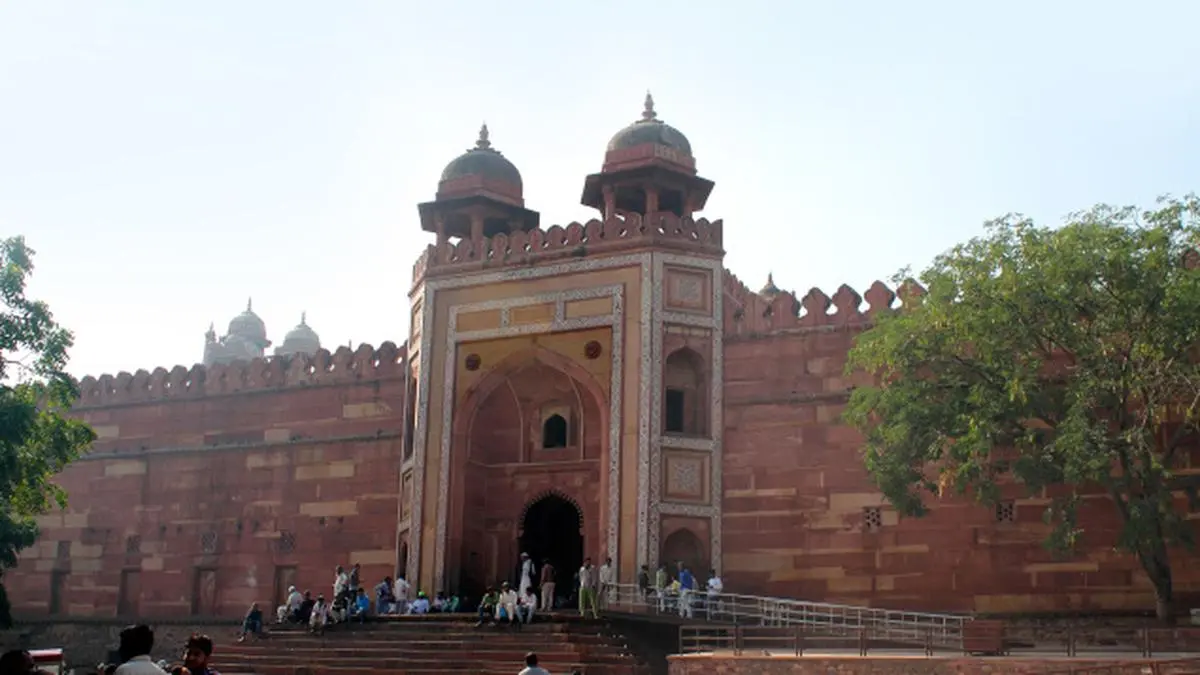
The Badshahi Darwaza through which Akbar entered the Masjid-Dargah complex.
LOCATED around 35 kilometres from Agra, the famous capital of the Mughals, and about 30 kilometres from Bharatpur, the heartland of the Jats, is one of the finest cities of medieval India, Fatehpur Sikri. Nestled on a ridge of the Vindhya mountain range, it represents a unique architectural experiment of the Mughals. Declared a World Heritage Site in 1986, it remains frozen in time and space. In its majesty and grandeur, Sikri is perhaps second to none, but it has always lived in the shadows of its world-famous neighbour, the Taj Mahal.
Connected with the life and times of the famous Mughal emperor Akbar and a crucial period in Indian history, Fatehpur Sikri is of great historical importance but remains one of the less-understood heritage complexes. The popular understandings of the site (and connected histories) are largely informed by guide culture and folk narratives. Some questions continue to haunt visitors. Why was the city built and abandoned within a span of just 14 years? Who was Jodha Bai? Did the Navratnas (“Nine Jewels”, talented and famed courtiers at Akbar’s court) really exist in an institutionalised form? Did the city decline because of shortage of water?
One area where the huge gap between the academic and popular understanding of the site gets reflected starkly is in the nomenclature and functionality of monuments. The nomenclature of the structures is informed by the occurrence of “matching”/“near matching” descriptions of events/anecdotes connected with Akbar in contemporary accounts—principally by Abul Fazl, Badauni and the Portuguese Jesuit missionary Monserrate. Archaeological findings and Mughal paintings also help us reconstruct the history of individual monuments. Two things complicate our understanding of the city and the monument complex. First, as the historian and expert on the site Nadeem Rezavi points out, the names of the structures on plaques put up by the administration are mostly taken from tourist guides of the 19th century who were often local residents with no professional training in archaeology or history. Second, the original architectural designs have, in some cases, been demolished or altered in the process of renovation and restoration.
Early History Though the city was built during Akbar’s time, the place has a history going further back in time. Archaeological findings from the region include painted grey ware sherds, beads and artefacts belonging to the Kushana and Sunga periods, besides pre-medieval rock shelters. A large number of Jaina sculptures (including one Shruti Sarasvati) were excavated around Birchhabili Tila on the eastern bank of the lake in 1999-2000. Sikri and Bayana came under the control of the Sikarwar Rajputs in the 12th century and there is evidence of fortifications built by them. According to one tradition, the word “sikri” comes from them. The region was subsequently taken over by the Delhi Sultans and the remains of mosques and tombs testify to the site being a flourishing township during the Sultanate period. The Mughal connection comes with Babar, who defeated Rana Sangram Singh at the Battle of Khanwa (located 16 km from Sikri). According to legend, he renamed the place “Shukri” (meaning “thanks”) to acknowledge the support of the local populace during the battle. It is said that after capturing Gujarat, Babar’s grandson Akbar built the commemorative monumental gateway called Buland Darwaza (The Lofty Gate) and changed the name from Sikri to Fatehpur, the “City of Victory”. Rezavi, however, prefers to call it Fathpur Sikri, connecting its nomenclature to the garden named Bagh-i Fath (The Garden of Victory) built by Babar. He says this connection later inspired Akbar to rename the area Fathpur or Fathabad.
According to chronicles, Akbar’s decision to build an imperial city was largely based on his reverence for Shaikh Salim Chishti, who had predicted that the heirless emperor would be blessed with three sons. Akbar shifted his pregnant queen to Sikri and later ordered the construction of the city. It is believed that the Rangamahal (which is now closed) was the place where the queen first resided. Under Akbar, this village became the cultural, commercial, and administrative centre of the empire. It is estimated that around 1580, the total population of this city was just short of a quarter million. Ralph Fitch, the English traveller who visited the city around 1585, wrote: “Agra and Fatehpore are two very great cities, either of them much greater than London and very populous.”
Situated strategically close to Agra Fort (located within a day’s march), the town was enclosed with walls, some 6 km long, from north to south-west and protected by a lake (now dry) on the western side. The planning of the city aligned with the contours of the ridge. The mosques, imperial palaces and offices, bureaucratic establishments, and nobles’ mansions were located on top of the ridge. The civic population and the gardens were located around the official zone below the ridge. Access to the city was controlled by a series of eight identical gates (prominent being the Agra and Ajmer Gates) which restricted movement from public spaces into imperial zones.
The Imperial Complex According to Monserrate, the imperial complex consisted of four great royal dwellings—the king’s palace, the palace of the queens, the princes’ quarters and a store house and magazine. The king’s palace, generally known as Daulatkhana (“Abode of Fortune”), was divided into the Daulatkhana-i-Khas (private/restricted space) and the Daulatkhana-i-Aam or the Diwan-i-Aam (Hall of General Audience).
The Diwan-i-Aam is possibly the place Abul Fazl describes as the site of an open court which lasted for four hours. The structure, as it stands now, consists of an extensive courtyard enclosed by cloisters of 114 bays and a centralised raised pavilion. Entry was through the northern gateway opening towards the Hauz-i-Shirin (Sweet Tank) and further to the Hathi Pol, the ceremonial entrance to the imperial complex. The original plan stands modified now, with the addition of a municipal-style garden and the creation of an opening in the wall of the courtyard for visitors entering from the Agra Gate side. The huge stone rings at the foot of the colonnade opposite the imperial pavilion were possibly used for inspection of animals from the royal stable or exhibiting captured war elephants rather than publicly trampling those condemned to death as the guides would say.
The Daulatkhana-i-Khas consists of the Diwan-i-Khas, the two-roomed Diwankhana-i-Khas, the Khwabgah, the Anup Talao, the Turkish Sultana’s Chamber and some minor structures. The Diwan-i-Khas, or “Jewel House”, is a square-shaped chamber with openings on all four sides. The interior has a richly carved pillar at the centre supporting a circular platform connected with four diagonal bridges emanating from four cardinal directions. This is a monument whose functionality is difficult to establish. Historians and scholars have variously identified it as a storehouse for imperial gems and jewels, with the emperor inspecting them from the suspended capital (S.A.A. Rizvi); a place where the emperor, enthroned in the central circular platform, listened to ministers seated at the corners (Y.D. Sharma) or to arguments from different religions—symbolising “Akbar’s Dominion over the Four Quarters” (Percy Brown); or, symbolically, of Akbar ceremonially occupying the axis of the world (represented by the column) in Hindu cosmology and, therefore, wielding supreme power (G.H.R. Tilotsan). Still others have tried to symbolically equate the emperor with a chakravartin sitting or a God-like Vishnu seated on a lotus, or like the sun domineering over all regions (Catherine Asher).
Next to the Jewel House is the so-called Aankh Michauli (literally, “blind man’s buff”—by implication, a place where Akbar played this game with the women of the harem), or the treasury, containing three large aiwan s (porticos). Like the Jewel House, this building also has concealed coffers and lockable doors in the thick walls. Historians have suggested that this was a part of the treasury where gold and silver coins were stored, while the copper coins were kept in the building behind this one which collapsed in 1894. To the south-west of the treasury stands a kiosk known as the “Astrologer’s Seat” modelled on a Cambay-style building, according to the art historian Ebba Koch. This was possibly the site from where the emperor watched the distribution of copper coins to subordinate officers and the needy.
The large red sandstone courtyard between the Diwan-i-Khas and the Anup Talao is known as the Pachisi—after the cruciform board on which this popular Indian board game was played. Local legend has it that the emperor played the game using slave girls as living pieces.
The Diwankhana-i-Khas, containing Akbar’s imperial chambers (Khalwatkada-i-Khas) and resting place (Khwabgah), was a restricted area. The Khalwatkada-i-Khas was also a place where learned discussions and, sometimes, official transactions took place. It had a projecting balcony where the emperor received royal guests such as Mirza Sulaiman of Badakshan. The lower walls of the rooms were hollow with sliding stone panels and were probably used to keep rare books and gifts. A large room behind this chamber contained a platform against the southern wall, with a window above it. Some historians think that the window was used for a practice Akbar instituted at Sikri—Jharokha Darshan, whereby the emperor showed himself to his subjects every day.
The Khwabgah is a beautiful chamber on the first floor of the Diwankhana-i-Khas. This is the place where Akbar rested and also had informal discussions. Badauni narrates the story of a Brahman named Devi who used to be pulled up on a charpai (traditional Indian cot) to instruct the emperor in the myths and legends of Hinduism. A cloistered passage from the west connected the Khwabgah with the principal Haramsara, the Panchmahal, “Mariam House” and the Hathi Pol. This offered a secret and unhindered passage to the emperor and the royal ladies from one palace to another.
The Anup Talao (literally “peerless pool”) has a central island linked by four bridges to its sides. To the north-east of the pool is a beautifully carved structure called Turkish Sultana’s Pavilion. It needs to be clarified that there was no one called Turkish Sultana in Akbar’s court. Further, it would have been impossible to have a zenana (female) pavilion/chamber within the mardana (male) section. The pavilion has beautiful carvings on brackets, pillars and pilasters, and gives the semblance of intricate woodwork rather than stone masonry. Rizvi identified this pavilion (and the cloistered verandah around it) with the Hujra-i-Anup Talao (the room of the Anup Talao)—which Badauni mentioned as a structure where the emperor used to hold religious discussions. In fact, he also mentions a cell which Akbar named Ibadatkhana (House of Worship). Through an insightful reading of Badauni (who talks about an Ibadatkhana with four aiwan s near the new palace), Abul Fazl and Nizamuddin Ahmad, and correlating them with Monserrate, Rezavi persuasively identifies the Ibadatkhana with what is now known as the Daftarkhana (Secretariat/Records Office). This was the place where Akbar’s famous religious discussions or disputations were held until around 1580. The Anup Talao is connected through a pillared verandah to a structure known as the Abdarkhana (again wrongly called the “Girl’s School”), where fruits, water, food and beverages were kept for the emperor.
Between the Daulatkhana and the Haramsara complex are located three intermediate structures: the Panchmahal, Mariam’s House and the “hospital”; the last two can even escape a visitor’s attention. The wall separating the Haramsara from this area was, unfortunately, removed during renovations carried out in the 19th century.
The Panchmahal is a four-storeyed, entirely columnar structure of diminishing sizes surmounted by a domed kiosk. It is screened on all floors except the ground. Interestingly, none of the columns on the first floor are alike (some circular, some octagonal) and they are ornamented with the typical Hindu bell and chain motifs. The building may have served a recreational purpose and offered a good panoramic view of the surroundings.
Mariam’s House is not named after a Portuguese queen called Marie as the guides would have us believe. The structure is also called Sunhara Makan, or “Painted House”, after the beautiful murals and gold-coloured paintings that once decorated it. Rizvi thought it belonged to the queen mother Mariam Zamani (Hamida Banu Begum). After a careful reading of Monserrate, however, Rezavi says it was some kind of a private dining chamber of Akbar. Mariam’s House was connected to the Abdarkhana, where food and beverages were laid out, through a private door. Further, its central hall had portraits of women and angels and the building was profusely painted with court scenes, elephant fights, polo games, and so on. Separated from the zenana Haramsara segment and located outside the mardana Daultakhana area, this may have been a special dining hall where the emperor could be joined by the women of the haram .
The structures that form the Haramsara complex (or Shabistan-i-Iqbal) include the principal Haramsara (the Imperial Haram), popularly known as Jodha Bai’s palace, and Birbal’s house. The former was the private zenana area where Akbar’s wives lived. Accessible through a single gate with a staggered entrance, the double-storeyed structure was once guarded by eunuchs. Its privacy was only partially disturbed by the jharokha windows on the first floor. The principal Haramsara consists of unconnected chambers and porticos on all four sides and a large square courtyard in the middle. The bases, columns and capitals in the central rooms have carvings inspired by Rajput traditions. The monotony of the red sandstone is broken by the azure blue tiles (originally found in Multan) on the ribbed roof of the upper rooms on the northern and southern pavilions.
It is important to clarify here popular misconceptions surrounding Jodha Bai. Her very existence is negated by several historians. Irfan Habib argued in an interview that a historical character called Jodha Bai did not exist. It’s true, he says, that Akbar married the eldest daughter of the Amber ruler Raja Bharmal, but her name is not mentioned anywhere and she was certainly not Jahangir’s mother. “The myth can be attributed to some guide who may have taken British officers around Fatehpur Sikri arbitrarily referring to various palaces as Todar Mal’s, Birbal’s or Jodha Bai’s.” Shireen Moosvi also clarifies that there is no mention of Jodha Bai in Akbarnama or other Mughal documents of the period.
Like Jodha Bai’s palace, “Birbal’s House” is also erroneously named. Rezavi says it is impossible for Birbal to have occupied the building—no male, not even a prince, was allowed to enter the female quarters. The corbels, exquisitely carved brackets, together with the chajja of this palace exhibit typical Hindu influences, while the pilasters have Islamic geometrical patterns. Birbal’s house was one of the earliest palaces to be constructed at Sikri (1571) and has a relatively independent character. It might have been used to house someone holding high esteem at Akbar’s court—probably the queen mother or the senior queens. The other ladies-in-waiting were presumably housed in the so-called Meena Bazar, which could have been the minor Haramsara. The Nagina Masjid (meant for the women of the Haramsara) and the beautiful small garden to the north also formed a part of the Haramsara complex.
Where did the princes stay? Rizvi and V.J.A. Flynn have identified the so-called Tansen Baradari (in front of Curzon’s Dak Bungalow) as Prince Salim’s quarters. On the basis of its vicinity to the Daulatkhana and the royal waterworks, Rezavi has identified the Hakim’s House with the princes’ quarters.
A number of offices and bureaucratic establishments were situated within and around the Daulatkhana complex, such as the departments dealing with kitchen, mints, tents and carpets, translations, paintings, arsenal, etc. The complex was also surrounded by rings of bureaucratic establishments, nobles’ houses, office-residences of bureaucrats and habitations of common people. Among the famous nobles’ houses, we may include what are popularly known as Abul Fazl Faizi House, Hakim’s House, Birbal’s House, Khan-i-Khanan’s House and Tansen Baradari. The presence of waterbodies—lakes, hammam s (public baths), baoli s (stepwells), tanks, garden channels and waterworks—indicates how availability of water was integral to the planning of the city. They served a variety of aesthetic, utilitarian and recreational purposes. Water was brought from the lake and supplied to the official/semi-official areas through a network of storage tanks and aqueducts. Fatehpur Sikri probably constitutes the largest surviving concentration of hammam s in Mughal India.
The Masjid-Dargah Complex
The other part of Sikri is the Masjid-Dargah complex (“private property part” as guides tell visitors), made famous because of the Sufi saint Salim Chishti. Belonging to one of the most influential Sufi sects in India, the Chishtis, he was a descendant of Fariduddin Ganj-i Shakar and had stayed in Mecca for some time before settling down in Sikri. It is said that the local quarrymen working on the ridge for the stone required to build the Agra Fort constructed a red sandstone mosque for the saint around 1565. This came to be known as the Stone Cutters’ Mosque. Akbar later built the Jami Masjid, conceived as one of the largest mosques of its times, and ascribed it to the saint. Legend has it that Akbar himself occasionally cleaned the floor of the mosque and called the azan . The mosque also played an important role in Akbar’s political ascendancy. It was here, in 1579, that Akbar read the khutba (recitation) to proclaim his sovereignty and also issued the mazhar (declaration) by which he arrogated substantive powers in religious matters. The mosque follows the traditional style of a central courtyard, with cloisters on three sides and the west side being the prayer hall or sanctuary. Divided into seven bays, the prayer hall is an arcade of pointed arches. The central dome is dwarfed by the central iwan while the lateral domes get somewhat blurred behind a row of chattri s.
Towards the end of his life, Salim Chishti moved from his house near the Stone Cutter’s Mosque to a new khanqah (hospice) near the Jami Masjid. The present tomb was built over the saint’s zawiya (meditation chamber) around 1580-81 and several additions accrued over a period of time. Known as “an architectural cameo”, the tomb is particularly known for its ornate brackets, chajja s (eaves) and the parapet. Adjoining the saint’s tomb is the Jamatkhana (also called the “Tomb of Islam Khan”), a red sandstone structure encircled by perforated stone screens. Its large dome is surrounded by 36 small-domed kiosks. Originally meant to be a common religious place for Chishti’s distinguished disciplines, it later became a tomb for his descendants. The Masjid-Dargah courtyard is crowned by the famous Buland Darwaza. Measuring 40 metres in height (add to that another 12 metres by way of stairs), it is an imposing structure with a huge arched iwan around a human-scaled doorway similar to the Badshahi Darwaza (emperor’s entrance) and the Masjid’s prayer hall entrance.
The architecture of Sikri
Irfan Habib says that Fatehpur Sikri was the nursery of Mughal architecture. Akbar’s reign not only saw the establishment of the Mughal Empire but the beginnings of a new style of architecture. It saw the amalgamation of the Timurid and Central Asian architectural styles with more indigenous ones of the Delhi Sultanate, Bengal, Rajputana, Malwa and Gujarat.
Two things need to be underscored here. First, Sikri presents a combination of the trabeate (of pillar and bean) and arcuate (using arches and domes) styles. Second, its colonnaded and flat-roofed structures drew inspiration from a Mughal campment and sometimes used the same fluid vocabulary. Rezavi says some buildings are similar in form to tents described in Ain-i-Akbari , with an added architectural feature—the central chambers are vaulted or domed from within but appear flat from the outside.
While accepting that Mughal campment did inspire the development of Fatehpur Sikri’s architecture, the art historian R. Nath says that it also represented an efflorescence in Indian art. He emphasises the role of regional and local influences which were systematically incorporated into classical imperial art. This could be seen in the use of indigenous forms and features in the plan and design of buildings —poli entrance, tibara-dalan , duchhatti rooms in the Raniwas (Haramsara) area; in the facades—arch and lintel entrance, bracket and eave compositions, jharokha windows and khaprel tile-roofs; and, in the superstructure—sloping khaprel , chhatri and chhaparkhat .
He says local idioms were introduced into the Mughal style of architecture by anonymous artisans drawn from areas annexed to the empire, particularly from the Malwa-Gujarat-Rajasthan region and especially from the Jamuna-Chambal region (Delhi, Agra, Fatehpur, Dholpur and Gwalior).
The use of malleable and locally available red sandstone served as some kind of a unifying agent. According to Ebba Koch, it glossed over stylistic clashes resulting from the amalgamation of various forms, besides imparting it the colour of the sovereign. It should be noted that the non-imperial structures were mostly built of rubble held together with lime and gypsum mortar and were covered with lime plaster.
The decline There are several theories regarding the decline of Fatehpur Sikri, the most important being that the city declined because of shortage of water. It is also commonly believed that the city was “abandoned” or “deserted” soon after Akbar left. According to a popular local myth, the waterbodies in the region dried up because of the curse of a dancer named Zarina who was falsely implicated in a case involving the theft of Jodha Bai’s golden bangles. Most guides taking visitors around the monument complex attribute the decline to scarcity of water. This has been systematically countered by historians working on the site. They say the city had enough water. Besides the lake, there were at least 13 step-wells and eight tanks, apart from several others spread across the city. Water was, therefore, not the reason for the decline. It was political expediency.
In July 1585, Akbar’s half-brother Mirza Hakim died in Kabul. The emperor also expected trouble from rivals in the north-west region, including the Shah of Persia and the Uzbek ruler of Badakshan. He, therefore, shifted his base to Lahore and ruled from there for the next 13 years. When he left Lahore in 1598, he came back to Agra instead of Fatehpur Sikri and the fortunes of this imperial city changed.
Rezavi says that Fatehpur Sikri’s “decline” has to be seen in terms of decline in the status of the city from an imperial capital to an ordinary town. It, however, continued to remain an important mercantile centre, flourishing in carpet-making and indigo-manufacturing. It also retained its imperial connection at least until the reign of Shah Jahan, the fifth Mughal Emperor. It has also survived as a pilgrimage centre for the disciples of Salim Chishti. Akbar himself visited the town in 1601 to pay a visit to Maryam Makani, the queen-mother who continued to live there. Both Jahangir and Shah Jahan took refuge in Sikri when Agra was hit by plague. Jahangir ordered the chaugan (polo) ground near the lake adjacent to the Hiran Minar to be enclosed and converted into a reserve for antelopes, while Shah Jahan (who made several visits to this place, including one encampment as the rebellious prince Khurram) got his own palace constructed outside Akbar’s after he became the emperor. Further, in 1719-20, the coronation ceremony of the captive king Muhammad Shah Rangila was also held in the city.
Misconceptions about Akbar and his court continue to haunt Fatehpur Sikri. In 2014-15, newspapers reported the district administration’s plans to install the statues of Akbar’s favourite navratna s at the monument complex. Historians strongly opposed this. It is true that several talented minds existed at Akbar’s court, counselling and helping him immensely in administering various matters. What is also true is that that the legends surrounding Akbar’s famed courtiers were born here. There is no textual evidence for any institutionalised existence of the navratna s in any contemporary Mughal source—a notion which remains embedded in popular imagination. As R. Nath says: “[T]here is no authentic list of nine jewels in any work of a contemporary historian.” The proposal was also opposed on the grounds that the 1958 Ancient Monuments Act did not permit the addition or deletion of any new structures within the complex.
Shashank Shekhar Sinha has taught history in undergraduate colleges in the University of Delhi.He now does independent research on issues relatingto culture and heritage.
source: http://www.frontline.thehindu.com / Frontline / Home> Arts & Culture> Heritage / by Shashank Shekhar Sinha / June 22nd, 2016