Hyderabad, TELANGANA :
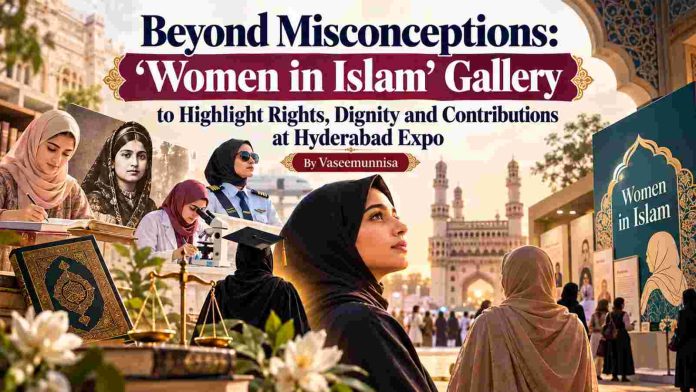
Misconceptions often thrive where understanding is limited. Muslim women, Islamic family values and the rights accorded to women under Islam have long been subjects of public debate, with social media frequently amplifying stereotypes and misinformation. An upcoming exhibition in Hyderabad seeks to challenge these perceptions through facts, historical accounts and Islamic teachings.
The gallery aims to encourage informed dialogue by addressing common misconceptions about Muslim women’s status, rights and role in society, drawing on historical evidence and references from the Qur’an and Hadith.
A special gallery titled ‘Women in Islam’ will be one of the key attractions at Beyond the Divide: Countering Hate Expo. Building Harmony, a three-day public exhibition is being organised by Jamaat-e-Islami Hind, Greater Hyderabad, at the Nampally Exhibition Grounds from October 30 to November 1.
Separating Myths from Facts
One of the central themes of the gallery is women’s economic independence and property rights. Challenging the widespread perception that women have no property rights under Islam, the exhibition highlights their right to own and manage property, inherit wealth and retain control over their personal assets. It also explains that mehr (dower), given to a woman as part of marriage, belongs exclusively to her.
The question of consent in marriage is another major focus. The gallery seeks to dispel the notion that a woman’s opinion carries little weight in matrimonial decisions, highlighting Islamic teachings that require the bride’s consent for marriage.
Education and the pursuit of knowledge form another important theme. Contrary to the perception that Islam discourages women’s education, the exhibition highlights the contributions of women scholars throughout Islamic history. Hazrat Aisha Siddiqah, the wife of Prophet Muhammad ﷺ, was a renowned authority on Hadith and Islamic jurisprudence who taught and guided generations of scholars.
The gallery will also explore women’s participation in public life, challenging the stereotype that Muslim women have traditionally been confined to their homes. From business and education to healthcare and social service, women have played active roles in Muslim societies since the early days of Islam. Hazrat Khadija, the Prophet’s wife, is among the prominent historical examples of a woman who independently conducted business.
Family Values, Rights and Responsibilities
The exhibition will also examine the Islamic understanding of family life, placing mutual respect, compassion and responsibility at the centre of marital relationships. In the Islamic perspective, the relationship between husband and wife is not merely a question of individual rights but one built on affection, mercy and shared responsibilities. While the husband is entrusted with financial maintenance of the family, women’s contributions to household management, emotional well-being and the upbringing of children are also acknowledged.
Complex and frequently debated subjects, including divorce and polygyny (a man having more than one wife), will also be addressed. The gallery aims to explain the conditions governing these practices under Islamic law, including the requirement of justice and fair treatment in polygynous marriages and the Qur’anic directive to marry only one if justice cannot be maintained.
Muslim Women Who Helped Shape India
Moving beyond religious principles, the gallery will highlight the contributions of Muslim women to India’s freedom struggle, education, social reform and contemporary public life. Abadi Bano Begum, popularly known as Amma Jaan, will feature among the women remembered for mobilising support for the freedom movement.
The exhibition will also showcase the contributions of Nawab Sultan Jahan Begum, former ruler of Bhopal and the first Chancellor of Aligarh Muslim University, and Rokeya Sakhawat Hossain, the pioneering educationist who established a school for girls in Bengal.
Among contemporary achievers, the gallery will highlight K.V. Rabiya, a Padma Shri awardee recognised for her work in literacy and social service; Dr Syed Sehrish Asgar, an IAS officer; Dr Mariam Afifa Ansari, a neurosurgeon; Dr Mazizia Bhanu, a gold medallist at the Powerlifting World Cup; and Syeda Salwa Fatima, a commercial pilot.
Their journeys, the organisers hope, will demonstrate the diverse ways in which Muslim women have contributed to the country’s social, educational and professional progress.
From Prejudice to Understanding
Built around the message that the distance between communities can be bridged through dialogue, Beyond the Divide Expo seeks to promote mutual understanding and challenge prejudice. The exhibition underscores the idea that appearances alone cannot define a person’s identity, abilities or aspirations, and that meaningful engagement begins with a willingness to understand others beyond stereotypes.
The three-day event at the Nampally Exhibition Grounds from October 30 to November 1 invites people from different backgrounds to explore the exhibits, engage with diverse perspectives and gain a deeper understanding of Islam, women’s rights and the Islamic family system.
By placing historical contributions, religious teachings and contemporary achievements side by side, the ‘Women in Islam’ gallery seeks to replace assumptions with informed understanding and encourage a more inclusive public conversation.
[The writer is JIH Hyderabad City Media In-charge]
source: http://www.radiancenews.com / Radiance News / Home> Features> Focus / by Vaseemunnissa / October 29th, 2026