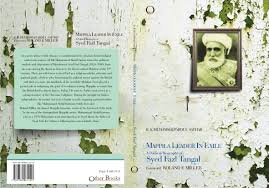
In the biography of Syed Fazl, Dr. K K Muhammad Abdul Sathar traces the political outlook and disposition of Mamburam Syed Fazal Tangal (1824-1900) from his roots among Ba alwis in Yemen to the Malabar of the 19th century.
There are references to Syed Fazal as a religious scholar, reformer, and spiritual guide, all these roles buttressing his political stance against the British and the feudal aristocracy.
In the preface to her memoir, the author B. M. Zuhara writes, “I grew up at a time when Muslim girls did not even have the freedom to dream.” The Dreams of a Mappila Girl is set at the time when independent India was embracing its new identity as a free nation. It offers a rare portrait of women in Muslim households in North Kerala through the lens of a woman writer. Zuhara showcases how women, bound as they were by the rules of society, still managed to hold key positions in their family and had an important voice in the discussions concerning their lives, contrary to popular perception.
The following piece is an excerpt from Fehmida Zakeer’s translation of the book, soon to be out from Yoda Press.
****
During the holidays, the hall upstairs turned into a playground for the children, who were allowed to play outdoors only in the evenings. Lined by long windows without grills, and furnished only with Uppa’s charukasera and writing table, the hall was an expansive place for us to jump and run and skip and play. Below the glass windows was a cement slab broad enough to be used as a seat, running the length of the hall. If you sat on it and looked out of the window, you could see paddy fields and coconut groves and people out on the road in front of the house.
One evening, I was playing with Achu, the elder brother nearest me in age. Though his name was Assoo, I called him Achu. We were racing cars, or rather matchboxes converted by our imaginations into pretend cars. Since both Achu and I were recovering from a fever, we did not have permission to go out and play with the others, and so we were playing in the hall upstairs. Suddenly I heard the sound of Umma’s medhiyadi on the staircase leading from the women’s section of the house.
In those days, people used wooden footwear indoors. Climbing stairs in a medhiyadi, gripping the peg in the middle with the big toe and the second toe, was a feat in itself. Valippa’s medhiyadi, which he wore when he went out, had leather straps. Uppa preferred to wear shoes when he stepped out of the house. Once a year, Chandu Aashari, the family carpenter, made medhiyadi for the whole family. Achu once broke the small medhiyadi made for me by Chandu Aashari, and how I wept!
Umma did not normally come upstairs in the evenings. I looked enquiringly at Achu when we heard the sound of her footsteps.
‘Umma is going to Kozhikode tomorrow morning. She knows that you will cry and insist on going with her. That’s why she didn’t tell you.’
Even though I knew Achu was trying to provoke me, my eyes started filling with tears. I was five years old at that time, and in class one at school. I missed school frequently because I used to accompany my mother wherever she went. This continued in class two. At the end of each year, Uppa would visit the school and meet the teacher, and I would be promoted to the next class. This was the usual practice.
I closed my brimming eyes and stood there thinking.
Achu spoke again. ‘Umma must have come upstairs to pack her clothes for the trip. You’d better go quickly.’
‘Don’t take my matchboxes. I’ll be right back,’ I called out as I ran to Umma’s room.
‘I told you about Umma’s trip, so now the matchboxes are mine,’ I heard Achu shouting after me, but I decided to ignore his words for now.
When I entered the room I saw the doors of the meshalmarah opened wide. The scent of kaithapoo filled the room. How it lingers, the fragrance of screwpine! The meshalmarah doubled as a table and a cupboard, and was actually a long table with drawers on both sides with space to store things below. Umma called the meshalmarah her clothes cupboard. Umma stored her clothes on one side and the children’s on the other side. In those times, children usually had only one or two sets of clothes, made from lengths of cotton. Trousers and shirts for the boys and chelakuppayam, or frocks, for me.
‘You are packing to go to Kozhikode without me?’ I whimpered.
Umma turned to look at me. ‘The crybaby has arrived!’ she said.
At that, I wailed even more loudly.
I had three nicknames as a child. Karachapetti, Tarkakozhi and Ummakutty. Karachapetti because I cried a lot; I did not know the meaning of Tarkakozhi but when someone called me that, I would put on a sullen look; I actually liked my third nickname of Ummakutty, ‘mother’s darling’. When someone called me by that name, a shy smile would tug at my lips. I liked to sing the lullaby Umma often sang to me. ‘Umma’s little girl Soorakutty, darling little daughter of mine.’
But at that moment, I was not thinking about the nicknames or Umma’s special song for me.
‘If you go without taking me with you, by God, by the Prophet, I will not go to school till you come back.’
‘Moideen will tie your hands and legs and take you to school,’ Umma said as she placed her clothes in a cloth bag fitted with wooden handles.
Moideen was the caretaker of our house, and all the children were scared of him. But even though he put on a stern face when any of us misbehaved, he really liked us. Whenever I cried and created a fuss, he would arrive and take me to the pond at the back of our house. He would get into the pond and pluck a lotus for me or teach me how to make toys with lotus leaves.
‘If I complain about a stomach ache, Ummama will not send me to school,’ I said, pouting.
‘This is too much. Don’t you want to learn to read and write? If you follow me around all the time, how will you learn your lessons?’
‘I don’t want to,’ I said resolutely.
‘Don’t imagine I’ll take you this time, Soora. If you hide inside the car, I will drag you out.’
Usually when it became clear that Umma would not take me with her on a trip, I would hide between the seats in the car without even having changed into an appropriate outfit. It did not occur to me that my grandfather, seated in the charukasera on the verandah, the driver, and the servants busy in their tasks would all notice my presence. I thought I was fooling Umma by hiding in the car. When Umma came out of the house and went up to the car, Valippa would jokingly call out, ‘Mariya, be careful, there is a cockroach in the car.’
Umma would understand immediately. She would get into the car and pinch my ear and say, ‘Don’t get smart with me. Get out of the car.’
I would hug the seat and wail loudly.
Valippa would say then, ‘Take her with you. She’s a baby after all.’
‘Baby indeed, she’s over five years old. You are all spoiling her.’
And I would get to accompany Umma to Kozhikode once again. Umma’s younger sister lived in Kozhikode and, to us children, her house was a source of wonder. Umma had to see the doctor in Kozhikode every three months and she would drop in at her sister’s house when she made the trip.
Now Umma ignored my wails and placed the bag filled with her clothes on the table. Then she went downstairs. Sobbing loudly, I followed her.
‘Why is the baby crying?’ Ummama called out from below the stairs.
‘If she complains of a stomach ache tomorrow morning, don’t allow her to take the day off from school, Elama.’
When Umma was fifteen years old, her thirty-year-old mother, nine months pregnant, died. Later, Valippa married again. Our present Ummama was his second wife. I understood all this only later. Even though my mother and her siblings called their stepmother Elama, Ummama treated them as if they were her own children.
Ummama intervened on my behalf now. ‘Take her with you, Mariyu. If you leave her here, she will raise the roof with her crying.’
By then we had climbed down the stairs.
Umma ignored me and asked Ummama, ‘Is Uppa sitting on the verandah?’
‘He was asking for you. He just sent Assan to look for you.’ Assan, the handyman, was Moidyaka’s son.
Every evening Umma and Ummama went to the verandah to keep Valippa company. This was the only time they were allowed on the verandah.
‘Aren’t you coming?’ Umma asked as she made her way outside.
‘You go on. I’ll come soon,’ Ummama said, walking towards the eastern side of the house where the bathrooms were located.
As Umma made her way to the front of the house, I followed close behind, sniffling and crying.
‘Soora, don’t irritate me. If you don’t stop I’ll lock you up in the kunhiara. I’m warning you.’
Kunhiara. As soon as I heard that word, my wails dwindled to a whimper. Kunhiara was the small room where the sparingly used big and heavy copper and brass utensils were stored. The room was dark even during the daytime and was a haven for cockroaches, moths and rats. I was not really scared of the cockroaches, the moths, the rats. What terrified me was the tomcat installed in our house to catch the rats. Its glowing eyes struck terror in my heart. To me, spending time there was like being in hell, and once locked inside I would remain there until the servants came to rescue me. I was still sobbing when we reached the verandah.
‘Chu, why are you laughing?’ asked Valippa.
My grandfather called me Chu.
‘Your darling Chu cries all the time,’ Umma said crossly.
‘Don’t say that, Mariya. Look at her smiling now. She looks so beautiful.’
On hearing this, in spite of the tears streaming from my eyes, I attempted a smile.
‘That’s my brave girl. Come here.’ Valippa beckoned to me. ‘If you massage my legs, I’ll give you a mukkal.’
Forgetting about the trip to Kozhikode, I walked towards the charukasera where my grandfather sat with his legs hoisted over its elongated armrests. I massaged his legs one by one with my small hands.
‘I want the coin with the hole.’
In those times, one pice coins came with a hole and without. I preferred the ones with the hole. I dropped all the coins I got from Valippa into a powder tin which had its top cut open with a knife.
By then, Ummama had reached the verandah. Ummama would sit on the bench and Umma would stand by the door as they talked about the events of the day with my grandfather. I listened to them talking as I pressed Valippa’s feet, directing smug looks at my mother and feeling like the valiant Unniarcha.* Absorbed in conversation, Umma too seemed to have forgotten the whole episode.
***
* Unniarcha is a mythological warrior woman celebrated for her fearlessness, immortalised in the vadakkan paatu, the ballads of the region.
Translator’s Bio
Fehmida Zakeer is an Independent writer with bylines in several publications including, The Bangalore Review, The Hindu, Al Jazeera, Reader’s Digest, National Geographic, Whetstone Magazine, NPR. Her fiction has appeared in publications such as The Indian Quarterly, Out of Print Magazine, Quarterly Literary Review Singapore, Asian Cha, among others. A story of hers was placed first in the Himal South-Asian short story competition 2013, and another was chosen by the National Library Board of Singapore for the 2013 edition of their annual READ Singapore anthology.
___________________________________________
B. M. Zuhara
BM Zuhara has written novels and short stories and is the first Muslim woman writer from Kerala. She won the Kerala Sahitya Akademi Award for her contribution to Malayalam literature in 2008 and has received awards such as Lalithambika Antharjanam Memorial Special Award, Unnimoy Memorial Award and the K. Balakrishnan Smaraka Award. Her novels, Iruttu (Darkness), Nilavu (Moonlight) and Mozhi (Divorce), have been translated into Arabic while the English translation of Nilavu was published by the Oxford University Press in an anthology titled, Five Novellas. She translated Tayeb Salih’s Wedding of Zein and Naguib Mahfouz’s Palace Walk into Malayalam.
______________________
source: http://www.bangalorereview.com / The Bangalore Reviews / Home> Non-Fiction / by B M Zuhera / July 2022
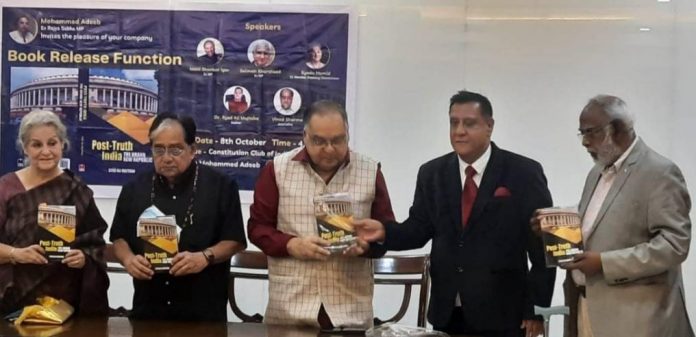
Book on ‘Post-Truth India’ by Syed Ali Mujtaba being released by former Rajya Sabha MP, Mohammad Adeeb, journalist Vinod Sharma, social activist Syeda Hamid and human rights activist John Dayal
New Delhi:
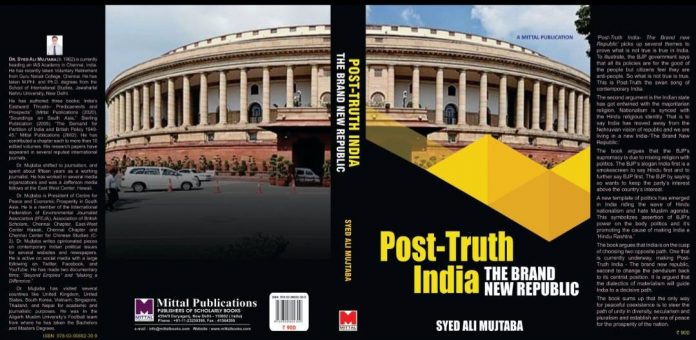
A new book titled, ‘Post-Truth India –The Brand New Republic’, by Syed Ali Mujtaba was released at a glittering function in the Constitution Club of India last week.
The book launch ceremony was graced by prominent personalities like former Rajya Sabha MP, Mohammad Adeeb, former Planning Commission member Dr. Sayyeda Hamid, senior journalist Vinod Sharma, and veteran journalist, and social activist John Dayal among others.
Authored by Dr. Syed Ali Mujtaba, a well-known author, and journalist, the book is a treatise on the contemporary situation in the country. Inspired by legendary Indian journalist and author Frank Morris’ work ‘Witness to an Era’, this book can be called a witness to contemporary India, whose value will be appreciated by those who read it living in a different era.
Speaking on the occasion, Adeeb said the author through the book, raised the concerns of a citizen living at a time when the country’s economy is in a mess, poverty, and unemployment is at an all-time high and the social fabric of the nation is in tatters.
Adeeb described the book as a testimony of the freedom of writing without fear. He lauded the author for the courage he displayed in speaking up about the truth at a time when it is considered a sin.
Addressing the gathering, well know journalist, Vinod Sharma, congratulated the author on bringing many aspects of contemporary life out of the closet. He expressed reservation over the title “The Brand New Republic” and said in the Post-Truth era that we are living, Republic is an illusion. He stressed the need for a campaign to fight hatred with truth.
In her turn, Syeda Hameed called the book ‘candid and bold. She said she found the book very direct and clear. “What fascinated the most about the book is that it talks about communal harmony and the re-establishment of real India,” she said.
The author, Dr. Mujtaba recounted his predicament when publisher after publisher rejected his manuscript, and said, at one point in time; he had lost hope of the book seeing the light of day. After encountering 10 rejections, when eventually one publisher mustered enough nerve to publish the book, he took a sigh of relief.
He said through the book, he raised the concerns of a citizen living in this great country. I have used four positions to write the book, the author said, one as a concerned citizen, second as a journalist, third as an academic and professor, and last his own identity as an Indian Muslim.
There was a consensus among the speakers that the work will serve generations as a reference book to relate to and learn from the contemporary realities faced by Indians living in this era.
The book release function began with the felicitation to the author by different media organizations where his writings appear regularly. Website ‘The India Observer’ published from New York; ‘Siasat Daily’ from Hyderabad, ‘Good Morning Kashmir’ from Srinagar, ‘Muslim Mirror’ from New Delhi felicitated the author.
The book launch ceremony was a well-attended event. Even the rains could not dampen the spirits ofi the Nobel souls, who braved the downpour to make the event a grand success.
source: http://www.muslimmirror.com / Muslim Mirror / Home> Books / by Muslim Mirror Network / October 16th, 2022
Rashid un-Nisa’s life and work continue to inspire, reminding us of the importance of education and the courage to advocate for change in the face of resistance.
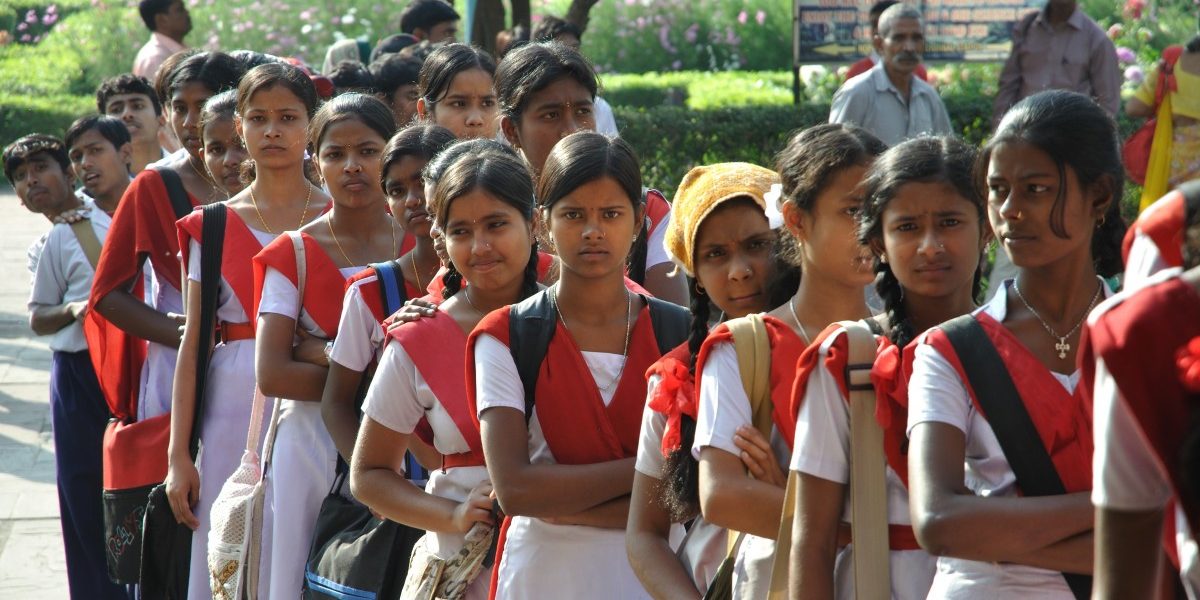
Representative image of girl students. Photo: Wikimedia Commons
Rashid un-Nisa, India’s first female Urdu novelist, wrote Islah-un-Nisa, advocating for women’s education and reform. Born in 1855 in Patna, she was also a champion of girls’ education, founding Bihar’s first girls’ school. Her novel, published in 1894, addressed social issues and encouraged women to seek education. Rashid un-Nisa’s pioneering efforts in literature and education have left a lasting legacy, inspiring generations of women and contributing significantly to India’s literary and social history.
The premise of Islah-un-Nisa is something like this: “I am aware of the fact that there are many problems in our Muslim families. I also want to remove these problems. But instead of giving any sermons for this, I have chosen an interesting way to do this work the way of writing a novel.”
Early life and family background
Rashid un-Nisa, also known as Rashidatun Nisa or Raseedan Bibi, was born in 1855 in Patna, Bihar, into a scholarly family. Her father, Shamsul Ulama Syed Waheeduddin Khan Bahadur, was a prominent Islamic scholar. Growing up in a rich intellectual environment, Rashid un-Nisa received her education at home through private tutoring. Though formal schooling for girls was rare, her intellectual curiosity was nurtured in this setting.
Her marriage to Maulvi Mohammad Yahya, a lawyer, introduced her to progressive literature, particularly Mirat-ul-Uroos by deputy Nazir Ahmad, which deeply influenced her views on women’s education and reform.
Islah-un-Nisa: Breaking new ground
Rashid un-Nisa began writing her most famous work, Islah-un-Nisa, around 1868, though it took over a decade to publish due to challenges as a female writer in a male-dominated field. With the help of her nephew, Mohammad Suleman, the novel was finally published in 1881. Its significance as the first Urdu novel written by an Indian woman cannot be overstated.
The novel advocates for women’s self-improvement through education and moral upliftment, tackling issues such as superstitions, societal constraints, and regressive customs. It promoted the empowerment of women and their active participation in social reform, much like the themes Rashid un-Nisa had encountered in Mirat-ul-Uroos.
Jamia Millia Islamia’s research scholar, Dr. Uzma Azhar, comments on the novel, stating, “Islah un Nisa is the first novel in Urdu literature authored by a woman (1881). Rashid un Nisa came from an educated family of Azeemabad (now Patna, in Bihar) and later started a girls’ school as well.
Titled “Islah” meaning “to rectify/reform”, and “un Nisa” of women, it conveys ways through which a woman could improve herself. She has advised women on broad mindedness, importance of education against ignorance and has also tried to talk about the lives of literate women of that era through her story.
The main story of Bismillah is followed by further similar short stories. She has given delightfully detailed descriptions of the various traditions around marriage, pregnancy, birth of a child in simplified common language interspersed with local regional songs, making this book an interesting historical document.”
The novel’s appeal stretched beyond its time, with later editions being released in 1968, 2001, and 2006, highlighting its enduring influence in India and Pakistan.
Social reformer: Championing girls’ education in Bihar
Rashid un-Nisa didn’t limit her reformist spirit to literature; she founded the first girls’ school in Bihar, a revolutionary step at a time when educating girls was controversial. The colonial administration even recognised her efforts, with Lady Stephenson, wife of the lieutenant governor, personally praising her work during a school visit.
Her educational philosophy was grounded in the belief that women’s education could transform not only their own lives but also the wider society. By ensuring access to education, Rashid un-Nisa opened new avenues for countless women, many of whom went on to contribute significantly to education and reform.
Educational Philosophy and Social Impact
Rashid un-Nisa’s educational vision was deeply embedded in her literary work. Islah-un-Nisa reflects her belief that intellectual and moral growth were essential for women. Her protagonist, Bismillah, navigates societal challenges, embodying the values of enlightenment and self-improvement. Through conversations between her characters, Rashid un-Nisa critiques harmful customs and superstitions, urging women to rise above them.
Senior journalist and well-known historian Shams Ur Rehman Alavi notes, “Islah un Nisa, gave message to women to shun regressive cultural practices that were a burden on them, and instead, aim at achieving excellence in all fields.
Through conversation of characters, she emphasised that it’s not just about ability to read and write, but learning and expertise in all spheres, which was the need of the hour for women. It must be remembered that it was a period, when all the social reformers were not so enthusiastic about women’s rights and adequate priority was not given to women’s higher education, as some of them still felt that basic literacy was enough, so that a woman could communicate through letters with husband in case he is away or be able teach own children a bit.
Sample this from a paragraph in the novel: Mir Waaez’ wife says, ‘Beti is mein bhalaa kya buraai hai [What’s wrong with this]’ and Karim-un-Nisa replies, ‘Aap badi hain, aap ki baaton ka jawab dena be-adabi hai magar….be-adabi maauf ho….ye rasm buri hai...[You are elder and it is disrespectful for me to speak but I need to say that this custom is bad’.
The writer shows her disgust towards superstitions also that are continued in the name of ‘tradition’ and disses fake healers as well as those who are obsessed with spreading fear about apparitions and paranormal. On one hand, language and Urdu idioms heard in households of the era, keep the reader fixated, the unique description of the rituals that brought financial burden on households and forced families into debt, was clearly aimed at discouraging the practice of going to money-lenders and falling in this trap, which affected the families.“
The novel blends traditional and progressive values, challenging superstitions while depicting modern aspirations. It offers a vivid portrayal of customs like marriage and childbirth, making it not only a piece of literature but also a historical document of women’s lives at the time.
Legacy
Rashid un-Nisa passed away in 1929, but her contributions to literature and social reform endure. She is remembered not only as the first Urdu woman novelist but also as a pioneer of women’s education in India. Her novel Islah-un-Nisa remains a powerful reminder of the struggle for women’s rights and education during an era resistant to change.
Her school continues to inspire generations, and her work has been reprinted several times, testifying to her lasting influence. As Dr. Uzma Azhar reflects, “Islah-un-Nisa offers delightfully detailed descriptions of the various traditions around marriage and other social practices, making it an interesting historical document.”
Rashid un-Nisa’s life and work continue to inspire, reminding us of the importance of education and the courage to advocate for change in the face of resistance.
Sahil Razvi is an author and research scholar specialising in Sufism and history. He is an alumnus of Jamia Millia Islamia. For inquiries, you can email him at [email protected].
source: http://www/thewire.in / The Wire / Home> Culture / by Sahil Rizvi / October 13th, 2024
Remembering the prolific Urdu writer from Lucknow whose novels and short stories were full of insights about the lives and concerns of women.
Photo: Mehru Jafar/WFS
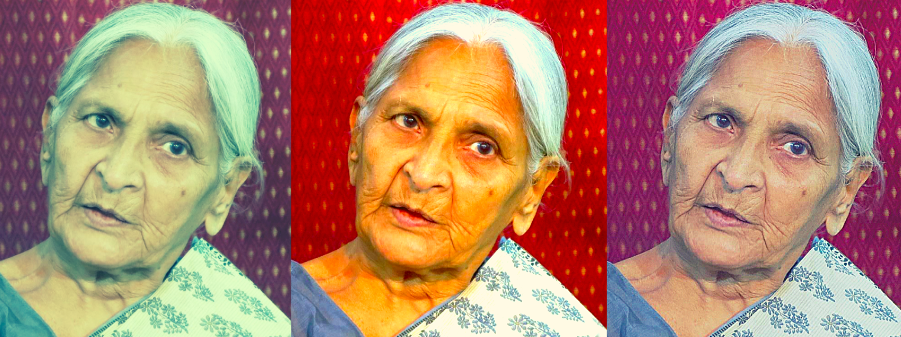
The prolific Urdu writer, Begum Masroor Jahan, quietly slipped into literary immortality in her beloved Lucknow on September 22 at the age of 81. Though she left behind an astonishing legacy of some 65 best-selling novels and more than 500 short-stories, the news of the passing of this titan did not even make it to the leading Urdu publications of India, what to speak of English and other languages.
Masroor Jahan belonged to that remarkable generation of Urdu women writers, born between 1925 and 1940, which includes novelists Nisar Aziz Butt, Altaf Fatima, Jilani Bano and Khalida Husain; and the short story writer Wajida Tabassum. With her passing, only two living representatives of that generation remain – Butt from Pakistan and Bano from India.
Born on July 8, 1938 in an educated and literary household in Lucknow, Masroor Jahan’s father, Sheikh Hussein Khayal Lakhnavi, was considered a good poet. Her paternal grandfather, Sheikh Mehdi Hasan Nasiri Lakhnavi, also had a collection of poems to his credit and was the author and translator of many books. Masroor Jahan had a passion for reading stories from an early age.
Her first short-story ‘Woh Kon Thi?’ (Who Was She?) was published in the Qaumi Aavaaz from Lucknow in 1960. Just two years later, she published her first novel Faisla (Decision). She began writing under the pen-name of Masroor Khayal – among others – which she later changed to Masroor Jahan at the advice of her publisher.
From her paternal side, her milieu was feudal, while her father was a teacher and the domestic atmosphere was middle-class. She was married at the tender age of 16 to Syed Murtaza Ali Khan, a nawab. Due to this background, her short-stories portray the minds and matters of all these three classes.
She claimed that whatever she wrote was given to her by her personal experience and observation, and was not fictitious. In a few instances, she even mentioned the real names of people living with her in her novels and when asked about this, pat came the response that she did not fear those folks ever going to court.
Her writings were popular with not only older homemakers but also students. Her stories published in the Urdu journals Beesveen Sadddi and Hareem had a seminal role in the upbringing of Lucknow’s middle-class young women. One of the standards of literary success is also that they be read and liked by every class of society. In that respect, many of her novels went into multiple editions.
Though Masroor Jahan’s forte was the novel, she turned her attention to short stories in the later years of her life and it can be said that the real form of her art is manifested in these tales. The simplicity of her story, the popular manner of writing and easy imagination were the qualities that distinguished her from her contemporaries, including her fellow-Lakhnavi, Naiyer Masud, who passed away in 2017, and Altaf Fatima, who hailed from Lucknow and died in Lahore last year.
Masroor Jahan belongs to the pantheon of female writers like Rashid Jahan, Ismat Chughtai, Quratulain Hyder, Hajra Masroor, Khadija Mastoor, Razia Sajjad Zaheer, Sarla Devi, Saleha Abid Hussain, Bano Qudsia, Jamila Hashmi, Zaheda Hina and Jilani Bano who drew attention to the woman who is present somewhere in society in some form through their short-stories and novels. She witnessed the era of the Progressive Movement as well as that of modernism, post-modernism and other trends in literature, but did not attach herself to any movement or trend.
But while presenting them, she did not adopt the conservative manner particular to some female fiction writers; neither did she adopt the kind of boldness which tramples upon cultural values in the heat of realism.
Whether her topics consist of middle-class or lower-class women, or the Anjuman Aras being nourished in high palaces, or the educated woman of the new society, she always maintained a cautious manner in the presentation of these matters and problems, especially when it came to sexual and psychological tension. She was acutely aware of how the decline of feudalism – when the life of Muslim households of northern India scattered owing to economic and moral decline – made women the ‘altar’ of the false honour of men. She created her stories by making women the subject through small incidents and characters.
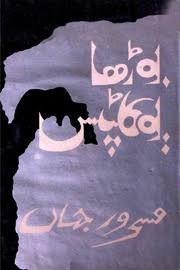
Boorha Eucalyptus. Photo: Rekha
Masroor Jahan also wrote romantic stories like the classic Boorha Eucalyptus (The Aged Eucalyptus) from her eponymous collection published in 1982, as well as stories where a helpless woman is hung on the cross of relationships. Then there are women who are the epitome of love and loyalty at one place, but at other places, create problems in others’ lives.
Many novels and short-stories have been written on the debauchery of nawabs and landlords. Wajida Tabassum had become famous at one time for writing such stories. Masroor Jahan too wrote many stories on this topic. But where she made the sexual waywardness of the nawabs her theme, she also presented the positive traits of their character.
In the character of begums too she tried to present every aspect of their life. These stories of a particular milieu express the solitudes and splendours of this culture, whose traces have themselves now become legend.
‘Kunji’ is a classic story of this milieu. Kunji was an extremely beautiful young dancer. Audiences were enthralled by his performances in the nautankis where he presented his dance. People of the highest rank were devoted to his coquetry and beauty. Nawab Zeeshan lost his heart to Kunji. He arranged for the whole nautanki troupe to stay near his harem and gave a beautifully decorated room attached to his bed-chamber to Kunji. In his love for the male dancer, he even forgot the beauty of his begum Anjuman Ara.
Anjuman Ara was amazed at what had happened to the nawab. She was also embarrassed thinking that her rival was not some woman, but a man. Indeed, she herself liked Kunji’s dance; but found her husband’s attachment to him obnoxious. One day when the nawab was off visiting the nearby village, she went to Kunji’s room. The dancer was bewildered by the unexpected sight of a beautiful woman in front of him. ‘I am Anjuman Ara, the begum of Nawab Zeeshan’, she says.
She looks around the room, which had feminine dresses and other articles of feminine adornment everywhere. But the beautiful youth sitting in front of her bore no relation to femininity. His long black hair appeared artificial. She tells him with great gravity that she liked his dance. Despite this praise, Kunji begins to consider himself inferior in front of her. He is also embarrassed listening to praise from her mouth; and he did not have the courage too to look towards her. Firstly, it was the awe of beauty and then that aspect of ridicule in her praise of him which he felt. Despite primping and preening for several hours, he could not compete with this beauty and femininity. People kept encouraging his coquetry now but real beauty was present before him. For the first time in his life, Kunji’s heart beat in a different manner.
He looked at Anjuman Ara with eager eyes. She too was looking in his direction. Their eyes met and lowered. Anjuman Ara’s beauty and femininity had brought to life a man whom the praise and admiration of others had patted to sleep. Anjuman Ara was stupefied reading the message of yearning in his eyes; and worried too. She immediately got up to leave. Kunji too regained consciousness, and said slowly, ‘You’re leaving so soon.’ Anjuman Ara replied, ‘Yes. The nawab will be here soon and then you too will have to change your appearance.’ When Nawab Zeeshan stepped into Kunji’s room upon his return, he saw that instead of the preening dancer he sought, a man was sitting there; and there was a heap of hair before him.
At the point where Masroor Jahan ends the story, looking at Anjuman Ara and Kunji one by one, the reader feels that he has seen with his own eyes how one beauty gives birth to another. Had she wanted, she could have presented Kunji like Ismat Chughtai’s ‘Lihaaf’ (indeed she cited Ismat Chughtai as an early influence and had attempted to make her female characters bolder after the latter’s advice). The nawab of Lihaaf too was happier with boys and left his Begun Jan. But Masroor Jahan did not let Anjuman Ara become Begum Jan. For her, homosexuality was not the refuge Chughtai hinted at for her protagonist.
Unlike ‘Lihaaf’, with which the former was often compared to, Kunji was based on a real-life character. In an interview conducted just five months before her death, Masroor Jahan named Kunji as her favourite real-life character from her stories.
The short-stories of Masroor Jahan with their absent and present realities are those milestones of her creative journey which will not be easily forgotten. About her own stories, she used to say, ‘Actually life is not unidirectional, it has a thousand aspects; and every aspect is a complete world in itself. The fiction writer is a pulse-reader of life. It is her duty to present every aspect of life in its proper context.’
Among the 65 novels she wrote, the social realist Nai Basti (New Colony) is of special interest. Published in 1982, this was topically different from all her novels. Indeed, to my knowledge, this is the first Urdu novel where the problems of nameless city settlements – which are called ‘illegal’ – have been narrated. Premchand had made the rural poor the subject of his novels, but in this novel are the urban disadvantaged, who have their own problems and life – and values that are being trampled on.
I got acquainted with Masroor Jahan barely a month ago when I read Shafey Kidwai’s lucid review of her two recent collections of short-stories namely Naql-e- Makaani (Migration) and ‘Khuvaab der Khuvaab Safar (A Journey Dream After Dream) in the Friday Review of The Hindu.
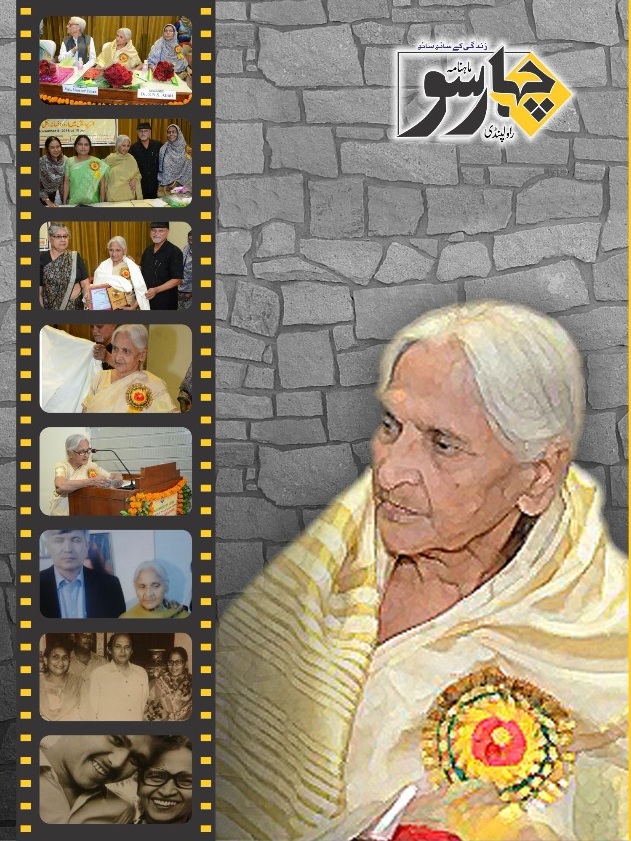
From there, I sought out the January/February issue of the monthly Chahaar-Su, issued from Rawalpindi, which was dedicated to Masroor Jahan and consists of an excellent and quite revealing interview of the writer with the editor Gulzar Javed. These readings also sent me down memory lane to my maiden visit to Lucknow back in 2014 when I was invited to the Lucknow Literature Festival.
It was there too that I made the acquaintance of the lovely and erudite Saira Mujtaba; I sadly do not recall any conversations we might have had with regard to her late grandmother, Masroor Jahan. Now when I think about that visit, I am disconsolate because I know I should have been spending time with the living monuments of Lucknow like Begum Masroor Jahan and Naiyer Masud, rather than admiring the dead buildings of that city. That regret will always be mine!
Masroor Jahan’s quintessential short-story The Aged Eucalyptus talks about the eponymous tree which is a witness to the eras, revolutions, stories and secrets of the haveli where it had stood so proudly for decades in addition to being the recipient of the imprinted affections of the doomed love affair of the two main protagonists, Maliha and Ahmer.
Later on, the aged eucalyptus would provide solace to Maliha as she held it to console herself in her lover’s absence. The story ends with the uprooting of the aged eucalyptus in a storm overnight.
I would like to think that the aged, kind, empathetic eucalyptus was not only a metaphor for the doomed love affair in the story itself but for Masroor Jahan’s own life, patiently accumulating the various sorrows of her life, in which she had to contend with the early deaths of her brother and her son, as well as another brother who went missing in 1973 but never returned (her 1980 novel Shahvar is dedicated to him), and which she never spoke of.
The aged eucalyptus for me also reflects not the physical passing on of Masroor Jahan, but the uprooting of a whole way of life and a system of thinking and feeling which was Lakhnavi culture.
It is now up to her younger successors like Anees Ashfaq and indeed Saira Mujtaba (to whom Masroor Jahan’s last volume of stories Khuvaab Dar Khuvaab Safar is co-dedicated and who is currently translating a collection of her grandmother’s short stories into English) to pen the dirge of Lucknow in our own time.
Raza Naeem is a Pakistani social scientist, book critic and award-winning translator and dramatic reader currently based in Lahore, where he is also the President of the Progressive Writers Association. He can be reached at: (email protected).
source: http://www.thewire.in / The Wire / Home> Books / by Raza Naeem / October 07th, 2019
Anees Ashfaq’s ‘Khawab Sarrab’ is destined to blaze a new trail in fiction writing in Urdu.
Presenting a new Avatar – Anees Ashfaq
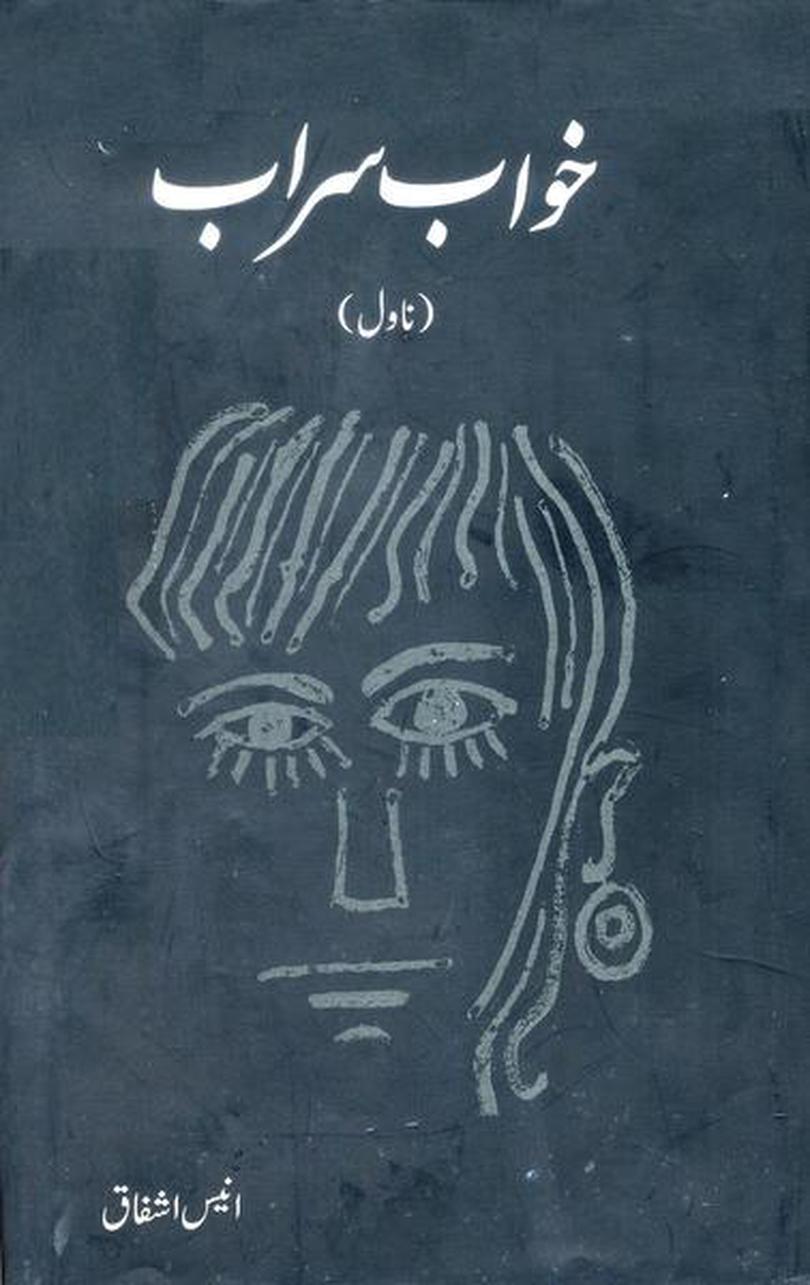
Truth is not what it appears at first glance. It lurks behind popular narrative and often reveals itself through a text that remained obscure for years.It is a pulsating narrative trajectory to retell an old story that is aptly adopted by an eminent Urdu author Anees Ashfaq in his latest novel Khawab Saraab (Dream, Mirage). The inspired story telling adds a strong sense of dreaminess to the old themes of love grief and cultural isolation. The narrative a sort of transgressional fiction leaps backwards and forward in time and throws light on the powerlessness that people feel in a fragmented world.
The protagonist of the novel desperately looks for an unpublished but widely discussed manuscript of the famous Urdu novel Umrao Jaan rendered into film by Muzaffar Ali. Undeterred by the popular pare down script, the narrator looks for the script that had not seen the light of the day.
Revelatory prose
Anees Ashfaq’s revelatory prose articulates how an old story can be presented as an awe-inspiring cultural force that we need to explore. The story betrays a renewed rendezvous with the literary and cultural history of 20th century Lucknow that was hardly told by the colonial historians and novelists.
A prolific writer, Ashfaq picks up different but equally fascinating narrative threads to weave a story that goes well beyond the mourning nostalgia. It is a story that skilfully blends connection between texts. The plot of Khawab Saraab does not harp on the notion of an absolute truth that is shared by various characters, but zeroes in on multiple and individual truths. It is a world where no master narrative with a definite moral exists. The first edition of Mirza Hadi Ruswa’s famous novel Umrao Jaan carried a concluding line which says that the author prepared another copy of the script. It was widely believed that the author tried to narrate the story with multiple focalisation about a city that was ravaged with the decay and decline. In one of the versions of the story, Umrao Jan was presented more than a dancing girl, she was a mother as well. It is what the narrator of the Anees Ashfaq’s trail blazing novel tries to explore.
Characters with culture
With remarkable narrative skill, the author produces a text that does not draw on the dazzling presence of mass media, consumerism, globalism and corporate world and his characters have not put aside their cultural concerns and values and they are not driven by greed. The protagonist’s painstaking efforts to find out the script that disappeared brings forth a tantalising tale of life that seems real but actually it is not really real. For Anees Ashfaq, reality is what we construct through language and he builds his narrative by referring to the celebrated writer Ruswa time and again. His insistence on the lost script makes his novel closely resemble with “histographic metafiction” It is a text that pins point the historicity of several heritage buildings and cultural practices of Lucknow. The author reveals that famous safed Baradari of Lucknow was the Qasrul Aza (place of mourning) constructed by Wajid Ali Shah and the building which houses Bhatkhande Music College was his ‘parikhana’.
Seldom does one come across with a text bursting with different genres, autobiography, memoirs, anecdotes, romance and some what detective fiction and Anees Ashfaq’s creative dexterity produced such a nuanced and multi-sensory narrative of metafiction .
source: http://www.thehindu.com / The Hindu / Home> Books> Going Native / by Shafey Kidwai / October 27th, 2017
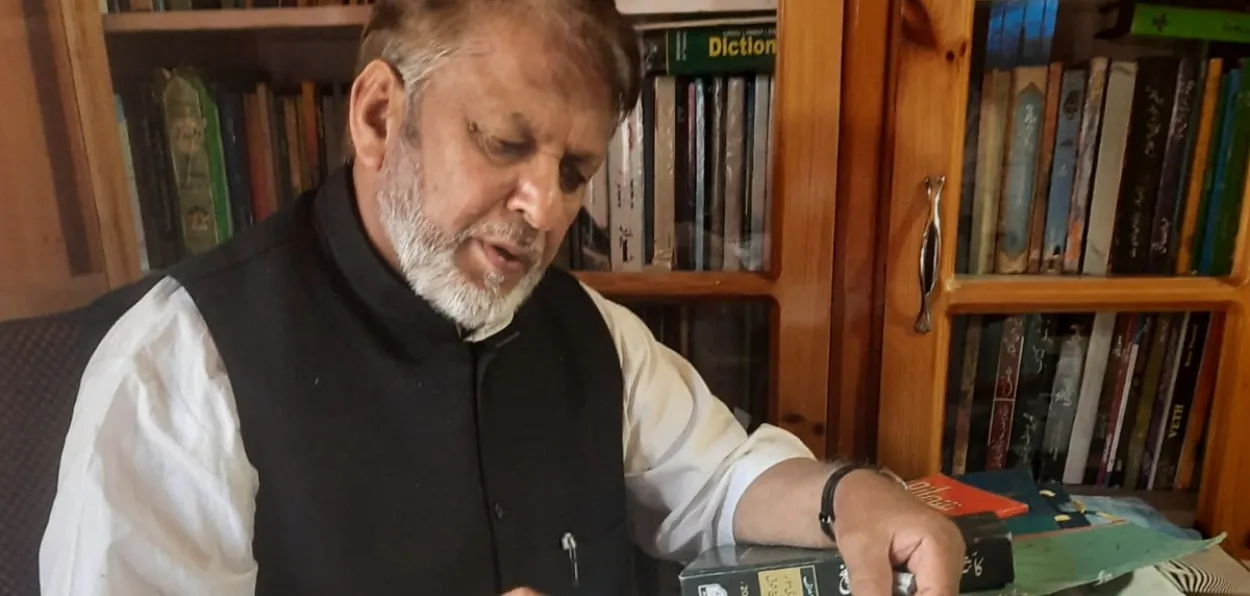
Farooq Fayaz Bhat’s rise in life had a strong link with the place of his birth. The Sahitya Akademi award winner author and historian feels that being born in a locality that was adjacent to Habbakadal, a hub of theatrical activities in Kashmir back then, shaped his personality and mind.
Early in his life, he developed a keen interest in art and culture and gradually moved into the realms of literary criticism, particularly Kashmir’s folk cultural history.
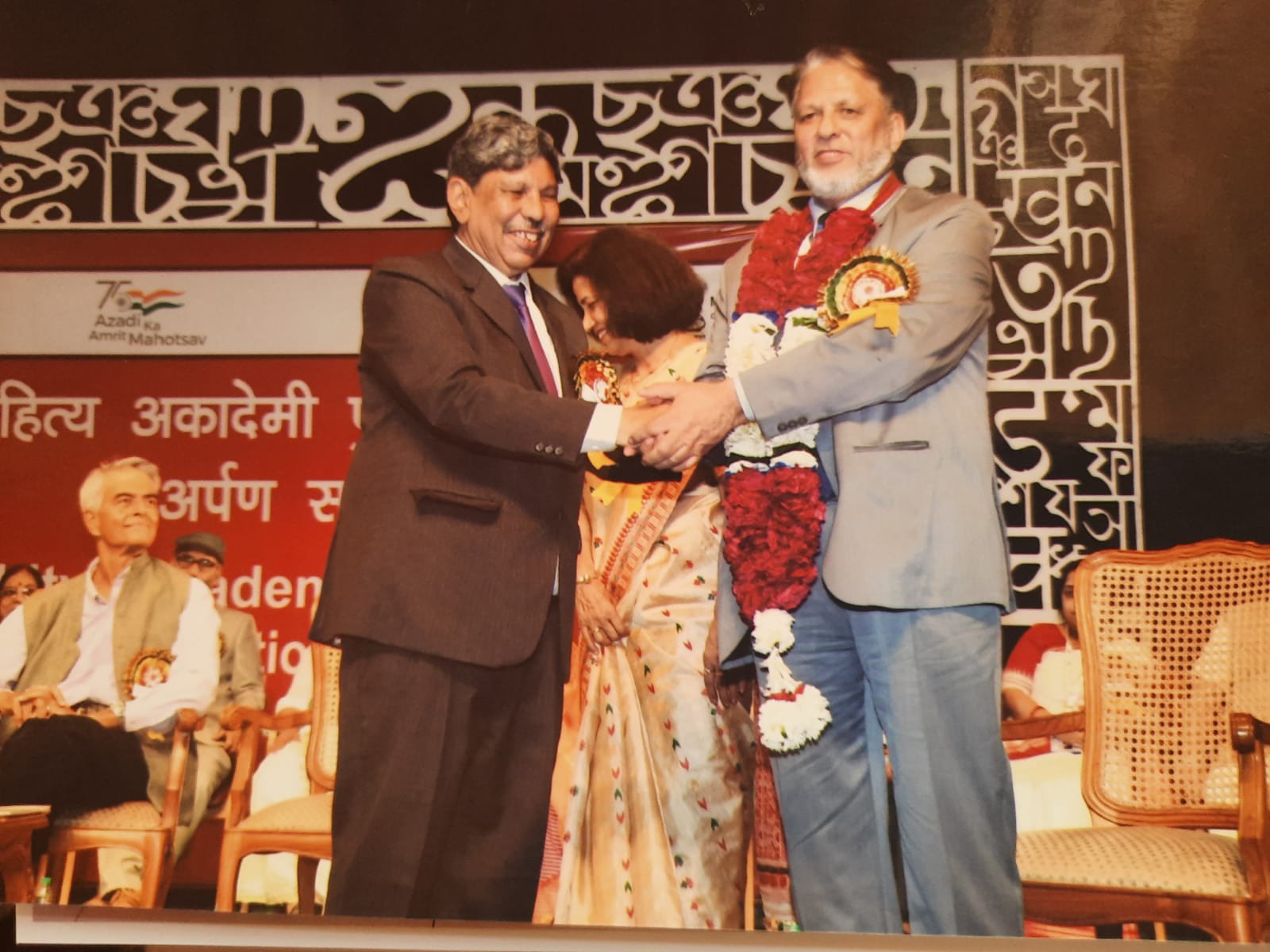
More than five decades of his journey through theatre, Radio Kashmir, Srinagar (now AIR), and teaching, his zest for Kashmiri culture through history has earned him the Sahitya Akademi award for the Kashmiri language in 2022.
The author of many books in Kashmiri and English, Bhat was also conferred with the Jammu and Kashmir State Academy of Art, Culture and Languages award in 2009. He also taught history at the University of Kashmir where he retired as Professor of History a decade ago.
He was also the Director, UGC Academic Staff College.
Farooq Fayaz Bhat receiving the Sahitya Akademy award
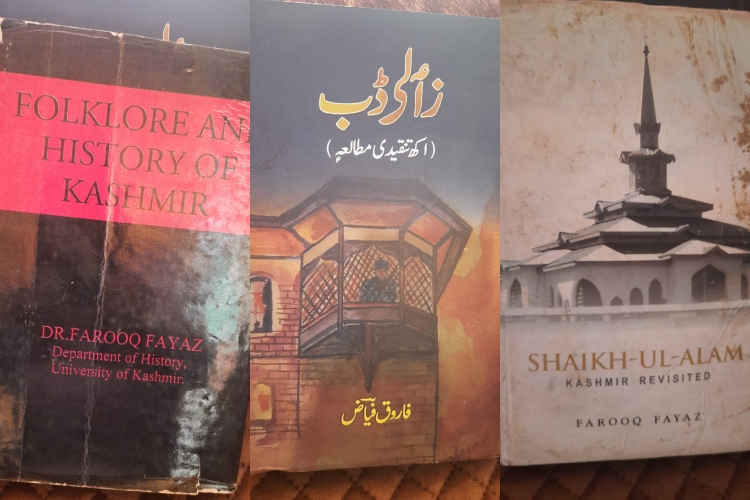
“Zael Dab, for which he received the Sahitya Akademi award in 2022, is a collection of critical essays on literary personalities of Kashmir. It was adjudged “the best book”.
“For the first time I applied a particular critical theory and it was under the wide frame of a post-modern critical theory, neo-historicism”, Farooq Fayaz said while talking to Awaz-The Voice at his residence at Kanipora on the Srinagar outskirts. “I applied this theory to examine Kashmir’s wide range of writers. It was highly appreciated in literary circles with (at least) 14 reviews published in regional and national media by eminent writers”, he said.
Farooq Fayaz disclosed that he was “working on the second edition of ‘Zael Dab’ in which more contributors would be critically examined”. He hopes to publish it next year.
One of his current projects in which he is working is the Kashmiri translation of Romila Thapar’s “Early India History”, under the aegis of National Translation Mission, Mysore. He said he has completed the work and the book is in the process of printing by the Mission of the Government of India.
Another project of “rewriting the history of Kashmiri literature”, is at the hands of the critic and author, which has been completed up to Habba Khatoon, 16th century Kashmiri woman poet.
The Jammu and Kashmir State Academy of Art, Culture, and Languages awarded Farooq Fayaz for his book “Kashmiri Folklore: A Study in Historical Perspective” (English) in 2009. The book was picked up among 100 entries for the coveted award. The awards were given away on the literary works in 14 regional languages of the erstwhile State of J&K by the then Chief Minister, Omar Abdullah at the Sher-e-Kashmir International Conference Centre (SKICC) in Srinagar.
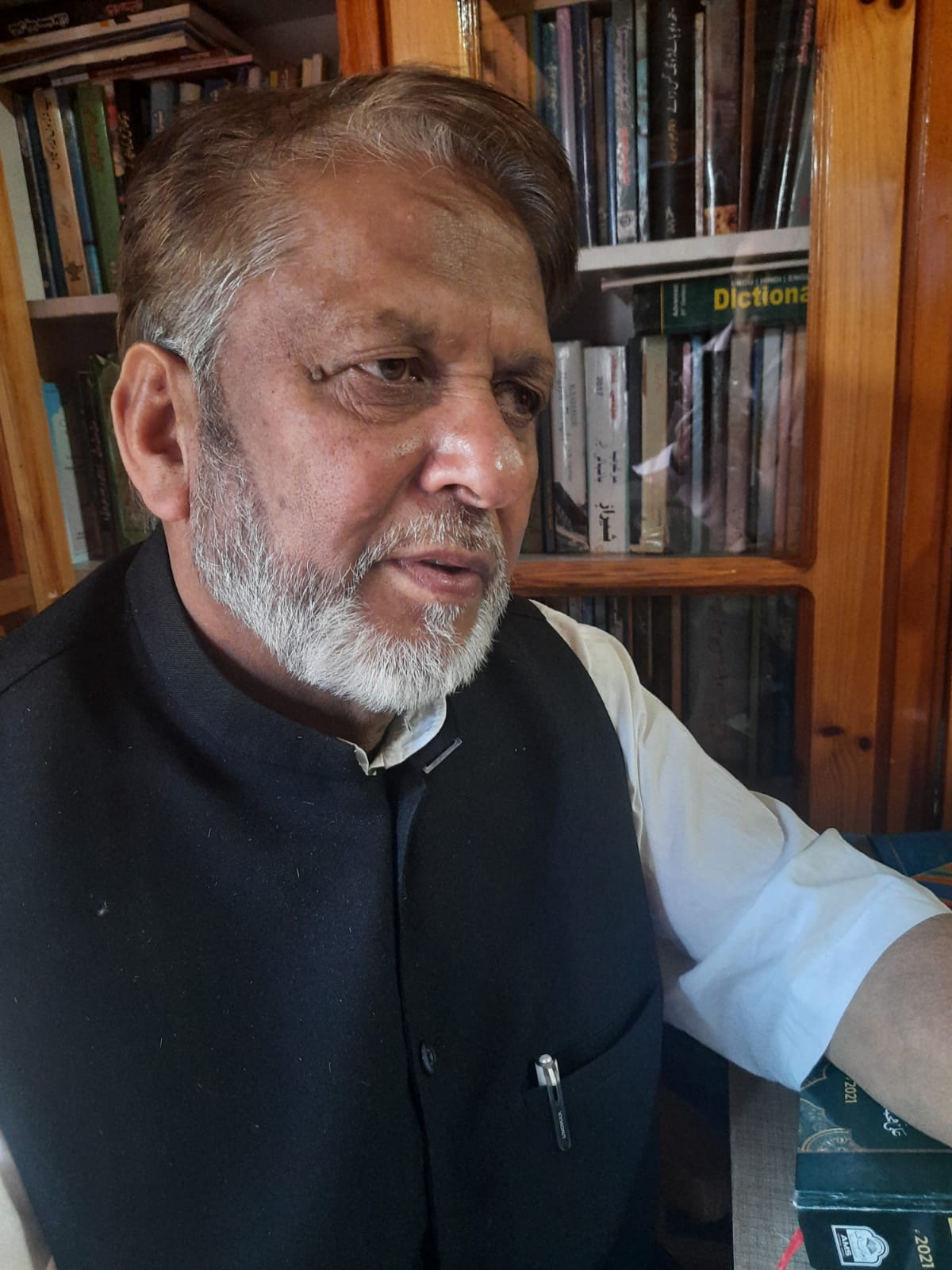
Prof Farooq Fayaz Bhat
This award-winning book was based on his Ph. D thesis under the guidance of renowned Prof Mohammad Ishaq Khan, with more additions to his work on the “Kashmir folklore as source information in an attempt to build a cultural history of Kashmir”, he said. Kashmiri folklore including “Baande paether” (street theater) and “Laddi Shah” have been the only oral evidence of folk culture in Kashmir, through which social and economic issues were being highlighted through street plays, mostly in the rural areas till the end of the last century. “Baande paether”, though being staged in some areas over the past two decades, has taken a back seat now.
Elaborating on his work, Farooq Fayaz said that the peasants, before 1947 were being humiliated and lived a hard life. “I studied and examined “Baande paether”, played by folk artists presenting their plight or torture, etc through their plays. It became a medium between the governments and the common man. I started decoding the coded language. Similarly, there is “Laddi Shah”, a story-telling musical genre, the art of traditional humorous folk singing by minstrels wandering (for alms during harvest season) from place to place. He also referred to the Wanwun, and Rauff, folk songs by Kashmiri women on marriage or other occasions, in his endeavor to build the cultural history of Kashmir.
Farooq Fayaz lamented that women were “marginalized” as there were illustrations of only 13 women who had been directly or indirectly associated with “Durbar”, adding there have been a large number of such women. “I highlighted the plight of Kashmiri women in feudal structure. How they suffered and how they have shown their miseries and plight….all these things were added to the thesis”, he said referring to the award-winning book.
His publications include (a) “Zaban Adab Te Tawareekh”(Language, Literature, and History), (b) Folklore and History of Kashmir, (c) Kashmir Folklore-A Study in Historical Perspective, (d) Zael Dab (Collection of Critical Essays), (e) Fazil Kashmiri (Monograph-Kashmiri) and (f) Ameer Shah Kreeri (Monograph-Kashmiri).
Some books authored by Prof Farooq Ahmed Bhat
Born on April 16, 1954, in Sathu Barbarshah, Farooq Ahmad who is known by his pen name Farooq Fayaz (Bhat), he got schooling at the local Government schools and the nearby SP Higher Secondary School and graduated from S P College in 1973. From early childhood, he was exposed to the “hub of theatrical activities” from the nearby Kralkhud to the Habbakadal area.
“The area was dominated by learned Kashmiri Pandits, great luminaries, having knowledge of Persian, Sanskrit (Urdu as well) theatrics and cultural activities. In the S P college, “there were teachers of eminence whose teachings influenced my passion for writing”, Farooq Fayaz said and referred to many teachers like Prof Mohiuddin Hajini, who was regarded as an authority on Arabic, Urdu, and Kashmir languages, Prof L N Dhar, History, Prof Manzoor Fazili (Political Science) and Prof Ghulam Nabi Firaq.
He was also a regular contributor to the prestigious college magazine, Pratap. With encouragement from the learned men in the vicinity and teachers in the college, Fayaz Farooq developed an “immense literary taste” and got associated with theatrical activities in and outside J&K. In the 1970s and ’80s, Radio Kashmir, Srinagar (AIR) being the “biggest attraction for writers and talented” persons, provided a platform for literary and cultural activities.
“I got motivated to work on the literary history of Kashmir and developed an interest in literature”, he said. Initially, he became a member of Rangmanch Dramatic Club, performing in J&K and also outside in Delhi, Mumbai, Kolkatta, and other places, where the audiences comprised mostly people from Bollywood.
However, his keen interest in History and language led him to pursue a master’s degree in the subject from the University of Kashmir, followed by a Diploma course in Kashmiri language at the newly set up Department (Later, PG Deptt) of Kashmiri at The University of Kashmir. Having served as a school teacher for about five years, Farooq Fayaz, also worked as a Translation Executive at Radio Kashmir, Srinagar from 1989 to 1992. He joined the Department of History as a Lecturer in 1992 and superannuated as a Professor at the University of Kashmir in 2014.
source: http://www.awazthevoice.in / Awaz, The Voice / Home> Story / by Ehsan Fazili, Srinagar / May 29th, 2024
Begum Gulbadan’s Humayun-nama, a remarkable chronicle of early Mughal life in India is the only work written by a woman in Muslim courts of Ottoman, Turkey, Iran and India.
An early Mughal princess
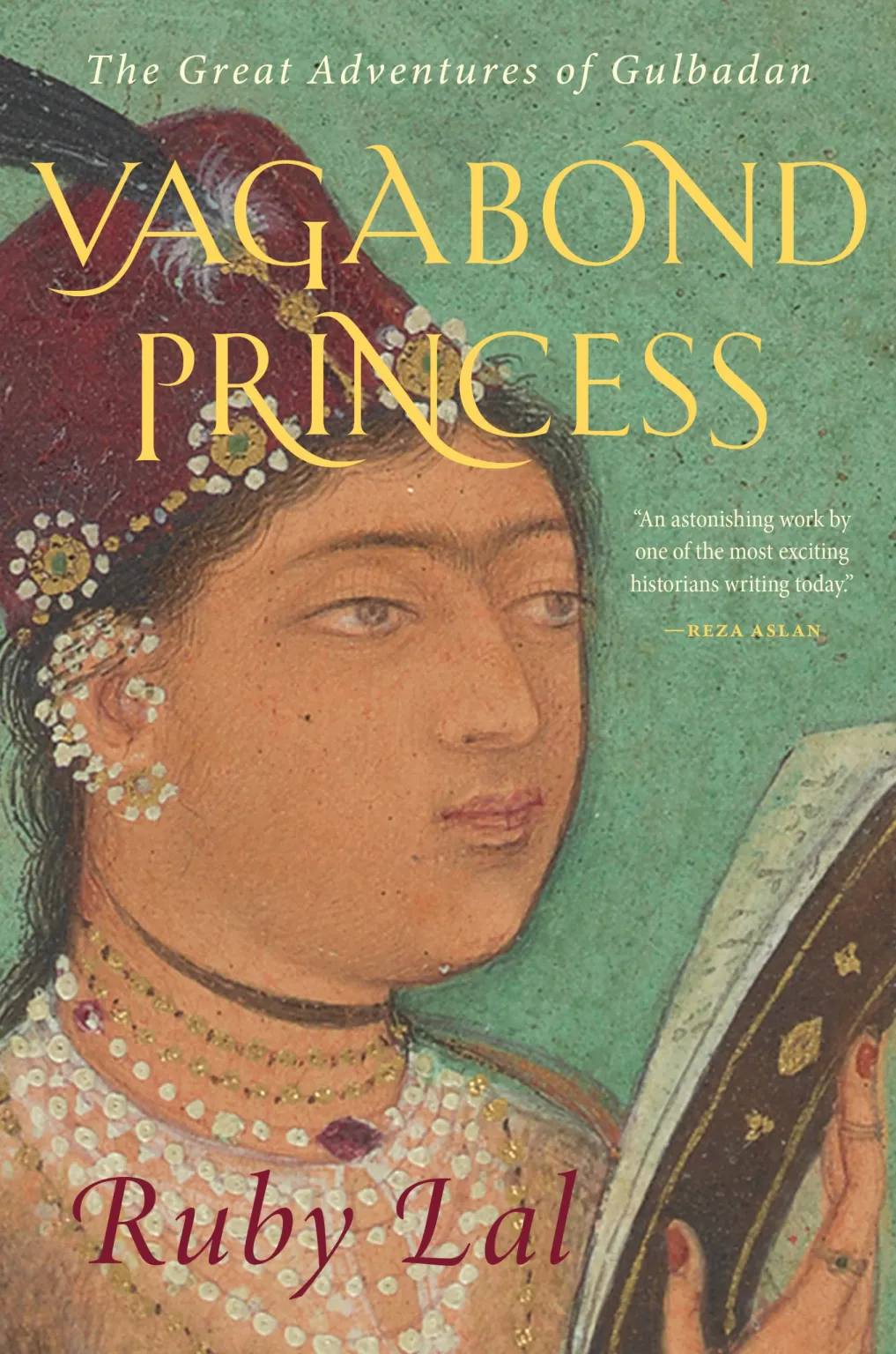
The Vagabond Princess by Professor Ruby Lal is a captivating historical biography of an early Mughal princess. Even though this is a work of meticulous historical research, it is an adventure tale and a travel narrative with a female protagonist which provides as much entertainment as any work of fiction. The real wonder of this book is that it’s a true account of a real woman, Gulbadan Begum, who lived from 1523 to 1603.
The author Dr. Ruby Lal is a Professor of South Asian history at Emory University in Atlanta who wrote The Astonishing Reign of Nur Jahan (2018)which was a Los Angeles Times Book Prize finalist.
While her previous book concentrated on a later Mughal queen who was as powerful as her husband the Mughal Emperor Jahangir, this work focuses on an early Mughal princess whose contribution is not so much to statecraft but to memorializing through her writing the formative years of the Mughal Empire in India.
The life of Gulbadan
As the title suggests, Gulbadan’s life was one of astonishing journeys that very few others had undertaken in the sixteenth century. She was a beloved daughter of Emperor Babar, the founder of the Mughal dynasty in India. At the age of six, she undertook an arduous journey with her Mughal relatives from Kabul in Afghanistan to Agra, where her father had established his new capital. This journey took her across the Khyber Pass, a treacherous mountainous gap that allowed an entry point into India.
Once in Agra, she reunites with her beloved father and grows up in the new country of Hindustan, amid a plethora of languages, her native Turkish, Persian, and the emerging mixed tongue of Hindavi in India. Even when it seems there is a modicum of stability, her father Babar’s life is suddenly cut short when he prays for the survival of his son and heir Humayun and participates in a ritual where he barters a part of his own life to save his son.
The untimely death of Babar is a shock for Gulbadan, but even more disconcerting are the rebellions by various half-brothers who periodically betray their allegiance to Humayun, her half-brother who ascends the throne.
A Mughal dynasty
Humayun’s reign becomes even more tenuous when he faces military challenges led by the Afghan ruler of Bihar, Sher Shah Suri, who defeats Humayun in Chausa in 1539 and Kanauj in 1540, forcing him into exile in Afghanistan. These changing vicissitudes of the Mughal dynasty force Gulbadan into a peripatetic existence moving back to Kabul and then returning again to Hindustan after Humayun recaptures Agra. During the years of his exile from India, Gulbadan witnesses Humayun’s marriage to his favorite wife Hamida who gives birth to their future heir Akbar, and who also becomes a close friend of Gulbadan.
Akbar’s ascension to the throne marks a shift in Gulbadan’s personal life. In her early life, she had lived in gardens and tents and had traveled freely. With the growth in Akbar’s stature, Mughal women were consigned to the enclosed quarters of the harem in Fatehpur Sikri. While this was a mark of the rising prestige of Akbar, the Emperor, it was not a particularly pleasing option for his aunt, Gulbadan. Even though she is a mother and a senior advisory figure in the harem and also highly regarded by Emperor Akbar as a writer and memory keeper of her clan, she is increasingly restless by her confinement in middle age.
A pilgrimage to Mecca
Gulbadan successfully petitions Akbar to allow her to embark on a holy pilgrimage to Mecca and Medina with the women of the harem. This is a formidable journey, even with Akbar’s support. First, the Mughal contingent arrive in the port city of Surat where they wait for the Portuguese to approve their passage as they have a monopoly over shipping routes. After much negotiation, and payment of requisite fees, two Mughal ships set sail for the haj pilgrimage. Lal provides a detailed account of the journey across the Arabian Sea, Indian Ocean, and the Red Sea to arrive at the port of Jeddah, from where the party travels to Mecca. At Mecca, they are able to complete all the rituals associated with the Haj including the lavish giving of alms to the poor. The party then proceeds to Medina and completes the rituals of worship particular to that city as well.
Gulbadan and her associates do not return to Hindustan after completing the Haj but stay on in one of the elite neighborhoods of Medina. After some time, they attract the criticism of the Ottoman Sultan Murad III, who issues orders of expulsion for Gulbadan and her group. Lal suggests that the lavish giving of alms, made possible by the immense wealth of Akbar and the Mughal Empire in a way threatened the sovereignty of the Ottoman Sultan.
The Humayun-nama
On her return journey by sea, Gulbadan faces being shipwrecked but escapes with her life and seeks refuge in Aden. Unlike Mecca, the authorities in Aden are not hospitable or courteous. She is relieved to return home where she commands the respect of men and women as someone who is a haji or who has accomplished one of the pillars of the Islamic faith: pilgrimage to the Prophet’s birthplace. Once settled in Fatehpur Sikri, Akbar commissions her to write a biographical sketch of Humayun. Gulbadan accomplishes this task with great finesse. Her book is an outstanding primary source document about the condition of life during the Mughal era in India.
The narrative begins with Lal’s examination of Gulbadan’s book Ahval- i- Humaun Badshah (Conditions in the Age of Humayun Badshah), at the British Museum in 1997. This is the only extant copy of this commissioned work that Gulbadan authored, but Lal soon realizes that the manuscript is incomplete, and it does not touch on her pilgrimage to Mecca or her life after the return. It is this gap that Lal seeks to fulfill in her research, trying to reconstruct events that happened during the pilgrimage including her group’s expulsion.
First female chronicler of Mughal life
As she recreates the life of Gulbadan, Lal reminds us that her work, popularly called Humayun-nama, is the only prose work written by a woman in Muslim courts including Ottoman, Turkey, Iran, and India. Gulbadan is a remarkable witness and chronicler of early Mughal life in India. Moreover, her life defies notions about women being constrained by Islamic institutions of purdah. Gulbadan did not accept the confinement of the harem and sought out travel to the holy cities of Arabia, appearing publicly to give alms to the poor.
Even upon her return she adopted the role of official historian and was not limited to traditional roles of wife and mother in the harem. At a time when the National Council for Educational Research and Training (NCERT) is reducing Mughal history content in school history textbooks in India, it is all the more important to continue bringing the lives of Mughal women to the attention of the world. Ruby Lal has succeeded in giving us a biography of an extraordinary life that women in the twenty-first century in India and the world can draw inspiration from.
The Vagabond Princess: The Great Adventures of Gulbadan by Ruby Lal Yale University Press, February 2024.
source: http://www.indiacurrents.com / India Currents / Home> Books> Culture / by Lopamudra Basu / April 10th, 2024
A new biography examines the life and work of one of the most acclaimed modern Urdu poets.
The Call of Unknown Destinations
Phir kahin khwaab-o haqiqat ka tasadum hoga Phir koi manzil-e benaam bulati hai hamein
Once again, a conflict between dreams and reality will rage somewhere Once again, some nameless destination calls out to me
Naya Din Naya Azaab
Sard shakhon pe os ke qatre Hain abhi mehv khwaab aur sooraj Rath pe apne sawaar aata hai
A New Day A New Calamity
Drops of dew on cold branches Are still immersed in their dreams when the sun Comes riding on his chariot
A new kind of poetry began to be written under the influence of the progressives. It loosened the hold of tradition and opened the way to new subjects and styles. From the 1940s new experiments were being conducted in Hindi prose and poetry and the Urdu writer was neither unaware nor unaffected by them; it was much the same in Hindi. Despite the jingoistic nationalism that projected the cause of Hindi and the zeal with which language chauvinists promoted one language along with its literature and respective literary culture, at the expense of the other, there were still some spaces where Urdu and Hindi writers met and interacted.
Aligarh, with its robust Urdu and Hindi departments, had healthy interactions between their respective faculty and several common platforms where writers and teachers of both languages met and exchanged ideas. In fact, the microcosm of Aligarh reflected the situation at the pan-Indian level, that is, of concurrent movements in Hindi and Urdu which prove that the ideas that propelled these movements were collective and widespread rather than unique and localised to individual languages and their respective literary cultures. And, if not mirror images, the Urdu and Hindi literary landscape displayed sufficient similarities to point to a commonality of concerns and inspirations in the years leading up to the 1960s when Shahryar begins to find his poetic voice.
The publication of a slim volume of Hindi poetry, TaarSaptak (1943), opened the door to a new wave of experimentation (prayogvaad) which, in turn, laid the foundation of the nayi kavita (new poetry).
Taar Saptak contained the poetry of seven young poets: Agyeya, Muktibodh, Shamsher, Raghuvir Sahay, Sarveshwar Dayal Saxena, Kedarnath Singh and Kunwar Narain. All seven were firm in their belief that (i) they belonged to no “school” of poetry, (ii) they were merely fellow travellers along the same road, who had differing opinions and worldviews, and (iii) they had not reached a destination or arrived at any grand conclusion; the journey was their destination.
In fact, Agyeya, the compiler of the anthology, went so far as to say that his fellow contributors consider “poetry a subject of experimentation” and that they were “explorers of new ways”. This “new” poetry turned out to be new in both form and content. The Saptak poets – and others who came under their mesmeric, insistent spell – were caught up with the need to convey a deeply-felt, intensely personal, emotional experience.
This resulted in the evolution of startlingly new metaphors and images, radical experiments in form and content, new rhythms and sound patterns that were meant to reflect harsh new truths and the deliberate use of laconic, abstruse even occasionally dense images and ideas. The entire process – spanning close to two decades – bore spectacular fruit by the 1960s.
Elucidating the commonality between the concerns of the Hindi and Urdu poets of the 1960s, especially those who came in the immediate aftermath of the progressive upsurge, Manglesh Dabral, Hindi writer and poet, notes:
“In fact, poetry, both in Urdu and Hindi, of and after the 1960s carries the melancholy, irony and sadness of its time with a ‘pessimism of the mind and an optimism of the heart’, as famously put by the Italian Marxist philosopher Antonio Gramsci.”
The waning of the progressive movement coincided with several other factors that plagued the body politic all through the 1950s and 1960s: disillusionment with the fruits of independence, simmering communal tensions, rampant corruption and unemployment, increasing scepticism about the very idea of freedom, in fact, a fast-eroding faith in any form of organised belief system be it religious, political or intellectual. The nayikavita in Hindi and the jadeed shairi in Urdu were the result of this manthan or churning in the post-1947 India.
While acknowledging Shahryar’s closeness to the Hindi department in Aligarh, especially its most charismatic teacher Kunwar Pal Singh, Prem Kumar, who taught at a college in the City, Ravindra Bhramar, who was a distinguished poet and teacher in the Department of Hindi, and Neeraj, the pre-eminent Hindi poet of Aligarh who, no matter where he worked, always returned home to his perch in the city, the eminent Urdu critic Gopi Chand Narang however feels Shahryar possibly benefitted more from early models of modernist poetry available in Urdu itself, such as Majeed Amjad, Nasir Kazmi, Muneer Niyazi and the young Turks of the “new wave”. Then there were the French models, the symbolists who had influenced NM Rashid and whose influence was plentifully available in Urdu through some spectacular and image-laden poetry, as well as Ezra Pound and TS Eliot.
Narang mentions the small leftist group lead by Maqsood Rizvi and the influence of Munibur Rehman, poet and teacher, on an entire generation of young men at Aligarh. Shahryar was at the fringes of almost all “left” activity in Aligarh – from his student days, as well as when he was a member of the staff and then again post-retirement till his death. The campus leftists regarded him as a fellow traveller – as one sympathetic to their cause if not exactly one of them, technically speaking, that is. Narang puts it well when he says, succinctly enough, “Shahryar’s urge was inner and his own”.
Poetry, Shahryar believed, must necessarily have an element of music. Without music there can be no poetry and like music, poetry too must follow some rules and principles. Above all, like music, poetry must have rigour.
While it is easy to say that poetry, and music, come naturally to those who are gifted, Shahryar maintained that even the gifted must follow certain rules and regulations if they are to be true to their gift. Mere practice is not sufficient to become proficient as a poet. For a seed to sprout, the soil it is planted in must also be fertile. Also, any seed will not sprout in any soil – no matter how much you may plough it or water it or add nutrients. It might appear as though anybody with any imagination can produce a creative work, but that is not so. Everyone cannot marshal the ideas produced by their imagination, organise them into a coherent and meaningful manner and present them in a way that is pleasing or new. Nor can everyone gather together scattered ideas and thoughts in a way that is startling. The primary function of any art form is to surprise; it is the most magical effect that art can produce.
Shahryar held tradition in great regard. Possibly because he had come through the rigour of a formal and exhaustive education – including a PhD under the exacting early supervision of a teacher such as Ale Ahmad Suroor as well as the guidance of a scholar such as Azmi – that too at a university such as Aligarh’s whose Urdu department boasted some of the finest academicians and greatest connoisseurs of urdu zubaan and tehzeeb. Unlike many of his contemporaries in the new wave of poetry that came in the wake of the progressive upsurge, Shahryar was never one to cock a snook at the centuries-old legacy that the modern Urdu poet had ready access to. He believed that tradition could teach the nuts and bolts of poetry and especially the ghazal, for the tools of Urdu poetry have remained largely unchanged while the outer appearance has changed as has its vocabulary. The manner of crafting a ghazal – a bit like “pouring” ideas into a mould or wine in a bottle – has remained largely the same since the genre of the ghazal was first perfected by masters such as Mir and Sauda.
Like cooking, which Shahryar enjoyed enormously, poetry too was a matter of getting the ingredients right. The metaphors, symbols, abstractions need to be in the right proportion; excess or want can make all the difference between magical and mundane. And just as in cooking, there is that indefinable element called haath ka maza (its literal translation “the taste of the cook’s hand” does not come close to doing justice to its meaning), so also with poetry. The form of the ghazal does not allow much deviation and the vocabulary too is constrained by metre and rhyme; yet, within these time-honoured constraints, the master ghazal-go can produce magic when the reader exclaims with wonder at something that touches his/her heart. Ghalib expressed it best when he said:
Dekhna taqreer ki lazzat ki jo uss ne kaha Maine yeh jaana ke goya yeh bhi mere dil main hai
Look at the deliciousness of speech that when [s]he spoke I felt as though this too lies within my heart
Good poetry can indeed make the reader feel “I could have said this” or “This is exactly how I feel”. And when that threshold is reached, Shahryar believed, the real aesthetic experience happens which is essentially a mystical communication between the writer and the reader or the reciter and the listener.
Shahryar was averse to extreme topicality in poetry. For literature to pass the test of time, he believed, it must contain something within it that would live beyond the here and now. In this he differed from the progressives, especially the more ideologically-driven progressives, who wrote on intensely topical subjects and whose works acquired the tag of waqti adab (topical literature).
As Shahryar said in an interview, it is not important how many poems are written on Korea; instead, what is important is how many good poems we remember being written on Korea. The undue importance being given to mauzu (topic) and maqsadiyat (purposiveness), he believed, was one of the reasons for the decline of the progressive movement:
“Purposive literature must necessarily contain the known and familiar; it has no scope for new experiments. It must have common thoughts, common feelings, and so on. Naturally, therefore, it can only accommodate general things about people, not individuals.”
Making his own position vis-à-vis art and life amply clear, Shahryar was at pains to establish the importance of life in the centuries-old Art vs Life debate – Adabbarai Adab (Art for Art’s Sake) and Adab barai Zindagi (Art for Life’s Sake):
“I believe in having respect and regard for all forms of Art on the express condition that Life – in all its myriad glory – must be present in Art. If such a situation arises whereby I am forced to choose between Life and Art, I will choose Life. Poetry is nothing more than this for me…With the coming of the English we Hindustanis discovered that literature holds a mirror to society and a valuable tool for social change. And ever since then we have all, in our own way, been doing this work. Every now and then some of us have declined to – and declined most vociferously – to perform this role.”
Among his seniors, Shahryar has acknowledged the influence of Faiz Ahmad Faiz, Miraji, Muneer Niyazi, Akhtarul Iman; but among his contemporaries his own poetry was likely to have commonalities with Zafar Iqbal, Nasir Kazmi, Ahmad Mushtaq, Muhammad Alvi, Salim Ahmad because they had possibly read and been influenced by the same sort of people he had. In India, he regarded the ghazals of Hasan Naim, Khalilur Rehman Azmi and Shaz Tamkanat as being among the finest – both in terms of technique and content.
However, Gopi Chand Narang offers us another way of seeing Shahryar and viewing him alongside his contemporaries. For one, he doesn’t believe one should necessarily go by how a poet assesses himself with regard to his peers. In his opinion, a poet’s views about himself can be discussed but should not be taken at face value. Narang goes on to say how “all poets, including Ghalib or Mir, try to play safe … they may exaggerate or deconstruct. There is always a crisscross of influences…”
Narang is also willing to speculate that since Azmi was the earliest mentor, his must have been the earliest influence on Shahryar’s poetry and it is possible that Shahryar chose to list Shaz Tamkanat and Hasan Naim rather than Azmi as the two were indeed current in those days and he might even have liked their works. But Narang himself is of the opinion that there is no trace of either Tamkanat or Naim in Shahryar; the two score in terms of craft but little else, whereas Shahryar “speaks in his own voice, an authentic voice. There is no trace of even Mir or Ghalib what to speak of Tamkanat.” Though Narang goes on to concede, “there may be a bit of Nasir Kazmi or Muneer Niyazi…They were the poets of their age. Muneer in his own natural way of wonder and awe viz a viz the onslaught of urban culture and Nasir Kazmi, via Firaq Gorakhpuri, rediscovered the painful and lonesome voice of Mir.”
But Shahryar’s creativity, Narang insists, was his own. Even if he wanted, Shahryar could not go the way of Nasir Kazmi or Muneer Niyazi. Shahryar interacted with them just as he did with his other contemporaries and fellow poets at mushairas and nashists but “once he had found his voice he was content and hardly looked around.” (emphasis mine.)
So, was Shahryar a progressive? Or was he modernist? This question has vexed many, for while he started writing poetry and gaining recognition as a poet when the modernist movement was gaining momentum, Shahryar himself was at pains to establish his socialist-Marxist credentials.
We have already established that when it came to the crunch, in a debate on Art for Art’s Sake vs Art for Life’s Sake, Shahryar could not have aligned himself with the former. Asked if poetry can afford to be wilfully self-referential, his answer was equally unequivocal: “There can be no poetry without the self.” But he was also quick to clarify:
“At the same time, no one can be expected to be interested in the purely personal details of other people’s lives, in the joys and sorrows of others. Some poets have tried to do that, for instance Akhtar Shirani wrote poetry that was intensely romantic yet extremely personal. But that has never appealed to me. I have a Marxist world view. I believe in the social and political commitment of literature. You may not always find direct references to my worldview in my poetry. But you will find them in the oblique and the symbolic.”
Asked if poetry must necessarily have a social commitment, a framework within which it must be located and a frame of reference that is accessible to all its readers, Shahryar’s answer became more general. All good poets, be it Iqbal or Faiz, he said, speak of the world, to the world. And then he tossed a “googly” at me when I was least expecting it by declaring: “In some respects, Faiz is a greater poet than Iqbal precisely because he is more human, more interested in all humanity and not one community or group.” This one seemingly offhand statement, possibly made on the spur of the moment, seems to contain the kernel of Shahryar’s own poetic vision and holds the key to understanding his perception of a poet’s role in society.
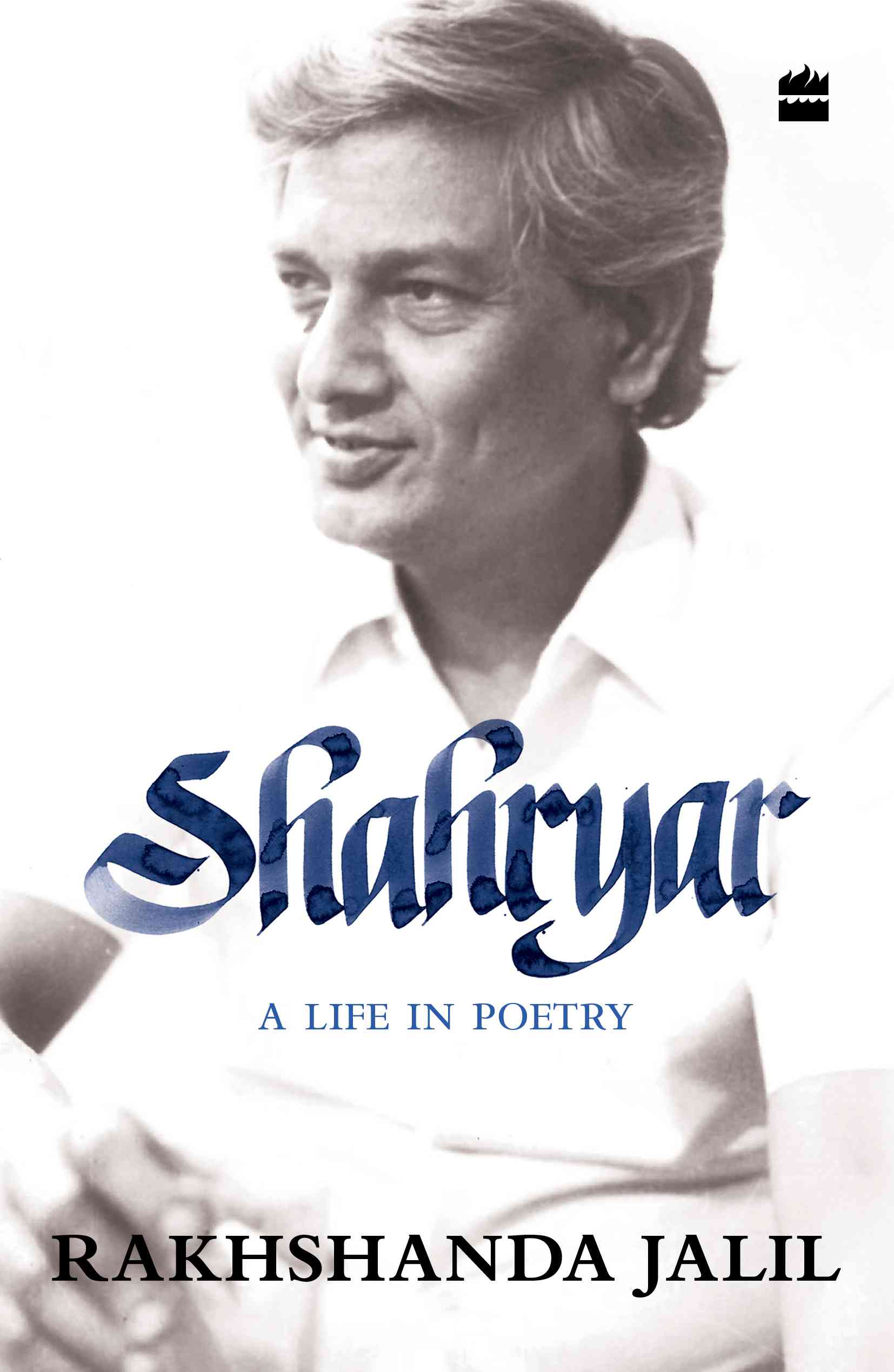
Excerpted with permission from Shahryar: A Life in Poetry, by Rakhshanda Jalil, HarperCollins India.
source: http://www.scroll.in / Scroll.in / Home> Book Excerpt / by Rakshanda Jalil / August 24th, 2018
Aligarh, UTTAR PRADESH / Murshidabad, WEST BENGAL :
Aligarh:
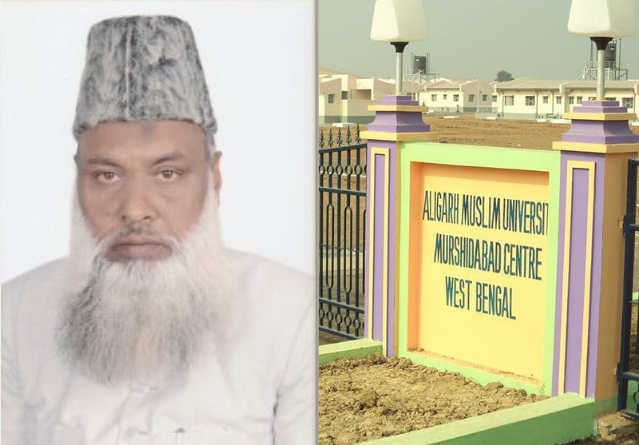
Dr. Mahboobur Rahman, Associate Professor in the Department of Sunni Theology at Aligarh Muslim University (AMU), has been appointed Director of the AMU Murshidabad Centre in West Bengal. His term will last for one year or until further orders or the convening of the General Selection Committee.
With over two decades of experience in teaching and research in theology, Dr. Rahman has been associated with AMU’s Department of Theology and has also taught at Senior Secondary School (Boys). His teaching portfolio includes a range of subjects such as Islamic culture, Quranic exegesis, Indian religions, sciences of Prophetic traditions, Islamic history, jurisprudence, and social sciences.
Dr. Rahman has authored two books, one of which is co-authored with Prof. Muhammad Ismail from the Department of Islamic Studies, and has published more than 50 research papers and articles in renowned national and international journals.
He previously served as Nazim-e-Deeniyat (Sunni) from 2012-2018, was Joint Editor of Fikr-o-Nazar, President of the Theological Society at AMU, and has been a member of several administrative bodies within AMU and beyond.
source: http://www.radiancenews.com / Radiance News / Home> News> Report / by Radiance News Bureau (headline edited) / October 26th, 2024