Category Archives: Business & Economy

Medical tourism explored in first forum

Quality care stepping stone for medical tourism

Dubai:

The Dubai Health Authority (DHA) has rolled out the first phase of the medical tourism pacakges which caters to the domestic market.

UAE residents and those already in the country such as delegates to the conference can avail of discounts of up to 70 per cent in areas such as wellness, weight loss, dentistry, orthopaedics, breast cancer screening and fertility treatments. The domestic packages do not offer visa and hotel stay.

Delegates from around the globe attended the first day of a two-day inaugural health regulation conference in Dubai which looked at major efforts by Dubai to become a medical tourism hub.

Medical tourism packages aimed at tourists will be rolled out soon, marking the second phase. A host of partners such as DHA, Dubai Tourism and Commerce Marketing (DTCM), and members of the private health-care and hospitality sector, among others, are working in tandem to make this possible shortly. These packages will be made available to DTCM-approved tour operators who will be allowed to market these.

According to Dr Layla Marzouqi, acting head of DHA’s health regulation committee, everything has been worked out and the second phase of the medical tourism packages will become a reality in the coming months.

One of the ideas explored was plans by Dubai health authorities to rate hospitals similar to the hotel industry which bases gradings on customer service and satisfaction.

Public-private partnerships are also seen as key to unifying efforts to draw investment to new projects that will attract those interested in medical travel, said experts examining the issues in panels and workshops.

Eisa Al Maidour, DHA Director-General, inaugurated the conference which has drawn more than 1,000 professionals from the field of health regulation and medical tourism and key stakeholders in the public and private health care sector.

Other stakeholders such as pharmaceutical companies and health care providers are also attending.

Enhancing the quality of health care to augment medical tourism was discussed, said the director-general in his inaugural speech.

“Health regulation is fundamental to achieve quality health services and protect patient safety; a strong health regulatory system leads to sustained growth of the health sector which in itself is a catalyst for medical tourism. This conference provides an opportunity for stakeholders to discuss the latest advances as well as share their experiences in the field of health regulation and medical tourism,” he said.

How public private partnerships could promote investment and take medical tourism to the next level is key, he added.

Dr Layla said, “Public private partnerships (PPP) are a very important concept in medical tourism in all the countries that have a robust health sector. In India, for example, it is the private sector which is partnering with the government to strengthen the infrastructure while the government is ensuring quality control, thus complementing each other. In the UAE we are very aware of this as more than 70 per cent of our hospitals are in the private sector. In Dubai, out of the 20 hospitals we have only four are government. Of the 2.700 health-care facilities in the emirate, only 17 are government. We want the private sector to collaborate with us, come forward with investments and take medical tourism to the next level.”

Dr Layla said that DHA’s health regulation department was in the process of creating a grading protocol for hospitals where hospitals would have hotel-like gradings beginning from five-star based on certain criteria.

“The most important criteria is that of quality health care. This will cover the quality of doctors and other health-care professionals at the hospital, the number of surgeries carried out, the incidence of surgical errors and the number of customer complaints. The next criteria was of ambience which will take into account patient care, the presence of a translator, food and nutrition facility to support the needs of the patient, among other things,” she said.

“The focus of medical tourism is good quality and reasonable pricing. The regulation department will work closely with the funding department to determine the prices that graded hospitals can charge and we will make sure we freeze those. If a hospital is found lowering its standards, it will not be able to increase its prices and that will create healthy competition among such facilities,” she said.

Dr Azad Moopen, Chairman and Managing Director of Aster and DM Healthcare, said his group was keen to take up PPP projects and added that the private sector needed to raise the bar on quality health care and make investments in good doctors to attract medical tourists.

His organisation, he said, was ready to work with DHA to bring those standards to the emirates.

“There are three main reasons why people around the world seek medical travel. They are looking for expertise that is available, the cost of the procedure and the turnaround time to carry out the procedure. If we can provide them with high-quality medical care at reasonable costs and within a short period of time, it will attract people from around the world.” He recommended that the private sector needed to focus on further increasing the number of hospitals, specialist medical centres, hospital beds, diagnostic centres and pharmacies, state-of-the-art surgical and trauma care facilities, wellness and cosmetic care centres along with introduction of cutting-edge medical technologies.

Dr Jameel Ahmad, Managing Director of Prime Healthcare Group, felt PPP was a welcome move, benefiting both the public and private sector. “We are ready for this kind of a collaboration as we tie in the concept of hospital and hospitality very well, being situated next to two major hotels and the Dubai airport. We are in a position to offer medical tourism packages in the area of orthopaedics, sports medicine, dentistry and cosmetic surgery,” he said.

source: http://www.gulfnews.com /  Gulf News / Home> UAE> Health / by Suchitra Bajpai Chaudhry, Senior Reporter / October 22nd, 2014
Khadi Utsav 2014 begins

KhadiMPOs27oct2014

Mysore :

District in-Charge Minister V. Sreenivasa Prasad inaugurated Khadi Utsav-2014 organised by Department of Industry and Commerce and Karnataka State Khadi & Village Industries Board at Nanjaraja Bahadur Choultry yesterday.

A total of 62 stalls have been erected at the Khadi Utsav which will be held till Nov. 3. Apart from our State, Khadi and Village Industries Board has given opportunity to khadi organisations from other States and NGOs to participate in the Utsav. The stalls are open from 10 am to 7 pm every day.

MLAs Tanveer Sait and Vasu, ZP President Dr. B. Pushpa Amarnath, Mayor R. Lingappa, Karnataka State Khadi & Village Industries Board Development Officer K. Sampath Kumar, District Khadi & Village Industries Officer H.S. Kamathraj and others were present.

‘Don’t you have other work?’: District Minister Sreenivasa Prasad got furious over a senior citizen’s request to close the potholes on road in the city. Reacting to the request, Prasad questioned the senior citizen saying he had asked a wrong question at a wrong place.

“We have given Rs. 10 crore for closure of potholes in city. What more do you expect us to do. Don’t you have any other work to do? Wherever we go the same question is asked,” the Minister said.

source: http://www.starofmysore.com / Star of Mysore / Home> General News  / Tuesday ,  October 21st, 2014

Workshop on ‘ Innovation Management & Intellectual Property Rights ’ at BPBIM


V. Raghu Ram, Consultant- Corporates, Academic and Research Institute, is seen addressing the gathering at BPBIM in city this morning.

Mysore :

Bhavan’s Priyamvada Birla Institute of Management (BPBIM), Bharatiya Vidya Bhavan (BVB), Mysore, in association with Vishvesvaraya Trade Promotion Centre (VTPC), Government of Karnataka, had organised a day-long workshop and sensitization programme on ‘Innovation Management and Intellectual Property Rights’ this morning at BPBIM Auditorium in Vijayanagar here.

N. Ramanuja, Chairman, Bharatiya Vidya Bhavan (BVB), Bangalore, in his inaugural speech, said: “The library of BPBIM, Mysore, is open to MBA students of all colleges of Mysore. We have around 18,000 books in our library and students can make use of the library.”

The chief guests were Dr. Rama Murthy, Professor, Jain University, Bangalore and V. Raghu Ram, Consultant-Corporates, Academic and Research Institute.

The guest of honour Shariff, Deputy Director, VTPC, Bangalore, who spoke about Export Business, invited the students to his office in Bangalore and said: “VTPC will provide financial assistance to the students for attending International exhibitions and trade fairs.”  Raghu Ram, who gave a presentation on ‘Innovation Management,’ said: “Innovation is the transformation of knowledge to money.” A large number of students took part in the workshop and sensitization programme.

A.V. Narasimhamurthy, Chairman, BVB, Mysore, Sampath Iyengar, President-Emeritus, NIE Group of Institutions, Prof. B.M. Shankar, BPBIM and others were present.

source: http://www.starofmysore.com / Star of Mysore / Home> General News  / Monday ,  October 20th, 2014

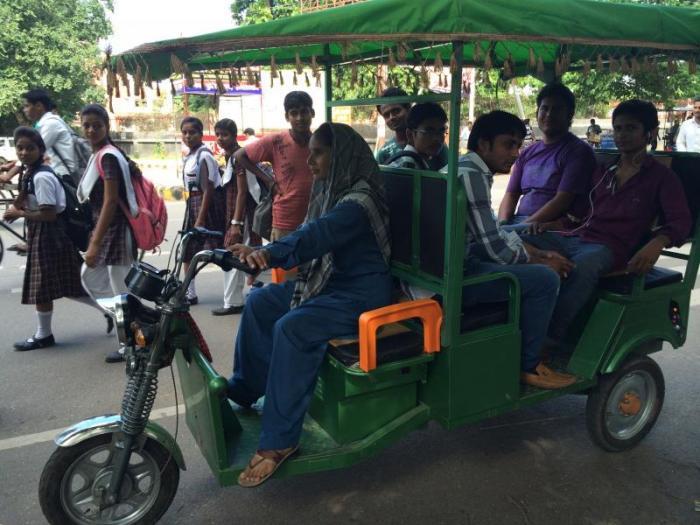
Meet Tabassum Bano – the first female e-rickshaw driver of Allahabad

Tortured by her in-laws for dowry, Tabassum was thrown out of the house with her six months old son, she decided to not give up.

Tabassum Bano riding the e-riskshaw  - Mohammad Anas
Tabassum Bano riding the e-riskshaw – Mohammad Anas

Tabassum Bano decided to fight and not surrender despite facing so many hardships some years back. She had been tortured physically and mentally by her in-laws for dowry, she was thrown out of the house with her six months old son, but Bano didn’t give up. She braved all the difficulties and challenges of her life. Confident and self dependent, Bano has set an example of courage as the first female e-rickshaw driver of Allahabad.

“I came to Allahabad in the year 2005. My family lives in a small village Narsimhagarh in Pratapgarh. One year after marriage, my in-laws started torturing me for more dowry. My son was just six months old at that time. One day they even took my clothes off and threw me out of the house. Tired of their torture, I had even thought of committing suicide, but my child gave me the reason to live and fight,” Bano broke into tears as she narrated her life story to iamin.

“Finally, I decided to get divorce from my husband and made up my mind to come to Allahabad and start a new life. With just two rupees in hand and my son in my arms, I began my journey from Pratapgarh by foot and reached Allahabad after walking 50 kilometres. Once when I wa at new Yamuna bridge, out of hunger, my son started crying uncontrollably and I became restless and helpless in this unknown city. An old man saw us and brought us to Sister Sheeba Jones. My life changed since that day,” said Bano who lives in a rented room at Teliyarganj colony in Allahabad with her son.

Bano gives the credit to Sister Sheeba for changing her life. “Sister Sheeba first taught me how to ride a scooty and then four-wheelers.” Besides riding the e-rickshaw, Bano also works as a maid in houses to bear her expenses of her family members.

Yes, apart from her own son, Bano is taking care of six other members of the family. “After my brother-in-law’s death, I took care of my sister and her three children. My brother died in the year 2011 and his daughter is also my responsibility. There is no male member in our family. I take care of my old mother too,” said Bano.

Besides work, Bano who was an illiterate before coming to Allahabad started studying and cleared class X examination. Her son Abdullah studies in a reputed English school in the city. “I want a better life for my son so, I work hard to send him in a good English medium school.”

Sharing her experience as a female e-rickshaw driver, Bano asserted, “I want to change people’s attitude towards women. There are different types of people in our society. Some people stare at me awkwardly while some praise and encourage me. I want to show that women are strong and can face challenges.”

Bano also uses her scooty to carry people. She sometimes drops school children to their homes free of cost in her e-rickshaw. Tabassum is surely an inspiration for women in the country.

source: http://www.iamin.in / I am in DNA of Allahabad / Home> Allahabad> Trending News / by Mohammad Anas, Edited by : Longjam Dineshwori/ Tuesday – October 21st, 2014


Vizhinjam all set to be a bunkering port

Proximity to global sea routes an advantage

The Department of Ports is gearing up to make Vizhinjam a bunkering port to tap the potential of the business in view of proximity to the international sea routes and the East-West Shipping Axis.

The procedures to extend bunkering services from the existing wharf at Vizhinjam had started, Director of Ports  P. I. Sheik Pareeth told The Hindu here.

The services of multiple agencies were needed and the modalities were being worked out with the stakeholders. The department was trying to exploit the strategic and unbeatable inherent advantages of the location, he said.

The port was just 10-12 nautical miles away from the busy Persian Gulf- Malacca shipping lines which carried almost a third of the world’s maritime traffic. Piracy issues had prompted vessels on the Red Sea – far east route to take a relatively northerly route and steam closer to west India. This would turn advantageous to Vizhinjam and Kochi, sources said.

The aim was to make available from the port food, water, and other things needed for the vessels that moved along the outer channel.

Besides generating revenue, bunkering business would bring in a sea change to the harbour and generate employment in the supply and logistics industry.

More maritime services could be generated in the port area. A supply hub could be developed and the increased utilisation of hotels and flights was possible, Mr. Pareeth said.

The preference shown by shipping lines towards Kochi and the government’s steps to promote it prompted the department to think of Vizhinjam as a bunkering port.

The service delivery would be as per Customs procedures governing the supply of fuel, ship stores, provisions, and fresh water to vessels on foreign run, round-the-clock, he said.

The government had reduced value-added tax (VAT) on bunkers being sold to foreign-going vessels. This had given a boost to bunker sales. Kochi and Colombo were the nearest bunkering ports. The annual bunkering market in India was estimated to be over 12 lakh tonnes, sources said.

source: http://www.thehindu.com / The Hindu / Home> News. Cities> Thiruvananthapuram / by S. Anil Radhakrishnan / Thiruvananthapuram – October 16th, 2014

Export Inspection Council of India branch to serve exporters

Export Inspection Council of India (EIC) logo. (Photo: Official websit of EIC)

Nellore:

Export Inspection Council of India (EIC), a regulatory authority for quality control and pre-shipment inspection of notified export commodities to European Countries, opened its branch in Nellore.

The new branch is a boon to 13 shrimp, fish and fishery product establishments and two milk establishments in Nellore. Hitherto these companies used to go all the way to Chennai for certification for export and the new branch has put an end to their ordeals.
This is the third branch for EIC, which got branches in Bhimavaram and Visakhapatnam in AP.

According to the Director of EIC, Dr S.K. Saxena, EIC is nodal certification body for certificate of origin under various preferential tariff schemes, designates and approve private inspection agencies and laboratories to supplement its own activities through Export Inspection Agencies.

It is also an advisory board to Government of India on measures to be taken for enforcement of quality control and inspection of commodities intended for export and to draw up programme for quality control and inspection of commodities.

He said that the new office in Nellore is the seventh sub-office under Export Inspection Agen-cy, Chennai and 27th sub-office under Export Inspection Council of India.

The inception of the Nellore sub-office is to cater the need of fish and fishery products and food establishments at Nellore and surrounding areas also covering the primary production level.

“As a major port in Asia, the export and import activities have been increased by manifolds in Krishnapatnam port. Certification activities of EIA, Chennai, in the issuance of certificate of origin are also expected to be more in the coming years. To ease the trade community for approaching EIA, Chennai regional office at Che-nnai for all the activities, the new sub-office at Nellore is established with modern laboratory facilities,” the Director said.

Nellore mayor and noted shrimp exporter Abdul Azeez said that the branch will save time to the exporters located in and around Nellore.

source: http://www.deccanchronicle.com / Deccan Chronicle / Home> Nation> Current Affairs / DC Correspondent / October 12th, 2014

Mysore’s green warrior

Heritage

Karnataka owes much of its position as one of the top-ranking horticultural states in the country to the initiatives taken by Tipu Sultan, who sent missions abroad to collect seeds of flowering plants, vegetables and fruits including the famed Ganjam fig and the Devanahalli pomelo, writes S Tahsin Ahmed.

TipuMPOs15oct2014

On December 10, 1985, when I accompanied the CBI team as the official witness in a raid conducted at Mysore during which a sword belonging to Tipu Sultan was seized, I visualised Tipu as a brave and valiant king who died fighting the British invaders. Later, I realised that Tipu Sultan was a much celebrated ruler in the history of South India not just for his military exploits, but also for his contributions in the fields of sericulture, rocketry, animal husbandary, social reforms, handicrafts, trade and commerce, etc. There is another major achievement of Tipu Sultan that has not been highlighted enough: his contribution to the field of horticulture.

In fact, Karnataka owes much of its position as one of the top ranking horticultural states in the country to the various initiatives taken by Tipu Sultan in his 18-year rule (1782-1799). Today, horticultural crops are raised on 18.99 lakh hectares of land in Karnataka, accounting for about 15.07 per cent of the total cultivable area.
What do historical records reveal?

In 1799, immediately after the defeat of Tipu Sultan, the British asked Francis Buchanan to survey South India which resulted in the publication of the historical work, ‘A journey from Madras through the Countries of Mysore, Canara and Malabar (1807)’. This book gives an interesting account of horticultural fields which were called tota, as existing during Tipu’s regime. “In the ashta gramas, there are four kinds of tota or cultivated garden lands, tarkari tota or kitchen gardens; tayngana tota (read tengina) or coconut gardens; but many other kinds of fruit-trees are planted in them; yele tota or betel-leaf gardens; huvina tota or flower gardens.” Buchanan also lists 48 vegetables grown in the areas ruled by Tipu Sultan.

Francis Buchanan took notes at lectures at the Botanical Garden, Edinburg in 1780 (before he came to Mysore) which got misplaced. Through another traveller, it accidentally reached Srirangapatna and came to the possession of Tipu Sultan. Tipu got this manuscript bound in tooled leather and added it to his big library, a reflection of his interest in botany and passion for horticulture. His library included many books on management of fruit trees.

Tipu kept up a sustained campaign against feudal chiefs called palegars who usurped land belonging to farmers. Land seized from palegars was handed over to farmers, tenants and bonded labourers. Tipu, it seems, was one of the earliest champions of the land reforms movement. Farmers were encouraged to expand the area of horticultural cultivation. Waste lands were exempted from rent in the first year of cultivation which was followed by tax concessions in the succeeding years. Incidentally, area expansion is one of the major schemes of the National Horticultural Mission today.

Tipu had a huge army and military police, to whom he gave cultivable land in addition to regular pay. Low-level workers like nirgunties were also allotted land to boost cultivation. He is the only king in the history of Karnataka who did not grant a single jahgir. These anti-feudal reforms had a far-reaching impact on the growth of agriculture and horticulture.

Missions abroad

An 80-member mission headed by Mohammed Darwesh Khan was sent by Tipu to France. The mission reached Paris on July 16, 1788, and met the French emperor and handed over a memorandum given by Tipu.
Among other things, the memorandum demanded seeds of flowering plants, vegetables, European fruit plants and trees. The mission was successful in procuring spice plants and camphor seedlings from Molucca.

A huge trade mission was sent by Tipu Sultan to Turkey which met Sultan Hameed in Constantinopole on November 5, 1787. It carried large quantities of black pepper, cardamom, sandal wood etc and succeeded in identifying an overseas market for this produce.

The mission brought back seeds of many flowers, vegetables and fruits. The famous Ganjam variety of fig was brought from Turkey.

Tipu Sultan wrote letters to the darogha at Muscat and instructed him to buy saffron seeds and date palms. The darogha was also asked to obtain silk worms from Qishm island and send them to Srirangapatna alongwith a few men knowledgeable about sericulture.

Farmers were encouraged to cultivate mulberry in their lands. In several diplomatic and trade missions sent by Tipu Sultan to countries like Muscat, Oman, Jordan, Iraq, Iran and Penang, export and import of horticultural produce was a major component.
Role of Thigalars

Tipu noticed that a class of people called Thigalars near Salem had expertise in cultivation of vegetables.

He encouraged them to migrate to Bangalore, Hoskote, Kolar, Devanahalli and Sira, which boosted the cultivation of vegetables in Karnataka. Other measures taken were to exempt farmers growing vegetable crops and cash crops like cashew, cardamom and cinnamon from payment of land revenue. The famous Devanahalli pomelo was also introduced by Tipu.

It was made mandatory for the village patels to plant avenue trees on either sides of the roads throughout his kingdom. But the interesting aspect here is that Tipu ordered planting of mango and tamarind trees among other trees which reveals that preference was given to useful trees over ornamental or just shade-giving trees.

Establishment of gardens

One wonders how Hyder Ali, father of Tipu Sultan, who was in the thick of military campaigns throughout his reign, found time to establish gardens. Hyder who had a taste for gardens (‘Char-bagh’ style), planned Lalbagh on 40 acres of land at Bangalore along the lines of Khan Bagh at Sira, established during the time of Dilawar Khan, the representative of the Moghul emperor in the South.

He imported plants form Delhi, Multan, Lahore and Arcot, apart from laying out a garden at Malvalli and another fruit garden at Srirangapatna, also called Lalbagh.
Tipu expanded Bangalore’s Lalbagh by acquiring more land. The garden was earlier known as cypress garden because the roads from the entrance to the garden and inside the garden were lined with cypress trees.

This is evident from a painting of this garden drawn on the spot by R H Colebrooke and published in 1793 at London. Another painting of the Lalbagh by James Hunter published in 1805 and showing many cypress trees is captioned ‘East view of Bangalore with the Cypress garden.’

Equally magnificent was the Lalbagh at Srirangapatna. The Gardens around the Gumbaz where both Hyder Ali and Tipu Sultan are buried were full of fruit trees, flowers and vegetables of every description. This Lalbagh is also believed to have served as a nursery for the kingdom. Fruits like apples, pears, guava and plantains were successfully grown here. Imagine apple trees in a place like Srirangapatna and that too in the 18th century! Also grown were betel nuts, coconuts, sandalwood, sugarcane, indigo, cotton, mulberry, cereals and pulses.

In the Third Mysore War (1792), the cypresses of Lalbagh at Srirangapatna were axed to provide firewood for British troops. After the war, Tipu restored much of the glory. But in the final war of 1799, British troops breached the fort wall and devastated Lalbagh. Nothing remains of this garden except a painting of the entrance to Lalbagh at Srirangapatna by James Hunter (1805).

The fruit orchard at Malavalli also no longer exists. Buchanan who visited this garden after Tipu’s death noticed 2,400 trees with mangoes and oranges in abundance. The garden surrounding the Daria Daulat Bagh at Srirangapatna was more of an ornamental garden, but very well maintained.

Tipu Sultan’s love for horticulture was so great that he linked this with dispensation of justice. For petty offences, convicts had to plant fast growing plants and for major offences, they had to plant trees like jamun, mango and coconut. In 1788, Tipu Sultan issued a circular to all amildars and in 1792 he passed a regulation that the fines of the farmers shall be commuted if the offender plants two trees, waters them and nurtures them till they reach a certain prescribed height.

Can we think of a better environmentalist among kings gone by, long before environment and climate change became fashionable slogans?

(The author is Additional Director of Horticulture (Administration), Lalbagh, Bangalore.)

source: http://www.deccanherald.com / Deccan Herald / Home> Supplements> Spectrum / by S. Tahsin Ahmed / July 04th, 2011

Razzak elected chairman of UP Bar Council

Lucknow-based lawyer Abdul Razzak Khan was declared elected as chairman of the Bar Council of Uttar Pradesh on Sunday.

Razzak won unopposed as all the other contestants- Hari Shankar Singh, Anil Pratap Singh and Shree Nath Tripathi withdrew their nominations in his favour. All the 25 members of the Bar Council, who had to elect the chairman, were present at the headquarters of the Bar Council of UP at Thrornhill Road on Sunday.

Later, Khan promised to make all possible efforts to get welfare schemes for lawyers implemented. Outlinign his priorities, he said that first of all, he would persuade the state government to implement the insurance scheme worth Rs 5 lakh for the welfare of lawyers. Secondly, he assured to request the state government to implement the scheme of stipend to new lawyers.

He even warned the state government that if these two long standing demands were not fulfilled expeditiously, then he would lead the members on a dharna in front of chief minister’s residence on October 31, to pressurize the state government to provide all the necessary assistance to get these two welfare schemes for lawyers implemented.

He further promised to taken more steps for the welfare of lawyers after getting the aforesaid two demands implemented.

source: http://www.timesofindia.indiatimes.com / The Times of India / Home> City> Allahabad / TNN / October 12th, 2014

Thumbay Group among Forbes ME ‘Top 100’ in Arab world

Ajman :

Thumbay Group has crossed another milestone today. Thumbay Group has been listed in “Top 100 making an impact in the Arab World”, a list compiled by Forbes Middle East Magazine in the May 2013 Issue 14. Rankings, awards, undoubtedly play an important role in recognizing an organization’s success. Thumbay Group, UAE ranks 44 in the list of “Top 100 Making An Impact In The Arab World”.

ThumbayMoideenMPOs12oct2014

Thumbay Group, UAE established in the year 1997 has come a long way. It has developed into a conglomerate having multifarious business activities and operations spread across the globe. The Thumbay Group, UAE today is a leading conglomerate with a host of medical and healthcare institutions under its ambit. The Group encompasses Gulf Medical University, GMC Hospital and Research Centre, Gulf Medical Centre & GMC Pharmacies in Dubai, Sharjah, Ajman and Fujairah.

Gulf Medical University has a student cohort from 67 nationalities, majority of them are locals and Arabs from the GCC, medical professionals and staff from 22 countries. Patients from over 175 nationalities ranging as far as Africa, Iran, Afghanistan, Pakistan, GCC countries and Western Europe receive treatment at GMC Hospitals & Research Centre, a constituent private teaching university hospital with a capacity of 250 beds housed with ultra-modern facilities. The Group also owns and manages international chain of Health Clubs and Coffee Shoppe, Chain of GMC Diagnostic laboratories, Chain of Pharmacies, Chain of Optical Centres.

“In a short span of time we have worked our way to reach to this position today. I thank the Almighty God, the great leaders of this country, all our staff members for their continued support in achieving this proud status today. We have very big and ambitious plans and God willing with each and every immeasurable support we will be able to reach to the pinnacle of success one day” commented Thumbay Moideen, founder president of Thumbay Group, UAE.

source: http://www.daijiworld.com / DaijiWorld.com / Home> Gulf / Media Release / Ajman – May 22nd, 2013 / posted Wednesday – May 22nd, 2013

Agri dept to train coconut farmers in Koz

Kozhikode  :

Agriculture department in association with Nalikera Karshaka Samithi will be organizing classes on how to make coconut farming financially viable for farmers. Classes on Neera production and other topics will be discussed by agriculture experts.

Apart from coconut farmers, persons engaging in other works related to coconut farming, copra production will also be attending the classes. Coconut tree climbers, toddy tappers, and those engage in producing value added products from coconut are expected to benefit from the training class.

The focus of the training programme will be to make farmers and others aware of the government schemes for coconut farmers, said Kollamkandi Vijayan, president of Nalikera Karshaka Samithi. The need for the use of modern technology for improving cultivation will also be discussed, he added.

Those interested to attend the sessions can register their names by dialling 9048627810 or 9745148451 said, Mujeeb Komath district secretary of the Samithi. The programme will be held at Perambra on Monday, he added.

The focus of the training programme is to make farmers aware of the government schemes for them.

source: http://www.timesofindia.indiatimes.com / The Times of India / Home> City> Kozhikode / TNN / October 10th, 2014