Mayor Mohd Majid Hussain will resign on Friday ending his over two-year term at the helm of the Greater Hyderabad Municipal Corporation (GHMC).
His party Majlis-e-Ittehad-ul-Muslimeen (MIM) has asked him totender his resignation from the post on Thursday. MIM is likely to field him in one of the Assembly constituencies in the city.
“My party has directed me to resign from the post on Thursday. Abiding by the decision of the party, I am resigning on Friday. My party will take a decision on utilizing my services,” Majid Hussain told TOI on Thursday.
Majid Hussain took over the reins of the GHMC on January 3, 2012 as part of the power-sharing agreement between MIM and Congress in 2009 soon after the civic body elections.
As part of the agreement, of the five-year term, the mayor post goes to a Congress candidate for the first two years followed by that of MIM for the next two years. The last year should go to a Congress candidate. Likewise, the deputy mayor post would go to the other party during that period. Congress mayor Banda Karthika Reddy had served as the mayor for the first two years and subsequently MIM corporator from Ahmed Nagar, Mohd Majid Hussain, took over the reins in January, 2012 and has completed his two-year term on January 3.
Though in the last one year the mayor post should have gone to the Congress, the party has not been claiming it for various reasons mainly keeping in view the likely tie-up with the MIM in the general elections. Since Congress was not coming forward, Majid Hussain continued in the post.
By pulling out from the mayor post, MIM is likely to snap its ties with the Congress in the upcoming Lok Sabha, Assembly and GHMC elections to be held this year.
With the resignation of Majid Hussain, Congress has to announce its mayor candidate. Several corporators, including deputy mayor G Raj Kumar, floor leader Diddi Rambabu, Bowenpally corporator Narasimha Yadav and others are eyeing the post.
source: http://www.timesofindia.indiatimes.com / The Times of India / Home> City> Hyderabad / by TNN / March 07th, 2014
With the growing interest in traditional and complementary systems of medicine across the globe, a facility located in Foundation for Revitalisation of Local Health Traditions (FRLHT) campus, Bangalore helps authenticate the identity of medicinal plants, especially in the form of a repository of the natural resources.
This centre named as Bio-cultural herbarium is a one-stop information related to plants and currently holds about 40,000 accessions pertaining to more than 3,200 medicinal plants collected from across various bio-geographic regions of the country. A unique feature of this herbarium is its easy accessibility both to the scientific community and the layman which has been achieved through linking the cultural information pertaining to vernacular names, local uses and classical uses of plants to the herbarium database.
The centre also has a repository of raw drugs collected directly from the botanical source and samples. The herbarium and raw drug repository is supported with an image library that currently possesses over 20,000 images. Dr Noorunnisa Begum, curator of the Herbarium says “Traditional knowledge of medicinal plants and their utilisation is increasingly being realised and put to use by modern medicine”.
The long term goal of the centre is to act as a vehicle to promote medicinal plant conservation and in turn help revive health care traditions.
source: http://www.deccanherald.com / Deccan Herald / Home> Supplements> Spectrum / by Manish Sharma / March 11th, 2014
Abdul Jabbar Mohammed Khatri is not a name urban dwellers are familiar with, but many get to wear garments made from the natural-dyed, ajrakh-printed fabric that comes from his workspace in Dhamadka near Bhuj, Gujarat.
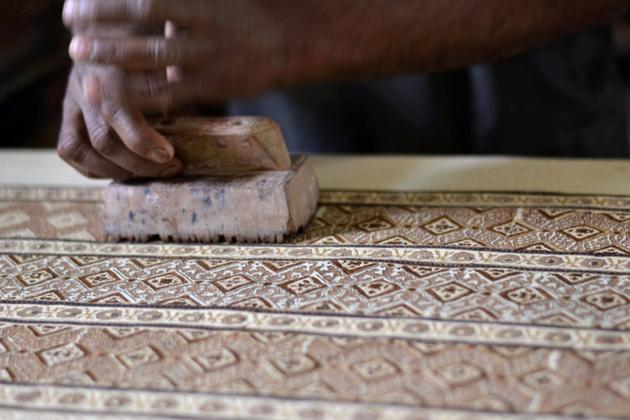
The ajrakh block printing process at Jabbar Khatri’s workshop in Dasada, near Bhuj / The Hindu
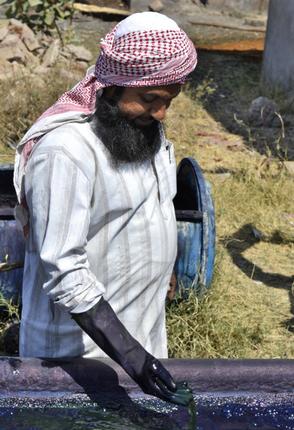
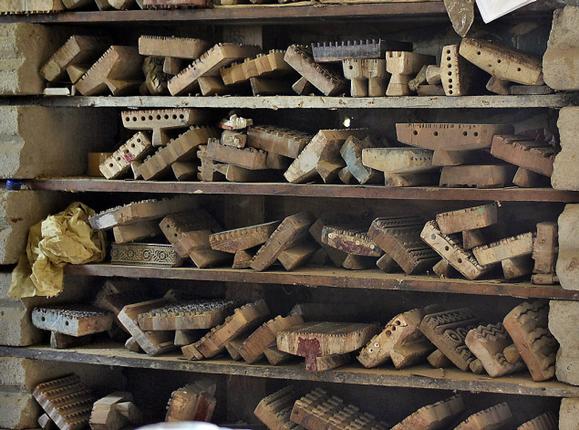
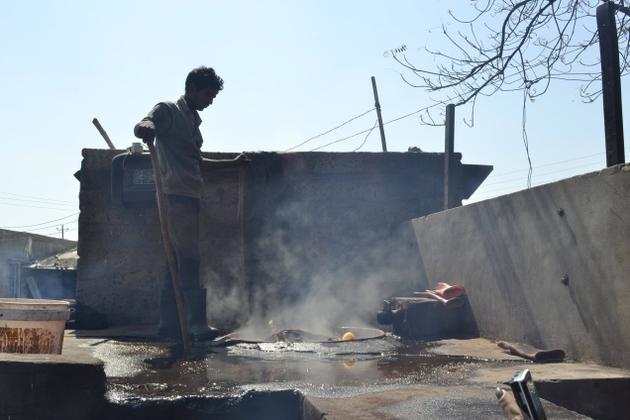
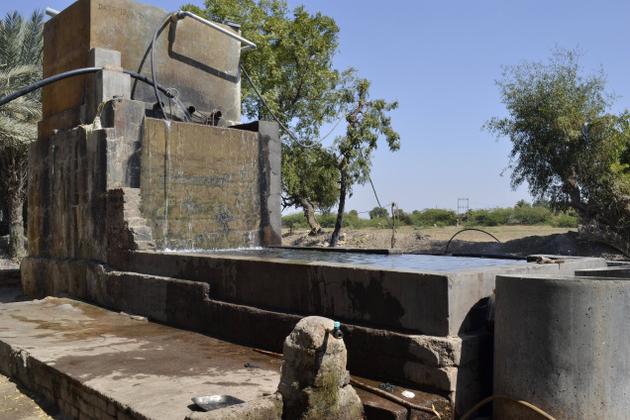
As one enters the muddy lane leading to his workshop, one can spot several metres of fabric, in different stages of dyeing and printing. The workshop has a large outdoor area where water from the borewell is filtered to rid its iron content, a boiling unit where fabric is treated several times during printing and dyeing and a printing room lined with tables and innumerable wooden blocks intricately carved with ajrakh patterns.
Stacks of ajrakh blocks at Jabbar Khatri’s workshop in Dasada, near Bhuj
A part of Khatri’s storehouse has stock that has to be sent to Fabindia. He’s a national-award winningajrakh printer and this is the 10th generation of a family of ajrakh printers that moved from Sind to Dhamadka. “Ajrakh requires running water and my forefathers moved here because of the river Saran, which dried up in 1987. Now we draw water from a depth of 200ft and it has more iron content,” he says.
A staff member treats the printed and dyed fabric with boiling water at the ajrakh workshop of Jabbar Khatri in Dasada, near Bhuj
In the initial stage, an indigenous ‘harda’ root is used as a mordant for the fabric (pomegranate skin and acacia nut skin are the other mordants). The ‘harda’, says Khatri, can react with iron in the water and turn the fabric black. “We use a filtering unit that has a bed of sand, coal, small and large stones to filter the water; iron particles gather on top,” he explains.
The dye varies from alizarine, madder or indigo, according to the colour desired. A mixture of lime and gum is used as a resist dye to keep the white portions intact.
Ajrakh printed saris, dupattas and stoles are now a fashion statement. Khatri recalls that a few generations ago, those who reared animals were the primary customers buying lungis and towels. Double ajrakh or printing on both sides, now a niche domain, was done to make the fabric more useable. “If one is wearing a lungi that flutters in the desert wind, one wouldn’t want the inner side to be not colourful,” says Khatri. Double ajrakh requires precision and is done only by master craftsmen.
An indigenous water system used to wash fabrics at the ajrakh workshop of Jabbar Khatri
If naturally dyed ajrakh printed fabric comes at a premium, it is because of the work that goes into it. In Ajrakhpur village in Kutch, several craftstmen specialise in block prints. “Each tribe has specificpatterns of ajrakh and communities do not copy patterns,” smiles Khatri.
Jabbar Khatri will be demonstrating ajrakh block printing at the International Workshop on Natural Dyes organised by ANGROU in Hyderabad from March 5 to 7.
Weft, warp and a legacy
Visitors to Bhujodi village near Bhuj would be surprised by the number of award-winning weavers in the village. Among them is Vankar Shamji Vishram Valji, known as Shamji bhai, who will also be participating in the International Workshop on Natural Dyes in Hyderabad next week. He gives us an insight into the Bhujodi settlement and its new quake-resistant and weather-proof houses and looms and moves on to talk about indigenous wool from the sheep he uses for weaving shawls, throws and bedspreads. Shamji bhai’s family weaves a small number of shawls in chemical-dyed, acrylic wool for commercial purposes but the larger focus is on indigenous wool and kala (black) cotton that grows in the area and natural indigo for dyeing.
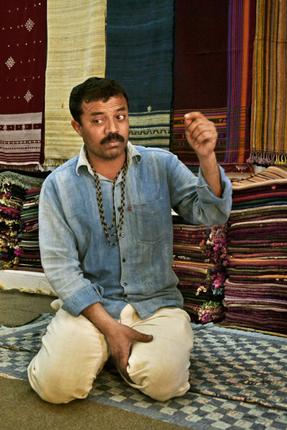
Vankar Shamji at his store in Bhujodi, Bhuj
“I get indigo from Auroville and Hyderabad,” he says, showing us his indigo vat, a 3.5ft clay pot placed partially within the ground. “We use excreta of goats at the base to maintain the temperature of the vat. Goats feed on salty leaves and hence their excreta does not attract ants,” he reasons. One of the vats he now uses has a four-year-old indigo dye that gets replenished after each dyeing process. Date, lime and water are added to the vat from time to time. “A vat can be used up to 20 years if it is in good condition. One has to use the vat each day,” he says. These vats, explains Shamji, are smaller than those used in Rajasthan to dye saris.
Shamji and his brothers work in spaces designed with an understanding of wind and sun direction so that they use minimum or no electricity. “We moved here from Rajasthan 10 generations ago, invited by members of Rabari community. The Rabaris are herders and their garments were the yardstick of their wealth,” he explains. Traditionally, Rabaris wore black and white while Ahirs (farmers) wore multicoloured garments. “The Rabaris wear black to mourn the death of one of their kings (the black shawls worn by Deepika Padukone in Ram Leela is an example) and the Ahirs, believed to be descendants of Lord Krishna, like colours,” adds Shamji.
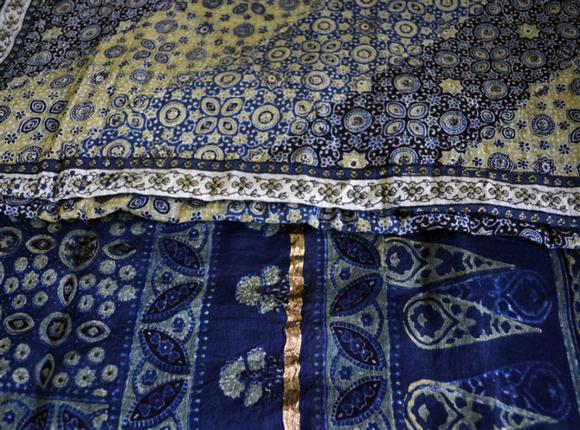
Natural-dyed fabric with ajrakh block prints
Today, Shamji’s family weaves cotton and wool shawls, stoles and furnishings and has a clientele that extends beyond Gujarat. He shows us prized, award-winning weaves by him and his father, valued at more than Rs. 2 lakh each. “My dream is to open a gallery to showcase such pieces,” he says.
(The writer was in Kutch as part of a textile trail conducted by Jaypore-Breakaway Journeys).
source: http://www.thehindu.com / The Hindu / Home> Features> MetroPlus> Events / by Sangeetha Devi Dundoo / Hyderabad – Bhuj, February 27th, 2014
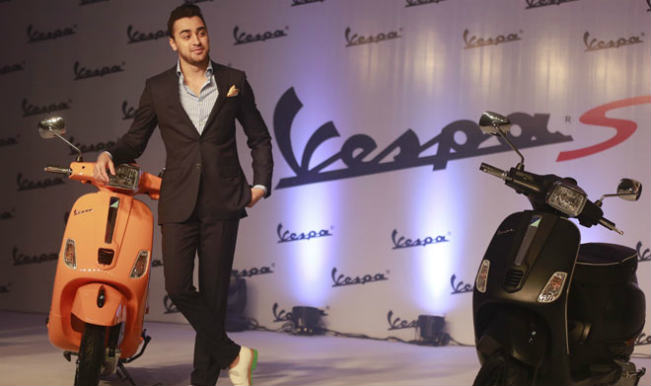
Piaggio presented the all new Vespa S to the dynamic youth of India. The all new Vespa S is a game changer. And to keep up with the youth quotient; it was Imran Khan who was selected as a face to unveil the Piaggio Vespa S scooter in Mumbai.
This new scooter is the third in series after Vespa and Vespa VX in 2013.The features include a 125cc, 3-valve single-cylinder and air cooled engine. It uses variable spark timing management, 3-phase electrical system and manifold absolute pressure sensing. The all new Vespa boasts of a fresh sporty look with chrome facia, chrome headlight borderline, chrome mirrors and many more chrome touches on the exteriors.
Imran Khan is back in action .And if you are wondering what kept Imran Khan so busy till now? He was lately not so seen in public events and any gathering. He almost disappeared after his last release Gori Tere Pyaar Mein. The actor was on an extended holiday with his wife Avantika who is expecting a baby soon. Imran Khan and Avantika dated for almost nine years before tying the knot in 2011.
“I was on a holiday. From Christmas till two weeks back, I have been on a very, very long extended vacation. So, it’s the last vacation before the baby is born. You obviously know that my wife is pregnant. So, we went on what is called a ‘babymoon’,” said the actor.
“After marriage you go on a honeymoon and before a baby is born you go on a babymoon, it’s the last holiday before you have a child. It was very relaxing,” he added.
His wife Avantika Malik is reportedly expecting their first child in June. And Imran the doting father to be seems to be very excited. He is so exhilarated about the expectant baby that he is doing his bit in order to need to know everything that he is expected as a dad to be.
He genuinely makes extra efforts for the forthcoming new experience and spends endless amount of time researching baby car seats, best crib and all other new things that he is looking forward to.
source: http://www.india.com / Home> Showbiz / by Priya Prakashan@india.com / March 07th, 2014
Union Health and Family Welfare Minister Ghulam Nabi Azad today asked the Jammu and Kashmir government to raise the retirement age of doctors so that the health sector did not suffer for want of adequate staff.
Azad said this after inaugurating a 220-bed Super Speciality Hospital besides launching Rashtriya Bal Swasthya Karyakaram (RBSK), Project Swasthya Slate and 102-J&K Referral Service under National Rural Health Mission here.
Regarding 102 referral service, he asked the state health minister to bring the remaining sanctioned 200 ambulances at the earliest.
Accompanied by Union Minister Farooq Abdullah, Azad said Jammu and Kashmir was the first state to get the Project Swasthya Slate to cover most difficult areas.
Spelling out achievements of the Centre and state governments, Azad said, “We have not only given new dimensions to health sector but all the development fields have witnessed a discernible change during the past 4 to 5 years.”
Azad said one more medical college has been sanctioned for Rajouri, thus raising the total number of newly sanctioned medical colleges to five.
He said the government has given nod to establish 75 cancer institutions in the country compared to only one such centre in the last 65 years.
He said the UPA government extended massive financial and moral support to all the states without any political, social or religious consideration.
Speaking on the occasion, Abdullah extended gratitude to the Centre for giving special consideration to development of J&K in view of its tough terrain and hoped it will continue to do so in future also.
He also thanked Azad for transforming the healthcare profile of the state.
source: http://www.business-standard.com / Business Standard / Home> PTI Stories> National> News / by Press Trust of India / Jammu- March 03rd, 2014
V. Venugopal, Editor of Veekshana monthly magazine, Hyderabad, delivering ‘Abdul Rehman memorial lecture’ at the Public Library in Visakhapatnam on Sunday. / Photo: A. Manikanta Kumar / The Hindu
Services of former trade union leader of VPT recalled
The concept of development had been redefined by former trade union leader of Visakhapatnam Port Trust Abdul Rahman, who passed away 15 years ago.
But his selfless contributions to the port employees in many forms were something to be remembered for a lifetime, senior journalist and editor of monthly magazine ‘Veekshanam’ N. Venugopal has said here on Sunday.
Recalling the expertise of Abdul Rahman on the occasion of his 15 death anniversary at an endowment lecture on the theme ‘Development and its alternate perspectives’ hosted by Abdul Rahman Memorial Committee here at Visakhapatnam Public Library, he said: “Development per se doesn’t have any relevance if it is not in line with people’s welfare. In the modern day context, the definition of development has taken a new dimension and is often confined to individual’s growth in the form of assets and other privileges. However, for Abdul Rahman it was beyond personal and professional preferences.”
His associates and others recalled that Rahman dedicated his life in service to society.
Several political and societal issues were discussed.
Former Union Energy Secretary E.A.S. Sarma highlighted how people’s views should never be ignored in a democratic country like ours. He said that before setting up any unit, it was important to draft policies in an inclusive manner.
“It was a privilege to work under the leadership of Abdul Rahman.
Till his last days, his focus was always on employees’ welfare. He was an epitome of hard work and perseverance who had led by example,” said convener of the committee P.V. Ramana.
With the first annual event inaugurated by former Mayor D.V. Subba Rao, committee members said that the annual feature will have experts speak on different subjects that would have a positive impact on society.
source: http://www.thehindu.com / The Hindu / Home> News> Cities> Visakhapatnam / by Staff Reporter / Visakhapatnam – February 17th, 2014
ESI Scheme Director Dr. (Mrs.) Rahimunnisa inaugurated the programme.
Mysore :
0ver 300 pharmacists of ESI hospitals attended day-long Pharma Fest-2014, organised by the pharmacists Association of ESI Hospitals of State, which commenced this morning at Guru Residency on JLB Road here.
ESI Scheme Director Dr. (Mrs.) Rahimunnisa inaugurated the programme.
Addressing the gathering as chief guest, Karnataka State government Employees’ Association (KSGEA) General Secretary Patel Pandu opined that the role of a pharmacist in dispensing the right medicine prescribed by a doctor was very vital. He said that a pharmacist should always be attentive and cautious is work. He advised the pharmacists to always abide by moral ethics.
Dr. Rahimunnisa and Dr. Subramanya, who are due to retire on Feb. 28, were feted on the occasion.
Children of Pharmacists — Swathi, Navya S. Rai, Deepak and Nihal — who excelled in SSLC and PU were presented prizes.
KSGEA President H.K. Ramu, Pharmacists’ Association President D.B. Mahadevaiah, Secretary M.K. Manjunath, Working President B. Mohan, General Secretary K. Narasegowda and others were present.
The afternoon session featured interaction on pharma sector.
source:http://www.starofmysore.com / Star of Mysore /Home> General News / February 22nd, 2014
(sitting from left) Fiaz Pasha, Nisar Ahmed Khan, Team leader Mir Humayun, Dr. Abdul Ravoof, Dr. Muneer Ahmed; (standing) Meher Banu, Iftekahr Ahmed Khan, Rahmath Ulla Shariff, Abdul Rahman Shariff, Ahmed Saleem Ahmed and Nasreen Begum
Mysore :
In the elections to the new Managing Committee of Muslim Co-operative Bank held on Sunday at Vidyavardhaka Law College on Sheshadri Iyer road here, the ruling group led by Mir Humayun, President, retained all the 11 seats.
The following were elected to the new Managing Committee of the Bank for a term of 5 years:
Dr. Abdul Ravoof (1,650 votes), Mir Humayun (1,517), Abdul Rahman Shariff (1,495), Fayaz Pasha (1,363), Dr. Muneer Ahmed (1,349), A. Saleem Ahmed (1,278), Nisar Ahmed Khan (1,179), Rahmathulla Shariff (1,122), Iftekhar Ahmed Khan (Backward Reserved-1,179), Nasreen Begum (Women Reserved-1,187) and Meher Banu (Women – 1143).
Out of 5,357 eligible voters, 2,340 members cast their votes at the polling held up to 4pm. The counting was taken up at 4.30 pm in the auditorium of Vidyavardhaka Law Collegeunder the supervision of Returning Officer V. Srinivas Murthy.
The newly-elected Directors of the bank were greeted by Incharge General Manager Md. Khaleelulla Shariff.
On the occasion, Mir Huma-yun garlanded Srinivas Murthy and Sub-Inspector of Police Shabbir Hussain, who supervised the bandobast at election venue along with Inspector Rajanna.
Roshan Baig, Minister for Information, Infrastructure and Haj, congratulated Humayun and his group over phone on their victory.
source: http://www.starofmysore.com / Star of Mysore / Home> General News / February 18th, 2014
Mohammed Aquil (left) with his father Mohammed Abdul Latheef at Camera Crafts./ Photos: K.V. Srinivasan / The Hindu
Spanning nine decades, Camera Crafts in the city has been a witness to the evolution of the photo industry
An auto screeches to a halt. A man gets down and walks in carrying a camera. Many customers have already settled into the backless seats at the store, and more filter in with cameras. Mohammed Aquil is busy shuffling in and out of his workshop at the back. Such scenes have remained unchanged at Camera Crafts in Triplicane for many years now. But what hasn’t changed is how the store has continuously adapted itself to the evolution of the photo industry.
Mohammed Abdul Sattar set up a camera repair shop in Triplicane in 1925 since there was nothing of that sort anywhere in the vicinity. “We were among the first in the Presidency,” says Aquil, as he wipes lenses carefully and places them aside. “My grandfather was good with carpentry and so, we started manufacturing wooden field cameras soon,” says Aquil, beside whom is a model of an old wooden camera with adaptable zoom lens.
For studios
Aquil says that his grandfather had told him how most of Camera Crafts’ customers back then were studios or wealthy locals who wanted their cameras repaired. Another aspect that Aquil remembers is Sattar narrating how military personnel visited the store during World War II. “Apparently, we were the only shop here then, so my grandfather would tend to all their cameras as well.”
When Sattar passed away in 1969, Aquil’s father Mohammed Abdul Latheef took over the business — just after the era of wooden cameras and at the beginning of the mechanical era. In keeping with the store’s tradition, he manufactured enlargers, studio lights and single-bulb flashes.
“Before the era of digital prints, one would need an enlarger to zoom images, and so my dad was making those. At one point, my father manufactured about 40,000 single-bulb flashes for studios such as Choksi Brothers spread across the country,” he says. And when electrical flashes became the norm, Aquil’s father decided to create sockets in older cameras to fit flashes. “He made those pre-War cameras compatible with flash,” he says.
In 1988, Aquil himself joined the shop, after completing a degree in electrical engineering. “We had a factory right here, which we demolished in the late 1980s. We moved the shop to a small one-room setup in the street opposite and functioned out of there for some time. Now, we have stopped manufacturing machines or cameras, and stick to just servicing. A lot of studios, professional and wildlife photographers continue to come here since we have been around for long.” He does sell cameras but not too many. “I mostly sell professional models.”
Cameras of yore: At Camera Crafts / The Hindu
However, he does have a large collection of cameras. “So many cupboardfuls,” he laughs. “Maybe 500 or even more.” Among the old cameras in his collection are the wooden field cameras his grandfather made — Leica and Rolleiflex. “A lot of them are pre-War cameras. I’m trying to restore as many as possible,” he adds. “Recently, I sold six cameras to a tourist who was looking for antiques. I just opened the cupboard and asked her to pick whatever she wanted.”
Camera Crafts has no visiting card. “Whatever customer base I have built is purely through word-of-mouth,” he smiles. “You can see for yourself.” Sure enough, more customers walk up to the counter with cameras.
source: http://www.thehindu.com / The Hindu / Home> Features> MetroPlus / by Anusha Parthasarathy / Chennai – February 06th, 2014
It was an evening to rejoice and celebrate with the winners of Hyderabad Women of the Decade Achievers Awards organised by Assocham Ladies League recently.
Chief minister Kiran Kumar Reddy was the chief guest of the evening and was seen mingling with the guests and winners.
Bollywood actress Soha Ali Khan , who graced the do, was given a special award.
Musician-singer Dina Fanai from New York made the evening memorable by crooning beautiful numbers.
Also spotted was tennis ace Sania Mirza , actress Sharada, Sangita Reddy, Geeta Reddy, and Seema Kumar among others.
source: http://www.timesofindia.indiatimes.com / The Times of India / Home> City> Hyderabad / TNN / February 01st, 2014