Former Indian Administrative Services officer Sabahat S Azim’s biggest challenge when he launched affordable healthcare chain Glocal Healthcare Systems was to prove that he could make the hospitals profitable.
Former Indian Administrative Services officer Sabahat S Azim’s biggest challenge when he launched affordable healthcare chain Glocal Healthcare Systems was to prove that he could make the hospitals profitable.
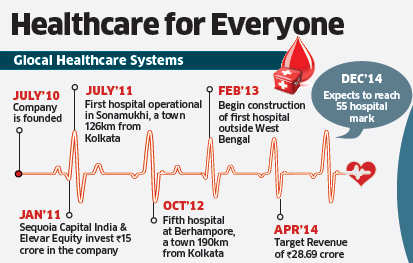
Within six months of launching the first Glocal hospital in July 2011 in Sonamukhi, a town 126km from Kolkata, the hospital had reached break-even. A model that the 37- yearold entrepreneur has now replicated in each of his other four hospitals. “They have proved that social good and profit can go hand in hand,” says Sandeep Farias, Founding Partner of Elevar Equity, which invested Rs 15 crore in the company along with Sequoia Capital India in January 2011. Most other hospitals that also offer affordable healthcare take up to two years to become profitable according to industry estimates.
Glocal is now expanding operations beyond West Bengal with plans to open 50 hospitals in Uttar Pradesh, Bihar, Chhattisgarh, Jharkhand and Orissa by December 2014.
It was the untimely death of his father that led Azim, a trained medical doctor, to launch Glocal in July 2010. “My father died due to unnecessary treatments. I thought, if this can happen to me, a doctor and an IAS officer, what about others?” says Azim, who found an early supporter in M Damodaran, the former Chairman of Securities and Exchange Board of India (Sebi), who became the Chairman of the venture. Azim has known Damodaran since his time as Secretary to the Chief Minister of Tripura, a position he held between 2004 and 2006.
“He is my first sounding board for any idea. When I think of introducing something new, my first thought is ‘how will Mr Damodaran react?’” he says. At Glocal, his team has come up with a protocol-driven model, where the computerised system will help the doctor automate diagnosis of 42 diseases, ranging from ischaemic heart disease to malaria, which they identified as affecting 95% of the patients.
Other affordable ventures are also attempting to cater to the semi-urban and rural market. Like Glocal, eight-yearold Vaatsalya also sets up hospitals (smaller than 100 beds) in small cities and towns with a focus on primary and secondary care. However, Vaatsalya leases out pre-existing hospitals and other buildings and upgrades them to high-quality hospitals. Azim, a fan of Fountainhead—Ayn Rand’s paean to individualism, wanted to design a hospital with just essential infrastructure.
Timely backing from investors helped convert the idea into a business. “I had a 30-minute meeting with Sabahat and he spoke about focusing on a limited set of diseases that constitutes 95% of healthcare issues in the country. I was hooked by this powerful idea,” says Elevar’s Farias.
Sequoia’s Managing Director GV Ravishankar says Glocal fit their requirement of backing good entrepreneurs in large and attractive markets. Glocal charges patients around onefifth of the fees a hospital with similar infrastructure would otherwise charge. It charges Rs 10,000 for a caesarean section, which costs about Rs 50,000 in other private hospitals.
Azim points out that he is able to charge lower fees due to lower cost of infrastructure and by eliminating unnecessary procedures. While a typical 100-bed hospital is about 70,000 square feet in size, Glocal has been able to restrict it to 30,000 square feet thus keeping cost of construction lower. At around Rs 8 crore for a 100-bed hospital, a Glocal hospital is built at about 50% of the cost of a private secondary hospital. The company aims to reach over Rs 28 crore in revenue in fiscal year 2014. As Azim begins Glocal’s expansion beyond West Bengal, he is not resting on his laurels. “It has been exciting so far but there is much more work to do,” he says.
source: http://www.economictimes.indiatimes.com / The Economic Times / Home> Business News> Rise> Entrepreneurship / by Radhika P Nair, ET Bureau / January 25th, 2013
The gate was last opened almost two decades ago, after which it had remained jammed with debris, rocks and plastic.
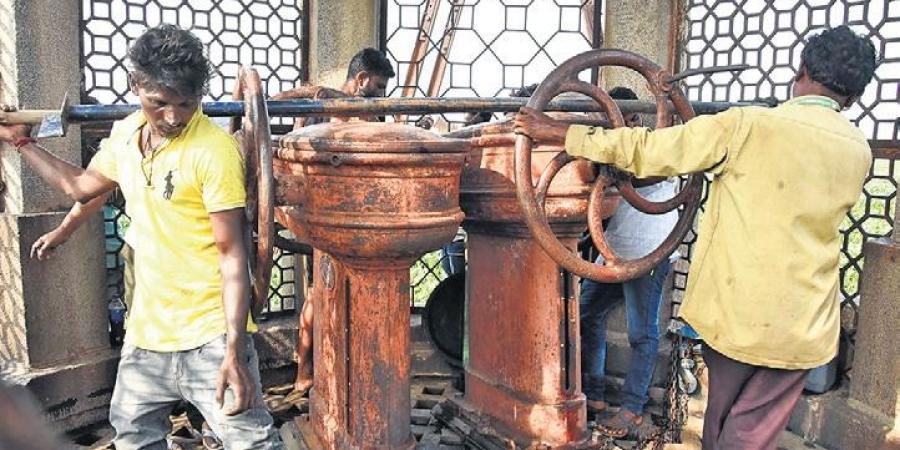
Mechanic Khadeer and his helpers try to open the sluice gates of Fox Sagar lake on Wednesday | rvk rao
Hyderabad :
In a surprising turn of events, the sluice gate of Fox Sagar lake was successfully opened by a local automobile mechanic, Mohammad Khadeer, after engineers and officials in charge were unable to unlock the century-old vents for over a week.
The gate was last opened almost two decades ago, after which it had remained jammed with debris, rocks and plastic.A big rock was stuck exactly where the wheels of the sluice gate were supposed to rotate. After the technical staff failed to remove the rock, Khadeer stepped in on the request of the local councillor.
Speaking to Express, Khadeer said, “We knew that works to open the Fox Sagar sluice gate had begun, as most of the chawls, bastis and residential areas around the lake have been inundated by water. The local councillor called me on Tuesday and asked me to check why the sluice gate was not opening. When I reached there, I was told they had been trying to open it for over eight days. I, with a couple of boys from my shop, tried to understand which part of the gate could or could not be worked around, since it is a very old structure.”
“We soon realised that it was not an engineering issue, rather, debris from the lake had got stuck at multiple levels of the four sluice gates. It took us over four to five hours to cut through layers of tarpaulin, fabric, debris, plastic, loose rocks and boulders,” Khadeer added.
The opening of the sluice gates sparked an outburst of cheers, and the technical team on the spot showered Khadeer with compliments, calling him the ‘man of the hour.’Once the gates are opened, water from the lake flows into the nala underneath the culvert junction, up to Hussainsagar.
source: http://www.newindianexpress.com / The New Indian Express / Home> Cities> Hyderabad / by Oishani Mojumder / Express News Service / October 22nd, 2020
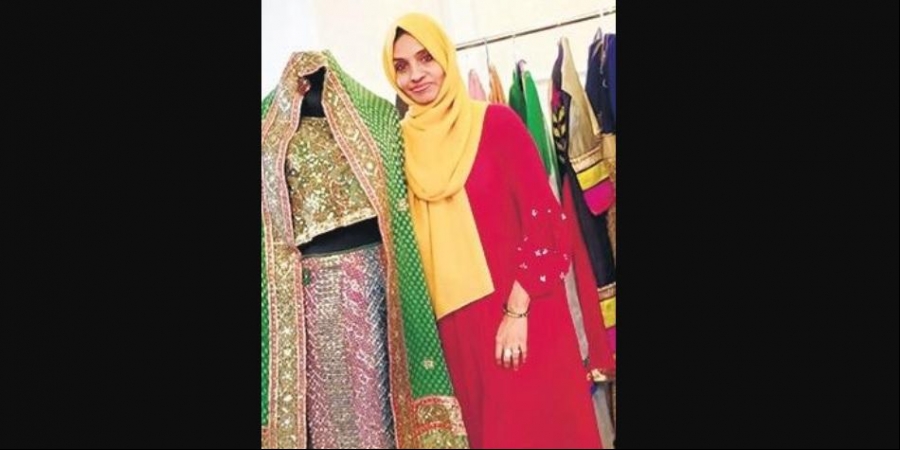
About two months ago, 41-year-old entrepreneur Sabitha AK—founder of Rainbow Women’s Outfits—received an SOS call.
About two months ago, 41-year-old entrepreneur Sabitha AK—founder of Rainbow Women’s Outfits—received an SOS call. The caller, a girl of 23, was inconsolable. Her wedding was in a few days’ time and she was unable to afford a wedding dress. She knew of Sabitha’s eight-year-old boutique that dealt with wedding finery, among other things, and decided to approach her on a whim.
Luck was on her side. Sabitha sent across a beautiful wedding dress with complimentary accessories. All free of cost.
The call got Sabitha thinking. She decided to reach out to her patrons and family through her social media handle to see if she could turn each underprivileged girl’s wedding dreams come true. She was in for a surprise. Her video has got one million views so far.
“The response was overwhelming. Many offered to donate their wedding dress. Bridal wear is mostly a one-time use. It ends up lying in our wardrobes for decades.
Moreover, in the Malabar region weddings last for three to four days.
Expensive outfits are bought for each day. Not many of these see the light of the day again,” she explains, adding that the dresses come from Mumbai, Ernakulam, Kochi, Dubai and even the UK.
She was also pleasantly surprised to get bridal outfits that cost Rs 1 lakh or more.
Now she had the problem of plenty. She decided to open a boutique exclusively for donated outfits, besides the one she runs in Pappinisseri in the coastal city of Kannur, Kerala.
Along with the dresses, many people also donated footwear, purses, jewellery, bed sheets and even makeup sets.
“I have everything a bride may want, and more,” Sabitha smiles. Based on word of mouth, she was inundated with calls from many districts. She has set up outlets in Thiruvananthapuram, Kollam, Ernakulam, Pattambi, Kasaragod, Kozhikode and Mangaluru.
Those who visit these outlets are allowed to take as many dresses as they want, with no compulsion of returning them. “If they want to return it after using it, it’s up to them. I want them to feel like they own the dress,” says Sabitha.
She has helped around 300 brides in the last couple of months. In fact, one might end up spotting a Sabyasachi or a Ritu Kumar outfit at her boutique. She has also started a free makeup arrangement for brides who come to her.
But Sabitha is wary of being taken for a ride and has made it mandatory for brides to produce a letter from community elders endorsing their need. At the same time, she makes it a rule to maintain the privacy of the brides. It’s all about providing a helping hand. But not in exchange for dignity. A story of Cinderellas in our backyard.
Sabitha has helped around 300 brides in the last couple of months. One might end up spotting a Sabyasachi or a Ritu Kumar outfit at her boutique. She has also started a free makeup arrangement for brides.
source: http://www.newindianexpress.com / The New Indian Express / Home> Magazine / by Medha Dutta Yadav / October 11th, 2020
Gujarat, INDIA / Blackburn (Lancashire) UNITED KINGDOM:
Mohsin Issa, 49, and brother Zuber, 48, stunned the City by being named as lead bidders for fight to buy Asda
Walmart, chain’s US owner, announced they had accepted bid from duo today but will retain a minority stake
Last stage of extraordinary rags to riches story that began with them taking over single petrol station in Bury
It comes more than a year after planned merger between Asda and Sainsbury’s was torpedoed by regulators
Two self-made billionaire petrol tycoon brothers have agreed to buy Asda from Walmart for £6.8billion to bring the supermarket back under British control.
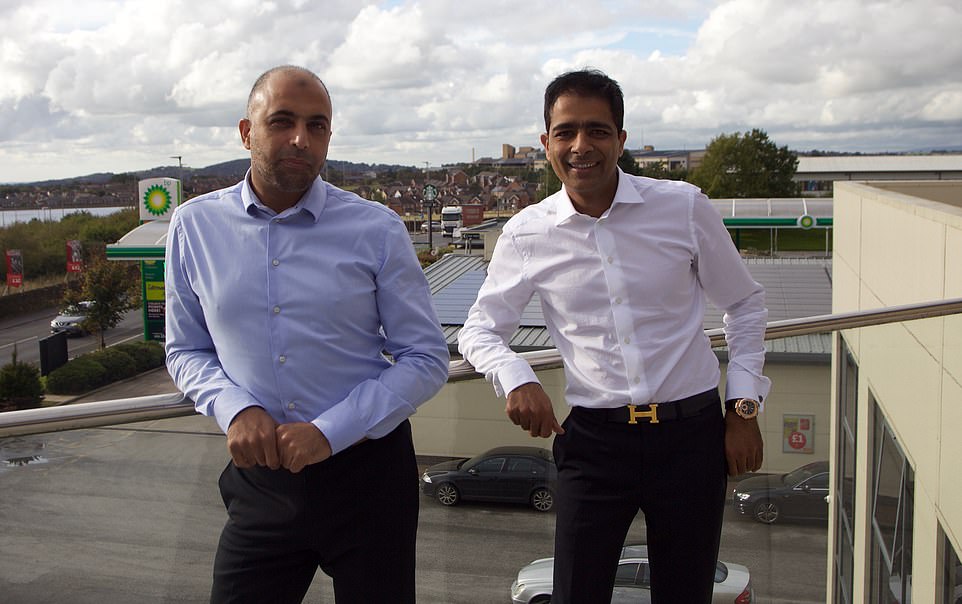
Mohsin Issa, 49, and his brother Zuber, 48, from Blackburn, stunned the City by being named as lead bidders to take over the retail giant alongside private equity firm TDR Capital, and concluded the deal today.
The new owners have committed to keeping the retailer’s headquarters in Leeds and said they will invest to grow its convenience and online operations. Walmart will retain a minority stake in Asda as part of the agreement.
It is the latest stage in the brothers’ extraordinary rags to riches story, which saw them turn a single petrol station in Bury into an empire of 5,900 branches.
The duo, whose parents came to Britain from India ‘with nothing’, built EG Group – previously known as Euro Garages – from one site bought for £150,000 in 2001 into a £9billion giant employing 44,000 staff.
Today’s deal comes more than a year after a proposed merger between Asda and UK supermarket rival Sainsbury’s was torpedoed by regulators.
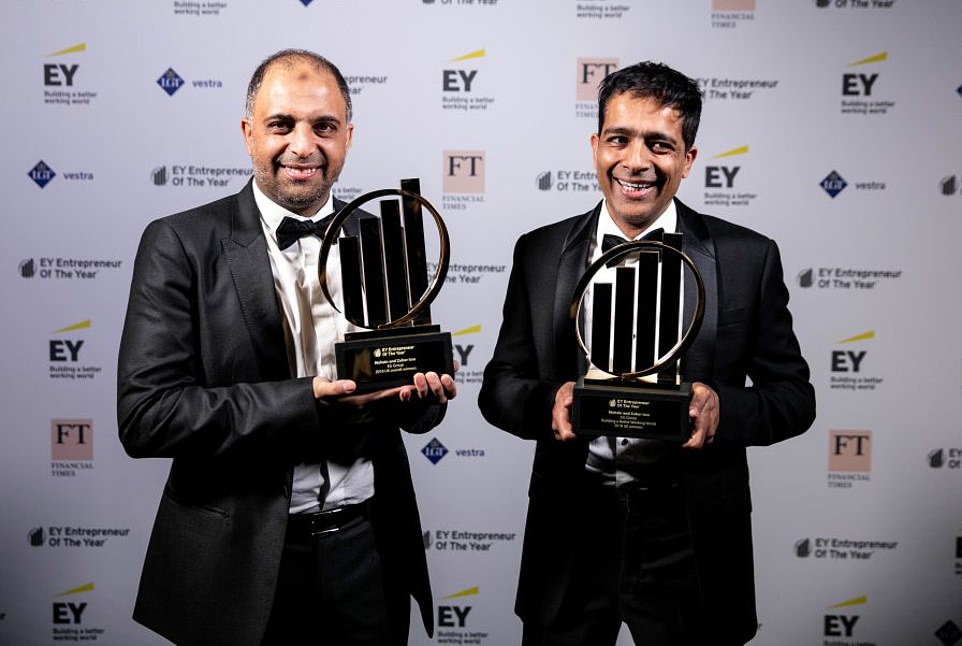
Mohsin Issa, 49, (left) and his brother Zuber, 48, whose parents came to Britain from India ‘with nothing’, today emerged as the winners of the battle to buy Asda The brothers holding trophies at an awards ceremony in London in 2018, which saw them named EY Entrepreneur of the Year
___________________________________________
The billionaire Issa brothers brothers and the rise and rise of EG Group
1970s – Mohsin and Zuber Issa’s parents arrive to the UK from Gujurat, India and the brothers are born not long afterwards in Blackburn, Lancashire.
They work at their parents’ petrol station before it closes.
2001 – The brothers buy their first filling station in Bury, Greater Manchester.
2015 – Private equity firm TDR Capital acquire a 50% stake in their Euro Garages chain.
2017 – Euro Garages buys EFR Group, a Dutch-based forecourt operator, and is renamed EG Group. The new company buys 1,000 garages from Esso in Germany.
2018 – EG Group announces it will buy 800 Kroger convenience stores in the US before buying 1,200 sites in Italy from Esso. Later that year it buys 97 fuel stations in the Netherlands and 540 from the Australian retailer Woolworths.
2019 – In another US expansion, EG buys 54 Fastrac sites in the US and 69 from Certified Oil.
2020 – EG becomes KFC’s largest franchisee in Europe after buying 145 KFC outlets in the UK & Ireland.
___________________________________________
Asda has seen its fortunes improve recently with trading strengthening through 2020, as shoppers have spent more money on groceries during the pandemic.
In the quarter to June, Asda saw online sales double but the new owners will be tasked with expanding its digital business further to take advantage of soaring demand and make ground on rivals, such as Tesco, who have a larger slice of the market.
The new owners will also face the challenge of keeping prices low amid tough economic conditions for shoppers and potential new tariffs on EU-imported foods, with the other big four supermarkets all announcing a raft of price cuts in recent months.
EG Group has sealed the deal after its offer was favoured by Walmart ahead of a move by US private equity firm Apollo.
Last week, a third bid from Lone Star Funds, fronted by former Asda executive Paul Mason, was dropped after failing to meet the price of its rivals during the latter stage of bidding.
Walmart sought a sale after the UK’s competition regulator blocked its merger with Sainsbury’s amid fears the move would push up prices and reduce product quality.
The US grocery started new discussions over a sale of Asda in February, but saw these halted due to disruption as a result of the coronavirus pandemic.
However, the auction process restarted in July as Walmart sought to exit the UK, 21 years after first purchasing the Leeds-based retailer.
Blackburn-based EG Group, formerly known as Euro Garages, already runs forecourt convenience stores for Spar and French hypermarket chain Carrefour.
The deal will have to pass through regulators, although it is expected to be given the green light.
Last week, EG Group announced a trial involving three ‘Asda on the Move’ convenience stores at its petrol forecourts.
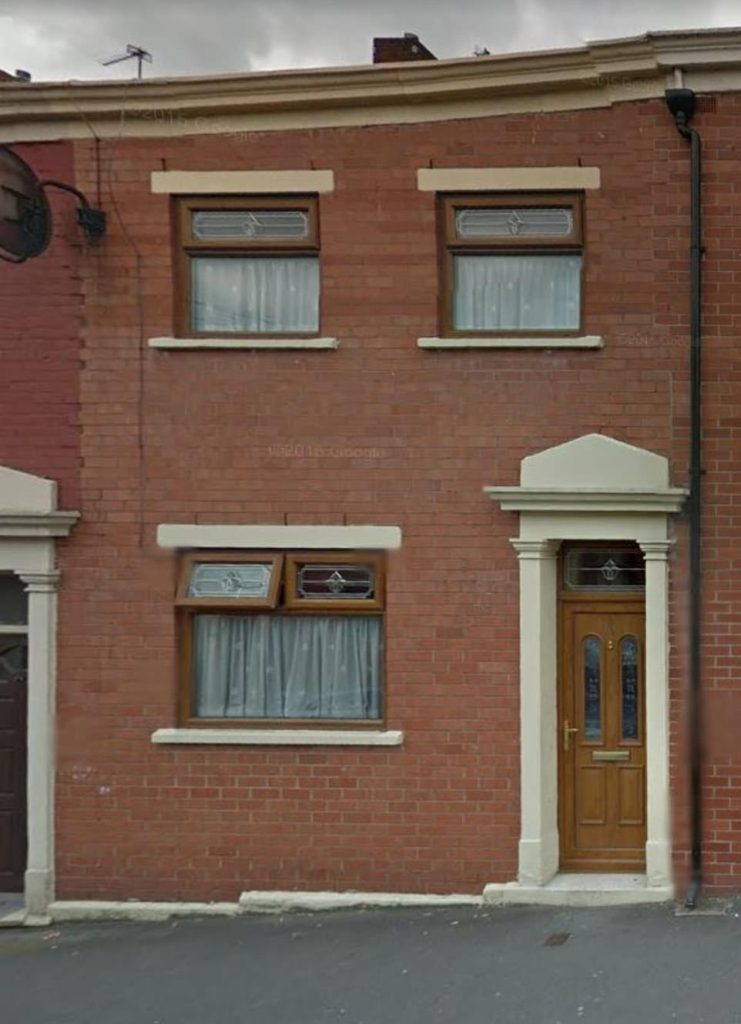
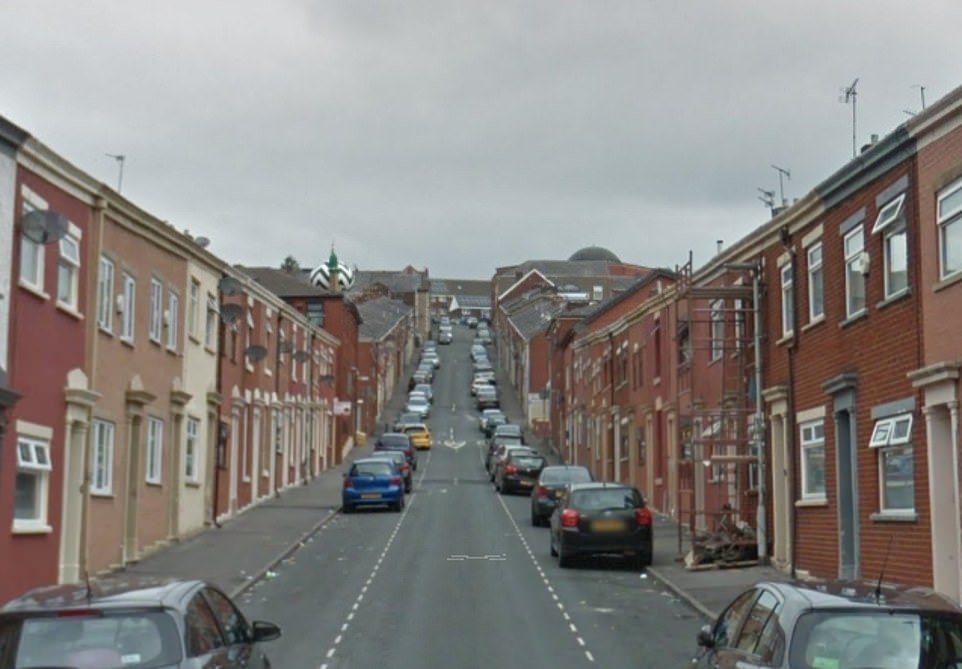
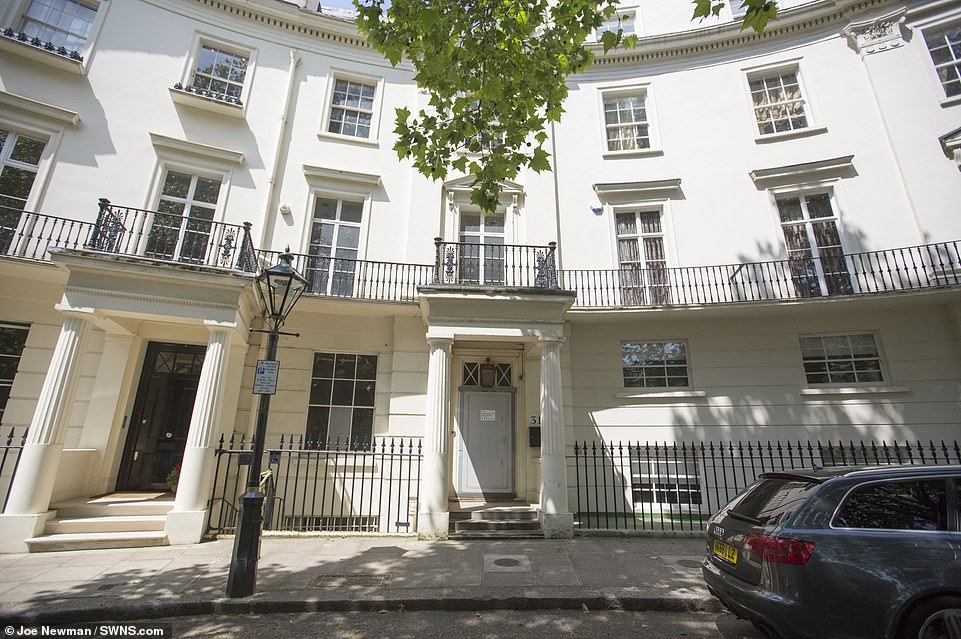
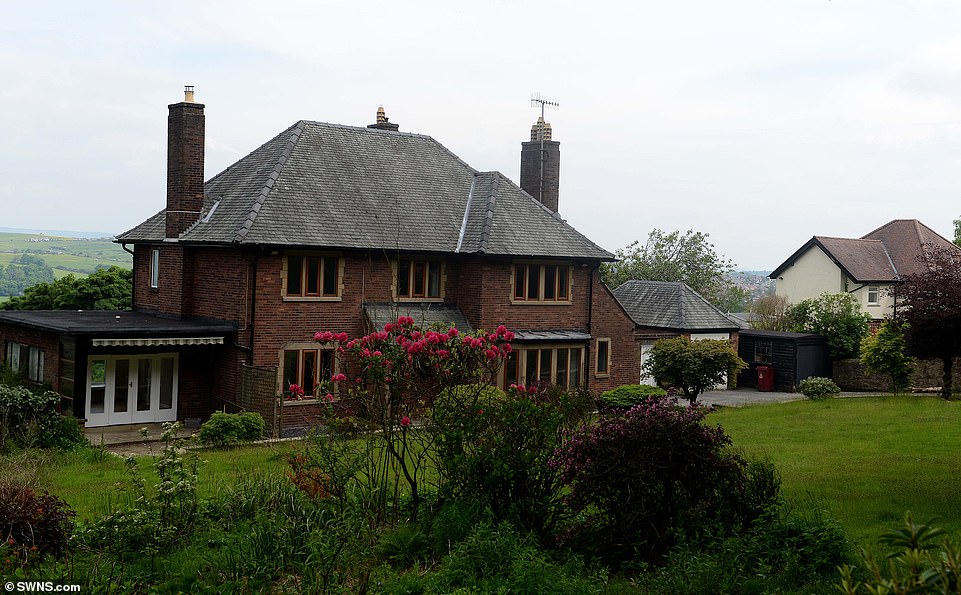
The £115,000 terraced house where the brothers grew up in Blackburn. They were born in the town after their parents moved from Gujurat, India A wider view of the road in Blackburn where the brothers grew up. Their company is still based in the town They are now worth an estimated £3.56bn, including a £25m Kensington townhouse (pictured) and a private jet that is kept in a hangar at Blackpool Airport alongside Donald Trump’s personal helicopter
______________________________
Asda history: How Britain’s third-largest supermarket began as a Yorkshire family butcher
1950s: The Asquith family (W.R. Asquith) open a butcher’s shop in Knottingly, West Yorkshire, which was eventually expanded to seven shops.
1958: They travel to the USA to visit Piggly Wiggly, probably the world’s first supermarket.
1963: The Asquiths open the UK’s first self-service supermarket in Wakefield, West Yorkshire.
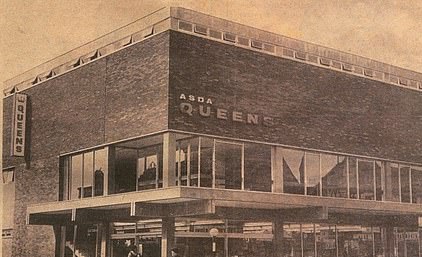
The first Asda supermarket, which was opened in 1965 in Wakefield, West Yorkshire
965: Peter Asquith built his first new supermarket from scratch, next to a large car park, knowing that cars would change the way people shop. Associated Dairies were employed to run the in-store butchery operation and the name Asda was born by combining ASquith and DAiries.
1966: Asda becomes the first major food store to sell general merchandise.
1968: Associated Dairies buys out the Asquith Brothers.
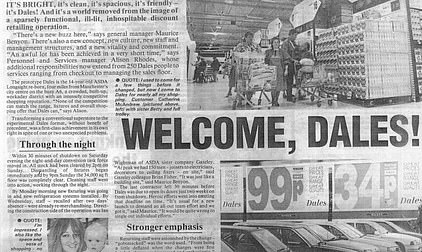
A newspaper article about one of the first ever Asda stores
1999 Asda is bought by Walmart.
2020 (February): Walmart says it is looking for a buyer.
______________________________
The Issa brothers are now worth an estimated £3.56bn, including a £25m Kensington townhouse and a private jet that is kept in a hangar at Blackpool Airport alongside Donald Trump’s personal helicopter.
They are also building five identical mansions just three miles from the £115,000 Blackburn two-up two-down where they were raised. Mohsin is expected to live there with his wife, Shamim with whom he shares two grown-up children.
As the children of immigrants who moved to Blackburn from Gujurat, India, in the 1970s, Mohsin and Zuber Issa – who were born in the former mill town – quickly learned the importance of hard work.
Their first experience of business was selling petrol from their parents’ filling station, where they would have their big idea that would revolutionise the industry and make their millions.
Petrol sales were in decline and fuel duty on the rise, cutting into already wafer-thin fuel margins and leading to hundreds of operators leaving the market.
At the time most garages – if they sold food at all – offered a measly selection of pre-packaged sandwiches, crisps, sweets and chocolate.
But the Issas realised fuel sales still had a purpose in creating a captive market at petrol stations, who could then be offered appetising food rather than the gruel offered elsewhere
The brothers struck franchise agreements with brands including Starbucks, Subway and KFC, before embarking on a buying spree to snap up sites that had previously become vacant.
They now own Europe’s largest forecourt operator, Euro Garages, which in 2019 reported revenues of more than £17.9bn.
The firm is now the largest Subway franchisee in Europe and earlier this year bought a group of 146 KFC stores.
Describing the secret of their success, Zuber told the Financial Times: ‘We wanted to create a destination where you could get fuel, food-to-go and shopping.
‘This is the formula and it works.
‘We were fortunate that the big players were leaving the market just as we were growing.’
TDR Capital – a London investment firm behind We Buy Any Car and David Lloyd gyms – bought a 50% stake in EG Group in 2015. The Issas retain the remaining 50%.
This prompted a debt-fuelled buying spree that saw the brothers buy thousands of new sites and expand into eight other countries around the world.
‘They never in their wildest dreams would have imagined 5,500 gas stations in nine markets,’ senior executive Ilyas Munshi told the American trade magazine CSP last year.
‘If they had only 20 sites, they would have felt they had done their job.’
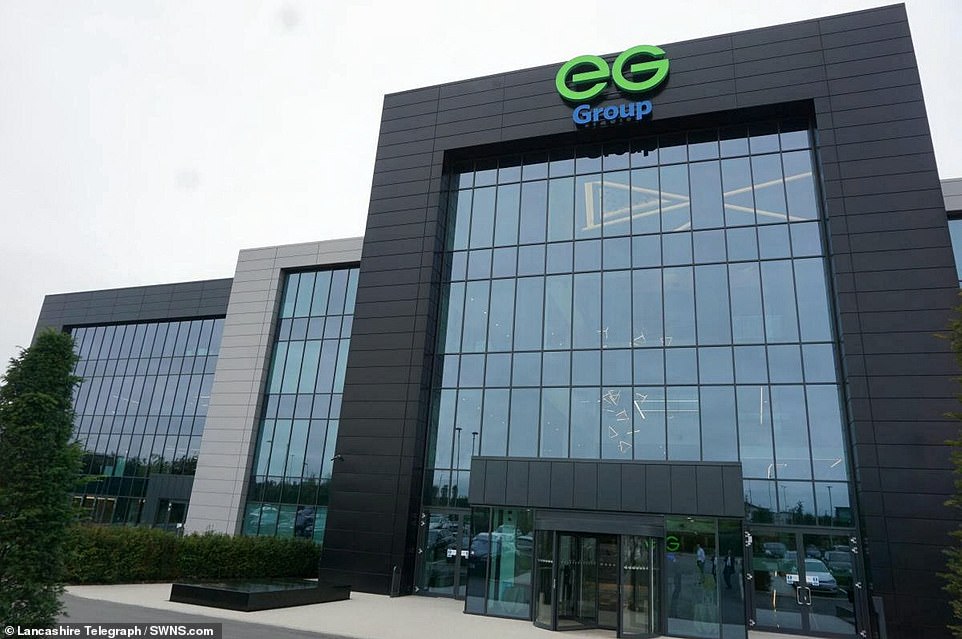
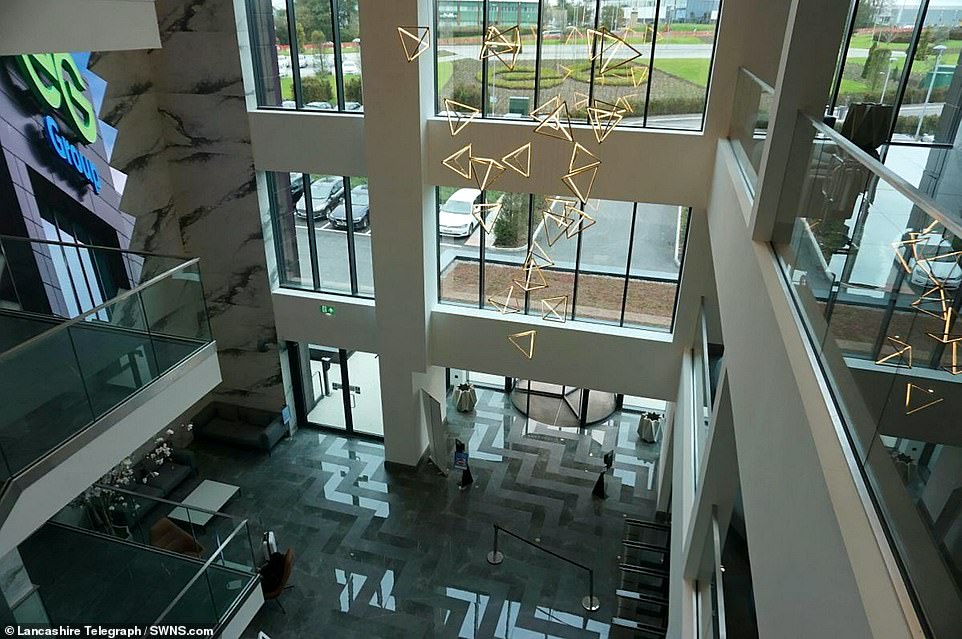
As proud Lancastrians, the brothers have insisted on keeping EG Group’s headquarters in Blackburn, and recently unveiled a new £35m headquarters.
‘People are always asking when we will move to London or Manchester,’ Zuber told the FT.
‘But the quality of life here is great. A lot of people do a few years in London then come to the North West.
‘They want to raise a family and have less pressure. We have got a lot of fantastic people that way.’
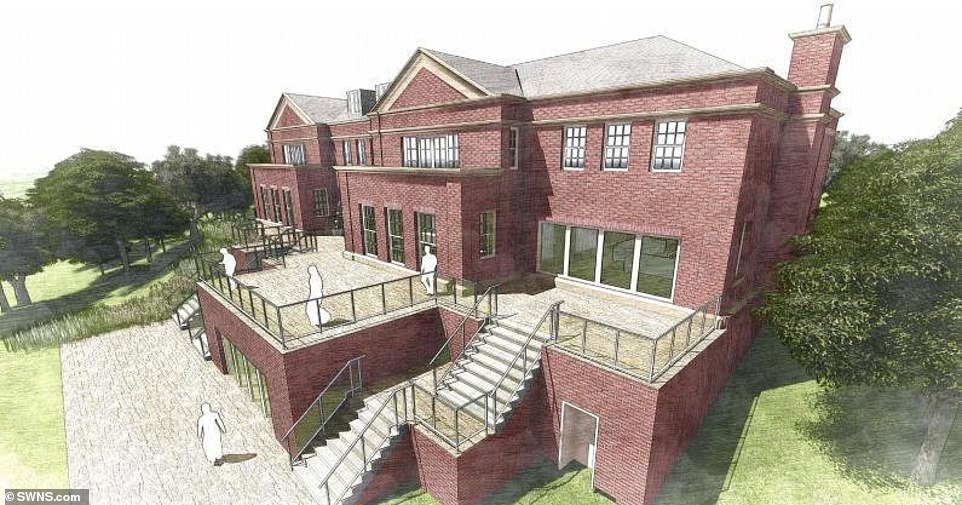
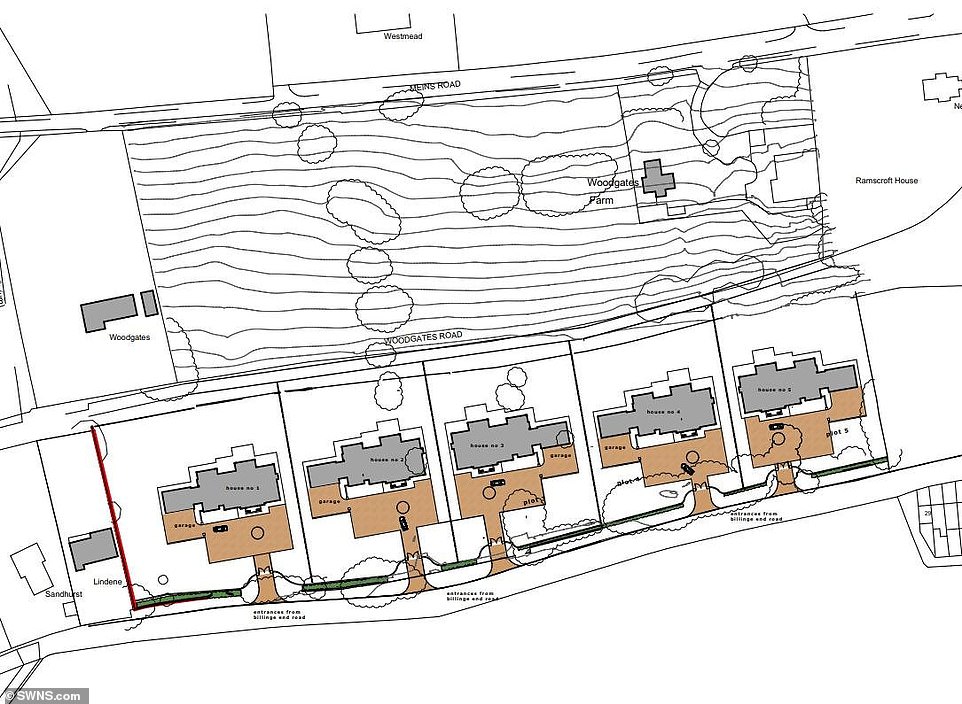
Architect’s plans for one of the five new homes that the brothers are building in countryside near BlackburnPlans for the large houses, which are located on a quiet rural road outside Blackburn where houses sell for up to £1 million, were lodged in April 2018. They are currently a building site Pictured: The homes on Billinge End Road, Blackburn, Lancashire, that was demolished in order to make way for the new houses
Mohsin has a wife Shamim, and their son and a daughter both work for EG. Both brothers rarely give interviews and have adopted a low-key public profile.
They are now building five identical ‘super-sized’ homes three miles from their childhood home.
Despite the fierce opposition, which saw the council face 30 letters of complaint, eight old houses have now been demolished and builders have laid foundations for the five 5,000 sq ft mansions.
Plans for the large houses, which are located on a quiet rural road outside Blackburn where houses sell for up to £1 million, were lodged in April 2018.
They sparked an uproar, with the properties described as ‘not in fitting with the local area’ as the homes stand over 4.5 metres taller with 1,500 square metres of floor space.
But planning permission was granted and pictures taken earlier this year showed builders had already moved in.
In 2017, the pair purchased a £25million mansion in Knightsbridge, which estate agents said could be worth £80million when planned renovations are carried out according to estate agents.
Their Grade II listed Georgian house is also at the centre of a long-running planning row.
The previous owner began digging a basement and left a vast 30ft-deep crater the size of two tennis courts, described by horrified neighbours to ‘Hitler’s bunker’.
When finished the luxury 22,000 sq ft home will have a huge underground car park, a swimming pool, spa, and cinema.
The brothers donate 2.5% of their earnings to charity through the Issa Foundation, which funds hospitals and provides free breakfasts for children in Lancashire.
The five new homes will stand over over 4.5 metres taller that the old homes with 1,500 square metres of floor spaceThese new photos show the EG Group’s gargantuan new premises in Blackburn, Lancashire, where the Issa’s were born and raisedBuilding took three years and staff began working there in August, although due to current social distancing only half can be there at once
source: http://dailymail.co.uk / Mail Online / Home> News / by Rory Tingle for Mail Online / October 02nd, 2020
KMS Hakkim Biryani also offered biryani for Rs 1 to frontline warriors who are battling the coronavirus pandemic.
Tiruchities throng in large as hotel chain offers biryani for 10 paisa | EPS
Tiruchy :
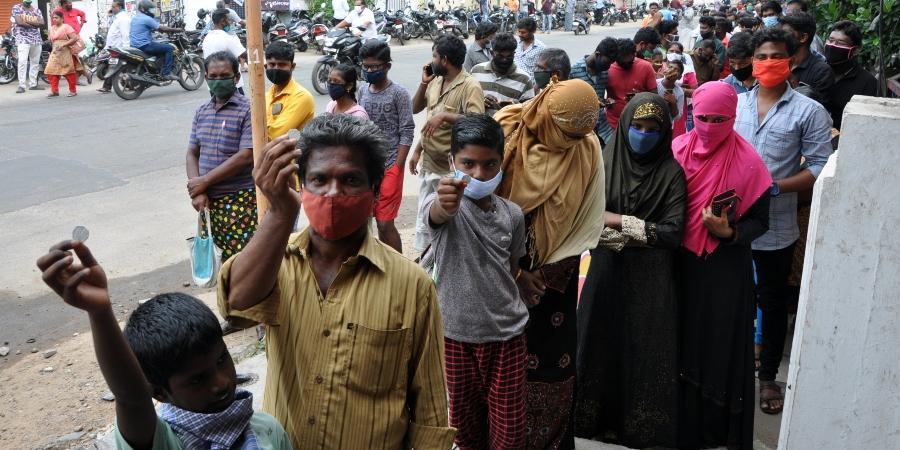
To celebrate the World Biryani Day in a unique manner, a popular Biryani chain in Tiruchy sold delicious biryani for a mere amount of 10 paise on Sunday. The restaurant chain also offered biryani for Rs 1 to frontline warriors who are battling the coronavirus pandemic .
Contrary to the regular Sunday morning look, the Shastri road in Tiruchy was bustling with activity and excitement after KMS Hakkim Biryani centre sold Biryani to the public for 10 paise. With the outlet advertising that the offer is valid only for the first 100 customers, several people beelined in front of the restaurant holding demonetised 10 paisa coins in their hands.
Speaking to TNIE, KMS Mohideen, owner of the KMS Hakkim Biryani Chain said, “We wanted to appreciate the frontline workers for braving their lives and decided to offer biryani at a cost of Rs 1 on the World Biryani Day. However, we did not want the other customers to be left out, so we introduced an idea to sell biryani for the public who in possession of the demonetised 10 paisa coin.”
With the biryani being offered for such an unbelievable price, several people including children and women tried their luck. Incidentally, few customers waiting in the lines expressed that they spent the last couple of days searching their houses in and out so that they could find 10 paisa coins and purchase biryani.
Ravindran, a city resident who had come along with his son in hope of purchasing a packet said, ” My father in a conversation with my son had taught him about the currency values in the olden days and gave him a few 10 paisa coins as memorabilia. After we saw the advertisement on social media, our entire family started searching the house thoroughly to find the demonetised coin.”
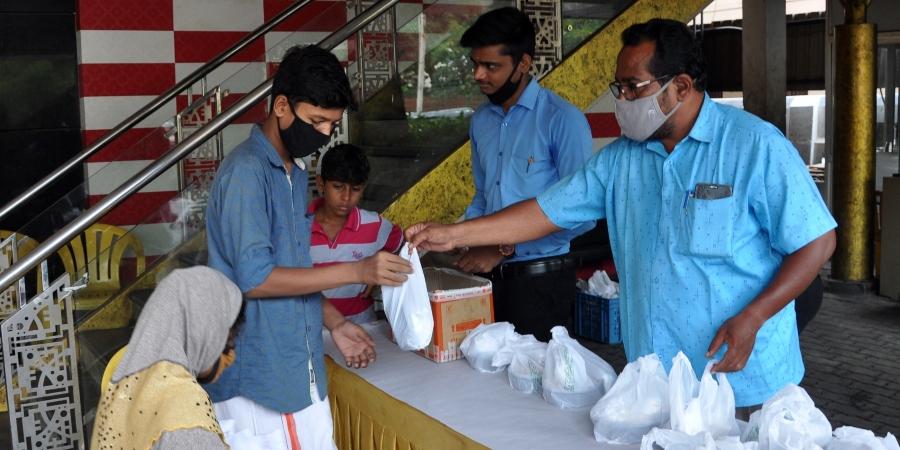
The biryani centre today through its two outlets served a total of 210 people- 100 customers through the 10 paisa offer and 110 COVID warriors. The customers were served with Chicken biryani along with raita and dalcha in neatly packed containers. Although they offered token to frontline workers on Saturday itself by verifying their ID cards, the tokens for 10 paisa offer were issued only on Sunday.
“A total of 110 frontline workers- 45 from the police department, 35 from the Corporation department, 20 from the health department and 10 sanitation workers were served with delicious biryani. Although the parcel to the regular customers was limited to the Biryani and the raita, we had added Chicken 65 and Sweet Kesari for the frontline workers parcels to appreciate their efforts and make them feel special,” said, a manager of the hotel chain.
source: http://www.newindianexpress.com / The New Indian Express / Home> States> Tamil Nadu / by Jayakumar Madala / Express News Service / October 11th, 2020
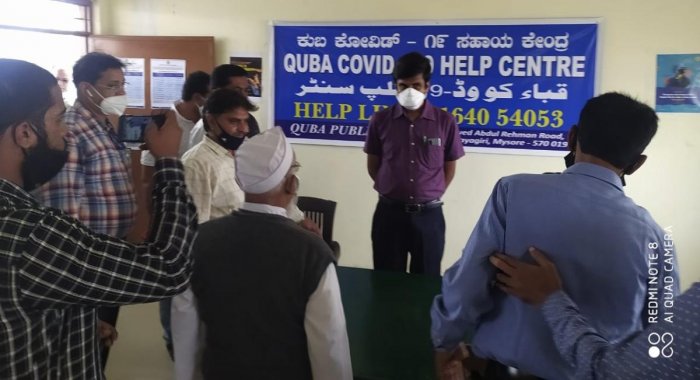
Deputy Commissioner Abhiram G Sankar inaugurates Quba Covid Care Centre at Mysuru recently.
Organisations of the Muslim community has opened three Covid Care Centres (CCC) under the Narasimharaja (NR) Assembly constituency in the city as the number of Covid positive patients is on the rise of late.
It has to be noted that NR segment, where Muslims are a majority, was being discussed over the past one week. District In-charge Minister S T Somasekhar has said that among the active cases, over 50% of the patients were from NR constituency and even most of the deaths related to Covid are from the same segment. There were also talks of ‘mini-lockdown in parts of the segment, citing non-cooperation by the residents.
On July 14 (Tuesday), Quba Covid Care Centre and Quba Covid-19 Care Centre and Quba Covid-19 Help Centre was opened, with its own 24/7 helpline number 91640 54053 at Quba Public School in Udayagiri, in the city. Deputy Commissioner Abhiram G Sankar inaugurated the Quba Covid-19 Care Centre and said this CCC should serve as an example for other districts and cities.
He said, it is an example of cooperation to the government by good citizens. “Particularly in such areas, where Covid-19 pandemic is on the rise exponentially, such positive cooperation will check the spread of Covid and help save critical patients.”
The centre initiated instant door-to-door Covid tests by Dr Nayaz Pasha Dr Shiraz Ahmed. Chaand Saab, ex-mayor Ayub Khan, Zaheerul Haq and Shahab Rahman were present.
The Quba CCC has set up three centres — 200 beds at Farooqia College in Udayagiri, 200 beds at Andalus Public School at Rajeev Nagar and Beedi Workers Hospital at Azeez Sait Nagar — in consultation of religious heads, NGOs and corporators. However, the Quba CCC will accommodate and help patients of all other communities also.
The Quba CCC has two ambulances and is used for ferrying Covid patients and unclaimed bodies.
The centre will provide all facilities like food. Besides, Muslim doctors have offered their services voluntarily. Healthcare workers and beds have to be provided by the district administration.
source: http://www.deccanherald.com / Deccan Herald / Home> State> Karnataka Districts / by T R Sathish Kumar / Mysuru – July 15th, 2020
Parvez Ali Khan’s restaurant in Armenia’s capital Yerevan is delivering packages of cooked food to those forced to flee their homes in the Nagorno-Karabakh region.
Patiala (PUNJAB)INDIA / Yerevan, ARMENIA :
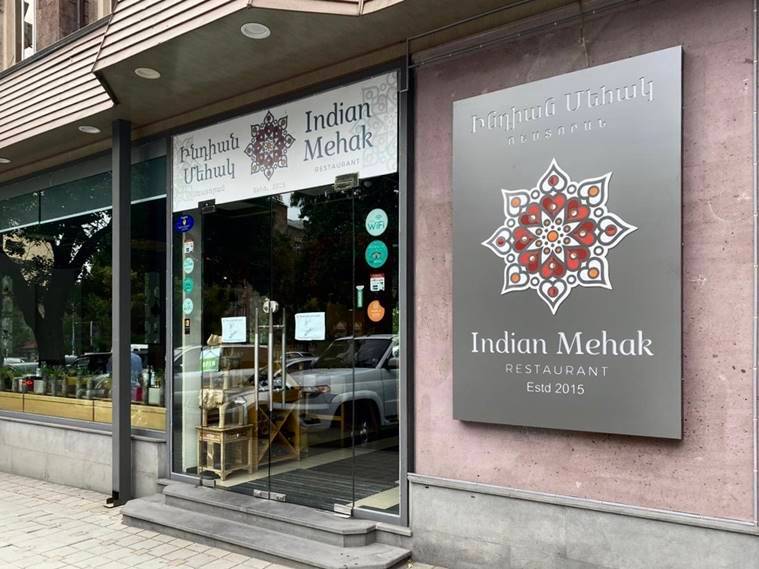
When fresh clashes erupted between Armenia and Azerbaijan in Nagorno-Karabakh in the South Caucasus approximately two weeks ago, Parvez Ali Khan knew that he had to do something for the country that he now calls home. Khan, a 47-year-old from Patiala, India, had moved to Armenia five years ago with his wife and two daughters, in the hope of economic prospects and now runs Indian Mehak Restaurant and Bar, a two-year-old establishment located in the heart of capital Yerevan, just minutes away from Republic Square.
Parvez Ali Khan runs Indian Mehak Restaurant and Bar in Yerevan, Armenia. (Photo credit: Aqsa Khan)
Since fighting broke out on September 27, Armenian officials have said that the total military death toll has gone up to 244 as of October 6, according to a Reuters report, making it one of the most violent clashes in the region since the 1990s. It is unclear how many people have been forced to leave Karabakh since the fighting began, but social media posts and witness reports suggest the numbers are high.
“I must have seen approximately 30,000 refugees in Yerevan,” Khan says. On October 4, on the restaurant’s Facebook page, the family announced that they were providing freshly-cooked Indian food to people who had fled the Nagorno-Karabakh region and were seeking refuge in the capital. “We are Punjabis and we help people wherever we are. We have always done it,” Khan says.
Since the clashes have intensified, Armenians across the country have stepped in to help in whatever way they can, and Khan says he wanted to do his bit. So he turned to the resources he had easy access to—his restaurant’s kitchen. People from the Nagorno-Karabakh region who were seeking refuge in Yerevan were being given dry ingredients, with no access to facilities where they could cook, Khan says.
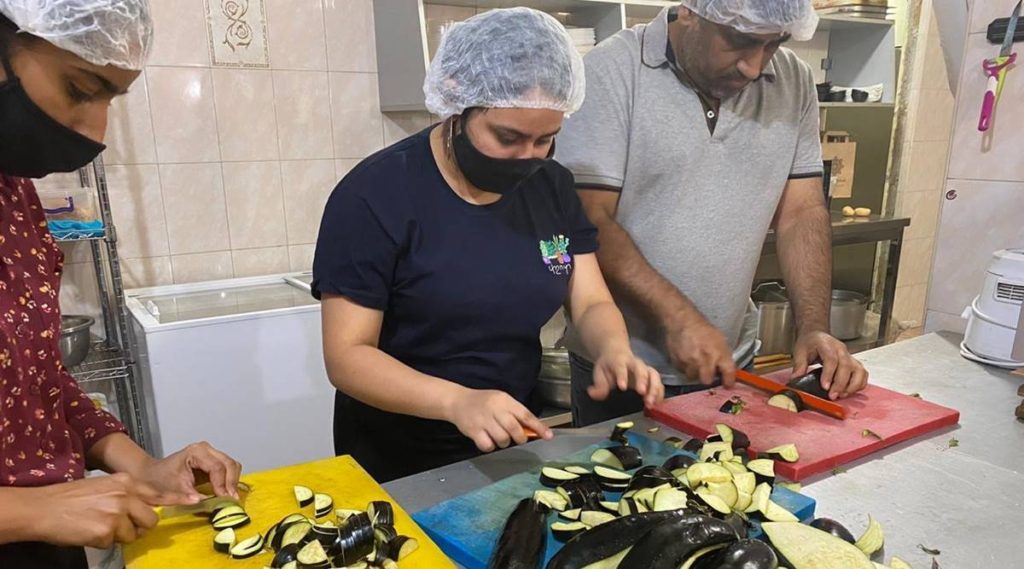
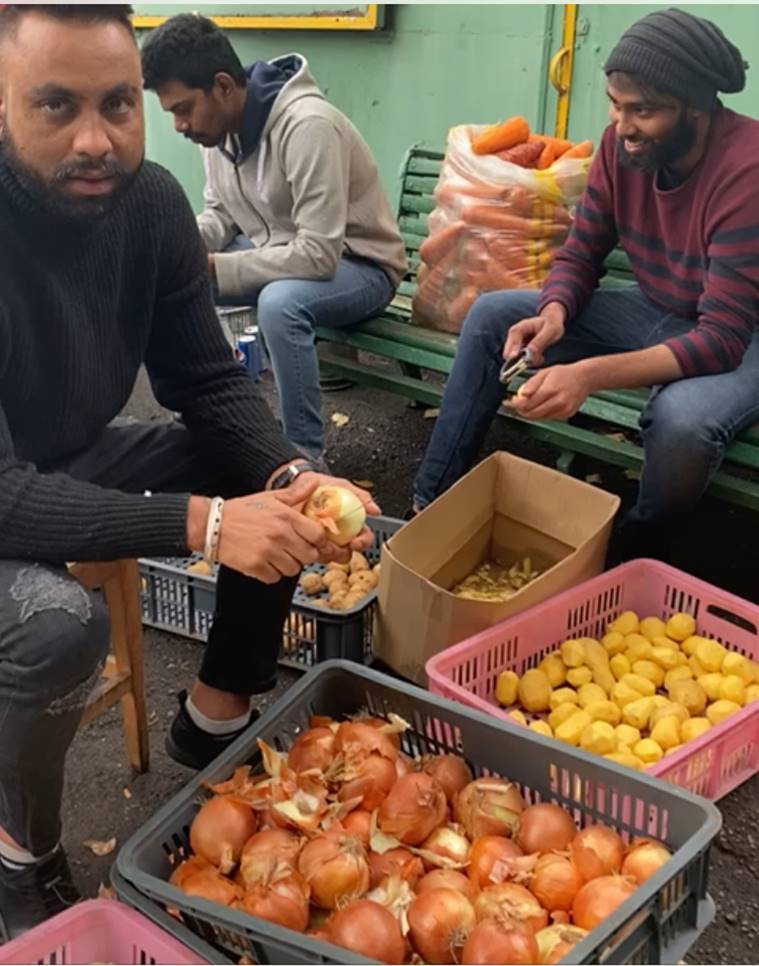
Overnight, he turned his kitchen into a space where his staff could prepare hundreds of food packages to distribute in the capital. “I had some savings that I had kept aside to open a restaurant in Prague. That didn’t materialise due to the coronavirus outbreak. So I am using those funds for this.”
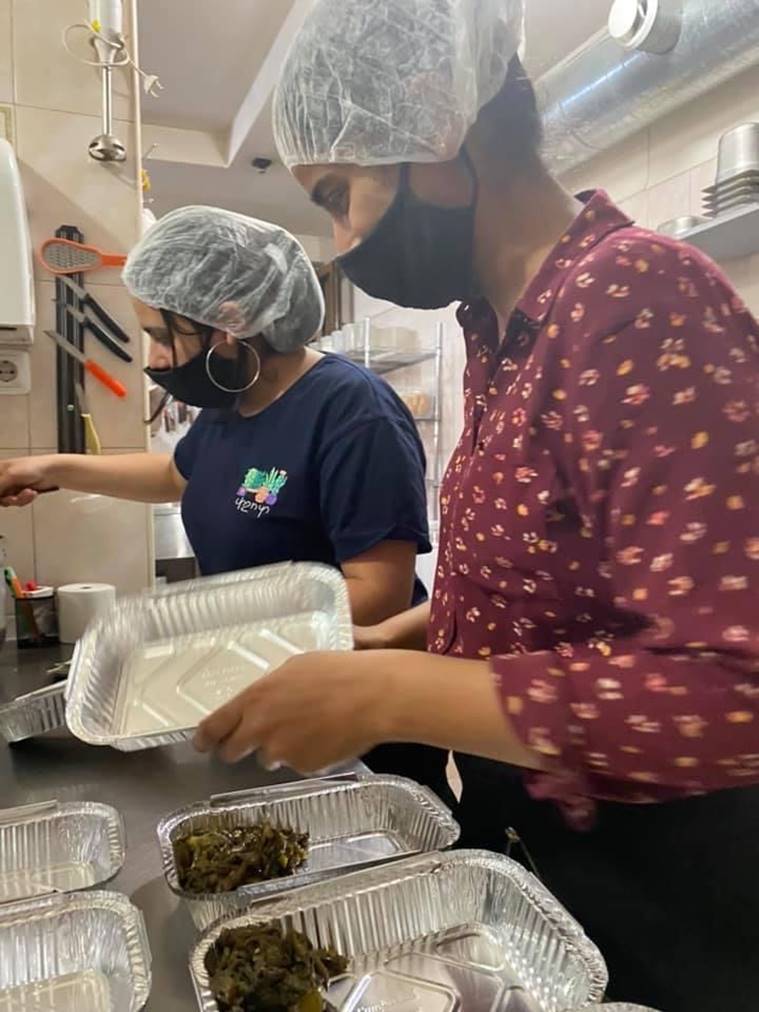
“We started on October 4, and it just blew up,” says 20-year-old Aqsa, Khan’s elder daughter. “We knew there were refugees, but we didn’t know there were so many.” Since then, Khan and his family, along with four employees, have been working 12-hour shifts to prepare boxes with rice and naan, chole-bhature, vegetable dishes with potatoes, brinjal etc., all cooked using less spice than what is customary in Punjabi cooking, to suit the preferences of Armenians.
Aqsa Khan (right) and her sister Alsa pack prepared food in their restaurant’s kitchen. (Photo: Aqsa Khan)
But the family doesn’t think they are doing anything unusual. “There is a lot of unity in Armenia,” Aqsa explains, pointing to citizens who have come together to donate whatever was possible—from money to essentials. “We were thinking about how we could help. So we first posted on the Facebook page about donating proceeds from delivery and take-out orders. But then we saw that the refugees didn’t have access to fresh food and we thought this was more impactful.”
Employees at Indian Mehak Restaurant and Bar in Yerevan, Armenia, work round the clock to prepare food packages. (Photo: Aqsa Khan)
Aqsa says that the family found inspiration for the initiative when a local resident approached the restaurant asking for dry ingredients that she could use to prepare food for children to whom she was providing shelter. The family offered cooked Indian food instead. “We thought that we would be doing it for 25 to 30 people only,” says Khan. But the family soon realised that there were many more who needed their assistance.
Aqsa and her sister Alsa, 18, then took to Facebook and announced that the restaurant was offering Indian food to whoever was coming in from Artsakh, another name for Nagorno-Karabakh. “On the first day, some 400 people asked for help,” says Khan. “It grew from there,” Aqsa adds.
As their social media post has spread, the Khans’ phones haven’t stopped ringing. While some callers have been requesting for food packages, many others have reached out to the restaurant to offer assistance in any way they can. “Women are calling us to ask if we need help in the kitchen. People are bringing their cars to help distribute the food,” says Khan.
Recently, a volunteer delivered food from the restaurant all the way to Hrazdan, a town some 50 kms away, where some residents of Nagorno-Karabakh have sought refuge. Another volunteer has helped deliver food to Tsaghkadzor, a town a little further away. While the Khans are cooking the dishes, four Armenians have stepped in to help package the food and deliver it across Yerevan.
“Now refugees are calling us directly, as are organisations who are helping them. Some hotels who have been hosting refugees have also asked us to provide (food packages) for one meal a day,” says Aqsa. “I have never seen anything like this.”
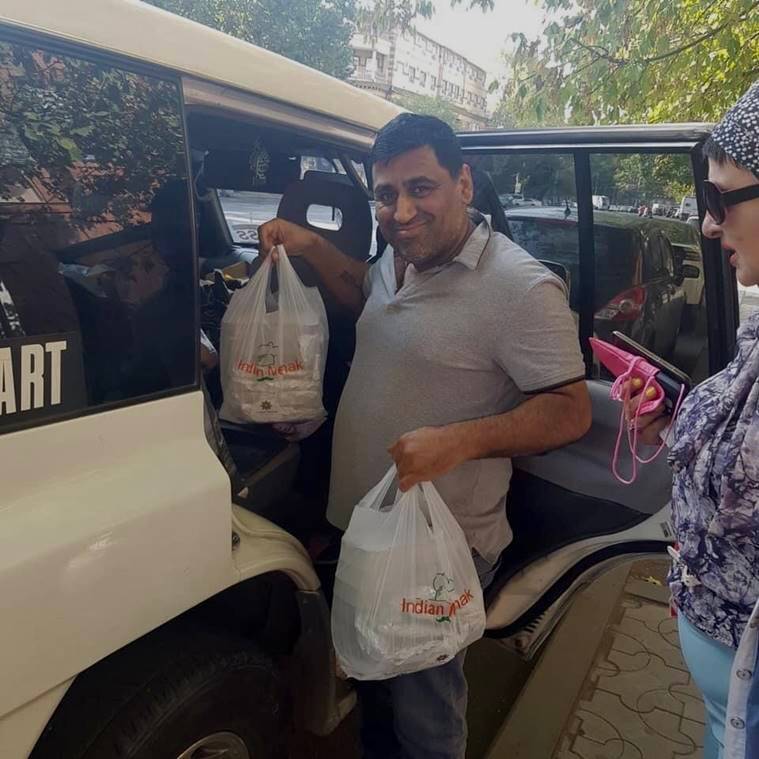
Parvez Ali Khan helps load food packages into a waiting van outside his restaurant in Yerevan, Armenia. (Photo: Aqsa Khan)
Since the initiative is only a few days old, for now, Khan is making use of his restaurant’s supplies to prepare these food packages. The restaurant has found an outpouring of support from people across Armenia and even those in the diaspora. Many have left them messages of gratitude, promising to visit the restaurant when they can. “After the war, I will visit your restaurant and celebrate our victory,” says one message on their Facebook page, with hundreds of others in a similar vein.
There aren’t too many Indians in Armenia, says Khan, and his establishment is among the few prominent Indian restaurants in the country. In Yerevan alone, he believes, there must be around 100 Indian families, with approximately 4,000 Indian students studying medicine, scattered in universities across the country. Following the Indian government’s operation of Vande Bharat flights to help citizens overseas return home during the coronavirus pandemic, many have temporarily left.
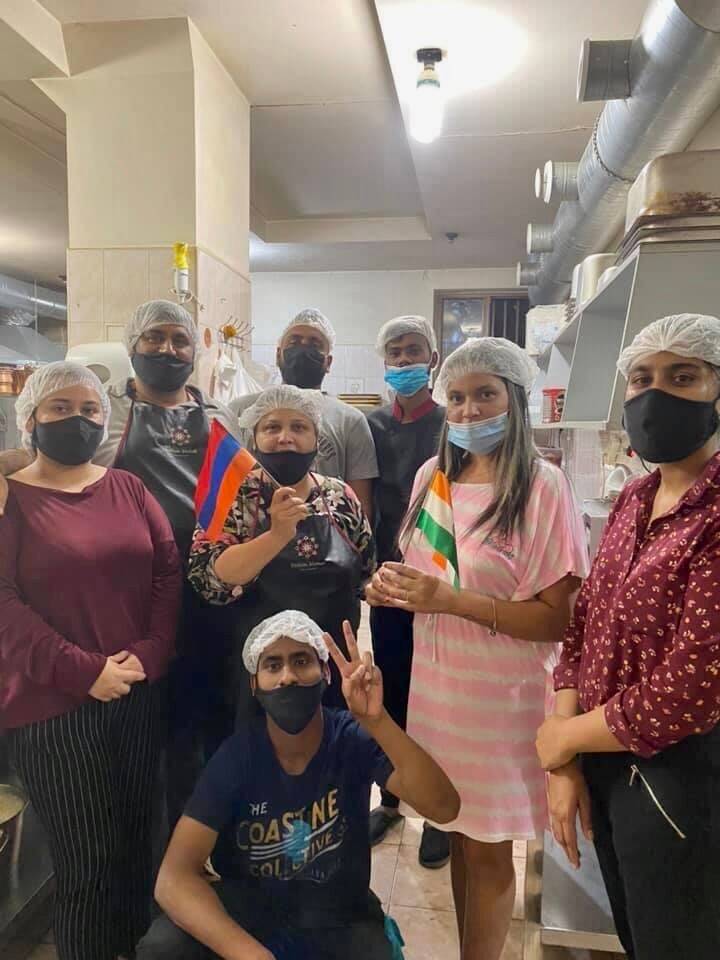
The Khan family and their employees pose with the Indian and Armenian national flags in their restaurant’s kitchen in Yerevan, Armenia. (Photo credit: Indian Mehak Restaurant and Bar)
Over the past five years, Khan says his daughters have developed a fondness for Armenia. During their years at school and college in the country, they have made friends, learnt the language and the culture and have adapted well here, while holding on to their Indian citizenship. “They like the country.” The family has been working non-stop to prepare the food packages and they don’t have too much time for more questions. For Aqsa, Nagorno-Karabakh is as much a cause as it is for her Armenian friends and she is doing whatever she and her family can to assist the country that is now home.
source: http://www.indianexpress.com / The Indian Express / Home> World / by Neha Banka, Kolkata / October 07th, 2020
Kiragavalu village (Malavalli Taluk, Mandya District) , KARNATAKA :
Syed Ghani Khan of Kirgavalu village has been conserving and propagating hundreds of native varieties of rice which are threatened with extinction in the race for high-yielding commercial varieties.
For Syed Ghani Khan of Kirgavalu village in Karnataka, preserving native varieties of rice is a lifetime passion.
This 42-year old has been cultivating virtually hundreds of varieties of rice on his 14-acre farm in the village located 20 kilometres from Mandya in the Cauvery basin. He preserves seeds of nearly a thousand of these varieties in a tiny museum that he has organized at his house in the village.
Walls of his first floor hall display these seeds, held in clusters of panicles neatly pinned on several panels with tags bearing the names of the varieties alongside.
Museum at Home Son of a farmer and someone who does not fight shy of calling himself a farmer, Ghani Khan holds a degree in Archaeology and Museology from Mysore University.
Pained at the increasing use of chemicals, fertilizers and pesticides and loss of native varieties, Khan took up the task of preserving seeds of these varieties in packets. He would supply the same to local farmers around his village before the arrival of the next monsoon. But he was not satisfied. It needed a little more effort. He conceived the idea of a museum for promoting general awareness together with the supply of seeds. Two halls in the upper floor of his old, tiled house were readied for the purpose. The clustered panicles were arranged on wall panels in a hall, while those in bottles were arranged on shelves in the second one.
Ghani Khan feels that commercialization of farming has led to rejection of traditional varieties of crops, be they cereals, lentils, vegetables or fruits. The farmers were influenced by the publicity to seeds produced by large firms that promised better yield. This has resulted in en masse switching over to hybrid varieties like MTU-1001, IR-64, Jaya etc.
Sustainable Ghani Khan says conservation of traditional varieties is critical to sustainable agriculture as several of them carry medicinal properties, some give out aroma on cooking, some can withstand drought and yet others can be grown with just one or two showers.
He wanted to conserve these varieties for future generations. So, he began collecting varieties like Ratnachudi, Gandhasalai, Rasakadam, Rajamudi, Ghamgadale, Doddibatta, Doddabyrenellu, Chinna ponni, Mysore Mallige, Zeerge Sanna, Parimalla Sanna, Basumati, Burma Black, Thai Jasmine etc.
Dedicated Zone He says while agricultural colleges or universities used freezers to preserve seeds, he applied on-field conservation methods which can ensure a life of at least 18 months for the paddy seeds without pesticides. He has dedicated one acre of land in his farm in a demarcated zone where seeds of several varieties are sown in documented segments.
He even wrote to the Chief Minister of Karnataka to initiate measures to preserve and conserve native varieties. But no response has been received from him.
During the last two decades, he has supplied free seeds of native varieties to around ten thousand farmers and received positive responses from them. He keeps a meticulous record of all those who have visited him or sought seeds from him. Shiv Prasad, a farmer from the outskirts of Hyderabad has taken seeds of around 200 varieties from him and forwarded the seeds from the resulting crop to his associates. Krishna from nearby Maddur village has been a constant procurer of seeds from him. Rachanna from Hosamalangi village in T. Narsipur taluk has successfully grown around 25 varieties of rice after having taken from him.
Honours Conferred A corner of his museum displays several trophies, medals and certificates that were presented to him in recognition of his work for propagation of native varieties. He was conferred Krishi Pandit Prashasti by the Government of Karnataka in 2008. Plant Protection Variety Forum conferred on him National Genome Seed-saver Recognition a year later. Directorate of Rice Research, Hyderabad selected him for Rice Innovative Farmer’s Award for 2011-12. Government of Karnataka chose him for Bio Diversity Award in 2010, while Suvarna TV channel declared him winner of the ‘Man of the Year Award’ in 2017.
According to Ghani Khan, India is home to thousands of varieties of rice and one should not be surprised to find one variety being replaced by another after every forty kilometres. He says several varieties are known for medicinal properties. If Navara of Kerala is good for those who have joint pain, Karigajvilli and Ambe Mohur from Karnataka are said to be good for lactating mothers. Mehdi is held to be good for healing of bone fracture, while Mapillai samba from Tamil Nadu improves virility. Khaima is said to be good for those suffering from piles.
Ghani Khan is a mobile encyclopaedia of knowledge on varieties of rice. He says it is wrong to presume that paddy is an aquatic plant. He refers to several varieties such Doddi Batta, Ghangadale and Biddi Doddi which can be grown in farms that receive just one or two showers. He says Ratnachudi, HMT, NMS-II are high-yielding varieties while Zeerge Sanna, Rasakadam, Gandha Sale, Parimala Sanna and Mugadh Sugandh emit pleasant aroma on cooking.
For the last few years Ghani Khan has taken up conservation of native varieties of mango too and has registered himself with the National Bureau for Plant Genetics, New Delhi. He has trees that have been there with his family farm for the last six to seven generations.
These trees yield native varieties like Mosambi ka Aam (tasting like sweet lime); Seb ka Aam (tastes like apple); Pheeka Aam (for diabetics); Kaale Malghoba, Bada Gola; Mangamari; Manji bi Pasand; Mittmia Pasand. Some of these varieties are procured from him by suppliers attached to Lulu Mall in Dubai.
Syed Ghani Khan can be reached at 99017-13351, email: muhinuha786@gmail.com.
source: http://www.islamicvoice.com / Islamic Voice / Home> Features / by Maqbool Ahmed Siraj / February 15th, 2019
Fashion, as we know it, is one of the most influential industries in the world.
Bengaluru :
Fashion, as we know it, is one of the most influential industries in the world. And when brands not only make top quality products but also come full circle and give back to the community through their choices, they become good influencers of fashion.
Kulsum Shadab Wahab, based in Bengaluru, is a philanthropist recognised by Chime for Change, a global campaign founded by Gucci, which features 25 women activists from around the world working to advance gender equality.
A true fashion enthusiast, she believes in altering the perception of high fashion through inclusivity. Ara Lumiere, an initiative by her Hothur Foundation, works with acid attack survivors in making avant-garde head gears. Worn by the likes of pop star Katy Perry, Ara Lumiere’s head gears have won many international awards. They have also collaborated with Shah Rukh Khan’s Meer Foundation to create awareness on skin banking.
Ara Lumiere X Dhruv Kapoor bucket hat collection
The spring summer ’21 edition of Ara Lumiere, in collaboration with ace designer Dhruv Kapoor (Ara Lumiere X Dhruv Kapoor), which was made out of diligence, love and hope by the survivors, was recently unveiled at the first-ever digital Milan Fashion Week.
Showcased through a short film, the gender neutral collection features embroidered bucket hats in sheer organzas and taffetas, handcrafted and hand embroidered by the brave acid attack survivors. All proceeds have gone into the rehabilitation of the survivors, where fashion has acted as a powerful tool in empowering these women.
The government’s leather ban in 2015 destroyed jobs for leather work artisans, mainly from marginalised communities. A fight for justice against caste and ostracised communities got artist-activist Sudheer Rajbhar to develop a new recycled material – one that is made from waste but close to leather in its texture and durability – to celebrate and conserve crafts from a banned industry. This is how Mumbai-based Chamar Studio was conceived.
Says Rajbhar, “Chamar was once used as a slur and we have tried to end that. Our brand’s promoters in Germany, the USA and France tell us the name sounds like a mix of ‘Chanel’ and ‘Shalimar’ and associate it with luxury.” These bags, which come in striking bold colours, are high on functionality, design and skilled craftsmanship and proudly stand at par with any global luxury brand. These timeless pieces are waterproof, cruelty free and vegan as well.
Brands with a cause make us believe that fashion can be something bigger, more than just a style statement. Along with creating high quality products that are recognised globally, fashion also puts out good into the world. Whether it is supporting a cause or sourcing sustainable material, these brands are definitely the game changers of fashion today.
(The writer is a lifestyle consultant and mindful fashion advocate)
source: http://www.newindianexpress.com / The New Indian Express / Home> Cities> Bengaluru / by Sarayu Hegde / Express News Service / October 01st, 2020
On Teachers’ Day, Association of Muslim Professionals (AMP), a not-for-profit organisation working in the domains of educational and economic empowerment, has announced the launch of 2 significant initiatives which will benefit the Students’ fraternity. Specially those needing financial assistance for higher education or expert career and professional guidance by professionals.
The 2 new initiatives that have been launched are;
India’s 1st Free Higher Education Scholarship Crowd-Funding platform (IndiaZakat.com/Scholarships) and
Free Mentorship Project for Needy Students requiring guidance (TheIndiaMentors.com)
While speaking at the event Dr. M. Aslam Parvaiz, Former Vice-Chancellor, Maulana Azad National Urdu University (MANUU), based his presentation on the teachings of Holy Quran. He said “the Quran guides us to not just worship the Almighty but also help His creatures in all ways possible”. He went on to say “We should not be slaves of Rituals and Religious practices but understand the actual meaning of the Holy Book and implement the teachings in our lives to advance as a Community.”
Mr. Aamir Edresy, President-AMP, initiated the Webinar and welcomed the participants. He said “it’s a very historic day for AMP as we have finally realized our dream of helping and guiding students through Scholarship funding and Mentorship guidance. The Muslims’ representation in Government, Corporates, Higher Educational Institutions is very low and these initiatives intend to increase these representations.” He went on to say “For a large part of the Muslim Community, due to their socio-economic conditions, basic needs take priority over education. We need to create the awareness of the importance of Education and improve its priority in our lives”.
Prof. Furqan Qamar, Professor, Centre for Management Studies, Jamia Millia Islamia (JMI) went on say that the Community needs to be convinced of not just Higher Education but also basic education itself. More than anything the community needs to get rid of ‘Perceived Barriers’ and that we should always encourage ‘Merit’ to ensure that those who work hard are recognized and promoted.
Speaking form United Kingdom, Mr. Zahid Howladar, Head of Delivery – 1 Million Mentors, said “While the well-educated and well placed are well connected and are able to get access to good education and good guidance, it’s the disadvantaged in our Community who suffer due to the lack of guidance and mentorship. Mentorship is an initiative which will ensure that there are lot less dropouts from Schools and Colleges and also lowers Hate among groups. It is also impactful and transformative in our lives.”
Ms. Naghma Mulla, President & COO-EdelGive Foundation said “The difference between today’s underprivileged and self-sufficient people is the ‘Digital Divide’. People who were digitally more advanced managed the Pandemic situation better and this is the outcome of being more educated.” She went on to say “In today’s Post-#Covid-19 world, where the Governments & Economies are badly affected, it is all the more necessary that Students and their Parents are assisted and supported in the financial as well as career domains. These initiatives of AMP will help the Community in the long run.”
These initiatives were launched at a special Webinar today with the audience attending from all parts of India and Globe.
The Higher Education Scholarship Crowd-Funding will be done on AMP’s (www.indiazakat.com) platform, which is India’s unique digital platform, connecting donors & seekers. Launched just 4 months back, IndiaZakat.com has already raised more than 80 lacs and helped needy people especially in the Education domain.
The Free Mentorship Project (www.theindiamentors.com) being launched today is the culmination of a long dream of AMP for which the seeds were sown in as early as 2012. However, the importance of ‘Mentorship’ in India is quite lacking unlike the Western countries and hence it took a long time for a team to form who could handle and drive the project. TheIndiaMentors.com will guide students for academic as well career or professional issues without any fees by expert professionals of Industry as well as Academia.
The welcome note was given by Mr. Hafeez Iqbal (Ex-director, L&D, Pfizer) and Mr. Shehzad Mukadam and Ms. Humera Kabir hosted the event.
The Webinar was followed by the announcement of 4th AMP National Awards for Excellence in Education 2020 in which 103 Educators were honoured across the Country for helping in nation building.
Association of Muslim Professionals (AMP) is a platform for professionals and volunteers to share their knowledge, intellect, experience and skills for the overall development of not just the community but also the society at large and further empowering underprivileged in the educational, social, political and economic fronts of life.
source: http://www.milligazette.com / The Milli Gazette / Home> News> Education and Careers / by The Milli Gazette Online / September 14th, 2020