Currently, Lulu imports apples and saffron from Kashmir and imports will significantly increase in the coming years.
Image used for representatio
The UAE-based Lulu Group International has announced a plan to set up a food processing centre in Srinagar for sourcing a wide range of agri products from Jammu and Kashmir.
The announcement was made by Lulu group chairman Yusuffali MA on Thursday during a meeting with a delegation from Jammu and Kashmir headed by its Principal Secretary (Agriculture Production and Horticulture) Navin Kumar Choudhary on the sidelines of the UAE India Food Security Summit 2020.
“As per the commitment made during the visit of Prime Minister Narendra Modi to UAE in 2019, Lulu Group is fully focused on sourcing a wide range of agri products from J&K,” Yusuffali, who is from Kerala, said.
“Setting up of a new food processing and logistics centre will further boost the export of Kashmiri products,” he said.
Currently, Lulu imports apples and saffron from Kashmir and imports will significantly increase in the coming years.
The group imported more than 400 tons of Kashmiri apples till date, despite several challenges in the recent past due to the coronavirus pandemic, according to an official statement.
Yusuffali said Lulu group is one of the leading importers of food and non-food products from India and setting up of a new food processing and logistics centre will further boost export of Kashmiri products to the Gulf Cooperation Council (GCC) and other countries.
GCC is a political and economic union of six Arab states bordering the Gulf.
Its members are the United Arab Emirates, Saudi Arabia, Qatar, Oman, Kuwait and Bahrain.
Describing the meeting as “very productive”, J&K Principal Secretary Choudhary said a large number of decisions were taken to promote the export of agriculture and horticulture products from the union territory to the entire Gulf region using stores of Lulu group.
He assured all help to Lulu group for setting up logistic facilities and offices at identified facilities in J&K.
Choudhary also welcomed the initiative of Lulu group to host a “J&K special” fortnight at all super markets at its group across the Gulf region on the occasion of Republic Day-2021 as part of Incredible India.
This fortnight celebration will begin on January 24 next year and will showcase J&K’s famous products like cuisine and cultural heritage, the statement said.
The discussions also focused on exploring the possibility of direct passenger as well as regular cargo flights between Srinagar and Dubai.
An MoU was also signed between Lulu group and Fruit Master Agro Fresh J&K for the supply of apple and other fruits for the super markets of Lulu group across the Gulf countries, the statement said.
Indian Consul General Aman Puri congratulated Lulu group for announcing a host of initiatives and the long-standing commitment and partnership in achieving the target of doubling J&K’s exports and expressed his gratitude to the company chairman for his initiatives in the union territory which would generate employment opportunities for local youths and contribute to the economic development of the region.
source: http://www.newindianexpress.com / The New Indian Express / Home> Business / by PTI / December 11th, 2020
Barwad Village, Chikodi Taluk (Belgaum District), KARNATAKA :
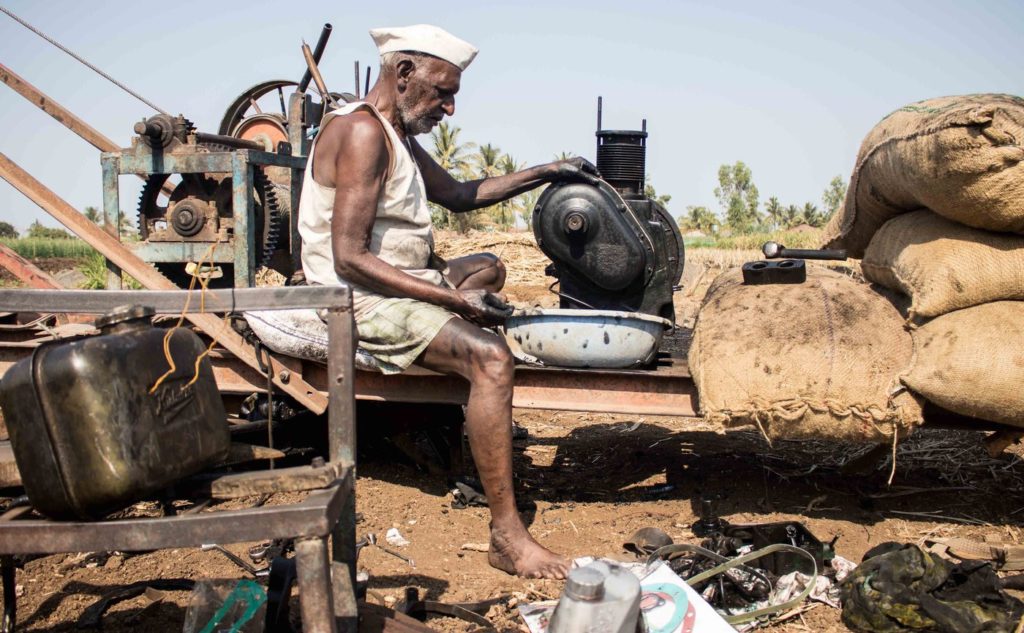
Shamshuddin Mulla is known in the villages of Belgaum and Kolhapur district as a master mechanic with over 70 years of experience. Not many after him, he says, will have his passion for this grimy work.
“I will die with a paana [spanner] in each hand,” says Shamshuddin Mulla. “Death will be my retirement!”
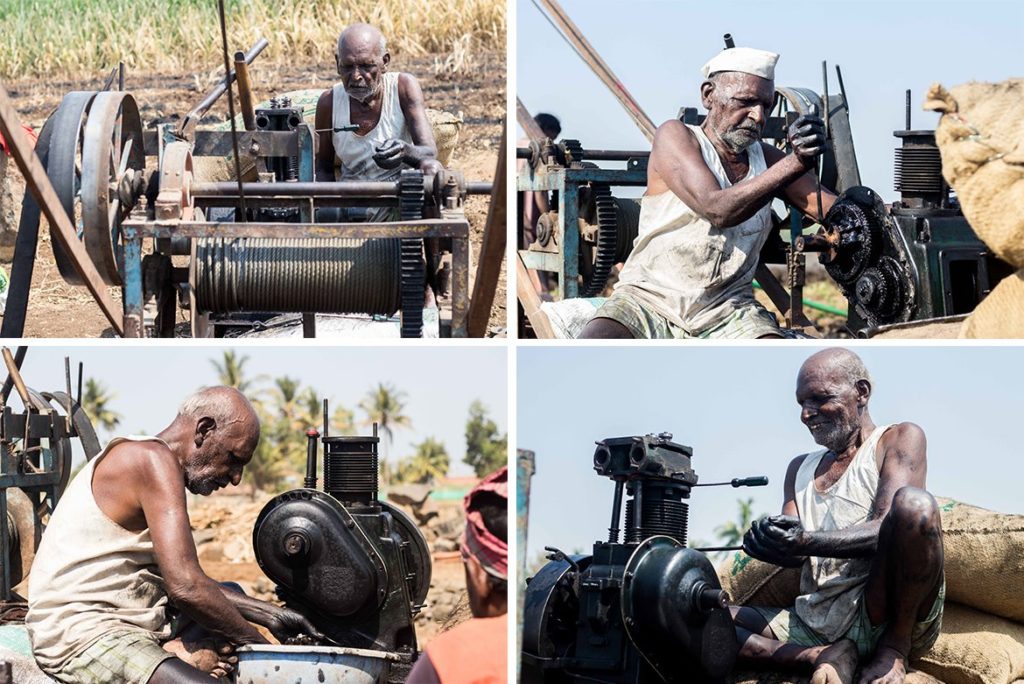
That may sound dramatic, but Shamshuddin has indeed spent a large portion of more than 70 years wielding a spanner and other tools. Using them to repair all kinds of engines – water pumps, borewell pumps, mini excavators, diesel engines and many others.
His expertise in bringing all this faltering or silent farmland machinery to life is in high demand in the villages of Karnataka’s Belgaum district and Kolhapur district in Maharashtra. “People call me only,” he says, with a hint of pride.
Farmers and other clients come to Shamshuddin seeking his signature technique to diagnose a mechanical problem. “I just ask the operator to rotate the handle and from that I can identify what’s wrong with the engine,” he explains.
Then the real work starts. It takes him eight hours to repair a troubled engine. “This includes the time from opening to reassembling,” Shamshuddin says. “Today, the [engine] kits come with readymade materials, so it’s become easier to repair them”.
But countless hours of practice have gone into achieving his eight-hour average. Now 83, Shamshuddin estimates he has repaired more than 5,000 engines in 73 years – engines used for drawing water from the river, for extracting oil from groundnuts and oilseeds, moving stones from construction sites and wells, and for various other purposes.
Shamshuddin Mulla, 83, is known in the villages of Belgaum and Kolhapur district for his signature techniques. While working unperturbed in the heat when we meet, he gets several calls from hardware dealers in Kolhapur city, and says, ‘The dealer just has to tell me the name of the client who visited me, and ask for the parts required’
It is difficult, he says, for many farmers to find skilled mechanics because the company-appointed technicians don’t usually go to their villages. “It’s expensive too to invite the company’s mechanic,” he adds. “And it takes them time to reach remote villages.” But Shamshuddin can reach the ailing engine much faster. The farmers also consult him when younger technicians are unable to diagnose or repair the machines.
No wonder then that in his village, Barwad in Chikodi taluka of Belgaum district, Shamshuddin is known as Shama mistri, an expert mechanic. It’s to this village that people carry their small silent engines to be brought to life, or from where Shamshuddin travels out to the fields and workshops where broken engines await his expert touch.
The engine-manufacturing companies value Shamshuddin’s skills too. He can repair the machines manufactured by big companies like Kirloskar, Yanmar and Skoda, as well as several local companies. “They consult me on making improvements to the engines, and I always tell give them feedback,” he says.
For example, engine handles were not sturdy and compact earlier. “People had to rotate the handle [crankshaft] several times, and this would hurt them and cause injuries. I advised some companies to improve the handles. Now many of them provide three gears instead of two,” he says. This improves the balance, timing and movement of the handle. Some of the companies with branches in Kolhapur district, he adds, invite him to their celebrations on occasions like Independence Day, Republic Day and the company’s anniversary.
The months of March, April and May are the busiest for Shamshuddin, when he repairs around 10 engines every month – for a fee ranging from Rs. 500 to Rs. 2,000 for each repair job, depending on the complexity of the breakdown. “Before it rains, many farmers get wells drilled on their land, and that’s when a lot of engines need repair,” he explains. During the rest of the year, his repair work continues but the calls are less frequent.
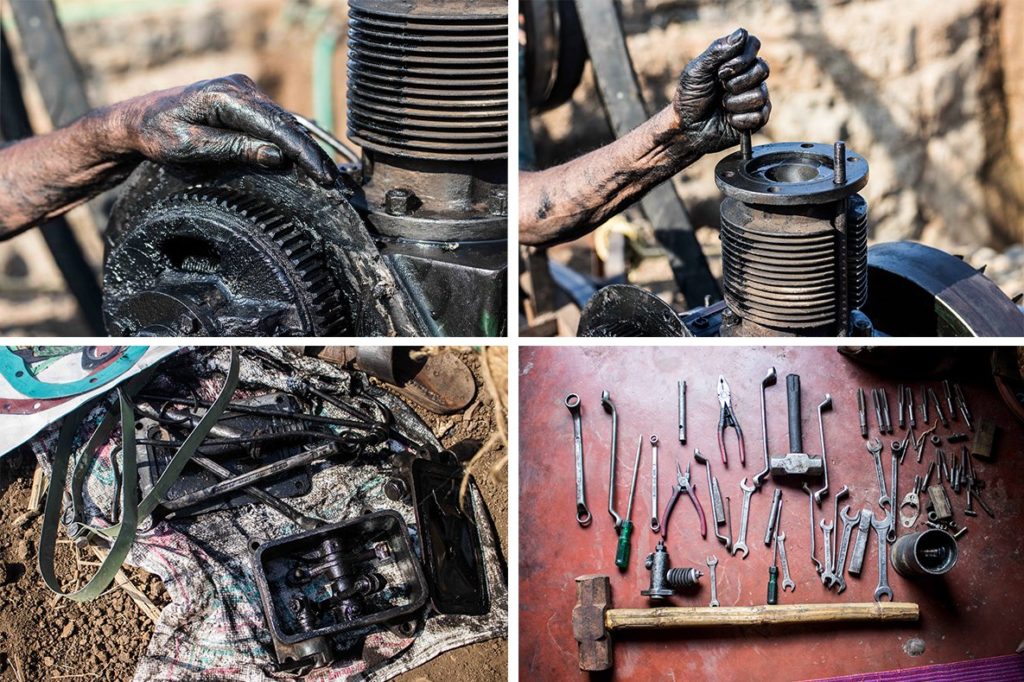
Top row: Shamshuddin says not many in the younger generation are willing to dip their hands in sticky black engines. ‘I’ve never used any gloves, what will I do by using them now?’ he asks. Bottom row: A dismantled engine’s innards (left) and some of the tools (right) which Shamshuddin has bought over seven decades. He is very particular about the right kind of equipment, and prefers carrying his own set of tools for any repair work
When he isn’t away repairing engines, Shamshuddin looks after his two-acre farm and cultivates sugarcane. He was only about 7 or 8 years old when his father Appalal and mother Jannat, who were farmers, shifted to Barwad from Pattan Kodoli in Kolhapur’s Hatkanangle taluka. To help with the family’s earnings, at the age of around 10, in 1946, Shamshuddin started assisting a mechanic in Barwad. Ten hours of work fetched him Re. 1 every day. The family’s poverty prevented him from studying beyond Class 1. “Had I completed my education, I would have been flying an airplane today,” he says with a laugh.
Shamshuddin recalls going by bullock cart every fortnight to Hatkanangale village, where freight trains halted – around 30 kilometres from his village – to purchase diesel for engines in the mid-1950s. “Back then, diesel cost one rupee per litre, and I used to buy three barrels [a total of 600 litres] each time.” Shamshuddin was known as ‘Shama driver’ in those days, whose job was to maintain the machines.
In 1958, a few mechanics from Kolhapur city came to Barwad to install an 18-horsepower engine for drawing water from the nearby Dudhganga river to the fields. Then 22, Shamshuddin carefully observed them at work to try and understand how an engine worked. “It required crude oil worth two rupees every day,” he recalls. The engine malfunctioned the following year after getting submerged in the rising river water. The technicians were called back and Shamshuddin used the opportunity to polish his own skills. When the machine went under water again in 1960 (it was eventually replaced by a newer version), he repaired the engine on his own. “From that day onward, my name was changed from ‘Shama driver’ to ‘Shama mistri’,” he says, proudly.
An incident in 1962 convinced Shamshuddin that it was the right time to further explore the world of engines. A farmer from Barwad had commissioned him to buy an engine for his field. “I went all the way to Ghunaki village [around 50 kilometres away] in Hatkanangle taluka to the company warehouse and brought the engine for Rs. 5, 000,” he says. It took him 20 hours over three days to assemble it. “A mechanic from the company inspected it afterwards and said it was done perfectly,” he recalls.
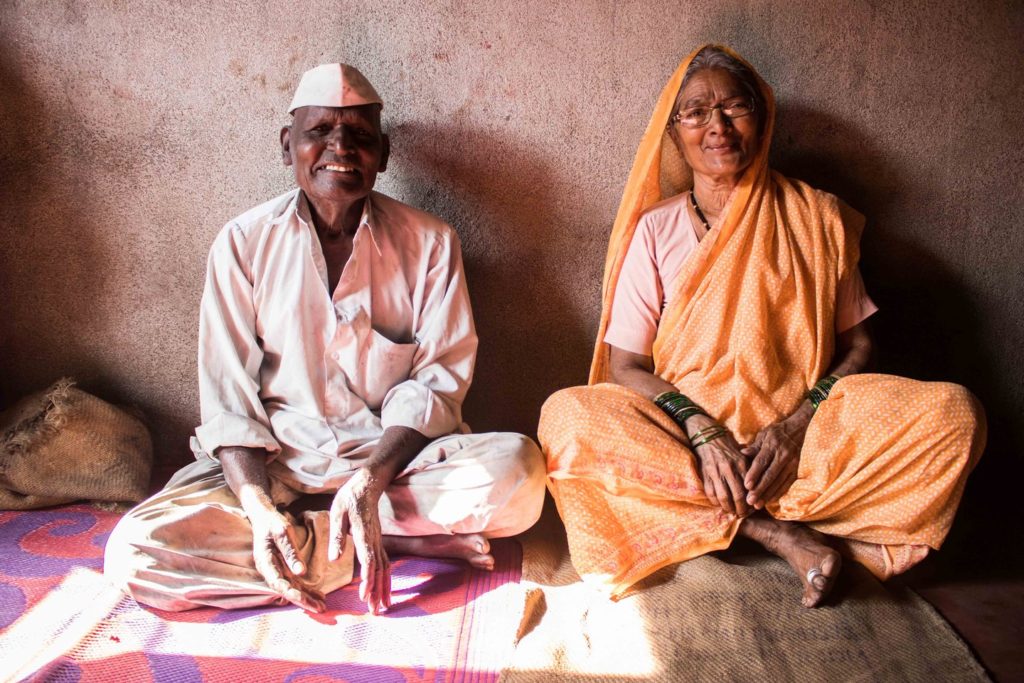
At their home in Barwad village: Shamshuddin and his wife Gulshan, who says, ‘For me, agriculture is better than repairing machines’
Over time, Shamshuddin’s reputation as a skilled mechanic kept growing. He had by then worked as an apprentice to another mechanic for five years, earning Rs. 2 a day. When he started repairing engines on his own, his income went up to around Rs. 5 a day. He would travel on his bicycle to the nearby villages of Chikodi taluka in Belgaum (now Belagavi). Today, his customers contact him by phone and ferry him in their vehicles.
But the craft of repairing engines also has its risks. “Once [in the 1950s] I got hurt while working. You can still see the wounds on my back. They will never heal,” Shamshuddin says. A few months ago, he went through an angioplasty procedure in a Kolhapur hospital. “The doctors asked him to rest for six months, but there is no one who can repair engines,” says his wife, Gulshan. “Within two months, people started bothering him to come and repair their engines.”
Gulshan, who is her mid-70s, helps with cultivating sugarcane on the family’s two acres, and they sell the cane in the market. “He asks me to learn how to repair and even teaches it sometimes, but I am not interested in it much. For me, agriculture is better than repairing machines,” she says, laughing.
Their sons have not taken to Shamshuddin’s craft either. (He and Gulshan don’t have any daughters). The eldest, Maula, 58, has an electric motor shop in Barwad. Isaq, in his mid-50s, helps look after the farm. Their youngest son, Sikandar, died about a decade ago.
“I went out, observed people and learned this art,” Shamshuddin says with a touch of sadness. “We have the knowledge and resources in our home today, but no one even wants to touch an engine.”
For big and heavy engines, Shamshuddin travels directly to the site. Here, he is at Gajabarwadi village of Belgaum district, repairing a diesel engine used to lift stones during well-digging
The situation is similar outside their house too. “No one wants to get their hands dirty with the kalakutt [black, grimy] engine oil. The younger generation calls it ‘dirty work’. How will you repair an engine if you don’t want to touch the oil?” he asks with a laugh. “Besides, people now have a lot of money, and if an engine doesn’t work, they usually buy a new one.”
Still, over the years, Shamshuddin has trained about 10 to 12 other mechanics from nearby villages. He is proud that they too can now easily repair engines, though none of them are as skilled as he is and occasionally seek his diagnosis of the problem.
When asked for advice for the younger generation, Shamshuddin smiles and says, “You should be passionate about something. You have to love what you do. I love engines, and that’s what I spent my entire life on. From my childhood, I wanted to examine and repair engines, and I think I have achieved that dream.”
This is when he declares – “I will die with a paana (spanner) in each hand” – but then clarifies that those words are borrowed from a mentor mechanic he met when he was a teenager, whose passion for repairing engines Shamshuddin still recalls. “He would travel hundreds of kilometers for this work,” he says.” The mentor [whose name Shamshuddin can’t fully recall] had told him once about dying with a spanner in his hands. “It inspired me, and that’s why I work even at the age of 83. Death will be my retirement!” reiterates Shama mistri.
source: http://www.ruralindiaonline.org / Pari – People’s Archive of Rural India / by Sanket Jain / August 07th, 2019
The World’s First Halal Angels Network was launched to promote innovation, entrepreneurship, and startups to tap $5 trillion, Halal consumer market, and would grow to USD 9.71 trillion by 2025. It was launched during the COVID-19 pandemic to help investors, businesses, entrepreneurs & startups overcome these challenging times.
It is founded by Indian American Dr. Tausif Malik , who is a serial entrepreneur based out of Pune, India, and Chicago, USA. India is the biggest manufacturer of Halal consumer goods and has huge market opportunities in the Middle East, North Africa, and Southeast Asia.
Halal Angels Network would be the 1st Angels Network backed by Blockchain technology. The areas of interest for investments would be future technologies (Blockchain, Fintech AI, etc), Modest Fashion & Cosmetics, Retail, Pharmaceuticals, Food Cafe & Restaurants, Processed Food & Tourism.
According to Dr. Malik to it is an extension of his earlier initiative of All India Muslim Business Startup Network (AIMBSN), India’s only (AIMBSN) is a very unique business ecosystem and the objective of the All India Muslim Business Startup Network (AIMBSN) is to create an entrepreneurial spirit and participation amongst the Indian Muslim community, so they can participate and contribute back to the economic activity of their motherland INDIA.
Halal Angels Network would be based on the traditional format of Angels Network where membership would be offered to Angel investors, Investment corporations, organizations, and, startup and they could network with each other for investments and business.
Halal Angels Network is also setting up offices in GCC, Europe, and South East Asia. Halal Angels Network would be hosting Halal Angels & Venture Capital Two Day Summit 2021, for Networking, Startup Showcase & Strategic Partnership.
Dr.Malik concluded by saying that ” When discussed this idea with the investment and startup community; they all got excited about the Halal Angels Network platform and the consensus was this would be win-win situation for everyone to overcome the COVID-19 pandemic”.
source: http://www.maktoobmedia.com / Maktoob / Home> Business / by Maktoob Staff / May 11th, 2020
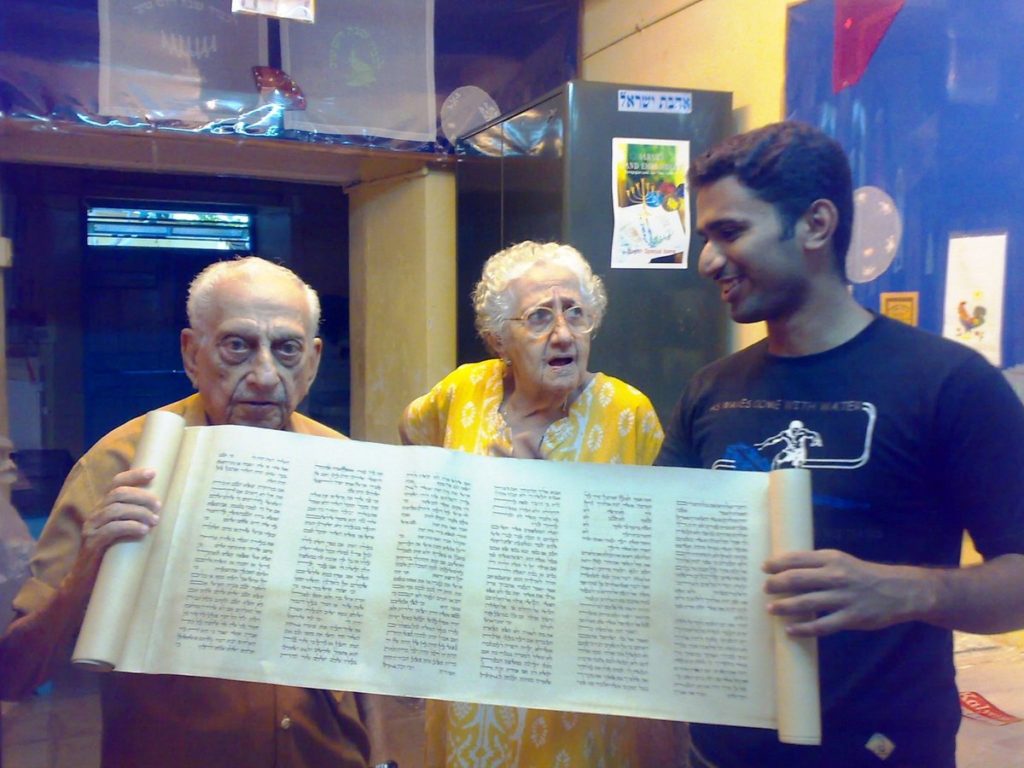
Thoufeek Zakariyah, Sarah Cohen and Isaac Ashkenazi inspecting a Torah that Thoufeek designed.
Down in the heart of “God’s Own Country,” as the Indian state of Kerala is affectionately known, an Indian Muslim calligrapher is using his skills in the art of the ink flourishes to bridge Jewish and Muslim communities.
Thoufeek Zakriya is an Indian Muslim from the city of Cochin who does calligraphy in a number of languages, including Arabic, Samaritan, Syriac and Sanskrit. More interestingly, he is a Muslim who does masterful Hebrew calligraphy.
While studying in madrasa, he learned that the Jewish people were considered by Islam to be ahl al-kitab (“People of the Book”), which sparked a curiosity in him to learn more about this religious community. His curiosity led him to find a copy of the Gideon’s Bible, which had a page with prayers in 23 different languages. He decided to find what encompassed the Hebrew word for God, so using the page as his “Rosetta Stone” he was able to decipher what letters entailed the Hebrew name for the Lord.
Jewtown – home of the tiny yet historic community of Jews in Cochin
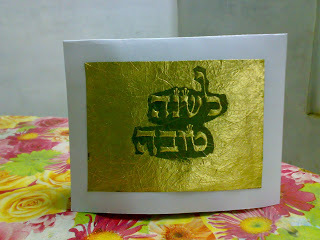
Thoufeek became more interested in Judaism and Hebrew calligraphy, and reached out to the tiny yet historic Jewish community in Cochin . Thoufeek purchased some Hebrew texts he found at a streetside book shop and he went about learning the Hebrew alphabet. His studies in Hebrew led him to begin crafting calligraphy of Jewish prayers such as the Birkat haBayit (prayer for the home) in golden resplendent brilliance.
Birkat HaBayit, the blessing for the home.
Thofeek even began creating calligraphic replicas of the Torah.
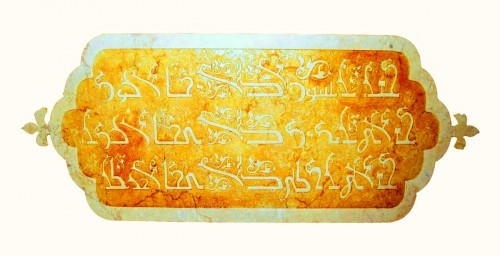
More importantly, Thoufeek does something very unique: he has crafted Hebrew calligraphy in the ancient Kufic Arabic script. Such work is a rarity in the calligraphic world, and his innovations in the Kufic/Hebrew calligraphy has brought Thoufeek accolades from admirers from all over the world. Zakriya has been commissioned as far away as Ukraine and the United States to create works that combine Arabic calligraphy with Jewish prayers.
Birkat Kufic in Jerusalem Stone. The Hebrew letters here are turned into the Kufic Arabic script.
Thoufeek’s work and his dedication to study Jewish history and culture led to a close friendship between him and Cochin’s Jewish community, including his warm friendship with the community’s matriarch Sarah Cohen. Cohen has hosted Thoufeek for Passover seders and other Jewish holiday celebrations.
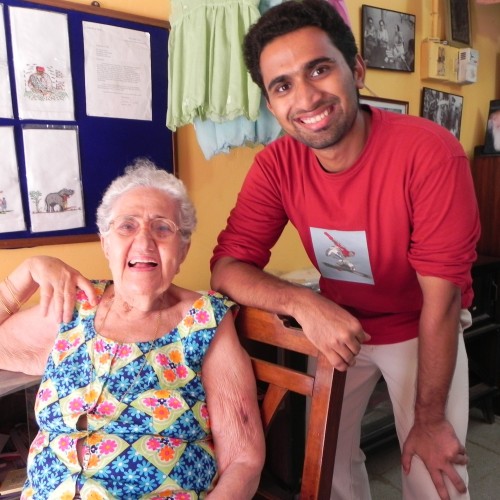
Thoufeek with Sarah Cohen
I met Thoufeek at Sarah Cohen’s embroidery shop, where she stitches yarmulkes and other Jewish-Indian embroideries. As we sat sipping tea and eating watermelon squares and black helwa (sweets), she remarked that she considers him to be like a grandson and a real mensch.
Birkat Kufic in stone. The Hebrew letters here are turned into the Kufic Arabic script
Thoufeek Zakriya is a wonderful symbol of India’s legendary tolerance for religious communities. “At a time when Jews and Muslims are sadly seen as natural adversaries, Thoufeek’s Hebrew calligraphy emerges as yet another example of Muslim-Jewish amity from India,” says Dr. Navras Aafreedi, an Assistant Professor in the School of Humanities and Social Sciences at Gautam Buddha University. Professor Aafreedi studies Jewish communities of India, and noted that Zakriya is the only known Muslim Hebrew calligrapher in India
Card for Rosh Hashanah reading, “Good New Year.”
“Thoufeek’s work shows us that the way to peace is through the exploration of each other’s culture and the commonalities between them,” says Dr. Aafreedi, “His work is a reminder of the shared cultural and religious heritage of Jews and Muslims, which definitely needs to be brought into sharper focus in such a manner that it overshadows the disputes, conflicts and differences.”
Photographs courtesy: Paul Rockower & Thoufeek Zakariya
This article first appeared in Huffington Post, and has been republished here in arrangement with the author. Follow Paul Rockower on Twitter: https://twitter.com/levantine18
source: http://www.thebetterindia.com / The Better India / Home> The Better Home / by Paul Rockower / January 02nd, 2013
At age 24, this college dropout helps companies like Airtel, Truecaller and Justdial protect their users’ personal data. Incredibly, however, he learnt all the necessary skills not through formal courses, but research on Google!
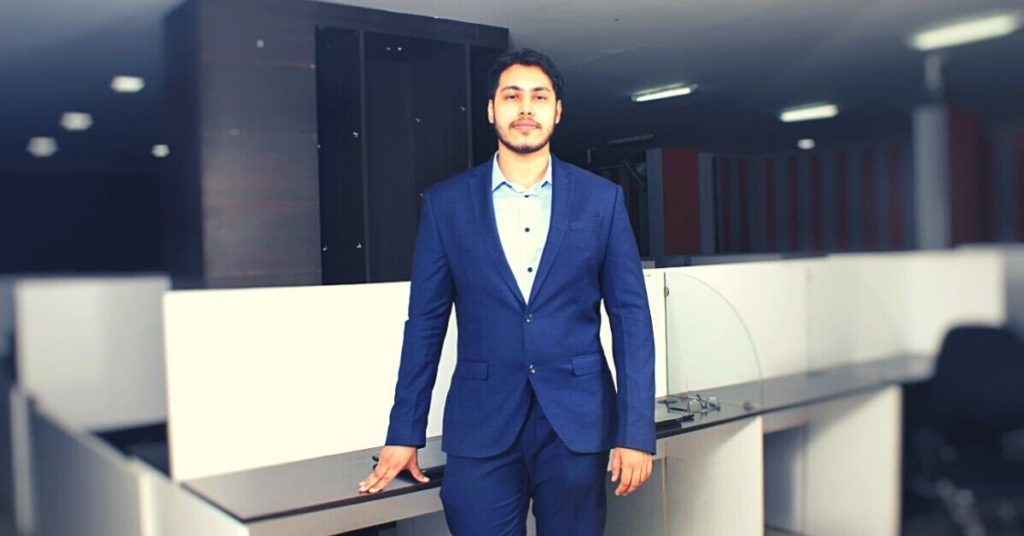
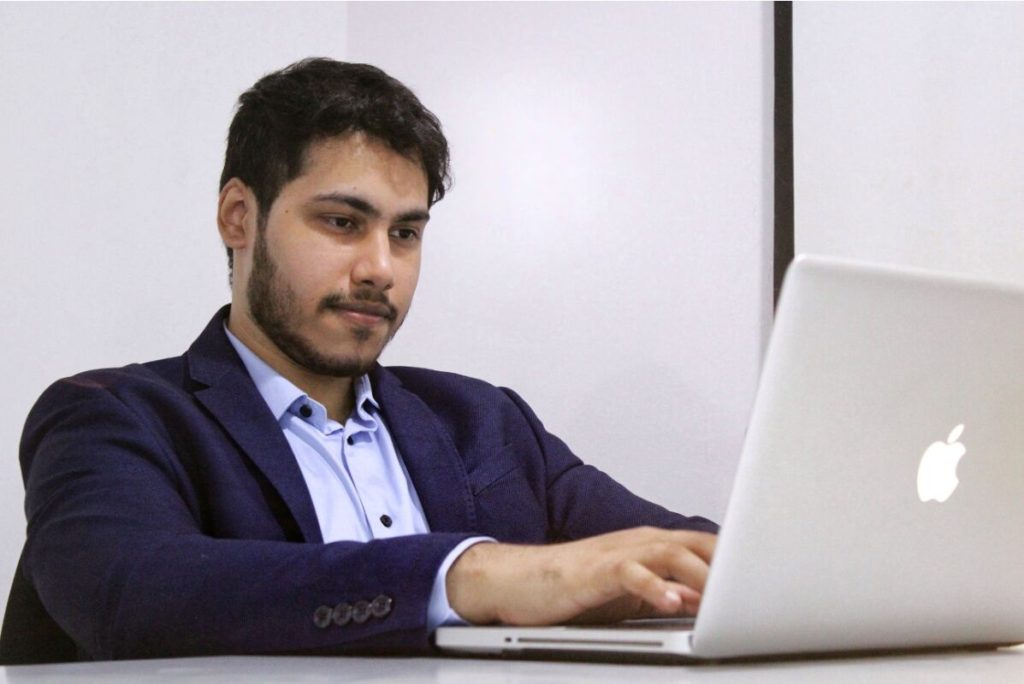
Meet Ehraz Ahmed, a 24-year-old, independent data security researcher from Mysuru, Karnataka, who since last year has protected the data of 700 million users by helping companies like Airtel, Justdial and Truecaller detect major flaws in their data security architecture. Simultaneously, he runs a fintech and a web security company.
What’s particularly remarkable about this first-year engineering college dropout is that he learnt all the necessary skills not through formal courses, but research on Google. A real online prodigy, Ehraz is looking to protect the data of 1 billion users by the end of this year. So, how did this ethical hacker and serial entrepreneur get to where he is today?
Early Days
“I began using computers when I was just 10. I remember accompanying my brother to the local cyber cafe paying Rs 30 an hour and playing games like Counter Strike or browsing the internet. Besides playing games, I was exploring different facets of the online world from social media sites like Orkut to finding ways of building a website because my elder brother was a web developer. I would peek into the source code of the websites he built and try to learn things independently through Google. Whatever I have learnt about computers, web security and the online world is through Google,” Ehraz tells The Better India.
It was while playing Counter Strike with his friends when Ehraz found his first opportunity at entrepreneurship. Understanding the craze for the game amongst his friends, at age 14 Ehraz started a game server hosting venture. However, besides providing online gaming servers for players to connect and play the game for just Rs 200 per player, his venture also began offering web hosting services to different websites.
The reason he ventured into the world of entrepreneurship this early was because of a few tragedies in his life. As an 8th grader, he recalls witnessing his brother meet with a serious road accident. Two years later, his father suffered a heart attack.
“My interest in my venture had dimmed after my father’s heart attack. I lost interest in my studies as well. That’s when I put everything on hold to make a fresh start. I wanted to stand on my own feet by doing something better and more significant than what I was doing. These incidents made me realise the value of time and money. Life is short and there is so much left to do not just for yourself but others as well. Nonetheless, by this time, I had grown into a competent web developer, picked up real-life entrepreneurial skills and began understanding some of the basic nuances of data security,” he recalls.
Meanwhile, by the early 2010s, discussions surrounding data security in the online world had begun to take off in India. One day during high school, he read a post on Facebook by a security researcher who was listed in Google’s Hall of Fame for finding a flaw. This researcher was even paid for it. This inspired him to learn how he could do the same.
That’s when he began targeting companies that offered bug bounties to hackers who would help them find flaws in their data security architecture. By the age of 16, Ehraz got listed in 50 Security Researcher’s Hall of Fame for finding security breaches in companies like Facebook, Microsoft, Apple, Adobe, Blackberry, Soundcloud, and EBay. These Halls of Fame are listings compiled by major tech companies of online security researchers who helped find these flaws.
Besides recognition and a certificate, there was monetary compensation involved which depended on the magnitude of the flaw found. In India, however, he observes that the concept of bug bounties are still very new and not many companies operating here have that facility for freelance security researchers.
His first hall of fame listing was on Facebook, where he discovered a cross-site scripting vulnerability that could have allowed attackers to steal a user’s browser cookies. With this, any hacker could log in to a user’s account without a password and users are vulnerable to extortion and blackmail.
Ehraz Ahmed: The ethical hacker who has helped companies like Airtel address their user data vulnerabilities.
Serial Entrepreneur
“Although I was good at finding security flaws, I was not making enough money from it. Not all companies offer bug bounty programs, while only a few provide monetary rewards. But most of them do acknowledge your efforts in finding that flaw,” he says.
Looking for ways to make money, one day he found someone trading in the financial markets talking about making money in a Facebook post. It piqued his interest and he began exploring this field. Ehraz admits that it took him a while to figure out how it all works because he was sifting through hundreds of blogs.
“It wasn’t the most efficient way of learning, but I wasn’t interested in studying courses. My interest lay in obtaining that raw information about how to navigate this world. In the initial years, I lost a lot of money trading from my brother’s account. Since I was still under 18 during my PUC days, I couldn’t really open my own trading account,” he recalls.
By the time he enrolled into an engineering college at the age of 20, in Mandya, to pursue a course in computer science engineering, he started a fintech company called Voxy Wealth Management that engaged in offering financial advice and analytic services to traders and other consumers who wanted to manage their stock portfolios.
But travelling 80 km up and down from Mysuru to Mandya everyday, attending classes and running a fintech company was becoming very stressful. Although he finished his first semester with good marks, when the time came to enroll for the second semester, he began questioning why he was studying these heavy theoretical courses.
“What am I learning all this for? Completing these courses felt like climbing a mountain, reaching the top and then seeing nothing. I had already begun earning money through my company. Meanwhile, I was already getting job offers because of the work I had done detecting security flaws across different websites. I eventually figured out engineering college wasn’t meant for me and before the second semester in 2017, I decided to drop out to start a web security company as well,” says Ehraz.
After launching Voxy Wealth Management, he started Aspirehive—a web security company that offers solutions for small and medium-sized companies—in December 2017.
Unfortunately, as he was making his way simultaneously in the world of financial markets and web security, another tragedy struck home.
In April 2018, his elder brother met with another road accident. He suffered an injury and upon recovery, his brother expressed a desire to start a company together. Following this conversation, he began work on launching a new company called StackNexo.
The premise for StackNexo is to offer all web services and solutions on a single platform. He describes it like an Amazon for users wanting to start their own website.
“We seek to provide all necessary services for starting your own website on one platform instead of compelling you to visit different websites for domain services, hosting services, etc. This is for entrepreneurs or users looking to start their own website without the necessary IT expertise. I have partnered with 20 companies like Stackpath, Cloudflare and Google to integrate their services on our web platform. I have spent over a year developing this platform and our plan is to launch the company in two months,” he says.
Protecting people’s data
While working on all these companies, Ehraz also began reading news of major data breaches in Indian companies last year. Using his expertise, he decided to help.
His work commenced in August 2019, and by December he had safeguarded user data of over 700 million users. In Airtel, for example, which is India’s second-largest telecom network, Ehraz had found a security flaw that could have allowed hackers to steal sensitive data of 320 million users. By December, he had discovered and reported data breaches to 10 companies, including Truecaller, Justdial and Nykaa.
By the end of this year, his objective is to protect the data security of 1 billion users. His work in this regard hasn’t stopped. Most recently, he detected and reported a major security flaw in a company called Thrillophilia that risked sensitive data of 2 million users.
“We don’t fix data breaches, but find them, report and notify the said company via email. With Airtel, for example, I began scanning their My Airtel app. I found a very simple flaw in the their application programming interface (API), which hackers could exploit to gain access into users’ personal data (address, location, IMEI, sex) through their mobile number. It took me just 15 minutes to find this flaw and access all this confidential data. Honestly, I was shocked to find such a basic flaw. Moreover, I am an Airtel user and it scared me how vulnerable their data was to this breach. With a user’s IMEI number, hackers can organise spear phishing attacks into your system using just a simple SMS,” he says.
With Truecaller, he had found a vulnerability on the app’s backend attached to the user’s profile picture. With this breach, if a user is trying to find out about who’s calling from an unknown number, a hacker could mine their location, figure out their IP address and their identity. As a result of this breach, nearly 150 million users were at risk here. Another major Indian company he assisted was Justdial, which has over 165 million users.
Through the breach he detected, hackers could log into a user’s Justdial account, access their JD pay (their payment gateway) and divert payments away from a particular merchant into another account. He approached the company and got this major flaw fixed.
Most small companies/startups, he believes, don’t focus on data security, and instead look towards getting the venture off the ground and earning all the money back that was invested. But these breaches are not restricted to small startups.
Just a couple of weeks ago, Big Basket suffered a major data breach.
“Government must make data security auditing mandatory. Secondly, we don’t have the legal architecture in place for independent security researchers like me to disclose to companies about major flaws in their data security. Indian companies, particularly the major ones, don’t have a responsible disclosure policy in place. Without such a policy, companies get intimidated when we find flaws and begin questioning us even though our intentions are good. There are no laws to govern and protect security researchers like us. International companies, meanwhile, are a lot more accessible and we can easily help them find flaws without any threat of a blowback. Indian companies have to start promoting bug bounty programs so that independent researchers can help them find flaws,” he says.
After all, there isn’t a bigger commodity out there than user data.
(Edited by Yoshita Rao)
source: http://www.thebetterindia.com / The Better India / Home> The Better Home / by Rinchen Norbu Wangchuk / November 30th, 2020
Dhebar says he got interested in politics at 16 years of age when his elder brother asked him to help a candidate for the municipal election.
Aijaz Dhebar is Mayor of Raipur. (HT Photo)
Thirty-years ago, while everyone would enjoy the conviviality of much awaited recess, a kid from Raipur used to sit alone. He did not have the luxury of bringing food due to his family’s penurious condition. One day, an empathetic lady teacher sensed the loneliness of the child and since then always handed over her tiffin-box to that kid.
That boy, Aijaz Dhebar, now 39, is Raipur Mayor, the first Muslim in Chhattisgarh to hold this post.
His teacher, Iccha Madam, now in her seventies, recalls Dhebar’s days of penury and says that in the last 30 years he has never missed teacher’s day. “He is among the first to ring door bell of my house and wish me teacher’s day,” she said.
“Those were difficult days for us…My father was just a worker in a shop and he had 10 children and therefore, we could not afford lunch in school. Every day, I used to pray to God before recess…..I felt humiliated,” Dhebar recalls, sitting in Mayor’s Chamber in the White House — the municipal corporation building in Raipur.
“Later, my father opened a scarp shop in Muadhapara and then our family’s financial condition started improving,” he says.
Dhebar got interested in politics when he was 16.
“One day, my elder brother instructed me to help a candidate who was fighting for municipal election and it was my first foray in politics. My brother, Haneef Dhebar, was close to Ajit Jogi and later I came close to some of senior leaders of Congress… I was made Baijnathpara ward president of Congress in 1995-96,” Dhebar said.
Dhebar became close to Jogi, who appointed him state president of National Students Union of India in 2001. “In 2006-07, I moved away from Jogi family due to personal reasons,” he says.
“Then I got in touch with Charandas Mahant, who gave me a post in Congress. I worked across the state and organized protests and events against the BJP government,” Dhebar claims.
But, Dhebar earned an image of rowdy in Chhattisgarh politics, which he vehemently denies. “There is was only case against me, in which I have been exonerated,” he says.
But, his rivals in the Congress say he has an image of ‘nuisance’ creator in the party. “I am sure by next assembly election the party will realize its mistake of making Dhebar mayor. He will have a negative impact on all the four assembly seats of the city,” a says a senior Congress leader, preferring anonymity.
But, those close to Dhebar said his image of an “aggressor” is result of his political fight against the Bharatiya Janata Party (BJP) during the saffron party’s rule in the state for 15 years.
“He fought on the streets when BJP was in power and therefore he is often described as an aggressive person. Each and every protest organised by Congress was either led by Vikas Upadhyay (now an MLA) or Dhebar…I have seen him since he was ward president of Congress party in the city…He is always devoted towards for the party and its objective,” said Sandeep Sahu, a coordinator of Other Backward Classes wing of All Indian Congress Committee (AICC).
Dhebar claims that his image was “distorted” by some people for vested interest. “If my image was so bad, I would not have won by the highest margin in municipal election in the state,” he says in his defence.
BJP leaders alleged that Dhebar became Mayor because he was close to those in power in Chhattisgarh.
“During legislative elections, he threatened Congress leader PL Punia and was denied a party ticket after which he ransacked the Congress office. This shows that who has promoted him. He handles all the big mining projects for some important persons in Congress. His image is of a trader not a politician,” Gauri Shankar Srivas, BJP spokesperson, claiming that Dhebar got Mayor’s post because of CM Bhupesh Baghel.
Dhebar had no qualms in agreeing with Srivas on this. “In the era when there is big debate on Citizenship Amendment Act (CAA) and National Register for Citizens (NRC) across the country, Bhupesh ji trusted me,” he said.
In his own words, Dhebar has seen meteoric financial rise. From a family, which was not able to provide him lunch in school, he now owns a lush hotel in Raipur and has invested in at least 10 construction projects in the city. “Ye sab apni mehnat se kiya hai (All this I have got through my hard work)… Not a single paisa is illegally earned,” he says, claiming that he delves in real estate and hospitability business.
Political commentator, Nand Kashyap, said he has earned his position.
“He has been very active since the state was formed and held many dharnas and protests against the previous BJP government. I will not call his appointment as Muslim appeasement. I think, he deserved the post,” Kashyap said.
source: http://www.hindustantimes.com / Hindustan Times / Home> India News / by Ritesh Mishra, Hindustan Times, Raipur / January 31st, 2020
Hanif Mohammed wants to take you out on his boat to share the wonders of the sea. He is also promoting sustainable fishing with his new online portal.
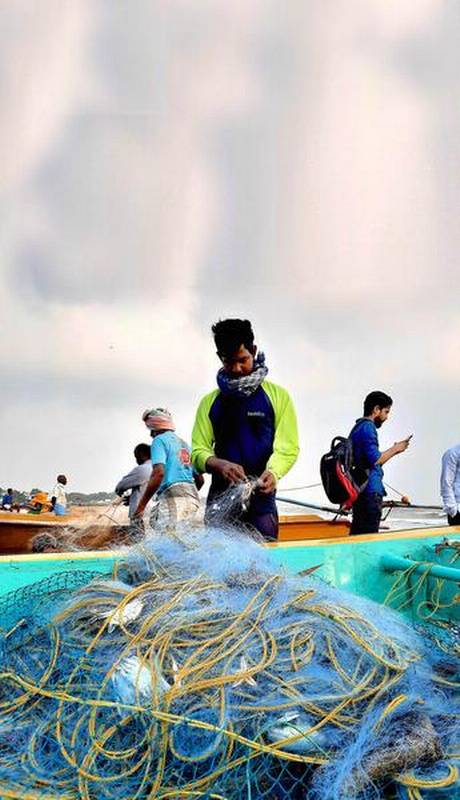
Over a hundred dolphins swimming alongside each other in clear blue waters. And a few whales too. It was a lucky day for Kovalam-based Hanif Mohammed Q and guests on his boat. “It’s another world out there,” says Hanif, recalling the sight. An interior designer, Hanif has been fishing out of passion for 15 years, and owns two boats. He knows the wonders of the sea first-hand, and wants to share it with others.
“I take people on small trips into the sea,” says the 40-year-old, adding that from July to August, and February to March, guests can witness the migration of dolphins.
Hanif demonstrates how fishing is done along the way. “I want to encourage parents to show children the outdoors; to let them experience Nature at its best,” he adds. “They can learn about the sea, among a lot of other things,” he says, adding how once, his guests released turtles caught in a fishing net. He is now in the process of setting up his company, called South Fin for leisure trips, as well as finalising essentials such as changing rooms and toilets. “We will launch in 10 days or so,” he says.
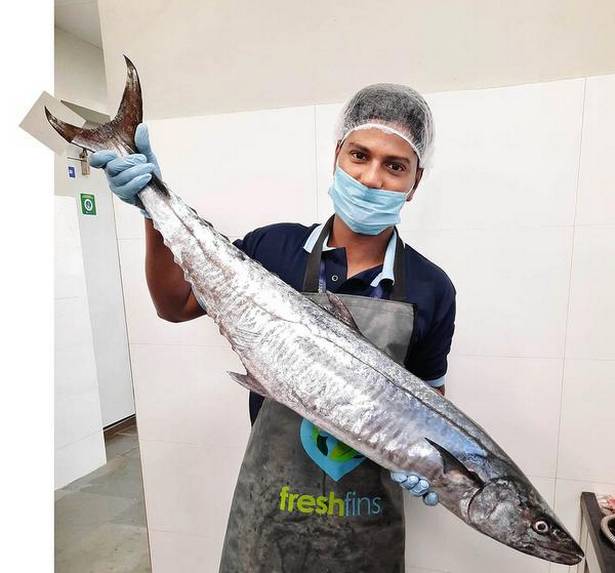
Hanif has launched yet another recent venture: Fresh Fins, an initiative that lets people from Chennai order fresh fish online. “My intention is to help small boat fishermen make a better living,” he says. With less financial support from the Government and no access to facilities to store their catch, these fishermen often end up selling to middle-men for a pittance. “I want to take their catch directly to customers,” he explains.
Right now, he sells catch from over 45 boats from Kanyakumari to Ennore and 90% of his team, right from call-centre executives to delivery persons, are from Kovalam. “There are 40 people in my team right now, and we deliver as far as Mogappair and Anna Nagar West,” he says.
Apart from eliminating middlemen and ensuring small boat fishermen get a good price for their catch, Hanif wants to familiarise people with seasonal fish and promote sustainable fishing.
“Customers should get used to the idea of eating what is local and seasonal,” he says. “This way, they will be able to enjoy a wide range as opposed to the usual vanjiram that big boats bring from as far as Andhra Pradesh and Odisha.”
For details, visit freshfins.in. To know more about the fishing trips — prices depend on the distance and number of people — call 9696089696.
source: http://www.thehindu.com / The Hindu / Home> Society / by Akila Kannadasan / November 18th, 2020
Premji pipped HCL Technologies’ Shiv Nadar, who had earlier topped the list collated by Hurun Report India and Edelgive Foundation, by a wide margin.
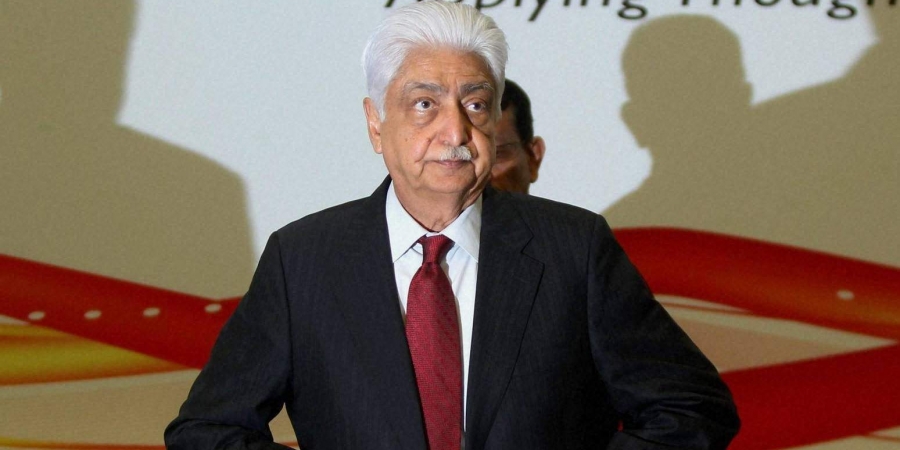
Wipro Chairman Azim Premji (File Photo | PTI)
Mumbai :
IT major Wipro’s Azim Premji donated Rs 22 crore a day or Rs 7,904 crore in a year to emerge as the most generous Indian in FY20 and top a list of philanthropy.
Premji pipped HCL Technologies’ Shiv Nadar, who had earlier topped the list collated by Hurun Report India and Edelgive Foundation, by a wide margin.
Nadar’s donations stood at Rs 795 crore for FY20 as against Rs 826 crore in the year-ago period.
Premji had donated Rs 426 crore in the previous fiscal.
Richest Indian Mukesh Ambani of Reliance Industries retained the third spot among the list of givers by donating Rs 458 crore as against Rs 402 crore a year ago, it said.
The raging pandemic had the corporate honchos repurposing their donations to fight the COVID infections, and the top giver on this turned out to be Tata Sons with a Rs 1,500- crore commitment, followed by Premji at Rs 1,125 crore and Ambani’s Rs 510 crore.
A bulk of the corporate commitments seemed to be given to the PM-CARES Fund, with Reliance Industries committing Rs 500 crore, and Aditya Birla Group donating Rs 400 crore, the report said.
It can be noted that Tatas’ commitment also includes a Rs 500 crore donation to the newly created fund.
Premji’s generosity pulled the total donations up by 175 per cent to Rs 12,050 crore in FY20, the list said.
Azim Premji Endowment Fund owns 13.6 per cent of the promoter’s shareholding in Wipro and has the right to receive all money earned from promoter shares, the report said.
The number of individuals who have donated more than Rs 10 crore increased marginally to 78 from the year-ago period’s 72, the report said.
With a donation of Rs 27 crore, Amit Chandra and Archana Chandra of ATE Chandra foundation are the first and only professional managers to ever enter the list.
The list has three of Infosys’ co-founders with Nandan Nilekani (Rs 159 crore), S Gopalkrishnan (Rs 50 crore) and S D Shibulal (Rs 32 crore).
The list of 109 individuals who have donated over Rs 5 crore has seven women, led by Rohini Nilekani’s Rs 47 crore.
Education is the highest beneficiary sector with 90 philanthropists, led by Premji and Nadar, donating Rs 9,324 crore, the report said, adding healthcare came second with 84 donors and was followed by disaster relief and rehabilitation with 41 donors.
The financial capital led by donor count at 36, followed by New Delhi at 20 and Bengaluru at 10.
E-commerce firm Flipkart’s co-founder Binny Bansal was the youngest donor at 37 with a commitment of Rs 5.3 crore and the average age of the donors on the list was 66 years, it said.
source: http://www.newindianexpress.com / The New Indian Express / Home> Business / by PTI / November 10th, 2020
Author Hemender Sharma re-examines activist and environmentalist Shehla Masood’s gruesome murder with detailed insight into the events leading to the conspiracy.
Author: Hemender Sharma
Publisher: HarperCollins
If an urban woman with ‘modern’ sophistication and a ‘questioning’ attitude is killed in our country, the investigation, in most instances, begins with a close examination of her character. Shehla Masood was one such gutsy woman – an Indian environmentalist, wildlife and RTI activist. Hemender Sharma, in his book, Shehla Masood: The Murder that Shook the Nation, peels many layers to understand her life, her murder and the ultimate resolution of her case
Stepping out of her house in Bhopal to attend Anna Hazare’s ‘India Against Corruption’ campaign, Masood was shot dead from point-blank range in broad daylight on August 16, 2011. With Masood featuring in the news ahead of her murder after exposing corruption rackets through ‘RTI Anonymous’ – a portal where individuals could file an RTI without disclosing their identity – the Indian media had covered her gruesome death extensively. Shehla came from a humble background, but convent education along with brave instincts made her a savvy Muslim girl endowed with big dreams.
The book unravels the circumstances that led to her murder, the politics that subsequently unfolded and the long fight for justice that ensued. Cover-ups and attempts to tarnish her image started soon after her death. The local police tried to label her death as a suicide, while the state chief minister ordered a CBI probe within 48 hours. Names of various political dignitaries and bureaucrats were in the suspect list, but when the verdict was declared in January 2017, Zahida Parvez, an interior designer who gave the contract to kill Shehla, along with three others, stood convicted.
Zahida, a mother of two girls, in her statement, revealed her affair with Darbar (pseudonym) who was the Chairman of Madhya Pradesh Tourism Department. After a few formal meetings, their friendship strengthened, leading to intimacy. Darbar, on the other hand, was already in a relationship with Shehla. Zahida was madly in love with Darbar and surely not fond of Shehla.
Darbar’s 53rd birthday was approaching and Zahida wished to celebrate it with grandeur. Bhopal has a tradition of politicians putting up their own hoardings and congratulating themselves on their birthdays. But to her disappointment, Darbar’s hoardings had no place for her, leaving her heartbroken.
She knew that Darbar was a Casanova, but couldn’t substantiate her doubt with palpable evidence. With her friend Sabah, she followed Darbar on instances to gather evidence and catch him red-handed. When Darbar went to meet Shehla on his birthday, Zahida was left fuming. Her anger and frustration usually subsided the moment she finished pouring her heart out in her diary. But this time, her anger knew no bounds. The man for whom she had waited the whole day, putting her family and daughters at stake, was drifting away from her. She assumed that Shehla was the culprit jeopardizing her illicit relation with Darbar, which was now showing visible cracks.
Zahida contacted Shakib, a contractor. When Shakib entered her office, she threw a file towards him with the initials ‘SM’ inscribed. It contained Shehla Masood’s newspaper cuttings from Hindustan Times and Free Press. She told him that she wanted this woman dead as she was negatively influencing girls. Besides, she had also lied to him about Shehla’s affair with her husband. She negotiated a deal worth Rs 3 lakh to get Shehla killed. Very soon, Shakib brewed the plan along with Irfan and Tabish, and it was only after a couple of failed attempts that they succeeded in executing the conspiracy.
On the day of her murder, Shehla walked towards her car around 11:19 am. She was about to ignite the car when Shakib pounced on her from the rear and shot her in the trachea. The detailed narrative furthers reveals Shakib’s call to Zahida confirming the murder, who further lets Sabah, her friend, know of their success. Irfan, Shakib’s partner in the crime, was let go as he turned an approver during trials. Zahida and Sabah were convicted under Section 302 (murder) with 120B (criminal conspiracy) of IPC and sentenced to life imprisonment. Shehla’s father, upset with the verdict, asserted, “Probably the real culprit will never be caught.”
The book also details how the CBI team, led by Joint Director Keshav Kumar and DIG Arun Bothra, painstakingly reached the killers after being severely misled.
source: http://www.millenniumpost.in / Millennium Post / Home> Book Review / by Arif Mohammad / May 04th, 2019
A snapshot from Tinge by Sabrina Suhail’s range | Photo Credit: Special Arrangement
Sabrina Suhail on creating a homegrown and toxic-free make-up brand suited for Indian skin
If Covid-19 has changed one thing in our perception, it is that everything we consume — from food to cosmetics — impacts our overall health. Tinge by Sabrina Suhail is a testament to this. After launching in July 2018, the brand gained popularity for its clean, customised lipsticks and foundation. It may seem that the make-up line garnered much attention in a short span, but Bengaluru-based Suhail has spent several years in preparation.
“I was never a person who knew anything about beauty; I studied chemistry, botany, zoology and psychology in college,” she says. After a second degree in fine arts, she worked as a make-up artist for 10 years, and took a course each year to learn more. “At one point, my clientèle got conscious about toxins in products and gave me a list of ingredients to avoid.” As she started reading labels — which were easy to decipher because of her chemistry background — she realised that she could create the products herself. Suhail then enrolled for a two-year diploma in colour cosmetics and formulation in New York, and took another four years to set up a studio and get certifications in place.
Sabrina Suhail | Photo Credit: Special Arrangement
Recreating beauty
“I decided to start with only lipsticks because it was the easiest, and something Indian women gravitate towards,” she says. First, it was just word-of-mouth as she didn’t want to invest in marketing. Even though there was an influx in the initial months, her clientele slowly started petering out. “But after December last year I’ve seen a massive change. People come to me with lipsticks they want me to recreate with safer formulation and aroma.”
I have tried Suhail’s bespoke lipsticks, foundation and powder (all gifted by her), so I understand why her products work. With just a couple of Instagram messages, she understood the exact creamy caramel colour I wanted in my lipstick. And without meeting me even once, she delivered the correct shade of concealer and powder to match my skin tone.
________________
Green check
As per American cosmetic biggie Aveda’s website, the brand that has been 100% vegan as of July 2019 is planning to have all vegan products on shelves by January 1, 2021. aveda.com
Closer home, celebrity make-up artist Bianca Louzado’s CODE Beauty is now offering everything from cosmetic sanitisers and brush-and-sponge cleansing balms to anti-bacterial cosmetic sanitising wipes and sprays. codebeauty.in
Another new launch to keep an eye out for is aša beauty. The clean beauty brand’s first drop includes an easy-blend concealer, corrector, crème and matte lipsticks, lip and cheek tints, and mascara. @asabeautyindia on Instagram
_______________
Checks and balances
I was curious to understand if she had avoided talc, classified as possibly carcinogenic, but a common ingredient in some organic make-up brands. Thankfully, she does. Her formulations are based on clay, “which may not have the same slip as talc but is definitely safer and more pigmented”. All of Suhail’s raw materials are from India and everything is certified. “When I started the company, it was important for me to have my licensing.” She has the MSDS (Materials Safety Data Sheet), SDS (Safety Data Sheet) and PETA cruelty-free certificate. The second part is when she puts the raw material together and gets the Bureau Veritas certification, world leaders in inspection and testing.
“If I make a lipstick for you, it has to go through many checks before it comes to you,” says Suhail, who also got the CDSCO (Central Drugs Standard Control Organisation) certification that approves of the manufacturing license, machinery, manufacturing facility, and contents used in the physical product. “Even though I don’t have that kind of space or machinery, I got the certification because it ensures that your products are made safely.”
___________
Scent of a lipstick
I personally do not have a problem with fragrance in colour cosmetics. In fact, the scent of lipstick is the reason I fell in love with make-up. Chanel Misia is my favourite perfume because it smells like powder and lipstick. Besides, the fragrances used in Suhail’s lipsticks are FDA approved and have no traces of phthalates, which are known endocrine disruptors.
_________
Get online
While Suhail still customises colours for lips and the base, she also has a line that can be readily bought online. Tinge by Sabrina Suhail offers eye pencils, multi-sticks, balms, scrubs, wax and liquid lipsticks, plus powder foundations for Indian skin tones that range from medium to milk chocolate. The full ingredient list is mentioned on tingestore.com, and she has a ‘Return to Refill’ policy where you can send an empty tube to be refilled with a 15% off on the lipstick.
In the current beauty landscape, where new brands are launched in a short amount of time without former training, a long prep period, attention to detail and certification are rare. This brand is homegrown, clean, cruelty-free, customised, luxurious and eco-conscious. What more do we want?
source: http://www.thehindu.com / The Hindu / Home> Life & Style / by Vasudha Rai / October 30th, 2020