Category Archives: Business & Economy

A visit to the hospital in Kerala that’s been repairing pens for almost 80 years now

Pen01MPOs07sept2015

A few metres down the Town Hall Road from the famous Round of Thrissur district of Kerala is a small, single-shuttered, 78-year-old shop where pens of many famous people have been repaired, including those of a former prime minister and president.

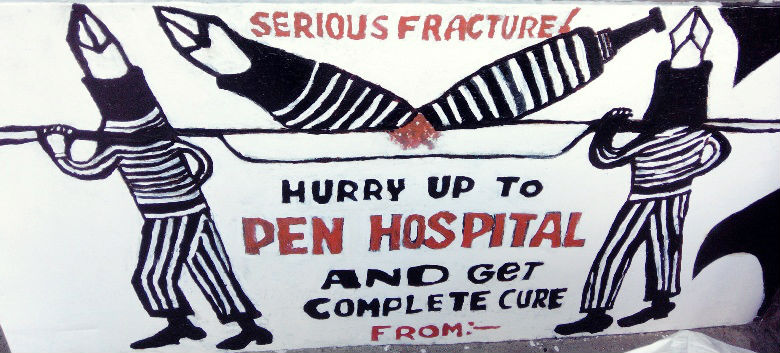
In bold yellow letters against a black background is a rectangular signboard – Honest Pen Hospital. A  painting on a wall adjacent to the shop shows a fractured pen being carried on a stretcher by two fountain pens, below which is written ‘Hurry up to Pen Hospital and get complete cure.’
Pen02MPOs07sept2015

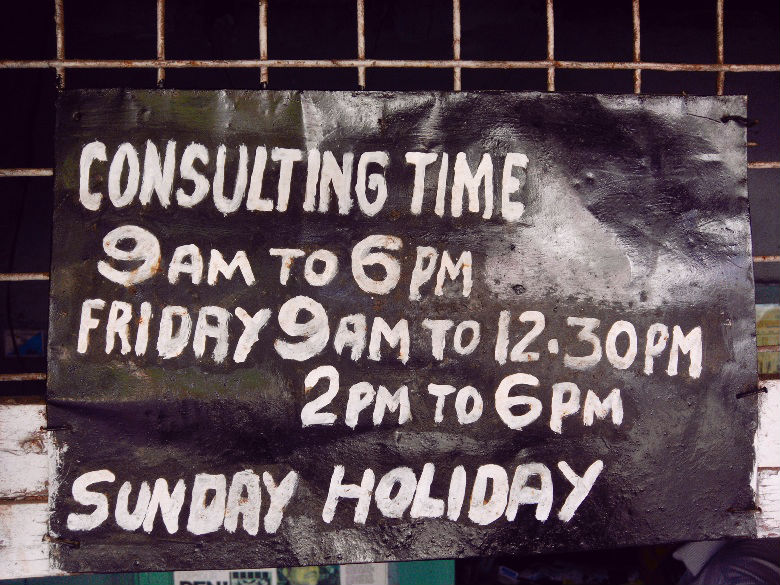
On the entrance hangs a small board with a caption ‘Consulting Time.’ 9 am to 6 pm. Next to it, hangs another board which reads ‘Wait for 10 minutes.’ This is the board which Nazar displays when he is away from the ‘hospital’ to do some household chores.

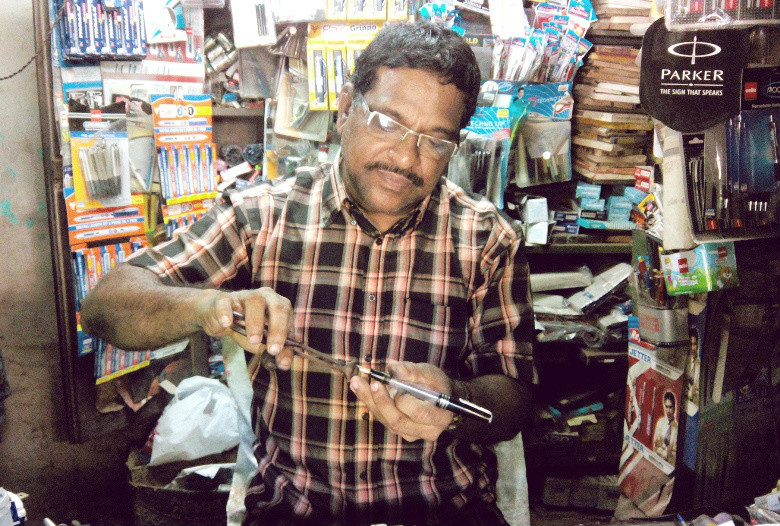
Fifty-eight-year-old Nazar is the pen doctor and has been repairing pens for the past 36 years, having learned the craft from his father.

Nazar’s father, Kaalathodu Koluthu Parambil Abdulla worked as a fountain pen mechanic in Bengal at a time when they were not popularly used. Swan, Blackbird, Pilot, etc. were the few fountain pens that were then available in India, and they were costly.

“When pens became cheaper and more people started using them, my father came back to Kerala to do the same work here. Thus was born the Honest Pen Hospital in1937,” Nazar recounts. The shop was first located in Thrissur district’s St Thomas College Road and shifted to its current location in 1959.

“My father’s fingers had some sort of magic in them. He knew pens so well that once he got a faulty pen in his hand, even before the owner could say what the problem was, he would diagnose it. He could successfully cure all pen ailments,” Nazar said.

In the last 50 years, the hospital has repaired the pens of many a famous person including former prime minister Indira Gandhi and former president APJ Abdul Kalam, and renowned Malayalm poets Kunjunni Master and Vyloppilli Sreedhara Menon.

Nazar claimed that Indira Gandhis’s secretary had once sent her pen to the shop for repairs when his father was running it. “The pen was special to Mrs Gandhi because it was gifted to her.”
Pen03MPOs07sept2015

After hearing of the death of his father passed away in December 2010, Nazar says that a man turned up at his shop. “The man showed me a fountain pen which my father had repaired. His father, an Ayurvedic doctor, only prescribed medicines using that pen,” Nazar says, adding that the pen was sent to the shop with a faulty nib.

“But the nib was not readily available and it needed a week to be replaced. By the time the son had got the pen repaired and taken it to his father, the father had got another pen for himself.” Nazar says that after his father gifted the pen to him, he got a wooden box made by a carpenter exclusively for keeping the pen safely in his locker. “As years passed the son got many more pens for himself and he forgot his gift. It was when my father passed away that he got reminded of the pen and brought it to me. Even after so many years the pen worked perfectly.”

As Nazar was telling me this story a customer walked in asking for a good fountain pen. Nazar showed him few pieces of the old, famous Doctor brand of pens made in Bombay. These pens are hardly available in ordinary shops as they are out of stock.

Having sold the pen, Nazar told his customer to use the pen regularly, or else to wash the nib section and keep it dry. “It is because of this advice that pen of the Ayurvedic doctor’s son worked perfectly when we tried writing with it after years,” says Nazar.

Nazar has had his own fifteen minutes of fame – he says he has repaired former president Abdul Kalam’s pen when the latter visited the city for an event. After returning to Delhi he learned that the organizers had cut down a tree to make arrangements for his welcome. He asked the organizers to plant a sapling in its place, for which he returned to Ernakulam. “When was placing the sapling in the pit that was dug, his pen fell into it and the pen’s top got stuck. He wanted it repaired and his secretary suggested this hospital to him. I repaired the pen.”

Today, most of Nazar’s customers are judges of the High Court of Kerala, advocates, doctors, or document writers. Typing has eaten away his customers, but for Nazar, other concerns are more important.

“Apart from helping in improving handwriting, fountain pens are more eco-friendly than ball point pens. Also, fountain pens bring sort of a discipline to life. It makes one slow down in this age of pace,” he says.

Even though business is slow as people have switched over to ball-point pens, Nazar sees his work as a service. “It is not all about money. Of course money is a factor but I do it more as a form of service. I know how badly people get affected when the pen they use regularly stops working the way they want it to. Most of the services require minor tweaking of the feed and the nib and I do not charge anything for it,” says Nazar.

But for all his love of pen, the man does not own one. “The only writing I do is when I check a pen after I repair it.”

As a young man, Nazar wanted the Malayali dream – a job in the Gulf. But his schooling was erratic because of a court case that his father had to attend to, leaving his son in charge of the shop. “But for the civil cases in the court I would have been in the Gulf. It is God that wanted me here, and he will have someone else in mind when I am not able to discharge my duties.”

The only thing that Nazar is sure of is that the next doctor in Honest Pen Hospital is not going to be either of his sons who are medical doctors.

(The stories were narrated by Nazar).

source: http://www.thenewsminute.com / The News Minute / Home / by Siddharth Mohan Nair / Sunday – September 06th, 2015
Les Clefs d’Or India Concierge holds its 9th AGM in Kolkata

LeClefKOLKATA31aug2015

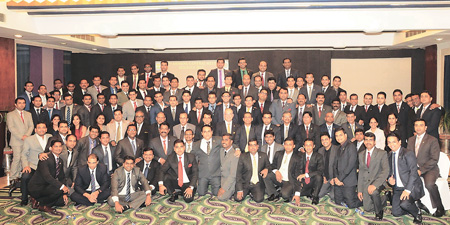
Les Clefs d’Or India Concierge recently held its ninth Annual General Meeting (AGM) in Kolkata recently.

The AGM was inaugurated by Zaid Farooqi, resident manager, Taj Bengal, Kolkata; James Ridenour chief concierge, InterContinental, Sydney and general secretary, Les Clefs d’Or International; Stephen Fernandes, past president, Les Clefs d’Or India; and Edwin Saldanha, president, Les Clefs d’Or India and Asian zone director, Les Clefs d’Or International.

Regional presentations were made by Rajesh Kumar Yadav from northern region, Sachin Singh and Apeksha Boricha from western region, David Aaron from eastern region, and Sri Kishen from southern region.

The treasurer and PRO reports were shared by Arun Baidya and Shaunak Vengurlekar respectively, and a speech on current trends was given by George Kuruvilla, general manager, The Oberoi Grand, Kolkata.

A brand presentation on social media was conducted by James Ridenour who urged for maximum participation in the communications committee.

The new executive committee for the period 2015-2017 was also announced during the AGM.

The AGM continued with the opening of networking eve by Samrat Dutta, general manager, Taj Bengal Kolkata.

During the pinning ceremony 32 new members received adherent membership to Les Clefs d’Or India and 36 adherent members were upgraded to full membership status.

The UICH Honorary Member was awarded to Biswajit Chakraborty, general manager, Sofitel BKC, Mumbai for his contribution and support extended to the concierge society in India.

This was followed by the Concierge of the Year 2015 award which was given to Debayan Ghosh from Shangri-La, Bengaluru.

source: http://www.financialexpress.com / Home> Food & Hospitality World / by FWH Staff – Mumbai / August 18th, 2015

Bazmi Husain named ABB’s global CTO

Swiss-engineering major ABB on Wednesday appointed  its India managing director Bazmi Husain as its global Chief Technology Officer (CTO) with effect from January 1, 2016.

BazmiHusainMPOs03sept2015

India-born Husain, an expert in power and automation who has been with ABB for more than 30 years, will report to CEO Ulrich Spiesshofer, says the statement issued by the company. In his new role, he will be based in Bengaluru with an office in Switzerland.

As CTO, Husain will be responsible for overseeing all aspects of ABB’s global R&D, which serves the entire company, its scientists and engineers, and for the R&D activities within ABB’s divisions.

Reporting to him will be the heads of R&D at group and division level as well as ABB’s venture capital arm, ABB Technology Ventures. With locations in seven countries, ABB’s corporate research centres bring together an international team of highly-skilled scientists across a variety of disciplines. ABB spends $1.5 billion annually on R&D and employs some 8,500 technologists.

“Bazmi Husain’s unrivalled know-how will drive technological innovation across multiple disciplines to support our profitable growth ambitions and the paradigm shifts in power and automation,” said CEO Spiesshofer.

source: http://www.deccanherald.com / Deccan Herald / Home> Business / DHNS / Bengaluru – September 03rd, 2015

Prestige’s Irfan Razack and his Mumbai dream

Having made Prestige a household name in Bengaluru, can billionaire-developer Irfan Razack do the same in India’s most expensive and competitive real estate market ?

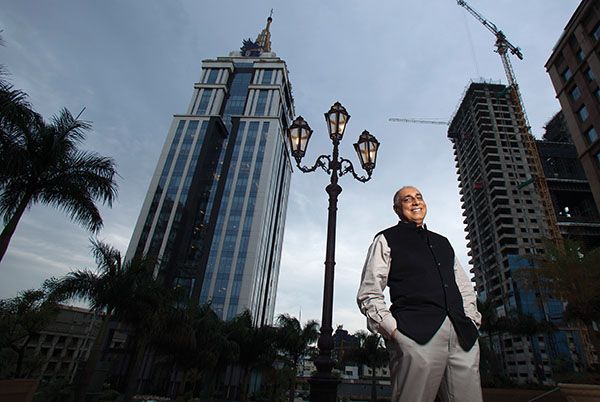
Image: Namas Bhojani for Forbes India Irfan Razack, 62, chairman and managing director of Prestige Group
Image: Namas Bhojani for Forbes India
Irfan Razack, 62, chairman and managing director of Prestige Group

In 1990, when Irfan Razack sold his second real estate project in his home market of Bengaluru for Rs 1 crore, he began planning his retirement. Elated with the money he had made, Razack thought he could spend his days indulging in his favourite hobby—horse riding. But twenty-five years later, the now 62-year-old chairman and managing director of Prestige Group is still hooked on to real estate. “My friend had warned me that making buildings is like a drug. He said, ‘You will become addicted to it’,” says Razack, who heads Prestige Estates Projects Ltd, the group’s flagship company.

A self-professed “clear thinker” who prides himself on being meticulous, he believes that life is about conquering the next big milestone. “Money loses its charm after a while. It is the creativity that keeps you going,” says the billionaire, who, with a net worth of $1.23 billion, ranks at No 77 on the 2014 Forbes India Rich List.

Prestige Estates Projects, India’s second-largest listed real estate company, is on the brink of greater things. Now more than ever, it needs its leader. Retirement is not an option for Razack.

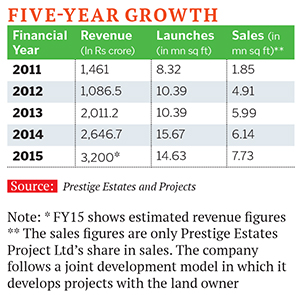
For the first time, in financial year 2015, Prestige has overtaken India’s largest listed real estate developer DLF Ltd in pre-sales (new sales). Last year, the difference between the pre-sales of the two competing companies was Rs 1,424 crore with DLF in the lead. But Prestige ended the recently concluded fiscal 2015 with Rs 5,014 crore in pre-sales compared to DLF’s Rs 3,850 crore of pre-sales much to the surprise of analysts who were initially sceptical of Prestige meeting its new sales target of Rs 5,000 crore.

Now, Razack expects to touch Rs 20,000 crore in pre-sales in the next three years. And this time around, everyone, competitors included, is paying attention.

To put things in perspective, prior to its initial public offering (IPO) in FY09, Prestige had recorded revenues of Rs 889 crore. Since 2010, its market capitalisation has grown from Rs 2,000 crore to about Rs 10,000 crore currently. Its subsequent rise in these last six years has coincided with DLF’s decline in growth. DLF’s market capitalisation has been on a downward spiral from a high of Rs 2 lakh crore in 2008 (a year after its IPO) to approximately Rs 22,000 crore.

These comparisons don’t sit too well with Razack. “We are the number two developer by default, rankings don’t matter,” he says.

But how did he ride the crests and troughs of the real estate market? For nearly three decades, the Bengaluru-based developer built an enviable portfolio by focusing mostly on his home turf (85 percent of its ongoing projects are in the city) compared to its larger rival DLF, which has projects across India. Luck had a hand in his success, too. Bengaluru, along with Mumbai and Delhi, is one of the top three residential property markets in India, and has held steady unlike the National Capital Region (NCR) where DLF has most of its projects.

5yrgrowthMPOs03sept2015

In terms of revenue, Prestige pales in comparison to DLF. The New Delhi-based real estate company ended FY15 with Rs 8,168 crore in revenue compared with Prestige’s modest estimated revenue of Rs 3,200 crore for FY15. Prestige was scheduled to declare its audited financial results for FY15 on May 30, 2015 (after Forbes India went to print).

What has largely gone unnoticed, however, is that a substantial portion of the Bengaluru developer’s sales have not yet come in for revenue recognition. Real estate firms recognise revenues once their projects reach the threshold limit of 25 percent completion. Because many of Prestige’s projects haven’t reached that limit, the company is sitting on unrecognised revenue (sales made but yet to come in for recognition) amounting to Rs 8,377 crore as of December 31, 2014. Much of these sales will kick in by FY16.

Not that Razack is sitting around waiting for the numbers to kick in. He has far bigger plans.

source: http://www.forbesindia.com / Forbes India / Home> Features – Big Bet / by Shabana Hussain & Debojyoti Ghosh / June 09th, 2015

Sizzle in Fazal’s designs

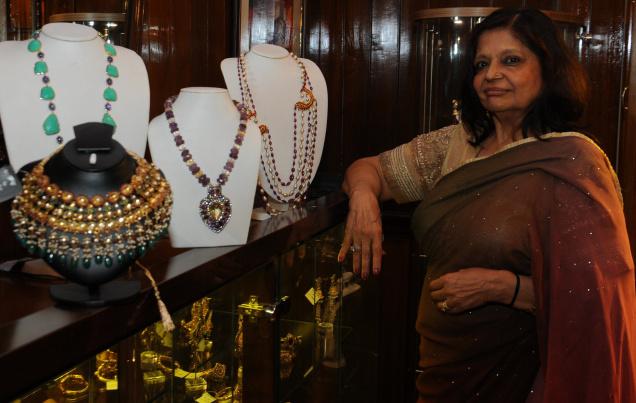
Stylish curations: Nafees Fazal’s collection Photo: Sudhakara Jain

Former minister Nafees Fazal has launched her own jewellery studio

Nafees Fazal, a former minister for Medical Education and Science and Technology, in Karnataka “loves politics and jewellery. I have a passion for beautiful things,” explains the lady herself. Dressed in an elegant sari, she is not wearing any jewellery herself. “I don’t like to look like a Christmas tree all the time. A lovely sari, draped well, is enough to get me through the day,” she beams.

Nafees is now in the news as she launched her own jewellery studio called The Private Collection by Nafees Fazal. She has converted a room in her bungalow into the studio. “Having a studio at home helps me cut the overheads,” she explains.

As of now she has a limited range of jewellery called the “Naf Collection”. “Naf is short for my name,” she says, and dons the role of a model as she stylishly demonstrates how a particular piece of jewellery must be worn or carried in style.

“I am itching to get back into politics. But what do I do in the meantime? I can’t play housewife all the time. I decided to travel, and curate this collection for women. Who doesn’t love jewellery?” asks Nafees. The collection, currently on display, starts at Rs. 4,000. It is collected from Tanjavur, Rajasthan, and Delhi over the “last four months”. It offers designs in precious and semi-precious stones, antique pieces from Trivandrum, “which are bought at the princely sales”. Then there are jhumkis, large earrings, kangans, neck pieces and so on.

From bridal wear, to party wear or just making a style statment, the collection has something for every occasion. “They are created in silver, plated with gold, and come with kundan in polki and other hand works. Hence, it brings the cost down drastically. The aim is to offer the traditional with a touch of modernity. Part of the proceeds will go towards my Kare Foundation, which was started to help poor patients in 2009,” states the former minister.

She adds that she is “passionate to help the poor”. “I do not have crores but am all game to help those in need.”

Will she get into designing as well? Pat comes the reply, “No! I am not into manufacturing but only curating. I need to get back into politics. This is just a hobby. The studio will continue. I assure you that there is something stylish for everybody here.”

source:  http://www.thehindu.com / The Hindu / Home> Features> MetroPlus> Fashion / by Shilpa Sebastian R / Bengaluru – August 31st, 2015

Venture Capital scheme soon for pharma start-ups

Chennai  : 

The Government of India is planning to set up a venture capital scheme to promote start-ups in the pharmaceutical sector.

Addressing a Roundtable session on Bio-Pharma 2015, M Aziz Ahammed, Joint Secretary, Department of Pharmaceuticals, said the scenario of drug discovery is changing as more start-ups are involved in the discovery of new molecules, which are later acquired by bigger companies.

₹1,000-cr corpus

Ahammed said the Centre is formulating a Venture Capital scheme that would benefit young entrepreneurs. The scheme with a proposed corpus of ₹1,000 crore, which is under formulation, will aid the start-ups in new drug discovery.

Ahammed said, “Only when India invests in drug discovery, the prices will come down, which will benefit Indians as well as entire humanity.” To encourage drug discovery and innovations, National Institute of Pharmaceutical Education and Research (NIPER) has been established in Guwahati, Ahmedabad, Lucknow, Kolkata, Hyderabad, Patna and Punjab.

Campus at Madurai

A new campus will be built in Madurai at a cost of ₹500 crore.

P Shanmuga Sundaram, Managing Director, Tamil Nadu Industrial Developmental Corporation (TIDCO) and TICEL, said TICEL Bio Park I and II, which provides lab infrastructure facilities for bio-pharmaceutical industries, houses 30 such incubators.

Bio parks planned

TICEL Biopark III that is proposed to be built in the Anna University campus, Somayampalayam village, Coimbatore at the cost of ₹55 crore, will focus on agro-food processing and poultry vaccine.

Sundaram said the aim of bio parks is to encourage research and development of new drugs and vaccines.

source: http://www.thehindubusinessline.com / Business Line / Home> Economy> Policy / by The Hindu Bureau / Chennai – August 26th, 2015

Ambur and the art of biryani

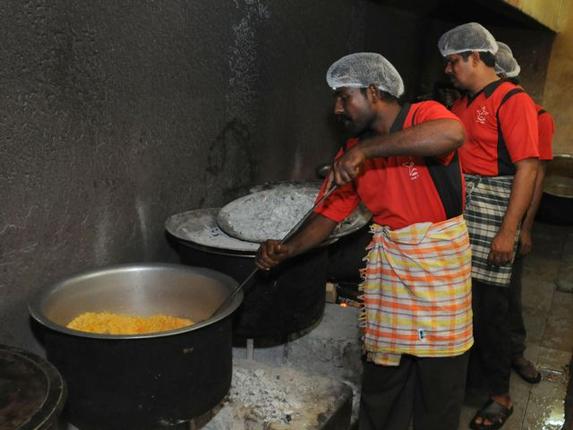
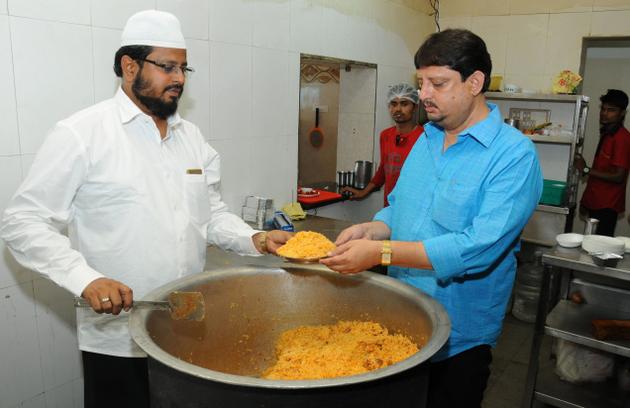
In the kitchen of Star Briyani, Ambur. Photo: R. Ragu / The HIndu

The writer spends a day tasting the town’s staple dish to find out what makes it so appealing.

There was once a man who loved biryani so much that he braved the rain to eat it under the leaky roof of an eatery. Another ate it for lunch every single day for 15 years. He continued the ritual even after he became old and toothless, except that he had it plain, without the meat. Stories of such biryani fanatics are common in Ambur, a town some 180km from Chennai. Here, people eat biryani for breakfast.

What’s so special about Ambur’s biriyani?

We walk into Star Briyani, one of the town’s well-known and oldest establishments to find out. It’s 11 a.m. and customers are already walking out after a meal. Brothers Muneer Ahmed and Anees Ahmed run the business now, that has branches across Ambur, Bangalore, and Chennai.

Brothers Anees and Muneer of Star Briyani Photo: R. Ragu / The Hindu

It all started with Hasin Baig, their great-grandfather, who is said to have cooked in the kitchens of the Arcot Nawabs. He brought what was once the food of the royals to the common man by opening a restaurant in his hometown, Ambur. Hasin’s son Khursheed then took over the business, which was then taken over by his son Nazeer Ahmed. In all, the family nurtures a 110-year-old biryani heritage. “At Khursheed Hotel that thatha ran in the 1900s, biryani was ready as early as 7 a.m.,” says Anees, who manages the Chennai wing of restaurants.

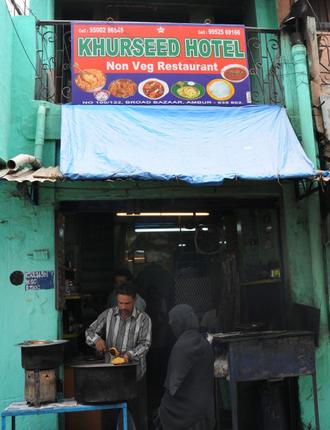
A view of Khurseed Hotel at Ambur. Photo: R. Ragu / The Hindu

He recalls how his ancestors used a short and thin rice variety called ‘surdas’ and country chicken. “We’ve replaced the rice with its closest match — seeraga samba, which we source from West Bengal,” he explains. Ambur purists will scoff at any other rice variety, even if it’s the slender basmati.

At the kitchen of Star’s branch that’s located on the Chennai-Bangalore highway, biryani masters Krishnan and Irfan are preparing mutton biryani. Cooked in gigantic containers over wood-fired stoves, the crucial aspect behind the biryani’s consistency is the ‘dum’ — a procedure where it’s removed from fire and covered with a lid over which hot coals are placed. The recipe consists of the usual ingredients that goes into biryani — onions, tomatoes, spices such as cardamom, cloves, and cinnamon, ginger and garlic paste (ground separately to incorporate each ingredient’s flavour), red chilli paste, salt, rice (par boiled) and meat.

As an over-powering aroma engulfs us, a mild whiff of sambar comes our way. “Oh, that’s our lunch,” Irfan informs us.

Khursheed is still present inside the main bazaar of the town, where it was originally started, and is now taken care of by Anees’ cousins. In a narrow lane where tring-tringing tricycles, autos, scooters, load men lugging heavy sacks on their shoulders and pedestrians jostle for space, the clang of the steelkarandi against the soot-smeared container, announces the birth of a fresh batch of biryani to the neighbourhood.

We follow the sound into Khursheed, a hole-in-the-wall eatery that can house not more than eight at a time. The biryani here is priced at Rs. 45 and is made of basmati rice unlike a typical Ambur biryani. This is probably to cut cost — the outlet mostly caters to the hard-working labourer who cannot afford the more expensive varieties. Ambur has plenty of such restaurants that serve biryani for less than Rs. 100.

Anees recalls how his grandfather’s friendly demeanour was responsible for him securing a loyal customer-base. “He would stand at the entrance and greet people he knew with ‘enna machan, rumba naala kanom?’ (long time no see?) and they would instantly step in for a plate.”

At Star’s bazaar outlet, a plate of mutton biryani costs Rs. 150. It’s peak hour at lunch time and biryani is getting sold out fresh off the wood-fired stove. The atmosphere here is rather informal — many of the diners are regulars who nod at each other as they polish off a greasy dish of pepper chicken. Back in the kitchen, Faizal is ladling a gigantic container of brinjal curry on the stove, while Kalim, the chicken 65 expert, is carrying a fresh batch of the dish that gleams like rubies, to the serving counter.

Then, our first plate of Ambur biryani is served — orangish-pink in colour, the rice is mildly spiced, the meat, a tad spicier and cooked to perfection. M. Rahman, a 75-year-old ex-councillor, a regular, sits with us to eat. “So, what…” we begin when he cuts us short. “Don’t ever talk when eating biryani. It distracts you.”

Just then, Anees’ father Nazeer comes into the restaurant, assisted to his seat by his son. Over 70 years old, he recently suffered a stroke. Although he has lost his speech, the man insists that he sit at the counter for at least two hours every day, amidst the steam of the biryani he dearly loves. It occurs to us then, the reason behind the success of Ambur biryani. True, it tastes good; but what makes it special are the people of the town. Their passion for biryani — that’s the secret ingredient.

source: http://www.thehindu.com / The Hindu / Home> Features> MetroPlus> Society / by Akila Kannadasa / Chennai – August 20th, 2015

States’ Monumental Revenue Rise as Taj Mahal Stays on Top

New Delhi  :

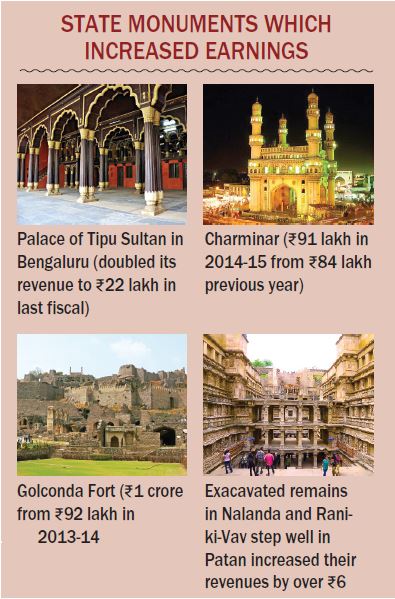
The alluring romance of famous monuments seems to be getting a little jaded with lesser-known ones tucked away in mofussil India garnering increased interest by domestic and foreign tourists. While the iconic Taj Mahal continues to maintain its top position in earnings through entry fees, smaller monuments in states witnessed a spike in revenue. The  Palace of Tipu Sultan in Bengaluru almost doubled its revenue with Rs 22 lakhs last fiscal.

StateMonumentsMPOs23aug2015

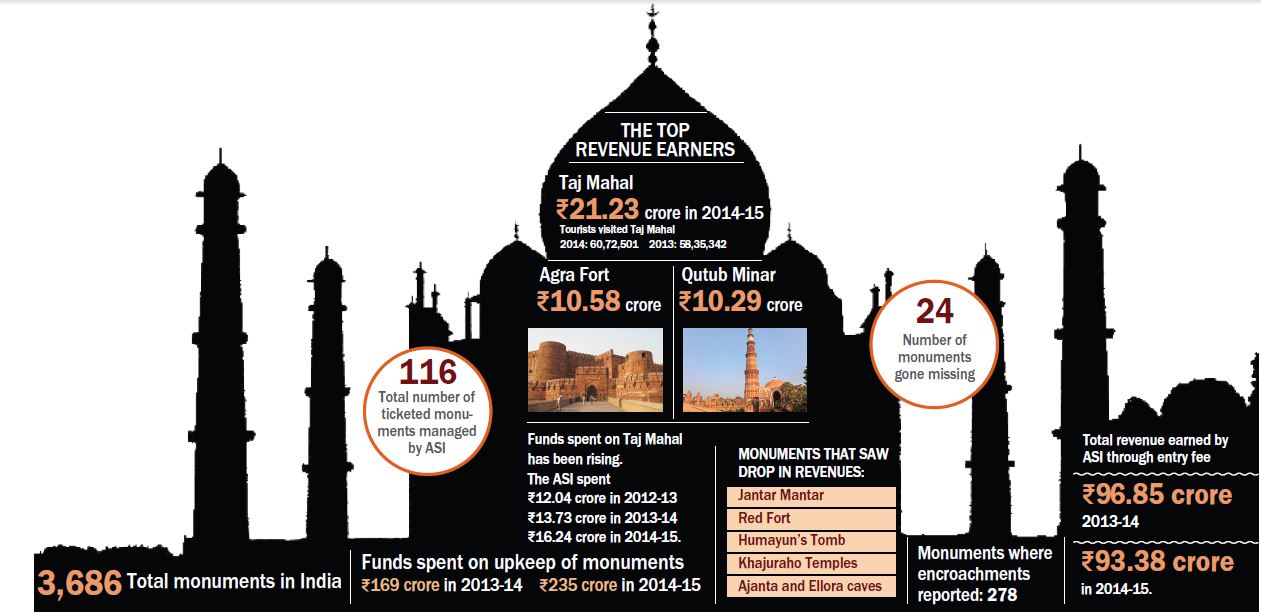
Last year, the Taj Mahal lost nearly Rs 60 lakh in revenues earned through entry tickets. In the 2014-15 fiscal, the ‘monument of love’ earned Rs 21.78 crore, while in 2012-13, its revenue was Rs 24.58 crore and Rs 22.40 crore in 2013-14.

Lesser known monuments such as, the Charminar in Hyderabad and Golconda Fort saw a surge in revenues this year; Rs 91 lakh in 2014-15 over Rs 84 lakh in 2013-14, and Rs 1 crore, up from Rs 92 lakh in the previous fiscal respectively.

Taj Mahal apart, some other big attractions showed a downward revenue trend. Revenues from UNESCO monument Red Fort dropped by Rs 10 lakh to earn Rs 5.9 crore, while the newly restored Humayun Tomb earned nearly Rs 70 lakh during 2014-15.

In Delhi, Jantar Mantar made Rs 23 lakh in the last fiscal, a drop of Rs 5 lakh. The Khajuraho Temples lost Rs 20 lakh to earn Rs 2 crore in 2014-15 and Ajanta and Ellora also saw a drop of Rs 2 lakh each.

According to the latest Ministry of Culture figures, many of the 116 ticketed monuments under the jurisdiction of the Archaeological Survey of India (ASI) were helping fill government coffers. In 2013-14, the ASI earned Rs 96.85 crore from monuments, which dropped to Rs 93.38 crore in 2014-15. Ironically, the money does not to go to the cash-starved ASI’s kitty but to the national treasury. Its battle to get the money for conservation of monuments has come to naught.

LowestEarnersMPOs23aug2015

The excavated remains in Nalanda in Bihar and Rani-ki-Vav (queen’s step well) in Patan, Gujarat, increased their revenues by over Rs 6 lakh each. Rani-ki-Vav was given a Unesco World Heritage Site status this year.

Other monuments that showed increase in revenues, though marginally, include the Rock-cut Hindu Temple at Undavalli and Buddhist Monuments at Guntuplli, both in Andhra Pradesh; Ahom Raja’s Palace at Sibsagar and Ranghar Pavilion at Bisnhudol, both in Assam;  ruins of Vikramshila, that was established by King Dharmapala (783 to 820) after a supposed decline in the quality of scholarship at Nalanda, and Sher Shah Suri’s Tomb in Bihar. On the other hand, the famed remains of Pataliputra in Patna showed a downward trend in ticket earnings.

The other significant monuments with increased entry tickets earnings are Sheikh Chilli (Haryana), Kangra Fort (Himachal Pradesh), Badami Caves and Gol Gumbaz in Karnataka, and Mandu monuments and Sanchi (Madhya Pradesh).

In Maharashtra, Ajanta and Ellora’s losses in revenue were gains for Aurangabad, Elephanta , Karla and Buddhist Kanheri Caves. In Delhi, Purana Qila, (which dates back to the days of the Mahabharata), Safdarjung Tomb and Tughlaqabad earned more this year while earnings from Red Fort and Humayun’s Tomb dipped. In Tamil Nadu, except for the Rock Cut Jain Temple in Sittannavassal, ticketed monuments like forts in Gingee and Dindigul had lesser earnings in 2014-15.

Interestingly, the Taj Mahal, Agra Fort and Qutub Minar collectively contributed over 45 per cent of the revenues through entry fee for ASI-run monuments The 17-century marble tomb with its intricate inlay work built by Mughal emperor Shah Jahan has been earning over Rs 20 crore every year through entry fees. Its revenue collections saw a drop in the last three years even though footfalls have been increasing. In 2012-13, Taj Mahal earned Rs 24.58 crore, Rs 22.40 crore in 2013-14 and Rs 21.78 crore in 2014-15.

“There has been no decrease in the number of total tourist footfalls in the past two years. In 2014, 60,72,501 domestic and foreign tourists visited Taj Mahal, against 58,35,342 in 2013,” culture minister Mahesh Sharma said.

Ironically, it isn’t just the Taj Mahal whose revenues have dropped. Revenue from the Khajuraho temples fell by Rs 20 lakh to Rs 2 crore in 2014-15, and Ajanta and Ellora also saw a drop of Rs 2 lakh each.

Indians and those from SAARC and BIMSTEC countries pay between Rs 5-10 while foreigners have to pony up between Rs 100 to Rs 500, depending on the monument.

On the other hand, funds spent on the upkeep of the Taj has been rising. The ASI spent Rs 12.04 crore in 2012-13, Rs 13.73 crore next year and Rs 16.24 crore in 2014-15.  Agra Fort, built by the Mughals in neighbourhood of the Taj earned Rs 10.58 crore in the last fiscal, while Qutub Minar grossed Rs 10.29 crore through ticket sales, a marginal increase over the previous year.

TajChartMPOs23aug2015

source: http://www.newindianexpress.com / The New Indian Express / The Sunday Standard / by Pratul Sharma  / August 02nd, 2015

Young, veiled and free: Meet Uber Delhi’s first woman driver

In the backdrop of security-related suspicions associated with the cab service Parveen’s large green eyes peeping out from her trendy hijab, hold promise.

“Today in the morning I dropped two young boys to Anand Vihar,” says Zamarrud Parveen, a pleasant surprise in her black-and-white hijab and bright yellow salwar kameez behind the wheel during my last Uber ride. “They started talking to me and asked where I was from. I told them I grew up in Bijnor, UP (Uttar Pradesh).” She changes gears and breaks into a proud chuckle. “They said, ‘Seriously?! We’re also from there, but we didn’t think any girl from there would ever choose this profession.’ I just laughed and asked them why. I said I loved driving! They had no idea what to say after that.”

The spirited 21-year-old says she is presently the only woman driver at Uber in Delhi and has been with the company for two months now. In the backdrop of the infamy and security-related suspicion associated with the cab service – given an incident of rape, sexual harassment and the general misbehaviour of male drivers with female passengers – Parveen’s mugshot with large green eyes peeping out from behind her trendy hijab, pops up on the app, with promise.

ZamarrudParveen01MPOs21aug2015

“I love the niqab. I’ve always worn it,” she says. “I usually wear a full burqa and niqab to college and everywhere, but while driving I only wear the niqab with ordinary clothes because it becomes difficult to drive,” adds Parveen, who is simultaneously pursuing a BA pass course from Jamia Millia Islamia and hopes to one day complete her MA and teach Islamic Studies, her favourite subject. “When I told my college friends about my job as a taxi driver, they didn’t believe me. Because of the way I am in college – always in a full burqa and niqab and all,” she says. “They only believed me when I showed them my visiting card. But they were really happy.”

Parveen grew up in a conservative mohalla in Bijnor and lived there until she graduated from the eighth grade, from Muslim Kudrat Girls Intercollege. She moved to Delhi, along with her mother and three younger sisters (Zoya, 19 and married, Shafaq, 12 and Ufaq, 10) and presently lives on rent in a one-room home where her father, a construction labourer had lived for 20 years. After graduating from school, Parveen was encouraged by her mother to learn how to drive and enrolled herself at Sakha Consulting Pvt Ltd. “My family is very supportive. My mother always wanted to learn how to drive, but couldn’t because she grew up in a conservative background… and culture. But she told me, ‘So what if I couldn’t drive? You must.'”

ZamarrudParveen02MPOs21aug2015

Parveen chose to take the job at Uber because they were offering to pay her a higher salary than her employers at Sakha. “I had a commercial licence so they were happy to take me,” she says. The country can expect more women like Parveen since Uber is working on recruiting close to 50,000 women drivers, who are presently being trained by the organisation, iCare Life. “They will be footing the bill to get them training and licences – learners’, permanent and commercial,” says Parveen, who enjoys her weekdays on the road. “This job is very convenient, if I have some personal work I can just go offline, finish my work and go back online.” She usually logs in at 7am, goes off between noon and 4pm and officially logs out for the day by around 7 or 8pm. This routine, she says, allows her to do namaz five times a day and spend time with her family.

The once shy, young girl, instructed as a child, as most girls in her neighbourhood were, never to speak to people or leave the house, felt liberated in Delhi and claims the course at Sakha helped her become exponentially more confident. “When I was young I couldn’t speak to or even stand in front of people. In Delhi, I spoke to more people, Sakha gave me training in self grooming, English classes, self defence and that really helped me open up.” The course at Sakha also had a week of law classes, in which Parveen learned different acts and “my rights out in the world and at home”.

ZamarrudParveen03MPOs21aug2015

But though Parveen has the support of her family, breaking out of an orthodox Muslim community was something her mother bravely battled. Ghazala Parveen defied all odds (and a disapproving mother-in-law) to educate herself and her three daughters. She graduated from class 10 after marrying her husband Habib-ur-Rahman and conceiving her eldest daughter Parveen. “You know what people think of women – by 18 or 19, get her married and that’s her whole life. Just chulha, chaaka, bachche, that’s it,” says Parveen. “But my mother was just completely different. The amount of turmoil she’s been through in her sasural, I don’t think anyone else would be able to. Her mother-in-law didn’t like girls at all. But my ‘abbu’ always wanted to have daughters.” Parveen’s three younger sisters all study in an English medium school near their home in Madanpur Khadar in Kalindi Kunj.

Being a lady taxi driver in a veil is not the only power statement Parveen is making. She’s also breaking the sexist stereotype associated with women behind the wheel. “During training, my sir used to say ‘jab tak gaadi thukegi nahi, seekhoge nahi (you won’t learn how to drive until you bang the car)’,” she says. “I used to say ‘aisa kisne bola hai‘. In the three years I have been driving I haven’t even touched another car with my car; no scratch, nothing.” She smirks, “Bhagaai bhi bohot hai. (I’ve driven very fast too).”

Parveen is happy with the response she’s got from passengers so far. “Most male passengers remain calm and silent. I don’t think they have anything to say,” she says. “Others are friendly and speak to me nicely. They definitely say this is the first time they’ve seen a lady driver. I love hearing that.”

The ambitious and dynamic Parveen is a powerhouse of resistance and part of a new generation of formidable women. Riding the wave of defiance her mother set in motion, Parveen is chatty and respectful, polite and witty. She is firm in her beliefs (“I have been allowed to even have a love marriage, but I’d prefer to be in an arranged marriage so my family can intervene if I have any marital trouble) and determined to achieve her goals (“I want to learn and when I become a teacher, I one day want to give other people the opportunity to learn”). At 21, her salary of Rs 15,000 per month, smacks full in the face every “how can you even educate the girl child” taunt from ladies in Bijnor. And her resilience is truly inspiring.

As she drives aggressively through the barriers of patriarchy, Parveen – who once successfully juggled her job, fasting for ramzan, an ailing mother and exams in college – says, “I love driving on the highway. It’s liberating when the car runs at 100-120km/h. I’m responsible for my own safety. And I absolutely love it.”

source: http://www.dailyo.in / Daily O / Home Page> Politics> Out of Order / by Asmita Bakshi @asmitabee / August 20th, 2015

Dailyo spots Jamia student, only woman driver at Uber in Delhi

The only woman driver at Uber in Delhi is a student from Jamia Millia Islamia, according to a report from dailyo.in. The reported pointed out that Zamarrud Parveen who grew up in Uttar Pradesh’ Bijnor has joined the company for two months now.

The hijab wearing Parveen, is also doing a BA pass course from Jamia. When asked about her future, she told the daily that one day she plans to complete her MA and teach Islamic studies, her favourite subject. “When I told my college friends about my job as a taxi driver, they didn’t believe me. Because of the way I am in college – always in a full burqa and niqab and all. They only believed me when I showed them my visiting card. But they were really happy,” she told the daily.

It was a few months ago when she moved to Delhi, along with her mother and three younger sisters (Zoya, 19 and married, Shafaq, 12 and Ufaq, 10).  The family live lives on rent in a one-room home where her father, a construction labourer has lived for 20 years, according to the report.

CAPTION: Photo of Parveen via dailyo.in

source: http://www.okhlatimes.com / Okhla Times / Home> JMI /OT Campus Reporter-JMI / OT – August 20th, 2015