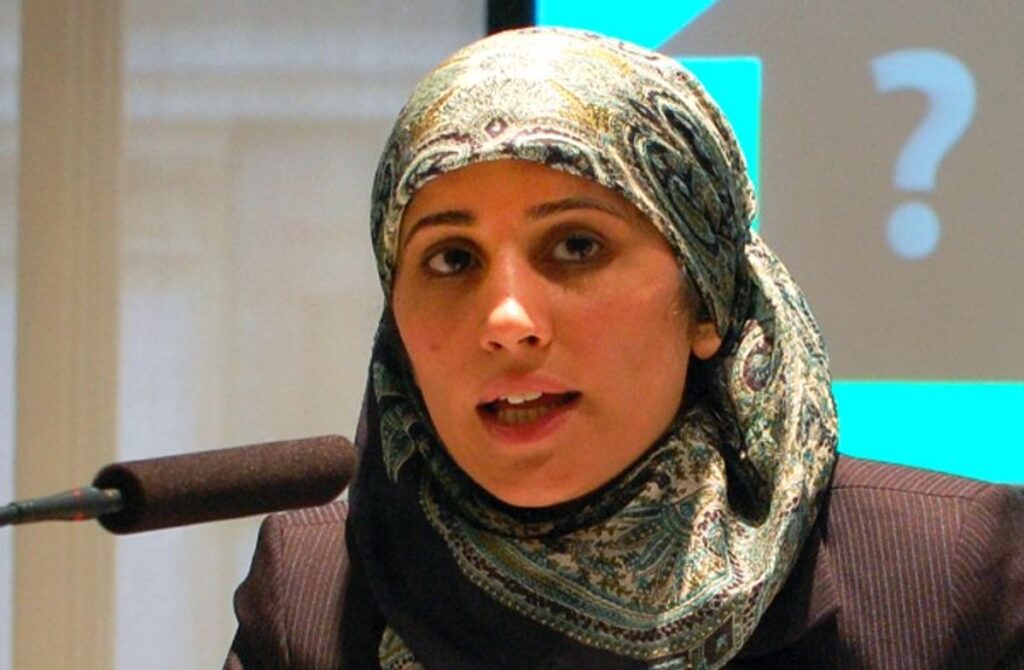
File image of Sameera Fazili, Deputy Director, National Economic Council at the White House| Twitter/ Sameera Fazili
‘Sameera Fazili has been named as Deputy Director, National Economic Council at the White House, the Biden-Harris Transition announced on Friday.
US President-elect Joe Biden has appointed Indian-American Sameera Fazili to a key White House position related to economy.
Sameera Fazili has been named as Deputy Director, National Economic Council at the White House, the Biden-Harris Transition announced on Friday.
The National Economic Council coordinates the economic policy making process and provide economic policy advice to the US president.
Fazili is currently the Economic Agency lead on the Biden-Harris Transition. She was earlier posted at the Federal Reserve Bank of Atlanta where she served as the Director of Engagement for Community and Economic Development.
Fazili is the second Kashmiri-origin Indian-American appointed to a key position in the incoming Biden administration.
In December, Aisha Shah was named as Partnerships Manager at the White House Office of Digital Strategy.
In the Obama-Biden administration, Fazili served as a senior policy advisor on the White House’s National Economic Council and as a senior advisor at the US Treasury Department in both Domestic Finance and International Affairs.
Prior to that she was a clinical lecturer of law at Yale Law School. Originally from Buffalo, she now lives in Georgia with her husband and three children. Fazili is a graduate of Yale Law School and Harvard College.
Before her time in government, Fazili was a clinical lecturer at Yale Law School’s community and economic development clinic, where she helped start a CDFI bank and a local anti-foreclosure initiative, and expanded the clinic’s work to international microfinance.
She also worked at ShoreBank, the nation’s first CDFI (community development financial institution) bank. Her work in finance has spanned consumer, housing, small business and microfinance.
She received her law degree from Yale Law School and her bachelor of arts in social studies from Harvard College.
source: http://www.indianexpress.com / The Indian Express / Home> World / by PTI / Washington – January 16th, 2021
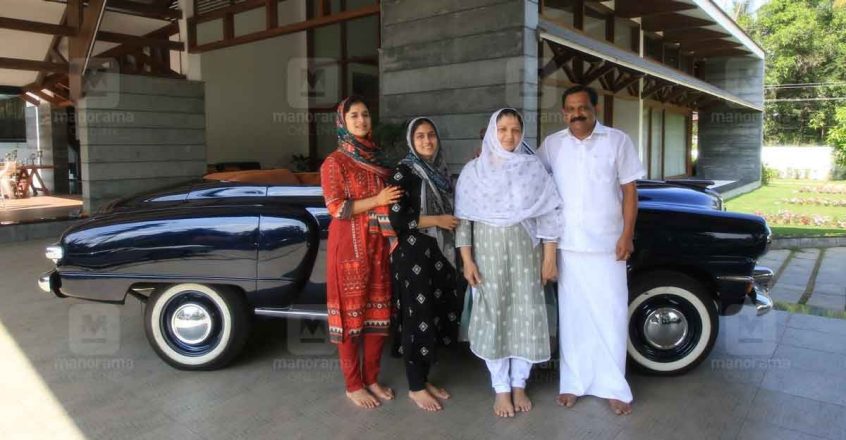
Expatriate businessman C P Salih had a happy reunion recently after 60 years — with a gleaming Studebaker car that had left his home in 1960.
Salih’s father Chandanaparambil C P Mohammad had bought this American car from Delhi. It is estimated that the car, manufactured in 1947, arrived in India in 1949.
It was in this car that the wedding party of the mother-in-law of prominent businessman Galfar Mohamed Ali had travelled to the wedding.
C P Mohammad sold the car in the 1960s. After changing several hands, it finally reached Delhi again. What’s more, it had the same old number — DBG 8213. Mohammad had written in his diary that he had bought the car for Rs 2,400. The car was tracked in Delhi with the help of the old number.
Salih purchased the car and brought it to his Valappad home to give it to his son Anhar Salih as a wedding gift. The car was originally red in colour. It has now turned blue. The top was lost due to age. But the engine is still the old one.
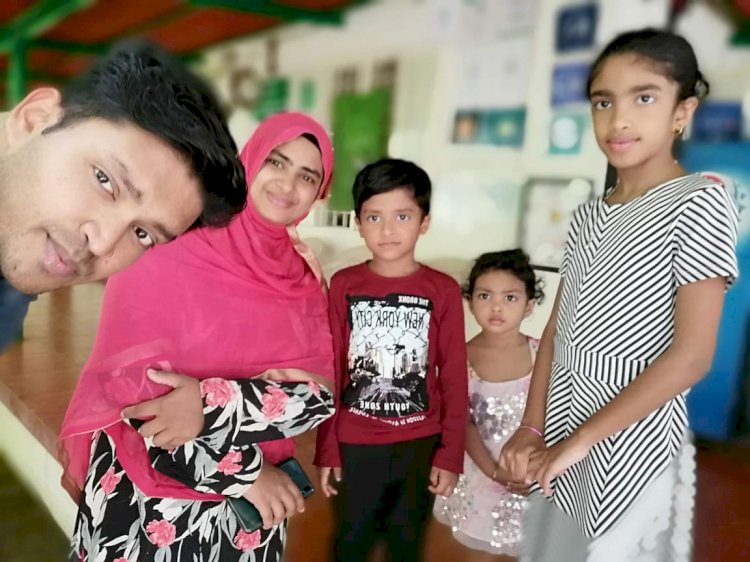
C P Salih with his family.
On seeing its return, many elders shared their memories of having seen the car in the past. All this was recorded and kept by Salih’s family. Many were not even allowed to touch the car. But C P Mohammad took everyone in the area in the car.
While the old car has been found, one puzzle related to it remains. CP Mohammad had written in his diary that an Ezhuthachan in Thrissur had helped him buy the car. Salih has not yet been able to find out who that was.
source: http://www.onmanorama.com / OnManorama / Home> News> Business / by OnManorama Correspondent / January 17th, 2021
Sondarapally Village (Thalassery),KERALA / Sharjah , UAE :
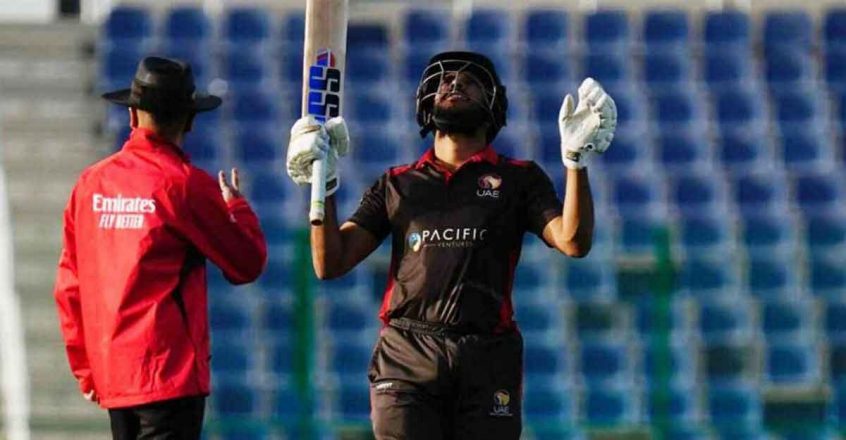
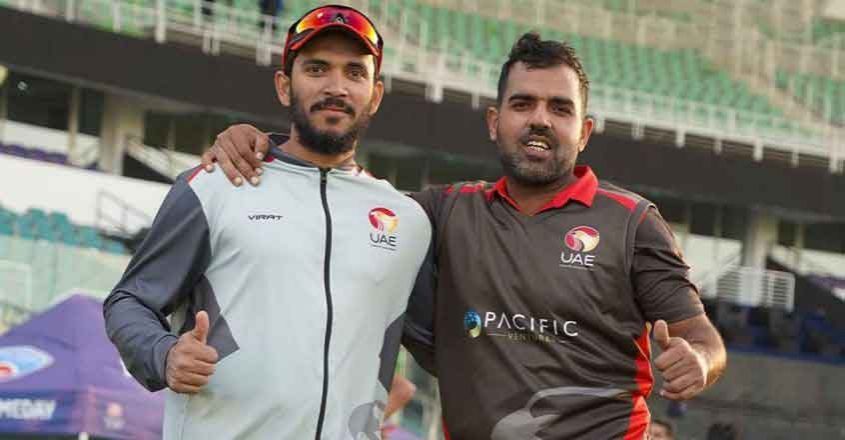
C P Rizwan won the man-of-the-match award his 109 against Ireland in the first ODI on Friday
Kannur:
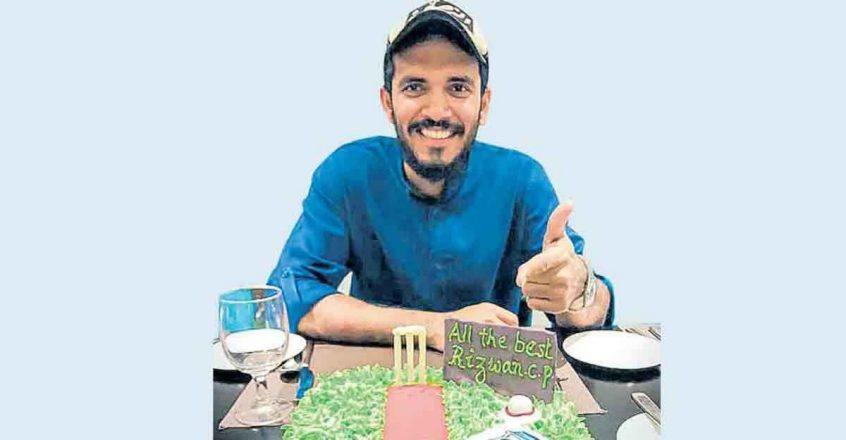
The story of C P Rizwan, who on Friday became the first Keralite to score a One-Day International (ODI) century representing any country, bears testimony to the fact that if you strive hard and stay focussed, you will ultimately realise your dreams.
The 32-year-old hailing from Thalassery, the cradle of cricket in Kerala, never gave up and never lost hope, even when his career hit a roadblock.
Growing up at Saidar Pally, a small village near Thalassery, Rizwan’s childhood mostly revolved around playing cricket with his friends in the locality. The youngster was gifted with the qualities that make a batsman successful at the top level and had the potential to become a future star.
He went on to represent Kerala in the junior levels and captained the U-25 state team. Although his performance in age-group categories was rewarded with a place in the senior side which included the likes of Sanju Samson and Sachin Baby, he was never given a chance in the playing eleven.
As it was frustrating sitting on the bench, he moved to the UAE in 2014 and landed a job in Sharjah. He continued to play cricket there and was able to catch the attention of the local cricket fraternity with consistent performances in domestic tournaments. In 2018, Rizwan completed the four years required for him to be eligible to play for the UAE and was duly included in the national team.
Rizwan celebrates his hundred against Ireland
An electrical engineering graduate from the Cochin University of Science and Technology, Rizwan made his debut for the UAE on January 26, 2019, in an ODI against Nepal. The Emirates Cricket Board offered him a one-year central contract last month in recognition of his excellent batting against against the USA and Zimbabwe. Apart from him, two other Keralites – Basil Hameed and Alishan Sharafu – also made it to the squad.
On Friday, Rizwan made history when he guided the UAE to a six-wicket win over Ireland in the first ODI of the four-match series in Abu Dhabi by scoring 109 off 136 balls. The splendid knock, which earned him the man-of-the-match award, was laced with nine boundaries and a six. He shared a fourth-wicket partnership of 184 with Lahore-born Muhammed Usman, who made an unbeaten 102, and made short work of the 269-run target set by Ireland.
Centurions Rizwan and Muhammed Usman after the first one-dayer against Ireland
Born on April 19, 1988, to M P Abdul Rouf and C P Nasreen of Poovathankandy, Rizwan studied at the St Joseph’s Higher Secondary School in Thalassery and played for the local Students Cricket Club and the Kochi-based Cordiant Sports Foundation in his formative years.
The right-hander, who bats at No. 3, has so far scored 288 runs from 10 ODIs at an average of 32.
He is currently employed with the Eastern International LLC in Sharjah.
source: http://www.onmanorama.com / OnManorama / Home> Sports / by G. Dinesh Kumar / January 09th, 2021
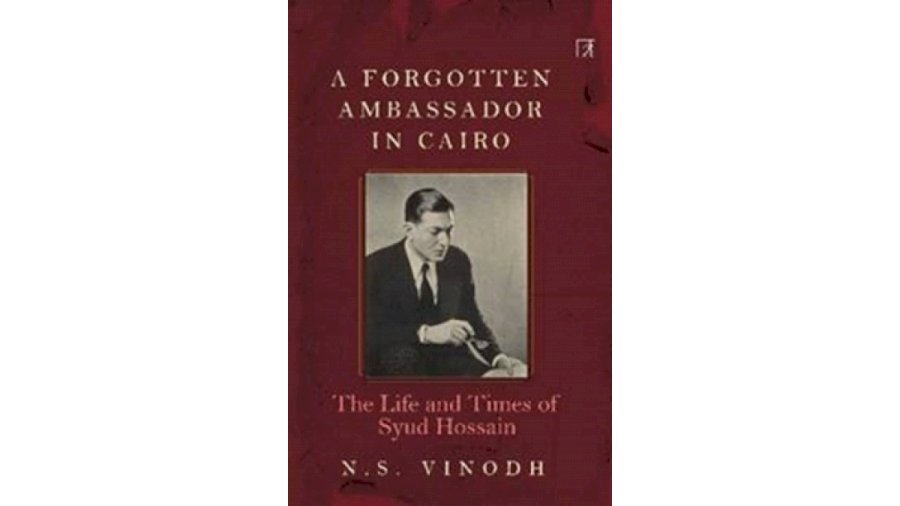
Among the multitudes of tombs in the City of the Dead in Cairo, there lies buried a lone Indian — an eminent scholar, writer, debonair statesman and a leader of the Indian freedom movement. Who is he? How did he get there? For a man who used both the lectern and the pen to devastating effect in the cause of the Indian Independence movement led by the likes of Mahatma Gandhi, Sardar Patel and Jawaharlal Nehru, very little is known of Syud Hossain.
Born to an aristocratic family in Calcutta, he started a career in journalism early in life and became the editor of Motilal Nehru’s nationalist newspaper, “The Independent”. After a brief elopement with Nehru’s sister, Vijaya Lakshmi Pandit, Hossain, under immense pressure from Motilal Nehru and Gandhi, annulled the marriage and was asked to stay away from the country for a few years. Thus began several years of exile.
Eventually, he landed in the US where he imparted Gandhi’s message far and wide across the country. Gathering a group of Indian freedom fighters around him, he fought for India’s freedom from afar, decrying British oppression and garnering support in the US for his cause. Flitting from one place to another, making homes of hotel rooms, Syud Hossain inspired and irked in equal measure. With every speech he delivered and every editorial he penned, he sent a shiver down the spine of the colonial rulers.
Adding to his formidable list of causes, Hossain also took on the fight for Indian immigrant rights in the US, one that successfully culminated in President Harry Truman signing the Luce-Celler Bill into an Act in 1946. He returned to India to witness the triumph of her Independence, as well as the tragedy of Gandhi’s assassination. He was appointed the first ever Indian ambassador to Egypt, where he died while in service and was laid to rest in Cairo.
“A Forgotten Ambassador in Cairo” (Simon & Schuster) offers an illuminating narrative of Hossain’s life interspersed with historical details that landscapes a vivid political picture of that era. Through primary sources that include Hossain’s private papers, the British Intelligence files, letters of his friends and contemporary newspapers, N.S. Vinodh brilliantly brings to life a man who has been relegated far too long to the shadows of time. Vinodh, is a civil engineering graduate from IIT, Madras, and a M.B.A. from IIM, Lucknow. In a corporate career spanning 25 years, he has held senior positions in corporate real estate with leading multi-national financial services companies such as ANZ Grindlays Bank, HSBC, and Fidelity Investments. He opted for early retirement to start his own boutique real estate company, as well as pursue his passion of travelling and history. He is married to Sheela and they have two sons, both based in the United States. He is based in Bangalore.
IANS
source: http://www.thehawk.in / The Hawk / Home>Lifestyle / by IANS / December 30th, 2020
Kadalundi (Kozhikode District) KERALA / Dubai, UAE :
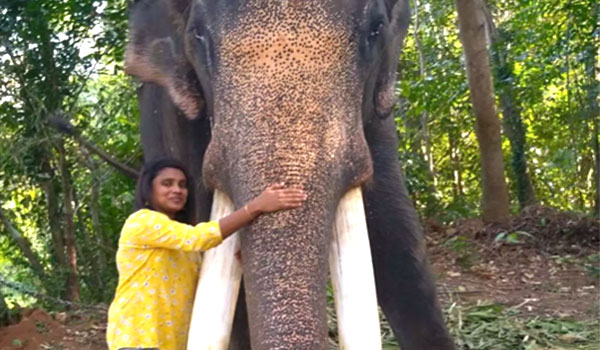
Shabna Sulaiman is the first Muslim woman from Kerala to become a Mahout. Shabna has to just whisper a command and tusker Manisheri Rajendran goes down on its buttocks. Manisheri Rajendran belongs to the Ottappalam Kappur elephant property. Malappuram Kadalundi native has trained the tusker Rajendran for the past two weeks. Shabna and the tusker have developed a strong bond. Shabna fed Rajendran with sugarcane, and watermelon and won his heart.
The 27-year-old can make the tusker make Rajendran sit, stand, turn around and raise its trunk and trumpet, indicating an instinctive way with animals. At first, it was difficult for Shabna to handle the tusker. But Shabna used everyday language and a conversational tone with the tusker to bond. She also didn’t use chains or hooks and managed to create a bond with him. Shabna told Kerala Kaumudi “It was not with stick or beating but with love I have conquered his mind.
Key Takeaways:
Shabna is taking training at the renowned Varikkassery Mana in Ottappalam in Palakkad district. Varikkassery Mana houses several elephants.
Shabna is doing research on elephants. She thought a much better way to learn about elephants would be by being close to them. Shabna will soon start the second phase of her training.
Sulaiman’s family owned a circus in the past. This was the major reason why her family loved animals.
About Shabna Sulaiman
The 27-year-old Shabna is taking training at the renowned Varikkassery Mana in Ottappalam in Palakkad district. Varikkassery Mana houses several elephants . Shabna will be the mahout of Manisheri Rajendran at the upcoming festival at the temple of Palakkad district. If this happens, Shabna will become the first woman mahout from the Muslim community in Kerala. Shabna is a medical professional from Dubai who has currently taken a break from her job.
“It is not an easy task for a woman to handle an elephant. But Shabna is very enthusiastic and skilful and she has learnt the basics easily. The training will continue for some more days.”
Shabna is doing her research on elephants. She thought a much better way to learn about elephants would be by being close to them. Shabna will soon start the second phase of her training. She told the Times of India “I am excited about the temple festivals. Hopefully, in those situations, I can learn a lot more in handling elephants.” Haridas a native of Ottaappalam told TOI “It is not an easy task for a woman to handle an elephant. But Shabna is very enthusiastic and skilful and she has learnt the basics easily. The training will continue for some more days.”
Shabna’s family owned a circus in the past and everyone in her family loves animals. She told TOI “It was after a tragic incident — my father’s brother was killed by a tiger during a training session — that my grandfather sold off the circus company.” She further added “But our family members still have a special affinity towards animals. When I expressed interest to train as a mahout their response was very positive. There was some opposition from my community, but I decided to go ahead.”
Picture Credit: The Wall
Mansi is an Intern at SheThe People.TV
source: http://www.shethepeople.tv / She The People / Home / by Mansi Wadhwa / January 29th, 2020
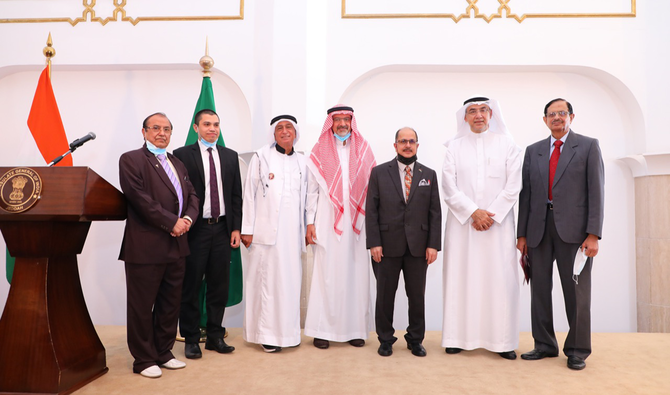
Indian Ambassador Dr. Ausaf Sayeed, third right; Dr. Ashraf A. Amir, second right; Acting Consul General Y. Sabir, second left; Dr. M.S. Karimuddin, right; and others.
The Jeddah chapter of the Indo-Saudi Medical Forum (ISMF) was launched at the InterContinental Jeddah on Friday by Indian Ambassador Dr. Ausaf Sayeed. The event took place in the presence of prominent Saudi and Indian healthcare professionals in the western region.
Dr. Sayeed thanked Dr. Ashraf A. Amir, chief medical officer (CMO) at Jeddah’s high-profile International Medical Center (IMC), for agreeing to become the forum’s president. He also thanked veteran and popular Indian pediatrician, Dr. M.S. Karimuddin, for becoming the forum’s vice president.
The ambassador highlighted the great strides that have taken place in recent times in relations between Saudi Arabia and India. Dr. Sayeed said the visit of Prime Minister Narendra Modi to Saudi Arabia in October last year plus the signing of a series of important agreements in different fields, including healthcare, have provided new momentum to the two countries’ relationship.
The ambassador highlighted the immense opportunities that “are waiting to be tapped in the healthcare industry.” He said the new forum, led by an energetic and experienced team, would be a good platform for complementing the steps and initiatives being taken by both governments — in Riyadh and New Delhi — to increase cooperation in the field of healthcare. He pointed out that India had become the “pharmacy of the world” during the coronavirus (COVID-19) pandemic. “India stands ready to play its part in alleviating the difficulties of the global community during times of global health crises.”
Dr. Ashraf Amir promised to take all steps to achieve the stated objectives of the Indo-Saudi Medical Forum. He said the advancement of the Indian healthcare sector had been phenomenal and that Saudi Arabia had won international praise for its exceptional handling of the coronavirus crisis.
Acting Consul General Y. Sabir welcomed the guests. He noted that the Indo-Saudi Medical Forum aimed to serve as a key platform point for high-level informal interactions between the medical fraternities of both India and Saudi Arabia.
Dr. Karimuddin highlighted the many activities that the forum plans to undertake in the coming days and months. Among other things, he said: “An effort will be made to bring together corporations working in the healthcare sector, including hospitals, pharma and surgical equipment firms, in order to collaborate with a view to providing excellent healthcare for Saudi citizens and expats.”
Dr. Karimuddin said the Indo-Saudi Medical Forum was a nonprofit body under the patronage of the Embassy of India. The forum, made up of Indian and Saudi doctors and experts in the field of healthcare and wellness, will play a supporting role in strengthening India-Saudi Arabian cooperation related to healthcare. ISMF will have three chapters in Jeddah, Riyadh and Dammam.
Nouf Marwaai, award-winning yoga instructor, spoke about how India’s expertise and facilities in the field of wellness and holistic healthcare was relevant to the Saudi healthcare system.
She said the momentum for the present Saudi-Indian relationship began during Modi’s visit to the Kingdom in April 2016 when King Salman presented him with the Kingdom’s highest civilian decoration, the Sash of King Abdul Aziz. “This recognition is an indication of the importance the Kingdom attaches to its relations with India,” she said.
Dr. Iqbal Musani, general secretary of the forum, highlighted with a PowerPoint presentation the giant strides that India and Indian doctors have made in the field of medicine.
Prominent among those who were present at the event included Hamna Maryam, consul (commerce) at the Indian Consulate in Jeddah; Mohammed Alungal, chairman of Abeer Medical Group; V.P. Mohammed Ali, chairman and managing director of Jeddah National Hospital; Dr. Kavitha Marusamy of Ibn Sina National College; Dr. Ataat Khan and Dr. A.H. Maniyar.
A large number of Indian and Saudi doctors also attended the launch virtually in view of COVID-19-related restrictions.
source: http://www.arabnews.com / Arab News / Home> Business>Corporate News> Latest News / December 26th, 2020
Syed Jamaluddin Quadri who was known among his friends and family members as Khusro passed away last year in Hyderabad, his hometown.
He wasn’t keeping well for quite some time. I had been told that he has developed difficulty in walking owing to serious knee problem.
I remember Jamal as Jamaluddin and not as Jamalullah that he is referred to by many of his friends.
When his close friend and companion Sheikh Ibrahim said his organization is bringing out a special issue on him and wanted me to pen my own thoughts, I agreed immediately.
His demise had triggered a stream of memories ranging from his childhood to the time he spent in Jeddah. I had attended his funeral prayers that were held at Abdullah Shah Saheb mosque in Hussaini Alam.
I first came to know of him when I was admitted to Modern Kinder Garten, a new English medium school in Hussaini Alam, the area in which I too lived. I was not alone in not knowing the meaning of Kinder Garten. We always thought it was Kinder Garden. And no one took pains to explain to the students the meaning of the school’s name. It was much later in life that I came to that Kinder means children and garten means garden.
Khusro was two years senior to me in the school. Traditionally, the juniors do not get the attention of the seniors. But circumstances at the school were such that I came to know of him and his family in the first few weeks of entering the MKG. His father Janaab Imaduddin sahib, a salt and pepper bearded gentleman was committed to the cause of education. He was looked at with tremendous respect by his peers, teachers and students. Khusro was his only male child. He had sisters, older and junior to him. Some of them taught at the school. We the students called them Bajis. One such sister, Rafia Baji, later became the Principal of the school. That of course was much later than I left the school. Interestingly, the school is still working.
I distinctly remember two incidents from the MKG days. The first was a Kabbadi tournament where we the fourth or fifth class students were pitted against the eighth class boys in the finals. Khusro was in that team which won the tournament. We had no regrets in losing to the big boys because we had given them a tough competition. In fact, we won more appreciation as we were the underdogs.
The second incident belonged to the annual day function that was organized in the mid-sixties. The war with China was still fresh in the minds, therefore, the management decided to present a play on that subject. The play showed the dedication of the people to sacrifice their lives for the country. The story revolved around a family that had just celebrated the wedding of its son who was on vacation from his army duty. Khusro played the bridegroom wearing an impressive army uniform. Since the girls were not allowed to take part in the play on stage, especially with the boys, the management was looking for boys who could play the female characters. My friend and classmate Abdul Wahab Abid played the role of Khusro’s mother and I was cast as his newly wed bride. As I was being prepared in a red bridal dress and jewelry for the stage a senior student, Nayeem, suddenly entered the room, stared at me intently for a few moments and suddenly kissed on my cheek and ran away. He left me red-faced and bewildered. I believe he was punished for the ‘mischief’ later.
It was a great show where the beautiful bride asks her handsome husband to attend to the call of the nation and fight against the enemy. But she does it with lots of weeping. That patriotic play was a hit.
A few years after I left the MKG I was invited by Khusro and his group of dedicated friends to teach younger students at a mosque during early morning hours every day. I accepted the offer and joined the group. That was a great social initiative led by Khusro. I saw in him at that age the leadership qualities that blossomed further during his long stint in the Kingdom of Saudi Arabia to which he had migrated in the middle seventies. Incidentally, many of those who had worked in that mosque also left for the Kingdom. These young men and their families lived in a neighbourhood located on way to King Abdul Aziz University in Jeddah. It was perhaps called Kilo Six or Seven.
After joining Saudi Gazette, one of the two English language newspapers published from Jeddah, in early 1982 I started meeting some of the members of that group. I found that in his own way Khusro had kept his tradition of social activism alive. He was helping the newly arrived Indians to find jobs and settle down. He was holding weekly classes on social and religious norms of the Kingdom and explained to them matters pertaining to religion.
He began working for the preservation and promotion of Urdu by helping students. He also started the tradition of celebrating The Education Day in commemoration of the birth anniversary of Maulana Abul Kalam Azad, every year on November 11. To coincide with the occasion he was regularly bringing out a souvenir on Maulana Azad. While I was working with Maulana Azad National Urdu University in Hyderabad as its Consultant/Advisor he used to phone me asking for my articles for the souvenir. I contributed a couple of write-ups on Maulana Azad for the souvenir.
His another area of interest was Jamia Nizamia, the 135 years old Islamic institution in Hyderabad. He invited Aalims and scholars to Jeddah to be part of the celebrations he would organise to sustain the interest in religious education among Indians, especially students, who were missing a lot by being away from their homeland.
A Sufi by the belief he never hesitated in working with different groups. I remember his regular meetings with Janaab Maslehuddin Saadi with friends to gain more knowledge about Sufi philosophy and practices.
I also remember the deep sorrow in his eyes when one of his sons drowned in the sea near Visakhapatnam. That boy was spending his vacation there. But Khusro managed to control it and did not allow the tragedy to deter him from his regular work.
I truly believe that people like Khusro come from are a rare breed. They do not forget that they have to play their role, however small or insignificant it may sound. I hope his friends in Hyderabad as well as those who are still in the Kingdom of Saudi Arabia or in other parts of the world would carry forward his positive work.
Mir Ayoob Ali Khan is a Senior Journalist who has worked with Saudi Gazette, Deccan Chronicle and Times of India. He is currently associated with Siasat.com, an English language news portal.
source: http://www.siasat.com / The Siasat Daily / Home> Featured News / by News Desk / December 28th, 2020
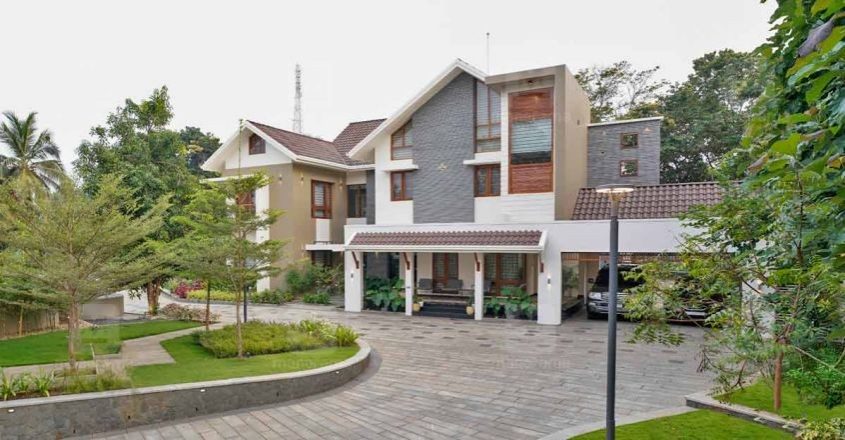
A blend of flat and sloped roof perfectly suits the weather of Nilambur which receives huge amount of rain
Rahim, an expatriate, has built his dream dwelling near the railway station in the beautiful town of town of Nilambur in Kerala, which is known as the haven of exquisite teak wood.
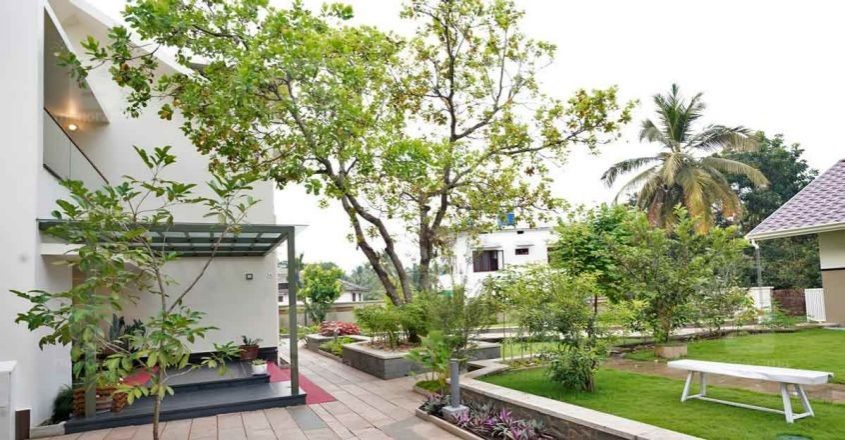
The structure is built by retaining the natural layout of the steep plot. Most of the trees that stood on the plot are still been protected here.
The house has a spacious front yard which is paved with Bangalore stones.
A blend of flat and sloped roof perfectly suits the weather of Nilambur which receives huge amount of rain. Meanwhile, the cladding on walls are the highlight of the elevation.
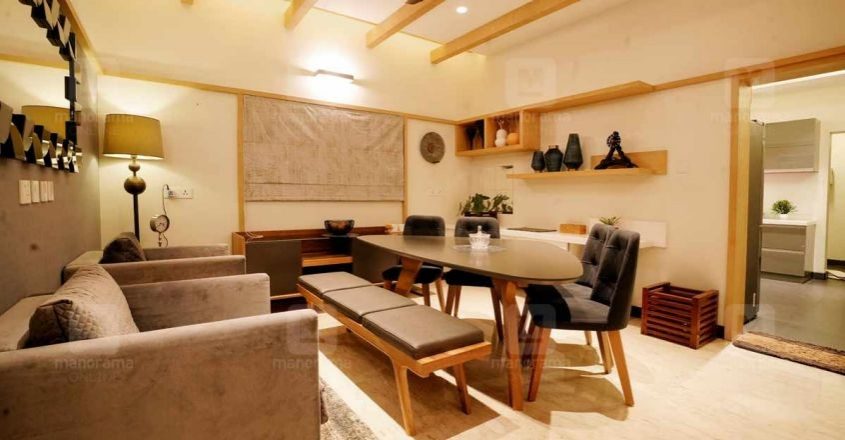
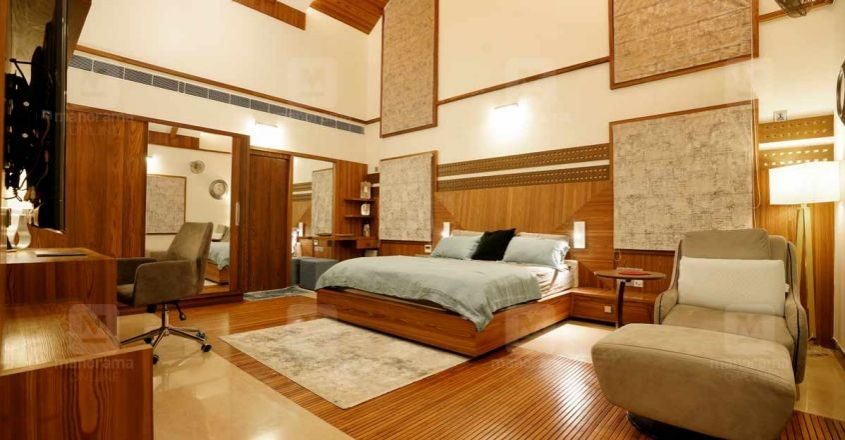
This majestic mansion that sprawls in 6500 sqft, has a spacious car porch, sit out, formal and family living areas, dining space, family dining area, courtyard, prayer area, kitchen with an adjacent work area, five bedrooms, upper living room, home theater and balcony.
The family living area has a double height ceiling. The TV unit too is arranged here. Meanwhile, the patio beside the family living area and the dining space leads to greenery of the beautiful garden outside.
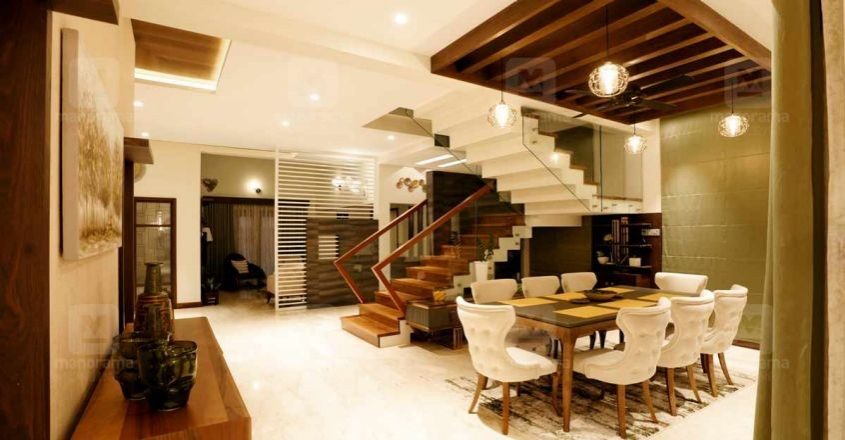
Imported Turkish furnish adorn the posh interiors of this house. Meanwhile, exquisite Italian marble grant a regal charm to the flooring works. The common areas don a pleasant green hue to complement the fabulous greenery of the yard. The flooring in the living area and the bedrooms are done using teak wood. The hand railings of the stairway too feature teak wood.
The stairway leads to the spacious upper living area. A sitting space, sturdy area and a home theatre have been arranged here. Besides the main dining area where the guests are hosted, there is a separate family dining area too. The family dining space is closer to the kitchen.
The kitchen cabinets are done in marine ply with planilaque glass finish. Meanwhile, Korean stone has been paved on the counter top.
source: http://www.onmanorama.com / OnManorama / Home> Section> Lifestyle / by IANS / December 18th, 2020
At a time when the world has turned online for education, work, shopping, business and whatnot, here is a couple from Malappuram district in Kerala who has brought out a new online method of learning, integrating computer coding with school subjects for kids. Let’s meet Aisha Sameeha and Shahid Jabbar from Nilambur.
Hailing from the village of Melattur, Aisha Sameeha was just one among the many girls in Malappuram – who studied well, graduated in BTech, got married and settled with her husband in his workplace Dubai.
Soon, they got their first child and Sameeha got busy with her daughter Eshal.
However, sitting idle or being content with the homely chores alone was not her cup of tea. Sameeha tried her hand at different trades such as content writing for technical websites, cooking and baking, stitching and embroidery etc. She also attended and won a few cooking competitions held in Kerala and Dubai.
Into the field of education
Having born and brought up in Kerala and abroad, Sameeha had got familiarized with different methods of education. And that encouraged her interest in learning and teaching. “Teaching has always been my passion, even when doing BTech. And that is also a reason I didn’t take up the job offers that came my way after the completion of my studies,” said Sameeha. She especially mentioned the methods followed in the PeeVeeS Public School, Nilambur, where she studied from class 1 to 6 and the MES Engineering College. The two institutions taught her the importance of encouragement by teachers and the effectiveness of grouping and sharing to learn better.
Once her daughter began to attend school, it opened her to another world in the field of education. The kindergarten that Eshal attended in Dubai followed the Reggio Emilia approach, which gave high importance to interaction between parents, teachers and students. Parents were encouraged to come to the school and be a part of various activities. Each class had a library and several other items that caught children’s attention and interest, where they could gain knowledge. “I had thought that I couldn’t manage small kids, but it was proved wrong when I began to go there,” confessed Sameeha. “I used to observe how they were doing things, dealing with the children, the method of teaching etc. That was a sort of experimental and experiential learning. Eshal liked it a lot there.”
source: http://www.thesite.in / The Site / Home> Empowerment / by Najiya O / December 07th, 2020
Noted NASA scientist Dr Hashima Hasan, who is the Program Scientist for NuSTAR, has thanked the Aligarh Muslim University (AMU) helping her materialise her dream. According to an official AMU press statement, she thanked the university during the interview to NASA STEM Stars.
“The student life at AMU from 1968 to 1973 and the academic credentials gained there helped me attain a prestigious scholarship to further pursue higher studies in Nuclear Science at the University of Oxford,” Hashima said.
“I worked hard and gave this land all I had, and this great nation paid me back in spades, but it all started at AMU,” she added.
“I was a little girl back then, but the spectacular satellite launch made me eager to follow every success and failure in the newspaper. I clearly remember the day man landed on the moon,” she said. The work at NASA is dynamic, challenging and energizing and my journey to become a space scientist began after a post-graduate degree in Nuclear Physics at the Aligarh Muslim University, reminisced Dr Hashima.
She attended Tata Institute of Fundamental Research, Mumbai for a postdoc and worked at the Bhabha Atomic Research Centre in Mumbai before reaching the United States on a US Council Fellowship.
“Later in life, I worked at the Space Telescope Science Institute, Baltimore, writing the simulation software for the optics of the Hubble Space Telescope and its science instruments, using it to analyse the optical error of Hubble after launch,” she shared in the interview.
Dr Hashima recalled that as the Optical Telescope Assembly Scientist, it was her job to keep the telescope in the best focus until a fix could be installed.
“Then I was ready to achieve my dream of working directly for NASA. An opportunity arose in 1994 when a job for a Visiting Senior Scientist was advertised. Although it was a two-year job, I found working at NASA Headquarters so exhilarating and rewarding that I stayed on,” she said adding that NASA’s space science program gives her the opportunity to lead cutting edge science, work with world-class scientists and write research papers on astronomy.
source: http://www.thesite.in / The Site / Home> Inspiration / by The Site Reporter / December 12th, 2020