The third annual general body meeting of was held on February 23. The programme began with Qirat by Maher Mohammed.
Imam of Ujire Central Masjid, Abu Sufyan H I Ibrahim Madani, Hamed Saeed Al Ghamdi, Anwar Hussain Goodinabali, Kamaruddin Goodinabali, Amjad Khan Polya, Qasim Tolhath president of Al Ameen Riyadh unit and Usman Kotrody senior vice president of Al Ameen Dammam-Jubail unit were the chief guests at the function.
Dammam-Jubail unit president, Sahul Hameed Ujire welcomed the audience and the chief guests. Vice president S A Azeez of Al Ameen Dammam-Jubail Unit anchored the programme.
Azeez S A delivered a brief introduction of the educational and other activities carried out by Al Ameen Association Ujire and explained how Al Ameen worked all these years back home. He also thanked each and every member of the unit.
Ubaidullah Ujire, general secretary, presented the audit reports.
Qassim Tolhath, appreciated the efforts of the unit and took up the responsibility to dissolve the old committee and announce the newly formed committee. He also wished the new committee.
Sahul Hameed Ujire was named president unanimously for the third time.
Abu Sufyan H I Ibrahim Madani Imam of Ujire Central Masjid expressed his gratitude to all the members and thanked them for their dedicated service to the community.
Hamed Saeed Al Ghamdi, Anwar Hussain Goodinabali and Kamaruddin Goodinabali called on the office bearers to exercise their team spirit and tireless effort to serve the community and their complete dedication toward the noble cause.
Ubaidulla Ujire proposed the vote of thanks.
Al Ameen Dammam-Jubail unit executive committee members for the year 2017-2018 are as follows:
Sahul Hameed Ujire (president), Azeez S A (general secretary), Usman Kotrody (vice president), Ubaidulla Ujire (vice president), Farook Alankar (treasurer), Mansoor Kuntini (joint secretary) Siddik Charmadi (joint secretary) and Asif QTF (auditor).
Advising committee:
Yakoob U A, Yusuf U H, Mohammad Ali and Bava Hussain
Executive members:
Mehboob, Salahuddin, Mohammed Anees, Irfan, Hudaifa, Suhail, Zameer, Mansoor Athaje, Hameed Athaje, Abdullah Muguli, Rafeeq Muguli, Abdul Khader Halepete, Rafeek vital, Ashraf Bellur, Amjad Khan, Raheem Arkula, Yusuf Vitla, Ibrahim Khader, Mohammed Iqbal and Shamsuddin.
source: http://www.daijiworld.com / DaijiWorld.com / Home> Middle East / Thursday – March 02nd, 2017
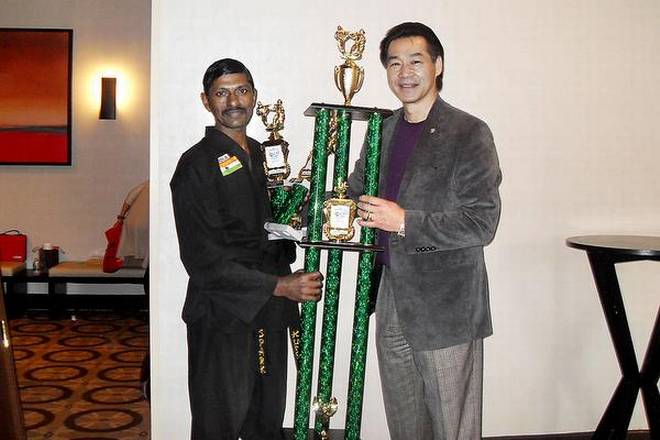
Proud moment: Pathan Jameel Khan winning gold in Virginia on Sunday is the second world championship gold this month, after he moved to the US.
Pathan Jameel Khan wins gold in the black belt division of World Championship in Virginia
This Hyderabadi has done it again! The 41-year-old Pathan Jameel Khan, the martial arts exponent, who moved to the US to take up karate training in an American school in New York a few months ago, made an emphatic statement again on Sunday winning the gold in the black belt division of the World Championship in Virginia.
This is incidentally the second world championship gold that Jameel has won, after moving to the US, this month.
Ironically, Jameel, winner of 15 gold, 13 silver and 17 bronze at the national and international events, including two 2016 World Cup silver in the US, has to look for greener pastures after his repeated pleas for financial assistance and a job did not evoke any positive response from the authorities concerned.
“It’s a pity that I had to move to the US to take up this training job which fetches me enough money to take care of my family of ageing mother, four brothers and a sister,” says Jameel, even while being subdued despite winning two world championship gold (conducted by two separate world federations).
But why? “My ultimate dream is to represent India in the 2020 Olympics when karate will be introduced. Since I realised that even winning at the highest level will not assure me the kind of exposure I need for the Olympics, I had no option but to move to the US,” counters Jameel.
This BA graduate from Dr. B.R. Ambedkar Open University, whose only livelihood when in Hyderabad was by training a handful of enthusiastic young talent, points out that the three-year contract with the American school should also ensure adequate exposure to the toughest competitors in the field. “Besides training, the stay in the US should also help in picking up a few new tricks too,” says Jameel, who also won two bronze in the men’s forms and weapons categories.
Will you come back after the contract period? “As things stand now, my contract will end in 2019, one year before the Olympics. By God’s grace if everything falls in place and I get the help from the Telangana government, I will train and put in the best efforts to realise my ultimate dream of playing in Olympics the next year,” Jameel concludes.
source: http://www.thehindu.com / The Hindu / Home> News> States> Telangana / by V.V. Subrahmanyam / Hyderabad – February 06th, 2017
Educational Excellence Celebrated at AFMI’s Silver Jubilee Convention in Delhi
American Federation of Muslims of Indian Origin’s Silver Jubilee convention held at the Kedar Nath Sahani Auditorium in New Delhi Dec.31-Jan.1st celebrated the accomplishments and marked a milestone in the organization’s history. The convention was held in co-ordination with the Delhi Youth Welfare Association.
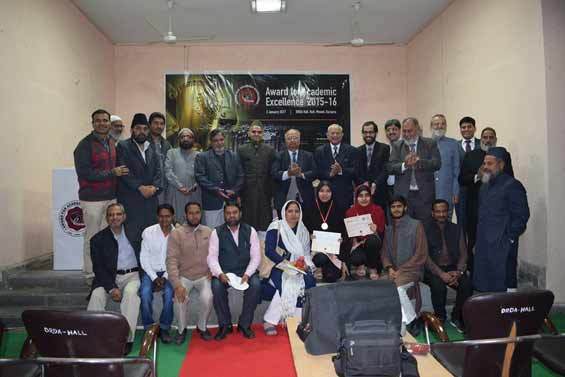
More than 120 Muslim students from across India were awarded with gold, silver, and bronze for attaining meritorious distinction in the board exams. In addition, the prestigious Sir Syed Ahmed Khan Award conferred about leading Mumbai philanthropist Dr. Abdul Kader Fazlani Sopariwala. The Mir Taqi Mir Award was given to Mr. Sanjiv Saraf, founder of the popular web portal www.rekhta.org, for his contributions in promoting the Urdu language. The website now features more than 22,000 titles of Urdu books. Excellence Awards were given to former Chief Electoral Commissioner S.Y.Quraishi and the historic Anglo Arabic Senior Secondary School.
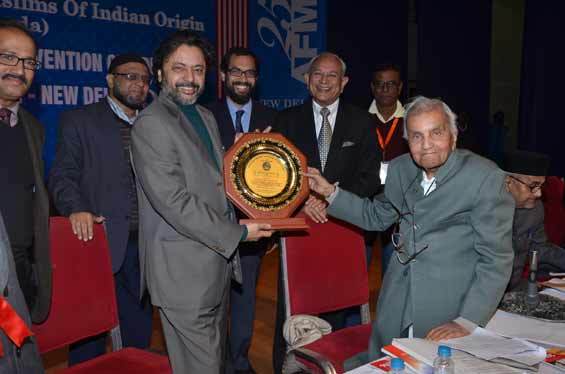
Sanjiv Saraf accepting his award from Justice Sachar
In a first for AFMI convention all the medallists were interviewed by Dr. Fazlani’s philanthropic organization and scholarships worth Rs.4 crore were pledged.
Awards to top students were given at the hands of Delhi Deputy Chief Minister Manish Sisodia. He praised the work of AFMI and that more such efforts need to be undertaken to uplift the society. He mentioned that education remains the top priority of the Delhi government with as much as 25% of the state government’s budget dedicated to it.
AFMI’s flagship awards program has been instrumental in spreading awareness about educational excellence and empowerment across the country. Dr.A.R. Nakadar, AFMI’s founding trustee, said that the fruits sown by AFMI at its inception are now bearing fruit. He said that due to such efforts there has been a remarkable improvement in the educational scenario of Indian Muslims. Citing the latest census reports, published in Indian Express, he stated that there has been a 98.8% increase in the number of Muslim graduates between 2001 and 2011. During the same period the Indian Muslim literacy rate has increased from 59.1% to 68.5%. He said that the day is not too far when, through the collective efforts of all, AFMI’s dream of 100% literacy will be realized.
Dr. Nakadar urged the students to not to rest on the laurels but to use the award as a motivational tool to attain even grater heights of educational excellence. He also asked them to not to forget those who have been left behind and to spread the message of educational empowerment everywhere.
AFMI’s incoming president Dr. Khutb Uddin, a practicing psychiatrist from Indiana, in his remarks applauded the students for their hard work. He urged them to not to be distracted by negative thoughts and to focus on their education. He also pointed out that everyone from the individual to the government should be involved in raising the quality of education in the country and that it should be everyone’s top most priority.
The inaugural session of the convention was addressed by Justice Rajinder Sachar, Mr. Anil Swarup, Secretary Education & Literacy (Government of India), Mr. Naseem Ahmad, Chairman of National Commission for Minorities, and convention chairman Mr. Mohammad Naeem, president of Delhi Youth Welfare Association. The session was ably moderated by AFMI Trustee and leading scholar Dr. Aslam Abdullah.
The convention was also addressed by Prof. Akhtarul Wasey (Vice Chancellor of Maulana Azad University, Jodhpur); Mr.Siraj Hussain, IAS, former VC Jamia Hamdard, Dr. S.Y.Qureshi (former Chief Election Commissioner), Justice Fakhruddin, Mr. Ali Quraishi (New Mexico), Mr. Tayeb Poonawala (New York), Mr. Siraj Thakore (Canada), Mr. Farhad Rahmani, Mr. Ayub Khan, Prof. Janaki Rajan, Dr. Shabistan Gaffar, Mr. Mohsin Siddiqui, Mr. Suhel Tirmizi (Editor, Gujarat Today), Dr. Husain Nagamia (Florida), Mr. Shafi Lokhandwala (Detroit), Mr. Khalil Ahmad, etc.
The convention also featured an AFMI Alumni session in which previous year’s medalists spoke on their experiences after winning the award. They also offered their guidance for the students in choosing their career pathways. Among those who addressed this session include Dr Nurul Islam (pediatric cardiologist), Mrs. Darakshan Khan (IT consultant), Dr. Suhail Qureshi (oncologist), Dr. Naseem Ahmed (Orthopaedic surgeon), Dr. Nabeel A.K., Ms. Samreen Siddiqui, Mr. Uzair Khan, among others.
In his closing remarks Dr. Nakadar thanked all the organizers and volunteers of Delhi Youth Welfare Association, under the leadership of Mr. Mohammad Naeem, for organizing a very memorable convention.
A seventeen member delegation of the American Federation of Muslims of Indian Origin, led by Dr. A.R.Nakadar, met the Vice President of India Mr. Hamid Ansari on January 2, 2017 and appraised him of AFMI’s activities. Mr. Ansari appreciated the efforts of AFMI and the concerns and care of NRIs for improving the quality of education in India.
An AFMI delegation met the Deputy Chief Minister of Delhi Mr. Manish Sisodia on January 3rd and discussed the current situation of education in Old Delhi.
AFMI’s Regional Awards Program in Mewat
AFMI held its regional awards program in Nuh, Mewat in coordination with the Human Welfare Foundation. One of the key organizers of the program is Uzair Khan, a former AFMI medalist, who is now carrying its message to the interiors of Mewat region. He is presently pursuing MBA from Jamia Millia Islamia.
Reviving Delhi’s Educational Institutions
AFMI’s NRI delegates visited a number of educational institutions in Old Delhi which have held aloft the banner of education among trying circumstances. The schools visited include Anglo Arabic Senior Secondary School, Mazhar ul Islam School, and the Fatehpuri School. AFMI’s governing board will soon formulate a a plan for help in the revival of these historic institutions.
source: http://www.milligazette.com / The Milli Gazette / Home> Online News> Education and Careers / January 23rd, 2017
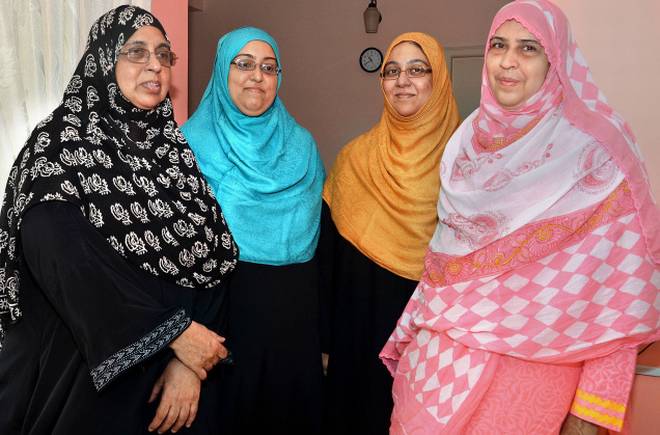
Together for food : From left, Sajida Aslam, Ruqia Suhaib, Nazia Tamir and Munira Munir from ‘Cutchi Kitchen’. Photo :Thulasi Kakkat
‘Cutchi Kitchen’ documents Kutchi cuisine through memories and recipes.
Almost 200 years ago, Sajida Aslam’s grandfather moved to Alappuzha from the Kutch region of Gujarat. Seventy-five years ago, her father moved to Kochi, where she was born among the growing community of Kutchi Memons in the city. Today, Sajida’s daughter, Shazia Wahid, is the founder of ‘Cutchi Kitchen’ — an initiative that documents through history and memories, the rich cuisine of the migrant community.
‘Cutchi Kitchen’ runs a website and a catering service primarily of Kutchi delicacies, with world cuisine as well. While Shazia runs the website from her present home in London, her mother Sajida, aunt Munira Munir Sait, sister Nazia Tamir and cousins Ruqia Suhaib and Sabiha Munir man the local orders from their homes in Ravipuram and Kaloor. “Shazia was inspired to begin ‘Cutchi Kitchen’ after she left the country,” says Ruqia, “She gave us all the first big push and we’ve completed almost a year now.”
‘Cutchi Kitchen’ opens with Shazia’s tribute to her ummima’s (maternal grandmother) special Kutchi chicken biryani. It is a detailed affair with three layers of rice sandwiching chicken in between, and served with raita. This recipe has been a favourite in our family for three generations for its minimal standing-by-the-stove time, writes Shazia. While two generations of Sajida’s family are involved in the daily workings of ‘Cutchi Kitchen’, Ruqia and Nazia say their children have taken a keen interest too, often chipping in with the preparations and tasting.
‘Cutchi Kitchen’ now has an active Facebook presence with over 3,000 fans and several followers on Twitter too. “We try and post at least once a day — either tips, or full recipes,” says Nazia. Thus far, they’ve had two online competitions too — the more elaborate one after they completed 100 recipes.
Their popularity rose most during the Ramzan fast, when they put together nine special Iftar menus, each with six dishes from starter, drink and main course to dessert. One of the highlights of these menus was their falooda recipes. While Sajida created an unusual falooda pudding made from China grass and cut into diamonds once set, Munira prepared the falooda drink, served cold and with jelly or ice cream. The menus were then released as an e-book.
The fasting season also brought with it almost daily orders for homemade frozen chicken fillets, samosas and rolls that only have to be fried before consumption. Their most ordered dish was also ‘Cutchi Kitchen’s’ most prized recipe — the goond jo laddoo, a powdery, sugary dessert served for auspicious occasions, given to brides before weddings and to mothers after deliveries. Explains Sajida, “The goond (acacia gum) has medicinal properties, and though the recipe for the laddoo is simple, it takes years of practice to get the mixture to hold right without giving way or being too sticky.” Sajida and Munira are the only ones in the family who prepare the laddoo, even today, as the next generations are still grasping the knack.
Changing rituals
Time has changed much among the Kutchi Memons, says Sajida. Old, prolonged rituals have turned brief, and with it, the associated foods have morphed too.
For example, by tradition, the peeti (haldi) ceremony for brides lasted several days and the household favourite was muthiya, a steamed rice dumpling dish that could be served dry or with gravy. “I remember my ummima sitting and shaping the muthiyas all by herself, not trusting anyone to make them correctly with her special mix of spices and ingredients,” writes Shazia. Peeti ceremonies now are associated more with quicker dishes such as kaaja (a badusha-like savoury) and paalchaya, a condensed milk-based drink. Hot favourites are also the Kutchi koottan (a dal curry served with pathiri), beef kofta (boneless beef meatball curry), buttery, cookie-like nankhatais and mitta ghatia, a deep-fried flour-based snack.
Sajida counts among her most prized possessions, a kombi, a 100-year-old bandini shawl bordered by gold, traditionally placed over the bride’s head at weddings. What they also cherish is their Kutchi language — a conglomeration of Sindhi, Gujarati,Urdu and Hindi, reflective of the community’s wide travels.
“We still speak it at home and though it has no specific script, all our children have learnt it too alongside Malayalam, Hindi and English,” says Sajida in fluent Malayalam. Someday, they hope to bring out a book of their family’s recipes. For now, ‘Cutchi Kitchen’ conducts workshops on their food, alongside those on Arabian recipes and world cuisine. Find the ‘Cutchi Kitchen’ at www.cutchikitchen.com
source: http://www.thehindu.com / The Hindu / Home> Food / by Esther Elias / November 14th, 2013
Calicut, KERALA / KINGDOM OF SAUDI ARABIA / KYRGYZSTAN :
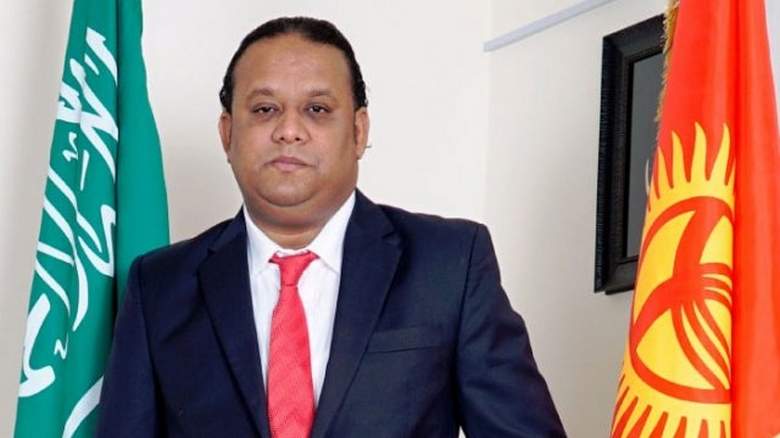
Shaik Rafik Mohammed, Chairman of Gammon Group / image credit: Twitter
The Saudi-based entrepreneur of Indian origin, was invited by the Kyrgystan Government to take up the prestigious military position in view of his earlier contribution to the country.
From among more than two million Keralite expatriates present across the world, a notable name is Shaikh Rafik Mohammed, who has now assumed a top position in the defense department of Kyrgyzstan, a Central Asian state of the former Soviet Union.
Shaikh Rafik Mohammed, Chairman, Gammon Group (UAE and Saudi Arabia), has been appointed Major General by Ali Mirza, Defence Minister of Kyrgyzstan, at an official ceremony held in the Central Asian country, Omar Abu Baker, media advisor of Rafik, told Khaleej Times.
It is a rare military position occupied by an overseas Keralite, he said on behalf of Rafik, adding that the Keralite holds Kyrgyzstan nationality conferred by its former President, Kurmanbek Saliyevich Bakiyev, whom he casually met in his 20s while working in Iran. He was conferred the military leadership at a function held in the Kyrgyzstan military head office, his representative told Khaleej Times.
The Saudi-based entrepreneur of Indian origin, whose family resides in Dubai, was invited by the Kyrgystan Government to take up the prestigious military position in view of his earlier contribution to the country.
The inspiring story of the Keralite expatriate who migrated from Calicut Kerala before completing his fifth-grade schooling culminated in his recent appointment as Major General of Kyrgyzstan. While there are scores of successful of business tycoons in the region, this could well be the first time a Malayali has occupying top military leadership of a foreign country.
Mohammed Rafik earlier worked as an advisor to the former Kyrgyzstan President Kurmanbek Saliyevich Bakiyev (2005-1010) whom he met in Iran where the young Indian entrepreneur was developing a major steel plant.
After selling the successful project to the Iranian Government, Rafik went to Kyrgystan and presented a similar project to Kurmanbek, then a governor who was preparing to contest presidential elections.
Kurmanbek promised to green-light the project if he won the election. After he got elected, the new president appointed young Rafik as his chief advisor – a milestone in his career in his mid-twenties. He remained president for two terms and Rafik developed wide network of friends in the Central Asian republic, which has witnessed a rapid flow of foreign investment and reversal of socialist mode of development to a capitalist mode of production.
As an economic diplomat, Rafik could play a key role in attracting foreign investment from many countries to the young nation by suggesting easy tax regimes that kept away foreign investors till then. From there, he was invited by Saudi Arabia to develop some projects on the free zone model of Dubai. Kyrgyzstan in the Central Asian region maintains close economic, political and strategic relationship with the Gulf region, especially Saudi Arabia. Kyrgyzstan is also a member of the Jeddah-based Organisation of Islamic Countries (OIC).
Gammon Group has a strong presence in emerging markets such as Asia, Middle East, Europe and North Africa. The diversified group is present in several areas, including infrastructure management and petrochemicals. According to the group’s website, it employs 200,000 employees in 28 countries.
“Rafik had left Kerala at a young age and he could complete only his primary school education. He went to Mumbai where the young man learnt all the tricks of business and from there to the Middle East. He has worked in the UAE, Iran, Saudi Arabia and Kyrgyzstan,” his media advisor added.
source: http://www.khaleejtimes.com / Khaleej Times / Home> News> General / by VM Satheesh, Dubai / December 31st, 2016
WhatsApp group helps 60-year-old woman unite with her family after 3 years
When Nasrin Banu Mulla aka Rukiya, a 60-year-old woman left her home Navabs Chawl, Danilimda (Ganesh Nagar) in Ahmedabad to meet her daughter Muneera in Surat, little did she know that this journey would take her almost three-and-a-half years to reach Muneera’s house that was just 270 km away.
Nasrin accidentally landed in Mumbai and from there reached Udupi to start living at the Kalmadi bus stand near Malpe. Speaking to Bangalore Mirror, Rasheed Vittal who played an important role in uniting Nasrin with her family, said, “The lady was lucky because she was taken to Vishwasada Mane, a home for destitutes run by Sunil and his wife Elizabeth in Shankarapura of Udupi. She was then mentally disturbed for which she is being treated,” he said.
As her health improved, she began thinking of her children and grandchildren. On seeing children around, she would tell everyone that her grandchildren resembled them. However, she was helpless because she was illiterate and could not recollect her residential address in Ahmedabad. She did not have an address nor a telephone number for people to even help her. Totally unaware about what to do, she spent almost three years and three months in the ashram. She had a feeling that she would never meet her near and dear ones. The ashram staff too made all attempts to find her address, but failed.
She was fortunate to meet Siraj, a resident of Krishnapur working in Saudi Arabia, on December 10. Siraj Krishnapura was on a holiday and had taken his mother to a private hospital in Mukka for treatment. During the same time, the inmates of the destitute home had been to the hospital for a checkup. Nasrin who had covered her head with a shawl caught Siraj’s attention. He approached her and she told him in a Hindi mixed with Bengali about how she was travelling to her daughter Muneera’s house in Surat but accidentally landed in Udupi. She requested Siraj to provide her with a copy of the Quran. He provided her with a mat so that she could perform Namaz and shared this experience on a WhatsApp group, MFriends, with a message that he would be returning back to the Gulf as his holidays were ending and it would be great if someone from the group helped in uniting this lady with her family.
Rasheed, who is also the founder of MFriends, said, “On December 15, we decided to take up the cause of Rukiya. I immediately contacted the orphanage head and collected more details of the woman. Along with her photo and contact numbers of the president of MFriends Haneef Haji Golthamajalu, we shared the post on social media. We then contacted Shantaram Rao, a Mangalurean social worker settled in Ahmedabad for help. Shantaram took the initiative further and saw that the post got maximum reach including mosques as well as Muslim organisations. Several newspapers in Ahmedabad reported the same. We then created a WhatsApp group called Operation Rukiya. The message spread in several Muslim dominated areas of Ahmedabad.”
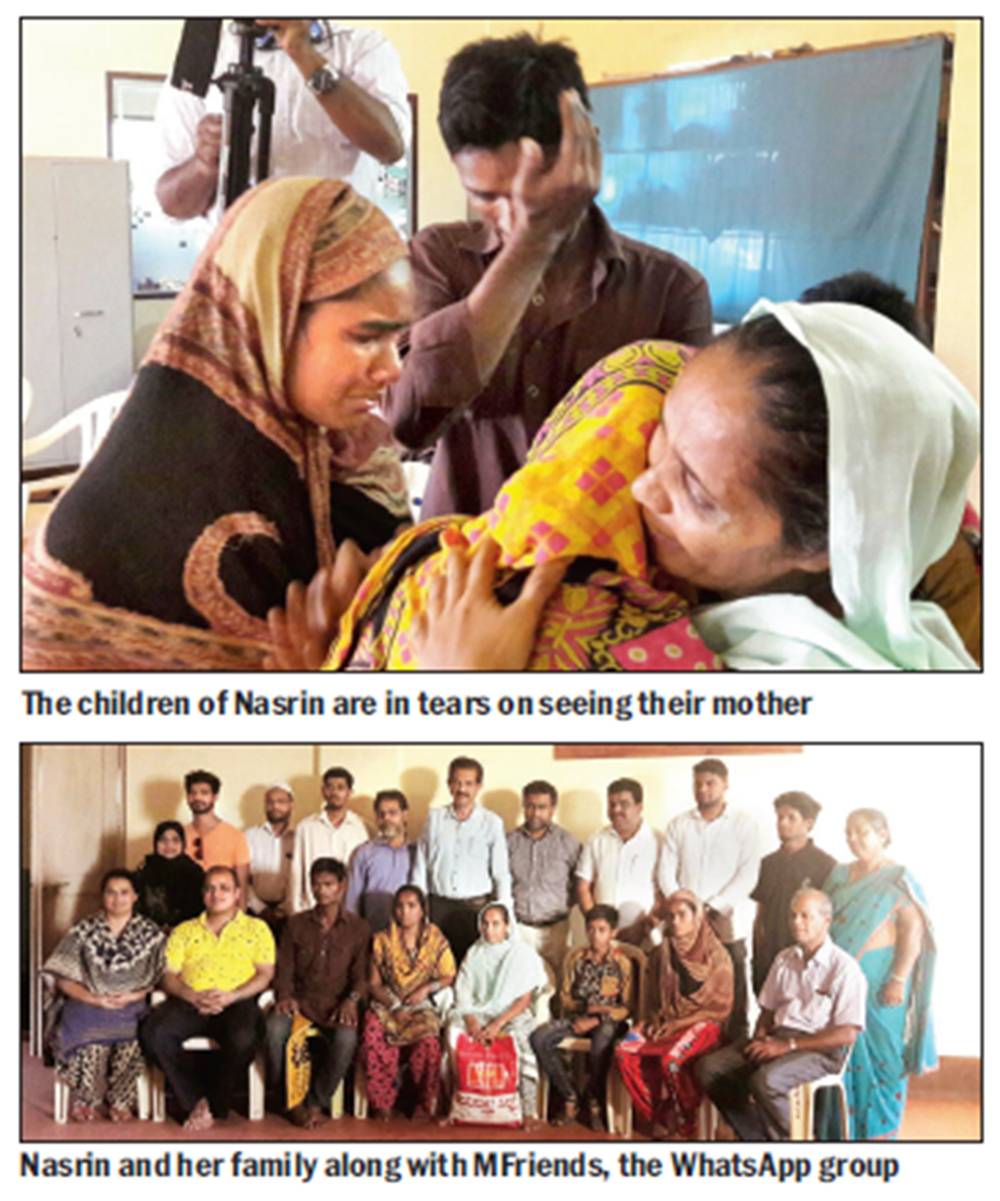
Within two days, Dilavar called Rasheed Vittal claiming that Nasrin was his mother. He told them that his family had made every attempt to search for her but to no avail. After uniting the family, Rasheed said, “It was a heart touching moment to see a mother unite with her family. They all had tears in their eyes.” Nasrin is widowed and four of her five daughters are married.
source: http://www.bangaloremirror.com / Bangalore Mirror / Home> News> State / by Deepthi Sanjiv, Bangalore Mirror Bureau / December 21st, 2016
Away from its cookie-cutter malls, Singapore’s Kampong Glam district is a different universe – a delightful cultural mix.
Melting pot: The streets of Kampong Glam
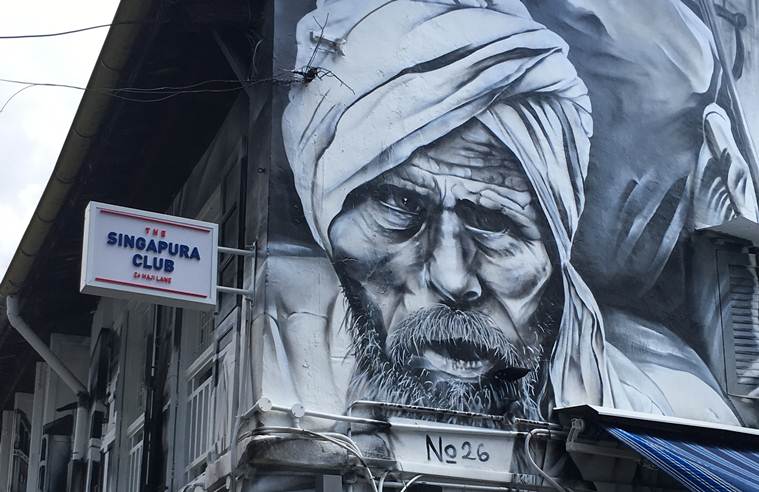
At Haji Lane, in Kampong Glam, one of Singapore’s most atmospheric districts, vibrant graffiti art — African tribal figures, surreal motifs, arresting visages — stares back at me. The psychedelic surfaces on the walls appear gilded in the afternoon sun. Embedded within the walls are colourful windows of pre-war shop houses that occasionally fling open to reveal the owner’s face. The picturesque lane is a photographer’s delight and I click a dozen photos a minute. Nobody seems to mind. People stand and talk in doorways of shops brimming with cult labels and vintage clothing. Hookah bars and cafes spill on to the sidewalk. This is a universe away from Singapore’s crowded, cookie-cutter malls.
“Haji Lane is named after the Haj, the pilgrimage undertaken by Muslims to Mecca and Medina,” says my guide Naseem Huseini, a second-generation Gujarati-Singaporean, as I move around, entranced by my new geography. “It provided accommodation for poor Malay families and lodging for pilgrims.” Today, reasonable rents and a prime location have turned the lane into a hub for upcoming designers and artists, the concept very similar to Delhi’s Hauz Khas Village. I peer through the shops’ doorways and spot artists at work — sculpting, etching, painting and tailoring. The narrowness of the shops’ facades is beguiling though. For as I peep in, I find them stretching way, way beyond. Naseem explains that the shops were built so because in the ’60s and ’70s, the government taxed property owners on the number of windows the houses had!
The graffiti-laden walls at Haji Lane
At the end of Haji Lane, we are swamped by the cheerful chaos of central Kampong Glam dominated by shops catering to the Malay/Muslim community: frame makers, tombstone carvers, textile wholesalers, spice traders, perfumers, Muslim food caterers, and retailers of gemstones, and religious paraphernalia. The Indonesian batik textiles and Muslim prayer carpet shops have been here for almost a century.
Kampong Glam, or KG, as it’s popularly called, is named after the gelam tree whose bark was used by the Orang Laut Malays (the indigenous sea nomads and gypsies of Singapore) to make awnings and sails. “The tree’s timber went into making boats or was used as firewood. Its fruit was ground and used as a spice and its leaves boiled to relieve rheumatism and cramps,” says Naseem.
History whispers from every corner of KG. And its streets have evocative monikers — Bussorah, Baghdad, Kandahar. Earlier, many of them were synonymous with specific trades. For instance, North Bridge Road housed tailors and Chinese-run goldsmith shops, Sultan Gate was dominated by stone masons and blacksmiths, while Bussorah Street hosted centres for pilgrimage services.
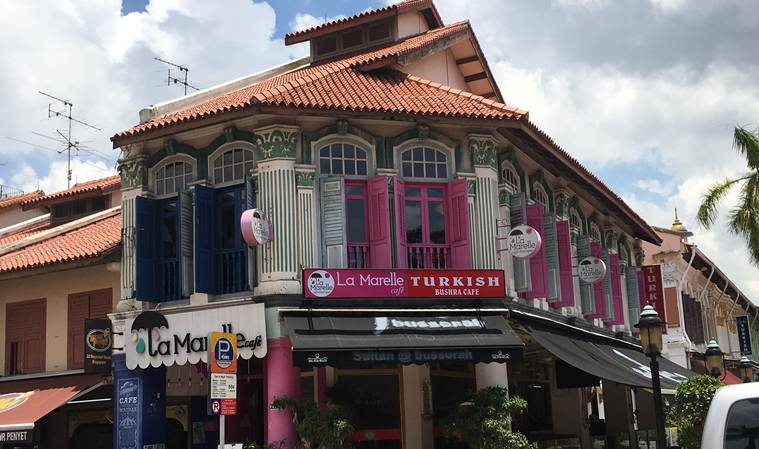
The exterior of Alaturka restaurant.
“In the early days,” elaborates Naseem, “KG was the exclusive preserve of Sultan Hussein and his family, and the rich Malay and Arab merchants. Later, the Bugis, Javanese and the Chinese also arrived. These people set up kampongs or villages, and built shop houses to expand their businesses.” The kampongs were row wooden houses with steep roofs of corrugated iron or thatch, gathered around a communal centre. Today, these structures stand demolished in the quest for modernisation.
While trying to negotiate KG’s uneven sidewalks, my eyes are constantly drawn to its architectural wonders. The Istana Kampong Glam, the Sultan’s palace, impresses with its exquisiteness. The golden dome and exquisite minarets of the Sultan Mosque — Singapore’s most important mosque and the pivot around which KG seems to flow — seem to scrape the sky.
KG’s street life unspools more engaging sights. We bump into Muslim men in lungis and white skull caps and abaya-clad women, who appear incongruous in Singapore’s landscape, where fashion-forward men in dapper suits and ladies in skyscraper-heels rule. In Bussorah Street, we’re engulfed by shops selling Indonesian batiks, leather bags, Persian carpets, kebaya dresses and handmade perfumes. A cluster of old stores in the shadow of Sultan Mosque sell traditional textiles, carpets and perfumes.
Partially to escape the catatonic heat, we stride into a cool, inviting wood-panelled shop chock-full of hundreds of glittering vials of custom-made perfumes. This is the iconic Jamal Kazura Aromatics, one of Singapore’s oldest perfumeries. A family-run business since 1933, the shop stocks readymade scents as well as fragrances customised from pure essential oils. There are massage oils, scented body soaps and shower creams too. The shop’s cut-glass perfume bottles are as intriguing as the scents. Kazura, the store owner, explains that his shop does double duty as his workshop. Like a modern-day alchemist, he creates scents from hundreds of ingredients sourced from around the world. We spot bits of sandalwood from India jostling for space with frankincense from Africa, myrrh from the Middle East, patchouli from Indonesia and lavender from France.
Kazura adds that when his grandfather, an Indian Muslim, arrived in Singapore in 1933, he started the business and expanded it later to Malaysia and India. “Blending perfumes is as much an art as a science,” he says. “Perfumers have to rigorously train their noses to distinguish between different scents. The provenance of perfumes is in ancient Egypt and Mesopotamia, and they still play a vital role in the Arab world. A good fragrance takes one closer to Allah,” he adds philosophically.
From Arab Street, we amble into Baghdad Street. “Would you like to try teh?” Naseem asks me, two hours into our walk. What’s that? I ask her. In response, the lady steers me to a hole-in-the-wall kiosk located at the junction of Bussorah and Baghdad Street. Here, an elderly white bearded gentleman is making tea at a stall ironically named “No Name Teh Sarabat” stall! Ahmed (65) has been selling Malaysian “pulled tea” for 40-odd years at this very spot and is quite a cult figure. His shop is abuzz with old Malay men sipping fragrant tea available in two flavours — teh tarik infused with rose essence and teh alia (ginger tea). The beverage is cheap. For a Singapore dollar and five cents, we’re soon cupping our hands around a mug full of a brew of black tea, milk and sugar. Ahmed explains that the technique of “tariking” (the process of ‘pulling’ tea from one cup to another) isn’t just a show, but actually makes the tea (teh) taste more delicious.
Food is an omnipresent motif in KG. Hip gelaterias, bistros and cafes pepper its warren landscape. Street after street resonates with the bustle of chairs and conversation, and the clatter of plates and glasses. Iranian, Lebanese, Turkish, Middle-eastern, Indonesian, Thai and Chinese, the repertoire is eclectic. There’s nasi padang (steamed rice served with various dishes) and Malay kuih (cakes), Middle Eastern falafels, sushi/sashimi, Lebanese meats and even quesadillas. At Alaturka, an award-winning Turkish restaurant, our taste buds are tantalised by succulent kebabs, soft pita bread and piquant dips glistening with unctuous olive oil. There’s mint-cinnamon tea to wash it all down with. As I stride out of KG, I feel I’ve learnt a thing or two about Singapore’s rich cultural heritage as well as the vital message it delivers — that plurality and diversity can thrive only in the soil of tolerance and inclusiveness.
source: http://www.indianexpress.com / The Indian Express / Home> Lifestyle> Destinations of the Week / by Neeta Lal / December 18th, 2016
An Indian philanthropist from Oman has given Rs 10 lakh to a jobless compatriot who has been living on the terrace of a building in the UAE for more than eight months without proper food, media report said on Friday.
Sajeev Rajan, an electrician in his early forties, belongs to Kollam in Kerala where his wife, two children and ageing parents live.
Indian philanthropist from Kerala Dr K T Mohammed Rabeeh Rabeeullah, chairman and managing director of a healthcare conglomerate, came from Muscat and handed over 5,000 dirham (Rs 93,272) to Rajan for immediate relief. He also promised to transfer Rs 10 lakh to his bank account in India, Khaleej Times quoted Rajan’s friend Biju as saying.
He was left with no other option but to live on the terrace of a building in Ajman city because his employer had refused to return his passport after settling his dues, the paper said.
His company officials visited the Indian consulate and agreed to return his passport at the earliest.
The Indian mission in the UAE and social workers have come forward with moral and material support for the man.
“It is a big relief for me because my pocket is empty. I have not received any money for the past eight months and my travel back home seemed impossible,” Rajan said.
He spent 236 days on the terrace because he does not have a job or money to get a bed space, the report said.
He has been surviving with the generosity of some construction workers and shop owners, it said.
“My contract ended on March 11 and I wanted to go home. Working for 900 dirham (Rs 16,761) per month did not meet my expectations,” he said.
Ranjan alleged that his employer was not ready to relieve him from work and send him back home after clearing his gratuity and leave salary.
On March 21, Ranjan was forced to vacate the company accommodation in Ajman.
“The employer from Punjab, India, promises to return my passport in front of officials who mediate for my release, but once he leaves their office, he refuses to hand it over to me,” he was quoted as saying by the paper.
After his plight was highlighted by the paper, several people came forward with offers to buy air tickets, give him a job among others, the report added.
source: http://www.timesofindia.indiatimes.com / The Times of India / News> NRI> Middle East News / by PTI / November 25th, 2016
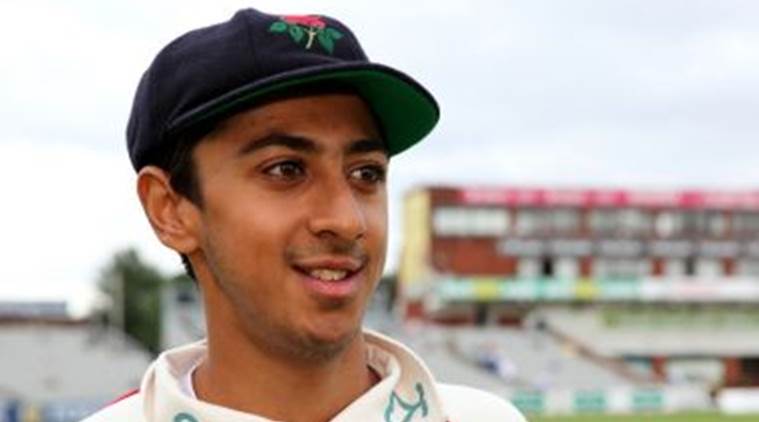
Haseeb Hameed, cricket of Indian origin, made his debut for England against India at the age of 19.
Touted as the most promising batsman teenager around, Haseeb Hameed made his U-19 debut at the age of 17.
Ismail Hameed had an unusual hero, while growing up as a cricket-obsessed youngster in Gujarat in the mid 70s. It was the usual Kapil Dev or Sunil Gavaskar. Or Kris Srikkanth or Dilip Vengsarkar. It was that stodgy English technician, Geoffrey Boycott, who by then was treading the sunset of his career.
In the late 80s, he shifted to Bolton for a better livelihood. He might have been busy yarning a better livelihood in a textile factory, though he still squeezed in time to represent semi-professional leagues in his locality. And when he expanded his household, he dusted up that old fixation for Boycott.
He bought old video tapes of Boycott and religiously showed them to his three sons, Safwaan, Numan and Haseeb. He would then make them “bat like Boycott” for hours on end in the neighbouring park. Soon, Ismail gave up his job in the factory and became a driving instructor so that he could spend more time drilling the technique of Boycott into his sons. The third son, though, showed more inclination to bowling and he would join his brothers and father in the park after school.
To his credit, Ismail straightaway made them bat and bowl with the leather ball. So the boys shed the fear of the leather ball at a young age. The older boys were in the Lancashire U-15 team as pure batsmen. But Haseeb’s first love was always leg-spin bowling, and it was as a leggie who could bat that he was picked for the Lancashire U-15 team, when he was just eight.
Maybe Haseeb was such a naturally talented batsman that his batting potential couldn’t be obscured for long. During a club game, he made an unbeaten 19 for his club Tong CC, which wowed the coach and senior players in the side. In a couple of seasons, he showed such precocious potential that he was opening the innings for his club and Lanchasire. His narrative was just beginning to unfold.
Hours of watching Boycott’s footages and twice as many hours of technical finetuning under his father’s gaze—his father is still his coach and mentor—helped him evolve into a fine batsman with a composure and belief that belied his age. The conditions back home too helped develop a compact technique. “The nature of the pitches, typical league cricket up north where it rains a lot; it’s slow and low, helped me. You’ve got to be careful driving on the up and the like. I had to wait for the ball and not leave my bubble, be patient. It’s always been that way for me,” he told The Guardian in an interview early this year.
Touted as the most promising batsman teenager around, he made his U-19 debut at the age of 17, and soon he was touring Australia for an U-19 Test series. In the first innings in Perth, he made a duck, but in the second he epitomised all the virtues his father’s idol had embodied in his career. Trailing by 300-odd runs, he engineered a resillient reardguard operation, soaking up 256 balls for an unbeaten, eventually match-saving 91.The effort earned him the moniker “Lancashire Wall”. That was only a preface.
Soon, he was blooded into the Lancashire first team. Last August, he was handed out his debut, against Glamorgan. He composed 28 off 119 balls in difficult conditions. However, for all his crease-occupation, a century eluded him, until his 11th match, against Warwickshire when he scored a crabby 103 off 295 balls, spending six-and-a-half hours at the crease against a rounded attack comprising former England bowler Samit Patel and Boyd Rankin.
More centuries flowed from his bat. He then became the first Lancashire batsman to score back-to-back hundreds against Yorkshire, showing again his fondness for occupying the crease. He batted for five hours for 114 in the first innings before reeling off, to show his other side of batsmanship, with a brisk 100 off 124 balls, against a bowling firm that featured Tim Bresnan, Ryan Sidebottom and Adil Rashid.
The knock fetched him instant applause from present and former players was a match-saving 122, occupying the crease for more than six hours, in the second dig against Nottinghamshire, whose bowling unit featured Stuart Broad and Imran Tahir. Thus in 31 innings, he racked up 1411 runs at an average of 50.39. And per innings, he consumes an average of 117 balls.
Among those wowed by his batting is former English skipper and opener Mike Atherton, who has dubbed his batting “Atherton-like”. Former Lancashire colleague and South Africa batsman Ashwell Prince says “he’s born to bat”. In the county circuit, he is called “Bolton Blocker” and “Bolton Boycott”.
If he makes his England debut against Bangladesh or later against India, he will be the youngest English debutant since Ben Hollioke and only the second teenager to play for England in the last 67 years.
While his father wants his son to keep producing Boycott-like knocks, Haseeb has bigger ambitions. “I want to emulate guys Kohli, Root, Williamson, players who play very organised cricket across the three formats extremely well. If you’ve got the basics and you’re strong in your basics, then you can develop your game very quickly. You just need to watch Kohli, the way he manipulates gaps so well and times the ball. I’m confident that down the line I’ll be able to do that as well.”
source: http://www.indianexpress.com / Indian Express / Home> Express Sports / by Sandeep G / November 09th, 2016
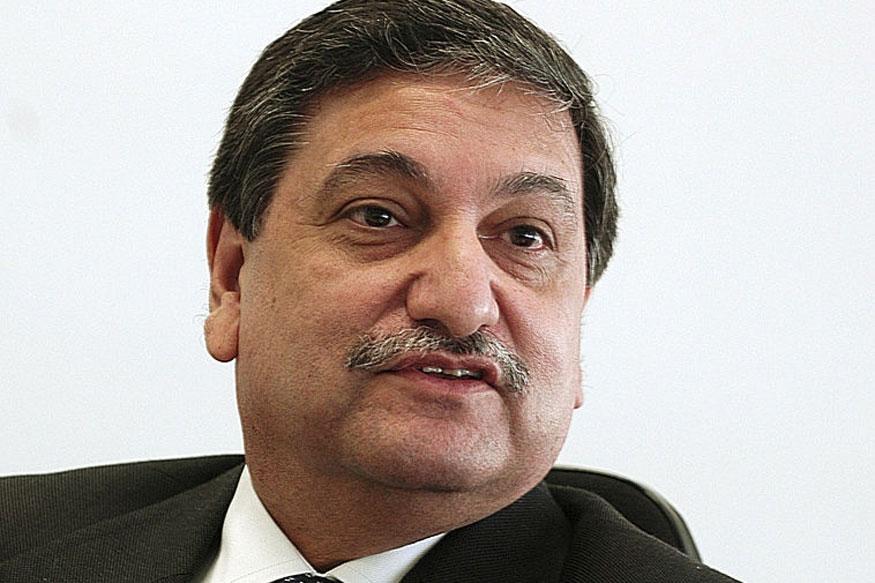
File image of Ishaat Hussain. (Photo Credit: Getty Images)
Tata Sons on Thursday appointed Ishaat Hussain as Chairman of Board Of Directors after Cyrus Mistry was ousted as the holding company’s Chairman.
Here are the 10 facts about Ishaat Hussain
* Born on September 2, 1947, Ishaat Hussain completed his schooling from The Doon School in 1963 and joined St. Stephens College Delhi to pursue graduation in Economics.
* Hussain, a chartered accountant from England and Wales, also attended the Advanced Management Program at the Harvard Business School.
* He is associated with the Tata Group since 1983 after Indian Tube was merged with Tata Steel.
* In November 2006, Hussain was appointed a Public Interest Director of Bombay Stock Exchange Limited.
* In January 2008, he was appointed a Trustee on the board of India Foundation for the Arts (IFA).
* Hussain joined the Board of Tata Sons as an Executive Director on July 1, 1999.
* He took over as Finance Director of Tata Sons Ltd. in 2000
* Prior to joining Tata Sons, Hussain has worked as the senior vice-president and executive director – finance in Tata Steel for almost 10 years.
* Besides being on the board of Tata Sons Limited, Hussain is Chairman of Voltas Limited and Tata Sky Limited.
* He is also on the boards of several Tata Companies such as Tata Steel, Tata Industries, Tata Teleservices, Titan Industries Limited.
source: http://www.news18.com / News18.com / Home> News18> Business / November 10th, 2016