An Indian-origin shopkeeper based in South Africa became an overnight sensation after the new deputy chief justice recalled his generosity over four decades ago when he was looking for a loan to fund his studies.
TWITTER
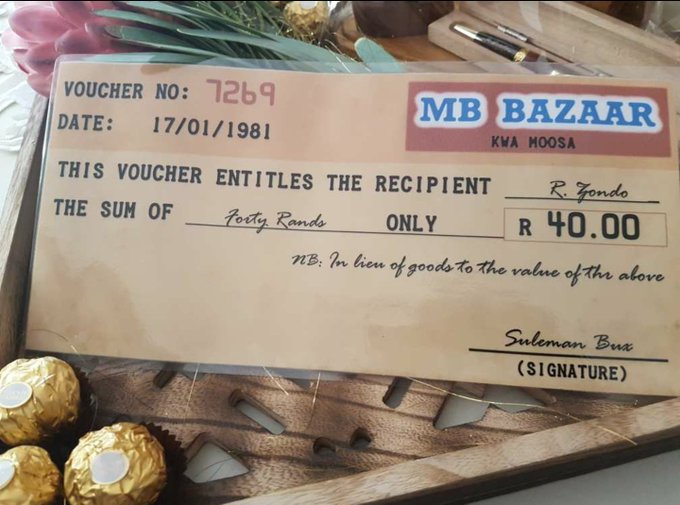
Suleman Bux, 76, who at that time ran a small general store in Ixopo town, had forgotten about the young man with whom he had struck a deal to be a good student by giving him groceries for his family so that they could save what they would have spent on this for his studies.
Judge Raymond Zondo, 57, who has been recently appointed as the Deputy Chief Justice of the Constitutional Court, recalled how he had sceptically approached Bux when he started his studies in 1981, unsure of whether he or anyone else would give a loan to a 20-year-old man.
Zondo approached Bux, without telling his family and helped him with groceries for his family.
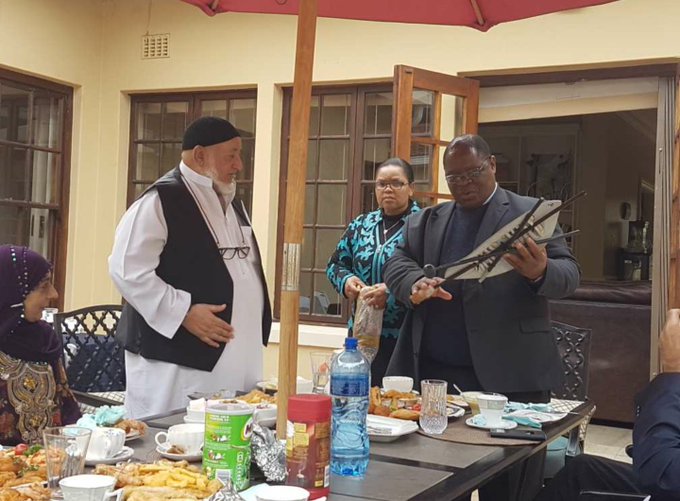
Reunion after over 30 years, Judge Raymond Zondo & Suleman Bux Absolutely love this..Faith In Humanity Restored@KhayaZondo73 – #Peace
Zondo’s emotional video at his installation to the second highest judicial post in the country recently went viral as he recalled Bux’s influence on his life, expressing a desire to meet him again after the fasting month of Ramadan was over.
Zondo met with Bux and his extended family to thank him personally. Bux shrugged off the huge media attention.
“He gave me a very nice watch, which was very generous. I was moved by the gesture,” Bux told local media, adding that he had not expected the issue to have received as much attention as it did.
After he began earning, Zondo tried to repay Bux but the shopkeeper, who is still running a wholesale store, told Zondo to rather finance some other young students.
“I helped him because it was the right thing to do. As a Muslim, helping others is important, but you do it because you want to, not because you want recognition and for everyone to know,” Bux added.
source: http://www.indiatimes.com / Indiatimes.com / Home> News> India / IndiaTimes / July 11th, 2017
Born into a family of ‘coolie Indians’, Ranjith Kally was important in documenting the role of Indians in the anti-apartheid movement
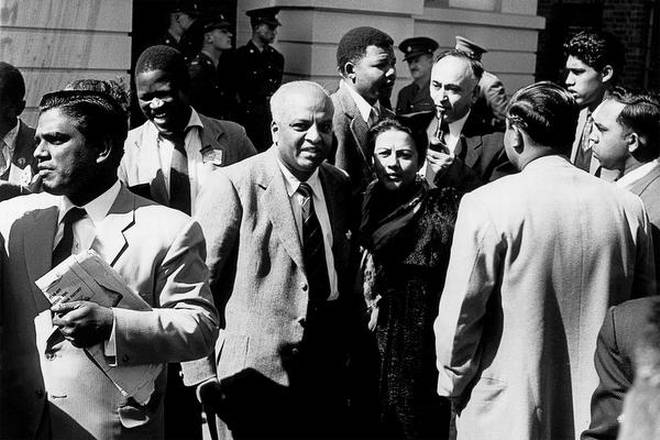
Monty Naicker, Nelson Mandela, and Yusuf Dadoo at the Treason Trial, Pretoria, 1958.
For most Indians with some awareness of the history of South Africa, India’s connection with the country begins and ends with Mohandas Karamchand Gandhi. As Nelson Mandela famously put it, India sent Mohandas to South Africa and received a ‘Mahatma’.
If the province of Natal was one of several places around the globe where the epic of Indian indentured labour was writ large, South Africa was nearly distinct as the site of an unusual and inspiring solidarity between black people and Indians in the equally epic struggle against racial oppression. Photojournalist Ranjith Kally, who died at the age of 91 in Johannesburg this June, was the great chronicler of both Indian life in Natal and the resistance to apartheid.
Kally was born near Durban in 1925 into a family of ‘coolie Indians’. His grandfather worked on a sugar plantation; his father, likewise, left for the fields early every morning. As was common in his generation, Kally was educated only up to Class VI. He worked in a shoe factory for 15 years and stumbled upon a Kodak Postcard camera at a rummage sale. In 1956, Kally procured a job as a photographer with Drum, a magazine that had been launched to give expression to the lives of black and coloured people.
Chronicling a struggle
Kally’s first photographs of anti-apartheid figures would be taken in the late 1950s. One of his favourite subjects was Monty Naicker, an Indian who trained as a doctor before turning to political activism. At a break during Pretoria’s Treason Trial in 1958, Kally captured Naicker with a young Mandela and the venerable communist leader Yusuf Dadoo in the background. Kally’s many photographs of Fatima Meer, another titanic figure in the anti-apartheid struggle, furnish insights both into how women assumed political roles in the public sphere and the little-discussed role of South African Indian Muslims in shaping secular narratives of freedom.
In one photograph, taken in the early 60s, Kally seated Meer’s daughters, Shamin, Shehnaaz and Rashid, around their buoyant-looking mother in Durban’s Botanical Gardens. The photograph was intended for Ismail, Meer’s husband, who was then indetention, as a keepsake of his family. There is no hint here of anxiety, fear, or the oppressiveness of racial terror. But Meer was also godmother to Nelson and Winnie Mandela’s children, giving them a home and hope at a time of despair.
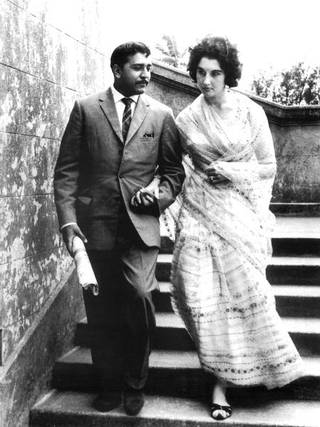
Kally knew better than most that the story of the anti-apartheid struggle was not only one, or even mainly, of ‘great’ figures. In a rigidly racist society, the occasions for transgression were many and the outcome generally was painful for those animated by the desire for equality and social justice. The anti-miscegenation laws were severe, but, as one of Kally’s most stunning photographs shows, this did not prevent Syrub Singh and the dazzling Rose Bloom (seen emerging from a court hearing) from joining hands in matrimony.
Courting the everyday
What is striking in Kally’s large and still largely unknown body of work is his attentiveness to the quotidian life of Indians in and around Durban. Close to half a century after the end of the indentured system, the greater majority of Indians still lived below the bread line. In one photograph, an Indian woman scrubs dishes outside a group of shacks; a very young girl, clutching a toddler, stands by her side. Kally closely observed young Indian boys and girls working in the cane fields.
His 1957 photograph, ‘Children Gotta Work’, is illustrative of not only Kally’s approach to the grittiness of Indian life in Natal but of the self-reflexivity in much of his work. Four Indian children, some unmistakably teenagers, are on their way to work in the fields. Shovels are flung across their shoulders; two of them firmly grasp lunch boxes in their hands. They walk barefooted in the morning light. The photograph resonates with pictures of Partition, but there are also shades of the historic march of Indian miners from Natal to the Transvaal in 1913. Workers on the move, the daily walk, the look of determination: all this is part of the ensemble.
I didn’t know Kally well enough to say whether he was a man of sunny optimism, but his photographs nevertheless suggest an eye for the whimsical and a zest for life. The whimsical touch is nowhere better captured than in his photograph of a boy with a large tortoise on his head.
The wide grin on the boy’s face reveals the unmistakable fun he is having in ferrying his slow-moving companion. The boldest expression of this element of joie de vivre in Kally’s work is a photograph called ‘The Big Bump’. Two men, both amply endowed at the waist, are rubbing against each other. Each man seems to be saying, ‘My tummy is larger than yours, and all the better for it.’ Kally’s camera paves the way for understanding the extraordinariness of the ordinary.
That is not an inconsiderable gift.
Professor of History at UCLA, the author has the distinction of being listed among the 101 Most Dangerous Professors in America.
source: http://www.thehindu.com / The Hindu / Home> Society> Spotlight – History & Culture / by Vinay Lal / July 08th, 2017
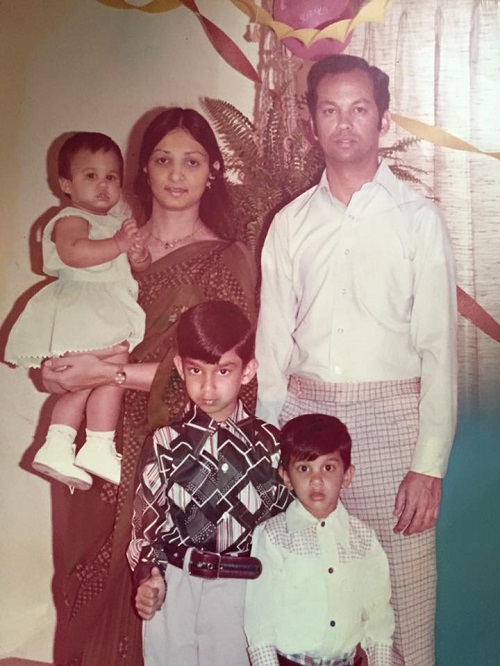
The author, his wife and three children circa late 1970s in North Dakota.
This is Day 22 of the 2017 #30Days30Writers Ramadan series – June 17, 2017
by Syed Husain
It was in the summer of 1976, following my post-doctoral assignment at Stanford Research Institute in California, I was offered a faculty position at University of North Dakota, School of Medicine. Although it was a tempting offer, leaving San Francisco and moving to Grand Forks with three small children was a difficult thing to consider.
Recalling the Persian proverb, “Mulk-e-Khuda Tang Neest, Pa-e-mera Lung Neest” (The Kingdom of God has no limits and no broken legs do I have to limit my travel), I decided to accept this offer – though I knew a Muslim community to draw on for support in North Dakota would be virtually nil.
A leap of faith indeed, but as a Muslim, I had a firm belief in my Creator and my destiny.
As we started our journey across the country, it was full of amusement and excitement. We only had ourselves to rely on – myself, my wife, and my three children, ages seven, four and one. The passage through Yosemite with tall redwoods, the majestic Grand Tetons, the enchanting Yellowstone National Park, the amazing Mount Rushmore and the Badlands was an experience to behold.
Finally, we arrived in the small college town of Grand Forks. And, we found the people of this land of Aurora Borealis, sun-dogs, snow and tumble-weed to be friendly, hospitable and compassionate.
After settling in the faculty housing, my priority was to find out how many Muslims, including students, were on campus. As the Ramadan was approaching, I wondered if they had facilities to pray and observe Ramadan. Surprisingly, I found only one another Muslim faculty and a handful of students with no place to worship. Later, I located four more families in a radius of fifty miles from Grand Forks that became the “core group” of Muslims in the area.
In this isolation, as Ramadan arrived, we made frantic calls to Chicago, Montreal, Minneapolis and Winnipeg to confirm the sighting of the moon. To determine the duration of fast and follow the fiqh ruling, we decided to follow the times in Winnipeg, the closest city with a sizable Muslim population. Those were long days — we were fasting for 19 hours a day with the sun setting around 9:45 p.m.
The University had appointed me as Muslim Faculty Adviser, and I was able to get space in the student union for our Jummah prayers and iftars. This small community had no provision for halal meat and no place to buy spices and other ingredients to prepare our food. A good Samaritan in the community located a farmer, who helped us sacrifice a heifer or a black angus.
This farmer became the source our halal meat supply for the rest of our stay (15 years) in North Dakota. Families would share the meat and drive to Winnipeg or as far as Chicago to get condiments and other supplies. The spouses in this small core group got together and started preparing meals, iftar and sahoor for their families and for students as well on weekends. We began to feel the baraka (blessings) of Ramadan in this newly formed community.
Fasting was difficult, but we managed and grew closer as a family (and as a married couple) in doing so. When we finally made it to iftar time around 9:45 p.m. and broke our fast, my wife and I (we were the only ones fasting in our family in the ‘70s) were grateful. Our children would beg us to take them to McDonald’s for ice cream after we prayed Maghreb and ate dinner, around 10:30 p.m. at night, but it was hard to get the energy to do so.
The nights we rallied and took them were very special to all of us – small treats that meant so much to our children and to us.
The summer season in North Dakota is short, sweet and very precious. It was amazing to see farmers busy harvesting crops under floodlights into the wee hours of the night. Our neighborhood on the outskirts of Grand Forks bordered a large farming field. The rumbling noise of trucks hauling beetroot and sunflower seeds were a reminder to us to get up for our sahoor.
I recalled my childhood days back in Hyderabad, India, when at sahoor time hawkers pass through Muslim neighborhoods singing local folklore, breaking the quiet of the night as these trucks did and reminding the community that sahoor time was soon to end.
Our children (and the daughter of one other Muslim family in town) were the only Muslim students in their schools. The school authorities were kind, compassionate and understanding. They were cognizant of the Islamic principles and provided our children with a private bathing facility and a place to worship. This was back in the 1980s in an educational community that probably had never seen or interacted with Muslim kids before.
Alhamdulillah, this conducive, inclusive and inter-faith understanding of the teachers and the school district authorities nurtured a healthy, positive civic atmosphere and a sense of belonging for our children. Our children use to wait eagerly for the arrival of Ramadan and for the celebration of two Eids.
These occasions were a real source of joy to these few host Muslim families and their children and to the small group of students. We celebrated Eids in a church, in an International Students’ Home on campus and in our homes.
This was our Little Mosque on the Prairie much before the celebrated television show.
This was our forging of an American-Muslim experience in a community that sometimes didn’t understand us, but developed friendships and deep relationships with us based on love, kindness and mutual respect.
In our sojourn of 15 years (1976-1991) in North Dakota, we also saw swings in the population of Muslim students and in the community due to graduations, termination of University of North Dakota’s Pilot Training programs with Gulf Airlines and Saudi Arabian Airlines and faculty transfers/retirements. In recent years, the economy of North Dakota has improved greatly due to oil exploration in Williston Basin.
The city of Fargo (one of the largest cities in North Dakota, about an hour away from Grand Forks) has seen a sizeable number of Muslim immigrants arriving. The city of Grand Forks also has its share and has seen a surge in new arrivals. We wish them all a Happy Ramadan and Eid Mubarak.
Syed Husain, Ph.D. is a retired professor of Pharmacology at the School of Medicine, University of North Dakota and a retired Scientific Review Administrator at the National Institutes of Health in Bethesda, MD. He now has eight grandchildren forging their own American-Muslim experience.
source: http://www.patheos.com / Patheos / Home> altmuslim / by Syed Asif, Guest Contributor / June 17th, 2017
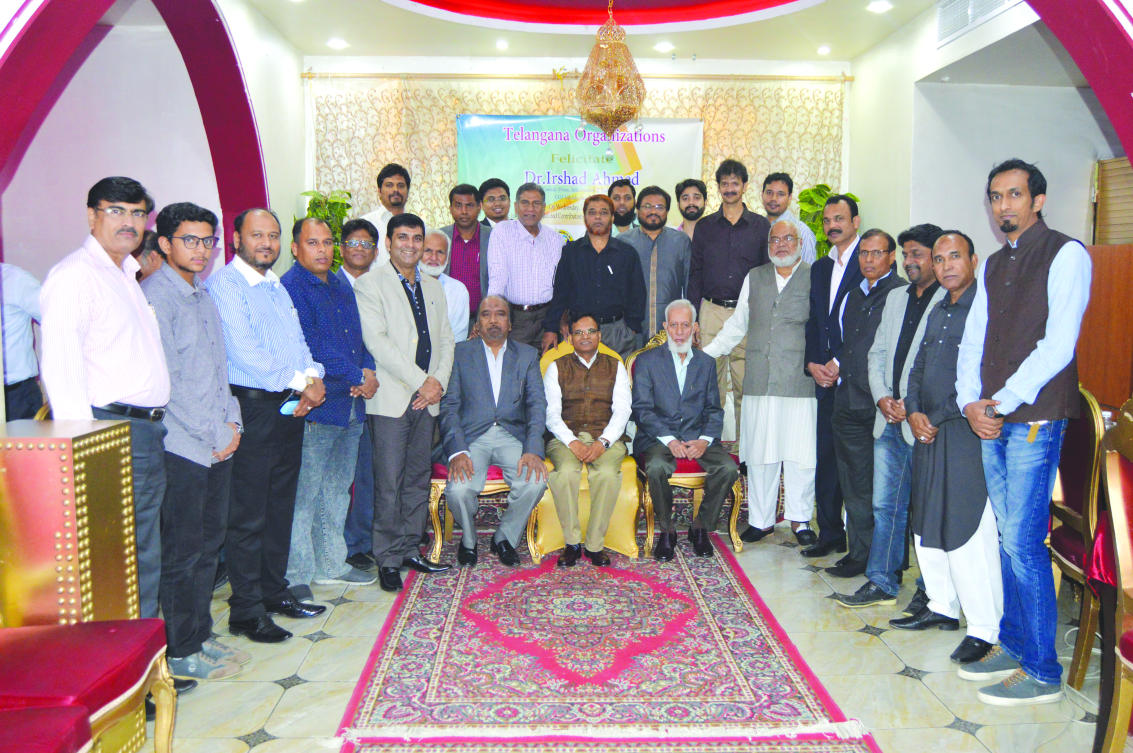
Dr.Irshad Ahmed (seated centre) with leading members of the Indian community in Jeddah at the farewell event
JEDDAH:
An evening to bid farewell to Dr. Irshad Ahmed, consul for press, information and culture, on completing his four-year term at the Consulate General of India in Jeddah was held recently.
It was organized by Jeddah-based community welfare organizations from Telangana, including Khak-e-Taiba Trust, Urdu Academy, Deccan NRIs, Noor Education Society, Pain & Palliative Care Trust and Telangana Welfare Foundation.
Ahmed thanked the Telangana organizations for holding the event in his honor. He spoke about his memorable experiences in the Kingdom and applauded the hospitality of the Hyderabadi community residing in Jeddah.
“People living in this holy land are very blessed and very proactive when it comes to community welfare,” he said, adding he will miss the Indian community.
Ahmed said he enjoyed his stay in Jeddah and felt very fortunate to be able to help the expats residing here.
The evening commenced with the recitation of the Holy Qur’an by Hafiz Noor, followed by a heart touching naat by Khalid Hussain.
Mirza Qudrath Nawaz Baig, along with senior community members, welcomed Chief Guest Ahmed and lauded the brotherly hand he had extended toward overseas Indians.
The presidents and vice presidents of the Telangana organizations praised Ahmed for his dedication to the Indian community and in organizing various events; specifically pointing out the large-scale mushaira held at the Consulate of India and promotion of the Urdu language in a foreign land.
Ahmed was presented with a plaque of appreciation. Members of the Telangana organizations said they would not say goodbye to Ahmed but would rather say “see you soon.” They said they are looking forward to seeing Ahmed soon in Jeddah on a new assignment.
One of the key hosts of the event, Imran Kausar, gave the audience an overview of the consul and his achievements.
He started his career as an Arabic lecturer in Jamia Millia Islamia in 1995; he later joined the Ministry of External Affairs, Government of India in 2001. His first foreign posting was at the Embassy of Riyadh as third secretary (Information and Culture from 2003 to 2005; then he was transferred to Consulate General of India, Jeddah as consul (Education and Culture) from 2005 to 2008.
He then worked as undersecretary (Gulf) from 2008 to 2012 and was then posted to the Consulate General of India, Jeddah again where he continued his posting as consul (Press, Information & Culture) from 2012.
He will continue his new assignment at the Ministry of External Affairs (headquarters) in New Delhi, India.
Leading members of the community at the event included Shameem Kausar, Siadat Ali Khan, Hasan Bayazeed, Jamal Qadri, Abdul Razzak, Abdul Wahab, Asimuddin Ansari, Aslam Afghani, Asif Daudi, Tahir Ali, Noorul Amin, Majid Saleem, Munawar Khan, Mazharullah Jibran, Sheikh Ibrahim, Rashid Razzak, Saleem Farooqui, Mahmood Misri, Ghazanfar Zaki, Mir Arif Ali, Abdul Rafay and Liaqat Ali Khan.
source: http://www.arabnews.com / Arab News / Home> Saudi Arabia / Wednesday – April 26th, 2017
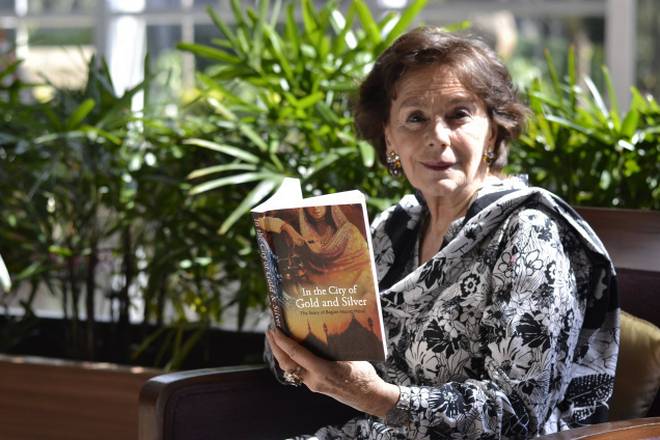
Kenize Mourad, author of ‘In the city of gold and silver – the story of Begum Hazrat Mahal’. Photo: Sangeetha Devi Dundoo
Hyderabad :
In the story of Begum Hazrat Mahal, Kenize Mourad found a story that belied misplaced notions of Muslim women of yore
Kenize Mourad, while researching for her book ‘In the City of Gold and Silver’, came across references to Begum Hazrat Mahal in documents written by the British. They referred to her as the ‘soul of the 1857 War of Independence’. “It is unfortunate and unfair that she has been forgotten in India,” says Kenize Mourad, in Hyderabad to launch her book ‘In The City of Gold and Silver – The Story of Begum Hazrat Mahal’ (Full Circle publications; Rs. 350).
Speaking to us in an interview, the author says, “Rani of Jhansi, Lakshmi Bai, is remembered because she died on the battlefield. She fought for about four or five months. Begum Hazrat Mahal fought the British for two years. It took the British nine months to gain control over Lucknow. The Begum continued her fight for a year after this.”
Kenize Mourad is of Turkish and Indian descent, Awadh to be precise. “I first visited Lucknow when I was 21 and heard about Begum Hazrat Mahal and her valour from my father (Raja Syed Sajid Husain Ali of Kotwara). Years later, I remembered the story and felt the Begum’s story had to be told,” says Kenize.
The author pored over documents and books in libraries of London, New Delhi and Lucknow. “It took me three years to find enough information. In Lucknow, I spoke to families whose ancestors had fought in the battle along with the Begum. Quite a bit of historyin India follows an oral tradition,” explains Kenize.
She scouted libraries in London and came across six volumes of ‘Mutiny Papers’ documented by the British. An 1858 edition of The Times had stated ‘The Begum of Awadh shows greater strategic sense and courage than all her generals put together’. Kenize wanted to write about the Begum and dispel notions about Muslim women of yore. “The book is relevant in this time when Islam is misrepresented. The majority of Muslims, 95 to 98 per cent, is also being put in the same bracket as extremists, which is unfair. And these normal peopleare the first ones to suffer due to extremists,” says Kenize. “I wanted to show how a Muslim woman was strong enough to lead an army. The Begum was an intelligent woman who enforced justice and waived taxes on food for the poor,” says Kenize.
Kenize takes pride in raising her voice for underdogs all through her career as a journalist in France. “I’ve felt like a fighter for justice all my life. In my books, I have often written about the misrepresentation of the Quran,” says Kenize. History, she says, has intriguing accounts of women Muslim rulers. “There are instances of Turkish women holding important positions on their own right, not because they are mothers, sisters of wives of important men.”
Though Kenize was keen to present accurate historical facts in ‘In The City of Gold and Silver’, she took the liberty of weaving in a love story between the Begum and a dashing Hindu Raja. “I felt people will absorb an interesting historical novel than a dry book full of facts. Keeping the sociology of people in that era, I tried to recreate Awadh of those times,” says the author.
Kenize wrote the book in French. “In France, the book sold more than 70,000 copies. The pocket-friendly (abridged) version sold even more copies,” she says. The book has been translated in English by Anne Mathai and Marie-Louise Naville.
Talking about her roots in Lucknow, Kenize says, “During my first visit to Lucknow as a student, I was amused and spent six months there. Had it been a bigger city like Delhi or Mumbai, I might have stayed on. Opportunities for work were limited. And I wasn’t willing to sit at home and get ready to be married off,” she says. The topic of marriage reminds her of Hyderabad. “I was almost married off to a well-known Hyderabadi,” she says. “Through my cousin, Princess Niloufer, I happened to meet a gentleman from the Nizam’s family. He told Niloufer that he hoped for my hand in marriage. I found it odd that he hadn’t asked me directly. I was given to understand that I would be a ‘bird in a golden cage’. I turned down the proposal.”
This is Kenize’s first visit to Hyderabad. “I never visited this city thinking I may not be welcome here since I turned down the marriage proposal,” she laughs.
Next, Kenize wants to write about present-day Pakistan. “The country, as it exists today, is a tragedy. I want to write about Pakistan through fiction. It will take at least three to four years to work on the book,” she signs off.
source: http://www.thehindu.com / The Hindu / Home> Books / by Sangeetha Devi Dundoo / Hyderabad – January 17th, 2013
Gulf-based Lulu Group has committed 3 crore rupees to construct a school girls hostel in Jamia Millia Islamia.
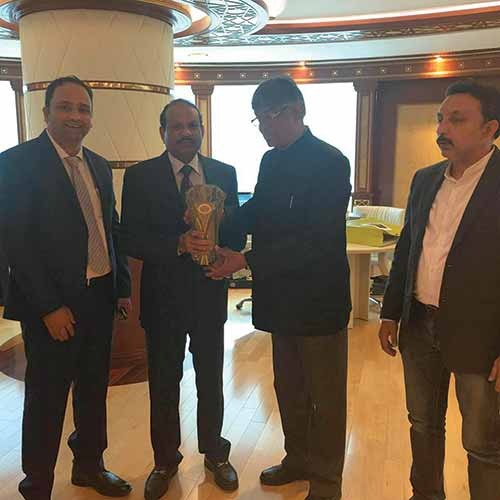
The commitment was made by the group chairman Yusuf Ali during JMI Vice Chancellor Prof. Talat Ahmad’s UAE visit as Chief Guest of an event organised on 2 February by the UAE chapter of the JMI alumni. During this event Lulu Group chairman announced this commitment.
Yusuf Ali (centre) with JMI VC, Dr Talat Ahmad (right)
I am also thankful to all my near and dear Jamia fraternity in UAE who actively participated with hand-in-hand for the overall program.
Effort and sincerity with the highest level of commitment of Alumni organzing members Syed Nadeem Zaidi, Nadeem Hassan, Imtiyaz Ahmad, Ahmad Khan, Kashif Zamman, Riyaz Ahmad Khan, Shah Shams Alam, Muslim Ghayur, Salahuddin Ansari, Abdul Khaliq, Shamim Ahmad, Jalal Ahmad, Amjad Iqbal Khan etc were at par excellence and hope to have similar energy and synergy in future too Insha Allah. (Parvez Akram Siddiqui)
source: http://www.milligazette.com / The Milli Gazette / Home> Special Reports / Print Issue: 16-29 February 16th – Online Aprl 04th, 2016
When Dr. Rubina Heptulla, a pediatric endocrinologist who was just awarded a $1.1 million grant to study a possible new use of a diabetes drug, isn’t doing research or treating patients, she can be found scuba diving off the coast of India or eating calamari at the Mamaroneck Diner.
The 46-year-old Rye resident leads the pediatric endocrinology program at the Children’s Hospital of Montefiore Medical Center in the Bronx. She was awarded a grant from the National Institutes of Health to figure out if the drug Januvia can help people with a less common form of diabetes.
The drug is now used for people with the most common form of diabetes, Type 2. Heptulla’s research is trying to determine if the medication can also help people with the more rare form of the disease, Type 1, control blood sugar levels after a meal. The once-a-day medication would be taken in addition to insulin by study participants to see if helps prevent blood sugar levels from rising.
Heptulla has had an interest in treating Type 1 diabetes – an autoimmune disease that can’t be prevented or cured – since childhood because her father had the disease. Unlike Type 2 diabetes, the illness is not related to diet or lifestyle and most often develops when a person is young.
The Westchester resident grew up in Mumbai and attended medical school there, completing her training in Rhode Island, Boston and at Yale. Heptulla was living in Houston with her husband, a geneticist, and their two children when she was recruited to lead the pediatric endocrinology program at Montefiore.
She is chief of the division of pediatric endocrinology and diabetes at the Children’s Hospital at Montefiore and Albert Einstein College of Medicine of Yeshiva University. She is also professor of pediatrics and medicine at Einstein.
As part of the job, she oversees six pediatric endocrinology and diabetes clinics that treat 200 patients each week, including one in Eastchester and one on Central Park Avenue in Yonkers.
When she’s not taking care of her young patients or doing research, Heptulla can be found at home engaging in one of her favorite pastimes, painting landscape portraits.
Ten things you didn’t know about Dr. Rubina Heptulla:
1.
She has a 17-year-old son and a 15-year-old daughter, both students at Rye Neck High School.
2.
Her favorite restaurant is the Mamaroneck Diner, where she often orders calamari – along with a salad.
3.
She manages to sneak away to her native India at least once a year, where she enjoys shopping for the latest in both contemporary and traditional clothing.
4.
Heptulla is a certified scuba diver and when she’s in India she likes to go to Lakshadweep, a series of islands off the southwestern coast known for its diving.
5.
When she was a child she wanted to be an artist.
6.
She still loves to paint and is now experimenting with acrylics. Her home overlooks the Marshlands Conservancy and she has set up an easel on a staircase landing that gives her a good view of the changing landscape.
7.
She belongs to a book club and not long ago hosted a talk at her home with author Rebecca Lewis about her novel “Jacob’s Folly.”
8.
Heptulla spends a lot of time at the Rye YMCA, where she takes classes in Zumba, yoga and swims.
9.
She likes Lady Gaga.
10.
Her favorite author is Bryce Courtenay. a South African-born Australian best known for his novel, “The Power of One.”
Twitter:
JaneLernerNY
Participants are needed for Dr. Heptulla’s research into the use of Januvia in people with Type 1 diabetes. To be eligible a person must:
Be between the ages of 13 and 30.
Have Type 1 diabetes.
Have no other medical condition except for hypothyroidism.
Emotions flooded former England skipper and commentator Nasser Hussain’s mind as he made his way to the pitch at the MA Chidambaram Stadium on Friday. Born in then-Madras in 1968, Hussain shares a special bond with the city – he spent the six years of his life in Chennai before moving to the UK.
Incredibly, in the mid-1980s, Hussain even scored a few hundreds at Chepauk as a TNCA league cricketer. “I’m very pleased to be back in the place of my birth. I think I was born in a hospital just over the other side of the stadium. Actually, I didn’t realise that. It was Ashwin who told me about that the other day when I saw him,” Hussain told TOI on Friday.
The 48-year-old was sad to see the devastating effects of Cyclone Vardah but lauded the people of Chennai for coming up with a “magnificent” rescue act.
“It’s obviously been difficult to see the devastating damage from the cyclone over the last couple of days. But the community spirit from the people of Chennai, the way they have been trying to clear up the trees on the road has been absolutely magnificent,” Hussain said.
An honourary member of the Madras Cricket Club (MCC), Hussain wants to soak in the atmosphere here over the next five days.
source: http://www.timesofindia.indiatimes.com / The Times of India / News> Sports News> Cricket News / by Bagwati Prasad / TNN / December 17th, 2016
Muslim women are flocking to a startup that promises them fashionable clothes that fit with their faith.
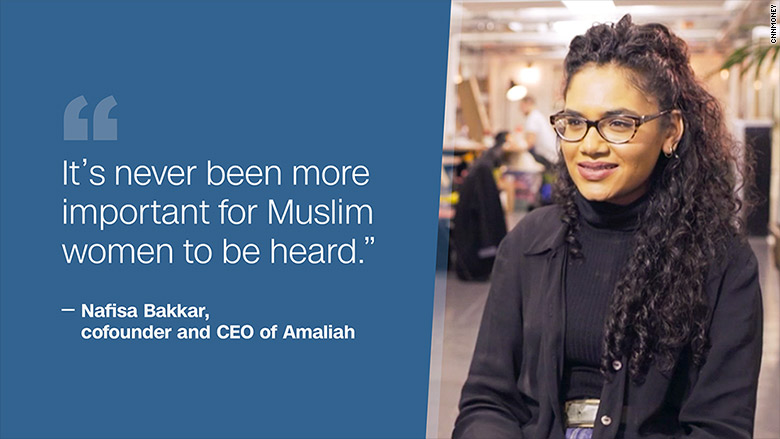
Nafisa Bakkar and her sister, Selina, launched Amaliah from their mother’s kitchen table in 2015 as an Instagram page to curate Muslim-friendly clothes from top brands.
Since then, that page has grown into an online community of more than 250,000 Muslim women.
The sisters grew up in the U.K., born to Indian immigrants from the eastern city of Kolkata.
Nafisa Bakkar told CNNMoney they grappled with multiple identities throughout their upbringing, but soon realized how big a role Islam played — and the challenges they faced as a result.
One of those was how to find clothes that were stylish but allowed them to adhere to their religion.
“Amaliah started as a personal frustration,” the 24-year-old said. “We realized that it was a big pain point for Muslim women to find clothes that were modest but also fashionable.”
That Instagram page has grown into a platform that allows Muslim women to share their perspectives, experiences and, of course, find the right clothes.The company’s website features a curated collection from leading stores such as H&M, ASOS and Zara, which customers can order directly online.
It also features blogs and articles with titles such as “My journey to being a part-time hijabi” and “Empowerment looks different to everyone.”
“I see Amaliah as a … tool for cultural change,” Nafisa Bakkar said. “I don’t really see us as just a clothing brand.”
The ultimate objective is gradually to change the perception of Islam in an increasingly polarized world.
“In today’s political turmoil… it’s never been more important for Muslim women to be heard,” the young CEO told CNNMoney. “What we’re seeing in the Islamic economy [is] a lot of start-ups rising out of frustrations, out of feeling that we’re not catered for.”
That market is growing, and big global brands are beginning to notice. Bakkar says fashion powerhouses such as Dolce & Gabbana and DKNY have started catering more to Muslim women over the past couple of years.
But there’s still a long way to go.
“In an ideal world, Amaliah wouldn’t exist,” Bakkar said. “It wouldn’t be difficult for a Muslim woman to find the right clothes that she doesn’t feel compromises her culture and values, it wouldn’t be difficult to hear the opinion of a Muslim woman in the mainstream news.”
CNNMoney (New Delhi)
source: http://www.money.cnn.com / CNN Tech / Home> India 20 under 40 / by Rishi Iyengar @Iyengarsh / CNNMoney (New Delhi) / March 17th, 2017

Absolutely love this..Faith In Humanity Restored
@KhayaZondo73 – #Peace