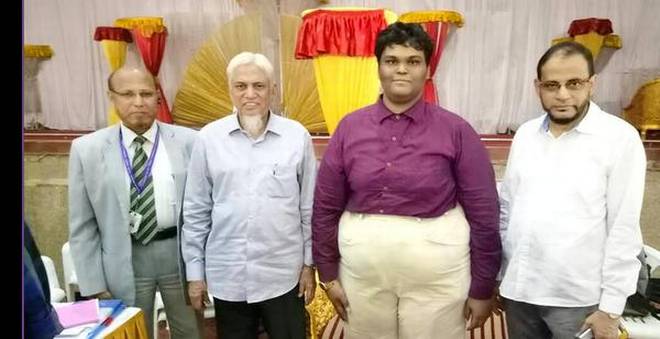
Sri 108 Munishree Pavanakeerthi Bhattaraka Muni Maharaj is seen conferring ‘Sri Mahaveera Ahimsa Award’ on noted Homoeopath Dr. Khader during the 2615th Janma Jayanti celebrations of 1008 Bhagawan Sri Mahaveera Theerthankara organised under the aegis of Sri Mahaveera Seva Samsthan at Sri M.L.Vardhamanaiah Smaraka Bhavan on Chadragupta Road last evening as Padmashree Jaina Mahila Samaja President Sheela Anantharaj, Sri Mahaveera Bhavan Construction Committee President M.A. Sudhirkumar, Sri Digambara Jain Samaj President S.N. Prakash Babu, M.L. Jain Boarding Home Secretary Madan Kumar, Sri Mahaveera Seva Samsthan Vice-President M.R. Sunil Kumar, Ajit and others look on.
Mysuru :
“Born as a human being, one should practice the habit of letting other living beings also live in peace,” said city’s noted Homoeopath Dr. Khader, who has been touring rural areas propagating the message of non-violence for the past 10 years after turning a vegetarian at the age of 15.
He was speaking after being conferred with ‘Sri Mahaveera Ahimsa Award by Sri 108 Munishree Pavanakeerthi Bhattaraka Muni Maharaj at a function organised by Sri Mahaveera Seva Samsthan as part of 2615th Jayanti Mahotsava of 1008 Bhagawan Sri Mahaveera Theerthankara at Sri M.L.Vardhamanaiah Smaraka Bhavan on Chadragupta Road in city last evening.
Regretting that 30 to 40 percent of those manufacturing biscuits and chocolates use fat extracted from animals, he added that consumption of bakery items also lead to sugar-related and respiratory ailments, which need to be curbed at once by using vegetarian products.
Former Mayor and Ekalavya Awardee (for Kho-Kho) N.Prakash was also felicitated on the occasion by the Seva Samsthan.
source: http://www.starofmysore.com / Star of Mysore / Home> General News / April 20th, 2016
The flow of scholarly work between the Mughals and Europe involved translation, re-translation, re-interpretation and development.
Christoph Clavius was born in Bamberg in either 1538 or 1537 (an amusing discrepancy for a scientist whose fame derives from his work on calendar reform) and was initiated into the Jesuit order by Saint Ignatius Loyola in Rome in 1555, and passed away in 1612, an eminent scholar.
Many of Clavius’ works were influenced by Latin translations of Arabic scientific works, including those of Ibn Rushd (in particular his commentary on Aristotle), the astronomers Abū Ma‘shar, al-Biṭrūjī and al-Farghānī, as well as the mathematician Thābit b. Qurra, among many other scientists writing in Arabic and Persian whose works Clavius cites.
Book 4 of Christoph Clavius, Gnomonices Libri Octo, published in Rome in 1581 (533.k.2, pp. 442-43).
Clavius is an excellent example of the many Jesuit scientists of his age who continued to teach Ptolemaic astronomy (i.e. a geocentric vision of the solar system, indeed the universe, in which the planets and stars orbited the earth in concentric circles), despite the rise of – and often despite their own familiarity with and endorsement of – Copernican astronomy.
Christoph Clavius’ Gnomonices Libri Octo, on the art of gnomonics (timekeeping through the use of a sundial), was published in 1581
Mu‘tamid Khān’s Arabic translation of the identical passage (IO Islamic 1308, ff. 289v-290).
Arabic version
This work also exists in a fascinating Arabic translation emanating from the Mughal empire that was purchased by Richard Johnson (1753-1807), a well-known collector of manuscripts and miniature paintings who worked for the East India Company.
Johnson made an annotation on the flyleaf of the manuscript that the translator of Clavius’ work was sent to Portugal by Aurangzeb – presumably to study or in some diplomatic capacity.
The full note reads, “Upon Dialling. Work of Clavius in Latin translated into Arabic by Maatemed Khan who went to Portugal in the time of Aurungzebe. This is the original foul copy of the translation in the hand of the translator (i.e., the ‘foul copy’ being the first draft, in contrast to the ‘fair copy’).”
Richard Johnson’s explanatory note (IO Islamic 1308).
A further note, in Arabic, added by the translator’s son, reads: “Draft of the Book of Measures [Kitāb al-Maqāyīs] which was composed by Clavius the Frank [Kalāwīūs al-Firinjī] in the Latin language, and my father, God have mercy on him, translated it into the [clear – mubīn?] Arabic language, possessor of virtuous talents including the perfection of acquired knowledge,
Rustam called Mu‘tamad Khān, the son of Qubād, gatherer of proofs of knowledge, perceiving the secrets of the spoken and the tacit, given the name Diyānat Khān al-Ḥārithī al-Badakhshī, may God be fair with both of them and elevate them.
Signed: I, who am a feeble slave begging for the mercy of the One and the intercession of the Prophet, Mīrzā Muḥammad, may God cause him to attain eternal happiness”.
Note by Muʻtamad Khān’s son (IO Islamic 1308, f.1v).
Complex process
This translation offers some fascinating possibilities.
The first is the demonstration of how knowledge circulated in the early modern world.
Clavius’ work, which responded to and was inspired by Arabic mathematicians and scientists in Latin translation, here a generation after its publication is translated back into Arabic to be read, presumably by elites at the court of Aurangzeb, where the work’s translator and his son were courtiers.
This translation demonstrates the complexity of knowledge flows – that they were synchronic as well as diachronic, and also involved a process not just of translation, but of re-translation, re-interpretation and development as they travelled.
Furthermore, the inscriptions taken in tandem, one in English made by an East India official, the other in Arabic by a Mughal courtier, open the possibility that already in Aurangzeb’s reign, Mughal elites travelled to Europe perhaps to study.
In the case of Mu‘tamid Khan, the translator of this text, he mastered the technical idiom of geometry and mathematics in Latin, and then translated it into an equally complex scholarly language, Arabic. Not an uncommon intellectual feat at the Mughal court, this process of scientific translation remains to be studied in depth.
It is also possible that the presence of the Jesuits at Goa had an influence on the production of this translation, but firm evidence remains to be found.
Builders’ Association of India (BAI), Mysuru, had organised an Inter-College quiz competition ‘YUKTI 2016, The Battle Of Brains…’ for the Civil Engineering and CTM students of various Engineering colleges of Mysuru, Mandya and Chamarajanagar districts.
The quiz was conducted by Shilpi, students’ wing of BAI, Mysuru, on Mar. 6 at MBCT premises, Mysuru. Five finalists were selected after the first round of written test among 18 teams.
There was a technical talk for the students on ‘Smart Cities – Spain Model’ by M.P. Manjunath Prasad, COO of Brigade Group, Benagaluru, on the same occasion. The technical talk also included short film on Building Technologies which ended with an interactive session.
After the Techtalk, the Quiz YUKTI 2016 continued for the finalists — NIE, MIT, SJCE (Civil), SJCE (CTM) and ATMECE.
An excellent Audio Visual final round was conducted by the Quiz Master S. Prakash, who is the Past Chairman of BAI, Mysuru and MD of Pramur Constructions.
MohammadZaidur Rehman and Bindushree of SJCE (Civil) emerged winners of YUKTI 2016. S. Supreeth and K.P. Meghana of ATMECE were declared Runners-Up.
A cash prize, mementoes and certificates, along with a trophy for the College, were given to both the teams. All the finalists were also given certificates.
BAI Mysuru Chairman M.S.Ramprasad, Hon. Sec. JVR Naidhruva, Shilpi Co-ordinators A.S Yoganarasimha and Ganapathy and others were present on the occasion.
source: http://www.starofmysore.com / Star of Mysore / Home> General News / March 15th, 2016
Neeraj Gupta, founder and CEO of Formulate IP presenting the scholarship award to Khwaja. Mohammed Kamal Khwaja, a final year B.Tech student of VIT University, was declared the first prize winner of the KTH Master’s Challenge 2016 in Wireless Systems track.
Khwaja to pursue studies at KTH Royal Institute of Technology, Stockholm
A final year B.Tech student of VIT University has been awarded a full scholarship to pursue master’s programme at KTH Royal Institute of Technology, Stockholm, Sweden. The scholarship came after he bagged the first prize at the KTH Master’s Challenge 2016 in Wireless Systems track.
As part of the challenge, Mohammed Kamal Khwaja, who is studying Electronics and Communication Engineering at VIT, went through a number of quizzes, essays and interviews. He was declared one of the top three students in India during December 2015. The positions of the top three prize winners were announced at a prize ceremony in Bengaluru, a press release said.
“The KTH Master’s Challenge is a nation-wide competition organised by KTH Royal Institute of Technology. The competition has multiple rounds to test various skills and knowledge of students,” he said.
He added that the first prize winner was offered a full scholarship of INR 23,00,000 to pursue the master’s programme at KTH along with an internship opportunity at FormulateIP.
Khwaja, who is currently pursuing his final year project at Singapore University of Technology and Design, said he was delighted to be declared the first prize winner, and as part of the prize, he has been awarded a two-year scholarship to pursue master’s studies at KTH.
The Wireless Systems programme, which is part of the Electrical and Electronic Engineering at KTH Royal Institute of Technology, Sweden, is ranked 16th in the world by the QS rankings 2015.
Khwaja has also been offered an internship to work at FormulateIP – an intellectual property, innovation management and consulting firm co-founded by a KTH alumni.
He has pursued research internships at Hong Kong and Singapore. Presently, he is pursuing his final year semester project at Singapore as part of the Semester Abroad Programme offered by VIT.
VIT Chancellor G. Viswanathan said their goal has always been to help students reach their full potential be it through academics or extra curricular activities, the release added.
source: http://www.thehindu.com / The Hindu / Home> National> Tamil Nadu / by Staff Reporter / Velllore – February 29th, 2016
City-based Legacy Custom Motorcycle has brought huge laurels to Belagavi by winning first prize for its superbike Immortale, in India Bike Week held recently at Goa. Immortale has been designed and built in Belagavi.
The motorcycle is conceptualized by Faizal Sait, the son of Belagavi (North) MLA Firoz Sait. MLA Sait unveiled the bike in Belagavi for public view on Thursday evening in a small programme. Motorcycle has won appreciation and prize for its design in Bike Build Off segment.
Around 30 bike builders from across the India had submitted applications to showcase their bike design in which five designs were adjudged as Best Bike Design of the year. Legacy Custom Motorcycle lifted the trophy by winning among the shortlisted five designs. Before it, the bike had gone into two days of toughest test monitored by Hyderabad-based top biker Reza Hussain, machine expert Anand Belerao, Pune based Auto car magazine editor Kartikeya and Arjun Raina of Dehradun.
When come to the specifications of the motorcycle, Harley Davidson 883 iron has upgraded to 1250 CC engine in Immortale to meet extreme speed of bike. Girder suspension technique has been adopted in frontal suspension segment while rear suspension is fitted with Mono Shock placed to fit nicely under tail to provide sporty look. The bike has been built in FRP fibre to reduce weight of the body.
Failzal Sait said he spent about two and half months to prepare the design of Immortale, which is now receiving thousands of appreciation messages from bike lovers and riders across the country. Legacy Custom is the first firm to participate in India Bike Week from Belagavi and it’s first in Karnataka in fetching prestigious prize. “I and my team of Legacy Custom is not interested in manufacturing of motorcycles in large scale. But we do hand build bikes for close ones and for the bike enthusiasts,” Faizal said.
source: http://www.timesofindia.indiatimes.com / The Times of India / News Home> City> Bangalore / by Ravindra Uppar, TNN / February 25th, 2016
Pointing out that cervical cancer is less among Muslim women, Dr V Shanta, chairperson, Cancer Institute WIA, attributes this to the religious ritual of circumcision practised by them.
Addressing the gathering at a symposium on women’s oncology organised by Apollo Hospitals and National Cancer Institute of the United States (USA NCI) on Monday, Dr Shanta says only 8.9% of the Muslim women have cervical cancer compared to 15.4% among the Christian women and 22.1% among the Hindu women against a total ratio of 1 lakh.
“The main reason for such a drastic change is the practice of circumcision and penile hygiene,” she adds. “Circumcision has a protective effect against sexual transmission of human papilloma virus (HPV), which is a causative agent in cervical cancer,” said a doctor at the symposium.
The country has seen an uneven literacy pattern which has affected cancer detection and curing, according to Dr Shanta. Various research have proved that uneducated adults are more likely to die from cancer than the educated as awareness is a big problem for illiterate people, she said.
Further, she says that there has been a decrease in cervical cancer among women in the urban centres when compared to rural areas. But city women have recorded an increase in breast cancer. Dr Shanta cited the figures of 2009-12 to show that cervical cancer reported in Chennai is only 16.5% when compared to 22.8% in rural areas. Likewise, breast cancer reported in the Chennai is 38.6% when compared to 15.1% in rural areas.
“This is because of education and socio-economic status of the people. The attitude among the urban populace is more towards the cure than prevention. Only when they realise that prevention is better than cure can the rates of cancer death be brought down,” she explained.
State health secretary J Radhakrishnan said that private and government hospitals along with NGOs are working together to fight oncology among women. He pointed out that around 1.09 crore women were screened for cervical cancer in Tamil Nadu out of which 3.7 lakh were found to have the the disease. Similarly, around 1.33 crore women were screened for breast cancer out of which which 1.64 lakh were found to have the disease.
A symposium titled ‘Marga’ focused on a road map towards women’s oncology care in India was held. It was pointed out that 35 million deaths occurred due to NCDs (non-communicable diseases) each year which is due to sedentary lifestyle, poor diet regime and high stress levels. While many schools had banned fast foods in their canteens, parents must avoid giving kids such items, they said.
source: http://www.newindianexpress.com / The New Indian Express / Home> Cities> Chennai / by Express News Service / February 23rd, 2016
Power minister Aryadan Mohammed inaugurated the state’s first floating solar plant at Banasura Sagar reservoir in Wayanad on Thursday.
The 10-kilowatt-capacity plant, spread over 1,200 sq ft has been installed on concrete floaters with hollow insides. The platform can carry 45 tonnes and the power generated will be fed to the KSEB grid through cables drawn through the reservoir bed. KSEB officials said that it is the first floating solar plant to be set up inside a reservoir in the country.
The innovative power generation system, set up at a cost of Rs 20 lakh, is the brainchild of two young entrepreneurs from Wayanad – Ajay Thomas and V M Sudhin. The duo’s startup firm Vatsaa Energy Private Ltd has implemented the project with financial aid from KSEB under its Energy Open Innovations Zone.
Inaugurating the plant, Aryadan Mohammed said that KSEB was making a big push in the area of renewable energy. He added that the government has acquired 500 acres of land in Kasaragod to set up a 200 MW solar park. A further 1500 acres will be acquired for the project.
The KSEB also has plans to convert the largest earthen dam in the country to a hub of solar power generation with the launch of construction works for two other solar projects at the site.
The projects include a proposed 500-kW floating solar plant at the reservoir and a 400kW ‘dam- top’ solar power generation project. The former is a scaled-up version of the 10kW concrete floating plant. The Rs 9.25-crore project will be spread over the water surface of the reservoir across 1.25 acres.
The minister will also inaugurate the works of the 400-kW dam-top solar project by installing solar panel canopy over the walkway atop the dam at a cost of Rs 4.6 crore. Another hydel tourism development project is being envisaged near the dam premises.
Ajay Thomas, who had developed the indigenous technology for the floating plant, said the device has around 20% higher efficiency compared to ground-mounted units as the cooling effect of water helps in keeping the temperature of the solar panels low, thus boosting output.
“The low dust environment in the reservoir also aids in enhanced performance of the photo-voltaic panels. Water bodies in the state, including those in large hydroelectric projects, can be used for large-scale solar power generation through floating plants,” he said.
KSEB chief engineer (renewable energy and energy savings), Suku R, said the floating solar plant was designed for dam reservoirs in the state, also taking into consideration the seasonal water level variations, heavy rain and winds.
M V Shreyams Kumar MLA presided over the function. KSEB chairman and managing director M Sivasankar, academician RVG Menon among other spoke.
www.timesofindia.indiatimes.com / The Times of India / News Home> City> Kozhikode / K.P. Rajeev / TNN / January 21st, 2016
Our society needs to change; we are generating a society of merits. We need to understand our children in such a way that education is mixed with passion.
These lines describe Abdul Kaleem’s life in a nutshell. In 2009, Abdul was felicitated by the President of India for his innovations, when he was barely 22 years old. That same year, he was also honoured by the National Innovation Foundation (NIF) for Grass Root Innovation.
Innovator and entrepreneur Abdul Kaleem
But it was never about good grades or staggering dreams; as a student, Abdul always thought a little differently, a philosophy he still lives by:
“Whenever something happens, I think about the logic behind it. I keep questioning.”
And this questioning always took the form of little innovations. In the seventh grade, he saved Rs 2 from his pocket money to buy a crystal bird, which he turned into a greeting machine. It would open out with banner saying Id Mubarak whenever someone entered his room. A theft in his neighborhood caused him to create an alert mechanism that would call the last dialled number on the owner’s phone as soon as the door was opened.
But the contrast of all this sets in when one realises that Abdul was brought up in a small village in Deoria, in Uttar Pradesh born to an Urdu tutor father and an uneducated mother, where an alert mechanism was unheard of!
His parents could never understand what their child was really up to. What they wanted for him was a basic education that would lead to a secure government job. His father was disappointed to see his son’s unconventional ways, and his neighbors constantly felt the need to remind them how he was wasting his time.
But Abdul was only interested in his innovations, electronics, machines, and not the world’s opinion of them. He was undeterred; he smiles and says:
On one hand, Abdul continued to think about wider impact and what the community really needed, while on the other, he finished his high school exams and joined a Psychology course in Deoria. Staying deeply grounded to his roots, Abdul started looking deeper at his inventions. He created a device that could gauge moisture in the soil using sensors, and water pots automatically. The device would stop watering the plants once the sensors gauged enough moisture in the soil.
Next in line was a flood informer system, with a scale fitted at different areas of the river, including the centre and the bed of the river. The minute the water rose to the third level, the sirens would alert villagers to look for higher ground.
Finally, it was a visit by his Psychology professor that put him in the spotlight. He convinced Dr Nagiz Banu to visit his home and the small laboratory where he carried out his experiments. Dr Banu was reluctant, but when she entered the room, she was in for a surprise. Seeing the scale at which Abdul had mastered his experiments, she asked him to send his innovations to NIF. He did and, on 21 November 2009, Abdul was awarded for his grassroots innovations by President Pratibha Patil; what followed was a slew of other recognitions by the state.
We ask Abdul why he pursued Psychology and not Engineering, where his passion truly lay. He replies
“If you see, technology is created by perceiving Psychology, similarly as Psychology perceives the invented technology. So every subject has a correlation, it depends on how you use it.”
When we ask him what we feel is missing in innovations today, he says it is a lack of understanding of Psychology to create technology for the masses, while understanding their needs.
Abdul’s interaction and felicitation from the various Presidents of India
From innovations to business
However, Abdul says that while he may be a good inventor or engineer, he is not a good businessman. He has never understood business numbers.
Abdul constantly innovating, with his GPRS sensor
In 2011, Abdul embarked on the Jagriti Yatrawith around 350 strangers, a journey which completely transformed his outlook on where he aspired to use his potential to startup. Immediately after the Yatra, Abdul started working on a low-cost solar table lamp, another basic innovation catering to the masses.
This business idea required an initial capital of at least Rs 5 lakh. Unable to procure the funds, he shelved the idea and pursued other innovations.
Through reference of a customer Siddharth Jettar, in 2014 Abdul was introduced to G.K. Sinha, who was in awe over how solutions to complex issues came so easily to this young man. Abdul had created a universal light controlling remote for Siddharth’s house. G.K. Sinha was an angel investor, having the experience of guiding multiple startups.
He helped Abdul with starting his venture Eco tronica Pvt. Ltd.
Sinha also introduced him to Gautam Kumar, a graduate from Harvard University. Gautam felt the same potential in Abdul’s innovation and worked with him to refine his soil moisture-sensor-driven innovation and mobile weather prediction station to a requirement at Centers for International Projects Trust (CIPT), which is affiliated with the Earth Institute at Columbia University.
The low-cost weather station of sorts, powered by solar power, works on cloud computing and the installation of sensors on rooftops of buildings. The industrial setup costs as little as Rs 15,000, while the user-friendly and domestic models cost up to Rs 10,000 and Rs 5,000, respectively. Jharkhand’s Birsa Agricultural University has planned to set up this technology in the state’s Angara block. This will directly impact 700 farmers of the area.
Today, Abdul is also working on solar powered lighting with dual LED lights, which he claims should work for 24 hours with just five minutes of solar charge. He says he still doesn’t understand the revenues or sales figures because he thinks he is an innovator at heart and will remain one.
Abdul says the biggest challenge in having a manufacturing startup is getting the right vendor, who gives the right product at the lowest cost.
But there is an important lesson for all entrepreneurs when Abdul speaks. Even as Indian entrepreneurs flock to create the next Uber and Amazon, he makes us question what truly comprises innovation for the masses. He makes us question whether business models and revenues are the only success metric for a startup.
For many Indian entrepreneurs taking their product to Silicon Valley – an enduring symbol of innovation – is the highest form of success. But what about innovations for the masses? Is our entrepreneurial ecosystem based on the same system of meritocracy followed in the US?
Innovators like Abdul even make us question our prevailing education system. He rightly says we need to harbor our own culture of innovation. Our challenges are different, and the only way out is to innovate through passion and dedication to solve a problem, rather than look at is as a business.
source: http://www.yourstory.com / YourStory.com / Home> Success Stories / by Tarush Bhalla / January 20th, 2016
Screenshot of the ‘Dial Kashmir’ app. The application has witnessed an average rating of 4.7 out of 5 with a thousand plus downloads on Google Play.
Srinagar, KASHMIR :
23-year-old girl becomes first Kashmiri to develop Android application ‘Dial Kashmir’ with over 500 contacts of government and private departments — a one stop source for ‘essential information’.
“I don’t want to be a second someone, I want to be the first me,” this is how a 23-year-old ambitious computer engineer, who has become the first Kashmiri to develop an Android application, describes herself on her Facebook page.
The Android application named ‘Dial Kashmir’ contains over 500 contacts of government and private departments — a one stop source for ‘essential information’.
‘Dial Kashmir’ contains important contacts of different departments, officials and public utilities and would be of immense help to the locals and tourists alike, says Mehvish Mushtaq, who holds a Bachelors (B.E.) in Computer Science.
“I felt a need to develop such an application because unlike outside where there are many apps and websites which contain such information, Kashmir had none. ‘Dial Kashmir’ would provide information easily to the people here. There are many users of Android platform based mobile phones here,” Ms. Mehvish, a resident of uptown Barzulla in Srinagar, told PTI.
Ms. Mehvish claims that the application has witnessed an average rating of 4.7 out of 5 with a thousand plus downloads on Google Play.
Ms. Mehvish did an online course on Android application designing in January and put together her skills and desire to develop a “helpful Kashmir centric application” and with an “actually, I can” attitude — as her display picture on Facebook suggests — developed ‘Dial Kashmir’. “I did this online course at the end of which I had to develop something, as part of the project. It took me about 2 weeks to develop this application,” she said.
‘Dial Kashmir’ provides users detailed information like addresses, phone numbers and email ids of various essential services and other departments in Kashmir. It is a one stop source for information on healthcare, education, transport, police and so many others and one does not need to surf through internet pages, official websites and directories,” she said.
A music lover and an ardent Atif Aslam fan, Ms. Mehvish says technology fascinates her and her love for “any-thing-tech” was the sole inspiration behind her “dream of developing something which would help the people of my native place”.
Ms. Mehvish, who did her B.E from SSM College of Engineering and Technology in Pattan area of north Kashmir’s Baramulla district, says girls in Kashmir are “second to none” and “can achieve anything“.
“We just have to keep a dream alive and start working towards realising it. We are second to none and once we set on something, we can achieve it,” she said.
The response to the application, she says, has been “encouraging”.
“Heartening to see a Kashmiri girl develop an android app when everyone claims to be a geek in Kashmir. Good work although app is simple. Keep it up,” one Android user, Rais Bhat, who downloaded the app from Google Play, wrote as feedback.
Another user, Wani Kamraan, wrote, “SPEECHLESS..! Well the application should be improved but this work of you should be appreciated by me, by your own people…So 4 stars for your outstanding work and extra one for being citizen as well as sister of me from my Kashmir… Thank You!“.
Ms. Mehvish says she is now working on making the application “much better” and trying to add “as more details and information as possible”.
source: http://www.thehindu.com / The Hindu / Home> Sci-Tech> Technology> Gadgets / PTI / Srinagar – April 16th, 2013
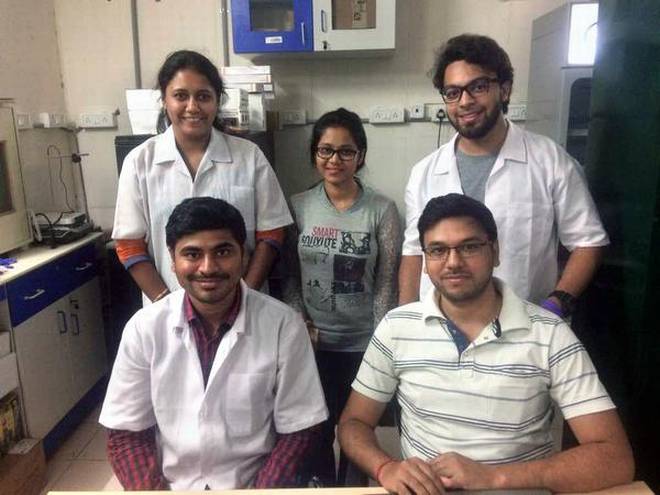
Liver team at Pandorum Technologies: Dr. Abdullah Chand, senior scientist (left); Arun Chandru, co-founder and managing director (centre); and Dr. Sivarajan T., senior scientist / @ABHINAV_MAURYA
Bengaluru, KARNATAKA :
Pandorum Technologies, a Bengaluru-based biotech startup, has developed an artificial tissue that performs the functions of the human liver.
Pandorum said these 3D printed living tissues made of human cells would enable affordable medical research with reduced dependence on animal and human trials. It will also eventually lead to full scale transplantable organs.
Arun Chandru, 30-year-old co-founder of Pandorum, said liver toxicity and drug metabolism are the key hurdles, and contributors to failed human trials.
Pandorum’s 3D bio-printed mini-livers that mimic the human liver will serve as test platforms for discovery and development of drugs and vaccines. The firm said these drugs would have better efficacy, less side-effects and be developed at lower costs.
“We developed everything here in India,” said Mr. Chandru. “We can grow thousands of these tissues in the laboratory and test the efficacy of drugs on them for diseases including cancer.”
He said large pharma companies on an average spend about $10 billion (Rs. 66,290 crore) and 10 years on research and development to get a single new drug to the market.
Tuhin Bhowmick (34), another co-founder of Pandorum, said development of artificial organs has numerous clinical uses. The cell-based miniature organs can be used to develop bio-artificial liver support systems for preserving life in patients who have developed liver failure.
“In the near future, such bio-printed organs will address the acute shortage of human organs available for surgical transplantation,” said Dr. Bhowmick, who holds a Ph.D. from the Indian Institute of Science.
Pandorum was founded by a group of friends in 2011 who were pursuing their higher studies at IISc. They came together to work on the development of artificial human organs after winning a business competition.
Surviving initially on money from friends and family, the team approached the Department of Biotechnology with their vision. The company was awarded funding support by the Biotechnology Industry Research Assistance Council in 2012. The same year, the company got incubated by the Centre for Cellular and Molecular Platforms in Bengaluru.
Mr. Chandru said they created the innovation with a funding of about Rs. 1 crore, more than half of which came from the government.
Scientists and startups across the globe are growing artificial organs made of human cells to better study diseases and help test drugs. A team of researchers led by Hebrew University professor Eduardo Mitrani is growing pancreas in a petri dish to better regulate blood sugar in diabetic patients.
The global artificial organ and bionics market is expected to reach $38.75 billion (Rs 2.5 lakh crore) by 2020 at an estimated CAGR of 9.3% from 2014 to 2020, according to a study by Grand View Research.
Pandorum’s ultimate aim is to make personalised human organs such as lungs, liver, kidney and pancreas on demand, according to Mr. Chandru.
Pandorum’s innovation takes the area of making artificial organs to the next level. Bengaluru-based bioinformatics firm Strand Life Sciences founded by IISc. professors had earlier developed a virtual liver that mimics the functions of liver through software simulation. It is a predictive method that integrates data and insights for deeper understanding of the impact of a drug on the liver. The platform can predict the toxicity of several known drugs and toxins and explain the mechanism.
source: http://www.thehindu.com / The Hindu / Home> Sci-Tech / by Peerzada Abrar / Bengaluru – December 23rd, 2015