Books help human beings lead a good life, said former President A.P.J. Abdul Kalam, in the city on Saturday.
In an interactive session with the students of Presidency College, Mr. Kalam said when he was studying at the Madras Institute of Technology in Chromepet, he used to come to Moore Market complex to buy old books.
When asked about his first failure, Mr. Kalam said, in 1979, he headed a team which was involved in launching a satellite at Indian Space Research Organisation, Sriharikotta.
On the day of the launch, the satellite, instead of moving on its scheduled orbit, fell into the Bay of Bengal. That was his first failure from which he learnt and conducted several successful missions.
Answering another question on the importance of technology and research, Mr. Kalam said intensity was lacking amongst researchers today.
To improve this, there is a need to rewrite the curriculum in a way that it promotes research. Students should also learn to accept defeats and celebrate it, he said.
source: http://www.thehindu.com / The Hindu / Home> News> Cities> Chennai> Events / by Special Correspondent / Chennai – June 22nd, 2014
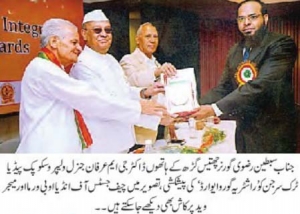
Managing Director Bakoban Hospital, Chandrayangutta, Mr. Abdur Rahman Bakoban congratulated Dr. G M Irfan specialist in General and laparoscopic pediatric surgery, on bagging internationally acclaimed Rashtra Gaurav Award and expressed his good wishes. Mr. Bakoban declared that Dr. Irfan has brought laurels to Hyderabad city. The award and certificate of excellence was presented to Dr. Irfan in a function held on June 12 in New Delhi.
The award was given by India International Friendship Society, a top listed voluntary organization which has completed 10 years of its social and economical services on national and international level.
Siasat news
source: http://www.siasat.com / The Siasat Daily / Home> Hyderabad / Thursday – June 19th, 2014
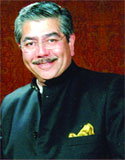
Did you know that Dr Pervez Ahmed, CEO, Max Healthcare Institute Limited, is an ardent reader of comparative religion and also loves adventurous sports? We give you a glimpse of his private world outside meetings and boardrooms.
He is a man who follows his heart. Piggybacking the success of his politician father (former President Late Fakhruddin Ali), he could have been a politician, but he chose to follow the profession of his grandfather, who was a medical professional during the British times.
Dr Pervez Ahmed, CEO, Max Healthcare Institute Limited, grew up in Shillong, nourishing the dream of becoming a doctor. A firm believer in ‘you will get what you want, provided you are ready to work for it!’, he left Shillong in 1964 for pre medical at Hindu College, Delhi University. He later joined AFMC, Pune for MBBS. He came to Delhi and joined Safdarjung Hospital. In 1972, he went to the US (SUNY Downstate and New York University) and finished his PG and fellowship in cardiology.
He wanted to come back to India after his studies, but decided to stay back on his father’s insistence that he garner practical experience. In the US, he was physician In-charge of ICU and Director of Critical Care Medicine at Brookdale Hospital Medical Centre, New York. He returned to India in 2005 and served as a Board Member of Max Healthcare from 2005 to 2007 and then in the capacity of Executive Medical Director from 2007-2009, before being designated as the CEO of Max Healthcare in January 2009.
So why did he decide to come back? “The desire was to impart the knowledge acquired in the other part of the world here,” he explains. As a CEO of one of the most popular names in healthcare, he wants to bring about a cultural change which starts by changing the mindset of people. He wants to reinforce teamwork, transparency, accountability and patient-centric approach. He affirms, “Today, healthcare should be safe, timely, effective and affordable and designed around a patient keeping these parameters in mind.”
So how important is money? “If money was important for me, I wouldn’t have returned to India,” he says. Besides, his efficiency and skills, he is also blessed with values like perseverance, hard work and integrity. Self-admittedly a very emotional person, he is known to be approachable at work— be it for professional or personal. He is known to be able to handle very crucial matters with utmost calmness.
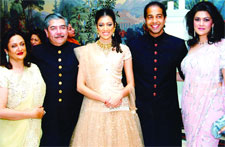
Dr Pervez Ahmed with his family
This quality may be attributed to his deep inclination towards comparative religion (a field of religious study that analyses the similarities and differences of themes, myths, rituals and concepts among the world’s religions) and his deep faith in God. A self-confessed God-fearing person, he believes in giving his best to life and leaving the results to God. He believes that if one takes care of one’s body and soul, there can be a better home and in turn a better society.
Because he is passionate about studying comparative religion, he reads books on Sufism, Islam and other religions and compares them. Right now, he is reading ancient Hindu culture. “Forget the politics, the two religions (Hinduism and Islam) are quite similar,” says the liberal administrator. He also appreciates God for giving him a very comfortable childhood and supportive parents.
A complete family man, his family is the centre of his life. He is blessed with two daughters. The elder one, Talaiya Ahmed (33) is an IT professional but runs her own business and the younger one, Asema Ahmed Amanat (30) is a lawyer and runs a law firm. Both are settled in the US. Besides studying comparative religion, it’s spending time with his grandchildren that gives him immense happiness. “One of the happiest moments in my life was when my grandson was born,” he confides with a sparkle in his eyes.
This sensitive person possesses an adventure streak too! He enjoys outdoor sports like golf, squash, tennis, fishing, hunting, shooting, trekking, hiking, and traveling. Once he retires, he wants to travel more with his family. His fathers’ political streak may still show up sometime. He may follow the footsteps of his father and become a politician once he retires. For now, we make him share some of his life memories with us.
The Mixed Bag
Your best prize in life so far
My children.
Your first day in school
My school was in Shillong. My first day was terrible. I joined school at the age of two and a half. I had a miserable day.
Your first ambition
To become a doctor.
Your first day at work
At Safdarjung Hospital, I was getting a salary of Rs 150 per month, which was quite decent at that time.
The first time you fired somebody
I have always fired people on issues of integrity. I have zero tolerance for any kind of dishonesty.
The toughest decision you have taken
To return back to India. There were so many aspects to it. I was leaving behind my children, my two grand children and I didn’t know exactly how things would turn out here.
The best memory of your childhood
Quite a materialistic one! The first time when my father went to the US as an UN delegate (in 1950’s), I gave him a whole list of the comic books. When he arrived back, he had all of them. I am fortunate to have a good childhood.
Your happiest moment
I have a very strong and supportive wife. When I first met her, she was an intern at Safdarjung Hospital. The fact that I still remember what was she wearing then, it must have been a happy moment.
Your funniest moment
Quite a few. It is very difficult to recall the one which stands out.
Three things you can not do without
My wife, freedom of choice and opportunity for personal growth. I can live without all material things.
One trait that you would like to change about yourself
I don’t hide my emotions. I always cry while watching a Hindi film (smiles).
Your first vehicle
With my own money, Dodge Dart (1973) was the first vehicle that I purchased.
One parental advice that you remember
Study-this advice has always helped me.
Sonal Vij
source: http://www.healthcare.financialexpress.com / Financial Express / Express Healthcare / Home> Weekend> Article> Time Out / by Sonal Vij / April 2009
The Air Force Station at Begumpet was one of six heritages of the city to be acknowledged with an award by the Indian National Trust for Art and Cultural Heritage (Intach) on the occasion of World Heritage Day 2014. The event brought into focus little known facts about Hyderabad’s history, including the city’s pioneering efforts in the field of aviation which commenced in 1911 when a Belgian aviator, Baron de Caters, along with his assistant Jules Tyck, arrived with a fleet of planes to give demonstration at the Secunderabad Parade Ground.
The three-day affair received wide publicity and drew large crowds of onlookers including quite a few women. A newspaper report preceding the event announced that “a popular society lady will be taken up by the Baron on the first day”. Unfortunately the identity of this enigmatic passenger remains unknown and it is believed that it must have been a member of the European community then living in the cantonment.
The first direct association of Hyderabad with aviation was established a few years later when during World War I, a British pilot challenged the enemy while flying an aircraft bearing the name of ‘Hyderabad’ over the skies of Germany in 1917. In recognition of contributions to the Imperial war effort, the names of native states had been inscribed on the aircraft of ‘Gift Squadrons’ raised and maintained with funds donated by the Indian rulers. Subsequently, the British formed two more Hyderabad Squadrons during World War II with public contributions raised at Hyderabad, and the Spitfires and Hurricanes of these units had the legend “Presented by His Exalted Highness, the Nizam of Hyderabad” emblazoned on their fuselage. Among the three Hyderabad Squadrons of the Royal Air Force, the 152nd had the Nizam’s crown, the distinctive ‘dastar’, displayed prominently on its insignia.
The credit of introducing Hyderabad to flying as a hobby goes to two adventurous youngsters, Babar Mirza and Pingle Madhusudhan Reddy, who developed a keen interest in flying while pursuing their studies in England. While Reddy managed to keep his passion for flying in check long enough to obtain a degree in mechanical engineering from Leeds, Mirza concentrated more on developing an expertise in handling aircraft. Reckless by nature, he purchased a Simmonds Spartan and set out from Croydon in late 1932 with the sole obsession of reaching Hyderabad within the shortest possible time despite his father having explicitly banned him from undertaking such a “perilous and foolish adventure”. Without giving a second thought to the logistics involved in undertaking such an arduous journey and despite refusal of permission to transit Turkey, Mirza successfully bluffed his way out of tricky situations including some perilous moments at Konya where he inadvertently landed on a military parade ground and was promptly marched off at gunpoint! Unable to take the punishment of the “Air Mad” Hyderabadi anymore, the plane’s engine gave way over the Iraqi desert. Rescued by Bedouins, he was packed off to India along with the wreckage of his aircraft.
Within a year of the mishap, Babar Mirza had somehow convinced his father Manzoor Jung to support his plans of establishing an Aero Club at Hyderabad. Laying out a landing strip on the polo ground of the family estate at Habsiguda, he flew in the now restored Spartan from Karachi and applied to the Nizam’s government for permission to start a private Flying Club and ordered another aircraft from London. Meanwhile Reddy, having purchased an Avro Avian in England in 1933, flew it to Hyderabad and touched down at Habsiguda to join the Deccan Aero Club. Official permission still pending, Babar Mirza took it upon himself to garner support and went about it in a unique way. Inviting the then Prime Minister of Hyderabad Maharaja Kishen Pershad and other elite to Habsiguda for an evening of flight demonstrations, he put on a show that they would never forget. After his colleagues had shown their skills in performing ‘loops’ and ‘rolls’, Mirza swooped down low over the heads of the visiting dignitaries creating ‘quite a sensation’! The dare seems to have had little effect on the administration as it was another three years before the Hyderabad State Aero Club was formally inaugurated in 1936. Mirza’s antics though, seem to have set a precedent for disgruntled aviators. Old-timers of the city narrate the exploits of another pioneer, a scion of the Bilgrami family who, jilted by his beloved because of a stubborn refusal to give up his ‘dangerous’ passion for flying, made repeated low passes over her wedding venue; blowing away the shamiana, scattering the guests and turning a lavish spread inedible with a coating of dust!
(This is the first of a two-part series on Hyderabad’s aviation. The writer is a heritage activist)
source: http://www.timesofindia.indiatimes.com / The Times of India / Home> City> Hyderabad / by Sajjad Shahid, TNN / April 27th, 2014
The founding of the Hyderabad State Aero Club ushered in an era of relative decorum and the unchecked exploits of buccaneering aviation pioneers of the city were finally tamed to a large extent. Over succeeding years Babar Mirza and P M Reddy, matured into serious aviators who took on the task of ensuring that aviation in the Deccan kept pace with international trends. Their enthusiasm for flying inspired others to take up the hobby and also hastened the plans of the Nizam’s government to establish an airline. Aban Pestonji Chenoy, the teenaged daughter of the Nizam’s Mint Master, became the first woman member of the Hyderabad State Aero Club to qualify for an aviator’s license in 1938, a year in which 55 of the club’s 70 members were Indians.
The club’s operations were suspended during World War II and its pilots, aircraft and facilities were commandeered for use by a training squadron. The association of Begumpet with the Air Force has continued ever since. The acute need for pilots during the war resulted in the establishment of a center of the Indian Air Training Corps on the Osmania University campus in 1945. Trained by Hyderabad’s own pilots along with British officers, cadets of the very first batch passing out from the Osmania University made such a strong impression on the recruiting board that a majority of them were recommended for a commission in the Air Force.
Princess Durru Shehwar laid the foundation stone for the passenger terminal at Begumpet in 1936 as part of the Nizam’s Silver Jubilee celebrations and Deccan Airways Limited was incorporated in 1945, becoming the first airline to be promoted by a native State. A joint venture of Hyderabad State and Tata Airlines, Deccan Airways had a fleet of a dozen Douglas DC-3 ‘Dakota’ aircraft when Hyderabad was absorbed into the Indian Union in 1948.
It was with Pingle Madhusudhan Reddy’s encouragement that the last Nizam, Mir Osman Ali Khan, first boarded an aircraft for a sortie over the city intended to check out his reactions to flying. Initially thrilled at being able to view from the skies, the Nizam is said to have later issued orders prohibiting any aircraft from flying over his palace. On one of his later flights in a twin engine aircraft, he enquired from PM as to what would happen if an engine conked off during flight. “Not a problem Your Exalted Highness”, PM replied, “We can safely carry on with the remaining engine”.
Years later when boarding a flight for Delhi, he pointed to the four engines of the Super Constellation and exclaimed; “Now that is what I call a safe aero-plane!”
By 1947 Deccan Airways had a fleet of sturdy Douglas DC-3 ‘Dakota’ aircraft which connected Hyderabad with key cities through regular services. Apart from scheduled flights, the airline also took on charters and diplomatic sorties on behalf of the Nizam and his government. The airline continued to serve the ruler of Hyderabad in his capacity as the Rajparmukh subsequent to merger and one of the tasks personally supervised by PM was to ensure a daily supply of fresh water for the Nizam during his sojourns away from Hyderabad. Drawn from a protected source which had supplied his ancestors, the waters of the Bam Rukn-ud Dowlah, a spring near the Mir Alam Tank, were shipped under guard in special sealed containers for the Nizam and his family.
Pingle Madhusudhan Reddy saw the airline through its most difficult phases of existence including a ban imposed by the Indian government just prior to the Police Action and later when Deccan Airways along with all other private airlines of the country, was nationalized in 1953 becoming part of the Indian Airlines Corporation. Having been appointed the first Operations Manager of Deccan Airways in 1945, he rose to become its General Manager and later Managing Director. Under his dynamic leadership Deccan Airways gained the reputation of being one of the best and the most efficient airlines in the country. Despite being named Regional Director of Indian Airlines, PM resigned and opted to revert to Hyderabad State service in 1954 and was put in charge of the Industrial Trust Fund and its operations; Praga Tools and Hyderabad Asbestos which was eventually handed over to the Birlas. At the request of the defense ministry, PM was released from state service and took charge of HAL Bangalore in 1957 to set up the jet engine factory from where he retired in 1967. After a long and eventful life PM passed away in Hyderabad in 1986.
(This is the second and concluding part of the column on pioneers of aviation in Hyderabad. The writer is a well known heritage activist)
source: http://www.timesofindia.indiatimes.com / The Times of India / Home> City> Hyderabad / by Sajjad Shahid, TNN / May 04th, 2014
Bangalore, the aviation capital of India, has often had its young opting for careers in aerospace, many displaying their skills at various forums. Two teams from Bangalore only reaffirmed this fact by bagging the first two places at the recently concluded (April 12) Boeing India-IIT national-level aeromodelling competition.
The four Bangalore boys — three from ASC College of Engineering, and one from BMS — competed against 560 participants to clench the contest.
At one point, Tabrez Nadvi Anser, Pavan MJ, and Vignesh Arul of ASC College, who bagged the first place, stared at a missed opportunity. “Selection for the finals was to happen at four zones, IIT Madras (South), IIT Kharagpur (East), IIT Bombay (West), and IIT Kanpur (North). Unfortunately, we couldn’t enter the zonal-level competition at IIT Chennai, as it coincided with our semester exams. We finally got permission to participate from the East zone, and our college helped us with the funding,” Tabrez told TOI.
In the zonal round, Pavan said, the team focused on design and building of the remote control (RC) aircraft, keeping in mind the ability to glide. “We did not buy a ready-made aircraft,” Tabrez added.
Having qualified for the finals with 12 other teams from various zones, the four shifted their focus to flying and acrobatic flying, as per the problem statement given by the organizers. They built a depron-made 3D RC aircraft which performed all manoeuvres as planned. “Eventually, we won because of our strategy which was duly acknowledged by the jury,” Tabrez said.
While team ASC was busy clearing hurdles at the zonal levels, Mohammed Shadman Alam was steering a solo show. “While other teams had at least two participants, with the upper limit set at four per team, Alam did everything alone,” said one of the organizers.
At the end, the battle was between the two Bangalore teams, and Alam came second. “Going alone has its perks. I could conceive and design what I wanted, and also perform manoeuvres I liked. Also, if something were to go wrong, the blame would be all mine, and so was it with the credit,” he said.
source: http://www.timesofindia.indiatimes.com / The Times of India / Home> City> Bangalore / by Chethan Kumar, TNN / April 30th, 2014
People generally go by sellers’ claims on the quality of Omani frankincense. However, a Sultan Qaboos University study has found that there is nothing such as ‘high quality’ or ‘low quality’ frankincense – all varieties are equally good and have the same antibacterial properties.
Commonly known as frankincense worldwide and luban in Jebeli and Dhofari Arabic, the resin is an extract of the Boswellia Sacra tree and has various medicinal and aromatherapy applications.
Omani frankincense is commercially available in four grades under the names hoojri, najdi, shathari and shaabi, based on four geographic locations in Dhofar from where the resins are harvested.
“Our study has found that hoojri – the first grade luban – and shaabi – the fourth grade luban – which greatly differed in price, closely resembled each other in essential oil composition, yield and physiochemical characteristics, except colour and texture,” said Dr Hisham Abdul Khader, associate professor of chemistry in the College of Sciences at Sultan Qaboos University.
The market price of the four grades varies considerably according to their colour, clump size and texture. Resin value is determined not only by fragrance but also by colour and clump size, with lighter colours and larger clumps being priced higher.
Hoojri, a first grade resin, which has the lightest colour and a large clump size, is collected from trees in the north of the Samhan mountains in Dhofar, and costs RO32 per kg. Najdi, a second grade resin with a pale yellow colour, is collected from a plateau behind the Dhofar mountains and costs around RO26 per kg.
Shathari, a third grade resin which is darker in colour and collected from the northwest of Dhofar, costs RO12 per kg while shaabi, a fourth grade luban of a darker colour that is collected from valleys, costs RO6 per kg.
Khader said, “As per our study, hoojri, the first grade luban, had the highest oil content of 8.5 per cent whereas the yield of the second and third grade samples – najdi and shathari – were 5.5 and five per cent respectively.
“The oil yield of the fourth grade shaabi was seven per cent, which was higher than that of the second and third grade and closer to that of the first grade, thereby indicating an inconsistency between the oil yield and grade.”
Titled ‘Composition and antibacterial activity of the essential oils of four commercial grades of Omani luban, the oleo gum resin of Boswellia Sacra flueck’, the study also tested frankincense oil for effectiveness of its anti-bacterial properties.
“All four grades were tested for their anti-bacterial properties and showed pronounced activity against a panel of bacteria. The oil killed all the bacteria irrespective of the grade it belonged to, in varying extent. The antibacterial activity of the oils suggests their potential use in food preservation,” Khader said.
“If you go to Salalah, you will notice that the prices are different. The best variety is sold for around RO36 while the lowest grade is sold for RO6. So this study is an eye opener. It will be of use to industries who have so far gone in for the high quality luban. They can now get the same benefits from a less expensive and low quality luban.”
Salim al Saidi, K B Ramesh Kumar, Nallusamy Sivakumar and Salma al Kindy also participated in the study.
source: http://www.muscatdaily.com / MuscatDaily.com / Home / Muscat Daily Staff Writer / December 30th, 2012
The award-winning Indian professor who was found dead in his residence on a university campus in Oman Friday, was a brilliant student, teacher and a scientist, his former colleague said.
M.Kabir, a visiting professor at the Centre for Development Studies here, told IANS that it was only last week that Hisham Abdul-Khader visited here for a day to attend his niece’s wedding.
“It was about 13 years back he left the state government service here and joined at the Sultan Qaboos University (SQU) in Muscat,” Kabir said.
“Two years back he got the UAE award for the best scientist. He was a brilliant student, teacher and a scientist,” he added.
Hisham Abdul-Khader, an associate professor in the chemistry department, was found dead at his residence on the SQU campus Friday night. He was not keeping well, said the former colleague of the scientist.
“We spent some time together as we were former colleagues and friends and he told me that he was having some health issues. We got the sad news Friday night and his wife (a retired professor here) has reached Oman Saturday,” Kabir said.
Abdul-Khader, who was in his late 50s, taught Chemistry at various State-run government colleges here before he went to Oman.
“We are expecting the body to arrive here tomorrow (Monday), or day after,” Kabir said.
The scientist was staying alone at the SQU campus and people saw him last Friday evening when he was out taking a stroll in Muscat. He later also spoke to his wife, reports from Oman said
Abdul-Khader’s grandfather was the legendary Vakkom Moulavi – a social reformer, teacher, Muslim scholar, journalist and a freedom fighter.
source: http://www.newindianexpress.com / The New Indian Express / Home> Nation / by IANS – Thiruvananthapuram / April 27th, 2014
A group of engineering students from Aligarh Muslim University have succeeded in extracting bio-diesel from refined and used mustard oil, university officials said on Tuesday.
Third-year students of the Diploma in Engineering at the AMU Polytechnic designed a bio-diesel extraction plant as part of the recently developed Alternative Fuel and Combustion Engineering Lab, said M. Yunus Khan, assistant professor of mechanical engineering.
The process can help in directly replacing diesel in conventional engines, thereby reducing India’s dependence on imported oil and emissions of various pollutants, officials said.
Bio-diesel is a renewable fuel derived from vegetable oil that can be an additive to or entirely replace diesel in engines.
source: http://www.timesofindia.indiatimes.com / The Times of India / Home> Science / IANS / April 01st, 2014
A team from the Osmania Medical College pipped five other short-listed teams at the regional round of Cerebrations, The Hindu Business Line Corporate Quiz 2014, held here on Tuesday.
The winning duo, brothers Syed Murtuza Hashmi and Syed Mustafa Hashmi, first and fourth-year students at the medical college, took early lead and managed to retain it, with the team from Reckitt Benckiser coming a close second and Sai Constructions at the third place. Of the 20 teams that took part in the quiz, six were short-listed after they fielded a general elimination round of 25 questions.
source: http://www.thehindubusinessline.com / Business Line / Home> News / The Hindu Bureau / Hyderabad – March 18th, 2014
Eminent Indian scientist Prof Seyed E Hasnain has bagged the Cross of the Order of Merit of the Republic of Germany. He served as the founder-director of Centre for DNA Fingerprinting and Diagnostics (CDFD) and vice-chancellor of University of Hyderabad.
The award has conferred on Prof Hasnain in recognition of his contribution to Indo-German relations. The Order of Merit of the Federal Republic of Germany was instituted in 1951 by Federal President Theodor Heuss. It is the only honour that is awarded in all fields of endeavour and is the highest tribute the Federal Republic of Germany can pay to individuals for services to the nation.
German Ambassador to India, H E Michael Steiner, conferred the prestigious ‘Bundesverdienstkreuz’ on Prof. Seyed Hasnain at the German Embassy in India, says a statement from the University of Hyderabad on Thursday. Prof. Hasnain is a renowned microbiologist especially acclaimed for his path-breaking research on tuberculosis. He paved the way for the office of the German Research Foundation in India, which is one of the key forums for scientific cooperation between Germany and India. During his stay at the Robert Koch-Institute in Berlin and the University of Wurzburg, he produced remarkable research results in microbiology.
Prof. Hasnain has almost all major Indian Science Awards to his credit: GD Birla Award, Shanti Swarup Bhatnagar Prize, FICCI Award, J.C. Bose National Fellow Award, Ranbaxy Research Award, Goyal Award, Bhasin Award and several others. He is the first Indian elected member of the German National Academy of Sciences Leopoldina and one of the youngest to be elected Fellow of TWAS, Trieste, Italy. Internationally, Prof. Hasnain is a recipient of the prestigious Humboldt Research Prize, awarded by the Alexander-von-Humboldt Foundation, Germany; as well as the very exclusive Robert Koch Fellowship, of the Robert Koch Institute, Berlin.
source: http://www.timesofindia.indiatimes.com / The Times of India / Home> City> Hyderabad / by Syed Akbar, TNN / March 13th, 2014