Less than a week ago, gynaecologist Laila Beegum supervised the birthing of a set of identical twins to a couple from Kodinhi village, now known globally for the high number of multiple births. The twin babies born on August 7 this year took the total number of such deliveries witnessed by her to 452.
Though the total number of twins in the village has now crossed 500, the mystery behind the phenomenon is yet to be unravelled.
Located close to Tirurangadi town in Malappuram district, Kodinhi village, with its high twinning rate, garnered global media attention around six years ago. At Kodinhi, twins account for 42 per 1,000 live births while the global average of twinning is reportedly around six per 1,000.
Brazil’s Candido Godoi and Nigeria’s Igbo-Ora have witnessed similar birth phenomenon. Attempts by several scientists and organisations to find the secret behind the high twinning rate have failed to bear fruit.
Recently, Dr N K Sribiju, public health consultant, Taluk Hospital, Tirurangadi, approached the state government seeking permission to conduct a genetic study on the local populace.
“Surely, there would be a scientific reason behind the birth of a huge number of twins in such a small area. But, the secret can be revealed only through a detailed genetic and environment study. We are awaiting permission from the ethical committee of the Rajiv Gandhi Centre for Biotechnology at Thiruvananthapuram for the same,” said Dr Sribiju.
Significantly, more than 90 per cent of the couples from Kodinhi who reported twin births conceived normally. “Hence, IVF treatment cannot be considered as a reason for the high rate of twinning in Kodinhi,” Dr Biju said.
Dr Laila, who runs Laila’s Hospital, Chemmad, said multiple births are not just being reported by persons born and brought up here.
“Many women who came to Kodinhi after marrying someone here have also experienced twin birth. So, it could be due to some mysterious element of nature.
“Earlier, we conducted a water test but the results were not conclusive,” Dr Laila added.
Twins and Kins Association (TAKA) of Kodinhi believes that their village has the most density of twins in the world and is planning to approach officials of the Guinness Book to claim a record.
Get-together
“There are families having three pairs of twins and triplets at home. A 90-year-old man here is the eldest among the twins who are alive,” said Bhaskaran Pullani, president, Twins and Kins Association, which is planning to organise a get-together of all Kodinhi twins.
source: http://www.newindianexpress.com / The New Indian Express / Home> States> Kerala / by Santosh Christy / August 17th, 2014
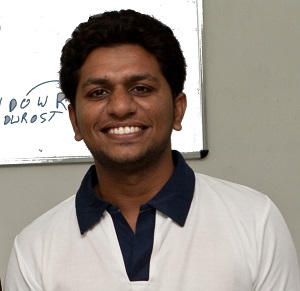
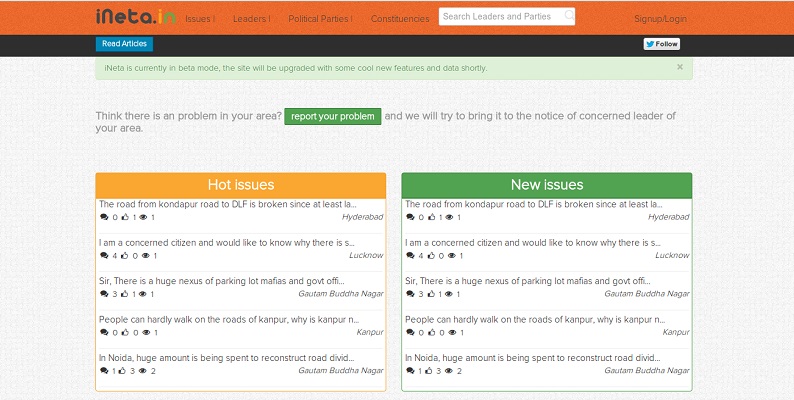
Entrepreneurs are among those who are most influenced by decisions made by the government. And as leaders in different spaces, you would have a strong opinion or two about politicians, governance and the general state of affairs. The problem is, how do you get your ideas across to your elected representatives? That’s where iNeta, a futuristic platform for transparent politics, can make a difference.
The rise of AAP and catapulting of IIT grad Arvind Kejriwal into the chief minister’s seat in Delhi after mass campaigns involving citizens indicates that the time is ripe for initiatives like iNeta. If an awakened electorate wants to have a say in governance, what better way than to use technology and the web to facilitate the process?
An idea whose time has come
Software engineer Akram Khan started thinking about this long before Anna, AAP and Arvind arrived on the scene. He was talking politics with his flatmates in Hyderabad in 2007, when it struck him that there was a need for a new age communication platform to dialogue with elected representatives. He was working with Mindtree then. The consensus was that meeting leaders to tell them about any issue was very cumbersome if not impossible.
Around then, Tata launched the Jago Re campaign, and Akram’s friends thought he had come up with an idea whose time had come. But it remained dormant as Akram didn’t know how to develop on it. He went on to do other things: An MBA, a stint as the business development guy with his friend’s startup Innocent Technosoft – a mobile application and game development company based in Lucknow – and a startup of his own in the software consultancy space.
It was 2012 and a next generation platform that enables open governance still didn’t exist. So, “I thought, why not take it up again? By now, I had enough experience and knowhow to develop it,” Akram told YourStory.
iNeta went live on 2 October 2013 – the birth date of Mahatma Gandhi. The space in which iNeta operates is different from other platforms like Voterite, which are more into campaigning. “iNeta is about solving people’s problems. It is about open governance and taking e-governance to the next level.”
It is based on the idea that people want to talk to elected leaders about issues that affect them. “People need an audience with their leaders. It is an attempt to make governance open source, like how it should be in a true democracy,” explained Akram.
“It is often rightly said that the road to Delhi goes from Lucknow and that is where we are based. It is the hub of political activity in India,” Akram says. He runs iNeta with his friend, Ankur Srivastava, an IT engineer and a clean politics enthusiast.
“We are funding iNeta from our own pockets right now. Since I am a web developer, there are no bills to pay for developing the site. But of course, there are other costs. We are looking to expand and hire cartoonists, writers and analysts. So we have to look at ways this could be achieved,” Akram says.
Risks of the plunge
Akram says it was his basic curiosity to look for solutions to problems around him and see if they succeed or not that led him to entrepreneurship. “I am already working on my next idea while I develop iNeta for scaling.”
Like most entrepreneurs, the big risk for Akram too is financial. He has an education loan to pay off. The EMI makes him “always cash-strapped”, he quips. “Apart from that I am not afraid. I believe persistent effort is required for success and if I keep at it I would be successful.”
Born and brought up in Lucknow, Akram did his engineering from the Manipal Institue of Technology. After eight years in South India, he moved back to Lucknow to startup. “My initial plan was to develop a site like shiksha.com while I was doing my MBA in 2009. But it did not materialize and I had to drop it,” he recalls.
He learnt web development while working at Innocent Technosoft. “I was more of an idea guy and always used to look for someone to develop it. Since I did not have enough funds to get my ideas developed, I thought, let me try building one on my own. I trained myself in web development and started doing web consultancy to make money,” he says.
Akram lives in a joint family, where his mother looks after the house and father runs a manufacturing unit for textile accessories. His younger brother is a doctor. He has two sisters. One is a journalist with a leading Urdu newspaper in Noida and the other is doing her M.Tech in Biomedical engineering.
Getting politicians to respond
The political climate of India is such that it would take mainstream parties a lot of time to understand the power of a platform like iNeta and how to effectively utilise it, Akram feels. “We have spoken to several political leaders who liked the idea but are not quite keen to get on board as they think it might hurt them – which could be true, but this kind of platform is the future.”
The problem iNeta tackles is quite universal. People elect their leaders and then get to see them only when their elected term is about to get over. Even if a leader really wants to connect with people, there is no dedicated platform for this. It is impossible for him to meet every individual in his constituency anyway. This is where iNeta comes in with a web-based interactive solution.
Talking numbers, there are 790,000,000 (79 crore) voters in India. Of these, 120,000,000 (12 crore) are first-time voters. “We consider all the voters as part of our market because everyone at some stage or the other has a problem and would like their leader to be available to at least listen,” Akram says.
Currently, they have a working product ready and live. “We are improving it on a daily basis. Funding would really speed up our expansion plans.”
The best part about iNeta, he says, is seeing how happily people receive the idea when he talks to them about it. “When we tell someone about iNeta there is a big smile on their face as if this is something which they have been looking for and would love to use.”
To take it forward to a larger audience, they plan to try an SMS module, where people would get to know more about the contestants in their constituencies by sending an SMS. “We would be creating a blog and introducing our website in our Facebook and Google+ groups and other online forums. Later on, we might go for online advertisements as well,” he says.
Right on top of their list of priorities, though, is to get political parties on board, using the platform to engage with voters. “As they are the ones who would eventually answer to the people, unless they come on board, it is a useless idea. So that is top priority as of now.”
If enough people get on to iNeta, we bet politicians will soon follow, in this election season.
Are you curious about how Arvind Kejriwal won over Delhi in a year of starting the Aam Aadmi Party? You might like this: 5 secrets to the success of AAP
source: http://www.yourstory.com / Your Story / Home / by Malavika Velayanikal / February 10th, 2014
This just might be the good news the playback singers, actors, anchors, teacher, lawyers and politicians, who earn their livelihood through their voice, in the state have long been waiting for.
In a development that will cheer thousands of voice professionals and voice patients who have developed various voice disorders, the Calicut University has come out with a unique graduate programme in Vocology, the science and practice of voice habilitation and rehabilitation, in collaboration with Chetana National Institute of Vocology, Thrissur.
This is the first time in the country that an Indian university is offering a course in vocology with an aim of producing vocologists who habilitate vocal behaviour – a speech-language pathologist, otolaryngologist, vocalist trainer, or voice coach.
Based on the proposal submitted by the National Institute of Vocology, the University gas given permission (U.O No6304/2014/admn) to the Vocology institute to frame the syllabus and other things related to the launching of the course, said Dr Musthafa, director of SDE, Calicut University.
There are hardly a dozen major vocology institutes across the world mainly in developed countries like NCVS Summer Vocology Institute in USA and institutes in Finland, Japan, Turkey, and UK. “There is a huge dearth of trained vocologists in the country since vocology is not widely taught in academic institutions in the country as an independent discipline. Celebrity voice professionals, including film stars and vocalists, are used to confront with voice disorders and seek rehabilitation and the return of their operational voice or to benefit professionally from vocal habilitation by learning to optimize the efficiency and effectiveness of their speaking voices,” said Fr Paul Poovathingal, the first vocologist in the country and the principal of National Institute of Vocology. “This six-semester course will equip a batch of 20 candidates to deal with all kinds of voice professionals and voice patients suffering from puberphonia (male having female sound), vocal cord paralysis, vocal nodule, phonatry gap, patients with wrong voice production, breathing techniques and poor lung pressure, and other voice disorders,” said Poovathingal. “Actor Mohanlal and even the late Chembai Vaidyanatha Bhagavatar, who had lost his functional voice suddenly at the peak of a concert, have confronted with voice disorders at one point of time in their careers. Some of the eminent professionals have even vanished from their field for ever after voice disorders developed,” said George S Paul, an academician and a physicist.
The high-level of pollution in lifestyle and surroundings is taking a toll on the voice professionals and they often need the help of professional to overcome the difficulties in their voice production and to discipline their voice. So vocology being a new branch of knowledge, there is great scope for job in this sector, he added.
The syllabus for the course is being prepared by Fr Paul Poovathingal, George S Paul, Dr R Jayakumar, famed laryngologist who performed surgery on Mohanlal, V R Prabodhachandran Nair, a linguist, in consultation with Dr Ingo Titz of USA, who is considered as the father of Vocology.
source: http://www.newindianexpress.com / The New Indian Express / Home> States> Kerala / by Dhinesh Kallungal – ENS / August 11th, 2014
The Telangana government appointed Ahmed Nadeem as the chairman and managing director of Telangana Transco. Ahmed Nadeem, a 1997 batch IAS officer, will have the full additional charge of Transco. He is currently serving as the commissioner of prohibition and excise.
He will replace Syed Ali Murtaza Rizvi, who has been placed at the disposal of the Government of India for appointment as director in the Cabinet Secretariat under the central staffing scheme, for a period of five years, on Central Deputation.
source: http://www.deccanchronicle.com / Deccan Chronicle / Home> Nation> Current Affairs / DC Correspondent / August 11th, 2014
This innovator made a kit that frees women in many parts of the world of the threat of infection during childbirth.
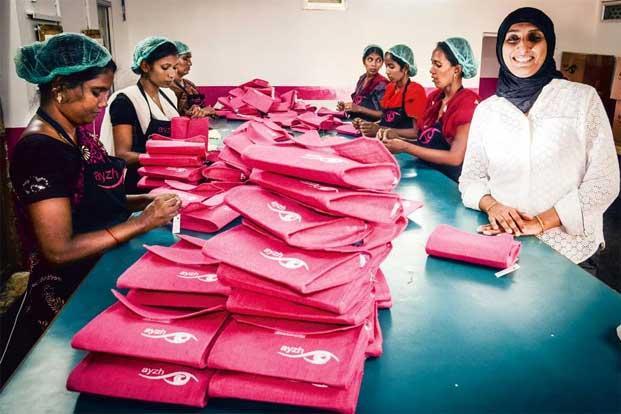
Zubaida Bai at the production facility of ayzh, 30km from Chennai. Photo: Nathan G/Mint
Freedom from risky childbirth | Zubaida Bai
Growing up in Chennai, a young Zubaida Bai wanted to study further after completing class XII. A reasonable request, except that in her family, nobody—male or female—had made it to college. The women in her family were usually married in their teens. Plus, Zubaida’s father did not have the finances to put her through college.
Undeterred, she decided to fight fate.
At 33, Zubaida Bai was the founder-CEO of ayzh (pronounced “eyes”), a low-cost women’s healthcare company based in Chennai and Colorado, US. Her biggest achievement: JANMA, a birthing kit sold and distributed through non-governmental organizations and healthcare companies.
JANMA (birth in Hindi) kits consist of six things: an apron, a sheet, a hand sanitizer, an antiseptic soap, a cord clip and a surgical blade. They meet the World Health Organization (WHO) guidelines of “six cleans” during childbirth—clean hands of the attendant, clean surface, clean blade, clean cord tie, clean towels to dry the baby and wrap it, and clean cloth to wrap the mother. A jute purse in five colours contains the kit and and it can be used as a purse after delivery.
From mundane struggles with a traditional Muslim family to being a successful innovator, Zubaida Bai’s journey has been one about exercising the right to free choice although that involved selling her jewellery to get ayzh off the ground.
Soon after school, Zubaida took a year off, selling retail banking services door-to-door for ABN Amro, cold-calling customers and earning her first pay cheque when she was 17. Soon she was in college, studying mechanical engineering, and went on to become the first graduate in her entire family. After graduation, she dreamt of designing cars, but ended up at auto-parts company Sundram Fasteners. “I was the only girl on the entire floor, all I did every day was change the dimensions on a CAD design or take printouts. I was getting fat from all the thayir saadam (curd rice),” she recalls.
She was soon planning her escape. Scouring the Internet for a master’s degree, she secretly applied to various universities. After an acceptance letter for a fully funded scholarship to an M.Tech programme at Dalarna University, Sweden, arrived, she told her parents. Her father thought this was one of those infamous scams that promised you a job and ended up hiring you as domestic labour. But finally, Zubaida left home.
In the summer of her first semester in college, she took a road trip, was part of a students’ exchange programme, visited Poland and, during a period of self-discovery, she decided to start wearing the hijab, though no one in her family did.
Back in Chennai before her second semester ended and coaxed to meet a potential suitor, Habib Anwar, she feared the worst. “(But) he said that he was looking for an educated girl, who he would like to work rather than sit at home and squabble with his relatives,” says Zubaida.
Anwar supported Zubaida’s plan to study further as well. Soon they were married. Much later, he would be instrumental in providing the necessary support to make ayzh a success.
In 2006, Zubaida gave birth to the first of her three sons, Yasin. It was a painful experience. She needed surgery, was forced to rest for two months and took close to a year to recover fully. In her childhood, she had witnessed the lack of healthcare facilities for her mother, close relatives and community, and the lack of financial resources to pay for these if they did happen to be available.
Sometime in 2009, as part of a master’s in business administration in global social and sustainable enterprises at the University of Colorado, US, Zubaida came to India to research ideas that could be developed into products. She worked with Chennai-based non-profit Rural Innovations Network (RIN), making the JS Milker, a vacuum-driven cow-milking machine, low-cost and commercially viable. In Rajasthan, she met a village dai (midwife) who had just delivered a baby with a grass-cutting sickle.
This was her a-ha moment. She started reading up on institutional childbirth. She stumbled upon a clean birth kit (CBK) while attending a tech event in Denver, US, promoted by the non-profit healthcare organization PATH. The kit had a plastic sheet, a Topaz blade, a piece of thread, a small square of soap, and a plastic coin. All this was wrapped in a box with instructions. She then travelled halfway across the world to Nepal, where a group of women was assembling the kit.
Unimpressed with the quality of the kit, she searched for more samples, but found none that matched her expectations. But she knew she was on to something, and started building her own improved version, using off-the-shelf components and assembling them.
By 2010, she had put together a rudimentary clean birthing kit called JANMA, which she tested in Bangalore, through her gynaecologist. The innovation won the Global Social Venture Competition for business plans at the Indian School of Business, Hyderabad in March 2010, and followed it up by topping the Camino Real Venture Competition at the University of Texas at El Paso, US, later that month.
Zubaida Bai also received a 2010-11 fellowship related to maternal health from Ashoka, an organization which identifies and invests in social entrepreneurs. At one event, she met the who’s who of the world of maternal health. “They were folks who were shaping the future of maternal health. These are people I would have found impossible to meet, especially Wendy Graham, who does research on how clean birth kits prevent infections,” she says. Her interactions confirmed her belief that a product such as JANMA would have a market.
By 2011, they had sold 2,000-3,000 JANMA kits, priced at $2-5 (now around Rs.120-300), in India and had made some inroads into the US.
After the initial success, though, Zubaida Bai hit a wall. Ayzh needed funds for operating costs, scaling up and distribution channels. Forced to return to India after completing her course at the University of Colorado, Zubaida and Anwar had two MBAs and two children between them, and no jobs. Those were trying times.
Even as friends and family advised one of them to get a job, Zubaida and Anwar calculated that they needed $300,000 for one-and-a-half years for ayzh to get off the ground. A social impact firm assured them of $50,000 if they could raise $100,000 and $20,000 if they raised nothing. Everything hung in the balance till the end of 2012, when they were awarded the $80,000 Echoing Green fellowship. They also got a Canadian government grant for another $100,000, while an individual investor put in another $100,000.
This was the turning point. In 2013, they clocked $100,000 in revenue, and sold 50,000 kits in India, Haiti, Laos, Afghanistan and Africa.
The JANMA kit’s relevance is irrefutable. According to the UN, India’s maternal mortality ratio per 100,000 live births reduced by 65%, from 560 in 1990 to 190 in 2013. But that still means 50,000 women die every year in India while giving birth. Seventeen per cent of the women die from preventable infections. More than 300,000 infants in India die the day they are born, according to the report “Ending Newborn Deaths, Ensuring Every Baby Survives”, by the non-profit Save the Children and Joy Lawn, professor at the London School of Hygiene and Tropical Medicine, UK.
Zubaida’s goal for ayzh is three-pronged. She wants women to have power over their health by introducing new products for post-partum haemorrhage, a new-born kit, maternity pad and other innovations in reproductive health and family planning. Instead of creating products from scratch she wants to leverage the ayzh distribution platform to aggregate and sell products already available in the market. And, finally, she wants to launch an innovation lab for low-cost healthcare products, so that an entrepreneur with an idea does not have to go through the same grind that they did.
To realize this ambition they are currently in the process of raising $3 million in funding—a huge sum for a social enterprise selling low-cost products to bottom-of-the-pyramid customers—from social impact investors.
“We want to build a corporate entity, with a group of companies that will focus on women’s health and empowerment. Habib saw his mother struggle doing sewing and embroidery and I saw my mother struggle as well. They always brought in money, but were not appreciated and treated as an asset,” says Zubaida.
Nelson Vinod Moses is a Bangalore-based freelance journalist who writes on social entrepreneurship.
source: http://www.livemint.com / Live Mint & The Wall Street Journal / Home> Lounge> Business of Life> Indulge / Home – Leisure / by Nelson Vinod Moses / Saturday – August 09th, 2014
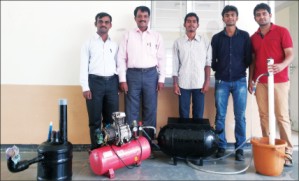
The 8th Semester students of ATME College of Engineering — Syed SuhailKadri, Pradeep and Suhas of Mechanical Engineering Department — under the guidance of K. Srinivasa, Head of the Department and Raghu, Asst. Professor, Department of Mechanical Engineering, have developed a technology to convert Raw Biogas to Enriched biogas, which has the potential to replace Compressed Natural Gas (CNG).
In present times, it is necessary to pay attention towards renewable energy sources such as solar energy, wind energy, biogas etc., due to fast depletion of conventional fuels like petrol, diesel and coal. In this regard, number of research works are going on in development of biogas technology. Biogas consists of 50-60% of methane and 20-30% of carbon dioxide. Due to this high percentage of carbon dioxide, the calorific value of fuel decreases and also affects the environmental pollution. In this project, the technology of enriching of biogas involves increasing the methane content in biogas from 50-60% to 70-80% by reducing the carbon dioxide content using Water Scrubbing process. On doing this, the calorific value of the fuel increases and environmental pollution reduces. This technology can be used for CNG also.
The students thanked the college for their support and facilities provided. The students were congratulated by Chairman of the institution, L. Arun Kumar, college Principal Dr. L. Basavaraj and teaching, non-teaching and management staffs.
source: http://www.starofmysore.com / Star of Mysore / Home> General News / July 17th, 2014
Railway Minister Sadananda Gowda, yesterday, said that his Ministry has worked out a plan to lay a second track in the Mysore-Bangalore sector without disturbing the 225-year-old Tipu armoury near Srirangapatna Station.
Refusing to disclose details of the plan, he said that Railway Engineers had chalked out a plan and the track-doubling work would be completed by March, 2015 and maintained “If I disclose the plans now, there will be unnecessary hurdles as this is a sensitive issue and there is no dearth of people who want to rake up controversies.”
The work had hit a road block as the track was expected to pass through Tipu’s armoury. A proposal to relocate the armoury was met with opposition which resulted in the delay, he added.
Funds
Speaking about the funds for other projects in the State, the Railway Minister said that Rs.1,543 crore had been allotted for works that are underway in Karnataka and declared that there was no question of shelving any project initiated by his predecessorMallikarjuna Kharge.
source: http://www.starofmysore.com / Star of Mysore / Home> General News / July 14th, 2014
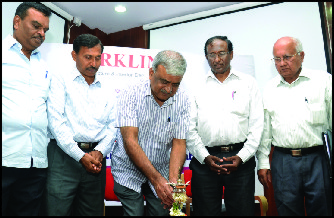
SJCE Principal Dr. Shakeeb-Ur-Rehman is seen inaugurating the workshop at SJCE premises this morning as architects M.P. Nagaraju, Chandrashekar, Shashi Kumar look on.
Mysore :
Arklines Architecture and Interior Design Studio, Kuvempunagar, in association with Sri Jayachamarajendra College of Engineering (SJCE) had organised a day-long workshop on architectural solutions for eco-habitat system at SJCE premises here today.
The workshop was attended by over 100 architects, designers and students.
Inaugurating the workshop, SJCE Principal Dr. Shakeeb-Ur-Rehman said that a serious thought should be given to check environmental pollution. He suggested to make use of the solar and wind power to its best, to tide over energy crisis. He added that the common man should be made aware of environmental protection and energy conservation. Arklines President and Architect S. Shashi Kumar, Architect Chandrashekar and others were present.
source: http://www.starofmysore.com / Star of Mysore / Home> Sports General News / July 10th, 2014
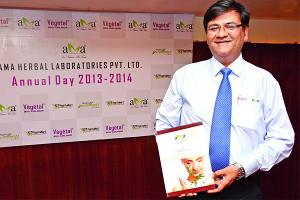
A lavish Annual Day party was organised for the entire staff of AMA Herbal in Lucknow on Tuesday . The directors of the company , along with their families and staff, got together to celebrate the occasion.
The evening began with a vote of thanks by Yawar Ali Shah, one of the directors, to all the employees who had helped achieve this success. Awards were given out to all those who had worked hard for this.
Yawar Ali Shah
Amid applause and cheers, trophies were given to more than 35 employees of the company . While Anshul Shukla and Neeraj Choubey jointly won the award for Employee Of The Year, while Khalil Ahmed was felicitated for 40 years of continuous service.
Several more awards were announced for excellent performance in administration, production, marketing, etc.
AMA Herbal, is a world renowned company dealing in natural textile dyes and herbal colours, Telling us more about the company , Yawar Ali Shah said, “Our herbal products are the result of our dedicated research and development team, which is responsible for making eco-friendly products for consumers.
Our natural products with Bio Active ingredients are well recognized by dermatologists in India and the world. The credit for our success goes to our team and that is what we are celebrating today .”
The guests again erupted in cheers as the launch of four new products was announced at the party .
AMA is in the process of introducing the Vegetal Bio Hair Colour in the US market in the coming year along with promoting natural dyes and gulal, in the European market.
The company also has plans to expand in the domestic market with wellness clinics and more herbal products.
source: http://www.timesofindia.indiatimes.com / The Times of India / Home> City> Lucknow / TNN / July 10th, 2014
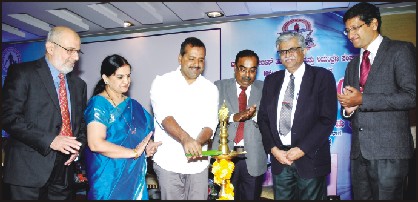
Health Minister U.T. Khader is seen inaugurating APCRICON 2014 in city this morning. Others seen are (from left) Dr. Abdul Rehman, President of APCRI, Dr. Pushpa Sarkar, Director, Mandya Institute of Medical Sciences, Dr. B.J. Mahendra, Organising Chairman, Dr. M.K. Sudarshan, Founder President of APCRI and Dr. M. Vinay, Organising Secretary.
Mysore :
“Rabies, like the malaria and polio diseases, must be made a notified disease by the Central Government in order to adopt preventive measures against rabies, which is highly infectious and severe, affecting domestic animals, wildlife conservation, public health and livestock economies),” said Health and Family Welfare Minister U.T. Khader.
Speaking at APCRICON 2014, the 16th National Conference of Association of Prevention and Control of Rabies in India (APCRI) at Fortune JP Palace in city this morning, he said that the State Government will appeal to the Centre to make Rabies a notified disease and opined that other States too must follow suit.
“In case of the occurrence of such diseases, we blame the animals. But we humans are to be blamed because we need to keep our environment clean and healthy,” said the Minister and called for prevention rather than cure by spreading awareness in schools.
This conference, organised by the Department of Community Medicine, Mandya Institute of Medical Sciences, Mandya, brings together experts from various fields dedicated to rabies research from across the country and world, providing a forum to learn and share valuable experiences of world renowned authorities on rabies.
The inaugural of the conference was presided over by Dr. Abdul Rehman, President of APCRI. Dr. Pushpa Sarkar, Director, Mandya Institute of Medical Sciences was the guest of honour.
Dr. B.J. Mahendra, Organising Chairman, Dr. M. Vinay, Organising Secretary, Dr. M.K. Sudarshan, Founder President of APCRI and Dr. Amlan Goswami, Secretary General of APCRI were present.
Minister U.T. Khader released a souvenir while the APCRI journal was released by Dr. Pushpa Sarkar. Dr. Bankim Patnaik, a physician and former Vice President of APCRI, was felicitated on the occasion and presented with Lifetime Achievement award for his research work in pathology and rabies.
What is a notified disease?
A notifiable disease is any disease that is required by law to be reported to government authorities. The collation of information allows the authorities to monitor the disease, and provides early warning of possible outbreaks. In the case of livestock diseases, there may also be the legal requirement to destroy the infected livestock upon notification. Many governments have enacted regulations for reporting of both human and animal (generally livestock) diseases. This usually happens during pandemics.
If rabies is notifiable in a country, surveillance data can be collected. Better estimates of the number of cases can therefore be made, ensuring a more accurate evaluation of the rabies burden in an area. Rabies needs to be reported so that infected animals can be swiftly identified, isolated and removed reducing the risk of animals and humans across the country contracting the disease. Surveillance data will also provide public health professionals with critical information to make informed decisions about saving human lives. For instance, in a number of countries notification is used by health authorities to investigate possible exposures and organise post-exposure prophylaxis, quarantine and other disease containment measures.
source: http://www.starofmysore.om / Star of Mysore / Home> General News / July 05th, 2014