Zareen faced a stiff challenge from RSPB’s Anamika in the 50kg gold medal match.
Bhopal:
Living up to their favourites tag, the reigning world champion Nikhat Zareen and Tokyo Olympics bronze medallist Lovlina Borgohain registered contrasting victories to clinch the titles while Railway Sports Promotion Board (RSPB) lifted the team trophy with 10 medals at the 6th Elite Women’s National Boxing Championships in Bhopal on Monday.
While the Assam boxer Borgohain beat Arundhati Choudhary of the Services Sports Control Board (SSCB) quite comfortably by a 5-0 margin in the 75kg final, Zareen faced a stiff challenge from RSPB’s Anamika in the 50kg gold medal match before the 26-year-old Telangana pugilist tilted the match 4-1 in her favour to successfully defend her title.
The boxers received the medals in the presence of the Union Minister for Youth Affairs & Sports Anurag Singh Thakur and officials of the Boxing Federation of India.
Another highlight of the day was Manju Rani, who led the domination of RSPB on the final day. The 2019 World Championships silver medallist won RSPB its first gold after outpunching Tamil Nadu’s S Kalaivani 5-0 in the 48kg final. Shiksha (54kg), Poonam (60kg), Shashi Chopra (63kg) and Nupur (+81kg) were the other gold medallists for RSPB, who also bagged three silver and two bronze medals.
Madhya Pradesh, with one gold, two silver and five bronze; and Haryana (two gold and two bronze) claimed second and third positions respectively.
Manipur’s young boxer Sanamacha Thokchom Chanu, who won gold at the 2021 Youth World Championships, also put up an impressive show to secure the title in the 70kg, beating Madhya Pradesh’s Shruti Yadav 3-2 in the thrilling final.
Haryana’s Manisha (57kg) and Saweety (81kg), SSCB’s Sakshi (52kg) and Madhya Pradesh’s Manju Bamboria (66kg) also clinched gold medals in their respective categories at the prestigious tournament, which saw participation of 302 boxers in 12 categories.
source: http://www.siasat.com / The Siasat Daily / Home> News> Sports / by Asian News International (ANI) / December 27th, 2023
At the very outset, I apologise to our freedom fighters for highlighting the role of Muslims among them. They would have never wanted themselves to be identified as Hindus, Muslims, or Sikhs. Hopefully, they would understand that under the attack of divisive propaganda I intend to bring out a united struggle against the British.
Colonial historians and educationists did not leave any stone unturned in dividing Indians based on religion and caste. Yet, no matter how many collaborators they had bought and manipulated our history Indians remain united. The first war of national independence of 1857 is a shining example of national unity. It was the Hindu-Muslim unity during the revolt of 1857 which led the British in implementing a divide-and-rule policy in every sphere of governance and policy-making.
A Slice Of History
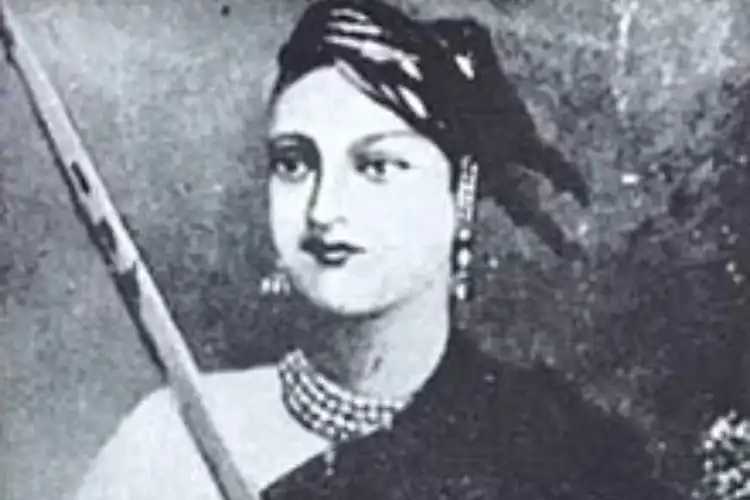
No wonder, our books are still following the pattern. Rani of Jhansi Lakshmibai was one of the brightest stars in the constellation of the Indian freedom fighters. English forces were the most frightened of her because she brought Hindus, Muslims, lower castes, upper castes, men, and women under one flag to fight against foreign rulers.
Not many people know that on 6 June 1857, Rani of Jhansi sent a Muslim Maulana to announce the war against the British from a mosque with prayer calls. In his history of 1857, Colonel Malleson wrote, “The afternoon of the 6th, then, the Rani, escorted by her new levies came from her palace, and went in procession towards the cantonment. As she issued from the town, a Mulla (a Muslim scholar) called all the true believers to prayers. This was the signal. The cavalry and infantry at once rose in revolt. They met Captain Dunlop, as already stated, on his return from the post office, shot him dead, and with him another officer, Ensign Taylor.”
On 21 August 1857, the deputy collector wrote that the Indian sepoys of 12th and 14th Irregular cavalries were concocted into mutiny by “bigoted Mussulmans of Delhi, who were considered the ring leaders” through weeks of ‘nocturnal meetings’ at the cantonment. The official inquiry setup by the British government named Bakhshish Ali, a jailer, as the leader who initiated mutiny among sepoys in Jhansi. The reports read, “Buxish Ali (Bakhshish Ali), the Jail Darogah, was the principal leader; he was concerned in the murder of the Officers”. The report also mentioned, “Buxish Ali publicly boasted (that he had killed the “Bura (Bara) Sahib’’ (Captain Skene) with one cut.” As a medal of his patriotic services an award of Rs. 2000 was announced to provide the whereabouts of Bakhshish Ali, equal amount was declared to capture Mama Sahib (father of Rani).
Other important leaders and associates of Rani were tehseeldar, Ahmad Husain, risaldar, Kaley Khan, and doctor Saleh Mohammad, they played an instrumental role in bringing about the surrender of British officers. They were accused of killing British officer and were punished. Deputy Commissioner in his report on Jhansi wrote, “Rani of Jhansi, the Tehsildar of the same place (Ahmad Husain), and Kaley Khan Risaldar of the 14th Irregular Cavalry, as the instigators and ring leaders of the cruel massacre at Jhansi” should be punished after the war was over.
If they were the loyalists of Rani before the war, Muslim revolutionaries also poured in from across the country to help defeat the British. An intelligence report from February 1858, read, “Vilayatis (Afghan Pathans), Mevatis and other Mahomedans (Muslims) that escaped from Raatghur came in here” another report said, “She has kept Nawab Adil Khan and Feeroz Shah of Mundisore in her service.” After the fall of the fort of Jhansi, the Superintendent wrote to W. Muir, “the Fort was taken possession of and an attack made on parties of rebels, mostly Rohillas, who had taken up a position outside the wall”
Major General Hugh Rose also pointed out that the close bodyguards of Rani were mostly Muslim fighters. He wrote, “the Ranee, accompanied by 300 Vilaities (Vilayatis) and 25 sowars fled that night from the fort”. About the war in Jhansi, Rose further wrote, “The Rebels, who were chiefly Vilaities (Vilayatis) and Pathans, generally sold their lives as dearly as they could, fighting to the last with their usual dexterity and firmness.”
The artillery, or cannon guns, were chiefly operated by a group led by Ghaus Mohammad Khan. The British were amazed at the great artillery work by Rani’s army. Hugh Rose wrote, “The Chief of the Rebel Artillery was a first-rate Artillery man; he had under him two Companies of Golundauze. How the Rebels served their guns, repaired their defenses, and reopened fire from Batteries and guns repeatedly shut up, was remarkable. From some Batteries, they returned shot for shot. The women were seen working in the Batteries and carrying ammunition: The garden Battery was fought under the black flag of the Fakeers.”
Interestingly the women and faqirs (Muslim Sufis) were an important part of the artillery force at Jhansi. Rose wrote, “women were seen hurrying along with ammunition and even assisting in working the Batteries, faqueers (faqirs) and fanatics exhorting the combatants to behave like men and taking part themselves in the fight. One Battery was indeed entirely served by faqueers who fought as their custom is under a black flag.”
Rani and her revolution had an important Muslim woman Moondar. She was a close aide and assisted her during battles. Robert Hamilton, agent of Governor-General to Central India, informed the British government on 30 October 1858, “Rani was riding a horse. Another Muslim woman was riding with her, who used to be her servant as well as a companion for many years. Both fell from the horse with the bullet wounds simultaneously.” Another British officer John Venables Sturt claimed that the body recovered by the British was not of Rani’s but Moondar’s.
Our politicians before dividing the communities should know about the vision these nation-builders had.
source: http://www.awazthevoice.in / Awaz, The Voice / Home> Culture / by Saquib Salim / November 19th, 2022
Feroze Jahan begum’s main goal is to make the current generation aware of the Nizams’ era; their food, culture and ‘adab-o-akhlaq’.
Sahebzadi Feroze Jahan Begum.
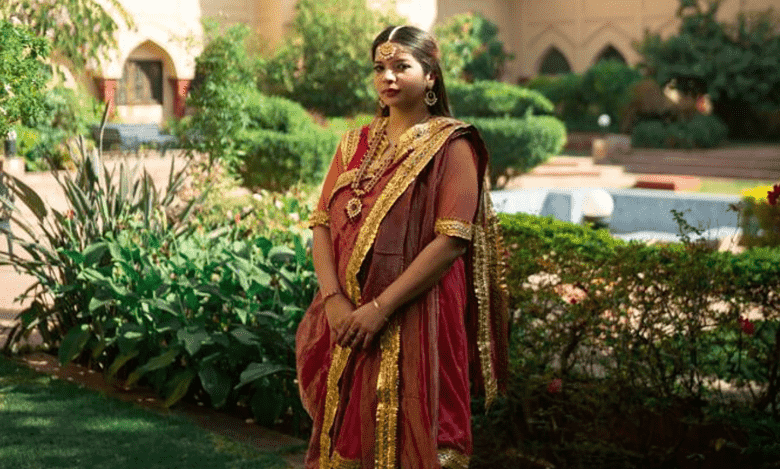
“When I wore the Khada dupatta at my wedding, a garment passed on to brides in the family, I didn’t give it a lot of thought. But it was at once desired by everyone,” remarked Sahebzadi Feroze Jahan Begum, the great-granddaughter of the last Nizam of Hyderabad, Mir Osman Ali Khan.
“Fashion can be traced back to our heritage,” she remarks.
Currently, Feroze is on a mission. Under her current project, she will travel across India hoping to shed light on how restored palaces across India are able to maintain remnants of royals who reigned in the past. Aside from spreading heritage and history, Feroze will also stage a photo shoot in which she will wear the Khada Dupatta alongside the historic monuments and old architecture at various locations.
Feroze Jahan begum’s main goal is to make the current generation aware of the Nizams’ era; their food, culture and ‘adab-o-akhlaq’.
“It worries me that each passing generation loses touch with Hyderabad’s history a little more than the previous one. It is haunting to see works of historical relevance in such a dilapidated state. My goal is to protect the neglected architecture and culture that Hyderabad has held on to for many years,” she said.
Feroze’s last trip was to meet the royal family of Bhopal. Her next trip will be to Bangalore. During her visit to Bhopal, Feroze Jahan Begum also met the state’s former royal family there. The Begum of Bhopal’s sons, Obaidullah Khan and Hamidullah Khan, are the descendants of Nawab Sultan Jehan Begum. She also promoted Hyderabadi culture, food, attire, and history by talking about Mir Osman Ali Khan Bahadur and his contributions.
The link between fashion and history is hard to miss. Hyderabad’s very own sixth Nizam Mahbub Ali Pasha played a key role in the evolution of modern-day Sherwani.
“No matter how drastically fashion changes, we keep going back to royal India’s treasured outfits. All big designers find their way to vintage and antique designs. I strongly feel the urge to connect with that style of clothing. It comes with a cultural atmosphere of its own and exemplified the royals’ sartorial sophistication,” she added.
Feroze hopes to launch a clothing line in keeping with her desire to honour the Nizam’s fashion aesthetic. Her own royal blog, ‘lifeofbegum‘, will debut soon.
source: http://www.siasat.com / The Siasat Daily / Home> News> Hyderabad / by Sanjana Gupta Taduri / December 07th, 2022
Over 200 BiPC students were present on the occasion.
ENT Surgeon Dr Sameena felicitated
Hyderabad:
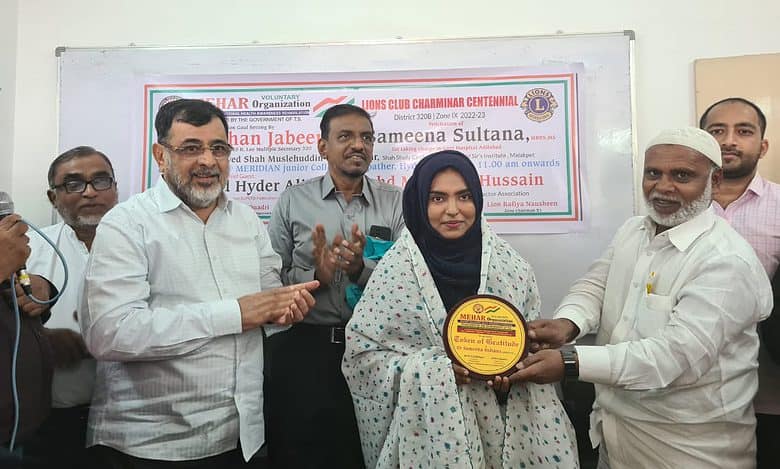
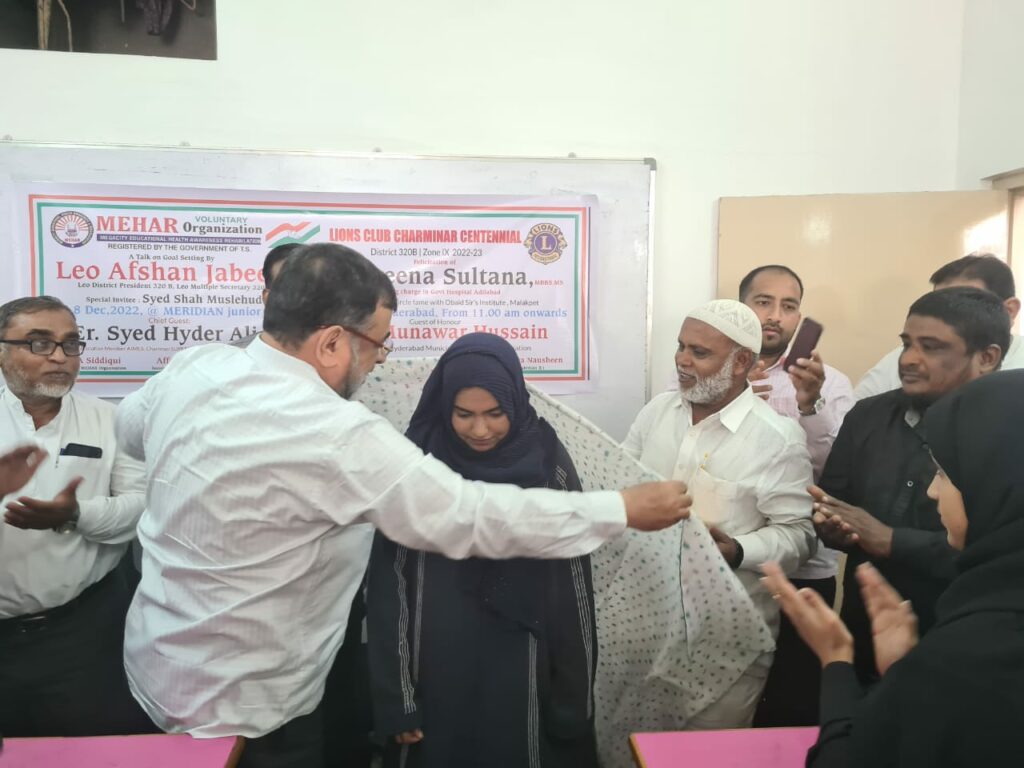
Mehar, a voluntary organization and Lions Club of Charminar felicitated Dr. Sameena Sultana MS, ENT Surgeon at Meridian Junior College, Hyderabad on her appointment as a medical officer in Kamareddy Government Hospital.
Dr. Sameena Sultana has struggled a lot and worked hard to achieve her goal. Professor Obaid played a key role and guided her in achieving her goal and becoming a government doctor.
On this occasion, MHA Siddiqui president of Mehar organization, Affan Quadri, Munawar Hussain Patron GHMC Contractors Association, chairman Jama Masjid Chowk, Er. Hyder Ali National Executive member AIMES, chairman superb federation pvt Schools Telangana, Firdous Shareef Correspondent Meridian College, and Syed Hameed, Mohd Farooq Secretary SGKT were present.
Apart from them, over 200 BiPC students were present on the occasion.
source:http://www.siasat.com / The Siasat Daily / Home> News> Hyderabad / by Sameer Khan / December 11th, 2022
Number of Muslim candidates under Category A selected for Government Medical Colleges including Osmania, Gandhi, Kakatiya Medical stood at 179.
Representational photo
Hyderabad:
Kaloji Narayana Rao University of Health Sciences has completed the three phases of web counseling. Total 603 Muslim candidates got admission in MBBS A category on the bases of NEET 2022 score in Telangana.,
The number of Muslim candidates under Category A selected for Government Medical Colleges including Osmania, Gandhi, Kakatiya Medical stood at 179, while 94 students got admission in non-minority private medical colleges and 330 students got admission in four Muslim minority medical colleges.
The cut-off marks for the BC-E category was 422 and for Muslim minority colleges stay at 424. The cut-off of the categories after the final stage mop-up stood at OC (General category) 449, BCA 360, BCB 437, BCC 372, BCD 444 and BCE 422 and SC 373 and ST remained at 376.
The Muslim students who are able to secure a seat will be presented with an award by The Siasat Daily in collaboration with MS Education Academy. Students are advised to send their information to Siasat’s Career Counsellor Mr. M.A. Hameed on Whatsapp No. 9290201021
source: http://www.siasat.com / The Siasat Daily / Home> News> Hyderabad / by Sameer Khan / December 15th, 2022
Dr Mohammed Jameel MD received the Pride of India Award at the India @75 GSA event held at Sheraton Hotel Lisle Illinois.
The award was in recognition of his Services as chairman of Americans Democratic Forum a U.S.-based 501c 4 organization that is instrumental in raising policy issues with US politicians. Also, he was recognized for being elected by the Governor of IL to the highest regulatory body Illinois state medical board.
Speaking on this occasion Dr Jameel thanked the organization and its team led by Dr Vijay Prabhakar and Shree Gurusamy for conferring the “Pride of India” award to him and commended them for inclusiveness and lauded the multilingual, multicultural, multi-religious showcase of India on its platform.
source: http://www.siasat.com / The Siasat Daily / Home> News> Hyderabad / by Sameer Khan / December 17th, 2022
Hind, son of Abi Haalah, (RA) used to describe a lot about the Prophet Muhammad (Sallallaahu Aleihi Wa Sallam)’s blessed physical features, looks and the characteristics many a times. Once describing the way the Prophet (SAWS) used to remain in grief and busy thinking, he said:
“THE PROPHET (SAWS) WOULD CONSTANTLY REMAIN IN GRIEF (ABOUT HEREAFTER) AND WOULD ALWAYS REMAIN BUSY THINKING. THERE WAS NO RESPITE FOR HIM.” (SHAMAAIL-E-TIRMIDHI: 226)
Mufakkire Millat Mualana Abdullah Kapodravi left for heavenly abode on 10th July 2018 in the afternoon. He was almost 85 years old. He was blessed with the ample portion of the quality of Allah’s Messenger (SAWS) “remaining always busy thinking” about the attributes of Allah and the betterment of the Ummah. He, therefore, used to remain busy thinking for the progress of the Ummah in general and for the betterment of the academic quality of the Ulama and the students in particular. Those who have been in his company, be it for few days or few hours, will bear witness that he was always busy thinking how would this Ummah progress and how the Ulama and the students would improve their academic qualities as they are the real guides, leaders and mentors of this Ummah. It was either his special gathering or a general programme, wherever he had a chance to address, he used to talk about the lack of attention of Ulama in the education and the deteriorating educational system of Madaaris. Observing his thoughts and views, this can be said that “he was the patron of the Ulama and the students” who was always concerned about them.
It is very true that if the Ulama are equipped with ability and skill, they are sincere, honest and qualified; they can lead this Ummah in proper way. If the Ulama and the students are weak, they are lacking in sincerity and quality, who is going to guide the Ummah? The main reason behind this thought is that the Almighty Allah has put the responsibility of leading this Ummah on the shoulders of the Ulama as they are true inheritors of the Prophets (SAWS).
Maulana Kapodravi was a perfect and competent scholar of the holy Qrua’an and Sunnah. He had deep knowledge. He was Allah-fearing scholar. He was very strict in following the Qura’an and the Sunnah in his daily life. His life was an ideal and role model. While talking, he used to present the Qura’anic verses, Ahaadeet commonly and the beautiful proverbs and idioms of the Arabic language occasionally. He liked academic conversation and dialogue. In whichever gathering he was, mostly he used to be its eloquent speaker and the president. In spite of that, he was very simple, humble and down-to-earth. Elder or younger, whoever came to meet him, with no excuse of being busy, he used to meet him at the same time without any protocol. Whenever a learned man came to meet him, he felt delighted. When he knew about any knowledgeable and qualified person visiting the vicinities of Bharuch or Surat, he would invite, host, made him stay at his home and had fruitful academic discussion with him.
This humble writer spent almost five years in Markaze Islami, Ankleshwar in Bharuch district as a learner and later as a teacher. During this period, I had opportunity to listen to his talks in the several programmes and functions. His each talk gave me impression that he is the patron of the Ulama and the students and he thinks sincerely about them. Due to his humbleness, knowledge and sincerity, he was loved by the masses and the learned people alike. None was heard complaining about him.
When I was perusing my “Diploma in English Language & Literature (DELL)” at Markaze Islami Education and Research Center, Ankleshwar, I wrote an article on the significance of English language and its learning. The rector of Markaze Islami, Maulana Moosa Mankrod (May Allah protect him!) informed him about the article and requested him to review and correct wherever necessary. Sheikh Kapodravi responded in positive happily and asked him to meet in Kapodra. Maulana Mankrod told me to get ready. Then we went with the article. When we reached, he welcomed us warmly and hosted us happily. The first and foremost, he wanted my introduction as I was a new person for him. I introduced myself. Then he asked me to read the article. I read the article which was consisting of 5000 words almost. He listened to the complete article carefully. Wherever he felt necessary for correction, he told me and I did it at the same time. When I completed the article, he appreciated, encouraged me and advised me to continue writing. It was my first meeting with him. May Allah give him the best reward and grant him Jannah!
Maulana Kapodravi used to stay few months in India and few months in Canada. When he was in India, we used to go to Kapodra to meet him. Once, Maulana Ismail Mankrod (May Allah protect him!), Director: Markaze Islami Education and Research Center and I went to Kapodra in the month of Ramadhan, in the night just after Taraweeh Salah to attend his gathering in Masjid Aisha. The gathering started with forty Durood upon the beloved prophet Muhammad (SAWS). Then he gave his talk. We listened to him attentively. We came back at the end of the gathering.
Once, Sheikh Kapodravi organized a programme in Masjid Aisha, nearby his home in Kapodra on Thursday 27th November 2008. He sent invitation letter to each Madrsa of Gujarat and requested to send the representative. The representatives of almost 45 institutions attended the programme. Maulana Yusuf Bhadkodravi, Maulana Ibrahim Falahi and I attended the programme from Darul Uloom Markaze Islami according to the suggestion of Markaz’s rector. What was the objective and aim of the programme? Please read the following paragraphs to know his sincerity, concern, worry and love for the Ulama, students and Madaaris. It will also make clear the purpose behind organizing the programme.
The theme of the programme was “Educational Decline and the Educational Progress of the Students in the Modern World”. Avoiding teachers from mutual discussion among themselves on some academic topics was also discussed. The participants presented their views and had discussion.
As the president of the programme, the suggestion and message given by Sheikh Kapodravi were very important. He suggested that in each Madrasa, there should be a teachers’ association. Under the association, there should be a library for the teachers where the books on all subjects must be available. The important magazines and newspapers of Urdu and Arabic languages publishing from India and abroad should be also arranged. The teachers should fix a time for opening the library and they should come and read the books, magazines and newspapers available. If a teacher finds an important point during his reading and he thinks that it is important for the students, he should make a photocopy of that portion and handover the students to read it. Under the association, every week, a topic should be decided for teachers’ discussion and dialogue. The teacher should prepare on that decided topic and come for open discussion. Sheikh gave dozens of books to the representative of each institution as gift and suggested to start the library with those books.
Please ponder over the aim of the programme! To spend a good amount of money, to invite the Ulama, to arrange food for them, to give them priceless suggestion, to give them dozens of books as gift and at the end to see them off with respect! SunhanAllah! What sincerity! It is a sample of the worry, concern and sincere efforts of Sheikh for the betterment and educational progress of the Ulama and the students. I don’t see anyone currently who can think so much and can go so far for the progress of the Ulama. May Allah give him the best reward!
After coming back from the programme, I gave the report of the programme to Maulana Moosa Mankrod, the rector of Markaze Islami. I also mentioned the suggestion of Sheikh Kapodravi. The rector was very pleased with the suggestion and gave approval to start the association. Then the teachers’ association was launched in Markaze Islami.
After few days, Maulana Ismail Mankrod and I reached Kapodra to meet Sheikh. He presented the tea etc. and started talking to us. During the talk, as I mentioned about the association, he became happy. Then he talked about studies and mentioned many important points about it. During the talk, he also mentioned the famous scholar of Hadith of the last century, Sheikh Abu Abdur Rahman Muhammad Nasiruddin Albany (1914-1999) and his work on Mishkatul Masabih. He also said that apart from the difference opinion, we should acknowledge one’s academic work and appreciate it.
What Sheikh Kapodravi said that is a golden point. When Allah has blessed the people with the wisdom, they may have different opinions. When they will have different opinions, the difference will arise certainly. The difference of opinion should remain as the one, but it should not change into enmity and hostility. Due to differences of opinion or due to some deficiencies, ignoring the day-night efforts and struggles of a personality is unjustified. It is a fact that Sheikh Kapodravi’s heart was neat and clean from any type of prejudice and malice. He used to appreciate the work of any scholar. It was his habit to admire the services of the elders and encouraged the efforts of the youngers.
Sheikh Kapodravi continued sending the books for the library of the Teachers’ Association latter. The books like: “Jang: Seerate Rasool Ki Raushani Men”, “Asaatidah Keliye Tarbiyati Waqiaat”, “Tafseer Azizi”, “Nasihatul Muslimeen” etc. were received in the library on his behalf.
I had chance to meet him in December 2009 in Lusaka, the capital city of Zambia. In those days, he was on a journey in Zambia. I participated in his one gathering after Isha Salaah. I met him after the gathering. He started saying that these African countries need struggles. Those who are working here will have to struggle and then it will bear fruits. During his talk, he mentioned about an Islamic school which is founded in a village: Anosa, near Petauke of the Eastern Province. He said that he had a chance to visit the school in the company of the celebrated orator, Maulana Abdul Majeed Nadeem some years back. He happily described about the discipline and education of the indigenous pupils. He praised the way they read Na’at and Nazam in Urdu language in front of him. He appreciated the efforts of Hafiz Ismail Munshi (1950-2015), who was the founder of the said school. Hafiz Ismail had completed his education of Hifz and Tjaweed from Darul Uloom Falahe Darain under the supervision of Sheikh Kapodravi. May Allah grant him Jannah!
Sheikh Kapodravi was a widely travelled and experienced person. He used to travel Asian, Arab, African and European countries. Wherever he went, he used to meet academic persons. He used to visit the libraries of those places. He used to get information about the newly published books and used to buy his loved books. Whichever places he visited, these were his preferable activities. His personal library in Kin Kapodra is full with the books of several subjects and topics.
Along with buying books, he was also very habitual and interested in reading books. He used to motivate the Ulama and the students for reading the books. When he came to know about the publication of any valuable new book, he mentioned it among the Ulama and the students and recommended to read. His love for the books and recommendation for reading was not limited just in his meeting and gathering, but he used to do it suitably in his articles and the letters as well. He writes in his travelogue of Reunion: “Aatash Fishan Ke Mulk Reunion Men”: “I present the names of the following books with the intention of informing our students as these books are very informative on the topic of Masjid”. After recording eight books’ names with its authors, he writes: “God willing, any book loving student may buy these new books and go through them; because the knowledge increases with reading the books. (Afkare Pareshan, P.: 259)
Mentioning the residence of Maulana Dr. Muhammad Taqiuddin Nadvi Mazahiri in “Alain” city of Abu Dhabi, he writes in his travelogue: “Muttahidah Arab Imarat Men Chand Din”: “I saw some new books in Maulana’s library. Some of those books are very useful for our Madaris.” Then he mentions eight Arabic books’ names, authors and publishers on Hadith and biography published from Arab countries. (Afkare Pareshan, P.: 209)
Sheikh Kapodravi was very much aware of the magazines published from different institutions and places. He used to read the magazines regularly. He also used to suggest the Ulama and the students to read it. Allah the Almighty had blessed him with the writing skill. Occasionally, he used to write in the Arabic and Urdu languages to express his views. His writings used to get published.
Once Sheikh was talking in reference to the magazines, during his talk, he gave the detailed introduction of the “Urdu Book Review” published from Delhi. He talked about the reviews getting published in the magazine and the standard language which is used. He recommended that library of each Madrasah should get this magazine. The librarian should read the magazine and try to get the beneficial and necessary books for the library. It will add a value to the library.
It is an important point to be noted that reading the articles on social, political and religious topics published in the magazines is very significant. It gives ample material and knowledge to the readers on different topics in arranged manner in a few hours. The readers are able to understand the views and opinions of the number of writers on the current affairs.
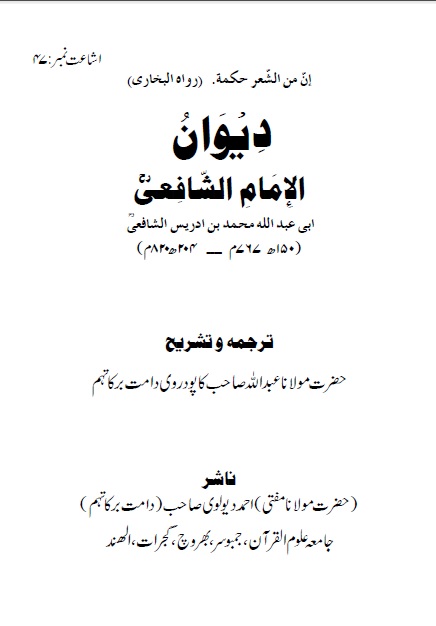
In spite of being busy in teaching and administrative duties and being occupied in the journey of different countries, Sheikh authored several books such as (1) Azwaun ‘Ala Taarikh Al-Harakah Al-Ilmiyyah Wa Al-Ma’ahid Al-Islamiyyah Wa Al-Arabiyyah Fee Gujarat, Al-Hind, (2) Allamah Badruddin Aeini Awr Ilme Hadith Men Un Ka Naqshe Dawaam, (3) Allamah Qutbuddin Awr Un Ki Ilmi Khidmat, (4) Allamah Yusuf Banuri Awr Khidmat Hadith, (5) Rushdo Hidayat Ke Minar…, (6) Haji Imdadullah Awr Un Ke Namwar Khulafa, (7) Deewane Imam Shafaee (Translation and Explanation), (8) Afkare Pareshan (2 Volumes) (9) Sadaye Dil (4 Volumes) etc.
Sheikh Kapodravi passed away on Tuesday 10th July 2018. His funeral prayer was led by Mufti Ahmad Khanpur (May Allah protect him!), Sheikhul Hadeeth: Jamia Talimuddin, Dabhel and Member of Governing Body of Darul Uloom Deoband. Thousands of Ulama and students participated in the funeral prayer. He was buried in Kapodra. Now, he is no more among us, but his good manner, humbleness, concern, worry and sacrifice for the Ulama and the students will be remembered for long. May Allah accept his services and grant him Jannah!
Sheikh Kapodravi’s Biographical Sketch
Sheikh Kapodravi was born in 1933 in Heho, Myanmar where his father was working and staying with his family. The family came back to India in 1935 and resided in Kapodra, Surat, Gujarat. He acquired the basic education of the Holy Qura’an and Urdu language in Madrasa Islamia, Kapodra. He got admission in Jamia Talimuddin, Dabhel in 1944 and studied from Farsi Class to the Mukhtasarul Quduri (3rd year of Fazilah Course). Then he got admission in Darul Uloom Deoband in 1948. He started from Kanzud Daqaiq (4th year of Fazilah Course). In next year, he learnt the books like, Noorul Anwar, Al-Maqaamat Al-Haririyah (5th year of Fazilah Course). Then he fell sick and had to come back home. When he recovered, he started his education again in “Talimuddin, Dabhel”. He completed his education from Talimuddin in 1953.
Sheikh Kapodravi learned from the following Ulama: Hafiz Ibrahim Umadwadvi, Maulana Dawood Kafletavi, Maualan Abdul Hay, Qari Bandah Ilahi, Qari Hasan from Meerut, Maulana Ibrahim Sufi, Maulana Nasir Ahmad Khan (ex-Sheikhul Hadeeth of Darul Uloom, Deoband), Maulana Fakhrul Hasan, Maulana Muhammad Naeem Deobandi, Maulana Merajul Haq Deobandi, Maulana Mahmood, Maulana Abdur Rawuf, Maulana Abdul Jabbar, Maulana Fazlur Rahman Deobandi, Maulana Fakhruddin, Mufti Mahdi Hasan and Sheikh Mahmood Tantavi from Egypt (May Allah grant them Jannah!).
His Services in the field of Teaching and Management: Following the completion of his graduation, he joined “Majlis Khuddamuddin, Simlak” and “Jamia Talimuddin, Dabhel” as a teacher. Following the resignation from those institutions, he worked as the Sub-Editor of “Tabligh”. Again he left for Darul Uloom Deoband, stayed two years and learnt from the senior scholars. Coming back from Deoband, again he joined Jamia Talimuddin, Dabhel and served as a teacher from 1961 to 1965. He got offer from “Darul Uloom Falahe Darain” in Tarkeshwar, Surat in January 1966 to teach. Latter, in March 1966, he was appointed as the rector. As the rector, he appointed numerous qualified teachers, created the suitable environments of teaching and learning and established the best system of cleanliness etc. He made “Falahe Darain” a model institution. From 1966, he served as a teacher and the rector of Falahe Darain continuously for 27 years beautifully. When the institute reached at the peak of success, he resigned willingly; but his love remained the same for “Falahe Darain” as he had as the rector. May Allah accept his services and grant him Jannah! ●●●●
*Moon Rays Trust School, Zambia, Africa
Email: qasmikhursheed@yahoo.co.in
source: http://www.millattimes.com / Millat Times / Home> Opinion / by Khursheed Alam Dawood Qasmi / December 18th, 2022
[Newly elected President of Majlis e Mushawerat and National President of All India Momin Conference Advocate Feroze Ansari (right) with Jameel Karanti (President of All India Momin Conference Malegaon in a file photo. (photo: ummid.com)]
Advocate Feroze Ansari is a practicing lawyer in the Supreme Court of India. He was only a month ago elected unopposed the President of All India Momin Conference (AIMC).
New Delhi: Advocate Feroze Ansari has been elected as the new president of All India Muslim Majlis-e-Mushawerat (AIMMM).
Advocate Feroze Ansari is a practicing lawyer in the Supreme Court of India. He was only a month ago elected unopposed the President of All India Momin Conference (AIMC).
All India Muslim Majlis-e-Mushawarat and All India Momin Conference both organisations are decades old. While the All India Muslim Majlis-e-Mushawarat was formed in 1964, All India Momin Conference was established in 1911.
Advocate Feroze Ansari defeated Aamir Edresy, President of Association of Muslim Professionals (AMP) and Software Engineer who is based in Mumbai.
Advocate Feroze Ansari will take over the rein of All India Muslim Majlis-e-Mushawarat after Prof. Dr. Basir Ahmad Khan who became interim president of the Mushawerat after Navaid Hamid – a renowned social activist based in New Delhi, completed his five-year term as president in 2021.
[Advocate Firoze had visited Jamia Mohammadia Mansoora Campus during his visit to Malegaon in September 2022. (Photo: ummid.com)]
Advocate Feroze Ansari is set to remain President of All India Muslim Majlis-e-Mushawarat for the full five term.
About Advocate Feroze Ansari
Advocate Feroze has always been at the forefront in raising issues pertaining to Indian Muslims. On this front, he had deposed before Justice Ranganath Mishra Commission and Justice Sachar Committee to share in details the problems of Muslim community in India.
He had recently also met Congress leader Rahul Gandhi during his Bharat Jodo Yatra in Burhanpur, Madhya Pradesh and briefed him about the issues facing the Muslims, especially the weavers.
Talking to ummid.com after the Mushawerat election results were announced Sunday, Advocate Feroze vowed to strengthen the organisation and work to resolve the pending issues of the Muslims in India and their upliftment.
[Advocate Feroze Ansari and other members of All India Momin Conference visiting Malegaon Textile Park in September 2022. (Photo: ummid.com)]
“Our top priority will be to work for the resolution of the pending issues of the Muslim community”, he said.
“Besides, we will work as a team to strengthen All India Muslim Majlis-e-Mushawerat (AIMMM) so that it regains its lost glory”, he said.
About Majlis-e-Mushawerat
All India Muslim Majlis-e-Mushawarat (AIMMM or MMM) is a federation of various Muslim organisations in India. Majlis-e-Mushawarat was formally launched at a two-day (August 8–9) meeting in 1964 at the Islamic seminary Darul Uloom Nadwatul Ulama, Lucknow.
Several leading Muslim scholars and clerics, including Syed Abul Hasan Ali Nadvi, attended the meet while freedom fighter and a member in Jawaharlal Nehru’s cabinet Syed Mahmud was elected its first president. It was established as an advocacy group in the wake of communal riots in the early 1960s.
Other who headed Muslim Majlis e Mushawerat include Syed Shahabuddin, Dr Zafarul Islam Khan, former Chairman of Delhi Minorities Commission and Editor of The Milli Gazette.
Meanwhile, Jameel Karanti, President of All India Momin Conference Malegaon has congratulated Advocate Firoz Ansari, the newly elected president of the All India Muslim Majlis-e-Mushawerat (AIMMM).
“Advocate Firoz was only a month ago elected unopposed National President of All India Momin Conference. His election as President of Majlis e Mushawerat is a historic moment and will help in strengthening both the organisations”, he said.
source: http://www.ummid.com / Ummid.com / Home> India / by ummid.com Staff Reporter / January 01st, 2023
In Sikh history, December is called the ‘month of sacrifices’ as it was in this month that the family of the tenth Guru Gobind Singh was martyred.
The tenth Sikh Guru was fighting a war against the Mughals when his family – wife and four sons – attained martyrdom. Countless Muslim families supported Guru Gobind Singh in the war even at the risk of being targeted.
Their stories have been recorded with the utmost respect in the pages of Sikh history.
Some of the relics and symbols related to Guru Gobind Singh continue to be preserved by Muslim families with utmost devotion and purity.
One of these is ‘Gangasagar‘.
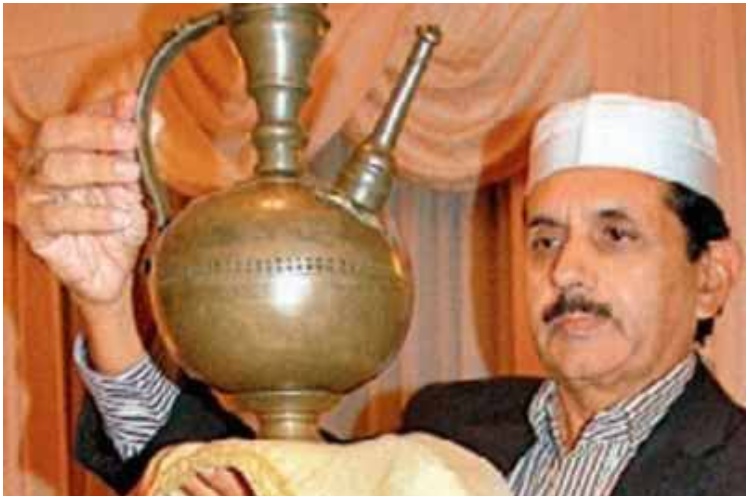
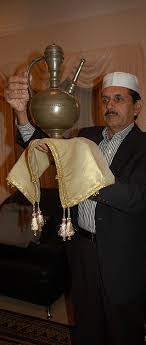
Gangasagar is a priceless vessel made of an alloy of copper-brass and some other metals, that Guru Gobid Singh used for drinking milk and water etc. He always kept it with him.
Rai Aziz Ullah Khan holding Gangasagar
It’s said that he carried Gangasagar to the war and also in the final battle of his life with the Mughals.
His sons Sahibzade Baba Jujhar Singh and Baba Ajit Singh were martyred in the fort of Chamkaur.
Just before this, Guru Gobind Singh had left the fort of Anandpur Sahib and parted ways with his family on the banks of river Sarsa.Guru Gobind Singh reached Machhiwada fighting his way against the Mughal army where he met two Muslim brothers Navi Khan and Gani Khan. They offered him shelter.
The brothers served him with devotion and with utmost dignity.
The Khan brothers were horse traders. Before taking their leave, Guru Gobind Singh accorded them the status of Pir in recognition of their services.
Navi Khan and Ghani Khan were well aware of the Mughals’ power, yet they carried Guru Gobind Singh on their shoulders and took him safely out of Machhiwada with proper protocol. Some other Muslim notables also accompanied them.
A portrait of Rai Kallan
At that time, the area was surrounded by the Mughal forces and their spies were keeping track of Guru Gobind Singh’s movements.
Guruji came face to face with the Mughal army at many places outside Machhiwada. At that time the saying “patta-patta sher ka Dushman ho gaya hai (Each leaf of the jungle has turned into the enemy of the Lion)” become commonplace. It was about the spies let loose by Mughal rulers against Guru Gobind Singh.”
When Gobind Singh reached the village of Heran in the Muslim princely state of Raikot, he met a shepherd in the fields. His name was Nooran Mahi. Nooran Mahi had heard about the martyrdom of Gobind Singh’s sons and yet he had no idea of the man he was meeting.
Guru Gobind Singh was tired and he asked him for milk to drink. As a host, Mahi filled his Gangasagar with milk. Mahi sensed that he was meeting an extraordinary person and had no clue about his identity.
He went to Raikot and informed his boss Rai Kallan about his encounter. After listening to Nooran Mahi’s words, Rai Kallan could make out that he had met Gobind Singh.
A painting of Guru Gobind Singh
Throwing caution to the winds, he ran to the place where Mahi had met Gobind Singh and took him to his mansion. Again he served the Guru with utmost affection and devotion.
Gobind Singh told Rai Kallan that he got separated from his family at Sarsa river and he wanted to know about the whereabouts of his wife and sons.
He requested Rai Kallan to depute a reliable person to Sirhind to find out about them.
Rai sent Nooran Mahi for the secret mission. On return, he broke the sad news to Guruji that his wife and sons have been killed. Nooran Mahi’s name is mentioned in the pages of Sikh history. After Guru Gobind Singh decided to continue his journey and the war against the Mughal Empire.
Guru Gobind Singh Rai was so pleased with Kallan’s service and spirit that he gifted his favorite jug ‘Gangasagar‘ to him.
He also gifted him some other items that he used. Among the gifts was a Peedi (a low-lying table) that has been used by generations in Rai Kallan’s family to place the Holy Quran for recitation.
A poster of Guru Gobind Singh
Raikot and its adjacent Talwandi Rai were Muslim-majority states and had Muslim administrators.
To commemorate the visit of Guru Gobind Singh to Raikot, the Muslims and Sikhs of Raikot and Talwandi built the historic Gurudwara ‘Rahaliana Sahib’.
Every day thousands of Sikhs, Hindus, and Muslims pay obeisance there. This place stands as testimony to unity and harmony among Indians.
Also, Guru Gobind Singhji’s favorite jug, or Surahi ‘Gangasagar‘ is still being handled with full devotion and protection by a Muslim family. At present, the head of the family is Rai Aziz Ullah Khan, who was born n Pakistan and is now settled in Surry, Canada.
Rai Aziz Khan represents the ninth generation of the Rai Kallan family. He was 27 years old when he was told about Gangasagar and other relics of Guru Gobind Singh.
Gangasagar
Rai Aziz Ullah Khan inherited this jug along with other things.
When he left Pakistan, he carried all these valuables with him with the full procedure. He had kept these things in the locker of a bank.
In 1999, on the occasion of Baisakhi, an international-level function was organized at Anandpur Sahib to commemorate 300 years of the martyrdom of the family of Guru Gobind Singh, Rai Aziz brought ‘Gangasagar’ and other relics for the darshan of the devotees.
He was provided a chartered flight by the then Government of India. Prime Minister Atal Bihari Vajpayee also visited Anandpur Sahib to have a darshan of the relics of Gobind Singh.
source: http://www.awazthevoice.in / Awaz, The Voice / Home> Culture> by Amrik Singh, Jalandhar / January 02nd, 2022
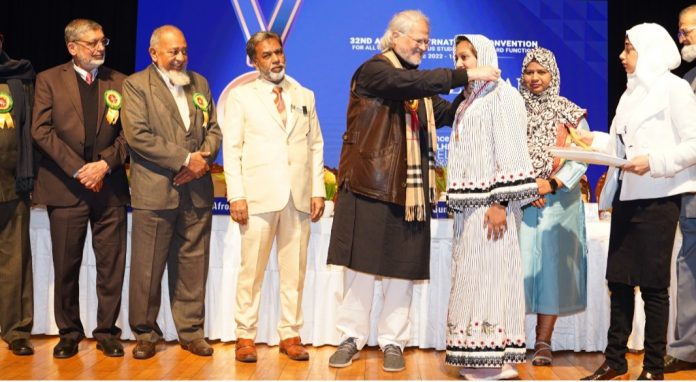
Najeeb Jung, former LG, Delhi, felicitating a meritorious student at the convention.
New Delhi:
Students along with their parents from 19 states convened in the national capital for the event. More than 80 students who passed class 10th and 12th in the year 2022 received medals, certificates and cash prizes.
“I was truly impressed when I got to know that people in America are so committed to contribute to the welfare of students here in India. This is very motivating,” said Ifrah Rauf, who received silver medal. Ifrah scored 95.6 per cent in class 12th and is now pursuing B.C.A from Indraprastha University. Ifrah’s mother is a teacher and father, a software professional. “This is encouraging for parents as well. This makes us believe that we took the right step by getting our daughter educated,” said Ifrah’s mother, Tayyaba Rehman who was present the convention.
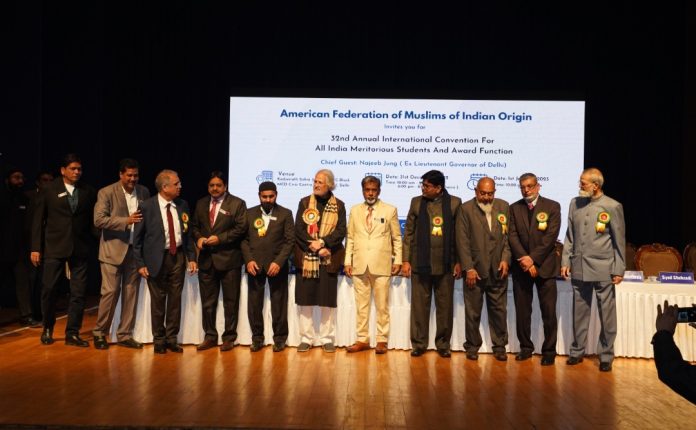
Dr Tabrez Taj, senior journalist, Afroz Alam, member, AFMI, Seraj Thakore, former president, AFMI. Mohammad Naeem, president, DYWA and Najeeb Jung, former L,G, Delhi, felicitating meritorous students during the convention.
Sixty one out of 84 awardees were girls. Gold, silver and bronze medallists received Rs 7,000, Rs 5,000 and Rs 3,000 respectively.
“It is fantastic to see so many students, especially girls, scoring so high in schools,” said Najeeb Jung, former LG, Delhi, who was the chief guest at the programme. “We should remember that knowledge is different from education. While you get educated through curriculum, it is also important to get knowledge because knowledge tells you how to be a better human being and how to treat people around you. Good scores will get you a job but knowledge will change your perspective,” said Jung.
He cautioned the audience against the dangers of technology. “It is good that we learn and use social media but we have to avoid addiction and ensure that the tech companies don’t manipulate us,” he said.
AFMI was formed in 1989 in Detroit (USA). AFMI has held conventions all over the country since its inception in 1989. It has honored more than 4,000 students from over 400 of India’s districts.
DYWA, formed in Delhi’s Walled City in 1990, works to promote education for under privileged children. It runs scholarship schemes, course distribution and a library housing more than 4000 books, among other initiatives.
Khalil Ahmed, patron, DYWA, said that in the present age and time, we should not always associate education with jobs and career. “Get educated to understand yourself, the world and the journey of life,” he said. “If you get a job, it is an added bonus. If you don’t get one, it is not the end of the world. If you have a family business, focus on expanding the same and take it to new heights. Don’t look down at it,” said Ahmed.
The awardees included two sisters from Telangana. Nargis Sultana (gold medal) and Nafees Sultana (silver medal) scored 95 per cent and 93 per cent in grade 12th. Nargis wants to be a doctor and is preparing for NEET. Nafees is pursuing Bachelors in pharmacy in Telangana. Their father, Mohammad Abdul Saleem accompanied them for the ceremony. “Both myself and my wife could not finish school education. We were clear that we would get out daughters educated and make them self- dependent,” said Saleem who works as a supervisor in a borewell. “Events like this one boosts our morale,” he added.
This was AFMI’s 32nd convention to honour student achievers in the country.
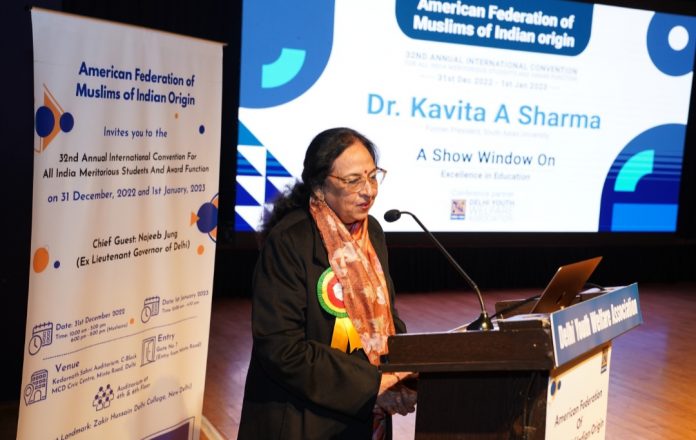
Dr Kavita Sharma, former president, South Asian University speaking at the convention.
Dr Kavita Sharma, former president, South Asian University, Dr Akhtarul Wasey, president, Maulana Azad University, Jodhpur, historians Swapna Liddle and Samina Mishra were also present at the event,
“In a jungle, trees compete to get sunlight. In the process, they outgrow each other. Similarly, we have tried to create a healthy competition among students. They get motivated and inspired when they see each other at such events,” said Shafi Lokhandwala, member, AFMI.
source: http://www.muslimmirror.com / Muslim Mirror / Home> Communal Harmony> Positive Story / by Muslim Mirror Network / January 01st, 2023