According to food delivery platform Swiggy, last year, Bawarchi clocked a sale of 2 biryanis per minute on the same day. The restaurant is planning to break that record this time.
Representational Image
Hyderabad:
Bawarchi restaurant in Hyderabad, for new year’s eve, has readied 15000 kgs of Biryani to cater to thousands of food lovers who are celebrating the end of another year.
According to food delivery platform Swiggy, last year, Bawarchi clocked a sale of 2 biryanis per minute on the same day. The restaurant is planning to break that record this time.
Chicken Biryani continued to be the most ordered on the food delivery platform Swiggy for the third consecutive year, showing statistics from the company. This pretty much sums up the city’s food culture, which if it has to be summed up in one line is: Biryani is king.
Interestingly, the number one snack item ordered on Swiggy in Hyderabad was everyone’s favourite – Idly. Apart from the usual chicken wings, samosas and veg puff – which are regularly on the most ordered items on Swiggy – the traditional Bun Maska (usually sold in Irani cafes) also found its way up on the most ordered list for snacks.
Another traditional item, Khubani Ka Meetha or Apricot Delight, turned out to be the most favourite dessert for Hyderabadis, while Double Ka Meetha was the most ordered dessert in Telangana, showed stats from Swiggy.
What people of Hyderabad and Telangana love to Eat on Swiggy Food Marketplace
Top 3 most ordered dishes: Chicken Biryani, Apricot delight, Mutton Biryani
Top 3 most ordered non-dishes – Thums up (drink), Milk Products, Tomatoes
Top 3 most ordered snacks: Idli, Maska Bun, Masala Dosa
Top 3 most ordered desserts on Swiggy: Apricot Delight, Double ka Meetha, Fruit Salad with Ice Cream
source: http://www.siasat.com / The Siasat Daily / Home> News> Hyderabad / by News Desk, posted by P N Sree Harsha / December 31st, 2022
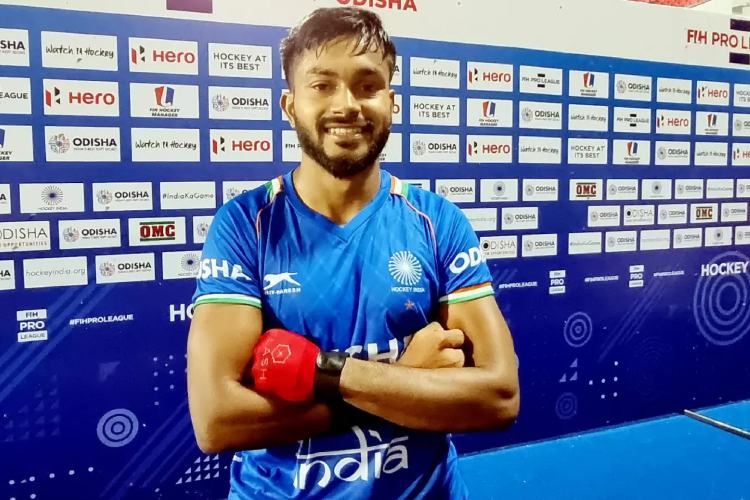
From the disappointment of not making it to the Indian team despite being called for two national camps, to donning the India jersey, Mohamed Raheel Mouseen travelled eight years trying to impress the national selectors and chief coach of the Indian Hockey team, Graham Reid.
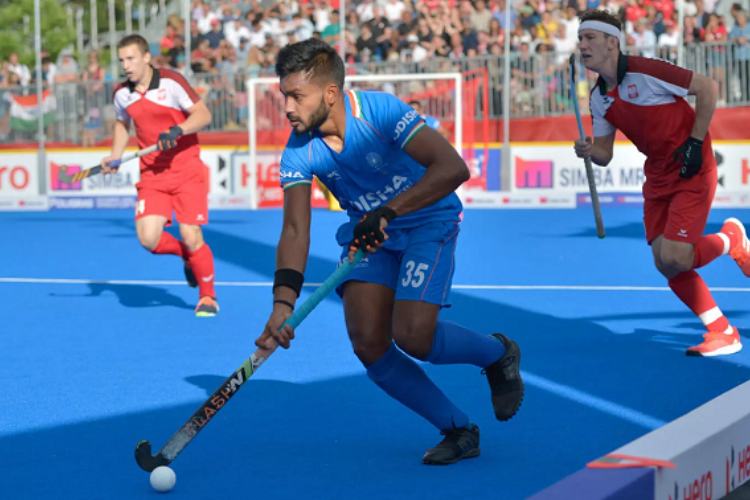
25-year-old Raheel, finally made his India debut against New Zealand in the FIH Pro League Hockey Championship in Bhubaneswar in October.
“It was a wonderful feeling to be wearing the India jersey. Dream come true. I played Hockey only to play for the country,” says an excited Raheel.
As providence would have it, he played his first match for the country in the same stadium where he had come as a teenager to watch an India-Pakistan match.
Way back in 2014, Raheel was among the few trainees of Sports Authority of India Sports School, Bangalore who came to the Kalinga stadium to cheer for the Indian team in a Champions Trophy match against Pakistan.
“I played hockey only to play for the country”
“I still remember the atmosphere was electric. I visualized myself playing on the turf with so many people watching,” he says.
The dream that was in its nascent stage, took a firmer shape that day. “The crowds, the national anthem playing, the frenzy in the stands, the pride I saw in the players…it all stitched together and I knew one day I will play for India,” adds Raheel.
“I knew one day I will play for the country”
But he also knew it won’t be as if he will wake up the next day and someone will hand him the India jersey. “I was determined to do the extra yards to earn the India cap,” he adds.
A sports buff, who follows the English Premier League and the fortunes of the Royal Challengers Bangalore in the Indian Premier League, Raheel comes from a family of Hockey players.
His father was a state player who played for the Hindustan Aeronautical Limited team in the local league. His elder brother was twice called for the junior national camp. All good achievements but not good enough to etch their names in the annals of Indian hockey.
“I have ensured the one missing piece is added to the family wall,” Raheel says with a smile.
He started playing Hockey at the age of five. So impressive was his growth as a player that by the age of 15 in 2012, he got selected to join the Sports Authority of India Sports School. After graduating from there he joined the Centre of Excellence.
“It was at SAI, my Hockey went on to the next level,” he says. Under the guidance of renowned coaches including former international, Jude Felix, Raheel continued to sharpen his skills as a striker in the hope of catching the attention of selectors and the senior team management.
“Olympics is a definite box I want to tick”
He was called for the senior national camp in 2018, but did not impress enough to make the final cut. However, his stellar performance in the domestic circuit, earned up a call for the Hockey 5s tournament in Lussane, Switzerland in 2022. There he emerged as the top-scorer with 10 goals, and was a key to India’s title triumph in the inaugural championship.
From there, it was only a matter of time before he made it to the India team in the proper format.
His performances impressed Graham Reid and after a few months in the national camp, Raheel was called to do India duty in the FIH Pro League. He is currently in Australia where India is playing five matches in preparation for the upcoming world cup in January.
Raheel who considers former internationals from Karnataka, VS Vinay and Arjun Hallapa as his role models, wants to now ensure the opportunity that has come his way does not slip off easily.
“I am looking for longevity in the Indian team. I want to play for the country for as long as possible. Olympics is a definite box I want to tick,” he says looking at the India jersey he wore in the FIH Pro League.
And fans will be hoping he weaves the same magic on the field as a Mohammed Shahid or a Zafar Iqbal for a good time to come.
source: http://www.awazthevoice.in / Awaz, The Voice / Home> Sports / by Nakul Shivani, New Delhi / November 30th, 2022
A well-known writer and Aligarh Muslim University (AMU) faculty member, Prof M Shafey Kidwai has been appointed as the Chairman of the renowned Qatar-based literary organisation ‘Majlis-e-Frogh-e-Urdu Adab’.
MFUA had the late Indian theorist, literary critic, and Urdu scholar, Prof Gopi Chand Narang on the honorary post of Chairman of that organisation.
The ‘Majlis-e-Frogh-e-Urdu Adab sets forth a platform to encourage fresh litterateurs in the domain who are mentored by experienced writers and poets with distinctive styles and practices. As the Chairman of the Adab Aalmi Award Jury Committee from India, one of the important roles will be to acknowledge those adept at the art,” said Majlis Chairman, Mohammad Atiq.
Extending congratulations, AMU Vice-Chancellor, Prof Tariq Mansoor said: “I am pleased to see that Prof Kidwai has been chosen to head the jury of a prestigious award. The university community is celebrating the dedication he has shown on the way to a well-deserved and earned success”.
Prof Kidwai is a known scholar, academic, bilingual critic, translator and author.
He has been writing for a number of reputed Urdu and English journals. His reviews and articles regularly appear in The Hindu, The Hindustan Times, The Indian Express, The Outlook, The Book Review, The Indian Literature, The Frontline, Siasat.com and others.
He has authored five books in English and eight in Urdu and published more than 100 articles in peer-reviewed journals.
He is a recipient of the Sahitya Academy Award (2019), Kalinga Literary Award (2021), Iqbal Samman (highest literary award of Madhya Pradesh Government, 2018) and Amir Khusro award (highest literary award of Uttar Pradesh Urdu Academy, 2017).
Prof Kidwai has been teaching communication studies, film studies, broadcast journalism, sports journalism and Urdu journalism for over 35 years at the Department of Mass Communication, AMU.
source: http://www.siasat.com / The Siasat Daily / Home> Featured News / by siasat.com news desk / August 13th, 2022
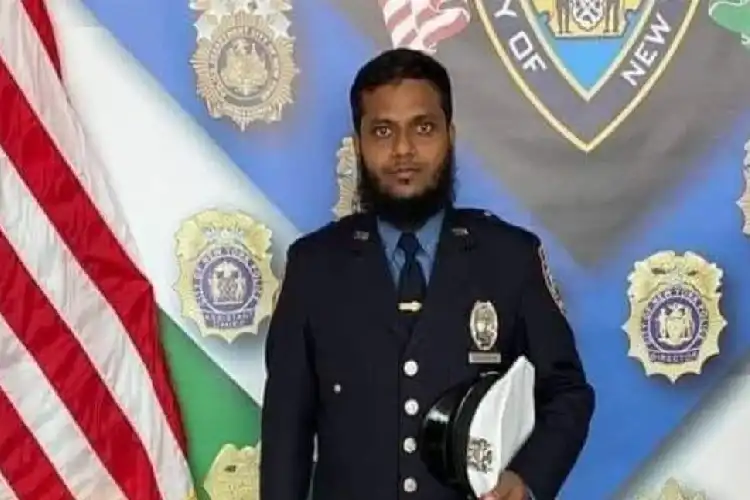
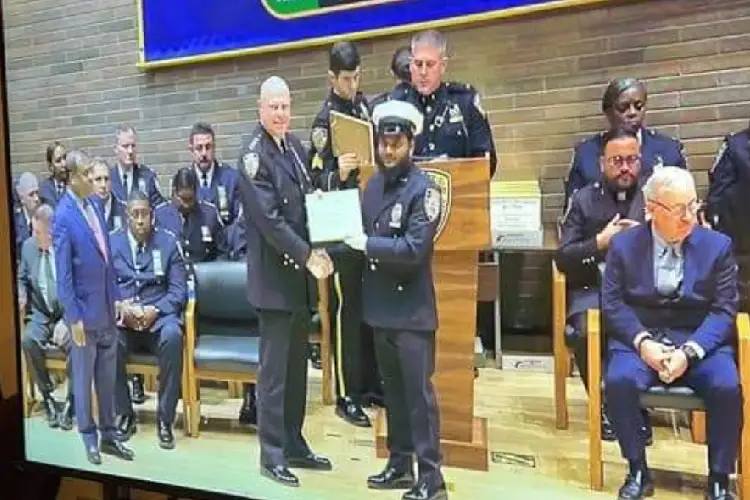
While there is a sense of jubilation on the recruitment of thousands of young people in the Assam Police through a transparent and fair recruitment process in a faraway land – the USA – an Assamese Abidur Reza Chowdhury alias Karjon Chowdhury of Badarpur, Karimganj district (Barak Valley) has been appointed in the New York Police Department (NYPD).
The young man from Badarpur joined the New York Police Department in October. Congratulating f Abidur, his friend Imran Laskar, wrote on Facebook:
“I am very much delighted and overwhelmed to share the grand achievement of one of my very best friends who has recently cracked one of the world’s most prestigious and most renowned with rewarding New York Police Department (NYPD), United State of America competitive exam and cracked with flying colours.
A tireless effort, dedication, commitment, and strong determination have made him achieve this success. Nevertheless, as we spend year on the year together, I found him always dynamic, utmost level of IQ, and was studious with multi-dimensional intelligence. He is none other than Karzon Choudhury, A resident of the small town of Karimganj, Assam. Huge applause and heartiest congratulations from me and on behalf of his all classmate from Delhi. I couldn’t but share the pride moment of receiving my graduation of him.”
source: http://www.awazthevoice.in / Awaz, The Voice / Home> Youth / by awazthevoice.in / by Shatananada Bhattacharya / Hailakandi / October 13th, 2022
Abidur Reza getting his credentials as NYPD cop
Another friend Riz Chowdhury wrote on Facebook:
“Alhamdulillah. On behalf of My brother Shohid AR Choudhury (Karzon), I would like to thank everyone for your immense love and support. He cannot post, reply or comment on anything on any social media due to NYPD privacy policy. So, please don’t think otherwise, and keep him in your prayer for health and success. Once again thank you to every one of you who showered love on my brother.”
Abidur Reza Chowdhury has a sister who is already working for the US Department of Health and Human Services. All members of his family are US nationals. Abidur has been living in the United States since 2014. It was his mother who took retirement from Mahakal LP School No. 215 and immigrated to the United States.
Her daughter got a job with the US Department of Health and Human Services.
Dr Ambedkar and Maulana Hasrat Mohani (left) at Sardar Patel’s reception
THE freedom attained on 15th August 1947 was a result of a long struggle which involved contributions and sacrifices of men and women of all classes and communities of India. Muslims form an integral part of this history. That muslims played an equal and important role in the freedom of India cannot be overstated.
It was muslims who spearheaded the very first attempts to fight back British imperialists. The list of people is inexhaustive. Whether it was Nawab Siraj-ud-Daulah in the Battle of Plassey or Tipu Sultan in the Seringapatam battle in South India in 1799; Muslims were not soft by any means towards Britishers. Infact, in what is known as the first war of Independence, 70% Hindu revolutionaries together with Muslims chose a Mughal ruler Bahadur Shah Zafar as India’s Ruler.
Bakht Khan from Bijnor district of Uttar Pradesh, was a major part of the rebellion of 1857. An experienced army-man, Bakht Khan was serving as the Subedar in the Army of East India Company and took command of the rebel forces. His strong and powerful rebellion activities prompted the British rulers to launch a manhunt against him, following which, he was shot dead by Britishers.
There are still many muslim heroes, some at the center and some pushed to the margins. Muhammad Ashfaq Ullah Khan of Shahjehanpur who conspired and looted the British treasury at Kakori (Lucknow) to cripple the administration is one. When asked for his last will, before execution,he said: “No desire is left except one that someone may put a little soil of my motherland in my winding sheet.”
Similarly, Barkatullah and Syed Rehmat Shah of Ghadar Party sacrificed their lives for the independence of their country. Umar Subhani, an industrialist and a millionaire of Bombay is popularly known for presenting a blank cheque to Gandhiji for ‘Tilak Swarajya Fund and INC. His boundless donations crippled him but he bore the challenge for his country.
Who doesn’t know Khan Abdul Ghaffar Khan, “frontier gandhi”, who was one of the major reasons behind the Britishers leaving India. Ghaffar Khan met Gandhi and entered politics in 1919 during agitation over the Rowlatt Acts, which allowed the internment of political dissidents without trial. In the following year he joined the Khilafat movement.
Then there was another such stalwart leader and freedom fighter of India, Maulana Abul Kalam Azad. His service to the nation didn’t just stop after India became independent, he continued serving India till his last breath.
Inspired by Bhagat Singh and Chandrashekhar Azad, Abbas Ali joined the Indian freedom movement in his teenage after completing his education. He joined the Indian National Army (INA) or the ‘Azad Hind Fauj’ and was subsequently court-martialled and sentenced to death.
When thousands of freedom fighters were getting jailed everyday, yet another Indian muslim, Asaf Ali stepped up and fought their legal battles to bail them out. He was even jailed alongside Jawaharlal Nehru. He participated in the ‘Quit India Movement’ and did everything he could to help India achieve independence. On 1 April 1953, Asaf Ali died in Bern (Switzerland) while serving as India’s representative. A postal stamp was issued in his honour in 1989.
Important historical events and etched echoes from India’s freedom struggle have a marked muslim presence, shoulder to shoulder with other Indians. It was Dr. Saifuddin Kichloo, hailed as the ‘Hero of Jallianwala Bagh’ who conducted a public meeting at the historical Jallianwala Bagh on 30 March, 1919, protesting the Rowlatt Act during the Indian National Movement. It was Yusuf Meher Ali, a socialist leader, founder of the National Militia, Bombay Youth League and the Congress Socialist Party who said, “Simon Go Back” was part of the Quit India Movement along with Mahatma Gandhi for India’s last nationwide campaign for independence from the British Empire.
Cardinal movements like the Non-cooperation Movement and the Swadeshi Movement saw overwhelming Muslim participation. Janab Sabusiddiq who was the sugar-king of that time gave up his business as a form of boycott. The Khoja and Memon communities owned the biggest business houses of that time and they parted with their treasured industries to support the boycott.
Muslim freedom fighters were active in the field of journalism as well. Maulana Azad used his pen against the British despite being prevented by the colonial powers a number of times. In fact, the first journalist to be martyred publically in the cause of India’s Freedom Struggle was also a Muslim – Maulana Baqar/Moulvi Muhammad Baqir. He was executed following the revolt of 1857.
Additionally, the history of the Indian national movement would be incomplete without mentioning the contribution of Muslim women. Asghari Begum (mother of Qazi Abdur Rahim, the revolutionary of Thana Bhawan, Muzaffarnagar) fought against the British and was burnt alive when defeated. It was estimated that about 225 Muslim women gave their lives in the revolt. Begum Hazrat Mahal, revolutionary Queen of Awadh, was the unsung heroine of the first war of Independence, who shot the British ruler, Sir Henry Lawrence and defeated the British army in a decisive Battle at Chinhat on 30thJune, 1857. Bi-Amma out of the hundreds of women who fought the battle of freedom along with their men folk against the British Raj. Abadi Begum (mother of Maulana Muhammad Ali), Amjadi Begum (wife of Maulana Muhammad Ali), Amina Tyabji (wife of Abbas Tyabji), Begum Sakina Luqmani (wife of Dr Luqmani and daughter of Badruddin Tyabji), Nishat-un-Nisa (Begum Hasrat Mohani), Saadat Bano Kitchlew (wife of Dr Saifuddin Kichlew), Zulekha Begum (wife of Maulana Azad), Mehr Taj (daughter of Khan Abdul Ghaffar Khan), Zubaida Begum Daoodi (wife of Shafi Daoodi, the reputed nationalist of Bihar) and many others. Aruna Asaf Ali popularly known as the ‘Grand Old Lady’ of the Independence Movement. She is known for hoisting the Indian flag at the Gowalia Tank Maidan in Mumbai during the Quit India Movement. In 1932, she had gone on a hunger strike in Tihar Jail against the mistreatment of the political prisoners, which led to an improvement in their living. There are many many more of such brave souls who fought for their nation all along with the people of other religions of the Country.
Views expressed in the article are the author’s own and do not necessarily represent the editorial stance of Kashmir Observer
The author is the Principal (I/C) Abhedananda Home-Higher Secondary Institution for Specially-abled Children, Solina, Rambagh, Srinagar and can be reached at abhome78@gmail.com
source: http://www.kashmirobserver.net / Kashmir Observer / Home> Guest Author, M Ahmad / August 14th, 2021
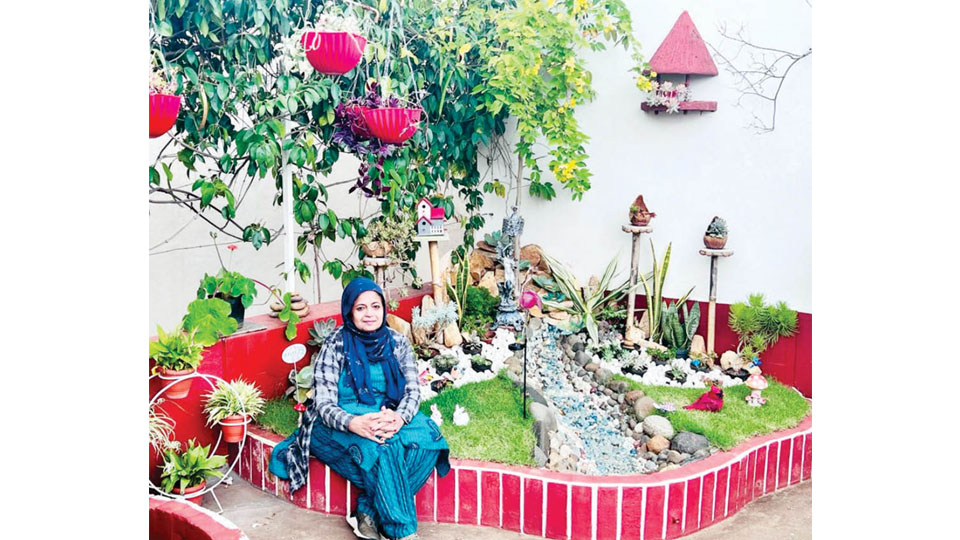
Nishhat Afza, Founder and Director of Curiocity — School of Creative Art and Design, N.R. Mohalla, Mysuru, has bagged first prize in the ornamental terrace garden and 1st prize in waterfalls for the 5th consecutive year in the Dasara Home Garden contest organised by the Horticulture Department.
An active member of Srushti Bonsai Club, she has also participated in women empowerment and other social activities. Besides, she helps people with landscaping and waterfall designing.
source: http://www.starofmysore.com / Star of Mysore / Home> Gallery> Photo News / October 07th, 2022
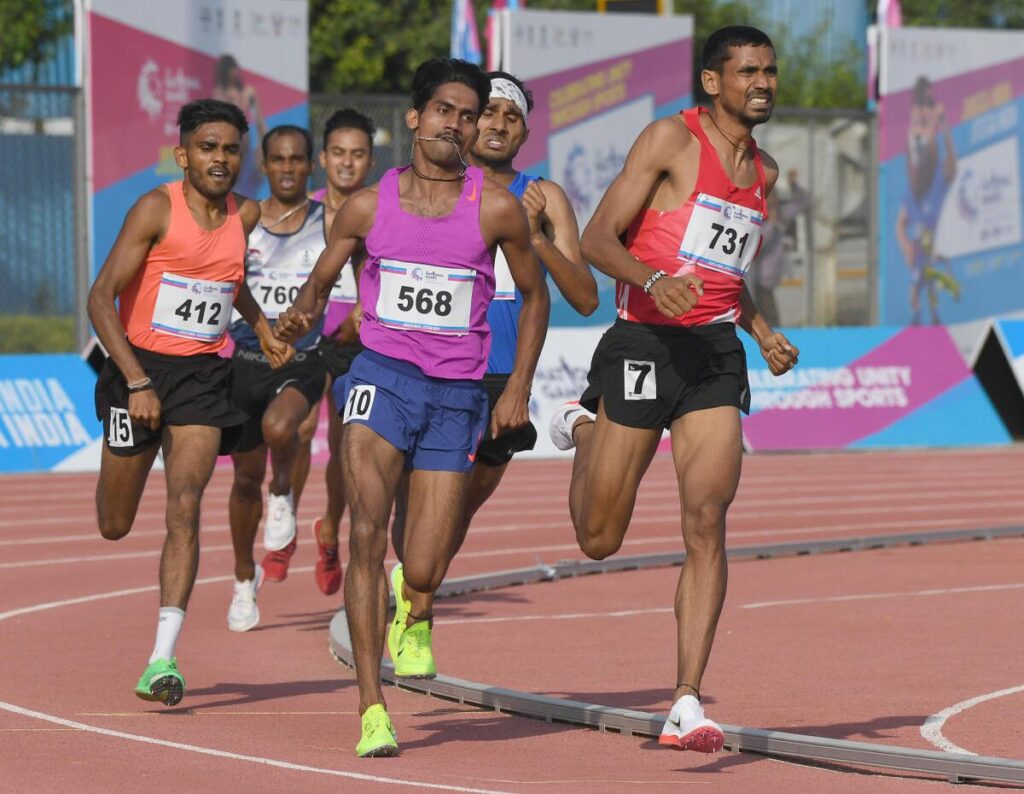
Parvej clocked 3:40.89 to leave Bahadur Prasad’s 1994 National Games mark of 3:43.57 behind.
Parvej Khan (568) of Services wins the men’s 1500M gold, and Ajay Kumar Saroj (731) comes second at the 36th National Games in Gandhinagar on September 30, 2022. | Photo Credit: V. V. Krishnan
Gandhinagar, Gujarat:
Parvej Khan improved upon Bahadur Prasad’s 28-year-old record to win the men’s 1500m event in the athletics arena of the National Games at the IIT campus here on Friday.
Parvej clocked 3:40.89 to leave Bahadur’s 1994 mark of 3:43.57 behind.
In the absence of Abdulla Aboobacker, Praveen Chithravel stole the limelight by setting a new Games record and winning the men’s triple jump title. The Tamil Nadu jumper leaped to 16.68m to erase Ranjith Maheshwary’s 2015 mark of 16.66m.
“After the Commonwealth Games I was not training with full intensity. But I wanted to finish well here. The presence of Eldhose Paul and Aboobacker would have pushed me,” said Praveen.
Altogether six Games records were made on the opening day of the athletics events.
Nine soldiers from the Indian Army’s Force K6 died in the area after fighting with the British in World War I and II.
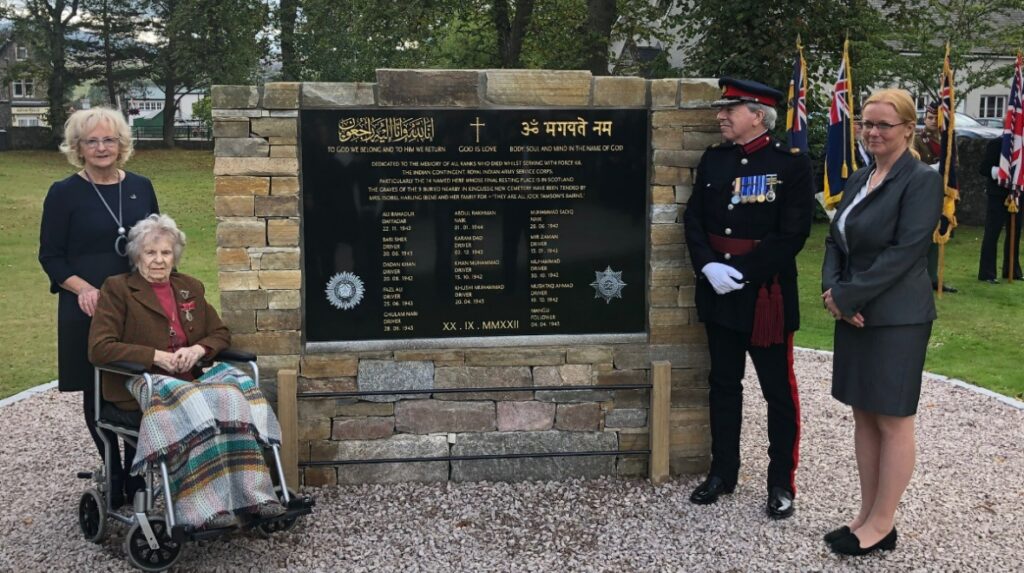
Monument: The memorial to the nine soldiers has been unveiled in Kingussie.
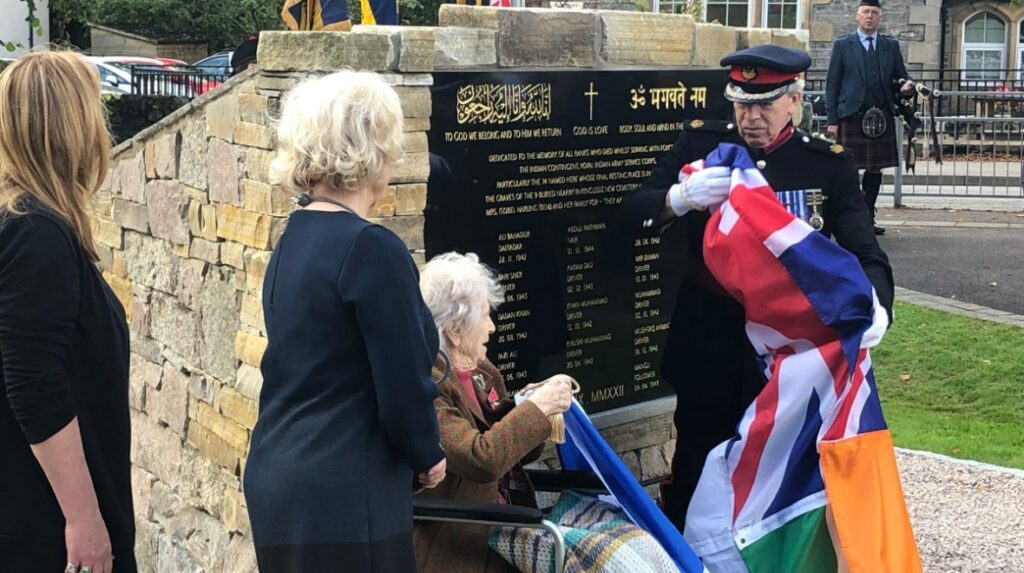
A memorial has been unveiled to commemorate a band of war heroes who served with the Indian Army and perished in the Scottish Highlands.
Nine soldiers were buried at a cemetery in Kingussie. The new monument stands prominently in the centre of the town.
People came from all corners of the UK for a pilgrimage to honour the men.
The Indian Army’s Force K6 was a transport unit that used mules to deliver vital supplies to frontline troops. It was despatched to various UK destinations.
The nine soldiers who died during training in the Cairngorms are remembered on the new stone-built tribute.
Among those attending the unveiling was 99-year-old Isobel Harling from Kingussie who had served in the Navy.
Isobel Harling tended the men’s graves for more than 70 years.
She tended the men’s graves for seven decades, influenced by kindly people who had done the same for her brother after he was shot down in Belgium.
Nasim Azad of the Muslim Council of Scotland, who travelled from Edinburgh for the ceremony, was thrilled to have met Isobel.
Ms Azad said: “She decided to take it upon herself to care for them with love but for no return – no return – for 70 years.
“For 70 years she took care of those graves, so it’s an absolute honour to have met such a wonderful, wonderful lady.”
Also attending the multi-faith event was Asif Hassan Sheikh of the Scottish Ahlul Bayt Society.
He said: “Thank you Scotland for looking after these sons who served so faithfully and gave their lives for the cause.”
Puneet Dwivedi of Hindus In Scotland said: “It’s very important to recognise the efforts of the soldier who gave their life for world peace.
“And I’m really impressed with Highland Council and the community here who built this memorial.”
He added: “It’s a changing world and this shows that all colours of people are the same and they’re honoured for their work.”
Memorial project officer Heather Taylor said: “The design was based on pulling together several aspects of faith, hope and charity – the charity that Isobel has shown, the hope that we have for the future tomorrow and the faiths that are represented here today.
“We’ve got an Islamic inscription from the Qur’an. We’ve got a Christian inscription and we’ve also got representation from the Hindu faith as well – all brought together under Isobel’s guidance.”
The men laid to rest at Kingussie New Cemetery are Ali Bahadur, Bari Sher, Dadan Khan, Fazl Ali, Khan Muhammad, Khushi Muhamm, Muhammad, Muhammad Sadiq and Mushtaq Ahmad.
The black granite stone monument is the UK’s first permanent memorial to all ranks of Force K6. It was engraved and adorned with gold leaf by Inverness monument makers Andrew Stewart and Son Ltd.
Craftsman Marc Bruce from Aviemore chose Indian sandstone and mixed shades of locally sourced Cairngorm granite.
Kingussie’s Am Fasgadh Regeneration Company was awarded £20,706 through a Highland Council investment programme to put towards the match-funded Force K6 memorial project.
Isobel Harling was awarded a British Empire Medal for her dedication.
Force K6 came from across India including the country now known as Pakistan.
They arrived in France in 1939 – with their mules – to provide animal transport for the Allies.
During Hitler’s infamous ‘Blitzkrieg’ one company was captured in Gerardmer. The others were evacuated with the British Expeditionary Force from Dunkirk and other ports.
After postings in England and Wales most of the companies ultimately arrived in the Highlands.
The 51st Highland Division remained with the French 9th Army to attempt to deny and delay Rommel’s advancing troops from further gains.
From June 1942 they had several camps in Badenoch and Strathspey from where they supported winter warfare training in the Cairngorm mountains.
The soldiers were popular in the local communities, helping on farms, playing with children, sharing cultural cuisine and demonstrating their flair for horsemanship.
After postings to other locations in the Highlands, they returned to India by early 1944.
Fourteen of the Force K6 men died in Scotland.
For outstanding duty in France, members of Force K6 received an MBE, an Indian Order of Merit, three Indian Distinguished Service Medals and one mention in despatch.
The British Indian Army contributed 1.5 million servicemen in World War I. A total of 74,000 died and up to 100,000 were injured.
In World War II, there were 2.5million service personnel – 87,000 of whom died and up to 150,000 were injured.
The soldiers were Hindu, Muslim, Sikh, Gurkhas, and Indian Christians.
source: http://www.news.stv.tv / STV News / Home> News> Highlands & Islands / by Iain Ramage / September 21st, 2022
The socio-cultural landscape of Kerala is also explored in this book with references to myths and legends.
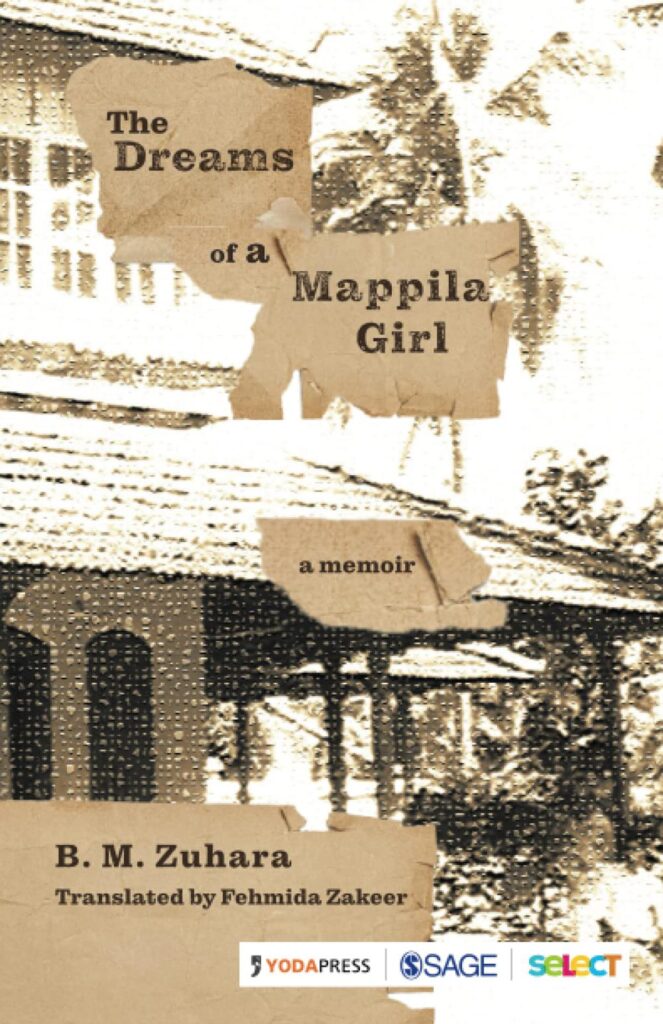
Writer B.M. Zuhara’s early years, spent in a large ancestral home at Tikkodi near Calicut, are brought alive in her evocative memoir
When the writer B.M. Zuhara was little she had three nicknames, Tarkakozhi (because she asked too many questions), Karachapetti (for bursting into tears often) and her favourite, Ummakutty (mother’s darling). She grew up in Tikkodi, near Calicut, at her ancestral home, Kizhekke Maliyakkal, which does not exist anymore. In her memoir, The Dreams of a Mappila Girl, translated into English by Fehmida Zakeer, she provides a fascinating glimpse into the lives of Malayali Muslims in the 1950s and ’60s.
Born in an aristocratic Mappila family, Zuhara, a well-known novelist and columnist, weaves a magical narrative about her growing up years in northern Kerala. Muslims of the Malabar region of Kerala are called Mappilas. They had trading relationships with Arabs for centuries, and embraced Islam as early as the 7th century. Their unique culture is a fusion of local customs and the Islamic value system.
Ties that bind
Much of the memoir explores Zuhara’s relationship with her loving (but firm) mother and the author’s emotional attachment to her ancestral home. Being the youngest child, she was very close to her mother, and that relationship lasted till her Umma passed away. In the preface, the author declares that her life has always revolved around her Umma, who had seen her family’s wealth decline.
Her mother was deeply concerned about her children, Zuhara says. “Even though Umma was born in an aristocratic family and had lived a privileged life, she had to endure many hardships. Umma’s sadness at the reversal of the family’s fortunes often laced her words. However, she always made sure that her children had a secure and comfortable life.”
Despite having studied only up to the fourth standard, her Umma was a great reader. She managed to find the time to read and learn the Koran and the Hadith while raising 10 children. Umma was an excellent storyteller, and Zuhara says her mother’s enchanting tales of ordinary events inspired her to write when she grew up.
One of the reasons for her closeness to her mother was the near absence of her father in her life. Her Uppa and her maternal grandfather, Valiappa, were not on good terms. They were fighting many court cases against each other over property. Since her mother and she lived in Valiappa’s house, her Uppa visited them occasionally. Her grandfather, however, pampered her a lot as she was his favourite child’s daughter.
Beyond these familial ties, the book also chronicles the quotidian struggles and challenges of a Muslim girl in post-independent India. How the conservative mores of that time created hurdles in the way of leading a normal life for girls like Zuhara. For example, while watching her father and her brother practise kalaripayattu, she yearned to learn this ancient martial art but couldn’t because she was a girl. Later, when she started writing and became the first Muslim woman writer in Malayalam, she faced a lot of criticism and had to be careful with her words. She took time to tell honest stories about Mappila women, their dreams and aspirations. And, finally, she carved out a niche in the world of Malayalam literature.
The socio-cultural landscape of Kerala is also explored in this book with references to myths and legends like Unniarcha, a mythological warrior woman celebrated for her fearlessness, immortalised in the vadakkan paatu, the ballads of the region. There are descriptions of local foods, customs and traditions, some of them gone forever.
Being a successful fiction writer, Zuhara uses the literary tropes of the genre to make her memoir engaging. Memories can play tricks, but her narrative evocatively captures a lost era. Every character is dealt with sensitively, making them come alive on the pages.
The translator, Fehmida Zakeer, who also comes from the same Mappila background, has done an excellent job while rendering this memoir into English. The aroma of Kerala spices and the fragrance of screwpine waft through the pages. She effectively uses kinship terms in Malayalam giving the prose a distinct ethnic flavour. In a nutshell, the book deserves your attention.
The Dreams of a Mappila Girl: A Memoir; B.M. Zuhara, translated by Fehmida Zakeer, Sage Publications, ₹550.
The reviewer is the author of Patna Blues , which has been translated into 10 languages.
source: http://www.thehindu.com / The Hindu / Home> Books> Reviews / by Abdullah Khan / September 16th, 2022
“The Musalmans of India are, and have been for many years, a source of chronic danger to the British Power in India.” – W W Hunter, an English official posted in India, in his famous book ‘The Indian Musalmans’, published in 1871.
After 1947, Indian scholars wrote a ‘nationalist’ history of the Indian freedom struggle and for unknown reasons, they excluded Muslims. For the last seven decades, we have been reading a history of the Indian Freedom Struggle that has largely overlooked the contribution of Muslims. The generations brought up over this narrative believe that either the Indian Muslims were pro-British or aloof from the freedom struggle.
Such falsehoods propagated in the name of history should be challenged.
The British imperialism in India was resisted by the Indians right from its outset and the Muslims were the flag bearers of this resistance. The British took over Bengal administratively and economically after defeating the royal armies at the Battle of Plassey (1757) and the Battle of Buxar (1764). With their win over the Nawab of Bengal, the British started exploiting the Indians of Bengal province in an unprecedented fashion. Their ruthless loot resulted in a famine in 1770, which accounted for the deaths of one-third of the total population of Bengal.
No wonder the first popular national resistance to foreign colonial rule arose in Bengal. A united front of Hindu Sanyasis and Muslim Fakirs rose up in arms against the British. The man who led this fight was, Majnu Shah, a Muslim sufi from Kanpur (Uttar Pradesh). Majnu was a devotee of Shah Madar, Kanpur, and took up the cause of poor peasants on the advice of another Sufi saint, Hamiduddin. Almost 2000 Fakirs and Sanyasis, under his command, would loot the treasures of the British and British-backed landlords to distribute the money and food among poor exploited masses. From 1763 till his death in 1786, Majnu was the most dangerous threat to the British Empire in India. Fakir and Sanyasi forces killed several officers and soldiers of the British in guerrilla wars. After his death, Musa Shah took up the leadership of the movement. Hindu Sanyasi leaders, like Bhawani Pathak, were also there and fought alongside but the colonial records considered Majnu as the most threatening leader because under him Hindus and Muslims fought a united war. The ruthless British suppressed this movement a few years after the death of Majnu but the spirit of nationalism could not be killed.
The suppression of the movement led by Fakirs in Bengal did not mean that they accepted defeat. Fakirs changed their strategy and joined Marathas and other anti-British forces at the turn of the 18th century. The first major mutiny by the Indian sepoys of the English East India Company Army in 1806 at Vellore, which is said to be the inspiration behind 1857, was planned by Holkars, sons of Tipu Sultan and brother of Nizam of Hyderabad with the help of Fakirs. In every cantonment in South India, Fakirs propagated the message of nationalism through religious sermons, songs and puppet shows. When the revolt broke out at several places including Vellore the Indian revolutionaries were led by Fakirs like Shaikh Adam, Peerzada, Abdullah Khan, Nabi Shah, and Rustam Ali. Scholar Perumal Chinnian writes, “the Southern conspiracy was supported by Fakirs and other religious mendicants. The conspiracy was established in all the army stations by them.”
Within a few years, the British faced another challenge in the form of three distinct movements led by Syed Ahmad Barelvi, Haji Shariatullah and Titu Mir respectively.
Born in Uttar Pradesh, Syed Ahmad toured a large part of the country and gained followers in Bihar, Bengal, and Maharashtra. His followers took up arms against the British and its allies in the areas adjacent to Afghanistan. The movement posed a challenge to the British for decades. The British painted the movement as a work of religious fanaticism while in reality, Syed Ahmad tried to forge an alliance with Marathas against the foreign rulers. After he died in 1831, Enayat Ali and Wilayat Ali, both from Patna, took up the leadership of the movement. The wars they led in the frontier region caused the death of thousands of soldiers of the British army.
Haji Shariatullah and his son Dudu Miyan took up arms in Bengal to resist the tyranny of rich landlords. They led peasants to revolt against the indigo planters and other British agents. The movement they led is known as Faraizi movement.
Titu Mir also led a movement of poor masses against the British-backed landlords. He formed his army and set up a popular administration. In 1831, Titu was killed during a battle with the British. Hundreds of his supporters were arrested and hanged, including his deputy, Ghulam Masum.
Meanwhile, the Movement started by Syed Ahmad remained a grave danger to British rule in India. Enayat Ali, Wilayat Ali, Karamat Ali, Zainuddin, Farhat Husain, and others led an armed struggle against the British. In Patna, as soon as the news of the revolt of 1857 reached, all the prominent leaders were arrested before they could act. Still, Pir Ali launched a revolt in Patna. Though not a part of the larger movement himself the British believed that he had their support. Pir Ali, Waris Ali, and other Muslim revolutionaries were executed in Bihar during the revolt of 1857.
The First War of the National Independence of 1857 had a long history of planning behind it. In 1838, the English government arrested Mubariz ud-Daula for plotting a nationwide revolt against the foreign rule. The investigations revealed that Raja Ranjit Singh, Gaekwars, Satara, Jodhpur, Bhopal, Patiala, Rohilla Pathans, and several nawabs, rajas and zamindars had agreed upon the plan. Raja Ranjit Singh had actually sent his troops to help Mubariz and contacted Persian and French powers for help. The plan, because of a few traitors leaked out, Mubariz was imprisoned where he died in 1854 and the revolt took place two decades later.
The role of Muslims in 1857 is no secret. The unity of Hindus and Muslims in 1857 threatened the British like never before and they resorted to a policy of divide and rule after that. Maulvi Ahmadullah Shah of Faizabad, Fazl-e-Haq of Khairabadi, Imdadullah Muhajir Makki of Muzaffarnagar, and Azimullah Khan, an associate of Nana Saheb, were prominent in propagating the need of taking up the arms against the colonial rule. For years before 1857, they were propagating these ideas among sepoys as well as civilians.
In Bihar, Kunwar Singh was leading the revolt of 1857. Zulfiqar was one of his most trusted comrades with whom Kunwar was discussing every plan. After liberating Arrah the civil government installed by Kunwar had his most trusted allies and there were several Muslims. The government had “Shaikh Ghulam Yahea as Magistrate. Shaikh Muhammad Azimuddin, an inhabitant of Milky Tola in the town of Arrah, was appointed Jamadar (treasurer) of the eastern thana: Turab Ali and Khadim Ali, sons of Dewan Shaikh Afzal, were made Kotwals (Police officers in charge of a city)”
The revolt did not succeed. Bahadur Shah was exiled to Burma, several were hanged and many more were transported for life to Andamans. But, the zeal for freedom did not die.
In 1863, tribals in North West Frontier Province stormed the British territories and entered into a war. The British, though registered a victory, had to face one of the stiffest military challenges. They lost more than a thousand of its English soldiers. Intelligence reports pointed towards a financier in Ambala. The man was Jafar Thanesri. During the raid police found several letters which established him as the principal financier of the war in NWFP. He channelled money, men and arms from different parts of the country to the war front. Yahya Ali of Patna and nine others were also charged for waging the war against the Queen. What followed was a series of arrests and trials across India.
People were arrested in Ambala, Patna, Malda and Rajmahal. Ahmadullah, Yahya Ali, Jafar, Ibrahim Mandal, Rafique Mandal and others were arrested and transported to Andamans. These revolutionaries celebrated martyrdom over life, hence the British decided not to hang them but to send them to the Andamans. In 1869, Amir Khan and Hashmat Khan were arrested in Kolkata. Norman, the Chief Justice, sentenced them to the Andamans. The sentence was avenged by Abdullah by assassinating Norman in 1871 and after a few months Sher Ali killed the viceroy, Lord Mayo, in the Andamans.
Bipin Chandra Pal, in his autobiography, credited these trials and killings as an important influence on his political career. Another famous revolutionary, Trailokya Chakravarty, noted, “the Muslim revolutionary brothers gave us practical lessons of unbending audacity and inflexible will and also advice to learn from their mistakes”.
In Maharashtra, Ibrahim Khan, a Rohilla leader, and Balwant Phadke launched a guerilla war against the British. They provided a tough resistance through the 1860s and 70s, and threatened the British in south India.
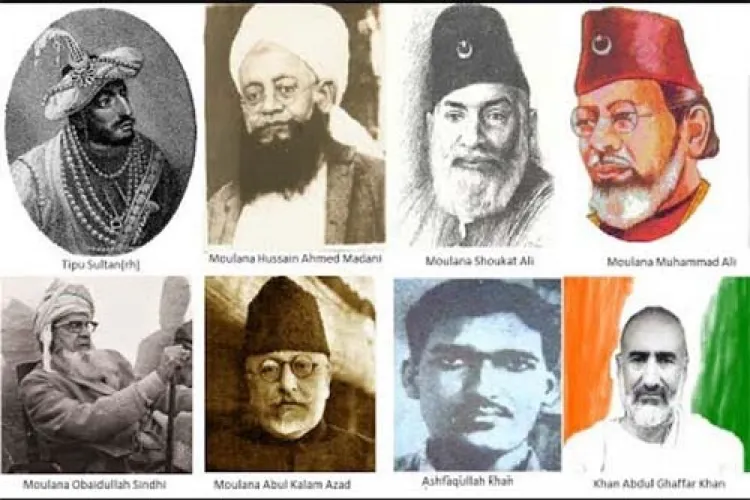
Meanwhile, in 1885, Indian National Congress (INC) was formed to voice the apprehensions of the emerging educated middle class. Badruddin Tayyabji and Rahmatullah Siani were two of the earliest members and presidents of Congress. Later on, M.A Ansari, Hakim Ajmal Khan, Hasrat Mohani, Abul Kalam Azad, and others remained associated with the largest political outfit of India.
In 1907, peasants in Punjab started agitation against the canal colonies. Along with Lala Lajpat Rai and Sardar Ajit Singh, Syed Hyder Raza was one of its prominent leaders. The movement is seen as a precursor to later Ghadar movement.
During the First World War (1914 – 18), the British intercepted three letters written on silk cloth. The letters were written by Maulana Ubaidullah Sindhi to Maulana Mahmood Hasan and pointed towards a global plan to overthrow the British rule in India. Ubaidullah was named as one of the most dangerous Indians for the British in the Rowlatt Committee Report. He formed armed groups, preached anti-British ideas and formed a provisional government in Kabul. The Prime Minister of the government was Maulana Barkatullah. The government had to have an army as well, which would attack India to free it. But, the plan failed because of the leaked silk letters and the end of the World War. The plan was called Silk Letter Movement and 59 freedom fighters, mostly Muslims, were charged for waging the war against the Empire. Maulana Abul Kalam Azad, Abdul Bari Firangi Mahli, Ubaidullah Sindhi, Maulana Mahmood, Husain Ahmad Madni and M.A Ansari were few of them. Maulana Mahmood and Madni were arrested in Makkah and imprisoned in Malta.
Maulana Abul Kalam Azad, who is often seen as a token Muslim in a largely Hindu dominated Congress, was a freedom fighter whom the British feared. His name occurred in different CID reports for planning armed revolutions. At least 1700 freedom fighters took oath to die for the cause of freedom as members of Hizbullah, a revolutionary organisation formed by Azad. Al-Hilal, a paper edited and published by him, was banned for propagating the revolutionary nationalist ideas. Azad established Darul Irshad, a madarsa, to popularise the anti colonial ideas. For his organization, Hizbullah, Jalaluddin and Abdur Razzak were prominent recruiters, who also united Hindu and Muslim revolutionaries of Bengal. No wonder, Azad was jailed many times and was the President of INC when the Quit India Resolution of 1942 was passed.
The Silk Letter Movement was not the only resistance movement during the World War. Ghadar Movement was another movement in which several Muslims took part and attained martyrdom. Rehmat Ali was hanged in Lahore for trying to instigate mutiny among soldiers. The efforts bore fruit in Singapore, when, in February, 1915, 5th Light Infantry consisting mostly Muslims from Punjab revolted. The soldiers captured Singapore for a few days. The revolutionaries were later defeated, captured and shot dead.
Another misconception prevalent among Indians is that the Bengali revolutionaries were Hindus. Interestingly, the revolutionary organizations with Hindu religious overtones, like Jugantar and Anushilan had many active Muslim members. Sirajul Haq, Hamidul Haq, Abdul Momin, Maksuddin Ahmad, Maulvi Ghayasuddin, Nasiruddin, Razia Khatun, Abdul Kader, Wali Nawaz, Ismail, Zahiruddin, Chand Miyan, Altaf Ali, Alimuddin, and Fazlul Kader Chowdhury were few of the Bengali Muslim revolutionaries who took up arms along with Hindus. Many of them were sent to Andamans or killed.
After the World War, the British introduced a draconian Rowlatt Act. The Indians protested against the act and many leaders were arrested. At Jallianwala Bagh people were massacred when they were protesting against the arrest of Saifuddin Kitchlew. The proportion of Muslims killed at Jallianwala was quite high. Around this time, 1919 onwards, Abdul Bari Firangimahli, Mazharul Haque, Zakir Husain, Mohammad Ali, and Shaukat Ali emerged as the mass leaders. Women like Bi Amma, Amjadi Begum, and Nishat al-Nisa also jumped into the freedom struggle.
In Tamil Nadu, Abdul Rahim organised the workers during the 1930s against the oppressive colonial rule. V. M Abdullah, Sharif Brothers, and Abdul Sattar were other prominent Muslim leaders in South India who led nationalist movements and braved torture and imprisonments.
Khan Abdul Ghaffar Khan led pathans posed a non-violent challenge to the British. In 1930, the British fired upon a crowd protesting against the arrest of Ghaffar Khan at Qissa Khwani Bazar, Peshawar. Hundreds of pathans laid their lives for the service of the motherland.
Faqir of Ipi, Mirza Ali Khan, and Pir of Pagaro, Sibghatullah, raised their armies in the 1930s in Waziristan and Sindh respectively to fight the British during the World War. In a larger scheme of things, Subhas Chandra Bose and Axis Powers allied with their armies in order to liberate India.
In 1941, Netaji Subhas Chandra Bose escaped from house arrest. The man who played an important role in the escape was Mian Akbar Shah. Netaji reached Berlin and formed a Free India Legion. Abid Hasan, became his confidant here and served as secretary. Abid was his only associate who accompanied him on a famous submarine journey from Germany to Japan. In 1943, Netaji formed Azad Hind Sarkar and Azad Hind Fauj. Here several Muslims like, Lt. Col. Aziz Ahmad, Lt. Col. M.K Kiani, Lt. Col. Ehsan Qadir, Lt. Col. Shah Nawaz, Karim Ghani, and D.M Khan became ministers with important portfolios. Azad Hind Fauj faced reverses in war and its soldiers were taken prisoners by the British. Rashid Ali’s imprisonment became a symbol of Hindu Muslim unity when Hindus and Muslims across the political affiliations came out on Kolkata road demanding his, and other Azad Hind Fauj soldiers, release in 1946. The police fired upon the protesters killing dozens of Indians. Elsewhere, in Mumbai and Karachi, the Royal Navy revolted in support of Azad Hind Fauj. Anwar Husain was one of the prominent martyrs of this revolt as Colonel Khan led the soldiers in revolt at Mumbai port.
India gained independence on 15 August, 1947. It was a costly affair. The cost was the Indian lives. The lives we paid were neither Hindu, nor Muslim. The lives belonged to the Indians. Those who laid their lives were Indians first, and Hindus or Muslims later. Here again, Muslim leaders like Allah Bux Somroo, K. A. Hamied, Faqir of Ipi, Abdul Qayyum Ansari, Abul Kalam Azad and others fought against the divisive communal politics of Muslim League to stop the partition. Tragically, more than seven decades later people have forgotten this important aspect of our freedom struggle and try to divide this great struggle along petty sectarian lines.
(The article is an updated version of an article published last year.)
source: http://www.awazthevoice.in / Awaz, The Voice / Home> Culture / by Saquib Salim / August 15th, 2022