F. M. Khan is taking a walk in his home garden. Picture right shows Dahlia in full bloom.
Madikeri :
Former Rajya Sabha member F. M. Khan is holding the annual flower show at his home garden for the public in Boikeri, near Madikeri, on Jan. 30 and 31.
The garden at Khan’s Balyatrie Estate, with more than 100 varieties of flowers — most of them rare — is spread over more than half-an-acre in front of his house.
Multi-hued roses, dahlia, chrysanthemum, jasmine are in full bloom to welcome the visitors.
Addressing media persons here yesterday, he said floriculture helps in the economic progress of the country and urged the government to support floriculture.
Stating that there is a huge demand for flowers at the international market, he said floriculturists should grow flowers in a natural atmosphere.
With the vagaries of nature, one needs to give special emphasis on protection of plants, he added.
Flowers like Jasmine, anthurium, marigold, salvia, Gerbera, Zenia, Dahlia, Cosmos, croton, colin, Plectranthus, Impatiens, Daisy, Gardenia, sun flower, Hollyhocks, Clarkia, Cockscomb, Lupine, Verbena, Fuchsia, pinks, spider flower, oster flower, calendula flowers, cupia, Gazania, Sweet pea, Cineraria, stock flower, love in a mist flower, devil in the bush and others are on display.
The flower show will be open to visitors from 10 am to 5 pm today and tomorrow.
source: http://www.starofmysore.com / Star of Mysore / Home> General News / January 28th, 2016
Salman Yusuff Khan, who was in the city as a judge for the MTV Campus Diaries auditions, opens up about his love for dance and Bengaluru
Salman Yusuff Khan who won the dance reality show Dance India Dance Season 1. made his debut as an actor with the movie, ABCD, directed by Remo D’Souza. In an interview with MetroPlus, he talks about what keeps his passion for dance ticking. Excerpts.
You are regarded as one of the best dancers in the country today. How has the journey been?
It has been amazing. I feel blessed to be an artiste. The love for my work and affection showered by the people is what has kept me going. Dance as a profession didn’t have the respect or importance six years ago as it gets today.
There was a period when I was working continuously for three months, without a day’s break. It was hectic, yet I enjoyed it. When you do something you love, it doesn’t feel like work.
How has the transition from dance to cinema been?
Mumbai has treated me well. I started my career here and the support and encouragement that I’ve received has been enormous and has helped me move forward. I had no uncertainty. I knew this is what I had to do. My only struggle was in Bengaluru when I had to complete my engineering. After that, I started exploring different fields, be it dance, movies or television. It hasn’t been effortless, but it hasn’t been difficult either.
What has the response been for the MTV Campus Diaries auditions in Bengaluru?
I loved the crowd. The energy and enthusiasm shown by the youth here is amazing. Though Mumbai has made me the person I am today, Bengaluru will always be special to me. Back in my time, there was quite a lot of stage fear and we weren’t too professional. I’m astounded by the professionalism shown by the youth here. The confidence shown and the effort they put in their work is inspiring.
I want to thank Amazon and MTV Campus Diaries for giving me the opportunity to experience the beautiful variations in all the four cities in which the auditions took place.
It has been difficult to select the best among the participants. I know I’ve broken many hearts but I want them to know this is not the end, but just another phase and it will help them better themselves.
source: http://www.thehindu.com / The Hindu / Home> Features> MetroPlus / by Mythili S. Bhat / Bengaluru – January 30th, 2016
Hajra Mohammed opens her eyes every morning to her one-year-old great-grandson’s videos on her newly acquired iPad. Mohammed, who turned 88 this year, started picking up computer skills recently with her daughter Nighat’s help. She now has a Facebook account in her name where she responds to all recipe requests from friends and relatives all over the world. For a woman of her age who is recovering from an injured back and spending a lot of her time in bed, it is no easy feat.
The Bangalore-based grandma hasn’t allowed age to become a hurdle. She published her first book at 85 and became one of the oldest first-time Indian writers.
“It was my determination and my granddaughter’s persistence that helped me publish the recipes I learnt and practised to perfection over the years,” Mohammed says. Her Dubai-based daughters Tasneem and Nighat Mohammed consider themselves lucky to have grown up on “the world’s best food”. “Mum is a remarkable woman with an amazing zest for learning. She has the courage to motivate herself with her aches and pains and do what she loves,” they say.
Mohammed’s first book, Hajra’s Recipes of Life for Life: Delectable Muslim Cooking, is for those who want a taste of Kutchi Memon cuisine, closely guarded by this Muslim community. A joke that goes about the Kutchi Memons is that even if they are generous enough to share their recipes, they purposely leave out one or two ingredients. Is that why it took Mohammed so long to decide that she could write a book on a cuisine she has mastered?
“I had the idea of a book 15 years before it got published,” she says. It didn’t happen until 2010 because a publisher was hard to find. Some feathers were definitely ruffled on the book’s release. “Several people from my community were shocked that I revealed so many of our secret cooking rituals and masalas,” laughs Mohammed.
But surprisingly, a lot of Kutchi Memons bought her book. Some use it themselves because it is methodically written; others sent it to their children studying abroad because the recipes are easy to follow.
“Our food is not only scrumptious but also healthy. Our biryani, for example, is cooked in minimal oil and spices as opposed to a lot of other Indian biryanis,” says Mohammed.
As a teenager, cooking was not on Mohammed’s mind. When most Indian girls were expected to hone their culinary skills, she enjoyed reading and music. “LPG [liquefied petroleum gas] wasn’t available then and my father didn’t let me cook with firewood.”
Unfortunately for Mohammed, both her parents died when she was still in her teens and she had to move in with her brothers. Her sister-in-law was instrumental in helping her become the expert cook she is today. She got married at 22; when her husband died 10 years later, she was left to bring up three young children all by herself. To eke out a living, she held cooking and baking classes at home and sold handmade dolls to a handicrafts emporium.
Today, she says it is her passion for cooking and learning that has given her the edge.
“The first thing I do is hit a bookshop when I visit a new place, to look at recipe books. An exciting recipe on a TV show finds a way into my diary and is soon tried out in the kitchen,” she says. “Love your cooking – put your heart and soul into it to get the best results.”
She’s excited about publishing her next recipe book, which she plans to call Hajra’s Favourite Recipes.
“This time, I’ll type all the recipes myself,” she says with a smile.
Sukha jhinga (Dry spiced prawns)
Serves 4
Ingredients
500g prawns, sliced and deveined
½ cup oil
Marinade
2 tsp garlic paste
2 tsp cumin powder
3 tsp red chilli powder
8 green chillies, finely chopped
4 tbsp finely chopped coriander leaves
Juice of one lemon
Salt to taste
Seasoning
4 tbsp oil
¼ tsp cumin seeds
10 curry leaves
Method
1 Wash the prawns and dry them with a clean kitchen towel.
2 Combine the marinade ingredients and rub them into the prawns. Refrigerate for two hours.
3 Heat ½ cup of oil in a pan and fry the marinated prawns for about 3-5 minutes, until they lose their translucency, but remain crunchy.
4 Heat the oil for seasoning in another pan. Add the cumin seeds and curry leaves. Once the cumin seeds crackle, remove from heat and pour the seasoning onto the fried prawns. Serve hot.
source: http://www.thenational.ae / The National / Home> UAE> Arts & Life / by Priti Salian / artslife@thenational.ae / December 08th, 2013
Power minister Aryadan Mohammed inaugurated the state’s first floating solar plant at Banasura Sagar reservoir in Wayanad on Thursday.
The 10-kilowatt-capacity plant, spread over 1,200 sq ft has been installed on concrete floaters with hollow insides. The platform can carry 45 tonnes and the power generated will be fed to the KSEB grid through cables drawn through the reservoir bed. KSEB officials said that it is the first floating solar plant to be set up inside a reservoir in the country.
The innovative power generation system, set up at a cost of Rs 20 lakh, is the brainchild of two young entrepreneurs from Wayanad – Ajay Thomas and V M Sudhin. The duo’s startup firm Vatsaa Energy Private Ltd has implemented the project with financial aid from KSEB under its Energy Open Innovations Zone.
Inaugurating the plant, Aryadan Mohammed said that KSEB was making a big push in the area of renewable energy. He added that the government has acquired 500 acres of land in Kasaragod to set up a 200 MW solar park. A further 1500 acres will be acquired for the project.
The KSEB also has plans to convert the largest earthen dam in the country to a hub of solar power generation with the launch of construction works for two other solar projects at the site.
The projects include a proposed 500-kW floating solar plant at the reservoir and a 400kW ‘dam- top’ solar power generation project. The former is a scaled-up version of the 10kW concrete floating plant. The Rs 9.25-crore project will be spread over the water surface of the reservoir across 1.25 acres.
The minister will also inaugurate the works of the 400-kW dam-top solar project by installing solar panel canopy over the walkway atop the dam at a cost of Rs 4.6 crore. Another hydel tourism development project is being envisaged near the dam premises.
Ajay Thomas, who had developed the indigenous technology for the floating plant, said the device has around 20% higher efficiency compared to ground-mounted units as the cooling effect of water helps in keeping the temperature of the solar panels low, thus boosting output.
“The low dust environment in the reservoir also aids in enhanced performance of the photo-voltaic panels. Water bodies in the state, including those in large hydroelectric projects, can be used for large-scale solar power generation through floating plants,” he said.
KSEB chief engineer (renewable energy and energy savings), Suku R, said the floating solar plant was designed for dam reservoirs in the state, also taking into consideration the seasonal water level variations, heavy rain and winds.
M V Shreyams Kumar MLA presided over the function. KSEB chairman and managing director M Sivasankar, academician RVG Menon among other spoke.
www.timesofindia.indiatimes.com / The Times of India / News Home> City> Kozhikode / K.P. Rajeev / TNN / January 21st, 2016
The Devannahalli fort, which stands 35 kms away from Bengaluru, is older than the city itself by 37 years.
The fort has been occupied by different dynasties over time. It was built in 1501 by Kempegowda’s ancestor, Malla Baire Gowda. But in 1747, in a battle led by Nanjarajaiah, the dalwai of Mysore, the clan lost it to the Wadiyar dynasty. Marathas later claimed it and lost it back to the Mysore state, in a siege led by Hyder Ali in 1746.
Arun Prasad, from Discover Bangalore Project, says that though Hyder captured the fort, it was his son Tipu Sultan who was responsible for modelling and building the Pulkad fort.
The town surrounding the fort was meant to be a a centre of learning and arts. “The Devannahalli town was supposed to be a place for learned artisans and intellectuals to inhabit,” says Prasad.
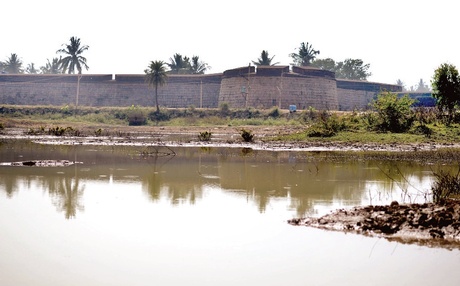
Devannahalli was a town typical of the time, with protected farmlands and fields. A lake, behind the fort and seen from the bastions, was meant to serve the needs of the inhabitants.
Today, the lake is dried up and is a sad sight to notice. Prasad blames it on poor urban planning. Earlier, a highway used to pass through the western part of the town. Now, a road has been built, which passes over the lake. A good portion of the lake was used up for it.
“The lake has always been rain-fed. But the new road cut the lake away from the adjoining canals and channels,” says Prasad. “The rain water could not flow in and the lake dried up. The vast area of 400-500 kms metres has only weeds and little water due to rains. You can also spot some tattered measurement devices, which was a failed attempt to study the level of water in the lake.”
Pics: Pushkar V
Bastions
Built on a higher ground, the bastions were used to keep a watch out for the enemy. The fort is 30 to 35 feet high and bastions, along the fort, are placed at equal distance from each other. “The bastions have well protected chambers, used by soldiers. The gun points are holes in the wall which can still be seen today. They are built from lime and brick. The holes were used to keep guns during the war,” adds Prasad.
Tipu’s Birthplace
South-west of the fort, there is memorial with a board, which proclaims that Tipu was born here. A six-foot-tall enclosure marks the spot.
When Tipu was born in 1750, his father Hyder Ali was engrossed in a battle. His mother, Fatima Fakhr-Un-Nisa, was secretly ushered into a carriage to give birth at the fort, as it was considered a safe place. However, she ended up giving birth inside the vehicle, right outside the fort. The monument is built over this birth spot.
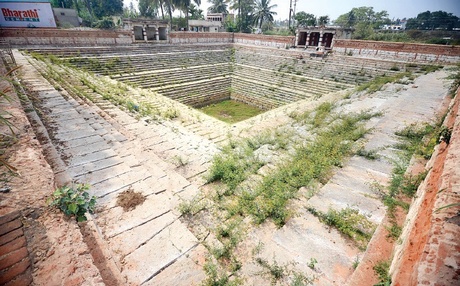
A pond was built under the administration of Purnaiah, the then Dewan of Mysore. It is a beautiful pond with the stones and excavations intact. “The water is used for rituals and festivals,” says Prasad. “People take baths here as well.”
Pics: Pushkar V
Temples
Inside the Devannahalli fort, there is the Venugopalswamy temple. The temple, which was built in the Vijaynagara style, has several depictions from the Ramayana on the walls. “At the entrance, the two horsemen are believed to belong to the Western Ganga dynasty (which ruled 350 and 1000 AD),” said Prasad.
There are sculptures of seamstresses, as you enter, from the same era. The north and south walls have sculptures showing Rishyasringa being brought from a forest to Ayodhya accompanied by dancing girls. There is also a scene of Vishwamitra caught in a an archery battle with Rama. The south wall has ten incarnations of Lord Krishna and Rama’s father performing a sacrifice.
Pics: Pushkar V
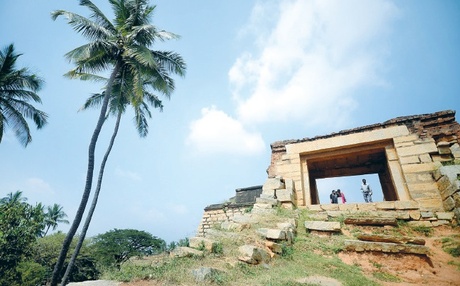
The fort gate and the fort walls are crumbling and there are scribblings on the walls. There is no security at the entrance and anyone can walk in. The commercial establishments all around have failed to preserve the authenticity of the past. “An ASI (Archeological Survey of India) office is located at the entrance, which is always closed and does not provide much information,” says Prasad. “The fort area needs to be protected by ASI and does not come under the corporation. The northern gate is crumbling as well.”
How it Began
Refugees on the run from Kancheepuram settled down near the Nandi Hills. Legend has it that Rana Baire Gowda, their leader, was told in a dream that he had to build a settlement in this region. This family goes by the name of Morasu Wokkalu. His son Malla Baire Gowda founded Devanahalli. Kempegowda also belongs to this family.
source: http://www.newindianexpress.com / The New Indian Express / Home> Cities> Bengaluru / by Seema Prasad / January 28th, 2016
A girl from Kolkata has become the first Muslim woman ever to top the West Bengal Commercial Tax Service. What makes Suraiya Ghaffar’s achievement sweeter is the fact that she has cleared the “state’s toughest examination” as a general category candidate despite qualifying for backward class quota, reflecting a growing trend among meritorious Muslim students of giving OBC reservation a miss.
In the commercial tax category itself in which Suraiya has topped, three of the top five candidates are Muslims, who despite qualifying for reservation, cleared as general category candidates. Mohammed Shabbar Khan has stood second and Mohammed Azhar Khan fifth. A total of 40 candidates have made it to the commercial tax service.
Suraiya, 23, was confident that her sound academic background would see her through. “If I wanted I could have taken the reservation route but I decided to test my skill by appearing as a general category candidate. Since age is on my side, I am entitled to several attempts,” she said, sitting in her husband’s Shibpur residence. Maqsood Hasan is in the West Bengal Police Service.
A senior official of the minority affairs and madrasah education department confirmed that Suraiya is the first Muslim girl ever to top the commercial tax service.
Close to 50,000 aspirants sat for the WBCS examination in 2014 out of which 4,000 qualified for the second stage termed as “mains”. Only 400 made it to the interview stage for the services listed in Group A and Group B. Apart from commercial tax service, Group A includes executive, labour, excise and agriculture services. Group B consists of the state’s police service. The results were declared last week.
Suraiya is the eldest of five siblings in a home with limited financial resources. Her father Abdul Ghaffar Khan works in the electricity department of the Garden Reach Shipbuilders and Engineers Limited.
Overcoming hurdles is nothing new for this girl from Metiabruz. After finishing her higher secondary from a local school, Suraiya enrolled into an Honours course in Chemistry in a college in central Kolkata for which she had to travel for almost two hours every day.
The girl, whose role model is her father, did not lose sight of her dreams, even after her marriage to Maqsood in 2014. Hard work, determination and resilience helped Suraiya sail through the written and interview rounds of WBCS in the first attempt.
When she is not glued to her books, Suraiya is inseparable from her smartphone. Beside her academic achievements, Suraiya has another accomplishment to boast of — her chemistry with her husband.
Even before marriage, Maqsood used to encourage Suraiya to sit for competitive exams. He helped her with the study material, tutorials and did all the research work for her so that she could concentrate on her studies completely.
“I would even serve food to her when the exams were approaching,” smiled Maqsood.
source: http://www.timesofindia.indiatimes.com / The Times of India / News Home> City> Kolkata / by Zeeshan Javed, TNN / January 25th, 2016
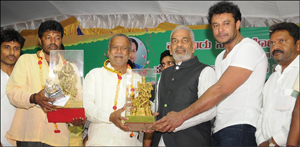
Former Mayor D. Dhruvakumar (third from left) is seen receiving the prize on behalf of his grandson Dhruvesh, who shared first place along with Venkatesh of Kolar (2nd from left) at the State-level Milking Contest, from Actor Darshan Thoogudeep and Animal Husbandry Minister A. Manju at J.K. Grounds in city yesterday. MLA H.P. Manjunath, Film Director Sandesh and others were present
Mysuru :
The three-day State-level milking competition, organised by Mysuru Nagara Gopalakara Sangha in association with the Department of Animal Husbandry at J.K. Grounds in the city, concluded yesterday.
The cow, owned by Dhruvesh, grandson of former Mayor D. Dhruvakumar and the cow owned by one Venkatesh of Kolar bagged the top prize, with both of them milking 40.800 kg of milk.
As both the cows shared equal honours, the owners were given Rs. 87,500 each (Rupees 1 lakh first prize and rupees seventy five thousand – second prize, divided by two). The third prize was bagged by the cow owned by Anwar Shariff, a resident of Akbar Road, Lashkar Mohalla, which milched 36.350 kg.
Anwar Shariff was given a cash prize of Rs. 50,000.
The fourth prize was bagged by the cow owned by Aishwarya, the grand daughter of former Mayor D. Dhruvakumar, which milched 35.450kg.
Aishwarya was given a cash of Rs. 25,000 as fourth prize.
Speaking after distributing the prizes, Animal Husbandry Minister A. Manju said that dairy farming can be a main source of income for farmers. Pointing out that taking dairy farming will bring happiness in the lives of farmers, he called upon the youth to engage themselves in dairy farming.
Stating that the State was one amongst the top producers of milk in the country with 66 lakh litres of milk production per day, he complimented the role of the Sangha in boosting milk production.
Actor Darshan Thoogudeep was the star attraction during the prize distribution ceremony. Thousands of people, most of them youths, gathered at the venue to have a glimpse of the actor, who has been attending the event for several years.
Minister Manju also presented a cheque of Rs. 1.5 lakh (Rs. 1 lakh donated by the Sangha and Rs.50,000 donated by actor Darshan) to Adarsh, son of the Sangha Founder late B. Paramesh on the occasion.
Former Mayor D. Dhruvakumar presided. Hunsur MLA H.P. Manjunath, KEA Chairman R. Murthy, Cine Producer Sandesh, JD(S) leader G.D. Harish Gowda, Sangha Hon. President Desigowda, President and Corporator D. Nagabhushan and others were present on the occasion.
source: http://www.starofmysore.com / Star of Mysore / Home> General News / Monday – January 25th, 2016
Our society needs to change; we are generating a society of merits. We need to understand our children in such a way that education is mixed with passion.
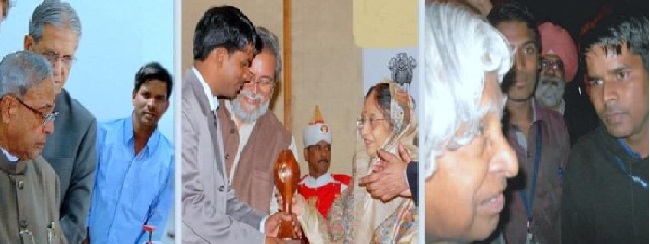
These lines describe Abdul Kaleem’s life in a nutshell. In 2009, Abdul was felicitated by the President of India for his innovations, when he was barely 22 years old. That same year, he was also honoured by the National Innovation Foundation (NIF) for Grass Root Innovation.
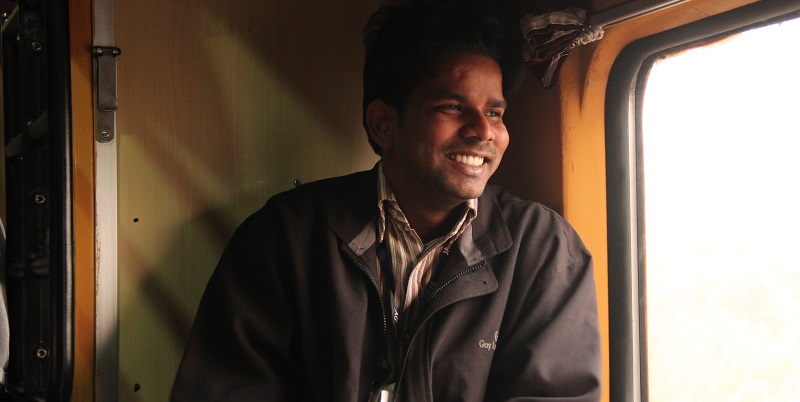
Innovator and entrepreneur Abdul Kaleem
But it was never about good grades or staggering dreams; as a student, Abdul always thought a little differently, a philosophy he still lives by:
“Whenever something happens, I think about the logic behind it. I keep questioning.”
And this questioning always took the form of little innovations. In the seventh grade, he saved Rs 2 from his pocket money to buy a crystal bird, which he turned into a greeting machine. It would open out with banner saying Id Mubarak whenever someone entered his room. A theft in his neighborhood caused him to create an alert mechanism that would call the last dialled number on the owner’s phone as soon as the door was opened.
But the contrast of all this sets in when one realises that Abdul was brought up in a small village in Deoria, in Uttar Pradesh born to an Urdu tutor father and an uneducated mother, where an alert mechanism was unheard of!
His parents could never understand what their child was really up to. What they wanted for him was a basic education that would lead to a secure government job. His father was disappointed to see his son’s unconventional ways, and his neighbors constantly felt the need to remind them how he was wasting his time.
But Abdul was only interested in his innovations, electronics, machines, and not the world’s opinion of them. He was undeterred; he smiles and says:
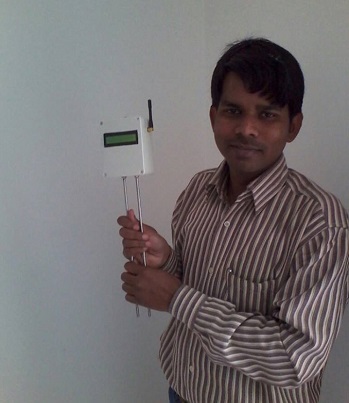
On one hand, Abdul continued to think about wider impact and what the community really needed, while on the other, he finished his high school exams and joined a Psychology course in Deoria. Staying deeply grounded to his roots, Abdul started looking deeper at his inventions. He created a device that could gauge moisture in the soil using sensors, and water pots automatically. The device would stop watering the plants once the sensors gauged enough moisture in the soil.
Next in line was a flood informer system, with a scale fitted at different areas of the river, including the centre and the bed of the river. The minute the water rose to the third level, the sirens would alert villagers to look for higher ground.
Finally, it was a visit by his Psychology professor that put him in the spotlight. He convinced Dr Nagiz Banu to visit his home and the small laboratory where he carried out his experiments. Dr Banu was reluctant, but when she entered the room, she was in for a surprise. Seeing the scale at which Abdul had mastered his experiments, she asked him to send his innovations to NIF. He did and, on 21 November 2009, Abdul was awarded for his grassroots innovations by President Pratibha Patil; what followed was a slew of other recognitions by the state.
We ask Abdul why he pursued Psychology and not Engineering, where his passion truly lay. He replies
“If you see, technology is created by perceiving Psychology, similarly as Psychology perceives the invented technology. So every subject has a correlation, it depends on how you use it.”
When we ask him what we feel is missing in innovations today, he says it is a lack of understanding of Psychology to create technology for the masses, while understanding their needs.
Abdul’s interaction and felicitation from the various Presidents of India
From innovations to business
However, Abdul says that while he may be a good inventor or engineer, he is not a good businessman. He has never understood business numbers.
Abdul constantly innovating, with his GPRS sensor
In 2011, Abdul embarked on the Jagriti Yatrawith around 350 strangers, a journey which completely transformed his outlook on where he aspired to use his potential to startup. Immediately after the Yatra, Abdul started working on a low-cost solar table lamp, another basic innovation catering to the masses.
This business idea required an initial capital of at least Rs 5 lakh. Unable to procure the funds, he shelved the idea and pursued other innovations.
Through reference of a customer Siddharth Jettar, in 2014 Abdul was introduced to G.K. Sinha, who was in awe over how solutions to complex issues came so easily to this young man. Abdul had created a universal light controlling remote for Siddharth’s house. G.K. Sinha was an angel investor, having the experience of guiding multiple startups.
He helped Abdul with starting his venture Eco tronica Pvt. Ltd.
Sinha also introduced him to Gautam Kumar, a graduate from Harvard University. Gautam felt the same potential in Abdul’s innovation and worked with him to refine his soil moisture-sensor-driven innovation and mobile weather prediction station to a requirement at Centers for International Projects Trust (CIPT), which is affiliated with the Earth Institute at Columbia University.
The low-cost weather station of sorts, powered by solar power, works on cloud computing and the installation of sensors on rooftops of buildings. The industrial setup costs as little as Rs 15,000, while the user-friendly and domestic models cost up to Rs 10,000 and Rs 5,000, respectively. Jharkhand’s Birsa Agricultural University has planned to set up this technology in the state’s Angara block. This will directly impact 700 farmers of the area.
Today, Abdul is also working on solar powered lighting with dual LED lights, which he claims should work for 24 hours with just five minutes of solar charge. He says he still doesn’t understand the revenues or sales figures because he thinks he is an innovator at heart and will remain one.
Abdul says the biggest challenge in having a manufacturing startup is getting the right vendor, who gives the right product at the lowest cost.
But there is an important lesson for all entrepreneurs when Abdul speaks. Even as Indian entrepreneurs flock to create the next Uber and Amazon, he makes us question what truly comprises innovation for the masses. He makes us question whether business models and revenues are the only success metric for a startup.
For many Indian entrepreneurs taking their product to Silicon Valley – an enduring symbol of innovation – is the highest form of success. But what about innovations for the masses? Is our entrepreneurial ecosystem based on the same system of meritocracy followed in the US?
Innovators like Abdul even make us question our prevailing education system. He rightly says we need to harbor our own culture of innovation. Our challenges are different, and the only way out is to innovate through passion and dedication to solve a problem, rather than look at is as a business.
source: http://www.yourstory.com / YourStory.com / Home> Success Stories / by Tarush Bhalla / January 20th, 2016
ECO-FRIENDLY ABODE : The Rs 2-crore mosque built by the Beary Group aims to promote harmony among all communities.
Udupi, KARNATAKA :
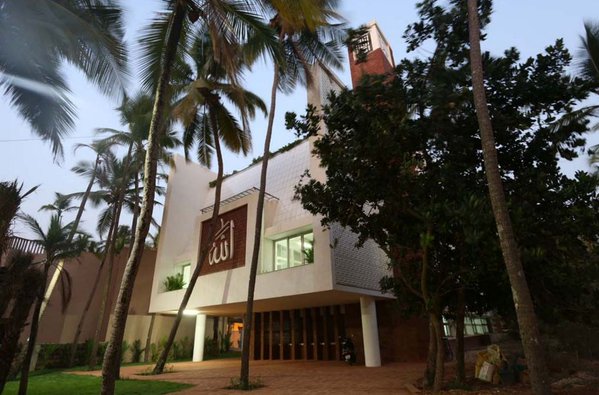
The Badriya Jum’a Masjid, a landmark on Kodi beach in Kundapur, holds out a new hope. Termed an ecofriendly mosque, it exemplifies sustainable technologies and also presents a modern face of Islam.
The green mosque, a typical Islamic architectural structure, aims to promote harmony among all communities in the world. There is a hope that the mosque will become a place of worship where people from all over the world will come and pray. It has already begun attracting non-Muslims.
Syed Mohamed Beary of the Indian Green Building Association’s state president told TOI that Badriya Jum’a Masjid is the world’s first `zero-energy’ green mosque. The Beary Group, with the help of locals, constructed the mosque at a cost of Rs 2 crore. Situated on two acres, the 1,500 sqft building can accommodate 2,000 people. It also has a library.
The Beary family built the mosque in memory of their grandfather. “Years ago, he wanted to go on the Hajj pilgrimage, but fell ill and couldn’t go. He used the same money to build a small mosque.It was renovated 40 years ago, but it wasn’t satisfactory . Now, using improved technology , we’ve come up with an eco friendly mosque,” he added.
Architects Sandeep and Manoj from Bengaluru have designed the mosque in such a way that the entire energy requirement is met through hybrid renewable energy , both wind and solar.
Their grandfather had planted a huge mango tree and a coconut palm on the premises. While the orientation minimizes solar heat gain, natural elements keep the inside of the building cool. The Lshaped building plan and elevated prayer hall, vegetation and water tanks around cool the environment naturally.
Natural cooling is accentu ated by a wind scoop on the 70-ft multifunctional minaret, from where the azan, or prayer call, is given. It forces down a draught of cool breeze into the prayer hall and also supports the tower structure of a wind turbine mounted atop it. The solar heat-reflecting terrace floor laid with white china mosaic and fitted with turbo vents not only keeps the prayer space cool but also reduces warming of the local micro climate.Non-conducting glass reinforced concrete jaalis with over 50% openings, maximize natural ventilation and supplement the design effort to reduce heat gain.
source: http://www.timesofindia.indiatimes.com / The Times of India / News Home> City> Bangalore / TNN / January 15th, 2016
Fitness enthusiasts in the city can add one more event to their workout calendar with JGI-Jain University announcing the launch of ‘My Country Run 2016’, which will see thousands of runners stream through the picturesque Cubbon Park as they compete in the 5k and 10k events on January 31.
The Sree Kanteerava stadium will be the hub of the activity as the races, which begin from 4pm, start and finish at the venue. “We have had an enthusiastic response so far as more than 3,000 people have already registered for the race. Though there are many road races in Bengaluru, we still need to do a lot more to get more and more people running,” race director Gul Mohammed Akbar told TOI.
Akbar said the first prize of Rs 1 lakh has attracted many elite runners, including athletes from Ethiopia and Kenya.
“Some of them are staying back after competing in the Mumbai marathon,” he said. Athletes who have finished the 10k in less than 60 minutes will fall in the elite category.
JGI Group chairman Chenraj Roychand said the proceeds generated from the race will go towards supporting the 30-35 athletes from below-poverty-line families, which are being looked after by the Jain Group. The money will be used to give them foreign exposure. “After looking at the savings, the trust will put in an equal amount to create a corpus that will be used to help these kids,” he said.
Uthappa lauds Jain College Returning to his alma mater along with ace cueist Pankaj Advani as the brand ambassador of the race, star cricketer Robin Uthappa recalled how the institution helped him through his college days. “I was frantically looking to get an admission for a degree course when I got a call from Jain College, expressing their willingness to start even a new course. Shankar sir was very helpful throughout my college days and the college even conducted special classes for all the sportspersons.
Now they want me to complete my MBA and I’ve promised to do that. I can confidently tell that Jain College is the best any sportsperson can aspire for,” recalled Uthappa, in the presence of his fiancee and former tennis player Sheetal Goutam.
The marriage is scheduled on March 3.
Roychand, meanwhile, recalled how he helped Uthappa to get back his focus after he was on the verge of quitting cricket.
“Robin once called up and said he wanted to quit the game but I told him that he was born to play cricket and put him through a few meditation sessions. Eight days later, he was back with a bang, cracking 165 runs,” the JGI chairman said.
He said the college has supported not only cricket but other sports as well, involving more than 300 international sportspersons, which included seven Olympians. “I’ve told Gul to reach out to rural schools and identify talent who can be nurtured to become top-class athletes. If we put in the hard work for the next 10-15 years, we can get more gold medals at the Olympics,” Roychand added.
UV Shankar, Director of Sports, Jain University, said the race will be an annual event. “The idea is to get everyone (men, women and kids) on one platform.”
The total prize money is Rs 5.35 lakh with Rs 1 lakh for the winner of the elite race. The registration fee is Rs 1,000 (Rs 800 for students) for Open 10K and Rs 700 (Rs 600) for the 5k race.
For online registrations, log on to www.mycountry.run.
source: http://www.timesofindia.indiatimes.com / The Times of India / News Home> Cities> Bangalore / by Biju Babu Cyriac, TNN / January 19th, 2016