Tag Archives: Tipu Sultan

Why We Need a Book About Muslims Who Fought for India’s Freedom

Mumbai, INDIA :

Can a stable and just democracy flourish on foundations of wilful amnesia and erasure?

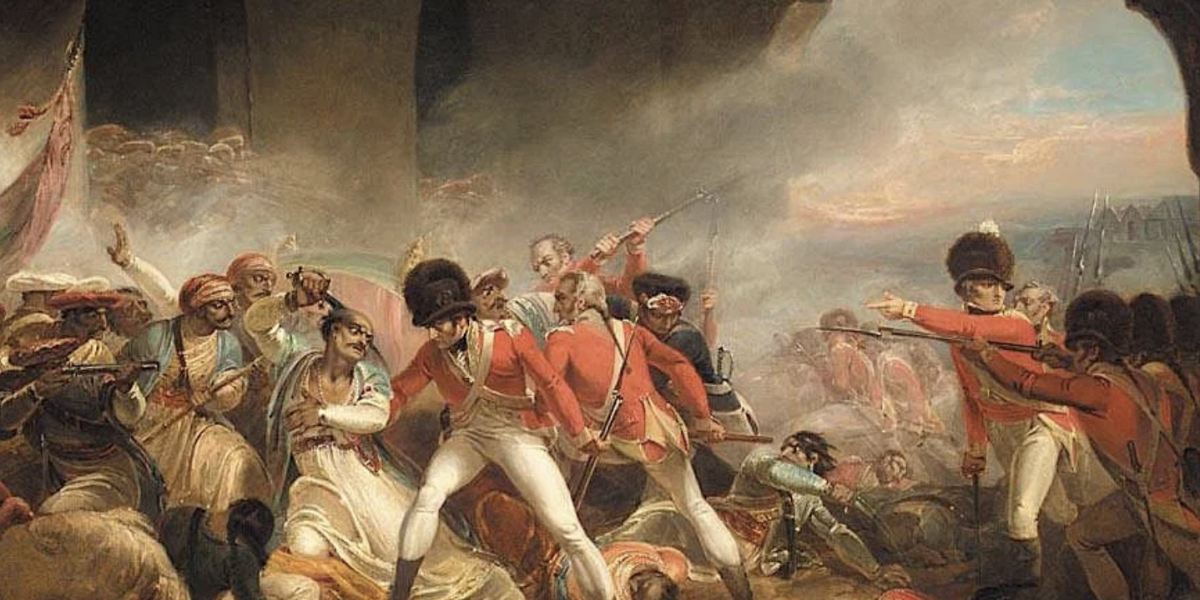
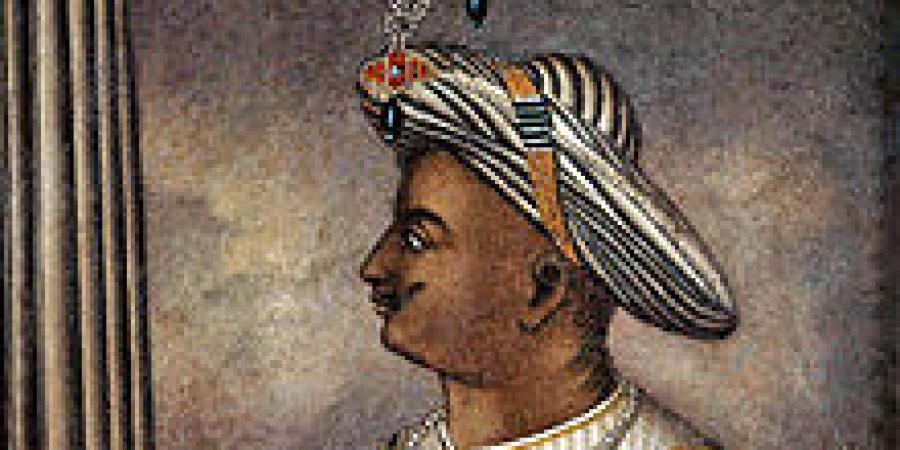
A c. 1800 painting showing the last stand of Tipu Sultan, ruler of Mysore in 1799 at the end of the Anglo-Mysore Wars with the East India Company. Photo: Henry Singleton/Public domain.

Many will ask why a book about Muslims who fought for India’s freedom? There’s no answer to such questions except another question. Had we been better memory keepers as a nation, could we have avoided the peak disinformation and stupidity which normalises reviling ordinary Muslims as outsiders, infiltrator and insurgents? 

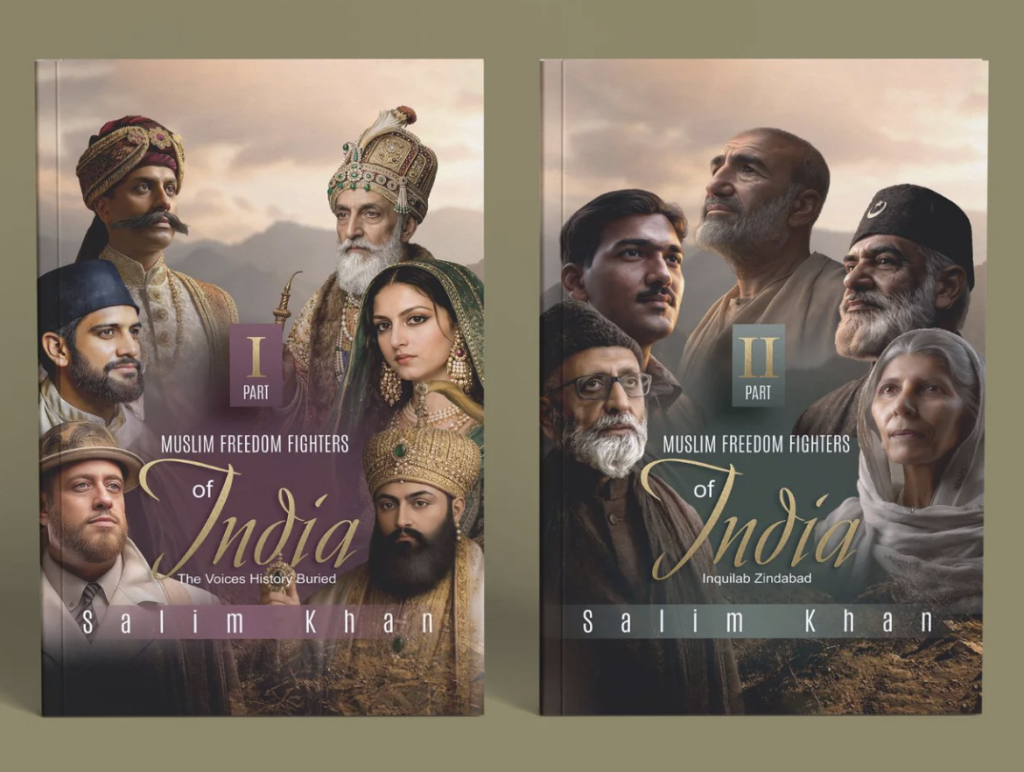
Muslim Freedom Fighters of India is a two-volume biographical compilation by Salim Khan on less-known, mostly forgotten and hardly known Muslim figures. The books aim to clear the fog around Muslim freedom fighters whose names are heard of without them being extensively known and this requires us to understand why this fog exists. Written in an extremely readable and accessible format, these biographical accounts embed the historical figures in the context of their times, responding to unprecedented events with foresight, clarity and conviction that sealed their fate and shaped and the nation’s destiny.

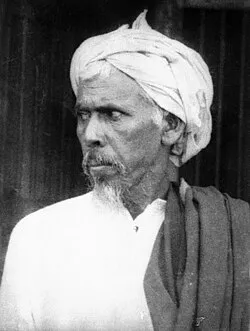
 Whether we are reading about Generals of 1857 – Bakht Khan and Khan Bahadur Khan – or the Cambridge-educated Rampur scion Mohammad Ali Juahar of Khilafat moment and his fiery mother Bi Amma, the larger questions seething beneath the stories keep rising to surface. Who does a society and nation choose to remember and celebrate? Whose memories are deemed worthy of preserving? History is always shaped by those who control archives, narratives and memorialisation and hence memory. 

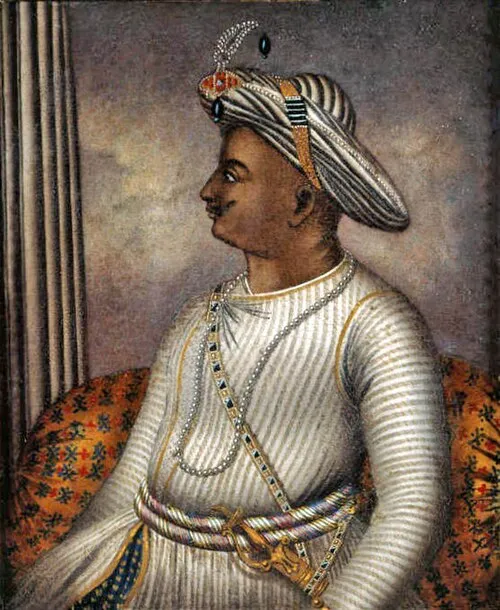
Reading about Tipu’s dazzling reign through the three Anglo Mysore wars where he proved superior to British forces, I was reminded of the controversy sparked by the late Girish Karnad’s suggestion of naming the Bengaluru airport after Tipu Sultan. Karnad had said, “It is true that Tipu Sultan was not born in Bengaluru, but he was a son of this soil and a freedom fighter. Had Tipu been a Hindu, he would have achieved the status of Shivaji, and the airport would have been named after him.” I recalled Karnad because his play Dreams of Tipu Sultan echoes the same theme that this two-volume tribute to erased, obscured and deliberately unremembered historical figures echoes: that when politics lays down who should be forgotten, remembering the erased becomes a duty, an affirmation and a political act. 

It is important to clarify that this is not a compilation of eulogies but well-researched fact based account of people who had the uncommon clarity to resist colonial domination even before the nationalistic narratives took shape. That they happened to be Muslims is important today because of the distortions that have obscured and erased them. But back then when they fought and resisted, they were simply rallying for the cause of their soil and their watan. From the earliest times they understood that freedom from foreign domination required Hindus and Muslims to put up a united front as in the war of 1857, the Khilafat movement, and the period between 1919 and 1924. Back then too, traitors cut across religious lines – Jagat Seth, Mir Jafar, and Ilahi Baksh.

Muslim Freedom Fighters of India: Part 1 and Part 2’, Salim Khan, Qalam Aur Kaagaz Books.

From Siraj ud Daulah to Tipu to Shahzada Firoz Shah, the book shows how the fog around these personalities is not accidental but meticulously designed – initially by the colonial mind, then picked up by early nationalists and woven into simplistic narratives. The macabre dance of history further stifled Muslim voices. Cataclysmic events like the ‘end’ of the Mughal Dynasty in 1857 and the Partition in 1947 sundered clans, erased family histories, legacies crumbled with no one is around to defend and uphold them. Today, even people who don’t know history have heard of Lakshmi Bai, but many who read history may not have heard about Shahzada Firoz Shah, the Mughal Emperor’s grandson who in August 1857, led a band of armed soldiers to rally the rebels in Rohilkhand and Malwa and who fought alongside Tatia Tope and called for a united Hindu-Muslim front against the Company. 

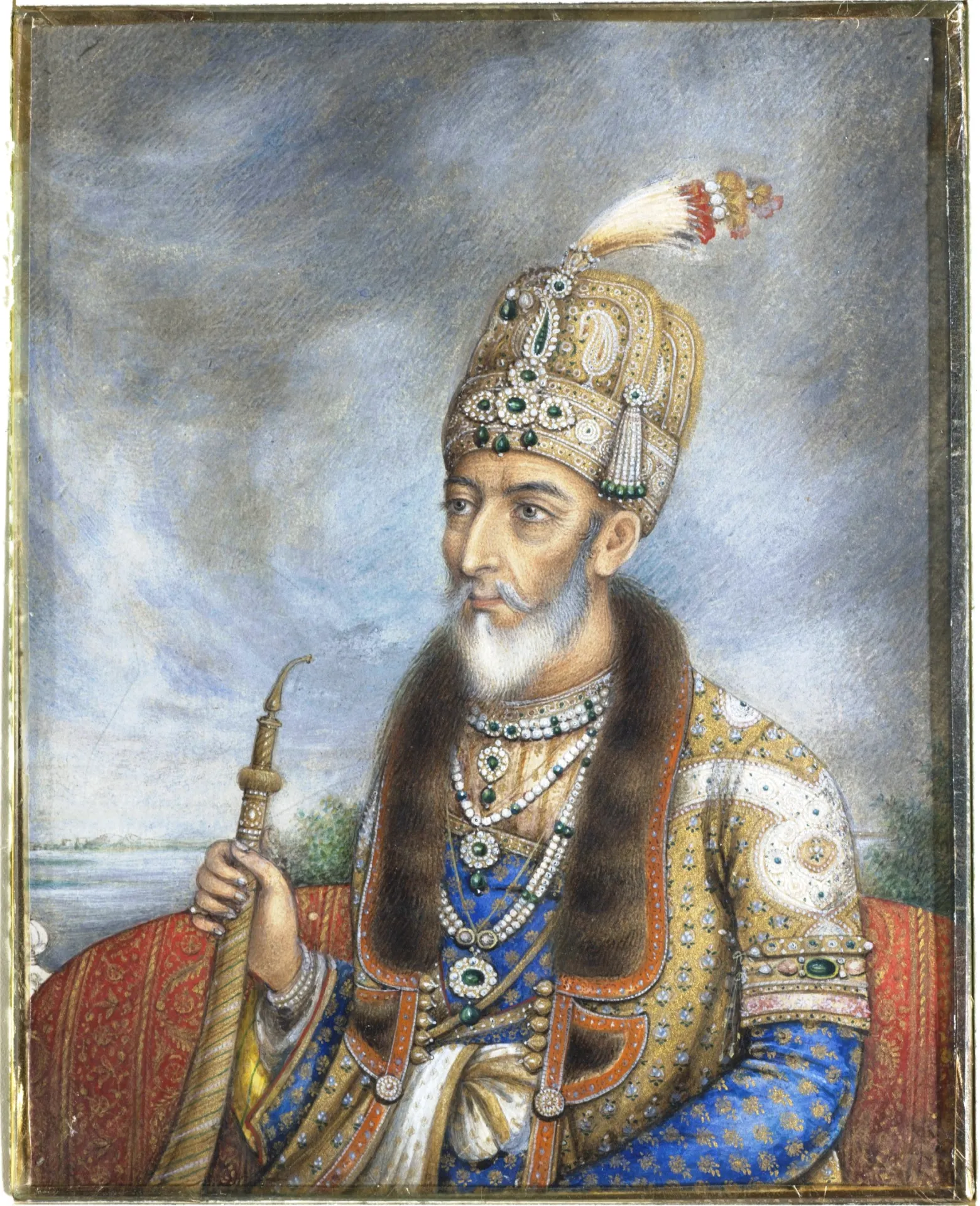
The British understood the dangerous potential of popular memory and subverted any potential for memorialisation of hugely influential figures. No one knows if Shahzada Firoz died in battle or escaped to West Asia. The Maulavi Ahmadulla of Faizabad whose authority and fearlessness scared the British so much that they kept a reward on his head, was likewise interred in an unmarked grave. Knowing that even his memory could become a node to unite the rebels, the British saw to it that no commemoration was permitted or possible. Zafar, the last Mughal was exiled to Rangoon for the same reasons.

In her book, India, 5,000 years of history on the subcontinent, Audrey Truschke, elucidates how Muslim rulers like Nawab Siraj ud Daulah and Tipu Sultan to Zafar felt a responsibility for their subjects no matter what their religion. For example, Siraj ud Daulah actively intervened in times of famines and drought in Bengal. But after the British took over they did nothing to alleviate human suffering, so that 20% of Bengal’s population died in the famine of 1768 and the small-pox epidemic of 1769-70 following it. This had never happened during earlier episodes of failed harvests. Truschke says, British historians initiated the custom of categorising Indian rulers as tyrannical, effete and incompetent, reducing them to their religion and writing in terms of Hindu rulers and Muslim rulers. The British needed to demonise Muslim rulers who were their immediate predecessors in subcontinent so that they might look good by comparison, Truschke notes. It was a part of the colonial propaganda.

Another pattern Salim Khan’s compilation brings out is that from mid-18th century onwards, the first responders and the most committed crusaders resisting colonial domination – the kings, queens, princes, preachers, noblemen – were Muslims. Not only because the British had wrested from them the power they had wielded for centuries (howsoever fragmented or diluted it may have become); but also, because they were looked upon as leaders. In Awadh, for example, the Shia elite took it as their moral-ethical duty (see Chapter 7, volume I: Shia Ullema and Noblemen of Awadh

Even in the 20th century, Muslim freedom fighters like Hasrat Mohani of the Inquilaab Zindabad fame and Asfaqullah Khan of the Kakori conspiracy who was an icon for Bhagat Singh, remain in the shadows, seen only in a hazy half-light. Were their contributions any less or only less remembered? One of the most important projects post-Independence should have been to restore memory and affirmation to those whom the British put on the wrong side of history, no matter what their religion or caste. But we know this is not what happened.

Since the arrival of the political controversy over Tipu Sultan, we have entered in an era of deliberate distortion of history. The larger question that these accounts refrain from asking but that jumps to any thinking person’s mind is this: can a stable and just democracy flourish on foundations of wilful amnesia and erasure? Should the memory of Muslim freedom fighters be kept only by the Muslims? The heritage and memory of Indian Muslims needs to be reclaimed by them. But equally, these volumes are required reading for the casually miseducated, hopelessly disinformed or simply ignorant Hindus who have been stupefied into denying and distorting their composite history.

Varsha Tiwary is a Delhi-based writer and translator. She has recently published 1990, Aramganj a translation of the best-selling Hindi novel Rambhakt Rangbaz.

Coastal Karnataka History Summit logo unveiled in Bhatkal; call for research papers issued

Bhatkal (Uttara Kannada District / Karavali), KARNATAKA :

Bhatkal:

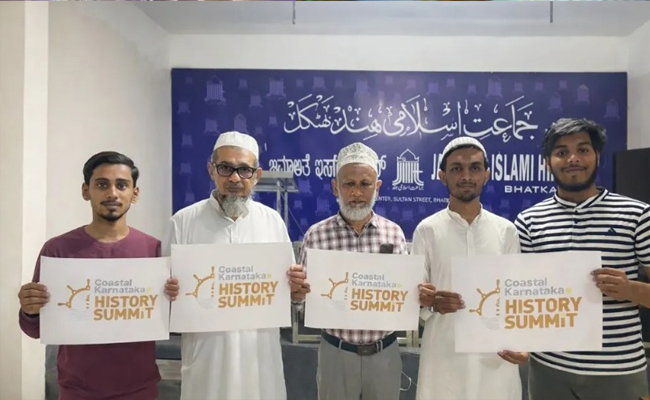
Preparations are under way for the upcoming Coastal Karnataka History Summit, with the official logo of the academic event unveiled at Dawat Centre by Students Islamic Organisation of India Bhatkal Unit in Bhatkal on February 22, 2026. The summit is scheduled to be held on May 5, 2026.

The initiative is being organised by the Centre for Education and Research & Analysis (CERA) with the aim of documenting and examining the historical evolution of Coastal Karnataka, including Uttara Kannada, Udupi, Dakshina Kannada and adjoining areas of Kasaragod.

At the launch event, the organisers released the official Call for Papers, inviting scholars, researchers, academicians and students to submit original and unpublished research.

Abstracts of 200 words, either in English or Kannada, must clearly mention the research question, methodology and key findings. The deadline for abstract submission is February 28, 2026. Selected participants will be informed by March 15, and full papers must be submitted by April 20.

The summit will centre around five broad themes. One section will explore the trade and economic networks of the coastal belt, including maritime routes, port towns, fisheries and commodity-based exchanges such as pepper trade. Another domain will examine social structures, caste formations and inter-community relations, along with the role of Islamic, Arab, Persian and local traditions in shaping the region’s cultural fabric.

A separate section will focus on the origin and growth of linguistic communities such as Tulu, Konkani, Beary, Moya Malayalam and Navayati.

Governance and administration under different rulers — including the Alupa dynasty, Rani Abbakka, Tipu Sultan, the Nawaith Sultans of Bhatkal and developments after Independence — will also be studied.

The fifth theme will highlight social reformers such as Narayana Guru, Syed Madani, Malik Deenar, Vakkom Moulavi, Sayyid Fazl Pasha and Kudmul Ranga Rao, and their contributions to education and social reform.

The logo launch programme was attended by senior journalist Dr. Haneef Shabab, JIH Bhatkal President Moulana Syed Zubair SM, SIO Bhatkal President Mohammed Zayan Bangali, Unit Secretary Githreef Rida Manvi and Media Secretary Mashaikh Talish.

Organisers said the summit intends to create a structured academic space for discussing the region’s layered past and bringing local histories into wider public and scholarly discourse.

For submissions and queries, researchers may contact coastalkarnatakahistorysummit@gmail.com.

source: http://www.english.varthabharati.in / Vartha Bharati / Home> Karavali / by Vartha Bharati / February 24th, 2026

Tipu Sultan’s sons engineered the Vellore Mutiny

Srirangapatna (Mysore) KARNATAKA :

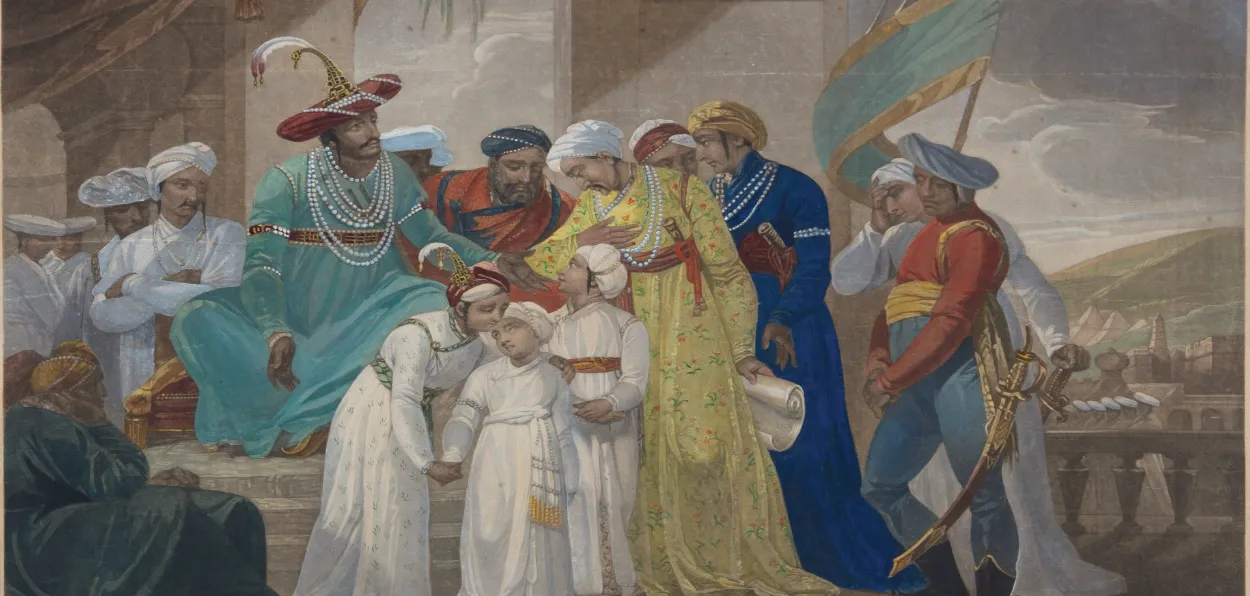
Tippoo Sultaun delivering to Gullum Alli Beg the Vakeel his sons who are taking leave of their brother previous to their departure from Seringapatam (1793) Painting by Henry Singleton

“The Christian drummers were seized, taken to the palace where Tippu’s sons were confined, and made to beat the “general” ; lights flashed in the palace, refreshments were brought out; a mob of sepoys called on the princes to place themselves at their head; Tippu’s own flag, green stripes on a red field, was nailed to the flagstaff. Prince Muizuddin (son of Tipu Sultan) ordered his horse to be saddled, and told off a party of sepoys to go and seize the principal hill fort; when that was captured and the dead body of Colonel Marriott, paymaster of stipends, brought before him, he promised he would mount his horse and ride through the native town proclaiming the restoration of the Mahommedan power.”

A Slice of History

This is the account by Colonel Alfred Keene of the night of 10 July 1806 at Vellore. The rising, popularly known as the Vellore mutiny, was a dress rehearsal of a sort of what would happen in May 1857 at Meerut.

Keene pointed out, “In the mutinies of Vellore and the greater one of 1857, two points of similarity stand out prominently. In each is the unreasoning fear of an attack on the institutions of religion and of caste; for the greased cartridges in the latter mutiny had as much to do with the outbreak as had the new head-dress in 1806, and the presence of the remnants of the Moghul Dynasty at Delhi acted in 1857 precisely as had the presence of Tippu’s family at Vellore in 1806.”

After the fall of Tipu Sultan in 1799, the English East India Company shifted his children to Vellore. In early 1806, the Commander-in-Chief ordered a new headgear and, the removal of beards, tilaks, earrings, or any mark of caste identity.

The Indian sepoys of the 2nd Battalion 4th regiment showed dissatisfaction in May 1806 and disobeyed the orders. These sepoys were tried in army court and 21 of them were found ‘guilty’. Of them, one Hindu leader and other Muslims were discharged from the duty and sentenced to receive 900 lashes each. The other 19 were not discharged but ordered  500 lashes each. The order was passed on 29 June and published to the army on 2 July 1806.

The wife of a serving English officer at Vellore, F. W. Blunt, wrote in a letter to her family in England, “Nine of the ringleaders, as they were called, were brought down to Madras and here passed publicly through the streets in irons, destined to receive the most dreadful military punishment…… The nine men in irons awaiting a most severe punishment was made use of by the sons of Tippoo, who have been kept prisoners in the Palace at Vellore since the taking of Seringapatam and served to ripen a design that had been long formed. A conspiracy was formed by the Sepoys to murder all the Europeans and take possession of that Fort.”

Tipu Sultan

On the night of 10 July 1806, Shaikh Kasim, a sepoy, led the English East India Company sepoys in starting a general massacre of the English troops.

Lt. Col. W. J. Wilson in ‘History of the Madras Army’ wrote, “The sepoys went away shortly afterward, and were heard to call out “Come out, Nawab, come out, Nawab, there is no fear.” This was supposed to be addressed to Futteh Hyder, the eldest of the four Mysore Princes.”

Of the 372 Englishmen present at Vellore, 128 were killed that night by the Indian sepoys. The English flag was replaced with the flag of Tipu Sultan, which was handed over by Moizuddin, the eldest son of Tipu. He was proclaimed the leader of the revolutionaries.

Though the immediate cause was the headgear and other orders, the revolt had been planned for a long time. Charles Macfarlane wrote, “The splendour which the sons of Tippoo were enabled, by the liberality of the Company, to keep up, attracted a continual influx of visitors, including all that came to Vellore from the countries which had once belonged to their father. Among these men were very many who had lost by the change which had taken place in Mysore, who hated the tranquillity which we had introduced into their country, and who longed for the old days of rapine and violence. It is believed that these desperadoes contributed to a regular conspiracy and facilitated the execution of the daring design.

It is said that the confederates intended that all who were brought to join in the insurrection should act upon a preconcerted plan, which had been digested and privately circulated by some of the turbulent Marawa chiefs; and that in connection with these desperadoes were some few Frenchmen, disguised as fakeers or dervishes, who went about the country inveighing everywhere against the English as robbers and tyrants. It is also stated that placards were fixed up within the mosques and Hindu temples, where Europeans never entered, to excite a general spirit of revolt among the whole native population of Madras.”

The English Government set up an enquiry commission headed by Major General Pater which submitted its report on 9 August 1806. The report said, “There are two principal causes which appear to us to have led to the mutiny. The late innovations in the dress and appearance of the sepoys, and the residence of the family of the late Tippoo Sultan at Vellore.”

Sir J. F. Cradock, the Commander-in-Chief, disagreed with these findings and argued in his submission that change in dress was a pretext and the real objective was to restore the rule of Tipu Sultan’s family. 

The Court of Directors after the investigation declared that the “immediate cause of the discontent among the sepoys was the introduction of certain innovations in their dress, which were offensive, and, as they held, degrading to them; and that the captive sons of the late Tippoo Sultan, with their adherents and abettors, took occasion, from the dissatisfaction of the sepoys, to instigate them to insurrection and revolt, with the view of effecting their liberation, and the restoration of the Mahomedan power.”

The mutiny was suppressed by noon on 10 July. Colonel Gillispie stationed at Arcot came to rescue the Englishmen at Vellore before 7 am. His forces, which also included Indian sepoys, killed more than 500 Indians in the fort within a few hours.

At least 15 English officers including, Colonel Fancourt, H.M.’s 34th regiment, commanding the garrison, Lieutenant-Colonel McKerras, Captain Willison and Lieutenants Winchip and Jolly of the 23rd, Captain Miller, Lieutenants O’Reilly, Smart, and Tichbourne of the 1st, and Lieutenants Eley and Popham of the 69th, Mr. Mann Deputy Commissary of Stores, Mr. Gill Conductor of Ordnance, Mr. Smith the Military Paymaster and Major Armstrong of the 16th N.I. were killed.

Among the captured sepoys, six were blown away with cannon guns, five were shot by firing squads, eight were hanged, and several others were transported for life. Out of the retainers of Mysore Princes, one was sentenced to death, two to transportation for life, one to imprisonment for life, and one to imprisonment for ten years. The sons of Tipu Sultan were sent to Kolkata with stricter vigilance.

Lord William Bentinck, Governor, and Sir J. F. Cradock, C-in-C, were removed from their respective offices by the Court of Directors.  

source: http://www.awazthevoice.in / Awaz, The Voice / Home> Stories / by Saquib Salim / July 10th, 2025

Tipu in Malabar

KERALA / Mysuru, KARNATAKA :

Tipu Sultan’s largesse to temples as recorded in the 19th century Inam Registers of Malabar shows that he was sensitive to the religious sensibilities of Hindus.

Karnataka Chief Minister Siddaramaiah paying tribute to Tipu Sultan in Bengaluru on November 10.

The Congress government in Karnataka led by Chief Minister Siddaramaiah has marked the birthday of Tipu Sultan on November 10 as “Tipu Jayanti” for the past three years. While Tipu is honoured as a freedom fighter for opposing the British in the Anglo-Mysore Wars and dying on the battlefield in 1799, there are intense protests against this event as well. The protests are led by a wide array of bodies that draw their support from the Hindutva ideology spearheaded by mainstream politicians of the Bharatiya Janata Party in Karnataka. They allege that Tipu was a religious bigot whose reign was marked by the plunder of temples and forceful conversions of Hindus to Islam.

There are allegations that Tipu forcefully converted non-Muslims in three parts of his domain: first, among the Kodavas of Kodagu in modern Karnataka; then among the Nairs of Malabar in present-day north Kerala; and the Christians of Mangalore (now Mangaluru) in coastal Karnataka. Frontline has discussed the broad reign of Tipu Sultan and his legacy (“Contested legacy”, December 11, 2015) and scrutinised the allegations of religious excesses made against him in Kodagu (“Tipu-Fact & Fiction”, January 6, 2017). This essay attempts to analyse the allegations made against Tipu Sultan in Malabar.The Inam registers

Deep inside the Regional Archives of Kozhikode, amid lakhs of valuable documents, is a set of seven registers dating to the 19th century, compiled by J.W. Robinson, the Inam Commissioner of Malabar. The seven British-era taluks the Inam registers pertain to are Ernad, Choughuat, Old Betatnad, Calicut, Kurumbranad, Valluvanad and Wynad. (These taluks have been absorbed into various districts in modern Kerala.) An “inam” is a gift, and inam land is land given as a tax-free grant to an institution or an individual, usually in perpetuity unless it is rescinded, as happened all over India through various land reform laws after Independence. The registers have archived for posterity the minutiae of the process of renewal of inams in the region.

The registers are long and broad and the calligraphy is stylised to the point that at first glance all that one can discern is a series of neatly slanted squiggles.

The register pertaining to Choughuat taluk (also known as Ponnani) lists nine temples whose inam lands were renewed. Of this, the largest land grant (of 613.2 acres) that was renewed belonged to the Guruvayur temple in central Kerala. A close perusal reveals that the text lists the beneficiary as Uralers, or trustees, of the “Guruvayur Kshetram”.

The extended note reads: “A sum of Rs.1,428-9-2 [rupee-anna-paisa] appears to have been allowed for the support of the temple by Tippu Sultan and continued by the British Government upto 1841, when the necessary examination was made and the money allowance commuted into a grant of the lands yielding an annual assessment equivalent to the money grant. The lands are still held as inams and are accordingly confirmed as such for such time as the conditions of the inam are fulfilled under date the 20th Nov. 1841.” This note was endorsed by G.A. Ballard, the then Collector of Malabar, and subsequently confirmed by W.J. Blair, the then Officiating Inam Commissioner of Malabar, on June 20, 1866. In other columns relating to this entry, a mention is made that the inam was first granted by Tipu Sultan in 1776-77 and verified by the British administration of Malabar. The basis of the British confirmation was the pioneering “paimash” (survey) land revenue records prepared by the Brahmin administrative clerks of the Mysore rulers, who wrote in the Modi script, the precursor to the Devanagari script used to write modern Marathi.

The Archives have around 500 bundles of these land revenue records, each around 100 pages. The pages are slightly frayed but the script is legible. These records in the Modi script are a gold mine for academics interested in the land reforms carried out by Hyder Ali and Tipu Sultan in Malabar, which had a long-term impact on Kerala society.

What is more germane to our times, when Tipu’s legacy is hotly debated, is that the Inam Registers contain detailed records of the substantial land grants he made to several temples. This is valuable evidence to counter reductive Hindutva propaganda that alleges that Tipu was a religious bigot whose ambitious expansionist ventures were only a jehad to spread Islam by destroying temples and forcefully converting Hindus in the region.

According to an estimate made by Muhamad Ismail, details of which are available in his unpublished PhD thesis, 6,931.03 acres of land were given as inam by Tipu Sultan. Of this, 5,434.07 acres were given to Hindu institutions and individuals, while 1,494.27 acres were given to Muslim institutions and individuals (“Religious Policy of Tipu Sultan: Malabar Region”, Unpublished Doctoral Thesis, 2016).

Grants were made under three categories: devadayam grants to 48 temples, dharmadayam grants to seven “sathrams”, and grants to three individuals (see table). Considering that local Muslims known as “mappilas” made up about a quarter of the population of Malabar, this stark disparity in the largesse of a “religious bigot” is startling. If anything can be argued through these land grants, it is that like in other parts of his kingdom, Tipu was keenly sensitive to the religious sensibilities of Hindu citizens in Malabar as well. He wanted to establish a long-term presence in Malabar, and his perspicacity is evident in his support to temples.The Mysorean interlude

The late 18th century was a period of transition in Indian history. The Mughals were in a state of continuous decline and the East India Company had emerged as a major player in the affairs of the subcontinent after the Battle of Plassey in 1757. The Marathas had established their sway over vast swathes of the subcontinent as well. In peninsular India, various powers were battling for expansion of their territories. Hyder Ali, a faujdar (military commander) in the Mysore Army, rose to become the de facto ruler of Mysore in 1761. His territory was threatened by the Marathas, the Nizam of Hyderabad, the Nawab of the Carnatic and the English under the aegis of the East India Company. The French were also an important power that could not be ignored.

North Kerala at the time was broken up into several small principalities. An early estimate states that there were four important kingdoms and 42 principalities across Kerala. Hyder invaded Malabar through Mangalore and Cannanore (now Kannur) in February 1766. Hyder was embroiled in the affairs of Malabar indirectly from the time he was in Dindigul. The Raja of Palghat (now Palakkad), who had a constant feud with the Zamorin of Calicut (now Kozhikode), reached out to him for help, providing Hyder the excuse he needed to come to Malabar as he had always wanted access to a long coastline and a share in the lucrative trade of spices. His fort in Palakkad, around which the modern town has developed, also dates to this era. Tipu, the eldest son of Hyder, who would have been a teenager at the time, accompanied his father on this campaign.

Hyder’s invasion was successful and he swiftly conquered the minor principalities of Malabar. The Zamorin of Calicut, defeated and forced to pay a tribute, committed suicide. The disunity among the rulers of Malabar and the disciplined approach of the Mysorean Army led by its cavalry were responsible for this easy victory for Hyder, who intended to march all the way down south to Travancore via Cochin), but the monsoon hindered his plans. He returned after appointing a governor called Madanna and fixing tributes for the local chieftains. Soon after, his outposts in Malabar were threatened by a rebellion led by the Nairs, who formed the fighting corps of the Kerala kings.

While this rebellion, which some historians see as a native resistance to a foreign ruler, was quelled, it did lead to Hyder severely restricting the privileges of the Nairs. Many upper caste Hindus, including the Namboodiris, the Nairs and chieftains, fled to Travancore during Hyder’s invasion.

Over the next few years, Hyder was fighting the marauding Marathas and the First Anglo-Mysore War (1767-69) and could turn his attention to Malabar again only at the end of 1773. This time, many local chieftains who had not been regular with their tributes were not reinstated, and Malabar came to be directly ruled as a province of the Mysore kingdom. Hyder’s plan of attacking Travancore was again left incomplete. A detailed land survey was done by Sreenivas Rao, the governor in charge of civil affairs, and the land records at the Regional Archives of Kozhikode date back to this era.

When Hyder came to Malabar, several European powers, led by the East India Company, were already deeply involved at various levels in local affairs as they all had trading outposts along the coast of Malabar. They included the English, the Dutch, the French, the Portuguese and the Danes. Among them, the English and the French had substantial trading interests from their bases in Tellicherry (now Thalassery) and Mahe. During the Second Anglo-Mysore War (1780-84), Tipu was in Malabar fighting the English. He was about to score a crucial victory when he received the news of Hyder’s death. Tipu swiftly returned to Seringapatam (now Srirangapatna), but his territory in Malabar was restored to him as per the Treaty of Mangalore in 1784. Malabar remained a part of Tipu’s domain until the end of the Third Anglo-Mysore War in 1792, but he had lost control over it by 1790. It eventually became a part of the Madras Presidency as Malabar district.Impact of Mysorean rule

“The great significance of the Mysorean occupation of Kerala for more than 25 years, lies in the fact that it marked an era of transition from the medieval to the modern,” writes C.K. Kareem in his book Kerala Under Haidar Ali and Tipu Sultan (1973). Although Malabar was officially part of the Mysore kingdom between 1766 and 1792, the Mysore rulers had only limited control for many years. Tipu ruled the region directly only for six years. While the period of direct rule was short, it had a long-term impact on Malabar society. Hyder and Tipu brought about an integration of the small principalities of Malabar for the first time and a feudal system of administration was replaced by centralised rule, much like it had been done in Travancore. A network of roads was built in the region for the first time. Trade and industry flourished during the time and European merchants who had secured favourable terms from the Malabar chieftains suffered as Tipu imposed a state monopoly on a number of items, including pepper. He also attempted to build a navy here and appointed the ruler of Cannanore as the chief of his naval force.

Perhaps the greatest impact of Hyder and Tipu was in the area of land administration. In this area one can also see the displacement of dominant castes, which gave rise to accusations of religious bigotry. Historians have written about how there were no land taxes in Malabar before it came under Mysore rule. The “jenmis” (landed aristocracy) were the absolute owners of land with the tiller having no claims. The Mysorean rulers shook up this system and settled land revenue claims directly with the tiller. In this way, Hyder and Tipu can be seen as early reformers in land administration. The rulers ensured that temple land remained untaxed. Land settlement became easy because the landowners—the Namboodiris, the chieftains and the Nairs—had fled from Malabar to Travancore. The tenants, who were mainly mappilas or lower caste Hindus, benefited from this.

Tipu also saw himself as a social reformer and attempted to change some of the traditional aspects of Nair society. For instance, he was appalled when he found out that Nair women cohabited with several men. He was also disgusted by the practice of lower caste women not being permitted to cover their breasts. Tipu forbade these practices, which was resented by the Nairs, who saw this as an encroachment on their religious and social rights.

Nairs and Namboodiris comprised a fifth of the population of Malabar and the upheaval wrought about by Hyder and Tipu in the caste and class privileges of these two communities led to social upheaval. The Namboodiris and the Nairs suffered the most during the time of Tipu. These two castes were severely affected by the political, social and economic reforms undertaken by Tipu. Kareem writes: “It was, therefore, the economic and social reforms that paved the way for the accusations of religious bigotry brought against Tipu Sultan.” It was also easy to see the issues of land and social reform along religious lines, as the main beneficiaries of Tipu’s land reforms were the mappilas. Some scholars have also made connections between the social upheaval caused due to the Mysorean interlude and the mappila rebellion of 1921.Problematic sources

Mark Wilks, an officer of the East India Company who participated in the final storming of Srirangapatna in 1799, recorded in his work that Tipu warned the Nairs that if they continued to adhere to their regressive caste practices and disobeyed his commands he would march all of them to Srirangapatna and convert them to Islam. The aspect of Tipu threatening conversion is strangely not contained in the account of Mir Hussain Ali Khan Kirmani, the avid court chronicler of Hyder and Tipu’s reigns who tinged his histories with an Islamic slant and never failed to present Tipu as a champion of Islam. The early works of writers like Wilks provided the basis for later writers like William Logan, who, as Collector of Malabar, wrote the two-volume Malabar Manual in 1887. Much of the allegations against Tipu regarding religious violence in Malabar come from this writer.

Thus, if one were to examine closely the various sources that vilify Tipu in Malabar, they are usually of two kinds: first, British writers who found in Tipu their arch villain and exaggerated aspects of his religious policy, and second, the writings of local upper castes who had lost considerable privileges during the Mysore rule.

However, there are young historians like M.P. Mujeebu Rehman, assistant professor in the Department of History at the University of Calicut, and Abhilash Malayil, a PhD student at the School of Humanities and Social Sciences, Indian Institute of Technology Mandi, who have assessed the Mysorean interlude in Malabar history objectively by faithfully historicising the period rather than seeing it in the surcharged communal atmosphere of contemporary politics.

Rehman writes in his book The Other Side of the Story: Tipu Sultan, Colonialism and Resistance in Malabar (2016): “The falsified image of Tipu Sultan, popularised fervently by the colonial writers, in fact was of ‘religious bigotry’. They had realised the fact that no other stereotypes could be so sensitively worked out among the Hindu believers than that of religious bigotry. Both colonial and nationalist historians highlighted religious aspects of Mysorean interventions concealing its political or economic aspects. For instance, they maintained that Tipu invaded Malabar and hundreds of thousands of native non-Muslims were hanged, circumcised or exiled. Several such statements have reverberated even in contemporary discourse without any substantial evidence other than the colonial narratives.”

Muhamad Ismail writes: “It is high time that we reinvestigate on the basis of true historical records, however meagre they may be, everything that has been unleashed against Tipu Sultan and the Mysore administration. It has been proved by recent historians engaged in the study of the Sultan’s history that the descriptions of the widespread arson, loot and violence that the Hindus of Malabar faced at the Mysorean interlude were mostly fallacies of imagination or the result of the retaliation of the Sultans against rebels.”

Tipu was aware that he was a Muslim king while his subjects were mainly Hindu and he legitimised his reign through generous support to temples in his domains. As the Inam Registers have shown, Tipu gave generously to the temples of Malabar as well and none of his actions suggest that he was a religious bigot.

S. Rajendu, a Palakkad-based historian and author of Mysore PadayottamIrunnoottiyanpathu Varshangal (Mysore Rule-250 Years) (2017), says: “There are instances of Hyder and Tipu plundering temples but that was only because wealth was hoarded in the temples in Malabar. There was no conception of nation or religion at the time that motivated the ruler’s actions.”

This become evident when we see that mappilas like Athan Gurukkal of Manjeri also revolted against Tipu in 1788-89 and Tipu suppressed this rebellion with the help of Ravi Varma, who belonged to the Zamorin’s family.

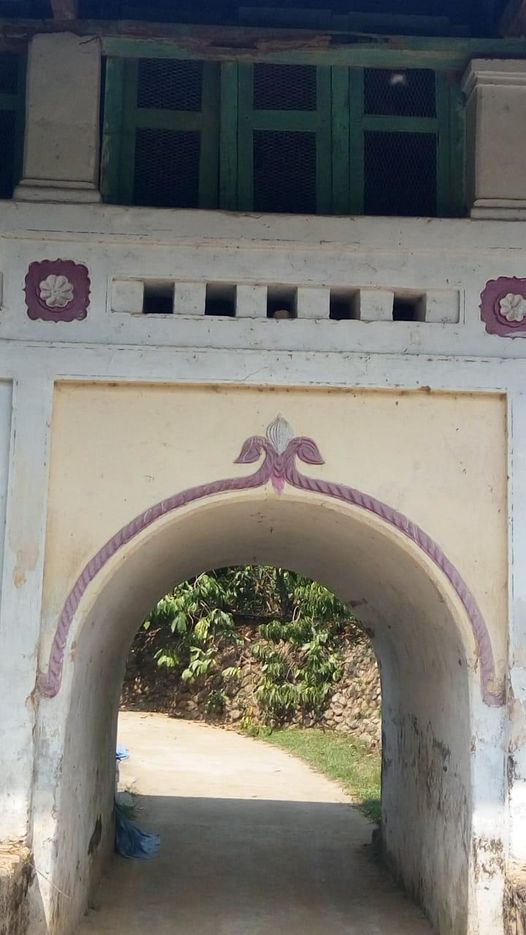
Tipu intended to have a long-term base in Malabar and even began to build a fort at a place that he founded some distance from Calicut called Farooqabad (now Feroke). Construction began at the site when Tipu visited Malabar in 1788, but it was never finished as Tipu’s forces were driven out before it could be. Locals who have seen the site say that the foundations and initial constructions are still visible, but access to the site is now blocked as the path leading to the fort falls in a site that is being legally contested. A sign from the Kerala Department of Archaelogy at a locked gated passage greets visitors attempting to look for the fort of Farooqabad, the capital that Tipu planned for his province of Malabar.

Soon, Tipu would cede his claim on Malabar and in 1799, this last bulwark against the great expansion of the East India Company, would be killed on the battlefield.

source: http://www.frontline.thehindu.com / The Hindu / Home> India> History / by Vikhar Ahmed Sayeed in Kozhikode / December 21st, 2017

Striking legacy

Mysuru, KARNATAKA :

The discovery of 1,700 Mysore rockets belonging to the 18th century gives a fillip to the argument that Tipu Sultan was a progressive king who made great advances in arms technology and was a formidable bulwark against the British East India Company in south India.

Rudrappa Shejeshwara, the curator of the Government Museum (Shivappa Nayaka Palace), Shivamogga, showing the rockets.

THE Congress-Janata Dal (Secular) coalition government in Karnataka has decided to continue the commemoration of the 18th century Mysore ruler Tipu Sultan’s birthday on November 10 as Tipu Jayanti. Ever since the Tipu Jayanti celebrations began in 2015 when the Congress, headed by Siddaramaiah, was in power in the State, the Bharatiya Janata Party (BJP) and right-wing Hindutva groups that accuse Tipu Sultan of being a religious bigot have opposed them vehemently.

As preparations for this year’s event began, Pratap Simha, the BJP Member of Parliament from Mysuru, asked Chief Minister H.D. Kumaraswamy not to go ahead with Tipu Jayanti as it hurt Hindu religious sentiments.

The allegations that Tipu Sultan was a religious bigot were examined in detail in the previous issues of Frontline . The article titled “Contested legacy” (December 11, 2015) provided an overview of Tipu Sultan’s reign and his role in fighting the British East India Company. The article “Tipu–Fact & Fiction” (January 6, 2017) discussed the accusation that Tipu Sultan had forcibly converted Kodavas of Kodagu, and “Tipu in Malabar” (January 5, 2018) examined the charge that the Mysore ruler had committed religious excesses in what is today north Kerala.

Tipu Sultan and, before him, his father, Hyder Ali, ruled Mysore for a brief period, between 1761 and 1799, but left a lasting impression on society and polity in the region. Both of them consistently opposed the British and fought four wars (known as the Anglo-Mysore Wars) against the East India Company. Hyder Ali was a perceptive and ambitious leader, but Tipu Sultan’s fame transcended that of his father. Tipu Sultan died on May 4, 1799, battling British soldiers, thus establishing his legacy as one of India’s earliest fighters against colonialism. It is for this reason that he is still feted.

Ever since Tipu Jayanti began to be marked, there has been an overwhelming focus on Tipu Sultan’s religious policies, with scores of articles written on the theme, but what has not been examined substantially is another important aspect of his reign. During his brief rule, he attempted to bring about significant modernisation in a number of areas through the establishment of an industrial state. This includes advances in arms technology, a continuation from Hyder Ali’s time that would eventually have a global impact.

Of all the advances that Tipu Sultan and Hyder Ali made in creating a modern army with lethal weapons, the rockets that were used against the British during the Anglo-Mysore Wars have left an indelible impression for two reasons. First, the rockets caused tumult and bedlam in enemy ranks. English soldiers have chronicled this aspect of Tipu Sultan’s warfare. For instance, the use of these rockets was the chief reason for the victory of the Mysore Army in the Battle of Pollilur (1780) in the Second Anglo-Mysore War. Rockets were also used subsequently, as documents show. Tipu Sultan’s army even had dedicated companies of rocket men. Colonel Bayly, a British officer, writes vividly about the havoc these Mysorean rockets caused as his regiment faced off Tipu Sultan’s army on April 5, 1799.

He wrote: “The ground of encampment was on the upper part of an inclined plane, at the foot of which, on the opposite bank of the River Cauvery, stood the proud fortress of Seringapatam, at three miles’ distance, from whence they already began to throw shot from guns of a huge calibre, and so pestered were we with the rocket boys that there was no moving without danger from these rocket missiles…. The rockets and musketry from upwards of 20,000 of the enemy were incessant. No hail could be thicker. Every illumination of blue lights was accompanied by a shower of rockets, some of which entered the head of the column, passing through to its rear causing deaths, wounds and dreadful lacerations from the long bamboos of twenty or thirty feet, which are invariably attached to them. The instant a rocket passes through a man’s body it resumes its initial impetus of force, and will thus destroy ten or twenty until the combustible matter with which it is charged becomes expended. The shrieks of our men from these unusual weapons was terrific; thighs, legs, and arms left fleshless with bones protruding in a shattered state from every part of the body, were the sad effects of these diabolical engines of destruction” (“Diary of Colonel Bayly: 12th Regiment” by Colonel Bayly, 1896).

The second reason is that Tipu Sultan’s rocket was the progenitor of the superior “Congreve” rocket, which was subsequently used by the British in the 19th century. The Mysorean rockets were found after the fall of Srirangapatnam and were transported to England, where they were studied closely.

About this, Roddam Narasimha, an aerospace scientist, writes that the Mysore “…rockets made an extraordinary impression on the British, and led, from 1801, to what would now be called a vigorous research and development programme (at the Royal Woolwich Arsenal). Sir William Congreve made systematic studies of propellants, analysed performance applying Newton’s laws, developed a series of rockets of different sizes and characteristics, made a comparative cost analysis and published three books on the subject. Rockets were soon systematically used by the British during the Napoleonic Wars and their confrontation with the U.S. during 1812-14.” ( Rockets in Mysore and Britain, 1750-1850 A.D. by Roddam Narasimha, 1985.)

Monumental find

Considering that these rockets marked a profound moment in the history of armaments, there were surprisingly few extant samples available. Only five iron-case Mysore rockets were known to be available for more than two centuries. Of these, three were housed at the Government Museum, Bengaluru, while two were at the Royal Artillery Museum, Woolwich Arsenal, in England. The three kept in Bengaluru were incomplete as they were mere shells. So, when in July this year a cache of 1,700 iron-case Mysore rockets from Hyder Ali’s or Tipu Sultan’s era was found, it was nothing short of a monumental discovery.

“The rockets were found in and around a large well owned by a farmer named Nagaraja Rao in Nagara village,” said Rudrappa Shejeshwara, the curator of the Government Museum (Shivappa Nayaka Palace) in Shivamogga. Nagara is around 80 kilometres from Shivamogga town in western Karnataka and was an important town in the 18th century. The site was chosen for excavation as a chance discovery at the same location a few years ago had revealed 160 rockets. They were not identified immediately, but were recognised subsequently as the famed Mysore rockets of Hyder Ali and Tipu Sultan. The State’s Department of Archaeology, Museums and Heritage, sanctioned an expedition and this led to the discovery of a larger cache of rockets.

The rockets are housed at the Government Museum in Shivamogga. They are not uniform and vary in length, measuring between half a foot and one foot. The small ones weigh about half a kilogram while the larger ones can almost weigh up to 2 kg. While some can be grasped easily, there are a few that are so thick that it is not possible to grasp them. It is remarkable that the farmer did not sell the rockets, which look like unusual pestles, as scrap. Nagaraja Rao actually had the foresight to communicate the information to the Archaeological Department.

While the fact that the Mysore rockets were a pioneer in arms technology is known, detailed tests on the rockets had not been conducted before simply because there were not enough samples to conduct tests. With the Shivamogga find, it became possible for the first time to conduct a thorough examination to find out what made these projectiles provide a fillip to the strength of the Mysore Army. Nidhin G. Olikara, an independent researcher based in Shivamogga, and Shejeshwara have sought to study just this aspect. They have co-authored a paper on their recent findings (“Rockets from Mysore under Haidar Ali and Tipu Sultan: Preliminary Studies of ‘Tipu Rockets’ from the Nagara Find” by Rudrappa Shejeshwara and Nidhin G. Olikara published in Journal of the Arms and Armour Society , Vol. XXII, No.6, September 2018).

Olikara explained how the rockets worked. He picked up a piece of paper and made a cylinder out of it. “Steel plates were folded into cylindrical tubes like this. Then, they were coated with clay, as this would act as a thermal insulator, and then stuffed with saltpetre and sealed at both ends with metal discs,” he said, as he cut two circular strips of paper and wedged them on the ends of his paper tube.

Pointing to the rockets, in which a tiny hole that has been sealed can be discerned, he said: “A fuse, most probably made of silk as these rockets were used even during the rainy season, was then tightly inserted perhaps by using a tool, which we found at the site. The rocket would then be tied to a bamboo staff with leather strips,” Olikara said. He pointed to a painting by Robert Home, called “Mysore rocket man”, which is currently in the collection of the Victoria and Albert Museum in London. “Once the fuse was lit, the rocket would travel for two to three miles,” he said.

The Mysore rulers, he said, used different kinds of rockets. While some would fly through the air before landing on enemy ranks, others would whoosh through the enemy lines at knee level. There were also swords attached to some of these bamboo poles, thus making them deadlier as they scythed through the disciplined lines of East India Company soldiers.

What is more interesting about these rockets is that they were not cast from a mould but forged from steel sheets that contained a very low level of carbon, which in itself was a grand technological advancement for the time.

Olikara and Shejeshwara write: “There can be no doubt that the Mysorean Rocket with its ferrous metal case and deployment in large numbers was unparalleled anywhere else in the world. It represented the pinnacle of Mysore’s technological prowess and its capability to experiment and innovate. It also showed that Mysore possessed the prerequisites to manufacture iron-cased rockets on an industrial scale. As a consequence of such qualities, Mysore was able to stem the colonial tide for twenty years whilst internecine strife was sweeping most other Indian states into the subjection of Britain.”

Why were so many rockets found in Nagara? Nagara was an important town of the Keladi empire. Hyder Ali conquered it in 1759, expanding the power and wealth of the Mysore kingdom substantially. Thus, it is not surprising that Hyder Ali and, subsequently,Tipu Sultan set up a manufacturing unit in the region.

T. Venkatesh, Commissioner, Karnataka’s Department of Archaeology, Museums and Heritage, who oversaw the discovery in July, concurred with this. He said: “While we are not yet certain about why the rockets were found at this location, we strongly suspect that a manufacturing unit must have been located in the vicinity.”

Ajay Kumar, an independent researcher based in Shivamogga, painstakingly began to work with the knowledge that a manufacturing unit had to be present in the region. Using Google satellite imagery, he identified spaces close by that had large quantities of iron slag. Going back and forth from contemporary chronicles of the 18th century to travelling around in the region, Ajay Kumar took six months to piece together his findings.

“To manufacture these rockets, you needed iron ore, saltpetre, bamboo, silk wicks, strips of leather, limestone, charcoal and clay. Based on my research, I have identified five sites in the villages of Tammadihalli and Chittihalu [pronounced as Chattanhalli by locals], which are 60-65 km from Nagara, as possible manufacturing units. We can also see pieces of iron in these iron slags that must have been part of the tuyere required for iron smelting,” he said.

It is unclear why these rockets were discarded in a well, but the serendipitous finding tangibly reinforces the idea of Tipu Sultan as a progressive king who used modern weapons. He was the last bulwark against the East India Company’s push to rule India directly.

At an event held in Bengaluru on October 30, the BJP’s national spokesperson, Sudhanshu Trivedi, said Tipu Sultan was a killer of Hindus. He said he would urge the Union Railways Minister to rename Tipu Express, which runs between Bengaluru and Mysuru.

The BJP’s opposition to the celebration of Tipu Sultan’s legacy stems from his Muslim identity. But it is not possible to disregard the various contributions he made to the region and to rocket technology. Hyder Ali and Tipu Sultan made a deep impact in the area of southern Karnataka, which formed the nucleus of their kingdom.

source: http://www.frontline.thehindu.com / The Hindu / Home> India> Discovery of Mysore Rockets / by Vikhar Ahmed Sayeed recently in Shivamogga / November 08th, 2018

Rare prints from Tipu Sultan era acquired by city-based collector

Bengaluru, KARNATAKA :

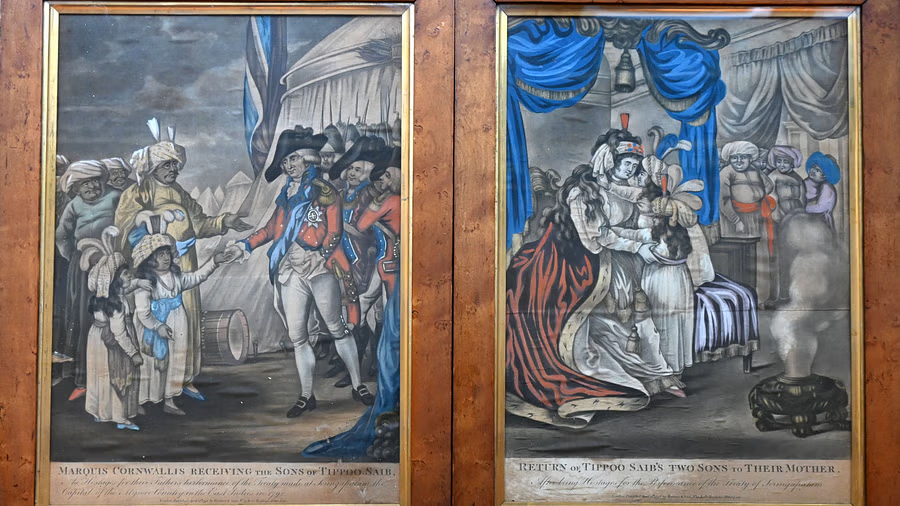
One print depicts Tipu’s two sons being taken hostage by Lord Charles Cornwallis, after the third Anglo-Mysore war in February 1792, and the other is a portrayal of their return to their mother.

The prints were made in 1796 by publisher Haines. / Credit: DH Photo/ B K Janardhan

A city-based art collector, Sunil Baboo, has recently acquired two rare prints of paintings from Tipu Sultan’s era. They capture significant moments in the history of the erstwhile Kingdom of Mysore.

One print depicts Tipu’s two sons being taken hostage by Lord Charles Cornwallis, after the third Anglo-Mysore war in February 1792, and the other is a portrayal of their return to their mother. 

History has it that Cornwallis laid out severe conditions Tipu had to adhere to in the Treaty of Seringapatam. He demanded that Tipu hand over his sons to British custody, until the king carried out all the demands he had agreed upon. 

“While there are multiple artworks depicting the moment of surrender, it is rare to come across one capturing the sons being returned to Tipu’s wife,” says 65-year-old Baboo, who has been collecting historic books, maps, aquatints and documents since 1982.

The creator of the paintings is unknown, but they were turned into prints in 1796 by publisher Haines. This was even before the defeat and death of Tipu during the fourth Anglo-Mysore war in 1799. “Many of these artists never set foot in India. They created these images based on what was described to them. While there was an artistic bent to them, it was more a way for them to document important events,” Baboo explains. Many of these prints were originally etchings and engravings that were coloured by hand, adds the Gangenahalli resident.

He learnt of the prints a few months ago, and was able to edge out some of the biggest auction houses like Bonhams, UK. “They were planning to auction them in June 2024, but I was able to procure them through my contacts,” he explains. Over the years, Baboo has built a wide network of collectors and auction houses that tip him off on new discoveries. Most of this category of prints are found in family collections of descendants of French and British soldiers of the colonial period. 

The prints, once discovered, are restored and framed. Baboo’s 16×14-inch prints came with a lot of archival tape and paper at the back of the frame. “Presumably to reinforce them. They can be kept in this condition for a long time,” he says. 

source: http://www.deccanherald.com / Deccan Herald / Home> India> Karnataka> Bengaluru / by Rashmi Rajagopal / January 24th, 2025

Khader Khan Khaisighi : A Slice of Kodagu History

Kodagu, KARNATAKA:

by Dr. Rekha Chinnappa.

Hyderali had an edge over the competition for the throne between the Haleri and Horamale branches of Ikkeri dynasty after the death of Mudduraja and Muddaiah raja. In the Haleri branch Lingaraja was fighting for his nephew Appajiraja and in the Haramale branch, Mallaiah arasa for his son Devapparaja. Finally, Devapparaja was coronated.

In this circumstance, the disappointed Lingaraja sought refuge from Hyderali along with his nephew Appajiraja and his sons which included his son Veerarajendra Raja. Hyderali took advantage of this situation by using Lingaraja as the spy. Hyder captured Kodagu and got Devapparaja and his family killed in 1774. This extinguished the Horamale branch.

As per the understanding, Lingarajendra-1 was coronated but remained the puppet of Hyder until his death in 1779. At this time, Lingarajendra’s son Veerarajendra being a minor was forcefully shifted by Hyder to Goroor. This was convenient for him to take control of the Kodagu administration through Karnik Subbarasaiah.

Hyder’s autocratic attitude in administration was disliked by the people of Kodagu. Hence they resisted his rule by various kinds of protests. Due to ill health, Hyderali died in 1782. This resulted in his son and heir Tippu sultan assuming the throne. Tippu’s rule was oppressive and this made the situation worst for the people of Kodagu. Eventually, they chose to bring back Prince Veerarajendra, who had been shifted to the Periyapatna prison from Goroor. He was to reinstate the peaceful administration of Kodagu.

Veerarajendra’s close associate Kulleti Ponappa, Hombale Nayaka, Appanarvanda Achaiah, Pattachervanda Bolakka and few other people of Kodagu set out to secretly release Veerarajendra from the prison. The warden of the Periyapatna prison was Khadher Khan Khaisighei. He was a Saurashtrian trader from Afghanistan in India on a trade contact. He was upright and empathetic individual and was sensitive to the ongoing affairs. He aided the Kodagu folks to get their prince out of a six year long imprisonment.

This became the major turning point for Veerarajendra to re-establish the rule of the Haleri dynasty in Kodagu. Soon after his release, Veerarajendra along with his Kodagu army resisted the strong determination of Tippu Sultan to capture Kodagu. The Kodagu army was brave and strong but were not very experienced in organized battle. Hence, they began setting plots in the routes of the enemy through forests and other mountain areas. This ousted the authoritative administration of Tippu who had gained an edge over the natives of Kodagu by pledging themselves in the territory.

While Tippu sent troops under various commanders to capture Kushalnagar, Beppunad and Bhagamandala forts of Kodagu, the Kodagu army won over the Sultans and Veerajendra Raja got Kushalnagar, Beppunad and Bhagamandala forts under his control.

While only Madikeri fort was in control of Tippu Sultan, the Kodagu troops way laid the routes and blocked all the provisions going there. During monsoon, when shortage of supplies was inevitable Tippu sent the necessary provisions under the leadership of Khadher Khan Khaisighei. They were attacked in Kushalnagar and captured by the Kodagu army. Veerarajendra Raja was obliged to release Khadher Khan Khaisighei out of immense gratitude towards him. His memory flashed back to his release from the Periyapatna prison. Khaisighei was also instrumental in protecting his sister when she was attacked by the muslim authorities.

However, Khader Khan Khaisighei’s loyalty was pronounced when he turns down the Raja’s favor, initially. Later on, he accepts the favor and requests that the provisions be delivered to the Madikeri fort and returns to Periyapatna. Thus, Veerarajendra Raja gains control of the territory of Kodagu.

Certain areas in Kodagu was commanded by Paleygars/nayaks. After the fall of Udichanda Palegar in Bilgunda, his property was gifted to Khadher Khan Khaisighei by Veerarajendra Raja. This gift was based on service jhagir under puthra parampara. Henceforth, they were the permanent residents of Bilgunda, living in their Aiynmane beside the Bhadrakali Village temple. This Aiynmane has all features of traditional Kodagu aiynmane.

The lineage of Khader Khan Khaisighei has been enjoying the thakkame and they decorate the respectable seat at the Hoskote Kolemandh reserved for various thakkas. Without overbearing the religious attitude they participate wholly in all the village activities including the festivals – Bhadrakali Namme and Eshwara Namme of the Bilgunda Village.

The Kodagu socio-cultural practices are followed by them celebrating the Kailmurtha and Puthari festival to the present day. These festivals are the celebration of the completion of several stages of paddy cultivation, which was the only source of traditional livelihood of the land. The thakkame of Puthari had been of the Kaisighei and is followed by his progeny now by Kaleemula Khan, the third generation.

The procession for cutting the sheaf begins at their house along with traditional fervor. The sheaf is reaped from Shafila Khan’s paddy field, where he fires the gun symbolizing the beginning of harvest. Later, the sheaf is taken to the temple and their respective homes.

Embracing Islam they have blended into the socio-cultural practice of the land they have inherited. This matured outlook has disseminated peace and harmony in and round Bilgunda Village.

source: facebook.com/ptbopanna.palangada

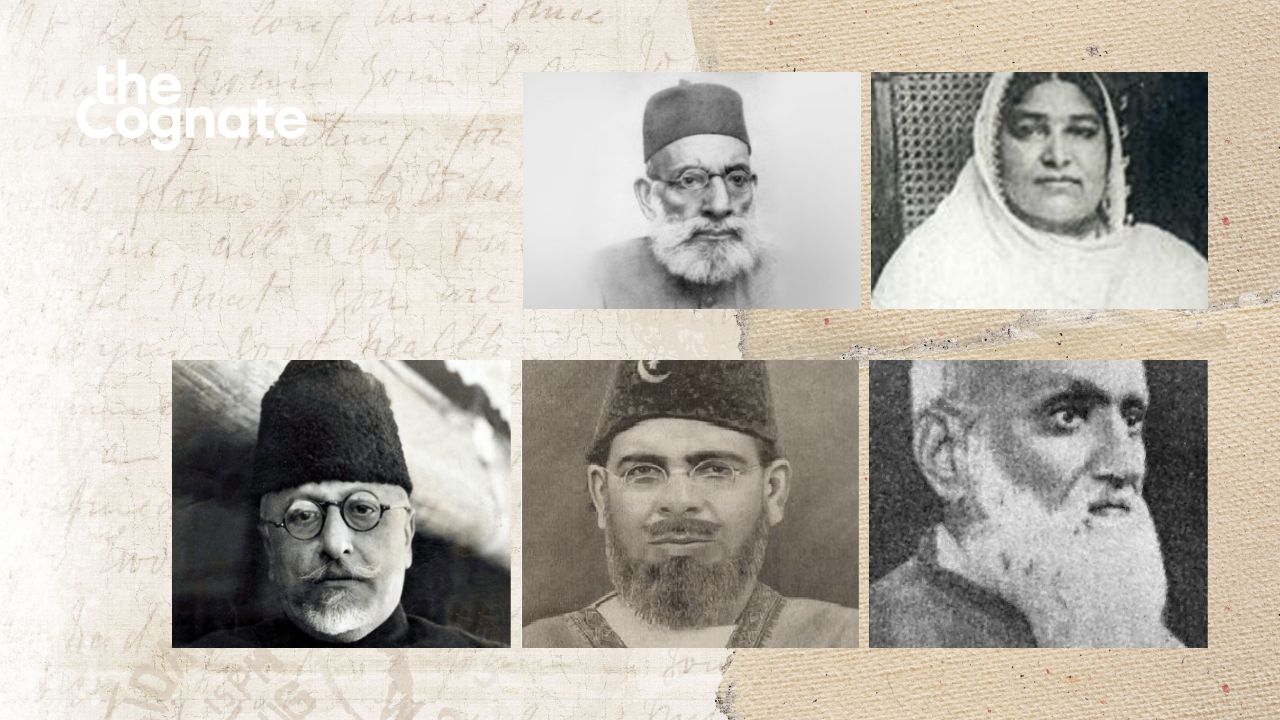
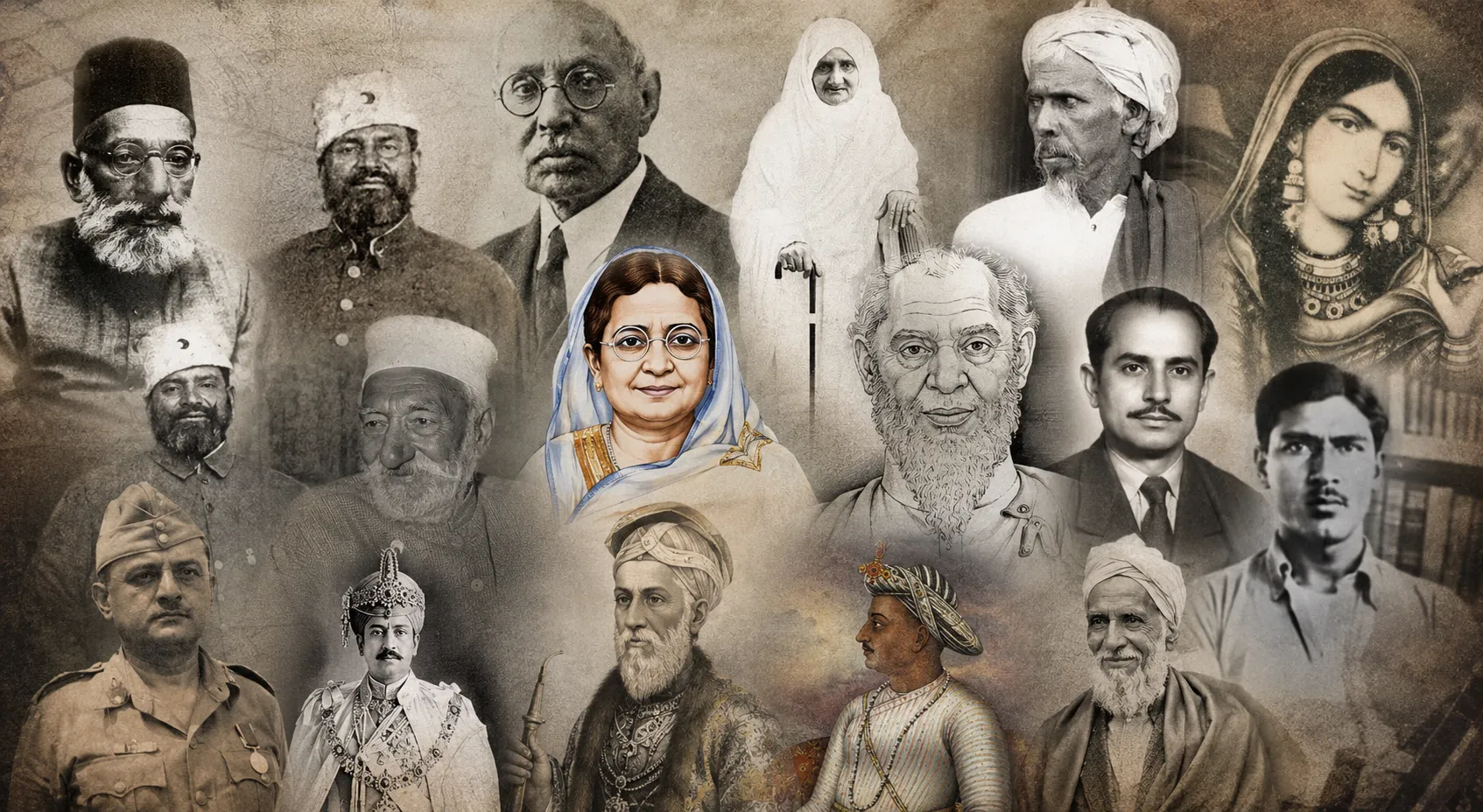
Contribution Of Muslims To India’s Freedom Struggle

INDIA:

The famous writer Kushwant Singh, once wrote: “Indian Freedom is written in Muslim blood, since their participation in the freedom struggle was much more, in proportion to their small percentage of the population.”

The story and history of India’s independence are written with the blood of Muslims. According to historical references, 65% of those who stood, fought and sacrificed against the British for India’s independence were Muslim freedom fighters, the hams live reported.

A large number of people from all religions and castes took part in the freedom struggle, undoubtedly. However, the struggles of many Muslim prominent personalities who also contributed to India’s freedom and even sacrificed everything including their lives are little known. Muslims have been at the forefront to oppose the British and stood shoulder to shoulder with people from other communities while fighting against them. Getting freedom was not easy, our ancestors had to go face a lot of struggles and difficulties to get us the freedom that we are enjoying now.

The First Call To Oppose British

In the 1750s, Nawab Siraj-ud-Daulah was the first awakened Indian ruler, who stood his ground against the British. He lost the Battle of Plassey in 1757 due to the betrayal of Mir Jafar (Commander of Nawab’s army). With this, Siraj-ud-Daulah’s reign marks the end of the last independent rule in India and the beginning of the East India company’s rule that was unabated for the next two hundred years.

First Freedom Struggle By Muslim Rulers

The first freedom struggle against the British was started by the rulers of Mysore Hyder Ali and his son, Tipu Sultan, during the 1780s and 90s. Both used the first iron-cased rockets and cannons effectively against the British invaders.

Tipu Sultan is considered to be one of India’s first freedom fighters for his fierce fight and brave against the East India Company. He resisted the conquest of the British in southern India and was reluctant to welcome them on his soil. He was the only Indian ruler who understood the dangers that the British posed to India, and fought four wars to oust them from the country.

The Unsung Heroines Of India’s Freedom Struggle

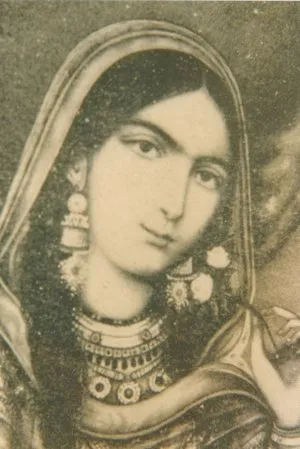
Begum Hazrat Mahal, the unsung heroin, played a very important role in India’s war of Independence. Being a woman, she led a rebellion against the British East India Company in 1857. She shot the British ruler, Sir Henry Lawrence and defeated the British army in a conclusive Battle at Chinhat in 1857.

In the great revolt of 1857, as many as 225 Muslim women sacrificed their lives in the uprising. These unsung Muslim women freedom fighters who have sloganeered, shed blood and given their lives for the country’s independence have now been forgotten to due biases.

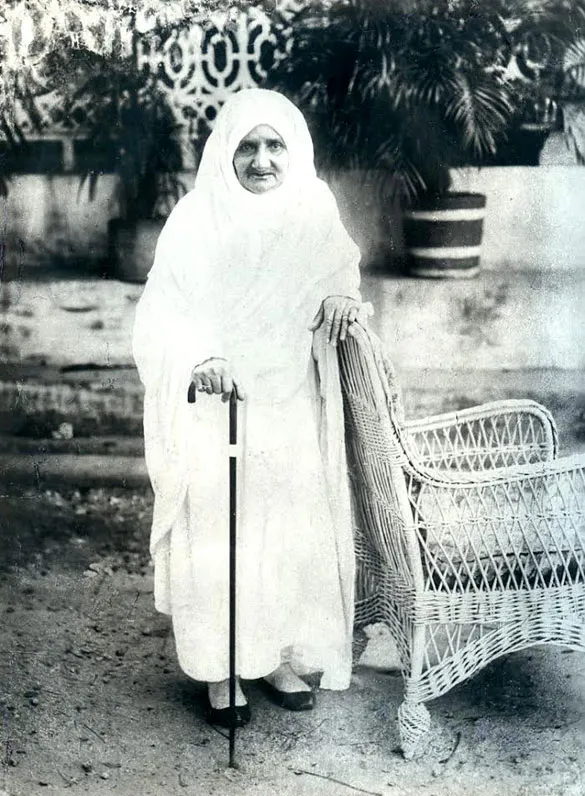
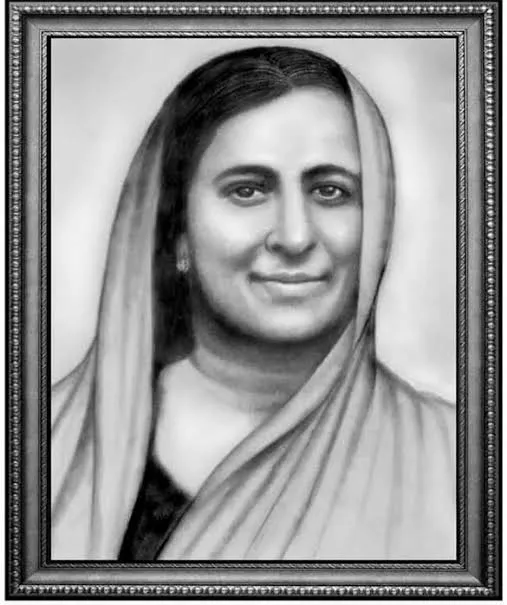
A majority of freedom fighters did a nameless service to the nation and one such lesser-known name was Abadi Bano Begum (Bi Amma). Bi Amma was the first woman to address a political rally wearing an abaya. She took part in National freedom struggles, Khilafat Movement and propagated Hindu-Muslim unity. Following Mahatma Gandhi’s advice, Bi Amma played an. An important role in encouraging women to take part in the freedom movement. Further, she played a pivotal role in the Swadeshi movements.

In the book, Gandhi and the Ali Brothers: Biography of a Friendship by Rakhahari Chatterji, Maulana Mohammad Jouhar says, “Suffice it to say that, although she was practically illiterate, I have, in all experience, of men of all sorts of types, come across none that I could call wiser and certainly that was more truly godly and spiritual than our mother.”

Bi Amma was also the mother of Muhammad Ali Jauhar and Shaukat Ali popularly known as the Ali Brothers whom she raised on her own after her husband died when she was young.

Amjadi Begum, the wife of Muhammad Ali Jauhar and daughter-in-law of Bi Amma, is yet another Muslim women freedom fighter. Mahatma Gandhi also dedicated an article on her titled ‘A Brave Woman‘ where he admired her as a courageous wife of a courageous man. 

At the age of 45, Asghari Begum, another forgotten Muslim woman, has also taken part in the 1857 revolt and challenged British rule in the present-day Uttar Pradesh. However, she was captured by the British in 1858 and burnt alive.

Habiba, a Muslim woman’s fought many battles against the British in Muzaffarnagar in 1857. However, she was captured and hanged along with 11 other female warriors at the age of 25.

The Great Revolt of 1857

During the Great Revolt of 1857, Hindus and Muslims under the leadership of the last Mughal emperor Bahadur Shah Zafar tried to oust the British from India. A majority of Hindu sepoys requested Zafar to lead them in the war of Independence. Although the Revolt failed due of several reasons, Muslims have always stood on the front line to oppose the British.

Former Prime Minister of India, Rajiv Gandhi during his visit to Bahadur Shah’s grave, wrote in the visitor’s book: “Although you (Bahadur Shah) do not have land in India, you have it here; your name is alive… I pay homage to the memory of the symbol and rallying point of India’s First War of Independence….”

Muslims came to India and ruled here for over 800 years but they did not steal anything from here as the British, the Dutch and the French did. By bringing plenty of knowledge in literature, architecture, judiciary, political structure, government body and management structure, which is still used in Indian management strategy, they helped India to progress into a unified and civilized nation.

Lighthouse of Rebellion

How many of us know that the organizer and leader of “First Indian freedom struggle” in 1857 was Moulavi Ahamadullah Shah. Known as the ‘Lighthouse of Rebellion’ in Awadh, he Faizabad free from British rule for almost one year, until his death at the hands of British agents on June 5, 1858.

“With being a practicing Muslim, he was also the epitome of religious unity and Ganga-Jamuna culture of Faizabad. In the revolt of 1857, royalties like Nana Sahib of Kanpur, Kunwar Singh of Arrah fought alongside Maulavi Ahmadullah Shah. Maulavi’s 22nd Infantry Regiment was commanded by Subedar Ghamandi Singh and Subedar Umrao Singh in the famous Battle of Chinhat,” according to researcher and historian Ram Shankar Tripathi.

The important role of Muslims in the uprising is the reason that the British government singled out the community for the worst revenge. From the Nawab, the King of Mysore, the last Mughal King, Princes, the landlords, the Ulemas, intellectuals, Urdu journalists, including common people, all members of the Muslim community have made great sacrifices for the freedom of India.

In the uprising of the 1857 revolt, thousands of ulema were slaughtered and the whole of Delhi was emptied of Muslims, according to excerpts from Syed Ubaidur Rahman’s book Biographical Encyclopedia of Indian Muslim Freedom Fighters. They were not even allowed to return to their homes and reclaim their properties.

First Journalist To Sacrifice His Life During The Great Revolt

Moulvi Muhammad Baqir, a scholar and activist of Indian independence activist was the first journalist to be executed following the rebellion in 1857. The editor of Urdu newspapers, Delhi Urdu Akhbar, was washed dead on 16th September 1857 for writing Nationalist articles, without even a trial.

Although India got independence on 15 August 1947, the foundation of the freedom struggle was laid before 1857. Since the time of the Revolt of 1857, which is considered to be the beginning of India’s freedom struggle, Muslim leadership has spearheaded the cause.

First Muslim To Be Hanged For Conspiring Against East India Company

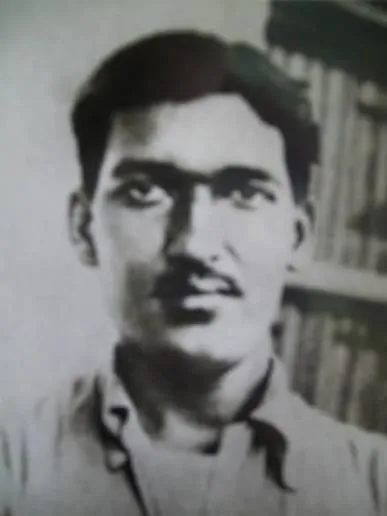
At the age of 27 years, Shaheed Ashfaqulla Khan was the first Muslim to be hanged for conspiring against the British Raj. Khan was hanged to death on December 19, 1927. With this, he became a martyr and a legend among the people because of his love for the country and his unshakeable spirit.

Reshmi Rumal Tehreek (The Silk Movement)

Muslims not only took the lead in the uprising, but also stood in the front line in all other efforts to topple the British colonial regime in India.

After the revolt of 1857, the Muslim leaders changed their strategy of resistance by setting up educational institutions across the country. Reshmi Rumal Tehreek or The Silk Letter Movement (1913-1920) was an initiative by Deobandi Leaders Maulana Mahmud Hasan and Maulana Ubaidullah Sindhi to topple the British Empire.

However, when British intelligence learned about it, hundreds of sympathizers of the initiative were arrested and put in prison for years without any trial. The top leaders including Maulana Mahmud Hasan and half a dozen of his followers were banished to Malta after a faux trial where they faced the worst hardship.

Role of Muslims in Congress’ anti-colonial struggle

Justice Abbas Tyabji, an Indian freedom fighter from Gujarat and associate of Mahatma Gandhi, was the first Muslim president of the Indian National Congress party. Justice Tyabji is also known for leading Salt Satyagraha following Gandhi’s arrest in 1930.

Another Congress president during the colonialism was Maulana Abul Kalam Azad, who is one of the chief Muslim leaders of the anti-colonial nationalist movement. He became the youngest President of the Indian National Congress in 1923 at the age of 35. He faced multiple imprisonments by the colonial state.

From Justice Tayabji to Maulana Abul Kalam Azad, there have been eight Muslim leaders who were in the Indian National Congress’s freedom movement. The other prominent Muslim leaders include, Muhammad Ali Jauhar, Shaukat Ali, Maulana Azad, Dr Mukhtar Ansari, Hakim Ajmal Khan, Maulana Mahmud Hasan and many others. They made every possible sacrifice for the cause of the end the colonial rule.

Frontier Gandhi

Khan Abdul Ghaffar Khan was a Pashtun independence activist who campaigned to end the rule of the British Raj in India. He founded the Khudai Khidmatgar resistance movement against British colonial rule in India. He was also known as Frontier Gandhi for his principles of non-violence and friendship with Gandhi. Khan worked towards the formation of a united, independent, secular India. 

Muslim Man Coins “Jai Hind”

The patriotic slogan “Jai Hind” was initially coined by Zain-ul Abideen Hasan, but it was adopted by Netaji Subhash Chandra Bose. It is now used as a way of salutation throughout India. It means “Victory to India” in English.

The Creation Of the National Flag

For a majority of us, the current national flag was designed by Pingali Venkayya. However, it was a Muslim Lady Surayya Tyabji, who created the flag’s final look today.

Although we have recounted several names of the Muslims who have contributed to India’s freedom struggle, there are several thousands of them who fought on the streets against the British Raj.

source: http://www.thecongnate.com / The Cognate / Home> History / by Rabia Shireen / August 15th, 2022

Mapping Tipu’s defeat

Mysuru, KARNATAKA :

Bengaluru-based collector Sunil Baboo has acquired maps that show the battle plan of the Third Anglo-Mysore war, which Tipu Sultan lost.

A painting of Tipu Sultan used for representational purpose only

Bengaluru : 

Sunil Baboo, a Bengaluru-based collector, has a penchant for procuring items of historical significance. The latest additions to his private collection? Maps detailing the British battle plan to corner Tipu Sultan.One of the maps, engraved by J Cooke, a man who worked under the British, shows the battleground of the Third Anglo-Mysore war that lasted between February 5-24, 1792, and saw Tipu’s defeat. 

Sunil Baboo | Ashishkrishna HP

He acquired the map during a trip abroad. He met a French woman named Christine Champlaine, whose great-grandfather served in the French army and came into the possession of the maps of the 1792 battle. “I bought them from her in early 2020,” Baboo says.The map details the seige of Seringapatam (now called Srirangapatna), and the position of the various troops on the side of the British, and the positions of British generals.

It shows the locations of Nizam’s forces, the Nawabs of Arcot, and the Marathas, vis-a-viz Loll Baug, Shair Ganjaum, Dowlet Baug (Daulat Bagh), Tippoo’s Tent, Powder Works, Hyder’s Mausoleum, Palace, Pavilion, River Cauvery, and Carigaut Pagoda.

“They cornered Tipu even before he realised it. Cornwallis went on to conquer all of Tipu’s forts – Nandidurg, Savandurg, Uttaradurg, Manjarabad fort, Ballari fort, Krishnagiri fort and others. Also, Tipu had a sense that his own people were turning hostile. There were instances of his own people falling for the lure of money from the British,” says Baboo.

In 2018, he acquired a lithograph titled ‘Taking of the City of and Fort of Seringapatam’ from a dealer of antiquities in Canada. Created by French painter Jean Duplessi Bertauz, the piece illustrates Tipu’s final battle. “It shows the slyness with which the British laid siege to Seringapatam, cornering Tipu from every side. In fact, Napoleon Bonaparte, who was busy fighting wars in Europe, had offered to help Tipu, but it was too late,” says the 60-year-old. 

Also engraved is the following text: “Tippoo perished with a great number of this followers and all his treasure fell into the hands of the conquerors. Colonel Wellesley commanded the reserve at the assault, and was afterwards nominated Governor of the City.”Baboo, who used to run an export business, is drawn to history. “I have a passion for documenting antiquarian documents, and maps that represent the past and which shaped our present,” he says.

source: http://www.newindianexpress.com / The New Indian Express / Home> Cities> Bengaluru / by Sanath Prasad, Express News Service / April 06th, 2021

Hyder Ali: The ‘Napoleon of South India’

Devanahalli, Mysore, KARNATAKA :

Hyder Ali, who is famously known as ‘the Nepoleon of South India’ for his relentless fighting against the conspiracies of the East India Company and its henchmen and for checkmating the British ambitions of expansion in South India, was born in 1722 at Devanahalli village, Karnataka state. His father was Fateh Mohammad Ali and mother Mujidan Begum.

Though he did not have any formal learning, he received training in martial arts. Hyder Ali was sharp in intellect, strong in will, capable of  handling multiple tasks simultaneously and was brave at heart.

He had participated in Devanahalli war in 1749 as a young soldier of Mysore State. Recognizing his gallantry, Nanjaraj, the Minister of Mysore kingdom, honoured Hyder Ali with the title of ‘Khan’ and promoted him as the Chief of a battalion in the Mysore army.

They attacked Mysore several times with the help of the East India Company.

Though Hyder Ali suffered initial losses, he resisted them successfully and proved a virtual nightmare to East India Company. Even then, the British rulers provoked Hyder Ali again which led to the second Mysore war in July 1780. He went to the battlefield along with his son, Tipu Sultan.

While Hyder Ali captured the Arcot, his son Tipu defeated the East India Company troops and captured Kanjeevaram, which was about 50 miles from Madras. This sent shivers to Warren Hastings, the Governor General of East India Company.

He immediately sent additional troops from Culcutta, Madras with abundant funds under the control of his Commander General, Sir Eyre Coote. While fighting against the foreign enemy on one side, Hyder Ali and Tipu Sultan taught a befitting lesson to Malabar Nayars and chieftains, who revolted against him with the active support of Nizam of Hyderbad.

Hyder Ali, while leading his troops towards successive victories, fell ill and died in the battlefield on 7 December, 1782, near Narasingarayuni Peta village, which is now in Chitoor district of Andhra Pradesh.

source: http://www.siasat.com / The Siasat Daily / Home> Featured News / by Nihad Amani / August 22nd, 2020