Category Archives: Uncategorized

Leafy narrative

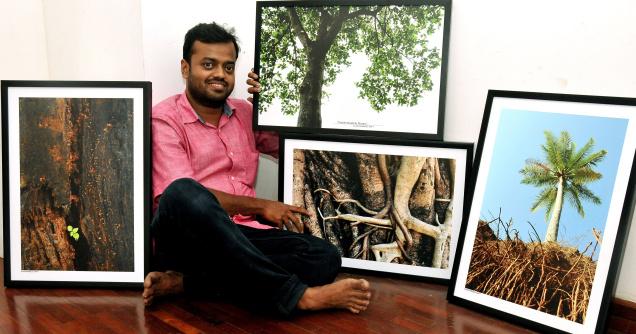
Mohammed Safi with his works / PHOTO: S. RAMESH KURUP / The Hindu

Leaves, often never given a second glance, are the principal characters of Safi’s photographs

Leaves — ever present and taken for granted—are Mohammed Safi’s focus. His photographs capture leaves in all their moods — green and vital; flushed red, crimson and yellow, smelling of autumn; and finally, brown, wrinkled and dying. “Ela Illathe Illa” (Without Leaves, Nothing) — 36 photographs of Safi, a freelance photographer, are on show at the Kerala Lalithakala Akademi Art Gallery.

Noticing leaves

“We might often sit under a tree’s shade and also eat its fruit. But the possibilities of leaves as fine art is often missed upon us,” Safi explains why he zeroed in on leaves. Abundant and everywhere as they are, Safi never went questing for his frames. Instead, they are drawn from everyday life. Images struck him on routine journeys, enticed him to stop, pull out his Nikon D200 and click. And his camera has caught the minute and the mammoth. One show is the photograph of an aging wet bark. But sprouting from its middle are two fresh leaves and glued to it is a rain drop. “When you see such a sight, you realise the poetry in nature. You also become aware of the possibilities of art,” he says.

Safi’s photographs capture poignancy, often arresting the moments between life and death. On show is a low-angle shot of a coconut tree on the edge of a beach, baring all its root. A day later, says the photographer, the tree was uprooted and washed away by the waves.

Most photographs speak of summer and sunshine. A few capture leaves drenched in rain. One frame merely has fallen acacia leaves lying listlessly in still waters. Quite like the dead leaves, imperfect ones — torn and blighted — make Safi’s frames. In a couple of photographs, leaves chipped and eaten at the edges are the centre. So too are trunks cut away at the middle. “Trees are categorised by their resourcefulness. For us coconut and rubber are lucrative. I am constantly instructed to clear the worthless trees in the yard. But I let them grow,” says Safi.

Among his photographs are trees and plants growing on the banks of the Bharatapuzha and those flourishing on clay tile roofs.

Inspiring environment

Safi finds most of his frames in and around Malappuram and Thrissur. A potent environment for him is the Thekkinkkadu maidan in Thrissur with its towering trees. Low-angle shots capture trees and leaves in different seasons giving the frames the feel of a canvas. The clutch of photographs on the maidan shows sweeping branches with full green leaves and so too wet and yellow ones.

The exhibition is on till February 12 from 11 a.m. to 7 p.m. at the Kerala Lalithakala Akademi Art Gallery.

source: http://www.thehindu.com / The Hindu / Home> Features> MetroPlus> Events / by P. Anima / Kozhikode – February 07th, 2014
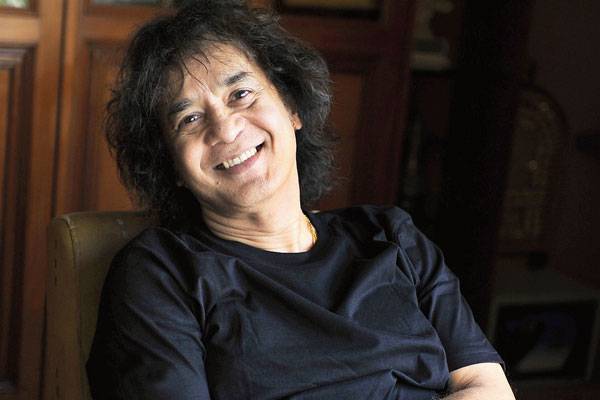
Lots of young Indian musicians are finally being noticed: Zakir Hussain

Zakir Hussain’s annual tribute to his abbaji on the day he passed away (February 3), is a day-long a musical marathon. The event is known to bring together musicians of eclectic styles each year. Last year, the Grammy-nominated banjo player Bela Fleck and jazz/bluegrass double bass player Edgar Myer had come down. This year, Khol drummers from Kolkata, the Panchratna Sanai Tafa Mandal from Nagar and gospel percussionist Lil John Roberts from the US will feature in this cultural happening.

ZakirHussainMpos10feb2014

For Zakir though, the event transcends the memory of his father. “It’s not then about my father. This is about a celebration of the art that he represented and he loved and the passion that he had for his culture. So, it’s nice to celebrate that culture and the effect that music had on our lives.”

While a show of this length can be exhausting, he is quite clear that performing is his lifeblood. “I actually feel elated when I play. I’ve arrived on stage tired and left the stage replenished. Playing music is the easiest thing. It’s not the hardest thing. That’s because we love doing it. It’s all the other paraphernalia that tires you out. Packing bags, arriving at the airport, going through security, fighting about excess baggage… All that stuff. The travel part of the touring is tiring. The performance is really the most fun part of the whole day. It inspires us to be able to deal with all the other stuff that goes on,” he says, continuing, “Music is really having a great renaissance time in india. Lots of young musicians are finally being noticed and focussed upon.”

He also elaborates on what playing solo and with a group of musicians means to him. “Playing the tabla solo, I am sharing with people centuries of this particular tradition, ragas, that I have learned and grown up with. Whenever I play a solo gig, I draw on memories of great maestros of the past. In my mind, I go, ‘okay, this is from this past maestro, this from that maestro’ and I bring that same piece of music that existed ages ago, into the present moment. Playing solo is fun but when I play live in a group, I enjoy the challenge of bouncing ideas off other musicians. Playing live is also different when you play with a singer or play only instrumentals in a group. When I play with a singer I need a particular pitch, it’s got to be in a particular way so as not to overpower the vocals. You won’t play the same as with a ghazal player than how you’d play with a sitar player. ”

While jamming and improvisations might be what fuels him, he also feels that live shows are a form of theatre. “Some of the performances at the Grammys this year were like theatre productions. That whole thing emerged since Michael Jackson’s Thriller. To me, he really pioneered that art… It requires much more production than say, a camera close up of Keith Urban playing the guitar compared to a Madonna doing Like a Virgin. You’ve got to get in your costume, you’ve got to be in the right place on the stage at the right time when the spot comes on ‘x’ area of the stage and then perform without a hint of self-consciousness,” he concludes.

source: http://www.articles.timesofindia.indiatimes.com / The Times of India / Home> Music> Zakir Hussain / by Reagan Gavin Rasquinha, TNN / February 01st, 2014

The man who knows the carriage by heart

Feast for the eyes:Mohd. Aqib worked for days to get the carriage (right) used by President Pranab Mukherjee at Beating Retreat ceremony ready.—  / Photos: S. Subramanium & Sandeep Saxena / The Hindu
Feast for the eyes:Mohd. Aqib worked for days to get the carriage (right) used by President Pranab Mukherjee at Beating Retreat ceremony ready.— / Photos: S. Subramanium & Sandeep Saxena / The Hindu

Aqib has spent decades looking after President’s buggy

The coach will head outside Rashtrapati Bhavan for the first time in two decades on Wednesday

On Wednesday, when President Pranab Mukherjee rode out to witness the Beating Retreat ceremony at Vijay Chowk in the horse-drawn carriage, known as the President’s Coach, one man intently observed every turn of the wheel.

Mohd. Aqib, a master craftsman who has spent decades looking after the six-horse carriage, worked relentlessly for days to get the carriage ready for the President.

Familiar with every part, he knows how to clean and maintain the handcrafted leather seats and how to add shine to the gold inlay work on the wheels. The red velvet of the mounting steps has to be just right and the canopy has to open with a single tug of the hooks.

“Just as doctors read the pulse, I can feel the veins of this wood and metal carriage. For years now I have been maintaining this coach… ,” he said.

There is a team of skilled workers to help the octogenarian, but Mohd. Aqib will not trust anyone. He oversees the work with hawkish vigil and, from the repository of his memory, recalls the tiniest of detail.

MohdAqibMPos30Jan2014

Armyman to the core

“I retired from the Army in 2001, but my association with it continues and I get to work on the carriages at Rashtrapati Bhavan. I am still an obedient solider of the Army and whenever they need me I will be present. My children sometimes worry for me, but I tell them, a soldier never says no,” he laughed.

When not working on the carriages at the President’s Estate, Mohd. Aquib’s skills take him across the country to places where carriages once owned by the Maharajas await repair and restoration. “I am responsible for looking after the buggies of several royal families, including that of Vasundhara Raje, some of these carriages have been presented to the Army.”

Having worked his magic on some of the oldest and decrepit carriages, Mohd. Aqib can build a gleaming new coach in as little as three months. “My first restoration work was the carriage of the Nawab of Aligarh. He wanted me to restore the wagon so that it could be presented to the Army; he was particular that it should not be disrespected after he was gone.”

“The Maharajas and even the British officers were very particular about their carriages. They would not hesitate to spend large sums of money. The Maharaja of Patiala got a carriage made with 10 kg of silver in Paris and presented it to his daughter who was married into the Kapurthala royal clan. The coach used by the President was made from raw material procured from London and great attention was paid to ensure that it was not just beautiful, but comfortable as well. It is a rare coach with low steps for allowing women to climb in without having to raise their feet too high,” he said.

Buggy-making and maintenance is a dying art he says. Even though he is among the very few who have mastered the skill, Mohd. Aqib feels awkward negotiating a fee.

“I do it out of a sense of love and duty. It is not a trade….” The President’s Coach left Rashtrapati Bhavan for the first time in two decades on Wednesday.

Owing to security concerns, the carriage is limited to use only at Rashtrapati Bhavan.

source: http://www.thehindu.com / The Hindu / Home> National> New Delhi / by Smriti Kak Ramachandran / New Delhi – January 30th, 2014

Madiba’s Indian connection

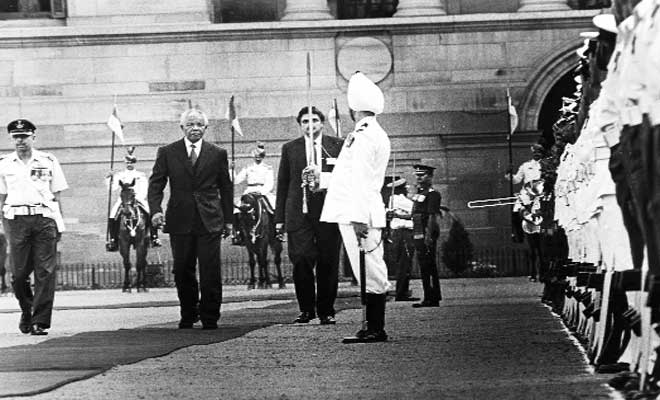
Mandela receives the guard of honour

While Nelson Mandela was a symbol of the struggle against oppression across the globe, he and his movement always had a very special connection with India.

A Bharat Ratna awardee in 1990, he is the only non-Indian to receive the honour. (He was also given the Nishan e Pakistan in 1992).

Mahatma Gandhi, who evolved and perfected his technique of Satyagraha in South Africa, was a source of great inspiration to Mandela. On his India visit in 1990, Mandela, when informed of a veteran journalist’s 13-year-old daughter, who was his fan, said “Tell her that I was in fact inspired by a man who was born right here in India.”

Mandela used Gandhi’s tactics at several points as he went about evolving his own philosophy. In the early sixties, the ANC had a militant wing called the Umkhonto We Sizwe (Spear of the Nation) which Mandela was part of. In 1962, Mandela spoke of the need for forceful action and quoted Gandhi as saying: “If the choice is between cowardice and violence, I will pick violence.” Later, he once again used Gandhi as a guide in his efforts to build bridges between seemingly irreconciliable forces.

Several of Mandela’s closest comrades and associates were of Indian origin. Two of his closest comrades, Ahmed Kathrada, and Ismail Meer, with whom he spent almost all of his prison years, were Indian.

An Indian, Sonny Venkatrathnam, also jailed at Robben Island in the 1970s for his role in anti-apartheid activities, got his wife to smuggle ‘The Collected Works of Shakespeare’ inside the prison and passed it off as the Robben Island Bible. Nelson Mandela, Ahmed Kathrada, Chris Hani and others read Shakespeare’s plays as a relief from the boredom of having to break stones all day.

Mandela kept a diary while in prison, and hid it in the grass to ensure that the wardens do not destroy it. After twelve years in prison with Mandela, another Indian, Mac (Sathyandranath) Maharaj, who was released after 12 years, as opposed to Mandela’s 27 years, transcribed his notes and smuggled the account out, which was known to the world on its release in 1976 as The Long Walk to Freedom.

source: http://www.indianexpress.com / The Indian Express / Home / by Seema Chisti / New Delhi , Saturday – December 07th, 2013

Indian-origin Ahmed Kathrada pays moving tribute to Nelson Mandela

Pretoria :

Ahmed Kathrada, the Indian-origin veteran anti-apartheid activist and aide of Nelson Mandela, moved many mourners to tears when he paid a poignant tribute to the late statesman during the state funeral at Qunu village in South Africa’s Eastern Cape province Sunday.

“When Walter (Sisulu) died, I lost a father, when you died I lost a brother, now I don’t know who to turn to,” Kathrada said.

Ahmed Kathrada, the Indian-origin veteran anti-apartheid activist and aide of Nelson Mandela, moved many mourners to tears when he paid a poignant tribute to the late statesman.

A long-time friend of Mandela, Kathrada said the last time he saw Mandela alive was when he visited him in hospital, South Africa’s government news agency SA News reported.

“He tightly held my hand… and brought all emotions… Farewell my dear brother, my mentor my leader… I have lost a brother.”

Kathrada and Mandela were both imprisoned in Robben Island for their political views.

“I recall the tall, healthy strong man, the boxer, the prisoner who rigorously exercised every morning. Now the inevitable has happened. He left us to join the ‘A team of the ANC’.

“Together, we shared ideas and walked side by side in the shadow of death,” Kathrada said.

“We are deeply grateful to Madiba… We are deeply grateful that dignity has been restored to the people of South Africa, we are deeply grateful to Chapter 9 institutions that zealously guard our Constitution,” he added.

Mandela, South Africa’s first democratically elected black president, died of illness in his Johannesburg home Dec 5 at the age of 95.

source: http://www.economictimes.indiatimes.com / The Economic Times / Home> News> World News – International / by IANS / December 15th, 2013

Abdul Khayum Khan appointed head of Andhra Pradesh Anti-Corruption Bureau

Picture for representational purposes only.

Hyderabad:

Abdul Khayum Khan, an IPS officer of the 1981 batch, has been appointed as Director General of the Andhra Pradesh Anti-Corruption Bureau (ACB).

Currently Vice-Chairman and Managing Director (VC&MD) of the Andhra Pradesh State Road Transport Corporation (APSRTC), he had also held additional charge as ACB Director General (DG) for the past few days, after the appointment of B. Prasada Rao as Andhra Pradesh’s Director General of Police.

In a minor exercise on Thursday, the government appointed Khan as the regular DG of the ACB and posted 1988 batch IPS officer J. Purnachandra Rao as VC&MD of APSRTC. Chief Secretary P. K. Mohanty issued an order to this effect on Thursday evening.

source: http://www.deccanchronicle.com / Deccan Chronicle / Home> News> Current Affairs / by Sijihaya / November 28th, 2013

The Turkish connection

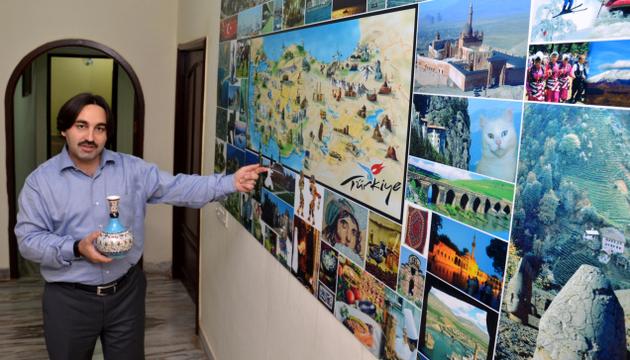
Indialogue Foundation director Osman Kayaoglu talks about the places to see in Turkey as he holds a traditional Turkish vase./  Photo: Nagara Gopal / The Hindu
Indialogue Foundation director Osman Kayaoglu talks about the places to see in Turkey as he holds a traditional Turkish vase./ Photo: Nagara Gopal / The Hindu

As the Turkish Consulate gets ready to set up office in Hyderabad, Neeraja Murthy finds a Turkey-Hyderabad connect

Enter the first floor of Learnium School on Road No. 44, Jubilee Hills and you’ll find a slice of Turkey in Hyderabad. On the walls is a Turkish Corner that displays photographs of ‘Turk folklor’, a Turkish bride, ‘Turk Lokumu’ among other things. Move around and there is a Indo-Turk Corner and photographs of famous Turkish palaces. As we soak in the pictures, we hear the booming voice of Sevim Kayaogolu calling out “Bir, iki, uch, dort… “(one, two, three four… in Turkish). She is teaching a Turkish dance to a group of young girls who are dancing to the beats of Yeni bir dunya, dressed in their traditional Turkish dresses.

Sevim (in the centre) joins a group of girls dancing to the tune of Turkish song ‘Yeni bir dunya’. / Photo: Nagara Gopal / The Hindu

“The students are presenting this Turkish dance for the Parents Day meeting,” informs Sevim. The school (will be called Iqbalia International School) run by a Trust (which also includes Turkish people) teaches Turkish language art, dance and culture to its students, in addition to its regular CBSE syllabus. Osman Kayaogolu, director of Indialogue Foundation’s second year in Hyderabad, calls the city ‘historical’. “Among the different cities in India, Hyderabad has a beautiful history,” he says and adds, “Turkey and Hyderabad share a lot in common in culture. We have given our daughters here in marriage – Princess Durru Shehvar who married Azam Jah, Princesses Esin and Esra have also come to Hyderabad after marriage.”

Osman talks about the ‘royal’ similarity between the two regions. “The Chowmahalla Palace looks like a replica of Dolmabahche palace, only the former is smaller. It is said that the Chowmahalla was built for Durru Shehvar so that she would feel at home in a place that reminds her of Turkey,” he smiles.

Indialogue Foundation, the Turkish cultural centre acts as a hub for the 15 Turkish families living in Hyderabad. “We get together here during religious ceremonies like Eid and we organise inter-faith seminars, talks, conferences and cultural programmes. We arrange business meetings between Turkish and Indian businessmen and also organise Turkish celebrations.”

Osman says the Turks enjoy their stay in the city. “The climate is nice and we enjoy eating biryani which is like our not-so-spicy Osmani pulao. We have made many friends here and people are affectionate too.”

What baffles Osman however is the way friendly Hyderabadis behave while driving on roads. “During busy traffic, they are not at all friendly and act differently,” he says with a smile. The Turkish women volunteers try to spread their art and culture in the city. Osman and his group of friends also play football every Sunday. “We don’t know about cricket, but now our children are picking up the game in Hyderabad.”

There is also good news for the Turkish families in the city with the Turkish Consulate coming up here. “The Turkish Consulate General Murat Omeroglu is in Hyderabad with his family and the work to establish the Consulate has begun. The process might take six months,” says Osman.

Osman says Turkish people in the city do miss their family and friends back home as well as Turkish food; but they have found a home away from home here.

“Hyderabad is our second home. Merhaba Hydarabad (Salaam Hyderabad),” he signs off.

Short film contest

Indialogue Foundation and Sarojini Naidu School of Arts and Communication, University of Hyderabad had organised a Indialogue Short Film Contest 2013on the theme ‘Peaceful Coexistence” which aimed to foster universally shared values among public .

The contest had two categories – YouTube award and Jury award. Emrah Alpaslan from Saritha Vidya Niketan with his short film titled Dedicated Life won the YouTube award with 2100+ views. Jhilam Chattaraj, from University of Hyderabad with her movie In Search of History was selected for the Jury award.

Both the awards carried a prize money of Rs. 35,000 each.

source: http://www.thehindu.com / The Hindu / Home> Features> MetroPlus / by Neeraja Murthy / November 19th, 2013

Soldier from Badami killed in freak accident

Salim Walikar, a soldier of the Indian Army and a native of Khaji Budhihal village in Badami taluk, was killed in a freak accident during weapons testing in Nagpur on Tuesday. His mortal remains will be laid to rest with full military honours at his hometown on Thursday.

Walikar, who had married four years ago, is survived by his wife Mumtaz Begum, two children and parents Fakruddin Saab and Jaibunnisa. Salim, who had joined the Army in 2002, had visited his home in August to celebrate Ramzan.

source:  http://www.deccanherald.com / Deccan Herald / Home> State / Bagalkot , DHNS / November 28th, 2013

I am… Basheer; Gold, silver polisher

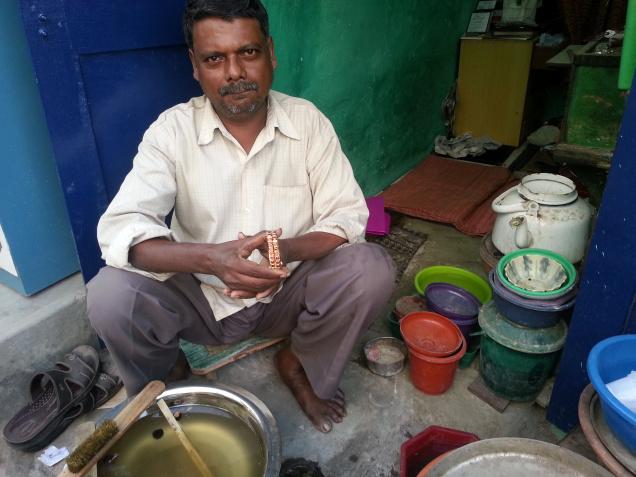
Basheer / The Hindu
Basheer / The Hindu

It’s only four in the evening, but Basheer has already decided to go home — he has no work that day. “The festive season just got over, hasn’t it? People will come to polish bangles and chains only after a few days,” he says, softly. Seated in front of a steel basin, with four boondhi kottais (soap berries) and four small brushes floating in the water, Basheer talks of the gold polishing business that he has been a part of for the last 30 years.

A Class 8 dropout, Basheer was initially a two-wheeler mechanic, before he trained for five years and became a skilled silver and gold polisher. After working out of several locations in Mylapore, Basheer now runs the ‘K. Noor Mohamed Gilt Shop’. “Earlier, I had my own shop. This one,” he says, pointing to the small, rectangular shop, with its blue shutters and green walls, “belongs to my cousin. He asked me to run it.” I strain to hear his voice, which gets drowned in the street noises of Mathala Narayanan Street; it’s only an old, narrow thoroughfare, but vehicle sounds and arguing neighbours make us raise our voices.

Our loud voices attract attention. One gentleman enquires why I’m asking Basheer “all these questions”; another offers to answer on his behalf and says, “He lives in Kunrathur.” Basheer explains that he moved to the ECR approximately 30 years ago. “Land was cheaper there, but now, it sells for crores!” Every morning, for the last three decades, Basheer has been taking two buses to reach Mylapore. “It’s faster to get here now, even though there’s heavy traffic after Tiruvanmiyur. In those days, there were hardly any buses, you see!” he smiles. The return journey is equally long, and he typically gets home for a late dinner around 10 p.m.

The day is spent in polishing silver and gold. Job orders range from small items — bangles and chains — to the temple kavacham or crown polishing. “Approximately 15 years ago, I polished silver items for the Kapaleeswara temple. Many of my customers are from Chennai, but some come from faraway places too.” Basheer, very modestly, says he’s an expert at polishing temple (dance) jewellery. “Dance jewellery is made in Nagercoil, and it’s difficult to clean and polish, as it has a lot of stones,” he says, showing me a pair of red-stone bangles that he has freshly gilded for a customer. It’s hard to tell it’s only ‘covering’.

To gold polish jewellery, Basheer first cleans it well. “I use soap berries bought from the naatu marundhu kadai; they foam naturally,” he says, pointing to the soapy water in the basin. Next, Basheer readies the ‘gold bath’, by dissolving a tiny amount of gold in acid, and boiling the resulting fine dust in water. This is then used to coat the article, by electrolysis. “After plating, the chain or bangle is dried on a bed of sawdust. It will then shine like gold.” (Silver plating is somewhat similar, except, it is buffed in the end).

Gold polishing costs around Rs. 250, a price that does not make it really profitable. “Gold prices have increased, but customers are not willing to pay more,” Basheer says. But he also rationalises their reluctance — gilt jewellery itself sometimes only costs Rs. 250, and the gold finish lasts for just a few months. And yet, Basheer seems happy with his lot; he talks of his three children — all graduates — and his visits to Nagore, with his family, once every two years. And when an old woman comes to his shop seeking alms, he springs up from his low stool, and fetches her a few coins…

(A weekly column on men and women who make Chennai what it is)

source: http://www.thehindu.com / The Hindu / Home> Features> MetroPlus> Society / November 11th, 2013

Winners of Tipu Gold Cup

Mysore :

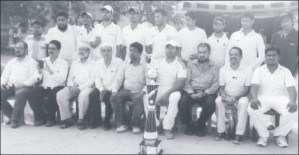
The Universal Cricket Club won the Tipu Sultan Gold Cup-2013, organised by Moon Star Cricket Club at University Ground in city recently. 

Seen in the picture are Sallahuddin, Abbas, Noushad Khan Durrani (Coach), Javed Pasha (Captain), Abrar Ahmed, MMH Bijlee, Jameel Ahmed, Rafiq (Manager), Nissar Ahmed, Imran Shareif, Nasir, Mahboob Pasha, Sannan Ahmed, Nazruddin, Asif Ahmed, Afreed Bijlee, Raffiuddin, Sallahuddin and Raqiub.

source: http://www.starofmysore.com / Star of Mysore / Home>  Sports News / November 13th, 2013