Eminent academician Faizan Mustafa, who is senior vice-president of city-based NGO Rural Litigation Entitlement Kendra, has been conferred with this year’s prestigious SAARC Best Law Teacher Award.
In a unanimous decision the high-powered jury conferred this award on Mustafa, according to a press statement released by the NGO here today.
The award which carries Rs 1 lakh in cash, a citation and a plaque would be given to Mustafa by the Union Law Minister in Delhi on September 6, in the presence of eminent professors of law, judges and eminent lawyers, it said.
Earlier awardees include leading jurists N R Madhav Menon, Ranbir Singh, G V Ajjappa, V S Mani, Prof. Laxminath and Prof. Mizanur Rehman of Bangladesh’s Dhaka University.
Mustafa is Aligarh Muslim University’s Law Faculty member and is widely respected for his passion for teaching. He introduced several courses such as Intellectual Property Rights, International Human Rights Law and Tourism Laws at AMU.
At NALSAR University of Law, Hyderabad where he is presently working as Vice-Chancellor, he designed and taught new courses like Diversity Management Law, Comparative Strict Liability Law, Multiculturalism & Minority Rights.
He is the only academic who has been nominated as member of the National Legal Services Authority, which is headed by the Chief Justice of India.
He is member of several Executive Councils, Academic Councils and General Councils of various universities. He has been member of several search committees for the appointment of Vice-Chancellors.
Noted rights activist Avadhash Kaushal who heads the NGO has suggested that the Uttarakhand government should utilise the services of Mustafa in planning the proposed National Law University of Uttarakhand.
source: http://www.outlookindia.com / Outlook / Home> News / Dehradun – August 19th, 2014
Former School Board Candidate Appointed to University System of Maryland (USM) Board of Regents Raaheela Ahmed breaks many “firsts” as she enters Student Regent Position Annapolis, MD, August 13, 2014: After nearly winning a bid for the Prince George’s County Board of Education, District 5 seat against former chairwoman Jeana Jacobs in 2012 (47%-53%), Raaheela Ahmed breaks ground as the first Muslim, the first South Asian, and likely the first home-grown Bowieite to serve in the role of Student Regent. She is one of a handful of women that have been selected for this honor in the history of the system.
The selection process involved several interviews with members from the University of Maryland, College Park, the University System of Maryland Student Council, the Chancellor of the USM, and the Governor’s Appointment Office. All in all, it took 10 months for the selection to be made (November 2013 to August 2014), an unusually long process for this position.
Her appointment was made through an emergency executive order due to a legality which states that the Governor cannot appoint individuals to state positions after the primary election, which was moved up from September to June this year. Hence, her term (which was supposed to begin July 1) will begin as soon as she is sworn-in this month. Raaheela is excited to be representing over 150,000 students in 12 institutions and 2 regional centers. Her focus for this year will be on college affordability, financial literacy and mental health issues.
Addressing the youth on the occasion of Independence Day Celebration, Maulana Peer Syed Shabbir Naqshbandi Iftekhari, president All India Religious Leaders Association said that history bears witness that Muslims played remarkable role in Indian Independence and development of country. Even today they pledge to sacrifice everything for their beloved country.
Maulana Peer Syed Shabbir Naqshbandi Iftekhari was addressing flag hoisting ceremony at schools run by Sultan ul Uloom Educational Society. He spoke on Muslims role in freedom struggle.
Siasat news
source: http://www.siasat.com / The Siasat Daily / Home> Hyderabad / Saturday, August 16th, 2014
Kerala Government has appointed senior IAS officer A P M Mohammed Hanish as Nodal Officer for the matches likely to beld in Kochi during the 2017 FIFA under-17 world cup football.
The appointment is as per FIFA’s direction, a Kerala Football Association press release said.
The official has also been entrusted with overseeing the infrastructure and development of soccer in the run up to hosting the event.
Hanish is the Kerala Roads and Bridges Managing Director.
source: http://www.business-standard.com / Business Standard / Home> PTI Stories> National> News / Press Trust of India / Kochi – July 01st, 2014
“See the skies from the air on Fridays at 2 pm for `10.” Amused? This was on a famous poster of the Deccan Airways of the circa 1950’s Hyderabad. Walk into the ‘History of Civil Aviation in India’ stall at the India Aviation 2014 at Begumpet airport and you will possibly stumble upon such fascinating records, be it aviation stamps or airline schedules, of a glorious past of aviation in Hyderabad and the country.
Deccan Airways, as the company owned by the Nizam of Hyderabad was called in 1945, had chartered flights to as far as Quetta and Rangoon, and were also the first one’s to start the Haj chartered fleet from the country in 1948.
“Hyderabad had a regular air-strip even back in 1932 at Habshiguda. PM Reddy and Babar Mirza of Aero Club of Hyderabad used to regularly fly from here. In 1934, it became Hyderabad State Aero Club and started operating from Begumpet airport, which is presently one of the oldest airports in the country,” says P Anuradha Reddy, who is the author of ‘Aviation of Hyderabad State’.
According to her, PM Reddy and Babar Mirza, both of Hyderabad, were among the firsts in the country to complete their flying training in England and obtain licenses.
Hyderabad was also the first princely state to have a coordinated transport system in place. Speaking about the fleet of flights procured by the Nizam, she says that at the start of World War-II, Royal Airforce of the UK took over the Hyderabad State Aero Club to convert it into the first Elementary Flying Training School.
“After the World War-II, Dakota DC-3 aircrafts used by the US Air Force were lying out of use at Assam. It was considered no good and were being given away for throw away prices. Hyderabad state bought 21 of them and flew them down here, worked on them and later the same aircrafts became the backbone of civil aviation in India,” she informs.
The Hyderabad state had five airfields with concrete runways in Aurangabad, Warangal, Bidar, Hakimpet and Begumpet. Photographs of Hyderabad’s first licensed pilots Capt PMM Reddy and Capt PN Reddy, first trained woman pilot Aban Peston Chenoy who passed away two years ago, and some of the earliest forms of trainer and chartered aircrafts are featured in the gallery.
Surprisingly, the Nizam of Hyderabad took his first flight only in 1951 in the capacity of Rajpramukh. Quoting Captain PM Reddy, who was also Anuradha Reddy’s father-in-law, she says that the Nizam was never really interested in flying and had his own worries.
“So finally, he took a test flight around Hyderabad city. He was as excited as a child to see his own King Koti palace. And he asked if others also can see his palace from the air. Getting an answer in the affirmative, he imposed a flying restriction on top of his palace,” she says.
So how did the Deccan Airways become the backbone of civil aviation? Unlike the other flight companies, the Deccan Airways enjoyed a much wider coverage, operating from Madras-Hyderabad-Nagpur-Bhopal-Gwalior-Delhi and Bangalore. Hyderabad also had the Night Air Mail Service, something akin to the present day Speed-Post.
“Passengers and mails were carried from Chennai, Bombay, Calcutta, Delhi and Hyderabad and interchanged at Nagpur, which was a major hub. Even newspapers were airlifted to their destinations. In fact, the Indian Express was the first news publication to be delivered via air, it was taken from Chennai to Delhi on the same day through Deccan Airways,” she adds. The world’s first aerial post also took place in Allahabad in February 1911. A humber sommer biplane that flew to Naini five miles away in 13 minutes carrying 6500 letters and cards was the first aerial post.
To pay true and fitting tribute to the city’s aviation history, she suggests a civil aviation museum. “There is so much to offer about Hyderabad’s aviation history. The oldest terminal at Begumpet airport, which isn’t in use, could be turned into a museum to protect the legacy,” she opines.
Titbits of aviation’s history
The Nizam’s Government owned 71 per cent of Deccan Airways and the remaining was held by Tata Sons and others. Launched with three aircrafts, it went on to have a fleet of 13 Dakotas by the early 1950s. It merged with Indian Airlines in 1953
When the seventh Nizam Mir Osman Ali Khan took a test flight in 1951, he was initially excited to see his King Koti Palace from the air. However, paranoia set in soon after and he imposed a no-fly zone over his residence
Deccan Airways had chartered flights to as far as Quetta and Rangoon. It was also the first to start the Haj chartered fleet from Indian in 1948
Hyderabad based Deccan Airways was of the one of the premier airlines of the country, operating on Madras-Hyderabad-Nagpur- Bhopal-Gwalior-Delhi, Hyderabad-Bombay and Hyderabad-Bangalore sectors. Though founded in September 1945, the first flight took off on May 25 the following year.
source: http://www.newindianexpress.com / The New Indian Express / Home> Cities> Hyderabad / by Rahul V. Pisharody / Hyderabad – March 15th, 2014
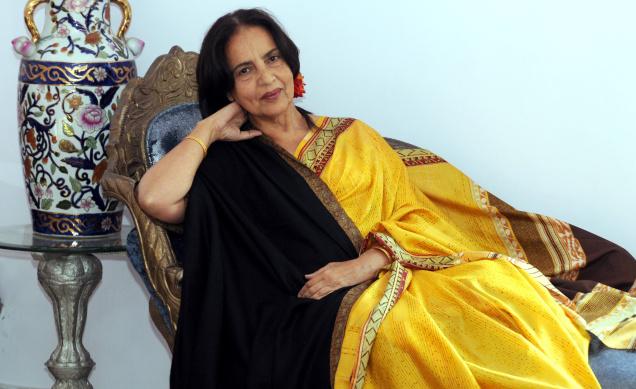
Salma Sultan at her home in New Delhi./ Photo : Rajeev Bhatt / The Hindu
What makes Salma Sultan click even at 63?
“I belong to a city where women ruled for 100 years. So much is the pride in that place that till date most women don’t attach their father or husband’s surname . Most girls still use ‘Sultan,’ just like I do.”
Personifying pride coupled with grace and humility – meet Salma Sultan, the woman who ruled the small screen as a newsreader for over two-and-a-half decades. A rose became synonymous with her and news reading — an elegant exercise.
Today Salma , over 63 years of age, hasn’t lost her charm and poise. Looking at her on television , no one would have imagined that she possessed such a tremendous sense of humour. Barely a sentence of hers is free of effortless wit and hilarity.
A Delhiite for over two decades, Salma now lives in her palatial three-storey bungalow at Jangpura and has to her credit the greenery of the area starting from Sahi Hospital to its back and beyond. An ardent nature lover, she has turned the ugly , illegal parking area to a lush meadow. “Delhi is my karmbhoomi. It has shaped my confidence and given me immense strength to fight contradictory situations.”
As one enters her drawing room through the Rajasthani fort style gate, peace greets through a painting of the Buddha and class via an original M. F Husain painting . “Husain saab gifted it to my father,” that familiar voice falls on the ears as one spots the beautiful woman with her dimpled smile and motherly warmth in her kohl-less eyes. She has “taken great pains” to get ready – a yellow and brown sari, “touch-ups with talcum powder and lipstick”, and stuck a red rose on insistence for the photo shoot. “I don’t like getting ready and ‘pose’ for pictures,” she says politely. She is shy and camera conscious despite, ironically, being in front of the camera from 1967 till the late nineties.
But Salma , quite contrary to her appearance on the small screen, had been a naughty child. “I was very assertive, irrepressible, naughty but not spoiled. Not a single day of my life would go without a prank in school.” For instance, the day “our teacher would ask us to bring the geography book, I would make it a point to give it to someone to get the ‘punishment’ of standing outside the classroom with three others equally party to this plan,” she laughs as her dimple grows deep.
Born to scholar and secretary in the Ministry of Agriculture Mohammed Asghar Ansari and a “Moghul” homemaker mother, Salma was her parents’ second child. “I was an unplanned child but a blessing to my lonely sister (Maimoona Sultan, four-time Member of Parliament) who would protect me from the wrath of my disciplined father who would make sure that I offer all my prayers (namaz) and read the Quran on time. But he has a great contribution in the making of my personality. He used to emphasise education and extra curricular activities in school. He would prepare my debate and make me rehearse in front of him,” recalls Salma about her Sultanpur school days in Bhopal. Salma did her graduation from Bhopal. “I did my post graduation in English from Indraprastha College, and simultaneously gave audition for an announcer on Doordarshan.”
On to news reading
Salma became a newsreader by fluke. “Those days”, she recalls “only Pratima and Gopal Kaul used tor read news. Kaul wanted to become a producer, so his tussle with the DD was a regular affair. Once, as a protest and to make sure not to read news anymore, he shaved his head. As he entered the studio, the producer was shocked.” In the frantic search to replace him, Salma became a casualty. “But there was a hidden desire to read news as it was a well-paid, comfortable job where the newsreader, unlike an announcer like me, had to come at 4 p.m., read the news a couple of times and go back.” A nervous Salma read the 15 minutes news in eight minutes and “paused”. “The hapless producer decided to train me and that’s how the journey began.”
She narrates the story behind the signature rose in her hair. “I once wore a pink rose to match my pink sari and read news. Telephone calls and letters of appreciation poured in. Then the day I wouldn’t tuck a rose, letters of complaints and requests would follow. So, a rose became a regular affair.” And to hunt for matching roses, Salma would either grow her own or “steal from the neighbourhood.”
After her retirement , Salma moved to direction. Her serials Panchtantra, Suno Kahani, Swar Mere Tumhare and Jalte Sawa drew attention. She recalls, “To shoot Panchtantra on minimum budget, I went to Mumbai to look for a set of rajmahal. Someone told me that B.R. Chopra’s set for Mahabharatawas being dismantled after the shooting. I met him and he was kind enough to let me use his set.Panchantra used to be telecast soon after Mahabharata and did very well. I will never forget his compliment , “Mujhe is ladki ki daad deni padegi. Mahabharat ke baad bhi log isse dekhte hain”.”
The mother of an Income Tax Commissioner Saad and a choreographer daughter Sana and two grandchildren, Salma’s quest for learning hasn’t waned. “I am learning synthesiser and , harmonium for my love of music, and computers to be tech-savy.” Salma also does interior designing. She began by doing up her 13-room bungalow in Bhopal followed by an apartment in Patparganj. Her residence is proof of her refined taste.
How does she keep fit? “I do yoga, walk and take supplements. I treat my body as a gift from God…. To purify my inner self, I offer namaz regularly,” she signs off, poise refuses to fade.
source: http://www.thehindu.com / The Hindu / Home> Features> MetroPlus / by Rana Siddique Zaman / February 22nd, 2010
Once upon a time, a queen lost her kingdom to a foreign invader. Under the terms of surrender, she was allowed to retain her title, inheritable by the seniormost member of the royal family. She was also assured an annual payment to maintain her standard of living. It was a generous sum back then. Then came the passage of time. Sovereigns vanished into history and elected governments came into existence. The royal family didn’t live happily ever after. Their annual pension, a fixed sum, was ravaged by inflation.
It began to look smaller and smaller, until it came to a point where it was not even as much as the monthly salary any of them earned.
And then the family decided to make a calculation. When they were first allotted that sum, how much gold could they have bought with it? And how much would that gold be worth today? This figure, they convinced themselves, was the sum that they should logically be getting.
And so they went to the government and asked for it. Else, they demanded their kingdom back. They will probably not get either.
+++
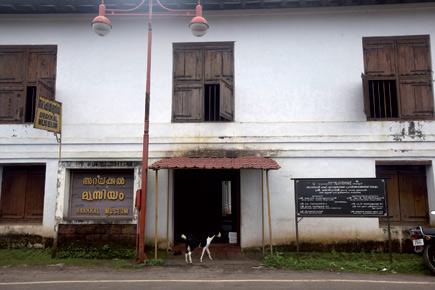
That, in short, is the story of the Arakkal family that once ruled the city of Cannanore (now Kannur) and Lakshadweep Islands, a reign that lasted five centuries. The trust that governs their affairs recently made the bizarre demand that the Indian government either raise their pension or return Lakshadweep.
I had to wait ten minutes after ringing the bell at the present queen’s residence in Talassery, a town 20 km away from Kannur. A huge house modelled on the original palace that is now a museum of history, it is as silent and empty as any other house along the Malabar coast whose members have left for greener pastures abroad. The queen has three sons, all working overseas, and one daughter. It is the daughter, who looks around 50, who opens the door and welcomes us in. She had been busy with her evening prayers and apologises for making us wait. She and her mother are the only two residents of this palatial house.
I am taken to the queen’s room, where the 92-year-old Sultan Arakkal Adi Raja Sainaba Aishabi, also known as Arakkal Beevi, reclines on a bed. More than three years ago, she had suffered a stroke and never fully recovered. But she welcomes me with a gladdening smile. I have to bend forward to catch the words of her broken voice.
“Journalists often come here,” she whispers, “though I am not well enough to talk. You may get sufficient information from my children. Please don’t forget to have tea and some food before you leave.”
I ask her whether she is aware of the Arakkal royal family trust’s demand. She answers with the same bright smile. It is her daughter who speaks. “She is too old to get into such headaches,” she says.
For centuries, the royal title has been passed along to the seniormost member of the family irrespective of gender. A male king would be called Ali Raja Adi Raja (‘lord of the sea’) and a female, Arakkal Beevi.
According to historians, the Arakkal Dynasty was Kerala’s only Muslim family of rulers. There is no consensus on their origins, but some say their assumption of power dates back to the 13th century.
According to a piece of local lore, the dynasty was founded by a minister of Kolathiri Raja (the then regional ruler) who converted to Islam and became a ruler.
Another says that the Arakkal royal family traces its lineage to Mohemmad Ali, a nephew of Cheraman Perumal (a regional ruler before the region split into different principalities) who is said to have embraced Islam. The only thing certain is that the Arakkal Dynasty had sovereign control of Cannanore that later extended to Lakshadweep islands off the coast of Kerala in the Arabian Sea.
The arrival of European seafaring powers bolstered their kingdom’s trade and commerce. They had a love-hate relationship with the Portuguese, the Dutch and the British. According to Dr A Sreedhara Menon, a scholar on Kerala history, the Arakkal principality of power came to an end in 1790, the year in which St Angelo Fort of Cannanore was stormed by General Abercromby, the then British Army general. Locally known as Kannur Fort, it had been built in 1505 by the Portuguese; it was later owned by the Dutch, who then sold it to the Arakkal king for Rs 1 lakh. The fort is now a tourist destination. The East India Company later forced the then Arakkal Beevi into an agreement under which she had to give up control of Lakshadweep islands. She was allowed possession of Cannanore city, but deprived of any claim to sovereignty. The East India Company pensioned off the Arakkals the same way they did other local kings and chieftains in India.
By 1900, the family had lost every trace of power. In 1905, they had to make another agreement with the British giving up all sovereign claims on Cannanore and Lakshadweep. In return, they were entitled to receive an annual pension, termed malikhana, of Rs 23,000. This is a sum they still get, though from the Government of India, which took over the obligations of the departing British.
+++
On 10 July this year, a decision was taken at a meeting of the royal family trust to press the demand for a raise (or a return ‘surrender’ of their kingdom). “It is not the first time we have made this demand,” says Ali Raja Adi Raja Hameed Hussain, the eldest male member of the royal family. We are at a shop he has in Kannur, where he runs the family business of spice exports. He takes a bundle of papers off a wooden shelf to show us. The stack includes copies of representations submitted to Central and state ministers to raise their malikhana. “We have been demanding a reasonable hike for long,” he says, “This time we decided to make it public through the media.”
While that may be so, why they consider their demand reasonable remains a mystery. India, after all, is a democracy and there is nothing that entitles them to such a payment. “We need money because we want to continue the charity work which had been done by our ancestors,” says Hameed Hussain. But why demand public money for purposes of charity?
“Because we are descendants of a sovereign ruler,” replies Ali Raja Mohammed Rafi, younger son of Arakkal Beevi Sainaba Aishabi, who runs an advertising agency in the UAE. “As per the contract of 1905 with the English East India Company, we are entitled to receive an amount sufficient to maintain the standards of royal living.”
The agreement, a copy of which is with Open, reads: ‘The Government would pay to the Adi Raja and to his heirs and successors a Malikhana of Rs 23,000 per annum in equal monthly installments one half being paid to him during his life and after his death to the head of the family for the time being as a personal grant for the maintenance of his position and dignity and the other half being paid to him and to his heirs and successors as heads of the family.’
Mohemmad Rafi, who is the managing trustee of the royal trust, says that Rs 23,000 was a huge amount in 1905. If calculated in terms of gold, he says, it would have bought 64 kg of the metal in 1905. “Considering the value of gold [now], we should get around Rs 14 crore per annum,” claims Mohemmad Rafi. “We know that is not practically viable and so we are demanding only a reasonable hike in the annual pension.”
+++
This is not the Arakkals’ only family tussle over ancestral property. There is an ongoing dispute with another family of Muslim landowners, the Keyis, over 1.4 million Saudi riyals—about Rs 2.2 crore—said to be lying in the Saudi Arabian government’s treasury. The exact sum cannot be verified, though many believe it to be in the tune of Rs 90 crore. About 150 years ago, a member of the Keyi family, Mayinkutty, is said to have built a guesthouse in Mecca to accommodate Hajj pilgrims from Malabar. In 1971, the Saudi government demolished this structure as part of a development exercise, allotting 1.4 million riyals as compensation to be handed over to the Keyi heirs. At that point, the Arakkal royal family also staked claim to the amount on the grounds that Mayinkutty had married one of their members, Aychi Beevi. “It is beyond dispute that we are the legal heirs of Mayinkutty Keyi and have legitimate claim over that property,” says Mohemmad Rafi.
The Kerala government recently appointed an IAS officer, TO Suraj, to look into the matter and take a final decision. He says that neither family might have any right to it. “In my understanding, the property was dedicated to the Wakf for the welfare of pilgrims,” says Suraj, “The government is trying to attach the property [for use of] the Wakf Board by due process.”
Professor Rajan Gurukkal, a historian and former vice-chancellor of Mahatma Gandhi University, thinks that would be ideal. “It should go to the government and be used for a public purpose,” he says. Gurukkal also thinks that the demand to raise the malikhana has no legal validity. Dr KKN Kurup, a historian of the Malabar region, author of a book on the Arakkal family’s history called Aliraja of Cannanore and former vice-chancellor of Calicut University, terms the demand “absolutely irrational”. He says there is no reason to spend public money on the upkeep of aristocracies and royalties of the past. “The malikhana was maintained primarily on the condition that they should be loyal to the English East India Company. How can they claim the same even after independence? Does it mean that the Arakkal family is still loyal to the British? What if all the heirs of rulers of princely states make similar demands?”
source: http://www.openthemagazine.com / OPEN Magazine / Home> Open> Feature / by Shahina KK / August 23rd, 2013
Mayor Mohd Majid Hussain will resign on Friday ending his over two-year term at the helm of the Greater Hyderabad Municipal Corporation (GHMC).
His party Majlis-e-Ittehad-ul-Muslimeen (MIM) has asked him totender his resignation from the post on Thursday. MIM is likely to field him in one of the Assembly constituencies in the city.
“My party has directed me to resign from the post on Thursday. Abiding by the decision of the party, I am resigning on Friday. My party will take a decision on utilizing my services,” Majid Hussain told TOI on Thursday.
Majid Hussain took over the reins of the GHMC on January 3, 2012 as part of the power-sharing agreement between MIM and Congress in 2009 soon after the civic body elections.
As part of the agreement, of the five-year term, the mayor post goes to a Congress candidate for the first two years followed by that of MIM for the next two years. The last year should go to a Congress candidate. Likewise, the deputy mayor post would go to the other party during that period. Congress mayor Banda Karthika Reddy had served as the mayor for the first two years and subsequently MIM corporator from Ahmed Nagar, Mohd Majid Hussain, took over the reins in January, 2012 and has completed his two-year term on January 3.
Though in the last one year the mayor post should have gone to the Congress, the party has not been claiming it for various reasons mainly keeping in view the likely tie-up with the MIM in the general elections. Since Congress was not coming forward, Majid Hussain continued in the post.
By pulling out from the mayor post, MIM is likely to snap its ties with the Congress in the upcoming Lok Sabha, Assembly and GHMC elections to be held this year.
With the resignation of Majid Hussain, Congress has to announce its mayor candidate. Several corporators, including deputy mayor G Raj Kumar, floor leader Diddi Rambabu, Bowenpally corporator Narasimha Yadav and others are eyeing the post.
source: http://www.timesofindia.indiatimes.com / The Times of India / Home> City> Hyderabad / by TNN / March 07th, 2014
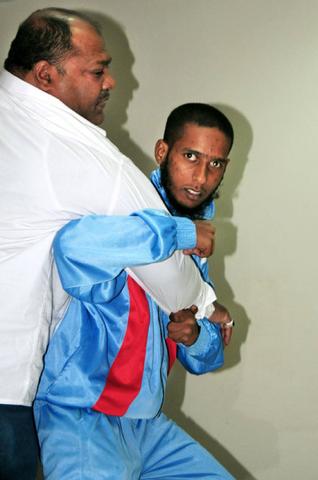
Irfan Bin Hamed Al Hamoomi, the visually-challenged judoka from Hydeabad, who has been selected to represent India in the Junior world games (Paralympic) in Hungary, seen with his coach and mentor M. A. Aziz. PHOTO: K. RAMESH BABU / The Hindu
Irfan Bin Hamed Al Hamoomi is the only person from the State to compete at the ongoing Junior European and Junior World Games competitions in Hungary
He cannot see the world like us, but Irfan Bin Hamed Al Hamoomi, 20, is sure to make the world sit up and watch his exploits in judo.
The local boy is the only person from the State (among five from India) to be selected to represent the country at the ongoing Junior European and Junior World Games competitions in Hungary. The 90-per cent visually challenged student of Chanchalguda Junior College says his career took a turn for the good after meeting M. A. Aziz, former national champion, and a jury member in the 2012 London Paralympics.
“Things changed for the good after I met him, as I was facing difficult times,” Irfan says, even as he traces his humble origins. His father Irfan Hamoomi supports the family selling onion and garlic.
The boy’s career took off when he won gold in the 55-kg category in the Lucknow nationals for the visually challenged (Andhra Pradesh won the overall championship for the first time with six gold, three silver and two bronze).
Irfan is confident of doing well in Hungary where judokas from 35 countries are expected to vie for top honours.
“I don’t think of my handicap at all. I am just enjoying the sport,” says the youngster. Irfan trains with 20 others at the Quli Qutub Shah Stadium on a wrestling mat (not a judo mat), showcasing his indefatigable spirit to keep improving despite all odds.
source: http://www.thehindu.com / The Hindu / Home> News> Cities> Hyderabad / by V. V. Subrahmanyam / Hyderabad – December 05th, 2013