Mehmood is an electrician whose business of setting up lights for festivals spans from Janmasthami celebrations in Muzaffarnagar to the famous Nauchandi Mela in Meerut
Prayagraj:
In a sea of saffron, he stands out with his skull cap and gray beard. To the first time visitor, a board reading ‘Mullah Ji Light waale’ (Mullah Ji, the lighting man) at the Kumbh Mela may be an odd sight but to the Sadhus who have gathered at the confluence of the Ganga and the Yamuna , Mohammed Mehmood aka Mullah Ji is a permanent feature of every Kumbh. To some, he is even a friend.
Mehmood is a 76-year-old businessman from Muzaffarnagar in Western UP. In 1986, he acquainted himself with the Sadhus of the Juna Akhara – the largest and one of the fiercest Akharas of the Naga Sadhus; an ancient order of warrior monks. They hired him to set up the lights around their tents. Today, every six years, he travels over 800 kms to Allahabad, now named Prayagraj, and camps out at the Kumbh Mela.
Sandwiched between the tents of the Juna Akhara, he talks of his journey to Kumbh. “I am an electrician. When you come here at night, you will see that the entire area where Sadhus have pitched their tents is dazzling with bright lights of all colours. That is my doing,” he says proudly. Mehmood’s business of setting up lights for festivals spans from Janmasthami celebrations in Muzaffarnagar to the famous Nauchandi Mela in Meerut. ‘Mullah Ji’ had started his business from scratch.
“The first Kumbh I ever attended was the 1986 Kumbh in Haridwar. Apart from the mela that happens in Nashik, I have attended every one. I haven’t kept count of how many Kumbh Melas I have attended, maybe you can do the maths,” he jokes, sipping a cup of tea at his 11th mela.
Naga Baba Sangam Giri, a warrior monk from the Juna Akhara, is Mehmood’s neighbor on the sands in Kumbh. “I have seen him at nearly every Kumbh Mela I’ve been to. I never even bothered to ask him, his real name. For us he is, and will always be, simply ‘Mullah Ji’ – our friend,” he says, adding, “For Hindus, we are gurus. For Muslims, we are Pirs. They (Muslims) worship niraakar (a formless God) and we worship aakar (idol worship). There may be different routes, but we are all going to the same place. There are 25 different ways to get to Allahabad. Everyone takes a different route to the railway station. But eventually, everyone ends up at the railway station.”
Mehmood says he is treated with respect among the Sadhus. The day that stops, he says, that will be his last Kumbh. “The Babas make me feel at home. Sometimes they ask me to sit on their gaddi (padded mattress), but I respect them too much to do that. I read my namaz five times a day in the presence of these Sadhus and they always give me the space,” he said.
If the Sadhus hadn’t treated Mehmood differently, he probably would not have come to Kumbh, he recalls in nostalgia.
Over the last three decades, Kumbh has become an integral part of his life. Will Mullah Ji come back for his 12th Kumbh? “Inshallah! If Allah commands me to, I will come back,” he says.
source: http://www.news18.com / News18 / Home> English> India / by Uday Singh Rana / January 15th, 2019
Faith healing is a scientifically accepted way-out. In Srinagar outskirts lives Abdul Qadir who treats more than 15000 patients a month and is considered a key healer for jaundice, reportsIrtiza Rafiq
Abdul Qadir
The plasma screen at Srinagar International airport shows the arrival of the Delhi- Srinagar flight and the lounge gets instantly active. Among the curious mixture of excited and bored arrivals, Ruqaya, a 33-year-old woman with her pale yellow face, sunken cheeks, and a feeble body stands out. Accompanied by her husband Javaid, 37, as she makes her way out of the airport, her anxious relatives waste no time in elaborate greetings. Flying straight from the USA, the couple is literally bundled into the car and their journey started towards Syedpora (Dhara) in city outskirts.
After a drive of around 29 km, the couple gets off, pass a small bridge across a shallow, crooked, clear, stream, walk down some narrow alleys and enter a house. In the time Ruqaya waits with dozens of other women, most of them mothers with children nestled up in their arms in a compound brimful of multifarious people, Javaid proceeds towards a chaotic, almost endless queue at a congested staircase where scores of people are nudging each other to pass their Rs 10 note for the exchange of a stamped paper piece from a 40-year-old man upstanding at the middle of the stairs. There is another man at the foot of the staircase for crowd control.
The scene resembles the representation of a shrine where followers with raised hands propel each other to get a touch of some higher deity or a sacred thing. The chit for which they are struggling for is their ticket to cross the stairway. This stairway crossing is heavenly for most of them because it leads to the Bab, the ‘spiritual healer’.
For the last five decades, the septuagenarian Bab has been treating all kinds of ailments, at his residence, a quiet and picturesque place, almost 2.5 km from Harwan.
The influx of patients can be gauged by the fact that the Reshi abode comprises three houses: one where the family lives, second where the patients wait for their turn and the third where Abdul Qadir Reshi, the Bab examines and treats his patients.
The room of the treatment-building is jammed by people, among yellow faces, crying neonates, ailing individuals, on the left corner, Bab sits on a bed at a slight elevation with his youngest son Abdul Ghani Reshi. In between them is a large copper bowl of water, on their either side various bottled up solutions, some powders, and in the front, lies a knife and a leather belt.
Khadija, 65, a woman from Rajbagh approaches him with her eight-day-old granddaughter having 7.68 mg/dL bilirubin level, Bab takes hold of baby’s clothes, lays her in front of him, squeezes her nipples, sprinkles handful of water from the copper bowl on her and then slowly rubs her forehead, eyelids all the while muttering something under his breath. He then hands the baby over to Khadija and asks her to make sure that her mother doesn’t eat oily or non-vegetable food. Interestingly, Khadija reveals that the mother of the kid is herself a doctor but has a firm belief in the healing powers of Bab. The medico mom didn’t comply to the paediatrician’s suggestion of exchange transfusion (blood change).
The certitude of this kind doesn’t come as a surprise, for Bab has treated thousands of people. Some of them approached him after they keenly heard their treating doctors telling them: “There is nothing more we can do”. But somehow after following Bab’s prescription, some of these people managed to do the unexpected − they lived, fully treated.
For 55 years and counting, sort of miracles have been happening around this solemn looking spiritual healer who credits it all to the Almighty. “I have been bestowed upon by the knowledge and ability by God that I can say by looking at a person what he is suffering from, particularly jaundice patients, one look at them and I can tell if they will make it or not,” Bab said after managing his patients. “It is a vision by God; the verses I read have a healing effect in them so the healing comes from God.”
This peculiar wisdom runs in the Reshi family and has been transferring from generation to generation. The story of this bequeathed enlightenment started when a spiritual healer from Kabul had a dream, so goes the family legend, wherein he was commanded to visit Mulfak, a neighbouring area of Syedpora, which is known to be home of peers. Once there, he spent a night and went touring adjoining areas escorted by a peer from Mulfak. When he saw ancestors of Abdul Qadir Reshi working in paddy fields, he told his escort, according to Bab’s son Abdul Gani Reshi, “Go back I have got what I was looking for. From that day, he resided with my great-grandfather and passed him his saintly knowledge,” said Reshi Jr.
“But we were warned by our spiritual teacher against being greedy,” Gami said. “So we do not take any money except on Sundays when we take Rs 10 from people and that too for Darsgah and charity. On the contrary, we provide tea and refreshments to visitors.”
Every day, up to 600 patients visit the place, and on Sundays, the number crosses 1000 people, all of whom are treated free of cost by Bab who does it as a social service. He and his family make their living out of their orchards and are financially well off.
“Except for gallbladder stones, everything is treated here,” claims Gani, and he then goes to name the ailments they take care of : Sorphtoph (snake bite), Gunstoph (cobra bite), Arkhor, Hounchop (dog bite), Malder (Herpes), Diabetes, Kambal (jaundice), psoriasis. “We deal with everything but a lot of cautiousness must be exhibited on our parts and we should abide by guidelines of our forefathers. Once my uncle made some mistake and as a consequence, he had a brush with death. This is like a sword hanging on our heads we have to be vigilant at every step.”
This guarded approach is quite evident from the way Bab instructs his son while he prepares herbal remedies and writes prescriptions for patients, even whilst himself dealing with a Malder (Herpes Zoster) patient, Fatima, 55, from Shalimar by dragging and flipping the knife over her lesions. He is doing the shoving and thrusting amid the surging crowd. Angry, he finally uses the leather belt and whips it over the unruly assemblage.
Family’s makeshift shop selling the prescriptions is run by his younger son, Ghulam Masood Reshi and grandson Rayees Ahmad Reshi. Even though it’s not mandatory for people to buy their stock from this shop, still they prefer it, because patients are patiently helped to understand how to follow their prescription. Bab’s prescriptions usually comprise of 80 per cent of herbs and 20 per cent of Hamdard products. Rishis say they take great care that herbs are genuine and hire peasants to handpick them.
People waiting outside Abdul Qadir ‘s abode.
“These unadulterated herbs when used in treatment do wonders,” Masood Reshi said. “There is a specific herb Wagan which heals the bite of rabies dog, without any need of injections, another herb, Sumbloo and Kawidarh Moul, helps to treat blood cancer, diabetes, cholesterol, and thyroid. Yet another herb, Jogi Patsah, found in dog free area of Ladakh aids in treating kidney and ovarian cysts. For jaundice patients, we use a rare herb called Michre Komal. The market value of these herbs is in thousands but we sell them at Rs 600 at the maximum.”
More diverse than the herbs here are the people who flock around Bub. People from all parts of Kashmir, urban as well as rural, from all socio-economic backgrounds, pin the hope of their healing on Bab, but what is more captivating is that people from different religions have belief in him as well.
Jaswant Singh, 60, brings his son, Gurpal Singh, 24, with some throat allergies and Bab after prescribing the medicines holds his turban and reads verses from Quran. This presents a quite peculiar sight.
= A month later, Bab informed this reporter that a non-resident Kashmiri couple from the USA have also come to him for a treatment. In the USA, she was diagnosed with severe jaundice. Her bilirubin count was 65 mg/dL, a level that has the least chances of recovery as per medical sciences. She and her husband then decided to return home, maybe they were preparing for the worst.
But back home, Ruqaya’s family wanted to try for the last time for which they travelled straightaway from Airport for Bab’s consultation.
After twenty days of Bab’s treatment, Ruqaya recovered and then left for the US along with her husband happily.
(Names of patients mentioned in this story have been changed to protect their identities.)
source: http://www.kashmirlife.net / Kashmir Life / Home / by Irtiza Rafiq / October 03rd, 2018
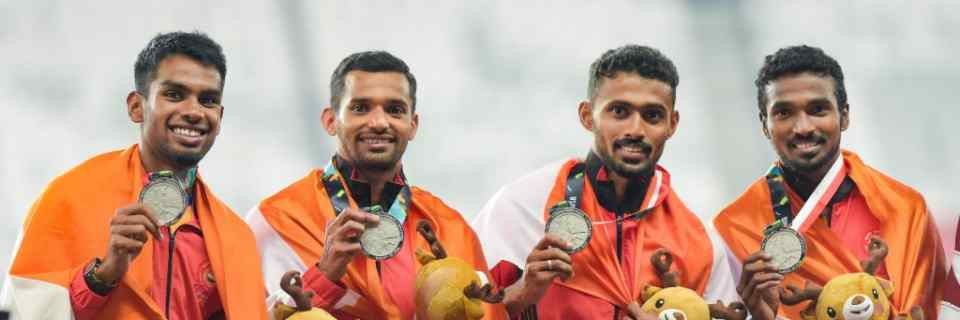
India’s 4x400m men’s relay team bagged silver in the final event of athletics at the Asian Games in Jakarta on Thursday.
The Indian quartet of Kunhu Muhammed, Dharunn Ayyasamy, Mohd. Anas and Arokia Rajiv clocked 3:01.85 to finish behind Qatar who won gold in an Asian record time of 3:00.56.
Japan took the bronze after clocking 3:01.94.
Kunhu Muhammed ran the first lap, followed by Dharun Ayyasamy but by the time the baton reached Anas, Qatar was pulling away. The Indian team was placed fourth at that time but Anas pulled off a great run to pass two runners and Arokia Rajiv managed to maintain the second position
India had finished fourth in this event in the 2014 Asian Games.
(With inputs from PTI)
source: http://www.thequint.com / The Quint / Home> Asian Games / August 31st, 2018
The disastrous floods of 2014 in Kashmir is as vivid in Bilal’s mind as if it happened yesterday.
Along with his two brothers, he was stuck in his house in Srinagar for almost 12 hours. The three boys, who had already lost their parents, stared helplessly at the waters which seemed to reflect their fear of death. But fortunately for them, their uncle managed to find his way to their house in a boat and rescued them.
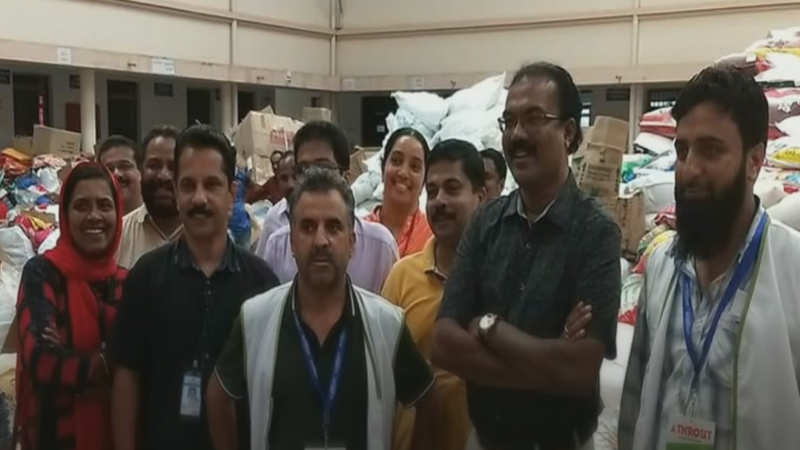
Bilal Ahmed Sofi, a 29-year-old marketing professional from Srinagar, was reminded of those days when he heard about the flood waters rising in the other end of the country, Kerala. The youngster, who has been working as part of a social service group who calls themselves Athrout Kashmir , kept everything else in the backburner and took off to Kerala, along with two other selfless souls from the group — businessmen Abdul Hamid and Waseem Hakim.
“We flew from Kashmir to Bengaluru first, to source some medicines. From there, we took off to Wayanad by road as it was in the news as one of the most affected districts,” says Bilal. The three-men army from Kashmir helped out the volunteers in Wayanad with medicines, supplies and more for almost a week here, and left only after assuring that if ever in need, they wouldn’t hesitate to come back and help again. “Athrout is a Kashmiri word which means a helping hand. We have many college students, youngsters and more as part of the group and we help with many things like conducting weddings of girls from poor families, helping the unemployed youth start a business, providing medicines, disaster relief, and more to those in need, wherever possible for us.” But then, what inspired them to come all the way to Kerala, from the other end of the country? “I believe that for volunteers, there are no boundaries,” says Bilal.
Hamid, who has also helped the victims of Chennai floods
in 2015, says, “I feel that the most difficult aspect during such a disaster is overcoming that mental stress, induced when watching your house getting torn down, nature in all her fury and being tormented by thoughts on what would one do from now on. Though there was a language barrier, we tried our best to talk to people and reassure them on how it’s still possible to rebuild their lives, from our own experiences.” The three also joined the various relief groups and visited villages, interacting with people, inquiring their needs and meeting them.
The three feel that when compared to how the authorities in Kashmir handled the floods, Kerala fared much better. Hamid says, “First of all, there was no religion causing any divide at least compared to the Northern States. People were helping each other out very well. We were given food from the house of one of the local volunteers and they were even ready to provide us accommodation.”
But it’s the local administration they praise the most. “The relief work was so systematic and well thought out. We could see that even the supplies we bought were first sorted and stored carefully, after which we were given a receipt. “This is a crisis, so we have to make sure all needs are taken care of,’ said some of the officials. When it happened back home, the counterparts there were only trying to save themselves and nothing more. Here, they were also tracking down dead bodies soon enough,” Bilal says.
At the same time, the trio feel that it’s time the government did something to form well-trained volunteer groups for such situations, across States. “Having a mind to serve is great, but it’s also important to have the right skills for it. For instance, a flood relief volunteer should know how to swim and what medicines would help the ailing. If there are such groups of interested citizens, the relief efforts can save lives better,” Bilal adds.
In the morning I woke up to messages of hope and happiness as is usual on India’s (71st) Independence Day. Family groups were full of photographs of our younger children dressed in saffron and green, as they went to their schools to celebrate Independence Day.
We watched the speech of Prime Minister Narendra Modi from the Red Fort, and posted messages and stirring poems on Twitter and Facebook. There was so much happiness and bonhomie, when suddenly I got a link to a tweet from a friend:
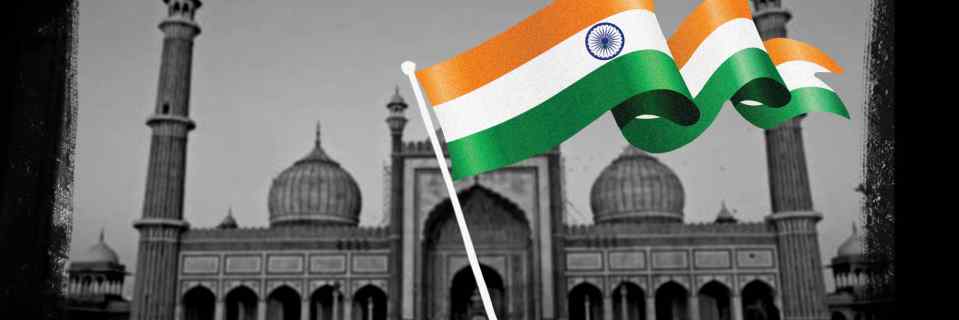
A bunch of people waving the flag in Delhi’s iconic Jama Masjid is hardly anything I should be upset about. In fact, the national flag on the historic Jama Masjid instills pride in me.
Why then, was I upset?
I was upset at the words that were deliberately aimed at hurting and demonising the community that prays in that mosque.
“71 साल बाद जामा मस्जिद दिल्ली की छाती पर चढ़कर हमने कार्यकर्ताओं के साथ राष्ट्रीय ध्वज फहराया, वन्दे मातरम”
“After 71 years, along with karyakartas (workers) I have climbed onto the ‘chest’ of Jama Masjid, and waved the national flag. Vande Mataram.”
Inherent to his speech is the message that the mosque, and by extension Muslims, have never hoisted the tricolour.
By the way, the call Madar e Watan Bharat ki Jai was given by Azimullah Khan in 1857, while fighting in the first war of Indian Independence. Honoring our motherland is not new to us. Perhaps Mr Singh (who tweeted the message) had missed this tweet by Sumer about flag hoisting at the Jama Masjid.
How Jama Masjid Area Celebrates I-Day
Mr Singh and his companions were 71 years too late, as the Indian Flag has been flying proudly in the hearts of every Indian, regardless of their religion. But yes, we fly the flag with love and respect, because we are Indians, not because we want to ‘otherise’ Indians.
Many flag-hoisting ceremonies were held in the Walled City. Flags were hoisted in homes, offices and public areas on 15 August.
As Abu Sufiyan, a resident of Old Delhi says, they came at noon, hoisted the flag, and left. No one objected or opposed them as flags were being hoisted everywhere. But he adds, “the enthusiasm with which Independence Day is celebrated in Old Delhi, where Red Fort is located, would be difficult to find anywhere else. They (Mr Singh and companions) may have climbed onto the steps of Jama Masjid after 71 years, but we have been hoisting the flag every year, in and around Jama Masjid.”
Sheeba Aslam Fehmi who runs the Walled City Café and Lounge at a little distance from the Jama Masjid, posted on her Facebook page this 15 August:
“We, living in and around Jama Masjid area, are used to several hoisting of the Tricolor on 15th August each year. Not only at the public spots like Azad Hind Hotel, right behind the main Gumbad of the Historic Jama Masjid, we have flags of all sizes on full mast at various establishments including all the schools, hotels, shops etc.
I just spoke to the local MLA Asim Ahmad Khan who has hoisted the Indian Flag at various spots in his constituency where Jama Masjid is located.
The celebrations and merry making is on since the day of full dress rehearsal only. Patriotic songs are played loudly in the narrow alleys of Jama Masjid.
If you want to witness the people’s celebration of the Independence day, come, take a stroll in the Jama Masjid bylanes.”
Ashok Mathur says, “I have been celebrating Independence Day since 11 AM today, and hanging over not one but many roof tops in the Pahari Imli and Matia Mahalarea of my Muslim friends flying kites, with music and fanfare, which started with the whole group singing the national anthem at the beginning… since I was a vegetarian among all others, someone quickly got kaddu ki sabji and chana from his home nearby… it was the tastiest kaddu that I have ever had… this is the spirit with which we live here.”
Role of Jama Masjid in India’s Freedom Struggle
Today, let’s examine the role of Jama Masjid in India’s Freedom Struggle.
As Hilal Ahmed, Assistant Professor, Centre for the Study of Developing Societies says, “The Red Fort and Jama Masjid have always been the symbols of political inspiration for Indian masses, irrespective of religion or caste, during the colonial period. Leaders from different backgrounds and ideologies used the mimbar (pulpit) of the mosque to deliver political messages. From Swami Shradhanand of the Arya Samaj to Gandhi, Nehru and Azad – leaders of all sects delivered speeches here.”
He adds:
It is worth noting that Jinnah never delivered any speech inside the Jama Masjid, though he participated in a procession of the League in 1946. Unfortunately the Hindu right-wing want to convert everything into ‘Hindu and Muslim’. Making Jama Masjid an anti Hindu/India symbol is part of this political campaign.
Hilal Ahmed, Assistant Professor, Centre for the Study of Developing Societies
1857 Uprising
The Jama Masjid has not only been a place for congregational prayers since the time it was built in 1650, but also a witness to India’s history. Since it had been such a symbol of togetherness and rebellion against British power in 1857, after the uprising, the British occupied the mosque and stopped people from offering prayers within its premises. Its gateways were guarded by British Indian troops to prevent entry.
The Jama Masjid was used as a mess, with horses tied along its corridors, with alcohol being freely consumed by the troops.
In the months of May-September, the sepoys and natives of India rose up against the East India Company, under the banner of Mughal Emperor Bahadur Shah Zafar. Fierce battles were fought in the summer and monsoon months of 1857, in and around the walled city of Shahjahanabad. Jama Masjid, as the centre of Shahjahanabad, was also central to this fight.
The mosque was the focal point for gatherings during the siege of Delhi in the 1857 Uprising.
It was on the walls of Jama Masjid that posters were put up by the forces who were trying to create a communal divide among India’s people. These were immediately taken down upon the then Mughal emperor Bahadur Shah Zafar’s orders. Maulvi Mohammad Baqar countered these posters in his newspaper The Delhi Urdu Akhbar, in which he said that Hindus and Muslims were ahl e watan (compatriots), and had been living together for a thousand years.
It was as a result of this that the British confiscated Jama Masjid and planned its demolition. It was only in 1862, following innumerable petitions by Muslims, that the British government returned the mosque to the original inhabitants.
Secular Nature of Jama Masjid
The nationalist movement and Hindu-Muslim unity took giant steps forward after World War I during the agitation against the Rowlatt Acts, and the Khilafat and the Non-Cooperation Movements. As if to declare before the world the principle of Hindu-Muslim unity in political action, Swami Shradhanand, a staunch Arya Samajist, was asked by Muslims to preach from the pulpit of the Jama Masjid at Delhi, while Dr Saifuddin Kitchlu, a Muslim, was given the keys to the Golden Temple, the Sikh shrine at Amritsar.
The entire country resounded with the cry of ‘Hindu-Muslim ki Jai’.
It was this mosque where, on 4 April 1919, Swami Shraddhanand, dressed in saffron robes, addressed the people gathered there, asking them to unite, saying that the need of the hour was Hindu-Muslim unity, against the common enemy, the British.
He started his speech with a Vedic mantra to which the congregation replied ‘Ameen’. He went on to exhort all Indians to purify their hearts with the ‘water of love’ of the motherland in ‘this national temple’, and become brothers and sisters.
I wish he would come back and again deliver a speech on unity only this time the common enemy is hatred and those who preach hatred.
It was in this mosque that Maulana Abul Kalam Azad delivered his historic speech in October 1947, which reminded them of their sacrifices for India, and exhorted them not to leave their motherland since the Prophet had said, ‘Allah had made the whole world a mosque’, and so the question of pure (Pak) and impure land does not arise.
In fact it was contrary to the ideals of Islam:
“Musalmano’n, my brothers,
Today you want to leave your motherland. Have you thought of the result of this step? … Close the door from which communalism has entered…”
(24 min onwards)
“Where are you going? And why are you going? Behold, the towers of this historic Masjid bend to ask you: lift up your gaze and see. The dome of this Shahjahani mosque asks you where you have lost the pages of your history. The sacred relics of your ancestors ask you, in whose care you are leaving them?”
“The sounds of ‘Allahu Akbar’ echoing from this mosque, ask you, on whose mercy are you leaving them? The walls and doorways of this mosque call out to you, again and again. O! those who are leaving, a time may come when you could lose your identity…
Don’t you remember that it was only yesterday that your caravans had performed ‘Wuzu; (Ablutions) on the banks of Jamuna. And today you are afraid to live here.
Remember that you have nourished Delhi with your blood.”
A simple study of literature written about the Freedom Struggle in the 19th and 20th centuries, will reveal that indeed not only Delhi, but India has been and is being nourished by the blood of Muslims. They are as much Indian as anyone else. 71 years ago, India was divided. I was not born then, but I am living now, and I will fight bigotry and hatred.
This Independence Day, let’s pledge to get freedom from hatred, bigotry and attempts to divide Indians on religious and sectarian lines.
Hindi hain hum watan hai Hindustan hamara.
(Rana Safvi is the founder and moderator of the popular #shair platform on Twitter, which is credited for reviving popular interest in Urdu poetry. She tweets@iamrana. This is an opinion piece and the views expressed are the author’s own. The Quint neither endorses nor is responsible for them.)
source: http://www.thequint.com / The Quint / Home> Big Story> Hot News> Videos / by Rana Safvi / August 15th, 2018
Hanan, who became a social media star after Malayalam daily Mathrubhumi ran a news report about her struggle to run her family, received support from CM Pinarayi Vijayan. He said she was a symbol of courage and determination and that the state must rise to support her.
Hanan walked the ramp in the state capital as part of the state-level inauguration of the Onam-Bakrid Khadi Mela 2018.
Hanan Hamid, the 21-year-old final year student of chemistry whose resolve to fund her education by selling fish and doing odd jobs had made her a darling among the social media in Kerala, met Chief Minister Pinarayi Vijayan in the state capital on Wednesday. She also walked the ramp for a fashion show organised by the Kerala Khadi Board in Thiruvananthapuram.
Hamid, whose onerous circumstances were reported by the local Mathrubhumi newspaper recently, initially received a lot of bouquets from those on social media. However, certain people on Facebook began spreading rumours that Hamid’s story was fabricated as part of a marketing stunt for a film and that it was akin to cheating the people of the state. The 21-year-old subsequently became a victim of dangerous levels of cyber-harassment and abuse. Two people, who were at the centre of the false rumours, were arrested by the Kerala Police and charged under relevant sections.
During the controversy, Hamid received support from the chief minister and leaders from all parties. The CM said she was a symbol of courage and determination and that the state must rise to support her. During her trip to Thiruvananthapuram, Hamid told reporters that she was a ‘daughter of the government’ and that she was assured of protection from the state. She thanked those who backed her story.
Hanan is Khadi’s face for Onam-Bakrid expo
She walked the ramp at a fashion show organised in the state capital as part of the state-level inauguration of the Onam-Bakrid Khadi Mela 2018. At the event, she met the chief minister and Sobhana George, vice-chairperson of the Kerala Khadi Board. George told reporters that Hamid was symbolic of the hundreds of hard-working women labourers toiling in the Khadi sector in the state.
source: http://www.indianexpress.com / The Indian Express / Home> India / b y Express Web Desk , Kochi / August 02nd, 2018
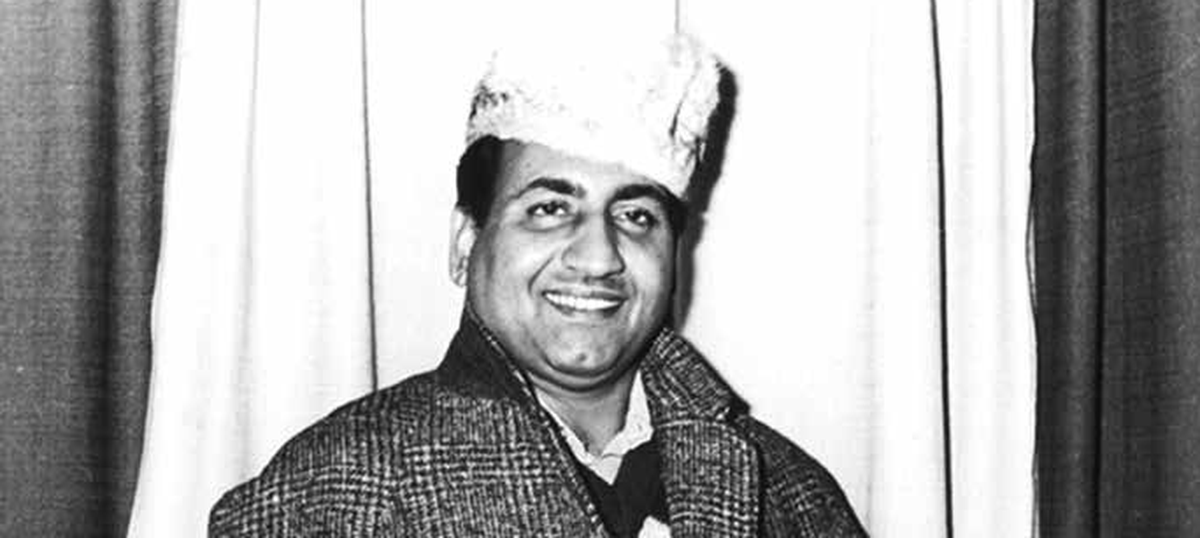
The legendary singer extended his vocal range to foreign languages whenever he got the opportunity.
Mohammed Rafi | Sujata Dev
Mohammed Rafi’s first break as a singer came in 1942, when he sang the duet Goriye ni Heeriye ni with Zeenat Begum for composer Shyam Sunder in the Punjabi film Gul Baloch (1944). Since then, he sang an estimated 4,500-5,000 songs in 14 Indian languages and four foreign languages until his death on July 31, 1980.
Not a bad feat at all for a singer who struggled with even English. In the biography Mohammed Rafi: Golden Voice of the Silver Screen, Sujata Dev writes about how the unlettered singer would politely turn down requests for autographs as his fame grew. “He began practising his signature diligently and when Ammi (mother) enquired why he was wasting reams of paper, he told her that he did not want to deprive his fans and so was learning to sign his name in English,” Rafi’s son, Shahid, told Dev. “Soon he began signing autographs in English and enjoyed doing so. It came as a great compliment for all his efforts when a journalist mentioned that he had the best signature in the industry.”
Rafi was born on December 24, 1924, in Kotla, a village near Amritsar. Singing in English became one of his greatest triumphs, especially since the language was a stumbling block throughout his life. When music composers Shankar-Jaikishen approached him to sing English numbers for a non-film music album in 1968, the singer was hesitant. Maverick actor-writer Harindranath Chattopadhyay , an ardent fan of the singer, wrote the lyrics. He convinced Rafi to take up the assignment, helping the singer perfect his diction for the recording. The two songs were Although we hail from different lands, based on the same composition as Baharon phool barsao (Suraj, 1966), and The she I love, based on the composition Hum kaale hain toh kya hua (Gumnaam, 1965).
Rafi’s English songs pale in comparison to the command he had over Hindi songs but never one to back down, he made a valiant effort to overcome his fears and grasp his limitations as a singer. It also gave him the courage to test his vocals in other foreign languages such as Dutch, Creole and Persian.
In this clip, Rafi sings in Creole, the local language of Mauritius, when he toured the country in the 1960s. He sings Mo le coeur toujours soif zot l’amour camarade (My heart will always be thirsty for your love, my friends), based on the tune of Ehsaan mere dil pe tumhara hai doston(Gaban, 1966).
‘Mo le coeur toujours soif zot l’amour camarade’.
This video clip shows Rafi performing at a concert in Dutch. He sings Ik zal jou nooit vergeten al zal ik in India zijn (I will never forget you, although I will be in India). The music is by Shankar-Jaikishen from the composition Baharon phool barsao, which remains immensely popular among Rafi fans.
https://www.youtube.com/watch?v=vz2piQTmraY
‘Ik zal jou nooit vergeten al zal ik in India zijn’.
For the Persian track Aye Taaza Gul (O fresh flower), Rafi collaborated with Afghani singer Zheela.
‘Aye Taaza Gul’.
In Mohammed Rafi: Golden Voice of the Silver Screen, Sujata Dev writes, “Kersi Lord, the multi-faceted musician had a long association with Rafi. He also happened to be the singer’s next door neighbour. ‘I remember once an Iranian couple had come to India and they wanted Rafi Sahab to sing an Iranian song. He called me home to play the synthesizer as he sang the song, with a fluency that made it seem as if it was his own mother tongue. The couple was left spellbound.”
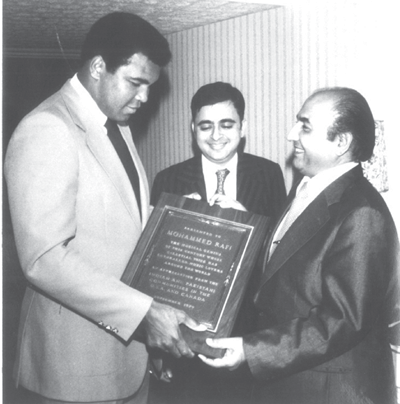
Boxer Muhammad Ali felicitates Rafi in Chicago during one of his tours. Courtesy Sujata Dev’s ‘Mohammed Rafi’.
source: http://www.scroll.in / The Scroll / Home> The Reel> Tribute / by Manish Gaekwad / July 31st, 2016
The series will capture the dark side of the story of the Mughal empire and had emperors like Akbar, Jehangir, Shah Jahan and Aurangzeb.
Mumbai :
“Taj – A Monument of Blood”, a period drama series on the rise and fall of the the Mughal empire, is set to be produced by Applause Entertainment in partnership with Contiloe Pictures, who are confident of presenting a story with a mix of blood, betrayal, power, beauty, deceit and heartbreak.
The series will capture the dark side of the story of the Mughal empire, which ruled India for just over 3 centuries and had emperors like Akbar, Jehangir, Shah Jahan and Aurangzeb. Writing is currently underway.
The tale will be told over 5 seasons of twelve episodes each, using the birth and death of Shah Jahan as bookends. It will delve deep into the Mongol origins, bloodlines mixing with Persian and Rajput royalty, the court and palace intrigues, the repeated purging of aspirants to the throne, and the arrival of the British and Portuguese.
Sameer Nair of Applause Entertainment calls himself a big fan of revisionist narratives of history.
“Our history books have been written by victors and often paint very two-dimensional pictures about past empires. When Abhimanyu Singh (Contiloe Pictures) and I first discussed this idea, we immediately moved away from a typical historical to a darker and edgier version of the Mughal empire, a version in which symbolically the Taj is more a monument of blood, than a monument of love,” Mr Nair said in a statement.
Mr Singh, who has produced a slew of historicals for the small screen, says the new series will show viewers the historic journey through a fresh lens.
“It will take viewers on a historic journey showing them an unseen perspective of this illustrious dynasty which lead to their rise as the greatest empire in medieval times and the quest for power, within it, that finally lead to its downfall.”
source: http://www.ndtv.com / NDTV / Home> All India / by Indo-Asian News Service / July 12th, 2018
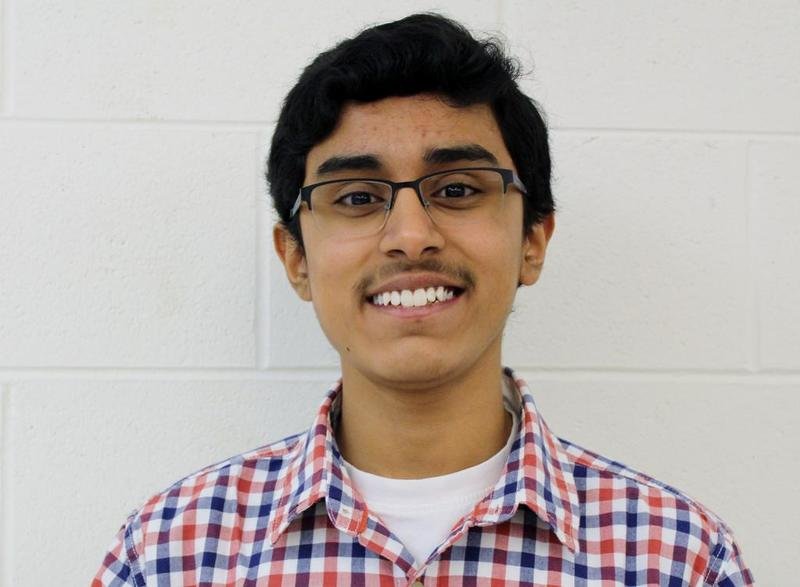
A Plainfield South High School sophomore is traveling to a national science competition, after he created and programmed a self-driving car.
Amaan Khan, 15, will compete this week in the National Junior Science and Humanities Symposium in Maryland, after winning the Illinois Junior Science and Humanities Symposium (JSHS) in March, according to a news release from Plainfield District 202.
Khan created and programmed a self-driving car that can drive within designated lanes, stop and go at lights and avoid obstacles.
He won a $2,000 college scholarship and free trip to the national competition. He is one of two students from Illinois heading to Maryland to compete Tuesday through Saturday with 93 students from across the nation.
Competitors must submit a research paper and present their projects before a panel of judges and an audience of their peers.
Khan became interested in robotics and artificial intelligence last year, after he built a voice-controlled toy car. He took online college courses and watched college lecture courses and YouTube videos to teach himself computer programming.
“As I was learning I kept building the project,” Khan said. “I’d learn one thing, implement it, learn another thing and implement that.”
Patrick and Samantha Scanlan, PSHS science teachers, have supported Khan along the journey.
Samantha Scanlan helped Khan register for the contest. Patrick Scanlan helped Khan polish his oral presentation.
“[Khan] knows what he wants and seeks out the resources to do it,” Patrick Scanlan said. “And if there’s something he needs to learn, he’s able to figure out what he needs to be successful.”
The JSHS is designed to challenge and engage students in science, technology, engineering or math.