Mumtaz Khan of India Women’s team in action against Wales during Junior Hockey WC (Image: HI)
Lucknow (Uttar Pradesh) April 4 (ANI):
India stunned Germany in the Junior World Cup Hockey pool match after doughty Mumtaz Khan’s powerful drag-flick sent the ball crashing into the nets to send the girls in blue in frenzied celebrations while joys of her mother, Qaiser Jahan, who sells vegetables in Lucknow, knew no bounds.
Mumtaz Khan, 19, is now India’s new hockey sensation, taking her team to the top league while her dribble and powerplay with her stick awing the opponents.
Lucknow, the city of Nawabs and also hockey-lovers, is showering love and appreciation on Mumtaz’s family, which ekes out a livelihood as vegetable vendor.
With the hockey stick, Mumtaz Khan is not only shattering India’s powerful opponents, but also the age-old patriarchal taboos. Her mother is jubilant that Mumtaz Khan, one of her six daughters, has given a resounding slap to all those who taunted her in the past for having only daughters.
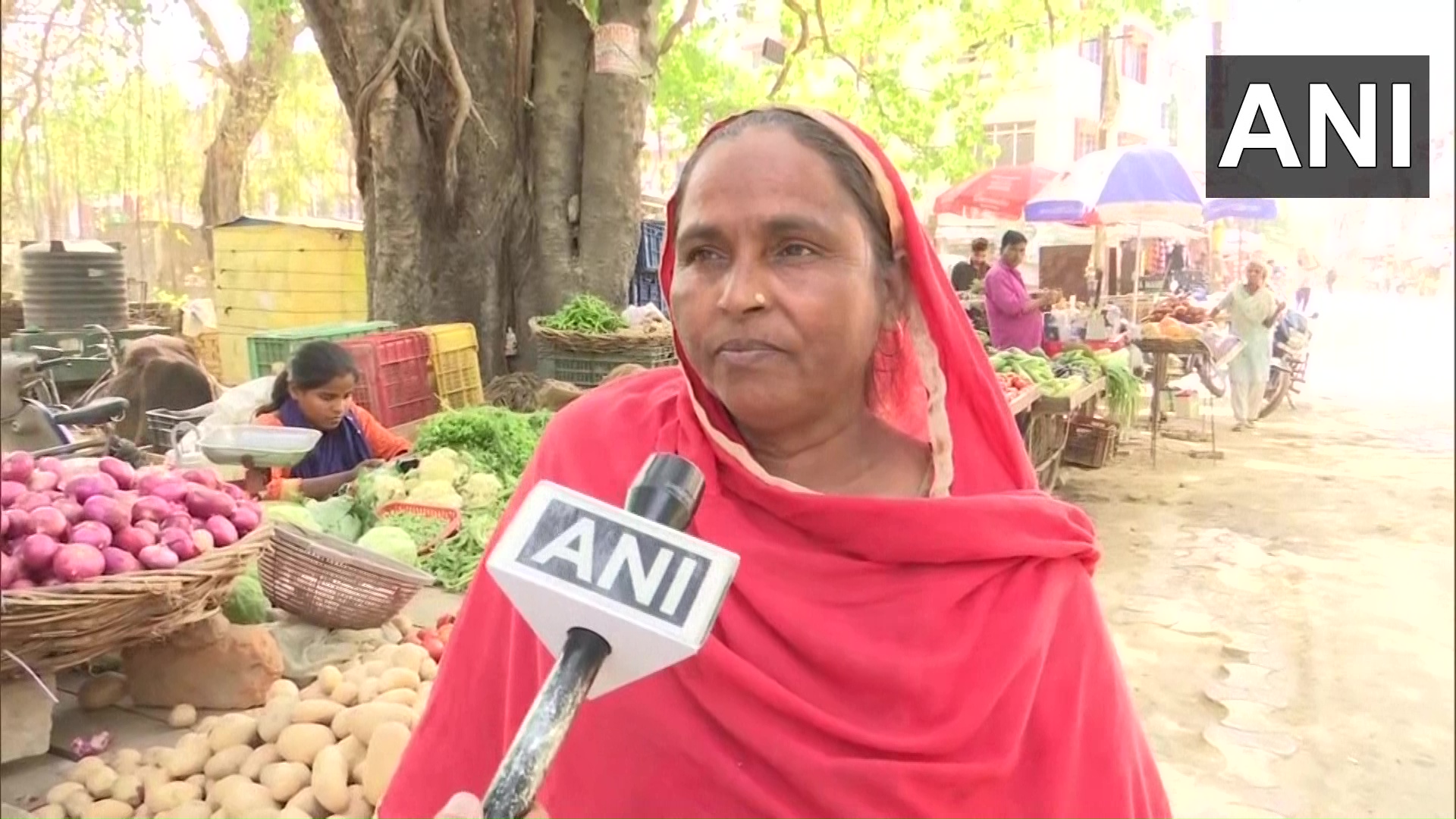
“People often made remarks that I only have daughters. Mumtaz has made us proud, and broke the social stigmas,” said Qaiser Jahan, while speaking to ANI at her vegetable shop in Lucknow.
My daughter is equal to 100 sons, said Qaiser Jahan.
While Qaiser Jahan managers to earn Rs 300 daily, she went beyond her means to support Mumtaz Khan pursue her dreams to wear the blue jersey and represent India on astroturf.
The financial strain proved insufficient for Mumtaz Khan to fly with the girls in blue to South Africa to play for the country.
Mumtaz Khan along with other under-19 Indian girls in blue is taking the team to newer heights, with a quarter-final berth sealed. Besides beating the formidable Germany by converting the penalty shoot, Mumtaz Khan had also taken India to an unassailable lead with a 3-1 scoreline with a brilliant field goal in the 41st minute against Wales in the FIH Women’s Junior World Cup at Potchefstroom in South Africa. India finally won the match 5-1.
Her father Hafiz Khan, a vegetable vendor, has all been supportive of Mumtaz Khan’s passion for hockey.
Mumtaz Khan’s journey as a hockey player began when she went to Agra to participate in a race and was spotted by Neelam Siddiqui who trained her at KD Singh Babu Stadium’s Sports Hostel.
“I feel very proud that my daughter is playing for the country. We are getting a lot of respect because of her,” said Mumtaz’s mother.
“I feel proud that my sister is an international hockey player. Despite poverty, our parents have raised us to make us capable to do something for ourselves,” said Farha Khan, Mumtaz’s sister. (ANI)
This report is auto-generated from ANI news service. ThePrint holds no responsibility for its content.
source: http://www.theprint.in / The Print / Home> India / by ANI / April 04th, 2022
Sufiya Khan began her run from the national capital on December 16, 2020
Sufiya Khan travelled the golden quadrilateral by foot.
Sufiya Khan has set a Guinness World Record for the shortest time taken to travel the ‘golden quadrilateral’ – a network of national highways connecting Delhi, Mumbai, Kolkata and Chennai – by foot. The ultra runner from Delhi completed a journey of 6,002 km in just 110 days, 23 hours and 24 minutes.
Sufiya began her run from the national capital on December 16, 2020. By April 6, 2021, she has completed the golden quadrilateral circuit. A gruelling journey, to be sure, but the 35-year-old athlete was determined to see it through.
“No, I did not think of giving up in the entire attempt,” she was quoted as saying by Guinness World Records. “Though there were very many injuries that happened during the run my full focus was on completing this attempt in minimum time.”
Sufiya was supported on her run by her husband, who drove the support car, took care of her nutrition and physiotherapy and managed her schedule. Besides this, local runners and cyclists joined her at various stretches of her journey.
“Almost all the cities where I was running through, runners and cyclists were joining and supporting us,” Sufiya said. “Most of the time in cities and small-town people were hosting me at their home for a night stay and dinner. Many times during the attempt we took hotels and couple of nights we had to sleep on roadside shelters.”
On Saturday, she was certified as the “fastest female to run along The Indian Golden Quadrilatrel Road.”
_____
Facebook.com / SufiyaSufiRunner
Sunday 27 March 2022 at 06:11
New Guinness World Records and It’s Officially Amazing!! Fastest female to run along The Indian Golden Quadrilatrel Road (6002km in 110 days 23 hours)
Glad to share it with you all who was a part of this amazing world record expedition. I am very grateful to all you amazing people who ran along for few miles to few hundreds miles, who warmly welcomed me in their city, who arranged homefood for me, who encouraged me to run when i was down, who celebrated my every success as t…See more
Sufiya describes ultra-distance running as her passion. Ultra running is any footrace longer than the traditional marathon distance of 42.195 kilometres.
“Ultra-distance running is my passion and I have left my aviation job for it so I always have time for such a journey. I train myself for long runs. This was my third expedition of long-distance running in-country,” she said.
She already holds a Guinness World Record for the fastest woman to run from Kashmir to Kanyakumari.
source: http://www.ndtv.com / NDTV / Home> OffBeat / by Sanya Jain / March 30th, 2022 (headline edited)
The women’s writings and paintings collected here pose fundamental questions about the relation between art and marginality
When tongues run dry but hearts remain fearless — can there be a plight direr than this tearing apart of body and mind? The drought on the tongue is the silence of fear, hiding a heart that rails against terror, pledging to shatter the quiet. Reema Ahmad and Semeen Ali have come up with a dream title for their edited collection of poetry, prose and painting by women, many of them newer voices, some unheard before, published by a daring and often-experimental publisher of poetry, Red River.
This jagged collection poses fundamental questions about the relation between art, passion, marginality, and the vagaries of everyday life. With close to 150 contributions combining verse, narrative, reflections and images, the heart of this book is filled with courage, and tongues remain dry no more — they spill rivulets of passion, anger, love, protest, and triumphant celebrations of the quotidian.
Hope is a lie
The sheer range reimagines the relation between creativity and passionate selfhood through a spectrum where the accomplishments of craft are uneven. But the honesty never is, and since in the end, honesty occupies the true heart of artistic craft, it also invites us to broaden our understanding of technical finesse beyond the usual and the expected.
Early in the collection, Debolina Dey confesses that “These poets have taught me/ to be a ruthless hunter of metaphors/ as if your body/ could be something else.” The body returns in its quotidian oppression in Sukla Singha’s story, ‘That ‘90’s Show: Blood, Shit and Other Things’, chronicling the daily humiliation, of body and labour, of a mother, experienced and narrated by a young daughter, but ending with the strange billowing of the heart: “A storm of jet-black hair in the air. A Meitei woman’s boisterous laughter. Nobody had the guts to ruin that magic.”
The vernacular is not only the name of reality here, but also of synergy between languages. Namita Bhatia’s Hindi poem, ‘Cactus’, opening with the eloquent grunt, “Mai cactus hun — cactus”, ends, in Reema Ahmad’s translation, with the “chaste hope” “That if my skin be peeled off/ I may bleed only milk”. But in her engrossing short story, ‘An Obscure Life’, Ketaki Datta reminds us that often hope is a lie — that her friend Swapna who claimed to a hotel singer had died without ever becoming one, after a life of prostitution known only to her mother.
In this dry-tongued world, poetry, as Sneha Roy knows, is a forever transgression: “Like a pillar of ‘shameless poetry’ standing tall/ in Plato’s failed and banished world.” Poetry lies in the humble and the mundane, not in flamboyance, as in Aratrika Das’s dream that her son grows up to cook in a kitchen of daily, soiled labour, not in the TV kitchen with glamorous aprons and hi-tech gadgets.
Haunted by sensation
Bodies are real and unruly in this collection. In her poem, ‘On Carving a Watermelon’, Yashasvi Vachhani voices a woman whose lover tells her: “you have a pretty face, if only you lost some of it/ some of the meat that calls your bones home”. As that “piece of art inedible”, she watches as “you hand me a knife/ and say begin”. Zehra Naqvi, in a poem of visual experimentation, reclaims the female body away from male desire and maternal nourishment: “Because our breasts belong to us. Not to the men who desire us. Not to the children who feed on us.” Dipali Taneja writes about the ageing body haunted by memories of sensation: “You hear that your uterus is senile!/ It may well be, but your skin is not.”
The lines face Teena Gill’s painting, Dancing Woman, and the meditative trance on her face strangely intensifies the bodily sensation in Taneja’s poem. Ikilily of Pink Lips, in Neha Chaturvedi’s ominous fairy tale of that name, nurses a curse — she can have sex, but if “so much as a thought of love entered her mind about the man or the woman she was with, the person would die.”
The myth contrasts sharply with the sculpted realism of Shamayita Sen’s poem, ‘Consent’, which states: “The birdcage in your chest/ will have to ask for consent/ for mine to respond.” Till the very end, the ineluctable violence of desire shapes the paradox of Khushk Zubaan, Bebaak Jigar.
Of Dry Tongues and Brave Hearts; Edited by Reema Ahmad & Semeen Ali, Red River,₹599
The reviewer’s most recent book is The Middle Finger, a campus novel about poetry, performance, and mentorship.
source: http://www.thehindu.com / The Hindu / Home> Books> Mixed Collection / by Saikar Majumdar / April 02nd, 2022
Jushna Shahin’s passion for the sport made her achieve the unthinkable.
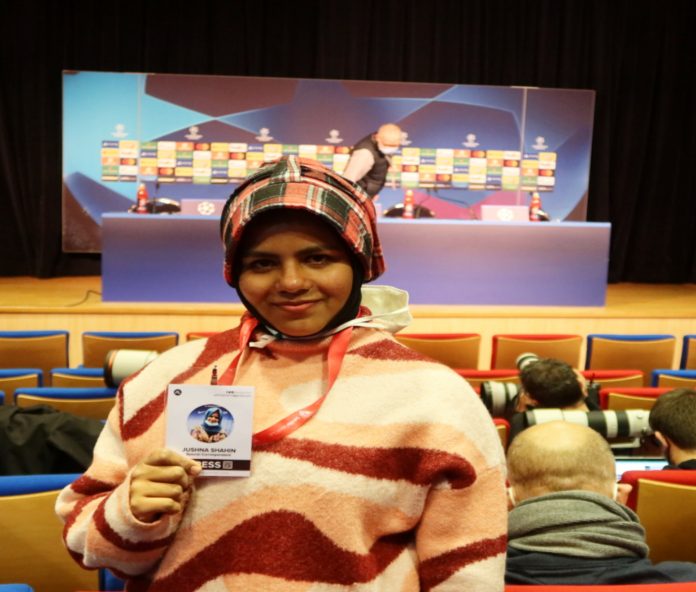
Jushna at the conference room Spain. | Picture by arrangement
Kerala :
Jushna Shahin’s earliest memories are of watching football matches on TV with her family in Kerala’s Mangattuparamb village.
As a die-hard Lionel Messi fan, Shahin got her chance to do her bit for the game in 2009 when she was selected as one among the 70 students in JNU for the language assistant program in Spain by the Ministry of Education, Spain. “In our village, girls rarely went outside of their homes, other than going to school etc,” Shahin, a teaching assistant and football reporter in Spain, told TwoCircles.net. “Girls going out to play was out of the question, and that put an end to my dream of playing the sport.”
The Kendriya Vidyalaya high school where she studied encouraged sports, but Shahin was not comfortable with the usual sports uniform of shorts and t-shirt.
This did not keep the girl away from football. “I spent my time learning about the sport, and its laws and rules,” she said.
Love for Spanish and Messi Shahin said she wanted to study Spanish when she was in 10th grade so that she could talk to Messi.“I don’t know if it will materialize or not but I will make efforts,” she said.
In 2019 when she got her first salary working in Spain, Shain bought tickets for the UEFA Champions League in Barcelona to see her sports hero play live. “It was unreal and amazing,” she said.
The following day, she went over to the Barcelona club’s office and handed over a hand- letter meant for Messi, hoping that he would reply one day.
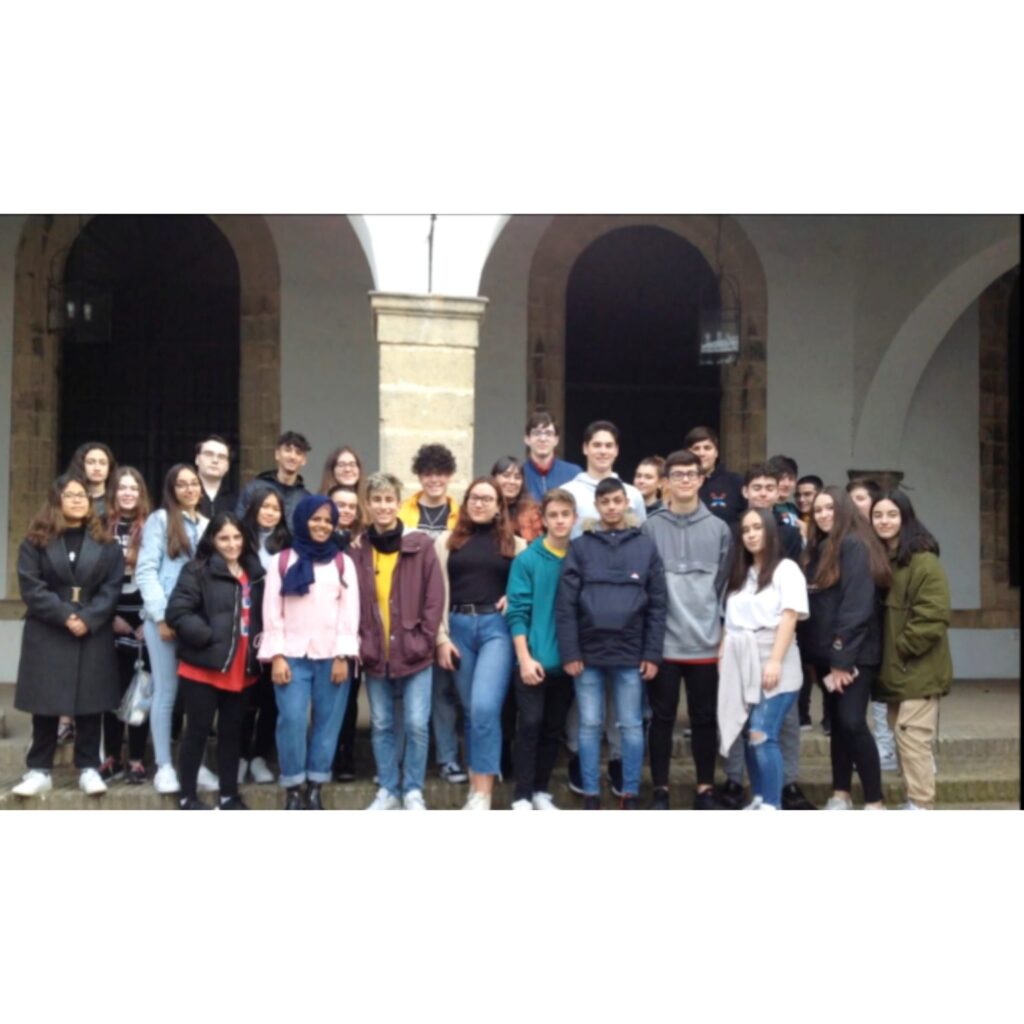
Jushna Shahin on a visit to a Vine Cathedral with her students at the IES Santa Isabel de Hungria, Spain. | Picture by arrangement
Last year when Messi moved to the Paris Saint Germain (PSJ) football club in France, Shahin flew to Paris and witnessed the team getting trained. “My heart-throbbing moment was when I watched Messi getting trained,” she said.
While in 11th grade, Shahin attended a camp organized by students of central universities to help those interested to pursue studies outside Kerala. Contacts she made from the camp helped her for the entrance exams. “Even after I cleared the exams, my parents were not convinced about pursuing Spanish as a graduation course. However, they gave in to my wishes,” she said.
In September 2019, Shahin traveled to Spain on her first international trip.
After landing in Spain she found that the Spanish she had learned from textbooks was not the same as spoken by people in Spain. “It was a challenge. Also, the other Indian student’s who had been selected were all placed in different cities of Spain. To travel to a new country was exciting but I felt tense and insecure initially,” she said.
Love for sports writing In 2014, when Shahin was at JNU, she started writing journalistic pieces for the Companion magazine. She would write short reports about the matches she watched. Her interest in sports writing led her to report for The Footy Times , which is an online magazine devoted to publishing football journalism. She started reporting for the magazine during the 2018 FIFA World Cup and has been writing for it since. She has also reported for Malayalam news channel MediaOne and online news website MaktoobMedia.
Shahin recalled two events as the most exciting during her work as a football reporter. In 2021 when the stadiums were closed to the public amid a global pandemic, she was one of the few media persons with accreditation pass reporting the semi-finals of the Copa del Rey in Spain. “I was seven months pregnant at the time,” she said
In February 2022, she got accreditation from the Paris Saint-Germain (PSG) Football Club to report the UEFA Champions League round 16 in Paris. She also attended a press conference at the home stadium of PSG club where hers was one among the ten questions asked to Karim Benzema (Real Madrid captain). “Now that stadiums are open for the public, I don’t think I will get the chance to go in with the media persons alone to watch a match in a closed stadium. That makes my reporting during the last year very special,” Shahin said.
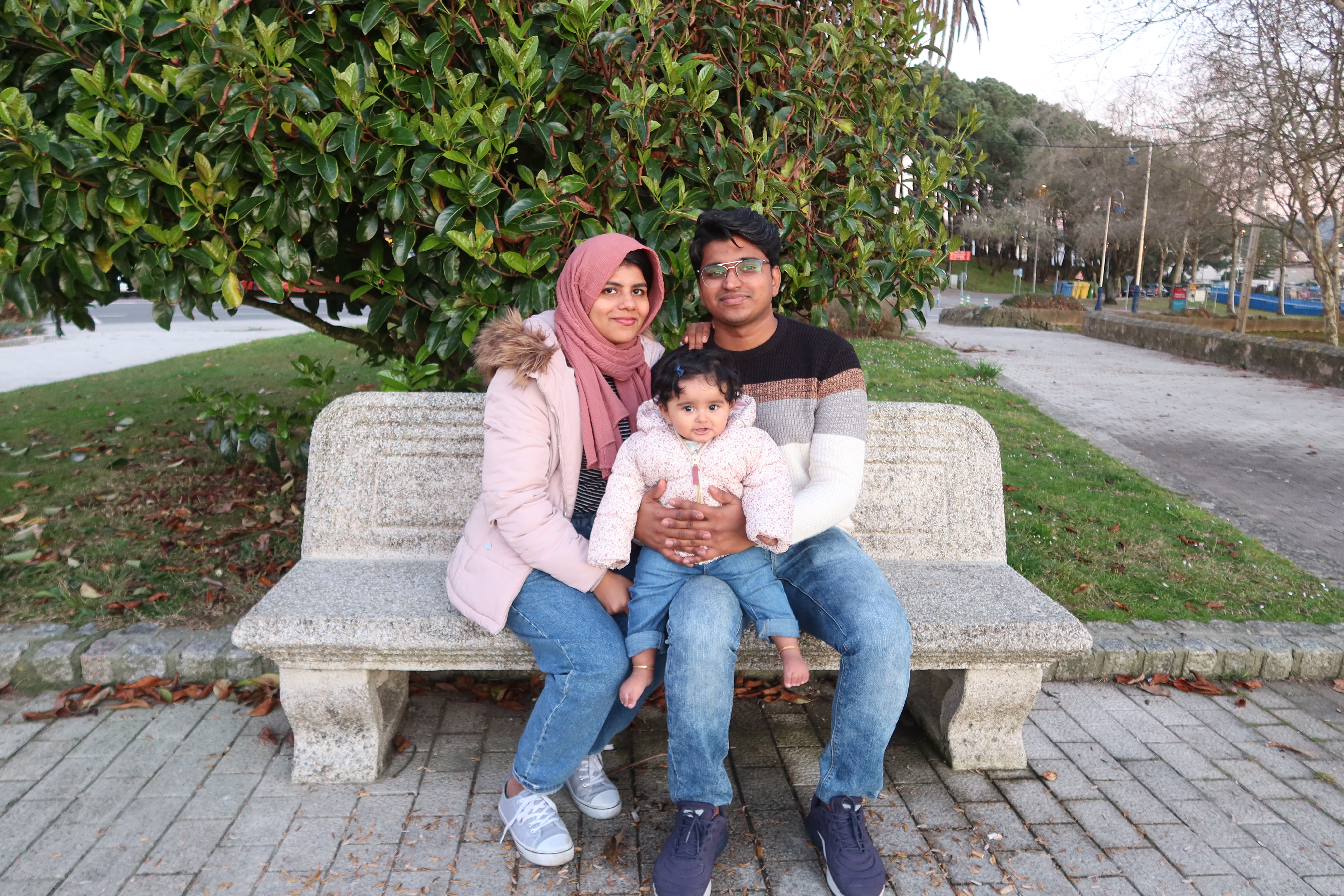
Jushna with her husband Awad and daughter Eva. | Picture by arrangement
Having been called crazy for her dreams and passion, Shahin shrugs it off and said, “What’s important and special for you might be very silly for the other person. It’s better not to see and look at your dreams in other people’s frameworks. Create your own dream and respect it, and be confident. Instead of just dreaming it, try to work on it. The only thing that matters is whether you are happy with it or not,” she added.
Shahin’s parents had seen her love for football only as a childhood interest and never knew she would pursue a career related to the game.
“More than her craze for football through Messi, I am happy that she is in the field of football journalism,” said her father CKA Jabbar, veteran journalist and associate editor of Malayalam news portal kvartha.com. “Love for football and writing have been in her since childhood, and she worked hard to follow her dream,” said her mother, Nazila CH, working in the Animal Husbandry Department under the Government of Kerala in Thiruvananthapuram.
Shahin now lives with her husband, Awad Ahmad, and eight 8-months-old daughter in the city of Vigo in north-western Spain.
Najiya O is a freelance journalist based in Calicut, Kerala. She tweets at @najiyao
source: http://www.twocircles.net / TwoCircles.net / Home> Lead Story / by Najiya O, TwoCircles.net / March 26th, 2022
In an impressive academic performance once again Muslims have emerged as “NEET State Topper” in 5 states for the year 2021.
NEET 2021 Toppers:
In an impressive academic performance once again Muslims have emerged as “NEET State Topper” in 5 states, including one abroad and overseas.
According to NEET 2021 Toppers’ List released Tuesday . Mohammad Zeya Belal, Zarina Batool, Farzina Yasmin Laskar, Shafeek Ahamed AM and Arsalan Mosaddiq are National Eligibility cum Entrance Test State Toppers (NEET UG 2021 Topper)in 5 states.
According to the NEET 2021 State Toppers List of 38 States and Union Territories, Zeya Belal, who also figured in the list of NEET 2021 Top 20, secured the first rank in Bihar. Zeya Belal has bagged 715 out of the total 720 marks in NEET 2021.
Other NEET Toppers 2021 who are Muslims include Zarina Batool who secured 596 marks and topped Ladakh, Farzina Yasmin Laskar who bagged 573 marks and topped Mizoram, whereas Shafeek Ahamed AM got a total of 489 and secured the first position in Lakshadweep,
The 5th Muslim topper is Arsalan Mosaddiq. Arsalan bagged 690 marks and topped NEET overseas centres.
The NTA did not disclose at which centre Arsalan appeared for NEET 2021. It was however announced that besides various exam centres in India, NEET was also held this year in Dubai and Kuwait .
In 2020, a total of 06 Muslim students had found their place in the list of NEET toppers. Among them was Shoyeb Aftab from Assam who had secured AIR 1 in 2020. Aftab is currently studying at AIIMS, New Delhi.
The NEET exams were conducted on September 12 at over 3,800 centres across 202 cities in India.
Around 16 lakh students from all over the country and abroad had applied to appear for the exam.
The NTA declared the NEET result Monday evening. In a first, the NTA sent the NEET score to the candidates on their registered e-mail addresses before publishing it on the official website.
Three students – Mrinal Kutteri from Hyderabad in Telangana, Tanmay Gupta from Delhi (NCR) and Karthika G Nair from Maharashtra have bagged 720 out of the total 720 marks in NEET UG 2021 and secured AIR 1, AIR 2 and AIR 3 ranks.
source: http://www.ummid.com / Ummid.com / Home> Education &Career / by ummid.com news network / November 03rd, 2021
Hamied has successfully steered Cipla on an accelerated growth path with a focus on boosting margins, without diluting the core values it stood for.
Synopsis
“I am humbled and honoured to receive the ET’s Businesswoman of the Year Award. This recognition belongs to each and every one of our 25,000 employees who stand with Cipla, putting patients’ interests before their own and upholding our purpose of Caring for Life,” Hamied, executive vice-chairperson, Cipla, told ET.
Samina Hamied represents a rich legacy. Her grandfather, KA Hamied, a freedom fighter and nationalist, founded Cipla in 1935, making it one of India’s oldest pharmaceutical companies. Her uncle Yusuf Hamied is the doyen of Indian pharma known globally for making affordable generic AIDS drugs accessible to millions of patients in Africa and other low- and middle-income countries.
“I am humbled and honoured to receive the ET’s Businesswoman of the Year Award. This recognition belongs to each and every one of our 25,000 employees who stand with Cipla, putting patients’ interests before their own and upholding our purpose of Caring for Life,” Hamied, executive vice-chairperson, Cipla, told ET.
Hamied has successfully steered Cipla on an accelerated growth path with a focus on boosting margins, without diluting the core values it stood for.
Both as executive director from July 2015 and as executive vice-chairperson from September 2016, Hamied has been instrumental in driving the company’s transformation from a traditional low-cost drug manufacturer to one with a young professional management and an aggressive approach towards inorganic expansion. Under her, Cipla also restructured its business and has also initiated cost-optimisation measures.
She spearheaded Cipla’s entry into the US market with strategic acquisitions of two generic companies, InvaGen Pharma and Exelan Pharma, for $550 million in 2015.
From FY15 to FY21, Cipla’s US revenue grew close to five times. US business contributed one-fifth of the total revenue in FY21.
Cipla’s revenue from operations grew at a compounded annual growth rate of 7% in the last 5 years to Rs 19,160 crore in FY21. Ebitda margin and net profit rose 12% CAGR in the last 5 years to 22.5% and Rs 2,405 crore, respectively, in FY21.
During Covid, Cipla launched antivirals, antibody cocktails, testing kits, masks and sanitizers. Cipla’s India business grew 15% year-on-year to Rs 7,736 crore.
Hamied focuses on board and governance issues, furthering Cipla’s global partnerships, shaping its corporate culture and hiring the right talent.
source: http://www.economictimes.indiatimes.com / The Economic Times / Home> English edition> Business News> Industry> Healthcare-Biotech> Healthcare / by ET Bureau / March 28th, 2022
Appointed to the High Court at the remarkably young age of 32, Justice Syed Mahmood displayed during a tenure of just six years that law without conscience was merely a facade for the perpetration of injustice
New Delhi:
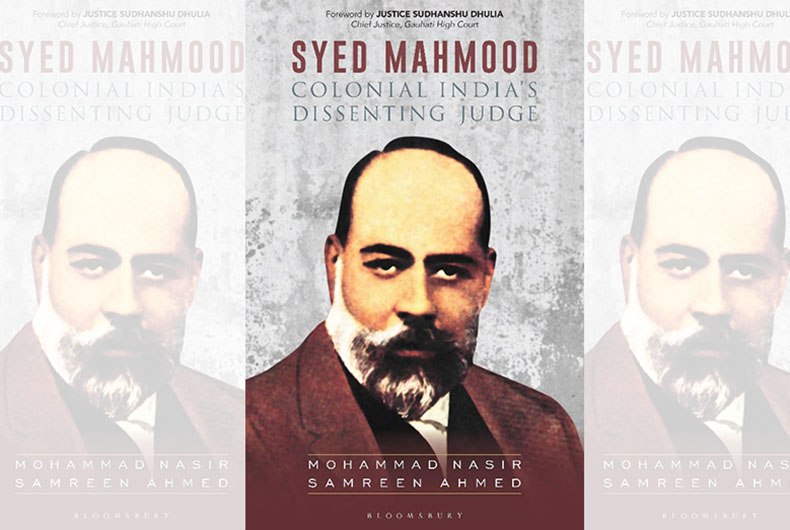
In the late 19th century, Justice Syed Mahmood, son of the great social reformer Sir Syed Ahmad Khan , and the first Indian judge of the Allahabad High Court, became an icon of judicial resistance to British colonialism at the apex of British power across the world.
Appointed to the High Court at the remarkably young age of 32, he displayed during a tenure of just six years that law without conscience was merely a facade for the perpetration of injustice.
A number of his dissenting judgments became a template for reference by future generations, Mohammad Nasir and Samreen Ahmed write in “Syed Mahmood: Colonial India’s Dissenting Judge” (Bloomsbury).
Outside of law, his largely invisible but wide-ranging intellectual corpus engages with questions related to colonial transformation of education and its reconciliation with Muslim identity, national integration and religious tolerance.
His role in the making of Aligarh Muslim University (AMU), presently celebrating its centenary, was notable, but survives only as a footnote in history.
This book chronicles the triumphs and tragedies of Syed Mahmood’s life, and his contribution to shaping the consciousness of modern India. It succeeds in exhuming a seminal figure from the dust of history and demonstrates how the past continues to speak in the present.
Mohammad Nasir is Assistant Professor in the Department of Law, Aligarh Muslim University (AMU). He has written on legal and socio-political issues for Hindustan Times, Indian Express, The Wire and OPEN. He co-edited the Special Centenary Issue of the Aligarh Institute Gazette, a periodical started by AMU founder Sir Syed in 1866.
Samreen Ahmed is a legal researcher and writer based at the Aligarh Muslim University. Her academic writings have been published in the Economic & Political Weekly.
source: http://www.ummid.com / Ummid.com / Home> India / by IANS / March 29th, 2022
Award named after N.R. Madhava Menon, father of modern legal studies in India
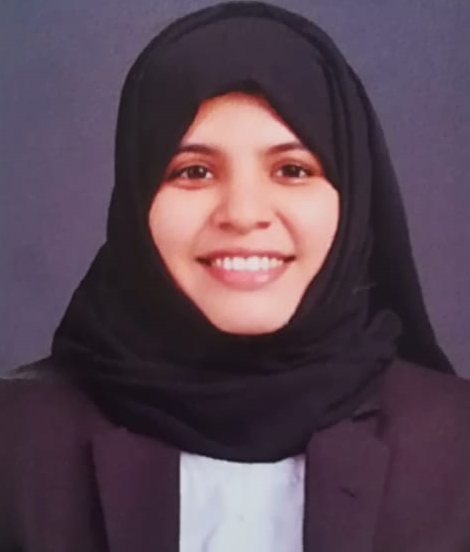
C.K. Sahala Farsana, student of the Nehru Academy of Law, Lakkidi, and first-rank winner of Calicut University in five-year LLB examination, has won this year’s N.R. Madhava Menon Memorial Award for the best law student.
The award has been given by the Victims Information, Sensitisation, Welfare and Assistance Society (VISWAS), an organisation providing succour for the victims of excesses and crimes.
Ms. Farsana was adjudged the best student considering her academic and non-academic performance, especially her leadership in social work. She had won prizes in quiz, debate, and essay competitions held in several parts of the country.
Kalyani Balachandran from Al Ameen Law College, Kulappully, was adjudged the runner-up. M. Shabas from V.R. Krishnan Ezhuthachan Law College, Elavenchery, and Amrit M. Nair from Al Ameen Law College, Kulappully, won consolation prizes.
Former district judge M.R. Balachandran Nair, former diplomat Sreekumar Menon, and Deputy Director of Prosecution K. Sheeba constituted the judging committee.
Principal district judge B. Kalam Pasha gave away the awards instituted in the memory of N.R. Madhava Menon, who was widely considered the father of modern legal studies in India. Menon was a former Vice Chancellor of the National Law Universities and former director of the National Judicial Academy.
VISWAS secretary P. Premnath, vice presidents B. Jayarajan and R. Devikripa, joint secretaries Deepa Jayaprakash and N. Rakhi spoke.
source: http://www.thehindu.com / The Hindu / Home> News> National> Kerala / by Staff Reporter / Palakkad – January 10th, 2022
Suhana Safar, a fifth-year student of BA LLB integrated course at SDM Law College Mangaluru, has secured second rank at the Karnataka State Law University (KSLU) examination.
Suhana is a resident of Ullal Kodi and daughter of Haneef and Ruqiya.
She had appeared for the KSLU final year exams 2021 in Kannada medium and has secured second university rank.
In the history of Odisha, there had never been a Muslim woman helming the top post of any municipality. That changed last week when she won the election to the chairperson post of Bhadrak town.
Thirty-year-old Gulmaki Dalawzi Habib has smashed many social and political conventions. Fighting the polls as an Independent in Bhadrak, the 31-year-old of Puruna Bazaar area made the candidates of three major political parties – the ruling BJD, BJP and Congress – bite the dust.
In the history of Odisha, there had never been a Muslim woman helming the top post of any municipality. That changed last week when she won the election to the chairperson post of Bhadrak town.
Gulmaki won the election by defeating her nearest rival, Samita Mishra of BJD, by a margin of 3,256 votes. While she secured 28,115 votes, Samita bagged 24,859 votes. The BJP candidate came a distant third with 6,787 votes while the Congress nominee could only secure 1,977 votes.
In a communally-sensitive town like Bhadrak, Gulmaki’s poll victory was an outcome which was least expected.
Though there were councilors from minority community in the past, the municipality chairperson post was never helmed by a Muslim. The fact that a Muslim woman could be choice of voters, majority of whom were Hindus, was something which even poll pundits could not predict.
The chairperson-elect said she was both humbled and proud to be the first Muslim woman in the State to be elected to the top municipality post.
“The whole of Bhadrak town is celebration my victory. People were steadfast in their support to me. I dedicate my win to both Hindus and Muslims of the town,” she said.
Of the total 30 Wards in Bhadrak Municipality, 12 are dominated by Muslims while two have a sizable population of the minority community.
There are more than 87,000 voters in Bhadrak town of whom over 34,000 are Muslims.
Contrary to the perception, there was no reservation in the minds of Hindu voters towards a Muslim candidate.
“While campaigning, I was treated like one of their own. In my personal experience, there is no divide between Hindus and Muslims as was being spread by some people during the elections. Irrespective of religion, voters showered their love and blessings on me.”
Though Gulmaki is a political greenhorn, her husband Sheikh Jahid Habib was the former district vice-president of BJD’s youth wing.
In the run-up to the urban local body polls, people of Puruna Bazaar demanded a chairperson candidate from the area which always bore the brunt of civic authorities’ neglect.
However, BJD ignored the demand following which Gulmaki filed nomination as an Independent candidate.
Development of the town is top on the agenda of Gulmaki, who hold a degree in Business Administration.
“Roads and drainage system need to be be drastically improved in the town. Especially in Puruna Bazaar, the living conditions are poor. I plan to work on these issues first after taking office.”
source: http://www.newindianexpress.com / The New Indian Express / Home> States> Odisha / by Anup Nayak, Express News Service / March 28th, 2022