Category Archives: Women/Girls(since May26-2021)

Meet Shariya Manzoor: The boxer girl from Kashmir

Nehama Village (Pulwama) Kashmir, JAMMU & KASHMIR :

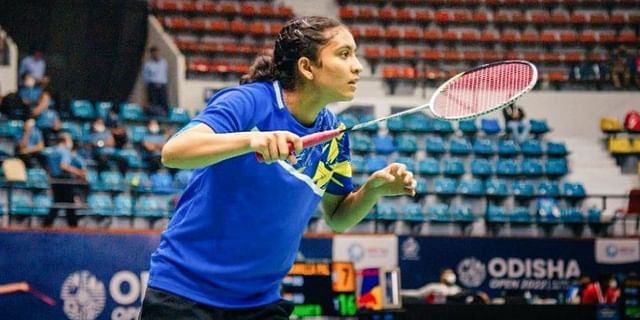
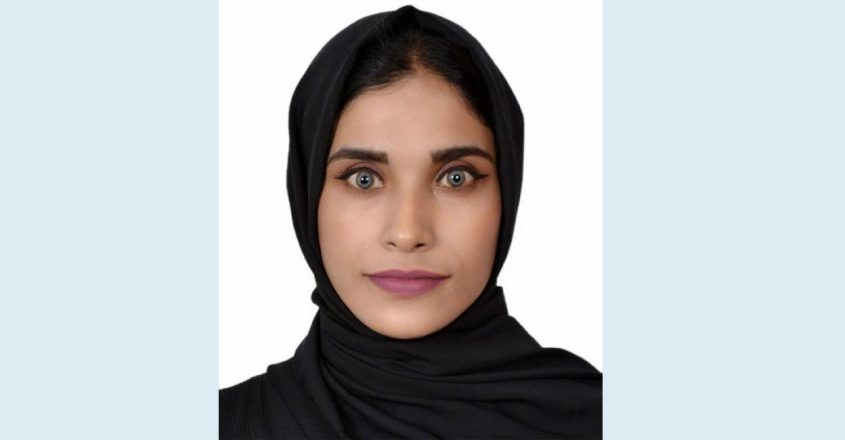
Shariya Manzoor displaying a medal she won during a competition. | Photo by arrangement

Twenty-year-old Shariya Manzoor from a restive region in Kashmir is a boxer whose passion for combat sports has earned her laurels. Her dream is to make it to the Olympics. 

Srinagar :

 A 20-year-old girl from South Kashmir’s Pulwama has brought laurels to her district—which is considered a hotbed of insurgency in Kashmir—by bagging a gold medal in youth games All India National Championship 2021.

Shariya Manzoor, a resident of Nehama village in Pulwama told TwoCircles.net that she and her family are extremely happy with her feat and she dreams of making it to the Olympics.

She is perhaps the first female boxer from South Kashmir and wishes to train many girls from the region.  

Achieving her goal wasn’t a cakewalk for a girl belonging from a restive region. She said she had to shed “blood and sweat” to make it possible. 

“Being a girl from Kashmir, there aren’t many platforms to explore sports and achieve success in it. During my journey, I realized why it is difficult for females to take part in sports, especially combat sports,” she said. 

Manzoor is pursuing her Bachelor’s degree from Government Degree College Pulwama. She, however, hopes to becoming a boxing champion.

Her father Manzoor Ahmad is a farmer and pools money from his pocket to support her daughter. 

“She has played in different parts of the country and every time, I had to arrange money to send her. The government doesn’t help her financially,” Ahmad said. 

A father of four daughters, Ahmad says it is very difficult for him to let her daughter follow her passion. 

“We live in a conservative society. Every day I had to hear from my friends and neighbours asking me not to send my daughter to play this sports,” Ahmad said.

But Ahmad doesn’t pay heed to their comments and says he wants her daughter to follow her passion.

Apart from fewer opportunities in sports for women in the region, Shriya said that she had to fight hard against “patriarchy” and “break the taboo.”

“A girl is seen in a different way when she chooses sports as her career. People stare at her when she is practising. I believe if a girl has to move forward in her career, she has to avoid and stay clear of these things,” she told TwoCircles.net.

She said that whatever she has achieved was not possible for her without the support of her family. “If your family is with you and supports you, nothing can stop you from achieving your ambition,” she said.

Boxing was her childhood passion
Manzoor has been passionate about boxing since her childhood. However, in absence of infrastructure and coaches, she had to face tough challenges in pursuing her passion. 

“When I chose boxing, there was no one to guide me. I used to practise at my home alone but I always wanted to be trained professionally,” she said.

Manzoor has won six medals at the national level, which include a medal she won at the Federation Cup and another one from the Youth All India National Championship 2021.

She doesn’t have anyone to guide her in this sport at present and takes training from a coach who is not from boxing background. 

“He is a Mixed Martial Art (MMA) coach but I take some tips from him,” Manzoor said. 

She travels over 13 kilometres every day for coaching and practices for over three hours. 

“I have to spend over Rs 4000 every month as travel expenses and my father gives me this money,” she added.   

She says she doesn’t have any idol but wants to become an idol for other girls in the region who want to pursue a career in sports. 

Manzoor said she faced hurdles and challenges all along her journey. “But I had faith in myself and Allah,” she remarks. 

Manzoor has won six medals at the national level, which include a medal she won at the Federation Cup and another one from the Youth All India National Championship 2021.

She has also won medals in the national Thang Soo Doo championship. “I have also won a silver medal at the state Taekwondo championships and participated in the belt wrestling championship,” she said. 

On 13 September 2021, Manzoor was facilitated with the “Kashmir Young Leadership Award” by Lieutenant Governor Manoj Sinha during the Kashmir Leadership Summit here at SKICC Srinagar.

As many as 46 young achievers from various fields including health, education, sports, adventure sports, social work, journalism, environment conservation, Art, Music, Women empowerment, etc were awarded on the occasion.

Auqib Javeed is a journalist based in Kashmir. He tweets at @Auqib Javeed. 

source: http://www.twocircles.net / TwoCircles.net / Home> Lead Story / by Auqib Javeed , TwoCircles.net / January 26th, 2022

Trip with an all-woman team helps Koyilandy native to discover her innate self

Koyilandy, KERALA :

The team had 15-members, all women, of whom Shahana had acquaintance with only a single member, Suhaila T, the trip coordinator

Shahana Nizar with children at Pandhi Ka Par village in Rajasthan

Kozhikode :

The story of 32-year-old Shahana Nizar has a slight similarity to Mudrita, the noted Malayalam novel of 2021 penned by Jisa Jose. Mudrita unfolds through the train trip of nine women who were strangers to each other but got together through an online group. Shahana’s maiden 10-day trip, without the company of her family, to Rajasthan by train concluded on December 30. 

The team had 15-members, all women, of whom Shahana had acquaintance with only a single member, Suhaila T, the trip coordinator. 

Hailing from a conservative Muslim family of Koyilandy and mother of 10-year old and four-year-old boys, she had many odds against taking such a trip. But finally, she pulled it off. “Till the moment I boarded the train from Kozhikode railway station, I was not sure I would make it. There were so many obstacles. But my passion for travelling self-liberating me besides, the solid support from my spouse made it happen,” beams Shahana. 

The group had 16-year old Haniya Haris to 39-year old Kadeeja, who were from Kozhikode and Kannur districts. Resorting to a budget tour, the women used public transport service and stayed mostly in youth hostels and residences of acquaintances in Rajasthan.

“It was difficult for me to travel in train for so many days. I was a person who loathed using public toilets. But during the trip, I had to even spend my period days on the train. Surprisingly, I myself adjusted to all of these due to the sheer pleasure travelling gave me. After reaching home and looking back, I found I had discovered myself, the liberal soul in me who wants to fly farther, recharge and come back,” says Shahana, an English Literature graduate. 

“Don’t want to be like mother’

Shahana reminisces that throughout her life, she saw her mother tied up in domestic chores and taking care of kids and her husband at home. “Watching her life, I had taken a strong decision then that I will not be like her. That spark was within me which poured out in the form of musings and scattered lines on Facebook. But there was not an attempt till now. But for my marriage, I think I cannot make a free trip without the ‘care’ of family or relatives. Now, I am brimming with confidence and ready to backpack any moment,” she says. 

While Shahana was on tour, her four-year old son was hospitalized for a day but she came to know it after reaching home only as her husband Nizar Mullasserry managed it. 

The women team’s travel was not all smooth. They had to run with heavy bags through railway platforms in Ajmer in odd hours and many such hardships. The team roamed around Mount Abu, Jodhpur, Ajmer, Udaipur, Barmer and had spent wonderful days at remote Rajasthani villages like Pandhi Ka Par and Viradka Par. 

source: http://www.newindianexpress.com / The New Indian Express / Home> States> Kerala / by Amiya Meethal / Express News Service / January 24th, 2022

Udupi’s 6-YO girl wins hearts of crown princes of Oman, Bahrain by her martial arts performance

Belapu (Udupi), KARNATAKA / OMAN :

Oman: 

Zaara Vasim Asadi, a young girl hailing from Belapu of Udupi in Karnataka, was recently appreciated by Crown Prince of Oman and Bahrain for her performance during the martial arts sport event representing Champ Sports and Arts Club here in Oman.

She was also awarded the “Star of the Event” award during the event and was appreciated by the crown princes and audiences alike. The crown princes also honored her by clicking photographs with her along with her appreciation medal.

Zaara Vasim Assadi is reportedly the youngest kid practicing Capoeira (Brazilian Martial Art) and is also the youngest to hold the belt that she holds currently.

Hailing from Belapu in Udupi, Zaara is the daughter of Mohammad Vasim Assadi and Hasra Sana Banu. She is the granddaughter of Mohammad Zikiriya Asaadi and is practicing martial arts from the age of 4. Apart from Capoeira Zaara is also keenly interested in Karate, Kickboxing and Gymnastics.

source: http://www.english.varthabharati.in / VarthaBharati.in / Home> Karavali / January 18th, 2022

Telegu short-story writer, Muslim physiotherapist win awards at Women Summit 2021

Kochi, KERALA :

Women Summit is the annual get together of the members and well-wishers of Women’s Manifesto, a national level NGO formed in 2014. It gives Women Manifesto Award to eminent women from different fields, who have contributed significantly to society and achieved great heights in their professions. 

New Delhi :

Manasa Yendluri, a young Telugu short-story writer and Shani S. Hameed, a physiotherapist and Founder, Director and Rehabilitation Child Specialist of Alfa Paediatric Rehabilitation Centre, received awards from Women’s Manifesto New Delhi at the Women Summit 2021. 

Women Summit is the annual get together of the members and well-wishers of Women’s Manifesto, a national level NGO formed in 2014. It gives Women Manifesto Award to eminent women from different fields, who have contributed significantly to society and achieved great heights in their professions. 

Women’s Manifesto New Delhi organised Women Summit 2021 virtually on 30 December 2021. Dr Rashmi Singh, IAS, Special Secretary-cum-Director, Department of Women and Child Development and Department of Social Welfare, Govt. of NCT of Delhi, was the chief guest of the event.

Talking to TwoCircles.net, Yendluri said, “Receiving an award from women’s manifesto is truly an honour as it not only helps women in need of guidance and support but also encourages and identifies the women of substances.” 

“It was a great evening listening to the eminent women across the nation. I sincerely that women’s manifesto and appreciate its deeds”, she added.

While sharing her proud moments with TwoCircles.net, she said, “I won Kendra Sahitya Akademi Yuva Puraskar for 2020 for her collection of short stories ‘Milinda’.”

Manasa did her graduation in Psychology and English literature and did her masters in linguistics from the University of Hyderabad.

Her father Prof. Sudhakar and mother late Dr Putla Hemalatha were also eminent writers in Telugu. 

Most of her short stories talk about women from varied backgrounds. She focuses more on the plight of educated Dalit Christian women in the urban setup. She also has written stories on queer characters as an ally. 

Her works have been translated into English and have been appreciated across the country. 

She has also translated famous Marathi writer Sharan Kumar Limbale’s novel into Telugu. She received many awards for her stories from prolific Telugu writers.

Shani S. Hameed is another winner of the Women’s Manifesto New Delhi. 

Hameed has won this award for her initiative called ALFA. ALFA is one of the leading Pediatric Rehabilitation centres and child development established in 2012 and started its operation with a 100 sq ft clinic in Changampuzha Nagar, Kochi, Kerala.

Around 10 kids were given pediatric physiotherapy treatment during the initial year. In 2013 the centre has expanded 1000+ sq feet own centre with more focus on early intervention programs. The program includes medical assessment speech therapy, occupational therapy and special education.

While speaking about ALFA, she said, “ALFA’s vision is to enhance the quality of life for children with special needs, nurture them for a self-reliant existence and support their parents to bring them back to the mainstream of the society”. 

“With focused early intervention therapies and multidisciplinary team approaches the centre could make significant achievement in rehabilitating the children with special needs,” she added.

Alfa has been recognized for its work over the past 9 years in the field of rehabilitation, for its coordination of over 50 Alpha team members with over 100% female representation, and for its efforts to make women who have had a career break due to having children with disabilities self-sufficient.

According to her, Alfa has received numerous accolades at the state level since 2014, this year’s national recognition, Alfa is proud to be able to grow from the single-member team from Car Porch converted centre to more than 50 team members today to serve more than 200 children per day at 5 centres across Kerala.

“Now, I am serving more than 200 children who come from different parts of Kerala. Among them, 100 kids are from a very poor financial background and cannot afford treatment expenses or travel expenses. I have been providing the same quality of services irrespective of their financial capability,” Hameed said.

She also talked about ALFA’s short film on social awareness about inclusive education, which is available on YouTube.  

While receiving the award, she said “I am very excited and happy on winning the award of Women’s Manifesto in the New Year. Many thanks to the Women’s Manifesto organization and those who are behind this initiative”. 

source: http://www.twocircles.net / TwoCircles.net / Home> Lead Story / by Snobar, TwoCircles.net / January 07th, 2022

Hafsa Foundation & PPF to work together for social uplift

Guwahati, ASSAM :

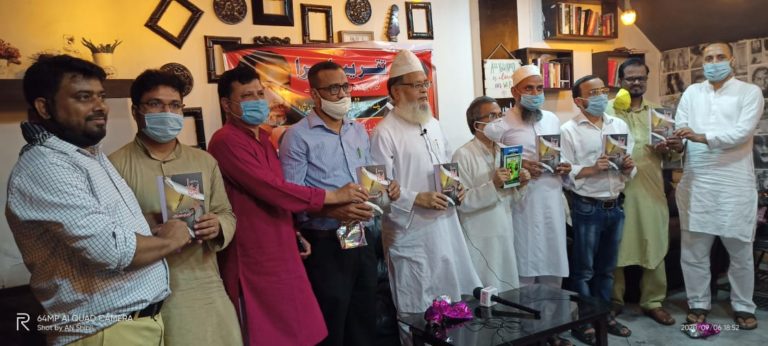
Books authored by three eminent personalities were launched at a conclave organised by HaFSA Foundation & Progressive Peoples Foundation in the outskirts of Guwahati on Sunday.

Guwahati :

A new year conclave of the office bearers and members of two frontline NGOs of Assam viz HaFSA Foundation (HF) and Progressive Peoples Foundation (PPF) was held at Tepesia, on the outskirts of Guwahati, on Sunday.

Families of the office bearers and members also attended the event in large numbers.

HF is an NGO working towards promoting education and social uplift of the people of Barak Valley, with primary focus on Bam region, the southernmost part of Cachar, for creating an enlightened, cohesive and resilient community. Under the umbrella of HF, four organisations viz HaFSA Academy, HaFSA Centre for Social Welfare, HaFSA Institute of Barak Valley Studies, and HaFSA Rural Library & Information Centre function to fulfil the aims and objectives of the Foundation.

Sayeeda Tasnim, Chairperson of HF, welcomed the guests and participants at the outset of the conclave and gave a glimpse of the different activities taken up by the Foundation during the last year.

Sultanuddin Ahmed, former executive at The Hindustan Times, reading out from “Beyond Soft Skills” authored by Nurul Islam Laskar, at a conclave held in the outskirts of Guwahati on Sunday.

Rafique Ahmed Laskar, Vice Chairperson, PPF informed the audience that PPF is engaged in developmental and social welfare activities across Assam. Its main thrust is on helping the poor and downtrodden in becoming self-reliant. PPF is also supporting a large number of poor students for pursuing higher and technical studies besides extending support to promising young athletes to achieve their dreams. Recently, they donated 100 blankets for the poor indoor patients at Cachar Caner Hospital, Silchar.

At the Sunday conclave organised at the initiative of HaFSA Foundation, it was resolved that the two NGOs – HF & PPF – will explore areas of collaboration in the sphere of educational development in the rural areas with special focus on Barak Valley. The two NGOs also decided to explore possibilities of working together for imparting coaching for Navodaya Vidyalaya entrance test and other recruitments in State & Central Government jobs.

One unique item of the conclave was the book reading session in which four books were released, one authored by Sabir Ahmed Choudhury and brought out by HF; two books on the history of Lakhipur authored by Abid Raja Majumder; and another book on motivation and personality development authored by Nurul Islam Laskar. Sultanuddin Ahmed, former executive of The Hindustan Times, read out a few chapters from Laskar’s book, “Beyond Soft Skills.”

The conclave recorded its appreciation for Jiauddin Choudhury, Chief Adviser, HF for initiating the process through which the NGOs were brought together to work hand in hand for the development of the society.

source: http://www.muslimmirror.com / Muslim Mirror / Home> Book Review> Indian Muslim> Positive Story / by Special Correspondent / January 03rd, 2022

Fatima Sheikh Birth Anniversary: Google Doodle Pays Tribute to India’s First Muslim Woman Teacher

Gang Peth (Pune), MAHARASHTRA :

Sunday’s Google Doodle: Alongside fellow pioneers and social reformers Jyotirao and Savitribai Phule, Sheikh co-founded the Indigenous Library in 1848, one of India’s first schools for girls

Fatima Sheikh Birth Anniversary: Google Doodle Pays Tribute to India's  First Muslim Woman Teacher
pix: Google Doodle / Janaury 9th Google Doodle features India’s first Muslim woman teacher, Fatima Sheikh. (Image: Google.com)

Google is celebrating the 191st birth anniversary of Indian educator and feminist icon Fatima Sheikh, who is widely considered to be India’s first Muslim woman teacher, by featuring a doodle for her. Alongside fellow pioneers and social reformers Jyotirao and Savitribai Phule, Sheikh co-founded the Indigenous Library in 1848, one of India’s first schools for girls.

Fatima was born on this day in 1831 in Pune. She lived with her brother Usman, and the siblings opened their home to the Phules after the couple was evicted for attempting to educate people in lower castes. The Indigenous Library opened under the Sheikhs’ roof.

Here, Savitribai Phule and Fatima Sheikh taught communities of marginalized Dalit and Muslim women and children who were denied education based on class, religion, or gender.

The Phules’ efforts to provide educational opportunities to those born into lower castes became known as the Satyashodhak Samaj (Truthseekers’ Society) movement. As a lifelong champion of this movement for equality, Sheikh went door-to-door to invite the downtrodden in her community to learn at the Indigenous Library and escape the rigidity of the caste system.

She met great resistance from the dominant classes who attempted to humiliate those involved in the Satyashodhak movement, but Sheikh and her allies persisted.

Although Sheikh’s story has been historically overlooked, the Indian government shone new light on her achievements in 2014 by featuring her profile in Urdu textbooks alongside other trailblazing Indian educators.

source: http://www.news18.com / News 18 / Honme> News> Lifestyle / January 09th, 2022

Ed-Tech startup by Jamia students secures investment to become 2 million USD company

NEW DELHI :

Gurucool team [Photo: released by Jamia]

New Delhi:

Gurucool, a Delhi-based EdTech startup whose three founders and the majority of the team are students and alumni of Jamia Millia Islamia(JMI), has raised an investment from Parvez Jasani, an Indian-American angel investor and FreeFlow Venture Builders, in the Pre-Seed round of $150,000 USD, the aforementioned varsity said in a press release.

Founded in 2019, Gurucool is an educational networking platform that offers a suite of phygital (physical+digital) tools to connect learners and educators. With more than 25 tools and a vast content pool, Gurucool is empowering educators like schools and colleges to go online and build their digital infrastructure which enables learners to find, connect and learn from them.

Adil Meraj, Founder and CEO of Gurucool, presently a student of Psychology at JMI, said, “We’re excited to begin our journey with our strategic investors, who believe in our vision and have a deep understanding of our ecosystem. Digitally, learning and socializing have emerged as divergent streams resulting in educational tools, content, learners and educators scattered across exclusive domains.Being an educational networking platform enables Gurucool to be a Publisher, Teaching platform, Marketplace and Aggregator, all at the same time. Gurucool has bridged the digital divide and brought all stakeholders in one phygital world.”

Gurucool plans to launch the Padhaai India tool, in collaboration with a few state governments to make quality education free and hyperlocal.

Recently, it has been approved by Higher Education of Bihar Govt. for piloting. Bringing together the best content from the best of open sources and educators, Padhaai India has 3000+ curated courses in 8 regional languages. It also has live classes, study material, test series and questionnaires for K-12, Competitive exams and Skill India.

Khansa Fahad who is the Co-Founder and COO, currently in the final year of B.Tech at JMI, added, “Our story isn’t a story of success.Our story is a story of struggle, survival and patience. Our story is a story of an unhazed dream and an unwavering faith to create a more learned and empathetic world!”

source: http://www.muslimmirror.com / Muslim Mirror / Home> Indian Muslim> Positive Story / by Muslim Mirror Staff / December 29th, 2021

Medal-Winners In Muaythai National Championship

Mysuru, KARNATAKA :

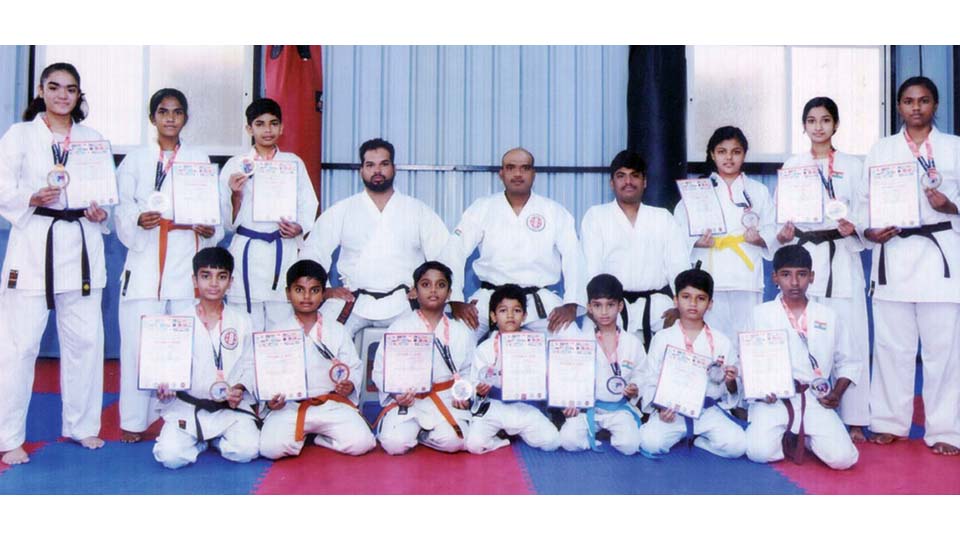
Nine Muaythai fighters (7 male and 2 female) of the Smite Academy of Martial Arts participated in the 22nd MTI Muaythai National Championship under the aegis of Mysore Muaythai Trust (MDMT) and Mysore Combat Sports Association (MCSA).

The event was held at Sheen Sports Alliance, Bengaluru, between Dec. 16 and 19.

The team bagged 4 gold, 3 silver and 2 bronze medals.

200 athletes from various States and UT participated in the event that was hosted by Muaythai Association of Karnataka (MAK) and sanctioned by MTI.

Medallists are as follows:

Falkia Khan (14 years, -40 kgs) – Gold Medal; Kulsum Harmain (senior, -53 kgs) – Gold; Mohammed Hasnen Khan (8 years, -32 kg) – Bronze; Raid Tanveer Syed (10 years, -32 kgs) – Gold; Mohammed Umar (15 years, -54 kgs) – Silver; Mohammed Usman Ghani (senior, -63 kgs) – Bronze; Irfan (senior, -70 kgs) – Silver; Mohammed Zaid (senior, -75 kgs) – Gold; Mohammed Fahad (senior, -85 kgs) – Silver.

source: http://www.starofmysore.com / Star of Mysore / Home> Sports / January 06th, 2021

Kanachur V.G. Medical College Sullia lifts Medi Quiz 2021 Trophy

KARNATAKA :

Mangaluru :

 K.V.G. Medical College Sullia duo team comprising of  Akshitha Anand and Ankitha Anand emerged as winners and clinched the glittering Medi Quiz – 2021 Trophy.  The competition witnessed a very exciting close finish as they faced stiff competition from the rival team Kanachur Institute of  Medical Sciences comprising of  Nusaiba Farheen and Nithya G.S.  who had to settle for Second Place.

The  Dept. of General Medicine Kanachur Institute of Medical Sciences conducted their Annual State level Inter Medical Collegiate Quiz Contest  “Mediquiz – 2021” exclusively for the M.B.B.S undergraduate Students on Dec 4 in their conference hall.  The Quiz was exclusively on Medical subjects.

College President Haji U.K. Monu graced the occasion as Chief Guest and awarded the glittering Trophy, Merit Certificates to the Winners and Runners up and congratulated them on their exemplary achievements.

Medical Superintendent Dr Devidas Shetty, Vice Principal K.G. Kiran, Chief Administrative Officer Dr Rohan Monis were the guests of honour.  HOD of Medicine Dr Devdas Rai was the Quiz Master.

The contest drew participants from different Medical Colleges comprising 37 teams.

Dr Preethika  Welcomed, Dr Narashimha Murthy proposed a vote of thanks, Dr Pooja Shekar compeered the program.

source: http://www.newskarnataka.com / News Karnataka / Home> Features / December 04th, 2021

How Jharkhandi Muslims fought for recognition throughout Jharkhand Andolon

JHARKHAND :

Mohd. Faizi with Shibu Soren in Iftar Party

Peter Gottschalk in his book Beyond Hindu and Muslim: Multiple identity in Narratives from Village India (2000) took a methodological leap to understand the multiple identities people carry in everyday lives. He carefully listened to the people talking about their local narratives regarding a fort; a temple dedicated to the ghost of a local Brahmin and a tomb that was probably associated with Bakhtiyar Khilji. While gathering the narratives of villagers of former Shahabad district of Western Bihar (during his fieldwork conducted in 1994-95) he tried to understand the significance of temporality and contextuality in assertion of identities.

Far beyond the monolithic religious binary of Hindus and Muslims, the identities get complicated with the presence of intertwined factors like class, caste, language, region, gender and nation. Not only that, the memory, context and existing narratives also shape the contemporary identities. For example, Gottschalk found lower caste Chamars claiming Hindu identity to establish their indigeneity against the Muslims, mostly considered as outsiders. But, similarly in the context of their exclusion from the upper caste village rituals, they assert their Chamar identity as opposed to both the religious groups.

Such assertion of identity becomes politically loaded through different means- mostly with the struggles for legitimate rights and in a few instances for establishing empathetic connection with the broader community. While working on Muslims’ presence in Jharkhand Andolon, what we encountered with is the assertion of a separate ‘Jharkhandi Muslim’ identity- sometimes it came as ‘Adivasi Muslim’, sometimes as ‘Moolvasi Muslims’. Whatever the lingual expressions be, the base of this identity assertion veers around their claims of being different from their North Indian coreligionists. Through the narratives and life sketch of different Andolonkaris, we learnt how this identity has shaped the presence of Muslims in Jharkhand Andolon. Jharkhandi Muslims in this context becomes both a constitutive and a derivative component of the broader statehood movement. To look into one without the other amounts to deliberate silencing of a politically effective assertion that had set forth the routes of the movement. This essay is thus an effort to find out the impact of this identity assertion in the Jharkhand statehood movement.

Muslims Kahan hai Jharkhand pe? – Story of A Composite Identity

Jharkhand Muslim Hotel, Simlia village, near Ranchi

Around 20 kms west from Ranchi, as we reached Simalia to meet Padmashree awardee folk singer and poet Madhu Mansoori Hasmukh, we found a place named, “Jharkhandi Muslim Hotel”. Though it didn’t come as a surprise as the complexities of Muslim identities in Jharkhand have been our companion throughout, what unfolded gradually made us literally silent. Barely we entered Madhu Mansoori’s house, we met Masi Zama, a social activist who use to come to his place for mundane cordial visits. On being asked what my research focuses on, I casually said, “It’s mostly on the Muslims in Ranchi, their silencing… participation…and…”. I was immediately stopped. His displeasure was though not reflected through his voice, the words he chose were enough to make us understand that we made a statement that we were ought not to. “Muslims? Muslims kahan hai Jharkhand pe? (Where are Muslims in Jharkhand?)”- for a moment I felt my whole research purpose, its objectives are dismantled to the core. “Ye aap logo ke tarah jo log hai uske liye yahan pe Muslims ka aaj ye haal hai (It is the people like you who are responsible for the conditions of Muslims in Jharkhand). When constituent assembly debates were going on why nobody spoke of giving Adivasi status to the Muslims of this region? Yahan pe Muslims nahi hai (There is no Muslim in this region) We are Jharkhandi Muslims, Adivasi Muslims… Moolvasi Muslims”, we were told.

Padmashree awardee Folk Singer Madhu Mansoori Hasmukh (Photo Courtesy: Ayan Tanweer)

Understanding the gravity of the mistake as we were about to apologize, Madhu Mansoori, in his mid-70s entered the room. Without any ‘Salam-dua’ (Islamic ways of greetings like Assalam Aleikum Wa Rahamatullahi Wa Berakatahu) what he welcomed us with was a humble ‘Namaskar’. Already ashamed enough of our misconceptions, we greeted him back with a ‘Namaste’ and our conversation started. Madhu Mansoori claims himself as an Oraon Muslim. His ancestors, as he says perhaps got converted generations back. But it is the Oraon culture that drives his everyday lives. Throughout the interview whenever he referred to Muslims, he spoke off how the Munda-Oraon culture is intact within them. Islam has no conflict and doesn’t contradict their existing way of lives- rather it is a spiritual addition to the everyday beliefs and faiths.

These fundamental similarities rather embeddedness of faiths and practices into one another were explained to us later by Dr. Eliyas Majid, a Professor of History in Maulana Azad College, Ranchi. Explaining the Jharkhandi culture, he told us, “We have a ritual namely Madeikki Byebastha. It means helping one another in different things.” While in a capitalist set up, hiring laborers for mundane works is the norm, in Jharkhandi culture, as Dr. Majid said people come together to do neighbors’ works – whatever the nature of the work may be.

Another significant concept that Jharkhandi culture entails is of ‘Sahiya’ (friendship between any being or thing). “Koi bhi kisika Sahiya ho sakta hai. Ye zaroori nahi ke usko Insaan hona hai. Bachpan se jo aam, jamun ke paer pe hum khelte the wo bhi humara sahiya ho sakta hai. Hum logo me bahut sara ladki paer ke niche ghanto beithe rehte hai aur pooche to bolte hai Sahiya pass thi. (Anybody can become friend in our culture. It needs not to be human being. The mango, Jamun trees that we played underneath in our childhood could be our Sahiya. In our culture, women sometimes are found sitting beneath the tree for hours and on being asked where they have been- they respond- I was with my Sahiya)”, Dr. Majid continued.

The third and most interesting cultural attribute that he told us is called Gotiya’ (means brotherhood). For being brother in Jharkhandi culture, people need not to have blood relations. Any Oraon, Munda, Santhal can be Gotiya of a Muslim. All these three ideas explained to us by Dr. Majid significantly goes with the fundamentals of Islam. Helping others whereas is considered as Sunnat (Prophet’s (SWAS) way of life), the idea of recognizing every living being is in consonance with the belief of Islam that each and every being is created by Allah (SWT) and humans must behave with them in compassionate and empathetic manner. The idea of universal brotherhood (Gotiya) is also part and parcel of Islamic scriptures and commands. This comparison though is not intended to portray the similarities between Jharkhandi culture and Islamic fundamentals, rather it is just to show how Islamic fundamentals got melted into the Jharkhandi culture and paved the way for the construction of the identity known as ‘Jharkhandi Muslims’.

The cultural assertion of Jharkhandi Muslim identity whereas is rooted into the cultures of the land, the political assertion got its shape and voice through Jharkhand Andolon. Our encounter with Mohd. Faizi, a readymade garment seller near Upper Baazar took us through the terrains of this identity formation. Faizi made us walk in the roads where ‘Jharkhandi Manasikata (Jharkhandi Mentality)’ of Muslim foot-soldiers had to cross the paths of external political efforts and influences that were gathered to dismantle the ‘ekta’ (unity) of Jharkhandi Muslims.

Asghar Ali Engineer in his 1991 EPW paper ‘Remaking Indian Muslim Identity’ pointed out how ‘the assertion of religious identity’ could be a method for the ‘deprived communities in a backward society to obtain a greater share of power, government jobs and economic resources’. Similarly, assertion of Jharkhandi Muslim identity in the context of Jharkhand Andolon became a path to achieve the desired goals of statehood, to secure the rights of Minorities in the newly formed state and to ensure that ‘pehchan’ (recognition) of Jharkhandi Muslims remain intact without the imposition of homogenizing laws and regulations.

Personal is Political- Jharkhandi Manashikata & Instilled Mijaj

Mohd. Faizi looking back through the pages of own Archives

Mohd. Faizi was born in March, 1966 at Rain Mohalla, Tewari Street near Ranchi Main Road. Since childhood besides poverty another constant feature of Faizi’s life has been instilled ‘Jharkhandi Manasikta’ (Jharkhandi Mentality). Faizi’s father had a small (5ft/10ft) ‘Kapde ka gumti’ (an apparel stall) at footpath near Urdu Library. His childhood was filled with the stories of Jharkhand Andolon. Shared by his uncles, these stories instilled the dreams of separate Jharkhand in little Faizi’s mind. One of the stories was of an old woman who used to stay behind the Gel church (Evangelical) during the British Raj. Every day, ignoring the scorching heat, unbearable rain and all other obstacles she marched through the main road alone with a flag raising the slogan of ‘Jai Jharkhand, Jharkhand Prant Alag Karo’. The flag was nothing but a stick wrapped in a green cloth that became the bearer of Jharkhandi identity. She marched up to the Commissioner’s office and spending some time used to come back. Though there was no crowd behind her, the visual of her intermittent desire to have a separate state got reverberated through all those like Faizi’s uncles who later joined the movement in numbers.As people mocked at her, Faizi’s grandfather told them- “Yaad rakho ye mang jayes hai, aur ye aaj akeli nazar aarahai hai lekin ek waqt ayega jab iske peeche jan sailab hoge” (Keep it in mind that her claims her legit. Today, she is alone but day will come when hundreds will join her for the demands). Faizi not only witnessed the ‘Jan Sailab’ (Public uprising), rather he led it from the front and embraced it as a ‘farz’ (duty, mostly used for religious obligations) against all the odds coming in between him and his pledge to the separate state.

Mohd. Faizi with his uncle and undisputed Muslim leader of Jharkhand Andolon Tako Ansari (Sitting on the Chair)

In his early age only, Faizi saw his uncles Tako Ansari, Mohd. Farooq joining the statehood struggle through N E Horo’s Jharkhand Party. In Faizi’s words, ‘Mijaj to thaa hi (Mood was always there). Along with that the devotion of family members to the cause of Jharkhand made these aspirations grow”.

Faizi had few friends like Shamim and Saajid with whom he started attending the meetings of Sadan Vikas Parishad (SVP). At that time, Prof. Shahid Hasan was the general secretary of SVP. It was very early stage of his engagement into the movement. However, two specific incidents changed the way he looked into the world thereafter. Due to his father’s deteriorating health condition he had to leave his education at an early stage. Still, in 1985, he appeared for the board exam. Though he scored good numbers in subjects like English, Arabi and Farsi, his marks in science and mathematics didn’t let him qualify the boards. He got only 2 marks less than required to pass the exams. There were other students as well with whom similar things happened and they decided to go to Patna Examination Board office.

The reality of blatant discrimination had hit him in an inexplicable way. While he and his ‘Jharkhandi saathis’ (friends from Jharkhand) were told that nothing could be done and they started preparing for the next year, students from Bihar started filling the forms of colleges. Faizi then got to know that his ‘Bihari Saathis’ (Friends from Bihar) were told by the officials to apply for reviewing their copies and got the required grace marks whereas they were told, “Yahan pe kuch nahi ho sakta (Nothing can be done here)’. This instance not only made huge impact on Faizi’s mind rather it made him further believe that ‘Ye maang Jaees hai, aur inse in Bihario se chutkara milna chahiye’ (The claims of statehood are legitimate and we must get rid of Bihari officials).

While referring to the second incident Faizi was red in rage. Sipping a bit of water from the glass that was kept near his bed, he continued- “It was 1987. For the first time, anti-encroachment drive was going on in Ranchi. Police forces and officers came to our small Gumti and asked us to immediately vacate it. They threatened us that if we don’t move, they would trample it on and would even charge fine. We didn’t have money- so we started dismantling out only source of earning. And as I was putting down the asbestos, a small piece of brick fell near an Officer’s feet. It didn’t touch him at all but he started abusing me with ‘Maa ki gaali’ (Slangs referring to mother). I felt like immediately hitting them. But no, I couldn’t. My ailing father was standing there along with my little brothers. I silently listened to them but pledged that I would take revenge. If not from them at least from their viradari (their kind). It was our time to get rid of all these brutal Bihari officers and polices- We had to achieve statehood- We must- for the sake of our existence- for the sake of having a dignified life”- Faizi was trembling- silence clouded the moment- tears were visible with the determination that led him to become one of the most committed soldiers of Jharkhand Andolon.

During this phase, he led a group of 10-15 youths who participated in different social works. Meanwhile All Jharkhand Students’ Union (AJSU) had already been formed and movement got its required momentum. One day, when they were sitting near Urdu library, Ranchi Main Road, Zubair Ahmed (then the Ranchi town secretary of AJSU) came and asked them to join AJSU. Zubair even brought the founder president Prabhakar Tirkey and arranged a meeting with Faizi and his friends.

Within days, for his oratory skills and determination, he became very close to Tirkey and other CC members of the party. “Kyun ki itne sare adviasio me ek Muslim chehra, upar se accha bakta (Among so many Adivasis, a Muslim figure with good oratory skills)” made people like him and Zubair stand apart. Along with Zubair and other Muslim leaders/members they started gathering Muslim support for the movement. Though Muslims’ presence had always been there since the very early days of Jharkhand Andolon, its further expansion and visibility became their objective.

Political Assertion of Identity- Jharkhandi Muslims and Foundation of JMC

Since then, what drive Faizi throughout was his desire to achieve statehood and the recognition of ‘Jharkhandi Muslim’ identity. The assertion of this ‘Jharkhandi Muslim Identity’ led people like Faizi or Zubair to invest their lives for the cause of separate statehood where they would be considered in same manner as their ‘Adivasi saathis’, instead of their religious brethren of the other states.

The JMM Visiting card of Faizi and News Cutout of Faizi inducted as Town Secretary, JMM

As soon as Faizi joined Jharkhand Mukti Morcha (JMM) in 1992 after a meeting with Prabhakar Tirkey and other leaders of AJSU (Tirkey faction) at Suleiman hotel, Lake Road, Ranchi, he got the chance to further work both for the statehood movement and the cause of separate Jharkhandi Muslim identity. The very next year in 1993, with the objectives of working for the social causes he founded Muslim Youth Forum. The organization though was not politically active, it could be called a social reform wing of the broader struggles for the Muslims in the state.Already Jharkhand Minority Front of Jharkhand Party was formed in 1988 and consequently in the next year Jharkhand Quami Tehrique (JQT) was founded. The founder president of All Jharkhand Students’ Union Prabhakar Tirkey in one of his articles in Prabhat Khabar titled ‘Jharkhandi Pehchan KeL iye Sanjida Rahe Musalman’ talked about the enormous participations of Muslims in the statehood struggle. His article even reflects what Mohd. Faizi has to say- “Jaise aapko pata hai Musalman bahut pehle se ye andolon me hai. lekin Musalman jo jude, kisi na kisi party se jude, aapna identity le kar ken ahi aye…Ab musalman ye tahriue ko aapne haat me bhi lenge aur tehrique chalayenge. (As you know Muslims have been part of this movement since very initial days. However, Muslims joined different parties and never came with their own identity. Now, it was the time for Muslims to lead the movement, to play the role of leaders not only the participants).On being questioned that why the Muslim identity became important at that stage, Faizi was more clear and vocal- “We have seen what has been the role of Muslims in Indian Independence. Even after that today Muslims are called ‘Gaddar’. Our histories have been deliberately eliminated. If we don’t create our own identity in this statehood struggle, people in coming days would definitely say that we had no role in the movement. We apprehended that in very early stage”. This was the reason why they not only fought rather as Faizi said, “We kept the documents as the evidence to prove that Muslims were no less in this movement and we made ‘barabar ki qurbani’ (equivalent sacrifices) like other communities”. Referring to ‘shahadat’ (martyrdom) of several Muslim leaders who died for the movement including Abdul Wahab Ansari, Qutubuddin Ansari, Murtuza Ansari, Mohd Zubair, Mohd Sayeed and Ashraf Khan, he implied, “Ye cheese Tarikh me jaana chahiye. Logo ko pata hona chahiye ki Musalman ye alag rajya ke liye kya kiye hai (It must be written in pages of histories. People must know what Muslims have done for the separate state).A Dr. Eliyas Majid had even mentioned in his book “Jharkhand Andolon aur Jharkhand Gomke Horo Saheb” that Muslims in the late 80’s needed their identities to be reflected on the grounds of the movements. On May 25, 1988 while presenting the working paper in the foundational Conference of Jharkhand Muslim Front (JMF), Dr. Majid said despite their participation and martyrdom, “Muslims utna hi cchipa hua hai, jitna Jharkhand Andolon ubhra hua hai” (Muslims are as much silenced as much the movement is vocal). His address majorly focused on two parts- firstly, the individual identity of Muslims and the political indifference toward their demands and secondly, the separate identity of Jharkhandi Muslims that share more cultural values with the Adivasi ‘saathis’ than their North Indian coreligionists. In words of Dr. Majid, “Jharkhand humara andolon hai, Jharkhand humare wajood se jura sawala hai” (Jharkhand is our movement, it is connected to our Entirety- our Entity).Even after this eternal connection with the movement, as Faizi says that Muslims were denied proper position in the histories of the struggle. “While writing the history of AJSU, people would talk about Suraj Singh Besra, Prabhakar Tirkey, Lalit Mahato, Mangal Singh Bobonga but nobody would mention Nazm Ansari, Farooq Azam, Zubair Ahmed or Mohd. Faizi. When JMM’s history would be drafted people would remember Shibu Soren, Suraj Mandal and Sailander Mahato but Prof. Abu Talib Ansari or Hazi Hussain Ansari would not be named”. His concerns later proved to be right as most of the accounts of Jharkhand movement hardly spoke of Muslim participation. They understood the fact that if only they would come up with separate organizations for Jharkhandi Muslims, it would be recorded in the pages of history.It was in early 1995 that the decision regarding the formation of Jharkhand Area Autonomous Council (JAAC) was taken. On the eve of it, Muslims of different Jharkhand ‘naamdhari’ (Jharkhand-named) parties came together to plan the formation of a specifically Jharkhandi Muslim platform that would talk about the condition of Muslims- that would ensure the constitutional rights of the community in the newly proposed state. During this period Qazi Mujahidul Islam of Imrat-e-Shariya was about to come to Ranchi. Hussain Qasim Kacchi, who used to be a keen patron of the movement asked Mohd. Faizi and his friends to meet Mujahidul Sahab. They planned a seminar on June 11, 1995 at Anjuman Plaza Hall, Ranchi Main Road to welcome Qazi Sahab. As there was no properly functioning Muslim front, they decided to use the banner of Qazi Sahab’s organization All India Milli Council.In Faizi’s words, “Banner didn’t matter to us, we had to do something to bring Jharkhandi Muslims together”. The title of the seminar was ‘Jharkhand Andolon aur Musalman’ (Jharkhand Movement and Muslims). Qazi Sahab while was the chief guest of the seminar, Prof. Abu Talib Ansari had presided over it. It was for the first time in the history of Jharkhand andolon that discussions happened in a public forum on participation of Muslims. Qazi Mujahidul Islam referred to the anti-racial movement in South Africa where Muslims stood by the colored people. This anecdote further worked as a spark as it not only echoes the ideals of Jharkhandi Muslims, rather it speaks directly to the fundamental tenets of Islam that commands its followers to join hands with the oppressed people of the world. He also called for an ‘umbrella’ organization that would accommodate all Jharkhandi Muslims.

Seminar at Anjuman Hall Plaza on Jharkhand Andolon aur Musalman

Following Qazi Sahab’s advice Muslim leaders of different Jharkhandi Parties called for a meeting on June 27, 1995 at Mohd. Faizi’s place. Around 252 representatives of different panchayats, social organizations and political parties attended the meeting and formed the Jharkhand Milli Council (JMC). As per the reports of Prabhat Khabar June 28, 1995, most of the leaders agreed to the contention that despite huge presence of Muslims in different Jharkhandi parties, they were not given due importance in decision making amounting to political silencing of Jharkhandi Muslims. So, the major objectives of JMC were to gain the recognition of Jharkhandi Muslim Identity (Moolvasi Muslim) along with claiming the legitimate political, economic, social and educational rights. To avoid the risk of catapulting another cult figure that the Jharkhandi parties had been the overwhelmed with, JMC decided to form a presidential council. Prof. Abu Talib Ansari whereas was declared the chief of the council, Farooq Alam, Mumtaz Khan, Prof. Khalik Ahmed and Salik Ahmed were the elected members. Nazm Ansari was projected as the Chief Secretary of the party and Mohd. Faizi, Sarfaraz Ahmed, Rafat Hussain, Abdul Moin Rizvi, Jameel Khan, Samnur Ansari, Mustaq Alam and Prof. Amin Ahmed became members of the secretariat. JMC pledged to not have any relation with the All India Milli Council, rather it decided to become a frontal organization for the Jharkhandi Muslims. Formation of JAAC- ‘Yahan Pe Muslim naam ka janwaar ka koi zikr nahi hai’Meanwhile, on July 30, 1995, Jharkhand Area Autonomous Council (JAAC) was formed and Shibu Soren became the chairman of the council. As anticipated earlier, almost negligible representations of Muslims in JAAC clearly made the fears of elimination legitimate. Protesting against the deliberate omissions of both Muslims and their causes Prof. Abu Talib Ansari wrote a press release on August 9, 1995. The release, however, could not see the light of the publication as Mohd. Faizi and other comrades restrained him from sending it to the press. As per Faizi, this declaration would have been considered as resignation of Prof. Ansari from JAAC leaving not even a single member in the council to voice the concerns of the Muslims. In the press release (collected from Mohd. Faizi) what we found was acute disgruntlement of Jharkhandi Muslims regarding the formation of JAAC. Prof. Ansari (then the Central Committee Secretary, JMM & Chief of Presidential Council, JMC) in the release said, “JAAC has played with the emotions of Jharkhandi Muslims by not giving them proportionate representations. There are few people in the council who didn’t even hold the party flag ever”.

Unpublished Press release of Prof. Abu Talib Ansari after the formation of JAAC in 1995

Mentioning that the Muslim leaders of JMM are not ‘kisi ka bandhua mazdoor’ (bonded laborers), he continued, “Jharkhand is nobody’s paternal property. There are leaders in JMM who have used the slogans of secularism to undermine the cause of Muslims. JAAC is the by-products of martyrdoms of leaders like Ashraf Khan, Wahab Ansari, Zubair Ahmed, Mohd. Sayeed and Qutubuddin. These ‘shahadat’ should not be forgotten if an inclusive Jharkhand state is to be imagined.

Though there were references to Silk, Animal Husbandry and other departments in the JAAC bill, there was no mention of Muslims (Yahan pe Muslim naam ka janwaar ka koi zikr nahi hai). Prof. Ansari categorically warned that if Minority Welfare & Development Council, Minority Commission, Waqf Board, Haj Committee, Madrassa Board, Urdu Academy and implementation of 15 points program are not considered in the council, there would be parallel movement of Jharkhandi Muslims across the territories of JAAC.

Claiming Adivasi Status- Kohl Jolha Bhai Bhai

While JMC’s movements, processions and meetings across the territory of the proposed state continued with vigor, the major step of claiming their separate identity of Jharkhandi Muslims came on October 24, 1998 when the party leaders reached Delhi to submit petition to the then Prime Minister Atal Vihari Bajpayee. At Tal Katora stadium, New Delhi, JMC gave a protest call and was presided by Prof. Abu Talib Ansari. After the demonstrations, they submitted the petition containing the following key points-

First Draft of JMC Petition submitted to then the Prime Minister Atal Behari Bajpayee in 1998

1. The Moolvasi Muslims of Jharkhand must be given the Adivasi status and rights as available in Lakshadweep (As per Article 342 of Indian Constitution)

2. Like the Scheduled Caste and Scheduled Tribes, Pasmanda Jharkhandi Muslims must be given Economic and Political Rights

3. Jharkhandi/ Moolvasi Muslims and specifically those who have been part of Jharkhand Andolon must be given priorities in Gram Sabha, Gram Panchayats and any other developmental commissions and boards

4. Urdu must be retained as the second language and all of the educational institutions must have Urdu in its curriculum

5. In villages and towns Urdu schools must be opened for the development and retention of the language

6. Minority Welfare Commission, Waqf Board, Madrassa board, Haj committee, Urdu Academy need to be formed and Andolonkaris should be prioritized in these committees

7. Jharkhand should be free from the coercion of Non-Jharkhandis

8. A University under the name of revolutionary Sheikh Bhikhari must be founded in Ranchi. Jharkhand Legislative assembly also must have memorials of Bhikhari

9. In school curriculum, the lives and sacrifices of Jharkhand Andolonaris must be included

10. The trials of Muslim youths in the name of terrorism must be stopped

11. Places where the Muslim families had to resettle due to communal disturbances and riots must be given residential legitimacy

12. All the Government offices must recruit Urdu translators

13. Jharkhandi Muslims must be recruited in Security and Police forces without any discrimination

14. All the poor Jharkhandi Muslims should be given residential facilities through Indira Awas Yojana.

These claims clearly indicate the significance of ‘Moolvasi Muslim identity’. On one hand, it claims the status of Adivasis, on the other it demands to secure the rights of Minorities enshrined in the constitution. During our conversation, several times we found Faizi referring to incidents that show how Jharkhandi Muslims had been treated by Muslims of the other states. While being asked what was the positions of Muslims of other states (Northern India) vis-à-vis their struggles, Faizi lamented, “Koi samarthan nahi- birodh, birodh. Ye log nafrat kiya karte thee. Ye log yehi bat failaya karte the ki sara jo ye log Kohl ho geya hai. Ye log bolte the ki ye julus jalsa karke hariya daru kha ke so jaya karte hai. In logo ka hukumat karne ka mijaj ban gaya thaa. Aaj bhi ye log Jahan pe basenge chahenge ki wahan ki hakim hum ban jaye. (They never supported us. They told us that we have become Kohls. They have the perception that after Processions and meetings, we take hariya [a specific form of alcoholic drink made out of rice] and sleep. They got used to rule over us. Even now wherever they settle in, they want to become the owner of the place)”.

‘Arab ke sarjameen pe jaye toh hum jaye humari Jharkhandi Pehchan se’

Such emotion was reflected in actions of JMC even after the state of Jharkhand was formed. The demand of separate Haj Committee as mentioned earlier though was there since the formation of different Muslim Forums during Jharkhand Andolon, several Ulemas from Bihar said that for the first year (i.e. 2001) let the Jharkhandis be sent through Bihar Haj committee. Faizi and his comrades were not ready under any circumstances to have some compromises. “Itne jaddo-jehad ke baad jab alag rajya mila tabhi bhi hum jaye Haj karne Bihari pehchan se? Nahi! Hum chahte hai ki hum jab Arab ke sarjameen pe jaye toh hum jaye humara Jharkhandi Pehchan se (After so many struggles and fights we have got the separate state and still are we expected to go for Haj with Bihari identity? No! Never! We want when we will touch the land of Arab, we will have our Jharkhandi identity)”, Faizi’s words were reverberating in the room- the only thing that we could hear was the aspiration for separate Jharkhandi Muslim identity- even in the holy land of Islam where all other identities are subsumed by the broader identity of ‘ummat’.

On April 28, 2001, JMC submitted memorandum to then Minority Welfare Minister of Jharkhand Arjun Munda and asked him to form separate Haj Committee immediately. Under pressure the newly formed Jharkhand Government on July 2 declared the formation of separate Haj Committee in Jharkhand and Arjun Munda was made the president of 14 members’ council.

Faizi referred to another meeting of Momin Conference in late 90s in Irba where he further understood how Muslims of other states looked down upon them. The chief guest was from Bihar who not only continued comparing Jharkhandi Muslims with Kohl tribes rather he continued saying that Muslims in this state didn’t have manners of clothing and speaking. Only after the ‘Yalgar’ (attack) from the people of Bihar that they started learning the Islamic ethos. This savior complex of North Indian Muslims is what the Jharkhandi Muslims fought against.

Their opposition to the Ulemas from Bihar and Uttar Pradesh got reflected in the meeting of JMC on October 11, 2001. Under the chairmanship of Haji Akhtar Ansari, district president, JMC, this meeting unanimously took the decision of not letting the Muslim leaders of North to divide the unified Jharkhandi Muslim community. Such idea of united Jharkhandi Muslim identity though stands in contrast to the caste panchayats working at the mohalla level, it came several times in the words of Mohd. Faizi, Zubair Ahmed and other leaders as well that without the external interventions such ‘firqahs (sects and divisions)’ wouldn’t have much fodder to grow.

JMC continued its struggle for the rights of Jharkhandi Muslims and emphasized on the proper upholding of Article 29 & 30 of the Indian constitution. On one hand, the fight was against any sort of discrimination, on the other it was for gaining the recognition of a separate identity. Considering the backwardness of Muslims in terms of economic and educational qualifications, JMC submitted its petition to Arjun Munda, then the Minority Welfare Commission, on June 5, 2001 to provide the Jharkhandi Muslims with 20% reservation. JMC used the analogy of Karnataka’s Muslims as in late 90s they used to have 6% reservation within the cap of OBCs. However, the reservation of Muslims in Karnataka has different historical trajectories. Qazi Arshad Ali in his book ‘Karnataka Muslims & Electoral Politics’ mentioned that Muslims were given reservation as backward class back in 1921, according to the recommendations of Justice Miller committee that was appointed by Maharaja of Mysore. The context of Jharkhand was though totally different, the analogy of Karnataka was a point for them to show the possibility of using Other Backward Classes quota for overall development of Jharkhandi Muslims.

Against the Grains of Homogeneity

Till the date, though in an overwhelmingly communally polarizing situation, JMC is still working for the rights of the Jharkhandi Muslims. The lynching of Tabrez Ansari was the latest that made them sit together further to contemplate for what actually they devoted their lives- Is it the Jharkhand they hoped for? While we were about to wrap up the interview, Faizi asked his daughters to meet us. At a glance, we recognized Shireen Faizi who was one of the leading women faces during Anti-CAA movement in Ranchi. Faizi smiled at us- “Humara pura khandan hi Andolon se juda hua hai… Abhi bhi Jharkhandi Muslims ka koi bhi issue me pehla insaan jo raste pe ayega wo mere ghar se hi niklega…(My whole family is connected to movements. Still now, whenever Jharkhandi Muslims will fight for anything, the first person to come out of the house will be from our place)”- there was reflection of just pride that still helps him to sustain the struggles for existence.

At a time when Hinduization of Adivasis has become one of the major propagandas of the ruling Hindu rights, the nuanced ‘Adivasi Muslim’ identity must be further interrogated. Against the grain of religious homogenization where Muslims and Hindus, Muslims and Adivasis, Muslims and Dalits are pitted against each other as singular blocks, the assertion of ‘Jharkhandi Muslim’ identity becomes imperative at least to reclaim the Adivasi-Muslim unity in Jharkhand. For the survival of Indian democracy perhaps what we need the most is the recognition of heterogenous identities that have not been products of some decade-old propagated conflicts, rather have history of century old collaborations and bonhomie.

Authors:

Abhik Bhattacharya is a Doctoral Research Fellow, School of Liberal Studies, Ambedkar University, Delhi. He works on Silencing and Spatial segregation of Muslims in Ranchi

Arshad Raza Khan is the admin of Facebook page Muslims of Ranchi. He is also currently pursuing his M. Tech from Central University of Jharkhand

Ayan Tanweer is a Freelance photographer based in Ranchi. He is pursuing his M.B.A from ISB&M, Pune

source: http://www.muslimmirror.com / Muslim Mirror / Home> Must Read / by Abhik Bhattacharya, Arshad Raza Khan & Ayan Tasveer / October 28th, 2021