Nallur Village, Bajagoli (Karkala Taluk -Udupi District), KARNATAKA :
Karkala:
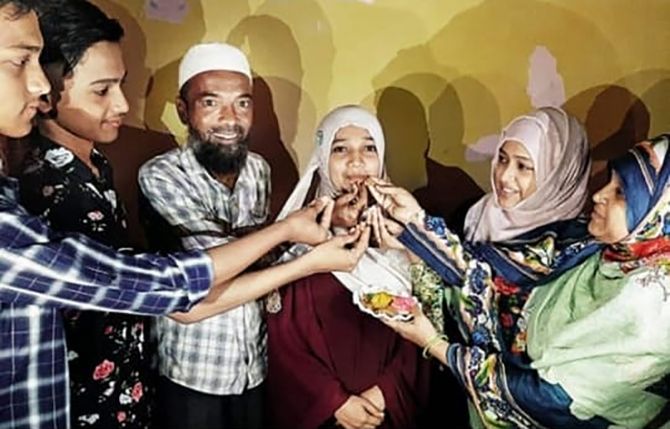
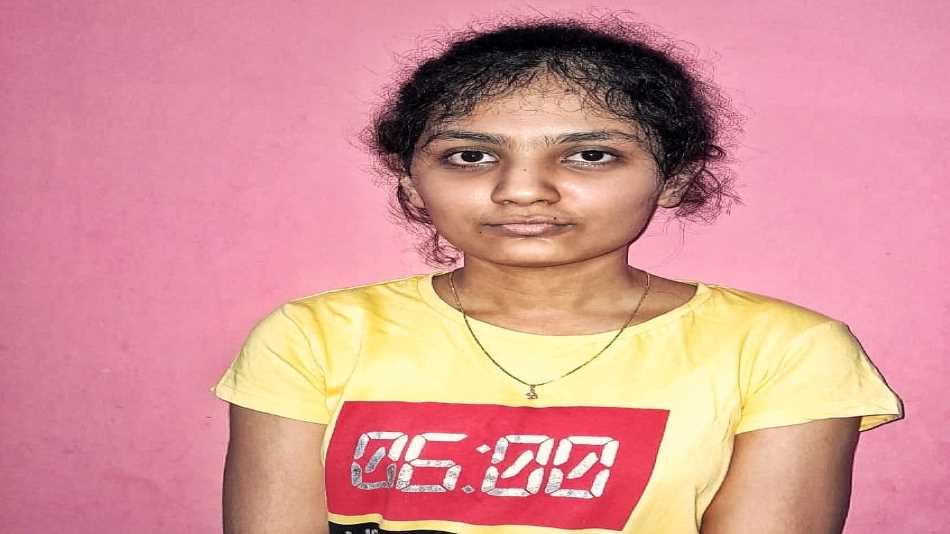
Naseera Banu, who was born in a poor Muslim family in Bajegoli near here has written the examination for the post of judge and is waiting for the appointment order.
Naseera’s father Aliabba owns a driving school and her mother Nabisa is a housewife. Naseera is the first lady, who will become a judge in their family. Naseera studied in the Kannada medium school of her village. But she realized that it is necessary to be proficient in English language, if she wanted to achieve her goal. Now she has reached the destination. Her parents also have supported her whole-heartedly.
Naseera’s achievement has made her parents proud. Her father Aliabba says, “We, who have spent the whole life with difficulties, were dreaming that our children should achieve something in their life. My daughter Naseera has realized my dream.”
The other two daughters of Aliabba and Nabisa are married. Their son is working in Qatar. Naseera completed her PUC in Bajegoli. Later she completed her LLB in 2010 from Vaikunta Baliga Law College in Udupi.
After completion of LLB, she was getting law training with advocate Vijendra Kumar in Karkala. At present she has been working as an assistant with advocate G Muralidhar Bhat where she began in 2015.
“I was involved in games and studies like any other child. But I always had an eye on my goal.” she says.
Naseera had faced her last round of interview on June 13 for the position of judge.
sourc: http://www.daijiworld.com / DaijiWorld.com / Home> Top Stories / by Daijiworld Media Network – Karkala (MS) / July 12th, 2019
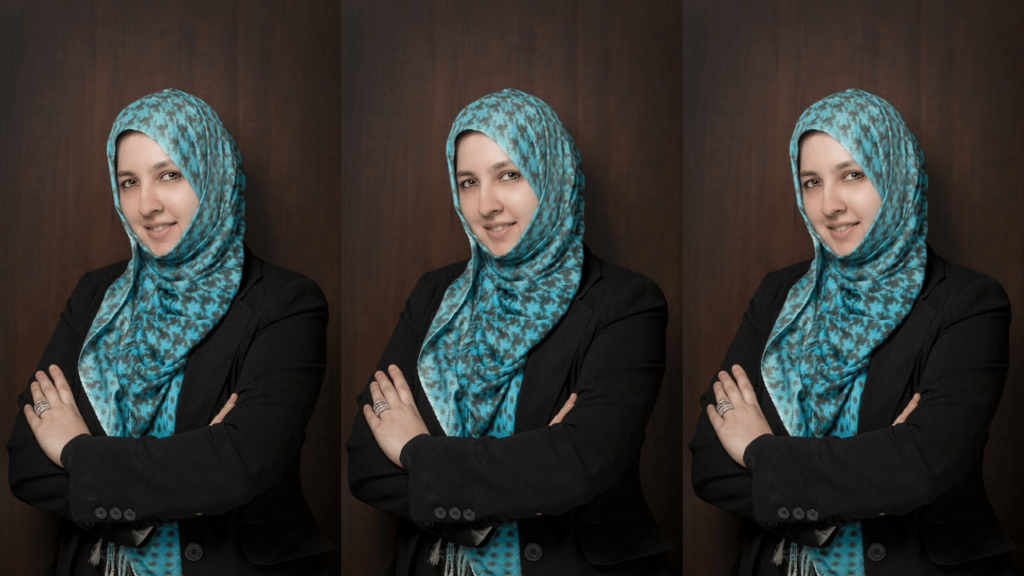
Serving the people of the UAE as a doctor for the last three decades has been a feeling of unconditional love for Dr Saleema Wani.
The greatest treasure for me as a doctor in the UAE, has been to witness babies born at my hands, go on to become mothers and fathers themselves!
During my three-decade’ plus journey in the UAE, I have been at hand to see generation after generation bring in beautiful children into this world.
I remember holding the hands of a young mother giving birth to her daughter. And then years later, holding the hands of her daughter as she gave birth to her two children.
And to think that when I landed here with my husband on April 15, 1989, I thought I would be spending probably a year or two, before returning to my home country.
The second day after landing in the UAE from Kashmir, I began work as a junior doctor at the Corniche Hospital in Abu Dhabi. Interestingly, when I arrived here, I had still not resigned from my previous role. I had planned on staying here for a few years, before returning to my home country. Little did I know then that those ‘few years’ would extend into a ‘few decades’ — thirty-two years to be precise.
In those years, I have walked in and out of the hospital day in and day out. There were times when I was extremely tired and desolate, as life kept marching ahead, but I could not give up. I was on a mission, with little time to spare!
When I think about leaving the UAE, it is hard to imagine. It is hard to leave a country when it feels like home and you are surrounded by family — not only your own blood, but the many who have become my extended family here — thanks to my profession.
I have served two generations of mothers, and today I am helping those women born through my hands, give birth to new babies! Many of them still call me up and ask for my advice, and treat me as if I were their second mother. How could I possibly leave my children behind?
When I look at these mothers, I see that while so many changes have taken place in the UAE over the last three decades — be it socio-economic change or in other aspects, two things have re mained constant — the values and traditions instilled in Emiratis and expats by the late Sheikh Zayed bin Sultan al Nahyan. The second is the weather! And while not much can be said about the weather, it is fair to say that it was these values and traditions of love and patronage showered by families and elders, that made me feel like I was at home — just like a member of each of their families. It gives me comfort knowing my two sons Mohammed and Ammar are never going to be alone.
Raising two sons whilst working as a doctor, being a wife, and earning qualifications all at once was not easy. But how could I not upskill when the path was paved for me through the pragmatic and visionary leadership of the late Sheikh Zayed bin Sultan Al Nahyan and Our Nation’s Mother Her Highness Sheikha Fatima bint Mubarak, Chairwoman of the General Women’s Union (GWU), President of the Supreme Council for Motherhood and Childhood, and Supreme Chairwoman of the Family Development Foundation (FDF).
Sheikh Zayed once said: “No matter how many buildings, foundations, schools and hospitals we build, or how many bridges we raise, all these are material entities. The real spirit behind the progress is the human spirit, able man with his intellect and capabilities.”
This particular quote resonates deeply with me. It inspired me to work on my growth in order to remain abreast with the latest technological advancements, as well as give back to the community by assuming several teaching and mentoring roles in the education sector.
Erich Fromm once wrote that: “People who manage to learn to love in a mature and conscious way understand that love isn’t possession nor conditions. Love is a caring and firm desire to promote the growth of all those people we love.”
Simply put, serving the people of this country as a doctor for the last three decades has been a feeling of unconditional love for me. As I reflect on my time in this country, and the years to come, I feel that life is not about us doing what we love; rather, we need to love what we do.
source: http://www.khaleejtimes.com / Khaleej Times / Home> Year of the 50th / by Dr Saleema Wani / July 29th, 2021
Rizwana Banu’s story breaks free from dogmas of male-dominated profession.
She is alone but not broken. Her life is filled with tragedy, yet she is a dreamer. She is brave, graceful, independent, hard-working, confident and what not. Words fall short to describe her attitude towards life. Her journey of life is an inspiration to all women out there.
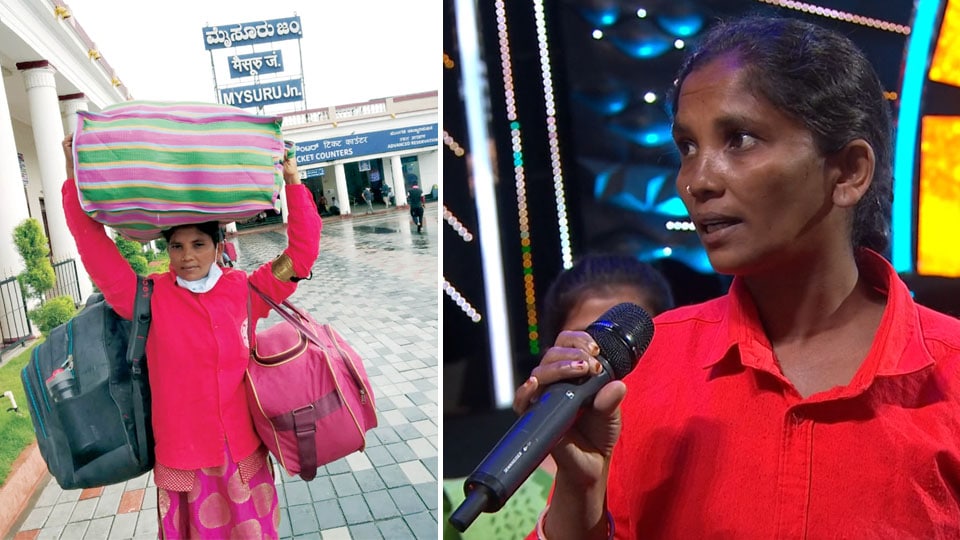
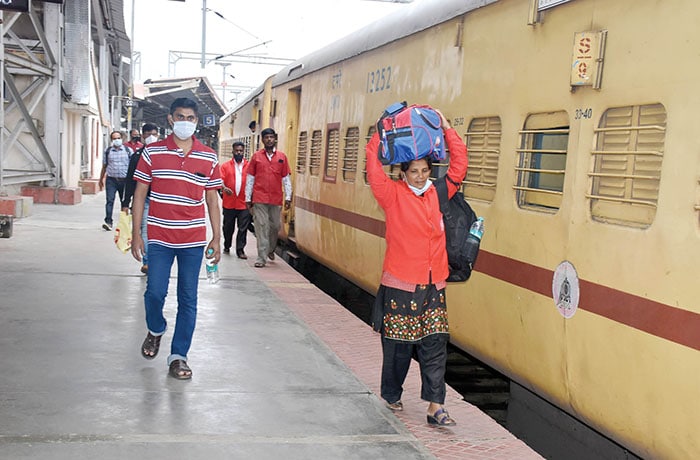
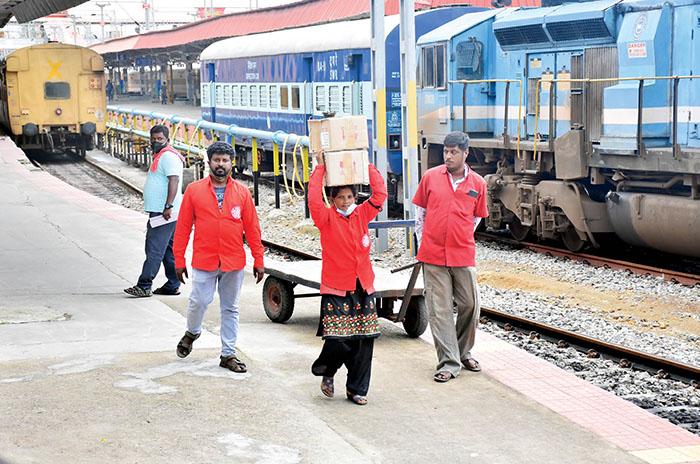
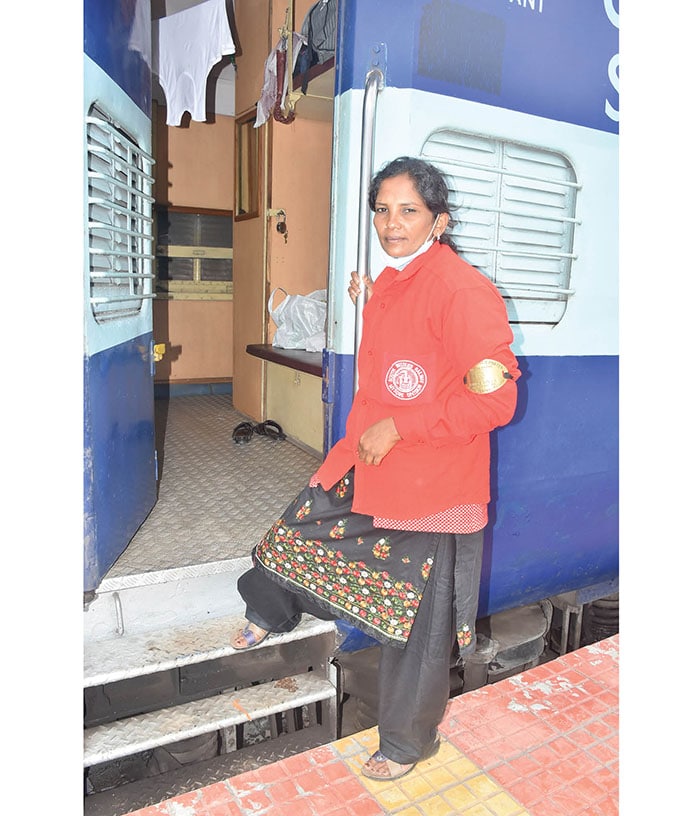
Next time when you are at the Mysuru City Railway Station, there are chances that you will come across 39-year-old Rizwana Banu, with a smiling face offering to carry your luggage. She is the only woman among the 60 porters at the Railway Station and she does the job as efficiently as the men.
Wearing Porter Badge No. 16, Rizwana has appeared on the stage of the country’s biggest singing TV reality show ‘Indian Idol’ in Mumbai on July 6 and this has made her the talk of the town. But the celebrity status has not got into her head and she still lifts passenger luggage, smiling. Her amiable approach gets her a few rupees more than the normal remuneration.
Life not a bed of roses
Rizwana lives in Shanthinagar and she lost her husband Javed Pasha in 2010. Javed was also a Porter at the Railway Station and after his death, the world came crashing on her as she had to take the responsibility of looking after the family including four children, parents and in-laws.
She was not qualified enough to get a job and she fell back on what her husband was doing for a living. Fortunately she got the job on compassionate grounds and she became the lone woman porter.
Sharing her life’s story with Star of Mysore, Rizwana said, “Initially I was scared to work amidst men as I was the only woman doing this job. I did not have friends and even passengers would ignore me thinking that I cannot carry heavy luggage. There were many depressing moments and many times I cursed myself for having been born as a woman.”
“I had no other option as I am the only bread-winner in the family on whom eight are dependent. I slowly gained confidence to work among men and even passengers started showing concern towards me. They sometimes pay extra money for my hard work. It’s been 10 long years,” she says with a sigh.
Unexpected opportunity
On appearing on ‘Indian Idol’ stage, she said that she never thought of standing on such a huge and famed stage. “Though I was not a contestant, it happened to me unexpectedly. I got an opportunity to go to Mumbai through our mesthri Jalendra. The ‘Indian Idol’ show managers were looking for a lady surviving life despite odds. Somehow they contacted Jalendra and asked me to come to Mumbai,” she said.
“I was flying for the first time in my life. After I reached Mumbai they arranged for accommodation at a private hotel. The next day I was invited on the stage and a video of my entire journey was shown to the audience. Show judges Anu Malik, Himesh Reshammiya and Sonu Kakkar praised me,” Rizwana recalled.
“Seeing the video that captured my life and struggle, everyone’s eyes welled up with tears. For me, I received the respect which I always wanted to earn. The anchor of the show Aaditya Narayan (son of singer Udit Narayan) announced that he would give me his one episode’s remuneration,” she said.
Rizwana got Rs. 1.5 lakh from the reality show. She plans to use it to clear a part of the Rs. 5 lakh loan taken for her daughter’s marriage. “Actually I watched the show and I am a big fan of contestant Mohammad Danish. But I never imagined that I would get an opportunity to be on the live stage,” she noted.
Life of a Porter not easy
“Earlier there were no lifts and escalators and porters had to carry the luggage using stairs. Now things have changed. I work 11 hours a day, from 6 am to 5 pm and whenever I have body ache, I take painkillers to be prompt at work the next day,” she said.
Lockdown was tough for Rizwana and her son sold tea to make ends meet. “I earn Rs. 300 a day, which is hardly enough but I have never complained and I am thankful to have at least this much. I love watching movies and dream of meeting the ‘real coolie’ Amitabh Bachchan one day,” she said and went about her routine.
source: http://www.starofmysore.com / Star of Mysore / Home> Feature Articles / by G. Amit Kumar / July 30th, 2021
Zareen Khan scored 461 out of 700 marks and topped the Chartered Accountancy intermediate exam conducted by The Institute of Chartered Accountants of India in the results announced February 8, 2021. Photographs: Kind courtesy Zareen Khan
Until February 8, 2021, no one knew who Zareen Khan was, where she lived or what her dreams were.
All that changed a few hours after the results of the Chartered Accountancy intermediate results were announced online this year.
Zareen, the eldest among four siblings, who had appeared for the exam in November 2020 for the first time after pleading her case with her parents, had secured an All India Rank of 1 and topped the exam scoring 461 marks out of 700.
“It was my younger sister who encouraged me to appear for the exam once. Earlier, I’d taken a break for two years to work before I could complete my post-graduation. I knew this might be the first and maybe the last time I could become a CA. So I told my parents to give me one chance to prepare and appear for this one, Zareen, who thinks she is a “little old at 25 years” tells Rediff.com‘s Divya Nair in a late night conversation over the telephone.
When the results were announced, Zareen who didn’t even have the courage to check her marks online, had to further explain to her bewildered parents what her success in the exam meant.
“My parents had no idea what CA is or how difficult it is to crack the exam,” she says while talking about how the entire neighbourhood came together to congratulate her for her achievement.
What makes Zareen’s story so inspiring is the fact that she is the first post graduate in the family and perhaps one of the few highly educated young women in Mumbra, a township on the outskirts of Mumbai, where she grew up and currently lives with her family of six.
Zareen is congratulated by her family. She lives in Mumbra with her parents, a younger sister and two younger brothers.
Growing up, Zareen, an academically bright student, was often subjected to criticism from neighbours over pursuing higher education.
“I used to score over 85 per cent and even stood second through my graduation and post graduation. Yet people would often say ‘kya kar logi itna padhai karke? Aage jake shaadi hi to karna hai,’ she recalls.
“I am sure everyone knows now that I stay in a 300 square foot one room kitchen which is shared by my parents, a younger sister and two brothers,” she says while explaining that her educational journey wasn’t a cakewalk for her.
Zareen’s father works as an auto mechanic and all her siblings equally contribute towards running the home, she informs us.
Although Zareen was aware of her family’s financial and social standing, she firmly believed that the “place, conditions or challenges you are born with doesn’t define how your future will turn out to be.”
Studying for a competitive exam like Chartered Accountancy, where the overall pass percentage is less than 25%, requires more than just academic brilliance or good coaching, she agrees.
Zareen pursued online coaching through an institute in Faridabad which provided her study material and other resources.
“In the morning, the kids would be playing outside. My mother would be cooking at home; anyone would walk in to chat or for some work. So I would wait till evening to begin my studies,” she says.
“10 pm to 6 am was perfect for me. I started in November 2019 and studied minimum 10-12 hours in the months leading to the exam and up to 16 hours a month before the exam.”
Soon after the results were out, wishes started pouring in from all over. Their humble 300 sq ft home has been bustling with well wishers, including local politicians.
For Zareen, the biggest hurdle was fighting her fears. “Like everyone else, I feared failure. I know the best of people crumble under pressure. I had only one chance. I didn’t want to fail.”
Looking back, she feels that the lockdown was a blessing in disguise for students like her.
“When the exam kept delaying from May to November, I used all the time to revise over and over again. I think this constant link between studies and revision helped me prepare better and finish the exam on time. My aim was to attempt all the questions in 3 hours, which was possible. I must have barely left out 3-4 marks.”
Zareen’s new found fame may have turned her into a mini celebrity of sorts in Mumbra. But she is unperturbed by all the attention around her.
“I am happy that people want to support me. I feel more responsible now. I want to be a positive example for compulsory higher education among girls,” she tells us.
Zareen feels that this success is an eye opener for her to chase her dreams and support her family.
“I will not lie — I wasn’t too confident of my abilities, yet I could reach so far purely because of my consistent dedication. Also, my family supported me. I really hope my story gives more women the power to dream big and fulfill them too.”
Currently, Zareen spends her time applying for articleships and wants to focus on preparing for the CA final exam scheduled for November 2021.
“Agar aap me dedication aurvishwas hai, aap kuch bhi kar sakte hai. At least ab to koi nahi bolega itna padh likhke kya karoge?” she says.
“I am the first post graduate in my family. I want to be the first CA too.”
source: http://www.rediff.com / Rediff.com / Home> Getahead / by Divya Nair / February 19th, 2021
Daughter of teacher couple ranked fifth in Madhyamik, dreams of becoming a doctor.
A girl has topped West Bengal Higher Secondary exams alone for the first time. Image Source: ABP Education picture.
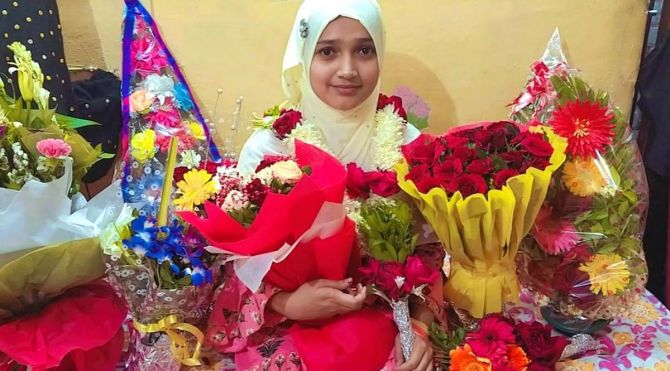
Rumana Sultana, a student of the science stream from Kandi Raja Manindra Chandra Girls’ High School from Murshidabad, has scored the highest marks in the West Bengal Higher Secondary (HS) 2021 exams.
Rumana scored 499 out of 500 marks — 99 in Bengali, 100 in English, 100 in bioscience, 100 in chemistry, 99 in physics, and 100 in maths.
“I am very happy for her. This is an all-time record. This is the first time that a girl student has topped the Higher Secondary exams alone and this is also the first time that a student from a minority community has topped the exam. We congratulate her,” said Mahua Das, the president of West Bengal Council of Higher Secondary Education (WBSCHSE), which conducted the HS exams and declared the result on July 22.
The Murshidabad girl’s dream is to become a doctor. She hopes to crack the medical entrance exam and if not she plans to study biology.
Apart from studying, Rumana loves writing poetry. She had ranked fifth in Madhyamik (Class X) 2019, scoring 687 marks.
Rumana comes from a family of teachers. Her father Rabiul Alam is the headmaster of Gaisabad Achala Vidyamandirin Bharatpur, Murshidabad. Mother Sultana Parveen is also a teacher.
Her feet firmly on the ground, Rumana regrets not being able to write the exams and does not to give too much importance to her top score. “My Madhyamik and Class XI results were good. That helped. I would say I was expecting to do well but did not expect to top,” she signed off.
Karnataka Beary Sahitya Academy has chosen nine persons with considerable achievements to their credit in their respective fields, for the honorary awards and honorary felicitations pertaining to the year 2021.
Harekala Hajabba has been chosen for his achievements in the field of Beary language and education sector. Hussain Katipalla, a famous singer, has been chosen for his contribution to the field of Beary art and literary fields. Dr E K A Siddique Addoor has been picked for enriching Beary culture and social service fields.
Honorary awards comprise Rs 50,000 cash component, felicitation, and award plaque.
Ashraf Apolo from Beary music sector, Dr K A Muneer Bava from Beary organizational sector, Mariam Fauzia B W, Beary woman achiever, Zulphi Beary from Beary Youth talent sector, Muhammed Basheer Ustad from Beary Duf field, Mohammed Faraz Ali from Beary young talent sector, have been selected for the Beary honorary felicitation. The felicitation comprises Rs 10,000 in cash, felicitation, and citation.
Academy president, Rahim Uchil, said that the awards function will be held at Shivamogga after fixing a date of the chief minister, Shivamogga district in-charge minister, and Kannada and culture department minister, after the Covid situation eases substantially.
source: http://www.daijiworld.com / DaijiWorld.com / Home> Karnataka / by Daijiworld Media News Network (SP) – June 30th, 2021
Tokyo Olympics: Anurag Thakur to launch official Team India Cheer song for Tokyo Games created by A R Rahman, Ananya Birla [Pic credits: India Today]
Tokyo Olympics: Anurag Thakur to launch official Team India Cheer song for Tokyo Games created by A R Rahman and Ananya Birla – The Indian Olympic Association will launch the official l Team India Cheer song for Tokyo Games created by A R Rahman and Ananya Birla on Wednesday at 3.30 PM. Sports Minister Anurag Thakur (Union Minister of I&B and Youth affairs, Sports Minister) will launch the official song in presence of IOA President Narinder Batra, Rajeev Mehta (IOA secretary) and MoS for home, Youth affairs and Sports Nisith Pramanik. The event will live stream on Team India and SAI.
Music maestro AR Rahman has teamed up with young singer Ananya Birla to work on ‘Hindustani Way’, a song that aims to boost the morale of Indian players who are all set to participate in Tokyo Olympics 2020.
“All of us are really excited to have made this special song and hope our athletes can feel the entire nation rooting for them, the Hindustani way, when they hear it. It was a pleasure working with Ananya on this project and we hope to convey all our support and best wishes to Team India through it! Jai Hind,” Rahman, who has composed the track, said.
Tokyo Olympics: Anurag Thakur to launch official Team India Cheer song for Tokyo Games created by A R Rahman and Ananya Birla
The track is jointly written by Ananya, Nirmika Singh, and Shishir Samant.
Expressing happiness on singing such an inspiring song, Ananya said, “It is a true honour to write and sing a song to cheer our Indian Olympic contingent at Tokyo 2020. The grit and fortitude of the Indian Olympic team in the face of such a challenging year is inspiring.”
“It was surreal to have had the opportunity to collaborate with my role model, AR sir on such a prestigious project, from whom I have learnt so much. We are here cheering, the Hindustani Way,” she added.
The Tokyo Olympics will be held from July 23 to August 8. The event was slated to be held last year, but it had to be postponed due to the COVID-19 pandemic.
#Cheer4India | Launch of The Official Team India Cheer Song for Tokyo 2020
(with ANI inputs)
source: http://www.insidesports.co / Inside Sport / Home> Latest Sports News / by James Kuanal / July 13th, 2021
Noor Ayesha, Founder-CEO, Iqra International School
“Women should give themselves a chance, there’s so much that they are capable of, we need to leave behind a legacy and contribute to our ummah and the world at large.”
Noor Ayesha is an award-winning educator, an empowering leader, a mother of three, and the founder of a school that nurtures more than 650 children. Iqra International School – awarded the ‘Most Promising school for Quality Education in Bangalore’ was founded by Noor Ayesha with the aim of delivering value-based education in order to cultivate in each child, the aspiration to ‘learn and live values’.
“To be a great leader, you have to be a great reader,” says Noor Ayesha. She believes that Muslims moved from the golden age to the “dust age” due to the gradual fading of value-based education guided by Islamic principles.
Noor Ayesha was conferred with the Rashtriya Shiksha Ratan Award by The Indian Society for Industry and Intellectual Development and the ‘Fakhr-e-Watan’ Award for her academic and social services. She has been a speaker at the Eldrok Summit 2019, Early Childhood Association Summit 2019, Asia Education Summit 2016, Asia Leadership & Services Awards 2016, and at various MFERD conferences. She has also been chosen as the Global Goodwill Ambassador of India for Global Goodwill Ambassadors (GGA).
She believes that one must always have goals – professional, personal, and spiritual. “When you have determination and passion, Allah makes ways. Always,” she says.
Ayesha, along with her team at IIS has disproven the prejudiced notion that the niqab and hijab are obstacles to development and that veiled women are incapable. “We are proof that Muslim women are no less than anyone,” she asserts. She also strongly believes that there is “no shortage of capacity in the Muslim society but there is a need to unearth it and move forward.”
She efficiently managed the school single-handedly for many years, with the support of her team, comprising only of women. “Many of them who thought nothing of themselves are now leading the institution and representing Iqra at various conferences.” Ayesha gladly affirms. “Women should give themselves a chance, there’s so much that they are capable of, we need to leave behind a legacy and contribute to our ummah and the world at large.”
She points out that the inherent flaws in the existing education system have resulted in educated individuals leading privileged lives but vehemently failing in giving back to society, which she believes is the primary purpose of education. At Iqra, students are instilled with a sense of responsibility towards society, along with the quality education they acquire.
Iqra International School is a dream come true for Ayesha’s father, who has always envisioned being able to educate the children of the community. “We felt that a mosque’s imam would be better at his role of a leader if he was additionally equipped with worldly knowledge,” she explains. The school was set up as a result of Ayesha’s commitment to fulfilling her father’s dream and the dire need for a school that would nurture students with Islamic values along with quality education, with the added advantage of facilitating students with a campus that is within the city.
The school was conferred with the ‘Best Innovative International Preschool in Bangalore’ award at the Asia Education Summit & Awards 2016, the ‘Most Promising School for Quality Education in Bangalore’ award at the Asia Leadership and Services Awards 2016, ranked No.1 in India for “Individual Attention to Students” at the India School’s Merit Awards 2016, ranked No.1 in India for ‘Holistic Development’ at India’s School Merit Award 2017, awarded Excellence in Flexible Education Programme at The India K12 Awards 2019, declared “Brand of the Year” in National Brand Awards 2019, and was conferred with the International School Award 2019-2022 by the British Council.
“As a school, we are in no competition with any other Islamic schools, as we are all working towards the same beautiful cause – ‘nurturing children to learn and live Islam’,” Noor Ayesha asserts. “We just do our very best and leave the rest in His (God’s) hands.”
Iqra International School provides quality education with the IGCSE curriculum, seamlessly integrated with the QIAS (Quran, Islam, and Arabic Studies) curriculum. They also have an intensive hifdh program for students who perform exceptionally well in the Quran classes. The school also has 25- 30 students from other faiths, who have no problem with learning the Quran, the Arabic language, or using the Islamic salutation of peace.
“Alhumdulillah, two years ago, 3 of our brilliant students became huffadh. All 3 students were excellent in the IGCSE academics as well. I must also mention how good they were at football. Most of our football championships were won with two of them scoring the highest goals. Pursuing religious knowledge only makes it easier to become brilliant at gaining worldly knowledge. A balance between the two could be gained and this was proven by these children who made it possible,” she narrates.
The majority of Iqra’s staff have their own children studying at Iqra. “Even before a problem gets addressed by parents we would’ve already found a solution to it or in many cases solved it because we are all mothers ourselves with our own children studying at our school”, Ayesha says.
They also make sure students get ample exposure to other global cultures and beliefs by conducting inter-faith programs, inter-school competitions, Mock United Nations (MUN), and other such activities.
Before establishing Iqra, Ayesha conducted extensive research in the field of international education, particularly Islamic education, including the works of Dr. Dawud Tauhidi’s Tarbiyyah project that elaborates the purpose of Islamic education – its ideal impact and practicality.
“It’s not just the name ‘international’, our school has been international in all aspects from day one, from the research to the books and the curriculum,” she says.
The project has been completely funded by her father, from its inception until recently. Ayesha explains that the biggest challenge they faced was the difficulty in finding experienced teachers. In order to solve this, they set up ISTARI (Iqra Staff Training and Research Institute), as a result of which, they’ve been able to train and hire passionate and well-trained teachers.
“The trust and support from our school parents and the entire Iqra community, in general, has been immense right from the beginning, and that has helped Iqra reach wherever it has today, Alhumdulillah,” she contends.
Currently, Noor Ayesha is the Founder-Managing Director at Iqra International School, Director at Fantasy Group, Founder & CEO at OURAH, Director at Iqra Games Village, Director at the Centre of Integrative Medicine and Clinically Applied Hijamah Therapy(ICAHT), and Vice-Chairman in the Universal Educational Trust.
She is also the Member of the Advisory Board at Aspire Residential Public School, Kochi, Patron Principal at Early Childhood Association (ECA), Member of the Advisory Board at Eastern Public School, Bhopal, Member of the Islamic Educators Communication Network operated by Islamic Schools League of America (ISLA) and Council of Islamic Schools in North America(CISNA).
She completed her schooling in Baldwin Girls’ High School, Bachelor in Computer Science Engineering from Visvesvaraya Technological University, and MBA in HRD and Project Management from Cardiff Metropolitan University, Wales UK. She is currently pursuing her Doctorate in Educational Leadership and Policy from July 2021 at the University of Toronto, Canada.
source: http://www.thecognate.com / The Cognate / Home> People> Rushda Fathima Khan / July 12th, 2021
Television actress Aalika Shaikh, who rose to fame from Star Plus show ‘Mann Kee Awaaz Pratigya’, is seen as Kesar in the second installment of the popular drama series.
She has been a part of the industry for almost a decade now and has starred in shows like ‘Tumhari Pakhi’, ‘Tum Hi Ho Banhu Sakha Tumhi’, ‘Pardes Me Hai Mera Dil’ and more.
While Aalika has finally gained fame and appreciation for her work, her journey has proven to be an uphill battle.
Aalika Shaikh had to choose between her acting career and her conservative Muslim family.
The actress, who decided to go against her family’s wishes and pursue a career in showbiz, shares, “I changed my name because of my family, I never had any mental or financial support from them.”
“I changed my name because I come from a Muslim family and in my family girls get married at a very early age. I neither wanted to choose that path nor did I want them to be answerable to people who they thought they would be accountable to, so I changed my name,” she adds.
The actress made her debut with a play on Doordarshan.
She reveals that she first started her career as a real estate investor. However, Aalika, at a friend’s behest, decided to try her luck in acting and gave an audition for ‘Air Hostess’. She was selected for the role of Pia and received a lot of praise for her enthralling performance.
Talking about how difficult it was to follow her dreams, Shaikh says, “It was challenging for me at first because I didn’t have a godfather in the sector and didn’t know anyone who worked in it. It was challenging to carve out that space, get my name out there and have people recognise my work, but once you get into the swing of things, people come out in droves to support you as friends and it becomes a bit easier emotionally and mentally to fight harder and live your dreams.”
Even amidst the personal turmoil, Aalika says that she never felt like giving up on her career.
“When I had detached from my family I tried to focus on work as much as possible, tried to discover new projects and my desire to be successful and recognized kept me going,” she says.
Shaikh reveals that her family eventually reached out to her and they decided to sink their difference.
“My family had contacted And I have accepted them and so have they. All this while, I have been supporting (financially) them,” reveals Aalika.
Asked if all of this has affected her faith in Islam, Aalika states, “I was born into a Muslim household and am a practising Muslim who offers namaz on a regular basis, yet I am a very liberal person who respects other religions. That isn’t to say I don’t respect or believe in other religions… I do, and more than that I believe in and follow the religion of humanity.”
Aalika, who is in a live-in relationship with Rohin Robert and often shares loved up pictures with her beau, seems unperturbed by trolls.
The actress says, “I wouldn’t say much about the trolls or assaults because everyone has their own life choices and rules. So, I choose to stay grounded and I am pretty much proud of the choices I’ve made in life relating to work and profession.”
When asked if she has an advice for aspiring actresses who are afraid of pursuing a career in acting, Aalika says, “I won’t be able to send a message to young girls who are afraid to pursue their dreams because of their family or religion as everyone has different circumstances in life that forces them to make decisions and take steps.”
“I just have one piece of advice: If you truly want to achieve something from the heart, don’t give up,” she concludes.
source: http://www.freepressjournal.in / Free Press Journal / Home> Television / by FPJ Web Desk / July 10th, 2021
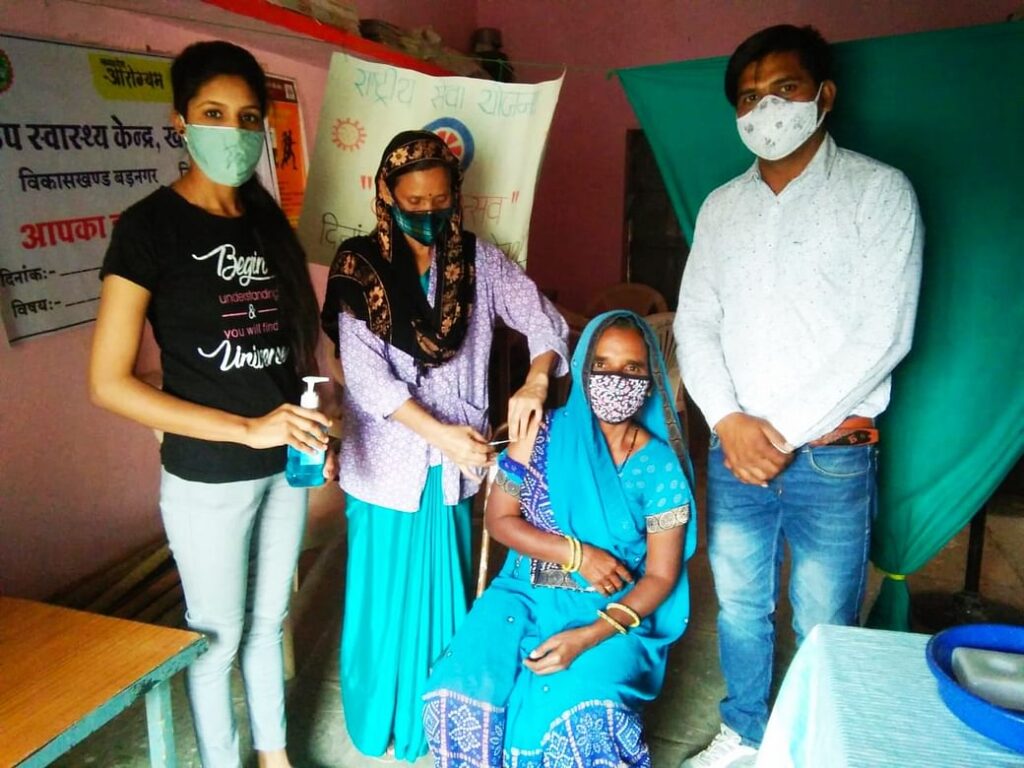
NSS programme officer Dr Rehana Sheikh said that due to the initiative of the students many people came forward for vaccination.
NSS volunteers of Bhartiya College present at the Corona Vaccination Centre along with villagers FP PHOTO
Ujjain:
During the Tika Utsav, the girl students of the NSS unit of the Bhartiya College spread awareness on Covid-19 vaccine among people in the rural and urban areas of the district.
They toured Kharsodkhurd, Lekoda, Javasia, to make people aware about the importance of vaccination and provided information about their nearest vaccine centre.
B Sc student Seema Sediwal said that we helped many people get rid of misconceptions about vaccination.
BA student Pooja Patel lead the residents of village Lekoda to the nearest vaccine centre.
B Com student Anjali Porwal told that people in the Mahakal Vanijya area said that they are waiting for the people around them to get vaccinated.
Porwal asked them to lead from the front, get vaccinated and then encourage people around them for getting jabs and contribute in the fight against corona.
NSS programme officer Dr Rehana Sheikh said that due to the initiative of the students many people came forward for vaccination.
source: http://www.freepressjournal.in / Free Press Journal / Home> Indore / by FP News Service / April 17th, 2021