Subia Parveen, a student of class 10th of Jamia Senior Secondary School has been selected for Kennedy-Lugar Youth Exchange and Study (YES) scholarship, sponsored by the U.S. Department of State.
She will be getting 28 thousand US Dollar scholarship to study for a 10-month duration programme in U.S. The programme will be held from August 2019 to June 2020.
Subia is the eldest child of Mr. Kalimuddin Ahmad, an electrician working in Jamia. She has been studying in Jamia from nursery class and is a very bright student. She appeared in class 10th board examination this year and is very hopeful that she will top the list. She had received several prizes in education and co-curricular activities in the school and outside too. Her aim is to become a scientist.
Registrar, JMI, Mr. A.P. Siddiqui (IPS) congratulated Subia on her achievement and said, “The selection process for this programme (YES schorarship) has been very competitive and its a proud moment for both Subia and Jamia”.
Kennedy-Lugar Youth Exchange and Study (YES) program was established in October, 2002. The Bureau of Educational and Cultural Affairs of the U.S. Department of State, along with the U.S. exchange community, recognized the importance of youth exchange as a key component to building bridges between citizens of the U.S. and countries around the world, particularly those with significant Muslim populations.
source: http://www.milligazette.com / The Milli Gazette Online / Home> Online News> Community News / by Press Release , JMI / April 06th, 2019
The decision by the Indian Muslims Association of Greater Houston( IMAGH) to become a Welcome Partner for the community reception to Prime Minister Narendra Modi is another step by IMAGH to rise above divisive politics in solidarity with other Indian-American organizations.
It was a unanimous decision by the IMAGH Board of Directors and the Executive Committee to be part of the organizing committee. Some 50,000 people have registered to hear Prime Minister Modi in what will be the largest audience in the US for a visiting foreign leader other than the Pope. 612 organizations have registered so far to be the Welcome Partner and the online registration is still open on howdymodi.org . Over 1,000 volunteers are working tirelessly to make the event a grand spectacle for the Houston community.
“The mission of IMAGH is to foster unity across cultures, communities and religion. We can only work toward this goal by engaging with all groups. We may not agree with their beliefs, practices or ideas but unless we interact with them in a cordial and friendly atmosphere, we cannot get our point of view across to them,” said Dr. Maqbool Haq, Chairman of the IMAGH Board of Directors.
Alluding to plans by a section of the people to stage a protest at NRG Stadium where Prime Minister Modi will be addressing the community on September 22, Dr Haq said,” We feel, we should try to have a seat at the table to present our views rather than not be at the table.”
Latafath Hussain, founding president of IMAGH, said, “I am very proud to be both an Indian and a Muslim. Growing up in Varanasi (Modiji’s constituency), I always felt that I had the same opportunities as everyone else. So when the duly elected leader of mother India comes visiting my adopted home town, it is my duty to give him a warm welcome.”
In a major outreach effort three months ago, IMAGH invited Ramesh Bhutada, national vice president of the Hindu Swayamsevak Sangh in America to be the chief guest at the organization’s signature event to celebrate Muslim festival of Eid al-Fitr, opening a new door for Hindu-Muslim cooperation in Houston and beyond.
Bhutada was forthcoming in his speech and received standing ovation by over 500 people at the event. He introduced himself as vice president of Hindu Swayamsevak Sangh, which is an independent US organization that takes inspiration from RSS in India and declared: “The RSS and the HSS would like communal harmony and unity among all religions.”
He quoted RSS chief Mohan Bhagwat, “India’s development cannot be complete without the development and progress of the minorities.”
Bhutada said: “We all have historical baggage — let’s acknowledge that — but we cannot look backwards. We have to look forward and that is the only way we can lead a peaceful life in this world.”
Hussain thinks that in order to move forward we must understand that we may be Hindus or Muslims or Christians but we are primarily Indian and are “part and parcel” of the Indian community in Houston. “In the community, there are, as there should be, political differences, but that’s for private debate. In front of the larger Houston and American community, we have to stand as one.”
Vijay Pallod, who is on the boards of IMAGH and Hindus of Greater Houston (HGH), says that both the organizations are unique in their role to carry out their missions with respect and understanding for each other.
The close cooperation between Hindu and Muslim organizations dates back to September 2010 when India Culture Center, an umbrella organization of various Indian groups, decided to host an Eid Milan party in collaboration with Indian Muslim groups. The joint event was an instant success and led to creation of IMAGH to foster amity across cultures, communities, and religions.
“We, in Houston, are proud to have a united happy community that respects interfaith customs and traditions by participating and celebrating Diwali, Holi, Eid, Christmas and Baisakhi,” said Col. Raj Bhalla who was the Event Chair of the Eid Milan party in 2010.
Talking about the joint event, Swapan Dhairyawan, president of Houston ICC in 2010, said, “This interaction and pollination has led to several positive and healthy relationships not only among individuals but also between organizations.”
India’s present Consul General in Houston, Dr. Anupam Ray, also helped in promoting cooperation by hosting an Iftar party in the fasting month of Ramadan for the past four years where people professing different faiths and nationalities were invited to break the fast with Muslims at the end of the day.
Although these efforts may appear to be the feeble first steps, the Houston community is showing its determination to move forward as ONE.
source: http://www.indiacurrents.com / India Currents / Home> Latest – Community / by Haider Kazim / September 14th, 2019
Feroz Shah Tughlaq (Reign 1351 – 88), the third ruler of the Tughlaq Dynasty was embarked on a vigorous campaign of construction activity, consisting mainly of public buildings of utilitarian nature.
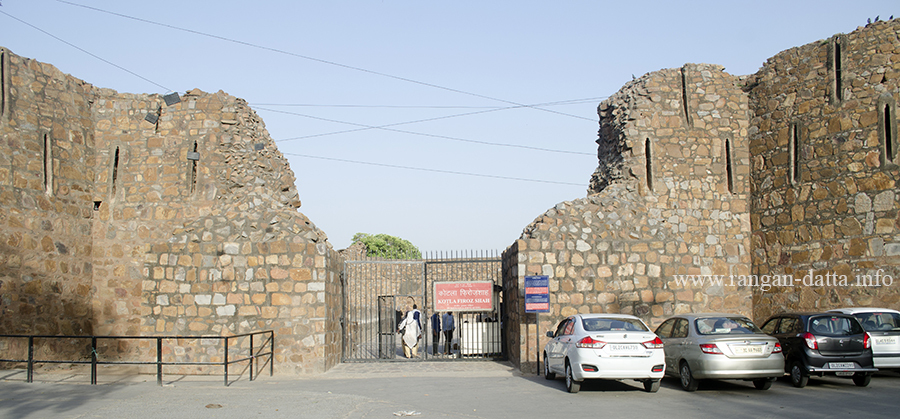
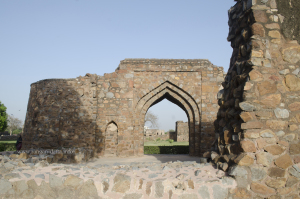
Gate of the citadel of Feroz Shah Kotla or Firozabad, Delhi
He made 1200 garden around Delhi and is credited with the erection of 200 towns, 40 mosque, 30 villages, 30 reserviors, 50 dams, 100 hospitals, 100 public baths and 150 bridges
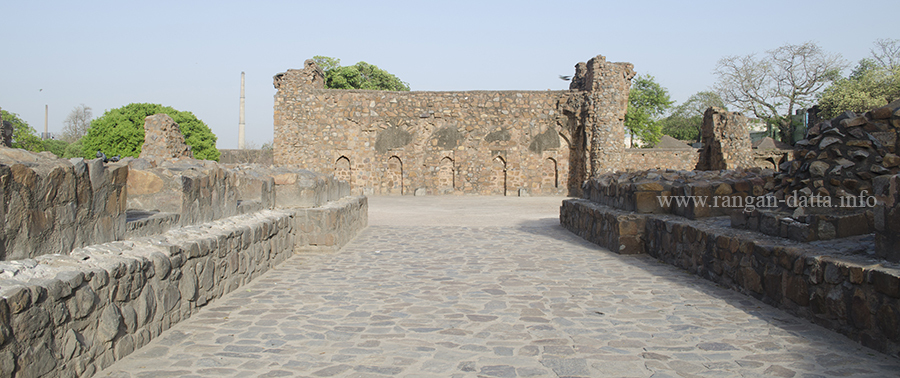
Passageway leading to the interiors of Feroz Shah Kotla or Firozabad, Delhi
In 1354 Feroze Shah Tughlaq built Feroz Shah Kotla or Firozabad, the fifth citadel of Delhi. His predecessors Ghiyasuddin Tughlaq (Reign: 1321 -25) and Muhammad bin Tughluq (Reign: 1324 – 51) has the credit of erecting the third and fourth citadel of Delhi.
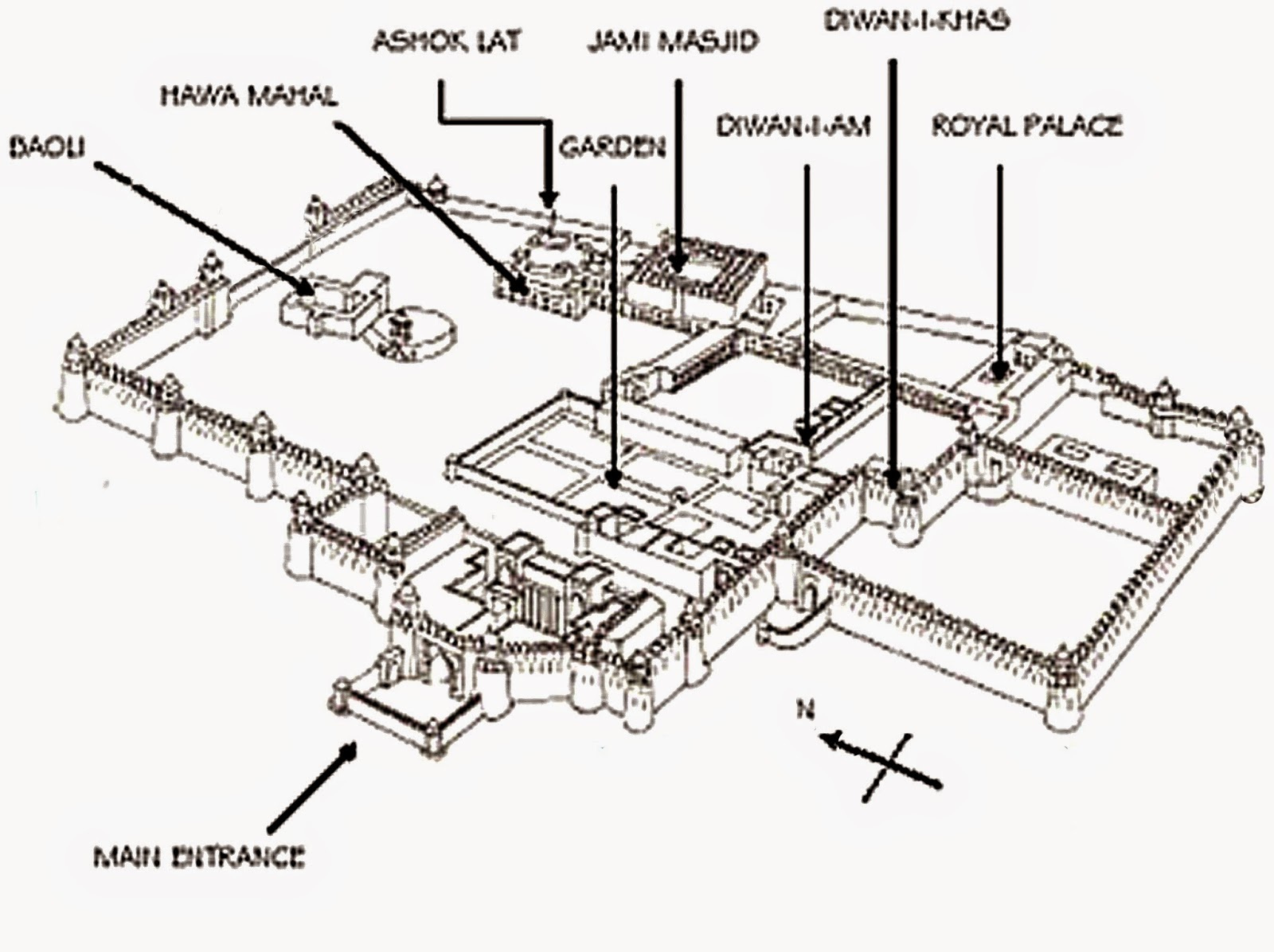
Plan of Feroz Shah Kotla or Firozabad (Source: http://www.pixels-memories.blogspot.in)
Tughlaqbad, the third citadel of Delhi, along with Jahanpanah, the fourth citadel of Delhi were abandoned because of acute water shortage. This lead Feroze Shah Tughlaq to move further north and to construct its citadel along the west bank of Yamuna River.
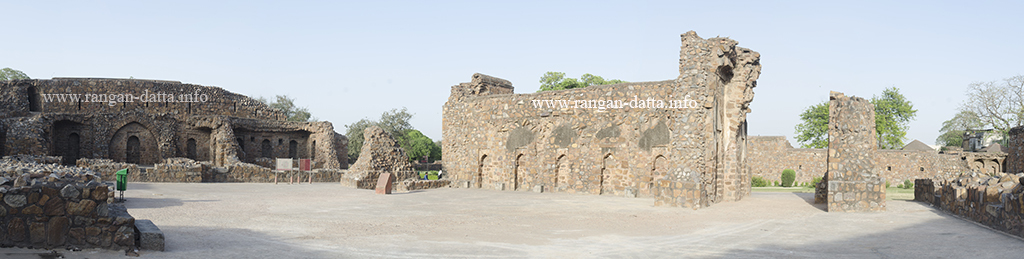
Panoramic view of the ruins of Feroz Shah Kotla or Firozabad, Delhi
Unlike Tuglaqabad, Feroz Shah Kotla lacked the defensive construction and after the collapse of the Tuglaq empire the Mongol invader Timur found it an easy target. In 1398 Timur gladly carried out all the riches of the citadel leaving behind the ruined rubble structures, which was again plundered and reused by Shahjahan (Reign AD 1627-57) for the construction of Shahjanabad, the seventh and last ancient citadel of Delhi.
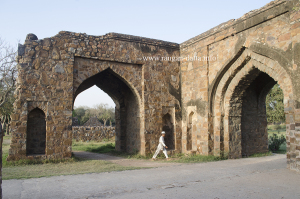
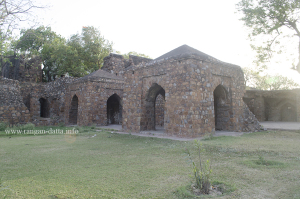
An arched gateway, Feroz Shah Kotla, Delhi
Despite being plundered by several rulers in the past and with centuries of neglect Feroz Shah Kotla still houses several interesting ruins, although minimalistic in nature, they still reveal the former glory and splendor of the ancient citadel.
Today the ruins of Feroz Shah Kotla nestles between the cricket stadium, of the same name, and the Ring Road. Every Thursday thousand of visitors visit the ruins of the ancient citadel.
Strangely these visitors are not history or heritage enthusiasts but are devotees looking for the blessings of Djinns, who according to legend are residents of the ruins of Feroz Shah Kotla. No wonder Delhi has always been a “City of Djinns.“
Djinns live in the heart of Delhi: they are spirits tending to the faithful seeking help. On Thursdays, they are busy when thousands turn up with letters for them.
A kid makes his way through the arched gateways of Feroz Shah Kotla, Delhi
Every Thursday hordes of devotees, irrespective of religion, visit the ruins of Feroz Shah Kotla with photocopies of letters, citing there problems. They stick the letters on different strategic spots of the citadel and offer prayers to the Djinns.
Strangely the concept of letters to the Djinns has only been an recent concept in the ancient citadel, which dates back to the 14th century.
The first records of people coming to Firoz Shah Kotla in large numbers began shortly after the emergency of 1977.
It was only in 1977, a few months after the end of the Emergency, that we have the first record of people starting to come to Firoz Shah Kotla in large numbers. This seems significant, given how destructive the Emergency was for the Old City and how many poor and working class people were displaced from the Old City to resettlement colonies across the river
Anand Vivek Taneja, Anthropologist
Ruined structures of Feroz Shah Kotla, Delhi
Even on other days large groups of Muslim devotes visit Feroz Shah Kotla to offer their Namaz at the Jami Masjid, one of the few structures of the citadel that have remained, more or less, intact to this day.
Designed by Feroz Shah Tughlaq’s state architects Malik Ghazi Samana and Abdul Haq the citadel of Feroz Shah Kotla follows a rectangular plan with dimensions 800 m by 400 m, with the longer side along the north – south axis.
The entire citadel is encased within a high stone wall. Although the walls look solid but it lacks the massive bastions of Tuglaqabad. The entrance is through a small and simple gateway on the eastern side and a broad passageway leads to the scattered ruins of Feroz Shah Kotla or Ferozabad
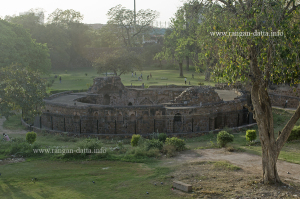
Circular Baoli (Stepwell) at Feroz Shah Kotla
Most of the buildings within the citadel are made of rubble masonry covered with heavy plaster and without any surface ornamentation.
The passages leads to series of scattered ruins, which was once part of the citadel’s garden.
It leads further to the Diwan – i – Am (hall of audience) and Diwan – i – Khas (hall of private audience).
A few pavilions and archways are all that remains today of the famed halls of audience of Feroz Shah Tughlaq. The Royal Palace located at the far end of the citadel lies in similar ruined condition.
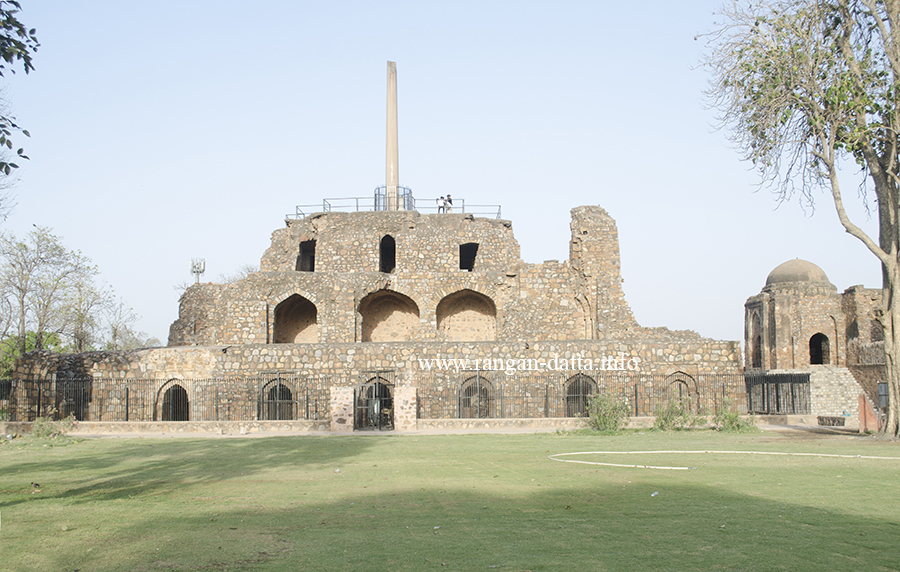
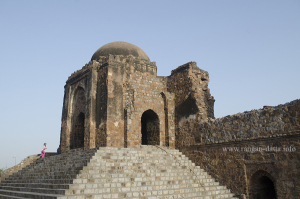
Stepped pyramidal structure, crowned with the Ashokan Pillar, Feroz Shah Kotla, Delhi
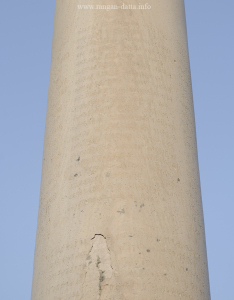
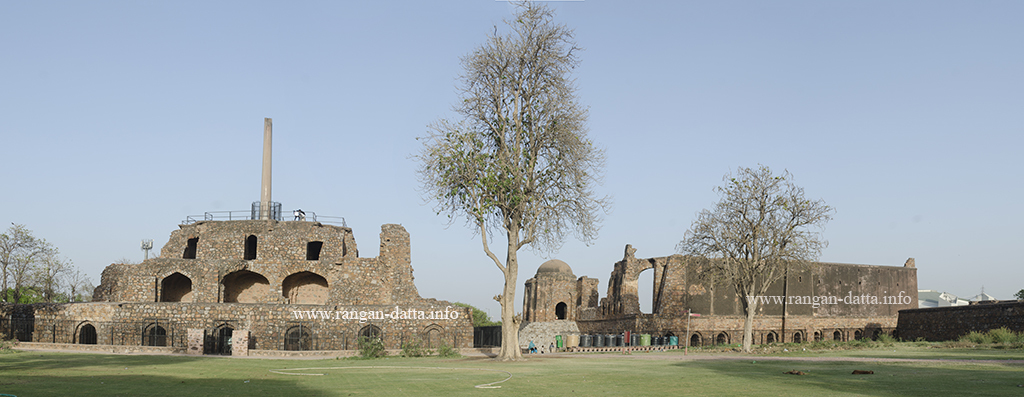
The more intact and interesting structures of Feroz Shah Kotla are located on its northern side. Towering above the lawns is the massive Jami Masjid and towards its left is the stepped pyramidal structure, known as the Hawa Mahal or Kushk-i-Shikar. It is crowned with the Ashokan Pillar, also referred as the Minar-e-Zarreen.
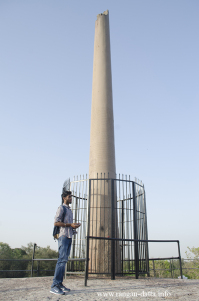
Ashokan Pillar, Feroz Shah Kotla
Just in front of the stepped pyramidal structure is a baoli (stepwell).
Delhi is no stranger to Baolis and even a century ago more than a hundred of them existed in Delhi.
Inscription on Ashokan Pillar
Today more than a dozen remains (Also see: Baolis of Delhi) but what makes the Feroz Shah Kotla baoli unique is its circular shape. It is the only circular baoli in Delhi. Sadly the baoli is kept under lock and key and the interiors are out of reach for the common tourist. But the baoli is best viewed from the differnt levels of the nearby stepped pyramid.
Domed Pavilion at the entrance of Jami Masjid
The Hawa Mahal is a three tired stepped pyramid with diminishing floors. Built with a central solid core and vaulted cells around it. Stairs at the comers lead to the uppermost terrace where the Ashokan pillar is planted.
The Ashokan Pillar was shifted from Topar in Ambala by Feroz Shah Tughlaq and placed atop the Hawa Mahal.
The 13 m high 27 ton pillar was shifted on a custom built 42 wheel carriage operated by 8400 men, which transported it to the banks of Yamuna River. From where it was transported by boat to Feroz Shah Kotla in Delhi
Incidentally Delhi contains another Ashokan Pillar, which was also shifted by Feroz Shah Tughlaq and placed near his hunting lodge on Delhi’s North Ridge, also known as the Kamala Nehru Ridge. (Also see: Historical Trail along Delhi’s North Ridge)
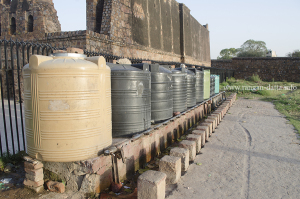
Tanks, along Jami Masjid, for ritual wash
The structure is open to public and one can take the stairs all the way to the base of the pillar. The pillar still maintains its shining police and the inscriptions in Prakrit are clearly visible.
According to popular belief Laat (pillar) Waale Baba, the chief of the Kotla djinns, dwells in the Ashokan Pillar, which is also referred to as the Minar-e-Zarreen. Every Thursdaay devotees ties up their wish letters on the railing surmounting the Ashokan Pillar.
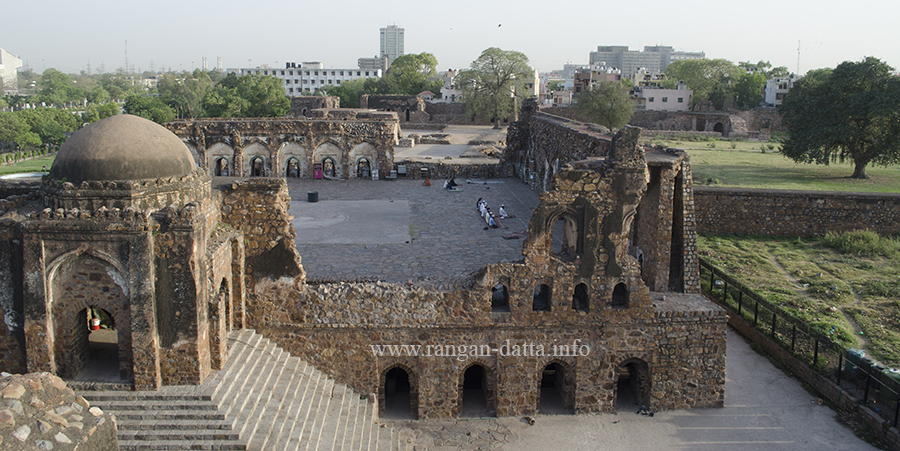
The top story of the Hawa Mahal offers grand bird eye view of the circular baoli (stepwell) and also the Jami Masjid, which lies on its southern side.
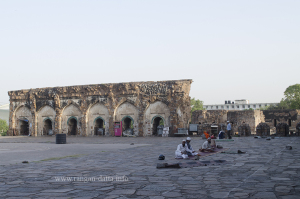
Namaz being offered at the Jami Masjid, Feroz Shah Kotla, Delhi
South of the Hawa Mahal lies the gigantic mosqque of Feroz Shah Kotla, the Jami Masjid. Built of Delhi quartzite stone. During the time of its construction it was the largest mosque in India.
The mosque rests on a series of cells on the ground floor and is approachable by a long flight of stairs leading to a domed pavilion gateway on the northern side. The grand dome pavilion, which once stood at the centre of courtyard has long vanished.
Even Taimur, who plundered Feroz Shah Kotla, was so impressed with the mosque that he commissioned a similar one in his capital Samarkhand. Even Shah Jahan constructed a underground tunnel connecting the Jami Masjid to his newly constructed citadel of Shahjanabad. The tunnel still exist but is sealed for obvious reasons.
Grand view of the Jami Masjid, from Hawa Mahal, Feroz Shah Kotla or Firozabad, Delhi
Strangely the Jami Masjid is still an active mosque and attracts thousand of devotees during the time of eid. Even on normal days large groups of local Muslims along with Muslim office staff from nearby offices drop in for there daily namaz.
Panoramic view of Stepped Pyramid Structure and Jami Masjid, Feroz Shah Kotla or Firozabad
Colourfull plastic tanks, along the eastern wall of the ancient mosque, serve as a makeshift ritual wash (wudu) area for the devotees, who drop in to offer namaz.
Just outside the citadel of Firozabad or Feroz Shah Kotla, on a road divider lies the notorious gateway of Khooni Darwaza.
Hyderabadi Takbir Fatima is an architect, engineer and educator who is always on the lookout for projects that challenge her.
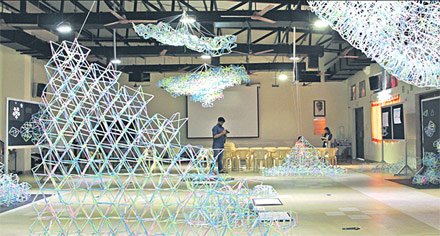
As part of Hyderabad Design Week, Takbir Fatima from Designaware is doing a series of workshops and installations leading up to the event. She is in the city to conduct workshops on design. “We’re experimenting with crowdsourcing the design process to bring together many minds to create something collectively.
Under the theme of Humanizing Design for Hyderabad Design Week, we are crowdsourcing through multiple activations leading up to the event, involving students, young designers, architects and children in designing installations and public art for Hyderabad,” says Takbir, who has completed her BArch from CSIIT School of Architecture & Planning (JNAFAU), Hyderabad, and an MArch (Architecture + Urbanism) from the Design Research Lab at the Architectural Association (AA) School of Architecture in London.
Born in Hyderabad, Takbir was shuttling on and off between Saudi Arabia and Hyderabad. She was inspired by one of the greatest architect in Hyderabad sparking her interest in the profession.
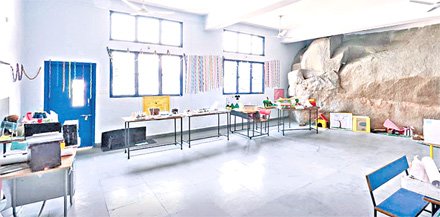
Highly creative, she has handled some challenging projects at a very low cost. One such project was a hilltop school located in Golconda. She explains, “Bright Horizon Academy is a charity school. The challenge was the Golconda fort, which has an outer wall and inner wall, which is a part accessible to the public.
The outer wall has a very old settlement as old as the fort. All these houses share a common wall. Everything is on a hill, so for this particular site we had to completely sheer rock and boulders. Half of the site was on the upper part of the cliff and half made up the lower part. It was quite challenging to navigate the terrain.
And budget was an issue as it was a charity school. We designed a building which uses low energy as much as possible, and with lot of windows and natural light in the centre. There is sunlight and natural ventilation in every part of the building. It has been awarded the silver rating by the Indian Green Building Council in 2018.”
For most of her projects here, Takbir follows Vastu in residential and commercial properties. “If the client is not particular, we do recommend the vastu, as the property will have a resale value,” says Takbir who was given the Telangana Young Architect award by the Indian Institute of Architects in 2016 and was also recognised as Emerging Architect of the Year by NDTV Design & Architecture Awards 2016.
Takbir feels that now there is lot of opportunities for design aspirants and she aims to bring design to as many people as possible. She wants to do away with the misconception that design is not affordable and not for common people. Currently, her company is handling a few residential projects, restaurants, series of workshops, etc.
source: http://www.telanganatoday.com / Telangana Today / Home> Personalities / by Madhuri Dasagrandhi / September 11th, 2019
Surat , GUJARAT / Bombay (now Mumbai) MAHARASHTRA / London, ENGLAND :
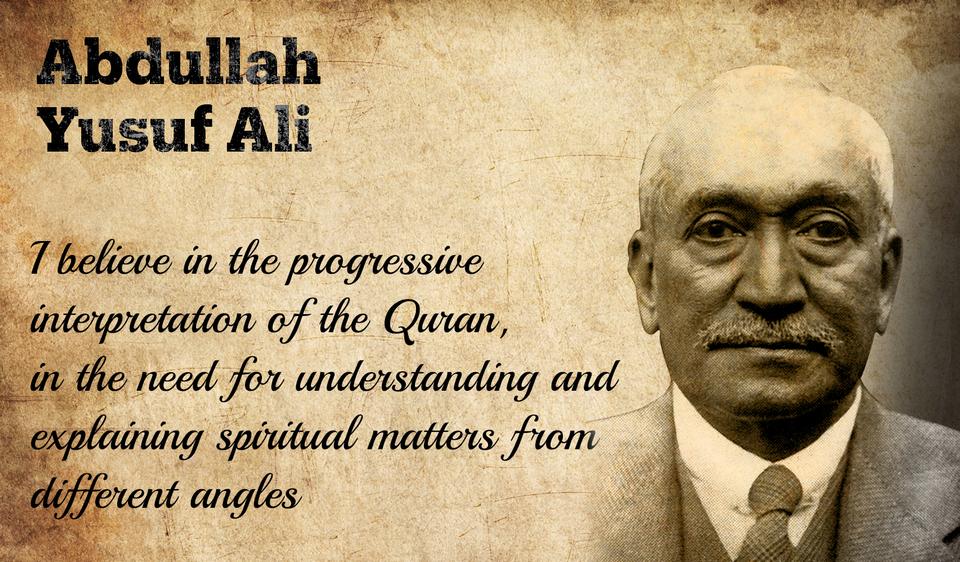
Abdullah Yusuf Ali wrote perhaps the most famous translation of the Quran but he also supported the British against the Ottomans and died a lonely man.
On a frigid December morning in 1953, a policeman found a half-conscious old man slumped on a street bench in the Westminster area of London. He was in a delirious state and died a day later on December 10. Ali
That man was Abdullah Yusuf Ali, the famous 20th-century translator of the Quran. He died alone, homeless, and with no one by his side. When the news reached Pakistan’s embassy in London, it dispatched someone to pay for his last rites.
“It pains me to think that so able and eminent a gentleman should have met with so pathetic an end,” Mirza Abul Hassan Ispahani, Pakistan’s High Commissioner in London, wrote in a letter to his prime minister two days later.
Generations of Muslims in English-speaking countries have grown up reading Yusuf Ali’s interpretation of the Quran. More than 200 editions of it have been published so far, making it perhaps the most read commentary in any non-Arabic language.
“Ask any English-speaking Muslim what translation and commentary of the Quran they originally studied, and the chances are that it was the one by Abdullah Yusuf Ali,” writes a commentator.
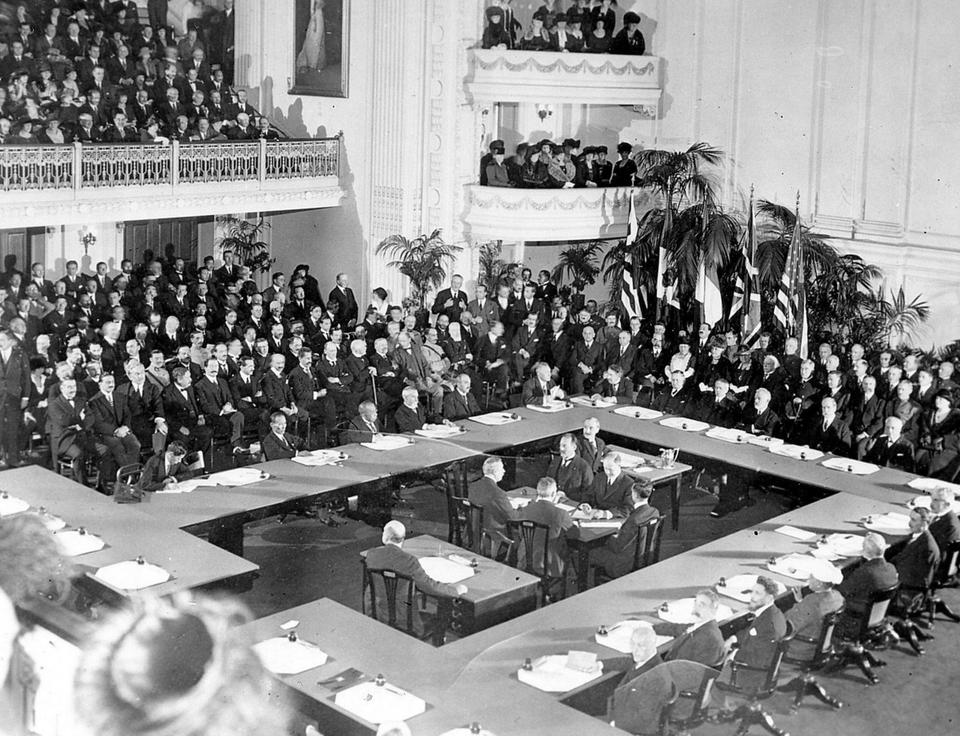
Yusuf Ali’s work and affiliations solidify his place as a giant of his time. He was one of the most senior Muslim civil servants during the British Raj, rubbed shoulders with the likes of Mohammad Ali Jinnah and the Aga Khan, inaugurated the first mosque in Canada, represented India at the Paris Peace Talks in 1919, was a trustee of London’s oldest mosque, and a known educationist. He was also a prolific writer on Islam.
But how did a prominent Muslim like him meet such a terrible end? Why was he forgotten so quickly?
A child of his time
In 1915, during World War I, the British faced a dilemma. Nearly half a million soldiers were Muslims from the Indian Subcontinent — modern-day India, Pakistan and Bangladesh — which was then under colonial rule. Some refused to fight the Turkish Ottoman soldiers who had joined the war against the allied army.
A mutiny broke out in November of that year in Singapore where Indian Muslim soldiers turned their guns on officers and took control of the island. The uprising was quickly crushed and 70 Muslim men were lined up against a wall and executed.
The events shook British officials. Many Muslims considered the Ottoman Sultan Mehmed Reshad as their Caliph. Their personal affinity and strong connection led to the Khilafat Movement in India that called for boycotting the British.
Abdullah Yusuf Ali thought otherwise.
“Fight ye glorious soldiers, Gurkha, Sikh or Muslim, Rajput or Brahman!” he said in a November 1914 speech at a London event in front of top British military officials. “You have comrades in the British army whose fellowship and lead are a priceless possession to you.”
In his talks and articles throughout the war, he urged fellow Muslims to side with the British, at times doing it so effusively that his rhetoric appeared jingoistic.
“The Ottoman Caliph announces Jihad against the British and what does Yusuf Ali do? He goes around European countries asking Muslims to fight for the British,” Humayun Ansari, a professor of Islam at the University of London, told TRT World.
“He was consistently loyal to the British and considered the British Empire to be a blessing. In his understanding of Islam he was very liberal. He wanted a reconciliation between the Muslim and Western philosophy.”
Abdullah Yusuf Ali attended the all-important Paris Peace Conference in 1919. (Getty Images)
Yusuf Ali was born in 1871 in Surat, western India, during a period of great introspection for the Muslims of India as their rule over the region for centuries came to an end and they were at the mercy of the English and a more politically organised Hindu majority.
Among the Muslims there was a realisation that they would have to study English, attain a modern education and learn British ways to get government jobs and regain their lost social status.
Yusuf Ali, who came from a middle-class family, proved to be an exceptional student throughout his school years and after matriculating from a missionary school, he won a scholarship to study at Cambridge University in London. The scholarship was given to only nine Indian students each year.
“We have to look at him in the context of his times. That was a generation when the British claimed superiority over the natives. And then you have somebody who can emerge and beat them at their own game,” says Jamil Sherif, who wrote Yusuf Ali’s biography titled Searching for Solace.
“Yusuf Ali’s approach was to show through his writing that Islam had made major contributions through the ages. But I think his compromise was that he saw religion mainly in spiritual terms and he saw socio-political dimensions of Islam as not really relevant in the days of empire,” he told TRT World.
At Cambridge, Yusuf Ali excelled in English composition, Arabic and other subjects. He also cleared the intensely competitive exam for the elite Indian Civil Service (ICS). In subsequent years, he rose to become perhaps the highest-ranking Muslim civil servant in India when he worked under Cabinet’s member of finance.
He was a devout Muslim, making sure he offered daily prayers, attended religious congregations and led prayers at the Shah Jahan Mosque in Woking, a town near London.
At the same time, he was against political Islam and insisted that Muslims could do better under British rule and that they should focus on educating themselves as opposed to agitating for independence.
Over the years, he remained affiliated with different institutions and also served as the principal of Lahore’s Islamia College – he was invited to take the position by the venerated poet Allama Muhammad Iqbal.
But behind the veneer of his intellect, busy schedule and scholarly importance, he was a man suffering from internal conflicts.
When the east meets west
Yusuf Ali was a troubled man. He married twice and both relationships ended bitterly.
In 1900, just a few years into his role as a civil servant, he married Teresa Mary Shalders, in a ceremony at the St. Peter’s Church in England.
“It was a bold and uninhibited act by the young couple, who may have looked at the dawn of the new century and thought everything possible – including the harmony of races, religions, and continents,” Sherif, who uses M.A. Sherif as his pen name, writes in his book.
But any hope of making a statement with this marriage of two different cultures faded in a few short years. They had four kids over the years but Yusuf Ali spent most of this time in India as a government officer while Shalders, who was in England, fell in love with another man.
Their divorce in 1911 was particularly painful for Yusuf Ali and he might have hinted at that period in the preface of his Quranic commentary when he wrote: “A man’s life is subject to inner storms…which nearly unseated my reason and made life meaningless.”
He won custody of their children but became estranged from them over time.
“These children by their continued ill-will towards me have alienated my affection for them, so much that I confer no benefit on them by this will,” Yusuf Ali later wrote in his will.
As an ICS officer, he rose swiftly from an assistant magistrate to more important positions, and the British government increasingly relied on him as its key propagandist.
Yusuf Ali was not entirely oblivious to the systematic discrimination that Muslims faced under British rule.
“He wrote about how Britain was using Indian revenue in the Great War. That’s a very subtle way of criticism. He also made references to discrimination suffered [by locals] on the basis of colour,” says Sherif.
In the early 1920s, Yusuf Ali married Gertrude Anne Mawbey, who he liked to call Masuma (innocent). That marriage didn’t work out either.
(TRTWorld)
It was during this personal crisis that Ali began the monumental work of writing an English translation of the Quran, often working on solitary ocean liner journeys which he took at the behest of the British government.
“Yusuf Ali’s bond with the Quran was forged in these times of anguish when searching for solace,” writes Sherif.
Prominent scholars such as Marmaduke Picktall and others had already done a lot to introduce the West to Islam’s holiest book but Yusuf Ali did it with humility and open-mindedness which set his work apart.
“His interpretation is very balanced. It doesn’t force you to any particular corner, it can be read by all the schools of thought. It’s a very broadminded, compassionate approach to studying religion,” Sherif tells TRT World.
Yusuf Ali was a Dawoodi Bohra, a strain of Shia Islam, but he garnered enough respect across the spectrum to lead congregations at Sunni mosques.
“In his translation of the Quran, published between 1934 and 1937, Yusuf Ali expounded the spiritual side of Islam more than its worldly view,” writes A R Kidwai, a prominent researcher.
His excellent command over the English language lends a poetic touch to the thousands of footnotes and he didn’t shy away from using English poets such as Longfellow and Milton to explain the word of God.
Besides dealing with his matrimonial failures, he had a hard time coming to terms with what happened to Arab Muslims after World War I.
“Unlike many of his contemporaries, he did not criticise the League of Nations when it dismembered the Ottoman empire,” says Sherif. “But what really shook him was the proposal to partition Palestine.”
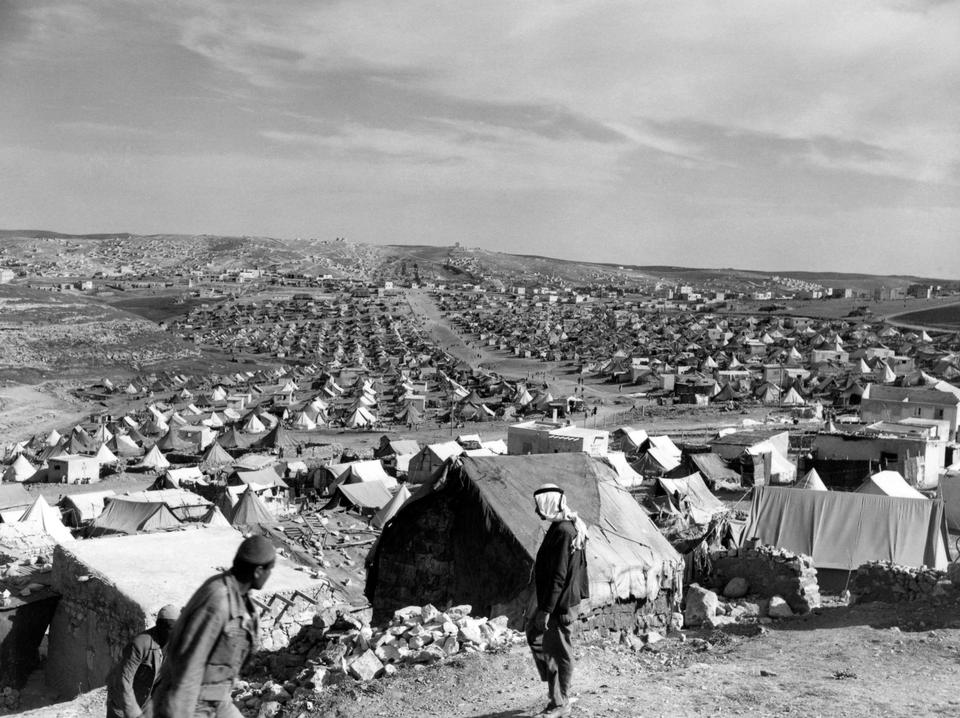
Hundreds of thousands of Palestinians were forced to live in camps in neighboring countries after Israel pushed them out of their homes. (TRTWorld)
For someone groomed to believe that the English people were true to their word, the haphazard division of the Ottoman Empire and the creation of Israel was unsettling for Yusuf Ali.
In 1937 he attended many meetings and conferences fighting the case of Palestinians and warned Western powers about creation of a Jewish state on Muslim land.
“One way alone can bring thee peace:
That ancient rights be not suppressed,
That aliens from encroachments cease,
And Quds be given its rightful rest,” he wrote in the poem Palestine published in January 1938.
However, Palestine’s tragedy wasn’t enough to deter his loyalty to the British as he travelled to India at the urging of England’s Ministry of Information to rally Muslim support after it declared war on Germany in 1939.
In Delhi, he met Sir Sikandar Hayat Khan and spoke to students about the need for India’s support for the British. That was a time of turmoil in India as both Muslims and Hindus had begun rallying for independence.
Upon his return, he wrote articles and gave speeches, asking Indians to unite in defence of the empire and drop their demand for political reforms. But his appearance as an important player in international events quickly faded after the war ended in 1944.
We might never know what broke him in the end. But as the British pulled out of the subcontinent in the days of its waning global status, so did Yusuf Ali slowly recede from the newspapers, his powerful friends no longer found a use for him.
Yusuf Ali spent his last years living in the National Liberal Club on a monthly pension that he received against his government job.
“How did the British treat him? There’s certainly a question mark there. They didn’t recognise his contribution as much as he probably expected,” says Humayun Ansari.
His powerful friends in the Muslim community including Pakistan’s then ambassador Ispahani had also lost track of Ali’s whereabouts, not bothering to check on him.
“That is an indictment of the Muslim society that we were not able to honour and care for someone of his stature,” says Jamil Sherif.
Source: TRT World
source: http://www.trtworld.com / TRT World / Home> News> Magazine / by Saad Hasan / September 04th, 2019
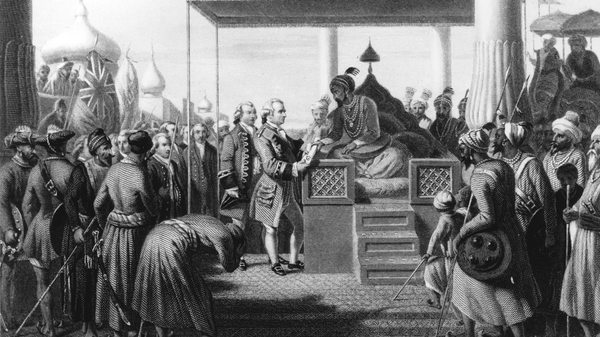
A sketch showing Robert Clive receiving, from Shah Alam II, the decree conferring on the East India Company the right to receive Bengal’s revenues.
The reign of Shah Alam, one the last Mughal emperors, was upturned by the Rohilla chief Ghulam Qadir
The vengeful treatment of the emperor caused such outrage that even the Afghan king offered to send aid
In August 1788, the Red Fort in Delhi witnessed what one observer would recall as the most “unspeakable and indescribable” crimes. As in the previous year, the Rohilla chief, Ghulam Qadir, had descended on the Mughal capital, threatening to unleash chaos. While his last attempt had been aborted, thanks to Begum Samru, a dancing girl turned princess, nobody rode to Shah Alam II’s rescue on this occasion. In fact, the officer in charge of the fort, despite orders to the contrary, threw open its gates, and 2,000 of Ghulam Qadir’s troops quickly took charge of the premises. Secure, the warlord made his way to the audience hall. And there, as William Dalrymple recounts in his splendid new book, The Anarchy, he “sat down on the cushions of the imperial throne”, blowing smoke from a pipe into the face of the badshah of Hindustan.
Shah Alam had not had a particularly glorious career, but even with its general turbulence, this was unprecedented. It was decades since the empire of the Mughals had begun to unravel, but while the emperors had been reduced to ciphers, their dignity had never been so insolently offended. Shah Alam had tried in vain to reclaim power for the crown: For over a decade, he was not even in control of his capital, and, during his peregrinations, was forced (after military defeat) to grant governorship of the empire’s richest province to the East India Company (EIC). In 1772, he finally returned to Delhi, his general Najaf Khan bringing order to the surrounding regions. When the latter died, the Marathas stepped in to supply protection. For all his outward marks of authority, though, this came at the cost of giving free rein to Shivaji’s political heirs. As the contemporary chronicler Prem Kishor wrote, “The king (had) abandoned his sovereignty and taken up the ways of beggary.”
As a man, Shah Alam was not, to be clear, all incompetence, but, as scion of the Mughals, he inspired little support. He was a poet of talent, writing verses in languages as diverse as Braj Bhasha and Persian. EIC officer Col Polier described him as “a good and benevolent man” so far as his private characteristics went, but acknowledged that he was not by any stretch a “great king”. The English governor Warren Hastings, who refused to remit even the share of Bengal revenues that were due to the emperor, was more blunt: Shah Alam was merely a “wretched King of shreds and patches”.
And, as Dalrymple reminds us, while others in theory paid homage to the crown, Tipu Sultan discarded even this pretence. Those who bowed before Shah Alam, announced Mysore’s sultan, “act through ignorance, since the real condition of the so-called Emperor is…(that he is) the servant of (the Marathas) at the monthly wages of ₹15,000″.
And yet for all this contempt, Ghulam Qadir’s actions in 1788 sent shockwaves down the entire subcontinent: As the colonial-era historian W. Francklin wrote, to this man “it was reserved to…add the last outrage to the miseries of a long and most unfortunate reign”. The sequence of events that confirmed the Rohilla as one of the worst villains of the 18th century is chilling. Soon after taking charge of the Red Fort, Ghulam Qadir had Shah Alam locked up, planting in his place another prince on the throne. But what the trespasser really wanted was gold, not empty titles and grants of land, and none of the coin heaped before him satisfied the demand. Old begums were dispossessed of their jewels, and even the officer who opened the fort gates paid up—threatened that he would be drowned in excrement, the latter surrendered his own money to escape this revolting fate.
Furious, Ghulam Qadir turned on the imperial family, which for all its bloody intrigues had never quite experienced what he now decided to unleash. Princes of royal blood, including sons and grandsons of Shah Alam, were dressed in drag and made to dance for the Rohilla troops. The emperor’s daughters were stripped, raped and humiliated. Even Malika-i-Zamani, the formidable widow of a previous emperor, Dalrymple writes, was left naked in the hot sun after failing to deliver to Ghulam Qadir the riches he believed she possessed. And finally, bringing to his presence Shah Alam himself, the “ferocious ruffian” had the emperor blinded. In some accounts, in fact, he sits himself on Shah Alam’s chest, scooping out the old man’s eyes with a dagger.
Theories abound on Ghulam Qadir’s diabolical ferocity. His father had rebelled several times against Delhi, and, after defeating him, Shah Alam had taken Ghulam Qadir, then eight or 10 years old, hostage. One apocryphal tale says that after seeing the uncommonly handsome boy, the emperor had him castrated, often making him dance in women’s clothes. In an account left behind by a disgruntled Mughal prince, there is a suggestion of something beyond a regular relationship between Shah Alam and the Rohilla boy. Even as the emperor described Ghulam Qadir as his “special son”, wishing him great happiness in his poems, this contemporary noted that the boy suffered from ubnah, or “an itching in his behind”, hinting that he was made to serve as the emperor’s catamite. This, more than mere ambition or greed, it is believed, explains the horrors Ghulam Qadir let loose in 1788 on Shah Alam and his children.
But the act was for the Rohilla a death sentence. The treatment of the emperor caused such outrage that aid was offered even from Kabul. The Maratha general, Mahadji Scindia, led a large force to Delhi, and while Ghulam Qadir escaped, he was cornered and captured in Mathura very soon. Placed in a cage, his ears, nose, lips and feet were cut off, one by one, each of these circulated in the Red Fort by the emperor. And finally, the story goes, Shah Alam, in whose reign the Mughals lost their final vestiges of power, received one last box, holding within it Ghulam Qadir’s eyes.
Medium Rare is a column on society, politics and history. Manu S. Pillai is the author of The Ivory Throne (2015) and Rebel Sultans (2018)
source: http://www.livemint.com / Live Mint / Home / by Manu S. Pillai / August 30th, 2019
A new organisation seeks to represent Indian Muslims, as well as help dispel the negative stereotyping about their community
On 16 July, the Indian Crescent Society of Australia (ICSOA) held its inaugural Eid function at the Himalaya Restaurant in South Granville. The hugely successful event provided an opportunity for Indian Muslims to connect with Indians from other religions.
The evening was attended by Dr A.S. Nakadar (founder of the American Federation of Muslims of Indian Origin), Rajeev Kumar (Vice Consul CGI), Peter Doukas (Chair, Ethnic Community Council NSW) and Julia Finn (Member for Granville) amongst other dignitaries.
The soon-to-be launched ICSOA aims to promote a positive image of Indian Muslims and help them integrate into mainstream society. Indian Link scratched the surface to find out more from the President of the society Mr Abbas Raza Alvi.
A well-known community leader, poet and businessman, Mr Alvi began by summing up the need for such an organisation:
“For the last 30 years, we’ve felt that the participation of Indian Muslims in the mainstream society has been limited. Most Indian Muslims are highly educated professionals, but due to a lack of networking and proper representation, they are not being recognised and celebrated as they should be. After lengthy discussions with the Indian High Commission and the Consul General, we finally came to the conclusion that Indian Muslims needed a special representation in Australian society. There was a need for a platform to allow them to participate and integrate like other Indians.”
In the wake of the hysteria against Muslims being kicked up by public figures like Pauline Hanson and Sonia Kruger, Mr Alvi feels that ICSOA has suddenly become the need of the hour. He realises the urgency to dispel the negative stereotype by integrating and showing the world that Muslims are a peace-loving people.
Touching briefly on the issue, he said, “Pauline Hanson must understand the effect of her provocative comments on the Australian economy. She has a history of inciting racial hatred; initially she targeted Indigenous Australians, then Chinese and Indian origin Australians, and now Muslims. Her comments can have a negative impact on Australian jobs, businesses and families. Australia currently exports $15 billion worth of goods to parts of the Muslim world. Include in that the exports to India and China and this figure may exceed $120 billion.”
On a lighter note he added, “I do suggest that PH (Pauline Hanson) should neutralise herself to the value of seven. (pH for pure water, H2O) is 7). Continuously spreading hatred through racist comments towards ethnic communities will not benefit any Australian and this includes those who have voted for her.”
There are around 5000 Indian Muslim families in Australia, but Mr Alvi feels, “Even though there are several small Indian Muslim organisations, their overall participation is rather small. When Muslims are not seen playing a role in society it creates disharmony and unbalance. India can never be properly represented in Australia until Indian Muslims are included in its representation.”
HIGHLIGHTING SOME OF THE MAIN GOALS OF ICSOA, MR ALVI EXPLAINED, “OUR AIMS WOULD BE TO HELP INDIAN MUSLIMS IN ISSUES AFFECTING THEIR DAILY LIVES LIKE EDUCATION, COMMUNITY WELFARE, MENTORING AND SUPPORT FOR NEW MIGRANTS.”
In addition, the organisation would work towards the integration of Indian Muslims within their own community, with other Indians and with the wider Australian society. “We will send our representatives to attend functions arranged by other organisations and invite them to ours in order to share and learn and work together for the welfare of all Indians.”
Programs will include working towards better recognition of the Urdu language, promoting creative talents within the community, supporting high achieving students, encouraging women in their goals and working with Aboriginal people to create artworks that depicts both cultures.
Another issue that concerns Mr Alvi is the demise of Indian cultural values in Australia. “I grew up with Hindus, Sikhs and Christians all living side by side in India. I don’t remember calling them by name, they were either mama, chacha, taya or dada. When we misbehaved, our parents weren’t the only ones to discipline us. If the neighbours got to know they would chastise us before them. That’s the Indian culture I love, but sadly when we come here, we get so busy trying to make a living, educating the kids, building a house, that the only spare time is either spent in home maintenance or religion. This is creating an isolation and disconnect with our Indian culture and is the cause of major problems and stress not just for Indian Muslims but for all Indians. Being religious is good, but the community connection is important for people to thrive and be happy. So, we want to bring back the integration, community feel and brotherhood we were used to in India and we want to promote peace.”
Mr Alvi took great pains to stress that ICSOA is not a religious organisation but an organisation to promote the Indian Muslim culture, language, food and traditions in order to help them integrate in the mainstream society.
To get the ball rolling, ICSOA has contacted individual organisations to form an ad hoc board which will represent Indian Muslims from all corners. The board is ironing out the finer details, compiling a database, advertising, initiating coordination in other cities and getting the website and logo in place before the formal launch. Mr Alvi informed that there will be a membership but the fee will be nominal. “We want every single Indian Muslim to join ICSOA.”
On the question of funding, he advised, “ICSOA will be self-funded by the large Indian Muslim business and professional community.”
The immense support for ICSOA was apparent at the Eid function where the expected turnout of 150 guests ballooned to over 250 attendees. Mr Alvi is optimistic about the future of the organisation, remarking, “Since ICSOA is a need based organisation with an experienced leadership I foresee it growing rapidly in future.”
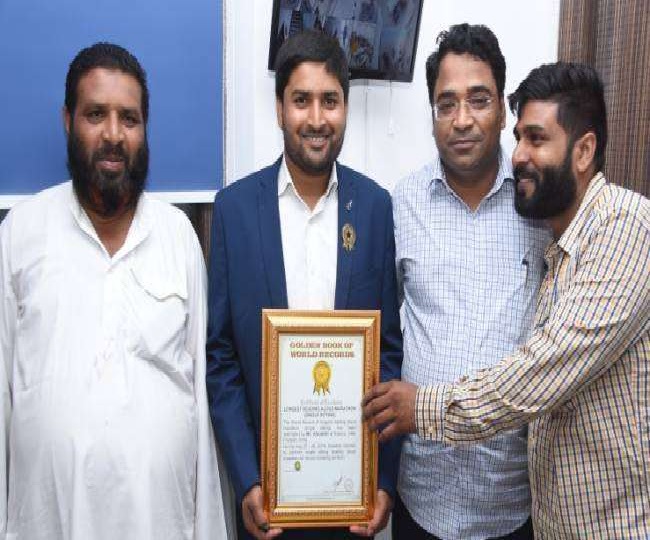
A student from Chhatrapati Shahu Ji Maharaj University (CSJMU), Kanpur created a world record for continuously reading books for 27 hours and five minutes.
Kanpur | Jagran Trending Desk:
A student from Chhatrapati Shahu Ji Maharaj University (CSJMU), Kanpur created a world record for continuously reading books for 27 hours and five minutes. His feat was acknowledged by the Guinness Book of World Records on Monday.
The 22-year-old boy, Allauddin, broke the previous record of continuous reading for 24 hours which was held by Yatish Chandra Shukla of Lakhimpur Kheri, who achieved this feat two years back.
His teacher, Dilip Gangwar, who helped him achieving this milestone said that the executive officers of the Guinness Book told him that he could break the earlier record if he could read for 24 hours and five minutes, but Allauddin said he would continuously read for 27 hours.
The Gangwar coaching made subsequent arrangements for Allauddin and a judge Mahesh Vishnoi, from Guinness Book of World Record was assigned to monitor the reading feat.
According to the rules to set this record, Allauddin could only take breaks of 30 seconds to sip water or to take some edibles and he would not be allowed to go to the washroom during the reading time.
Allauddin, standing firm on his desire to break the record started reading at 10 am on Sunday and finished on Monday. He took less than three breaks of less than 30 seconds to sip small quantities of water, said Dilip Gangwar.
Several eminent people, including former union minister Sri Prakash Jaiswal, MLC Arun Pathak and Satish Nigam witnessed the challenging task.
source: http://www.english.jagran.com / Jagran English / Home> English News> Trending / posted by Talib Khan / August 27th, 2019
Hyderabad’s Ismail Sheriff only lensman to be invited to conference on snow leopards in Kazakhstan
For city-based wildlife photographer Ismail Sheriff, known for capturing the elusive snow leopards on camera, it was a rare honour to be invited as the only lensman to a recent conference on conservation of snow leopards in Kazakhstan.
The conference attended by delegates from 12 countries including Russia, India, Bhutan, Nepal, Pakistan, Afghanistan and Mongolia, focussed on initiating various measures to increase the population of snow leopards.
“It was indeed an honour to be there. I am glad that my adventure in Kibber (Himachal Pradesh) where I first sighted a snow leopard five years ago and subsequent sightings of the magnificent species helped me come thus far,” he tells The Hindu.
Rare captures of the elusive snow leopards by City-based wildlife photographer Ismail Sheriff. PHOTO: Special Arrangement
Mr. Sheriff, 39, started off on the big cat trail nine years ago, mostly photographing Royal Bengal Tigers and gradually moved on to snow leopards.
“India has about 250 snow leopards and interestingly, there are no territories for them like tigers. They often travel across about 150-200 square km, transgressing even borders of a few countries,” says Mr. Sheriff, who is into fine arts printing apart from pursuing his passion in wildlife photography.
“Unlike spotting tigers in a reserve forest, this is a different ball game altogether because the biggest challenge comes from the freezing conditions. Often, we have to brave life-threatening landslides and avalanches. It was a spine-chilling experience for me,” he explains. “But, still these factors don’t deter me as anything related to a snow leopard gives me joy,” he adds.
The maximum snow leopards, Mr. Sheriff says, are in China — about 2,000 — and it is Kazakhstan’s national animal and hence, that country’s concern for conservation is pretty much understandable.
“Groups of wild dogs pose serious threat to the leopards, especially the cubs. They also deny food to the leopards by taking away their kill. And, then there is climate change which is making the snow leopards come closer to the human habitat,” he points out.
What are the corrective measures being planned? “It has been decided to have a four km grid with trap cameras to understand their behavioural pattern, density and prey base, and educate the locals about the importance of protecting them. We generally travel to the mountain ranges during winter and by the time we have the second edition of the conference in January 2020, we should have more practical solutions to ensure an increase in their numbers,” he concludes.
source: http://www.thehindu.com / The Hindu / Home> News> Cities> Hyderabad / by V.V. Subrahmanyam / Hyderabad – August 26th, 2019
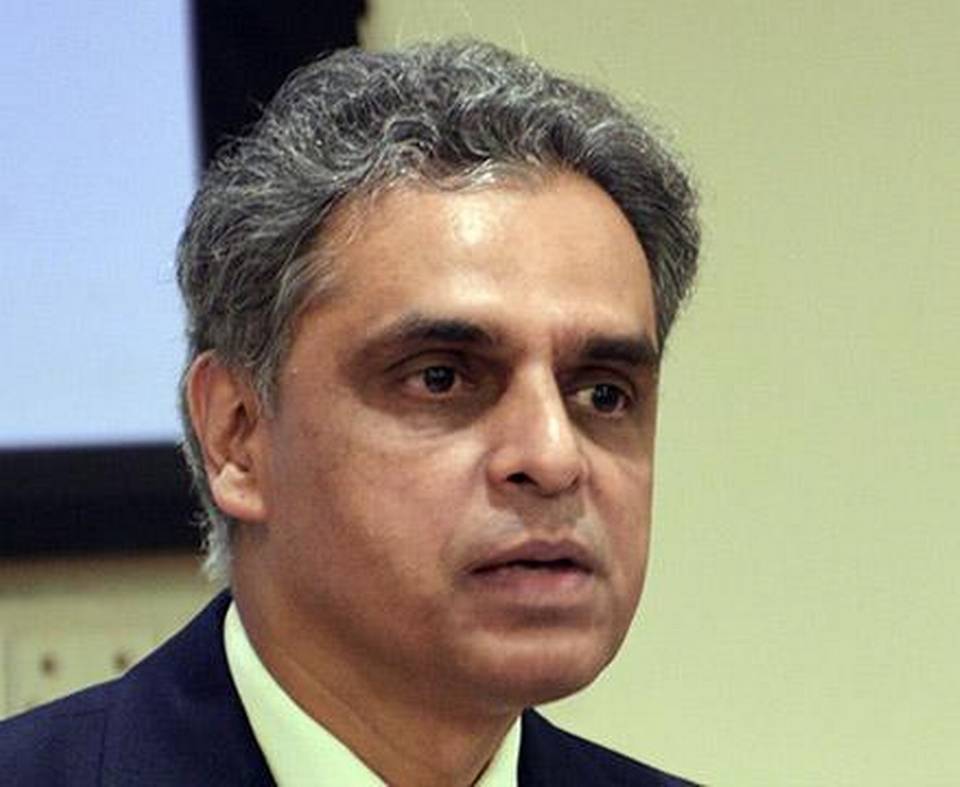
Syed Akbaruddin’s friends describe him as a thorough professional
India’s Permanent Representative to the United Nations, Syed Akbaruddin, won accolades from Twitteratti after he extended his ‘hand of friendship’ to Pakistani journalists and reportedly asserted at the U.N. Security Council’s closed consultation on Kashmir that Article 370 was an internal matter of the country. But unbeknownst to many, the suave diplomat has a strong Hyderabadi connection, including that of serving as joint secretary of Nizam College Students’ Union.
#WATCH: Syed Akbaruddin, India’s Ambassador to UN says,”so, let me start by coming across to you and shaking hands. All three of you,” to a Pakistani journalist when asked,”when will you begin a dialogue with Pakistan?” pic.twitter.com/0s06XAaasl
Those who have been acquainted with Mr. Akbaruddin describe him as ‘focussed’, ‘articulate’, ‘soft spoken’ and with ‘no enemies’.
“He was a degree student at the Nizam College from 1977 to 1980. His father S. Bashiruddin was head of the Department of Journalism from the early 70s to the mid-80s and then moved to Dr. B.R. Ambedkar as its Vice-Chancellor. He also served as Ambassador to Qatar,” says his friend and journalist M. Somasekhar, who met the diplomat around six months ago. “He was active in student politics in the college and was very popular. He continues to be articulate and soft spoken.”
Mr. Akbaruddin’s school, Hyderabad Public School at Begumpet, tweeted its appreciation on Tuesday, “We are proud to recognize the man of the moment, Syed Akbaruddin who is the permanent representative of India at the United Nations, an alumnus of the HPS @IndiaUNNewYork @AkbaruddinIndia @UN #HPSBegumpet #HPS #Alumni #Hyderabad #Begumpet”.
Managing editor of Siasat Daily, Zaheeruddin Ali Khan, who was the diplomat’s junior in Nizam College, describes Mr. Akbaruddin as ‘truly secular’ and ‘highly efficient’ with a deep understanding of not just diplomatic issues, but also those connected to the culture of the country.
“We had organised an exhibition of Indian calligraphy exhibits in Delhi in 2013. It was there that he understood its potential and wanted to project it as India’s contribution to global Islamic culture. A thorough professional, one can never find him in controversies and has always maintained a clean record,” Mr. Khan says.
source: http://www.thehindu.com / The Hindu / Home> News> Cities> Hyderabad / by Syed Mohammed / Hyderabad – August 22nd, 2019