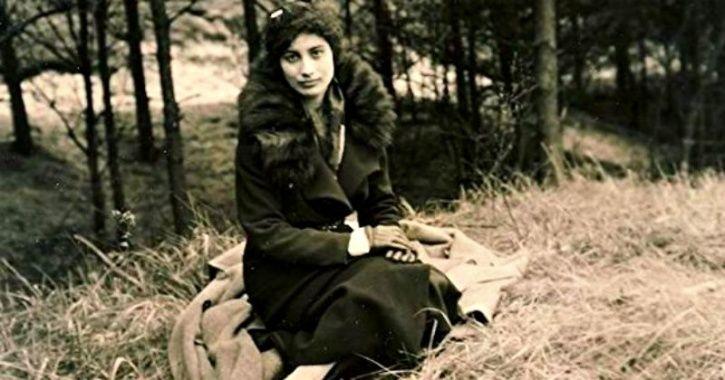
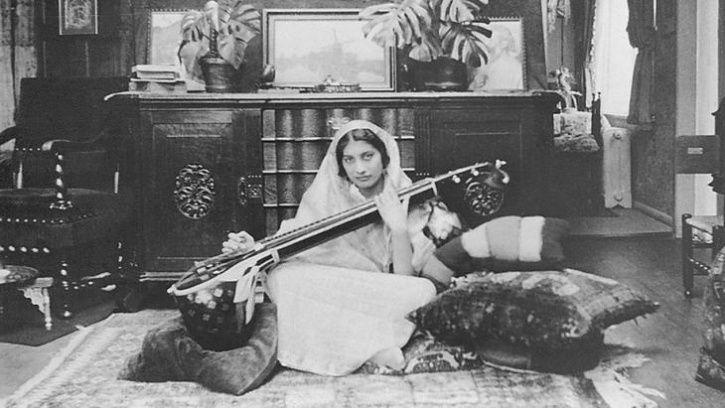
British Indian World War II spy Noor Inayat Khan may be the next face of British currency. A campaign for the same is gaining momentum wherein people are demanding the spy to be featured on a redesigned 50-pound currency note.
The Bank of England had recently announced plans for a new polymer version of the large denomination note to go into print from 2020 and indicated that it would invite public nominations for potential characters to appear on the new note.
An online petition in favour of the campaign has already garnered over 1,200 signatures by Wednesday, calling for Khan, a descendant of Tipu Sultan and daughter of Indian Sufi saint Hazrat Inayat Khan, to be considered as the first ethnic minority British woman to be honoured on the currency.
“I am absolutely delighted that the story of Noor Inayat Khan has inspired so many people and that she has become an icon. Noor was an extraordinary war heroine,” said Shrabani Basu, the author of Khan’s biography ‘Spy Princess’ and founder-chair of the Noor Inayat Khan Memorial Trust.
The trust was set up in 2010 to campaign for a memorial in honour of the war-time spy, who had been recruited by Britain’s Special Operations Executive (SOE) and infiltrated beyond enemy lines before being captured and killed by the Nazis in 1944, aged only 30.
Khan’s memorial bust now has a permanent home at Gordon Square in central London, with the trust also lobbying for a commemorative blue plaque to mark the house nearby where she spent time with her family.
“I am very happy to support the campaign for Noor Inayat Khan on the 50-pound note. It is a way of keeping her memory alive and taking this story to the next generation. It will certainly make a big statement internationally because Noor was someone who believed in breaking down barriers,” Basu said.
The campaign has found the backing of prominent political leaders, historians and academics in the UK, with many taking to social media to voice their support.
“The new 50-pound note could have anyone on it. I’m backing Noor Inayat Khan. She volunteered for SOE, served bravely as an agent in occupied Europe, was eventually captured and murdered. A Muslim, a woman, a hero of WWII. This would celebrate her courage and all SOE,” said Conservative Party MP Tom Tugendhat, who is currently leading the UK Parliament’s Global Britain and India Inquiry.
“Just returned from both East Africa and the Western Front and am more than ever aware of the shared service and sacrifice of men and women of many backgrounds. I would love to see Noor Inayat Khan on the new 50-pound note,” said Melvyn Roffe, Principal at George Watson’s College in Edinburgh.
Noor Inayat Khan, born in Moscow to an Indian father and American mother, was raised in Paris and Britain. As a Sufi, she believed in non-violence and also supported the Indian independence struggle.
But she felt compelled to join the British war effort against fascism and went on to become the first female radio operator to be infiltrated into Nazi-occupied France before she was captured, tortured and killed at the Dachau concentration camp in Nazi Germany.
“In this age, when we see a rise in anti-semitism, anti-Muslim hatred and intolerance, it is important that we continue to build bridges and show positive contributions from Britain’s ethnic and religious minorities, not least one of World War II’s almost forgotten heroes, a British Muslim woman,” said social activist Zehra Zaidi in the online petition she started to campaign for Khan as the face of the new banknote.
The 50-pound currency will be the final redesigned note to go into circulation after notes in the denomination of 5 and 10 have already been reissued in polymer. The new 20-pound polymer note will go into circulation from 2020 when the 50-pound is set to go into print to be circulated later.
“The bank will announce a character selection process for the new 50-pound note in due course, which will seek nominations from the public for potential characters to appear on the new note,” the Bank of England said.
With Inputs From PTI
source: http://www.indiatimes.com / India Times / Home> News> India / October 18th, 2018
In an interview with Indianexpress.com, Lal spoke about the incredible achievements of Nur Jahan. Remnants of imperial orders issued by her, coins minted in her name, paintings that paid ode to her sovereignty and bravery are all evidence of the enormously powerful figure she was.
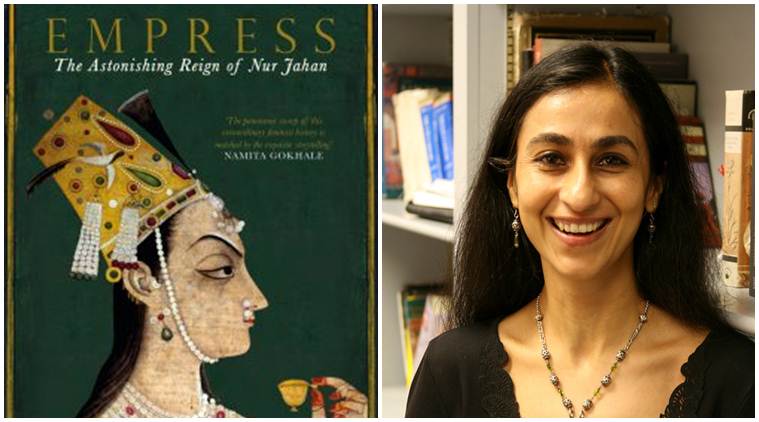
Left- Cover of the book ‘Empress: The astonishing reign of Nur Jahan’ (wwnorton.com) Right- Historian Ruby Lal (personal website of Ruby Lal)
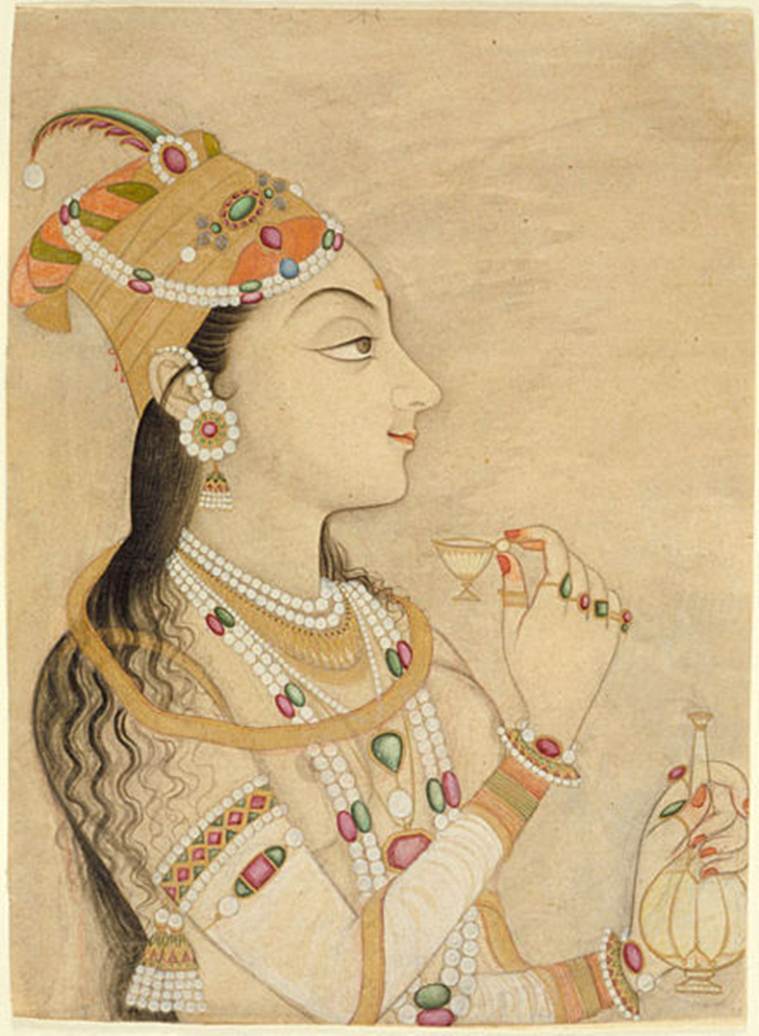
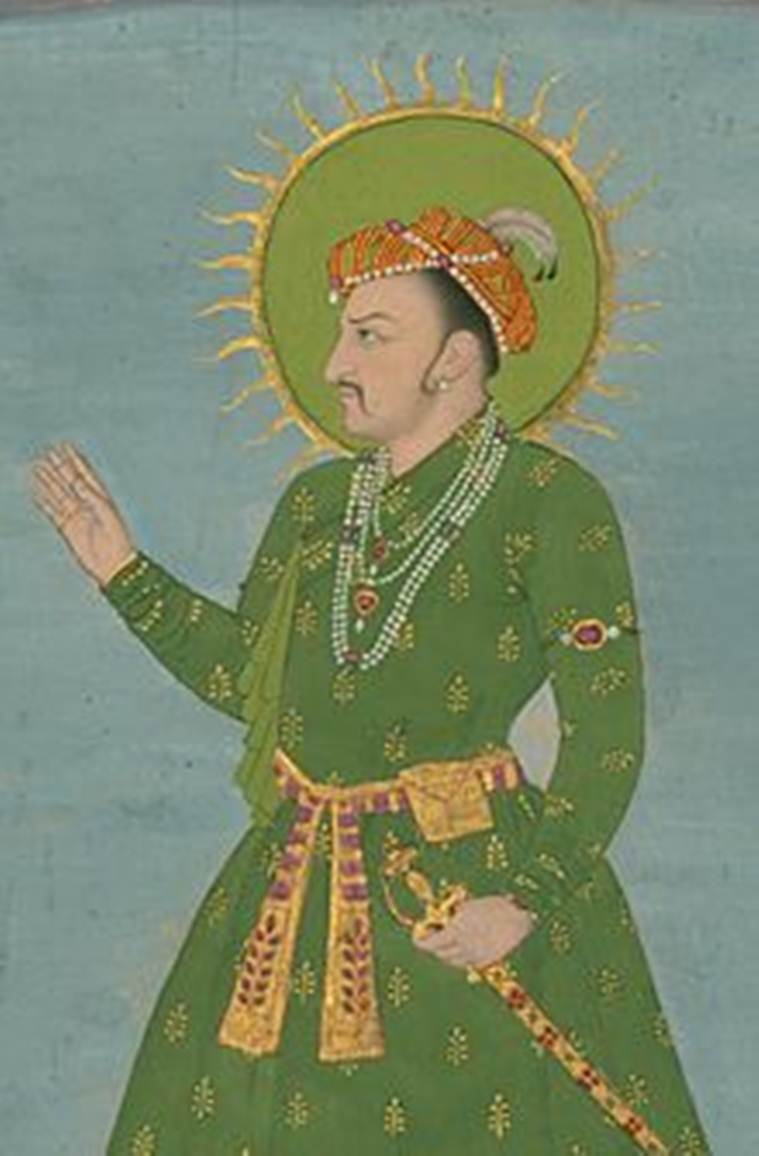
For four centuries, from when she was at the centre of one of the largest empires of the world, Nur Jahan, the twentieth and supposedly the most loved wife of Mughal emperor Jahangir, has been a household name in the Subcontinent. Though she was not officially the ruler of Mughal India, Nur Jahan has been noted by historians to be the real power behind the throne. A politically astute and charismatic figure, she ruled Mughal India as a co-sovereign of Jahangir and is known to have been more decisive and influential than he ever was. Historian Ruby Lal in her latest book, ‘Empress: The astonishing reign of Nur Jahan’, dives deep into the intriguing world of the only woman to have helmed the Mughal empire. Tracing her life in great detail, Lal attempts to rip apart narratives of romance and exoticism that surround the image of Nur Jahan and focus upon what made a Muslim woman living in seventeenth-century India, one of the most authoritarian figures in Indian history.
In an interview with Indianexpress.com, Lal spoke about the incredible achievements of Nur Jahan. “People say she always sat right next to Jehangir in the court and that if some cases or decisions came up and if she agreed with him, she would pat him on the back and he would say yes to that decision,” says Lal who is Professor of South Asian Studies at Emory University in Atlanta. Remnants of imperial orders issued by her, coins minted in her name, paintings that paid ode to her sovereignty and bravery are all evidence of the enormously powerful figure she was. Charting the life history of Nur Jahan, and placing her in the background of the pluralistic cultural space that Mughal India was, Lal puts together an evocative biographical account of the queen.
Here are excerpts from the interview with Lal.
Popular perception of Nur Jahan is somehow constricted to the romantic relationship she shared with Jahangir. Why is that the case?
There is a very long history of the erasure of Nur Jahan’s power that I chart in the book. As she traveled through the length and breadth of the country with Jahangir – issuing imperial orders, hunting a killer tiger near Mathura, discussing the expansion of the empire- she rose to being the co-sovereign. This does not mean that in her own time people did not raise eyebrows. In 1622, her stepson and Jahangir’s son Shah Jahan had risen in revolt. The catalyst for his revolt was the moment when Nur Jahan arranged a match for her daughter from her first marriage, Ladli; she chose the youngest prince, Shahriyar for her. About that time, Shah Jahan went into rebellion against Jahangir. And its is very clear that he felt threatened; he knew about the power of Nur Jahan. In fact, Shah Jahan and Nur Jahan had been closely aligned. The year 1622 is when certain chroniclers begin to write about the chaos that Nur Jahan Begum had raked up between the father and son.
“There is a very long history of the erasure of Nur Jahan’s power that I chart in the book,” says Ruby Lal. (Wikimedia Commons)
So the early criticism appears to begin around this time. The other major moment of critique of Nur’s power was when they were on their way to Kashmir and Mahabat Khan (who went on to capture Jahangir later in 1626) goes on the journey with them to a certain distance and according to one of the chroniclers he says to Jahangir that a man who was governed by a woman is likely to suffer from unforseen results. In 1626, she, completely visible, goes to save Jahangir (sitting upon an elephant on a roaring river), commanding all men including her brother Asaf Khan. She stratergises and eventually saves the emperor. After this, we begin to come across a word called Fitna, in the records.
Fitna is a very loaded term in Islamic history. It is used for the first time during the Shia-Sunni split for civil strife. It was also used against Ayesha, Prophet Muhammad’s favourite wife, when she went on a battle against Ali who was eventually the leader of the Shias. Over time, the word came to be used against women’s visibility, their sexuality and so on. Following 1626, this is one word that is used repeatedly against nur – that is to say that her power produced chaos.
Later, in the Shahjahanama, we find that at one point that the chronicler lists her power as a “problem”: the Shahjahanama reverts to the male inheritance of power and completely undoes her co-sovereignty with Jahangir.
Then there were also visitors to India like Thomas Roe, the ambassador of James I of England who follows Nur and Jahangir through the camps in Gujarat and Malwa. He calls her the Goddess of heathen impiety.
In the 19th century orientalist renditions of the romance of Nur and Jahangir become very important in the histories of the time; later, the colonial renditions highlight and forward such stories. Nur Jahan becomes classic oriental queen. Thus, a long-standing history of the erasure of the power of an astonishing emperess. It is certain that the erasure of Nur’s power travels into modern times and we only hear about her romance with Jahangir, not about her work as co-sovereign of the empire.
Jahangir is often compared with Akbar and criticised for being an uncompetitive, flamboyant king, who spent much of his time in drinking and merrymaking. But the fact that it was during the reign of Jahangir that a woman became so powerful, what does it say about his attitude towards women?
You are right, this is how Jahangir has come to be imagined. There are a range of scholars who for sometime now have been rethinking Jahangir’s reign, his philosophical and artistic engagements. My book foregrounds the ways in which Jahangir seeks to go differently from how Akbar articulated his sovereignty. If you look at the reigns of Babur and Humayun, there was no stone harem: the kings were nomadic and forever on the move. During Akbar the Great, for the first time in Mughal history, the imperial harem is built in stone in Fatehpur Sikhri. For the first time in the Ain-e-Akbari, women are declared as ‘pardeh-giyan’ which means “the veiled ones.”
“My book foregrounds the ways in which Jahangir seeks to go differently from how Akbar articulated his sovereignty,” says Ruby Lal. (Wikimedia Commons)
But what Jahangir does is that he goes back to the ethics of Babur. He was constantly wandering, he was constantly moving. The ethics of a peripatetic life and movement, which contributed to the co-sovereignty of Nur Jahan. Nur Jahan is the biggest example of Jahangir’s attitude towards women. An 18th-century chronicler that advances the Jahangirnama to the end of Jahangir’s death had suggested that the emperor had once claimed that he had given the sovereignty to Nur Jahan Begum and that he was quite content with his wine and meat. It’s an allegorical statement: and one indicates his admiration of Nur, something that he chronicles in his own memoir
Would Nur Jahan be this powerful had she not been married to Jahangir or had she not been part of the Mughal empire?
I think, Nur Jahan, looking at her whole life history and context, would have expressed her power differently in other circumstances. Her life history shows her dynamism and boldness. Of course, as I have been saying, and detail in the book that the plural landscape of Hindustan was very important- in that that it fostered experimentation and all sorts of ways of being (alongside war other challenges of co-existence of multi-confessional identities). We should also remember that she comes from an important Persian family background, deeply invested in poetry, arts, calligraphy. Then her own initiative must be highlighted: there were other women in the harem – and indeed Nur walks in the tracks of these women’s power – but no one becomes a co-sovereign. That speaks something about her boldness, her endeavours and of course her ambition.
Islamic societies are often noted to be more regressive compared to others in their treatment of women. In your book do you try to subvert this notion?
I Am trying to suggest that Nur Jahan is the history of India. She was a Shia married to a Sunni Muslim who was also half Hindu Rajput. Further, Nur Jahan is the only woman ruler among the great Mughals of India (there are technical signs of being a sovereign and informal signs, both of which I detail in the book). That is the history of India. As far as Islam is concerned, people should know that there were incredible and powerful women in Islamic history all the way through. We have Ayesha, Raziya, we have Nur Jahan Begum, we have any number of powerful women. It is also the multicultural world. In the modern world, we tend to think in terms of fixed identities. People in early modern times were much more open. Jahangir was engaging with Siddichandra, a Jain monk. Nur Jahan used to tease him about the pleasures of the flesh. What does this tell you? It tells you about an open engagement. It tells you about how experimental Islam is, how mixed Islam is, how vibrant Muslim women are and how Islam is so deeply attached to India.
‘Empress: The astonishing reign of Nur Jahan’ has been published by W.W.Norton in the United States earlier this month and will be published by Penguin Books in India soon.
source: http://www.indianexpress.com / The Indian Express / Home> Research / by Anrija Roychowdhury, New Delhi / July 11th, 2018
Entrepreneur, under-the-radar philanthropist and an over-the-top personality — the relevance of Shahnaz Husain 40 years after her first formulation
Shahnaz Husain’s press kit weighs 12.3 kilos, and contains press clippings from around the world. But then everything about her is over the top, and it’s not just her red hair threaded through with gold ribbons. Of her 58 homes, one is in Delhi’s tony Greater Kailash. There is a Rolls-Royce and a Jaguar parked up front, while inside is a sort of Midas-touch shocker. There are swans, a Ganesha, cushions, high-backed chairs, window valances, all in gold. There is an MF Husain on the wall that the artist did especially for her, large urns in the corners taller than people, horses sprinting across the carpet. Curios clutter, and I imagine a dusting nightmare.
She is not short on staff though. There are at least 15 people I have counted, and I am there just for a couple of hours. They appear, to offer food, tea, more food, juice; and to take instruction each time Shahnaz rings her bell to show me something — her first husband’s photograph, a letter from romance novelist Barbara Cartland’s friend’s son whose eyesight she cured, a picture of a man she picked up off the street because he was lame. They are dismissed soon after, with a wave of Madam’s hand.
She is wearing a blue-and-leopard print cassock-like garment, and holds forth for the next couple of hours. While she knows just what to say to the media, often telling the same stories, there is a certain warmth I feel, even as she holds my hand, her 70+ years, showing only in her hands.
Cosmetic shift
She begins with the first of many stories (these are her forte, not the dates or the details): when on a course with cosmetics entrepreneur Helena Rubinstein, she had a friend whose mother would come and sit outside the class because she was blind and had no one to take care of her at home. “She’d been a sought-after model who had worked for an eye make-up company,” says Shahnaz. She had modelled a new line, complaining to the manufacturers that her eyes would feel blurred after use. “They told her to wash them and put Optrix.” The blurring continued, until she simply could not see any more.
Shahnaz was learning what she calls “chemical beauty” at the time — Arnould Taylor, London; Christine Valmy, New York; Lancome, Paris; Swarzkopf, Germany; Lean of Copenhagen, Denmark. “There was no school I hadn’t been to, until Rubenstein started to say ‘we have nothing to teach you’.” She had funded herself through her writing work. Married at 15 to Nasir Husain, who was director foreign trade in the State Trading Corporation, she was determined to study. She did, for eight years.
Back in India when she was about 24, she set up a small factory in Delhi’s Okhla (that she still has) and “employed ayurvaids . I gave them the chemical formulations and asked them to convert them”. She also recruited chemists to make products for “treatment and cures” — falling hair, acne, pigmentation, dark circles, stretch marks. She asked people who came to her home salon to test them and give her feedback, tweaking each product as she went along. They retailed out of Sahib Singh Chemists in Connaught Place, in little white bottles with green caps and handwritten labels. That is the thing, she says. It has never been about beauty, but always about Ayurveda, in the days before it became a marketing tool.
Thinking beyond business
There is no marketing, in fact. At an address at Harvard Business School in 2015, she spoke about how she created a successful business sans advertising. Two years ago she told the same school in an interview how she entered Selfridges and broke a 40-year record, selling products worth £2,700 (approximately Rs. 2,63,500) in the first two hours, even as she displaced half of the space allocated to Pierre Cardin.
Her way of entering a foreign market is often through the Indian government (as in Selfridges, where Ingrid Bergman bought 12 of her cactus cleansing creams at the Festival of India), and by liaising with the press. She says wherever in the world she goes, ambassadors are happy to organise a press conference. She will talk Ayurveda, distribute samples, and get enormous press coverage. She is clear that the future is Ayurveda, not chemicals.
In fact, even as a young girl travelling the world studying, her father, Nasirullah Beg, a chief justice of the Allahabad High Court, would write to the ambassadors in various countries so his daughter could stay with them through the duration of the course.
But it is not just running a business; she is happy to dole out products made for cancer patients free of cost, especially those with patches of alopecia, and will pick people off the street, offering them jobs, connecting them to medical specialists.
Today, the company invests in R&D, with customers from salons testing them out, though it is not clear whether they know they are part of the research. She also talks in terms of “prescriptions” and “fairness creams”, a throwback to an era where protocols, both medical and social, were not as strict.
The label life
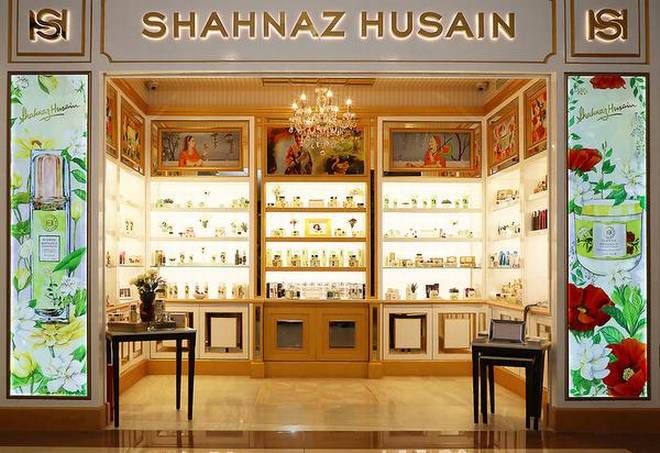
Earlier this year, the Shahnaz Husain brand was relaunched, with a new store at Delhi’s Select Citywalk, with new branding that seems rather mixed, with large pictures of flowers all over the frontage. Her face is still on some of the packaging, not retro-styled, but much like how it would have been done in the ’90s. She is not about to sell out or have anyone invest in the company. The brand is present in 40 countries today, including Iceland and Vietnam.
I dare not ask, ‘What after you?’ For Shahnaz is the brand.
As we conclude, she declares, “I think you have enough for a book now,” in her alto. Then she asks for her matching blue-and-leopard print bag, as we sit in her foyer, surrounded by a garden of plastic flowers, taking photos, with a couple of photographers jumping into the fray, seemingly from nowhere (waiting in the wings for this moment, perhaps). “Now we are best friends,” she declares, after we cut a cake, the done thing when a guest comes to her house for the first time.
She says wherever in the world she goes, ambassadors are happy to organise a press conference. She will talk Ayurveda, distribute samples, and get enormous press coverage. She is clear that the future is Ayurveda, not chemicals.
source: http://www.thehindu.com / The Hindu / Home> Features> Weekend / by Sunalini Mathew / October 13th, 2018
Faith healing is a scientifically accepted way-out. In Srinagar outskirts lives Abdul Qadir who treats more than 15000 patients a month and is considered a key healer for jaundice, reportsIrtiza Rafiq
Abdul Qadir
The plasma screen at Srinagar International airport shows the arrival of the Delhi- Srinagar flight and the lounge gets instantly active. Among the curious mixture of excited and bored arrivals, Ruqaya, a 33-year-old woman with her pale yellow face, sunken cheeks, and a feeble body stands out. Accompanied by her husband Javaid, 37, as she makes her way out of the airport, her anxious relatives waste no time in elaborate greetings. Flying straight from the USA, the couple is literally bundled into the car and their journey started towards Syedpora (Dhara) in city outskirts.
After a drive of around 29 km, the couple gets off, pass a small bridge across a shallow, crooked, clear, stream, walk down some narrow alleys and enter a house. In the time Ruqaya waits with dozens of other women, most of them mothers with children nestled up in their arms in a compound brimful of multifarious people, Javaid proceeds towards a chaotic, almost endless queue at a congested staircase where scores of people are nudging each other to pass their Rs 10 note for the exchange of a stamped paper piece from a 40-year-old man upstanding at the middle of the stairs. There is another man at the foot of the staircase for crowd control.
The scene resembles the representation of a shrine where followers with raised hands propel each other to get a touch of some higher deity or a sacred thing. The chit for which they are struggling for is their ticket to cross the stairway. This stairway crossing is heavenly for most of them because it leads to the Bab, the ‘spiritual healer’.
For the last five decades, the septuagenarian Bab has been treating all kinds of ailments, at his residence, a quiet and picturesque place, almost 2.5 km from Harwan.
The influx of patients can be gauged by the fact that the Reshi abode comprises three houses: one where the family lives, second where the patients wait for their turn and the third where Abdul Qadir Reshi, the Bab examines and treats his patients.
The room of the treatment-building is jammed by people, among yellow faces, crying neonates, ailing individuals, on the left corner, Bab sits on a bed at a slight elevation with his youngest son Abdul Ghani Reshi. In between them is a large copper bowl of water, on their either side various bottled up solutions, some powders, and in the front, lies a knife and a leather belt.
Khadija, 65, a woman from Rajbagh approaches him with her eight-day-old granddaughter having 7.68 mg/dL bilirubin level, Bab takes hold of baby’s clothes, lays her in front of him, squeezes her nipples, sprinkles handful of water from the copper bowl on her and then slowly rubs her forehead, eyelids all the while muttering something under his breath. He then hands the baby over to Khadija and asks her to make sure that her mother doesn’t eat oily or non-vegetable food. Interestingly, Khadija reveals that the mother of the kid is herself a doctor but has a firm belief in the healing powers of Bab. The medico mom didn’t comply to the paediatrician’s suggestion of exchange transfusion (blood change).
The certitude of this kind doesn’t come as a surprise, for Bab has treated thousands of people. Some of them approached him after they keenly heard their treating doctors telling them: “There is nothing more we can do”. But somehow after following Bab’s prescription, some of these people managed to do the unexpected − they lived, fully treated.
For 55 years and counting, sort of miracles have been happening around this solemn looking spiritual healer who credits it all to the Almighty. “I have been bestowed upon by the knowledge and ability by God that I can say by looking at a person what he is suffering from, particularly jaundice patients, one look at them and I can tell if they will make it or not,” Bab said after managing his patients. “It is a vision by God; the verses I read have a healing effect in them so the healing comes from God.”
This peculiar wisdom runs in the Reshi family and has been transferring from generation to generation. The story of this bequeathed enlightenment started when a spiritual healer from Kabul had a dream, so goes the family legend, wherein he was commanded to visit Mulfak, a neighbouring area of Syedpora, which is known to be home of peers. Once there, he spent a night and went touring adjoining areas escorted by a peer from Mulfak. When he saw ancestors of Abdul Qadir Reshi working in paddy fields, he told his escort, according to Bab’s son Abdul Gani Reshi, “Go back I have got what I was looking for. From that day, he resided with my great-grandfather and passed him his saintly knowledge,” said Reshi Jr.
“But we were warned by our spiritual teacher against being greedy,” Gami said. “So we do not take any money except on Sundays when we take Rs 10 from people and that too for Darsgah and charity. On the contrary, we provide tea and refreshments to visitors.”
Every day, up to 600 patients visit the place, and on Sundays, the number crosses 1000 people, all of whom are treated free of cost by Bab who does it as a social service. He and his family make their living out of their orchards and are financially well off.
“Except for gallbladder stones, everything is treated here,” claims Gani, and he then goes to name the ailments they take care of : Sorphtoph (snake bite), Gunstoph (cobra bite), Arkhor, Hounchop (dog bite), Malder (Herpes), Diabetes, Kambal (jaundice), psoriasis. “We deal with everything but a lot of cautiousness must be exhibited on our parts and we should abide by guidelines of our forefathers. Once my uncle made some mistake and as a consequence, he had a brush with death. This is like a sword hanging on our heads we have to be vigilant at every step.”
This guarded approach is quite evident from the way Bab instructs his son while he prepares herbal remedies and writes prescriptions for patients, even whilst himself dealing with a Malder (Herpes Zoster) patient, Fatima, 55, from Shalimar by dragging and flipping the knife over her lesions. He is doing the shoving and thrusting amid the surging crowd. Angry, he finally uses the leather belt and whips it over the unruly assemblage.
Family’s makeshift shop selling the prescriptions is run by his younger son, Ghulam Masood Reshi and grandson Rayees Ahmad Reshi. Even though it’s not mandatory for people to buy their stock from this shop, still they prefer it, because patients are patiently helped to understand how to follow their prescription. Bab’s prescriptions usually comprise of 80 per cent of herbs and 20 per cent of Hamdard products. Rishis say they take great care that herbs are genuine and hire peasants to handpick them.
People waiting outside Abdul Qadir ‘s abode.
“These unadulterated herbs when used in treatment do wonders,” Masood Reshi said. “There is a specific herb Wagan which heals the bite of rabies dog, without any need of injections, another herb, Sumbloo and Kawidarh Moul, helps to treat blood cancer, diabetes, cholesterol, and thyroid. Yet another herb, Jogi Patsah, found in dog free area of Ladakh aids in treating kidney and ovarian cysts. For jaundice patients, we use a rare herb called Michre Komal. The market value of these herbs is in thousands but we sell them at Rs 600 at the maximum.”
More diverse than the herbs here are the people who flock around Bub. People from all parts of Kashmir, urban as well as rural, from all socio-economic backgrounds, pin the hope of their healing on Bab, but what is more captivating is that people from different religions have belief in him as well.
Jaswant Singh, 60, brings his son, Gurpal Singh, 24, with some throat allergies and Bab after prescribing the medicines holds his turban and reads verses from Quran. This presents a quite peculiar sight.
= A month later, Bab informed this reporter that a non-resident Kashmiri couple from the USA have also come to him for a treatment. In the USA, she was diagnosed with severe jaundice. Her bilirubin count was 65 mg/dL, a level that has the least chances of recovery as per medical sciences. She and her husband then decided to return home, maybe they were preparing for the worst.
But back home, Ruqaya’s family wanted to try for the last time for which they travelled straightaway from Airport for Bab’s consultation.
After twenty days of Bab’s treatment, Ruqaya recovered and then left for the US along with her husband happily.
(Names of patients mentioned in this story have been changed to protect their identities.)
source: http://www.kashmirlife.net / Kashmir Life / Home / by Irtiza Rafiq / October 03rd, 2018
No rainy day can be better spent than roaming around Mandu’s Jahaz Mahal, with Jahangir’s words as guide
“What words of mine can describe the beauty of the grass and green flowers? They clothe each hill and dale, each slope and plain. I know of no place so pleasant in climate and so pretty in scenery as Mandu in the rainy season,” wrote Jahangir in his memoirs.
On a misty morning in July, we entered the hilly kingdom of Mandu with these words echoing in my mind.
In 1401, Dilawar Khan, the governor of Malwa who was appointed by the Delhi Sultans, took advantage of the chaos resulting from Mongol attacks and declared his independence. He shifted the capital from Dhar to Mandu (Mandav) and renamed it Shadiabad, or City of Joy. When Ghiyasuddin Shah (1469-1500 AD) came to the throne, he decided that his father, Mahmud Shah I, had expanded the kingdom enough. All he wanted to do was enjoy life. Handing over the affairs of the kingdom to his son and heir, Nasir Shah, Ghiyasuddin Shah gave himself up to a life of delights. He was a connoisseur of food, and his recipes are sealed in an illustrated book, Nimatnama, that is with the British Library and has been translated into English by Norah M. Tiley as The Sultan’s Book of Delights.
A life of pleasure
Ghiyasuddin Shah wasn’t joking when he declared that he wanted to devote himself to a life of pleasure. He filled his harem with women who were trained in various disciplines for which they had an aptitude. While some were singers, dancers, painters and chefs, others were trained to be his guards and personal soldiers. He established a madarsa and educated the women to be proficient in religious as well as secular subjects. There were Qazis, schoolmistresses, hunters, scholars, embroiderers, and accountants among them.
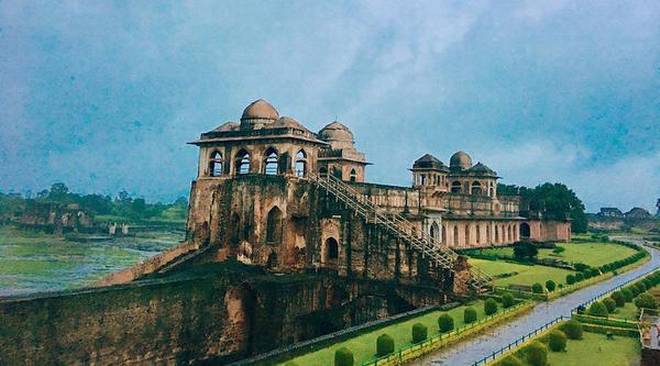
We drove straight to Jahaz Mahal, a stunning building, named as such because its shape, when it fell on the water tanks surrounding it, looked like a ship.
All the guides and stories will tell you that Ghiyasuddin Shah built it to house his harem. A probably exaggerated figure of his harem was given by Jahangir, who wrote it as 15,000. That figure is gleefully quoted by local guides, with perhaps a hint of envy on their faces.
After Dilawar Khan established the Malwa dynasty he got architects and craftsmen from Delhi. The early buildings bear a stamp of the Tughlaq and Khilji architecture of Delhi.
The Jahaz Mahal, however, is a flight of imagination and takes yours along with it. I could see girls dancing and singing in the rain on the rooftop and in the courtyards, their shadows reflecting on the Munj Talao and Kaphur Taloo surrounding it.
The strains of Megh Malhar were flooding my senses, and in my mind’s eye I could see the arcades being lit up by the lanterns and lamps that were floating on the water, glimmering and dipping along with the wind, glowing like fireflies.
I could smell the heavily laden kadhais (woks), with samosas and baras being fried. As the illustrations of the Nimatnama show, the Sultan took a keen interest in, and was perhaps supervising, the correct temperature of the oil, the salt in the filling. How golden was the result?
Who knows? All I know is that I was transported back to the 15th century as soon as I entered the long, double-storied Jahaz Mahal through its main arched, marble entrance. At the back, every arch of the continuous arcaded 360-feet building opens on to Munj Talao. I don’t know how close it was originally to Kaphur (Camphor), now called Kapoor Talao, but now this is quite a distance from it. There are manicured lawns between it.
Initially it was decorated with glazed tiles and colourful friezes. Now we have the unfortunate graffiti that people are wont to inscribe on monuments. The cool corridors and pillared compartments were made for dancing and singing.
Nur Jahan accompanied Jahangir to Mandu in 1617 and the palace complex of Mandu enchanted the royal couple.
A magical bubble
Jahangir sent Abdul Karim in an advance party to repair the buildings. He was so pleased with the result that he rewarded him with the title of Ma’mur Khan (architect Khan). Mandu is a treasure house of water harvesting. There are also bathing tanks. There are two in this palace, on both the floors, shaped like a tortoise with steps going in. Now devoid of water, one can imagine women going to the toilet there, with roses and lotus flowers floating in the perfumed waters.
The roof has a few open pavilions and kiosks on its four corners. While I was there on the wet, open terrace, the mist came and blotted out everything around. We were trapped in our very own magical bubble.
source: http://www.thehindu.com / The Hindu / Home> Opinion – Where Stones Speak / by Rana Safvi / September 03rd, 2017
The family had moved to England at the Queen’s behest, bringing great solace to an increasingly homesick Karim, said Mahmood.
Javed Mahmood, Abdul Karim’s great grandson
It was an April morning in Bengaluru and Javed Mahmood, as was his custom, sat down to flip through the newspapers. The year was 2010, nearly two decades since he had moved to the city to live a quiet retired life. His relatives were scattered between Bengaluru and Karachi, as they had been since Independence. Very little remained of the family’s rich history, much of what they had left was lost in the traumas of Partition and mostly forgotten. That summer morning in 2010, however, everything changed. Mahmood found, to his astonishment, that Indian author Shrabani Basu’s Victoria and Abdul: The True Story of the Queen’s Closest Confidant had uncovered the truth behind his great grandfather Abdul Karim telling a tale of friendship and loyalty. Mahmood talks to Darshana Ramdev about a family that has been steeped in history since, with his father, Anwar being a founding member of Bata in 1933.
“I rushed at once to the British Council and asked them to help me contact her,” said Mahmood, whose grandfather, Abdul Rashid, was Karim’s adopted son. “We didn’t actually know he was adopted until Karim’s death in 1909 and the inheritance had to be dealt with.” The family had moved to England at the Queen’s behest, bringing great solace to an increasingly homesick Karim. “The Queen made them feel very much at home my grandfather received the same education that Edward VII and the rest of her children had earlier received.” The Queen, who was aware of the couple’s inability to have children, sent her personal physician, Dr. John Reid, to examine (much to his horror) Karim’s wife.
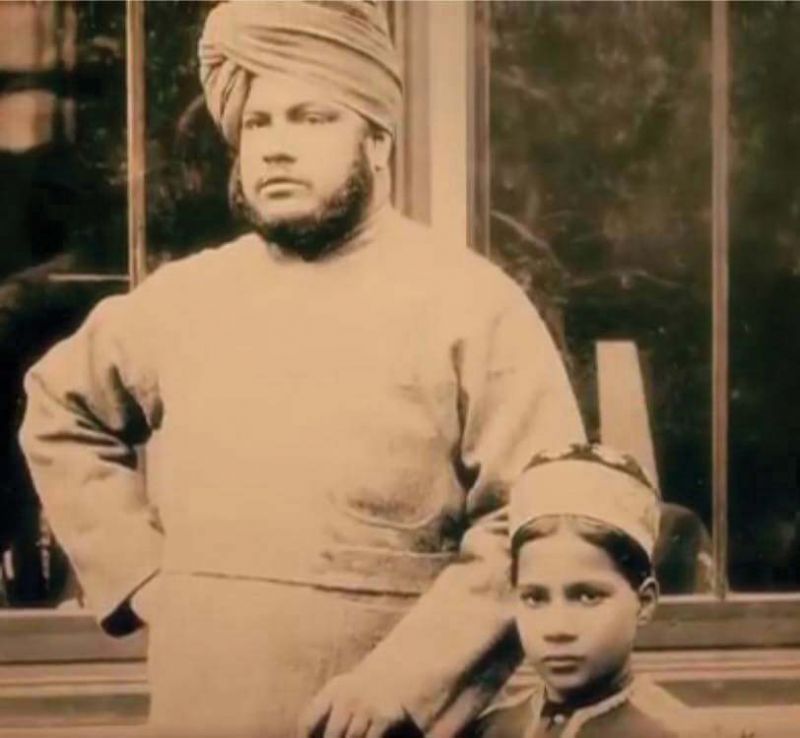
Abdul Karim with his adopted son, Abdul Rashid in England
“Abdul Karim had been greatly maligned by historians the Queen’s family may have wanted to destroy all trace of his presence in the court. Ms Basu had gained access to hidden archives, however. Our family still had a few documents – the diary being one of them, so Shrabani and I hopped on a plane to Karachi at once!” Karim’s descendants there were understandably wary, but Mahmood succeeded in coaxing them to part with the diary. Like most people of the time, Karim maintained meticulous written records into his life, which helped set the record straight on the stream of allegations that had been made against his character. “The diary proved beyond doubt that their relationship was marked by great affection, but had remained platonic always,” said Mahmood.
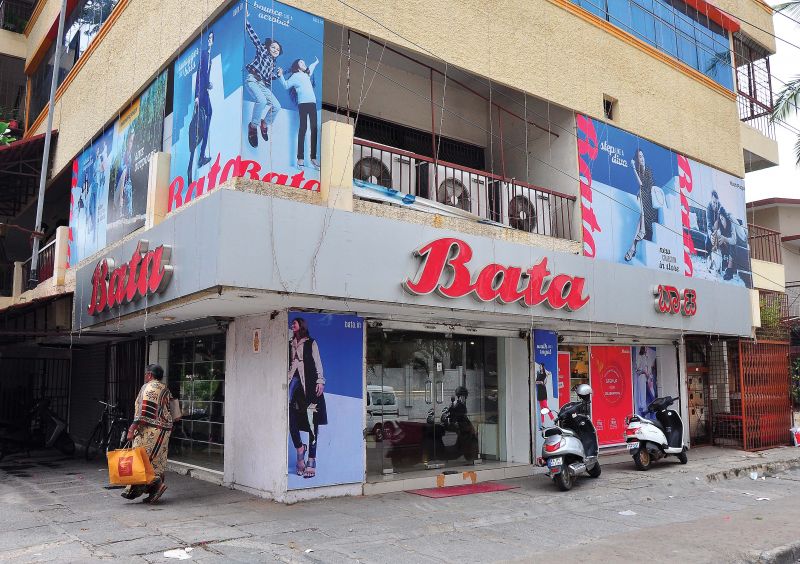
Javed Mahmood’s father, Anwar Mahmood, was one of the founding members of Bata in 1933. He started the Trot Shoe Company in 1963, setting up a second factory in Whitefield in 1970.
It contained valuable insights into Queen Victoria’s much loved Munshi, or teacher, the prepossessing young man who won the affections of a foreboding monarch with a reputation for a heart of stone. He was presented as an orderly to the Queen, which he didn’t like it was not a fitting position for the son of a landed ‘doctor’. He soon found himself promoted to Munshi, leading the now ailing Empress to a discovery of India. The Queen’s love for her young munshi drew jealousy, hatred and racial prejudice in a society known for its repressive puritanical leanings. Neither cared, however, with the Queen sticking her neck out on numerous instances to defend her young friend. “She was always caring and appreciative of our customs every Eid, she would walk across the grounds to Karim Cottage (on the Osborne House estate) to visit the family.” They were, in turn, invited up to the palace for tea during Christmas “The Queen would even have the windows covered with silk curtains so Karim’s family could keep the purdah. He was also a wonderful cook he would cook for her on occasion, as an act of love.”
Little was known of his life after the Queen’s death in 1901: Karim and his family were unceremoniously deported, almost at once, by a jealous Edward VII, who been aroused to such fits of rage that he had even attempted to force his mother to abdicate from office, on grounds of insanity. “Soon after the Queen’s death, King Edward arrived at Karim Cottage in Osborne House and ordered Rashid, who was a teenager at the time, to scour the house for any heirlooms or documents that contained the royal insignia. The little they could salvage, including Karim’s diary, returned with him to Agra in 1901, where he died eight years later. “He died at the age of 48 and the family was given his inheritance,” said Mahmood.
These remained with the family for some decades, until talk of Partition began to do the rounds. “We were a fairly prominent family and were advised at the time to shift temporarily to Bhopal, until the trouble blew over,” said Mahmood. This they did, greatly underestimating the scope of the problem and packing only the essentials. When the Partition took place, the family was evacuated to Mumbai, but many of the treasures were lost in transit. “The diary was with my grandfather, who was the custodian of Karim’s things.” The family moved to Karachi, save for Mahmood’s mother, Begum Qamar Jahan and two sisters. The diary went to Pakistan with them. “One of the sisters eventually shifted to Pakistan too,” he explained.
Meanwhile, in 1933, Bata, which was a burgeoning Czech company, found itself in hot water after the nation was declared Communist. The company decided to set up a factory near Calcutta, where leather was widely available. The large Muslim population in the area was another perk, providing the tannery services they so badly needed. “My father, Anwar Mahmood, was one of the founding members of the company,” he said. He joined the company at the age of 16 and worked there for nearly 30 years before he started his own business, the Trot Shoe Company. The first factory was set up in Kolkata in 1963 and the second in Whitefield, in 1970. “The organised shoe industry didn’t exist in South India and the Karnataka government had offered businesses a number of benefits, which led us here,” said Mahmood. Natural rubber, an important raw material and was grown abundantly in Kerala, making it easily accessible. “My elder brother managed the factory here, I handled the one in Kolkata and my parents shuttled between the two cities. When my younger brother was ready to start work, we established a third branch in Hosur.” Javed Mahmood and his younger brother still call Bengaluru home.
Mahmood tells his story from San Francisco, where calls have been pouring in from across the world since the release of the film, Victoria and Abdul. “The film is doing very well, it’s being shown at local theatres here as well and friends have been getting in touch to tell me how much they enjoyed it,” he smiles.
“My great grandfather’s relationship with the Queen had been presented as scandalous and sleazy he was falsely accused of every imaginable sin. Ms Basu read Karim’s diary cover-to-cover and brought those insights into the second edition of her book.” And that’s how Abdul Karim’s story received its long overdue re-telling, well over a 100 years after his death in 1909. “Queen Victoria was a woman far ahead of her times, rising well above the prejudices that so plagued her society, to defend the young Indian man she called a friend. I think there’s a lesson in it for all of us even today.”
source: http://www.deccanchronicle.com / Deccan Chronicle / Home> Nation – In Other News / by Darshana Ramdev, Deccan Chronicle / October 14th, 2017
An adult cinema turned mosque, a Muslim home turned film museum, a gorgeous blue masjid & a dargah cops love.
The one that now houses a film museum
National Museum of Indian Cinema, Pedder Road
On Pedder Road, one Muslim-owned mansion has been converted in a someday-to-be-opened museum for the movies. Gulshan Abad, the Victorian-Gothic villa, was built in the mid-1800s (a time when the main entrance itself offered a view of the Arabian sea) and was home to the Gujarati businessman Peerbhoy Khalakdina. The five-acre estate was eventually inherited by a relative Cassamally Jairazbhoy, whose third wife, Khurshid Rajabally, hosted cultural gatherings at the home in the 1920s.
Rajabally’s filming of a Haj pilgrimage makes her one of India’s earliest documentary filmmakers. Her son Nazir Ali made documentaries about Indian classical and folk music.
The home served as a hospital for WWII soldiers and in 1949 was briefly rented out to Jai Hind College before the institution found a permanent campus in Churchgate in 1952. But in 1950, the government confiscated the estate, declaring it an evacuee property after Partition.
The home, now restored, holds artefacts from India’s rich cinematic history. Alas, the launch has been tied up in bureaucratic red tape, and you can only get as far as the entrance.
The one that used to be an adult movie theatre
Deeniyat centre, Mumbai Central
The Deeniyat educational and charitable trust couldn’t be more wholesome. It aims to educate children, men and women in basic Islamic tenets and moral teachings related to the Koran and Sunnah. But the institution and mosque are housed in a building that once screened films of less salubrious taste.
In 1914, Ardeshir Irani and Abdulally Esoofally, both instrumental businessmen in early Indian cinema, bought a theatre near Nagpada junction on Bellasis Road. By 1918, they’d named it Alexandra Cinema and converted it into a movie hall, screening films from India and abroad. The single-screen movie hall screened films through the decades – silent films, new talkies, Technicolor hits, epics, Amitabh’s angry-young-man phase and blockbusters. But by the 80s, it was largely where you’d go to watch a B-grade or adult film.
In 2011, a developer bought the 15,000sqft property, turning it over to the non-profit. Deeniyat has spruced up the interiors, and even added a mosque inside. But the exterior – tiled roofs, wraparound verandahs – stays largely the same.
The one where the cops go to worship
Hazrat Makhdum Fakih Ali Mahimi dargah, Mahim
The scholar-saint who lived between 1372 and 1431, was the first commentator of the Koran in India. His books have focus on the philosophy of time and space. He was the Qazi or judge for the Muslims of Thana district.
But what makes him the patron saint of the Mumbai Police? Because he lived at a time when the Portuguese had possession of Salsette, the islands north of Mahim. A Portuguese sergeant would seek his advice and help on many cases. Many also believe that the site at which the Mahim police station stands is said to have been the saint’s home.
Until today, during the annual urs or fair held in his honour, it’s the policemen who lay the first ornamental sheet over his tomb at the dargah. On the urs days, devotees can also walk into the police station premises to pay their respects.
The blue one that catches the moonlight
Masjid-E-Iranian, Dongri
I first saw what is locally called the Mughal Masjid on a local-history tour of Bhendi Bazaar back in 2005 (Yes, I was a nerd before it was fashionable). I was lucky. It was a cool full-moon night and the blue tiles seemed to glow in the dark. For a minute, this tiny corner of Mumbai seemed like Morocco.
The mosque is 158 years old, built by a wealthy Iranian merchant, Haji Mohammad Hussain Shirazi, in 1860 and is maintained by a trust set up by his descendants. It has no dome, but two minarets, and a mosaic of blue tiles of every hue and pattern.
Inside, if you do get permission to enter is a lawn, a pond, a fountain, crystal chandeliers in the inner sanctum and Koran verses inscribed on the walls.
source: http://www.hindustantimes.com / Hindustan Times / Home> Mumbai / by Rachel Lopes, Hindustan Times / October 05th, 2018
Kalanaur (Gurudaspur District), PUNJAB / (buried in Imphal, MANIPAL) :
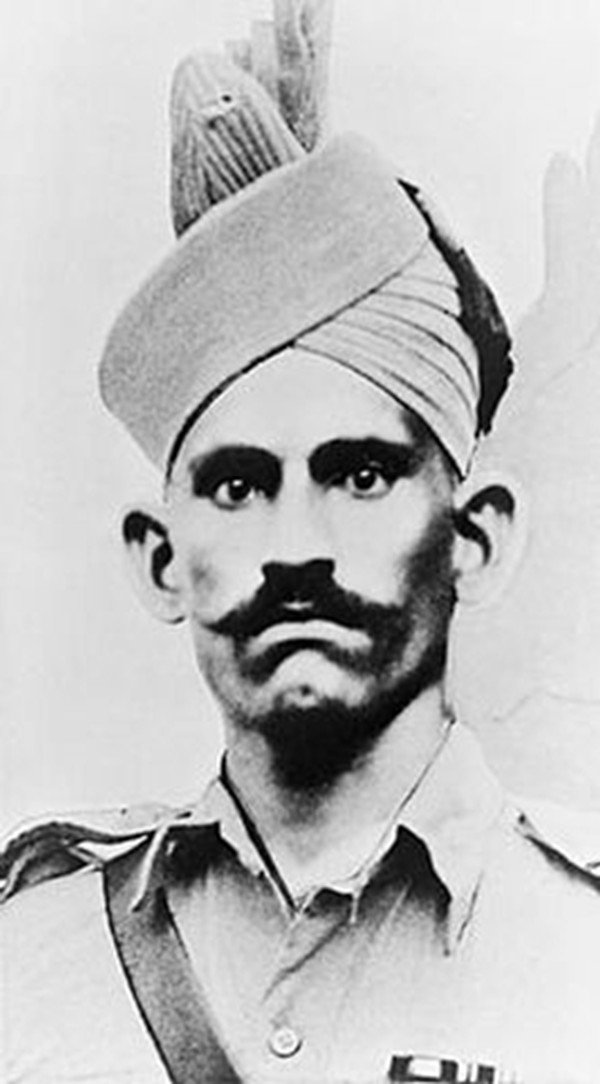
Jemadar Abdul Hafiz VC
Abdul Hafiz was born in Kalanaur Village in Punjab, India. His father name was Nur Muhammad and mother was Hamidan. He was married to Jigri Begum.
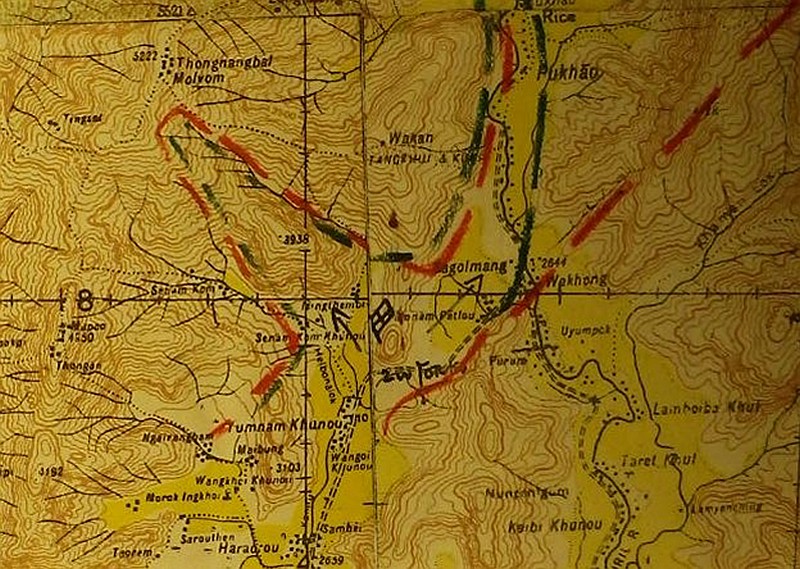
Jemadar Abdul Hafiz of 3/9 Jat won the Victoria Cross- the first Muslim soldier to do so in the Second World War ( Imphal, 1962). He won the VC in a feature named “Runaway Hill” which is located at the corner of the road leading to Isingthembi on the Pangei- Sagolmang Road (see map).
“He served with the 9th Jat Regiment with service number 11460. Jats are an ethnic group who follow a variety of religions. The Jat battalions were structured around two companies of Hindu Jats, one company of Punjabi Muslims and one company of Musulman Rajputs, a mix requiring not only good purely military leadership to ensure the respect of all but sensitivity for different cultures and beliefs”. (CWGC)
The 3rd Battalion, 9th Jat Regiment, was part of the 5th Indian Division during the Imphal campaign and at the time of this action were operating in the Nungshigum area to the north east of Imphal as part of a force advancing up the Litan road which was of strategic importance to both sides as it offered one of the few approaches to the Imphal plain. The attacks in and around Nungshigum Hill, of which Abdul Hafiz’s was one, continued until 13th April 1944 when the hill was finally captured.
Flag in the map showing the RUNAWAY HILL
According to War Diary dated 6th April 1944, 3rd battalion, 9th Jat Regiment,
” D Coys standing patrol the high ground at RK 420790 was driven offduring the night by thr enemy. At approx. 0930 hrs. D Coy counter attacked the enemy from the high ground killing at least 45-50 Japs and capturing a great deal of equipment. Our losses were 4 killed and 12 wounded including Major RITCHIE M.C. wounded. 1 Pl. B Coy supported by 1 tp of “HONEYS” did a sweep at approx 0900 hrs to the village ISINGTHEMBI RK 410800 where enemy had been reported- N.E.S.. 1 Pl. B Coy and the GR Pl at 1630 hrs ordered to NUNSHIGUM RK 4375 to take up a defensive posn”.
“It was by Runaway Hill that the Division’s third Victoria Cross was won. Before dawn on April 6, during this original encircling movement, at a time when we could not be sure when they would appear next, the Japanese attacked one of Colonel Gerty’s standing patrols. By driving the Jats off, they secured a hillock that overlooked the main company position. Jemadar Abdul. Hafiz was ordered to recapture the hill with two sections of his platoon.
After an artillery bombardment by Bastin’s 4th Field Regiment, Abdul Hafiz led his Jats in to the attack. They charged up the hillside that was bare of cover, shouting their war-cry as they neared the top. Then the waiting Japanese opened fire with machine-guns. On the approaching Jats they threw down grenades. Jemadar Abdul Hafiz was wounded at the outset. A bullet struck him in the leg. Yet he dashed forward and seized the enemy machine-gun by the barrel, while another Jat killed the Japanese gunner.
The Jemadar then took up a Bren gun dropped by one of his men who had fallen wounded, and notwithstanding the heavy fire from the enemy positions on this hill and on a feature to the flank, he shot a number of the Japanese soldiers. And so fiercely did he lead his men that the enemy ran away: hence the name Runaway Hill. But Jemadar Abdul Hafiz was mortally wounded in the chest, still grasping his Bren gun. To his men he shouted in his own language, “Reorganize! I will give you covering fire.” But he died,. without having been able to pull the trigger. He was awarded the Victoria Cross, posthumously, and was the first Muslim soldier to win this decoration in the Second World War” ( Ball of Fire – Antony Brett-James 1951) .
Geoffrey Evans and Antony Brett-James in their book “Imphal” give the account of how the feature got its name of Runaway Hill . ” Undaunted, Abdul Hafiz rushed forward as best he could and with supreme bravery seized the barrel of the machine gun while a second Jat Killed the gunner. That done, he saw a bren automatic which had been dropped by one of his wounded men, and picking it up without hesitation, he opened fire on the enemy to such effect that those whom he did not kill ran away as fast as they could. For this reason the hill became known as ‘Runaway Hill’, a name which it retained throughout the battle”.
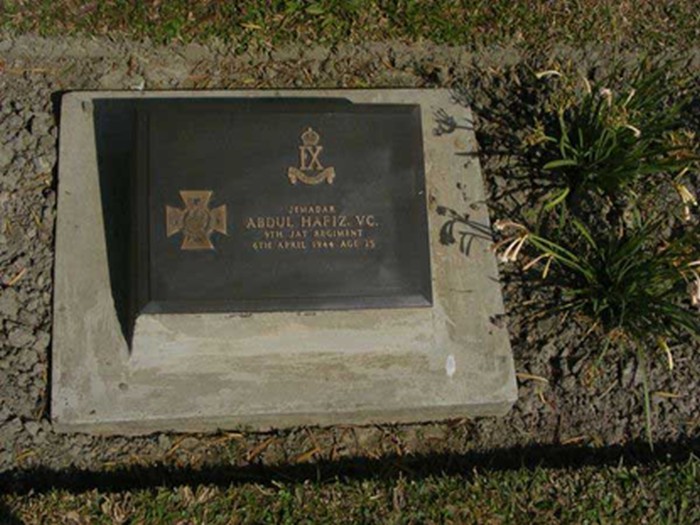
Grave of Jemadar Abdul Hafiz VC
His citation reads as follow:
The KING has been graciously pleased to approve the posthumous award of the VICTORIA CROSS to:–Jemadar Abdul Hafiz (11460), 9th. Jat Regiment, Indian Army.
In Burma, in the early hours of the 6th April, 1944, in the hills 10 miles North of Imphal, the enemy had attacked a standing patrol of 4 men and occupied a prominent feature overlooking a Company position. At first light a patrol was sent out and contacted the enemy, reporting that they thought approximately 40 enemy were in position. It was not known if they had dug in during the hours of darkness.
The Company Commander ordered Jemadar Abdul Hafiz to attack the enemy, with two sections from his platoon, at 0930 hours. An artillery concentration was put down on the feature and Jemadar Abdul Hafiz Khan led the attack. The attack was up a completely bare slope with no cover, and was very steep near the crest. Prior to the attack, Jemadar Abdul Hafiz assembled his sections and told them that they were invincible, and all the enemy on the hill would be killed or put to flight. He so inspired his men that from the start the attack proceeded with great dash.
When a few yards below the crest the enemy opened fire with machine-guns and threw grenades. Jemadar Abdul Hafiz sustained several casualties, but immediatetly ordered an assault, which he personally led, at the same time shouting the Mohammedan battle-cry. The assault went in without hesitation and with great dash up the last few yards of the hill, which was very steep. On reaching the crest Jemadar Abdul Hafiz was wounded in the leg, but seeing a machine-gun firing from a flank, which had already caused several casualties, he immediately went towards it and seizing the barrel pushed it upwards, whilst another man killed the gunner.
Jemadar Abdul Hafiz then took a Bren gun from a wounded man and advanced against the enemy, firing as he advanced, and killing several of the enemy. So fierce was the attack, and all his men so inspired by the determination of Jemadar Abdul Hafiz to kill all enemy in sight at whatever cost, that the enemy, who were still in considerable numbers on the position, ran away down the opposite slope of the hill. Regardless of machine-gun fire which was now being fired at him from another feature a few hundred yards away, he pursued the enemy, firing at them as they retired.
Jemadar Abdul Hafiz was badly wounded in the chest from this machine-gun fire and collapsed holding the Bren gun and attempting to fire at the retreating enemy, and shouting at the same time “Re-organise on the position and I will give covering fire.” He died shortly afterwards.
The inspiring leadership and great bravery displayed by Jemadar Abdul Hafiz in spite of having been twice wounded, once mortally, so encouraged his men that the position was captured, casualties inflicted on the enemy to an extent several times the size of his own party, and enemy arms recovered on the position which included 3 Lewis Machine-guns, 2 grenade dischargers and 2 officers’ swords. The complete disregard for his own safety and his determination to capture and hold the position at all costs was an example to all ranks, which it would be difficult to equal.—( London Gazette. Issue 36627, 25th July 1944 ).
The Victoria Cross and Campaign medals awarded to Jemadar Abdul Hafiz, 3rd Bn, 9th Jat Regiment, Indian Army, have been acquired by the Michael Ashcroft Trust, the holding institution for Lord Ashcroft’s VC Collection.
Abdul Hafiz is today laid buried at Imphal Indian War Cemetery at Hatta Minuthong, Imphal. His Grave number is 3. Q. 2. He was 25 years of age when he died on 6th April 1944
source: http://www.e-pao.net / E-Pao / Home> Manipur> History of Manipur> Historical War Manipur / by Rajeshwor Yumnam / May 18th, 2015
The kallupallis are reminders of the region’s cultural and architectural traditions
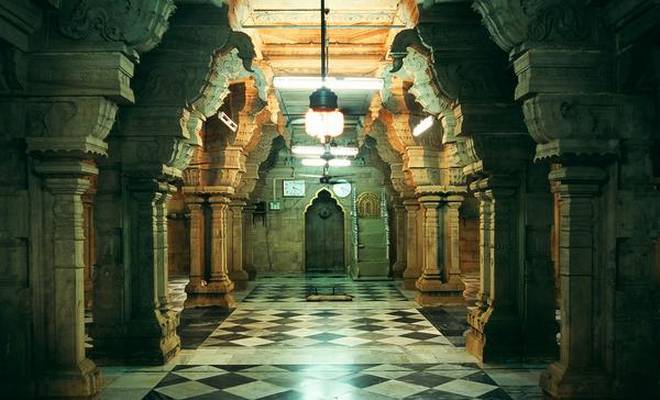
Among the many inscriptions at the Vaishnavite shrine of Adhi Jagannatha Swamy at Thirupullani, about 10 km from Ramanathapuram in southern Tamil Nadu, there is one about a grant for a mosque. This particular inscription of the late 13th Century by the Pandya King Thirubuvana Chakravarthy Koneri Mei Kondan, describes the grant made to the Muslim Sonagar, to build a mosque at Pavithramanikka Pattinam. While no one today has a clue as to the exact location of Pavithramanikka Pattinam, the region has many ancient mosques like the rest of Tamil Nadu. What is unique about these mosques is that they were all built of stone, in the Dravidian architectural style with Islamic sensibilities.
Unlike north India, Islam came to the south through maritime spice trade even as it was spreading across Arabia in the 7th Century. The Muslims who were traders enriched the country with precious foreign exchange, and hence were accorded a special place by the Tamil rulers of the day, and often received grants to build mosques, like the one at the Adhi Jagannatha Swamy temple.
As mosques are called Palli Vaasal in Tamil, and they were built of kal, the Tamil word for stone, they came to be locally known as kallupallis. These kallupalliswere essentially built more like mandapams, better suited to Islamic requirement for the congregation to assemble and stand together in prayer.
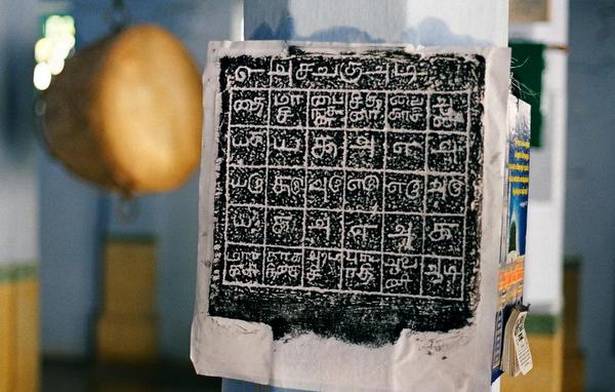
Engraving of Tamil calendar for prayer found inside the mosque
With guidelines for the construction of mosques being simple – such as prayer facing Mecca, no idol worship and clean surroundings, the masons who worked on these mosques under the supervision of religious heads restricted themselves to carving floral and geometrical motifs instead of human figures as in a temple. “While the raised ‘Adisthana’ of the Hindu temple was retained, there were no ‘Garbha Grahas’ and no figurines carved on any of the pillars” says Dr.Raja Mohammad, author of Islamic Architecture in Tamil Nadu.
For more than a millennium, hundreds of such mosques built in the Dravidian Islamic architectural style came up across Tamil Nadu, often with the help of grants from the rulers of the day, ranging from the Cheras, the Pandyas, the Venad kings and the Nayaks to the Sethupathis of Ramanathapuram. Across Tamil Nadu, wherever Tamil Muslims lived in large numbers, from Pulicat near Chennai to Kilakarai, Kayalpatnam, Kadayanallur, Kottar, Tiruvithancode, Madurai, etc., one finds these beautiful kallupallis.
Amongst these kallupallis, though not the oldest, the most beautiful mosque is to be found at Kilakarai, near Ramanathapuram. A medieval port town with a predominant Tamil Muslim population, Kilakarai has many mosques built during different eras spanning many centuries. The one built towards the end of 17th Century is the most beautiful of them all. It is believed to have been built by the great merchant and philanthropist Periathambi Marakkayar, also known as Seethakkathi, whom the Dutch records speak of as a great trader having considerable influence with the Sethupathis, the then rulers of Ramanathapuram.
The mosque built in the Dravidian architectural style of the late Vijayanagara period, has elements that are specific to native traditions. Like many other kallupallis, this mosque too has Podhigai, the floral bud detailing on the pillar corbels, which represent positivity and auspiciousness, an essential part of the cultural beliefs of the land. An interesting engraving found in this mosque is the Tamil calendar for prayer.
What is unusual about this calendar is that, timings for prayers in the various Tamil months are marked in Tamil numerals, a rarity, found in just a few other mosques in southern Tamil Nadu.
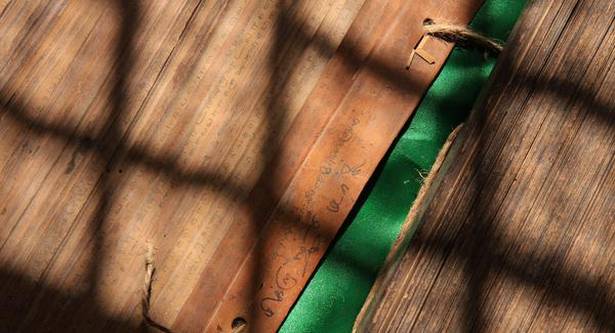
These mosques, deeply embedded in the Tamil culture, were also places where Tamil flowered. Further down south, at the Kottar mosque in Nagercoil, an early Tamil Islamic literary work, Mikuraasu Malai, was presented to the assembled congregation by Aali Pulavar in the late 16th Century.
Mikuraasu Malai, a palm leaf work
Mikuraasu is a Tamilised form of Mihraj, and narrates a significant event in the life of Prophet Muhammad (Pbuh), his ascension to the heaven. Even after 400 odd years, the tradition of singing Mikurasu Malai on the eve of Mihraj continues to this day at the Kottar mosque. Other literary works such as Seera Puranam, a Tamil epic on the history of the Prophet, are also recited across mosques in Tamil Nadu.
The Kallupallis in Tamil Nadu stand as proud reminders of not just an architectural tradition but also of cultural traditions, where Islam effortlessly adapted itself to the native customs.
source: http://www.thehindu.com / The Hindu / Home> Society> History & Culture – Anwar’s Trail / by Kombai S. Anwar / November 23rd, 2017
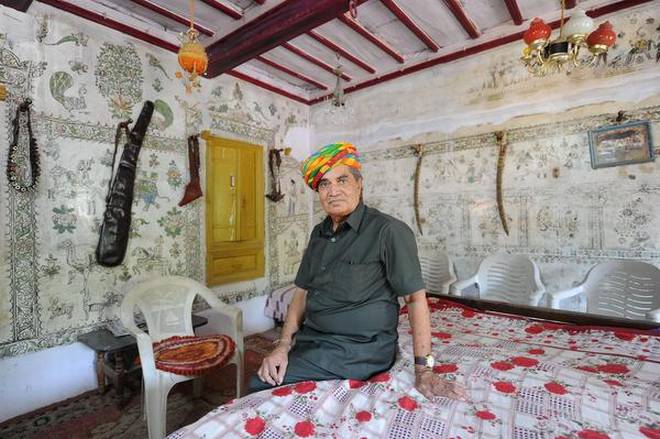
Kalubhai Vaghela in his ancestral house in Mundra. Photo: Vijay Soneji
In 18th century Kutch, walls were painted with stories. They survive today in only three places
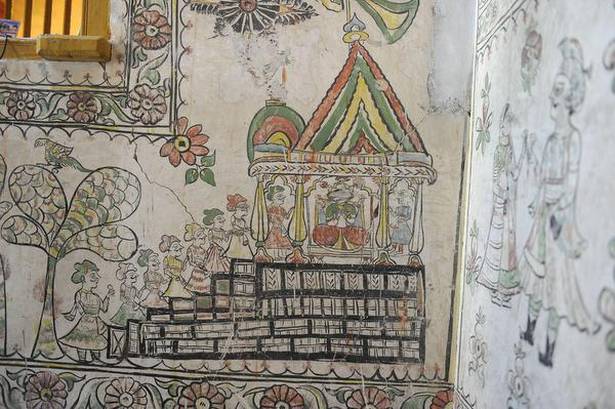
On the fissured walls of the magnificent Tera fort in Gujarat’s Kutch district the story of the Ramayana springs to life in vivid colour: there is Sita on a pyre, Ram raining arrows on Ravana.
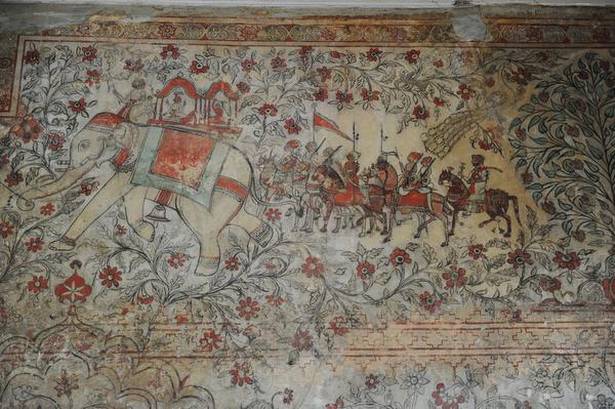
Kamangari bhint chitro or wall paintings was once a thriving art form in Kutch, used to embellish the palaces and homes of the affluent. The themes were as diverse as the patron’s tastes, but were predominantly mythological, with scenes from the Ramayana or Krishna Leela. Royal processions was another favourite. The landscape was another rich source of material, and date palms and peacocks and scenes from everyday life were common.
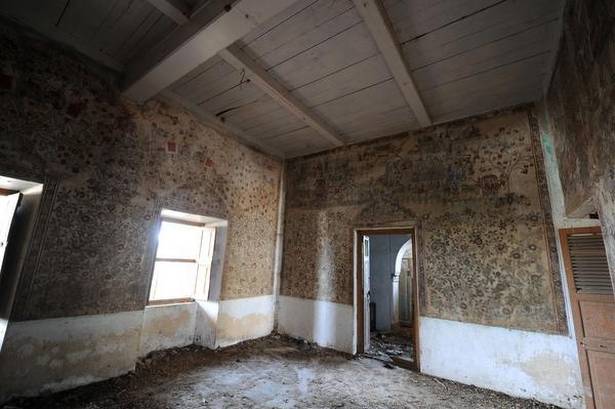
Today, only bits and pieces of this rich art are preserved in a few homes, temples, and on Tera fort. But if you were to string these together chronologically, history would come alive in a lyrical manner.
Back to its origin
Kamangari art originated in the 18th century. “It was a relatively peaceful time; there were no battles, and it was a conducive environment for travel and trade,” says Pradip Zaveri, a Vadodara-based businessman, known for documenting Kamangari. During this time, the Kamangars, a Muslim community from northern Kutch who traditionally made bows and arrows (kaman means bow) and painted shields, travelled to the rest of the region.
Soon the affluent Bhatia and Jain communities commissioned the Kamangars to paint their homes, giving birth to the art form. Such artistic embellishment on walls was traditionally seen as auspicious in Kutch.
A folk art
One of the finest examples of Kamangari art is in Aina Mahal, an 18th century palace in Bhuj. Here, the corridor is painted with a 47 feet scroll titled Nagpanchami Ashwari, by Kamangar artist Juma Ebrahim. The scroll begins with a royal procession with a mounted Arab cavalier, Arab soldiers, a cannon drawn by a pair of bullocks, a chariot of the family deity, and a group of camel riders. In the middle of the scroll is Maharao Shri Pragmalji II on a caparisoned elephant. The ethnicity of every individual is represented by their costume.
The paintbrushes were made from the bark of the local date palm, and the colours sourced from tree bark, flowers and stones. The artists would paint on wet plaster to ensure permanence.
For all its beauty, says Zaveri, Kamangari does not appear to have a consistent style. “If you look at two paintings, you will see the difference in the treatment and rendering. For example, the lines on wall paintings are thicker than those in the scrolls. In some places, flowers are used to fill gaps — like in a temple in Anjar — but in other places this is missing.”
Kamangari artwork at MacMurdo’s bungalow in Anjar. Photo: Vijay Soneji
Artists essentially followed their patron’s instructions. As the rich traders who commissioned this art travelled abroad, the art saw changes too. “The artists were given postcards from these places, and they would then draw characters inspired from the West but wearing a Kutchi pagdi, or the women would have long skirts,” Zaveri says.
In a Jain temple in the Abdasa taluka of Kutch, a man is shown wearing a hat but in a dhoti and long coat. Some later paintings depict British soldiers in uniform. Others have aeroplanes, rail engines, and even a game of cricket.
MacMurdo’s bungalow in Anjar. Photo: Vijay Soneji
At the bungalow of James MacMurdo in Anjar, the first political resident of the East Indian Company in Kutch, you can see Krishna and the Gopis dressed in the traditional attire of the Rabari community, complete with the nath (nose-ring). Much of the work also showed influences of the Mughal and Rajasthani styles.
The decline
According to Zaveri, Kamangari was popular until the early 20th century. Then, around the time of the Great Depression, its patrons began to migrate out of Kutch, and homes were locked up or abandoned. The murals degenerated and new occupants painted over them. The Kamangari artists turned to other livelihoods.
“The 2001 Kutch earthquake dealt another severe blow; many houses that had the last few paintings came down,” says Zaveri. Now there are only three places in Kutch with well-preserved Kamangari — the fort in Tera, MacMurdo’s bungalow in Anjar, and an ancestral home in Mundra, belonging to Kalubhai Vaghela.
There have been some feeble attempts by the government to revive the art, but more promising is a new project. Dalpat Danidharia, a librarian at Bhuj’s Prag Mahal, a 19th century palace, says: “Some of us who are passionate about saving Kamangari from disappearing from public memory are working on commissioning artists to create replicas.” The aim, he says, is to let everyone experience this vibrant Kutchi heritage before it’s lost forever.
When not researching new stories, the Gujarat-based freelance journalist likes spinning tales for her toddler.
source: http://www.thehindu.com / The Hindu / Home> Society> History & Culture / by Azera Parveen Rahman / September 29th, 2018