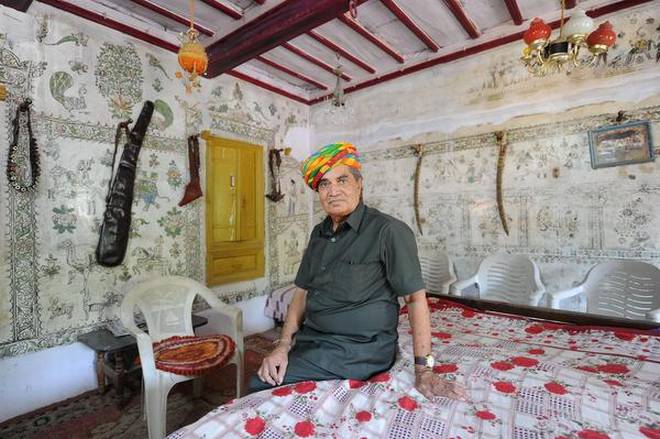
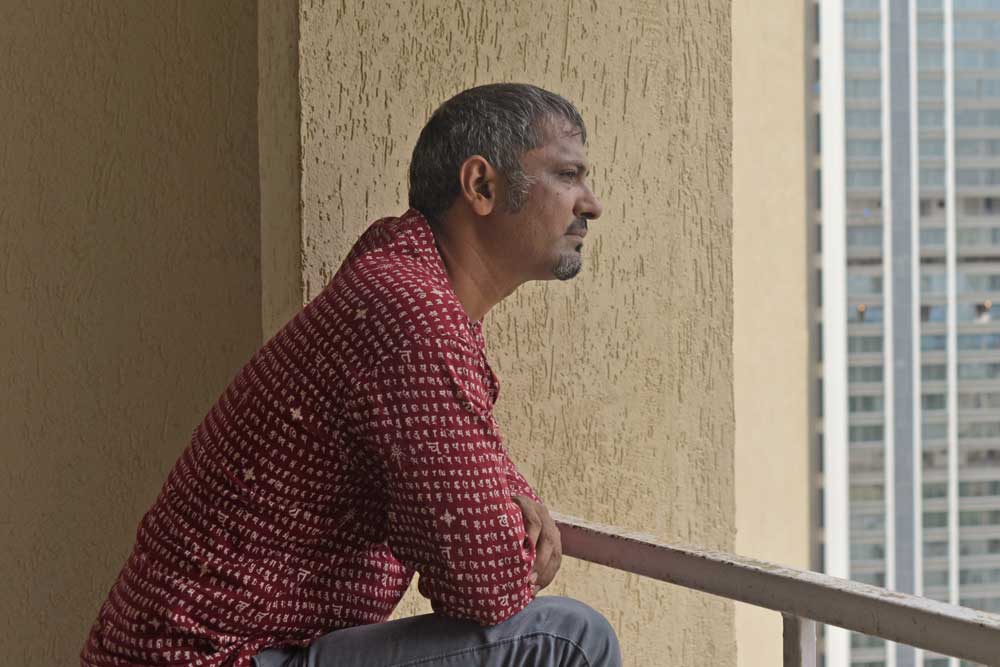
Kalubhai Vaghela in his ancestral house in Mundra. Photo: Vijay Soneji
In 18th century Kutch, walls were painted with stories. They survive today in only three places
On the fissured walls of the magnificent Tera fort in Gujarat’s Kutch district the story of the Ramayana springs to life in vivid colour: there is Sita on a pyre, Ram raining arrows on Ravana.
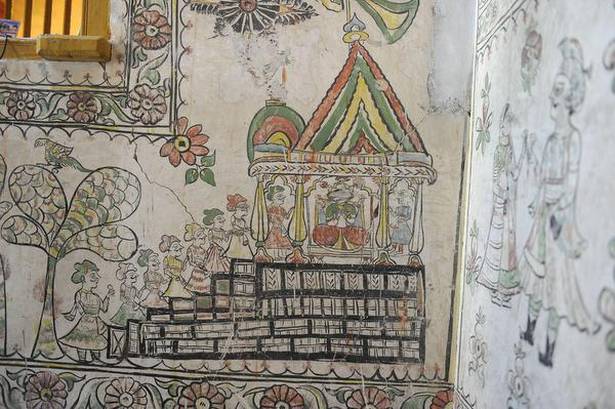
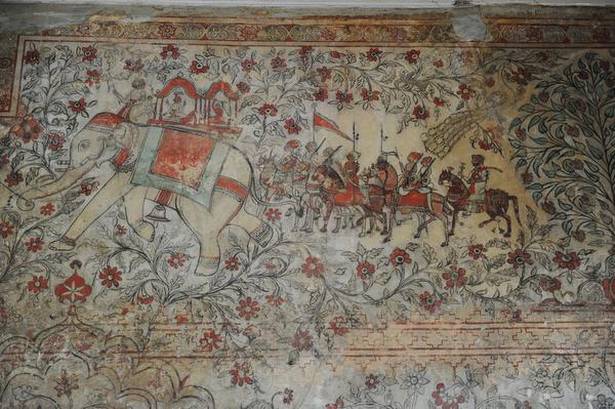
Kamangari bhint chitro or wall paintings was once a thriving art form in Kutch, used to embellish the palaces and homes of the affluent. The themes were as diverse as the patron’s tastes, but were predominantly mythological, with scenes from the Ramayana or Krishna Leela. Royal processions was another favourite. The landscape was another rich source of material, and date palms and peacocks and scenes from everyday life were common.
Today, only bits and pieces of this rich art are preserved in a few homes, temples, and on Tera fort. But if you were to string these together chronologically, history would come alive in a lyrical manner.
Back to its origin
Kamangari art originated in the 18th century. “It was a relatively peaceful time; there were no battles, and it was a conducive environment for travel and trade,” says Pradip Zaveri, a Vadodara-based businessman, known for documenting Kamangari. During this time, the Kamangars, a Muslim community from northern Kutch who traditionally made bows and arrows (kaman means bow) and painted shields, travelled to the rest of the region.
Soon the affluent Bhatia and Jain communities commissioned the Kamangars to paint their homes, giving birth to the art form. Such artistic embellishment on walls was traditionally seen as auspicious in Kutch.
A folk art
One of the finest examples of Kamangari art is in Aina Mahal, an 18th century palace in Bhuj. Here, the corridor is painted with a 47 feet scroll titled Nagpanchami Ashwari, by Kamangar artist Juma Ebrahim. The scroll begins with a royal procession with a mounted Arab cavalier, Arab soldiers, a cannon drawn by a pair of bullocks, a chariot of the family deity, and a group of camel riders. In the middle of the scroll is Maharao Shri Pragmalji II on a caparisoned elephant. The ethnicity of every individual is represented by their costume.
The paintbrushes were made from the bark of the local date palm, and the colours sourced from tree bark, flowers and stones. The artists would paint on wet plaster to ensure permanence.
For all its beauty, says Zaveri, Kamangari does not appear to have a consistent style. “If you look at two paintings, you will see the difference in the treatment and rendering. For example, the lines on wall paintings are thicker than those in the scrolls. In some places, flowers are used to fill gaps — like in a temple in Anjar — but in other places this is missing.”
Kamangari artwork at MacMurdo’s bungalow in Anjar. Photo: Vijay Soneji
Artists essentially followed their patron’s instructions. As the rich traders who commissioned this art travelled abroad, the art saw changes too. “The artists were given postcards from these places, and they would then draw characters inspired from the West but wearing a Kutchi pagdi, or the women would have long skirts,” Zaveri says.
In a Jain temple in the Abdasa taluka of Kutch, a man is shown wearing a hat but in a dhoti and long coat. Some later paintings depict British soldiers in uniform. Others have aeroplanes, rail engines, and even a game of cricket.
MacMurdo’s bungalow in Anjar. Photo: Vijay Soneji
At the bungalow of James MacMurdo in Anjar, the first political resident of the East Indian Company in Kutch, you can see Krishna and the Gopis dressed in the traditional attire of the Rabari community, complete with the nath (nose-ring). Much of the work also showed influences of the Mughal and Rajasthani styles.
The decline
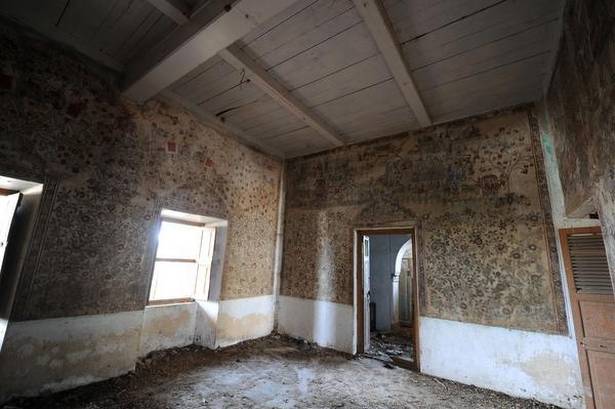
According to Zaveri, Kamangari was popular until the early 20th century. Then, around the time of the Great Depression, its patrons began to migrate out of Kutch, and homes were locked up or abandoned. The murals degenerated and new occupants painted over them. The Kamangari artists turned to other livelihoods.
“The 2001 Kutch earthquake dealt another severe blow; many houses that had the last few paintings came down,” says Zaveri. Now there are only three places in Kutch with well-preserved Kamangari — the fort in Tera, MacMurdo’s bungalow in Anjar, and an ancestral home in Mundra, belonging to Kalubhai Vaghela.
There have been some feeble attempts by the government to revive the art, but more promising is a new project. Dalpat Danidharia, a librarian at Bhuj’s Prag Mahal, a 19th century palace, says: “Some of us who are passionate about saving Kamangari from disappearing from public memory are working on commissioning artists to create replicas.” The aim, he says, is to let everyone experience this vibrant Kutchi heritage before it’s lost forever.
When not researching new stories, the Gujarat-based freelance journalist likes spinning tales for her toddler.
source: http://www.thehindu.com / The Hindu / Home> Society> History & Culture / by Azera Parveen Rahman / September 29th, 2018
Reminiscing a slow but stimulating journey to Akbar’s capital city
When Marion and Sally, two English teachers of St Thomas’ School, Mandir Marg, set out on a trip to Fatehpur Sikri in 1978, they boarded the last train from Delhi. “It sounds ominous, like the last plane from Da Nang, when South Vietnam was overrun by the Viet Minh,” remarked Sally, “Yes,” recalled Marion. “Many struggled to board the plane. Some were left behind but in the melee an enterprising Western reporter was not only able to capture the heart-wrenching scene, but also played the hero by helping a hysterical woman and her kid take his seat on the plane as he jumped down to shoot what later turned out to be award-winning pictures of the airport scramble.”
The last train from Old Delhi station did not cause any such frenzied commotion. Over 40 years ago it was the one that was supposed to leave just before midnight, but the departure was invariably delayed. From Delhi Main station it ran up to Agra Cantt, its destination, and took seven hours to do so, usually even more. The passenger train had a whole lot of policemen travelling in it. As a matter of fact, right from the ticket window they made their presence felt when they pulled suspicious-looking youths out of the queue and slapped and punched them before asking questions like, “Where are you going? Where did you get the money to buy the ticket? Are you drunk? Who else is travelling along with you? Where do you live?” before searching them with their shirts off and pants down,” the two teachers recalled.
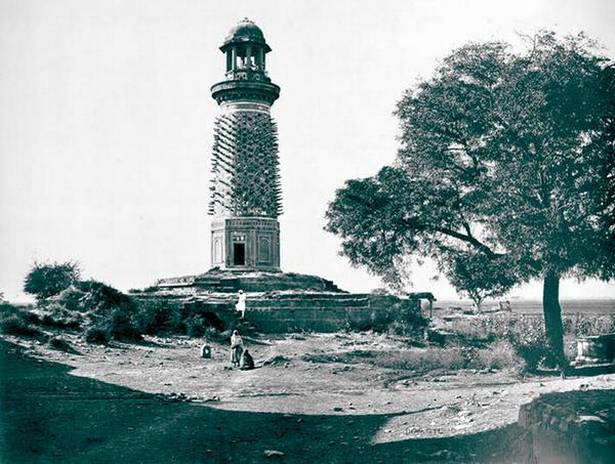
A view of Hiran Minar
When they caught the train they didn’t see those young men again. The train made three false starts, provoking someone to remark that the driver was shaking the compartments to fit in more passengers. Finally it started rolling, with several urchins rushing to catch it. By the time the train reached New Delhi station it was nearly 1 a.m. After that the Passenger stopped at every station big or small and as people got down, many were detained and searched by policemen on the platform. But the two girls reached Agra Cantt station safely. From there they were escorted by friends Sam, Lewis and this scribe by car to Sikri.
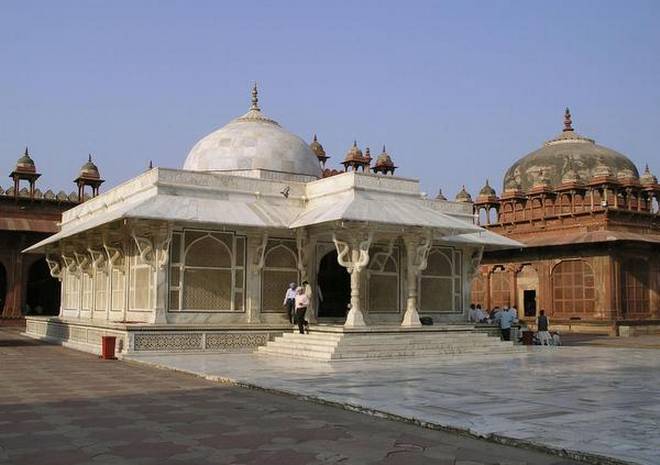
The shrine at Fatehpur Sikri is one of the most venerated places. Where wild animals once roamed a gem of a monument now greets the eye,” disclosed Sam. “It was here on a hill that Sheikh Salim Chisti dwelt and thither came Akbar the Great to seek his help for the birth of a son and heir apparent. He came on foot, leaving his camels, elephants and horses behind. The hermit sat with a rosary (tasbi) reciting the 99 names of Allah. The emperor’s prayers were heard and his Rajput queen bore a son, Salim, whom Akbar always called Sheikhu Baba, after the saint. Not only that, he built this magnificent city to commemorate the event and dwelt here with his Nine Jewels, like the Nine Worthies of the ancient world. “I have heard about the Nine Jewels,” said Marion, “but who were the Nine Worthies?” “Hector, Alexander the Great, JuliusCaesar, Joshua, David, Judas Maccabaeus, King Arthur, Charlemagne and Godfrey of Bouillon,” replied Sam without batting an eyelid.
Akbar’s legacy
Sam related his tale standing by Sally’s side. She listened, her doe eyes thoughtful. As they approached the trellis of the shrine where people who seek favours tie a thread, she tied one too, making Sam wonder what she had sought. They next went to the Buland Darwaza and saw the town of Sikri spread out before them. Nearby is the water works set up by Akbar and from above the ramparts a man dived 80 feet into the baoli or step-well. They looked aghast. “Just you wait and see,” said Sam as Lewis nodded in approval. Soon a dare-devil emerged and salaam-ed them. They tipped him and he walked away to prepare for another demonstration. “These divers have been continuing the tradition for several centuries. VIPs and common people alike tip them. Perhaps, it will continue so long as there is water in the baoli. But it is a paradox that Akbar, who built a new capital here, had to desert it because of water scarcity.” Sam informed the party. They went down the steps of Buland Darwaza, Sam pointing out the Hiran Minar from where the shikar was shot in Mughal times, though some think that Akbar’s famous elephant was buried there and perhaps that’s why it is also called Elephant Tower.
At Sikri town they had the fabulous 24-layer Mughalia parantha. “Why is this parantha so thick?” enquired Marion. “It could feed one whole family.” “Quite right,” said Sam. “Ask Sally, when we were last here she had to take half the parantha to Delhi where we had it for breakfast the next day and the remainder for lunch.”
“Did Akbar really play with women as chess pieces? “enquired Sally.” Off course he did,” replied Sam. “Don’t talk rubbish. Listening to you one would imagine the great Akbar had nothing else to do but seduce maids of honour”, admonished Lewis. From there the party went to the Taj Mahal and then caught the Taj Express back to Delhi after a memorable day. Marion and Sally are now back in England and Sam works in Bangalore, where Lewis keeps reminding him of the visit whenever he rings up from Kolkata.
source: http://www.thehindu.com / The Hindu / Home> Society> History & Culture – Down Memory Lane / by R.V. Smith / October 01st, 2018
Wockhardt’s Habil Khorakiwala has looked crisis in the eye, and come out of it stronger
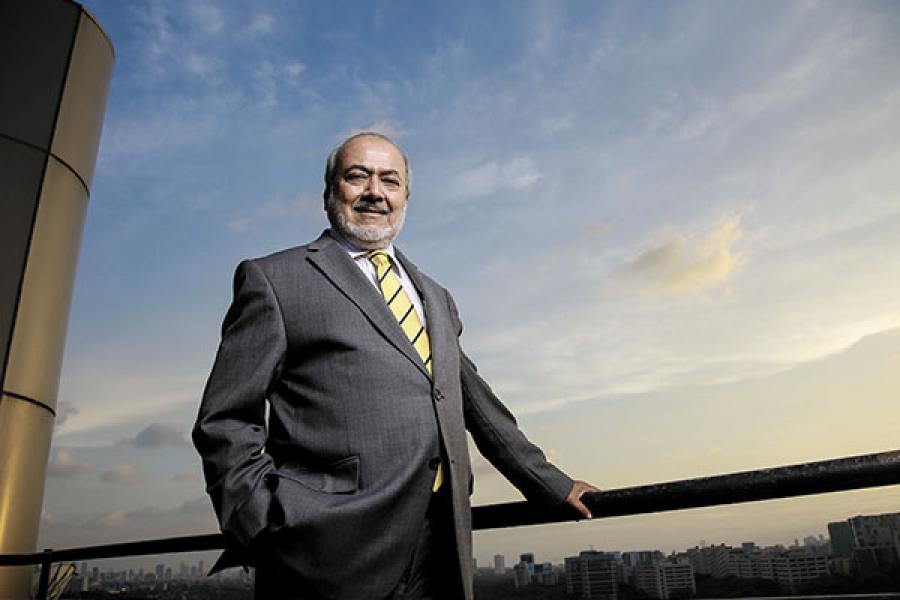
Image: Joshua Navalkar / Habil Khorakiwala, founder chairman, Wockhardt. His tenacity and calm helped the pharmaceutical company tide over recent crises
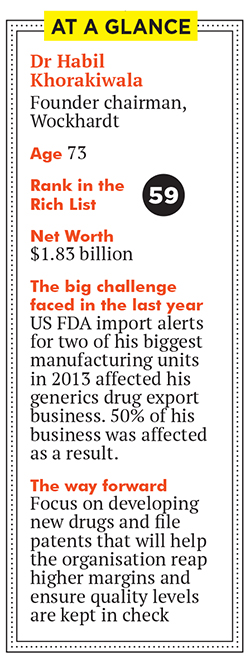
“In your darkest hour you have two options: One, you get overwhelmed by the massive extent of the problem and it paralyses you from any action; the other, you anticipate the worst case scenario and deal with it the best way you can. I choose the latter.” This choice—to fight back and swim against all odds—has brought Dr Habil Khorakiwala, 73, back from the brink. Twice.
The first time was in 2008. Wockhardt was incorporated in 1967 and had done well for itself, growing steadily into one of India’s leading pharmaceutical companies. But, during the heady days of the stock market boom of the mid-noughties, it had bet heavily on foreign exchange and derivatives. The global financial meltdown caught many—including Khorakiwala—unawares: Cross-country derivative deals unravelled and Wockhardt declared a loss of Rs 1,000 crore in FY10. The company experienced near bankruptcy and speculation was rife that it will be sold out.
Enough to rattle the toughest businessman, perhaps. But not Khorakiwala: “I anticipate the worst possible outcome and see if I can live with it. This frees me up to take action.” When he realised that it was indeed a worst-case scenario, he “moved to the next step in figuring out how to reduce the impact, and steps needed for it,” he tells Forbes India.
He had to deal with more than 20 different banks and master the complex world of derivatives. He began by acquiring the knowledge he needed, legal and financial, to deal with the ailment; he read books and consulted experts across the globe, then armed with better understanding, he worked assiduously to resuscitate the company.
He went in for a CDR (Corporate Debt Restructuring) exercise, and made two major divestments: The profitable nutrition business (brands such as Farex and Protinex) to dairy giant Danone for about Rs 1,280 crore, almost 25 times Ebitda; and the veterinary pharmaceuticals business to a French company, Vetoquinol (the price was not disclosed). These funds helped him reduce debt substantially.
Also, at this time, the Wockhardt Hospitals venture that he had built with his own money (it is not connected to the listed pharmaceutical entity) had begun unravelling. Debt had piled up due to borrowings-led scaling up and expansion across India. Khorakiwala decided to swallow another bitter pill: In August 2009, he sold 10 of the most profitable hospitals—from the 17 in the chain at that time—in cities like Delhi and Bengaluru, to Fortis Healthcare. Khorakiwala is phlegmatic about this phase: “It is not a mental or emotional barrier for me to hold on to [companies].”
What worked in his favour was that their pharmaceuticals were doing well. This helped him convince his creditors and Wockhardt’s dealers and distributors to not give up on the company. The family also communicated with employees during the crisis. All of which helped stem attrition at the top as well as keep the core business largely unaffected.
Habil’s son, Dr Murtaza Khorakiwala, 43, who is managing director of the pharmaceutical business sums it up: “What the company was facing was a financial issue, not a business issue, and financial issues are transient.”
There wasn’t much time to enjoy the fruits of these labours, however. In 2013, two of Wockhardt’s drug manufacturing facilities in Aurangabad, Maharashtra were the subject of import alerts from both the US Food and Drug Administration (FDA) and the UK’s Medicines and Healthcare Products Regulatory Agency (UKMHRA). Naturally exports, 80 percent of Wockhardt’s Rs 5,721 crore revenue in FY13 (half of which came from exports to US), took a large hit, falling to Rs 4,830 crore in FY14.
Wockhardt took corrective steps immediately, improving technology and raising quality standards across all its manufacturing facilities in India and abroad (Ireland, UK, USA). The UKMHRA has now eased restrictions on one of the plants, while the US FDA has re-inspected the facilities.
A side-effect of the export crisis was that the Khorakiwalas and the management team paid more attention to building the India business, which has, over the last two years, grown at a compounded annual growth rate (CAGR) of more than 30 percent.
The cumulative effect of both crises and the way the company reacted to them has made it a leaner, healthier enterprise. Murtaza Khorakiwala says that they have focussed more on operational efficiencies to do “more and more with less and less”. Optimisation drives in all plants and offices helped reduce operating costs: Every line item was carefully looked into, staff across all departments rallied to cut any wasteful expenditure they came across. People cost, as a percentage of sales, came down from 15 percent to about 11 percent over the last three years.
Image: Joshua Navalkar / Wockhardt Foundation head Huzaifa Khorakiwala (left), Zahabiya Khorakiwala (centre) who runs Wockhardt Hospitals and Murtaza Khorakiwala who handles the pharmaceutical business at Wockhardt
One spend hasn’t been cut, however: R&D. Khorakiwala launched Wockhardt’s drug discovery programmes 15 years ago, and budgets have never been cut even during the company’s toughest financial years, because, he says, “I always believe it’s a long-term gain. Never sacrifice any part of the future to save the present.”
No action, he says, is trouble-free; even inaction has a cost. “Running a business will lead to problems. Don’t run away from it. Have discipline and work at it.”
The tenacity and calm in times of crisis are traits that define him. This is also what his colleagues and friends often single out about him. And these qualities have inspired, and rubbed off on, the next generation.
Daughter Zahabiya Khorakiwala (33), who is managing director of Wockhardt Hospitals, says her father remained as cool as a cucumber throughout the troubled years: “He is a fighter and will never resign [himself] to any situation because he firmly believes that every problem has a solution.”
Mentored by her father, Zahabiya has opened two new hospitals (to add to the seven left after the sale to Fortis), and taken revenues from Rs 180 crore in FY10 to Rs 350 crore in FY15. With the most recent launch, a hospital in South Mumbai, she personally looked into every detail, from the dozens of permissions required to run a 300-bed hospital to recruiting the surgeons, doctors and specialists. She follows the principles that her father espouses; with hospitals, he says, financial success is secondary, “Establishing a benchmark in clinical care is more important.”
For the Khorakiwalas, a business family, social responsibility is deeply ingrained. They owned Akbarallys, which was originally India’s first true department store. Habil’s father, Fakhruddin Khorakiwala, had bought Worli Chemical Works (which was later renamed Wockhardt)as part of a backward integration plan for the pharmacy in Akbarallys. A busy man, Fakhruddin Khorakiwala made time to serve as Sheriff of what was then Bombay. Habil Khorakiwala made CSR activities a regular part of his agenda, and in 2008, he merged all those activities into a formal entity, the Wockhardt Foundation. This was partly prompted by his eldest son, Dr Huzaifa Khorakiwala (44).
An MBA from Yale, Huzaifa had worked with Wockhardt’s international operations in the US and later the UK, before returning to India to work alongside his father in India, handling the veterinary pharmaceuticals business which was sold in 2008. Always spiritual, he had read many religious books and developed a desire for care-giving. “My son walked up to me in 2008 and said, ‘I want to focus on the Foundation work, and don’t mind spending more time on it.’ I said, ‘go ahead and do it.’” Huzaifa became CEO and trustee of Wockhardt Foundation.
The foundation raises its funds not just from Wockhardt, but also from other organisations seeking to conduct professionally-run CSR activities. It employs 300 people and runs a number of activities. Its 60 mobile medical vans—fitted with the latest equipment, stocked with necessary medicines and staffed by experienced doctors—provide healthcare in remote villages and areas in ten Indian states; corporations can sponsor these vans in return for branding, and they get regular reports on the operations and number of people it has helped. It has also built 1,000 clean toilets in villages, started 25 toy libraries to encourage children to read and absorb good values (an initiative spearheaded by Huzaifa’s wife Samina), and has started an e-learning project to cover 200 schools in Thane, Aurangabad and Rajasthan. From a Rs 1.8 crore corpus in 2008, the foundation has raised Rs 70 crore as of FY15. Huzaifa plans to ramp up activities over the next three years; he wants to expand to 300 mobile medical vans and build 3,000 toilets.
The senior Khorakiwala has good reason to look back on the last few years with a wry smile. In 2012, he was the biggest gainer in the Forbes India Rich List, adding $1.17 billion to his net worth and moving up 47 places in the rankings. The problems with the US and UK pharma regulators later that year saw Wockhardt’s share prices plummet, as did his position on the Rich List: He lost $1.09 billion and dropped 56 places.
Today, he has triumphed against adversity, and come back stronger. His children have come into their own and are growing the family business, in their own ways. He has created value for both his shareholders and the community.
And there’s the little matter of his personal wealth. Wockhardt share prices have surged, and the 74.39 percent promoter and promoter group stake has resulted in a considerably heavier bank balance: His personal wealth went up by $580 million, placing him at 59 in the 2015 Forbes India Rich List. As he likes to say, “If you do the right thing, it will lead to good business.”
(This story appears in the 29 October, 2015 issue of Forbes India. You can buy our tablet version from Magzter.com . To visit our Archives, click here.)
source: http://www.forbesindia.com / Forbes India / Home> Lists> India Rich List 2015 / by Deepak Ajwani / November 27th, 2015
Says the BCCI’s aim is to have more umpires in the ICC Elite panel
It’s been almost three months since Saba Karim, the former India wicket-keeper-batsman, took over as the BCCI’s general manager – cricket operations.
One of the biggest challenges he has is to ensure umpiring standards, especially in domestic cricket, improve. At a time when the BCCI is being forced to re-conduct umpiring examinations due to goof-ups of the operations department last year, Karim opens up in a chat with The Hindu.
Excerpts:
Despite the umpires academy in place for over a decade now, the quality of Indian umpires continues to be questionable. Is it time to have a re-look?
We are doing that. We do have our regular training workshops. In the end, we need hard-working professionals to come into this field. We are trying to put in some stringent and transparent measures so that the best candidates come out of it. That is why we may redesign our Level 1 and Level 2 examinations so that we get the possible candidates. That’s in the pipeline. Very soon you will hear from us.
Starting with the just-concluded season, 23 of the 40 domestic umpires are supposed to retire in three seasons. How do you plan to maintain — if not raise — the standards in domestic cricket?
It’s not about maintaining. It’s about evolving. We have to raise our standards. That is one point that we will discuss with our umpires during the workshop. Umpiring standards have to go up.
That is how we can have more footprints at the international level. The BCCI’s aim is to have more umpires in the ICCElite panel. Right now we have five (four international, one Elite) and we do have some very good young umpires coming through.
The reports from the exchange programmes with ECB and CSA have been wonderful. Last year, some of our umpires did fairly well in IPL. Going forward, that is what we want to do, to have more and more umpires at the international level.
We need to have a solid education pathway for them, need to update them all the time, there has to be upgradation and faculty development all the time and then the exams that we conduct have to be transparent.
Will involving more former players as umpires help?
We are open to that, but they have to go through the entire process. It is quite similar to coaching. Just because you have played the game does not mean you will be a good coach. Same stands for umpiring. We are extremely open to First-Class or international cricketers getting into this role. It is tough work, so they’ll have to consider it.
Are former cricketers not attracted towards umpiring because it is not as lucrative as it should be, especially at the domestic level?
We will try and make it lucrative for them. Try and make it possible for First-Class cricketers to get into this profession. It is a highly demanding and a respectable profession, but you are right. We’ll have to work something out.
Cricketers’ match-fees have been revised but that for the other staff — umpires, scorers and video analysts — is still pending.
It is a decision that is taken by the top management. They are aware of the fact that something should be done about it and I am sure they will look into it.
source: http://www.thehindu.com / The Hindu / Home> Sport> Cricket / by Amol Karhadkar / Mumbai – March 21st, 2018
Liveried servants of the Nawab of Oudh wait with a palanquin in one of the rare photographs of Metiabruz, during Wajid Ali Shah’s time. The royal insignia is embroidered on the back of one of them. Copied from the original by Rashbehari Das
A portfolio of fast-fading photographs that provides possibly the only pictorial document of the second Lucknow that Wajid Ali Shah had created in Metiabruz, after he was exiled there, is urgently in need of preservation. The photographs are, moreover, some of the earliest examples of the art as practised the world over.
Amjad Ali Mirza of Garden Reach Road, in his 60s, who is a great-great-grandson of the ruler of Oudh, possesses the photographs. But he doesn’t know how to preserve these friable prints whose sepia has, in some cases, turned a ghostly shadow of its former self. Says Mirza: “I have no doubt about the authenticity of the photographs. The portfolio is ancestral property. It was handed down to me by my uncle, Yaqub Ali Mirza, who died in 1973.” Some of the photographs are captioned in Urdu. But the identity of the photographer shall always remain a mystery. Oscar Mallitte, a French commercial photographer, we know, had captured a view of the village at Garden Reach, circa 1864, but there is no evidence he did this assignment.
Abdul Halim Sharar (1860-1926) tells the story of Oudh in his book Lucknow: The Last Phase of an Oriental Culture. In it, he has also documented the last days of Wajid Ali Shah in Metiabruz, where he set up a city whose splendour surpassed Lucknow’s glory in the pre-Mutiny days. The palaces, pleasure gardens and zoo that the Nawab had created on the banks of the Hooghly come alive in these photographs, not much larger than postcards. It is as if chemicals and light had “fixed” the scenes that Sharar’s readers conjure up in their mind’s eye.
Soon after the Mutiny had fizzled out, the Nawab was released from confinement in Fort William and he returned to Metiabruz. There, while turning abstemious, he developed a passion for animals and for building beautiful houses. Before the Zoological Gardens was established in Alipore in 1876, the Nawab had already acquired a large menagerie that included rare birds, deer, horses and an open-air snake-pit that left visitors awestruck. But after Wajid Ali Shah’s death in 1887, Metiabruz became a hell-hole almost overnight.
The photographs prove that Sharar, when he described Metiabruz, never deviated from reality. Unlike the Lucknow architecture, with its embarrassment of stucco ornaments, the buildings of Metiabruz are constructed on the lines of European bungalows. The lines are simple but no less grand than the palaces of Lucknow.
Overlooking the river or surrounded by expanses of water, they are connected by bridges. Flags flutter on their tiled roofs. There is hardly any Islamic influence in their architecture, save a low-rise with triple minarets. Ostriches, deer, sheep and horses were the showpieces of the Metiabruz parkland. The snake-pit resembles a giant termite hill. One can almost hear the harsh calls of the clumsy pelicans and cranes strutting around the aviary. The liveried servants wait outside the palace gate with a palanquin. The piscine insignia of the royal family of Oudh is stitched on to the back of one man’s coat. There are two significant photographs. In one, the gang of smiling labourers carry construction material on their heads as they create the new Metiabruz. Another shows the buildings of Metiabruz being demolished. An exquisite way of life being wiped away forever.
source: http://www.telegraphindia.com / The Telegraph / Home> West Bengal / by Soumitra Das in Mirza / July 14th, 2003
Writing about an immigrant Muslim family in America, A Place for Us author Fatima Farheen Mirza says she wanted to place their lives and concerns at the centre of the narrative.
Visiting India for the first time five years ago, author Fatima Farheen Mirza visited the masjid (mosque) where her parents had her nikkah (wedding), in the city of Hyderabad. Fatima was then the same age that her mother was the same number of years ago.
“A man was sitting outside in the courtyard, threading flowers that would decorate one of the shrines. I asked if I could have one flower, because I wanted a souvenir of the place, and he denied me. I remember telling him, ‘But my mother got married here’. And he looked at me, asked me to wait for a minute, and then threaded an elaborate string of flowers that I could tie to wear in my hair. I’ll never forget it.”
This is how Fatima describes that moment. It is almost as if this passage has filtered out of the consciousness of one of the characters of her famous debut, A Place for Us. As a family gathers for the nikkah of their eldest child, the obedient, precocious doctor Hadia, their youngest, the delinquent, the errant Amar, cannot be found for the family photograph. This is a family, but the discord is unbelievable, and the silhouette of the elephant in the room grows darker and darker.
“I wanted to do my best [for] this family. I wanted to do justice to their lives, I wanted to understand their experience with as much complexity and care as I possibly could. I loved them, and it was a privilege to be able to write about them,” says Fatima about the book’s keenly felt impulses, its ability to pick up life’s mundane moments lying unnoticed in our midst and light them up with meaning. A Place for Us was recently chosen by Sarah Jessica Parker — Carrie Bradshaw of the hit American sitcom Sex and the City — for her publishing debut with her imprint for Hogarth Press. And while Parker has called it a “book about a quintessentially American family”, Pulitzer Prize-winner novelist Paul Harding has exalted it as “a work of extraordinary and enthralling beauty”.
Born and raised in California, it is natural to assume that Fatima not only spoke and wrote English for the majority of her life, but wrote about characters that belonged to a certain place, a certain way of life. How did the book come about? “Writing has always been a part of my life. Recently, I was surprised to find a story from when I was maybe seven or eight, because it was written in both Urdu and English—an impulse that returned when I was working on the novel. But throughout high school, I wrote about characters with names like Corrie, and now I wonder if my imagination had internalized the belief that stories belonged only to the kind of characters I’d grown up consuming. I remember pausing when I first wrote the name Hadia, how I not sure if I could proceed, but once I started writing about this family, I was committed,” says Fatima.
But conceptualising Hadia — which means the ‘guided one’, and is the ideal daughter, freethinking but also committed and devoted, and thinking for her — surely must have come somewhere from inside Fatima, who was once pursuing medicine, and has similar beliefs about religion and autonomy?
“Once seeds from one’s own life are planted into the novel, they are altered by the personality of the characters, and begin to take on their own significance. I might relate to the pressure Hadia feels to pursue a medical career path in order to make her parents proud, or Amar, keeping journals and looking to lines of poetry as a way to make sense of his own life — but the way these pursuits and pressures manifest in Hadia and Amar’s life is theirs alone,” Fatima shares.
At a moment in the novel, Hadia, soon to turn nine, contemplates intensely on the looming prospect of wearing the hijab, which her faith requires of her. With religious symbols coming under a lot of fire lately throughout the world, how does choosing or rejecting the hijab empower Hadia or her mother Layla? “Each character is aware of what the world wants from them. They have to navigate what their community, family, and faith want from them. It can be difficult, in the face of all of this, to know what they want for themselves. Figuring out their desires and attempting to make choices is what each of the characters contends with,” she says.
“[So], they are empowered when they make a choice that is aligned with their inner voice. This also applies to religious practices — Layla is empowered when she wears the hijab, and Hadia, when she decides not to.” And indeed, when not touching your deepest impulses about life and relationships, A Place for Us is a work about the significance of choices: An otherwise patriarchal father passes on a watch meant for a son, to his daughter. A deeply conservative mother gathers the courage to roll up her shalwar to meet her little son in the river. A young couple in love chooses to continue to meet in private, risking everything at stake for their families.
In this book about a quintessentially American family, white characters make short appearances as the immigrant minority dominates the focus, and their customs and sensibility — Sunday school, the significance of prayer, community gatherings — comes to the forefront of an American consciousness. Can one interpret this novel, then, as an attempt to envision a new America?
“This is rather [my way] of presenting the experience of living in America that is true to these characters. I wanted to place their lives, their concerns, at the centre of the narrative. If what results is a version of America that seems new, then what that speaks to is the lack of adequate representation in literature — because these lives are here, they have been here, and they have stories to tell,” Fatima says.
Modest though she may be — Fatima has undeniably mastered the art of sticking to describing life through memory. From the first scene, the narrative shifts into a series of flashbacks, in no particular sequence, from the collective consciousness of this family. From the parents’ wedding in India, their relocation to the US, the birth of their kids, the little moments as they grow up — the childhood stories, picnics, crushes, school, their rivalries and revelries — the narrative reveals itself both all at once and in parts.
And she explains the systematic revelation and withholding of information that take place through such a technique. “The [flashbacks] appear the way memories rise in a mind trying to understand something about one’s past — seemingly at random, skirting around a conflict, until enough context is understood that the centre of the conflict can be tunneled towards.”
Most of A Place for Us is poetry, and poetry is what moves its author. “I loved and returned to The Lover by Marguirite Duras and The Great Fire by Shirley Hazzard. I listened endlessly to Samuel Barber’s Adagio for Strings, trying to pay attention to the mood and movement in it, and how that could translate into the way I thought about the structure for the sections within the novel. I wrote and rewrote quotes by Muhammad Ali into my journal to stay focused,” says Fatima, who is learning boxing these days.
Interact with the author @Prannay13
source: http://www.hindustantimes.com / Hindustan Times / Home> Books / by Prannay, Hindustan Times / September 19th, 2018
Leicester previously had Hindu and Sikh Lord Mayors,but Abdul Osman is first Muslim to hold the office.
Indian-origin councillor Abdul Razak Osman has become the first Lord Mayor of the Islamic faith to hold the high office in the multi-cultural town of Leicester,which has a large minority of Indian origin people.
Osman was born in Kenya and arrived in the UK in 1971.
His late father Yousuf Razak worked on the East African Railway,and worked for a local engineering firm after moving to Leicester.
The Lord Mayor is Leicester’s first Citizen and has a high profile role maintaining and promoting the interests of the city and its citizens, by attending a variety of civic engagements during the year.
Leicester previously had Hindu and Sikh Lord Mayors,but Osman is the first Muslim to hold the high office.
Incidentally,the office of the Deputy Lord Mayor of Leicester is also held by an Indian-origin councillor,Mustafa Kamal,who hails from Ferozepur,Punjab.
Osman has worked with several charity organisations and was instrumental in fundraising to build two villages and a school in Kutch,Gujarat for orphaned children,following an earthquake in 2011.
Osman,who joined the city council in 1996,takes over from Councillor Rob Wann.
Osman said after being sworn in at the Town Hall last night: “It’s an important year,with the Diamond Jubilee and the Olympics,so it’s a privilege for me to hold office with everything that’s going on”.
He added: “I want to focus on visiting the communities and raising the profile of the office of Lord Mayor.
I’m proud to be the first Muslim councillor to hold the position we’ve had Christian,Hindu,Sikh and now I’m able to bring the Islamic faith to the office which is a great honour”.
Osman,who previously held the office of High Bailiff and Deputy Lord Mayor,is married to Shaina,who will serve as the Lady Mayoress.
The couple have two children.
The term of Leicester’s Lord Mayor is one year,and runs from May to May. Each year the longest serving City Councillor is offered the role. Leicester has had a Mayor since the year 1209. From 1928,the Mayor became a Lord Mayor.
The town also has a separately elected Mayor,currently Peter Soulsby (Labour).
source: http://www.indianexpress.com / The Indian Express / Home> News Archive> Print / by Agencies, London / May 18th, 2012
Urdu writer Rahman Abbas on the challenges of being defiant
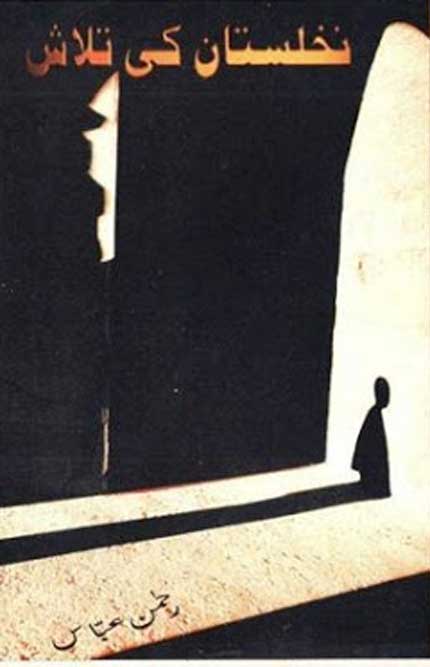
A few paragraphs were all it took for the trouble to start. Thirteen years ago, Urdu writer Rahman Abbas was booked for obscenity for his debut novel Nakhlistan ki Talash, a love story set in Bombay following the 1992-93 riots. The offending two or three paragraphs dealt with love and sex.
It’s been more than 10 years since that particular combination of words got him arrested and two since the case of obscenity was closed. But aside from polishing the rawness of a first novel, he probably wouldn’t change the words.
“I may [take] care about a few words; I will use those words but will try to use them more creatively,” he says, when asked what he would have done in hindsight. “But I don’t think there is any word we should hide. I, for one, cannot.” He continues, “As Manto said, you say ‘breast’ for ‘breast’, you can’t use another word. Or for a ‘chair’ you have to say ‘chair’, you cannot say ‘donkey’.”
A medium-height man with a soul patch and a disarming frankness, Abbas, 46, is currently translating Nakhlistan into English, and expects it to be published next year. He has just come back from a tour of Germany with the German translation of his fourth and latest novel Rohzin—the first time any of his novels has been translated. Next month, Rohzin’s English translation, by Sabika Abbas Naqvi, is slated for release. Set in Mumbai, the love story opens with the flood of July 2005 and won a state Sahitya Akademi award in 2017.
But to a general audience Abbas, a former teacher, is still perhaps best known as the writer who found himself in the crosshairs of an outdated legal provision: Section 292 of the Indian Penal Code that punishes obscenity in writing and art.
“I don’t regret what happened,” he says. “These are the challenges you have to face as a writer or creative person. If your society is orthodox, it is your duty to challenge the orthodoxy.”
And that is precisely what he plans to do. Since the police case that changed his life, Abbas has left the teaching profession, won and returned a Sahitya Akademi award, won and retained a Sahitya Akademi award, and is in the incipient stages of launching a broader campaign against Section 292. That section, among others, has for years been a part of the restrictive free speech architecture that bedevils Indian writers and artists.
“There is freedom for people to protest against a book, to dislike a book. I respect that freedom. If I have the freedom to write, people have the freedom to criticise,” says Abbas, who won his first state Sahitya Akademi award for his third novel, Ek Mamnua Mohabbat ki Kahani . “But a [legal] provision that gives people an opportunity to send a writer to jail, that should be stopped.” He adds, “For a democracy, this is crucial.”
The first step, Abbas believes, is to galvanise public opinion through writing and advocacy against Section 292 in particular. A public interest litigation (PIL) opposing the use of this provision against writers and artists is already in the works.
Abbas is also busy working on a fresh piece of Urdu fiction, his first literary effort since the case against him was closed in 2016, liberating him in several ways. “For my next novel, I will try to explore the things I couldn’t explore in my previous three novels,” he says. “Since the case has ended, I feel I am free to write.”
Abbas denies the impact that fame— or infamy—can have on the reception of a work. “I think if you aren’t a good writer, it will not help,” he says. “Nothing can help.” He names Sadat Hasan Manto and Ismat Chughtai as illustrious Urdu predecessors who were prosecuted (though ultimately unsuccessfully) under the same law he was. Then he chuckles: “There is no single example of bad writers having any problem.”
Good or bad, Indian filmmakers and artists have consistently faced oppressive free speech laws, whether through criminal prosecution, government bans or threats from conservative factions.
In 2016, various groups protested against Tamil writer Perumal Murugan’s One Part Woman and sought a ban on it. In 2015, Jharkhand-based writer Hansda Sowvendra Shekhar’s The Adivasi Will Not Dance was banned by the state government on allegations of having violated Section 292, among others. Earlier this month, the Supreme Court dismissed a plea seeking a ban on the Malayalam novel Meesha. To Abbas, this is part of a wider pattern. “English writers enjoy more freedom than us. I don’t know why. Alice Walker’s novel was in our syllabus and used those same words that I did and went to jail for,” he says. “On the one hand, the Government makes you read a book; on the other hand, if you use the same word in your text, you are a criminal.”
Though he was let off without a trial—the complainant told the court she had misunderstood the offending passages and the case was closed—Abbas spent one night under arrest in Arthur Road jail until his lawyer was able to complete the bail formalities. “It was quite a humiliating process,” he says, its memory still fresh more than a decade later. “When you go to jail, you feel your whole freedom is gone, that you will never get out of there.”
The experience was both debilitating and transformative. “I remembered Manto and wrote about how I felt the pain of Manto,” says Abbas, a touch dramatically. “If you are a writer or journalist and you experience jail, you understand the importance of freedom. I had it when I was writing; when it is stopped, you realise the importance of maintaining it. It’s not only your struggle, but a struggle of humanity.”
Though he lost his job, was pilloried at the time by the Urdu media, and still faces the censure of conservative Muslims, he now has more enthusiastic readers, he believes. “Now my writing has been accepted in a big way. Urdu readers are not that narrow minded,” he says. “They are openly reading and I am happy when young people appreciate the work which the previous generation had condemned.”
Abbas taught at a Muslim institution for several years and was also the principal of one. He later decided to leave academia and joined a think-tank fulltime in 2012. “If you are liberal Hindu, you won’t work in an RSS shakha,” he says of leaving that minority institution. “It is very conservative. Through education, they want to promote their religious ideas. I believe education should be 100 per cent secular; there shouldn’t be any discussion on religion. But now both communities are insisting on preaching religion and morality, and that is antieducation, anti-scientific temper.”
In 2015, Abbas joined the awards return protests initiated by authors disturbed by the silence of institutions and the apathy of the Government to violence against free thinkers. Like many writers and intellectuals, he too is concerned about what he perceives as the shrinking space for dissent in the country and the rise of divisive politics. “The right-wing is gaining. And only because it is doing the same ugly, dirty propaganda and dividing people in the name of religion,” he says. “There is a feeling that Dalits, Muslims, Christians, Adivasis can be targeted. Yes, there is a fear. And people should speak up.”
source: http://www.openthemagazine.com / Open / Home> Salon > Web Exclusive: Books / by Bhavya Dore / September 21st, 2018
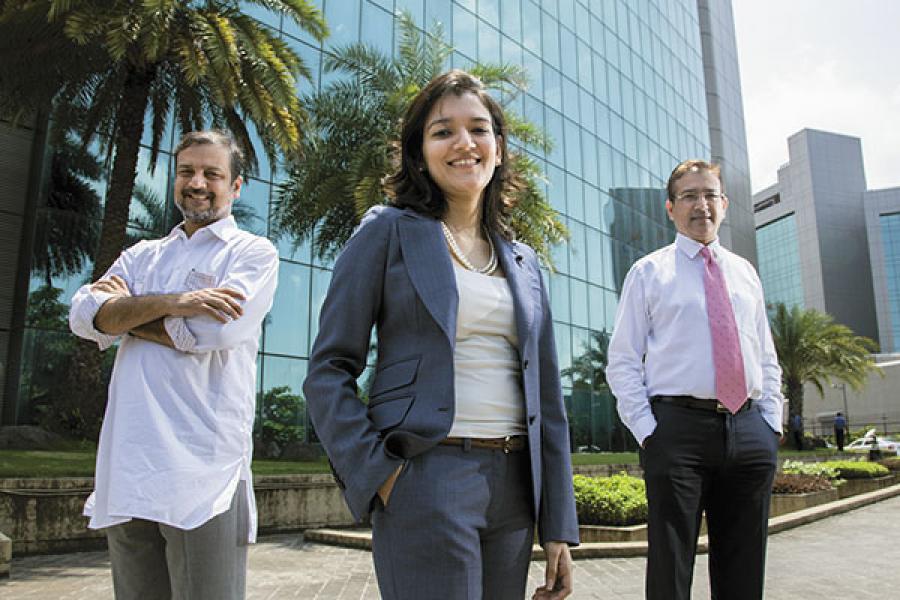
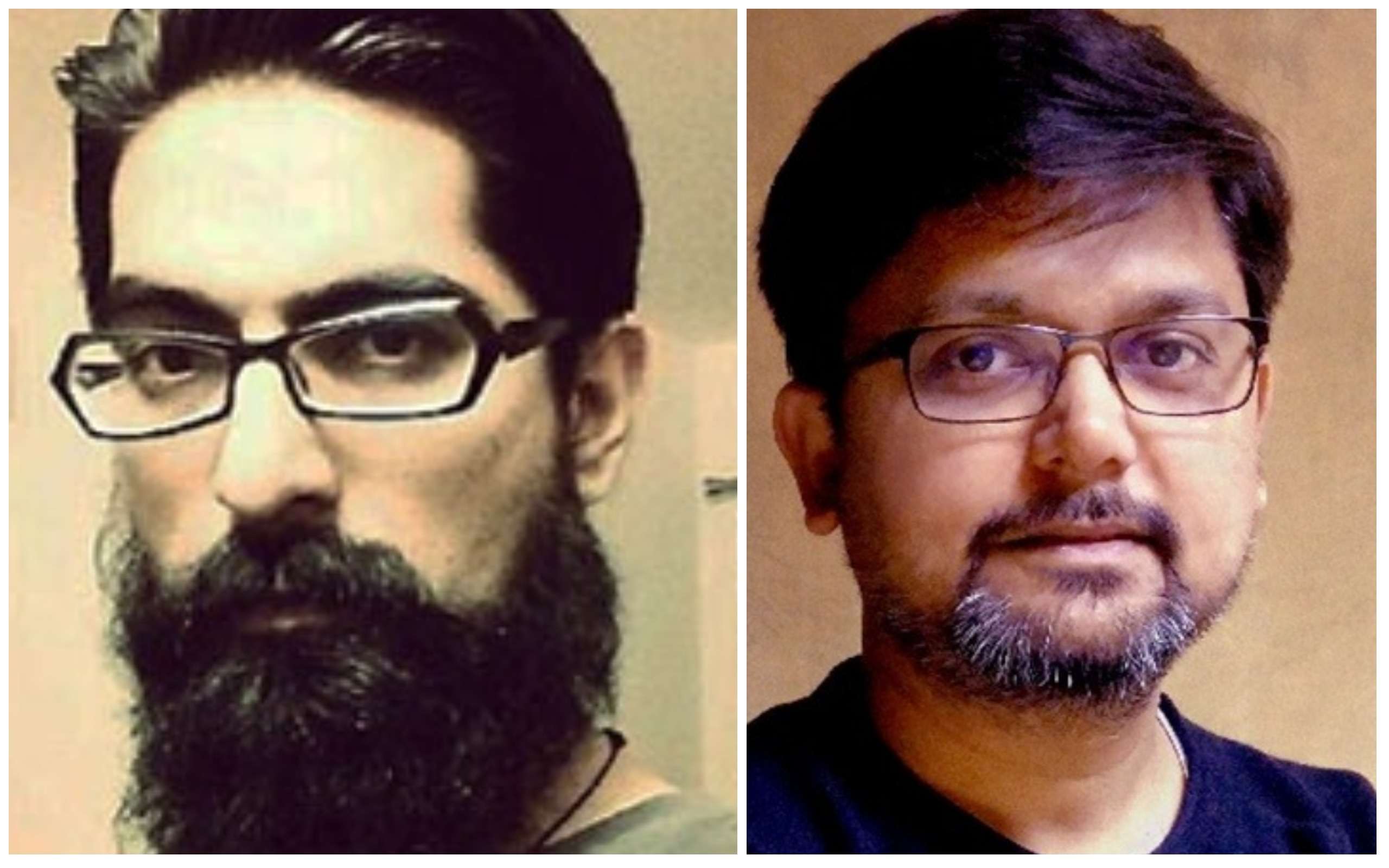
Cheil India has appointed Moosa Khan and Nitin Pradhan in their senior creative leadership. The duo will report to Sagar Mahabaleshwarkar.
Khan joins as head of digital (creative) and Pradhan takes on the role of senior executive creative director.
Speaking on the appointment, Atika Malik, chief operating officer, Cheil WW India, said, “We are the Agency of Now where creativity is inspired by technology. I am extremely happy that Moosa and Nitin will add their digital capability, creativity and energy to Cheil. I look forward to working closely with them to inspire new ideas and solutions for our progressive brands. For 15 years Cheil in India has provided brand solutions across retail, experiential, digital and communication to transform our client’s businesses. They will be a great asset to our creative strength and we welcome them warmly into the Cheil family.”
“I am delighted to welcome Moosa and Nitin to our team. Both of them are exceptional creative talents to have on board. While Moosa has immense understanding of new age digital media, Nitin is a fantastic creative talent with great ability of storytelling. Most importantly, we all have a shared passion for creative excellence and digital innovation. With these beliefs firmly at the heart, Moosa and Nitin will be a tremendous asset to our bold creative ambitions. Wait and watch as magic happens!” added, Sagar Mahabaleshwarkar, chief creative officer, Cheil WW India.
What it takes to build the reputation of a brand
Khan brings with him over 10 years of experience in digital as well as traditional advertising. He has worked across agencies such as Dentsu Webchutney, Madison, TBWA and Jack in the Box Worldwide.
Pradhan, a known name among the advertising fraternity, has 17 years of experience working with– Ogilvy, JWT, McCann, Leo Burnett and the likes.
source: http://www.brandequity.economictimes.indiatimes.com / ET Brand Equity / Home> The People Report / June 02nd, 2018
South African Indian cinema doyen Moosa Moosa has passed away. He was 75. Moosa succumbed to a heart attack on Sunday after undergoing surgery.
He was buried in Johannesburg on Monday according to Muslim rites.
Moosa had earned the title of being the longest-serving cinema group executive in the world, adding to the company’s reputation of having the longest relationship with Hollywood production house 20th Century Fox for almost eight decades now.
In 2007, Moosa received the South African Film and Television Industry Lifetime Achievement Award.
Tributes from all across the world continued to pour in for Moosa as the news of his demise spread.
Family and friends recalled how Moosa had taken over the family cinema business of the Avalon Group, started by his father 79 years ago as the first and still only Indian-owned cinema group in South Africa, after most of the 18 cinemas in the group were shut down by the draconian apartheid-era laws restricting property ownership in city centres to the minority white community.
Undeterred by this as the Avalon Group continued with just one cinema in an area designated for Indians in Durban, Moosa took on the seemingly impossible task of challenging the monopolies of white-owned major national cinema chains and won legal battles in the new democratic South Africa headed by President Nelson Mandela.
Moosa then started rebuilding the business as his son Aboobaker, popularly known as AB, also joined the business as the chief executive officer.
Currently they have cinemas in three major South African cities where new Bollywood releases play alongside Hollywood titles every week.
“My father showed tenacity and strength in keeping alive the Avalon dream through the tough times,” AB Moosa said in paying tribute to his father.
“When many had already begun to write the company’s obituary, my father’s resolve never wavered,” he added.
Many community leaders also paid tribute to Moosa for his support of community initiatives.
“He was always willing to support a variety of important social justice issues and always availed Avalon cinema venues for such events at no charge,” said Lubna Nadvi, from the University of KwaZulu Natal’s School of Social Science.
“Moosa will be justly remembered as a courageous and articulate businessman who was determined in his challenge of white monopolies in the 1980’s,” businessman Nirode Bramdaw recalled.
source: http://www.thehindu.com / The Hindu / Home> News> International / by PTI / June 26th, 2018