Category Archives: World Opinion

Magic of gifted hands without brand power

Agra, UTTAR PRADESH :

RafiquddinMPO22apr2018

Frankfurt :

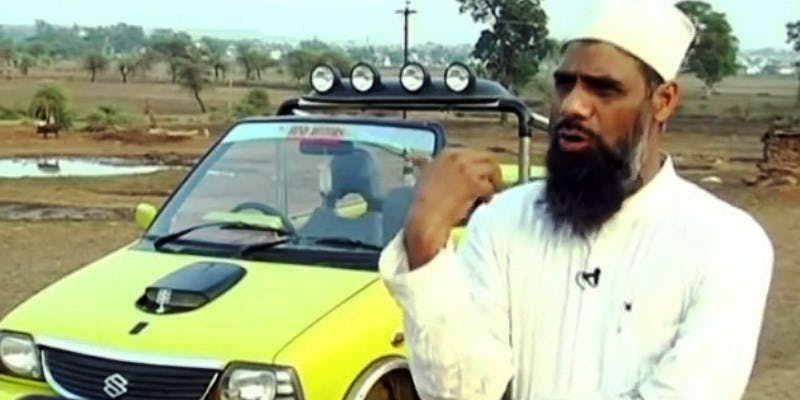
Rafiquddin sat cross-legged on the red-carpeted floor inside Frankfurt’s Festhalle Messe, far away from his home and workshop in Agra where he’s a star craftsman. His tools were laid out in front of him: small slabs of marble, a polishing machine and a few marble boxes with intricately patterned motifs in coloured stone. At the Messe Ambiente Fair, Mr. Rafiquddin and four others, all recipients of the national award for craftsmen, were seated under the banner “India — Magic of Gifted Hands”, an Export Promotion Council of Handicrafts (EPCH) stall.

However, in an exhibition space of over 3,08,000 sq. m (imagine 245 Olympic-sized swimming pools), they were barely noticed as visitors from over 168 countries and exhibitors from over 89 countries, including 435 companies from India, passed by. They were neither exporters nor buyers, and weren’t within the main exhibition halls. They were representing India, from the margins, at a demonstration stall along the lobby.

Since Mr. Rafiquddin won the ‘Shilp Guru’, India’s highest award for arts and crafts, in 2013 for his intricate marble inlay work, the EPCH has sponsored him to several International fairs for ‘demonstration’ purposes.

Over the last three years, many craftsmen have travelled abroad through this initiative, said Rakesh Kumar, executive director, EPCH. “Over seven million Indians are in the handicrafts industry. It’s India’s USP: handmade goods, and at such demonstrations, we showcase their craftsmanship and skills,” he explained.

Such stalls are not aimed at bagging big shipment orders. They act as a branding tool for Indian handicraft exports. And Mr. Rafiquddin has become an unlikely poster boy for such campaigns.

Data from research organisation CMIE show that handicrafts exports from India in 2016-17 totalled $1,926 million, merely 0.7% of the total exports. Of this, exports to Europe accounted for $553 million, about 28.7%.

At fairs such as the Ambiente, nearly 75% of Indian products are handicrafts. According to Nicolette Naumann, vice-president, Ambiente, “In Europe, customers are attaching greater value to individual, high-grade products or products that look as if they have been hand-made.” India will be the partner country for the fair’s next edition, which will have a special handicrafts gallery, she adds.

Narrating his story of learning this medieval-era technique when he was 17, Mr. Rafiquddin says many of his relatives are craftspersons, and so is his son. However, the father-son duo have been unable to crack the mechanics of the European market. “The demonstrations are a great opportunity, but we want some clients in the West,” he said.

Not able to scale up production

There are several policies to promote handicrafts exports, and EPCH too has worked on creating schemes and projects. In recent years, innovative initiatives (like Gaatha Project and Gramin Vikas Sansthan) have provided craftspersons with direct access to the global market. But can an individual artisan, even if he a national award winner, make it big at a global level?

“These are B2B shows, individuals cannot meet the demand and volume that export requires,” explained Mr. Kumar. Mr. Rafiquddin admitted that he needs months to craft large objects and days for smaller ones.

Between the promise of a growing market and the drawbacks of the handicrafts industry are many Rafiquddins, whose magic hands can’t fathom the demands of consumerism.

Mahima A. Jain is a London-based freelance journalist

source: http://www.thehindu.com / The Hindu / Home> News> International / by Mahima A . Jain / April 21st, 2018

Artist Wajid Khan making India’s tallest Swami Vivekanand statue

Indore, MADHYA PRADESH :

International artist Wajid Khan, famous for his ‘iron nail art’, is making the tallest statue of Swami Vivekanand in India that would be installed in Uttar Pradesh.

International artist Wajid Khan, famous for his ‘iron nail art’, is making the tallest statue of Swami Vivekanand in India that would be installed in Uttar Pradesh. The statue made of ashtdhatu (alloy) will be 170-feet tall and will be installed either in Lucknow or Agra, said Khan.

He said the statue will be completed in six months. Khan is here to take part in the four-day International Art Festival being organised at the Aligarh Muslim University (AMU).

Though Wajid Khan has not studied in any university or college, he has made a mark for himself by his craftsmanship in metal statue making. He is also making a sculpture for FIFA 2022 to be held in Qatar. The project will take five years to complete.

“A 40-feet statue of Swami Vivekanand is installed in Kolkata and that is his tallest statue. Now, the work on making his 170-feet statue has started in Indore,” said Khan.

“The project is being financed by some businessmen from UP, Delhi and Gujarat. They will decide on the place where the statue will finally be installed. As of now, the first preference is Lucknow and the second is Agra. Due to any reason, if the statue is not installed these cities, the third option will be Delhi,” he added.

“The statue is being made from eight metals including iron, zinc and copper. For the time, the total cost of the statue cannot be revealed,” he said.

Wajid Khan said he is also making a 10×8 ft statue of British Queen Elizabeth, which will be installed at the Royal Palace in London.

Khan has embarked upon a new venture. A proposed retro Bhopal city will be established in 40 acres area in Bhopal and the artist will give it a 2,000 years old look. The project is being financed by some businessmen.

source: http://www.hindustantimes.com / Hindustan Times / Home> Cities> Lucknow / by Pradeep Saxena, Hindustan Times,Aligarh / March 15th, 2018

IIT-Madras to map Golconda’s Bagh-e-Naya Qila

Hyderabad, TELANGANA :

A tunnel hidden below the garden layout at the Qutb Shahi tombs and connecting with Golconda Fort was unearthed during excavations. File | Photo Credit: G. Ramakrishna

ASI wants to ensure medieval relics aren’t destroyed by an expanding golf course

In another instance of modern technology coming to the aid of medieval heritage, the Archaeological Survey of India (ASI) will be using Ground Penetrating Radar (GPR) to map the contours of the area around the Bagh-e-Naya Qila excavated garden inside the Golconda Fort. It has roped in the Indian Institute of Technology-Madras (IIT-M) to carry out the mapping.

This medieval garden in Hyderabad  is the only one of its kind still intact. All the others – built during the Qutb Shahi rule (1518-1687) — have either been built over or have disappeared. The contour mapping was necessitated by the impending advance of the Hyderabad Gold Club, which wants to expand its 18-hole course into a 21-hole one by taking over some of the land adjoining the Bagh-e-Naya Qila site. A GPR map would reveal any medieval relics that may lie buried under the ground, and could thus be saved by the ASI.

“The Hyderabad Golf Club, which has built a golf course in the Naya Qila area, wants to add a few more holes on the other side of the garden. We don’t want to lose any more history. We want to ensure that there are no relics of the Bagh-e-Naya Qila underneath and hence we are planning to map the area with GPR. We would have liked to do this with a Light Detection and Radar (LiDAR) but for that we need the permission of the Defence Ministry,” said ASI Superintending Archaeologist Milan Kumar Chauley.

The Naya Qila garden inside Golconda Fort was built by successive rulers of the Deccan and is one of the few symmetrical gardens extant. In 2014, when the ASI excavated the area after diverting the water flow, it discovered water channels, settlement tanks, walkways, fountains, gravity pumps, and a host of other garden relics.

An earlier excavation unearthed gold coins in the area where the golf course has been created. According to author Ali Akbar Husain, the Naya Qila area also has multiple chabootras (raised platforms) which are remains of garden structures that pre-date the Qutb Shahi rule. In the 1940s, the garden was even used for celebrating Basant Panchami.

The team from IIT-Madras will do a preliminary survey to ascertain the path for the contour-mapping. “We have told the IIT-Madras team that the survey and mapping have to be finished before the monsoon sets in. We will do the preliminary study by end of this month and the mapping might be completed in May,” Mr. Chauley said.

While there is a semi-collapsed ‘baradari’ (a gazebo-like structure with many pillars) in the garden, historians believe that another baradari might lie buried in the ground. GPR uses electromagnetic radiation in the microwave frequency for imaging sub-surface area.

source: http://www.thehindu.com / The Hindu / Home> News> Cities> Hyderabad / by Serish Naninsetti / Hyderabad – April 17th, 2018

Over 100 Missiles of Tipu Sultan found in a shivamogga well

Mysuru, KARNATAKA :

Surprise find came when well was being desilted

It is one of the most sensational archaeological discoveries in Karnataka. Over a 100 war rockets from the 18th Century were found recently during the desilting of an open well in Shivamogga. The rockets used by the Mysore kingdom, during the Anglo-Mysore Wars, especially in the last two of them during the reign of Tipu Sultan, are considered the most-advanced of their age. Only five known specimens of the rockets were known to be in existence till now; three in the Government Museum in Bengaluru and two in the Royal Armoury, Woolwich, UK.

The rockets discovered were being studied outside of public glare for a few months now. When Bangalore Mirror asked Shejeshwara Nayak – the assistant director and curator of the Government Museum, Shivappa Nayaka Palace in Shivamogga (where some of these rockets are now being kept for display) – he said: “When they were discovered a couple of months ago, these were thought to be some kind of shells. Dr HM Siddhanagoudar [historian] has identified them as rockets.”
“Rockets have been used in battles for 700 years. But it was only in Mysore, under Hyder Ali, that iron casings were first used. Before that, rockets had wooden or paper casings. The iron casings drastically improved their efficiency and range. Mysore rockets were the most advanced ones during the second half of the 18th Century,” said Nayak.

Hyder Ali’s father Fath Muhammad worked for the Nawab of Carnatic before moving on to work for the Mysore Kingdom. Under the Nawab, he handled a rocket corps. Back then, these rockets were used for signalling during battles, not as weapons. Hyder became the first to use rockets with iron casing, and that’s how they became deadly battlefield weapons.

After the fall of Tipu Sultan in 1799, hundreds of rockets of various kinds fell into the hands of the British. The Congreve rockets developed by the British in 1804 (and later used against the armies of Napoleon) were based on the Mysore rockets.

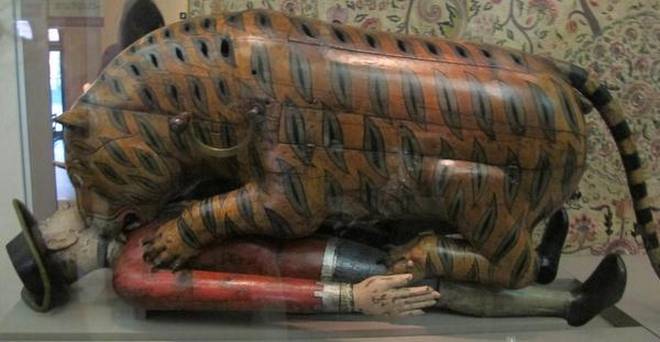
TipuSultan02MPOs19apr2018

THE INITIAL FINDING

The rockets discovered in Shivamogga are likely to be put up for public display in March-April this year. However, how the discovery was made is not being revealed by authorities. The rockets are said to have been found in a well in Nagara of Hosanagara taluk, 60 km from Shivamogga, in a farm belonging to one Nagaraja Rao.

The rockets were basically metal cylinders that were filled with gunpowder and then strapped to a bamboo pole, sometimes up to 30 feet long. Mysore rockets had the highest range of around 1 km. During Tipu’s time, more changes were made to these rockets. From a few hundreds, the ‘cushoons’ – or regiments handling rockets – reached a high of 5,000 men during his time. During the battles of the III and the IV Anglo-Mysore Wars, the rocket cushoons had a terrifying impact on the British forces, as recounted in several accounts of the period.

The area where these rockets were found was part of the Keladi Kingdom, one of the bigger principalities in Karnataka and was annexed to the Mysore Kingdom in 1763 by Hyder Ali. His successor, Tipu Sultan built a mint and an armoury at Nagara. Thus, these rockets are from between 1763 and 1799.

Nidhin George Olikara, a historian with specialisation in Tipu’s era, said: “These rockets were found sometime ago but were identified as rockets recently. Nagara in Shivamogga district earlier was home to an armoury and mint during Tipu Sultan’s rule. The work of researchers is now over and scientists should step in to find out what kind of iron has been used to make rockets.”

2006AP2869

THE REMAINS

The newly discovered rockets are actually the iron casings. Those are the only part of the rocket that could have survived being buried for 200 years. The other parts, such as the bamboo pole and straps, are long gone. Like the records of that age which mention Mysore rockets of various sizes, the Shivamogga rockets are also found in various sizes. Most of the rockets are 7-8 inch long. A few of them are longer. The circumferences are 1, 2 or 3 inches.

source: http://www.bangaloremirror.indiatimes.com / Bangalore Mirror / Home> Bangalore> Cover Story / by Bangalore Mirror Bureau / by S. Shyam Prasad & Gururaj B R / January 20th, 2018

Hyderabad boy’s life holds spotlight in London

Hyderabad, TELANGANA :

Mohammad Ali Baig in a scene from 'Under an Oak Tree' in London
Mohammad Ali Baig in a scene from ‘Under an Oak Tree’ in London

Hyderabad :

A play based on a Hyderabadi palace set in the mid-19th century has taken centre stage in London. The play’s premier attracted connoisseurs of theatre and enthusiasts of Hyderabadi history, drama and heritage.
“Under an Oak Tree”, presented by Hyderabadi theatre revivalist Mohammad Ali Baig, is based on the story of a boy born in the 19th century Ahmed Bowla Bagh Palace built by Nizam V Nawab Afzal Jah Bahadur. The play was produced by Qadir Ali Baig Theatre Foundation. The premiere show was sold out one week before the play was staged.

“The hour-long bio-play retraces the protagonist’s journey from the seclusion of a 19th century palace spread over 100 acres with a 100-horse stud farm, to the glitzy world of advertising and ultimately, to the intense spotlight of theatre, getting him one of the highest civilian honours of the country. The play aptly presents the changing political and social scenario in a post-Independence, post-Privy Purse era of the princely state of Berar and Deccan and consequently, the changing times,” Mohammad Ali Baig told TOI.

He said the play beautifully captures the story of a boy growing into adolescence without any friends, where the next neighbour was 5km away. The boy had more ponies than toys to play with. Written by Noor Baig, the play was directed by Mohammad Ali Baig. He also acts in it.

Mohammad Ali Baig has presented his plays earlier in Turkey, US, Canada and UK, taking Hyderabadi heritage to the global spotlight. The play is scheduled for its Indian tour in Bengaluru, Mumbai and other places this month.

“It’s really fulfilling when global audiences, accustomed to the best of world theatre, give an original Hyderabadi flavour such an amazing response with full house attendance,” he said.

According to Rehana Ameer, councillor of the City of London (the first Indian-origin woman of the elite Westminister district), the buzz was such that people from the Edinburgh and Oxford Universities came to London to watch the show. Prof Tariq Muneer, Millennium Fellow at Edinburgh University, also lauded the Hyderabadi play.

source: http://www.timesofindia.indiatimes.com / The Times of India / News> City News> Hyderabad News / by Syed Akbar / TNN / April 12th, 2018

Nizamabad boxer wins bronze at Commonwealth Games

Nizamabad, TELANGANA :

Commonwealth Games bronze medallist in boxing Mohammed Hussamuddin with SATS Chairman A. Venkateshwar Reddy in Gold Coast on Friday.

‘This serves as an inspiration to prepare for bigger events’

Mohammad Hussamuddin from Nizamabad has become the first-ever boxer to win an individual medal (bronze in 56 kg) from Telangana in the ongoing Commonwealth Games in Gold Coast on Friday.

The success story of Hussamuddin is another gentle reminder of the abundance of talent in the State that badly needs to be nurtured. The gifted pugilist, the youngest of six bothers, was lucky in a way to be mentored by his father Mohammad Samsamuddin himself. He is the same person who also groomed woman boxer Nikhat Zareen (former World Youth gold medallist) in her formative years in Nizamabad.

“We are delighted that he is the first boxer from Telangana to achieve this. We knew it was coming, but were hoping for a much better performance,” exclaimed the proud father.

For someone who made an impact in the 2011 Youth Nationals with a silver and clinched a gold in his maiden Senior Nationals last year, Hussamuddin has always been tipped as one of the potential champions by SATS coach Omkar Yadav, who had seen his progress since childhood.

But what clearly changed his career graph for the good was when he joined the 1 EME Centre before moving over to the famed Army Sports Institute in Pune to be trained by Narender Rana and Kuttappa later.

Naturally, 24-year-old Hussamuddin is pleased, if not overjoyed, with his bronze in the ring on Friday. “I was targeting gold, but had to be content with bronze. Anyhow, this will remain a huge inspirational moment for me as I prepare for the bigger events later this year, including the Asian Games,” was what the boxer conveyed to SATS Chairman A. Venkateshwar Reddy, who was there to cheer the boxer.

“No doubt this is the beginning of a new chapter in my career and I am hopeful of winning in bigger events given the kind of motivation I get from this one,” was his message from Gold Coast when the SATS official made it a point to personally congratulate him.

source: http://www.thehindu.com / The Hindu / Home> News> Cities> Hyderabad / by V. V. Subrahmanyam / Hyderabad – April 13th, 2018

Imprint of a saint and a brimming degchi

Hyderabad, TELANGANA :

The area of Panje Shah houses relics of saints and the Messenger of God and many stories of forgotten riches .

Kali Kaman road in Panje Shah. — Photos: Surya Sridhar


The area of Panje shah has a rich history behind it. The word, ‘Panja’ means an ‘imprint of hand’. It is located on the left of the main road leading towards Kaali Kamaan from Aitbaar Chowk. The story goes that during the reign of Sultan Abdullah Qutb Shah, a person named Ibn-e-Sher Ali came to Golconda from Najaf-e-Shareef in Iraq, where Hazrat Ali is buried.

He brought an imprint of the Hazrat’s hand and gifted it to the Sultan, who built an Aashoor Khana and installed the imprint there. The imprint is an amalgamation of metals and resembles solid wax. Light brown in colour, it is about 15 inches in length and 8-10 inches in width. The holy names of Prophet Mohammed, Hazrat Ali, Hazrat Bibi Fatima, Hazrat Hasan and Hazrat Hussain are engraved on the Panja. It is covered with a piece of cloth. Above the Panja on a platform is an alam(standard). Since it was installed by the king, the area came to be known as Panje shah.

During the mourning month of Moharram, more alams are set up around it. A round stone cistern is placed in the courtyard, where the sharbat prepared during this month is stored and distributed to the visitors.

On the walls are some paintings depicting the martyrs of Karbala, scenes of strange phenomena like bleeding trees among other subjects of the artworks.

Opposite this holy place is another place of faith called ‘Qadam-e-Rasool’, where a foot-print of Prophet Mohammed is placed. Sayyad Mohammed Ali is said to have got it from Isfahan, Iran, in 1575, along with adequate proof of its authenticity. He bought a large house, got it decorated and installed the footprint there. (Qadam-foot, Rasool-Prophet Mohammed). There are two stone reservoirs at the gate which are filled with milk beverage (sharbat) and distributed to the devotees during Moharram.

The annual Bibi ki Sawari, which arrives on an elephant stops here on the 10th day of Moharram. It is said Bibi Fatima, the daughter of the Prophet and mother of Hazrat Hussain, laments and woes about the merciless killing of her son in Karbala. This scene is so heart-rending that it leaves everybody present in tears and inconsolable.

Apart from the holy footprint, relics such as the hair of Hazrat Ali and Hazrat Hussain are also kept here.

A round stone cistern in the courtyard, where the sharbat prepared during the month of Muharram, is stored and distributed to the visitors. — Photos: Surya Sridhar

Gurvanna gali

Opposite Panje shah is a lane named after Hakeem Guruvanna, which leads to Mir Alam Mandi. An important landmark of this lane is Kashmiri Qivam factory, established by the descendants of Guajarati businessman Poorandas Ranchoddas, in 1973. Qivam is a paste made of saffron, tobacco, cardamom and other spices which is added to paan to give it a kick. This Kashmiri Qivam was a favourite with film stars like Sunil Dutt, Meena Kumari and Nargis. Shaik Mujeeb-ur-rahman, the first President of Bangladesh was also a customer. Apart from Qivam, a hair oil named ‘Zulf-e-Kashmir hair oil’ is also prepared here. The factory is spread over a vast area of 3,700 sq yards and is managed by the grandsons of Poorandas ji. A Shivalaya has been constructed here near a large peepal tree.

Deghchi galli

This lane is situated close to Guruvanna galli and owes its name to a fantasy like story. Long ago, a deghchi (a vessel) full of rich gems and jewellery was found here during digging. Close to Panje shah is another lane called Kotaah galli (narrow lane) which is erroneously called Kotta galli.

On the way to Panje shah from Aitbaar Chowk, lies the haveli of Raja Mahipat Ram, an army commander and a minister of the second Nizam. It was called ‘baawan darwaazon ki haveli’ since it had 52 doors. The havelis of Raja Vithal Pershad and Raja Shainblum Pershad were also located here and came on the way to Kaali Kamaan and Gulzar Houz.

Upon crossing the Kaali Kamaan, one also gets to see several shops selling kites, thread, maanja and charqas. The kites have many fascinating names like dulhanpachchisilangotaiyyawarek qakamgola sulemanchand-tarasinghada, and lehanga. Similarly, the names of maanja are also very interesting like motiyagandhakferoza, and angoori to name a few.

source: http://www.telanganatoday.com / Telangana Today / Home / by Dr. Anand Raj Varma / April 15th, 2018

The world’s only handwritten newspaper is 91 and sells at 75 paise

Chennai, TAMIL NADU :

The calligraphy is the soul of The Musalman. | Photo Credit: R. Ragu

The Musalman was established in Chennai in 1927

Reed pens, ink bottles, stacks of papers — these are the first things you notice when you step into the computer-less office of The Musalman. Aged a venerable 91, what is possibly the world’s only handwritten newspaper (and the only one without a computer) shows no signs of signing off.

In its office in Chennai,  a dark green visiting card bears the newspaper’s name and that of its editor, Sayed Arifullah, and lists the 13 degrees he holds.

Arifullah, in his mid-30s with a salt-and-pepper beard, exudes a casual confidence. He has been at the helm for nearly 10 years now.

The Musalman, established in 1927, was started by Syed Azathulla, Arifullah’s grandfather, because “he felt there was no voice for Muslims and there should be one.” Located in a small lane next to Chennai’s iconic Wallajah Mosque, the office is a tight space with two rooms, one housing the press and the other acting as reception area. “We are renovating, hence the bustle,” he says.

Since its inception, the newspaper has seen three editors: Azathulla, his son Syed Fazlullah and now, Arifullah. When I ask if he had always planned to take over the reins from his father, he shrugs. “It was important that the newspaper be kept running and so I chose to do it. I edit, I write, and I run the paper now.”

Potter-esque

Almost all the articles in the four-page broadsheet are selected by Arifullah himself. He says he has reporters in different parts of the country, but the newspaper, much like The Economist, does not carry bylines. Around 10 every morning, two translators come in and set out the news in Urdu. In the next two hours, the paper’s three calligraphers, called katibs, painstakingly write out each news item on to the broadsheet using calligraphy pens in a Harry Potter-esque manner.

The calligraphy is really the soul of the paper. But with the advent of technology, the katibs, earlier employed in newspapers and Urdu publishing houses, have become redundant. The Industrial Training Institute in Srinagar, one of the last government institutes where Urdu calligraphy was taught, wound up the course last May because of no takers.

Finding skilled scribes is a challenge, Arifullah acknowledges, but he is quick to add that he isn’t looking yet. His scribes have been with the paper for the past 30 years. “At that time, my father conducted calligraphy tests, analysed their handwriting, and hired them. They have remained with us all these years — we’re like a family,” he says.

Once the laborious scripting is done, the advertisements are added and the paper is set to the negative. It goes to print around 1 p.m. and reaches most of its 21,000 readers by the evening. And it costs 75 paise. “It’s the cheapest paper in the country!” Arifulla quips dryly, his income coming from the press and not the paper.

Musalman02CF16apr2016

“We cover all sorts of news: national, international, local… all the important happenings,” says the editor. From the Egypt elections to ‘carcinogenic’ coffee, The Musalman does cover it all. But like most Urdu newspapers, the focus is on opinions rather than news itself. “The Urdu newspapers in our country are often revenue-strapped and might not be able to carry breaking news or pay for agency copy, so the focus is on providing opinions and context,” says veteran journalist and Urdu aficionado Shams Ur Rehman Alavi.

Arifullah seconds this. “We don’t carry breaking news. It’s very difficult to rewrite entire pages, so we stopped.” He also says that there is a strong preference for topics that are close to the community. “Our focus is obviously on Islam and Islamic teachings, but that is not all of it. We have many Urdu readers who are non-Muslims as well,” he says.

Personal process

The paper has readers all over the country. “Delhi, Kolkata… families who have been subscribing to the newspaper for generations. We send them the paper by courier. It’s a very personal process,” says Arifullah.

The newspaper carries a few advertisements, in English and Urdu, for jewellery, furniture, tour operators, even a few government tenders. Otherwise, it largely sticks to a format. The front page is for top stories with a thrust on international news. Page two carries the editorial, and the other two pages are for local news and advertisements. The Monday edition is different — there are more articles on the Quran and a bit of Islamic history.

In the pre-Independence era, many prominent newspapers in north India were in Urdu and were read by everybody, regardless of religion. But after Partition, Urdu fell out of favour and many newspapers shut down. The last decade has seen a slow reversal, with the revival of papers like Sahara (renamed Roznama Sahara) and Inquilab.

Other papers might be going online, but The Musalman has no such plans. As Arifullah says, the paper’s uniqueness is in being handwritten, and anything else would kill the legacy.

For 91 years, the paper has been published every day, without fail. Even during Partition, The Musalman was on duty. So what happens after Arifullah? Will his children carry forward the legacy? “Sure,” he says, sounding amused. “They aren’t even five yet, but sure.”

navmi.krishna@thehindu.co.in

source: http://www.thehindu.com / The Hindu / Home> Focus> Society / by Navmi Krishna / April 14th, 2018

A calligraphed 200-year-old Padmaavat preserved for posterity

Hyderabad, TELANGANA :

Malik Muhammad Jayasi’s Padmaavat in Hyderabad. | Photo Credit: The Hindu

Digitised manuscript of epic tale draws scholars from all over

Away from the violence and din surrounding the release of Padmaavat, a nearly 200-year-old copy of Malik Muhammad Jayasi’s 16th-century epic poem, on which the film is based, sits in the library of the Jamia Nizamia Islamic seminary here.

Records at the Jamia, which is itself a 140-year-old institution, show that the book was copied in 1239 Hijiri (Islamic calendar), which corresponds to 1823 CE.

The title finds a place in the library alongside over 2,500 books and rare manuscripts, one of which — on Islamic jurisprudence — is 700 years old.

‘Padmaavat’ review: an insipid love letter to Rajputs

In the poem, the Sufi Jayasi speaks of Padmavati, princess of Sinhaldweep in Sri Lanka, and Ratansen, the King of Chittor. After hearing of the princess’ beauty from Hiraman, a parrot, the king, who is already married to Nagmati, embarks on an arduous journey to Sinhaldweep, and later marries the princess.

But there is a twist: Devpal, another king, too, has heard of Padmavati’s unmatched beauty and covets her. A battle ensues between the two kings. Meanwhile, a banished courtier seeking vengeance tells Alauddin Khilji of Padmavati and he marches to Chittor. But upon his arrival, he sees that the princess has committed jauhar.

The Jamia’s library is on the first storey in one of several buildings on its sprawling campus in the Old City. There are several cupboards and shelves which contain books, most of them handwritten, on different disciplines. One has books on tasawwuf, or Sufi mysticism, written in Farsi, others house books on Arabic grammar, and a third has books on liturgy in Urdu.

But perched on a shelf marked adab, or literature, is Padmaavat. The poem, handwritten in delicate nastaliq calligraphy on ageing paper, is contained within fine boundaries in red ink. Its 216 pages, which narrate the tale, are largely well-preserved. It has also been digitised.

The Jamia’s chief librarian of 20 years, Mohammed Fasihuddin Nizami, alumnus of the Islamic varsity, points out that the book belonged to its founder Maulana Anwarullah Farooqui.

Reverentially referring to Maulana Farooqui as Baani-e-Jamia, he says, “He was the vazeer (Minister) for the Umoor-e-Mazhabi (ecclesiastical affairs) in the Hyderabad State. He tutored the sixth Nizam Mir Mahbub Ali Khan and seventh Nizam Mir Osman Ali Khan. Once he was appointed Minister, it was realised that the Hyderabad State did not have a Jamia. The Jamia Nizamia is a result of this realisation. This copy of Padmaavat is a part of his vast collection.”

Mr. Nizami explains how the book reached Maulana Farooqui’s library. “While we do not know for how much [this copy of] Padmaavat was procured, Baani-e-Jamia was a Minister and he had the required resources at his disposal. He had men and money to procure books,” he says.

The seasoned librarian then turns to the last page of the book and reads the name of the calligrapher who painstakingly made of the copy of the original so that it could be preserved for posterity, “Az qalam Tilokchand.” From the pen of Tilokchand. Apart from using scientific methods to preserve the book, the Jamia has digitised it for scholars. Researchers have arrived here from West Asian countries and even Japan. “We cannot say that there is an increase in footfalls as the general public is unaware of its [the copy of Padmaavat] existence here. Primarily, the kutub khana is for scholars and researchers.

The book is old and needs to be preserved. We do not want to damage the manuscript by wear and tear. This is why we let scholars use the digitised version,” Mr. Nizami says.

But there is more to the poem than meets the eye. Jayasi’s work is deeply allegorical as is the nature of Sufi mysticism. Each character in Padmaavat has an implied meaning.

Speaking to The Hindu, noted historian Rana Safvi said, “The parrot is the spiritual teacher. Ratansen is the Sufi seeker. Padmavati is the wisdom which he is seeking. Nagmati, the first wife, is the material world. Ratansen brings Padmavati to his palace. There is a fight between the two wives. He tells them that they have to live together. This is the existence of the temporal and spiritual world.”

source: http://www.thehindu.com / The Hindu / Home> News> Cities> Hyderabad – Sunday Special / by Syed Mohammed / Hyderabad – January 27th, 2018

New plant species from West Bengal named after former President Abdul Kalam

TAMIL NADU / WEST BENGAL / NEW DELHI :

Drypetes kalamii: The plant is found in the wet, shaded areas of subtropical, moist semi-evergreen forests, at heights of 50-100 metres.

The plant is named after former President Abdul Kalam

Scientists from the Botanical Survey of India have identified a new plant species from two protected National Parks in West Bengal. Named Drypetes kalamii, it is a small shrub found to be shorter version of its close relative Drypetes ellisii. This adds to the rich floral wealth of India.

Standing just 1 metre tall, the newly described plant is unisexual in nature, which means they have separate male and female plants.

“During the survey and documentation of the flora of Buxa National Park, West Bengal (core area of Buxa Tiger Reserve), in 2011, I came across these plants, but could not identify them. Another author of the paper had collected a new female plant with fruits from Jaldapara National Park, West Bengal. The fruiting specimen can be easily identified in Drypetes. We later found that both the plants belonged to the same species. Further consultations with plant biologists from India and abroad helped us confirm its new identity,” says Dr Gopal Krishna from BSI who is the first author of the paper published in Phytotaxa. The researchers compared the new plant with other Drypetes species and found differences in the leaf, flower and fruit structures. There are about 220 species of Drypetes identified across the globe of which 20 have been reported from India.

Medicinal cousin

“The new species is a close relative of a medicinal plant known in Sanskrit as Putrajivah”, says Dr K. Karthigeyan, scientist at BSI and corresponding author of the work. “NASA had recently named a new bacterium after Dr Kalam, and we also chose his name as he is a big inspiration for students and young researchers,” adds Dr Karthigeyan.

The new species is found in wet, shaded areas of subtropical moist semi-evergreen forests, at a height ranging 50-100 metres. With pale yellow flowers in clusters and bright orange to red fruits, the plant is exclusive to the two national parks.

By following the IUCN (International Union for Conservation of Nature) rules, the scientists have provisionally assessed the plant to be “Critically Endangered”. The report states forest fires and grazing as two plausible threats to the new species.

source: http://www.thehindu.com / The Hindu / Home> Science / by Aswathi Pacha / February 24th, 2018