Category Archives: World Opinion

The story of a Hyderabad Nizam and his diamond paper weight

Hyderabad, TELANGANA (formerly ANDHRA PRADESH ) :

Mahboob Ali Khan
Mahboob Ali Khan

Mir Mahboob Ali Khan was taken to court by the trader who sold him the huge Jacob diamond

Of all the Nizams who ruled Hyderabad ,Mir Mahaboob Ali Khan — the sixth Nizam — was the most delightful and pleasure-loving monarch. He had great liking for everything western, be it dress, cars, manners and habits.

Born in 1866, he came to the throne at the age of three after the death of his father Afzal ud Daulah, and ruled till 1911. Mahaboob Ali kept the most lavish court in Hyderabad that several native rulers in India tried to emulate. He had a passion for expensive jewellery and precious diamonds. A number of exquisite pieces of jewellery including that of the famed necklace of Mary Antoinette of France, found place in his prized collections. However, the most renowned in his collection was the Jacob diamond, said to be the fifth biggest in the world.

Victoria Diamond

Originally known as Victoria Diamond, Jacob diamond had a short, but eventful, history  before reaching Hyderabad. It was found in Kimberly mines in South Africa in 1884 and was secretly transported to England to avoid heavy duties then in place for raw diamonds. It was sold to a consortium of jewellers at the Hutton Garden diamond market in London. The gem was then sent to Amsterdam in 1887 where it was polished in a specially erected workshop. The finished gem, with 58 facets, weighing 185. 75 carats was stunningly beautiful, in its cut, clarity and colour. (Kohinoor weighed only 105.6 carats).

DiamondMPOs28feb2018

It was this Victoria diamond, also called Imperial diamond that Alexander Jacob, the Shimla-based diamond dealer, sold to Mahaboob Ali Khan, the Nizam of Hyderabad in 1891. Since then it came to be called, Jacob Diamond.

Deal Went Murky

Like many famous diamonds of the world, Jacob diamond too had its own tale of woes due to the shady deal in its sale by Jacob to the Nizam. Jacob was a well-known, but notorious, Jewish merchant dealing in antiques and jewels having a shop in Shimla. Quite aware of Mahaboob Ali Pasha’s obsession for diamonds, Jacob arrived in Hyderabad in early 1891 to sell the Victoria diamond that was still in London. Jacob met the Nizam through Albert Abid, Nizam’s trusted Chamberlin, himself a jeweller and like Jacob, a Jew.

Jacob, with his alluring eloquence, spoke of the fabulous Victoria diamond and showed its glass replica that he had got made. Finally, after negotiations, both agreed for a mutual price of ₹46 lakhs. Half of the agreed amount, ₹ 23 lakhs, was paid as advance immediately by depositing in the bank and the remaining amount was to be paid on delivery of the diamond.

_______________________________________________

Czar Nicholas views Nizam’s Jewels
  • Czar Nicholas II, the last Emperor of Russia, was a guest of Mahboob Ali Khan in Hyderabad. Nicholas, as the Grand Duke of Russia, visited Hyderabad in 1892, two years before he succeeded his father as Emperor of Russia. The Duke stayed at the Falaknuma Palace along with other Russian officials accompanying him. The Nizam exhibited his famed jewel collection for the Russian Prince at a specially erected grand pavilion at the Chowmahalla Palace. Nicholas went on a hunting expedition in the Nekkonda forests near Warangal. A number of sports events were also organised at the magnificent Mahaboob Mansion in Malakpet for the visiting Prince and his entourage.
  • Much later, in the wake of Bolshevik Revolution that broke out in Russia, Czar Nicholas II was executed with family in July 1917

_________________________________________________

It was Jacob’s suggestion that the Nizam would use it as a paper-weight on his official papers and that his image would go up with such a use.

On July 21, 1891, when Jacob came with the original diamond, the Nizam to his disappointment found the diamond was much smaller than what the model was. Therefore he refused to buy the diamond and Jacob was asked to return the money paid as advance. But the wily Jacob by then, contrary to the understanding, had withdrawn all the advance money from the bank.

Jacob insisted that the Nizam pay him the remaining amount, and went so far as to file a case in the High Court in Calcutta. During the trial, the Calcutta High Court wanted to interrogate the Nizam as a witness. Accordingly, the Nizam met the commission at the Residency on October 5, 1891 but felt it an insult to go before a Commission of enquiry. On returning from the Residency, the angry Nizam, wrapped Jacob Diamond in a piece of cloth that was used to wipe the nib of his pen, pushed it into a shoe, and staved it off in his table draw, vowing never to open.

His son and successor, Mir Osman Ali Khan who succeeded his father in 1911, discovered it and used as paper weight, the purpose for which his father bought it.

What happened to Jacob?

The case Jacob filed proved to be his nemesis for, he had to spend all his money on his advocates. Born in Armenia , to Jewish parents, Alexander Malcolm Jacob was an ambitious and unscrupulous person. He came to India in 1871 with nothing and grew enormously influential as a dealer in jewels, diamonds and antiques. After his relations with the Nizam were strained, other native rulers treated him like the plague and refused seeing him. Jacob ultimately died in penury in Bombay. His life served a model for India-born Rudyard Kipling, to create the character, Lurgan in his Nobel prize winning novel, Kim, published in 1901.

source: http://www.thehindu.com / The Hindu / Home> Society> History & Culture / by K S S Seshan / February 21st, 2018

UK Asian Film Festival: Filmmaker Danish Iqbal’s movie will be screened

Allahabad, UTTAR PRADESH / NEW DELHI :

Allahabad:

Filmmaker Danish Iqbal’s movie, “Sadho” will be screened at UK Asian Film Festival. This festival will begin on 14th March and is planned to be held in Edinburgh, Manchester Leicester and London.

Sadho is a film based on true events and it highlights Child Trafficking menace.

Talking about the movie, Mr. Danish said that Sadho is a heart touching film. In the film, character Sadho finds a newborn child who survives in a car accident. He was supposed to make a decision whether to return the child to parents or not.

It may be mentioned that the movie was produced by Mr. Varad Gupta. Role of Sadho was played by Mr. Sukumar Tudu.

Earlier, Sadho was selected in nine international film festivals.

In Haryana International Film Festival, the movie won best film critics award and best actor award.

Filmmaker Danish’s career started from the theatre in 1994. He did graduation from Allahabad University and was a student of National School of Drama and Central School of Speech and Drama, London.

He got British Council’s Charles Wallace Award, Sahitya Kala Parishad’s Mohan Rakesh Award and Sangeet Natak Akademi’s Ustad Bismillah Khan Award.

source: http://www.siasat.com / The Siasat Daily / Home> Entertainment / February 21st, 2018

Kashmiri lensman bags 2016 Wisden-MCC Cricket ‘Photograph of the Year’ award

Srinagar, JAMMU & KASHMIR :

Saqib Majeed is the first Kashmiri and second Asian after Atul Kamble to receive the prestigious award.

Saqib01MPOs28feb2018

A Srinagar based freelance photographer has done Kashmir proud, pocketing the prestigious 2016 Wisden-MCC (Melbourne Cricket Council) Cricket Photograph of the Year for a stunning image, which captured boys playing cricket in the outskirts of the city, clicked by him.

Saqib Majeed, an engineer by profession clicked the award-winning picture at the Nishat garden in Srinagar.
Majeed is the first Kashmiri and second Asian after Atul Kamble to receive the prestigious award. Every year MCC publishes a book titled Wisden Cricketer Almanack, which includes best sports pictures from across the globe.

This year’s edition includes Majeed’s picture.

Majeed’s picture in Kashmir’s autumn setting certainly had all the ingredients to make the cut. It had nature’s own beauty coupled with cricketers playing the game in their own way that typify the sport with the man behind the camera having a feel of the occasion to capture the decisive moment.

SaqibMPOs28feb2018

“The historic Lords Cricket Ground will display my image for a year,” said a visibly happy Majeed, who was chosen among 450 participants.

“It was an autumn day when I visited the Nishat Garden with a friend to click some pictures. When I reached the garden, some guys were playing cricket under the shade of Chinar trees. I started to click the pictures for next half-an-hour,” he said.

Majeed recalls trying different angles to get a perfect shot, but ended up clicking only a few.
“I am very thankful to my family, friends and The Counselor Magazine, who always encouraged me,” he added.

source: http://www.inuth.com / inUth.com / Home> Sports> Cricket / by ANI News Agency / May 06th, 2017

UM’s Ikhlas Khan Wins Lifetime Achievement Award

Aligarh, UTTAR PRADESH / Mississippi,  U.S.A  :

Ikhlas Khan. Photo courtesy of Ole Miss Communications

Ikhlas Khan, director of the National Center for Natural Products Research at the University of Mississippi School of Pharmacy, is the winner of AOAC International’s 2018 Harvey W. Wiley Award, which recognizes lifetime scientific achievement.

AOAC International develops global quality standards for microbiological and chemical materials, ranging from food to pharmaceuticals in an effort to ensure public health. Khan, who has been with the university since 1992 and directed the natural products center since 2017, has spent much of his career developing standards for dietary supplements.

“I’m very pleased to receive this award,” Khan said. “AOAC is the top organization for chemical standards, and I appreciate this recognition of my work in this area.”

As part of the honor, Khan will deliver the Wiley Award address and chair the Wiley Award Symposium at AOAC’s annual meeting in August in Toronto.

The Harvey W. Wiley Award has been given to one person a year since 1957, with past recipients including scientists from government, industry and academic institutions from around the world.

The National Center for Natural Products Research maintains a repository with more than 18,000 natural product specimens, derived extracts and pure compounds. Photo by Robert Jordan/Ole Miss Communications

Story by Sydney Slotkin Dupriest, courtesy of Ole Miss Communications

source: http://www.hottytoddy.com / HottyToddy.com / Home> Headlines> News & Views / February 21st, 2018

Africa, India and royalty

An on going art exhibition reveals the African legacy in India begins even before the Mughal period

Thriving in india -- Politically, culturally and socially
Thriving in india — Politically, culturally and socially

Gujarat is not only home to the lost city of Dwarka, but also houses another secret heritage, of African kings in India. Till date, two dynasties of African kings live on in the former princely states of Sachin and Janjira.

The exhibition “Africans in India — A Rediscovery”, on view at the Southern Regional Centre of the Indira Gandhi National Centre for the Arts (IGNCA), remembers their forgotten legacy. The exhibition has been curated by Dr. Sylviane A. Diouf and Dr. Kenneth X. Robbins of the Schomburg Center for Research in Black Culture, part of the New York Public Library.

The exhibition reveals how the African legacy in India begins even before the Mughal period in the 1400s. Beginning as slaves migrating from East African regions around Ethiopia, Eritrea and Somalia, Africans rose up the social ladder to become generals, commanders, admirals, prime ministers, rulers and architects, largely known as Sidis or Habshis.

“The exhibition portrays how a community that travelled across the globe and came to India thrived here, politically, culturally and socially. Most of the immigrants came as slaves and some of them reached high offices in the army, some even became rulers,” says Dr. Mangalam Swaminathan, Programme Director, IGNCA, New Delhi.

According to Mangalam, this aspect of heritage isn’t widely known because of lack of information and research. “Even this exhibit, according to curator Sylvianne is only a fraction of the material lying scattered,” she adds. Through photographic reproductions of paintings from several collections across U.K. and U.S.A., the exhibition thematically displays several significant milestones of this heritage captured in diverse paintings spanning across eras. The exhibition showcases the role played by the Africans in four major kingdoms in the regions of Bengal, Deccan, Sachin and Janjira.

Some of the most famous African rulers were Prime Minister Ikhlas Khan who was Prime Minister and Commander-in-Chief for the Bijapur Sultanate, Malik Ambar, who was regent and Prime Minister in the Deccan and the Nawabs of Janjira and Sachin.

The forts, mosques, mausoleums and other physical testimonies to their skills as city planners, architects and rulers, can still be found in these regions. There were also some famous African queens, Mehr Lekha Begum Sahiba, Yasmin Mahal and Bamba Muller.

“The major aspect that one can take away India was a flourishing nation, where people came seeking employment, as far back as fourth century. Indian culture assimilated them into the society, as it had done with several other faiths, cultures and lifestyles. There was mutual give and take culturally, part of the broadminded tolerance of India. Africans in India are an indelible part of Indian history and heritage. We need to do more research and come up with exhibitions, research papers and publications,” says Mangala.

The exhibition was also taken to UNESCO in Paris, IGNCA New Delhi, National Science Center in Surat, M.S. University in Baroda and Gujarat National Law University in Ahmedabad. It was also shown at the India Africa Forum Summit in New Delhi.

The exhibition will be on view till December 26 at IGNCA-Southern Regional Centre (SRC), Kengute Circle, Magadi-Kengeri Ring Road, Near IIPM, Mallathalli, Jnanabharathi Post.

source: http://www.thehindu.com / The Hindu / Home> MetroPlus / by Harshini Vakkalanka / December 21st, 2015

Naeem Khan Designs Feathered Dress for Houston Gala Chair

UTTAR PRADESH / Mumbai, MAHARASHTRA  / New York, USA :

Khan designed the dress for Houston Ballet Ball chair Hallie Vanderhider.

Hallie Vanderhider / Photo by Jenny Antill
Hallie Vanderhider /
Photo by Jenny Antill

Black Swan :

Guests at The Houston Ballet Ball were encouraged to don black, white or a mix of both as an ode to Tchaikovsky’s ballet “Swan Lake,” but Houston Ballet Ball chair Hallie Vanderhider took the concept further — much further, enlisting the design prowess of Naeem Khan to create her feather-laden gown.

Vanderhider and Tootsies creative director Fady Armanious flew to New York and met with Khan to discuss a gown that would capture the elegance and dark beauty that Vanderhider had envisioned for the ball. Within a few sketches, the trio had landed upon an all-black gown covered in 3,500 natural black coque feathers, weighing in at 7.25 pounds.

“It was a magical moment. Naeem totally captured the essence of Swan Lake,” Vanderhider said. “He is such an amazing talent and has a great sense of humor.

Khan encouraged Vanderhider to embrace the mysterious elements of the dress, reminding her, “This isn’t a mother-of-the-bride gown.” The gown’s sheer long sleeves and bodice were finished with intricate beading.

source: http://www.wwd.com / WWD / Home> Fashion> Fashion Scoops / by Heather Staible / February 22nd, 2018

An acclaimed sportsman, yet struggles to make ends meet

Hyderabad, TELANGANA :

PathanJameelKhanMPOs28feb2018

Martial arts exponent Pathan Jameel Khan represents the other side of Indian sport?

Well, yes, if his ordeal in getting even a decent job or sponsorship to take part in international sporting events is any hint. For this 40-year-old Jameel, winner of 15 gold, 13 silver and 17 bronze at the national and international events including two 2016 World Cup silver in the US is now struggling to meet both ends for want of financial support.

At a time, when cash incentives are being showered on truly deserving outstanding achievers, Jameel gently asks what is that he should do more to get the attention of the powers-that-be.

A native of Mandamarri village in Adilabad district, Jameel, whose father is a vegetable vendor, moved over to Hyderabad to pursue his passion in karate. His diligence and consistency at the highest level have won acclaim including an offer from a martial arts organisation to settle down in US with a chance to represent US. But for the love of the country, he spurned that and came back to India with hope of getting some help. But, as things stand, Jameel, a BA from Dr.Ambedkar Open University, is still staring at an uncertain future – even shunted out from one rented accommodation to the other for not being able to raise even the rental by the first week of the month. His lone source of income – training about 20 karate kids in Mehdipatnam – is always doubtful as it depends on the payment of fee by the students. Still, he has the grace to train about 500 girls of a Government-aided school free of cost to make them good in self-defence daily even now.

It may be recalled here that Telangana Government has been pretty generous in showering cash incentives on some of the deserving athletes in the recent past, running into lakhs but the fact that there are some big achievers like Jameel who are out of its radar is a sorry story of the powers-that-be not getting the right info. “May be, I am paying a price of not having the right connection or Godfathers to take up my cause,” moans a dejected Jameel even as he pursues the dream of representing India at this age in the 2020 Tokyo Olympics where karate is being introduced for the first time.

source: http://www.thehindu.com / The Hindu / Home> News> Cities> Hyderabad / by V.V. Subrahmanyam / Hyderabad – September 29th, 2016

Alam Beg, martyr of Sepoy Mutiny, wants to return home

BRITISH INDIA :

The resting place: The skull was found in a store room of The Lord Clyde pub in London. | Photo Credit: Special Arrangement

Skull of soldier, executed by the East India Company for rebellion in 1857, found its way to London pub; it’s now with historian Kim Wagner

Headhunting is usually associated with primitive tribes and contemporary terrorists, but the colonial rulers of India also collected heads of Indian soldiers as war trophies.

A 160-year-old skull of sepoy Alam Beg, now in the possession of a historian in London, is proof that colonial rulers who brought many modern practices to India were also at times inhuman.

In 1857, Alam Beg, also known as Alum Bheg, was a soldier with the 46th Bengal Native Infantry, an arm of the East India Company.

The Mutiny that year, after having covered the north Indian heartland, spread to Sialkot (now in Pakistan), where Alam Beg and his companions tried to follow their fellow soldiers and attacked the Europeans posted there. On July 9, 1857, they killed seven Europeans, including an entire Scottish family.

Alam Beg, along with his comrades, left Sialkot and trekked all the way to the Tibetan frontier only to be turned away by the guards on the Tibetan side. He was reportedly arrested from Madhopur, a scenic town on the northern part of the Indian Punjab and taken back to Sialkot. A year later, he was tried for the brutal killing of the Scottish family and blown up from the mouth of a cannon. The Mutiny ended soon after. Alam Beg’s tragic story surfaced more than a century later thanks to an Irish captain Arthur Robert George Costello, who was present at his execution.

The skull of Alam Beg. | Photo Credit: Special Arrangement

Present at execution

The Irishman was a captain in the 7th Dragoon Guards, dispatched to India after the Mutiny had shaken the bonds between the East India Company and the native soldiers. Costello had not seen any episodes of the Mutiny but was present at the execution, said historian Kim Wagner, who possesses the skull now.

Costello picked up the skull and returned to London with it. In 1963, the skull was discovered in a store room of The Lord Clyde pub of London, after it had changed hands. The new owners were less than happy to find this war ‘trophy’ from 1857, but treated it as a solemn object from a disturbing past of British history in the subcontinent. The owners of the pub learnt from a note left in an eye socket that it belonged to Alam Beg, who played a leading role in the mutiny of sepoys in Sialkot. They desired to repatriate the skull to the soldier’s family. For years, they tried but failed. It is not known how the skull of Alam Beg ended up in the Victorian-era pub. But it is possible that the Irish captain who witnessed the execution of the leader of the mutinous soldiers visited the pub or someone deposited it there, given the fact that it had links with the history of the Indian Mutiny. In fact the pub was named after Collin Thomson, also known as Lord Clyde, who was a military commander and played a role in crushing the mutiny in north and northwest India. So it is possible that soldiers after their Indian stint would visit the pub.

In 2014, the owners of the pub contacted Kim Wagner who has been writing about South Asian history for years. They urged him to take the skull and return it to the descendants of Alam Beg. Mr. Wagner brought it home and the skull finally added to his research on South Asia which was published late last year as “The Skull of Alum Bheg: The Life and Death of a Rebel of 1857.” The historian believed that only by making people aware of the skull that Alam Beg can be returned to his motherland.

His research showed that most of the soldiers of the 46th Bengal Native Infantry were from modern states of Uttar Pradesh and Bihar and Havildar Alam Beg most probably hailed from Uttar Pradesh. Though he wanted to return him to a dignified family grave yard of Beg’s family, it was not possible as the East India Company left no records of the soldiers of the 46th Bengal Native Infantry.

“There are no longer any records for sepoys of the Bengal Army – the best I could do was locate the area where the 46th regiment recruited from,” Mr. Wagner said.

The Mutiny of 1857 was crushed mercilessly and many gruesome incidents of that era find mention in official records. In 2014, around the time when Mr. Wagner began writing his book on Alam Beg, Ajnala in Punjab’s Amritsar hit the headlines when authorities discovered skeletons of 282 soldiers who were executed after the Mutiny. They apparently had surrendered hoping for a fair trial, but the Deputy Commissioner of the district Frederick Henry Cooper ordered execution of the rebels. They were buried with medals and even money of the East India Company that many of them had in their pockets. The grisly discovery is yet to receive a closure as the family members of those soldiers remain untraced.

Similar is the condition of Alam Beg as his journey back home remains incomplete but Mr. Wagner believed that his only physical remain should find a proper peaceful burial. Mr. Wagner is aware that the government of Prime Minister Narendra Modi has been vocal about honouring the fallen soldiers of India in various colonial era battles. He says that something similar can be done in case of Alam Beg as well.

“After all these years, it is high time for Alum Bheg to return home…he was probably born in what is today India, he was executed in what is now Pakistan,” Mr. Wagner wrote in his book proposing that a burial for Alam Beg near the India-Pakistan border would be the most suitable tribute to his sacrifice.

The historian said that in the absence of the descendants of such soldiers, it is the Indian government that should bring back Alam Beg to his motherland.

Headhunting by colonial rulers from Europe was a rampant practice in the 19th century and activists worldwide have been vocal in demanding human remains from Western museums and collectors should be returned to their countries of origin. Such a movement is yet to begin in India whose soldiers from the colonial past in many instances continue to remain anonymous and abroad.

source: http://www.thehindu.com / The Hindu / Home> News> National / by Kallol Bhattacharjee / New Delhi – February 04th, 2018

Syed Saqib Ahmed overcomes pressure to lift maiden pro title

Bengaluru, KARNATAKA :

The 24-year-old golfer from Bengaluru had produced amazing play over the last two days, including a hole-in-one at Nedumbassery’s CIAL Golf Club, but suddenly everything appeared to be going up in smoke.

Bengaluru golfer Syed Saqib Ahmed with the PGTI Cochin Masters Trophy, his maiden pro title, on Saturday. - STAN RAYAN
Bengaluru golfer Syed Saqib Ahmed with the PGTI Cochin Masters Trophy, his maiden pro title, on Saturday. – STAN RAYAN

For a brief moment, as he came up with successive bogeys on the 15th and 16th holes in the final round on Saturday, Syed Saqib Ahmed felt his title chances slipping away in the PGTI Cochin Masters.

He then found out from his friends that Delhi’s Honey Baisoya, his nearest challenger who had started half hour earlier, had finished with a seven under and realised that he had to buck up. And Saqib found his touch just in time, produced birdies in the last two holes, and lifted his maiden professional title.

“I really felt the pressure after the bogeys on the 15th and 16th because both the par fives are actually easy holes,” said Saqib who finished with a three-shot lead (total 278) over the pre-tournament favourite Baisoya who came second.

“But I had a birdie on the 17th, which I think is one of the toughest holes. And the 18th went like a dream, I really didn’t think I could handle it so well. This is really a big burden off my head.”

The title ended three years of waiting for Saqib. “I dedicate this, my first pro title, to my parents and to my grandfather,” said the young man and then turned emotional.

Another Bengaluru player, M. Dharma, and Chandigarh’s Abhijit Singh Chadha finished joint third. V.J. Kurian, Managing Director, Cochin International Airport Limited, gave away the prizes. The Pro-Am event will be played on Sunday.

The final placings (par 288, four day total, top 10): 1. Syed Saqib Ahmed (278), 2. Honey Baisoya (281), 3. M. Dharma & Abhijit Singh Chadha (both 283), 5. Ankur Chadha (284), 6. Veer Ahlawat, Maniram, Gaurav Pratap Singh (all 285), 9. Arjun Prasad & Karandeep Kochhar (286).

source:  http://www.sportstarlive.com / SportStar / Home> Golf / by Stan Ryan / Kochi – February 03rd, 2018

19-year-old Ayesha Noor battled epilepsy and poverty to become a karate champion

Kolkata, WEST BENGAL :

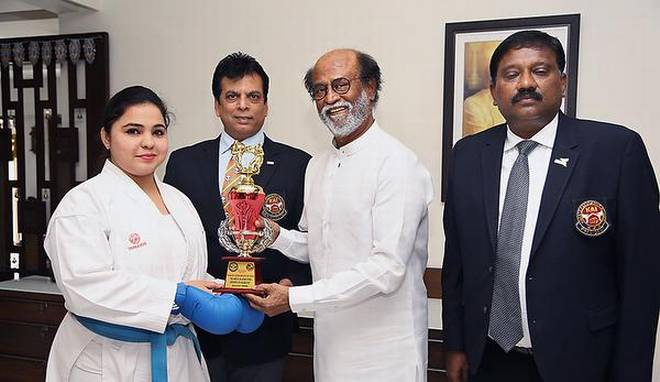
Ayesha Noor was born in a slum in Kolkata. Suffering from epileptic seizures, Ayesha was asked to leave school when she was just five. Only a year later, she decided to learn karate. Today, at the age of 19, Ayesha is an inspiration for many.

Images (L) Huffington Post (R) YourStory.com

Ayesha is the winner of two gold medals at the national level and has brought home three gold medals from international events. She also trains girls in Kolkata in self-defence. “I become a sherni (tigress) when I teach karate,” Ayesha told Huffington Post.

Ayesha’s journey hasn’t been an easy one. Her father passed away when she was just 13. Life has been difficult for the family of three that lives in a one-room house in a Kolkata slum. While her mother works as a tailor, her brother sells slippers to make a living.

Despite her inspirational triumphs in the international arena, Ayesha wants to teach karate to people across the world. Her coach and mentor MA Ali told Business Standard, “She is a completely different personality once she hits the ring and the fighter in her takes over.”

source: http://www.yourstory.com / YourStory.com / Home> HerStory> Think Change India / November 16th, 2016