The thunder of hooves is equestrian buffs’ delight.
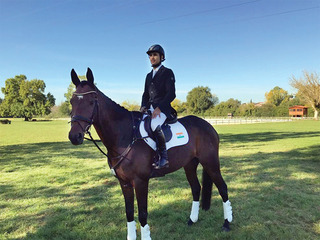
And local boy Fouaad Mirza made the Indian equestrian fraternity proud by galloping to fame in the first two trials at the Asian Games CCI equestrian event held in Montelibretti, Italy.
The top Indian rider produced an exemplary effort to win the event in style and on the strength of this performance is certain to spearhead the Indian challenge in the Asian Games next year.
The in-form Indian saddle artiste, pitted against some of the best Italian riders, produced a series of winning jumps to seize the initiative early on in the big event.
The top score posted by Fouaad in the championship is a couple of points behind the gold medalwinning score registered in the Asian Games last year and considering the fact that Fouaad didn’t really break sweat to register the top mark, he is a big medal hope in Indonesia while staking the Indian claim in the event at the Asian Games.
The first Indian rider to post a victory in Europe, Fouaad, training under German Olympian Bettina Hoy, will compete in Le Pouget, France next month before parading his skills in a couple of championships in Germany. Bettina immensely pleased with Fouaad’s progress made no secret of her opinion that the top Indian rider is peaking right for the big Asian event.
Vice-president of the Equestrian Federation of India (EFI) and head honcho of the Embassy Group, Jitu Virwani, said that a couple of other Indian riders, including one from the Army, are training in Germany and are on top of their game. “We have a great chance to win gold at the Asian Games and hopefully our riders will scale new high and put Indian equestrian on the international map,” said jitu Virwani, indicating that the top riders are comfortable partnering the big German warmbloods. “It is simple. We from our end are providing our riders the best horses and the onus is on them to go for gold,” said Jitu Virwani, who has roped in some of the best Show Jumpers on the circuit in Germany.
Silva Storai, the only woman jockey to register two Derby victories in flat racing, said Fouaad is a fine talent and is ready to make a mark on the international scene. “I have followed his progress from the time he successfully competed in many EPL championships at the Embassy International Riding School and he now looks ready to make the big league,” said Silva.
source: http://www.bangaloremirror.indiatimes.com / Bangalore Mirror / Home> Sports> Others / by Ikram Khan / October 18th, 2017
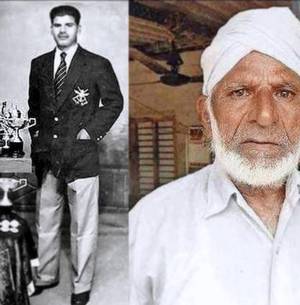
Shamsher Khan won a place in the Indian Olympics contingent that had visited Australia in 1956.
Shamsher Khan, the country’s first swimmer who had participated in the 1956 Summer Olympics, died at his native village Repalle on Sunday.
Mr. Khan, 92, died of heart attack, his eldest son Babu said.
Chief Minister N. Chandrababu Naidu, Leader of the Opposition Y.S. Jagan Mohan Reddy, and Principal Secretary L.V. Subramanyam condoled the deathof Mr. Kahn.
The funeral rites would be performed on Monday.
Mr. Khan had enrolled himself in the Indian Army in 1949. He had taken part in various national swimmingcompetitions. He won a place in the Indian Olympics contingent that had visited Australia in 1956. He, however, secured fourth place in the competition. He continued to serve in the Army till he retired in 1973. After retirement, he settled at Repalle.
He lived a life of penury till his death. In July 2016, the Andhra Pradesh Government awarded him ₹25 lakh.
While Mr. Khan’s eldest son is a farmer, his second son is working in a private company.
source: http://www.tlhehindu.com / The Hindu / Home> Sport> Other Sports / by Staff Reporter / Guntur , October 15th, 2017
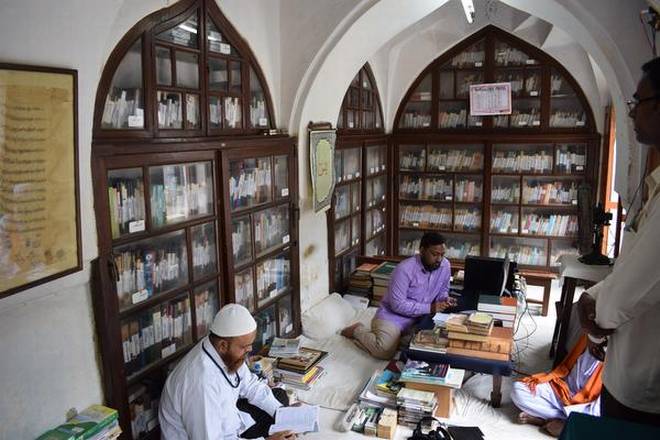
The library at the Khaja Bandanawaz Dargah in Gulbarga.
The library of Khaja Bandanawaz Dargah takes you back to the time of the emperors
The city of Gulbarga in Karnataka received much attention when the government decided to rename it as Kalaburagi a few years ago. Tucked away in the corner of freshly-minted Kalaburagi is a library that is seldom mentioned anywhere. Yet, this library, of the Dargah of Khaja Bandanawaz in Gulbarga, is a repository of some of the rarest of books on Tasawwuf (Sufism), Tafsir (Koranic commentary), Fiqh (Islamic jurisprudence), Ilm-e-Kalam (science of discourse), history, linguistics, and biographies of the Sufis of yore.
Operating out of a remote corner in the mausoleum complex, the library is not known to many people, except scholars researching Islam or Sufism. But that is going to change soon, thanks to the current sajjada nashin (custodian) of the Dargah, Syed Shah Khusro Hussaini.
The library is going to be moved to new premises with state-of-the art facilities, which will enable access to its carefully archived resources.
Lac seal
A part of the All India Syed Muhammad Gisudaraz Research Academy, the library has a collection of over 4,000 books and nearly 500 manuscripts. The collection includes about 25 biographies of Khaja Bandanawaz.
Perhaps the most prized item in the collection are three bound volumes of letters titled Khutoot Shahan e Salf (Letters from the Emperors) dating back to 1755. These are 23 letters, each on a page made of cardboard, with a lac seal embedded in a corner. This was the practice followed at that time to authenticate the origin of firmans (decrees) and letters from the imperial court. Some of the letters are from Aurangzeb’s court.
Khaja Bandanawaz Gisudaraz (1321 to 1422 AD), who carried the Chishti order of saints to South India, was a disciple of Hazrat Nasiruddin Chiragh Dehalvi. He moved first to Daulatabad, the capital of India during the Tughlaq era, and then came to Gulbarga in 1400 AD under the reign of Firuzshah Bahamani. Bandanawaz himself wrote a commentary of the Koran titled Tafsir e Multaqit, which ran to two volumes.
One of the volumes was preserved in Kutubkhana-i-Nasiriya, Lucknow. The other ended up in the British Library. An old patron of Gulbarga Library who had migrated to Karachi during Partition noticed it in London and sent a photocopy to the sajjada nashin a few years back. The Dairatul Maarifil Osmania (Institute of Oriental Studies in Hyderabad’s Osmania University) recently published Tafsir e Multaqit.
Sword-patterned decree
The library also preserves the original volume of Awariful Maarif, the famous Persian treatise on Sufism by Shahabuddin Suharwardy, written in the 12th century.
Khaja Bandanawaz wrote its key in Persian and titled it Maariful Awarif. Tafseer e Azeezi, written on silk pages, is yet another marvellous book treasured by the library.
It is a translation of and commentary on the Koran by the 18th-century Delhi scholar, Shah Abdul Aziz. The calligraphy was done about 200 years ago but the text retains the original brightness and beauty. While the Urdu translation runs underneath every line of the original Arabic text, the commentary is on the margins.
An imperial firman that hangs in a glass panel is written in Khat-e-Shikasta (calligraphy mimicking various objects) dating back to the 986th year of the Hijri calendar (corresponding to 1578 AD). Here, the lines of the firman run in the pattern of a sword.
The library is now headed by Dr. Mohamad Qamaruddun, an Arabic and Persian scholar from Bihar. Qamaruddin says the library receives scholars from the Oriental Studies department of universities in the U.S. and the U.K. The library plans to soon prepare a catalogue of the books and microfilms of all manuscripts. It will also digitise some of the more important works.
M.A. Siraj is a Bengaluru-based journalist.
source: http://www.thehindu.com / The Hindu / Home> Books / by M.A. Siraj / October 14th, 2017
The opening night of Amazon India Fashion Week SS 18 was celebrated by the collaboration of designer Nida Mahmood and Milind Soman’s active lifestyle brand. The collection was inspired by the rich culture, colours, textiles in their four distinct lines.
The ageless art of Ikat was also an inspiration for designer Nida. From indigo dyeing, printing techniques and Mughal patterns, the collection was a visual treat on the Day 1 of AIFW.
The silhouettes were inspired by women of India, keeping their comfort in mind for various forms of workout. Be it a dance class or running out in a gym, the outfits will cater to all. This genius collab with the fitness enthusiast Milind Soman brought together body positive image and inclusivity through the collection.
One of the main highlights of the collection was the first ever running sari, suitable for all Indian women of different shapes and sizes. Who would have that of that?
“With the launch of our running sari we now empower more women to get fit with their choice of silhouette”, said Milind Soman in a statement.
The clothes were made keeping in mind every person’s body requirement, empowering women to be fit with their choice of clothes. Made with 100% recycled plastic bottles, the collection is a treat for all fitness buffs.
source: http://www.timesofindia.indiatimes.com / The Times of India / News> Lifestyle> Fashion> Fashion Shows / TNN / October 13th, 2017
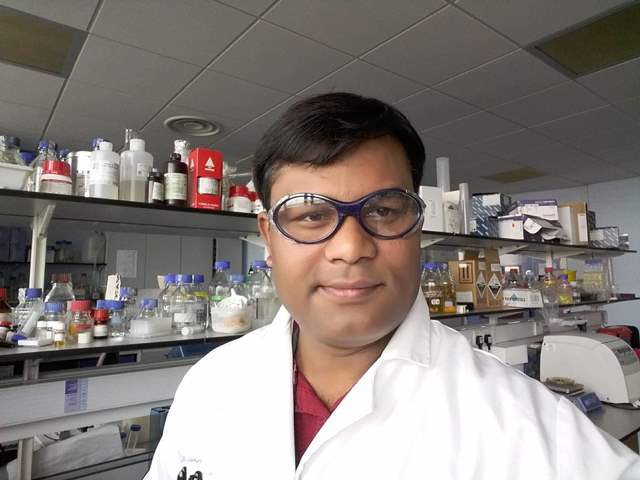
In a development that is something Bihar should be proud of, Dr Mumtaz Naiyer, a UK-based scientist from Kishanganj district, has come up with an ‘exciting’ discovery on path to develop new type of vaccine to treat global viruses.
He along with other scientists from the University of Southampton has made a significant discovery in efforts to develop a vaccine against Zika, Dengue and Hepatitis C viruses that affect millions of people around the world.
In a study published in Science Immunology, researchers have shown that natural killer cells (NK cells), which are a fundamental part of the body’s immune system, can recognise many different viruses including global pathogens such as Zika, Dengue and Hepatitis C viruses, through a single receptor called KIR2DS2.
The Southampton team have shown that this NK cell receptor is able to target a non-variable part of the virus called the NS3 helicase protein, which is essential in making the virus work properly. Unlike other proteins, the NS3 helicase protein does not change, which allows the immune system to grab hold of it and let the NK cells deal with the threat.
Lead researcher Salim Khakoo, professor of hepatology, said the findings are very exciting and could change the way viruses are targeted by vaccines but warned that the research is still at an early stage, and animal studies/clinical trials will be needed to test the findings.
It is very exciting to discover that other viruses similar to Hepatitis C, such as Zika virus, dengue virus, yellow fever virus, Japanese encephalitis virus and in fact all flaviviruses, contain a region within their NS3 helicase proteins that is recognised by exactly the same KIR2DS2 receptor.
“We believe that by targeting this NS3 helicase region, we can make a new type of vaccine based upon natural killer cells, which can be used to help protect people from these infections,” said Khakoo.
In an exclusive interview with MuslimMirror, Dr Naiyer, a postdoctoral scientist at the University of Southampton who the first author of the paper, talked at length about his roller coaster journey from Bihar to the United Kingdom and study.
Here are the excerpts:
MM: Please tell us about your journey from Bihar’s one of the most backward districts of Kishanganj to the University of Southampton, United Kingdom?
Dr Naiyer: I was born in one of the remotest village of Kishanganj in Bihar. The place earlier was referred to as ‘Kala Pani’ because of sheer backwardness and no access to mainland India. You can consider my small village as ‘Kala Pani’ with no access to schools etc. So much so, electricity in my village arrived in 2016 after 70 years of independence.
I was born in the 80s in a humble family of farmers. My parents were illiterate but had great quest for education. I was youngest among my siblings with five elder brothers and two sisters. The eldest brother did not attend school, one studied up to class V and three attended college. One of them did masters and later PhD in English literature.
My father passed away when I was 8 years old. It was extremely difficult for my mother to support us. As madarsas are cheaper, my mother even asked me to attend the Islamic seminary and become an ‘Aalim’ (Islamic scholar). After my father’s demise, one of my eldest brothers Mr Zainul Abedin had to discontinue his studies to support the education of two younger brothers.
As there were no schools nearby, I studied at home and a single teacher used to teach all the children in the village. I was directly admitted to standard three in a government school, which was 4 km away from my village. There were no roads and the situation in rainy season was like a nightmare. There was a strict discipline in our family for education. No matter how bad the day, one cannot miss the school.
I studied up to high school in my village. After that, I moved to Patna. Since my medium of instruction was Hindi till high school, it was difficult to switch to English books at 10+2. Contrary to my elder brothers who studied arts, I choose science with biology, physics and chemistry. I had a dream to become a doctor as I had seen young children die in my village without medical facilities.
However, after repeated attempts I could not clear Premedical Test (PMT) conducted by Central Board of Secondary Education (CBSE) and Bihar Combined Entrance Examination (BCEE). I moved to Delhi from Patna in the year 2000. I cracked BDS (Bachelor of Dental Surgery) entrance examination of Karnataka and B.Pharm (Bachelor of Pharmacy) entrance examination of Jamia Hamdard, New Delhi. Unfortunately, I could not afford any of these two. Then, I decided to do a simple B.Sc. course.
I appeared in the entrance test of B.Sc. (Biosciences) at Jamia Millia Islamia, New Delhi, and I got selected for the course. That year, Jamia had lauched B.Sc. (Biotechnology) programme. The central university gave us an option to choose either of the programme. In addition, those who were top in the merit list have an option to choose biotechnology. I choose biotechnology.
Teachers were very supportive. Till that time, I had no predefine goals for an academic career like this. But later, I attended lectures of prominent academicians and scientists in my university. That changed my attitude completely towards higher education.
Surviving in a metro city like Delhi was not an easy job. The money I used to get from my family was not enough. I used to give tuitions in the posh colonies of Delhi to earn some bucks and support myself. Apart from that, I received Merit Scholarship by Central Wakf Board, Ministry of Minority Affairs, Government of India, for consecutive two years at bachelors level. I must say my brothers tried their best to support me throughout my academic journey.
After my bachelors, I joined Jamia Hamdard, New Delhi in its master’s programme in biotechnology, which was one of the best in the capital. Here too, my teachers were very supportive and encouraged me to do pursue research. I got training in institutions like Institute of Genomics and Integrative Biology (IGIB), New Delhi. I got an exposure to quality research at my masters level. I was the recipient of Tasmia Merit Scholarship for best academic performance at masters level university exams in Jamia Hamdard.
My M.Sc. final year was full of turmoil. I lost my mother just a month before my final year’s examination and my family was going through financial crisis. Somehow, I managed to continue my studies.
I appeared in national level exams like National Eligibility Test (NET) jointly conducted by CSIR-UGC. I was awarded NET -Lectureship and Junior Research Fellowship by the UGC to pursue Ph.D. I also cleared GATE with 97 percentile.
After my masters, I joined National Centre for Cell Science (NCCS), Pune, an autonomous institution of the Department of Biotechnology, Government of India, for my Ph.D. This is one of the top biotechnology research institutes in India. It is also a national cell repository. One of the best Immunologists in the country Dr Bhaskar Saha who is also a Shanti Swaroop Bhatnagar Awardee mentored me.
During my Ph.D., I gained knowledge in molecular immunology and cell signaling. I worked on Human Visceral Leishmaniasis also called Kala-azar. My research work ‘Identification and Characterisation of Interleukin-10 Receptor Antagonist’ was published in the journal ‘Human Immunology’. The financial support was provided by the UGC for five years in which I was awarded Junior Research fellowship (JRF) for two years and senior research fellowship (SRF) for three years.
At the end of my Ph.D., I received offers for postdoctoral fellowships from University of Montreal, Canada; John Hopkins University, Baltimore, Maryland, USA; National Institute of Health, Bethesda, USA; and Imperial College London, UK. Previously, Khakoo lab was in Imperial College London, which was later shifted to University of Southampton where I work now since March 2012.
Although I had options to join other labs in the USA and Canada, I decided to join Professor Khakoo’s lab for my postdoctoral research as my research goals were best matched with the objectives of Khakoo lab.
At University of Southampton, I started working on clinically important viruses such as Hepatitis C virus, Dengue, Zika, etc. and tried to understand how Natural Killer cells – which are fundamental part of body’s immune system – can clear the viruses.
MM: Tell us about your research.
Dr Naiyer: This is a well-presented study and a significant advancement in this field that identifies the important role of the receptor KIR2DS2. Since I come from India, which has thousands of cases of dengue each year, I can understand the suffering of patients with dengue. Nothing would give me greater pleasure than to ease the suffering of these dengue-affected patients.
Natural Killer Cells play important role in fight against cancer and viral clearance. Our study focuses on how a single vaccine can be effective against multiple viruses. Our findings, which was recently published in prestigious journal “Science Immunology” also suggests that this strategy for virus therapeutics could be easily translated into the field of cancer.
2. What kind of encouragement did you find from your family and friends?
Dr Naiyer: My family was supportive. My brothers would often say, ‘Do not think about money, you just focus in your studies and leave rest to us’.
I had a very healthy competition with my friends and some of them genuinely motivated me.
MM: given the literacy rate of your area, what did inspire you to select this stream in higher studies?
Dr Naiyer: During my growing up years in the 90s, the sentence I often hear in my surrounding was “padh likh kar kuch nahi hota” (education gives you nothing). Most of the parents would send their school going to children to Delhi, Mumbai, Punjab and other metro cities of India to earn money and livelihood. That was such a discouraging period for education in my area called Seemanchal, which resulted in very high number of unskilled labour force.
Nevertheless, I was never tempted to leave my school or studies and determined to prove that education is the most powerful tool. Despite hardship, I keep going systematically. Even during my bachelors and masters in Delhi, people from my area would say “kab tak padhte rahoge miyan” (how long would you study)?
MM: Why did not you go for engineering and other short-term professional courses like others belonging to humble family background do to support their families?
Dr Naiyer: As I said before, I wanted to become a medical doctor, so engineering or any other short-term courses were never in my mind.
MM: What are your future plans?
Dr Naiyer: I want to contribute more to science and use my knowledge and expertise against the serious threats to humankind posed by dangerous viruses such as Zika, Dengue, Ebola, etc.
I would like to establish my own lab and become a principal investigator. If given the opportunity, I would like to return to India and want to contribute to the Indian science.
MM: Is there anybig project in your mind?
Dr Naiyer: I am contemplating to write grants for my own funding to support my research work. I shall apply for grants in Medical Research Council, UK, and Wellcome Trust, UK.
MM: Where do you want to see yourself 10 years down the line?
Dr Naiyer: After 10 years, I want to see myself as a successful scientist who has contributed a bit for the welfare of humankind by doing high-level science. I want to become an expert in my field.
Do you have any plan for the educational upliftment of your area, especially for Muslim youth?
Dr Naiyer: This is interesting question. I would definitely plan and would happy to contribute for the educational upliftment of my area. I along with some other friends from Bihar are trying to develop a unique platform where we can support meritorious students from Seemanchal (Bihar) irrespective of their financial conditions.
I have a dream to establish school/colleges, hospitals and healthcare in every block of Seemanchal. I would also focus in girls/women education. I would share the road map at appropriate time.
MM. Do you want to give any message to the youth of the community?
Dr Naiyer: Our community has some deeper problems and the youth are looking for microwave solutions. Our community has limited resources, please use them effectively. You must work hard, and should not waste time and resources.
The message I would pass to the youths is that there is no short cut for success. You cannot bypass the stairs of education and reach on the top through a side-lift. If you try, it would be disastrous for your career. Do not fear failures as failures are there to make you strong.
source: http://www.muslimmirror.com / Muslim Mirror / Home> Health / by admin – Muslim Mirror Staff / October 10th, 2017
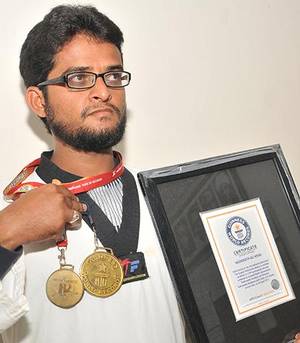
Hashmath Ali Khan. | Photo Credit: CH_VIJAYA BHASKAR
Hashmath performed 16 steps of Taekwondo for 65 times in 30 minutes
Hafez Hashmath Ali Khan, Taekwondo and Karate coach who hails from Vijayawada, is on a mission to make bigger achievements in the world of Taekwondo for several years. His spirit has got a boost after the successful participation in a recent event that found a place in the Guinness Book of World Records. Hashmath performed the 16 steps of Taekwondo for 65 times in 30 minutes. It was a result of rigorous training for six months, he says.
Hashmath, also an Imam who occasionally teaches in masjids in Andhra Pradesh, is one among the few persons in Hyderabad who successfully performed the feat of delivering 300 perfect punches in 180 seconds. This feat secured a place in the High Range Book of World Records.
As a profession, Hashmath teaches Taekwondo and Karate at many schools in Hyderabad and simultaneously grew stronger in the martial art under the guidance of his master Jayanth Reddy of the JR International Taekwondo Academy in Hyderabad, which is known for its Guinness records in Taekwondo.
‘Governments attention needed’
“Taekwondo is an important sport that needs the attention of the Union and the State governments. However, there is not much encouragement from the State governments even as the sport is an Olympic event since decades,” says Hashmath.
“Government should take Taekwondo seriously and focus on providing the training facility for the students who could get into Olympics and bring medals to the nation. I am confident that I can compete in Olympics and also nurture my students including national fighters to rise up to the level of Olympics,” said Mr. Hashmath, who also trained the police in Hyderabad.
Hashamth, 30, was born in Vijayawada. He moved to Nellore for education and then moved to Hyderabad where he learned Karate 12 years ago and then took up Taekwondo in 2012.Now, he is a Master Instructor as recognised by the Korean Cultural Centre India as per the World Taekwondo Federation rules.
source: http://www.thehindu.com / The Hindu / Home> News> Cities> Vijayawada / by Tharun Boda / Vijayawada – October 08th, 2017
Samiya found the going tough in the opening game as Stephani jumped to a 6-1 lead early on and kept distancing herself to grab it easily.
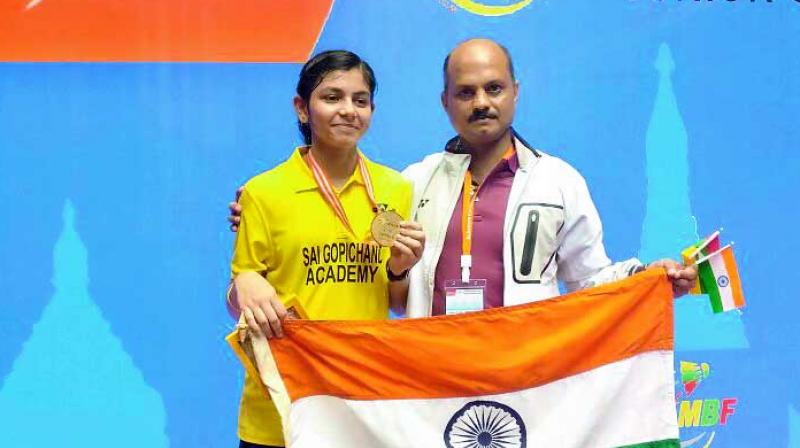
Samiya Imad Farooqui poses alongside junior chief coach Sanjay Mishra in Yangon on Sunday.
Yangon (Myanmar):
Indian shuttler Samiya Imad Farooqui clinched the gold medal at the Under-15 women’s singles competition after defeating Indonesia’s Widjaja Stephani at the Asian Junior Championship here on Sunday.
The third seeded Indian, who had reached the finals at Pembangunan Jaya Raya International Junior Grand Prix U-19 in April, defeated Stephani 15-21, 21-17, 21-19 in a 56-minute match to lay claim to the coveted title.
P.V. Sindhu had won the gold in U-19 Asia Junior championship in 2012 at Gimcheon, South Korea. Samiya found the going tough in the opening game as Stephani jumped to a 6-1 lead early on and kept distancing herself to grab it easily.
However, the 14-year-old from Hyderabad made a roaring comeback in the second game, opening a 6-2 lead and then grabbing a 13-8 lead.
The Indonesian clawed back at 13-13 but Samiya managed to wriggle out and eventually forced the match into a decider. In the third game, Stephani and Samiya entered in a tooth and nail battle. Samiya clawed back to a 16-16 and turned the tables eventually to take the title home.
source: http://www.asianage.com / Asian Age / Home> Sports> In Other Sports / by PTI / October 09th, 2017
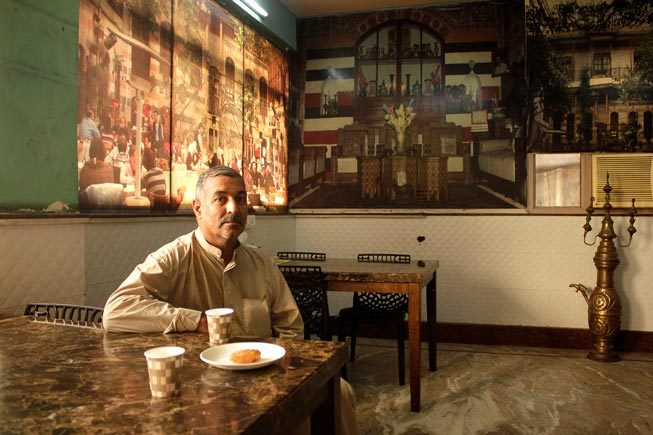
The wallpaper of Asharq al-Awsat bears images of Beit Jabri, a large, famous restaurant in Damascus. / Photo: Vamika Jain
When I walked into Asharq al-Awsat on a morning in early July, a man named Anas was praising Abdullah, the restaurant’s head chef, for helping him feel like he was back in his native Syria. Anas’s praise was prompted by Abdullah’s kibbeh labaniyeh—a yoghurt-based meat dish that is a staple of Arab cooking.
Like many of the guests who frequent Asharq al-Awsat, Anas was receiving treatment at a medical centre nearby. Over the past several years, Sarita Vihar has become a hub for medical tourists from all over the world, especially West Asia, who come to receive affordable medical treatment at private hospitals in the neighbourhood. While here, many patients from West Asia yearn for a taste of home, particularly because the food they are accustomed to is much less spicy than Indian food. Responding to this need, Asharq al-Awsat—which translates to “the Middle East” in Arabic—serves up Arab food in a setting that almost makes you forget that you are in India.
Asharq al-Awsat is on the fourth floor of Om Palace, a guest house in an area of Sarita Vihar dotted with lodging for medical tourists. The restaurant’s wallpaper bears images of Beit Jabri—a large, iconic restaurant in Damascus. An Arabic news channel plays on a small television. The restaurant’s patrons are typically Arabs wearing off-white thawbs and joking loudly in Arabic. But these jolly surroundings belie the difficulties faced by many of the restaurant’s patrons and staff.
Abdullah used to work as a chef in Damascus, but he and his family fled the ongoing Syrian civil war in 2011, leaving for Delhi. “Other than the war, there’s no other reason I would ever leave Syria,” he said. He lost two brothers in the war.
Two years after leaving Syria, Abdullah began work at Asharq al-Awsat. The restaurant was founded by Sohaib Kamal, an Indian man from Rajasthan, who studied Arabic and Farsi in a madrasa in old Delhi. He was inspired to open the restaurant in 2013, he told me, after he visited Om Palace—which, at the time, had an Indian restaurant on the fourth floor. Kamal spoke to many West Asian medical tourists staying at the hotel who were struggling to stomach the restaurant’s spicy food. “When I met a few Iraqis here once, they complained, ‘Coming to India was such a mistake—there’s nothing to eat here! I can’t even drink tea here, because I’m afraid it could be spicy,’” Kamal recounted, when I met him at Asharq al-Awsat. “They were so distressed and hungry all the time, and would end up eating biscuits and curd for meals.” Kamal spoke to the owners of the Indian restaurant and asked if he could start a restaurant there that served Arab cuisine. The owners agreed to rent out their kitchen, and Kamal opened his restaurant.
One day, about a month after Kamal rented out the fourth-floor space, Abdullah, who was at Om Palace to meet someone, stormed into the restaurant’s kitchen. “Who made this? This is not how you make kabsa!” Kamal remembered him saying. Abdullah then proceeded to show the cook—an Indian, and a personal friend of Kamal—how to make chicken kabsa, a popular Arab dish. Abdullah then, Kamal said, offered to help the restaurant in any way he could. “I was excited, because no other restaurant in Delhi has an Arab chef,” Kamal said. Before Abdullah came along, Kamal added, “We had been learning the cuisine off the internet and through other ad-hoc methods.” The chef at whom Abdullah had snapped on that fateful day became his assistant, and, “to date, he continues to learn from Abdullah,” Kamal said. Even the restaurant’s name bears Abdullah’s stamp—Kamal had not settled on a name for the place until the Syrian cook came along. They eventually decided on “Asharq al-Awsat” because it was the name of the restaurant where Abdullah worked as a chef in Damascus.
For the past few months, however, business has been bad at Asharq al-Awsat. “Sometimes this happens,” Kamal said. “We are mostly dependent on foreign medical patients—not many Indians come here, because we don’t serve any Indian food.” Faced with this downturn, the team decided to open another restaurant, in the more centralised location of New Friends Colony, opposite the Fortis Escort Heart Institute. Called MEC Syrian Food (the MEC stands for “Middle Eastern Cuisine”), this restaurant has been doing much better than Asharq al-Awsat, as it is frequented by Indian students from nearby universities.
I visited MEC Syrian Food a few days after it had opened, in late June. There, I met Abu Tarikh—the restaurant’s manager, who has also been Asharq’s manager for over a year. The walls had just been decorated with tiles inscribed with Arabic lettering. Some tables were draped with Persian rugs.
Tarikh, like Abdullah, is a Syrian refugee. He fled Damascus with his family in 2015, after both his home and the mobile-accessories shop he owned were destroyed in the war. He and his family initially moved to Mumbai, but they only stayed there for 20 days before Tarikh realised it “was not for him.” They moved to Delhi after that, he told me, and he is much happier here; he “understands things” in this city, and thinks that the “people here are good.”
It has not all been smooth sailing for Tarikh, though. He speaks some English but no Hindi at all, except for the few functional words which help him communicate with autorickshaw drivers and customers. This means, he said, that “one day’s work sometimes takes ten days. Nobody here understands me as they do back home.” But “I like India in general,” he added. “I have many Indian friends.”
Abdullah has had more trouble adjusting to life in Delhi. He finds the language barrier even more difficult to deal with than Tarikh does, since he barely knows any English or Hindi. “I left my home in Damascus because the entire country was in dire straits; but even here, I don’t know anybody, and I’m facing just as many troubles,” he said. “I don’t like it here at all. But I’m helpless, what can I do?”
In Abdullah’s ideal world, he would migrate to the United States. In India, he said, “there are no facilities. Even if you work for 24 hours a day, you can’t earn enough to take care of your children—everything is so expensive.” Also, he said, “Indians don’t like my food, because they eat such spicy food. I can make at least 80 types of Arabic food, but unfortunately, I have to limit myself to four, five types of dishes. It’s very frustrating.” He told me he has applied for a US visa, but has not heard back.
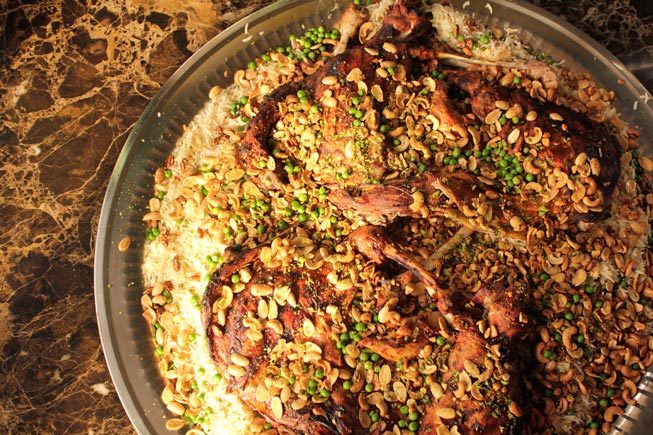
Every day, the Palestinian embassy places an order with Asharq al-Awsat for mansaf, an elaborate lamb-based dish
When I first met Abdullah, it was rush hour at Asharq al-Awsat. Each day, the Palestinian embassy places an order with the restaurant for mansaf—an elaborate dish of lamb cooked on top of a layer of flatbread and rice in a yoghurt-based sauce, decorated with pine nuts and almonds. His enthusiasm was palpable as he spun around the kitchen, grilling meat, assigning tasks to employees, bringing various dishes to boil.
But, shortly after that, during a smoke break outside the restaurant, he confessed, “Honestly, here, I am just going about my days, not even living. I am barely existing, with no end in sight.”
Anisha Sircar is an intern at The Caravan.
source: http://www.caravanmagazine.in / The Caravan / Home> Reporting & Essays> The Lede / by Anisha Sircar / September 01st, 2017
Lalitpur (Jhansi) & Agra (UTTAR PRADESH) / London, GREAT BRITAIN with Empress of India
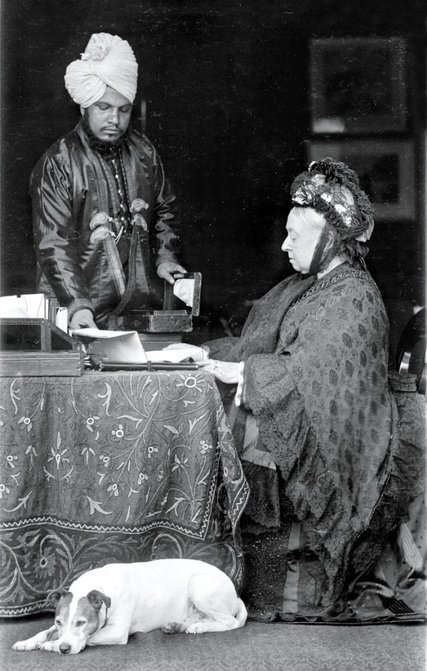
Queen Victoria at her desk, assisted by her servant Abdul Karim, the munshi.
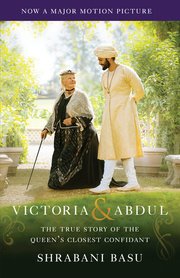
VICTORIA & ABDUL
The True Story of the Queen’s Closest Confidant
By Shrabani Basu
Illustrated. 334 pp. Vintage Books. Paper, $16.
I really do wonder if I am qualified to review this remarkable work. I am a nonagenarian, Anglo-Welsh, republican, agnostic liberal, an only half-redeemed British imperialist, sexually complex and incorrigibly romantic. “Victoria & Abdul” is about an aging British queen, her eccentric obsession with an engaging Muslim servant from India and the half-farcical opposition of the British establishment to their relationship. I had never heard of the story until the book reached me for my critique, and I had no idea it was about to be the subject of a much-publicized movie. Am I qualified to respond to it for The New York Timer? Reader, judge for yourself.
When it first reached me I began, as a republican, by scoffing. The very status of Alexandrina Victoria, Queen of England, at the time of her first encounter with that Indian servant struck me as perfectly ridiculous. She was a woman in her late 60s who was treated with almost religious reverence and responded accordingly. The whole preposterous charade of royalty was performed perpetually in her presence. It was wildly exaggerated, too, because she happened to be the titular head not simply of a small island nation but of the most enormous empire in the history of empires, claiming sovereignty over nearly a quarter of the earth’s surface. Perhaps the least logical of these bizarre circumstances was the fact that among her far-flung territories was one of the proudest and most ancient of all human entities, India. Since 1877, Victoria had been called Queen Empress, and India was the reason.
I scoffed, but then that Indian charmer entered the book, and I was beguiled.
So was Victoria. Abdul Karim was 24 when he arrived in England in 1887, engaged as an orderly for the queen during her Golden Jubilee celebrations and presently also charged with teaching Her Imperial Majesty Hindustani (as the British habitually referred to both Hindi and Urdu). Although of relatively humble stock, he was a born winner, educated, good-looking, clever and ambitious. I soon fell for him myself.
In no time at all, it seems, he became far more than an orderly, but rather an Indian gentleman of the court, more or less self-promoted out of the servants’ quarters and dubbed, by Her Majesty’s command, a “munshi” — which meant, I gather, a sort of more-than-teacher. This in turn seems to have morphed into a vaguely aristocratic honorific, and before long the delightful young orderly had become the Munshi. For the rest of his life he flaunted the title, and “Bravo,” say I!
I find myself genuinely touched by the bond between the empress and the munshi. He was an opportunist, but he was kind, which for my money redeems many faults, and old Victoria had been having a rotten time of it. First she lost her adored husband, Albert, and never got over it, and then John Brown, her beloved Scots gillie, died on her. Victoria’s nine children were scattered across Britain and Europe, and they were a mixed bag anyway. It must have been a lonely time for the old lady, but then along came Abdul Karim, in his virile youth, and he was very soon treating her not only as an empress but as a woman.
There was obviously nothing carnal about the relationship. Heaven forbid! The munshi seems to have regarded Victoria as an affectionate and generous surrogate mother. (She gave Abdul Karim and his wife three cottages, each near one of her own palaces, plus some land in India, and when he traveled on the royal train he had a whole carriage to himself.) In return he gave her his sympathy and understanding, and in particular they both seem to have enjoyed her daily (and very successful) lessons in Hindustani.
The affair, if we can call it that, spilled over into the style of the British court, which became more and more Indianified. Indian colors were everywhere, Indian sounds and even Indian smells (for curries were often served). When the court indulged itself or its visitors with one of its elaborate tableaux vivants, Indian faces were prominent on the stage, and indeed in the tableau of the king of Egypt, pictured in this book, the Pharaonic ruler himself was played by none other than — the munshi!
The generally snobbish and often racist British establishment of the day came to detest the munshi with an almost comical fervor, and, led by Victoria’s son and heir, Bertie, who later reigned as Edward VII, persecuted even Abdul Karim’s memory when he and his love were both long gone. I suspect that the munshi was a sort of dual reincarnation of Victoria’s beloved Albert and her dear, dear John Brown. And if there was something rather excessive — even, to my mind, schoolgirlish — about her attachment to her young servant, it was perhaps only a late and pathetic extension of the maternal instinct.
I grew fond of them both as I read this generous and meticulous book, and I write this review now with a sentimental tear in my eye. So what think you, Reader? Am I qualified for the job?