KOLKATA (West Bengal) / UTTAR PRADESH / NEW DELHI :
REUTERS
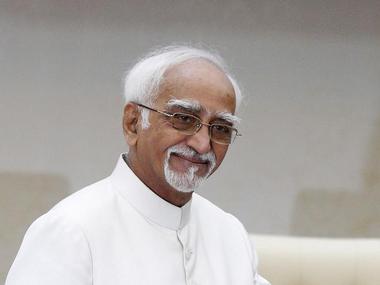
The Indian Vice-President Hamid Ansari is expected in Morocco from May 30 to June 1, a visit expected to highlight by the signing of several Memoranda of Understanding (MoU.)
The Indian Vice-President’s visit is taking place few months after King Mohammed VI visited India to participate in the India-Africa summit held in October last year. The king was the guest of honor of the India-Africa summit.
During this diplomatic visit, the first in 50 years since the last visit of an Indian Vice-President, Ansari will hold talks with Moroccan officials on a wide range of issues including economy and UN Security Council expansion, Indian sources say.
“This visit intends to further strengthen the cordial relations between the two countries, further develop and diversify profile of bilateral economic cooperation and explore new avenues of co-operation and partnership on a wide range of issues of shared interest,” a statement from the Indian external Affairs Ministry said.
The Indian Vice-President will also launch, together with the Head of the Moroccan Government Abdelilah Benkirane, the India-Morocco Chamber of Commerce and Industry, according to Indian sources.
Besides the political dimension of the trip, a special accent will be put on the economic issues as India plans to expand market outreach of its cars and truck manufacturers.
MoUs will be signed in education, IT and communication technology sectors during the visit.
Several economic initiatives have been undertaken by both sides over the past months. Last month, officials of the two countries’ ministries of transports mulled in Mumbai the idea to launch a direct air link between the two countries.
Also in the course of April, a team of Moroccan business people visited New Delhi to study business partnership opportunities that can be established between India and Morocco.
source: http://www.northafricapost.com / The North Africa Post / Home> Headlines> Morocco / by Kamailoudini Tagba / May 27th, 2016
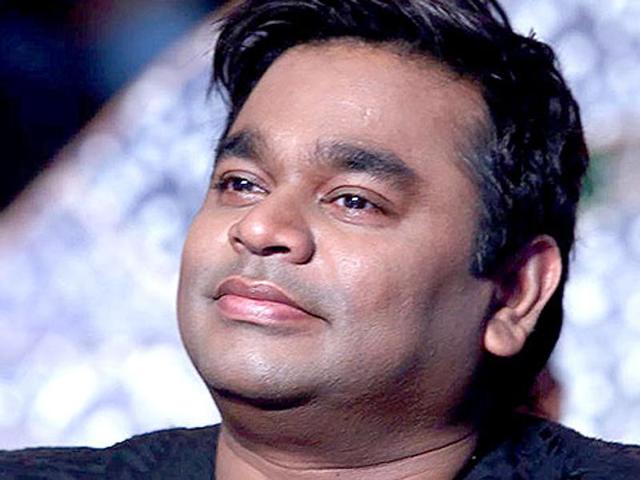
Music maestro A R Rahman has been announced as the recipient of Grand Fukuoka Prize 2016 for his outstanding contribution to Asian culture through his music.
As part of the ceremony, Rahman has been invited to the city to give a public lecture on “From the Heart: The World of A R Rahman’s Music”.
The 49-year-old Oscar-winning composer has been chosen for the honour alongside Philippines’ historian Ameth R Ocampo (Academic Prize) and Yasmeen Lari from Pakistan (Arts and Culture Prize) by the secretariat of Fukuoka prize committee.
The annual award, was established by Fukuoka City, Japan, in 1990 with an aim to honour the outstanding work of individuals, groups and organizations working to preserve and promote the unique and diverse culture of Asia.
Rahman started his movie career with Mani Ratnam’s Tamil film “Roja”. Rahman’s first big break in Hindi cinema came with Ram Gopal Varma’s “Rangeela”.
He is now one of the most sought after composers in India with his brilliant compositions for films like “Bombay”, “Dil Se”, “Taal”, “Lagaan”, “Rang De Basanti”, “Delhi 6”, “Rockstar”, “Highway” and “Tamasha”.
Rahman has carved an impressive career in Hollywood after composing “Jai Ho” for British director Danny Boyle’s “Slumdog Millionaire”, which earned him two Academy awards and a Golden Globe trophy.
Previous winners from India include distinguished names such as sitar player Ravi Shankar, dancer Padma Subrahmanyam, historian Romila Thapar, sarod maestro Amjad Ali Khan, Ashish Nandy, Partha Chatterjee, Vandana Shiva, Nalini Malini and historian Ramachandra Guha.
Other winners include Nobel laureates Muhammad Yunus (Bangladesh) and Mo Yan (China).
source: http://www.deccanherald.com / Deccan Herald / Home> Entertainment / PTI / New Delhi – May 30th, 2016
Lack of proper scouting network has hurt the growth of swimming in India: Nihar Ameen
Nihar Ameen’s journey as a swimming coach began more out of compulsion than choice. The then 20-year-old Nihar had just one goal, to coach his sister Shanaz Shacoor when she was left floundering after being the youngest swimmer at the 1982 Asian Games.
“I was forced into it (being a coach) due to various reasons. I never thought it would turn out to so good,” says Nihar, recalling his early days.
“It was a short-term goal back then. There was my sister, 12-years-old when she competed at the Asian Games and she needed someone to train under. It was a learning curve,” he continues.
Thirty-four years have gone by since then. Nihar today is one of the respected and most sought-after swimming coaches in India. The 2015 Dronacharya awardee who has produced medal winners at the Asian Games level besides shaping the careers of many aspiring swimmers, Nihar has let his work speak for itself.
In a freewheeling interview with Deccan Herald, the 54-year-old coach discusses the upcoming Olympics, his two Asian Games medal-winning swimmers and the swimming scene in India. Excerpts:
Another Olympic Games is fast approaching and India’s swimmers are yet to clock the ‘A’ standard to assure themselves of a place at the Rio Games. How disappointing is it given that the qualification period ends on July 3?
I won’t say it’s disappointing because no Indian swimmer has ever made an ‘A’ standard. We’re still trying and hopefully we can clock the timings.
Normally — in our case — a male and a female swimmer, who have clocked the ‘B’ cut goes for the Games (based on the universality quota). And if there’s something to cherish this time it is the fact that we’ve had the most ‘B’ cuts ever. I see this as a sign of some kind of progress. Unfortunately the qualifying time is moving so far ahead that it has become difficult. Like in 100M freestyle, the qualifying time (48.99 seconds) is so close to Alexander Popov’s world record time (48.29 seconds) set in 1994. It stood for close to six years. So it’s a mixture of all these factors that have hurt us.
India’s presence at the international stage is very minimal. Our swimmers have found it hard to match the international standard, what would you pin that on?
I think it (the problem) begins with talent identification. We don’t have a system where we go out and scout for swimming talent. Right now, the best coaches in the country only have accesses to those swimmers who come to them. With a population of over a billion, the number of registered swimmers is very less. If you consider countries like China, the US and Australia, they have a huge number of competitive swimmers. China has close to 700,000 swimmers, the US has close to that number too. Australia has close to 1,50,000 swimmers. Quite frankly, I believe, the more milk you have, more cream you’ll get on the top.
Funding is another big issue. The kids who come to us (coaches) have to pay for everything. And that’s a big amount. Another aspect is the mentality of the parents. Like for instance, by the time a young swimmer reaches the 10th grade, a eureka moment hits them and suddenly everything stops and academics takes centre stage. And once the kid is in college, sport takes a huge backward step.
And above all is the fact that disciplines like track and field and swimming, which are considered to be the mother sport for an Olympic nation, struggle for money.
If you look at other countries, the Olympic committee pays special emphasis on these events as they have maximum number of medals up for grabs. But in India, unfortunately, these are the disciplines that struggle for funds.
You have been into the sport of swimming for over three decades now. How much has the sport changed and evolved?
It’s a completely different scenario now. We are a cricket-mad nation because of which Olympic sport takes a back seat on many fronts. If you look at nations like the US and Australia, how people perceive sport is totally different than how we do in India. Here it’s still a leisure activity, while in the west, it’s a multi-billion dollar industry. But having said that, I can see the scenario changing. Especially in the metropolitan cities, parents are now aware of the role sport can play in the overall development of their kid. But it’s not a country-wide (phenomenon).
Two of India’s medal-winning swimmers at the Asian Games, Virdhawal Khade and Sandeep Sejwal, have trained under you. What made them different from other swimmers?
They were extremely talented and a lot had to do with the lack of parental interference. Up to a point their parents were very much involved in getting them into the right programme. But once they knew that their kids were in the right programme, there was this essence of trust, which is very much lacking today. It was their talent accompanied by complete trust from their parents.
Sandeep’s parents were in Delhi and Veerdhawal’s parents were in Kolhapur. They trusted me completely and I ensured that they went as far as they could and that relationship worked like magic.
Karnataka has been a dominant force in swimming in India. Winning the national championships and churning out quality swimmers seem like an every day activity. What has been the winning formula?
Two things, first, it’s the coaching. We have some of the best coaches in the country who have been producing a number of top swimmers for the past 2-3 decades. Secondly, the infrastructure is being used properly and the State association is one of the more functional ones in the whole country. It’s the combination of these that has paid off.
You were presented with the Dronacharya award in 2015. How much does the honour mean to you and the swimming community in India?
I think it should mean more to the swimming fraternity than to me. While I am thrilled that I got the award, it’s just the affirmation of the 35-36 years of labour that I have put in to make it work in our country and produce quality swimmers.
But I really hope that the powers in the sports ministry wake up and take a look at what swimming and that the sport gets some recognition from this award.
source: http://www.deccanherald.com / Deccan Herald / Home> Supplements> Sportscene / by Naveen Peter / DHNS / May 29th, 2016
The Juma Masjid in Vadodara houses a unique 250-year-old Quran. At six and a half feet long, and four and a half feet wide, members of the mosque trust claim it to be world’s largest Quran.
Handwritten by Mohammad Ghous nearly 250 years ago, two volumes of the Holy Quran were restored at the Jama Masjid in Vadodara in May
Indian driver Armaan Ebrahim, along with Sri Lankan team-mate Dilantha Malagamuwa, started his campaign in the Lamborghini Blancpain Super Trofeo AsiaSeries on a bright note by finishing second in both the races here on Sunday.
Having qualified second for the first race, 27-year-old Chennai-based Armaan, driving for Dilantha Racing, was quick off the blocks and soon took the lead, but could not push any more as he encountered problems with the brakes and dropped to second, a position he held to the finish line.
In the next race, Dilantha who had qualified sixth, opened the proceedings and quickly moved to the third spot. However, he was hit from behind which cost him track positions. He soon pitted for Armaan to take over.
Armaan could not make headway thereafter and opted to hold position to complete a successful weekend.
Reflecting on his performance, Armaan said in a release: “We could have probably won both the races, but not a bad way to start the championship. I am happy to have points in the bag. We had a few issues with the car, but overall, it was a good weekend.”
–IANS— sam/vt
source: http://www.business-standard.com / Business Standard / Home> News-IANS / Shanghai – May 22nd, 2016
Considered, but not limited to, as the ‘fifth element’ of hip hop, beatboxing is rhythms and beats flowing in harmony. And when 18-year-old Riyaz Ur Rehman is at his best, his music flows for hours together. In fact he holds the Limca Book of Records for the longest — a straight 10 hours — beatboxing marathon. “I can just keep beatboxing!” says the vocal percussionist.
Five years ago, he found home in hip hop after listening to greats like Eminem and Tupac. “I think most people relate to Eminem because he was an outsider to the culture himself and he changed how hip hop is perceived,” says Riyaz. And he finds it in him to push forward though the hip hop culture in India is relatively underdeveloped because of artistes like Eminem.
“I got interested in hip hop at an early age, after watching YouTube videos, but somehow, I took to beatboxing quicker than the other elements.” Explaining the other elements of hip hop, he adds, “There are 5 elements — emceeing, DJing, B-boying, drawing graffiti art and beatboxing. Though I was most interested in emceeing or rapping I somehow floated towards beatboxing.” While he plans to rap, he says, “No, no, no” when asked if he’s going to try the other elements. Distinguishing between rap and beatboxing, Riyaz adds, “Beatboxing is like music coming out of you and rap is your emotions flowing out.
This is one of the reasons I like the hip hop culture — it is different and a way to express your most personal thoughts so that they become relatable to everyone.” This particular quality of the genre makes him call it ‘music therapy’.
Having performed at 600 corporate shows, college events and music gigs, the youngster is hopeful that the hip hop culture is gaining more prominence in India. “Bengaluru, in particular, has a good space for us. It’s challenging to get people to listen as they aren’t accustomed to hip hop but many give it a chance, which is a good sign.”
Talking about his world record and how he managed to beatbox for 10 hours, he says, “It was easy as I love it. None of what I did was rehearsed; all the music comes to me on spot and I improvise as I go.”
Catching and coupling the beats may seem hard but when Riyaz does it, they move with ease. He can’t hold his excitement when he adds, “I also have my debut rap song coming out soon, it’s called ‘Mediocre’.”
Using words and beats to solidify his thoughts, Riyaz plans to go a long way in the music scene. Though he is still in college, he sees a bright future ahead.
source: http://www.deccanherald.com / Deccan Herald / Home> Supplements> MetroLife / by Ananya Revanna / DHNS – May 17th, 2016
AR Rahman joins Sachin Tendulkar, Abhinav Bindra and Salman Khan as goodwill ambassadors of the Indian contingent at the Rio Olympics. (File photo)
Oscar-winning music composer AR Rahman on Thursday agreed to be the Goodwill Ambassador of the Indian contingent at the Rio Olympics, joining cricket icon Sachin Tendulkar, ace shooter Abhinav Bindra and Bollywood star Salman Khan.
Tendulkar, Salman and Olympic gold medallist Bindra had earlier accepted the role offered by the Indian Olympic Association (IOA).
The IOA said that it has also received an official written confirmation from Rahman.
“It’s absolutely an honour and my pleasure to be a goodwill ambassador of the Indian contingent scheduled for August 2016,” Rahman said in a release issued by the IOA.
Welcoming Rahman on board, IOA Secretary General Rajeev Mehta said, “I would like to welcome AR Rahman on board as a goodwill ambassador of Indian contingent for Rio Olympics. It’s our privilege to have the Oscar-winning living legend music composer on board to spread awareness and promote the Olympic movement.
“As per our plan to reach out to maximum people in the country for Olympic Sports, we are happy that Mr Rahman has come forward from the field of music to support our athletes and we already have Salman Khan from Bollywood, Abhinav Bindra from Olympic Sports and Sachin Tendulkar from Cricket. I am sure Mr Rahman will inspire our sportspersons.”
There was a huge uproar after Salman was appointed Goodwill Ambassador ahead of other sporting luminaries. Former and current athletes were up in arms against Salman’s appointment and demanded to know why someone from the field of sports was not named by the federation.
The IOA immediately went into damage-control mode and requested Beijing Games gold medallist shooter Bindra and Tendulkar to be Goodwill Ambassadors.
source: http://www.hindustantimes.com / Hindustan Times / Home> India / PTI, New Delhi / May 12th, 2016
Names of the brave soldiers written on the plates of the grave at the Kohima War Cemetery, and who dedicated their life during the World War II: Battle of Kohima.
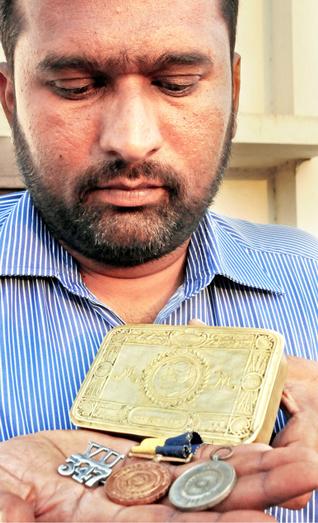
Mohammed Babavali showing the ‘Princess Mary’s Christmas Gift 1914’ ‘received by his great grandfather and the medals won by his father.— Photo: Ch.Vijaya Bhaskar
Babavali is taking care of the brass tin gifted to his great grandfather by Princess Mary
Mohammed Babavali, a 36-year-old resident of Thotlavalluru in Krishna district, has been protecting a brass tin for the past two decades. His father the late Abdul Raheem, a head constable in Vijayawada Police Commissionerate, protected it all through his life and even salvaged it from the 1977 Diviseema cyclone that swept away everything in his native village Pedagurumotu of Avanigadda mandal.
Raheem’s father Abdul Azeez too protected it all through his life before passing it on to him.
The tin, with a shape of a small tiffin box, isn’t an ordinary item, for it has a long and interesting legacy connected with the British.
“It’s Princess Mary’s Christmas gift and has a history of more than 102 years. It (the tin) was born out of the idea of Princess Mary, the daughter of Great Britain’s King George V and Queen Mary, who wanted to gift the members of British, Colonial and Indian Armed Forces on the eve of Christmas during First World War.”
One of the captains in Indian Armed Forces Fateh Ahmed, the great-grandfather of Babavali, was one among the 4.2 lakh personnel who received the gift from Princess Mary in 1914. The gift came with tobacco, confectionary, spices, pencils, scissors and a Christmas card. “Everything is gone except this tin. I have been protecting it and after me my kids will carry on the legacy,” Babavali told The Hindu .
“We lost everything including our home during the 1977 cyclone, but the ‘tin’ was saved by father who kept it with him in the police quarters in Vijayawada,” Mr. Babavali said.
Some of those gift tins are now among the collections of several museums across United Kingdom and Australia. “I thought of giving it to a museum. But later I decided to keep it with me in memory of my great grand father,” said Mr. Babavali.
The decorative tin is embossed with the face of the Princess Mary and Britain’s allied countries France, Russia, Italy, Belgium and the United States during World War I.
Back home, Mr. Babavali lost a fortune taking care of his ailing father who passed away in 2003 and he is presently working as a security guard, still looking for a break in life.
This six-foot plus Thotlavalluru man is taking care of the 102-year-old brass tin gifted to his great grandfather by Princess Mary in 1914.
source: http://www.thehindu.com / The Hindu / Home> News> Cites> Vijayawada / Tharun Boda / Vijayawada – May 07th, 2016
With no air conditioners, the approaching summer may spell doom for the thousands of rare and antique books of the famous Raza Library here.
The lab technicians have claimed that the precious books and manuscripts of the library may get damaged if the temperature soars in the coming months.
“The library had proposed a new building, with AC facilities, to preserve the books and Rs 20 crore was also sanctioned by the government,” said Himanshu Singh, spokesman of Raza Library.
But, governor Aziz Qureshi stopped it, he said. The state governor is also the chairman of Raza library board.
The library staff preserves the manuscripts manually and no high -tech support has been provided by the government. Speaking with TOI, Singh said, “Temperature between 18 and 24 degree Celsius is considered ideal for preservation of these documents and objects.”
The library is a treasure trove of rare documents and books. “Rare documents in different Indian languages written on palm leaves, more than 60 thousand published books in Indian and foreign languages.
There is also a Qur’an hand written by Hadhrat Ali on deer skin,” the spokesman said.
According to Singh, the library has also about 17 thousand rare documents in Arabic, Persian, Sanskrit, Urdu, Pushto, Hindi and Turkish etc as well as rare specimens of arts and paintings.
“Since the days of Nawabs, not much attention was paid nor was it needed in preserving these documents. But, because of changing weather conditions during the past few years temperatures in summers and winters are varying greatly because of which more care and suitable temperature is needed,” said, Naved Qaisar, research scholar at the library.
Former director of Raza Library, Muhammad Azizuddin Husain, had prepared a proposal for setting up a separate building for preserving the documents. Archaeological Survey of India’s (ASI) permission was also obtained. The ASI has also suggested that the height of this new building should be one metre less than the old building, the spokesman said.
source: http://www.timesofindia.indiatimes.com / The Times of India / News Home> City> Bareilly / by Nazar Abbas / TNN / April 09th, 2016