M J Akbar’s debut as a minister caps a remarkable political turnaround for the journalist and author who made a dashing foray into politics as a Congress MP in 1989, thanks to his proximity to the then Prime Minister Rajiv Gandhi, before a long spell in wilderness.
65-year-old Akbar, who was recently elected to Rajya Sabha from Madhya Pradesh, is seen as an articulate and modern Muslim voice in BJP who can also be trusted to defend it at times on the strident Hindutva pitch with his eloquent evocation of Modi’s developmental agenda.
A party spokesperson, he has often spoken on the government’s foreign policies.
An eminent editor and author of several well-received books, including a biography of Jawaharlal Nehru, he debuted in politics in 80s as he came close to the then Prime Minister Rajiv Gandhi and wielded considerable influence.
He contested Lok Sabha election in 1989 from Kishanganj in Bihar and won but Congress lost badly.
He drifted apart from the party after Gandhi’s death in 1991 and he soon returned to full time journalism.
Though he was critical of Modi, the then Gujarat Chief Minister, following 2002 riots, he gradually came closer to the saffron party as he assailed the Gandhi family over its leadership of Congress.
BJP expects that Akbar will provide it what the party has often lacked — an eloquent English-speaking Muslim voice.
source: http://www.newindianexpress.com / The New Indian Express / Home> Nation / PTI / July 05th, 2016
He had been ailing for some time and was taken to a local hospital where his condition did not show any signs of improvement.
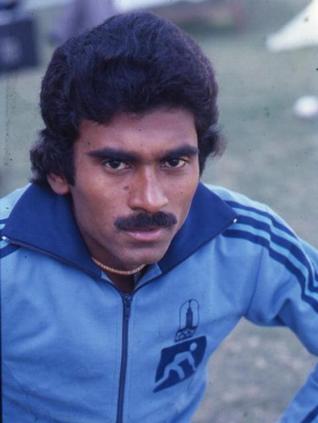
Mohammad Shahid, hockey star of yesteryear, was admitted to a private hospital in Gurgaon on Wednesday for liver treatment which was not available in Varanasi, his home town.
Shahid had been ailing for some time and was taken to a local hospital where his condition did not show any signs of improvement.
According to sources close to the hockey player, he was treated for dengue and jaundice but Shahid complained of restlessness and was promptly advised dedicated treatment of a higher quality in Delhi and was flown in on Wednesday.
With swelling in his legs and acute stomach pain, Shahid, who would once leave opposition defenders chasing his shadow, was not even able to walk on his own. He reportedly presented a pitiable sight and his physical state left many of his admirers in tears.
Known for his exceptional dribbling skills, Shahid had been hurt by the hockey world shutting him out from all schemes. He was hardly involved by his employer — Railways — for any coaching assignment related with the game and that had left the hockey great disillusioned.
True to his nature, Shahid refrained from blaming anyone for his condition and preferred spending his life in solitude. Hockey, needless to say, stayed close to his heart always.
Shahid’s former teammate Zafar Iqbal promised all help. “I am saddened to know about his condition. I will visit him (on Thursday) and offer all possible support from the hockey fraternity,” said Zafar.
source: http://www.thehindu.com / The Hindu / Home> Sport> Hockey / Vijay Lokapally / New Delhi – June 30th, 2016
Resul Pookutty has made the country proud by becoming the first Asian to win the award for best sound for documentary “India’s Daughter” at the coveted Motion Picture Sound Editors’ 63rd annual Golden Reel Awards.
Resul Pookutty has made the country proud by becoming the first Asian to win the award for best sound for documentary “India’s Daughter” at the coveted Motion Picture Sound Editors’ 63rd annual Golden Reel Awards.
Oscar-winning sound designer Resul Pookutty has made the country proud by becoming the first Asian to win the award for best sound for documentary “India’s Daughter” at the coveted Motion Picture Sound Editors’ 63rd annual Golden Reel Awards.
Pookutty, 44, who attended the awards ceremony here, took to Twitter to share his excitement about winning the honour for British documentary maker Leslee Udwin-directed “India’s Daughter”, made on the Delhi gangrape incident of December 2012, which is banned in India.
“I am honoured with the Golden Reel Award for ‘India’s Daughter’. This is an incredible recognition for me as well as for all those worked in the banned film apart from all those who protested against the brutal killing of Nirbhaya,” Pookutty told PTI from Los Angeles this afternoon.
The Oscar-winning sound engineer said he is the first Asian to win the coveted award at the 63rd Golden Reel Award from the Motion Picture Sound Editors’ (MPSE) of US for best sound.
The government had banned the film from public screening/ airing in the country.
Dedicating the award to the 23-year-old paramedic student who was brutally gangraped on December, 16 2012 following which she died, Pookutty said the film “India’s Daughter” is the true spirit of the youth of the nation.
He said the film recognises the entire spirit of the youth who protested against the inhuman treatment being meted out to girls and women.
“I dedicate this award to Nirbhaya’s soul… And her indomitable spirit,” Pookutty said.
The competing films/ television documentaries in the list included “Beware Baltimore”, “Chef’s Table”, “Deadliest Catch”, and “The Undrafted” “Mad Max: Fury Road”, “The Martian”, “Star Wars: The Force Awakens” and “The Revenant” among others.
Pookutty said a double nomination was rarity in the industry and the beauty is that both these are Indian works.
Late last month, in a rare achievement, Pookutty had won two nominations for two films, both banned in the country, from the prestigious American Motion Picture Sound Editors’ (MPSE) Golden Reel Awards.
The 44-year-old artist of “Slumdog Millionaire” fame has won nominations for his sound engineering work in “Unfreedom”, a US production, and “India’s Daughter”.
He noted that all his international recognitions came for the work he has done in India, but expressed anguish over the ban imposed on both the films in the country.
“I don’t understand why a progressive society like ours should react the way we do now. I am pained at the suppression of artistic freedom,” he had said earlier, adding these two works are analysis of extreme violence, which any progressive society should welcome.
“By banning such films we are nullifying the will of the people,” Pookutty said.
The MPSE recognises excellence in an array of sound editing achievement, from sound effects and foley to dialogue and ADR to music and score integration.
The MPSE is the final industry group to announce nominees this year and remains the only group to do so after annual Academy Award nominations.
“India’s Daughter” was directed, written and produced by British director Leslee Udwin. Though the documentary was banned in India, it was globally beamed on March 4 last year.
“Unfreedom”, which espouses homosexuality, is the debut film of Florida, US-based director Raj Amit Kumar. The film, starring Adil Hussain and Victor Banerjee, is also banned in the country by the Censor Board.
The thriller chronicles a lesbian love story set in New York and New Delhi and is said to be inspired by Faiz Ahmad Faiz’s poem – “Ye Dagh Dagh Ujala”. The film is expected to hit North American halls on May 29.
Pookutty is a film sound designer, sound editor and mixer, and lives in Mumbai with his family. He is a graduate of the Film and Television Institute of India, Pune.
He, along with Richard Pryke and Ian Tapp, had won the Academy Awards for best sound mixing for the Britsh production “Slumdog Millionaire”.
source: http://www.indianexpress.com / The Indian Express / Home> Entetainment> Music / PTI, Mumbai / February 28th, 2016
Indian quartermiler Mohammad Anas qualified for the Rio Olympics by shattering the men’s 400m national record on the second day of Polish Athletics Championship at Bydgoszcz.
21-year-old Anas clocked 45.40secs, the exact Rio qualification timing, to book the Olympics ticket last night and become the 21st Indian track and field athlete to qualify for the upcoming Games.
The Kerala athlete shattered his own national record of 45.44secs which he set on Friday on the first day of the same competition at this Polish city.
Rajiv Arokia, whose national record of 45.47secs Anas broke on Friday, finished second with a timing of 45.60secs.
Anas had won a silver in the Federation Cup of National Athletics Championships in April with a timing of 45.74secs.
source: http://www.timesofindia.indiatimes.com / The Times of India / News Home> Sports> More Sports / PTI / June 26th, 2016
It looks like Resul Pookutty is on an award-winning spree. The Academy Award-winning Slumdog Millionaire sound designer was recently honoured with yet another award.The Rocheston Accreditation Institute has honoured the sound designer with Rocheston’s Distinguished Engineer award, for his contribution to the field of sound and music in cinema.
Academy Award-winning musician AR Rahman, took to his micro-blogging page to congratulate Resul. He posted, “Congrats Resul for getting the most distinguished engineer award from Rocheston”. Rahman and Resul share a cordial working relationship.
source: http://www.timesofindia.indiatimes.com / The Times of India / News Home> Entertainment> Tamil / TNN / June 26th, 2016
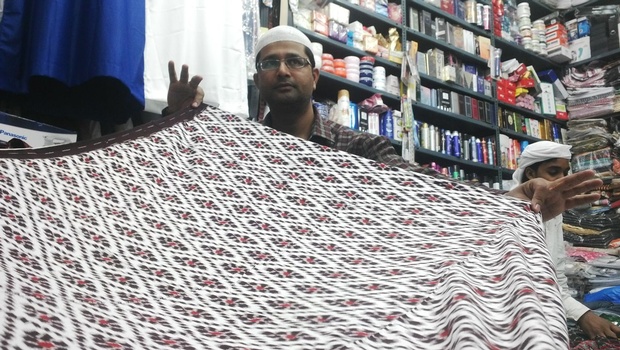
A shopkeeper displaying a Yemeni lungi | (Vinay Madapu/EPS)
Hyderabad :
While the colourful lungi is fast disappearing giving way to the trendy Bermudas, the casual wear is making a comeback among certain communities in the Pearl City.
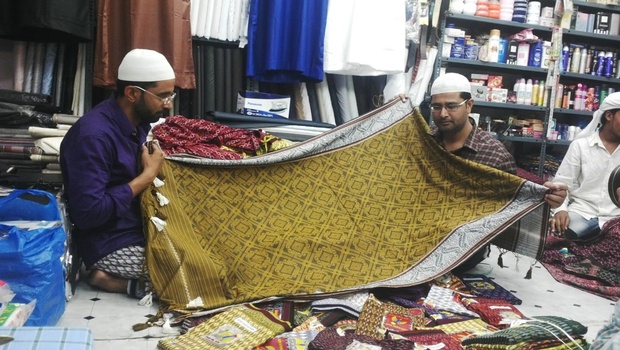
Sale of imported Yemeni lungis or Futah (also called Izaar in Saudi Arabia) has more than doubled during the holy month of Ramzan in Barkas, the area where Arab-origin Hy derabadis reside in Old City.
While big shops in the area have recorded a whopping 60-70 per cent rise in the sale of lungis, small-scale textile dealers say that there is a 50 per cent rise in demand for lungis.
A shopkeeper displaying a Yemeni lungi | (Vinay Madapu/EPS)
“The lungis form part of our identity,” said 23-year-old Khaled Umar, who doesn’t mind shelling out some extra bucks for it.
Young or old, every male in Barkas prefers the Arab lungis along with full or half-sleeved shirts over any other dress. This is said to be the reason for the spurt in sale of the simple casual wear during Ramzan.
“People gift lungis to their relatives in Barkas and elsewhere during Ramzan and Eid, and a customer will order for multiple number of lungis,” said Md Sarfaraz Khan, a dealer.
Though the price range of lungis starts from Rs 350, high-quality Futahs cost up to Rs 7,000.But, one needs to be extremely careful in handling the lungis. “They are not for rough use. They should be cleaned with care and not squeezed too hard, or else small holes may appear,” said the shop-owner, whose great grandfather, like many other residents of Barkas was brought to Hyderabad as soldiers in the Nizam’s Army.
source: http://www.newindianexpress.com / The New Indian Express / Home> Cities> Hyderabad / by Aishik Chanda / June 20th, 2016
With a UK court on Tuesday rejecting India’s arguments regarding the ownership of 35 million pounds lying in the Nat West account, the case would now proceed to trial, unless settled. After 68 years, the court has arrived at who are the litigants in the case so that a trial would be started.
Though it happens to be a snub at India, experts see a bright possibility of the issue being resolved in the next couple of years. “The initial euphoria is as if the entire money is handed over to Pakistan, which is not the case. I had suggested a formula earlier, to divide the money into three equal parts -one each part to Governments of India and Pakistan and Nizam’s family (two of his eldest grandsons as he wished) and this would have been logically acceptable to all the parties. Eventually, I think that is going to happen,” said Md Safiullah, a city based historian and managing trustee of Deccan Heritage Trust
The sum of `310 crore in his opinion is quite a small amount to government of India. “The amount was huge at the time of transfer. Imagine what would have the amount been today had it been invested in business then?,” he asked.
Over the years, Pakistan had been trying to convince the court that money was sent by the Nizam to the newly formed state of Pakistan which did not have any funds at its disposal. The seventh Nizam had in fact sent `20 cr to that country by then. The Nizam’s agent General Nawab Fazal Jung Bahadur, had transferred one million pound to Habib Ibrahim Rahimtoola, the high commissioner of Pakistan, in 1948 at a time of political uncertainty when the future of the then princely kingdom of Hyderabad was in the balance.
“In fact, immediately upon knowing of the transfer of funds to the Pakistan high commissioner, the Nizam sent a telegram that the amount was transferred without his knowledge,” Saifullah added.
source: http://www.newindianexpress.com / The New Indian Express / Home> States> Andhra Pradesh / by Express News Service / June 22nd, 2016
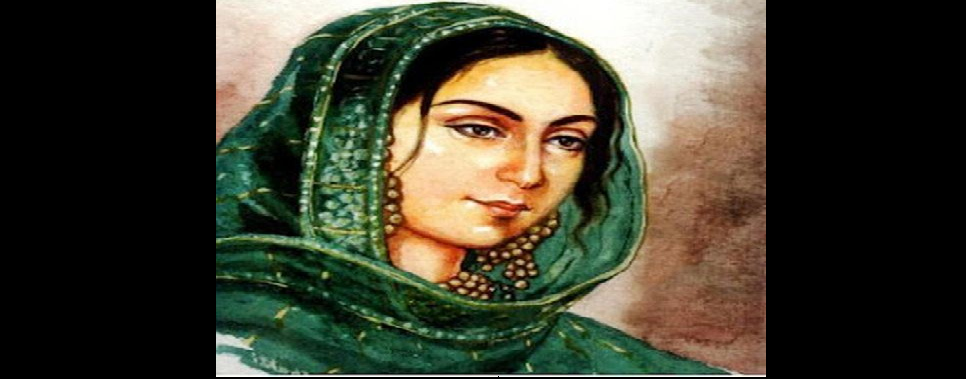
June, in particular is a good month to remember Begum Hazrat Mahal who led the first war of independence against the British in Lucknow. This Begum of Avadh had defied British forces of the East India Company in the great uprising of 1857.
She was one of the nine divorced women of Wajid Ali Shah, Lucknow’s last ruler.
“When the king left Lucknow on 13 March 1856 he took with him as well as his mother, three of his wives including Khas Mahal and Akhtar Mahal. An unknown number of wives were left behind in Lucknow as well as nine divorced women including Hazrat Mahal and her young son,” writes Rosie Llewellyn-Jones in The Last King in India.
Begum Hazrat Mahal took charge of the city despite her divorce from the king and her supporters included Raja Jailal Singh, a former Nizam of Azamgarh. It was Raja Jailal who fed support to the rebellion from the suburbs around Lucknow.
The other supporter defending Lucknow was Nana Sahib, a Maratha soldier and childhood friend of Rani Lakshmibai. Nana Sahib led the revolt against the British in Kanpur. Like Begum Hazrat Mahal he too retreated to Nepal after the British regained Lucknow in 1858.
Wajid Ali Shah was forced to leave Lucknow for exile in Calcutta, by the British. Lucknow was one of the most bitterly contested cities during this first war of independence against the British.
Between the exile of Wajid Ali Shah in March 1856 and the first war of independence in June 1857, Lucknow was defended by Begum Hazrat Mahal and she ruled as regent for 10 months. Her 12 year old son Birjis Qadr was crowned in the Baradari at Qaiserbagh, the palace built by his father.
After the British overpowered the freedom fighters, Begum Hazrat Mahal refused a pension and continued gorilla attacks on British military centers till November 1859. She spent the rest of her life in Kathmandu, Nepal and was buried there in 1879.
It may be recalled that fighting broke out at the end of June in 1857 against the British after soldiers mostly from the Avadh region heard that their mild mannered ruler was unceremoniously stripped of his throne and his kingdom by the British on grounds of mismanagement. Their first reaction was one of disbelief. Their second reaction was of anger. soldiers in different parts of north India took up arms and in Lucknow laid siege to the city’s British Residency where English and Anglo Indian inhabitants were hiding for four and a half months between July and November 1857.
But before Begum Hazrat Mahal transformed into a revolutionary she was a fairy. It may be recalled that apart from official wives and temporary wives there was yet another category of women, the pari or fairy who was often taken on as a temporary wife if the king found her pleasing and talented. The fairies were certainly an innovation of Wajid Ali Shah, poet prince and were recruited from the lower classes, including courtesans who lived mainly in Chowk, in the old city.
These women were not educated but after tuitions some of them acquired sophistication. Some fairies went on to become expert singers or dancers while others proved to be good for nothing.
Begum Hazrat Mahal’s maiden name was Muhammadi Khanum, and she was born in Faizabad. Her father was a slave called Umber owned by a Ghulam Hossein Ali Khan. Her mother was a Muslim mistress of Umber. A courtesan by profession, Muhammadi was taken into the royal harem after being sold by her parents.
She was later promoted to a fairy and was called Mahak Pari by the king. She became a begum after being accepted as a royal concubine of Wajid Ali Shah and the title Hazrat Mahal was given to her after the birth of their son, Birjis Qadr.
For some time Wajid Ali Shah was completely smitten by Hazrat Mahal. writing many poems for the dusky beauty.
Soon the king moved on to other women but in 1845 when he learned that Mahak Pari was pregnant, he immediately put her into purdah and gave her the title of Iftikhar-un-nisa or pride of all women.
Now this beautiful fairy, brave freedom fighter and pride of all women is immortalised in a documentary film directed by Mohiuddin Mirza and produced by the Films Division that was screened in the city by Lucknow Expressions Society in the presence of Kaukab Qadr Meerza, great grandson of Begum Hazrat Mahal and Manzilat Fatima, the warrior queen’s great great grand daughter.
“The aim is to never forget how the entire city had united under the leadership of Begum Hazrat Mahal to stand up against the British irrespective of religious and gender differences,” said an organiser of the event.
source: http://www.thecitizen.in / The Citizen / Home / by Mehru Jaffer / Monday – May 30th, 2016
It will be a royal evening for Lucknow coming Monday when in the company of the last Queenof Awadh, Begum Hazrat Mahal, the city will come face to face with its past. In the 137th death anniversary year of the Queen, an unsung hero of the first war of Independence of 1857, a documentary on her will be screened on May 30.
Claimed to be the first ever film on the Queen, the 26-minute documentary has been directed by national award-winning director Mohi-ud-Din Mirza. Commissioned by the Films Division, the film will be screened by the Lucknow Expressions Society along with the UP Tourism department. Prince Kaukab Qader Meerza, great grandson of the Queen, will also be coming to Lucknow from Kolkata for the day.
The screening comes with an aim to enlighten people about the sacrifices of the freedom fighter for the motherland. Documenting the history of Begum Hazrat Mahal as also including her direct descendants, it shows the Queen in her role as one of the first women revolutionaries in India’s independence struggle.
“It is for the first time that a film has been made on my great great grandmother who is someone that we have grown looking up to,” said Manzilat Khan, a direct descendant of King Wajid Ali Shah and Begum Hazrat Mahal. Khan will also be in the city on the day. It was after King Wajid Ali Shah was exiled to Matiaburj in Kolkata that the Queen fought valiantly against the British troops annexing Awadh, defeating them in Alambagh. She later took refuge in Nepal where she died on April 7, 1879.
“At the time when the independence of women was just a notion, she had a vision for the country’s freedom from the British. She chose to fight and take it on herself. Not many know about her struggle and the film will rightfully do that,” added Khan.
source: http://www.timesofindia.indiatimes.com / The Times of India / News Home> City> Lucknow / TNN / May 26th, 2016