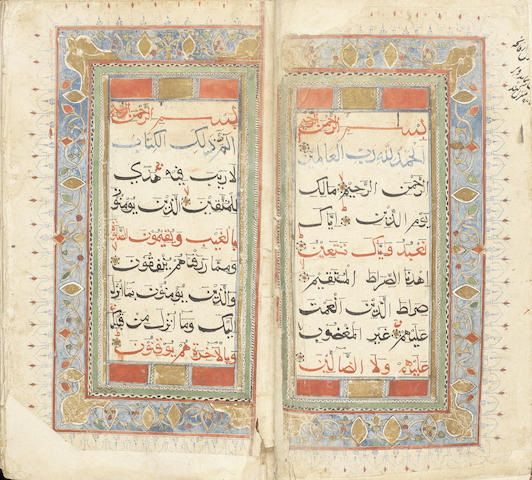
A large illuminated Qur’an, by repute taken from the baggage of Nana Sahib after his defeat in the Mutiny of 1857, Sultanate India, late 15th/early 16th Century
Arabic manuscript on cream-coloured thin paper, 632 leaves, 11 lines to the page written in large and dispersed bihari script, first, sixth and eleventh lines on each page written in red ink, remaining lines written in black ink with diacritics and vowel points in black, the work Allah and some other significant words picked out in red, gold rosettes decorated with blue and red dots between verses, inner margins ruled in blue and red, catchwords, circular and pear-shaped devices in predominantly red, yellow and white coloured panels between suras left blank, two double pages of illumination at beginning and end with outer borders decorated with intertwining stylised floral and vegetal motifs interspersed with gold lozenges, edges frayed, some tears, corners rather thumbed, some waterstaining mostly restricted to outer borders, discoloration, later brown morocco with stamped central medallions and cornerpieces of paper onlay, with flap, edges torn, covers stained, rebacked
325 x 200 mm.
FOOTNOTES
Provenance:
Probably Dhondu Pant, known as Nana Sahib (1824-57).
Lieutenant-General Harward, Royal Artillery.
Portsmouth Libraries.
Exhibited:
Portsmouth High Street Museum (unknown date, but probably first half of the 20th Century).
A typewritten label affixed to the flyleaf reproduces the exhibition note: Copy of the Koran from the baggage of the arch fiend of Bittoor, “Dundoo Punt”, Nana Sahib – the monster of Cawnpore. The Nana was a Hindoo, and this Koran was used to swear in his Mahomedan followers. Presented by Lieut. Gen. Harward, RA.
Nana Sahib, whose original name was Dhondu Pant, was a Maratha aristocrat, born in Bithoor, adopted son of the last exiled Maratha ruler, Peshwa Baji Rao II.
In the 1850s he became disenchanted with what he regarded as the East India Company’s high-handed policies, as well as, more immediately, its revoking the pension he felt he was due following the defeat and extinction of the Maratha kingdom.
In 1857 at Cawnpore (Kanpur) he switched sides, captured the Company’s treasury and declared loyalty to the Mughal Emperor Bahadur Shah II and that he intended to restore the Maratha kingdom.
It is disputed whether Nana Sahib himself, or his subordinates, gave the order to murder 120 women and children (survivors of an earlier massacre) on 15th July 1857 at Bibighar.
But they were undoubtedly murdered, hacked to death by sepoys and others, and the bodies thrown down a choked well. Whatever the exact details, the incident, alongside others of 1857, became part of the mythology of the British Empire, and the cry of ‘Remember Cawnpore!’ passed into common parlance – seen even in the label in this manuscript – as a reflection of British views of Indian perfidy during the Mutiny (or Rebellion).
Nana Sahib disappeared after the Company retook Cawnpore. There were rumours that he lived on in Nepal, and became an ascetic; others that he died of fever.
Post-Independence he was lauded as a freedom fighter and there is a park in Kanpur in his honour.
According to David James (After Timur: Qur’ans of the 14th and 15th Centuries, The Nasser D. Khalili Collection of Islamic Art, Oxford 1992, pp. 102-107), ‘most of the Indian Qur’ans that have survived from the pre-Mughal period were written in bihari, a peculiarly Indian form of naskh whose origins are still obscure and which virtually disappeared with the advent of the Mughals.
In bihari script, the emphasis is on the sublinear elements of the Arabic letter forms, which are greatly thickened and end in sharp points. It is usually assumed the name of this script was derived from the province of Bihar in eastern India, but Bihar was not particularly important as a centre of Islam.
There is an alternative spelling, bahari, and it has been suggested that this is the correct form and that it is derived from the size (bahar) that was used to prepare paper for writing’.
James observes that the most frequently used colours in the illumination are a strong orange, a milky blue and yellow and motifs such as floral sprays, quatrefoils and chains painted in gold directly onto a blue ground.
source: http://www.bonhams.com / Bonhams / Bonhams.com> Auctions / London, Bond Street
Tabbu Afroz, the daughter of a cycle mechanic based in Ranchi district, has been invited to the Breakthrough Inspiration Awards in New York where she will deliver a speech on child marriage.
This 17-year-old girl from Jharkhand is the only participant from India to be named by the international NGO Breakthrough for the event for her efforts to stop child marriages in her hometown.
Her commendable endeavour began when Tabbu was 15. Her elder sister, who was then 17, was forced to quit school to get married.
Tabbu had heard about child marriage being an offence in various programmes organized by NGOs in her school and began convincing her parents and other family members to stop the marriage. When her pleads went unheard, she contacted an NGOs with her teacher’s help and finally was able to save her sister from child marriage.
Since then Tabbu has been working towards spreading awareness.
She has been making people of her locality realize why it is important for girls to study and choose a career, says a report in Times of India .
Tabbu has recently taken admission in a Ranchi college while her elder sister who was to be married away is now 19, and pursuing a course in computers.
Tabbu’s father, Mohammad Ramza is very happy with the success of his daughter and is thankful to her for making him stop the marriage of his elder daughter.
When the chief minister Akhilesh Yadav felicitated eminent persons of different fields with Yash Bharati Award and announced a monthly pension ofRs. 50000 to the recipients in Lucknow on Monday, the kin of 115-year-old member of Subhash Chandra Bose’s Indian National Army (INA) Nizamuddin in Azamgarh district were upset over government’s apathy to recognize contribution of the centenarian war veteran.
“Not to speak of any award or pension, there is not even a ‘cheering smile’ from government side to this living legend of INA,” Nizamuddin’s son Akram Sheikh told to TOI.
“Is the service of my father, who had faced enemy’s bullet on his body to save Netaji’s life in the jungles of Burma (now Myanmar), worthless for the government machinery,” wondered Akram adding that no political leader except Prime Minister Narendra Modi appreciated his father publically. During his Lok Sabha election rally in Varanasi in May 2014 Modi had publicly greeted Nizamuddin and touched his feet.
“My father needs nothing, but only a warm call of ‘Jai Hind’ when the chief minister along with SP supremo Mulayan Singh Yadav will be at Sathiaon in Azamgarh, just about 6km away from our place, on Tuesday to attend a programme,” said Akram. He said that his father used to tell the wartime stories. Once when the INA troop was in the forests of Burma Nizamuddin spotted an enemy soldier targeting Bose. He shielded Bose and faced the bullet on his back. Laxmi Sehgal had removed three bullets from his body.
Nizamuddin, a resident of Dhakwa village in Azamgarh district, claims to be the close aide of Bose. He served as his body guard cum driver during INA tenure.
The only documentary proof to show his association with INA is the repatriation certificate issued in favour of Nizamuddin by one Swami (full name SV Swami), the chairman of Relief and Repatriation Council, Ex. Azad Hind Fauj and Allied Organisation, Rangoon. It is a certificate having information about him and a pledge for the nation with a seal of AH Fauj & Allied Organisation, Burma.
Nizamuddin is not ready to accept that Bose died in air crash in 1945, as he claimed that he had dropped his master on the banks of river Sitangpur near the Burma-Thailand border about three-four months after the said air crash. He strongly believed that Bose lived in Faizabad in the guise of Gumnami Baba, and he also claimed that the German make binocular found in the box of Gumnami Baba belonged to INA.
source: http://www.timesofindia.indiatimes.com / The Times of India / News Home> City> Varanasi / by Binay Singh / TNN / March 21st, 2016
The ancient site of the Madan Kamdev temple was once preserved by a Muslim. The fact that this has been forgotten is a sign of a larger erasure that we should be concerned about.
Madan Kamdev in Assam. Credit: Wikimedia Commons/Arup Malakar.
Over a century ago, the incisive colonial historian Edward Gait, who compiled the first compendium of history in modern Assam lamented the fact that “…there is probably no part of India regarding whose past less is generally known. In the histories of India, as a whole, Assam is barely mentioned, and only ten lines are devoted to its annals in the historical portion of Hunter’s Indian Empire.”
Despite the passage of a hundred years, Gait’s observations on the narrativisation of Assam in popular Indian historiography remain true as ever. Timothy Garton Ash writes that recorded history is a history of memories. And when memories are being deliberated upon, can forgetting be far away? The act of peeking into the silences of historical narratives that have developed over centuries in Assam, or anywhere else in the world, becomes a crucial intervention.
Some such silences are palpably becoming more visible in the culturescape of poll-oriented Assam. The state has often been termed as ‘Sankardev-Azaan Ore Dexh’ – the land of Sankardev and Azaan Fakir, two religious and cultural saints of medieval Assam responsible for altering its socio-religious landscape. Srimanta Sankardev inspired the Bhakti movement, while Azaan Fakir established Sufi Islam here. Renowned Assamese geographer and social scientist Mohammed Taher observed that the syncretic relationship between Sankardev’s Vaishnavite religious traditions and Azan Fakir’s Sufi Islam was one of the main reasons that Muslims became a part of Assamese society.
These syncretic traditions have been an intrinsic part of Assamese society, including its political and cultural milieus. They are also reflected in the case of Ismail Siddiqui, one of the main commanders of the great Ahom general Lachit Barphukan. Siddiqui defeated the Mughal Army led by Raja Ram Singh in the historic Battle of Saraighat in the 17thCentury. For his bravado, Siddiqui was given the honorific Bagh Hazarika, or the Tiger commanding a thousand soldiers.
Religious sites have also been a significant marker of this syncretism. There have been many instances where Hindu religious sites have been taken care of by Muslims for years and Muslim sites have had been under the care of Hindus. In fact, Azan Fakir who ventured into Assam around 1636 AD, was known to have married a high-status Ahom woman. His dargah was constructed by the Ahom King Swargadeo Churamfa as an act of penance, at Saraguri Chapori in Sivasagar District close to the Ahom capital.
Madan Kamdev
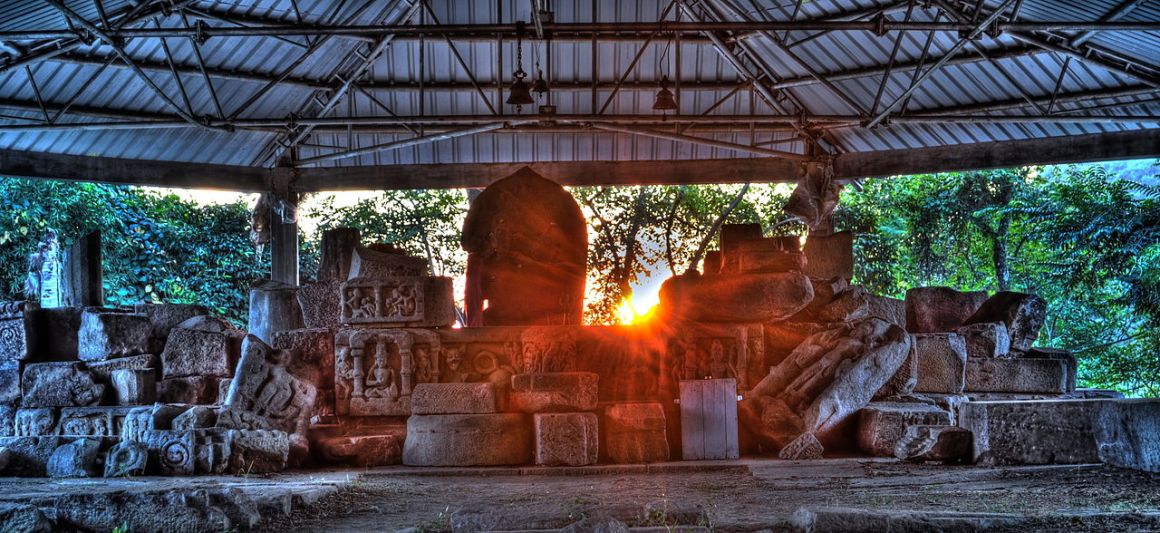
There are many such stories across the Brahmaputra valley in Assam, and one of them is found in the history of the ancient temple site Madan Kamdev, the mythical place where Kamdev supposedly resurrected himself after being burnt to ashes by Shiva. These magnificent ruins lie 40 kilometres outside Guwahati.
Though the site has been dated to the 11-12th century CE, new scholarship suggests that the place may have been even older. Construction may have started with the ruler Vanamalavarmadeva of the Salasthambha dynasty in the 9th century, and continued by the succeeding Pala dynasty up to the 12th century.
The site is the capital of ancient Assam, which was known as Kamrupanagara. Even today, one of the major districts in Assam which encompasses this area is known as Kamrup, and those staying in this district in Lower Assam are generally referred to as Kamrupiyas.
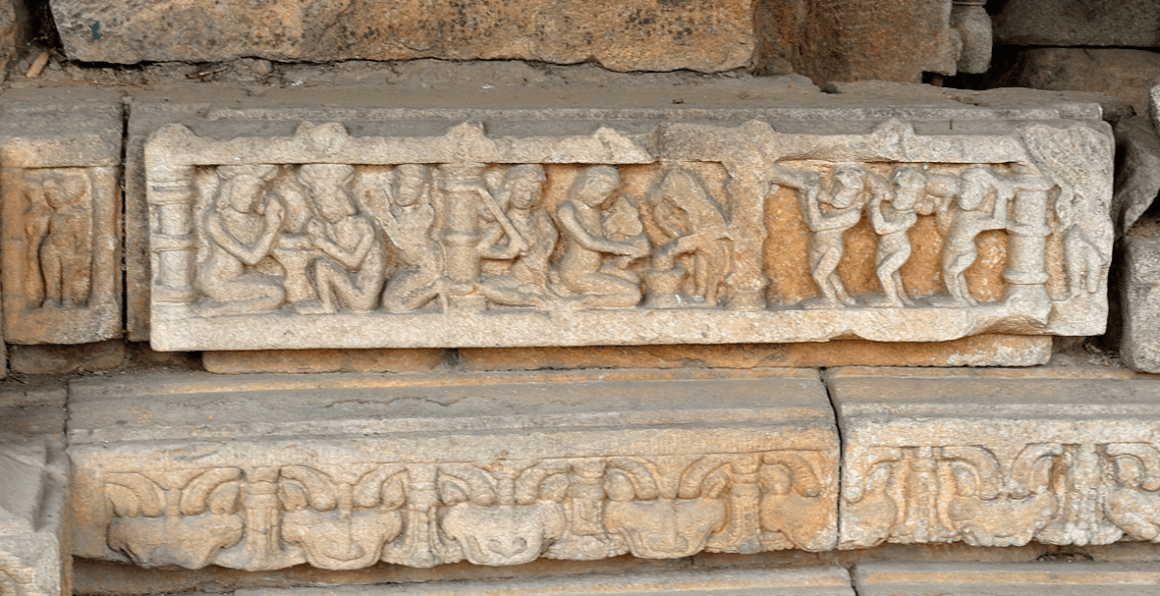
Though the temple is dedicated to Uma-Maheshwar, the site of Madan Kamdev has often been referred to as the Khajuraho of the east due to the numerous erotic sculptures dotting the expansive landscape. Madan Kamdev finds mention in the important 10th century Hindu text, Kalika Purana and in the 16th century Tantric text from Assam, Yogini Tantra. However, this stone temple stretching to around half a km was subsequently destroyed by various earthquakes over the centuries, starting with the earthquake of 1548 CE.
Sculpture at Madan Kamdev temple. Credit: Travelling Slacker/Flickr CC 2.0
The ruins of Madan Kamdev were first excavated in 1855 by the colonial military officer, Captain Dalton. But not much information is available on the kind of preservation or conservation efforts that were undertaken post this discovery. However, records do show that a Muslim land official of the colonial administration, Niyamat Ali Mondol, took the responsibility of preserving this ancient temple. Niyamat Ali belonged to the nearby Piyolikhata Village, around 2 kms from the temple site. He was given the title ‘Mondol’ by the British administration, which meant that he measured land in order to calculate revenue for the colonial administration, and also arbitrated land disputes.
Very little is known or written about Niyamat Ali Mondol, but what is significant is that he became the first doloi or chief administrative officer of Madan Kamdev for 10 years, starting in 1901. The upkeep of Madan Kamdev, as with a lot of similar temple sites was administered by a committee made of locals till either the Government of India or the Assam government or the Archaeological Survey of India (ASI) took over the responsibilities of conservation and restoration. It was only as recently as 1977 that the directorate of archaeology in Assam officially took over the responsibility of the upkeep of this ancient site.
Mondol’s role
When the temple faced a severe scarcity of funds, Mondol paid its khazna or land tax in his individual capacity for about four years. With such a history, one would expect the temple to hold information or the villages around the temple to offer some narratives, oral or otherwise. However, as Garton-Ash writes, ‘…writing history is nothing less than an infinity of individual memories of any person or event’. One can definitely discern a new form of historiography in the making – one that is complicit in the erasure of certain persons or events or even the linear chronological history of a tangible space. The ASI museum at the site of the temple does not offer any narrative on who discovered the site, how was it maintained, and who was associated with the site in modern history.
Mondol’s descendants who still live close to Madan Kamdev feel that there is an effort to do away with this part of the history of the temple, and in the history of Assam in general. ‘In the early 1990s, the temple officials including the thendoloi came to our house and took away the only surviving portrait that we had of Mondol, as they wanted to honour his efforts and install the portrait at the temple office,’ says his grandson, 86-year-old Bhola Chowdhury. ‘But the portrait went missing after a few years. We have tried locating it as that was our only tangible memory of him, but unfortunately we have no trace of it,’ he rues.
Kamal Nayan Patowary, an assistant professor of history whose doctoral thesis was on Madan Kamdev, offers an interesting anecdote on Mondol: ‘The locals did tell me about a person called Mondol who was the first doloi of this temple. But apparently, there was some issue with the locals and he was removed from the post of doloi soon (after). Hence, in anger, he took a tamrapatra or copper inscription from the temple, and threw it into a pond. According to the locals, the history of the temple has thus been lost. I did try to excavate the inscription during my doctoral research, and even employed divers to search in the pond, but it was a futile exercise.’
This narrative is however confounded by the fact that Mondol’s son, Chand Mohammed Chowdhury Kamrupi himself was part of the temple committee for about five years after the death of his father. Chowdhury was also part of the temple committees of other ancient temples in the region such as Goreswar, Pingleswar, and the 200-year-old Patrapur mosque. He was a prominent citizen of the region, who was bestowed the title Kamrupi by the locals because of his avowedly secular nature and love of the land. Kamrupi was also a well-known political figure, as well as a published writer and poet. He authored the book Vivaah Chitra in 1936, and also had his essay Purdah published in the journal Chetana which was edited by Ambika Giri Rai Chowdhury, popularly known as Assam Kesari.
Forgetting
In the temple precinct, there is also a palpable reluctance by the current trustees to talk about the modern history of Madan Kamdev. There is no awareness of the histories or narratives associated with sites such as these among devotees, or even in the villages nearby. Historian Will Pooley exhorts us to engage with the absent narratives and corroborate the voices that are heard.
In 2016, the state is facing elections which many term as a game-changer in the political landscape of Assam. Perhaps this is also a historical moment to critically examine the larger absences that are being created. It is a narrative or an absent presence that seems to haunt the Khilonjia or local Muslim community of Assam, which has always identified itself with its ethnic rather than religious identity.
History and memory are always interlinked. Changing memories involve the process of what Garton Ash has called ‘slow fading or forgetting.’ Whether this forgetting can be contained and lost memories retrieved is a question that the Assamese community as a whole may want to ponder upon this year.
The author is a PhD research scholar at the School of Arts and Aesthetics, Jawaharlal Nehru University.
source: http://www.thewire.in / The Wire / Home> Communities> by Shaheen Ahmed / April 10th, 2016
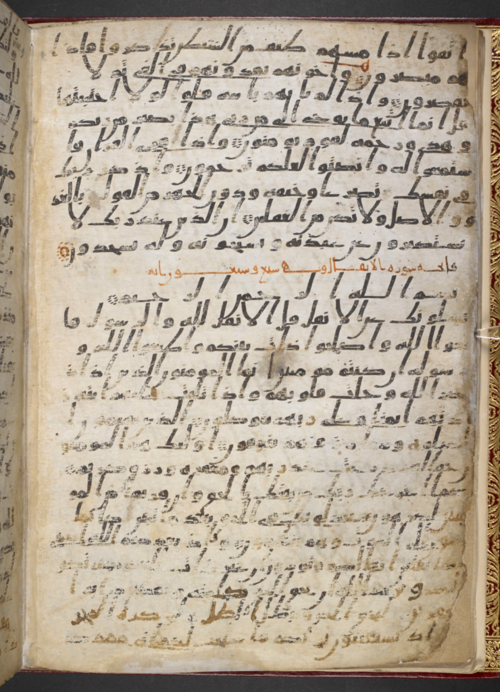
It is one of the largest of known fragments of an early Qurʼān written in the māʼil script.
Image credit: Pixabay
The British Library’s oldest Qur’ān manuscript, Or.2165, dating from the eighth century, has now been fully digitised and is available on the British Library’s digitised manuscripts site. Among the most ancient copies of the Qurʼān, it comprises 121 folios containing over two-thirds of the complete text and is one of the largest of known fragments of an early Qurʼān written in the māʼil script.
The end of Sūrah 7 (Sūrat al-A‘rāf, ‘The Heights’) and the beginning of Sūrah 8 (Sūrat al-Anfāl, ‘The Spoils of War’). The heading in red ink gives the title of the Sūrah and says that it contains 77 verses (British Library Or.2165, folio 7v)
This manuscript was purchased by the British Museum in 1879 from the Reverend Greville John Chester (1830-1892) as noted on a fly leaf at the back of the manuscript. Chester was an ordained clergyman interested in archaeology, Egyptology and natural history and made numerous trips to Egypt and the Near East, where he acquired objects and manuscripts, which are now in the collections of major UK cultural and library institutions. It is very likely he acquired this Qur’ān when he was in Egypt.
Acquisition details recorded at the end of the manuscript (British Library Or.2165, endpaper)
The earliest Qur’ān manuscripts were produced in the mid-to-late seventh century, and ancient copies from this period have not survived intact and exist only in fragments. Or.2165 contains three series of consecutive leaves (Sūrah 7:40 – Sūrah 9:96; Sūrah 10:9 – Sūrah 39:48; Sūrah 40:63 – Sūrah 43:71) from the so-called mā’il Qur’ān, which is about two-thirds of the Qur’ān text and is one of the oldest Qur’āns in the world. It probably dates from the eighth century, and as far as can be ascertained, was produced in the Hijaz region of the Arabian Peninsula.
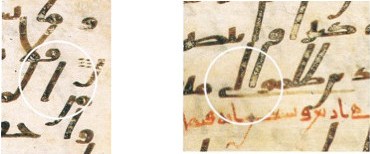
The Arabic word mā’il (by which this Qur’ān is known) means ‘sloping’ and refers to the sloping style of the script – one of a number of early Arabic scripts collectively named ‘Hijazi’ after the region in which they were developed. The main characteristic of mā’il is its pronounced slant to the right. It can also be recognised by the distinctive traits of some of its letters, for example, the letter alif does not curve at the bottom but is rigid, and the letter yā’, occurring at the end of a word, turns and extends backwards frequently underlying the preceding words.
Left: the letter alif; six small dashes mark the end of the verse. Right: the letter yā’; the Sūrah heading in red ink was added later
In early Qur’āns there are no vowel signs, and this early style of script is also notable for its lack of diacritical marks to distinguish between letters of similar shape. Verse numbering had also not yet been established; the end of each verse was indicated by six small dashes in two stacks of three. The sūrah headings were added much later in red ink in the recognisable space purposely left blank to distinguish between the end and the beginning of chapters. Red circles surrounded by red dots to mark the end of every ten verses were also added later.
The beginning of Sūrah 12 (Sūrat Yūsuf, ‘Joseph’) showing the verse markers and also the red headings and circles which were added later (British Library Or.2165, folios 23v-24r)
As with all early Qur’āns, the text is written on vellum and would have been bound into a codex or muṣḥaf – originally a collection of sheets of vellum placed between two boards. Each double sheet was folded into two leaves, which were assembled into gatherings then sewn together and bound as quires into a codex.
The importance of Or.2165, in addition to all other known early Qur’ān fragments, cannot be overestimated. They provide the only available evidence for the early development of the written recording of the Qur’ān text and help towards our understanding of how early Qur’ān codices were produced.
Imam-e-Haram of Holy Place of Mecca addresses thousands of Muslim brethren in city.
Mysuru :
Imam-e-Haram of Holy Place of Mecca in Saudi Arabia, Dr. Saleh Bin Mohamed bin Ibrahim Al Talib, arrived by a special chartered flight from Bengaluru and landed at Mandakalli Air Port in city at 11.45 am yesterday.
Hazrath Moulana Syed Arshid Madni, President, Jamiath-e-Ulema, Ameer-e-Shariath Karnataka Hazrath Moulana Mufthi Mohamed Ashraf Ali Baqvi, former Mayor and Corporator Ayub Khan and Javeed Ahmed, Joint Secretary, Siddiqia Arabic College, accompanied the visiting Imam-e-Haram from Bengaluru to Mysuru.
Tanveer Sait, former Minister and MLA N.R. Constituency, Vasu, MLA, Chamraja Constituency, Hazrath Moulana Shabbir Ahmed Saheb Rishadi, President, Jamiath-e-Ulema, Mysuru Unit, Moulana Hafiz Arshad Ahmed, General Secretary, Jamiath-e-Ulema, Mysuru Unit, Abdul Azeez Chand, Secretary, Siddiqia Arabic College, Corporators K.C Shoukath Pasha, Suhail Baig, Ayaz Pasha alias Pandu and Feroz Khan, Janab Ariff Ahmed Mehkri, Chairman, Mysuru District Wakf Advisory Committee, Md Mumtaz Ahmed, Secretary, Mysuru District Relief Committee and others welcomed and garlanded the visiting dignitary.
Later, he was taken to Rajiv Nagar Eidgah Maidan in a convey of more than 50 cars and same number of motor bikes followed the convey. And other Muslim Brethren welcomed him standing both the side of the Road from Mandakalli to Rajiv Nagar Eidgah Maidan, where Muslim Brethren from Mysuru, Mandya, Hassan, Kodagu and Chamrajanagar Districts were waiting since 7 am in spite of scorching Sun.
In the history of Mysuru city, this is the first time that Imam-e-Haram from Holy place of Mecca in Saudi Arabia is visiting Mysuru to address the gathering and to lead the prayer.
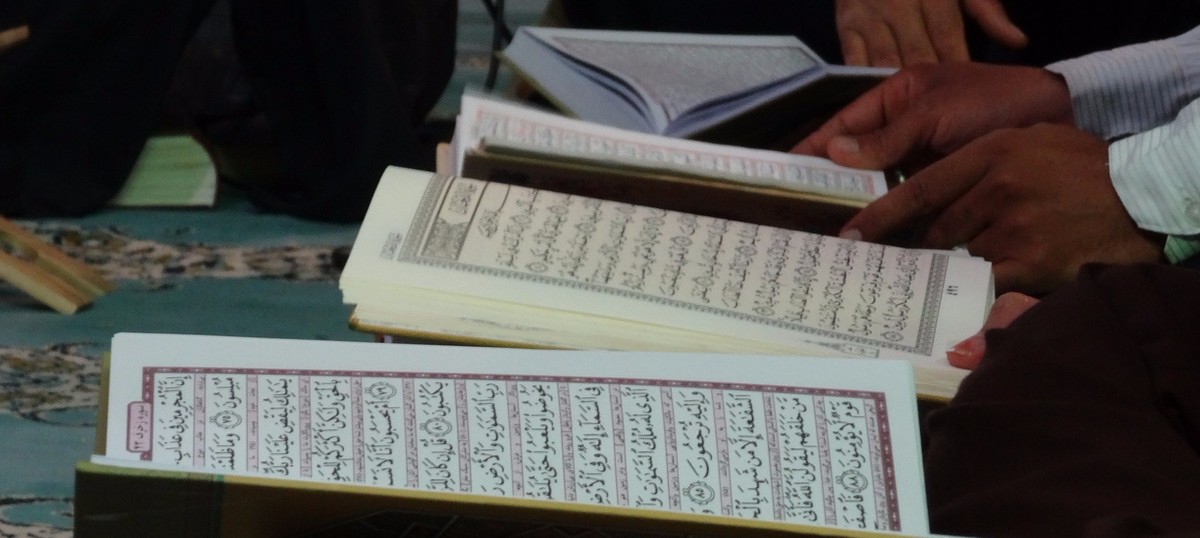
Later, addressing the gathering in Arabic language, Imam-e-Haram Dr. Saleh Bin Mohamed appealed to Muslim Brethren to spread the message of peace and humanity and to help poor and needy irrespective of caste and creed. The same was translated to Urdu by Hazrath Moulana Syed Arshad Madni Saheb, President, Jamiath-ul-Ulema.
On the occasion, Imam-e-Haram also prayed for copious rains. More than 2.50 lakh members were attended the prayer at Eidgah Maidan.
Hazrath Moulana Mahmood Ul Hassan Saheb, Moulana Salman Ahmed Saheb Nadvi, Hazrath Moulana Mohamed Naseem Saheb, former President, All India Mili Council, Mysuru District and other eminent personalities were present on the occasion.
Superintendent of Police Abhinav Khare supervised the Police bundobast. Traffic Police diverted the traffic for smooth movement of the vehicles.
source: http://www.starofmysore.com / Star of Mysore / Home> General News / Saturday, April 09th, 2015
India today said Begum Hazrat Mahal, who had rebelled against British colonial rule in the country in 1857-58, will always be remembered for her contribution in India’s freedom struggle and described her as a “source of inspiration”.
Recalling Begum’s contributions towards the freedom movement of India, India’s Ambassador to Nepal Ranjit Rae laid a wreath on her tomb to commemorate her 137th death anniversary here.
“We must remember her with great honour as she has been a source of inspiration for us all,” Rae said.
Begum of Awadh and the first wife of Nawab Wajid Ali Shah, who was one of the heroes of freedom struggle of 1857, died on April 7, 1879 during her refuge in Nepal.
Noting that Mahal was one of the freedom fighters of the first freedom movement of India, Rae said she had always been remembered for her contributions in India’s freedom struggle.
He also offered to provide necessary assistance to protect and preserve one and a half century old Hazrat Mahal tomb located in the heart of Kathmandu.
“Hazrat Mahal has been a symbol of age old tie between Nepal and India,” Rae said.
Begum fiercely fought the British East India Company during the Indian Mutiny of 1857-58, with the help of her commander Raja Jailal Singh. When her forces regained power of Lucknow for a brief stint, her son Brijis Qadra was declared ruler of Awadh.
When the forces under the command of the British re-captured Lucknow and most of Awadh, she was forced to retreat. She then took refuge in Kathmandu along with 10-year-old Qadr and some other loyal supporters.
Begum’s rebellion was ignited by the demolition of temples and mosques by the East India Company to make way for roads.
source: http://www.ptinews.com / Press Trust of India (PTI) / Home> International / by Shrish B Pradhan / Kathmandu – PTI, April 07th, 2016
Begum Hazrat Mahal was one of the freedom fighters of the first freedom movement of India, Rae said she had always been remembered for her contributions in India’s freedom struggle.
Kathmandu :
India today said Begum Hazrat Mahal, who had rebelled against British colonial rule in the country in 1857-58, will always be remembered for her contribution in India’s freedom struggle and described her as a “source of inspiration”. Recalling Begum’s contributions towards the freedom movement of India, India’s Ambassador to Nepal Ranjit Rae laid a wreath on her tomb to commemorate her 137th death anniversary here.
“We must remember her with great honour as she has been a source of inspiration for us all,” Rae said. Begum of Awadh and the first wife of Nawab Wajid Ali Shah, who was one of the heroes of freedom struggle of 1857, died on April 7, 1879 during her refuge in Nepal. Noting that Mahal was one of the freedom fighters of the first freedom movement of India, Rae said she had always been remembered for her contributions in India’s freedom struggle.
He also offered to provide necessary assistance to protect and preserve one and a half century old Hazrat Mahal tomb located in the heart of Kathmandu. “Hazrat Mahal has been a symbol of age old tie between Nepal and India,” Rae said. Begum fiercely fought the British East India Company during the Indian Mutiny of 1857-58, with the help of her commander Raja Jailal Singh.
When her forces regained power of Lucknow for a brief stint, her son Brijis Qadra was declared ruler of Awadh. When the forces under the command of the British re-captured Lucknow and most of Awadh, she was forced to retreat. She then took refuge in Kathmandu along with 10-year-old Qadr and some other loyal supporters. Begum’s rebellion was ignited by the demolition of temples and mosques by the East India Company to make way for roads.
source: http://www.india.com / India.com / Home> News> World / by Wires English / April 07th, 2016
The flow of scholarly work between the Mughals and Europe involved translation, re-translation, re-interpretation and development.
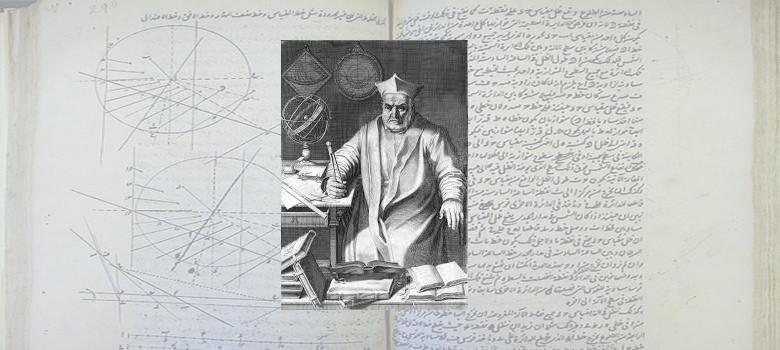
Christoph Clavius was born in Bamberg in either 1538 or 1537 (an amusing discrepancy for a scientist whose fame derives from his work on calendar reform) and was initiated into the Jesuit order by Saint Ignatius Loyola in Rome in 1555, and passed away in 1612, an eminent scholar.
Many of Clavius’ works were influenced by Latin translations of Arabic scientific works, including those of Ibn Rushd (in particular his commentary on Aristotle), the astronomers Abū Ma‘shar, al-Biṭrūjī and al-Farghānī, as well as the mathematician Thābit b. Qurra, among many other scientists writing in Arabic and Persian whose works Clavius cites.
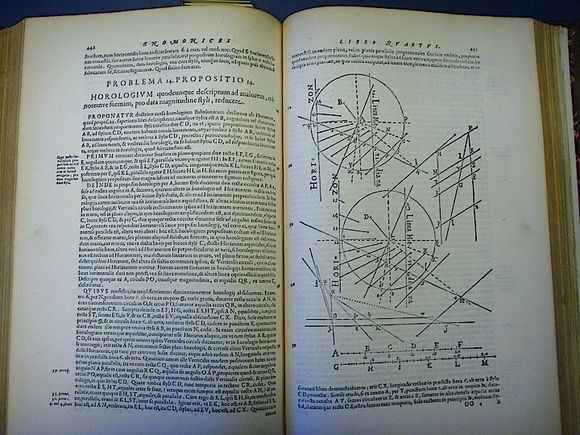
Book 4 of Christoph Clavius, Gnomonices Libri Octo, published in Rome in 1581 (533.k.2, pp. 442-43).
Clavius is an excellent example of the many Jesuit scientists of his age who continued to teach Ptolemaic astronomy (i.e. a geocentric vision of the solar system, indeed the universe, in which the planets and stars orbited the earth in concentric circles), despite the rise of – and often despite their own familiarity with and endorsement of – Copernican astronomy.
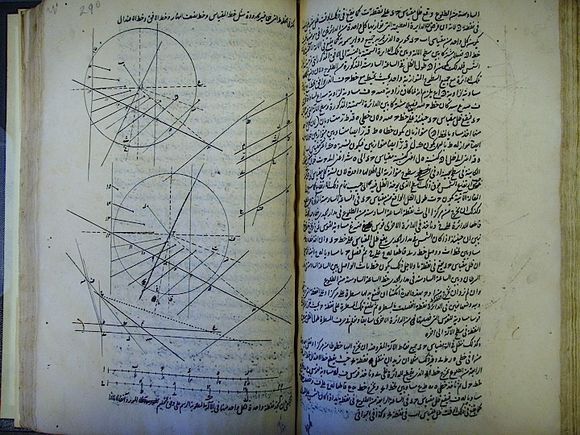
Christoph Clavius’ Gnomonices Libri Octo, on the art of gnomonics (timekeeping through the use of a sundial), was published in 1581
Mu‘tamid Khān’s Arabic translation of the identical passage (IO Islamic 1308, ff. 289v-290).
Arabic version
This work also exists in a fascinating Arabic translation emanating from the Mughal empire that was purchased by Richard Johnson (1753-1807), a well-known collector of manuscripts and miniature paintings who worked for the East India Company.
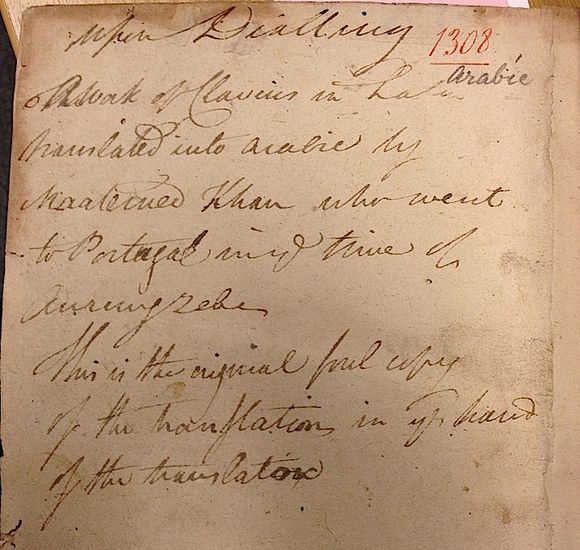
Johnson made an annotation on the flyleaf of the manuscript that the translator of Clavius’ work was sent to Portugal by Aurangzeb – presumably to study or in some diplomatic capacity.
The full note reads, “Upon Dialling. Work of Clavius in Latin translated into Arabic by Maatemed Khan who went to Portugal in the time of Aurungzebe. This is the original foul copy of the translation in the hand of the translator (i.e., the ‘foul copy’ being the first draft, in contrast to the ‘fair copy’).”
Richard Johnson’s explanatory note (IO Islamic 1308).
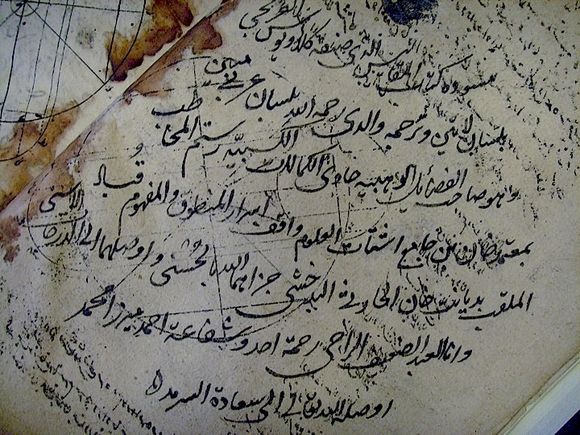
A further note, in Arabic, added by the translator’s son, reads: “Draft of the Book of Measures [Kitāb al-Maqāyīs] which was composed by Clavius the Frank [Kalāwīūs al-Firinjī] in the Latin language, and my father, God have mercy on him, translated it into the [clear – mubīn?] Arabic language, possessor of virtuous talents including the perfection of acquired knowledge,
Rustam called Mu‘tamad Khān, the son of Qubād, gatherer of proofs of knowledge, perceiving the secrets of the spoken and the tacit, given the name Diyānat Khān al-Ḥārithī al-Badakhshī, may God be fair with both of them and elevate them.
Signed: I, who am a feeble slave begging for the mercy of the One and the intercession of the Prophet, Mīrzā Muḥammad, may God cause him to attain eternal happiness”.
Note by Muʻtamad Khān’s son (IO Islamic 1308, f.1v).
Complex process
This translation offers some fascinating possibilities.
The first is the demonstration of how knowledge circulated in the early modern world.
Clavius’ work, which responded to and was inspired by Arabic mathematicians and scientists in Latin translation, here a generation after its publication is translated back into Arabic to be read, presumably by elites at the court of Aurangzeb, where the work’s translator and his son were courtiers.
This translation demonstrates the complexity of knowledge flows – that they were synchronic as well as diachronic, and also involved a process not just of translation, but of re-translation, re-interpretation and development as they travelled.
Furthermore, the inscriptions taken in tandem, one in English made by an East India official, the other in Arabic by a Mughal courtier, open the possibility that already in Aurangzeb’s reign, Mughal elites travelled to Europe perhaps to study.
In the case of Mu‘tamid Khan, the translator of this text, he mastered the technical idiom of geometry and mathematics in Latin, and then translated it into an equally complex scholarly language, Arabic. Not an uncommon intellectual feat at the Mughal court, this process of scientific translation remains to be studied in depth.
It is also possible that the presence of the Jesuits at Goa had an influence on the production of this translation, but firm evidence remains to be found.
Prime Minister Narendra Modi today gifted Saudi King Salman bin Abdulaziz a gold-plated replica of Kerala’s Cheraman Juma Masjid, believed to be the first mosque built in India by Arab traders around 629 AD.
“PM @narendramodi gifted His Majesty King Salman bin Abdulaziz Al Saud a gold-plated replica of the Cheraman Juma Masjid in Kerala,” the prime minister’s office tweeted.
The mosque in Karala’s Thrissur district is believed to be the first mosque built in India by Arab traders around 629 AD.
“Cheraman Juma Masjid is symbolic of active trade relations between India and Saudi Arabia since ancient times,” it said.
According to oral tradition, Cheraman Perumal was the Chera King and a contemporary of the Holy Prophet who went to Arabia and embraced Islam after meeting the Holy Prophet at Mecca, the PMO said.
Before he died in Oman due to some illness on the way back to India, he wrote letters asking the local rulers, to whom he had handed over his empire, to extend all help they could to Arab merchants who were planning to visit India.
The mosque has an ancient oil lamp that is always kept burning and believed to be over a thousand years old. People from all religions bring oil for the lamp as an offering.
Many believe that the mosque is a testimony to Islam’s arrival to India long before the Mughals came in from the northwest.
Modi, who is on a two-day visit to Saudi Arabia, was today received at the Royal Court here by King Salman.
He is the fourth Indian Prime Minister to visit Saudi Arabia after Manmohan Singh in 2010, Indira Gandhi in 1982 and Jawaharlal Nehru in 1956.
source: http://www.ptinews.com / Press Trust of India / Home> International / by Manash Pratim Bhuyan / Riyadh – April 03rd, 2016