The Nizam of Hyderabad’s Rs 310 crore lying locked up in a UK bank due to a dispute between India, Pakistan and his family for the last 68 years is likely to be opened soon. According to government sources, the final arguments in the case continued for five days in the High Court Chancery in London and judgment has been reserved.
“The case came up for hearing in Justice Henderson’s court on March 2, 3, 4, 7 and final argument was on March 17. We are hopeful that a judgment in the case will be pronounced soon,” a source said.
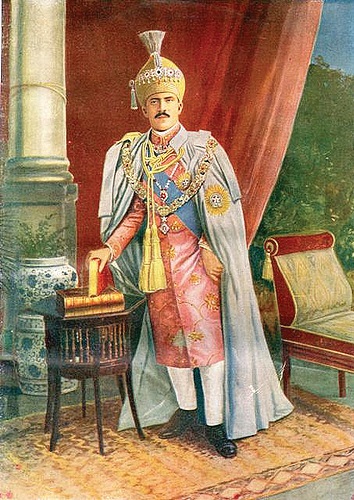
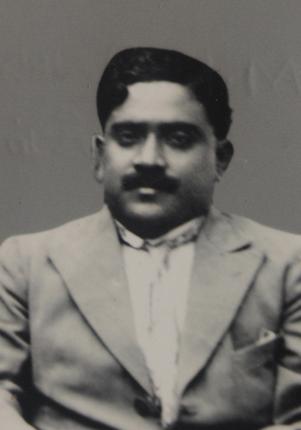
Mir Osman Ali Khan, the last Nizam of Hrderabad
The dispute has its genesis in a 1948 transfer of GBP 1 million from Nizam Mir Osman Ali Khan’s account in Westminster Bank (now NatWest Bank) to the account of then Pakistan’s High Commissioner to the UK, Ibrahim Rahimtoohla. The fund was allegedly transferred by the nizam’s finance minister without Khan’s knowledge. After the State of Hyderabad was annexed to India, the nizam brought a civil action against his finance minister and Rahimtoohla for illegal transaction.
House of Lords after Pakistan claimed sovereign immunity. In subsequent years, attempts to resolve the issue through diplomatic channels failed due to conflicting claims of beneficial entitlement to the funds by three parties: Pakistan, India and the nizam’s heirs. The bank also made it clear that it will not release the money unless the British court passes an order directing it to do so. The government ofIndia had also participated in discussions with Pakistan since 1958 at various levels. According to sources, it figured in almost all foreign secretary-level meetings between India and Pakistan.
“The last such meeting was held on July 5, 2012, but no out of court settlement was reached. Pakistan was not too keen to even respond to our positive approach,” the source said.
On April 3, 2013, the Pakistan High Commissioner to the UK proposed to initiate a civil action against the bank for releasing the money, which is now worth Rs 310 crore, saying it indisputably has the legal title over the nizam’s money. On November 23, 2013, it again approached the court serving a notice of discontinuance of the proceedings, which the court had observed as abuse of legal process.
“In serving the notice of discontinuance, Pakistan was abusing the process of the court. The abuse lay in seeking to achieve a tactical advantage, which would place Pakistan in a better position than that to which it had already voluntarily submitted by bringing its action against the bank,” the court’s observation on January 16, 2015, stated.
Claims have also been put forward over the years by or on behalf of members of the Nizam’s extended family.
Though the bank refused to release the money without an order from the English court, it continued to send bank statements to the Pakistan High Commissioner to the UK, solicitors for the High Commissioner for India in London and nizam’s heirs.
The money trail
■ The nizam’s Rs 310 crore is locked up in NatWest Bank
■ In 1948, the nizam’s finance minister transferred GBP 1 million to the account of then Pakistan’s High Commissioner to the UK without permission
■ The Nizam brought a civil action against his finance minister
■ The money is claimed by Pakistan, India and the nizam’s heirs
source: http://www.newindianexpress.com / The New Indian Express / Home> The Sunday Standard / by Yatish Yadav / March 27th, 2016
M. Sayeed Alam’s “Sir Iqbal” will be staged in the Capital this Sunday
The most sung poet and perhaps the most sung song in India “Saare Jahan Se Accha” written by Allama Muhammad Iqbal is all set to ignite the imagination of theatre lovers in Delhi. Playwright and directors, M. Sayeed Alam and Danish Iqbal’s spring time production ‘Sir Iqbal’ is a biographical work on the life, times and scholarship of Allama Iqbal who continues to be misunderstood in India but is celebrated in Pakistan as the man who came up with the idea of a separate nation for Muslims.
“Iqbal’s love for India which clearly comes through in the poem ‘Saare Jahan Se Accha’ and yet his choice of living in Islamic Pakistan over a secular India is in itself a study in contrast, a paradox that has pushed him far away from public memory in India. Iqbal died in 1938 much before the idea of Pakistan even took shape. Doctored history, misapprehensions about Allama being a fanatical Muslim who chose to live in a Muslim dominated undivided India needs to be closely looked into. My play is an effort to demystify Iqbal and clear some perceptions about the great poet, philosopher and politician and above all a humanist who has given India its most enduring patriotic poem yet remains forgotten in the country,” said Alam in the midst of rehearsals for the play which opens to public on March 20 at Sri Ram Centre.
“From what I have read about Iqbal’s political philosophy, he never demanded a separate home for Muslims outside India. Iqbal’s formulations somehow suited the supporters of Pakistan and they hailed him as the ideological father of the country – something that many Indians came to detest and therefore Iqbal remains forgotten whereas his poem as a song is sung everyday in schools all over the country. Our play brings out this dichotomy,” said Alam.
“Sir Iqbal” had first premiered in Kolkata in November last year to much critical acclaim. The one and half hour play with a 15-member cast will see Alam himself essay the role of Iqbal. The play is centred around the poet and philosopher’s life. In the play, Iqbal’s story is narrated by his trusted servant Ali Baksh who enjoyed Iqbal’s confidence and had witnessed many events in his life. Set in British India in the backdrop of the first half of the 20th Century, ‘Sir Iqbal’ will mirror the socio-political churnings during Allama’s times till his death in 1938 in undivided India. The play will perhaps set some records straight and clear many perceptions about Iqbal, who for many Indians still remains an enigma.
source: http://www.thehindu.com / The Hindu / Home> Features> MetroPlus / by Anasuya Basu / March 18th, 2016
Geetakshi Arora, a PG student of the South Asia Institute at the School of Oriental and African Studies, University of London, won the £1,000 prize.
An Indian student is the winner of the first Noor Inayat Khan Prize for 2016, the London-based Noor Inayat Khan Memorial Trust announced on Saturday.
Geetakshi Arora, a post-graduate student of the South Asia Institute at the School of Oriental and African Studies (SOAS), University of London, won the prize — which consists of £1,000 and a certificate — for her dissertation on “Goddess Myths in Graphic Novels: Reimagining Indian Feminity”.
The Trust awards the annual prize to a post-graduate student from SOAS, University of London, working in the area of gender studies and South Asian history.
Ms. Arora said that she was “humbled” by the award. “Noor has always inspired me to stand up for the values of peace, education and respect for all individuals irrespective of race, gender and religion. I will always try to live up to her legacy,” she told The Hindu.
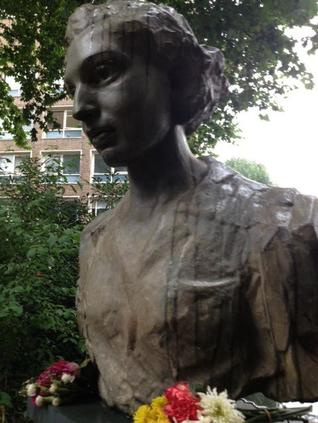
Noor’s bust in Gordon Square, London. / The Hindu
Of Indian descent, Noor Inayat was a secret agent in the Second World War, who was sent to Nazi-occupied Paris in 1943 from where she worked as a wireless operative sending intelligence reports to the Allies. Though betrayed to the Gestapo, tortured and ultimately killed at the Dachau concentration camp, she defied her captors to the very end.
“We hope the annual award keeps the memory of Noor Inayat Khan alive in the student community. We felt that SOAS was the natural choice to locate this prize given its long tradition of promoting South Asian culture and history” said Shrabani Basu, founder and chair of the Noor Inayat Khan Memorial Trust, and author of the biography of Noor Inayat, The Spy Princess.
A campaign by the Noor Trust resulted in the unveiling by Princess Anne in 2012 of a bust of Noor Inayat in Gordon Square, a tranquil lung space close to a cluster of institutions including SOAS.
source: http://www.thehindu.com / The Hindu / Home> International / by Parvathi Menon / London – March 19th, 2016
Hailing from the senia tradition of Tansen, Ustaad Ghulam Mustafa Khan is that gem that Hindi filmdom can still boast off. Rubina P. Banerjee salutes the maestro whose journey started at the age of 8 and continues even today at 82!
Coke Studio recently witnessed the magic meandering of the golden voice of Ghulam Mustafa Khan Sa’ab as he sang Rahman’s composition ‘Aao balma…’. The studio rebounded with the sonorous depths of Khan Sa’ab’s voice while Prasanna, on the Carnatic guitar, kept pace with his vocal dexterity. At 82, the Padmabhushan awardee is keeping in tune with the times while keeping alive the tradition of the Rampur Sahaswan Gharana.
What can one ask an Ustaad, who started singing at 8 and is still going strong at 82! All my questions seemed banal when it came to his art but one has to start somewhere so we started at the very beginning with his first concert…
“My journey into music had started with the music inherent in my family. At the time, every city had a Victoria Garden and it was the custom that on Janmashtami, the first public performance of those interested in music be performed as a debut. Ali Maqsood Sa’ab, who was the Chairman of the Municipality, organised the Janmashtami function every year and asked me to perform. I was only 8 then and it was the January of 1950 but my performance was much appreciated and people lauded me for my courage to perform at this tender age in front of such a well-informed audience!”
If he performed so well at 8, at what age did he start learning music?
My question brings a smile to his lips…
“I started learning to sing before I had even started talking! My father used to hold me on his chest and teach me sa re ga… even as I was starting to lisp my first words. After a point, I began saying sa re ga… before any other word. My mother was the daughter of the great Inayat Hussain Khan and music was the legacy of my family. Our seniya traditions go back to the times of Tansen and my great great grandfather Ustaad Qutubuddin Khan Sa’ab was the court musician of the Nawab of Oudh, Wajid Ali Shah. My father, Ustaad Waaris Hussain Khan was my first guru. Both my parents wanted me to be a singer.
I started so young that I could remember the tune but not the words! After my father I was trained by Ustaad Fida Hussain Khan who was the court singer at the Baroda royal durbar. And then I learnt with none other than the great Nissar Hussain Khan Sa’ab himself. I never had to find a guru outside my family as there were so many eminent musicians in my family itself.”
Does he look back on his childhood with laughter?
“I have only one complaint with my childhood – that my parents never allowed me to play. Studies and riyaaz; that’s all I did! My father had told all the elders in my family that if I stepped out they should discipline me and make sure I was back inside. Even my mother, who loved me immensely, would complain to my father and ensure I got a sound beating when I played truant. So I have no idea what it is to play and never learnt any sport. I only play with my tanpura.”
When did he realise that he could also sing well?
“You know you are good if the people who are in this field praise you, as they minutely observe and know your strengths and weaknesses. I was indeed very lucky as my brother, Hafeez Ahmed Khan became a producer for All India Radio and I came over to Mumbai. He had organised a programme with all the great performers of the time and I had the privilege of singing with Ustaad Bade Ghulam Ali Khan Sa’ab for four hours at a stretch!
“At the end of the performance, Ustaadji asked me how I managed this deep sonorous voice when my frame was so thin! – and he blessed me. It was a wonderful moment for me.”
The path of music which he embarked on now saw him perform for Dr. Rajendra Prasad (former President of India) in 1952. He was named Junior Tansen in the Haridas Sangeet Sabha in 1969 and awarded the Ustaad Haafiz Ali Khan and Ustaad Chand Khan awards. He performed in India and abroad in the presence of the Queen and Lady Diana and was awarded the Padmashri in 1991, the Sangeet Natak Academy Award (2003) and the Padmabhushan in 2006.
How did he then find his way into the Hindi film world?
“The first film I sang for was in Marathi, ‘Chand Pretticha’. I was here from 1957 and started singing playback for Marathi and Gujarati films but if you ask me if I know the languages, I don’t. At a function, a lady came up to me and said, ‘Khan Sa’ab, aap ga rahi thi, main sun raha tha,’ Yeh mujhe ek aurat keh rahi thi!” His laughter fills the room.
Getting back to films, he says he started with Mrinal Sen’s ‘Bhuvan Shome’ and sang ‘Sajanaa kahe nahi aaye…’ for ‘Badnaam Basti’ under the same music director, Pandit Vijay Raghav Rao. It was Muzaffar Ali’s ‘Umrao Jaan’ that saw him sing the immortal ‘Jhoola kinne dala…’ and ‘Pratham dhar dhyan…’ under Khayyam’s music direction. The ambience of the kotha and the plight of the little Umrao as she is sold into the life of a courtesan, are made all the more poignant by the soulful rendition of the song by Khan Sa’ab.
His connection to Hindi filmdom doesn’t end there. From the late ’50s, he has been a guru to Asha Bhosle, Manna Dey, Geeta Dutt and today, Hariharan, Shaan and Sonu Nigam are among his students. “They have all given me a lot of love and respect and brought me fame as a teacher,” says the Ustaad. On their part, his shagirds acknowledge that their singing skills have been greatly enhanced by their guru.
The most satisfying part of his life is perhaps knowing that he has done his best to keep alive the tradition of the Rampur Sahaswan Gharana; a gharana known for vocal dexterity. His four sons Ghulam Murtaza, Ghulam Qadir, Ghulam Rabbani and Ghulam Hasan Khan are singers as well and have been trained by him.
Today they are professional singers in their own right and have sung for the renowned Rahman in films like ‘Fiza’, ‘Meenakshi’ and ‘Saathiya’. Rahman himself is a student of Khan Sa’ab’s and says he has a lot to learn from his guru. The mellifluous Ustaad Rashid Khan is his nephew as well as his shagird.
However, it is his grandsons who make him proud. Little Faiz and Shoaib have received taalim from the great Ustaad that is their grandfather. Watching Rahman’s song ‘Soz o salaam…’, I see Khan Sa’ab’s eyes light up as Faiz sings the verse flawlessly. His eyes wander wistfully as if seeing in his grandson, his own 8-year-old avatar, performing at his first concert in Victoria Gardens!
source: http://www.freepressjournal.in / The Free Press Journal / Home> Entertainmen / by FPJ Bureau / February 16th, 2014
Gauhar is all set to make her hollywood debut with a song in the big budget film ‘Solar Eclipse-Depth Of Darkness’ | (File/IANS)
Popular model and actress Gauhar Khan seems to be following the footsteps of Priyanka Chopra and Deepika Padukone.
After PeeCee and Deepu, now Gauhar is all set to make her Hollywood debut with a song in the big budget film ‘Solar Eclipse-Depth Of Darkness’ which is based on Indian independence and set in Violent India, post partition.
According to the reports in Times of India, ‘Chand Bibi’ will be seen in Mujra sequence which is choreographed by none other than Saroj Khan, making it more special for her.
In an interview with the leading newspaper, she said, “After seeing me dance on ‘Jhalak Dikhhla Jaa’, Sarojji had said that she wished I was her daughter. I’m thrilled that she is choreographing this song.”
Talking about her fitness, “My fitness is keeping me super excited. I do crazy weight training and I’m very happy with the shape I’m in. Of course, in the mujra I’ll be all covered up!” she added.
source: http://www.newindianexpress.com / The New Indian Express / Home> Entertainment> Hindi / by Online Desk / March 03rd, 2016
More than 600 years after a seven-foot tall Chinese naval explorer touched the shores of Calicut (now Kozhikode), a bustling international port city in northern Kerala, an attempt to find his relics and perhaps his final burial place is in order in the state.
Last month, two professors, working in different countries, arrived in Kerala with the aim of finding more information about Zheng He, a fleet admiral of China’s early Ming dynasty and one of the world’s earliest navigators, much ahead of the likes of Christopher Columbus and Vasco da Gama. According to credible historical accounts, Zheng He, who had led seven naval expeditions in the Indian Ocean, was buried at sea off the coast of Calicut after he died of illness in the course of a voyage.
“We came to Kerala on January 7-9 to find information about relics and stories of Zheng He and his crew in Calicut. It was an official trip of Zhenghe International Peace Foundation,” said Shaojin Chai, a senior research fellow at the Ministry of Culture in UAE.
While history books are replete with the exploits of Columbus and Gama, not much is known about Zheng He, whose fleet was considered to be ten times bigger than his contemporaries. In fact, National Geographic magazine described the naval armada of Zheng He off the coast of Sri Lanka as a ‘massive shadow on the horizon’, that moved like a ‘floating city’ and stretched across miles and miles of the ocean.
Zheng He, who is venerated almost like a God in several parts of China and has temples dedicated to him in Malaysia and Indonesia, was born in China’s Yunnan province in 1371. Born into a Muslim family, Zheng He was ritually castrated at the age of ten at the hands of an invading Ming army. But his life as a eunuch turned out for the better after he was sent to serve in the household of Zhu Di, who would later go on to become the Yongle Emperor. History says Zheng He was able to gain the trust of the emperor in a short period of time and convinced him to let him embark on naval trips that would extend China’s trade potential to Southeast Asia, the Indian subcontinent and the far-away Middle East.
Zheng He’s first voyage, according to several accounts, began in the year 1405, sailing from China through Indonesia and Malaysia to finally end at Calicut via Cochin. His fleet was estimated to be more than 20,000 men travelling in more than 60 treasure ships – numbers described astonishing in most accounts. His subsequent trips took him as far as Iran and eastern Africa to the shores of Mogadishu.
For the Chinese explorer, Calicut, then a prosperous trading port that dealt extensively in eastern spices under the rule of the Zamorin, was an ideal base to conduct trade across the Indian Ocean and the Middle East.
“Chinese historian Ma Huan, Zheng He’s translator, described Calicut as very friendly, harmonious and a dynamic place where trading was fair and the Hindu king consulted with Muslim ministers to conduct state affairs,” said Professor Chai, who was accompanied to Kerala by Haiyun Ma, a professor at Frostburg State University, Maryland, US.
During their short visit, both professors visited a few mosques which had Chinese connections and inspected tombstones, but could not unearth any reliable clues that could point to Zheng He’s period.
However, CK Ramachandran, convenor of the Calicut Heritage Forum, dismissed claims that the Chinese naval commander had been buried under land.
“According to early Chinese traditions, a eunuch, after death, cannot go to heaven with a deformed body. That’s why he was ceremonially buried at sea,” said Ramachandran, who has meticulously collated several historian accounts of the Chinese in Kerala.
“I did visit Nanjing in China where a tomb has been erected in Zheng He’s memory. But it is more of a memorial. It is empty,” he added.
Nevertheless, undeterred, Professors Chai and Ma are planning to organise a conference next year in Kerala which would throw light on Zheng He’s exploits for which they have spoken to state government officials as well.
“Zheng He was considered one of the greatest statesmen and explorers in Chinese history and was our national pride for promoting peace and trade with other countries (sic),” said Prof Chai.
source: http://www.in.news.yahoo.com / by Vishnu Varma, The Indian Express / February 20th, 2016
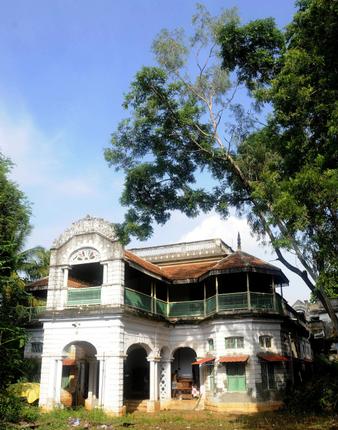
A view of the M.K. Maaligai in Khajamalai, Tiruchi. Photos:A. Muralitharan
Behind the façade of this heritage residence in Tiruchi lies the story of its enterprising owner, M.K. Mohamed Ibrahim Ravuthar.
It is an arresting sight on the Race Course Road in Tiruchi. A stately home, complete with gabled roofs and stained glass windows peeks out demurely from behind black granite walls, willing you to stop and take a closer look.
“It’s a unique building just like the man who built it,” says Dr. M.A. Ansar, describing the mini 11-roomed palace and his grandfather M.K. Mohamed Ibrahim Ravuthar in one breath.
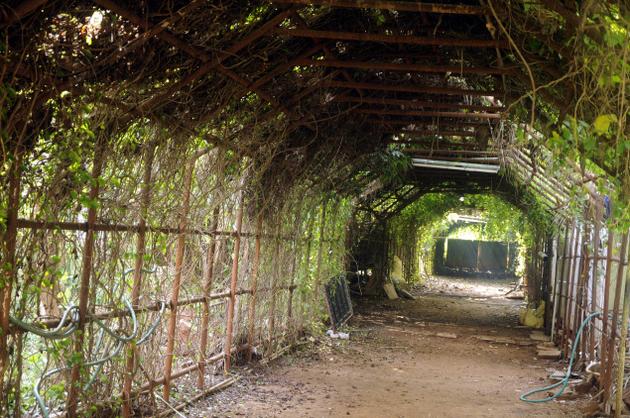
Built in 1928, the M.K. Bungalow was actually the main home in a complex of four residences in this quiet nook off the Race Course Road in Khajamalai. It resembles a structure straight out of a Jane Austen novel, especially when you walk through the green corridor (an iron trellis walkway that is still covered with the ‘December Poo’ or Philippine Violet vines planted by the patriarch) to reach the main entrance.
A trellis ‘green corridor’ leads up to the bungalow. Photo: A. Muralitharan
The garden is overgrown, and the annexes that once housed a live-in washerman, stables for horses and cattle, huge bathrooms and an elaborate pantry and storehouse, clearly have seen better days. Even so, when Mrs. Najma Begum, the current resident of the house and one of M.K.M. Ibrahim’s granddaughters, opens the main door, it is possible to see flashes of another, more flamboyant world that once existed here.
“When Thatha was alive, this house used to be called ‘M.K. Maaligai’ (Palace), today I can hear people calling it the ‘Pei (Ghost) Bungalow,’ when they walk past on the other side of the walls,” says Mrs. Najma.
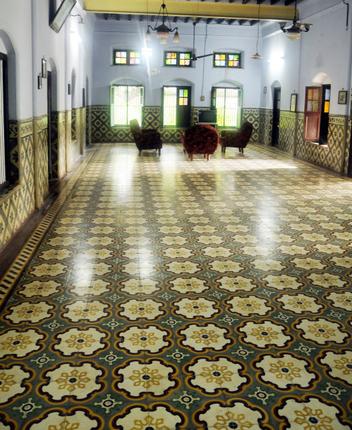
Keeranur tiles brighten up the interior of the M.K. Maaligai. Photo: A. Muralitharan
As room leads to room, each with Keeranur floor tiles and wide windows fitted with cooling coloured glass, the other tales about the house are dusted off and narrated too.
Tales of how chandeliers with red glass and gold paintwork imported from Austria used to adorn the halls. Records that were played on a Polyphon, a coin-operated music box which played metal discs measuring 195/8 inches in diameter, for dance parties hosted for British guests. And how a fountain and a ‘chaukhandi’ (gazebo) used to be star attraction of the garden.
The M.K. Maaligai was the entertainment venue not just for M.K.M Ibrahim’s friends and business acquaintances, but also guests of the State from Britain. On average, some 15-20 people would gather for the daily repasts, made with the finest of produce sourced from nearby towns.
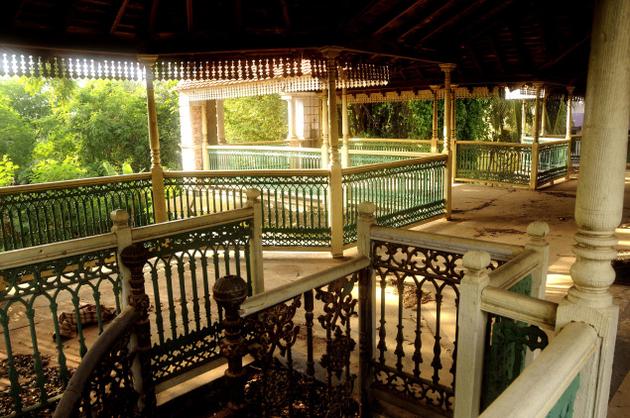
Elaborate decorative work done on the verandah’s eaves and railings. Photo: A. Muralitharan
As the tour continues, up an imported cast-iron spiral staircase (one of two), to the first floor where the master suite looks out on a large decoratively gabled verandah, it becomes clear that this house was meant to be a personal work of art.
Hands-on leader
“My grandfather used to be known as the ‘Prince of Tiruchi’ for his lavish lifestyle,” says Dr. Ansar, whose late father M.K. Abdul Salam was the eldest son of M.K.M. Ibrahim. “Though he didn’t have much education, he used speak English fluently because of his close association with the British. He was among the invitees to a special assembly to commemorate the coronation of King George VI in May 1937.”
M.K.Mohamed Ibrahim Ravuthar.
Born in 1885, M.K.M. Ibrahim was the second son of M. Kasiappa Ravuthar, a wealthy businessman and landowner who migrated to Tiruchi from Ettayapuram, Tirunelveli district (see related story on Page 4).
Taking over his father’s kerosene dealership and leather tanneries after his elder brother Yusuf died, Ibrahim diversified the family business rapidly, branching out into petrol supply (he owned 18 petrol stations in his heyday), bus transport, and construction, besides starting a third tannery near Hyderabad.
The family made the Palakkarai area in Tiruchi its base.
The contracting projects that his M.K. Constructions company is associated with are still in use – the Erode Railway Junction, a part of Erskine’s Hospital Madurai (now renamed Government Rajaji Hospital), the Kakinada port (Andhra Pradesh), Chikmaglur Railway Station (Karnataka) and Railway staff quarters in Dindigul, besides a number of highways.
He also built a four-storey building in Chennai, close to the harbour, between Angapannaickan Street and Moore Street, where the leather from his tanneries used to be transported to by coal-fuelled lorries, and then exported to Britain.
Despite not being a part of the Independence movement, Ibrahim commanded a lot of popular support in Tiruchi. He served the city as its Municipality Vice-Chairman from 1925-28 and as Chairman from 1928-31.
He was a close friend of veteran freedom fighter P. Rathinavel Thevar, and co-operated with him on numerous occasions to preserve communal harmony in the city.
Known as a hands-on leader who once paid Municipality workers their salaries from his own funds, he donated the land for Ibrahim Park on West Boulevard Road on the condition that it would be put to public use.
He owned homes similar to M.K. Maaligai in Dindigul, Kodaikanal and Courtallam, which became summertime resorts for the family.
A poignant reminder
“The bungalow was still under construction when there was an epidemic of cholera or typhoid in the inner city areas in the late 1920s,” recalls Dr. Ansar. “Thatha decided to shift the entire family to this place from Palakkarai.”
Despite the love with which he built the residential complex, M.K.M Ibrahim was able to spend only around two to three years there, as he passed away at the age of 55 years on December 2, 1940 due to a heart ailment.
“It is astonishing to see how much this person achieved in a short period of 20-25 years,” says Dr. Ansar, whose father grew up in the complex of four residences along with his siblings. “He was inspired by the things he saw and people he met on his travels, and always tried to recreate the best of it for himself.”
Following the partition of his properties, the M.K. Maaligai was bequeathed to his second son M.K.M. Abdul Hakeem in 1949, whose children still maintain ownership of the heritage building.
After a brief spell as a student’s hostel, the M.K. Maaligai is now back to its original role as a family home.
“We clean it out for family functions, and whitewash it sometimes,” says Mrs. Najma Begum, who stays alone on the ground floor of the vast house.
“Even though it needs a lot of effort to maintain, we’d rather not demolish it. This residence is tied to many people’s lives.”
***
Snippets from an eventful life
M.K.M. Ibrahim fell in love with Rukkaiyya Bi when he saw her coming from the Madrassa (Islamic school) while he was working in Palakkarai. She was 9, he was 15. They married two years later, despite initial parental disapproval. They went on to have three sons and two daughters.
Tiruchi observed an unofficial day of mourning when M.K.M. Ibrahim died on December 2, 1940. Shops were closed as the public thronged to catch a sight of the cortege that was taken out from the family home in Palakkarai, through Main Bazaar to Rock Fort, NSB Road, and Main Guard Gate and to the burial ground just a few yards away from where the procession started in Palakkarai.
In the middle of the four homes that he built around the M.K. Maaligai, M.K. Ibrahim had left space for a tennis court that was never completed. The yard has since been sold to a scrap merchant.
His eldest son M.K.M. Abdul Salam showed an aptitude for public office, and was the first Congress Member of Parliament from Tiruchi in 1957.
***
Founding father
It is easy to see where M.K.M. Ibrahim got his penchant for largesse and flamboyance from. His father, M. Kasiappa (a merging of ‘Kasim’ and ‘Appa’), Ravuthar was an businessman who made his fortune in the early 19th century after migrating to Tiruchi from Ettayapuram.
He was the kerosene agent for Tiruchi and Thanjavur districts, and owned residential properties in the city centre called ‘stores’. The ‘Kasiappa Ravuthar Store’ was one such property near the Rock Fort area.
Besides that he had nearly 500 acres of agricultural lands near Samayapuram and Maruthur.
Kasiappa Ravuthar built two tanneries, one for goatskin and another for buffalo skin which used to be sent to Chennai and then exported to England, in the 1880s. Since the British didn’t allow outside sales, the leather used to be auctioned in England, and the money would be sent back to him in India.
As an expression of gratitude for recovering from a severe skin abscess on his back, Kasiappa Ravuthar dedicated a gold ‘kalasam’ to the main stupi (pillar) of the Nagore Dargah weighing 1,000 sovereigns, that stayed intact until it was knocked down by cyclonic winds in 1958.
source: http://www.thehindu.com / The Hindu / Home> Features> MetroPlus> Society / by Nahla Nainar / November 13th, 2015
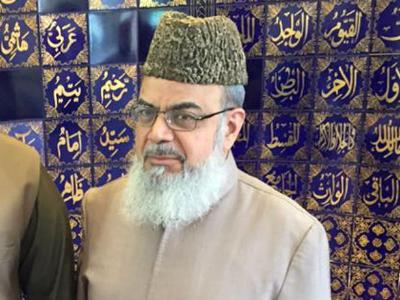
A senior Indian-origin imam has been conferred an honorary doctorate by the University of Leicester in recognition of his work for his local community.
Muhammad Shahid Raza, who serves as Head Imam at Leicester Central Mosque and is a leading Muslim cleric and teacher in the UK, was born in Bihar and studied in Moradabad, Agra and Meerut before moving to the UK.
“The city of Leicester has always been a place of significance in my life since I emigrated here from India in the late ’70s. One of my first responsibilities as Imam of Leicester Mosque and then Leicester Central Mosque was to oversee the moral and spiritual education of children,” he said in reference to the honour.
“I have always strived to instill in my students a desire to achieve academically and integrate themselves as valuable members and contributors to society. I am delighted to note that many of my former students have gone on to graduate from this university and of those many are now working in this city as civil servants, teachers and doctors or owners of small businesses.
“For this reason I reflect on this award fondly and I hope it will further inspire the young Muslims of Leicester,” Raza said.
He was awarded his honorary Doctorate of Laws by University Chancellor Lord Grocott at the university’s degree ceremony at De Montfort Hall today before an international audience of graduating students and their families.
Raza leads the Friday prayers at Leicester Central Mosque and is credited with designing and conducting the first in-service training course for imams in the UK.
As executive secretary and registrar of the Muslim Law (Sharia) Council UK, he is engaged in a number of initiatives directed towards the wider community in Britain, Europe and North America through his association with organisations such as the InterFaith Network UK and the InterFaith Youth Trust in London, the university said in a statement.
In the 2008 New Year’s Honours list, he was awarded an OBE for services to the Muslim community in Leicester.
Reverend Canon Dr Stephen Foster, Coordinating and Anglican Chaplain to the University of Leicester, said, “Muhammad Shahid Raza has been a hugely influential figure in our city and County as a leading Muslim cleric and teacher over a period approaching 40 years.”
“In terms of Interfaith dialogue over that period, again his influence has been profound. As we presently travel sensitive times and roads in interfaith issues, his wisdom and insight into same will continue to be so important both locally and far beyond. The University of Leicester I know honours him…rightly and gratefully so,” Foster said.
source: http://www.timesofindia.indiatimes.com / The Times of India / News Home> NRI> Other News / PTI / January 25th, 2016
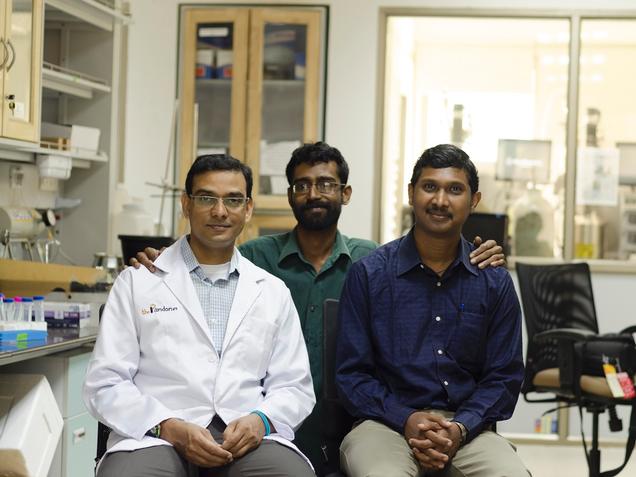
Liver team at Pandorum Technologies: Dr. Abdullah Chand, senior scientist (left); Arun Chandru, co-founder and managing director (centre); and Dr. Sivarajan T., senior scientist / @ABHINAV_MAURYA
Bengaluru, KARNATAKA :
Pandorum Technologies, a Bengaluru-based biotech startup, has developed an artificial tissue that performs the functions of the human liver.
Pandorum said these 3D printed living tissues made of human cells would enable affordable medical research with reduced dependence on animal and human trials. It will also eventually lead to full scale transplantable organs.
Arun Chandru, 30-year-old co-founder of Pandorum, said liver toxicity and drug metabolism are the key hurdles, and contributors to failed human trials.
Pandorum’s 3D bio-printed mini-livers that mimic the human liver will serve as test platforms for discovery and development of drugs and vaccines. The firm said these drugs would have better efficacy, less side-effects and be developed at lower costs.
“We developed everything here in India,” said Mr. Chandru. “We can grow thousands of these tissues in the laboratory and test the efficacy of drugs on them for diseases including cancer.”
He said large pharma companies on an average spend about $10 billion (Rs. 66,290 crore) and 10 years on research and development to get a single new drug to the market.
Tuhin Bhowmick (34), another co-founder of Pandorum, said development of artificial organs has numerous clinical uses. The cell-based miniature organs can be used to develop bio-artificial liver support systems for preserving life in patients who have developed liver failure.
“In the near future, such bio-printed organs will address the acute shortage of human organs available for surgical transplantation,” said Dr. Bhowmick, who holds a Ph.D. from the Indian Institute of Science.
Pandorum was founded by a group of friends in 2011 who were pursuing their higher studies at IISc. They came together to work on the development of artificial human organs after winning a business competition.
Surviving initially on money from friends and family, the team approached the Department of Biotechnology with their vision. The company was awarded funding support by the Biotechnology Industry Research Assistance Council in 2012. The same year, the company got incubated by the Centre for Cellular and Molecular Platforms in Bengaluru.
Mr. Chandru said they created the innovation with a funding of about Rs. 1 crore, more than half of which came from the government.
Scientists and startups across the globe are growing artificial organs made of human cells to better study diseases and help test drugs. A team of researchers led by Hebrew University professor Eduardo Mitrani is growing pancreas in a petri dish to better regulate blood sugar in diabetic patients.
The global artificial organ and bionics market is expected to reach $38.75 billion (Rs 2.5 lakh crore) by 2020 at an estimated CAGR of 9.3% from 2014 to 2020, according to a study by Grand View Research.
Pandorum’s ultimate aim is to make personalised human organs such as lungs, liver, kidney and pancreas on demand, according to Mr. Chandru.
Pandorum’s innovation takes the area of making artificial organs to the next level. Bengaluru-based bioinformatics firm Strand Life Sciences founded by IISc. professors had earlier developed a virtual liver that mimics the functions of liver through software simulation. It is a predictive method that integrates data and insights for deeper understanding of the impact of a drug on the liver. The platform can predict the toxicity of several known drugs and toxins and explain the mechanism.
source: http://www.thehindu.com / The Hindu / Home> Sci-Tech / by Peerzada Abrar / Bengaluru – December 23rd, 2015
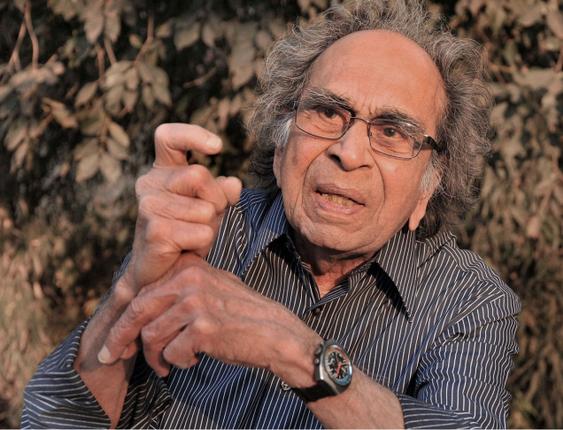
Internationally-renowned mime artist Irshad Panjatam left job at Begumpet airport to follow his dream.— Photo: G. Ramakrishna
Hyderabad, TELANGANA / Berlin, GERMANY :
When 85-year old mime artist Irshad Panjatam was about 18-years-old, he had joined the Begumpet airport as a ground apprentice engineer. Getting such a job back then was perhaps not easy, which is why many at his workplace advised him against quitting, when he took the decision a year after joining.
“I left the job because tightening nuts and bolts, was not what I wanted to do,” recalled Mr. Panjatam, who is in Hyderabad currently. Though he eventually become an artiste, it was not until 1958 that he discovered his true calling in pantomime, which then changed his life and has made him the internationally renowned mime artiste that he is.
Remembering that crucial moment, Mr. Panjatam takes a ride through memory lane during an interview to YUNUS Y. LASANIA .
Excerpts:
How did you get introduced to and develop your skills? Was the art form present in India back then?
I never knew the word pantomime. When I was working with the Hindustani Theatre in New Delhi, I was part of famous Sanskrit play. During rehearsals in the third act, the main actor was not there, so I took stage in his place. Dr. Charles Fabri, a very famous art critic, was present in the rehearsal room.
I started performing, but the musicians were not ready to support me, hence my movements were absolutely silent; without music and without song. Dr. Fabri said it was a very good pantomime act, and then he gave me a book on it. I read the introductory lines and learnt what mime was. It was 1958, and the art form was not present here. I learnt everything on my own.
What was your first performance like? How was the reception to your performances?
I started with short stories like Aesop’s Fables. I showed it to some of my good friends who were also my critics. In 1962, the Indian Arts and Crafts Society, a prestigious organisation of Delhi at that time, put me on stage for my first mime performance. The house was full, and it was well received. After that my friends told me that I was alone here (as an artiste), and that I had to go abroad and perform to know where I stood.
Your first international performance took place in the neighbouring Pakistan. How did that happen?
When I was performing in Delhi, a delegation from the Women’s College in Lahore was present. One of the girls asked me when I was coming to perform in Pakistan, and gave me her college’s address. So my journey began with Pakistan in 1963. I left with Rs.5 in my pocket on the Amritsar Express train, and performed at her college, for which I earned Rs.350 (Pakistani currency).
From there on, I travelled to Afghanistan, Iran, Iraq, Syria, Turkey, Yugoslavia (currently Bosnia and Herzegova, Croatia, Macedonia, Montenegro, Serbia and Slovenia), Germany, France, and Britain, where I had performed. It was always about luck, as I was received well and nobody had has criticised my work.
You settled in Berlin, Germany, and have also acted in German movies. Did you come to India often after you shifted from Hyderabad?
I met my wife Ingrid in Bombay. She had come to India as an Indian art student, and was doing archive work in Uttar Pradesh between 1971/72. We settled in Berlin where I started a school called the ‘Pantomime Workshop of Irshad Panjatan’. I used to visit India once in three or four years.
I closed my school in 1995 after the doctor’s advice to not perform. Later, I started my career in German films, and the one that made me famous is ‘Der Schuh des Manitu (Manitu’s Shoe), which broke all records, as it was viewed about 40 million times. I was doing about one or two movies in a year after that.
How would you describe pantomime is your words?
It is an art of telling a story, experiencing a mood or emotions without resorting to words and only with body movements. I never play with any music or dialogues – I am a pure mime. Silence has power.
My German film ‘Der Schuh des Manitu (Manitu’s Shoe) was viewed about 40 million times
source: http://www.thehindu.com / The Hindu / Home> National> Telangana / by Yunus Y. Lasania / January 05th, 2016