In 1791, the Swami of Sringeri Math wrote to his ruler, and most generous patron, to relate a tragic tale of murder, temple destruction and violent iconoclasm.
The great temple, he related, had been attacked by a large armed party of cavalry. The invaders had mercilessly sacked the complex, stealing over Rs 60 lakh of offerings, including the temple vessels and other valuables. But it was not just a matter of looting and plunder— the raiders had deliberately violated the sanctum sanctorum. The idol of the presiding deity, Sarada, had been desecrated and pulled out of its socket.
The Swami knew that his patron was likely to be sympathetic. He was, after all, locally well-known for taking most seriously his role as protector of his Hindu subjects and their places of worship—as had been his father before him. It was the father who had begun the special relationship between the family and Sringeri, writing earlier to the Swami that ‘you are a great and holy personage. It is nothing but natural for everyone to cherish a desire to pay respects to you.’
The son had continued where his father had left off. From the beginning of his reign, he had loaded the temples of his realm with presents, honours and land. Few of his chancery records survive, but from the temple archives of the region we know, for example, that in 1784 he gave a land grant to one Venkatachala Sastri and a group of Brahmins, begging them ‘to pray for the length of his life and prosperity.’ A year later, he sent the temple complex of Melkote 12 elephants and a kettledrum, while also sending a Sanskrit verse recording his grant of lands ‘to the temples and Brahmins on the banks of the Tungabhadra.’ So it continued at the rate of at least three or four major endowments or gifts of money, bells, pensions, villages, jewels or ‘padshahlingams’ per year, for the rest of his reign, mostly in return for requests for prayers, pujas ‘for the success of the King’s armies’ or temple processions.
But it was Sringeri that had always received both the most generous presents, and as a stash of correspondence discovered within the temple in the 1950s bears witness, Tipu Sultan rose to the occasion and wrote a most heartfelt letter in response to the Swami. He put on record his horror at what the Maratha raiding party, led by their general Parasurambhau, had done to his favourite temple during their 1791 invasion of Mysore: ‘People who have sinned against such a holy place are sure to suffer the consequences of their misdeeds,’ wrote Tipu, ‘In accordance with the verse, Hasadbhih kriyate karma rudabhih anubhuyate, those who commit evil deeds smiling, will reap the consequences weeping. Treachery to gurus will undoubtedly result in the destruction of the line of descent.’
Sending a large sum of cash and a consignment of grain ‘for the consecration of Goddess Sarada’ and to ‘feed one thousand Brahmins’, Tipu asked the Swami ‘to pray for the increase of our prosperity and the destruction of our enemies.’ Shortly after this, he sent another note, along with a present of an elephant, writing that ‘wrongdoers to gurus and our country will soon perish by the grace of God! Those who took away elephants, horses, palanquins and other things from your Matha will surely be punished by God. Cloth for the Goddess has been sent through Narasimha Sastri. Please consecrate the Goddess, and pray for our welfare and the destruction of our foes.’
That the Marathas could desecrate a Hindu temple, and that Tipu Sultan could restore it, goes so firmly against all our modern expectations that it is worth examining what was going on here. How exactly could this happen?
The reality is that the pre-modern rulers of India tend to be more layered and complex figures than the one dimensional gallery of angels or devils we sometimes reduce them to. Moreover, they usually tend to behave in a far less straightforwardly sectarian manner than we might imagine. It was quite normal, for example, for Hindu rulers to endow mosques and Sufi shrines within their Kingdoms—as for example the Marathas did in the 1760s when they took over Burhanpur and Khandesh— just as it was not unknown for them to destroy the temples and state deities of their enemies when they invaded neighbouring lands. This was an old tradition, a normal way to humble an enemy and remove the sources of his power.
The Cholas, for example, were especially ruthless in this respect: when they invaded Sri Lanka and attacked Anaradhapura in 993, they sacked the town, plundered the stupas and destroyed all the temples. According the Culavamsa, the Anuradhapura chronicle:
‘They violently destroyed here and there all the monasteries,
Like blood-sucking yakkhas, they took all the treasures of Lanka.
They took away all valuables in the treasure house of the King,
They plundered what there was to plunder in vihara and the town.
The golden image of the Master [Buddha],
The two jewels which had been set as eyes in the Prince of Sages,
All these they took.
They deprived the Island of Lanka of her valuables,
Leaving the splendid town in a state as if it had been plundered by yakkhas.’
They also laid waste the temples of Manyakheta, the Rashtrakutan capital, and according to western Chalukyan inscriptions, did the same in Kalyana, ‘slaughtering women, children and Brahmins’, even raping Brahmin girls, and taking a large black stone guardian image back to Thanjavur, where it was displayed to Rajaraja Chola’s subjects as a trophy of war. Captured Chalukyan women were enslaved and also taken back to Thanjavur where they formed what one scholar has described as ‘reproductive pools’ for breeding a cadre of military men, the kaikkolas, loyal only to the Chola king.
Indeed, places of worship in state capitals often bore the brunt of successive conquests and reconquests: when Warangal fell to the Delhi Sultanate in 1323, the Tughlaqs destroyed the state temple of Svayabhu Shiva and built a congregational mosque in its place as the centre piece of the city they renamed Sultanpur. But then, at the breakup of the Sultanate, at the Hindu reconquest of the city by Kapaya Nayaka in the 1330s, the mosque seems to have been demolished and the temple restored and rebuilt over its ruins.
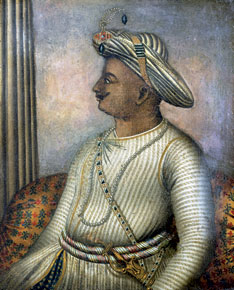
This was the world—often surprising to our eyes—that Tipu Sultan inhabited, and we have to make an effort to try and understand the mores of the times if we are to make sense of all this.
There is no question that Tipu was ruthless in war. He routinely and brutally converted to Islam captive enemy combatants and internal rebels, both Hindu and Christian, Indian and British, frequently destroying the temples and churches of those he conquered. He did this on a particularly horrific scale in Malabar, Mangalore and Coorg. Portuguese missionaries wrote that ‘he tied naked Christians and Hindus to the legs of elephants and made the elephants move around till the bodies of the helpless victims were torn to pieces.’
When he defeated the British in 1780, of the 7,000 prisoners he captured—one of whom was my ancestor James Dalrymple—around 300 were forcibly circumcised and given Muslim names and clothes. It is also true that he liked, especially towards the end of his reign, to describe himself as a ghazi, a Muslim Holy Warrior. Yet he clearly did not see this as being in contradiction with his duty to protect the lands and temples of his own Hindu subjects. We may see this as a massive paradox. He and his contemporaries did not.
Tipu’s patronage of the Hindu institutions of Mysore was no doubt as much a recognition of political realities, as any inherent liberalism or ‘secularism’. Tipu recruited a large number of Hindu warriors into his army—especially from the Telugu huntsman caste of Bedas or Beydaru—and he employed Brahmins to run much of his administration, particularly the revenue department, under a Hindu prime minister, Purnaiya. The palace coup which brought his father to power had been financed by Hindu bankers.
The Ranganatha Temple in his capital was not just protected but loaded with gifts which are still on display today, as are all the beautiful Vijayanagara-era images, not one of which has suffered from iconoclasm, despite standing in the middle of the capital of a ruler denounced by his British enemies as an ‘intolerant bigot’, a ‘furious fanatic’ who had ‘perpetually on his tongue the projects of Jihad’. In return for this royal patronage and protection, the Brahmin priests of his capital were expected to pray for Tipu’s success, and by studying his horoscope and the stars, to help augur his fortunes. On one occasion after a group of Malabar Christians had sided with the British, he destroyed churches in Mangalore and northern Malabar and gave the magnificent Dutch-cast bells to one of his state temples, the Venkaramana Temple in Nagar.
Yet it was not all realpolitik. Tipu, despite being a devout Muslim, believed strongly in the power of Hindu deities: in his dreams, which he diligently recorded every morning in a dream book which survived the British sack of Srirangapatna, Tipu encounters not only long-dead Sufi saints, but also Hindu gods and goddesses; in one dream sequence, which he saw on 16 November 1798, there are references to him encountering in a ruined temple idols whose eyes moved: one talked to him, and as a result, Tipu ordered the temple rebuilt. Tipu also strongly believed in the supernatural powers of holy men, both Hindu and Muslim. As he wrote in 1793 to the Swami of Sringeri: ‘You are the Jagatguru,the preceptor of the world… in whatever country holy personages like you may reside, that country will prosper with good showers and crops.’
Moreover, it is clear that for all his self-portrayal in his letters to other Muslim rulers such as Zaman Shah of Kabul, or the Ottoman Sultan in Constantinople, as a Muslim ghazi, intent on kafir conversion, his personal beliefs and cosmologies were imbricated with Hindu ideas of holiness and the supernatural: it is recorded , for example, that he made all his troops, Hindu and Muslim, take ritual baths in holy rivers ‘by the advice of his augers’ in order to wash away cowardice and make them superior in battle to the Marathas.
In this deeply syncretic world view, Tipu was a man of his time, and this vision which saw two cosmologies, Hindu and Islamic, profoundly intertwined, was one that he shared with many of his contemporaries: the Maratha leader Mahadji Scindia, for example, was well known at the time for his deep devotion to various Sufi saints.
Where Tipu does stand apart from almost all his contemporaries, however, was in his prescience about the intentions of the British, his profound alarm at the power of their East India Company, and his determination to attempt to root it out of India. He tried to warn other Indian rulers of the dangers of the increasingly arrogant and aggressive Company: ‘Know you not the custom of the English?’ he wrote in vain to the Nizam of Hyderabad in 1796. ‘Wherever they fix their talons they contrive little by little to work themselves into the whole management of affairs.’
It was these British enemies of Tipu who did most to create the image of Tipu so widely held today. In 1799, before sending into the field the largest army the East India Company ever gathered together, the Governor General, Lord Wellesley, began a campaign of vilification against Tipu, portraying him as an aggressive Muslim Monster who divided his time between oppressing his subjects and planning to drive the British into the sea. This essay in imperial villain-making opened the way for a lucrative conquest and the installation of a more pliable regime which would, in the words of Wellesley, allow the British to give the impression they were handing the country back to its rightful owners while in reality maintaining firm control.
It is, however, a truth universally acknowledged that a politician in search of a war is not necessarily over-scrupulous with matters of fact. Until recently, the British propaganda offensive against Tipu has determined the way that most people in India remember him. But as with more recent dossiers produced to justify pre-emptive military action against mineral-rich Muslim states, the evidence presented reveals far more about the desires of the attacker than it does about the reality of the attacked. For recent work by a succession of modern scholars has succeeded in reconstructing a very different Tipu to the one-dimensional fanatic invented by Wellesley. Tipu, it is now clear, was in fact one of the most innovative and far-sighted rulers of the pre-Colonial period.
What really worried the British was less that Tipu was a Muslim fanatic, something strange and alien, but that he was in fact frighteningly familiar: a modernising technocrat who used the weapons of the West against their own inventors. Indeed in many ways he beat them at their own game.
Tactically the Mysore forces were fully the match of those of the East India Company, and Tipu’s sepoys were every bit as well trained by their French mercenary officers as those of the Company were by theirs; indeed the steely discipline of the Mysore infantry amazed and worried many British observers. The Mysore army was strong in those areas where the Company was weakest and the Mysore light cavalry was ‘the best in the world’, according to Arthur Wellesley, the future Duke of Wellington.
Moreover the sepoy’s rifles and canon were based on the latest French designs, and their artillery had a heavier bore and longer range than anything possessed by the Company’s armies. Indeed, in many respects the Mysore troops were more innovative and tactically well ahead of the Company armies: firing rockets from their camel cavalry to disperse hostile cavalry, for example, long before William Congreve’s rocket system was adopted by the British army. Tipu also developed a large bullock ‘park’ of white Deccani cattle to allow him rapidly to deploy infantry and their supplies through his kingdom, a logistical innovation later borrowed by the British for their wars against the Marathas.
More worrying still for Wellesley, the defences of the island fortress of Srirangapatna were state-of-the-art and designed by French engineers on the latest scientific principles, following Sébastian de Vauban’s research into artillery-resistant fortification designs, as adapted by the Marquis de Montalembert in his book, La Fortification Perpendiculaire. These provided the most up to date defences that the 18th century could offer and also took into account the newly increased fire-power of cannon, bombs and mines, as well as the latest developments in tactics for storming and laying siege to forts. Haider and Tipu even tried to create a navy which by 1766 comprised two ships, seven smaller vessels and 40 gallivats, all commanded by a European sailor named Stannett.
All this made Tipu by far the Company’s most formidable enemy. He was responsible for a unique and catastrophic defeat of the armies of the East India Company at Pollilur in 1780 which led to the slaughter of an entire army and the capture of one in five of all the British soldiers in India: no less than 7,000 British men, along with an unknown number of women, were held captive by Tipu in his sophisticated fortress of Srirangapatna. Many were circumcised and forcibly converted to Islam. Even more humiliatingly, several British regimental drummer boys were made to wear ghagra cholis and entertain the court as nautch girls.
At the end of ten years’ captivity, one of these prisoners, James Scurry, found that he had forgotten how to sit in a chair or use a knife and fork; his English was ‘broken and confused, having lost all its vernacular idiom’, his skin had darkened to the ‘swarthy complexion of Negroes’ and he found he actively disliked wearing European clothes. This was the ultimate colonial nightmare, and in its most unpalatable form: the captive preferring the ways of his captors, the coloniser colonised.
Tipu was just as innovative in peace as he was in war. He tried to import industrial technology through French engineers and experimented with harnessing water-power to drive his machinery. He sent envoys to southern China to bring back silkworm eggs and established serriculture in Mysore—something that still enriches the region today. He introduced irrigation and built dams so that even his British enemies had to admit that his kingdom was ‘well cultivated, populous with industrious inhabitants, cities [including Bangalore] newly founded and commerce extended.’ More remarkably still, he created what amounted to a state trading company with its own ships and factories dotted across the Persian Gulf. He even asked his ambassadors to Istanbul to secure for him the ijara—farm— of Basra so that, like Europeans, he could establish an overseas settlement which would be both a base and a safe haven for his vessels. No wonder the British were terrified when they discovered that ‘Citizen Tippoo’ was in communication with Napoleon Bonaparte, whom he formally invited to visit India to liberate the country and expel the British. He had even sent Ambassadors to Paris along with a draft treaty in which he proposed an alliance to drive the British out of India.
As Christopher Bayly nicely put it, Tipu attempted to fight ‘European mercantilist power with its own weapons: state monopoly and an aggressive ideology of expansion.’ He failed only because the resources of the Company were expanding faster than those of Mysore. British propaganda might like to portray Tipu as a savage barbarian, but he was in fact something of a connoisseur and an intellectual, with a library containing some 2,000 volumes in several languages, and a large collection of modern scientific instruments including thermometers and barometers. The culture of innovation Tipu fostered in Mysore stands record to a man very different from that imagined by the Islamophobic propaganda of the British and the startling inaccuracy of Lord Wellesley’s ‘dodgy dossier’ of 1799. The fanatical bigot and savage was also something of an economic and political visionary.
Tipu knew what he was risking when he took on the British, but as he said himself, “I would rather live a day as a tiger than a lifetime as a sheep.” He duly went down fighting: when Wellesley’s army finally closed in for the kill and surrounded Srirangapatna in mid-April 1799, Tipu resisted with characteristic ingenuity and tenacity. As one British observer wrote, he ‘gave us gun for gun… night time skirmishes were made with desperate exertion… Soon the scenes became tremendously grand; shells and rockets of uncommon weight were incessantly poured upon us from the SW side, and fourteen pounders and grape from the North face of the Fort continued their havoc in the trenches; while the blaze of our batteries which frequently caught fire… was the signal for the Tiger sepoys [Tipu’s élite forces dressed in tiger-striped uniforms] to advance, and pour in galling vollies of musketry.’ It was a brave and skilful defence that ended with Tipu falling, sword in hand, at the breach in his defences near the water gate.
How should we remember Tipu today? He is certainly a complex figure, and it is anachronistic to call him ‘secular’: his was an Islamic state, albeit one run with a Hindu administration and a partially Hindu army, and led by a man who firmly believed in the power of Hindu deities. It is perfectly reasonable for the descendants of his victims—and I can count myself among them—to remember his horrible savagery in victory: in Coorg, Malabar and Mangalore he was responsible for what we today would call war crimes.
But he was beloved by his own people, as the British discovered to their surprise when they seized his state: ‘numbers of his confidential Hindoo servants who during the war fell into our hands, acknowledged him to be a lenient and indulgent master.’ At his funeral, people lined the streets ‘many of whom prostrated themselves before the body, and expressed their grief by loud lamentations.’ So it is not far-fetched to see him as a brave proto-nationalist. For while it is true that modern ideas of nationalism and patriotism were only in their infancy, he nonetheless firmly identified the British as dangerous outsiders and there is no question he did more than any other ruler of the time to stop them taking over the country.
source: http://www.m.openthemagazine.com / Open / Home> Quiz> Voice / by William Dalrymple / November 26th, 2015