Category Archives: World Opinion

The last days of Mughal Emperor Bahadur Shah Zafar in Burma

by Dr. Syed Ahmed for TwoCircles.net,

Prime Minister Dr. Manmohan Singh, during his recent visit to Myanmar (erstwhile Burma), offered floral tributes at the memorial of last Mughal emperor Bahadur Shah Zafar which lies at 6 Ziwaka Road in Dagon, Yangon. Prime Minister, accompanied by his wife Gursharan Kaur and External Affairs Minister S.M. Krishna, offered prayer at the graveyard/mazar of the former ruler, who died four years after he was exiled to Yangon following his defeat in the 1857 war of independence.

It has been a tradition for the dignitaries from India, Pakistan and Bangladesh to pay their visit to the graveyard of the Mughal emperor and pay their respect. It is said that Netaji Subhas Chandra Bose started his “Delhi Chalo” campaign in 1942 after paying his respect to the former emperor. Rajiv Gandhi during his official visit to Myanmar in Dec. 1987 paid his tribute to the grave. He wrote in the visitor’s book placed at the grave: “Although you (Bahadur Shah) do not have land in India, you have it here, your name is alive… I pay homage to the memory of the symbol and rallying point of India’s first war of independence….”

Bahadur Shah Zafar [Photo Courtesy: exoticindia.es]
The Great Uprising of 1857

Bahadur Shah was 82 years old and in poor health when the revolting sepoys from Meerut stormed into the palace on 11 May 1857. According to William Dalrymple (The Last Mughal, 2006), sepoys and cavalrymen from Meerut numbering 300 rode into Delhi in the morning and massacred Christian men, women and children they could find in the city, and proclaimed Bahadur Shah as their leader and emperor. Bahadur Shah gave his blessing to the sepoys. A.G. Noorani (Indian Political Trails 1775-1947) writes, “Bahadur Shah was the one around whom both the communities rallied as a symbol of revolt and unity…In him have still been centered the hopes and aspirations of millions. They have looked upon him as the source of honour, and, more than this, he has proved the rallying point not only to Muhammadans, but to thousands of others with whom it was supposed no bond of fanatical union could possibly be established.”

The outbreak started in Meerut and Barrackpur from January to May 1857, and then spread to Lucknow, Allahabad, Ghaziabad, Delhi, Allahabad, Kanpur, Jhansi, Gwalior, Bareilley, Madras, Bombay, and several places in Punjab. Leaders like Nana Sahib, Tantia Tope, Bhakt Khan, Azimullah Khan, Rani Laxmi Bai, Begum Hazrat Mahal, Kunwar Singh, Maulvi Ahmadullah, Bahadur Khan, Rao Tula Ram and Raja Nahar Singh of Punjab led the local uprisings.

Within 4 months the uprising was crushed by the British with a strong hand. Poets and princes, mullahs and merchants, Sufis and scholars were hunted down and hanged. Palaces, mosques, shrines, gardens and houses of Mughal Delhi were destroyed. The properties of the Muslims were confiscated. All the leaders of the uprising were either killed or drove out of India.

Bahadur Shah surrendered on 21 Sept. 1857. The next day, Major William Hodson set out to Humayun Tomb to arrest his sons, Mirza Mughal and Mirza Khizr Sultan, and his grandson, Mirza Abu Bakr. Hodson took the princes to Sher Shah Suri’s outpost, then known as Kabuli Darwaza or Lal Darwaza. They were stripped naked and shot. Since the incident the outpost came to be known as Khooni Darwaza. Hodson paid the price for his misdeeds. A few months after the shoot-out, he was killed at Begum Kothi in Lucknow on 11 Mar. 1858.

With the arrest of Bahadur Shah the four centuries of Mughal rule in India came to an end and the Mughal emperor was made a prisoner. He was brought to the walled city and kept under house arrest. Sadly, the poet was not given even a pen to write while in captivity. He scribbled some of his last verses on the wall with a burnt stick.

The Prime Minister, Dr. Manmohan Singh signing the visitor’s book during his visit to the Mazar of Bahadur Shah Zafar, in Yangon, Myanmar on May 29, 2012.

Last Days of Bahadur Shah

Bahadur Shah’s trial began on 27 Jan. 1858 and ended on 9 Mar. 1858. The trial recommended the transportation of Bahadur Shah to Burma. In Oct 1858, Bahadur Shah accompanied, according to William Dalrymple, by his wife Zinat Mahal and 2 sons Mirza Jiwan Bhakt and Mirza Shah Abbas and daughter-in-law and wife of Jawan Bhakt, Shah Zamani Begum (generally referred to as Raunaq Zamani, the granddaughter of the emperor), who all chose to follow the emperor departed from Delhi for Calcutta, where they were placed on board a warship called Magara and taken to Rangoon.

In Burma British Commissioner Captain H. Nelson Davies received Bahadur Shah and his family. The family was then lodged in a quarter near the Shwe Dagon Pagoda under the supervision of Nelson Davies. The family was provided 4 rooms each of 16 ft. sq., one allotted for Bahadur Shah, another for Jawan Bhakt and his wife Zamani Begum, the rest for Zinat Mahal and Shah Abbas. Pen, ink and paper were completely forbidden. The family was provided 4 Indian attendants (a chaprasi, water carrier, washer-man and a sweeper).

Bahadur Shah died on Nov. 7, 1862 at the ripe old age of 87. Fearing another revolt the last rites of the emperor was performed without informing anyone. The janajah was performed by an old Moulana along with the two princes. After a week Nelson Davies informed about the death of the emperor to the higher officials in London. He wrote in his letter, “Have since visited the remaining State Prisoners- the scum of the reduced Asiatic harem; found all correct…The death of the ex-king may be said to have no effect on the Mohamedan part of the populace of Rangoon, except perhaps for a few final triumph of Islam. A bamboo fence surrounds the grave, and by the time the fence is worn out, the grass will again have properly covered the spot, and no vestige will remain to distinguish where the last of the Great Moghuls rests.” The news of the death of Bahadur Shah reached Delhi a fortnight later.

In one of his couplet Bahadur Shah had lamented on the irony of his fate thus:


Umr-e-daraaz maang ke laye the char din/Do aarzu mein kat gaye, do intezar mein
Hai kitna badnasseb Zafar dafn ke liye/Do gaz zameen bhi mil na saki koo-e-yaar mein.
Na kisii kii ankh ka nur na kisii ke dil ka qarar hun/Jo kisii ke kam na a sake main vo ek musht-e-Gubar hun
Na to main kisii ka habiib hun na to main kisii ka raqiib hun/Jo bigar gaya vo nasiib hun jo ujar gaya vo dayar hun
hamane duniyaa mein aake kyaa dekha/dekhaa jo kucch so Khvaab-saa dekhaa/hai to insaan Khaak kaa putlaa/lekin paanii ka bulbulaa dekhaa)
I had requested for a long life a life of four days/Two passed by in pining, and two in waiting/How unlucky is Zafar! For burial/Even two yards of land were not to be had, in the land (of the) beloved./My life gives no ray of light, I bring no solace to heart or eye/Out of dust to dust again, of no use to anyone am I/Barred the door of the fate for me, bereft of my dear ones am I/The spring of a flower garden ruined/Alas, my autumn wind am I/I came into the world and what did I see?/Whatever I saw was just like a dream/Man is moulded from clay but/I saw him as a bubble of water.
In 1867 the family of Bahadur Shah was allowed to leave the prison enclosure and to settle elsewhere in the Rangoon cantonment. The long confinement made Shah Zamani Begum, who was just around 15 years old, became seriously ill suffering from extreme depression. She started getting blind. To improve her condition she along with her husband was given another house not far from the Rangoon jail. By 1872 Shah Zamani Begum became completely blind. Mirza Shah Abbas married a girl from Rangoon, a daughter of a local Muslim merchant. His descendants still live in Rangoon today. Zinat Mahal lived on alone, comforting her loneliness with opium. She died in 1886. Her body was buried near her husband’s grave. Few years later Mirza Jawan Bakht died of stroke. He was 42.

The Prime Minister, Dr. Manmohan Singh and his wife Smt. Gursharan Kaur pray after offering chadar at the Mazar of Bahadur Shah Zafar, in Yangon, Myanmar on May 29, 2012.

A delegation of visitors from India visited Burma in 1903 to pay their respects at the burial place of Bahadur Shah. By then, due to long years of neglect, the exact location of the graves of Bahadur Shah and his wife became uncertain. In 1905 the Muslims of Rangoon protest demanding that the grave of Bahadur Shah should be marked. The British authorities agreed in 1907 and a railing was also erected around an supposed site of the grave, and the engraved stone slab, marked, “Bahadur Shah, the ex-king of Delhi died at Rangoon Nov. 7th 1862 and was buried near this spot” and “Zinath Mahal wife of Bahadur Shah who died on the 17th July 1886 is also buried near this stone,” was placed.

Surprisingly, in Feb. 1991 labourers while digging a drain at the back of the shrine uncovered the original brick-lined grave of Bahadur Shah. It was found 3 feet under the ground, and about 25 feet away from the earlier supposed graveyard of the emperor. This original graveyard has over the years become a popular place of pilgrimage for the Burmese Muslims. The local Muslims, who believed Bahadur Shah as a powerful saint, come to seek his spiritual blessing and favours. A prayer hall was also constructed in front of the graveyard with Indian assistance, which was inaugurated on 15 Dec. 1994. Today the graveyard is managed by a trust named Bahadur Shah Zafar Mausoleum Committee. Before the military takeover in Myanmar, the shrine was managed by a trust set up by the descendants of Bahadur Shah.

[Photo Courtesy: PIB]

source: http://www.twocircles.net / TwoCircles.net / Home / by Dr. Syed Ahmed for TwoCircles.net / May 31st, 2012

Guinness recognition awaits Hyderabadi for fastest nose-typing

Mohammed Kursheed Hussain nose-typing in Hyderabad on Monday.- Photo: By Arrangement

How fast do you think you can type?’ Before most would have gone half-way with the sentence, 24-year-old Mohammed Kursheed Hussain of Hyderabad would have finished typing, with his nose.

Mr. Hussain attempted to break a Guinness world record for fastest nose-typing here on Monday. In 43.85 seconds, he typed the 103-character long ‘Guinness world records have challenged me to type this sentence using my nose in the fastest time’. He had to best 46.30 seconds, the standing record that was set in December 2014. An official word from Guinness is awaited to confirm his Monday’s feat.

Incidentally, Mr. Hussain had set a nose-typing Guinness record in February last year when he typed the challenge sentence in 47.44 seconds.

“I was told by Guinness in January this year that the record I had set was broken. Since then I trained to break the record,” said Mr. Hussain, who is a masters student at a university in Indiana, US.

Hussain’s tryst with typing began when he turned seven. It was however not until he turned 18, did he realise the uniqueness of his skill.

“I thought nothing of my typing ability until I had gone to college. That is when my friends made me realise that I had skill that others did not have. But I never thought that I would be a Guinness record holder,” he said. In 2012, Hussain hand typed the English alphabet with spaces in record 3.43 seconds, debuting in the annals of the Guinness World Records.

“I had to beat 3.52 seconds. It seemed impossible then,” he said. That record stands unbroken for three years now. Ask how he types with his nose when keys are blurred at nose’s width away from the keyboard,

Mr. Hussain offers a plausible explanation. “I think I just have a big nose,” he chuckles.

source: http://www.thehindu.com / The Hindu / Home> News> Cities> Hyderabad / by Rohit P.S./ Hyderabad – August 18th, 2015

IOS to celebrate 30th anniversary in 2016, hold national & international seminars

New Delhi:

Institute of Objective Studies, (IOS), will celebrate its 30th anniversary next year by organising national and international seminars and workshops on the new education policy.

These seminars and workshops will be organised in Delhi and other places of the country. Similarly, about six seminars on “Minority Rights and Identities and Constitutional Safeguards: The Role of State, Judiciary and Civil Society” will be organised.

Chairman Dr. Mohammad Manzoor Alam (centre) presiding over the two-day 29th Annual meeting of General Assembly of the Institute of Objective Studies, (IOS), in New Delhi.

The above decisions were taken at the two-day 29th Annual meeting of General Assembly of the IOS which concluded here the other day. Besides this a number of other decisions were also taken on the occasion. The meeting was presided over by IOS Chairman Dr. Mohammad Manzoor Alam.

It was also decided to award scholarships to students with Madrasa background pursuing courses in social sciences and the law in universities besides students studying journalism. Five priority areas viz. law, history, education, Islamic Studies and the comparative study of other religions, have been selected for research. In addition, a committee will be constituted to study the nature of the schemes being implemented by the Central government and create awareness among Muslims.

The book entitled “Qalmi Khake” by late Prof. Zafar Nizami being released at the IOS meeting.

Another committee will be set up to review school and higher education as also research under the new education policy. Decision was also taken to undertake work on books on “Seerah” in regional languages.

On this occasion, two books, “Qalmi Khake” by late Prof. Zafar Nizami, and “Musalmano ka Siyasi Empowerment” by Prof. ZM Khan in Urdu and Hindi published by the IOS were released.

Those who attended the function included Vice-Chairman of the IOS, Refaqat Ali Khan, Secretary General of the IOS Prof. ZM Khan, Prof. Ishtiyaque Danish, Prof. Manzoor Ahmed, Maulana Atique Ahmad Bastavi, Dr. Major Zahid Husain, Prof. Shamim Ahmad Ansari, Prof. Mohsin Usmani Nadvi, Prof. Arshi Khan, Adv. Mushtaq Ahmad, Prof. Sanghasen Singh, Prof. M. Muqeem, Maulana Amin Usmani, Dr. Fakhruddin Mohammad, Dr. Priyasen Singh, Dr. Shakeel Ahmad Tamanna, S. Pervez Bari, senior journalist, Suhail Anjum, scientist, Mohammad Khalil, Prof. Obaidur Rahman Hashmi and Dr. Imtiyaz Husain.

source:  http://www.twocircles.net / TwoCircles.net / Home / by TCN News / September 14th, 2015

‘Aurangzeb is a severely misunderstood figure’

Audrey Truschke
Audrey Truschke

Scholar Audrey Truschke says we should not make the error of attributing Mughal emperor Aurangzeb’s lack of interest in Sanskrit to his alleged bigotry

In an email interview, Audrey Truschke, Mellon postdoctoral fellow in the Department of Religious Studies at Stanford University, shares with Anuradha Raman the experiences of writing her book, Culture of Encounters: Sanskrit at the Mughal Court, to be published in February 2016, and argues forcefully in favour of acknowledging diversity in India.

The present Bharatiya Janata Party government believes Mughals are not part of India’s history. Your book is about how Sanskrit, sought to be made mainstream by the government, flourished under the Mughals. How do we reconcile the two?

We don’t reconcile the two perspectives. Rather, we ask two key questions. One, who is on firmer historical ground in their claims? Two, what are the political reasons for the BJP wanting to erase the Mughals (or at least most of the Mughals) from India’s past? The bulk of my work concerns the honest excavation of history. The Mughals are a significant part of Indian history, and Sanskrit is a significant part of the story of the Mughal empire. Those facts may be inconvenient for the BJP and others, but as a historian I do not temper my investigation of the past in deference to present-day concerns. However, I realise that history matters in the present, perhaps especially in modern South Asia. One present-day implication of my work is to point up the flimsy basis of the BJP’s version of India’s past.

In an ironical way, as the present government fights to push Sanskrit into mainstream discourse, your work concentrates on the Mughals, whom the BJP dislikes, and their engagement with Sanskrit.

The BJP only wants a certain version of Sanskrit in the mainstream. They no doubt love Kalidasa, but I cannot imagine the BJP endorsing students to read the Sanskrit accounts of the Mughals written by Jains in the 16th and 17th centuries. India has a great treasure in its Sanskrit tradition, but that treasure is not only classical poetry and the Indian epics, but also the immense diversity of Sanskrit literature.

Who were the Mughal rulers under whom there was active exchange of Sanskrit and Persian ideas, in your account?

Sanskrit flourished in the royal Mughal court primarily under three emperors: Akbar, Jahangir, and Shah Jahan.

Aurangzeb. Photo: CC 3.0 SA

However, we should not make the error of attributing Aurangzeb’s lack of interest in Sanskrit to his alleged bigotry. Aurangzeb is a severely misunderstood historical figure who has suffered perhaps more than any of the other Mughal rulers from present-day biases. There are two main reasons why Sanskrit ceased to be a major part of Mughal imperial life during Aurangzeb’s rule. One, during the 17th century, Sanskrit was slowly giving way to Hindi. This was a wider literary shift in the subcontinent, and even under Shah Jahan we begin to see imperial attention directed towards Hindi-language intellectuals at the expense of Sanskrit. Aurangzeb’s reign simply happen to coincide with the waning of Sanskrit and the rise of literary Hindi.

Second, as most Indians know, Aurangzeb beat out Dara Shikoh for the Mughal throne. Dara Shikoh had been engaged in a series of cross-cultural exchanges involving Sanskrit during the 1640s and 1650s. Thus, from Aurangzeb’s perspective, breaking Mughal ties with the Sanskrit cultural world was a way to distinguish his idioms of rule from those of the previous heir apparent. In short, Aurangzeb decided to move away from what little remained of the Mughal interest in Sanskrit as a political decision, rather than as a cultural or religious judgment.

“Dara Shikoh had been engaged in a series of cross-cultural exchanges involving Sanskrit during the 1640s and 1650s.” Painting shows the marriage procession of Shikoh. Photo: Wikimedia Commons, Source: National Museum, Delhi

As a side note, let me clarify that while Akbar inaugurated Mughal engagements with Sanskrit, he did so for slightly different reasons than many people think. Akbar’s reputation is that he was open-minded and tolerant, almost a protosecular figure. This can be a misleading characterisation. Akbar was interested in Sanskrit for its political valence in his empire, not as some personal religious quest. Akbar also had no qualms about harshly judging perspectives that he viewed as beyond the pale. A good example is that he questioned Jain thinkers about whether they were monotheists because to be otherwise would mean being evicted from the Mughal court (Jains assured him that they believed in God).

What was the interaction between the Mughal elites and Brahmin Hindus and Jain religious groups like?

Brahmans, for example, assisted with Mughal translations of Sanskrit texts into Persian. The method was that Brahmans would read the Sanskrit text, verbally translate it into Hindi (their shared language with the Mughals), and then the Mughals would write down the translation in Persian. Jains and Brahmans alike assisted the Mughals with astrology. Brahmans cast Sanskrit-based horoscopes for the Mughal royal family. On at least one occasion, Jains performed a ceremony to counteract an astrological curse on Jahangir’s newborn daughter. My forthcoming book, Culture of Encounters, devotes an entire chapter to reconstructing the social history of links between Mughal elites and Brahmans/Jains.

You argue that the ideology underpinning violence — such as what took place in the 2002 pogrom, in which more than 1,000 Muslims died, or the current intolerance towards them — erases Mughal history and writes religious conflicts into Indian history where there was none, thereby justifying modern religious intolerance. Is it correct to then deduce that there was no religious conflict in the court of the Mughals?

No. First, there was plenty of violence in Mughal India. Violence and conflict are enduring features of the human experience and I would never suggest otherwise. Even under Akbar, violence was commonplace. A far trickier question, however, is, how much Mughal-led violence was religious-based or motivated by religious conflicts? Generally, the Mughals acted violently towards political foes (whether they were Rajput, Muslim, Hindu, or otherwise was irrelevant). It is very difficult for many modern people to accept that violence in pre-modern India was rarely religiously motivated. In this sense, pre-colonial India looked very different than pre-modern Europe, for example. But we lack historical evidence that the Mughals attacked religious foes. On the contrary, some scholars have even suggested that modern “Western” ideas about religious toleration were, in part, inspired by what early European travellers witnessed in the Mughal Empire.

That said, there were limited instances when the Mughals persecuted specific individuals over religious differences. A good example is that Akbar sent a few of the Muslim ulama on hajj to Mecca, which meant that they were effectively exiled from the court. Some of these ulama were murdered on their way out of India.

Is there a problem with a Marxist interpretation of history as is being argued now by the BJP government?

Marxist history is limiting, in my opinion. This strain of thought tends to emphasise social class and economic factors in determining historical trajectories. Modern historians have a much wider range of approaches at their disposal that better situate us to understand other aspects of the past.

Mughal history is such a contentious part of history in the Hindu nationalist imagination. How do you propose to shed light, and create space for a scholarly engagement with the period? It also comes at a time when there is a wave of revisionism in India.

My approach is that of a historian. I seek primary sources from numerous languages and archives, read deeply in secondary scholarship, and attempt to reconstruct the most accurate vision of pre-colonial India possible. My work has plenty of present-day implications, but those come secondary and explicitly after the serious historical work. This approach is unappealing to many in modern India (and across the world). It is painstaking, requires specialist knowledge, can be slow, and often leads to nuanced conclusions. But there are also plenty of people, non-academics, who view what is going on in modern India with scepticism. For those who want it, my work offers a historically sound foundation for challenging modern political efforts to revise the past.

What are the dangers of rewriting history?

So far as the dangers of rewriting history and subscribing to narrow interpretations of specific texts, there are many risks. One is that we risk rising intolerance going forward, something already witnessed on both popular and elite levels in 21st century India. Another risk is that we cheapen the past. India has a glorious history and one of the richest literary inheritances of any place on earth — it would be unfortunate to constrict our minds to the point where we can no longer appreciate these treasures.

You argue that “a more divisive interpretation of the relationship between the Mughals and Hindus actually developed during the colonial period from 1757 to 1947”, a legacy that the present Modi government appears to have inherited. But while the British positioned themselves as neutral saviours, who will emerge as the neutral saviours now?

In the BJP vision, I believe that the new saviour is the BJP itself and affiliated Hindu nationalist groups that will restore India to its proper, true nature as a land for Hindus. This is an appealing ideology for many people, which is part of what makes it so dangerous. I maintain that India’s greatness is found in its astonishing diversity, not some invented, anachronistic, monolithic Hindu past. Part of the sad irony of the BJP’s emphasis on rewriting Indian history is precisely that India has a deep and compelling history, which so many seem intent to ignore.

ndanu@ thehindu.co.in

source: http://www.thehindu.com / The Hindu / Home> Opinion> Interview / by Anuradha Raman / September 14th, 2015

OFF RADAR – When APJ Abdul Kalam charmed his way into Boeing’s nerve centre

Nostalgia: APJ Abdul Kalam with Dinesh Keskar during his 2009 visit to Boeing's Seattle plant - PICTURE COURTESY: BOEING
Nostalgia: APJ Abdul Kalam with Dinesh Keskar during his 2009 visit to Boeing’s Seattle plant – PICTURE COURTESY: BOEING

Aircraft manufacturer’s Dinesh Keskar recalls the late President’s visit to Seattle in 2009

The sudden demise of former President APJ Abdul Kalam on July 27, left people mourning in India. Over 12,000km away in Seattle too, a pall of gloom descend on Boeing’s manufacturing plant, where the former President had charmed and impressed the employees during his visit in 2009. Later Dinesh Keskar, Senior Vice-President, Asia-Pacific and India, Boeing Aeroplanes called Kalam “a friend of a lot of people, including Boeing.”

During the 2009 visit, the former President had shown an interest in meeting Joe Sutter, the man who designed the double-decker aircraft, the Boeing 747, which is popularly known as the Jumbo Jet. “The former President knew of him (Sutter) and wanted to meet him,” recalls Keskar.

The 2009 visit to the Seattle plant was Kalam’s first to the Boeing’s manufacturing facility. The 88-year-old Sutter, often called the Father of the 747, was there. The two had a 20-minute meeting which Keskar too attended. “The former President wondered how Sutter had come up with the idea of the upper deck. Kalam also asked Sutter about the support he had in designing the Boeing 747,” Keskar recalled. Perhaps Kalam, who was involved with the Light Combat Aircraft project, was hoping to replicate the same in India. The Missile Man also gave a lecture to an audience that included scientists and top technologists during the Seattle visit. Kalam, however, was not just interested in the Jumbo Jet. During his visit he also got a first-hand feel of the first Boeing 787 aircraft, the long-range, wide-body, twin-engine jet airliner . The 787 aircraft that Kalam saw in Seattle was the first of the 27 aircraft that are joining the Air India fleet.

Kalam was impressed with the aircraft, particularly its wings. The crystal model of an aeroplane that Boeing presented Kalam to commemorate the visit is still displayed in Delhi.

Bengaluru days

Kalam’s relationship with Boeing did not end at Seattle. He also visited the Boeing research centre in Bengaluru. Keskar says that the former President spent over three hours talking to the 15 people present, inquiring about their work. Many of the people were picked from the National Aeronautics Lab, where Kalam was the Chairman of the organisation’s research council.

It was during this visit that Kalam said that one of the things Boeing must do is to get India into the aeroplane market. “He was obviously very interested in getting Boeing to do something in India in terms of building an aeroplane in India. We are still working on smaller pieces of that. We have not gone to the stage of the aeroplane but that was his vision,” Keskar added.

source: http://www.thehindubusinessline.com / Business Line / Home> Specials> Flight Plan> Off Radar / by Ashwinin Phadnis / August 25th, 2015

Sania Mirza-Martina Hingis win US Open women’s doubles title

New York  :

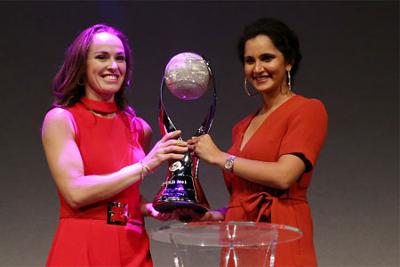
India’s tennis star Sania Mirza bagged her second consecutive Grand Slam title of the season, and fifth overall, as she won the US Open women’s doubles with Swiss partner Martina Hingis on Sunday.

The top-seeded Indo-Swiss team outplayed the fourth seed team of Casey Dellacqua and Yaroslava Shvedova 6-3, 6-3 in the final, which never rose to great heights.

Sania’s win capped off a memorable US Open for Indians as Leander Paes had won the mixed doubles trophy with Hingis on Friday, in a repeat show of the Wimbledon.

Kazakshtan’s Shvedova and Australia’s Dellacqua struggled to hold serve, making it too easy for Sania and Hingis. The contest was over in just 70 minutes as the top seeds asserted themselves.

Sania’s ground-strokes from the back of the court and Hingis’ agility at the net was too good for their rivals.

It was Sania and Hingis’ second major title in a row, having won the Wimbledon championships earlier this season.

Sania now has five Grand Slam titles in her collection. She won three Mixed Doubles trophies, the last one coming at this very venue with Bruno Soares in 2014.

In an extraordinary season, Hingis has won five Grand Slam titles this season, taking her overall number to 20. She won three titles with Paes and two with Sania.

“It’s a great year for us. Already been a great year, became world number one. We were a solid team and were in with a chance in all Slams. We are happy to come through. I won mixed doubles here last year, great to come back and win this,” Sania said after her win.

An elated Hingis said, “from the start we hit it off. Our games complement each other. Sania won her first Wimbledon, for me it is bonus. I volley better than what I used to. (in her singles days)”

Shvedova committed a double fault in the second game at 30-all to give top seeds a break point and then a superb return from Sania brought another opportunity but the fourth seeds saved both chances.

The top seeds did not have to wait much for next chance as they broke Dellacqua at love to take a 3-1 lead. But the advantage slipped soon as Sania was broken in the fifth.

Shvedova, who is getting married on Tuesday, surrendered her serve one more time, letting Sania and Hingis just walk away with the set.

Shvedova was far from the player she is as she was down by three break points in the very first game of the second set. Top seeds grabbed the opportunity and consolidated lead with a solid hold.

Sania fired two stunning service winners on Dellacqua’s serve as the Australian was broken at love in the seventh game. Hingis hit an overhead volley winner on the first match point after Shvedova’s double fault at 40-all.

source: http://www.timesofindia.indiatimes.com / The Times of India / News Home> Sports> Tennis > US Open 2015 / PTI / September 13th, 2015

Celia Bell researches Hyderabad’s Urdu poets

Celia Bell / Photo: Mohammed Yousuf / The Hindu

American researcher Celia Bell delves into the works of Hyderabad’s Urdu poets Mah Laqa Bai Chanda and Luft-un-Nisa Imtiyaz

At a time when Urdu language is losing patronage among native speakers, it seems to strike a chord elsewhere. Its poetic form in particular has many followers both within and outside the country. Interestingly, in the land of Uncle Sam too Urdu is making waves, and not just out of curiosity.

Celia Bell, a student of Columbia University, is a case in point. Charmed by the musical quality of the language, she has come all the way from New York to Hyderabad to do research on two women Urdu poets of the 18th century, poets that Hyderabadis themselves have almost forgotten. She has chosen little known poets like Mah Laqa Bai Chanda and Luft-un-Nisa Imtiyaz for her research. Their works have not generated much critical appreciation and this is precisely the reason why Bell would like to explore them.

Maha Laqa Bai was the first women poet with a diwan (published works) of her own. A woman of great beauty, she was a courtesan during the reign of Nizam II and III. Luft-un-Nisa was also a sahibaan-e-diwan poetess with a rich collection of ghazals and masnavis. She wrote under the penname ‘Imtiyaz’.

During the last one month she is here, Bell’s mission has stirred quite a bit of interest and is drawing quiet admiration among Urdu circles. “It is interesting to take up studies on writers on whom not many have researched. I hope I will be able to throw fresh light on these poetesses,” she remarks.

Bell plans to explore the ‘gendered voices’ in the poetry of Mah Laqa Bai and Luft-un-Nisa. She will also delve into the technical elements of their works and their impact on Deccani literature. This project will be of immense help to Bell who wants to do Ph.D on contemporary literature and South Asian Studies. She is in India as part of the Fulbright-Nehru Student Research Programme.

But why in the world she has chosen Urdu literature for research? “I am much drawn to Urdu. It is a sweet language. The best part is its poetry which casts a spell,” says the 24-year-old who is quite familiar with the language by virtue of having studied Hindi at the undergraduate level.

Main padh sakti hoon, bol sakti hoon aur likh sakti hoon (I can read, speak and write),” she says in Americanised accent. But she feels shy of speaking in Urdu for fear of committing mistakes. “That’s why I am conversing with you in English,” she laughs.

Bell is all appreciation for Dr Habeeb Nisar, her research guide at the University of Hyderabad. The University is her host institution during her nine-month long project work. A self driven resercher, Bell has been poring over books in libraries and has found little time to explore the nawabi city. She is looking forward to the trek to Maula Ali to look up the mausoleum of Mah Laqa Bai.

Who are her favourite Urdu poets? Mirza Ghalib, Iqbal and Faiz – she reels out the names. But she is more fond of Ghalib whom she considers the Shakespeare of Urdu. She backs her claim by reciting this famous couplet of Ghalib:

Baske hoon Ghalib aseeri main bhi aatishe zere pa

Mue aatish deedah, hai halqa meri zanjeer ka

(Whereas, even in bondage, there is fire under my feet Ghalib

The chain that binds me is merely curls of singed hair)

She further recites verses from the works of Faiz Ahmed Faiz –

Ye daagh daagh ujaala, ye shab-gazidar sahr

Ye wo sahr to nahin jiski aarzu lekar

Chale the yaar ke mil jaiegi kahin na khain

(The stain-tainted light, this night-bitten dawn

That we were waiting for, this is not that morning

This is not the morning, in whose yearning

We had set out full of hope that we will surly find)

Bell took to writing early in her life. A good number of her short stories in English have appeared in New York Times Magazine and literary journals like Five Points and Bomb Magazine. Will she write in Urdu too? She only flashes a big smile by way of answer.

source: http://www.thehindu.com / The Hindu / Home> Features> MetroPlus> Society / by J.S. Ifthekhar / Hyderabad – September 13th, 2015

An Extraordinary Story of Five Colonial Indians and the Myth of Muslim ‘Insularity’

Muslim Cosmopolitanism in the Age of Empire Seema Alavi Harvard University Press, 2015, 504 pp, Rs 1495
Muslim Cosmopolitanism in the Age of Empire
Seema Alavi
Harvard University Press, 2015, 504 pp, Rs 1495

Muslim Cosmopolitanism in the Age of Empire is an exhilarating book encompassing broad swaths of trans-imperial history, religio-cultural geography and a stunning breadth of vision. Seema Alavi’s credentials as a historian of substance are well-established. Starting with a book on India’s military history and the Sepoys of the Company that came out of her doctoral research work in Cambridge with C A. Bayly, she later forayed into the history of indigenous medicine, producing the gem of a book, Islam and Healing with another book thrown in between—The Eighteenth Century in India. The current tome has a distinguishing feature that sets her apart from the ordinary run of historians – her multilingual scholarship, her willingness and ability to access source materials in several languages and her skill in marshalling arguments from different perspectives combined with insights drawn from literary sources to give a comprehensive, almost definitive, view of the phenomenon under discussion.

The seed of Muslim cosmopolitanism was, perhaps, sown when the Prophet had exhorted his disciples to undertake even the hazardous journey to China in quest of knowledge. Unlike some cultures, where travel across seas and mountains were proscribed for fear of losing purity/caste, Islam always put a premium on travel and trade, the Prophet himself being the best exemplar of both. When one travels one gets exposed to multiple cultures, belief systems and world-views, thus shedding one’s parochialism and embracing traits of cosmopolitanism. Baghdad (of Baitul Hikmah fame), Constantinople (current Istanbul, the seat of Ottoman empire), Cairo, Cordoba, Damascus, Bukhara, and Delhi were all Muslim cosmopolitan cities at different historical moments where scholars, statesmen, adventurers from all over the world congregated and conducted dialogue in a spirit of openness and catholicity. In the current times, when Muslims, for a variety of reasons, have become victims of insularity and ghettoisation, Alavi’s book is a potent antidote to the widespread but ill-informed media narrative about Muslim resistance to forces of modernity and globalisation.

Extraordinary journeys

Alavi’s articulation of Muslim cosmopolitanism in the 19th century is chronicled through the extraordinary biographies of five Islamic scholars from India – Sayyid Fadl, Maulvi Rahmatullah Kairanwi, Maulvi Imdadullah Makki, Siddiq Hasan Khan, and Maulvi Jafer Thanesri – who transcended their limited identity as British subjects and charted careers at the interstices of imperial borders. Taking advantage of imperial knowledge, strategies and rivalries between two great empires of the day, British and Ottoman, “they carved out a spiritual and civilisational space between the [these] Empires and projected it as their cosmopolis.”

The chapter on Sayyid Fadl brings alive the phenomenon of the ‘Indian Arab’ who hailed mostly from Hadramawt, Yemen, and whose presence was marked in Delhi, Gujarat, Deccan and Malabar. Starting his Indian career in the Malabar district of modern day Kerala, he was branded as a “fanatic” and an “outlaw” by the British government because of his alleged involvement in the anti-British Moplah uprising. But he fled from British India and then used the British and Ottoman tension and his trans-imperial connections to put himself up as the ruler of Dhofar – a semi-independent region in the southwest of Arabia . “Sayyid Fadl’s remarkable journey – born and brought up in a Malabar Sufi family of Arab descent and rising to become an independent ruler of an Arabian principality, a leader who commanded respect in both Meccan and Istanbul high society – was enabled by the connections he forged early on between British and Ottoman societies. And he established these connections using imperial networks as well as his religious and kinship ties.”

Amadeo Preziosi’s Entrance to the Golden Horn, painted c.1840-1880. Credit: Seema Alavi

Nawab Siddiq Hasan, who had a prominent position in the state of Bhopal, exerted great influence through his agents in Hijaz and Istanbul and fully exploited the potentialities of print culture to propagate a version of Islam at odds with the political interest of the British rulers in India. But the British resident in Bhopal could do little to prevent him from propagating his anti-British views. Exploiting British-Ottoman rivalries allowed him to publish his books and journals from Bhopal, Calcutta, Mecca, Madina, Istanbul and Cairo. His agents also bought books pertaining to a similar ideology and had them printed from Bhopal. “Imperial assemblages were also empires of print”, and Hasan fully exploited the possibilities of the moment to propagate his version of the Muslim cosmopolis making forays through porous imperial borders.

For the other three religious thinkers, the 1857 war of independence provided the backdrop for their political careers. They became suspects in the eyes of the British because of their alleged roles in the uprisings. Rahmatullah was one of the rebel leaders of Kairana who escaped the British noose by fleeing to Mecca, and his extensive family estate was confiscated by the colonial administration. He established the Madrasah Saulatiya in Mecca which became a hub of Muslim cosmopolitanism and produced scholars who spread out in different parts of the world, establishing similar seminaries and spreading the same message of consensus and unity among Muslims. Kairanwi wrote in Arabic, Persian and Urdu, addressing the Muslim umma across the empires, adhering largely to the Salafi intellectual tradition. Imdadullah followed Rahmatullah to Mecca and taught in his Madrasah Saulatiya. Both met Muslims from all over the world who came for hajj and discussed with them the challenges of anti-British struggles being waged in their own countries.

Challenge to colonialism

The pedagogical model evolved in Saulatiya and their ideological underpinnings shaped the broad curricular structure at the Deoband seminary in India. Thanseri who couldn’t escape was sent to the Andamans. However, he was one of those convicts who was co-opted in the colonial administration. “Unlike Kairanwi and Imdadullah Makki, he did not manage to escape to the Ottoman territories. But this did not stop him from envisaging a Muslim cosmopolis stretched across empires, and via his writings he envisaged an embracive civilisational space that spilled out of British India and challenged the colonial regime through its call for Muslim unity across the imperial assemblage.” (P. 333)

Alavi is prescient in her analysis of how print capitalism, the telegraph and the increasing ease of travel that fuelled resentment in colonised societies by upsetting the social order were also the means that helped build Muslim solidarities across a vast geographical divide. She is equally prescient in her debunking of the British paranoia of ‘Wahabism’ which the nervous officials saw everywhere. The British fear of Muslims was exacerbated by 1857 and William Hunter’s meretricious book Indian Musalman predisposed them to see the spectre of Wahabism even in innocuous reformist movements among Muslims and equate what Alavi defines as Muslim cosmopolitanism with territorial loyalty. The study reminds the reader of how intensely nationalist these Indians were even while they were trying to bring about a broad consensus among Muslims of different countries regarding contentious issues that divided them along ideological faultlines. Through her book Alavi has retrieved a segment of our national history that had been all but erased from public memory.

M Asaduddin, an award-winning author and translator, is currently Dean, Faculty of Humanities and Languages, Jamia Millia Islamia

source: http://www.thewire.in / The Wire / Home> Books / by M. Asaduddin / September 06th, 2015

KCR Greets Sania for Khel Ratna

Lawn Tennis player Sania Mirza | (File/PTI)

Hyderabad :

Chief minister K Chandrasekhar Rao on Saturday congratulated Hyderabad- based Indian lawn tennis player Sania Mirza for receiving Rajiv Gandhi Khel Ratna award.

The Chief Minister wished her all the best, expressed the hope that in future she would get many more such awards nationally and internationally, an official release from the CMO said.

source: http://www.newindianexpress.com / The New Indian Express / Home> States> Telangana / by Express News Service / August 30th, 2015

India continues strong show, wins five more medals in CYG

Indians continued their strong show in the 5th Commonwealth Youth Games by bagging five medals, including two gold, on the second day of competitions here on Tuesday.

Weightlifter Deepak Lather (boys 62kg category) and javelin thrower Mohd Hadish bagged a gold each in their respective events while Jisna Mathew won a silver in girls 400m race. Chandan Bauri (boys 400m) and Velavan Senthilkumar (boys squash singles) won a bronze each to continue India’s medal haul on the second day.

With five medals on Tuesday, India’s count swelled to four gold, two silver and two bronze and occupied the fifth spot in the tally after Australia, South Africa, England and New Zealand at the end of the second day. Indians had won two gold and one silver on the opening day of competitions on Monday.

15-year-old weightlifter Lather gave the gold to India in boys 62kg category as he lifted a total of 258kg with 120kg in snatch and 138kg in clean and jerk. His effort in snatch was a new CYG record.

Indian track and field athletes took part in three finals on the second day of competitions and all of them delivered personal best performances while winning a medal each in their respective events.

Javelin thrower Mohd Hadish, a silver medallist in the inaugural Asian Youth Championships at Doha earlier this year, proved to be a cut above the rest in the field as he set out the spear to a whooping distance of 79.29m in securing the gold.

Although he marginally missed the Games Record of 81.53m set by South African Morne Moolman in the last edition held at Isle of Man in 2011, the Indian thrower dominated the field as the second placed George Davies from England stood a distant 68.23m for the silver medal.

Quarter-milers Jisna Mathew and Chandan Bauri also gave their best efforts in winning a bronze each.

Jisna, an upcoming athlete from the stables of legendary P T Usha and another Doha silver medallist, clocked an impressive 53.14 secs to settle for silver in the girls’ 400m final. She missed the gold in just 5/100th of a second to Jamaican Junelle Bromfield.

source: http://www.thehindu.com / The Hindu / Home> Sport> Other Sports / PTI / APIA – September 08th, 2015