Wipro founder Azim Premji makes it to the tech billionaire’s list
Washington :
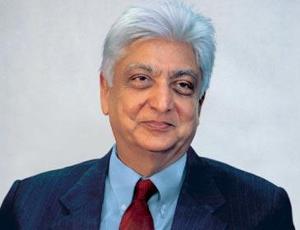
Two Indian tech tycoons,Wipro chairman AzimPremji and HCL co-founder Shiv Nadar are in the Forbes’ first-ever list of the 100 richest people in the technology field, dominated by Americans with Microsoft founder Bill Gates at the top.
Two Indian-Americans tech czars, Romesh Wadhwani, CEO and chairman of Symphony Technology Group, and Bharat Desai, co-founder of IT consulting and outsourcing company Syntel also figure on the list released last week.
Premji, 70, with a net worth of $17.4 billion is ranked 13th on the list followed by Shiv Nadar, 70, in the 14th spot with $14.4 billion.
Wadhwani, 67, is ranked 73rd with a net worth of $2.8 billion while Desai, 62, with $2.5 billion is in the 82nd spot.
Premji’s Wipro, India’s third-largest outsourcer, reported a 10 percent rise in revenues to $1.9 billion in the last quarter, on the back of new business from clients such as ABB and Philip Morris, the magazine noted.
Nadar, Forbes noted, has diversified into healthcare with HCL Avitas, a new firm in partnership with John Hopkins Medicine International, which has opened 10 clinics in Delhi.
Wadhwani has a degree in electrical engineering from the Indian Institute of Technology and a PhD from Carnegie Mellon. His Symphony Technology Group is a collection of 20 companies spanning big data, analytics and software.
Syntel, co-founded by Desai and his wife Neerja Sethi, now generates over $900 million in revenue, has a market cap of over $3 billion and more than 24,500 employees across the globe.
While 51 American billionaires are on the list, tech barons from Asia made a strong showing as well, with 33 people hailing from that region. Forty of the 100 live in California.
Bill Gates, who’s also the world’s richest man, ranks number one among tech tycoons, with a net worth of $79.6 billion.
Number two on the list is Larry Ellison, founder of database software firm Oracle, with a net worth estimated at $50 billion.
The third richest on the list is Jeff Bezos with a net worth of $47.8 billion followed by Facebook founder Mark Zuckerberg in the fourth place with $41.2 billion.
Google co-founders Larry Page and Sergey Brin are ranked fifth and sixth respectively.
Altogether, the world’s 100 richest tech billionaires are worth $842.9 billion.
Just seven women made the list, the wealthiest of whom is Laurene Powell Jobs, the widow of Steve Jobs, with an estimated net worth of $21.4 billion.
Nearly all of the 100 are self-made billionaires: 94 made their own luck, 3 inherited their fortunes, and 3 have inherited fortunes but have been actively expanding them.
source : http://www.timesofindia.indiatimes.com / The Times of India / News Home> NRI> US & Canada News / IANS / August 13th, 2015
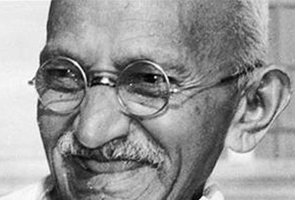
Indian political geniuses Mahatma Gandhi and Emperor Akbar have been listed among the ‘Top 25 Political Icons’ of all time by TIME magazine, along with Tibetan spiritual leader the Dalai Lama and Mao Zedong, the father of modern China.
Released on the 100th birth anniversary of the late US President Ronald Reagan, the TIME list figures names like the great conqueror Alexander the Great and some of history’s most polarising figures like Adolf Hitler and Benito Mussolini.
Gandhi’s experiments with satyagraha — the genesis of the non-violent methods of protest pioneered by him — and his leadership of India’s freedom movement that has inspired many revolutionaries of later years, led him to the top of the list of the 25 all time greats.
Describing Mohandas Gandhi as a figure “few will ever forget”, the prestigious magazine said his struggle paved the way for other social movements including America’s struggle for civil rights.
“While working as a lawyer in South Africa, he pioneered the concept of satyagraha, or, civil disobedience in response to tyranny, helping Indians there campaign for civil rights,” it said.
“Working with Jawaharlal Nehru, the nation’s future prime minister, Gandhi led the country in peaceful protest against foreign domination, exemplified by the 1930 Salt March in protest to a British salt tax. His rise paved the way for
India’s independence in 1947,” it said.
Gandhi, who left behind a universal influence, has inspired leaders like American civil rights movement leader Martin Luther King and South Africa’s anti-apartheid champion Nelson Mandela, and also US President Barack Obama.
The 16th century Mughal Emperor Jalaluddin Mohammad Akbar, a figure who played a major role in unifying the largely scattered fiefdoms in northern India, also finds a place in the elite list.
The ethos of pluralism and tolerance pioneered by the Muslim ruler in a Hindu-majority India underline the values of the modern republic of India, the magazine said.
The third Mughal ruler of India presided over a flourishing of the arts, sponsoring artisans, poets, engineers and philosophers at a time when Europe was still in its
pre-Renaissance stage.
“If ever a leader merited a tautology, it was the Mughal Emperor Akbar the Great. Under Akbar, a fragile collection of fiefs around Delhi grew into the great Mughal
Empire, a diverse and sprawling kingdom across northern India,” the magazine said.
“He was a canny warlord whose conquests gave rise to one of the early modern world’s wealthiest states. Moreover, while a Muslim, Akbar was spiritually curious and hosted religious scholars from Hindu gurus to Jesuits at his vast,
diverse court,” it said.
source: http://www.ndtv.com / NDTV / Home> India / by Press Trust of India / February 06th, 2011
Sania Mirza’s name was today officially approved for the coveted Rajiv Gandhi Khel Ratna award, becoming only the second tennis player to be nominated for the highest sporting honour.
The government also named the winners of the 2015 Arjuna Awards. The list has 17 sports-persons including cricketer Rohit Sharma and shooter Jitu Rai. Gymnast Dipa Karmakar, hockey player P R Sreejesh, wrestling duo of Bajrang and Babita, athlete M R Poovamma, shuttler K Srikanth and boxer Mandeep Jangra are among those who won the Arjuna.
“It’s a tremendous honour for me to be conferred the Khel Ratna award and I feel humbled with the love and respect showered on me by my country,” Sania told PTIfrom Toronto.
“Representing my country in all corners of the world has been my great privilege for so many years and this recognition of my efforts by the government of India is certain to inspire me to earn more laurels for our country. I would like to wish all my fellow Indians a happy independence day,” she said.
Sania, currently ranked world number one in women’s doubles, scripted history by becoming the first Indian to win a women’s doubles Grand Slam title when she and Martina Hingis clinched the Wimbledon trophy earlier this year.
Sania is only the second tennis player after Leander Paes to be named for the top award. Paes had been bestowed the honour way back in 1996 after his bronze medal in the Atlanta Olympics.
The 28-year-old, who has won three mixed doubles Grand Slams in her career, beat competition from squash player Deepika Pallikal, discus thrower Vikas Gowda, track and field star Tintu Luka, rising shuttler P V Sindhu, and hockey captain Sardar Singh for the coveted honour.
The awards will be conferred by the President Pranab Mukherjee on August 29, the National Sports Day.
The Khel Ratna carries a prize money of Rs 7.5 lakh along with a citation, while the Arjuna awards come with a cash prize of Rs 5 lakh and a citation.
Besides doing well on the professional circuit, Sania had also won the gold medal and the bronze medal in the mixed and women’s doubles categories of the 2014 Asian Games in Incheon, South Korea.
The Hyderabadi girl had won the Arjuna award in 2004 and was the favourite for the top award this year. In 2006, she was bestowed the Padma Shri — the country’s fourth highest civilian honour.
Sania’s mixed doubles trophies had come in the Australian Open (2009), French Open (2012) and US Open (2014).
Rohit has been India’s batting mainstay in the ODIs and became the highest individual scorer with a knock of 264 against Sri Lanka last year.
Jitu, on the other hand, has been in splendid form, winning seven international medals in the last one year besides an Olympic quota berth.
Sreejesh was recommended for his outstanding show as India’s goalkeeper. He was part of the team that won the Asian Games gold medal last year, which also fetched the side a direct qualification for next year’s Olympics.
Dipa has been rewarded for becoming the first Indian woman gymnast to win a medal at the Commonwealth Games, while boxer Mandeep has been recommended for his silver medals in the Asian Championships and the Commonwealth Games.
Srikanth has been one of India’s top performers on the badminton court, winning three titles this year.
The list of sportspersons recommended for Arjuna awards: P R Sreejesh (hockey), Dipa Karmakar (gymnastics), Jitu Rai (shooting), Sandeep Kumar (archery), Mandeep Jangra (boxing), Babita (wrestling), Bajrang (wrestling), Rohit Sharma (cricket), K Srikanth (badminton), Swarn Singh Virk (rowing), Satish Sivalingam (weightlifting), Yumnam Santhoi Devi (wushu), Sharath Gaekwad (para-sailing), M R Poovamma (athletics), Manjeet Chhillar (kabaddi), Abhilasha Mhatre (kabaddi), Anup Kumar Yama (rollerskating).
source: http://www.outlookindia.com / Outlook / Home> News / New Delhi – August 14th, 2015
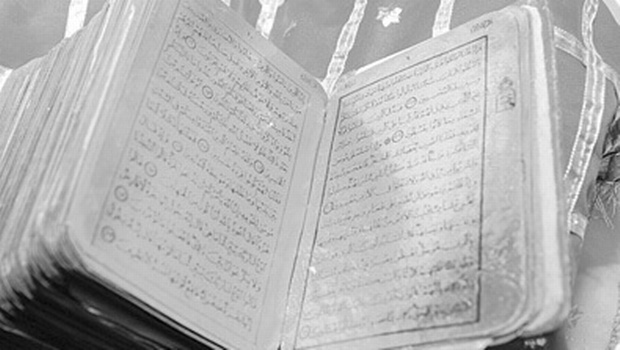
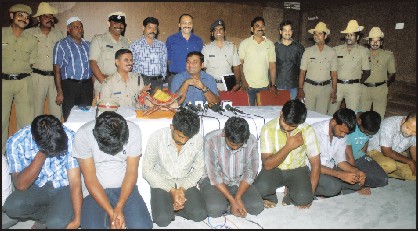
An antique Quran dating back to the Mughal era has been seized by the police from a 10-member gang at K R Nagar town in the district. The gang claimed to have got the book from Hyderabad and was planning to sell it for Rs 5 crore, the police said.
The district police came to know about the gang a week ago when they came across a video which had details of the book. The video was made to find potential buyers. After showing the book to historian and former vice-chancellor of Goa Univeristy and Mangalore University, Prof Sheikh Ali, who confirmed its authenticity, the police followed up the case. On Monday night, the police received a tip-off about the gang’s whereabouts in K R Nagar town.
The police officers approached four members of the gang on the pretext of buying the book and arrested them. The remaining six members were arrested in Mysuru city.
The arrested are Nagaraju S (39) and A Muralikrishna (30) of Raichur district, Kanakappa (40) of Gadag district, Kallappa (40) of Kalburgi, Sanath (27), Ravindra (33) and Raghu (30) of Udupi district, Vijayendra (30) and Prasad (43) of Shivamogga district and Bhaskar (31) of Bengaluru rural district. Kallappa is an SDA in the Food and Civil Supplies Department. Prof Ali said going by the date mentioned on the last page of the 604-page book based on lunar calendar, the book belongs to the 17th century and is 398 years old. The pages are gold-coated and the calligraphy is in Arabic.
The pages have decorative borders, he added. He said the ink used in the book is not an ordinary one but a chemically treated one and hence the writings are still intact.
source: http://www.newindianexpress.com / The New Indian Express / Home> States> Karnataka / by ENS / August 12th, 2015
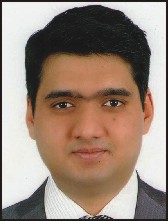
Syed Usman Taqui of Mysuru has been awarded Erasmus Mundus Fellowship amounting to 1,29,900 Euros (almost equivalent to rupees one crore) to pursue his Doctoral Programme in Membrane Engineering for a period of three years beginning November 2015.
He is the youngest to top the Global Ranking List. The Erasmus Mundus doctorate in Membrane Engineering (EUDIME) is a prestigious European Fellowship programme designed to implement at international level — excellence, innovation, mobility and multidisciplinary in investigation approaches related to membrane science and technology. The consortium includes six leading partner institutions from Portugal, Netherlands, Czech Republic, France, Belgium and Italy.
Syed Usman Taqui pursued his Master Degree in Membrane Engineering under the Erasmus Mundus Master’s Scholarship amounting to 48,000 euros (rupees thirty-four lakh) during 2012-14, then the youngest to be selected among fourteen from all over the world.
Usman’s elder brother Syed Raihan Taqui was the youngest and one among the three from Asia to be awarded Erasmus Mundus Scholarship from European Union to pursue his Master’s Degree majoring in Education Management in 2007.
Usman Taqui is the son of Ayesha Nasreen and Prof. Syed Akheel Ahmed, former VC of Yenepoya University and former Dean and Syndicate Member of University of Mysore.
Usman carried out his project at the Department of Chemical Engineering Technology (IIT), Mumbai, during his undergraduate days. He has bagged numerous prizes and awards from the institutions he studied.
source: http://www.starofmysore.com / Star of Mysore / Home> General News / Saturday – August 08th, 2015
Ten-member gang trying to sell it for Rs.5 crore arrested
Mysuru :
In a meticulously planned and precisely executed operation, sleuths attached to the District Police, seized a 410 year-old Quran, written during Mughal ruler Akbar’s period in the district and also arrested a gang of 10 members who were allegedly trying to sell it for Rs.5crore.
Police have also seized a Ford Ikon car (MH02 AK-4967) from the gang
The nabbed have been identified as S. Nagaraju of Sindhanur, A. Muralikrishna of Sasalamai Camp, Kanakappa Kambli of Yerebeleri village in Gadag district, Kallappa Kambali o Kalaburgi and Sanath of Kollur in Udupi taluk, Ravindra, Vijayendra of Hosanagar in Shivamogga district, Prasad of Heggodu in Sagar taluk, Bhaskar of Sindhanur and Raghu of Karwar.
Addressing a press conference at his office in city yesterday, SP Abhinav Khare said that Police, who came across a video on the antique Quran that the gang was sharing with prospective buyers formed a team to trap the gang.
The Police team, posing as prospective buyers approached five members of the gang near the Railway Station in Hosa Agrahara in K.R.Nagar taluk in the district and nabbed them before nabbing the remaining members in Mysuru city, he said and added that the accused had confessed to have got the antique from some persons in Hyderabad promising to share the proceeds of the sale with them.
Additional SP Kala Krishnaswamy, Rural Dy.SP Vikram Amte led K.R.Nagar Inspector H.N.Siddaiah, DCIB Inspector Gopalakrishna, Saligrama SI Poonacha in the nabbing and seizing operations.
Meanwhile, noted historian and former Vice-Chancellor of Mangalore and Goa Universities Prof. B. Sheikh Ali, who was present at the press conference described the calligraphy as a 604-page book, each separated by a butter paper for better preservation as a piece of Exquisite Art adding that writing in the Quran is legible.
Continuing, Prof. Sheikh Ali said ‘It was written in 1959 of the Hijri calendar, which works out to 1605 A.D. This was around the period when Mughal rule was at its peak in India and the time when Akbar was succeeded by Jahangir.”
He further said that though there is no other information on the last page other than the year in which it is written, there is a sentence that says that the calligraphy is dedicated to the saints.
Interestingly, SP Khare removed his footwear while holding the Quran to pose for photograph before the Quran was carefully placed in a carved wooden stand and covered with a cloth.
source: http://www.starofmysore.com / Star of Mysore / Home> General News / Wednesday – August 12th, 2015
Here we publish the full text of the convocation address delivered by Dr. A.P.J. Abdul Kalam, the then Scientific Adviser to Raksha Mantri and Secretary, Department of Defence, Research & Development, at the 75th Convocation of University of Mysore on Feb. 25, 1995. — Ed.
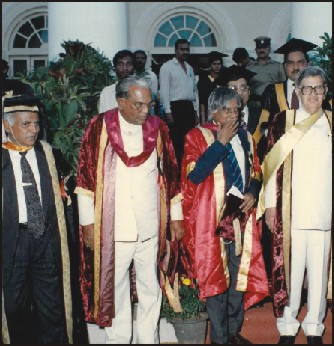
Dr. A.P.J Abdul Kalam (second from right) seen with the then Governor-Chancellor Khurshed Alam Khan, the then Higher Education Minister and Pro-Chancellor D. Manjunath and the then Vice-Chancellor Prof. M. Madaiah during the 75th Convocation of University of Mysore on Feb.25, 1995.
by Dr. A.P.J Abdul Kalam
Dare to Dream: I am indeed delighted and honoured to participate in this 75th Convocation of University of Mysore. I have been thinking about what to share with you on this important occasion when you are entering the most eventful phase of your life after years of learning. I know that for the past twenty-years or so you have been continuously taught various aspects by teachers. I am, therefore, not going to extend this process. Instead, I would like to share with you a few of my experiences, one at a place very close to you and others at Trivandrum and Hyderabad.
These are the experiences where people have dared to dream and met with success. Of course, we have to recognise that success is always the result of sweat of individuals and also coupled with many failures. The place close to you is the site of pilgrimage not only for me but for every one who practices rocketry in our country. Let me first tell you something about this.
First War Rocket: When I was studying in school and college, Srirangapatna interested me for two reasons — the place was the scene of battle against foreign rule and also there was a reference to a new weapon introduced. In 1960, when I visited Srirangapatna with my friends, we were thrilled to walk around this historical town. We searched for the Turukhan-hally Fort built during Hyder Ali – Tipu Sultan times and used for making rockets, way back in 1794. I had a tremendous disappointment when I did not see any permanent evidence or historical recordings in Srirangapatna regarding creation or development of first war rocket in the world.
Later, in 1963, I was at Wallop’s Island, the rocket launch facility of NASA in USA, in connection with a collaborative programme of launching of sounding meteorological rockets for research of upper atmosphere. In the lobby of their command-control centre, I saw a prominently displayed picture. The war dress and the colour of the soldiers’ skin attracted my attention. Some dark complexioned soldiers were firing rockets on their white skinned opponents. The label on the painting read, “The world’s first war rocket.” It was indeed a great pleasure to see an Indian feat acknowledged on the other side of the planet. I felt excited with happiness.
I started reading the history of rockets. I had a dream I must see Tipu’s rockets. Time continued to pass. Rocket technology engulfed me and India’s first Satellite Launch Vehicle SLV-3 was launched. In 1980, we had an opportunity to visit London. There, I saw two of the war rockets captured by British at Srirangapatna, displayed at Museum of Artillery at Woolwich in London with the heading “India’s War Rocket.” Probably, Europe learnt rocketry from our Srirangapatna rocket in the eighteenth century! It was a great thrill to see an Indian innovation on a foreign soil, well-preserved and with facts not distorted.
I got the performance of these 2 kg rockets, 50 mm in dia. and about 250 mm in length analysed by our designers. What a simple and elegant design, effectively used in war ! Surely, Hyder – Tipu Sultan would have had talented men who could look at propulsion, material, ignition and build rockets and fly them for war operations. In fact, when we look back to eighteenth century ambience, it is a technology marvel.
I would like to declare today that this land is the birth place of war rockets in the world and offer it my reverence and respect. The tradition continues.
Prof. Vikram Sarabhai – Man of Vision: Nations advance along the course charted by great dreamers. Let me narrate to you an incidence which occurred in 1968. We were working on the configuration of India’s satellite launch vehicle in Thumba. One day, Prof. Vikram Sarabhai, the then Chairman, Indian Space Research Organisation (ISRO), brought Prof. Curien, President, CNES, France, to our laboratory. France was developing Diamont satellite launch vehicles at that time. After focussing on our planned efforts, as an almost spontaneous reaction, Prof. Sarabhai proposed that we should fly India’s fourth stage of SLV-3 as the Diamont’s fourth stage. We had not flown even a meteorological rocket by that time, but Prof. Sarabhai was aware of the possibilities and trusted the capabilities of his team. His dream of SLV-3 fourth stage getting into a French launch vehicle finally came true in the form of apogee boost motor for APPLE satellite, flown by ARI
ANE, the European launch vehicle. This is the vision ! He gave us a 15-year jump in our efforts. With three experimental Indian Remote Sensing (IRS) Satellites in orbit and their images being received in the USA, Satellite Ground Stations with Indian Satellite Launch Vehicle PSLV launching our own satellite from our own land, his dream visualised in 1965 has taken form through the people born at different times. Nations are thus built by men of vision who dream and prepare ground for the coming generations.
Super Computer and Parallel Processing: In 1986, Dr. V.S. Arunachalam and myself went to US to buy a Super Computer with 400 mega flop speed. The Deputy Secretary in the Department of Defence at Pentagon first put us into long series of technical discussions and then regretted the sale on the pretext that we will use it to develop long range missiles detrimental to the security interests of the world. Travelling back disappointed, Dr. Arunachalam said, “Let us make our own Super Computer.” Today, India has a 32 node 1000 M Flops PACE SPARC 10 machine available for other countries to buy. Once we decide, we work and realise even tough dreams. That is what India expects from you.
A team of young scientists and engineers under the leadership of Dr.G.Venkataraman formed ANURAG, that is, Advanced Numerical Research and Analysis Group, to develop a parallel processing computer specially for aircraft design. At that time, AGNI also was taking shape. The payload of AGNI would re-enter the atmosphere at 15 times the speed of sound. Even at this speed, we had to keep the vehicle under control and while the payload outer temperature goes to 3000 degrees centigrade, inside of payload the ambient has to be less than 30 degrees centigrade. We have in India supersonic wind tunnel. We needed hypersonic wind tunnel for designing the AGNI payload. Various wind tunnel data could provide the loads experienced during the re-entry phase of the system. There were tunnels abroad but once they knew the application, they were refused.
This time our high-tech academic institutions rose to the occasion. Prof. S.M. Deshpande of Indian Institute of Science (IISc.) with five young bright fresh scientists from DRDL with background of mathematics and fluid dynamics, developed Computational Fluid Dynamics Software for Hypersonic Regimes in just six months. This software is the original contribution with minimum computational facility available in the world. No country would have given us this type of software. But it was done through optimum partitioning, sequencing and paralleling the task. This software solution has established that brain-power excels man-made machines, even super-computers.
I have seen that India can build her own super-computer; India can fly its own rocket system within and outside the country. Both the dreams have come out of visions. This convocation ambience, where hundreds of young graduates are entering their professional lives, is ideal for thinking about the need of visions for the next two decades. What could they be?
Vision for the Nation: With the growing population, increasing unemployment, unaffordable medical care and changing value system, our society is going through certain turbulent situation. The society looks forward to prosperity. In a decade or two, prosperity and good life is possible if the nation has the vision. Vision generates progress. As an example, we can study the period between 1857 and 1947; it was the vision of freedom which not only got us independence but during the same period in India, vision of independence generated many leaders of excellence in politics, philosophy, history, science and technology and industry. Again, can we dream for a vision to make this nation great — a nation with prosperity and peace?
Enlightened Citizens: The vision of “Enlightened Citizens” calls for a mission of integrating education, occupation and health care as one single entity. For development of self, society and nation, it is essential that hundreds of clusters of villages are divided into multiple blocks of 20,000 families. And each block can be considered as a progress group with certain number of hospitals, schools and agriculture farms which could be growing cash crops, aromatic plants or fish farms.
The experience in Kerala and Tamil Nadu indicates that integration of education and occupation resulted in small families, in addition to promoting self- sustained good life. This enlightened citizen package can be extended to the whole country.
Networking of Major Rivers: We recently conducted a workshop on the subject based on Dr. K.L. Rao’s report “National Water Grid” and Capt. Dastur’s proposal of “Garland Canal.” This has all the dimensions of becoming an important vision for the nation. Nation can aim at linking multiple rivers resulting in water distribution, flood and drought control, navigation and power generation.
Above all, this will bring together the country as it happened during the independence movement, with potential revolution in agricultural output and employment generation. Experts have indicated that this is the right time to take this as a major programme as technology exists today and the country has the capability to finance such a programme.
Today we have: satellite mapping of water resources and river flow aspects; capability to use nuclear energy for large tunnelling in mountains to direct the river flows and technological strength in mechanical, civil and communication engineering. It may be a 20-year programme for the nation.
Energy Everywhere: Similarly, the third area is “Energy Everywhere.” We believe by year 2000-plus, we will have to generate almost 50% more power. Probably, we will have to look for environment clean power. In addition to hydro and thermal energy, the non-conventional energy and nuclear energy has to contribute to power generation for which technological innovation is essential. Even hydro and thermal energy would need newer technologies so that they can provide affordable electrical energy.
Conclusion: Friends! Vision for the nation is in front of you. These dreams are bigger than the individual or group of people. Great things do not just occur; you have to dream about them and work to realise them. You can be a partner to the visions for the country and begin to experience dreams coming true. What you are is God’s gift to you. What you make out of yourself will be your gift to God. I wish you a challenging profession in your respective fields and recall the famous lines:
“The chances have just begun
The best jobs haven’t been started,
the best work hasn’t been done.”
source: http://www.starofmysore.com / Star of Mysore / Home> Feature Articles / Saturday – August 01st, 2015
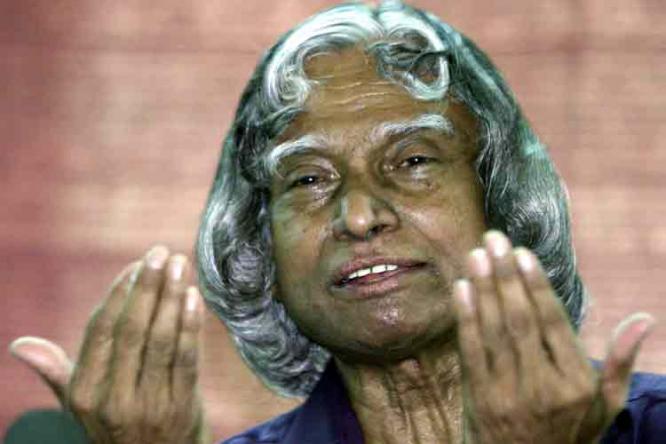
Describing him as one of the most “exuberant boosters” of India’s nuclear capabilities, the US media on Tuesday highlighted the contribution of ‘missile man’ A P J Abdul Kalam to the country’s atomic and space programme.
Kalam, who would have turned 84 in October died after suffering a massive cardiac arrest during a lecture at the IIM Shillong on Monday, plunging his country into overwhelming grief.
Describing him as one of the most “exuberant boosters” of India’s nuclear capabilities, the US media on Tuesday highlighted the contribution of ‘missile man’ A P J Abdul Kalam to the country’s atomic and space programme.
“He was one of the most exuberant boosters of the country’s nuclear program,” The New York Times wrote in a rare obituary for Kalam.
“He used the spotlight to urge India to build up its military strength and to free itself from the threat of domination by outside forces,” the daily said.
The Times said that Kalam spent little time outside India. “For him, it was a point of pride that India had developed its bomb without much help from foreign powers. And he described himself as thoroughly Indian,” it said.
Kalam has been credited with helping develop his country’s first space satellites. In the 1980s, he helped design the nuclear-capable ‘Prithvi’ and ‘Agni’ ballistic missiles, The Washington Post said.
“He played a crucial role when India tested its nuclear weapons in 1998. The test resulted in sanctions against the country but helped elevate Mr Kalam to the status of folk hero in his country,” the Post said in its obituary.
The Wall Street Journal reported that Kalam, who was born into a poor Muslim family in Tamil Nadu, was at the forefront of the country’s efforts to develop a space programme and a strong advocate for India’s self-reliance in defence technologies.
“He encouraged the development of India’s first indigenous satellite launch vehicle that brought the country into an elite club of space-faring nations and guided India’s missile-development programme,” the daily said.
“Dr. Kalam also played a key role in boosting India’s nuclear capabilities, leading to nuclear tests in 1998, a technological achievement seen as pivotal in asserting the country’s place in global politics,” the WSJ said.
“He was the first scientist to hold the office, and was widely viewed as an apolitical figure,” the CNN said.
source: http://www.ibnlive.com / IBN LIVE / IBN Live> World / Press Trust of India / July 28th, 2015
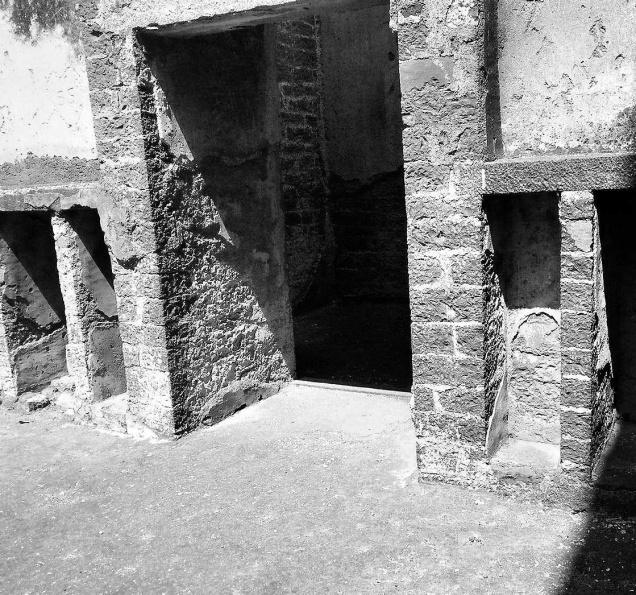
The wind-catcher at the Takht Mahal in Bidar fort.— photo: gopichand t.
This natural cooling system is in existence in the old Bidar fort
What is the warranty period on your air-conditioning system — five, seven or at the most 12 years? How about a system that has a warranty of 550 years?
Bidar fort houses this system. The Gagan Mahal, or the grand palace that has the takht (throne), has just such a natural cooling structure.
Local guides call it the ‘Bahmani AC’. Built by the Bahmani kings in the 15th century, it still functions.
Cool air gushes out from the bottom of the twin tunnels that are connected to towers on the ceiling. However, the roof of the building has collapsed, depriving visitors of a real air-conditioned experience.
The technique involved is simple. Hot air, sucked in from the surroundings, moves up a quadrangular pillar. It gets cooled, gains weight and comes down. Air is thus cooled by convection and evaporation.
The walls of the tower, exposed to the sun, attract cool humid air towards them. This happens through multiple vents, providing ample supply of cool air. Two such pillars are fixed in each room, on opposite sides of the hall.
These structures, called Badgeer, Malqaf or Hawa Khamba (wind-catcher), are also found in other buildings, including the Rangeen Mahal, Turkash Mahal or Queen’s Palace, and the Diwan-e-Khas or VIP enclosure.
There are some such structures inside the city too. Havelis of zamindars and the rich had these structures. “I had saw them while growing up in the old city,” says historian Abdul Samad Bharati.
V. Govindan Kutty, groundwater expert who has worked on the Surang Bavi system of medieval era aqua ducts in Bidar, said the method of cooling buildings involved both wind tunnels and underground water canals.
“There were several wind-catchers along the Jamuna Mori or the Shukla Teertha channels originating in the old city and ending in the Bidar fort. Some houses had basements where people would collect water. The combination of wind-catchers and underground channels led to general cooling of these houses,” Mr. Kutty said. He points out that this system is used extensively in Iran, where multiple wind-catchers are built over cisterns to chill water.
“The government should take steps to conserve these structures” says Digambar Thakur, heritage enthusiast.
This natural cooling system is in existence in the old Bidar fort
source: http://www.thehindu.com / The Hindu / Home> National> Karnataka / by Rishikesh Bahadur Desai / Bidar – July 31st, 2015
The Rampur Raza Library is renowned globally for its collection of ancient manuscripts from South Asia. The library has now organised an exhibition of Qurans, inviting scholars to view ancient manuscripts of the holy Quran in the month of Ramzan.
Some of the manuscripts on display are among the oldest pieces of Arabic calligraphy. A 7th century Quran written on parchment in the early Kufic script, attributed to Hazrat Ali (d. AD 661) is on display. Viewers are lining up to see this rare manuscript.
An 8th century manuscript of the Quran is attributed to Imam Jafar Sadiq, whose unique penmanship is widely appreciated.
A 9th century script is attributed to Imam Abul Hasan Musa, who served as prime minister to three caliphs of Baghdad. He died on July 20, 941 AD. His Quran is in the early Naskh style, popular in the 10th century. This form of calligraphy continues to be in vogue, with some changes.
Maulana Mohammad Irshad Nadvi, who is coordinating the exhibition, said, “The library also has a copy of a Quran written by master calligrapher of the 13th century Baghdad, Yaqut-al Musta Simi. It is decorated in gold and precious lapis lazuli.”
Nadvi said another masterpiece of Arabic manuscript by this calligrapher, titled Diwan-al-Hadira and dating to 1221 AD is part of the royal library of Sultan Ibrahim Adil Shah of Bijapur.
The exhibition also displays calligraphy in Arabic that created its own pseudo-geography, with exquisite and richly illustrated figures of human beings, animals and birds. Some of this came from the pen of 13th century calligrapher Zakaria bin Mahmud al-Qazvini.
Among the assets of the library on display is the Arabic manuscript Sharhal-Kafia of Razi. It bears marginal notes by Nawab Sadullah Khan, prime minister of Mughal emperor Shah Jahan. Among the many seals on this manuscript is one of emperor Aurangzeb.
Jacob Thorek Jensen, who is visiting the exhibition from Denmark and serves as advisor to a Danish culture agency, said, “This is a brilliant show of the elaborate calligraphy of writers of the Quran.”
Library spokesman Himanshu Singh said visitors to the library and the exhibition come from different faiths.
source: http://www.timesofindia.indiatimes.com / The Times of India / Home> City> Bareilly / by Nazar Abbas, TNN / July 16th, 2015